Richly diverse
pp. 50-51 · Read in the full issue
Arts
By Liz Thompson
IT seems that 1993, this Year of Indigenous Peoples, has indeed seen an increasing respect for and appreciation of indigenous culture. More and more projects of a cross cultural nature illustrate both how much there is to learn from indigenous cultures and how much can be gained in the sharing of infor mation. Communications now permit a cross fertilization of influences which
have the capacity to produce creatively
rich and rewarding results. The music of Not Drowning Wavings album, Tabaran, combining the talents and influences of
Australian and Papua New Guinean musicians and the fauna survey carried out at Uluru, Northern Territory, Aus tralia, between CSIRO scientists and the Mutitjulu, traditional Aboriginal land owners (both reported on in past issues) illustrate the potential of changing atti tudes. These are gestures in a move away from cultural domination and conversion towards a greater appreciation and understanding of differences and the way in which these differences can inform and enhance one another.
A similar cross cultural exchange taking place between Australian artist Nina Angelo and Fijian communities shows yet another approach, this time
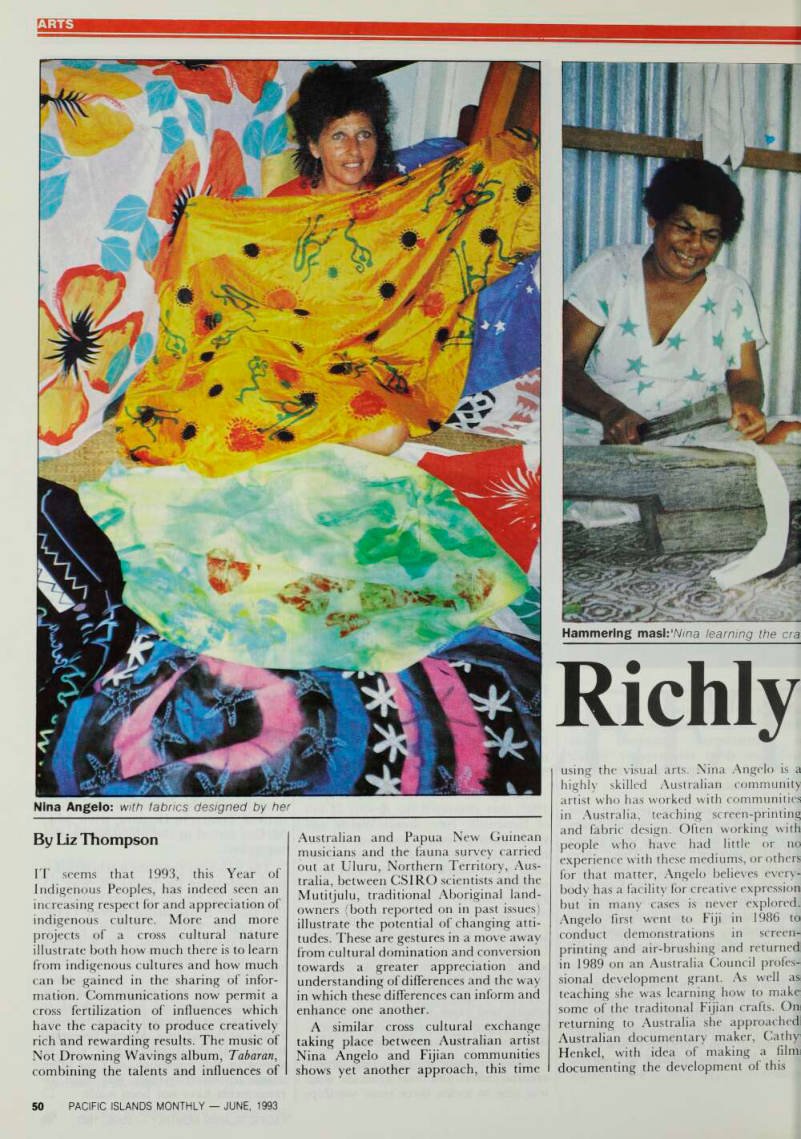
using the visual arts. Nina Angelo is a highly skilled Australian community artist who has worked with communities in Australia, teaching screen-printing and fabric design. Often working with people who have had little or no: experience with these mediums, or others for that matter, Angelo believes every body has a facility for creative expression but in many cases is never explored., Angelo first went to Fiji in 1986 to conduct demonstrations in screen printing and air-brushing and returned! in 1989 on an Australia Council profes sional development grant. As well as; teaching she was learning how to make: some of the traditonal Fijian crafts. Oni returning to Australia she approached!
Australian documentary maker, Cathy' Henkel, with idea of making a filmi documenting the development of this
Nina Angelo: with fabrics designed by her
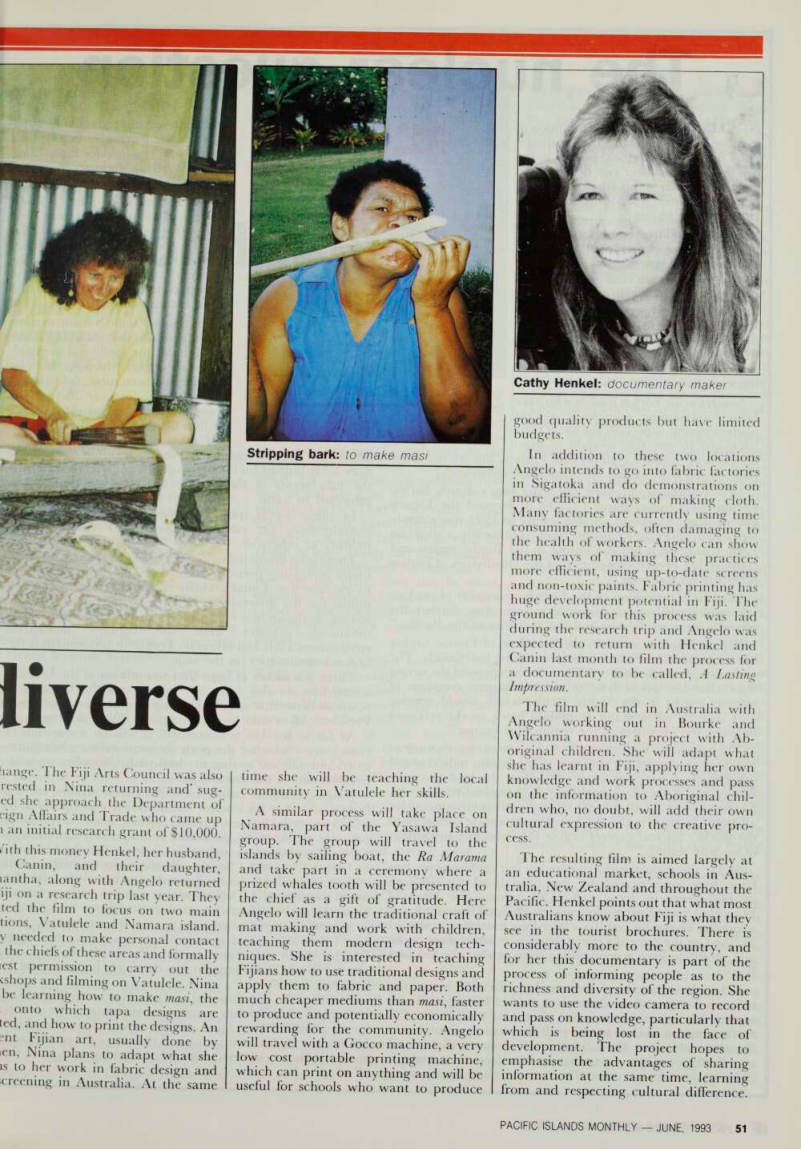
Hammering masi: 'Nina learning the cra
iiange. The Fiji Arts Council was also rested in Nina returning and' sug ed she approach the Department "of L'ign Affairs and Trade who came up i an initial research grant of SIO,OOO. nth this money Henkel, her husband, Canin, and their daughter, lantha, along with Angelo returned iji on a research trip last year. They ted the film to focus on two main tions, Vatulele and Namara island, y needed to make personal contact the chiefs of these areas and formally est permission to carry out the (shops and filming on Vatulele. Nina be learning how to make masi , the onto which tapa designs are ted, and how to print the designs. An ?nt Fijian art, usually done by en, Nina plans to adapt what she is to her work in fabric design and creening in Australia. At the same I
time she will be teaching the local community in Vatulele her skills.
A similar process will take place on Namara, part of the Yasawa Island group. The group will travel to the islands by sailing boat, the Ra Marama and take part in a ceremony where a prized whales tooth will be presented to the chief as a gift of gratitude. Here Angelo will learn the traditional craft of mat making and work with children, teaching them modern design tech niques. She is interested in teaching Fijians how to use traditional designs and apply them to fabric and paper. Both much cheaper mediums than masi, faster to produce and potentially economically rewarding for the community. Angelo will travel with a Gocco machine, a very low cost portable printing machine, which can print on anything and will be useful for schools who want to produce
good quality products but have limited budgets.
In addition to these two locations Angelo intends to go into fabric factories in Sigatoka and do demonstrations on more efficient ways of making cloth.
Many factories are currently using time consuming methods, often damaging to the health of workers. Angelo can show them ways of making these practices more efficient, using up-to-date screens and non-toxic paints. Fabric printing has huge development potential in Fiji. The ground work for this process was laid during the research trip and Angelo was expected to return with Henkel and Canin last month to film the process for a documentary to be called, A Lasting Impression.
The film will end in Australia with Angelo working out in Bourke and Wilcannia running a project with Ab original children. She will adapt what she has learnt in Fiji, applying her own knowledge and work processes and pass on the information to Aboriginal chil dren who, no doubt, will add their own cultural expression to the creative pro cess.
The resulting film is aimed largely at an educational market, schools in Aus tralia, New Zealand and throughout the Pacific. Henkel points out that what most Australians know about Fiji is what they see in the tourist brochures. There is considerably more to the country, and for her this documentary is part of the process of informing people as to the richness and diversity of the region. She wants to use the video camera to record and pass on knowledge, particularly that which is being lost in the face of development. The project hopes to emphasise the advantages of sharing information at the same time, learning from and respecting cultural difference.
Stripping bark: to make masi
Cathy Henkel: documentary maker