missing icon
pp. 46-47 · Read in the full issue
Religion
The case of the missing icon
By David North
EARLIER this year a Government of Guam worker was driving past a small public park in the historic section of Agana, the island’s capital. As he glanced toward the Old Spanish Bridge, something caught his eye. “Someone appeared to be waving at me,” he later told police. Parking his truck, he ap proached a grassy area near the bridge and there, at his feet, stood a one-foot, 48-pound hardwood statue a priceless religious icon missing for more than a month.
As mysteriously as it had disappeared, the statue of Santa Marian Kamalin Our Lady of Camalin) had been returned. Guam police were as puzzled by the recovery as they had been by the theft of the 300-year old relic. Someone had entered the Dulce Nombre de Maria (Sweet Name of Mary) Cathedral Ba silica in Agana on the evening of December 28 and removed the painted and bejewelled figure from its niche 20 feet above the main altar. But there was no sign of forced entry to the church.
After the recovery, a private investigator told police a “disturbed” woman had called him claiming she had the figure, but was afraid to return it. The island’s religious leader had offered not to prosecute if the figure was returned. So as far as the church is concerned, the incident is closed. But Archbishop Anthony Apuron, noting this was the third time since World War II that the statue had been taken, said the church will now secure the icon behind a bolted glass cover and upgrade the security system.
For many of the island’s Catholics, who repeatedly asserted their belief that the relic would be returned safely, the episode is but one more “miraculous” event associated with this powerful symbol of Guam’s heritage. (Ninety-five percent of Guam’s 50,000 Chamorro population is Catholic). Their faith had been justified. The figure, a represen
tation of the mother of Christ with outstretched hands, is the patron saint of Guam and a revered icon among the island’s Catholics. It has survived fires, floods, typhoons, wars, and the Japanese occupation and has had numerous mir acles attributed to it.
Every year, the statue is taken in solemn procession around old Agana on December 8 on the feast of the Immacu late Conception the most important religious holiday of Guam. Hundreds of school children and village youths, dressed in their uniforms and Sunday clothes, are joined by the leaders of the island’s Catholic organizations, decked out in their formal dress regalia, for the evening procession. The assemblage is symbolic of Chamorro family, clan and
village identification.
The figure is removed from its prom inent place above the main altar, prepared for the procession and then placed on a decorated carriage. The slow walk begins at the Cathedral, a post World War II structure which stands on the ground where the first Spanish church was built in 1668. The procession winds its way through the streets of Agana, the site of the island’s highest ranking village in pre-contact times, as well as the religious and administrative center during the Spanish colonial
period.
The history of the statue is, in a way, a capsule history of Chamorro Catholicism. Local traditions hold that the figure was found by a fisherman on the southwest coast of Guam in the late 1600 s. He is believed to have caught the statute in his net while fishing along the reef between the village of Merizo and Cocos Island. Those traditions also say the fisherman gave the statue to a Spanish padre who in turn presented it to the Spanish Governor of Guam.
History records that a very large Spanish galleon was lost off Cocos Islands in June of 1690. Like most of Spain’s Pacific treasure ships, the 1200-ton silver argosy was named after the mother of I
Christ. It was called “Nuestra Senorad del Pilar de Zaragoza” (Our Lady of the Pillar in Zaragoza an apparition of Virgin Mary on a pillar of a church in the Spanish towns of Zaragoza). The vessel grounded on the reef west of Cocos Island and was wrecked there by stormy weather.
The figure’s association with the Pacific galleon trade also is supported by physical evidence. The statue is made of molave, a Philippine hardwood which was used widely in galleon construction.
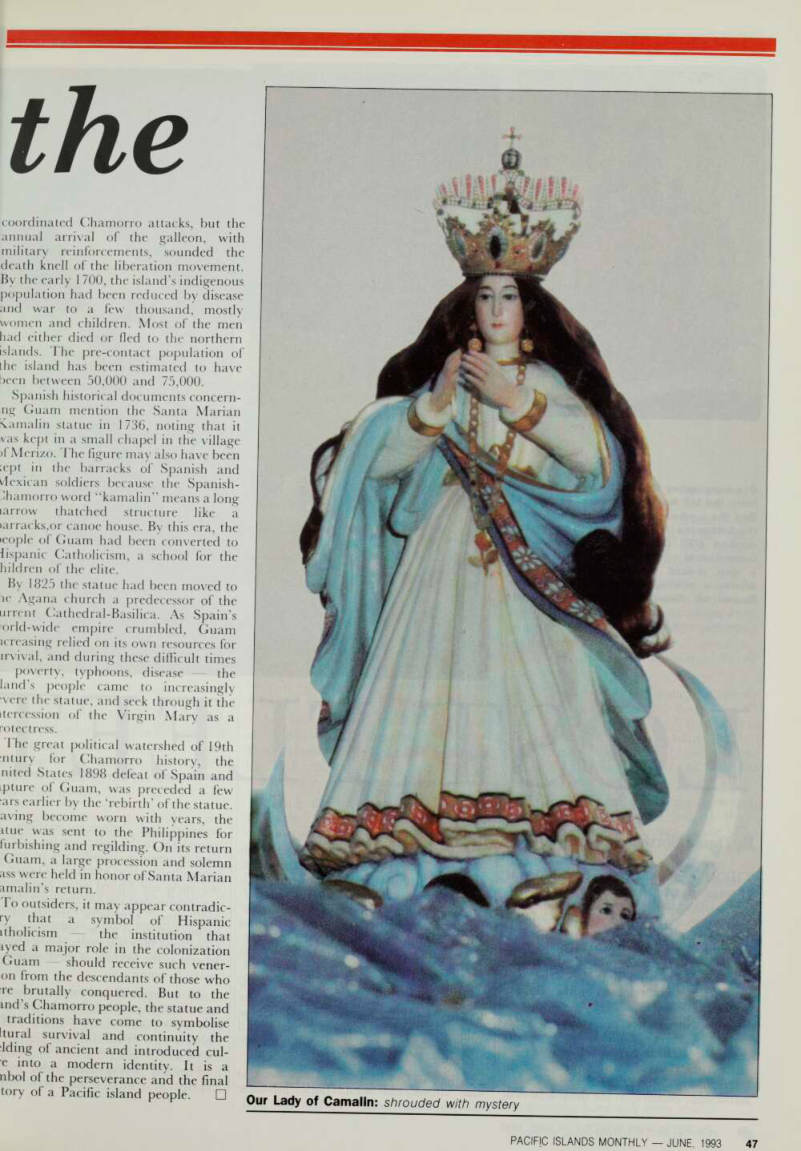
The figure’s face and hands are ivory, a common trade good of the line, while the eyes are glass and the hair and eyelashed are of natural human hair. The base of the statue is a crescent moon with three small angel heads. The construction and style of carving indicate to researchers that the icon is a “santos” a religious statue constructed in the Philippines during the Spanish era and used on Spanish ships in the Pacific. Crewmen prayed to it for divine protection from the dangers of navigating the vast Pacific.
Regardless of its origin, the oral traditions placing its finding in the late 1600 s coincides with the end of the Spanish-Chamorro wars, which lasted roughly from 1670 s to about 16905, and the island’s conversion to Catholicism.
The Spanish missionaries proselytised
relentlessly and in many instances forced their religious beliefs on the islanders to the detriment of the local culture and its key institutions. The struggle of some Chamorros against forcible conversion to Christianity began only a few years after the 1668 founding of the first Spanish mission and fortress by the Jesuit Padre Luis de San Vitores. Igniting a smolder ing resentment, a Chamorro Chief, Matapang, killed San Vitores in 1672 after the priest had forcibly baptized Matapang’s child despite the chiefs protest, the Spanish soldiers retaliated and thus began the Chamorro resistance, which continued on and off for almost thirty years. The Spanish were nearly wiped out in 1684 by a series of
coordinated Chamorro attacks, but the annual arrival of the galleon, with military reinforcements, sounded the death knell of the liberation movement.
By the early 1 700, the island's indigenous population had been reduced by disease and war to a few thousand, mostly women and children. Most of the men had cither died or fled to the northern islands. The pre-contact population of the island has been estimated to have been between 50,000 and 75,000.
Spanish historical documents concern ng Guam mention the Santa Marian \.amalin statue in 1736, noting that it vas kept in a small chapel in the village )f Mcrizo. The figure may also have been :cpt in the barracks of Spanish and Mexican soldiers because the Spanish fliamorro word “kamalin” means a long (arrow thatched structure like a ►arracks, or canoe house. By this era, the ►eople of Guam had been converted to lispanic Catholicism, a school for the hildren of the elite.
By 1825 the statue had been moved to ic Agana church a predecessor of the urrent Cathedral-Basilica. As Spain’s orld-wide empire crumbled, Guam icreasing relied on its own resources for irvival, and during these difficult times poverty, typhoons, disease the land s people came to increasingly vere the statue, and seek through it the itercession of the Virgin Mary as a rotectress.
The great political watershed of 19th ntury for Chamorro history, the nited States 1898 defeat of Spain and ipture of Guam, was preceded a few ars earlier by the ‘rebirth’ of the statue, aving become worn with years, the itue was sent to the Philippines for furbishing and regilding. On its return Guam, a large procession and solemn ass were held in honor of Santa Marian amalin’s return.
To outsiders, it may appear contradic ry that a symbol of Hispanic itholicism the institution that lyed a major role in the colonization Guam should receive such vener on from the descendants of those who re brutally conquered. But to the md s Chamorro people, the statue and traditions have come to symbolise itural survival and continuity the Iding of ancient and introduced cul c into a modern identity. It is a nbol of the perseverance and the final tory of a Pacific island people. □
Our Lady of Camalin: shrouded with mystery