treaties
pp. 44-45 · Read in the full issue

Law
Test
case for
treaties
How effective are the extradition commitments with metropolitan powers?
By David North
TWO criminal extradition agree ments are testing the strength of treaty commitments between major metropolitan Pacific powers and newly emerged Micronesian states. One case involves an Australian pledge to
extradite one of its “well-connected” citizens to the Republic of the Marshall Islands should the confessed forger fail to live up to the terms of his probation. The other controversy revolves around the Federated States of Micronesia’s power to extradite one of its citizens wanted in the United States for a multi-million dollar medical insurance fraud.
The Australian, Gregory B. Symons, whose investment migration scheme caused the temporary downfall last year of an influential member of Paul Keat ing’s Labour Party government, pleaded no contest on March 25 to 15 counts of forgery in the Marshalls. Symons admit ted he had illegally taken 51.25 million from Taiwanese investors as part of an
investment-for-Marshalls-passports
swap. Marshalls High Court Judge
Written Philippo accepted Symons plea
bargain, sentencing him to 90 days in Marshalls jail and 10 years probation.
As part of the deal, Symons has agreed to make every effort to repay the five Taiwanese, from whom he accepted 5250,000 each. Australia’s government,
under Keating’s leadership, has stipu
lated that it will extradite Symons back to Majuro, the islands capital, if he should fail to abide by his agreement. At the same time, Keating, whose Labour
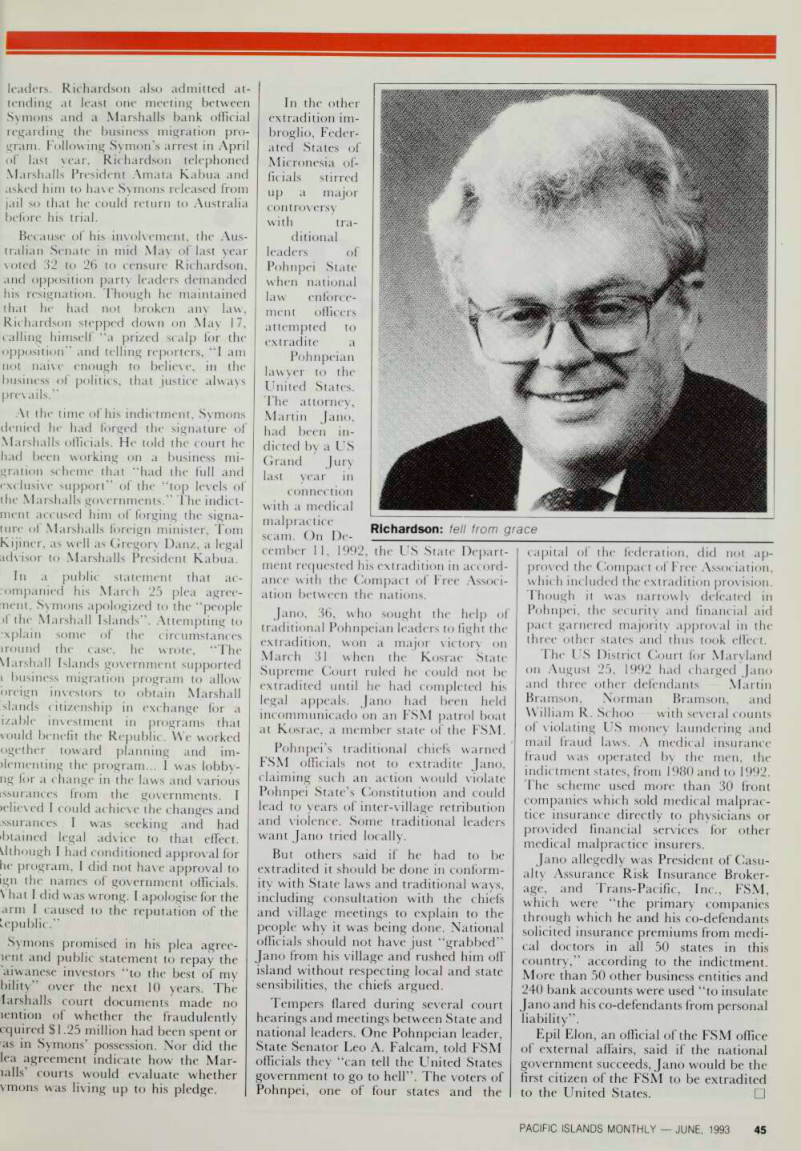
Party won its fifth straight election in February, resurrected Senator Graham Richardson, who was implicated and politically hurt by the ‘‘Marshall Islands Affair”, returning him to his cabinet post as part of a reshuffled ministry.
Symons, 44, was in charge of a project that offered Marshalls citizenship to foreigners who made “sizeable invest ments” in the island nation. Symons told potential investors that a Marshalls passport could eventually provide them with free entry to the United States.
Under a treaty with the United States the Compact of Free Association Marshallese may enter United States territory as if they were US citizens.
However, US State Department officials have said that benefit would not apply to
non-Marshallese who gain citizenship
through programs like the one offered by
Symons.
Symons had won the confidence of Marshalls leaders in 1992 through Richardson, then Minister for Transpor tation and Communications. Symons is married to Richardson’s cousin and is an old friend of the cabinet minister.
Richardson, a well-known member of Keating’s Labour Party cabinet, had recommended Symons to the US am bassador in Australia and to Marshalls
leaders. Richardson also admitted at tending at least one meeting between Symons and a Marshalls bank official regarding the business migration pro gram. Following Symon’s arrest in April of last year, Richardson telephoned Marshalls President Amata Kabua and asked him to have Symons released from jail so that he could return to Australia before his trial.
Because of his involvement, the Aus tralian Senate in mid May of last year voted 32 to 26 to censure Richardson, and opposition party leaders demanded his resignation. Though he maintained that he had not broken any law, Richardson stepped down on May 17, calling himself “a prized scalp for the opposition” and telling reporters, “I am not naive enough to believe, in the business of politics, that justice always
prevails.”
At the time of his indictment, Symons denied he had forged the signature of Marshalls officials. He told the court he had been working on a business mi gration scheme that ' had the full and exclusive support” of the “top levels of the Marshalls governments.” The indict ment accused him of forging the signa ture of Marshalls foreign minister, Tom Kijiner, as well as Gregory Danz, a legal advisor to Marshalls President Kabua.
In a public statement that ac companied his March 25 plea agree
ment, Symons apologized to the “people
)f the Marshall Islands”. Attempting to explain some of the circumstances iround the case, he wrote, “The Marshall Islands government supported i business migration program to allow breign investors to obtain Marshall slands citizenship in exchange for a izable investment in programs that vould benefit the Republic. We worked ogether toward planning and im dementing the program... I was lobby ing for a change in the laws and various issu ranees from the governments. I >elieved I could achieve the changes and ssurances I was seeking and had obtained legal advice to that effect.
Uthough I had conditioned approval for he program. I did not have approval to ign the names of government officials. \ hat I did was wrong. I apologise for the arm I caused to the reputation of the Lcpublic.”
Symons promised in his plea agree ment and public statement to repay the aiwanese investors “to the best of my bility” over the next 10 years. The larshalls court documents made no lention of whether the fraudulently cquired 51.25 million had been spent or as in Symons’ possession. Nor did the lea agreement indicate how the Mar ais courts would evaluate whether vmons was living up to his pledge.
In the other extradition im broglio, Feder ated States of Micronesia of ficials stirred up a major controversy with tra ditional leaders of
Pohnpei State
when national law enforce ment officers attempted to extradite a
Pohnpeian
lawyer to the United States.
The attorney, Martin Jano, had been in dicted by a US
Grand Jury
last year in connection with a medical malpractice scam. On De
cember 11, 1992, the US State Depart ment requested his extradition in accord ance with the Compact of Free Associ ation between the nations.
Jano, 36, who sought the help of traditional Pohnpcian leaders to fight the extradition, won a major victory on March 31 when the Kosrae State Supreme Court ruled he could not be extradited until he had completed his
legal appeals. Jano had been held
incommunicado on an FSM patrol boat at Kosrae, a member state of the FSM.
Pohnpei’s traditional chiefs warned FSM officials not to extradite Jano, claiming such an action would violate Pohnpei State’s Constitution and could lead to years of inter-village retribution and violence. Some traditional leaders
want Jano tried locally.
But others said if he had to be extradited it should be done in conform ity with State laws and traditional ways, including consultation with the chiefs and village meetings to explain to the people why it was being done. National officials should not have just “grabbed”
Jano from his village and rushed him off island without respecting local and state sensibilities, the chiefs argued.
Tempers flared during several court hearings and meetings between State and national leaders. One Pohnpeian leader, State Senator Leo A. Falcam, told FSM officials they “can tell the United States government to go to hell”. The voters of Pohnpei, one of four states and the
capital of the federation, did not ap proved the Compact of Free Association, which included the extradition provision.
Though it was narrowly defeated in Pohnpci, the security and financial aid pact garnered majority approval in the three other states and thus took effect.
The US District Court for Maryland on August 25, 1992 had charged Jano and three other defendants Martin Bramson, Norman Bramson, and William R. Schoo with several counts of violating US money laundering and mail fraud laws. A medical insurance fraud was operated by the men, the indictment states, from 1980 and to 1992.
The scheme used more than 30 front companies which sold medical malprac tice insurance directly to physicians or provided financial services for other medical malpractice insurers.
Jano allegedly was President of Casu alty Assurance Risk Insurance Broker age, and Trans-Pacific, Inc., FSM, which were “the primary companies through which he and his co-defendants solicited insurance premiums from medi cal doctors in all 50 states in this country,” according to the indictment.
More than 50 other business entities and 240 bank accounts were used “to insulate Jano and his co-defendants from personal
liability”.
Epil Elon, an official of the FSM office of external affairs, said if the national government succeeds, Jano would be the first citizen of the FSM to be extradited to the United States. □
Richardson: fell from grace