Building up human resources
p. 41 · Read in the full issue
AS a member of the Asia-Pacific com munity, Japan is firmly committed to the South Pacific region. True, the vast expanse of the Pacific has provided Japan with boundless resources for her long-distance fishery industry but this aspect is not all that links the country to the region. Increasing interdependence in the global community today makes the ocean a free passageway rather than a topographical hindrance.
Close friendly ties have been forged between Japan and the South Pacific island countries. The 1985 visit to this region of Yasuhiro Nakasone, the then Prime Minister, was followed by the then Foreign Minister Tadashi Kuranari’s visit in 1987, where he gave a keynote address underlining five principles, namely 1) Respect for independence or auton omy; 2) Support for regional co-operation; 3) Preservation of political stability; 4) Assistance for economic prosperity; and 5) Promotion of exchanges of visit.
These principles, still valid, will con tinue to guide Japan’s foreign policy in
this region.
One prominent feature of Japan’s co operation with Pacific island countries is her disbursement of the Official Develop ment Assistance (ODA), or the aid money. It is characterised by a steady increase, particularly visible in the South Pacific region. This trend is clearly shown in the chart.
Japan places a strong emphasis on luman resource development, truly in "esponse to the development needs of espective recipient countries.
The ODA comprises two arms - :echnical co-operation and capital issistance. In the bilateral context, the sending of Japanese experts is a potent neans of technical co-operation. These experts, numbering 487 up until Fiscal fear (FY)1991, are to transfer technical mow-how to their local counterparts ather than themselves being enlisted as i part of manpower. Experts are in such ields as fishery, agriculture, telecom nunications, health, medicine and so brth.
The sending of Japanese volunteers
Japan Overseas Co-operation Volun
eers) is another pillar of technical co
►peration. Up until FY1991, Japan has
ent 775 volunteers to Pacific island ountries, who have been involved in uch wide-ranging fields as the manufac
turing indus tries, human resource devel opment (in cluding educa tion), health and medicine, public admin istration, social infrastructure and so forth.
Admission of trainees into Japan is no less important.
Japan has up to FY1991, in
vited 2167 trainees to study in Japan in varied fields such as human resource development, telecommunication
broadcasting, public administration,
fisheries and so forth.
Japan has also hosted a number of programs, in what is known as “third country training”, in which students are invited from various Pacific countries, to
join in the sem inars or work shops to be held in their regional centres such as Papua New Guinea and
Fiji. Coastal
fishery devel opment and telecommuni cation have been the main areas of
Japan’s “third country planning” in the South Pacific.
Meanwhile, capital assistance com prises two arenas grants and concessional loan. In the South Pacific, grants have been a decisively dominant feature of capital assistance. Japan’s grants are conducted, in principle, not in public finance assistance but on project oriented basis. Every care is exerted to meet the requests from recipient countries in their priority orders. Needs are carefully identified, designs precisely drawn, and costs clearly examined. Self help efforts on the part of the recipient countries are integrated as part of Japan’s successful grant projects. Japan was proudly associated with such achievements as the development of the Apia port in Western Samoa (1988-89); improvement of the Port
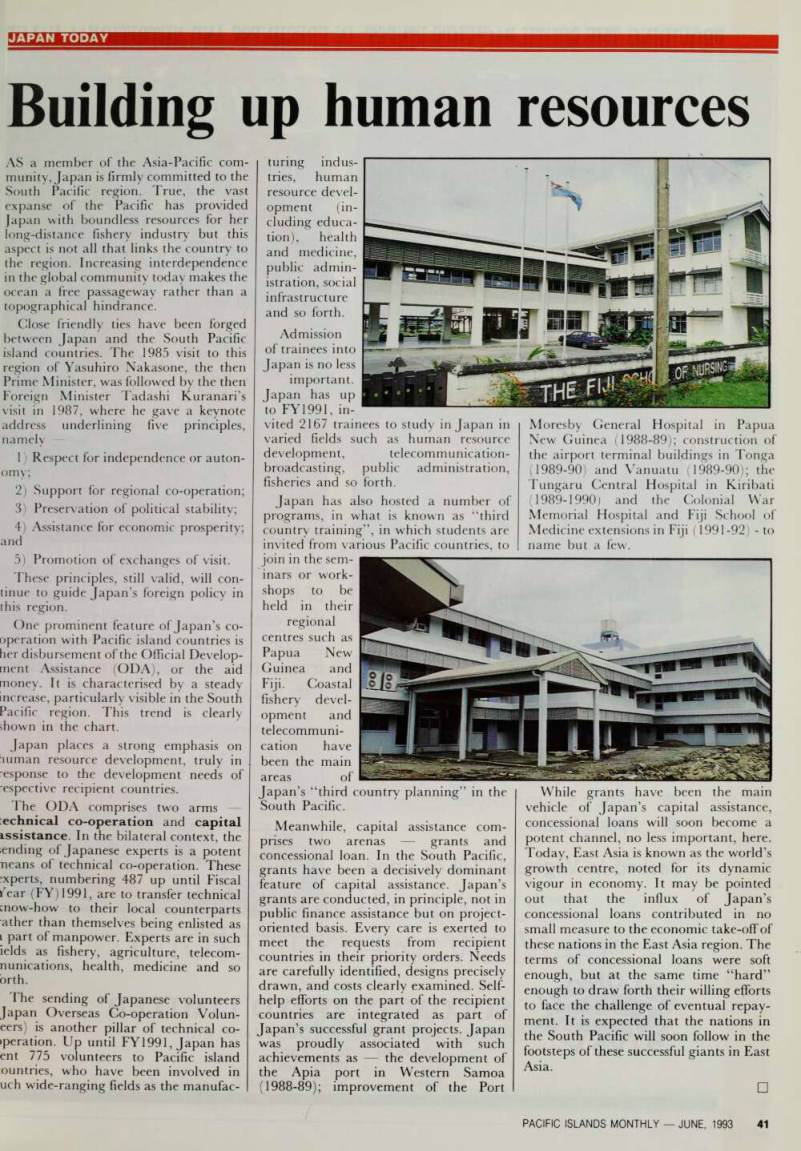
Moresby General Hospital in Papua New Guinea (1988-89); construction of the airport terminal buildings in Tonga (1989-90) and Vanuatu 1989-90); the Tungaru Central Hospital in Kiribati (1989-1990) and the Colonial War Memorial Hospital and Fiji School of Medicine extensions in Fiji (1991-92) - to name but a few.
While grants have been the main vehicle of Japan’s capital assistance, concessional loans will soon become a potent channel, no less important, here.
Today, East Asia is known as the world’s growth centre, noted for its dynamic vigour in economy. It may be pointed out that the influx of Japan’s concessional loans contributed in no small measure to the economic take-off of these nations in the East Asia region. The terms of concessional loans were soft enough, but at the same time “hard” enough to draw forth their willing efforts to face the challenge of eventual repay ment. It is expected that the nations in the South Pacific will soon follow in the footsteps of these successful giants in East Asia.