A new social order
p. 39 · Read in the full issue
Before World War II most Japanese lived in an extended family of three or
more generations. Family relationships
were governed by a rigid hierarchical
system, and parental authority was strong. Fathers commanded respect and obedience from their children, and in turn offered the same to their own parents; married women were ex
pected to faithfully obey their hus
bands and parents-in-law.
The process of democratisation after the war, however, transformed every
aspect of Japanese family life. Especi
ally important was the revision of the Civil Code in 1947, which gave women equal legal status with men in all
phases of life, thereby abolishing the
old patriarchal character of the family.
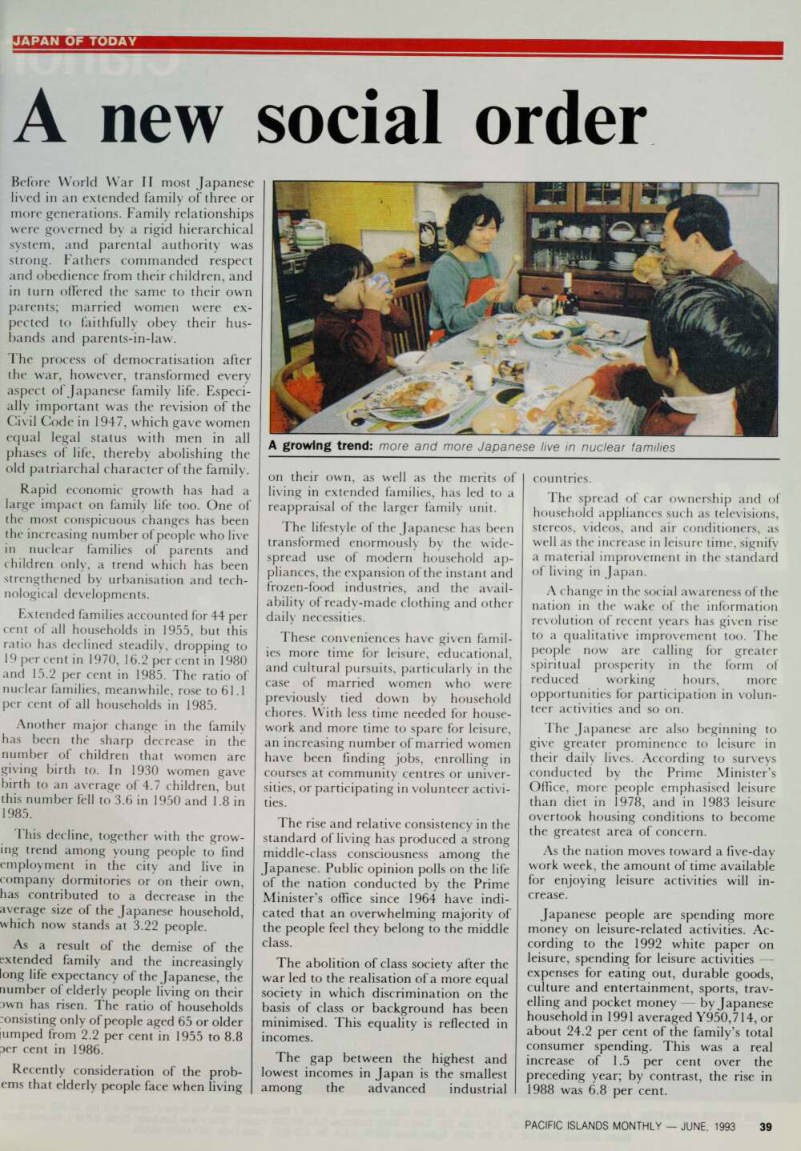
Rapid economic growth has had a large impact on family life too. One of the most conspicuous changes has been the increasing number of people who live in nuclear families of parents and children only, a trend which has been strengthened by urbanisation and tech
nological developments.
Extended families accounted for 44 per cent of all households in 1955, but this ratio has declined steadily, dropping to 19 per cent in 1970, 16.2 per cent in 1980 and 15.2 per cent in 1985. The ratio of nuclear families, meanwhile, rose to 61.1 per cent of all households in 1985.
Another major change in the family has been the sharp decrease in the number of children that women are giving birth to. In 1930 women gave birth to an average of 4.7 children, but this number fell to 3.6 in 1950 and 1.8 in 1985.
This decline, together with the grow ing trend among young people to find employment in the city and live in company dormitories or on their own, has contributed to a decrease in the average size of the Japanese household, which now stands at 3.22 people.
As a result of the demise of the
extended family and the increasingly
long life expectancy of the Japanese, the number of elderly people living on their nwn has risen. The ratio of households :onsisting only of people aged 65 or older lumped from 2.2 per cent in 1955 to 8.8 ner cent in 1986.
Recently consideration of the prob ems that elderly people face when living
on their own, as well as the merits of living in extended families, has led to a reappraisal of the larger family unit.
The lifestyle of the Japanese has been transformed enormously by the wide spread use of modern household ap pliances, the expansion of the instant and frozen-food industries, and the avail ability of ready-made clothing and other daily necessities.
These conveniences have given famil ies more time for leisure, educational, and cultural pursuits, particularly in the case of married women who were previously tied down by household chores. With less time needed for house work and more time to spare for leisure, an increasing number of married women have been finding jobs, enrolling in courses at community centres or univer sities, or participating in volunteer activi ties.
The rise and relative consistency in the standard of living has produced a strong middle-class consciousness among the Japanese. Public opinion polls on the life of the nation conducted by the Prime Minister’s office since 1964 have indi cated that an overwhelming majority of the people feel they belong to the middle class.
The abolition of class society after the war led to the realisation of a more equal society in which discrimination on the basis of class or background has been minimised. This equality is reflected in incomes.
The gap between the highest and lowest incomes in Japan is the smallest among the advanced industrial
countries.
The spread of car ownership and of household appliances such as televisions, stereos, videos, and air conditioners, as well as the increase in leisure time, signify a material improvement in the standard of living in Japan.
A change in the social awareness of the nation in the wake of the information revolution of recent years has given rise to a qualitative improvement too. The people now are calling for greater spiritual prosperity in the form of reduced working hours, more opportunities for participation in volun teer activities and so on.
The Japanese are also beginning to give greater prominence to leisure in their daily lives. According to surveys conducted by the Prime Minister’s Office, more people emphasised leisure than diet in 1978, and in 1983 leisure overtook housing conditions to become the greatest area of concern.
As the nation moves toward a five-day work week, the amount of time available for enjoying leisure activities will in crease.
Japanese people are spending more money on leisure-related activities. Ac cording to the 1992 white paper on leisure, spending for leisure activities expenses for eating out, durable goods, culture and entertainment, sports, trav elling and pocket money by Japanese household in 1991 averaged Y 950,714, or about 24.2 per cent of the family’s total consumer spending. This was a real increase of 1.5 per cent over the preceding year; by contrast, the rise in 1988 was 6.8 per cent.
A growing trend: more and more Japanese live in nuclear families