Simply
pp. 36-37 · Read in the full issue
Pacific Islands Monthl T Is A
significant publication of the region and I am pleased to contribute to
this supplement on Japan.
In July 1992, I had the pleasure of heading the delegation of the Gov ernment ofjapan to the Fourth Post- Forum Dialogue of the South Pacific Forum in Honiara, the Solomons Islands.
It was my first exposure to this region, and this gave me an oppor tunity to confer with the leaders of the Pacific island nations and to know the fervour of their nation building aspirations —'a truly mem
orable experience.
Allow me to briefly present Japan’s view of the South Pacific.
The South Pacific region is our
geographical neighbour and we
share deep historical ties. The links between Japan and the South Pacific are rapidly growing even closer in such fields as fishery, trade, invest ment, and economic co-operation.
Your island nations are striving earnestly forward despjte manifold handicaps such as limited land space, small populations, and mono cultural economies, and all Japanese admire your spirit.
Official Development Assistance is
Japan’s main vehicle for supporting the efforts of the island nations of the South Pacific. Recently, our bilat eral aid to this region has multiplied at a pace far higher than to other parts of the world. Still Japan wishes to increase our co-operative endeavours and to especially con tribute to your basic needs and to the development of your human re sources.
Japan also admires your region’s co-operative initiatives, in such arenas as the South Pacific Forum, the South Pacific Commission, and the SOPAC. My country also hopes that this region’s interests will be adequately reflected in the broader frame-work of on-going regional co operative endeavours, such as the APEC and the PECC.
Exchanges at the grassroots and among our leaders are growing in frequency and are bearing good fruit. Another encouraging trend is the steady increase of Japanese tourists reaching your island shores.
I am confident that better mutual understanding that is thus fostered, will form a basis for greater and closer relations between the South Pacific nations and my country.
These are sure signs of a brighter tomorrow. □
ALTHOUGH a product of the cultural heritage of the Orient, Japanese culture is nevertheless noted for its uniqueness.
Were one to try to characterise it in a few words, it might be said to reveal a preference for internal grace as opposed to external splendour.
The sense of beauty characteristic of the Japanese, as expressed in such concepts as miyabi (refined elegance), mono no aware (pathos of nature), wabi (quiet taste) and sabi (elegant sim plicity), suggests a world of aesthetic and emotional harmony. The distinctive Japanese culture of today is the result of a series of encounters between traditional Japanese culture and western cultures through which the latter were imported, absorbed, and harmoniously blended with the former. Some of the noteworthy characteristics of this process include a flexibility and openness towards other cultures. Rather than rejecting the latter, the Japanese have chosen to fit them into their own aesthetic framework, often quite creatively adapting them to Japan ese needs.
However as culture is a general term it becomes difficult to generalise when talking about Japanese culture as a total
MESSAGE from His Excellency Mr Koji Kakizawa, Parliamentary Vice- Minister for Foreign Affairs of Japan.
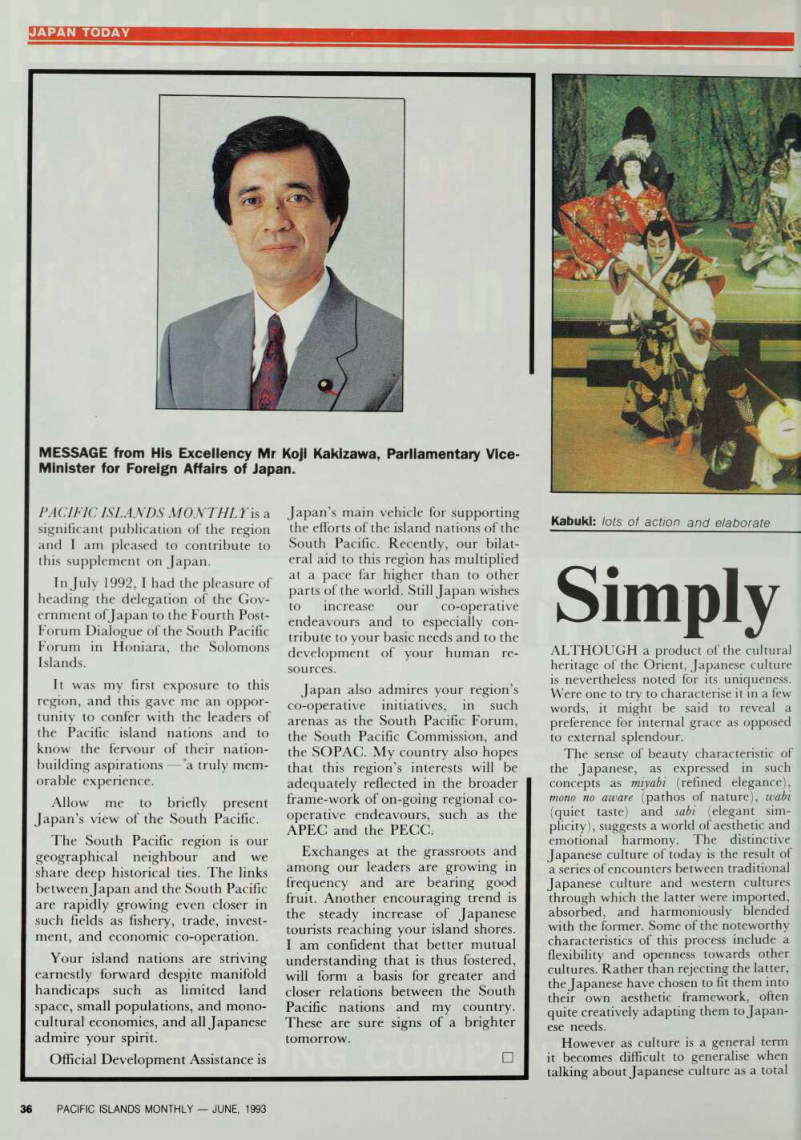
Kabuki: lots of action and elaborate
phenomenon. Criticisms have been voiced in various sectors of contemporary Japan that the Japanese people are perhaps excessive in their anxious efforts to adopt and assimilate the materialistic and mechanic civilisation of the West, at the price of losing much of their traditional aesthetic sensitivity. And one is inclined to give these criticisms their due in view of the thread of destruction of natural beauty engendered by wide spread environmental pollution.
Were the Japanese of today really allowing themselves to be uncritically submerged by the flow of Western :ivilisation, there would indeed be a need or urgent changes in their thinking and iction; at the same time, those who are nclined to lament the decline of tra litional Japanese culture without offer ng any specific factual evidence might be idvised to review the history of the levelopment of Japanese culture, and to onsider, once again, what Japanese ulture really is.
In 1968 the Agency for Cultural dfairs was established as an external rgan of the Ministry of Education to
take charge of administrative affairs related to the promotion and dissemi nation of culture and the preservation and utilisation of cultural properties, as well as matters relating to incorporated religious groups. Attached to the agency are the national museums (Tokyo, Kyoto and Nara), the National Museums of Modern Art (Tokyo and Kyoto), the National Museum of Western Art (Tokyo), the National Museum of Art (Osaka), the National Japanese Lan guage Research Institute (Tokyo), the National Research Institutes of Cultural
Properties (Tokyo and Nara), and the
Japan Art Academy (Tokyo).
Every year the agency selects recipi ents of the Order of Cultural Merit, designates Persons of Cultural Merit, and holds ceremonies for the presentation of these awards on November 3, which is Culture Day. Every autumn the agency sponsors the Japan Art Festival and awards prizes in such fields as broadcast ing, cinema, and theatre. The agency annually adds to the list of designated cultural properties, and it preserves rows of old houses and stores as well as old highways as part of its efforts to preserve historical sites.
Japan has about 800 museums and many schools specialising in art and publication of art books is vigorous.
Of the books published in Japan in 1990, literature accounted for 7896 titles, or 20.4 per cent of the total. Hundreds of regular literary prizes are awarded in such fields as poetry, novels, drama, mystery, nonfiction, commentary, and essays.
The most famous of these are the Akutagawa Prize and the Naoki Prize, which have been awarded by Bungei Shunju, a major publishing house, since 1935 and are regarded as gateways to success for new writers in the fields of serious novels and popular literature, respectively.
Japanese literature traces its begin nings to oral traditions that were first recorded in written form in the early eighth century after a writing systems was introduced from China.
The Kojiki (record of ancient matters) and Nihon shoki (chronicle of Japan) were completed in 712 A.D. and 720 A.D. respectively as government projects. The former is an anthology of myths, legends, and other stories, while the latter is a chronological record of history.
The Fudoki (records of wind and earth), compiled by provincial officials beginning in 713, describe the history, geography, products and folklore of the various provinces.
Japan Today, 1992
[?]es and sets
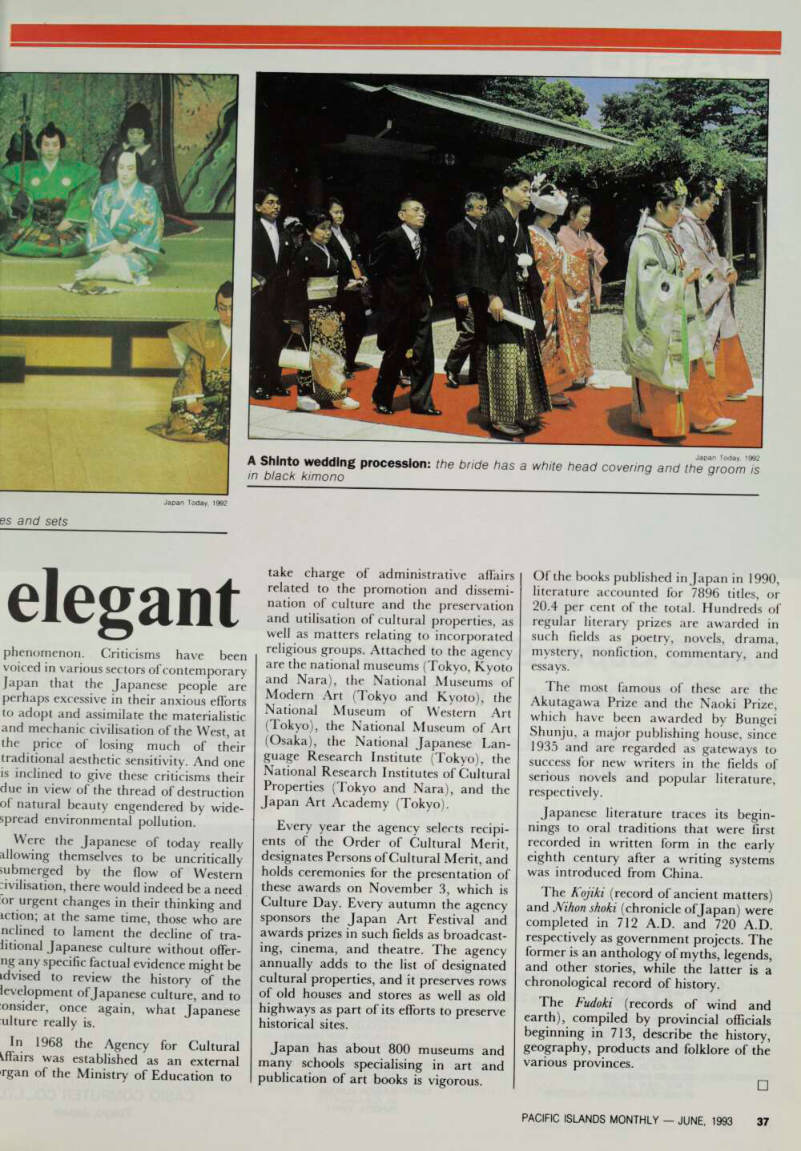
A Shinto wedd ing procession: the bride has a white head covering and groom is in black kimono