Employment
pp. 43-45 · Read in the full issue
The Taiwan Experience
The economic
miracle
IN the four decades from 1952 onward, the economy grew at an average innual rate of 8.8 per cent. Less than US$lOO at the close of World War 11,
3er capita gross national product
'GNP) in Taiwan by 1992 had risen to
Employment
trends
UT the end of June 1992, employment ate in Taiwan was 98.45 per cent, down ►y 0.17 per cent from the 98.62 per cent f March 1992.
In recent years the government has stablished service centres all over Tai wan to adjust man-power supply and emand. According to their figures, pplicants totalled 30,429 and job penings numbered 119,394 in the
cond quarter of 1992. Demand for orkers was almost four times greater an job-seekers.
US$lO,OOO. The economic progress during this period has been nothing short of remarkable.
Taiwan has a land area of only 36,000 square kilometres. It has very r . i 1 lew natural resources.
The major resource that Taiwan does have is manpower. At the end of 1991, population stood at 20.6 million, a density of 571 people per square kilometre making Taiwan one of the
most densely populated areas in the world. To develop the potential of Taiwan’s human resources, the gov
ernment has given special emphasis to
education. Education for the first to the ninth is now universal, and educa . , , tional and training programs are aimed at meeting economic needs, The first four year plan in 1953 sparked the economic growth that Taiwan has sustained, Gross national product (GNP) in
real terms grew at an average annual rate of 8.2 per cent during the 19505, 9.1 per cent in the 60s, and 10.2 per cent in the 70s. Economic growth slowed at the start of the 80s, as the world experienced a recession. In the 80s, however, Taiwan’s economy ad vanced at an annual average rate 0f8.2 per cent. In 1991 GNP grew to reach US$lBO.3 billion.
Annual per capita GNP grew 4.7 per cent in the 50s, 6.2 per cent in the 60s, 8.1 per cent in the 70s and 6.6 per cent in the 80s. In 1991 it rose by 6.2 per cent and stood at US$BBl5. By the end of 1992 it had exceeded US$lO,OOO.
How was all this made possible?
A land reform program was intro duced in the early 1950 s to stimulate farm production and exports of agri cultural products. The land reform also promoted social justice and paved the way for industrialisation. In 1960, a Statute for the Encouragement of Investment was enacted to promote
saving, capital formation, industrial
development and export expansion. In 1966, Taiwan’s first export processing
zone, with the combined features of an industrial park and a free trade zone, was opened to introduce foreign direct investment, to promote exports and to create employment opportunities.
These measures helped Taiwan overcome its economic disadvantages.
They also provided a foundation for rapid and sustained economic growth.
The strategies adopted by the gov ernment to promote economic devel opment and stability were guided by
six key policies :
• Attaching equal emphasis to economic growth and economic stab ility; • Promoting the growth of agricul ture and industry;
• Developing light industry first
and then heavy industry; • Moving from import substitution to export expansion; • Expanding the infrastructure to meet development needs; • Narrowing the income gap be tween the affluent and less affluent.
These policies were implemented in four stages. The first stage, from around 1945 to 1952, saw economic
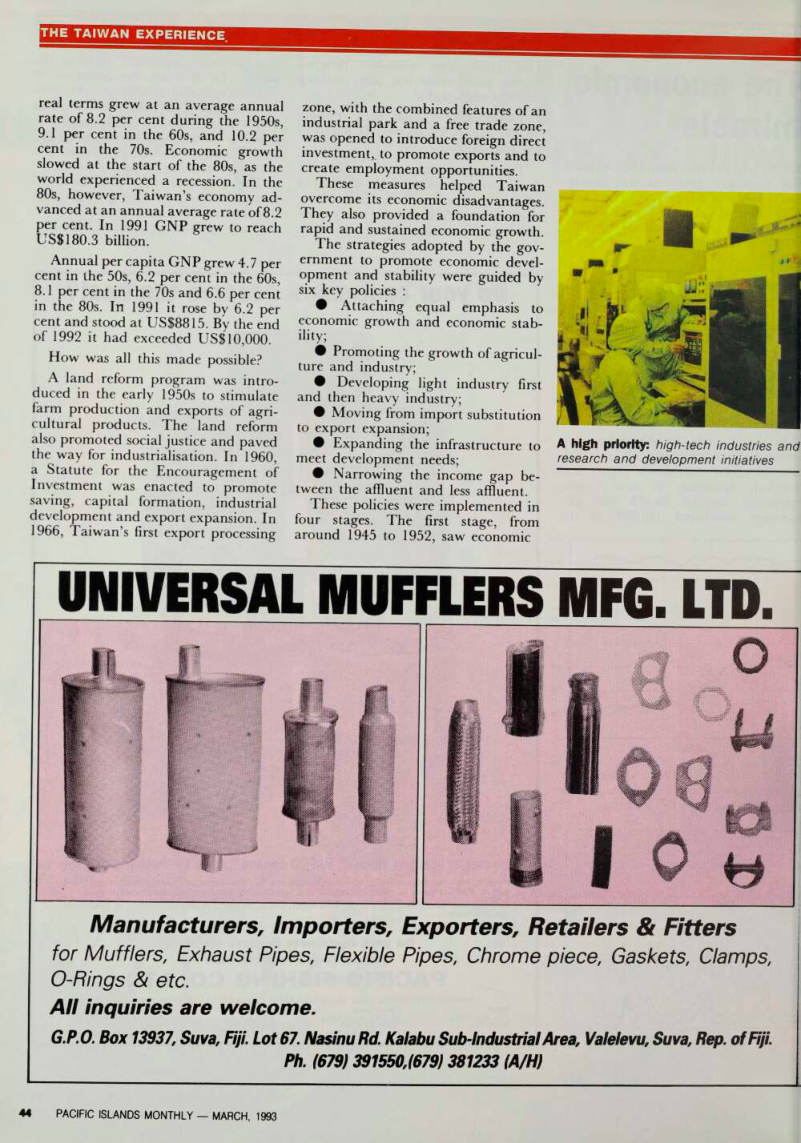
A high priority: high-tech industries and research and development initiatives
ehabilitation and stabilisation as najor concerns. Measures included a nonetary reform program and land eform.
During the second stage, from 1953
d 1960, an import-substitution policy
ras adopted to save foreign exchange
nd channel limited resources to areas f production with a proven domestic larket. The 1950 s also saw the itroduction of a series of four-year
conomic development plans and
>reign exchange, economic and fiscal Torms. The New Taiwanese dollar
as devalued against foreign
arrencies, and a unitary exchange
ite system was adopted.
In the third stage from 1961 to 1972, ic government shifted its emphasis to
i export-expansion policy. During
lis period real GNP grew 10.2 per ;nt a year, consumer prices rose only 3 per cent resulting in price
ability and rapid economic growth.
From 1973 onward, the economy ced two oil crises, high inflation, and rise in protectionism abroad. To stain economic growth the govern ent embarked upon a restructuring id modernisation of the economy, bis saw a growth in high-tech and
value-added industries as electrical and non-electrical machinery, electronics and information. In 1973 an Industrial Technology and Research Institute was set up, in 1980 the Science-based Industrial Park, a newly created mini-town, was opened to
attract investment in high-tech indus tries. In 1990 the Statute for Industrial Upgrading was enacted offering tax credits for research and development, automation, pollution control and other activities that promote produc tivity and restructuring.
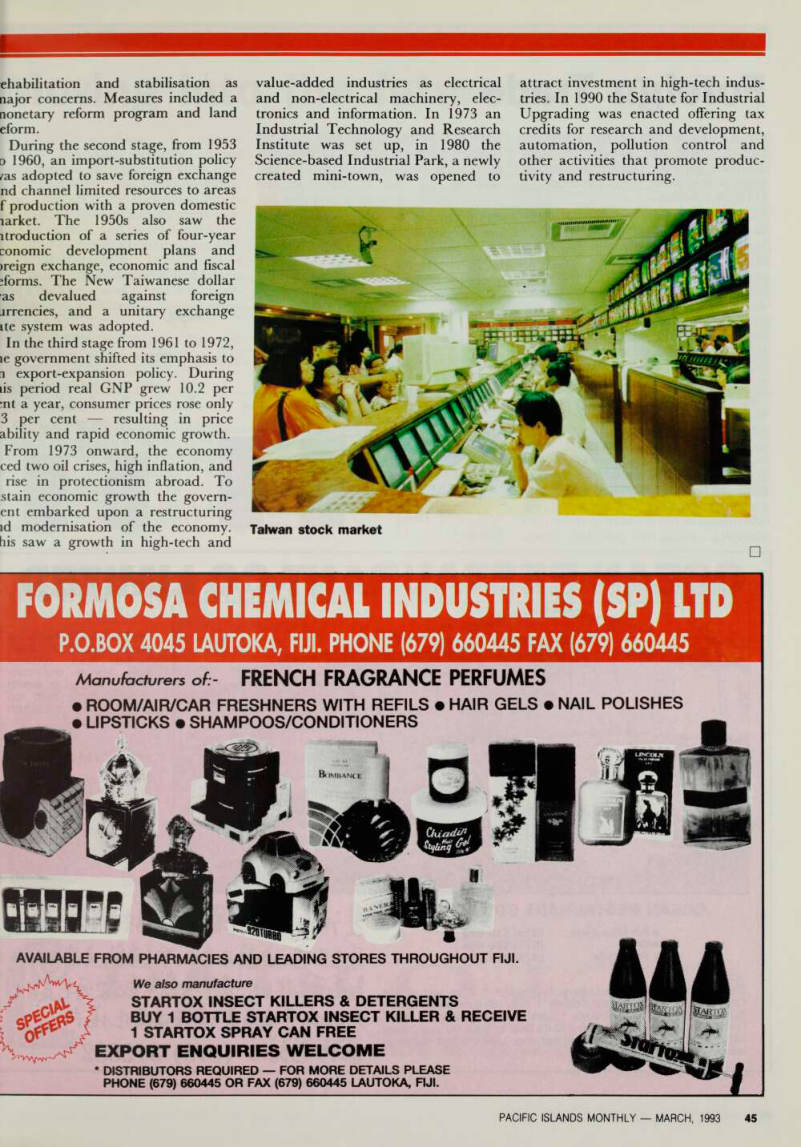
Taiwan stock market