The ragon's Dream
pp. 40-41 · Read in the full issue
The Taiwan Experience
FOR more than 40years the lie of China on Taiwan has enjoyed healthy economic growth and stab ility. This growth, however, did not happen by chance. It was part of a series of plans and programs in itiated by the government to stimu late economic activity. The govern ment introduced a land reform program in the 19505, adopted an export-oriented policy in the 19605, stepped up the production of inter mediates, known as backward inte gration, launched major
infrastuctural development proj
ects in the 19705, and pressed forward with economic restructur ing and modernisation in more recent years. These policies have transformed the Republic of China on Taiwan from an agricultural backwater into a newly industrial ised country. This record of econ omic ahievement has come to be known and admired the world over as the “Taiwan Exp
Pacific island countries perhaps have a lesson to learn from the Taiwan experience. Like Pacific countries, Tai wan has a relatively small land mass and few resources. But through sheer determination and well-formulated economic policies, it has managed to overcome these shortcomings to be come the 14th largest trading country in the world.
Although only one-quarter of the
land, mostly along the west coast, is arable. The rest is rugged terrain with a spine-like ridge of steep mountains running along the eastern coast. Fortu nately, the sub-tropical climate per mits year-round farming and multi cropping of a wide variety of crops including rice, sugarcane, fruits and
vegetables. However, large quantities
of sybean, corn and wheat are impor ted.
Although Taiwan does have deposits of coal, limestone, marble and dolo
mite, and some natural gas has been discovered, it is not rich in minerals.
More than 90 per cent of its energy
requirement are met by imports.
While about two-thrids of the land is forested, forest resources are highly limited because of poor accessibility,
inferior quality and understocking.
Among factors which have made Taiwan’s success possible are a large skilled workforce, economic policies
mmitted to growth and development d political stability. Taiwan had, iring its initial phases of growth, anaged to keep labour costs low owing it to find a niche for itself in the v-en markets of the world.
Taiwan’s rapid rise to an industrialised ntre is also because it was a base for ernational companies to set-up factor- , allowing it to gain the knowledge and :hnology required to later branch out its own and deveop its own brand
names. Today, Taiwan is at a major cross-road of industrialisation. As it becomes more industrialised and stan dards of living and wages rise, it can no longer compete as a producer of low-cost goods. Enter the “quality revolution” a campaign to re-launch “Made in Taiwan” products into the world market
as high quality alternatives to existing
brand names.
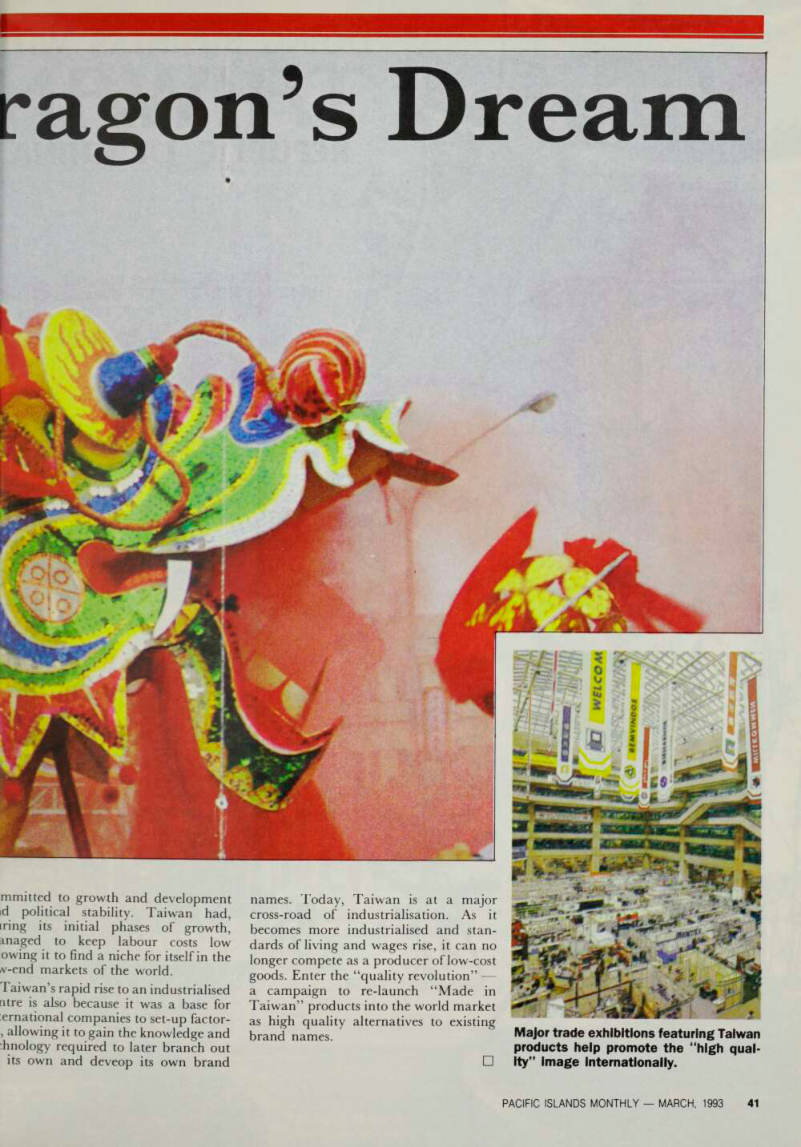
Major trade exhibitions featuring Taiwan products help promote the “high qual ity” image internationally.