Suva In A Day
pp. 37-39 · Read in the full issue
Focus
By Kim Taylor
AFTER a number of visits, coming back into Suva always creates an air of excitement. As we brought our sailing home into the bustling harbour, the unmistakeable aroma of the city envel
oped us.
On this visit a friend was with us, new to the town, and on a tight schedule.
How could we possibly squeeze it all into tomorrow?
We could at least try, and so made an early start at the fish market beside Nobukalou Creek. A colourful throng vied to purchase the best of the equally
kaleidoscopic sea
food, from tuna to turtle, sea urchin to octopus. Everyone seemed oblivious to the large notices along the quay advis ing the sale of fish was illegal. Even the
Suva policeman,
smart in blue shirt, red cummerband and white sulu takes not a care.
It’s a relaxed sort
of place.
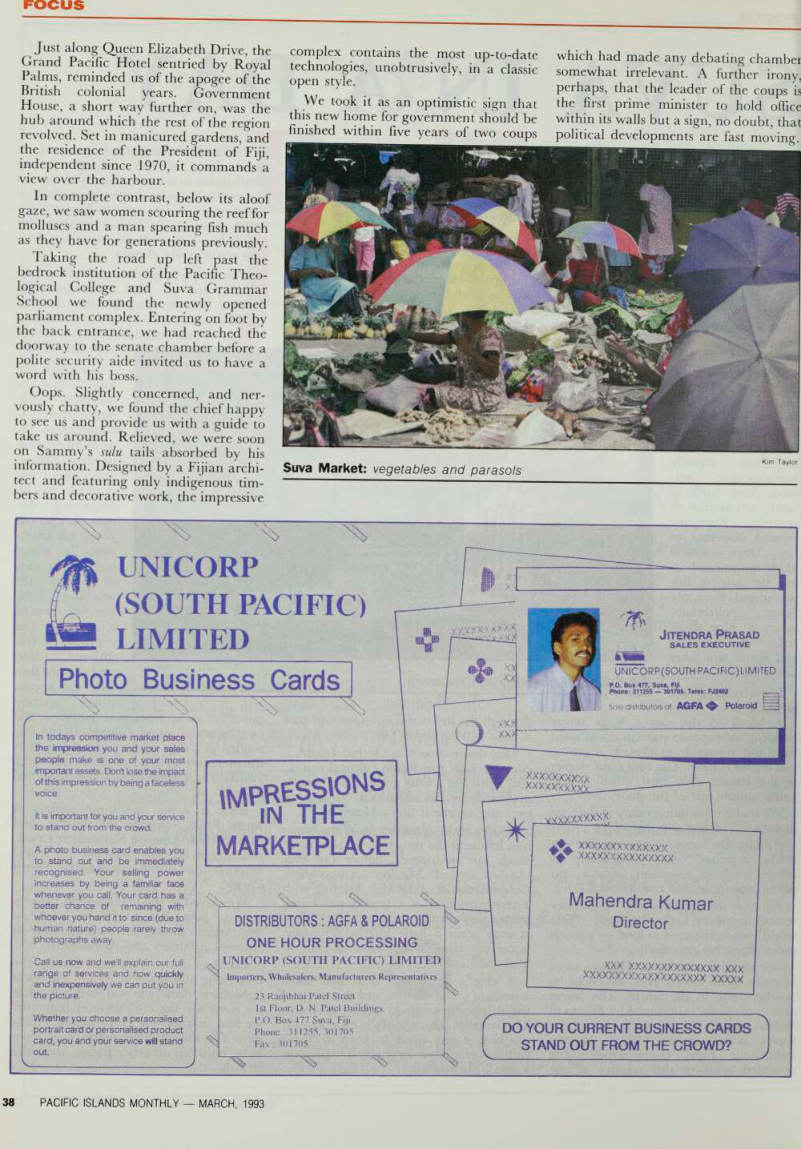
A block to the east a large dingy building attempts to contain the vibrant fruit and vegetable market. If if grows, you’ll find it here. The root crop staples of the Pacific diet; taro, cassava, and yams tumble out of the doorways.
We had fun sampling many of the fruit items we had not seen before.
Admittedly, some are now on the “not to be repeated” list, particularly as others, such as succulent papaya and sweet pineapple, are readily available.
Fiji may be “third world” in money terms, however, it’s definitely “first world” when it comes to food a much more digestible commodity.
For distilled essence of Fiji, we went upstairs. With closed eyes, we could be nowhere else in the world. The warm aroma of spices, introduced by Fijians of Indian origin, mingle with the earthy yaqona (kava) grown largely by the indigenous rural communities. The pounded roots of this relative of the
pepper plant, infused with water, pro duce the national drink of all Fijians. We had acquired a taste for it in the outer islands and shared a bowl at the back of the market on the way out.
Rain is not unknown in Suva, so we sought to minimise any inconvenience by dealing with the more outdoor parts of the trip before the possibility of an afternoon shower. With more time we should have taken one of the colourful, if aged, buses but, as reasonably priced taxis abound, we were soon rattling
through the industrial environs and past
a grim-looking Suva Jail.
Our destination was Orchid Island, a commercially run Fijian cultural centre, an d \ still feel a little guilty that this was preferred, by the narrowest of margins, over the excellent Suva Museum.
A stop at the cemetery in Walu Bay is best left until the return as we wanted to reach our destination before the tour coaches arrived. Mission accomplished, the guided part of the visit, starting with a reconstruction of a traditional Fijian temple was a much more personal affair, It may seem a little hurried for some tastes but there was plenty of time to backtrack later.
A chiefs house was next and some aspects of social custom and the usage of the displayed artefacts were explained.
The wooden pillow looks a little agonis ing but, if you need to keep a chiefs elaborate hairstyle in place, it is perhaps a small discomfort.
We liked the frank admissions made on the subject of the making of masi (barkcloth) in the next display. In lieu of the vegetable gums the not-so-traditional “superglue” is now used to laminate the thinly beaten bark. Our opinions dif fered, but I thought the wedding dress was particularly elegant.
A turtle pool, garden walk and a rare
iguana, led to jolly septuagenarian,
Jervais, who revelled in some interna tional banter whilst showing us some of the native and introduced species of food
and cash crops.
No Fijian his tory would be complete with out reference to cannibalism, the missionary influ ence and politics and this was covered in an absorbing dis
play. Askjervais
about his ances tors. It would have been easy to spend the morning here, but we needed to move on. The centre’s tra ditional bures and temple pro vide the appro
priate starting
point for an architectural overview, but on the way out of Orchid Island the replica of a drua (canoe) reminded us of the maritime skills necessary to travel the vast Pacific in these modest double hulled canoes.
Back in town, the huge edifices of Burns Philp, opposite the market, and Morris Hedstrom, on Nabukalou Creek, reflect the trade influence of these emporia on the whole of the South Pacific.
We stayed in the taxi through the city centre, past Sukuna Park and up MacArthur Street, for a quick view at colonial suburbia and its churches.
Coming down Thurston Street, the increasing number of well-built Fijians in light shirts, dark sulus and leather sandals [de riguer for the civil service) indicated we had reached the Government Build ings. The brooding monolith could have been built by no other nation than the British.
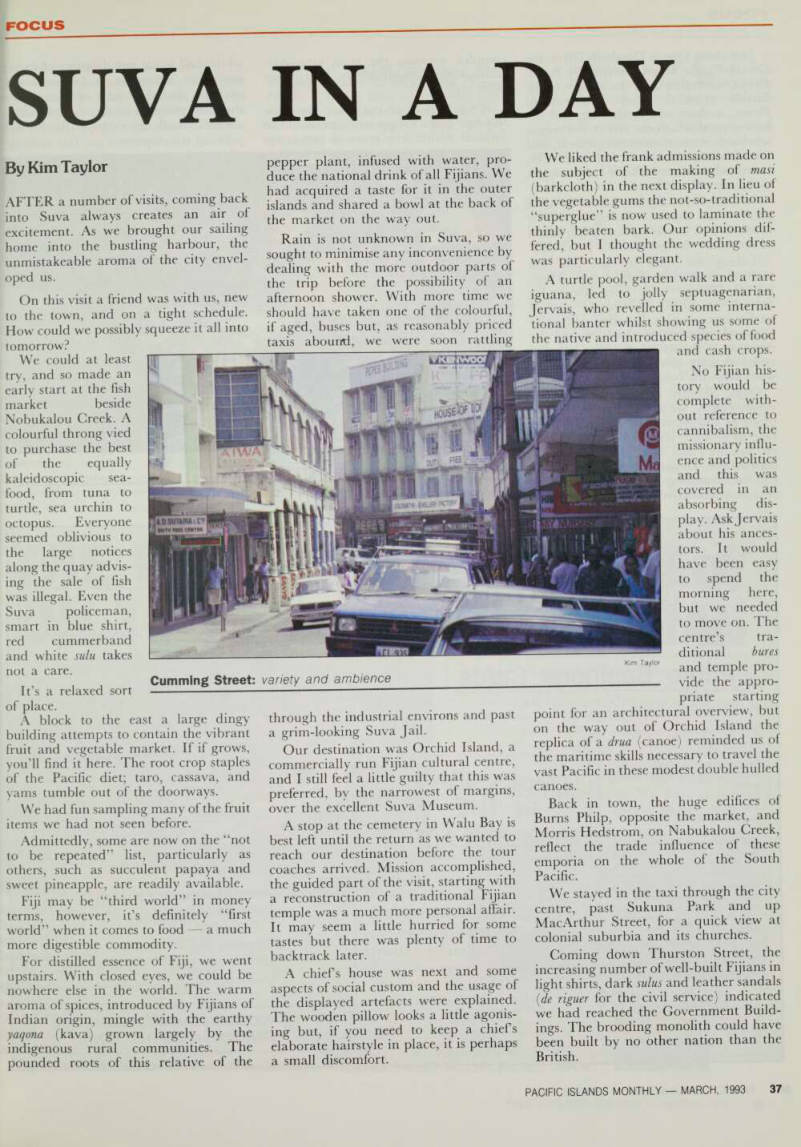
Gumming Street: variety and ambience
Just along Queen Elizabeth Drive, the Grand Pacific Hotel sentried by Royal Palms, reminded us of the apogee of the British colonial years. Government House, a short way further on, was the hub around which the rest of the region revolved. Set in manicured gardens, and the residence of the President of Fiji, independent since 1970, it commands a view over the harbour.
In complete contrast, below its aloof gaze, we saw women scouring the reef for molluscs and a man spearing fish much as they have for generations previously.
Taking the road up left past the bedrock institution of the Pacific Theo logical College and Suva Grammar School we found the newly opened parliament complex. Entering on foot by the back entrance, we had reached the doorway to the senate chamber before a polite security aide invited us to have a word with his boss.
Oops. Slightly concerned, and ner vously chatty, we found the chief happy to see us and provide us with a guide to take us around. Relieved, we were soon on Sammy’s sulu tails absorbed by his information. Designed by a Fijian archi tect and featuring only indigenous tim bers and decorative work, the impressive
complex contains the most up-to-date technologies, unobtrusively, in a classic open style.
We took it as an optimistic sign that this new home for government should be finished within five years of two coups
which had made any debating chamber somewhat irrelevant. A further irony, perhaps, that the leader of the coups is the first prime minister to hold office within its walls but a sign, no doubt, that political developments are fast moving.
Kim Taylor
Suva Market: vegetables and parasols
Which is also what we needed to be.
We were soon amongst the authentic wood carvings, masi, pandanus mats and basket work on show at the Government Handicraft Centre in Ratu Sukuna House.
It’s true that items may be cheaper by hard bargaining at the Handicraft Mar ket behind the Post Office, but many there have little to do with Fiji.
Our guest chose a kava bowl ( tanoa ) which for many is the most representa tive of Fiji. The more luggage conscious may settle for a war club, oil dish or the übiquitous, if gruesome, brainforks.
Other than particular souvenirs of Fiji, the very wide range of goods available are usually at reasonable prices. We
bought brightly printed cotton fabrics,
which are widely available, and stamps and first-day covers at the Philatelic Bureau in the GPO building.
Electrical goods, cameras etc. may not be that much cheaper than at home so if anything particular in this line is intended a little research may be wise.
Whether or not any particular pur :hase is in mind, a walk along the :ommercial Gumming or Marks streets is veil worth it if only to appreciate the variety and absorb the ambience.
We had reached tea time, which would have seen us back to the “Grand Pacific ”, had it been open. There being no equal, we missed tea to spend more time, window-shopping and people watching, downtown.
We had arranged to be in Suva for the Hibiscus Festival and tonight was “Fiji Night”. So it was back to our base at the Royal Suva Yacht Club for a shower, quick change and a cool beer. We headed back to town and joined the throng bound for Albert Park.
Around it’s perimeter all manner of foods were being cooked, extolled and served. We feasted on the hoof. In one corner carousels and ferris wheels spun to their passengers’ delighted shrieks. Un derneath the sports’ grandstands, a small stage, too far from the seated audience, was poorly lit.
Several Fijian folk groups, consisting mainly of older folk, sang their specialities, often accompanied by some modest dancing.
All around the Park a cacophony of other noises competed for attention. The performing groups sat in tight circles facing inwards. Most of the time this introspective culmination of thousands of years of oral tradition was drowned out
by a showman’s booth. At least four times further away from us than the stage, its sound system dominated the Park.
Ratu Sukuna, Fiji’s most respected soldier and statesman, atop his pedestal not a hundred yards away gazed fixedly out to sea. He had been out-flanked, To his left, the great “octopus” of commercialism, which he feared would overwhelm his people, was at hand. In general terms, however, he need to have been so pessimistic, Modern cosmopolitan Suva is no stranger to change. Adapting success fully, its diversity is its main attraction to Fijians, of all ethnic backgrounds, and
foreigners alike.
Many were now heading for the clubs and bars which provide the pulsing night-life. We were exhausted and de cided to give that a miss. We had packed
quite enough into our day already,
As I tumbled into bed I remembered there used to be a roadsign, on the Queen’s Road at Walu Bay, which read “Suva invites you to return”.
It was gone this year, I wonder why.
Perhaps for others, as well as ourselves, the invite is no longer necessary, We’ll be back soon. □