The lid has been lifted
p. 35 · Read in the full issue
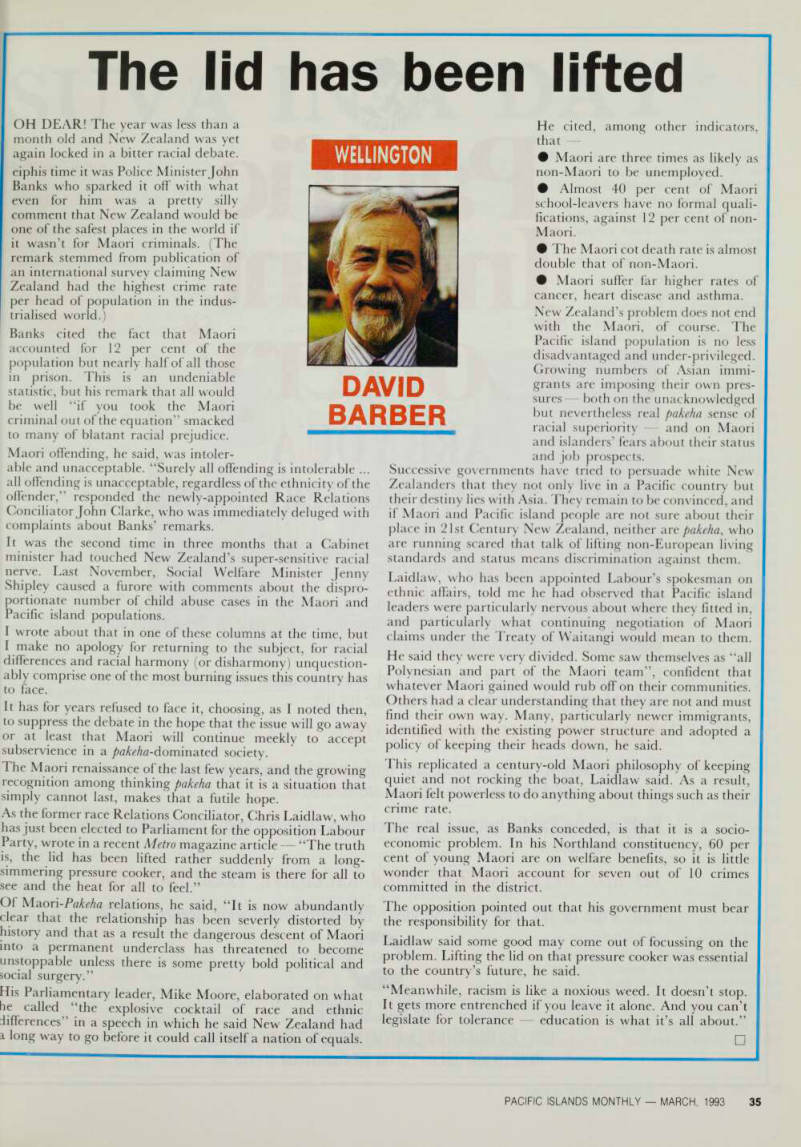
Wellington
OH DEAR! The year was less than a month old and New Zealand was yet again locked in a bitter racial debate. eiphis time it was Police Minister John Banks who sparked it off with what even for him was a pretty silly comment that New Zealand would be one of the safest places in the world if it wasn’t for Maori criminals. (The remark stemmed from publication of an international survey claiming New Zealand had the highest crime rate per head of population in the indus trialised world.) Banks cited the fact that Maori accounted for 12 per cent of the population but nearly half of all those in prison. This is an undeniable statistic, but his remark that all would be well “if you took the Maori criminal out of the equation” smacked to many of blatant racial prejudice.
Maori offending, he said, was intoler-
able and unacceptable. “Surely all offending is intolerable ... all offending is unacceptable, regardless of the ethnicity of the offender,” responded the newly-appointed Race Relations Conciliator John Clarke, who was immediately deluged with complaints about Banks’ remarks.
It was the second time in three months that a Cabinet minister had touched New Zealand’s super-sensitive racial nerve. Last November, Social Welfare Minister Jenny Shipley caused a furore with comments about the dispro portionate number of child abuse cases in the Maori and Pacific island populations.
I wrote about that in one of these columns at the time, but I make no apology for returning to the subject, for racial differences and racial harmony (or disharmony) unquestion ably comprise one of the most burning issues this country has to face.
It has for years refused to face it, choosing, as I noted then, to suppress the debate in the hope that the issue will go away or at least that Maori will continue meekly to accept subservience in a pakeha-dommaied society.
The Maori renaissance of the last few years, and the growing recognition among thinking pakeha that it is a situation that simply cannot last, makes that a futile hope.
As the former race Relations Conciliator, Chris Laidlaw, who has just been elected to Parliament for the opposition Labour Party, wrote in a recent Metro magazine article “The truth is, the lid has been lifted rather suddenly from a long simmering pressure cooker, and the steam is there for all to see and the heat for all to feel.”
Of Maori -Pakeha relations, he said, “It is now abundantly clear that the relationship has been severly distorted by history and that as a result the dangerous descent of Maori into a permanent underclass has threatened to become unstoppable unless there is some pretty bold political and
social surgery.”
His Parliamentary leader, Mike Moore, elaborated on what he called “the explosive cocktail of race and ethnic differences” in a speech in which he said New Zealand had a long way to go before it could call itself a nation of equals.
He cited, among other indicators, that • Maori are three times as likely as non-Maori to be unemployed. • Almost 40 per cent of Maori school-leavers have no formal quali fications, against 12 per cent of non- Maori. • The Maori cot death rate is almost double that of non-Maori. • Maori suffer far higher rates of cancer, heart disease and asthma.
New Zealand’s problem does not end with the Maori, of course. The Pacific island population is no less
disadvantaged and under-privileged.
Growing numbers of Asian immi grants are imposing their own pres sures both on the unacknowledged but nevertheless real pakeha sense of racial superiority and on Maori and islanders’ fears about their status and job prospects.
Successive governments have tried to persuade white New Zealanders that they not only live in a Pacific country but their destiny lies with Asia. They remain to be convinced, and if Maori and Pacific island people are not sure about their place in 21st Century New Zealand, neither are pakeha , who are running scared that talk of lifting non-European living standards and status means discrimination against them.
Laidlaw, who has been appointed Labour’s spokesman on ethnic affairs, told me he had observed that Pacific island leaders were particularly nervous about where they fitted in, and particularly what continuing negotiation of Maori claims under the Treaty of Waitangi would mean to them.
He said they were very divided. Some saw themselves as “all Polynesian and part of the Maori team”, confident that whatever Maori gained would rub off on their communities.
Others had a clear understanding that they are not and must find their own way. Many, particularly newer immigrants, identified with the existing power structure and adopted a policy of keeping their heads down, he said.
This replicated a century-old Maori philosophy of keeping quiet and not rocking the boat, Laidlaw said. As a result, Maori felt powerless to do anything about things such as their crime rate.
The real issue, as Banks conceded, is that it is a socio economic problem. In his Northland constituency, 60 per cent of young Maori are on welfare benefits, so it is little wonder that Maori account for seven out of 10 crimes committed in the district.
The opposition pointed out that his government must bear the responsibility for that.
Laidlaw said some good may come out of focussing on the problem. Lifting the lid on that pressure cooker was essential to the country’s future, he said.
“Meanwhile, racism is like a noxious weed. It doesn’t stop.
It gets more entrenched if you leave it alone. And you can’t legislate for tolerance education is what it’s all about.”