The people want changes
p. 23 · Read in the full issue
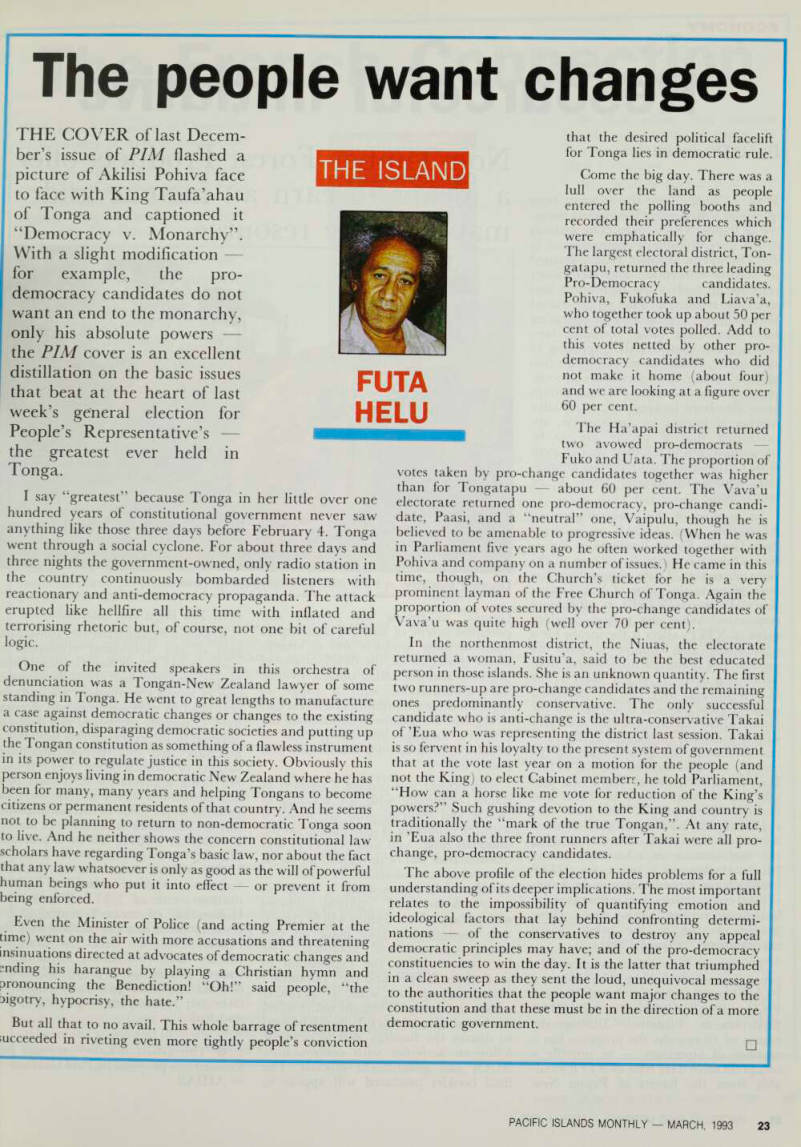
The Island
THE COVER of last Decem ber’s issue of PIM flashed a picture of Akilisi Pohiva face to face with King Taufa’ahau of Tonga and captioned it
“Democracy v. Monarchy”.
With a slight modification for example, the pro democracy candidates do not want an end to the monarchy, only his absolute powers the PIM cover is an excellent distillation on the basic issues that beat at the heart of last week’s general election for
People’s Representative’s
the greatest ever held in
Tonga.
I say “greatest” because Tonga in her little over one hundred years of constitutional government never saw anything like those three days before February 4. Tonga went through a social cyclone. For about three days and three nights the government-owned, only radio station in the country continuously bombarded listeners with
reactionary and anti-democracy propaganda. The attack
erupted like hellfire all this time with inflated and terrorising rhetoric but, of course, not one bit of careful
logic.
One of the invited speakers in this orchestra of denunciation was a Tongan-New Zealand lawyer of some standing in Tonga. He went to great lengths to manufacture a case against democratic changes or changes to the existing constitution, disparaging democratic societies and putting up the Tongan constitution as something of a flawless instrument in its power to regulate justice in this society. Obviously this person enjoys living in democratic New Zealand where he has been for many, many years and helping Tongans to become citizens or permanent residents of that country. And he seems not to be planning to return to non-democratic Tonga soon to live. And he neither shows the concern constitutional law scholars have regarding Tonga’s basic law, nor about the fact that any law whatsoever is only as good as the will of powerful human beings who put it into effect or prevent it from
being enforced.
Even the Minister of Police (and acting Premier at the time) went on the air with more accusations and threatening insinuations directed at advocates of democratic changes and mding his harangue by playing a Christian hymn and pronouncing the Benediction! “Oh!” said people, “the
Digotry, hypocrisy, the hate.”
But all that to no avail. This whole barrage of resentment lucceeded in riveting even more tightly people’s conviction
that the desired political facelift for Tonga lies in democratic rule.
Come the big day. There was a lull over the land as people entered the polling booths and recorded their preferences which were emphatically for change.
The largest electoral district, Ton gatapu, returned the three leading
Pro-Democracy candidates.
Pohiva, Fukofuka and Liava’a, who together took up about 50 per cent of total votes polled. Add to this votes netted by other pro democracy candidates who did not make it home (about four) and we are looking at a figure over 60 per cent.
The Ha’apai district returned two avowed pro-democrats - Fuko and Uata. The proportion of
votes taken by pro-change candidates together was higher than for Tongatapu about 60 per cent. The Vava’u electorate returned one pro-democracy, pro-change candi date, Paasi, and a “neutral” one, Vaipulu, though he is believed to be amenable to progressive ideas. (When he was in Parliament five years ago he often worked together with Pohiva and company on a number of issues.) He came in this time, though, on the Church’s ticket for he is a very prominent layman of the Free Church of Tonga. Again the proportion of votes secured by the pro-change candidates of Vava’u was quite high (well over 70 per cent).
In the northenmost district, the Niuas, the electorate returned a woman, Fusitu’a, said to be the best educated person in those islands. She is an unknown quantity. The first two runners-up are pro-change candidates and the remaining ones predominantly conservative. The only successful candidate who is anti-change is the ultra-conservative Takai of ’Eua who was representing the district last session. Takai is so fervent in his loyalty to the present system of government that at the vote last year on a motion for the people (and not the King) to elect Cabinet members, he told Parliament, “How can a horse like me vote for reduction of the King’s powers?” Such gushing devotion to the King and country is traditionally the “mark of the true Tongan,”. At any rate, in ’Eua also the three front runners after Takai were all pro
change, pro-democracy candidates.
The above profile of the election hides problems for a full understanding of its deeper implications. The most important relates to the impossibility of quantifying emotion and ideological factors that lay behind confronting determi nations of the conservatives to destroy any appeal democratic principles may have; and of the pro-democracy constituencies to win the day. It is the latter that triumphed in a clean sweep as they sent the loud, unequivocal message to the authorities that the people want major changes to the \ constitution and that these must be in the direction of a more democratic government.