Sharing Aboriginality
p. 22 · Read in the full issue
Origins
By Craig Skehan
Generalised prejudices may continue unless Islanders and Aborigi nes share more.
MANY Pacific Islanders think of Austra lian Aborigines as either political mili tants with chips on their shoulders or drunks on the dole. Rather than re spected, Aborigines have been pitied as examples of what happens when a people lose their sovereignty and land.
On the other side of the equation, romanticisation of the islands region has no doubt twisted Aboriginal perceptions along with those of other Australians.
Simplistic notions of a palm fringed paradise have obscured shared harsh realities such as poverty and high infant mortality rates. The cultural gap may well have been opened by stereotypes passed on to Islanders about Aborigines by Australian expatriates in the Pacific.
Ancient cultural factors, such as the hierarchical natural of Polynesian societies and a decree of xenophobia in parts of Melanesia, have at times widened the divide.
On one occasion, Aboriginal activist Michael Mansell was detained by islands’ police at the ceremonial opening of a regional gathering for displaying a protest banner dealing with Aboriginal concerns. He had underestimated the weight Islanders place on protocol. And Mansell’s fair complexion raised the sensitive issue of racial mixing.
In Australia, the trend has been towards acknowledging an individual’s right to declare his Aboriginality, regard less of a part-European ancestry. How ever, in the Pacific people with a part foreign heritage are more likely to state simply they are of “mixed race”, “Those Aborigines who make all the noise are more white than black,” one Islands’ politician said when asked if he
sympathised with Aboriginal rights’ campaigners.
Generalised prejudices may well con tinue to prevail unless Islanders and Aborigines get to know each other better.
Fortunately, new opportunities for con tact are being created as governments, churches, educational institutions and other groups become aware of what constitutes an odd historical legacy.
When exposed to both modern Ab original Australia, and to the antiquity of Aboriginal cultures, Islanders will usually react positively. For example last year, sponsored by the Australian Gov ernment, 103 Aborigines and Torres Strait Islanders attended the South Pacific Festival of Arts in the Cook Islands. There were nearly 1000 people at the Festival from more than 20 island countries and the Australian contingent were not only a great success, but personally popular with fellow partici pants.
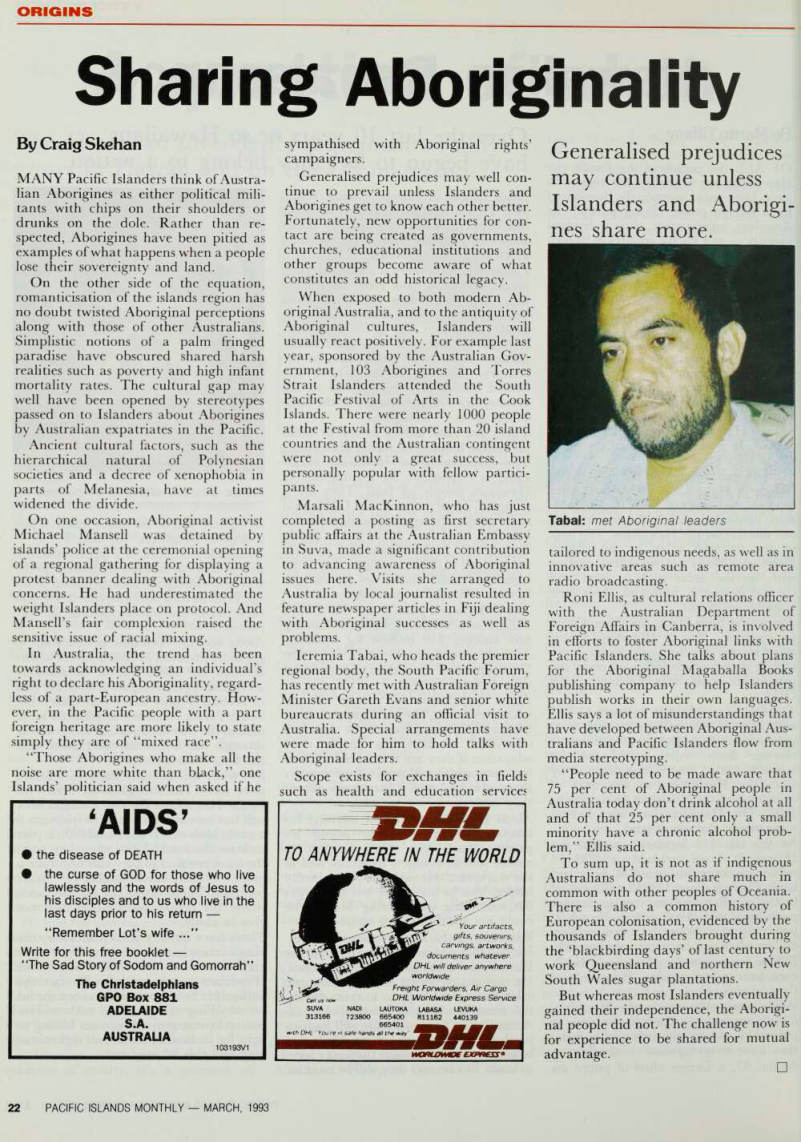
Marsali MacKinnon, who has just completed a posting as first secretary public affairs at the Australian Embassy in Suva, made a significant contribution to advancing awareness of Aboriginal issues here. Visits she arranged to Australia by local journalist resulted in feature newspaper articles in Fiji dealing with Aboriginal successes as well as problems. leremia Tabai, who heads the premier regional body, the South Pacific Forum, has recently met with Australian Foreign Minister Gareth Evans and senior white bureaucrats during an official visit to Australia. Special arrangements have were made for him to hold talks with
Aboriginal leaders.
Scope exists for exchanges in fields such as health and education services
tailored to indigenous needs, as well as in innovative areas such as remote area radio broadcasting.
Roni Ellis, as cultural relations officer with the Australian Department of Foreign Affairs in Canberra, is involved in efforts to foster Aboriginal links with Pacific Islanders. She talks about plans for the Aboriginal Magaballa Books publishing company to help Islanders publish works in their own languages.
Ellis says a lot of misunderstandings that have developed between Aboriginal Aus tralians and Pacific Islanders flow from
media stereotyping.
“People need to be made aware that 75 per cent of Aboriginal people in Australia today don’t drink alcohol at all and of that 25 per cent only a small minority have a chronic alcohol prob lem,” Ellis said.
To sum up, it is not as if indigenous Australians do not share much in common with other peoples of Oceania, There is also a common history of European colonisation, evidenced by the thousands of Islanders brought during the ‘blackbirding days’ of last century to work Queensland and northern New South Wales sugar plantations.
But whereas most Islanders eventually gained their independence, the Aborigi nal people did not. The challenge now is for experience to be shared for mutual advantage.
Tabai: met Aboriginal leaders