Hawaiian Renaissance
p. 21 · Read in the full issue
By Martin Tiffany
Over the last 10 years or so Hawaiians have begun to feel they belong to a nation.
OF ALL the people of the Pacific the Hawaiians are arguably the race who have been most completely dominated by a foreign power. Being part of the American super-nation, their individual identity as a Pacific country in its own right has all but disappeared. So much so, special programs have had to be set up to ensure native Hawaiians learn their language and culture.
However, in the last 10 years or so there has been something of a “Hawaiian Renaissance” as Hawaiians begin to get a sense of belonging to a nation. These nationalistic feelings were aided greatly by the setting up of the Office of Hawaiian Affairs (OHA)in 1981. Consti tuted in 1980 the OHA represents the native Hawaiians and the Hawaiian people. It is the only official represen tation they have.
With 64 staff throughout the eight major islands of Hawaii the OHA looks after land and revenue from it educa tion, housing, health and other import ant matters for the Hawaiians. The bulk of the 64 staff work in the capital Honolulu. Many are specialists dealing with specific areas such as land and natural resources and run their own research programs.
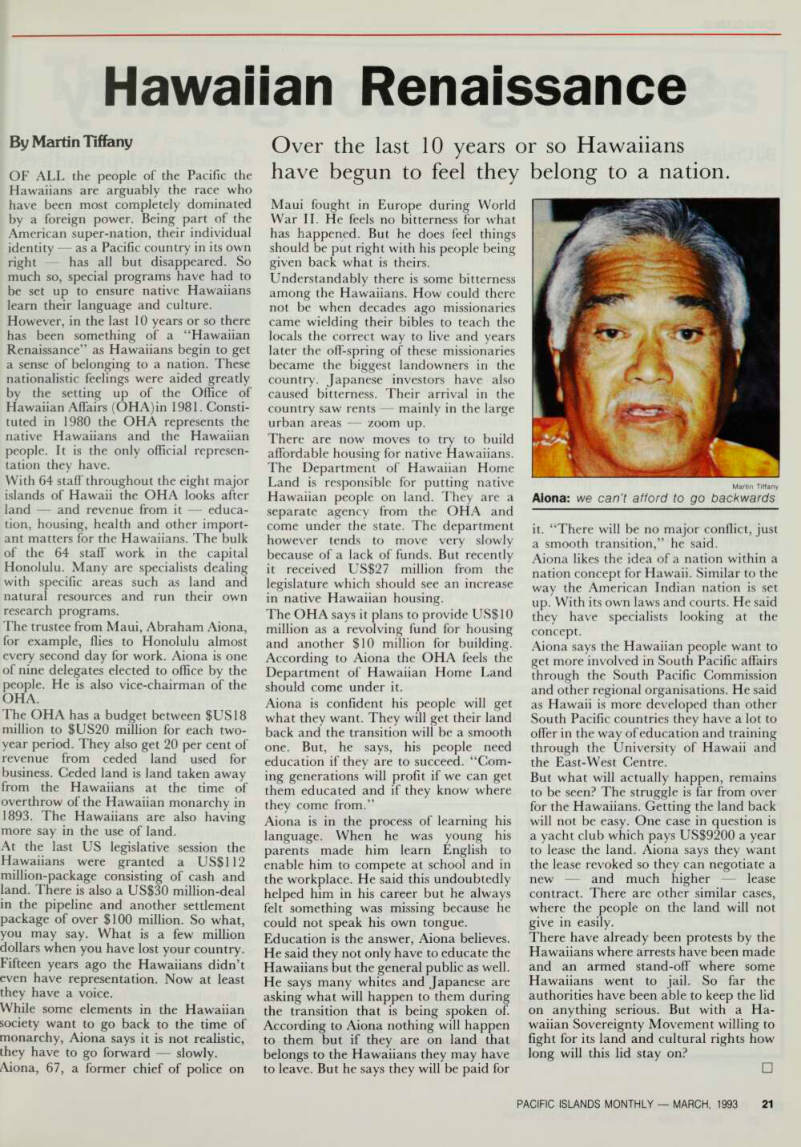
The trustee from Maui, Abraham Aiona, for example, flies to Honolulu almost every second day for work. Aiona is one of nine delegates elected to office by the people. He is also vice-chairman of the
Oha.
The OHA has a budget between SUSIB million to SUS2O million for each two year period. They also get 20 per cent of revenue from ceded land used for business. Ceded land is land taken away from the Hawaiians at the time of overthrow of the Hawaiian monarchy in 1893. The Hawaiians are also having more say in the use of land.
At the last US legislative session the Hawaiians were granted a US$ll2 million-package consisting of cash and land. There is also a US$3O million-deal in the pipeline and another settlement package of over $lOO million. So what, you may say. What is a few million dollars when you have lost your country.
Fifteen years ago the Hawaiians didn’t even have representation. Now at least they have a voice.
While some elements in the Hawaiian society want to go back to the time of monarchy, Aiona says it is not realistic, they have to go forward slowly.
Aiona, 67, a former chief of police on
Maui fought in Europe during World War 11. He feels no bitterness for what has happened. But he does feel things should be put right with his people being given back what is theirs.
Understandably there is some bitterness among the Hawaiians. How could there not be when decades ago missionaries came wielding their bibles to teach the locals the correct way to live and years later the off-spring of these missionaries became the biggest landowners in the country. Japanese investors have also caused bitterness. Their arrival in the country saw rents mainly in the large urban areas zoom up.
There are now moves to try to build affordable housing for native Hawaiians.
The Department of Hawaiian Home Land is responsible for putting native Hawaiian people on land. They are a separate agency from the OHA and come under the state. The department however tends to move very slowly because of a lack of funds. But recently it received US$27 million from the legislature which should see an increase in native Hawaiian housing.
The OHA says it plans to provide US$lO million as a revolving fund for housing and another $lO million for building.
According to Aiona the OHA feels the Department of Hawaiian Home Land should come under it.
Aiona is confident his people will get what they want. They will get their land back and the transition will be a smooth one. But, he says, his people need education if they are to succeed. “Com ing generations will profit if we can get them educated and if they know where they come from.”
Aiona is in the process of learning his language. When he was young his parents made him learn English to enable him to compete at school and in the workplace. He said this undoubtedly helped him in his career but he always felt something was missing because he could not speak his own tongue.
Education is the answer, Aiona believes.
He said they not only have to educate the Hawaiians but the general public as well.
He says many whites and Japanese are asking what will happen to them during the transition that is being spoken of.
According to Aiona nothing will happen
to them but if they are on land that belongs to the Hawaiians they may have to leave. But he says they will be paid for
it. “There will be no major conflict, just a smooth transition,” he said.
Aiona likes the idea of a nation within a nation concept for Hawaii. Similar to the way the American Indian nation is set up. With its own laws and courts. He said they have specialists looking at the concept.
Aiona says the Hawaiian people want to get more involved in South Pacific affairs through the South Pacific Commission and other regional organisations. He said as Hawaii is more developed than other South Pacific countries they have a lot to offer in the way of education and training through the University of Hawaii and the East-West Centre.
But what will actually happen, remains to be seen? The struggle is far from over for the Hawaiians. Getting the land back will not be easy. One case in question is a yacht club which pays US$92OO a year to lease the land. Aiona says they want the lease revoked so they can negotiate a new and much higher lease contract. There are other similar cases, where the people on the land will not give in easily.
There have already been protests by the Hawaiians where arrests have been made and an armed stand-off where some Hawaiians went to jail. So far the authorities have been able to keep the lid on anything serious. But with a Ha waiian Sovereignty Movement willing to fight for its land and cultural rights how long will this lid stay on? □
Martin Tiffany Aiona: we can’t afford to go backwards