A question of when
p. 20 · Read in the full issue
Sovereignty
The Hawaiian sovereignty movement steadily grows in Hawaii and on the US mainland.
By Mel Kemahan
THE MOOD was solemn this Sunday (Jan 17, 1993) afternoon as over 150 Hawaiians and friends, many clad in black, braved flood conditions to gather
at Loyola Marymount University
(LMU) to commemorate the 100th anniversary of the overthrow of Queen Lili’uokalani and discuss the Hawaiian
Sovereignty Movement.
Community leaders and individuals came from as far as San Diego, 100 miles away despite a winter storm that pummelled Southern California and Baja with rain and small tornadoes,
leaving highways impassable with
mudslides and flooding in places.
According to the 1990 census, 35,000 Hawaiians live in California, about one sixth of the total Hawaiian population.
There are only about 216,000 Native Hawaiians left among Hawaii’s million residents. The increasing vigor of the Sovereignty Movement in the island state has raised questions and anxieties among Native Hawaiians living overseas.
“Will we have a say in the process?”
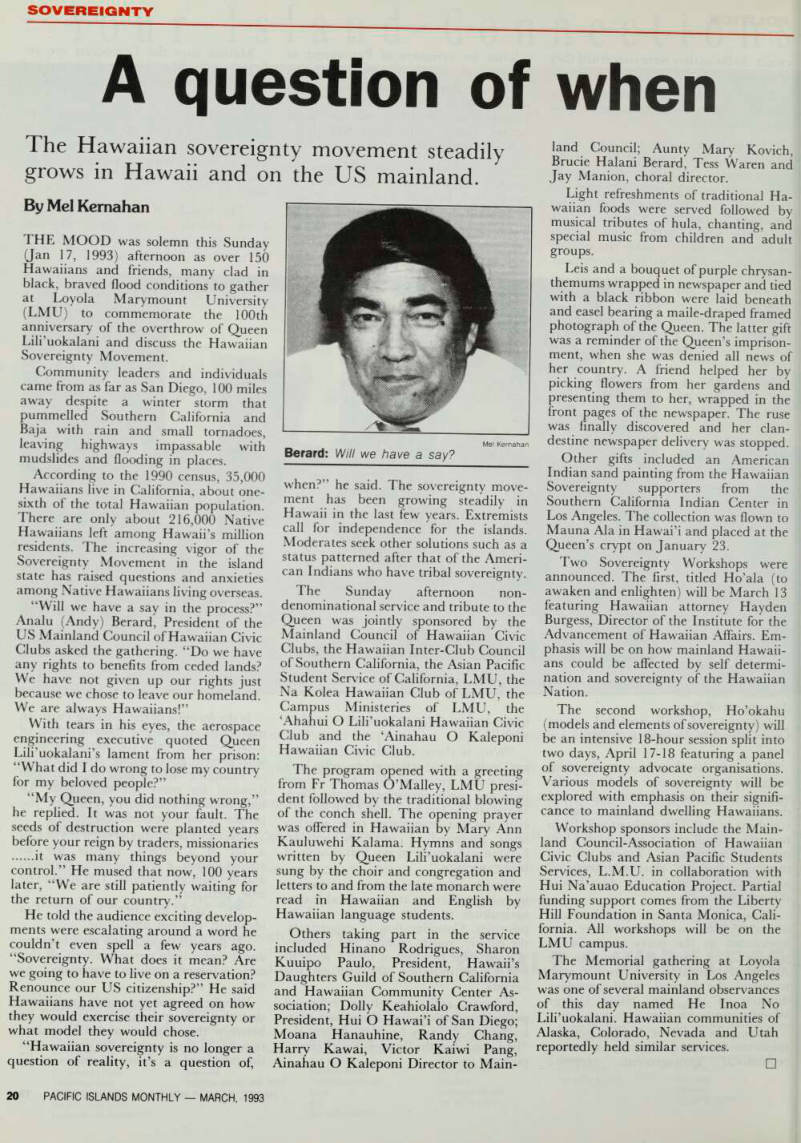
Analu (Andy) Berard, President of the US Mainland Council of Hawaiian Civic Clubs asked the gathering. “Do we have any rights to benefits from ceded lands?
We have not given up our rights just because we chose to leave our homeland.
We are always Hawaiians!”
With tears in his eyes, the aerospace
engineering executive quoted Queen
Lili’uokalani’s lament from her prison: “What did I do wrong to lose my country for my beloved people?”
“My Queen, you did nothing wrong,” he replied. It was not your fault. The seeds of destruction were planted years before your reign by traders, missionaries it was many things beyond your control.” He mused that now, 100 years later, “We are still patiently waiting for the return of our country.”
He told the audience exciting develop ments were escalating around a word he couldn’t even spell a few years ago.
“Sovereignty. What does it mean? Are we going to have to live on a reservation?
Renounce our US citizenship?” He said Hawaiians have not yet agreed on how they would exercise their sovereignty or what model they would chose.
“Hawaiian sovereignty is no longer a question of reality, it’s a question of,
when?” he said. The sovereignty move ment has been growing steadily in Hawaii in the last few years. Extremists call for independence for the islands.
Moderates seek other solutions such as a status patterned after that of the Ameri can Indians who have tribal sovereignty.
The Sunday afternoon non denominational service and tribute to the Queen was jointly sponsored by the Mainland Council of Hawaiian Civic Clubs, the Hawaiian Inter-Club Council of Southern California, the Asian Pacific Student Service of California, LMU, the Na Kolea Hawaiian Club of LMU, the Campus Ministeries of LMU, the ‘Ahahui O Lili’uokalani Hawaiian Civic Club and the ‘Ainahau O Kaleponi Hawaiian Civic Club.
The program opened with a greeting from Fr Thomas O’Malley, LMU presi dent followed by the traditional blowing of the conch shell. The opening prayer was offered in Hawaiian by Mary Ann Kauluwehi Kalama. Hymns and songs written by Queen Lili’uokalani were sung by the choir and congregation and letters to and from the late monarch were read in Hawaiian and English by Hawaiian language students.
Others taking part in the service included Hinano Rodrigues, Sharon Kuuipo Paulo, President, Hawaii’s Daughters Guild of Southern California and Hawaiian Community Center As sociation; Dolly Keahiolalo Crawford, President, Hui O Hawai’i of San Diego; Moana Hanauhine, Randy Chang, Harry Kawai, Victor Kaiwi Pang, Ainahau O Kaleponi Director to Main
land Council; Aunty Mary Kovich, Brucie Halani Berard, Tess Waren and Jay Manion, choral director.
Light refreshments of traditional Ha waiian foods were served followed by musical tributes of hula, chanting, and special music from children and adult groups.
Leis and a bouquet of purple chrysan themums wrapped in newspaper and tied with a black ribbon were laid beneath and easel bearing a maile-draped framed photograph of the Queen. The latter gift was a reminder of the Queen’s imprison ment, when she was denied all news of her country. A friend helped her by picking flowers from her gardens and presenting them to her, wrapped in the front pages of the newspaper. The ruse was finally discovered and her clan destine newspaper delivery was stopped.
Other gifts included an American Indian sand painting from the Hawaiian Sovereignty supporters from the Southern California Indian Center in Los Angeles. The collection was flown to Mauna Ala in Hawai’i and placed at the Queen’s crypt on January 23.
Two Sovereignty Workshops were
announced. The first, titled Ho’ala (to awaken and enlighten) will be March 13
featuring Hawaiian attorney Hayden
Burgess, Director of the Institute for the Advancement of Hawaiian Affairs. Em phasis will be on how mainland Hawaii ans could be affected by self determi nation and sovereignty of the Hawaiian Nation.
The second workshop, Ho’okahu (models and elements of sovereignty) will be an intensive 18-hour session split into two days, April 17-18 featuring a panel of sovereignty advocate organisations.
Various models of sovereignty will be explored with emphasis on their signifi cance to mainland dwelling Hawaiians.
Workshop sponsors include the Main land Council-Association of Hawaiian Civic Clubs and Asian Pacific Students Services, L.M.U. in collaboration with Hui Na’auao Education Project. Partial funding support comes from the Liberty Hill Foundation in Santa Monica, Cali fornia. All workshops will be on the LMU campus.
The Memorial gathering at Loyola Marymount University in Los Angeles was one of several mainland observances of this day named He Inoa No Lili’uokalani. Hawaiian communities of Alaska, Colorado, Nevada and Utah reportedly held similar services. □
Berard: Will we have a say?