Bad Boy George
pp. 17-19 · Read in the full issue

Politics
Controversial Atiu MP Norman George has finally secured party leadership.
By Christine Hatcher
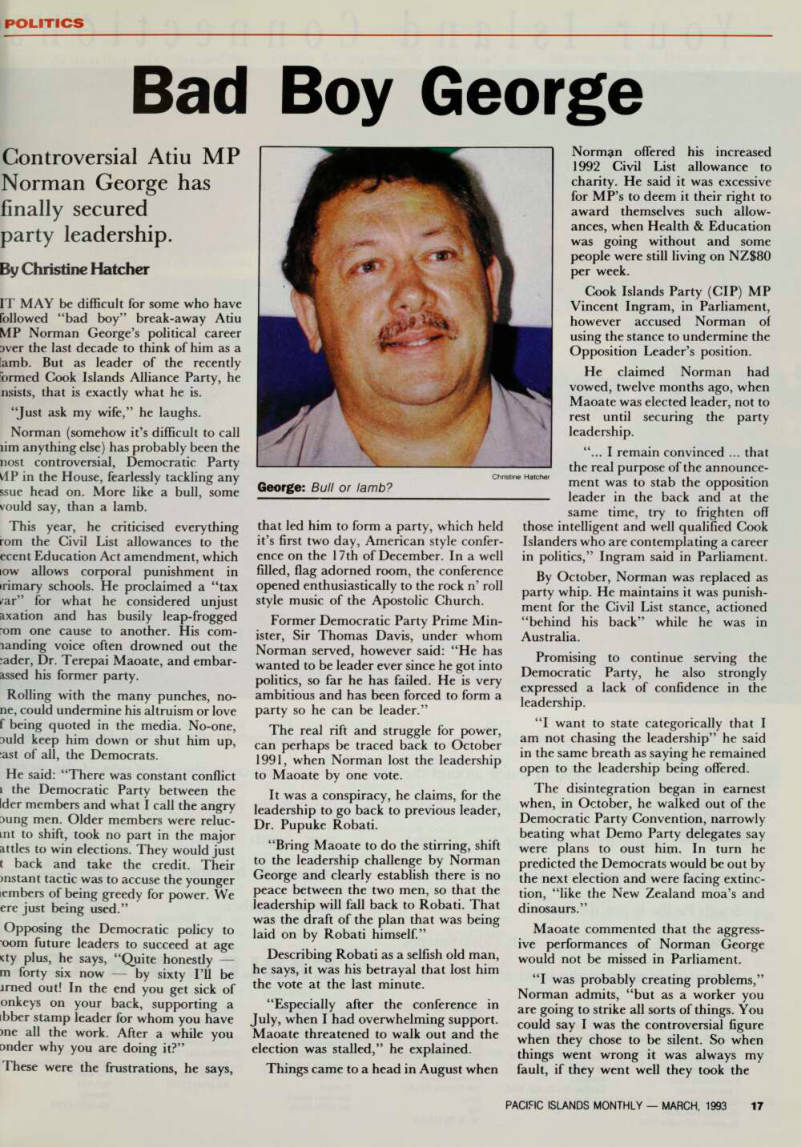
IT MAY be difficult for some who have followed “bad boy” break-away Atiu MP Norman George’s political career Dver the last decade to think of him as a lamb. But as leader of the recently brmed Cook Islands Alliance Party, he nsists, that is exactly what he is.
“Just ask my wife,” he laughs.
Norman (somehow it’s difficult to call lim anything else) has probably been the
nost controversial, Democratic Party
HP in the House, fearlessly tackling any ssue head on. More like a bull, some vould say, than a lamb.
This year, he criticised everything rom the Civil List allowances to the ecent Education Act amendment, which
iow allows corporal punishment in
irimary schools. He proclaimed a “tax far” for what he considered unjust axation and has busily leap-frogged "om one cause to another. His com landing voice often drowned out the :ader, Dr. Terepai Maoate, and embar assed his former party.
Rolling with the many punches, no ne, could undermine his altruism or love f being quoted in the media. No-one, Duld keep him down or shut him up, :ast of all, the Democrats.
He said: “There was constant conflict i the Democratic Party between the Ider members and what I call the angry Dung men. Older members were reluc mt to shift, took no part in the major attles to win elections. They would just t back and take the credit. Their mstant tactic was to accuse the younger icmbers of being greedy for power. We
ere just being used.”
Opposing the Democratic policy to oom future leaders to succeed at age
tty plus, he says, “Quite honestly
m forty six now by sixty I’ll be imed out! In the end you get sick of onkeys on your back, supporting a ibber stamp leader for whom you have me all the work. After a while you Dnder why you are doing it?”
These were the frustrations, he says,
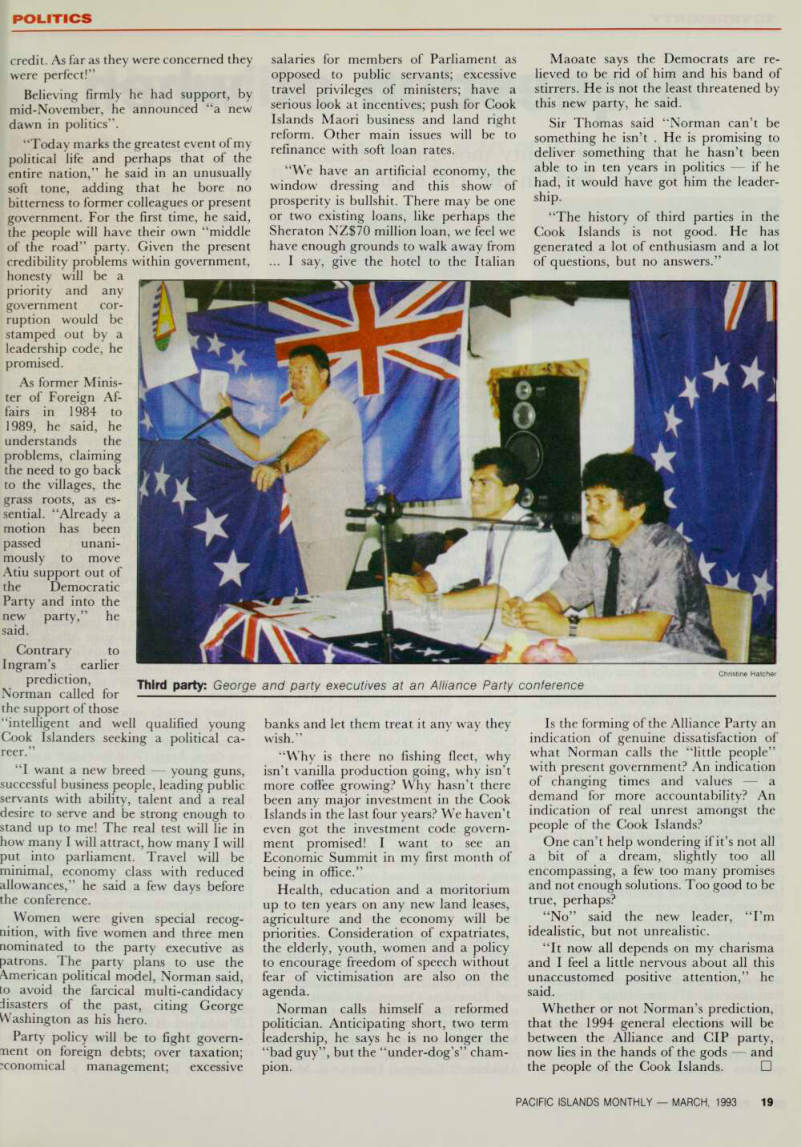
that led him to form a party, which held it’s first two day, American style confer ence on the 17th of December. In a well filled, flag adorned room, the conference opened enthusiastically to the rock n’ roll style music of the Apostolic Church.
Former Democratic Party Prime Min ister, Sir Thomas Davis, under whom Norman served, however said: “He has wanted to be leader ever since he got into politics, so far he has failed. He is very ambitious and has been forced to form a party so he can be leader.”
The real rift and struggle for power, can perhaps be traced back to October 1991, when Norman lost the leadership to Maoate by one vote.
It was a conspiracy, he claims, for the leadership to go back to previous leader, Dr. Pupuke Robati.
“Bring Maoate to do the stirring, shift to the leadership challenge by Norman George and clearly establish there is no peace between the two men, so that the leadership will fall back to Robati. That was the draft of the plan that was being laid on by Robati himself.”
Describing Robati as a selfish old man, he says, it was his betrayal that lost him the vote at the last minute.
“Especially after the conference in July, when I had overwhelming support.
Maoate threatened to walk out and the election was stalled,” he explained.
Things came to a head in August when
Norman offered his increased 1992 Civil List allowance to charity. He said it was excessive for MP’s to deem it their right to award themselves such allow ances, when Health & Education was going without and some people were still living on NZ$BO per week.
Cook Islands Party (CIP) MP Vincent Ingram, in Parliament, however accused Norman of using the stance to undermine the
Opposition Leader’s position.
He claimed Norman had vowed, twelve months ago, when Maoate was elected leader, not to rest until securing the party
leadership.
"... I remain convinced ... that the real purpose of the announce ment was to stab the opposition leader in the back and at the same time, try to frighten off
those intelligent and well qualified Cook Islanders who are contemplating a career in politics,” Ingram said in Parliament.
By October, Norman was replaced as party whip. He maintains it was punish ment for the Civil List stance, actioned “behind his back” while he was in Australia, Promising to continue serving the Democratic Party, he also strongly expressed a lack of confidence in the
leadership.
“I want to state categorically that I am not chasing the leadership” he said in the same breath as saying he remained open to the leadership being offered.
The disintegration began in earnest when, in October, he walked out of the Democratic Party Convention, narrowly beating what Demo Party delegates say were plans to oust him. In turn he predicted the Democrats would be out by the next election and were facing extinc tion, “like the New Zealand moa’s and dinosaurs.”
Maoate commented that the aggress ive performances of Norman George would not be missed in Parliament.
“I was probably creating problems,”
Norman admits, “but as a worker you are going to strike all sorts of things. You could say I was the controversial figure when they chose to be silent. So when things went wrong it was always my fault, if they went well they took the
George: Bull or lamb?
credit. As far as they were concerned they
were perfect!”
Believing firmly he had support, by mid-November, he announced “a new dawn in politics”.
“Today marks the greatest event of my political life and perhaps that of the entire nation,” he said in an unusually soft tone, adding that he bore no bitterness to former colleagues or present government. For the first time, he said, the people will have their own “middle of the road” party. Given the present credibility problems within government,
honesty will be a priority and any government cor ruption would be stamped out by a leadership code, he
promised.
As former Minis ter of Foreign Af fairs in 1984 to 1989, he said, he understands the problems, claiming the need to go back to the villages, the grass roots, as es sential. “Already a motion has been
passed unani
mously to move Atiu support out of the Democratic Party and into the new party,” he said.
Contrary to
Ingram’s earlier
prediction, Norman called for the support of those
“intelligent and well qualified young Cook Islanders seeking a political ca reer.”
“I want a new breed young guns,
successful business people, leading public
servants with ability, talent and a real desire to serve and be strong enough to stand up to me! The real test will lie in how many I will attract, how many I will put into parliament. Travel will be minimal, economy class with reduced allowances,” he said a few days before the conference.
Women were given special recog nition, with five women and three men nominated to the party executive as patrons. The party plans to use the American political model, Norman said, to avoid the farcical multi-candidacy disasters of the past, citing George Washington as his hero.
Party policy will be to fight govern ment on foreign debts; over taxation; economical management; excessive
salaries for members of Parliament as opposed to public servants; excessive travel Privileges of ministers; have a senous look at incentives; push for Cook Islands Maori business and land right re {? rm - ° ther main issues wiU be to reflnance wlth soft loan rates ' “We have an artificial economy, the window dressing and this show of prosperity is bullshit. There may be one or two existing loans, like perhaps the Sheraton NZS7O million loan, we feel we have enough grounds to walk away from ... I say, give the hotel to the Italian
banks and let them treat it any way they wish.”
“Why is there no fishing fleet, why isn’t vanilla production going, why isn’t more coffee growing? Why hasn’t there been any major investment in the Cook Islands in the last four years? We haven’t even got the investment code govern ment promised! I want to see an Economic Summit in my first month of being in office.”
Health, education and a moritorium up to ten years on any new land leases, agriculture and the economy will be priorities. Consideration of expatriates, the elderly, youth, women and a policy to encourage freedom of speech without fear of victimisation are also on the
agenda.
Norman calls himself a reformed politician. Anticipating short, two term leadership, he says he is no longer the “bad guy”, but the “under-dog’s” cham pion.
Maoate says the Democrats are re lieved to be rid of him and his band of stirrers. He is not the least threatened by this new party, he said, Sir Thomas said ‘ ‘Norman can’t be something he isn’t . He is promising to deliver something that he hasn’t been able *° in tf" Y ears m P olltlc ;> he bac b 11 would have got him the leader shi P “The history of third parties in the Cook Islands is not good. He has generated a lot of enthusiasm and a lot of questions, but no answers.”
Is the forming of the Alliance Party an indication of genuine dissatisfaction of what Norman calls the “little people” with present government? An indication of changing times and values a demand for more accountability? An indication of real unrest amongst the people of the Cook Islands?
One can’t help wondering if it’s not all a bit of a dream, slightly too all encompassing, a few too many promises and not enough solutions. Too good to be true, perhaps?
“No” said the new leader, “I’m idealistic, but not unrealistic.
“It now all depends on my charisma and I feel a little nervous about all this unaccustomed positive attention,” he said.
Whether or not Norman’s prediction, that the 1994 general elections will be between the Alliance and CIP party, now lies in the hands of the gods and the people of the Cook Islands. □
Christine Hatcher
Third party: George and party executives at an Alliance Party conference