Resourceful Initiative
p. 24 · Read in the full issue
Economy
By Liz Thompson
Non-Timber Forest Products offer a means to earn an income and maintain the resource
FOR a long time there have been questions surrounding the logging indus try in Papua New Guinea. The findings of the Barnett Inquiry commissioned in 1987 by Prime Minister Wingti pointed to massive corruption and inefficiency resulting in both a loss of revenue and valuable resources. The report stated that no timber operations were operating on a sustainable basis. For some time NGOs have criticised the exporting of raw timber, calling for an immediate ban and the setting up of secondary process ing and manufacturing. Various groups have also been looking into alternative sources of income for landowners, ap preciating that if people are to be encouraged not to sell their timber, even if the financial return is minimal, alterna tive sources of income need to be established.
In support of this idea, a grant of A$ 100,000 from AIDAB to research Non-Timber Forest Products in Papua New Guinea is a significant step in the right direction. Little recognition has been given to the value of Non-Timber Forest Products (NTFP) in subsistence economies. What the proper develop ment of NTFPs offers is the means for a community and country to earn an income and maintain the resource from which it is derived. As Jeff Sayer at the lUDN argues, they can be harvested without gross physical disruption to the forest. Their exploitation does not carry with it the risk of subsequent agricultural encroachment, nor does it open up the canopy and thus increase the risk of fire.
Harvesting, processing, marketing and use can be undertaken by rural and forest-dwelling people, thus not only exploiting the traditional skills of these sectors of society but also encouraging the maintenance of traditional know ledge. Harvesting systems for NTFP usually leave more benefits in the hands of local communities than is the case with industrial timber exploitation whose benefits accrue to the urban based
entrepreneurs” (Sayer 1990).
The grant has been given to the project partners the University of Papua New Guinea and the Melanesian Environment Foundation by AIDAB Environment Initiative. During the course of 18 months the program has a number of objectives to provide a comprehensive data base of NTFP avail able from the forests of Papua New
Guinea; to review the current and potential extent of national and export trade in these products and to recommend strategies for the development of products and marketing outlets; to conduct consultations with a range of representative communities on forest use; te organise workshops to disseminate the project’s findings and to produce a booklet appropriate for community and policy use.
The project will involve a number of stages, beginning with the training of NGOs and students who are involved with the collecting of information on the potential range and uses of NTFPs and questionaires will be developed for use in community consultations. A number of communities, representing a range of environment; and cultural systems within Papua New Guinea will be chosen and research will take place on two levels, economic and botanical. The “economic” being the exploration of markets for NTFPs and the “botanical” understanding just what is available within the forests. When the information has been collected workshops will be used to discuss the findings and to organise follow-on activities with communities, NGOs and government officials. The final booklet produced will appear in
both Tok Pigin and English.
Resource exploitation is a substantial part of the developing economies of countries like Papua New Guinea. Whilst people are concerned about the destruc tion of forests the situation will only be improved by offering economic alterna tives. Obviously secondary processing as opposed to the export of raw timber is a necessary step but the potential and validity of manufacturing NTFP is only just being appreciated. According to a Utiited Nations survey in 1980 the total value of world trade in medicinal plants was US$55O million. The insect market is valued at US$lOO million a year and shiitake mushrooms have potential US$2B million annual market. In 1987 Indonesia exported a total of US$23B million worth of NTFP. Papua New Guinea has enormous potential to be come involved in these markets with the export of fragrant barks (for example, massoy and cinnamon); copal gum; insects; rattan; nuts (galip and okan); orchids; medicinal plants; tannins; san dalwood; mushrooms; sago; betel nuts and fruits. □ • This article is based on ideas put forward in a proposal by Paul Chatterton
To Aidab
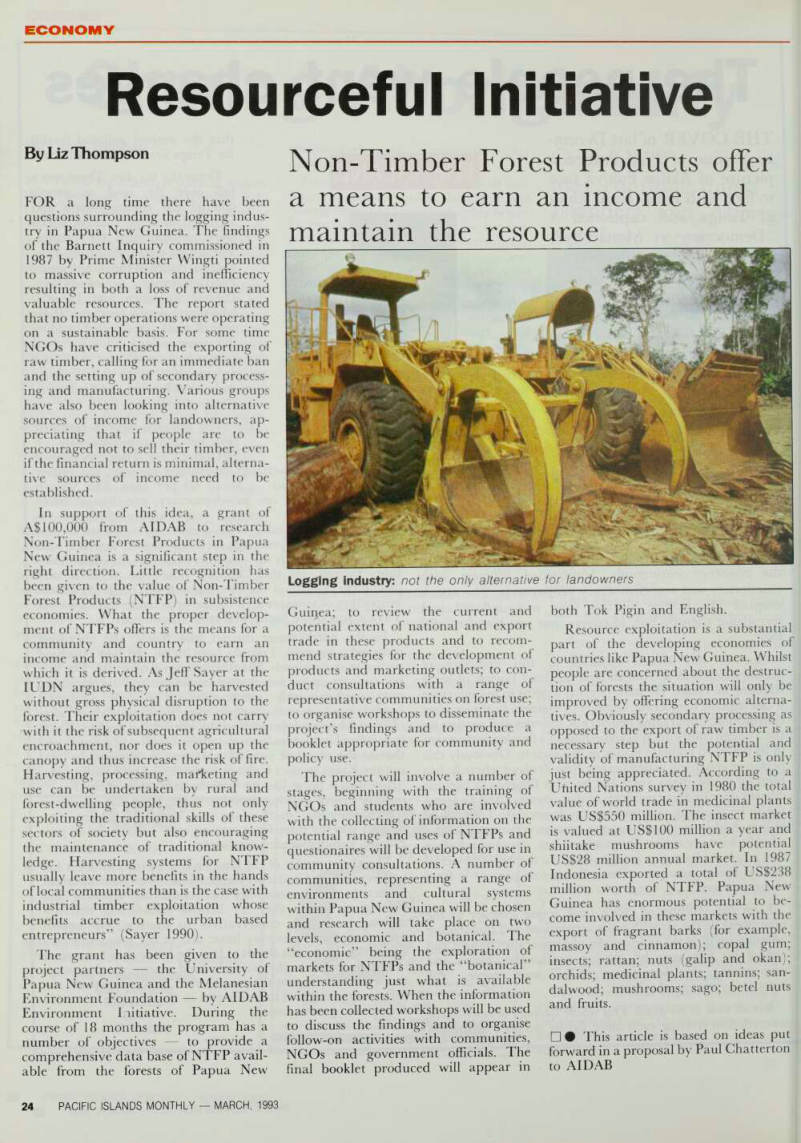
Logging industry: not the only alternative for landowners