Monopoly is out
p. 21 · Read in the full issue
Television
By Mala Jagmohan
After years of indecision and debate on the country’s television service the Fiji government has surprised many by offering licences to all interested.
AFTER years of debate, decision and its fair amount of controversy, the Fiji government appears finally on the way to making a decision on the future of the country’s television service. And the decision, likely to come as a surprise to many of those who had tendered for the rights to broadcast, is likely to be announced in the next month.
While for years the companies, which had tendered, had banked on operating as a monopoly, the new line of govern ment thought is likely to come as a jolt to a few of them.
PIM has managed to establish the new approach is to do away with the idea of granting any one company exclusive rights for a specified period of time, say 12 years, to control television services in
Fiji.
Instead, the government has now decided it would be wiser to grant licences to all companies which come forward with viable proposals and agree to operate under guidelines set down by the government.
“Open it up, that’s what we want to do,” said Fiji’s Prime Minister, Sitiveni
Rabuka. “There has been far too much lobbying by the various companies.”
The lobbying has made the govern ment aware of the virtues of many of them; that more than one was offering a good deal. So, rather than limit the choice to one, the government is willing to give them all a shot at it. In this way, the government feels, only those serious enough about setting up the service and with the resources to do so would come forward. It would rule out companies who were banking on surviving on the basis of the exclusive rights alone.
This will definitely be good news to the viewer not only will he have a choice in what he wants to watch, but the competition is likely to ensure better quality in programs.
“The best will survive. Who says the laws of the jungle cannot be applied here?” he says with a chuckle.
Government control is expected to be regulatory only again a departure from former government views that it should also have some shareholding in the new venture. After the financial mess the government-owned Fiji Broadcasting Commission built up over the years, it has become wary of any financial involvement in the deal.
But, the government has not veered from its initial stance that the company which granted the rights must look at providing services to as wide an audience as possible, to include programs which enhance local culture and tradition and to provide skills and expertise to local staff both technical and in producing programs.
In addition the government is looking at the venture as providing a social service to the people, a service which can be developed to meet the needs of the people. This will invariably mean the inclusion of educational programs reach ing as much of the rural population as
possible.
Television New Zealand, which has been providing a “temporary” service since October, 1991, and costing the government more than $BO,OOO a month to provide the service, appears unlikely to take up the offer on a permanent basis.
For one, it is more keen to enter into a partnership with the local government in providing the service. And the network is not exactly known for producing its own programs an aspect the govern ment is looking for to use in developing local programs.
Late last year Cabinet had announced it would be reviewing television services here and fresh tenders would be called to allow it to make a decision. The government had also announced it would not be directly involved financially in the operation, but would leave it entirely to the private sector. This is in line with an overall policy of privatising some of its own departments.
But it would ensure regular services were maintained and nationwide cover age available within a reasonable time.
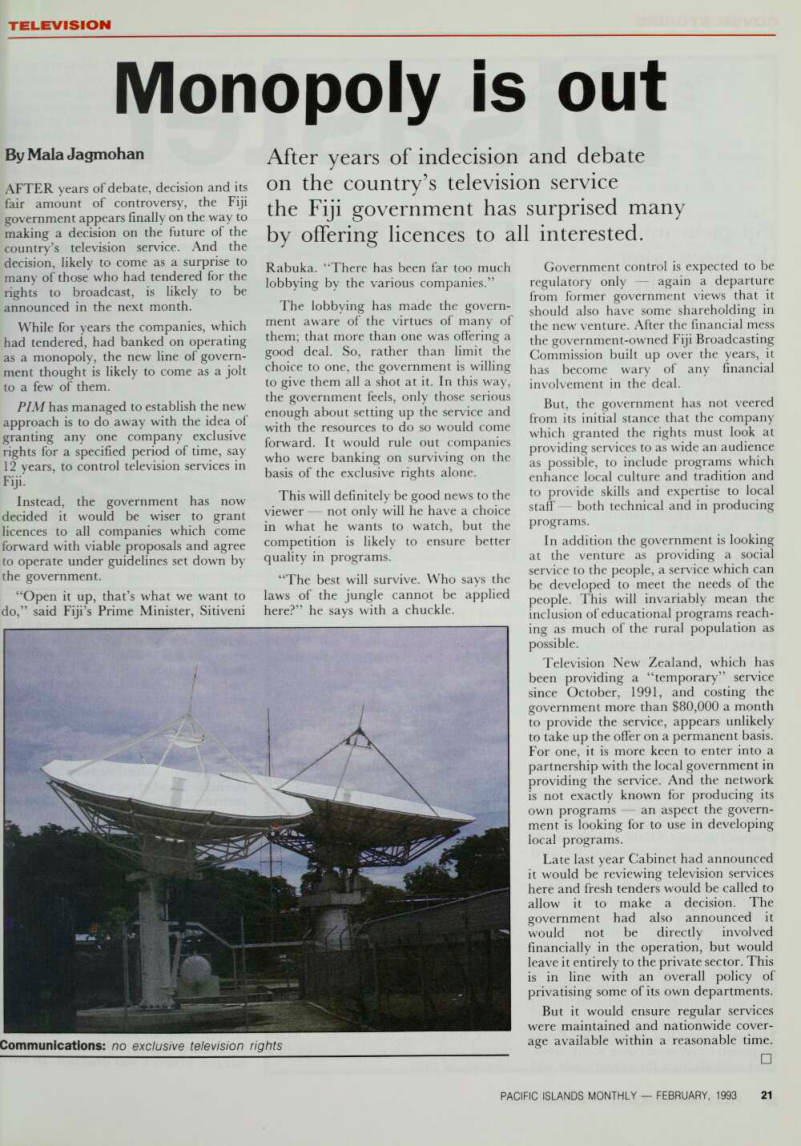
Communications: no exclusive television rights