Selling off the
pp. 18-19 · Read in the full issue
Business
By Roman Grynberg
WHEREAS you almost never get a yawn when the government tries to sell off the nation’s telephone service, you can visibly raise blood pressures when the government tries to sell off the nation’s airlines.
This national reflex to protect the flag has been clearly evident in Honi ara over the last few months where one of the hottest questions around town was who was going to buy the nation’s ailing flag carrier Solomon Airlines.
The second hottest question was just how much the government was going to lose on the deal.
Solomon Airlines has been seriously in the red since it started its international operations in 1990. The now well known 737-200 has provided a valuable east west link across the Pacific joining New Zealand, Fiji, Vanuatu, Solomon Islands, Papua New Guinea and Austra lia for the last two years.
However, like most ventures that have tried to link the Pacific in the east west direction, Solomon Airlines got itself into trouble because there has simply not been the ‘BIS’ (‘bums in seats’ as it is called in the airline industry).
The entry of the Solomon Islands government into the airline business was in large measure a product of happenstance. In 1987 the government bought Buchanan’s (of Talair fame) shares in Solair and began running the domestic service.
According to Solomon Airlines, Buchanan left the government one Queenair, one Aztec and two Islanders.
Soon after the take-over, the company bought two Twin Otters and sold the Queenair. The purchases were funded by on-shore loans at high interest rates.
In addition, says the airline, Buchanan after having four years of negotiation to sell, left the company with some S 3 million in debts and other liabilities and left its worst fleet in the Solomon Islands.
This then created huge costs in upgrad ing and refurbishing the Islanders and Aztecs.
For its efforts Solomon Airlines lost $81300,000 in 1987 and a further $81500,000 in 1988. In 1989 the com pany turned a small profit of $50,000 and then when it started its international
services it began to make substantial losses.
In 1991 the losses were approximately SSIS million and this is expected to grow to SSIB million when the results for 1992 are finalised. The exponential growth in debts is what caused the government to call for tenders for 70 per cent of its share in the company.
How did, a well run airline with what is universally considered to be excellent in-ffight service get itself into such a mess? There are a number of expla nations depending upon who you talk to.
The first that is given by the airline is that it has made such substantial and unexpected losses because it was not able to fill its aircraft. On average the capacity utilisation of Solomon Airlines
has, according to the airline, been in tt vicinity of 40 per cent, with lower lev\ of utilisation in some months and some sectors.
The airline in turn has suggested tH it has not been able to sell seats on o aeroplane because it claims there s simply not enough beds in Honiara on the Solomons to support the curre service. One spokesman said, “If tt government had gone ahead with
1990 five-year tourism development pll
and provided the 200 four-star beds Guadalcanal that it assured us would built, we would not have this problem The response of Solomon Island go ernment officials to the line of reasonii was that the explanation offered Solomon Airlines management was “o
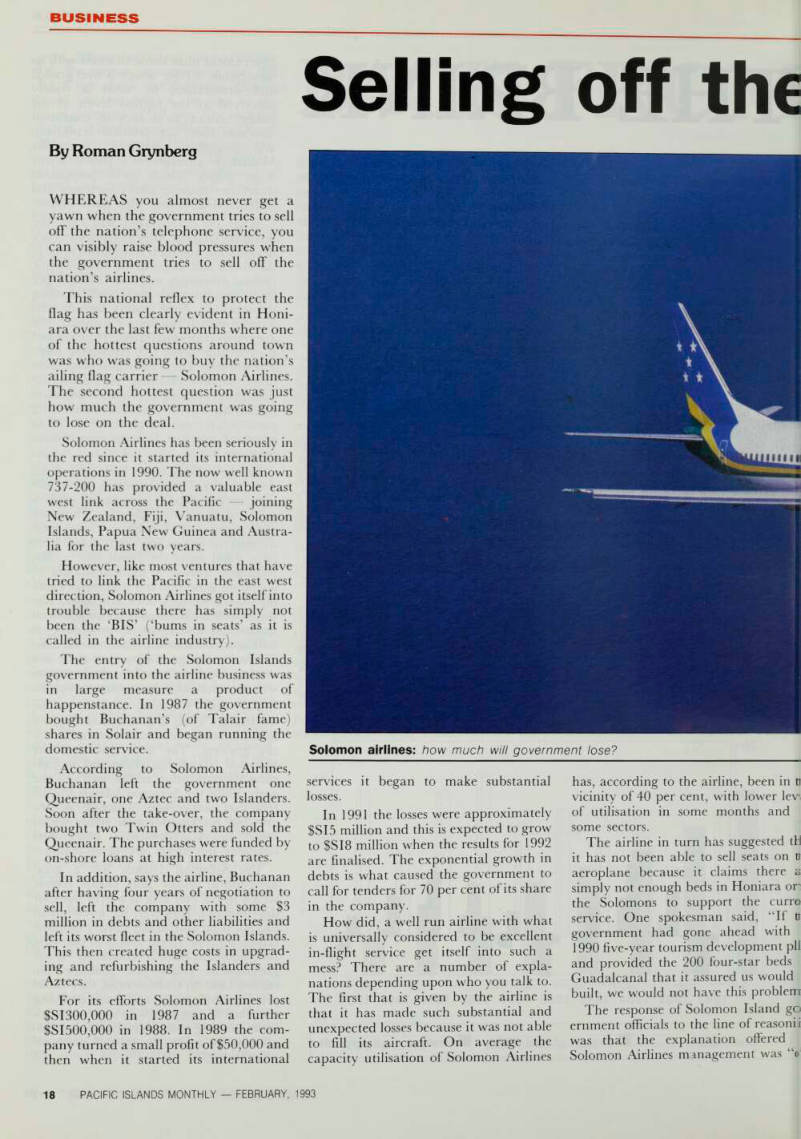
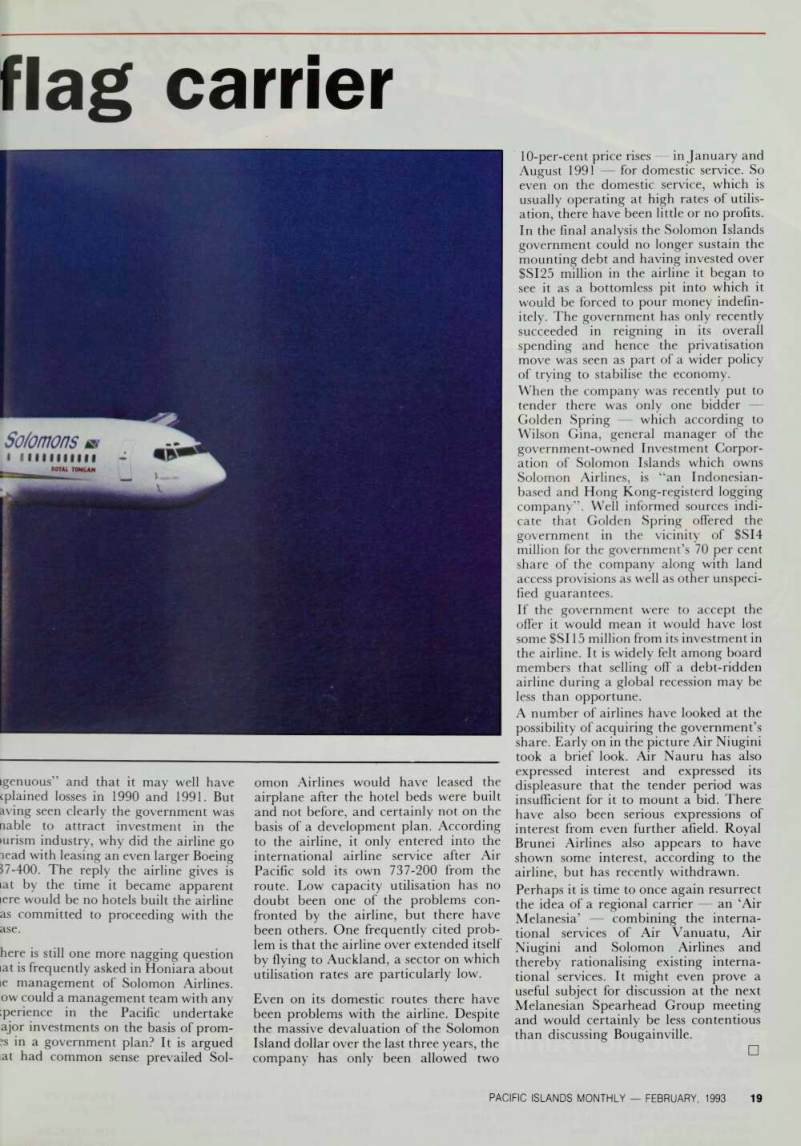
Solomon airlines: how much will government lose?
igenuous” and that it may well have (plained losses in 1990 and 1991. But aving seen clearly the government was nable to attract investment in the •urism industry, why did the airline go lead with leasing an even larger Boeing 17-400. The reply the airline gives is lat by the time it became apparent icre would be no hotels built the airline as committed to proceeding with the ase. here is still one more nagging question lat is frequently asked in Honiara about ie management of Solomon Airlines, ow could a management team with any :perience in the Pacific undertake ajor investments on the basis of prom ts in a government plan? It is argued at had common sense prevailed Sol
omon Airlines would have leased the airplane after the hotel beds were built and not before, and certainly not on the basis of a development plan. According to the airline, it only entered into the international airline service after Air Pacific sold its own 737-200 from the route. Low capacity utilisation has no doubt been one of the problems con fronted by the airline, but there have been others. One frequently cited prob lem is that the airline over extended itself by flying to Auckland, a sector on which utilisation rates are particularly low.
Even on its domestic routes there have been problems with the airline. Despite the massive devaluation of the Solomon Island dollar over the last three years, the company has only been allowed two
10-per-cent price rises in January and August 1991 for domestic service. So even on the domestic service, which is usually operating at high rates of utilis ation, there have been little or no profits.
In the final analysis the Solomon Islands government could no longer sustain the mounting debt and having invested over SSI2S million in the airline it began to see it as a bottomless pit into which it would be forced to pour money indefin itely. The government has only recently succeeded in reigning in its overall spending and hence the privatisation move was seen as part of a wider policy of trying to stabilise the economy.
When the company was recently put to tender there was only one bidder - Golden Spring which according to Wilson Gina, general manager of the government-owned Investment Corpor ation of Solomon Islands which owns Solomon Airlines, is “an Indonesian based and Hong Kong-registerd logging company”. Well informed sources indi cate that Golden Spring offered the government in the vicinity of SSI4 million for the government’s 70 per cent share of the company along with land access provisions as well as other unspeci fied guarantees.
If the government were to accept the offer it would mean it would have lost some SSI 15 million from its investment in the airline. It is widely felt among board members that selling off a debt-ridden airline during a global recession may be less than opportune.
A number of airlines have looked at the
possibility of acquiring the government’s
share. Early on in the picture Air Niugini took a brief look. Air Nauru has also expressed interest and expressed its displeasure that the tender period was insufficient for it to mount a bid. There have also been serious expressions of interest from even further afield. Royal Brunei Airlines also appears to have shown some interest, according to the airline, but has recently withdrawn.
Perhaps it is time to once again resurrect the idea of a regional carrier an ‘Air Melanesia’ combining the interna tional services of Air Vanuatu, Air Niugini and Solomon Airlines and thereby rationalising existing interna tional services. It might even prove a useful subject for discussion at the next
Melanesian Spearhead Group meeting
and would certainly be less contentious than discussing Bougainville.