Back From
pp. 16-17 · Read in the full issue
Economy
ONE year ago there was not a sober economic commentator who did not think the Solomon Islands would become one of the first of the island countries to fall into “the clutches of the International Monetary Fund (IMF)”. At the end of 1991 the economic situation was grave indeed. The foreign exchange reserves in December were at record lows representing a little over two weeks import cover. At its most recent peak in late 1986 by comparison, the country had nearly five months import cover a figure normally considered to be quite healthy by international stan dards.
By September of 1992 the Solomon Islands appears to have pulled back temporarily from the brink of economic disaster with external reserves recovering at the end of the third quarter of 1992 to over 51554.6 million, which was slightly over 1.5 months cover and there appear to be some initial signs that there may actually be a longer term real recovery in the economy.
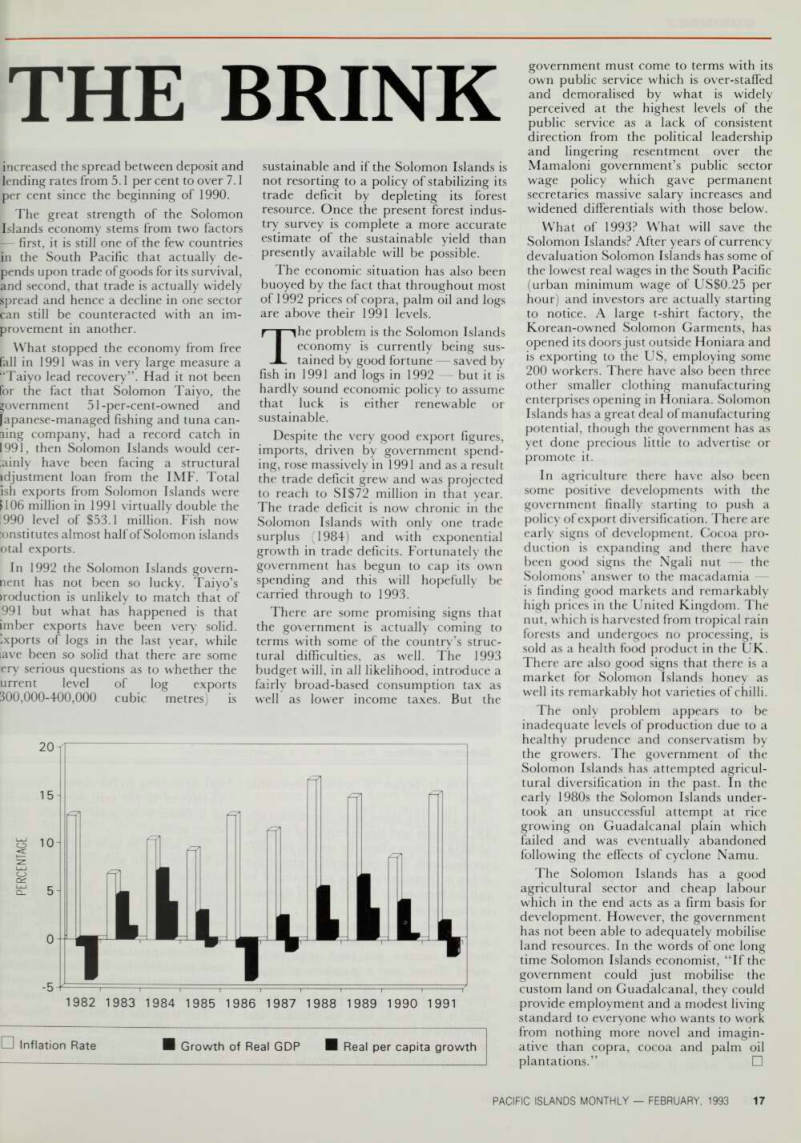
Economic growth in the Solomon Islands has been erratic in the past five years with real GDP growth varying from quite respectable levels of 6.5 per cent in 1989 to very low levels of 1.8 per cent in 1991. In terms of per capita GDP, the Solomon Islands, with a population growth of over 3.5 per cent has basically stood dead in the water with the standard of living neither rising nor
declining.
The reason for the apparent failure of the Solomon Islands economy to exhibit any real per capita growth over the last five years stems from two factors. The most important reason must be the very serious deterioration in the nation’s terms of trade (export price divided by import price). Using 1985 as a base year of 100 the terms of trade had deteriorated to 50 by 1991. In other words, the Solomon Islands had to export twice as much copra, fish and palm oil in 1991 as it did in 1985 just to buy the same quantity of
imports.
With the exception of 1987 the terms of trade of Solomon Islands have deterio rated every year since 1985. While government policy in the Solomon Islands cannot be blamed for the appar ent deterioration in the terms of trade, there can be no doubt the situation would have been better had the govern ment been able to further stimulate export volumes which showed a modest four per cent growth rate over the period.
For decades resource exporting countries in Africa and the South Pacific have used the deterioration in the terms of trade as a justification for their apparent policy paralysis. The argument goes that because import prices have risen more rapidly than export prices
there is nothing the government can do to maintain living standards. The retort that if the deterioration is structural or permanent governments should then find new export sectors is usually met by the stock reply that this is the job of the private sector. Of late this type of argument comes from even fairly developed resource exporting countries such as Australia, New Zealand and Canada when the government wishes to explain the apparent deterioration of living standards.
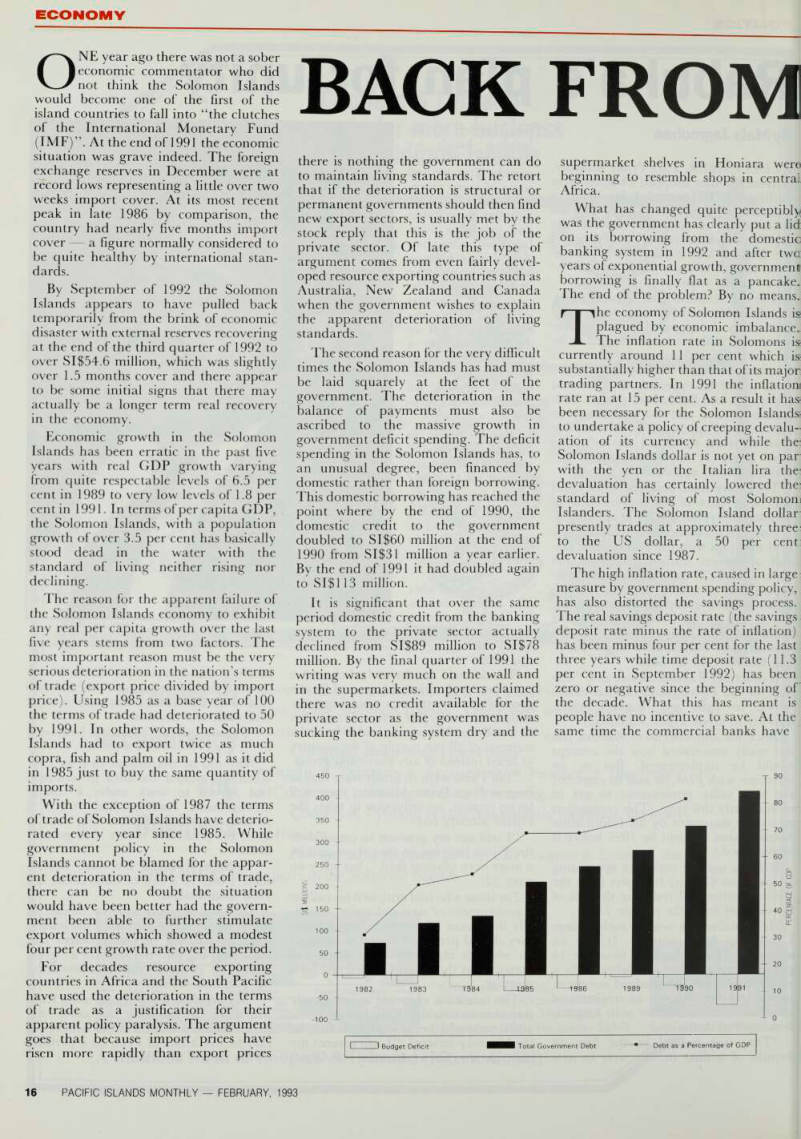
The second reason for the very difficult times the Solomon Islands has had must be laid squarely at the feet of the government. The deterioration in the balance of payments must also be ascribed to the massive growth in government deficit spending. The deficit spending in the Solomon Islands has, to an unusual degree, been financed by domestic rather than foreign borrowing.
This domestic borrowing has reached the point where by the end of 1990, the domestic credit to the government doubled to Sls6o million at the end of 1990 from Sls3l million a year earlier, By the end of 1991 it had doubled again to SIS 113 million.
It is significant that over the same period domestic credit from the banking system to the private sector actually declined from SISB9 million to SIS7B million. By the final quarter of 1991 the writing was very much on the wall and in the supermarkets. Importers claimed there was no credit available for the private sector as the government was sucking the banking system dry and the
supermarket shelves in Honiara were beginning to resemble shops in central Africa.
What has changed quite perceptibly was the government has clearly put a lid on its borrowing from the domestic banking system in 1992 and after twee years of exponential growth, government! borrowing is finally flat as a pancake.
The end of the problem? By no means.
The economy of Solomon Islands is plagued by economic imbalance..
The inflation rate in Solomons is currently around 11 per cent which is substantially higher than that of its major trading partners. In 1991 the inflationi rate ran at 15 per cent. As a result it has* been necessary for the Solomon Islands* to undertake a policy of creeping devalu ation of its currency and while the!
Solomon Islands dollar is not yet on par with the yen or the Italian lira the; devaluation has certainly lowered the; standard of living of most Sblomom Islanders. The Solomon Island dollar presently trades at approximately three; to the US dollar, a 50 per cent: devaluation since 1987.
The high inflation rate, caused in large;
measure by government spending policy,
has also distorted the savings process.
The real savings deposit rate (the savings; deposit rate minus the rate of inflation) has been minus four per cent for the last three years while time deposit rate (11.3 per cent in September 1992) has been zero or negative since the beginning of the decade. What this has meant is people have no incentive to save. At the same time the commercial banks have
increased the spread between deposit and lending rates from 5.1 per cent to over 7.1 per cent since the beginning of 1990.
The great strength of the Solomon Islands economy stems from two factors first, it is still one of the few countries in the South Pacific that actually de pends upon trade of goods for its survival, and second, that trade is actually widely spread and hence a decline in one sector can still be counteracted with an im provement in another.
What stopped the economy from free fall in 1991 was in very large measure a “Taiyo lead recovery”. Had it not been for the fact that Solomon Taiyo, the government 51-per-cent-owned and fapanese-managed fishing and tuna can ning company, had a record catch in 1991, then Solomon Islands would cer :ainly have been facing a structural idjustment loan from the IMF. Total ish exports from Solomon Islands were MO6 million in 1991 virtually double the '990 level of $53.1 million. Fish now :onstitutes almost half of Solomon islands otal exports.
In 1992 the Solomon Islands govern nent has not been so lucky. Taiyo’s •reduction is unlikely to match that of 991 but what has happened is that imber exports have been very solid.
Exports of logs in the last year, while lave been so solid that there are some ery serious questions as to whether the urrent level of log exports 300,000-400,000 cubic metres) is
sustainable and if the Solomon Islands is not resorting to a policy of stabilizing its trade deficit by depleting its forest resource. Once the present forest indus try survey is complete a more accurate estimate of the sustainable yield than presently available will be possible.
The economic situation has also been buoyed by the fact that throughout most of 1992 prices of copra, palm oil and logs are above their 1991 levels.
The problem is the Solomon Islands economy is currently being sus tained by good fortune saved by fish in 1991 and logs in 1992 but it is hardly sound economic policy to assume that luck is either renewable or sustainable.
Despite the very good export figures, imports, driven by government spend ing, rose massively in 1991 and as a result the trade deficit grew and was projected to reach to Sls72 million in that year.
The trade deficit is now chronic in the Solomon Islands with only one trade surplus (1984) and with exponential growth in trade deficits. Fortunately the government has begun to cap its own spending and this will hopefully be carried through to 1993.
There are some promising signs that the government is actually coming to terms with some of the country’s struc tural difficulties, as well. The 1993 budget will, in all likelihood, introduce a fairly broad-based consumption tax as well as lower income taxes. But the
government must come to terms with its own public service which is over-staffed and demoralised by what is widely perceived at the highest levels of the public service as a lack of consistent direction from the political leadership and lingering resentment over the Mamaloni government’s public sector wage policy which gave permanent secretaries massive salary increases and widened differentials with those below.
What of 1993? What will save the Solomon Islands? After years of currency devaluation Solomon Islands has some of the lowest real wages in the South Pacific (urban minimum wage of US$O.25 per hour) and investors are actually starting to notice. A large t-shirt factory, the Korean-owned Solomon Garments, has opened its doors just outside Honiara and is exporting to the US, employing some 200 workers. There have also been three other smaller clothing manufacturing enterprises opening in Honiara. Solomon Islands has a great deal of manufacturing potential, though the government has as yet done precious little to advertise or promote it.
In agriculture there have also been some positive developments with the government finally starting to push a policy of export diversification. There are early signs of development. Cocoa pro duction is expanding and there have been good signs the Ngali nut the Solomons’ answer to the macadamia is finding good markets and remarkably high prices in the United Kingdom. The nut, which is harvested from tropical rain forests and undergoes no processing, is sold as a health food product in the UK.
There are also good signs that there is a market for Solomon Islands honey as well its remarkably hot varieties of chilli.
The only problem appears to be inadequate levels of production due to a healthy prudence and conservatism by the growers. The government of the Solomon Islands has attempted agricul tural diversification in the past. In the early 1980 s the Solomon Islands under took an unsuccessful attempt at rice growing on Guadalcanal plain which failed and was eventually abandoned following the effects of cyclone Namu.
The Solomon Islands has a good agricultural sector and cheap labour which in the end acts as a firm basis for development. However, the government has not been able to adequately mobilise land resources. In the words of one long time Solomon Islands economist, “If the government could just mobilise the custom land on Guadalcanal, they could provide employment and a modest living standard to everyone who wants to work from nothing more novel and imagin ative than copra, cocoa and palm oil plantations.” □