Rabuka’s plan for unity
p. 15 · Read in the full issue
By Mala Jagmohan
IN DECEMBER, Fiji’s Prime Minister, Sitiveni Rabuka, dropped a bombshell in parliament. He extended his hand to members of the Opposition to join his government, a coalition between the Soqosoqo ni Vakavulewa ni Taukei Party and the General Voters Party, in a govern ment of national unity for the good of the future of the country.
The call stunned most of parliament, especially his own party members, and the nation. It appeared as a complete about turn in the attitudes fostered so far that a Fijian-dominated government was in the interest of the country.
As would be expected, the National Federation and Fiji Labour parties, both Indian parties and both destined to remain in the opposition for the next five years at least, welcomed the call. The third group in opposition, Fijian na tionalists, were appalled.
They have since announced they will not be a part of the government of national unity, but remain in opposition.
Since his announcement, Rabuka has held meetings with the government side and opposition leaders to discuss the idea. The SVT has unanimously wel comed the proposal. But the ethnic- Fijian pressure group, the Taukei Move ment, set up in 1987 protesting the formation of an Indian-dominated gov ernment and instrumental in its down fall, has rejected the idea.
It describes Rabuka’s move as a “sell out” of the Fijian people and is deter mined to fight any attempt which appears to erode Fijian supremacy.
Since his announcement Rabuka has not really announced how the concept would be implemented. But in an interview with PIM, he said he expected the new unity government to get in motion early this year. (This contradicts an earlier statement by his Information Minister that it could be 1994 before it
materialised.)
Rabuka says he envisages appointing at least two Cabinet ministers from the Indian parties and reducing the size of his Cabinet from the present 27.
He explained he needed such a large Cabinet to help settle in. It was an attempt to have members from the 14 provinces represented in Cabinet. As a result there were fully-fledged ministers, junior ministers known as ministers of state and even a minister with unspeci fied “special duties”.
“That was needed in the first six months of settling in. We were in new
jobs, needed all the helping hands we could get. “Now six months later, we find some of these minis ters cannot work together, some duties and portfolios over lap, now I know bet ter. “I may have to withdraw some of the appointments, es pecially of ministers of state. That’s the difficult part, but we do have too big a Cabinet for the small nation,” said Ra buka. “Besides we cannot satisfy every body.”
Was he trying to
“satisfy everybody”
when he initially ap pointed his Cabinet?
“Yes, that’s why we had such a big Cabinet. We had to get everybody started on the right foot.
“But we are, after all, human beings.
We change, we grow, we discard. We re spond to changing situations.”
Rabuka said he sincerely believed a government of national unity was for the good of the country as a whole, not any select community. He believed, now that he was Prime Minister he had to have the interests of all the people of the country at heart instead of any particular group.
“But I also want to firmly state that as long as I am Prime Minister, there will be no erosion, no reduction in what the Fijians already have.
“I will use my position to consolidate the Fijian interests so that there can be a more even playing field.”( See story on page 32).
For those who had criticised his call for a government of national unity, especi ally the Taukei Movement, Rabuka said they should prepare a sound submission on why his idea would not work and present it at the Great Council of Chiefs meeting.
The council is expected to meet early this year to consider Rabuka’s proposal and decide whether it would, in fact, be the best way forward. “I will present my case at the Great Council of Chiefs
meeting, and I expect the Taukei Move ment, if they hav e any grievances, to do so as well. The council can act as a court and make the decision.
“I made the call because I believe in it.”
Why did he not believe in it in 1987 when the ousted Bavadra government had agreed to work under a similar arrangement. Rabuka had staged a second coup in September that year to avert the possibility of any such govern ment.
“Because it would not have worked then. I believe it can be done under the 1990 Constitution.”
To his detractors and to threats of attempts to topple him from his leader ship, he said his biggest problem had been stepping into the shoes of a “great statesman”, former Prime Minister Ratu Sir Kamisese Mara.
“My problem is people are using Ratu Mara as a yardstick to assess my performance. I don’t want to believe I’ll ever be like him. All I can do is perform to the best of my ability.” □
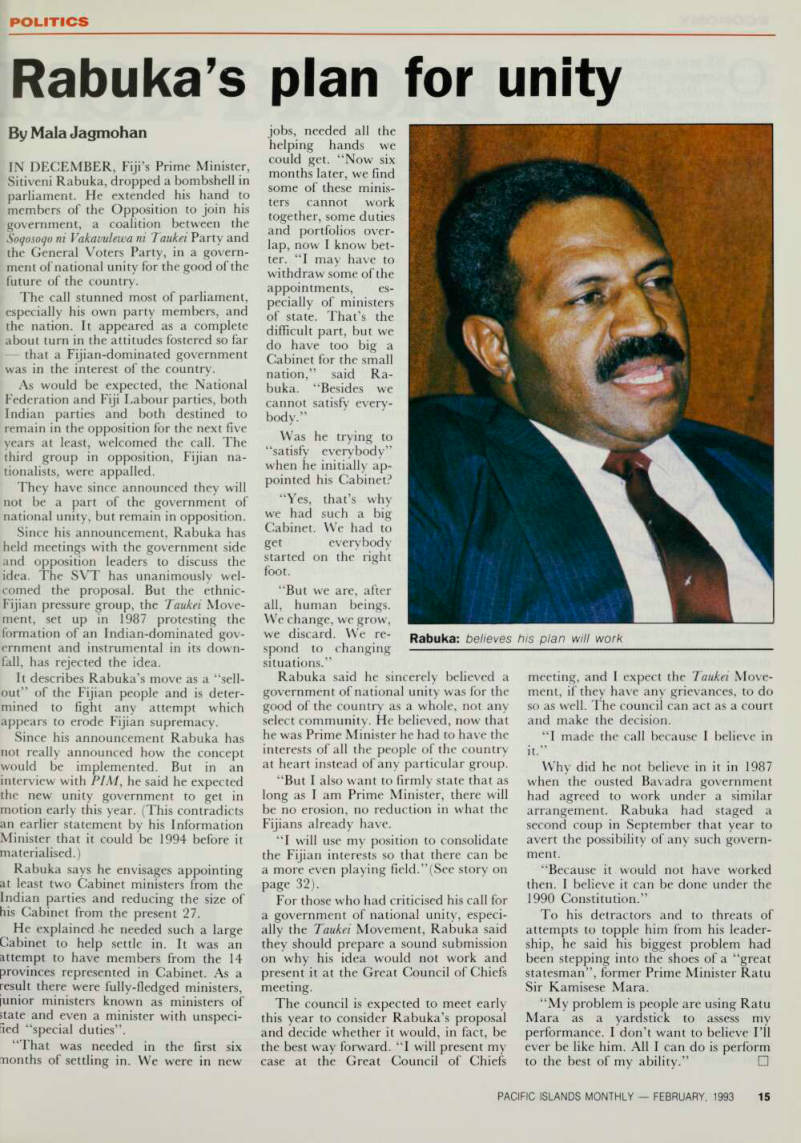
Rabuka: believes his plan will work