Disaster
pp. 22-23 · Read in the full issue
Cover Stories
Fiji picks up the pieces after the onslaught of Cyclone Kina.
By Martin Tiffany
EVEN describing Cyclone Kina and its aftermath as a disaster seems to be putting it mildly. The death, desolation and despair the cyclone left behind when it pulverised Fiji on January 2 and 3 is hard to describe.
Whole villages washed away, 21 people dead and the number rising at the time of writing, 6000 people in evacuation centres and 119,000 reliant on govern ment for relief food supplies, extensive damage to infrastructure, three major bridges washed away, whole sections of roads washed away, massive disruption to electricity and water supply, roofs of houses ripped oflf, livestock killed this list goes on. It is impossible to put an accurate figure on the cost of damages yet but the figure will certainly run into the hundreds of millions of dollars.
One of the worst hit areas is undoubtedly the Central Division on the east and south east side of the main island Viti Levu. While other areas may have been hit harder by the force of the cyclone the capital Suva, the towns of Nausori and Navua and the areas surrounding the three centres are the most densely populated in the country. This meant there were more people to affect and more houses and infrastructure to de stroy and damage. Of the 119,000 people who rely on the government for food 75,000 are in the Central Division.
The Nausori area also contains the heart of the dairy industry. According to the divisional planning officer Central, Krishan Prasad, the industry has been about wiped out. There was an almost total loss of food crops while 90 per cent of livestock was lost. The whole Central Division has been declared a disaster area with damage conservatively put at SF6O million.
The whole area is a pitiful sight. Knee deep water and mud cover many areas, dead animals litter the country side and
could pose a major health hazard, families try and salvage what they can of their belongings and their houses while others just sit surrounded by the sludge and water and stare in disbelief. ni CT?- -, i t t'i, I? - "
One ot Fin s dailies Ihe bin 1 imes ran a . J • a i u nu a story on painter Akash Chand on r , j , • anuarv b. Chand could do nothing more u*u i i i . u u u & , n but helplessly watch as his home and all it contained were blown away. Chand, , • -r , uij i his wife and three young children are left • i • tV , r -1 with nothing. Ihe Chand family are „ • , rff i i j c typical of the s.tua, ,n hundreds of fam.hes throughout the country have found themselves m after the fateful January 2 night.
Communication within Fiji has been difficult. But as reports slowly trickled in they tell of death and destruction. The death toll rose from nine the day after Cyclone Kina to 19 two days to 21 on the third day. It is likely to go up with a
number of people reported missing. The
causes of death include drowning in flood water, a house collapsing on a person, someone hit by flying glass and people
dying of medical complications as they
could not get to a hospital or health centre because of the cyclone. Victims ranged from a one-week-old baby to a 70-year-old man.
Cyclone Kina hung around indecisively for a week gaining intensity. At times it crawled at only two knots. It was at first uncertain if it would be a major threat.
But on January 2 the worst fears were realised as it roared in from the West with maximum wind speeds of 120 knots spanning an area 180 miles from its centre and moving at between 15-20 knots.
When Kina finally struck it unpredictedly turned eastwards through the main island groups ripping a path of destruction along the eastern costs of the two main island and the smaller islands of the Koro Sea and the Lau Group. It snapped and uprooted trees, tore roofs ofi houses, brought down power poles and lines plunging the country into darkness, twisted and crumpled corrugated roofing iron as it were paper, disrupted water supply, made communication difficult and generally created chaos.
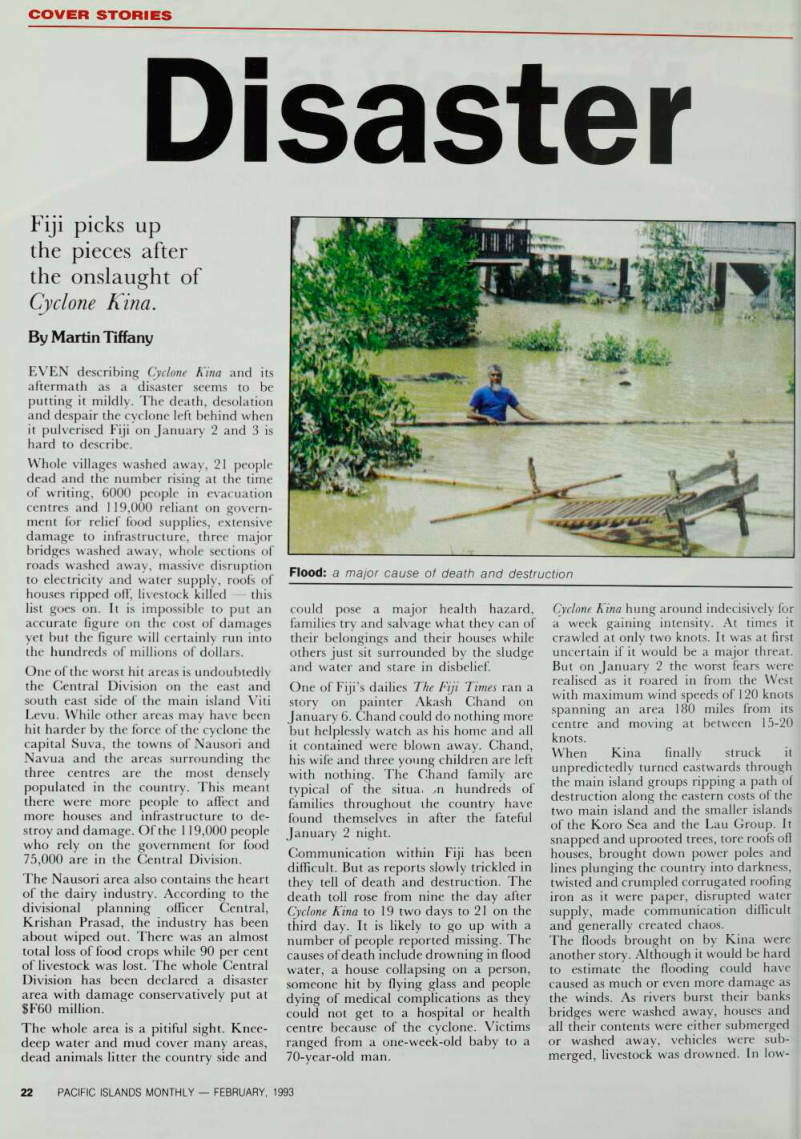
The floods brought on by Kina were another story. Although it would be hard to estimate the flooding could have caused as much or even more damage as the winds. As rivers burst their banks bridges were washed away, houses and all their contents were either submerged or washed away, vehicles were sub merged, livestock was drowned. In low
Flood: a major cause of death and destruction
lying areas like Navua, Nausori and the Sigatoka Valley mud clung to everything as waters subsided and covered root crops and vegetables destroying them. It was these flood waters that accounted for most deaths.
As the waters rose people were forced to climb onto the roofs of their houses and climb trees to escape the torrent. Some had to remain there for up to 16 hours.
As this report was being compiled four days after Kina the country was only just beginning to show some semblance of normality. Electricity and water were being restored, people were returning to work, ferry services were being run across rivers that had lost bridges, flights were operating and a general clean up was taking place.
The affect to the country’s economy has yet to be assessed but it is certain to be bad . The dairy industry has been very badly affected, cane crops have been damaged but how badly is not yet known, livestock and poultry have been killed by the thousand, the rice crop in the Central Division has been wiped out, the Sigatoka Valley, known as Fiji’s salad bowl, lost its vegetables and rootcrops and damage is expected to run into the hundreds of thousands of dollars. To make matters worse some farmers also lost farming equipment. Luckily tourism infrastructure was not badly affected.
On a brighter note a joint New Zealand, Australian and French relief effort has been launched to help Fiji. The three nations agreed last year they would work together to provide aid in such circumstances.
A Royal New Zealand Air Force Orion aircraft and a helicopter were sent to Fiji to assist in the relief effort. The Orion has been carrying out aerial survey of the damage while the helicop ter has been helping with relief supply distribution. The Australians sent a Hercules transport plane carrying a military helicopter and crew to assist in operation. Another Hercules was sent from Australia carrying supplies includ ing emergency rations, tarpaulins and water purification equipment. From Noumea the French sent a Transall aircraft carrying 1000 tarpaulins, 200 water tanks and 134,000 water purifying tablets.
Other countries including Japan, Brit ain and the United States have re sponded with relief assistance which has included cash and equipment.
The sun is now shining again in Fiji, the water is drying up and the rubbish is being cleared away. But for the people of Fiji the real task of rebuilding their lives has only just begun.