Crack down or [?]llegal fishing
pp. 38-39 · Read in the full issue
FOREIGN fishing vessels continue to face stiff opposition to illegal poaching in the economic zones of South West Pacific islands if a copybook surveillance and apprehension of a Taiwanese long-liner early this month is any guide.
The operation, conducted by Vanuatu nationals with the help of Australian and New Zealand P 3 Orion aircraft, resulted in a case so ‘watertight’ that the master of the offending vessel pleaded guilty before a Port Vila court on November 6 and was ordered to pay a fine and costs totalling the equivalent of about
Sus4O,Ooo.
The most recent penalty, according to the Director of (South Pacific) Forum Fisheries Agency (FFA), Sir Peter Kenilorea, follows a cash settlement of SUSI million reached between the owners of purse seiners caught fishing illegally in the waters of Nauru in July and August; and the payment of SUS 150,000 by the owners of two Taiwanese purse seiners for illegal activi ties during the same period.
Australian Defence experts hailed the Vanuatu operation as the latest in a number of indicators which point to the government’s Defence Co-operation pro gram with SW Pacific island nations bearing fruit both for Australia and for the participating countries.
Australia’s present focus to provide fishing surveillance to the South West Pacific region has its genesis in the announcement by Prime Minister Hawke at the 1983 South Pacific Forum in Canberra that it would provide Australian designed and built Pacific Patrol Boats (PPBs) to Forum countries.
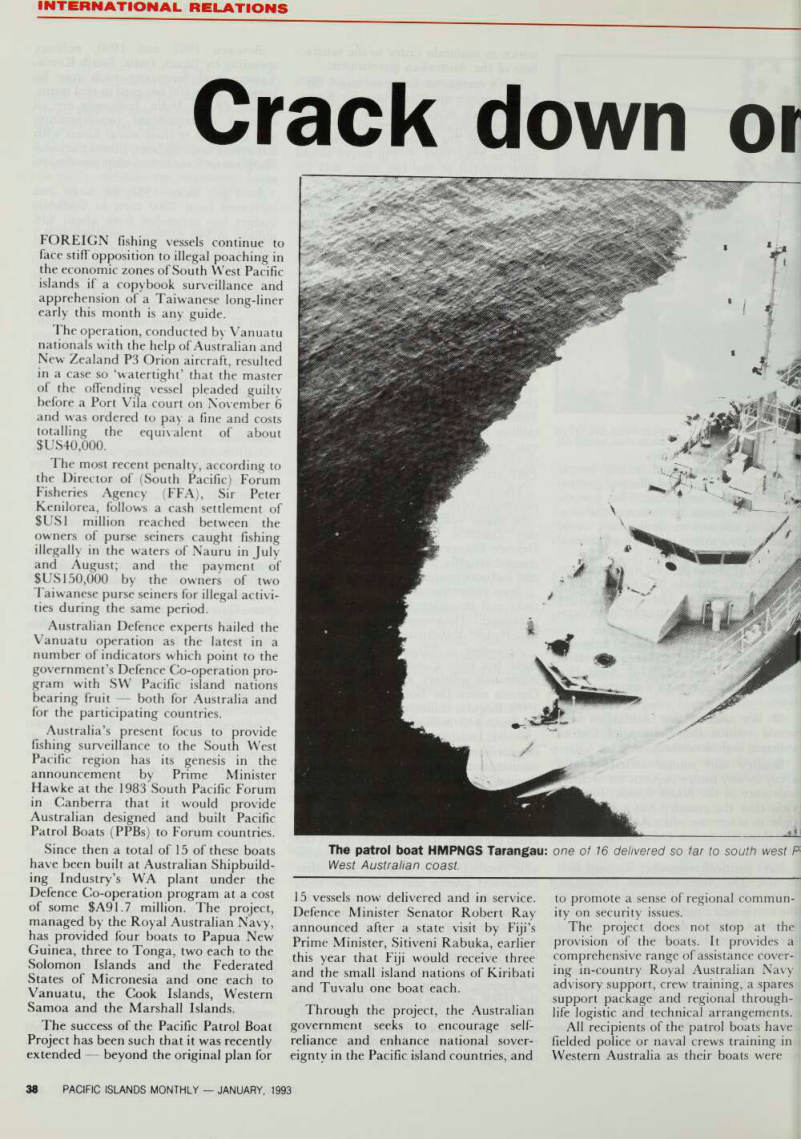
Since then a total of 15 of these boats have been built at Australian Shipbuild ing Industry’s WA plant under the Defence Co-operation program at a cost of some 5A91.7 million. The project, managed by the Royal Australian Navy, has provided four boats to Papua New Guinea, three to Tonga, two each to the Solomon Islands and the Federated States of Micronesia and one each to Vanuatu, the Cook Islands, Western Samoa and the Marshall Islands.
The success of the Pacific Patrol Boat Project has been such that it was recently extended beyond the original plan for
15 vessels now delivered and in service.
Defence Minister Senator Robert Ray announced after a state visit by Fiji’s Prime Minister, Sitiveni Rabuka, earlier this year that Fiji would receive three and the small island nations of Kiribati and Tuvalu one boat each.
Through the project, the Australian government seeks to encourage self reliance and enhance national sover eignty in the Pacific island countries, and
to promote a sense of regional commun ity on security issues.
The project does not stop at the provision of the boats. It provides a comprehensive range of assistance cover ing in-country Royal Australian Navy advisory support, crew training, a spares support package and regional through life logistic and technical arrangements.
All recipients of the patrol boats have fielded police or naval crews training in Western Australia as their boats were
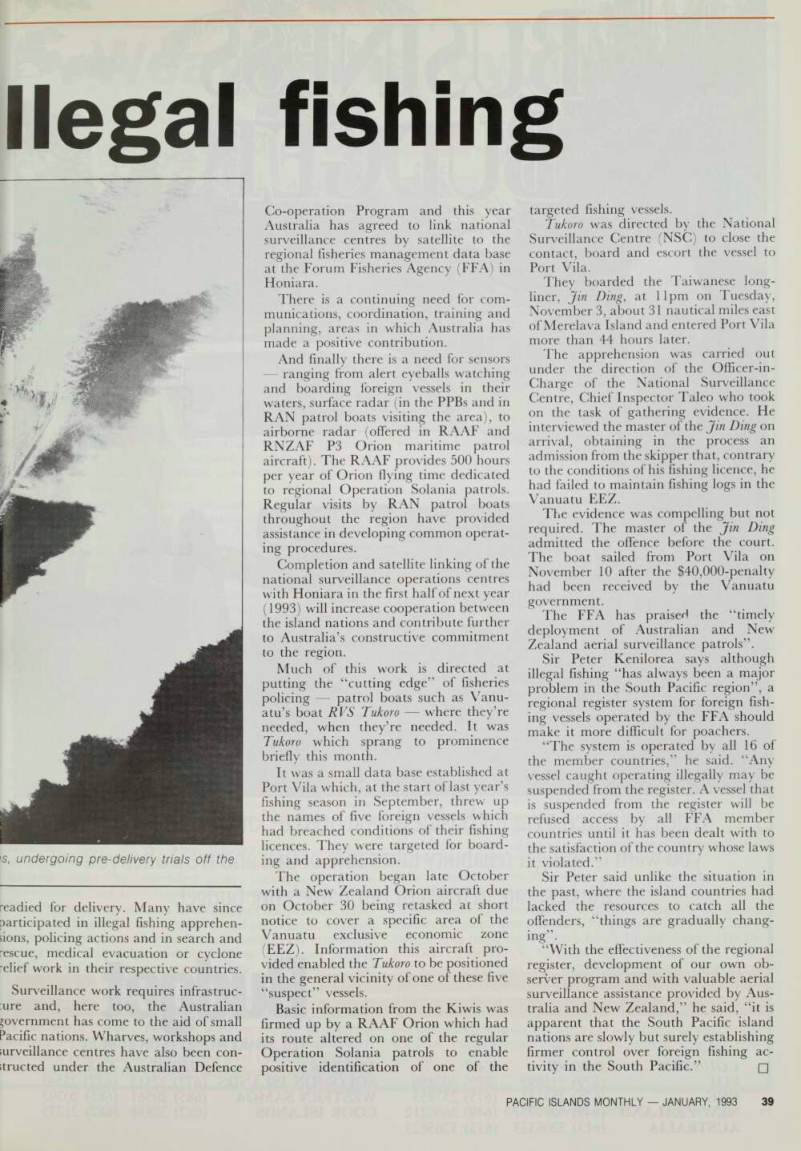
The patrol boat HMPNGS Tarangau: one of 16 delivered so far to south west P[?] West Australian coast.
readied for delivery. Many have since participated in illegal fishing apprehen sions, policing actions and in search and rescue, medical evacuation or cyclone "elief work in their respective countries.
Surveillance work requires infrastruc ture and, here too, the Australian government has come to the aid of small Pacific nations. Wharves, workshops and surveillance centres have also been con structed under the Australian Defence
Co-operation Program and this year Australia has agreed to link national surveillance centres by satellite to the regional fisheries management data base at the Forum Fisheries Agency (FFA) in Honiara.
There is a continuing need for com munications, coordination, training and planning, areas in which Australia has made a positive contribution.
And finally there is a need for sensors ranging from alert eyeballs watching and boarding foreign vessels in their waters, surface radar (in the PPBs and in RAN patrol boats visiting the area), to airborne radar (offered in RAAF and
RNZAF P 3 Orion maritime patrol
aircraft). The RAAF provides 500 hours per year of Orion flying time dedicated
to regional Operation Solania patrols.
Regular visits by RAN patrol boats throughout the region have provided assistance in developing common operat
ing procedures.
Completion and satellite linking of the national surveillance operations centres with Honiara in the first half of next year (1993) will increase cooperation between the island nations and contribute further to Australia’s constructive commitment to the region.
Much of this work is directed at putting the “cutting edge” of fisheries policing patrol boats such as Vanu atu’s boat RVS Tukoro where they’re needed, when they’re needed. It was Tukoro which sprang to prominence briefly this month.
It was a small data base established at Port Vila which, at the start of last year’s fishing season in September, threw up the names of five foreign vessels which had breached conditions of their fishing licences. They were targeted for board
ing and apprehension.
The operation began late October with a New Zealand Orion aircraft due on October 30 being retasked at short notice to cover a specific area of the Vanuatu exclusive economic zone (EEZ). Information this aircraft pro vided enabled the Tukoro to be positioned in the general vicinity of one of these five
“suspect” vessels.
Basic information from the Kiwis was firmed up by a RAAF Orion which had its route altered on one of the regular Operation Solania patrols to enable positive identification of one of the
targeted fishing vessels.
Tukoro was directed by the National Surveillance Centre (NSC) to close the contact, board and escort the vessel to Port Vila.
They boarded the Taiwanese long liner, Jin Ding , at 11pm on Tuesday, November 3, about 31 nautical miles east of Merelava Island and entered Port Vila more than 44 hours later.
The apprehension was carried out under the direction of the Oflicer-in- Charge of the National Surveillance Centre, Chief Inspector Taleo who took on the task of gathering evidence. He interviewed the master of the Jin Ding on arrival, obtaining in the process an admission from the skipper that, contrary to the conditions of his fishing licence, he had failed to maintain fishing logs in the Vanuatu EEZ.
The evidence was compelling but not required. The master of the Jin Ding admitted the offence before the court.
The boat sailed from Port Vila on November 10 after the $40,000-penalty had been received by the Vanuatu government.
The FFA has praised the “timely deployment of Australian and New Zealand aerial surveillance patrols”.
Sir Peter Kenilorea says although illegal fishing “has always been a major problem in the South Pacific region”, a regional register system for foreign fish ing vessels operated by the FFA should make it more difficult for poachers.
“The system is operated by all 16 of the member countries,” he said. “Any vessel caught operating illegally may be suspended from the register. A vessel that is suspended from the register will be refused access by all FFA member countries until it has been dealt with to the satisfaction of the country whose laws it violated.”
Sir Peter said unlike the situation in the past, where the island countries had lacked the resources to catch all the offenders, “things are gradually chang ing”.
“With the effectiveness of the regional register, development of our own ob server program and with valuable aerial surveillance assistance provided by Aus tralia and New Zealand,” he said, “it is apparent that the South Pacific island nations are slowly but surely establishing firmer control over foreign fishing ac tivity in the South Pacific.” □
is, undergoing pre- delivery trials off the