Regional
pp. 35-37 · Read in the full issue
International Relations
Regional Superpower
By Asha Lakhan
Australia’s increasing influence in the Pacific has raised questions on its role regional policeman or spy?
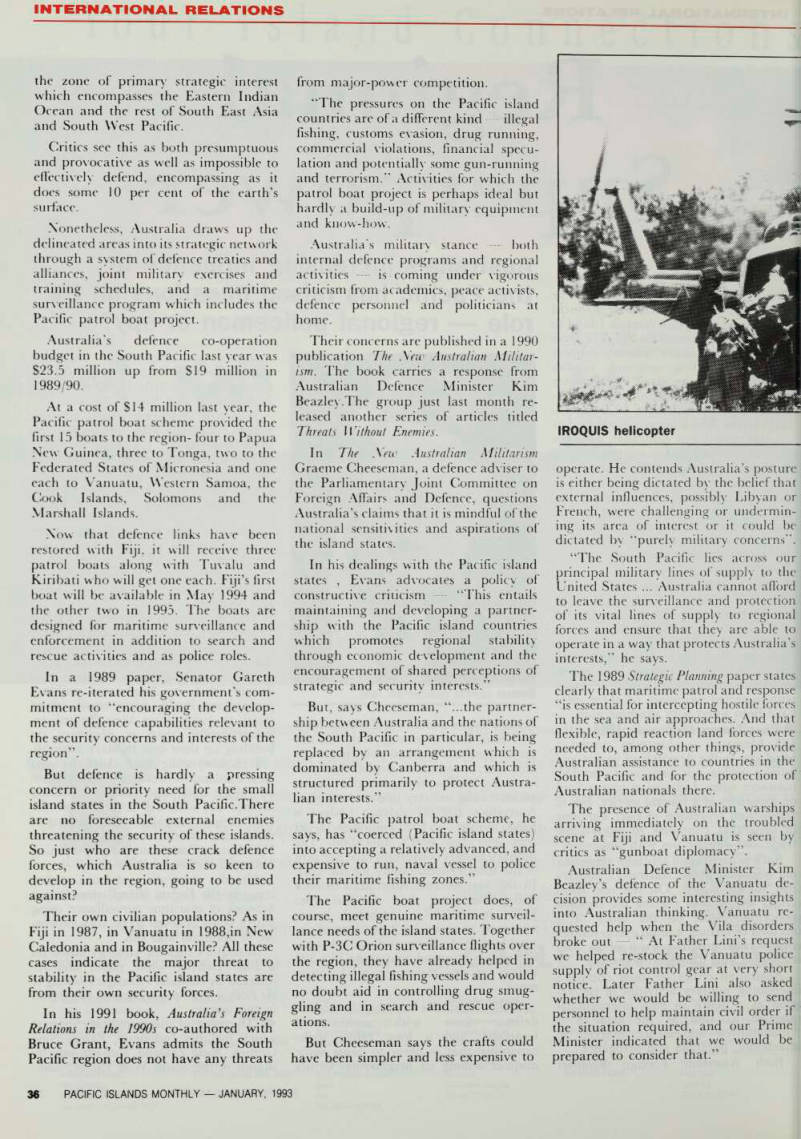
• Fiji, May 1987 - 120 members of the Australian Operational Deployment Force were airlifted to Norfolk Island to board warships bound for Fiji. The force equipped with heavy infantry support weapons including anti-tank missiles were to land on the island by helicopter on a mission to evacuate foreign na tionals together with some 4000 Austra lian tourists. The scheme was aborted at the last minute but Australian warships were despatched to Fiji waters. • Vanuatu, May 1988 - Australian government supplied riot control gear to Vanuatu police to quell disorder. It also had a contingency plan to deploy several hundred troops to Vanuatu to secure the airport and protect Australian/New Zea land nationals there. Australian warships were on the scene. • Papua New Guinea, 1990 The Bougainville crisis four Australian helicopters given to Papua New Guinea were used to massacre civilians in Bougainville and dump bodies in the sea.
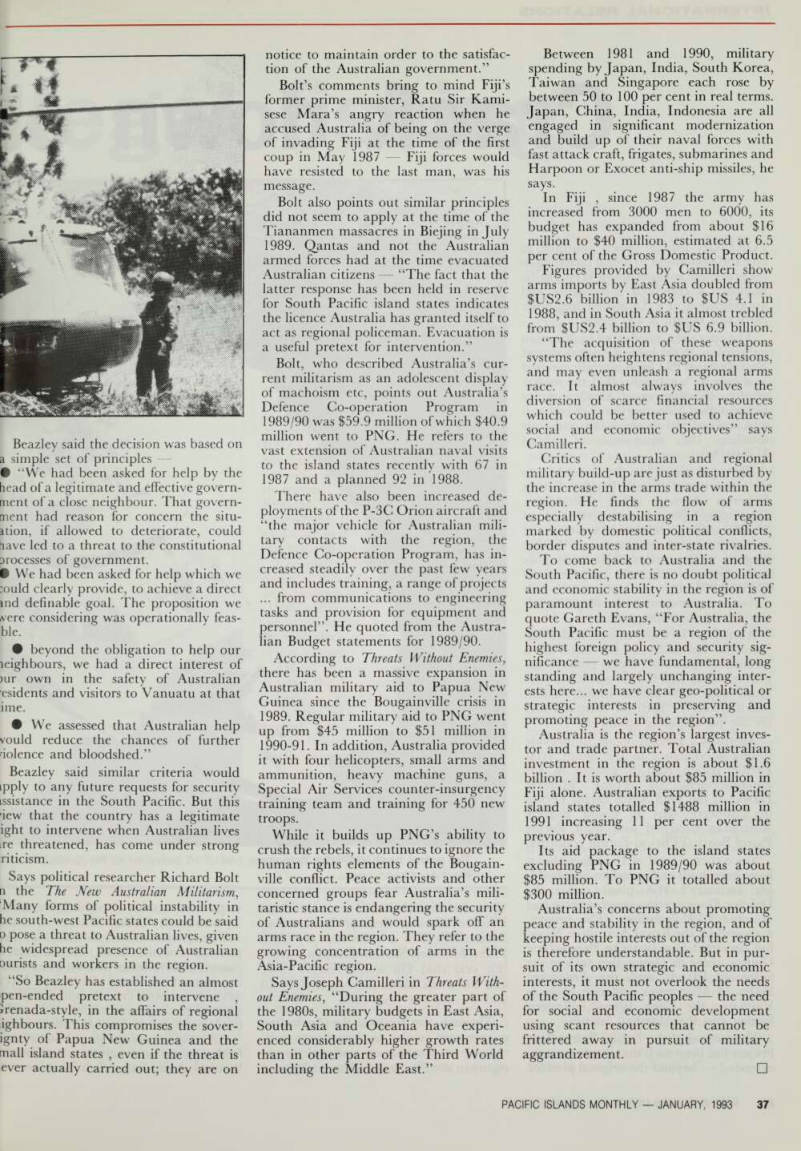
Although Australian instructions were specific that the helicopters were not to be used as gunships for assault or attack with mounted weaponry on them, they have been fitted with machine guns. • East Timor, Indonesia, 1991 - the Dili Massacre Australia turned a blind eye to the demands of justice and human rights not only over the Dili massacre when Indonesian troops fired 3n mourners at a funeral service, but to Indonesian repression of East Timorese n general.lt continues to enjoy close ;rade and defence ties with Indonesia.
Such activities and attitudes are arous ng questions about Australia’s military ole in the region. On the one hand :ritics accuse it of playing the regional policeman while on the other, it is iccused of turning a blind eye to human ights violations in pursuit of its own ;conomic and strategic interests.
Australian critics see their country’s ncreasing military activities in the re gion as a desire to gain international )restige as well as the sign of a ‘maladjusted adolescence marked in nachoism, paranoia and arrogance”.
Both Austrlian Foreign Minister
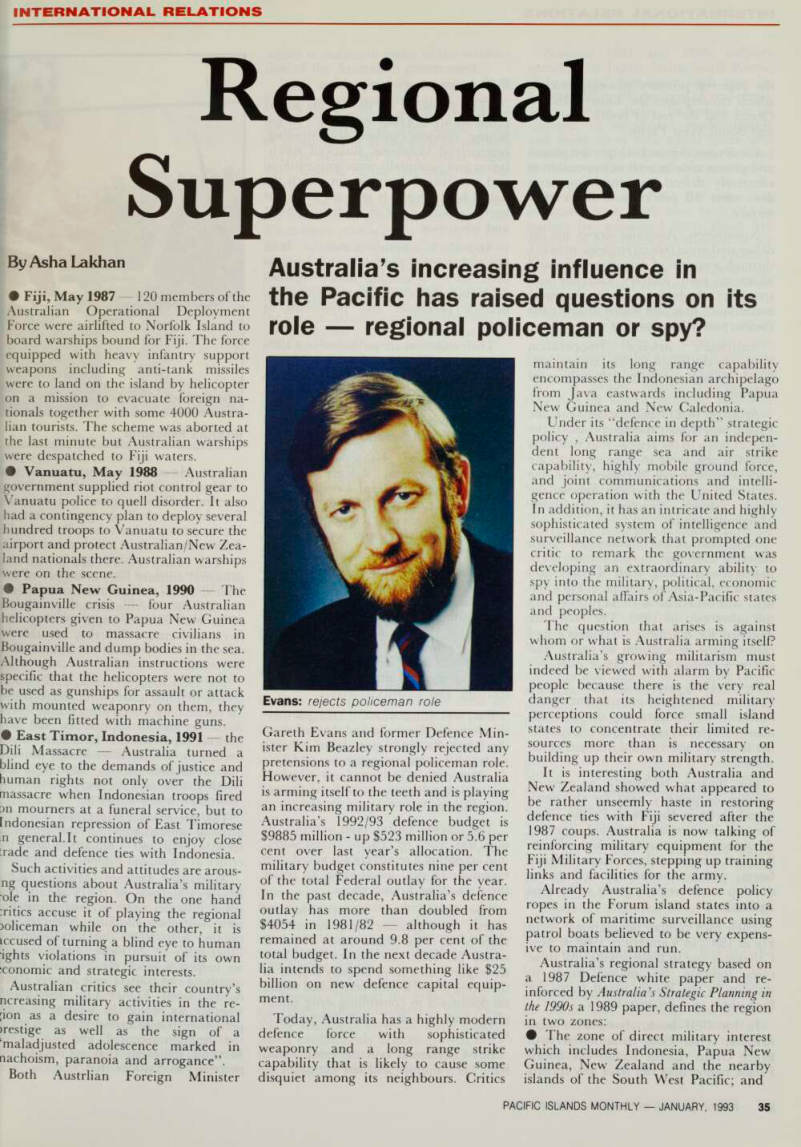
Gareth Evans and former Defence Min ister Kim Beazley strongly rejected any pretensions to a regional policeman role.
However, it cannot be denied Australia is arming itself to the teeth and is playing an increasing military role in the region.
Australia’s 1992/93 defence budget is $9885 million - up $523 million or 5.6 per cent over last year’s allocation. The military budget constitutes nine per cent of the total Federal outlay for the year.
In the past decade, Australia’s defence outlay has more than doubled from $4054 in 1981/82 although it has remained at around 9.8 per cent of the total budget. In the next decade Austra lia intends to spend something like $25 billion on new defence capital equip ment.
Today, Australia has a highly modern defence force with sophisticated weaponry and a long range strike capability that is likely to cause some disquiet among its neighbours. Critics
maintain its long range capability encompasses the Indonesian archipelago from Java eastwards including Papua New Guinea and New Caledonia.
Under its “defence in depth” strategic policy , Australia aims for an indepen dent long range sea and air strike capability, highly mobile ground force, and joint communications and intelli gence operation with the United States.
In addition, it has an intricate and highly sophisticated system of intelligence and surveillance network that prompted one critic to remark the government was developing an extraordinary ability to spy into the military, political, economic and personal affairs of Asia-Pacific states and peoples.
The question that arises is against whom or what is Australia arming itself?
Australia’s growing militarism must indeed be viewed with alarm by Pacific people because there is the very real danger that its heightened military perceptions could force small island states to concentrate their limited re sources more than is necessary on building up their own military strength.
It is interesting both Australia and New Zealand showed what appeared to be rather unseemly haste in restoring defence ties with Fiji severed after the 1987 coups. Australia is now talking of reinforcing military equipment for the
Fiji Military Forces, stepping up training
links and facilities for the army.
Already Australia’s defence policy ropes in the Forum island states into a network of maritime surveillance using patrol boats believed to be very expens ive to maintain and run.
Australia’s regional strategy based on a 1987 Defence white paper and re inforced by Australia's Strategic Planning in the 1990 s a 1989 paper, defines the region in two zones: • The zone of direct military interest which includes Indonesia, Papua New Guinea, New Zealand and the nearby islands of the South West Pacific; and
Evans: rejects policeman role
the zone of primary strategic interest which encompasses the Eastern Indian Ocean and the rest of South East Asia and South West Pacific.
Critics see this as both presumptuous and provocative as well as impossible to effectively defend, encompassing as it docs some 10 per cent of the earth’s surface.
Nonetheless, Australia draws up the delineated areas into its strategic network through a system of defence treaties and alliances, joint military exercises and training schedules, and a maritime surveillance program which includes the Pacific patrol boat project.
Australia's defence co-operation budget in the South Pacific last year was 523.5 million up from Sl9 million in 1989/90.
At a cost of Sl4 million last year, the Pacific patrol boat scheme provided the first 15 boats to the region- four to Papua New Guinea, three to Tonga, two to the Federated States of Micronesia and one each to Vanuatu, Western Samoa, the Cook Islands, Solomons and the Marshall Islands.
Now that defence links have been restored with Fiji, it will receive three patrol boats along with Tuvalu and Kiribati who will get one each. Fiji’s first boat will be available in May 1994 and the other two in 1995. The boats are designed for maritime surveillance and enforcement in addition to search and rescue activities and as police roles.
In a 1989 paper, Senator Gareth Evans re-iterated his government’s com mitment to “encouraging the develop ment of defence capabilities relevant to the security concerns and interests of the region”.
But defence is hardly a pressing concern or priority need for the small island states in the South Pacific. There are no foreseeable external enemies threatening the security of these islands.
So just who are these crack defence forces, which Australia is so keen to develop in the region, going to be used against?
Their own civilian populations? As in Fiji in 1987, in Vanuatu in 1988,in New Caledonia and in Bougainville? All these cases indicate the major threat to stability in the Pacific island states are from their own security forces.
In his 1991 book, Australia’s Foreign Relations in the 1990 s co-authored with Bruce Grant, Evans admits the South Pacific region does not have any threats
from major-power competition.
“The pressures on the Pacific island countries are of a different kind illegal fishing, customs evasion, drug running, commercial violations, financial specu lation and potentially some gun-running and terrorism." Activities for which the patrol boat project is perhaps ideal but hardly a build-up of military equipment and know-how.
Australia's military stance both internal defence programs and regional activities is coming under vigorous criticism from academics, peace activists, defence personnel and politicians at home.
Their concerns are published in a 1990 publication The Mew Australian Militar ism. The book carries a response from Australian Defence Minister Kim Beazley.The group just last month re leased another series of articles titled Threats W ithout Enemies.
In The A 'ew Australian Militarism Graeme Cheeseman, a defence adviser to the Parliamentary Joint Committee on Foreign Affairs and Defence, questions Australia’s claims that it is mindful of the national sensitivities and aspirations of the island states.
In his dealings with the Pacific island states , Evans advocates a policy of constructive criticism “This entails maintaining and developing a partner ship with the Pacific island countries which promotes regional stability through economic development and the encouragement of shared perceptions of strategic and security interests.”
But, says Cheeseman, “...the partner ship between Australia and the nations of the South Pacific in particular, is being replaced by an arrangement which is dominated by Canberra and which is structured primarily to protect Austra lian interests.”
The Pacific patrol boat scheme, he says, has “coerced (Pacific island states) into accepting a relatively advanced, and expensive to run, naval vessel to police their maritime fishing zones.”
The Pacific boat project does, of course, meet genuine maritime surveil lance needs of the island states. Together with P-3C Orion surveillance flights over the region, they have already helped in detecting illegal fishing vessels and would no doubt aid in controlling drug smug gling and in search and rescue oper ations.
But Cheeseman says the crafts could have been simpler and less expensive to
operate. He contends Australia’s posture is either being dictated by the belief that external influences, possibly Libyan or French, were challenging or undermin ing its area of interest or it could be dictated by “purely military concerns".
“The South Pacific lies across our principal military lines of supply to the United States ... Australia cannot afford to leave the surveillance and protection of its vital lines of supply to regional forces and ensure that they are able to operate in a way that protects Australia’s interests," he says.
The 1989 Strategic Planning paper states clearly that maritime patrol and response “is essential for intercepting hostile forces in the sea and air approaches. And that flexible, rapid reaction land forces were needed to, among other things, provide Australian assistance to countries in the South Pacific and for the protection of Australian nationals there.
The presence of Australian warships arriving immediately on the troubled scene at Fiji and Vanuatu is seen by
critics as “gunboat diplomacy”.
Australian Defence Minister Kim Beazley’s defence of the Vanuatu de cision provides some interesting insights into Australian thinking. Vanuatu re quested help when the Vila disorders broke out “ At Father Lini’s request we helped re-stock the Vanuatu police supply of riot control gear at very short notice. Later Father Lini also asked whether we would be willing to send personnel to help maintain civil order if the situation required, and our Prime Minister indicated that we would be prepared to consider that.”
IROQUIS helicopter
Beazley said the decision was based on a simple set of principles “We had been asked for help by the head of a legitimate and effective govern ment of a close neighbour. That govern ment had reason for concern the situ ation, if allowed to deteriorate, could have led to a threat to the constitutional processes of government. • We had been asked for help which we :ould clearly provide, to achieve a direct and definable goal. The proposition we vere considering was operationally feas ble. • beyond the obligation to help our aeighbours, we had a direct interest of >ur own in the safety of Australian esidents and visitors to Vanuatu at that ime. • We assessed that Australian help vould reduce the chances of further holence and bloodshed.”
Beazley said similar criteria would ipply to any future requests for security issistance in the South Pacific. But this hew that the country has a legitimate ight to intervene when Australian lives ire threatened, has come under strong riticism.
Says political researcher Richard Bolt n the The JVew Australian Militarism , Many forms of political instability in he south-west Pacific states could be said o pose a threat to Australian lives, given he widespread presence of Australian ourists and workers in the region.
“So Beazley has established an almost pen-ended pretext to intervene , Irenada-style, in the affairs of regional ighbours. This compromises the sover ignty of Papua New Guinea and the mall island states , even if the threat is ever actually carried out; they are on
notice to maintain order to the satisfac tion of the Australian government.”
Bolt’s comments bring to mind Fiji’s former prime minister, Ratu Sir Kami sese Mara’s angry reaction when he accused Australia of being on the verge of invading Fiji at the time of the first coup in May 1987 Fiji forces would have resisted to the last man, was his message.
Bolt also points out similar principles did not seem to apply at the time of the Tiananmen massacres in Biejing in July 1989. Qantas and not the Australian armed forces had at the time evacuated Australian citizens “The fact that the latter response has been held in reserve for South Pacific island states indicates the licence Australia has granted itself to act as regional policeman. Evacuation is a useful pretext for intervention.”
Bolt, who described Australia’s cur rent militarism as an adolescent display of machoism etc, points out Australia’s Defence Co-operation Program in 1989/90 was $59.9 million of which $40.9 million went to PNG. He refers to the vast extension of Australian naval visits to the island states recently with 67 in 1987 and a planned 92 in 1988.
There have also been increased de ployments of the P-3C Orion aircraft and “the major vehicle for Australian mili tary contacts with the region, the Defence Co-operation Program, has in creased steadily over the past few years and includes training, a range of projects ... from communications to engineering tasks and provision for equipment and personnel”. He quoted from the Austra lian Budget statements for 1989/90.
According to Threats Without Enemies , there has been a massive expansion in Australian military aid to Papua New Guinea since the Bougainville crisis in 1989. Regular military aid to PNG went up from $45 million to $5l million in 1990-91. In addition, Australia provided it with four helicopters, small arms and ammunition, heavy machine guns, a
Special Air Services counter-insurgency
training team and training for 450 new troops.
While it builds up PNG’s ability to crush the rebels, it continues to ignore the human rights elements of the Bougain ville conflict. Peace activists and other concerned groups fear Australia’s mili taristic stance is endangering the security of Australians and would spark off an arms race in the region. They refer to the growing concentration of arms in the Asia-Pacific region.
Says Joseph Camilleri in Threats With out Enemies , “During the greater part of the 1980 s, military budgets in East Asia, South Asia and Oceania have experi enced considerably higher growth rates than in other parts of the Third World including the Middle East.”
Between 1981 and 1990, military spending by Japan, India, South Korea, Taiwan and Singapore each rose by between 50 to 100 per cent in real terms.
Japan, China, India, Indonesia are all engaged in significant modernization and build up of their naval forces with fast attack craft, frigates, submarines and Harpoon or Exocet anti-ship missiles, he says.
In Fiji , since 1987 the army has increased from 3000 men to 6000, its budget has expanded from about $l6 million to $4O million, estimated at 6.5 per cent of the Gross Domestic Product.
Figures provided by Camilleri show arms imports by East Asia doubled from SUS 2.6 billion in 1983 to SUS 4.1 in 1988, and in South Asia it almost trebled from SUS 2.4 billion to SUS 6.9 billion.
“The acquisition of these weapons systems often heightens regional tensions, and may even unleash a regional arms race. It almost always involves the diversion of scarce financial resources which could be better used to achieve social and economic objectives” says Camilleri.
Critics of Australian and regional military build-up are just as disturbed by the increase in the arms trade within the region. He finds the flow of arms especially destabilising in a region marked by domestic political conflicts, border disputes and inter-state rivalries.
To come back to Australia and the South Pacific, there is no doubt political and economic stability in the region is of paramount interest to Australia. To quote Gareth Evans, “For Australia, the South Pacific must be a region of the highest foreign policy and security sig nificance we have fundamental, long standing and largely unchanging inter ests here... we have clear geo-political or strategic interests in preserving and promoting peace in the region”.
Australia is the region’s largest inves tor and trade partner. Total Australian investment in the region is about $1.6 billion . It is worth about $B5 million in Fiji alone. Australian exports to Pacific island states totalled $l4BB million in 1991 increasing 11 per cent over the
previous year.
Its aid package to the island states excluding PNG in 1989/90 was about $B5 million. To PNG it totalled about $3OO million.
Australia’s concerns about promoting peace and stability in the region, and of keeping hostile interests out of the region is therefore understandable. But in pur suit of its own strategic and economic interests, it must not overlook the needs of the South Pacific peoples the need for social and economic development using scant resources that cannot be frittered away in pursuit of military
aggrandizement.