Capitalising on timber
pp. 29-32 · Read in the full issue


Business
By Liz Thompson
PAPUA New Guinea has approximately 33 million hectares of closed forests, about 15 million of which have forestry potential. To date it is estimated that apporximately 5 million have either been logged or are under logging permits. In 1987 the forest industries exported 1450 cubic metres of timber worth 103 million kina and in 1988 timber accounted for eight per cent of total exports. It is an industry which has the potential to provide great return and yet it has been beset by problems resulting in the squandering of a national resource for little return. In 1987 the Wingti government started a commission of inquiry into the operations of the timber industry in PNG under the chairing of Justice Thomas Barnett. The enquiry pointed to a number of the industry's main problems and its findings, along with those of the Tropical Forest Action Plan (TFAP) set up under the directions of the World Bank, resulted in the setting up of a moratorium on the granting of logging concessions.
Paul Chat ter ton is currently working for the World Wildlife Fund helping them organize their Conservation Programmes in PNG and was a founding member of the Asia Pacific Action Group which was responsible for publishing a condensed and extremely influential version of the 5500-page Barnett Report which was never made available to the public. He works with community groups in PNG and has long been concerned with the rapacious nature of the timber industry. Here he talks about some of the issues involved.
L.T. The Barnett Report slated that in 1987 the PNG government lost 527.500,000 in foreign currency earnings and around 54.270.000 on company profits through transfer pricing. Can you
explain what this is?
P.C. Well that happens when a company puts the name of a less valuable log on the log it is exporting, so that they don't have to pay royalties on the real
value and, in many instances, the logs arc declared by Japanese company officials.
They write in Japanese and the forestry officials can't understand and there aren't enough officials to check all the timber export operations.
L.T. The Barnett Report also pointed out that landowners receive inadequate returns for their timber and that often contractual obligations, such as the development of roads, schools and hospitals arc not fulfilled, why is this?
P.C. As Barnett said, almost every logging company in the last 10 years hasn't provided the benefits it promised.
In very few cases have they replanted and if they have it is seldom to the extent
required under contract. They're usually
fly-by-night, low capital operations that
go in to make a quick buck and get out before the people have to deal with the consequences.
L.T. The report also implicated many political figures in the corruption.
How effective is the leadership tribunal in enforcing control?
P.C. They are enforcing some control, it was the tribunal which took
Ted Diro to task and forced him to step down from parliament over 70 charges which all referred to allegations brought up in the enquiry. The problem is the mechanisms are snowed under, the report implicated so many people that the tribunal and the courts just simply aren t able to deal with it all. » >-p /-'ll I I ... ki Car \ raW |, irn k er 15 not ; P 01 V' en Ur r ean seco . n ar > process- ? U ? U ar more iterative. But,
has decliLd\olUXn’a“wen{ie°hTfTl
1979 levels What’s hannpnintr? WnnlHn’t if be the ri*ht time be the right time to .develop secondary processing manu actunng, given that in the transition other resources wil provide a reliable income? P P.C. Yes. It is paradoxical that it’s so difficult because there are good economic returns to be made. Part of why it hasn’t happened I think is because of the timer lobby which is driven largely by multinational companies who mike their profit shipping out logs rather than sawn timer. 00 But I think PNG is strong enough to lake this on. I also think this is a good place for the involvement of Australian aid in supporting, at least in the early stages, a sawn timber market, furniture manufacturing, a training program for walk-abou, saw mill operators and a marketing program for their timber and also perhaps the support 01 research or non-timber lorest products
and their markets.
L.T. -- How viable are non-timber forest products?
P.C. Well the East Sepik Council of Women has been looking into alternative sources of income like gum of cowrie pine.
It can be tapped like rubber and the gum can be used for lacquer in Europe. In Indonesia they’ve developed a strong: industry exporting non-timber forest products bk e ra ttan bark and gum, that industry earned them $239 million in 1987.
L-T The PNG government is imposing higher taxes on timber products, but aren’t they also imposing higher taxes on rattan an d so on? K p q Thev are and that’s actuallv killed 1 ney are ana mat s actually killed the ratlan industry in the last couple of years and I think that’s crazy but there are other things like traditional medicines, for example. If PNG were to exploit the materials it has in the forest the potential to find important cures is significant and 'he value inestimable.
L.T. - Some NGOs suggest that while secondary manufacturing processes are 0 r established there should be a total ban on the export of raw timber. Japan has said that it would lobby for its nationals’ interests. What do you think of the NGOs angle?
P.C. - Alternatives have ,0 be developed that make it stupid to export logs. Everyone knows it s crazy exporting logs. PNG should be exporting sawn timber at least,
better still furniture. There are about 600 portable saw mills that can be carried out into the forest to produce at a sustainable level and there’s a massive market for it.
There’s a major timber chain in the UK that has 200 stores and they want to change all their sales over to sustainably produced timber. PNG can meet that market but it has to get its industries going now.
L.T. Clearly that is the direction to go
in but establishing secondary processing
and non-timber forest products is a process that will take number of years In the interim there needs to be more adequate policing of the industry. Do you think it will benefit PNG to employ a contractor like the international Swiss firm, Societe Generale ~, . ’ . t , , de Sumllance ,which is currently tendered *° m onitor Indonesia loggers. * think it would be a great idea and 1 know the government is talking with such a contractor at the moment to like go into mineral exports L.T. - Obviously a lot of landowners who feel ,be >' ve b f" exploited by logging contractors will be resentful in years to come. Do you think that has potential to cause future problems.
PC ? , We l l ’ tbe P«°P le who own the land under the April Salumei concession have do " 1 , belleve ther< ; was P™P, er consultation. They re going to try and take % r a “hismric cale the lfrst fime ando J lers in PNG have stood up and said w to a , in concess ion before it
actually gets going □
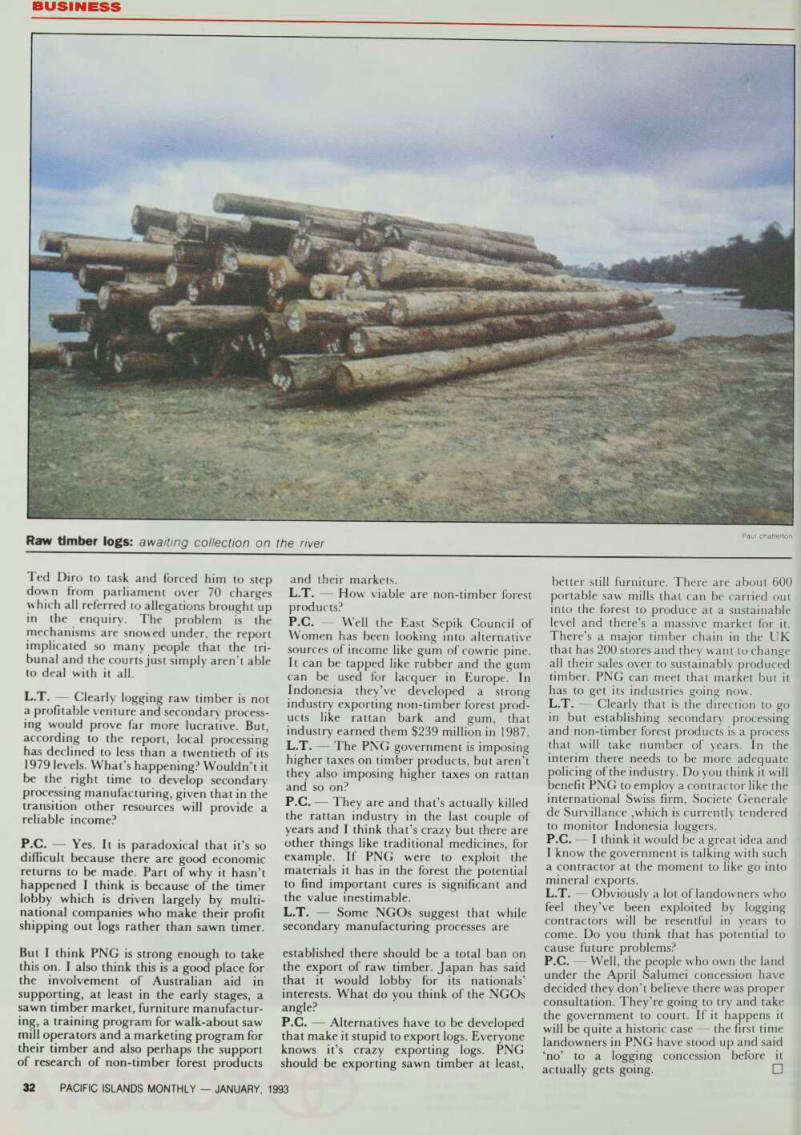
Raw timber logs: awaiting collection on the river
Paul chalterton