The people - our hope
pp. 27-28 · Read in the full issue
Special Report
By Martin Tiffany
Poor human resource development among the growing population has led to the dismal economic growth
THE people of the South Pacific have long captured the imagination of Eur opean writers and poets and fascinated explorers, adventurers, tourists and arm chair readers alike. Normally seen as kind, friendly and beautiful, living a perfect life in a lush tropical paradise, Pacific people seem to live as close to heaven on earth as one can get.
Generally the lot of the Pacific islander is comfortable. There is virtually no absolute poverty in South Pacific island economies and those who still practise a traditional lifestyle have an adequate and enjoyable existence. However it is the people themselves or at least their growth that is predicted to be the single biggest problem the region will face.
While population growth has been high in South Pacific countries over the last 20 to 30 years, the rates of economic growth have been low. Poor human resource development among this grow ing population has played a key part in the dismal economic growth.
As Australian academic, Ken Gannicott, explains, “The reason for the low rates of economic growth is complex, but it is clear that deficiencies in human resource development arc at least part of the story.”
In its recent survey of the prospects for higher growth in the region, the World Bank remarked that “the acute shortage of qualified and experienced personnel represents a fundamental constraint to development in the South Pacific”.
Gannicott, a Professor of Education at Wollongong University, said Fiji, Kiri bati, Solomon Islands and Vanuatu registered negative growth in per capita incomes during the 1980 s and without large scale migration Tonga and Western Samoa would have shown similar de cline. He pointed out that in the Polynesian countries, lifestyles are subsi dised by the remittances of those who go to work overseas. In the region as a whole, per capita aid levels are among the world’s highest.
Dennis Miller, the director of the Forum Secretariat’s Trade and Invest ment Division, in Suva, sees the region’s high population growth averaging 2.2 per cent for the region per annum as arguably the biggest constraint to econ omic growth. He said population spills over into everything else and will put pressure on the already-burdened educa tion system. This again leads to skill
shortages.
As Gannicott points out, Vanuatu and the Solomon Islands became indepen dent with such low levels of labour skills, it is hardly surprising that skill shortages should continue to be a key feature of their human resource development.
What is of particular interest is the same theme emerges in Kiribati, Western Samoa and Tonga, despite all having well-developed educational systems and an overall level of human resource which is high by the standards of other
developing countries.
“These shortages are not simply tran sient features of normal labour market
adjustments, but constitute a long standing structural problem,” said Gannicott.
One of the most obvious features of skill shortage is that even in the second or third decade after independence many countries are still short of trained teach ers. The result is a continued heavy reliance on expatriate teachers.
Gannicott feels one of the main problems lies in the poor quality of education and the poor standard of preparation in primary and secondary school.
For example, the Solomon Islands is very short of post-secondary labour, but
Asaeli Lave
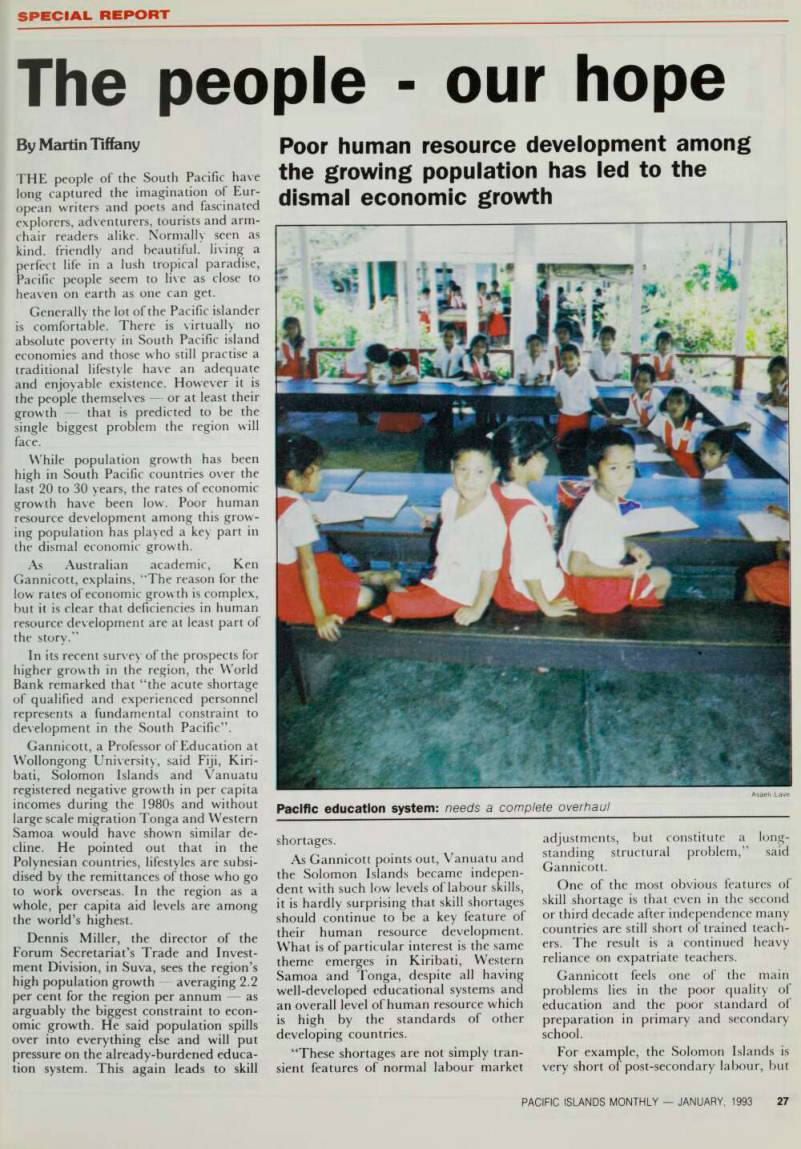
Pacific education system: needs a complete overhaul
the problem is not because of the shortage of tertiary places. In fact, the Solomon Islands College of Higher Education has excess capacity, and donors fund a large number of tertiary fellowships at overseas institutions.
The real problem is the low standard of secondary education means there aren’t enough students of adequate standard coming through the secondary system, and those selected for overseas training often require remedial training.
Gannicott indicates the quality of education in the region cannot be improved without a substantial increase in funding and there is a need to get
enough books and supplies. u ,• i u , •, • • , „ short the South Pacific. In Tonga, for example there continue s to be a critical shortage of tex tbooks, reading material, science equipment and even such basic items as exercise books, pens and rulers.
The shortaee of trained teachers also snorta g e oi trained teacners also F° nt^ butes s/gnificantly to the low qual ity of schooling. Substantial proportions of secondary school teachers have no more education than the pupils they teach.
Of the approximately 200 Solomon Island secondary teachers in 1987, half
had no more than Grade 9 schooling. In Tonga, 47 per cent of secondary teachers have no more than secondary education and in Vanuatu 25 per cent of non expatriate secondary' teachers have noth ing higher than grade 10 education.
The region’s relatively high popu lation growth means a fast-growing school-age population. This would mean more spending on education but, as Gannicott points out, this may only mean maintaining current enrolment rates and current standards.
Gannicott says all countries in the region need to improve their schools both quantitatively and qualitatively. He said to do this the countries will have to generate more national savings or divert investments from areas such as health, power or transport.
“If a country is unable or unwilling to make those sacrifices, spending must be spread over a large group of school children, to the detriment of school quality, or a growing number of children will have to be excluded from educa tion.”
But Gannicott warns a well educated population does not necessarily mean a fast growing economy.
“Whether the countries of the South Pacific then come merely to emulate Sri Lanka and the Phillipines as well educated but slow growing economies, or whether those investments pay off in enduring economic growth, will depend crucially on whether the essential comp lementary policy reforms instil a dy namic culture of growth.”
The ball is now in the region’s court and the future truly lies in the hands of the people. □
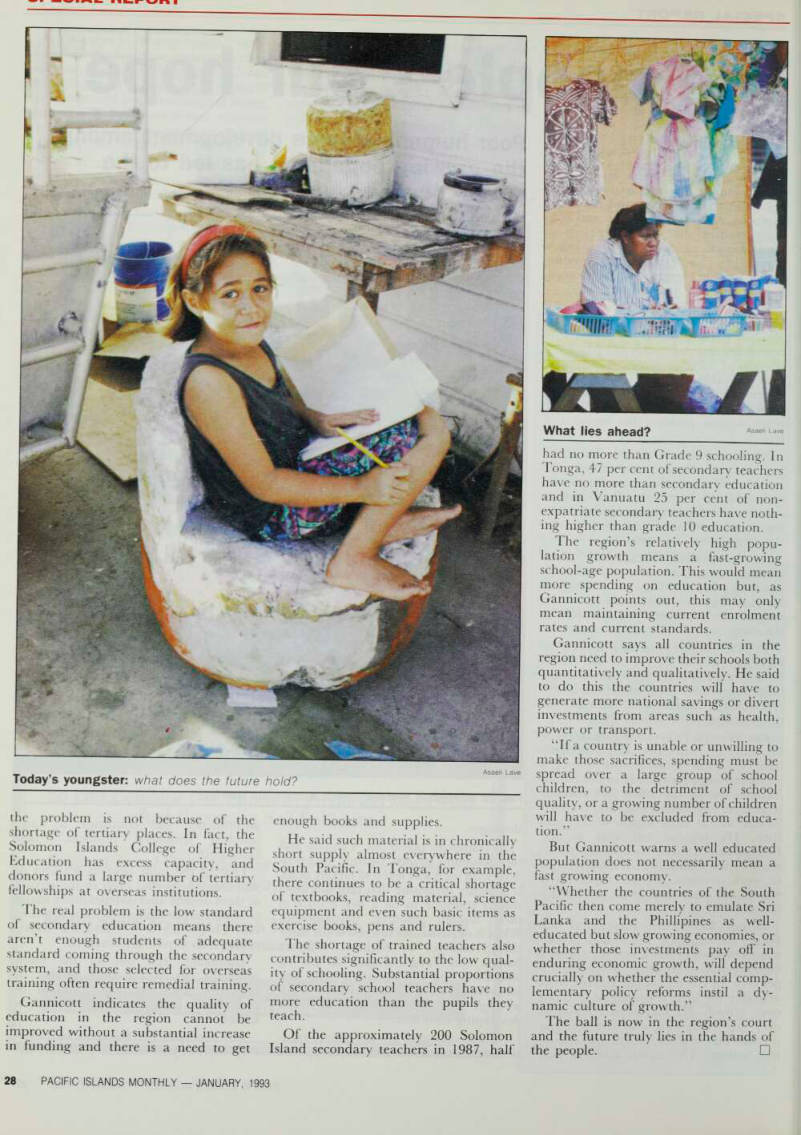
Today’s youngster: what does the future hold?
Asaeli Lave
What lies ahead?
Asaeli Lave