The fastest canoe the south Pacific
pp. 50-51 · Read in the full issue
Festival
By Angela McCarthy
With no large timber on the islands, the builders used drift wood logs for the hull and old douglas fir telephone poles for the mast and sail booms. The hull was lashed together by twisted coconut fibre strands.
diplN LESS than 30 hours a sleek walap (canoe) from Enewetak made history for the Marshall Islands and the sixth Festival of Pacific Arts by being the fastest traditional canoe to sail to the festival.
With three other traditional style canoes, Waan Aelon Kein sailed 250 km from Aitutaki to Rarotonga as part of the Pacific Arts Festival held in the Cook Islands in October.
Low-lying and fast the 50-foot single hull Waan Aelon Kein quickly left the Polynesian double-hulled canoes behind, taking only 29 hours to arrive in Rarotonga.
Waan Aelon Kein’s escort vessel was the 156-foot, three-masted yacht Tole Mour.
She had to use her engine to keep up with the walap which reached speeds of 10 knots as it dipped and rose in six to eight foot swells, that often looked like swamp ing the canoe.
After a wet night during which the mast end broke, Waan Aelon Kein’s six men crew radioed to Tole Mour for hot coffee, to supplement the fruit, water and many cigarettes they had stored in the single hull.
Navigator Toshiro Jokon found his way using the waves and currents, unlike the Polynesian navigators in the other canoes who mainly followed the sun and stars. Twelve hours into the journey he reported to Tole Mour he had begun to feel the waves reflecting off Rarotonga.
Land was not sighted for 11 more hours.
The canoe was steered by the sail and a single paddle tied to the side of the two foot wide hull. A crew member sat each end of the hull and when they wanted to change direction the paddle was thrown through the water to the person at the other end of the hull to use.
By the time they arrived in Rarotonga the crew was exhilarated but exhausted as none of them had done trips longer than 60 miles before. Twenty nine hours of sitting in the two-foot single hull or perched on the eight-foot outrigger platform watching the sea had taken its toll.
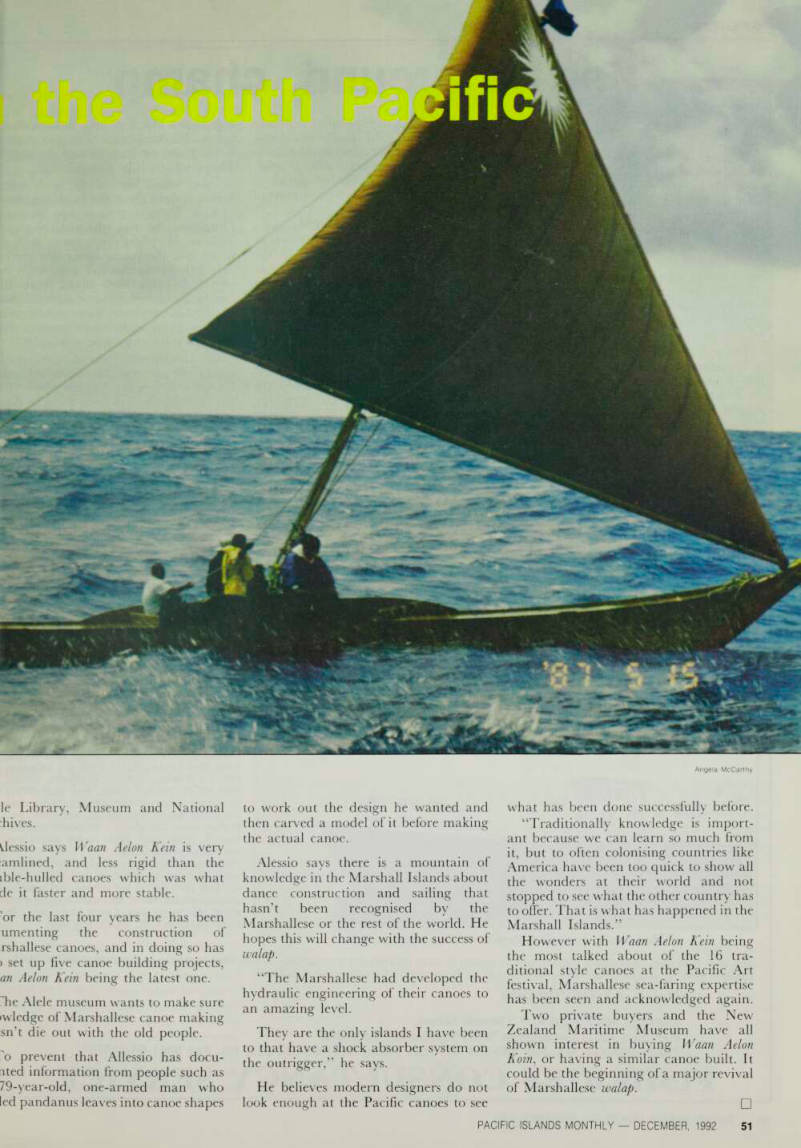
Shaped like a bird’s wing with its brown sail adorned with a 26-point star representing the Marshall Islands’ atolls, the Waan Aelon Kein surprised festival participants in Rarotonga with her swiftness and shape.
She surprised the Marshallese even more!
“This is a historical experience for our people, and one which we can be very
proud of,” said Carmen Bigler, Alele Library, Museum and National Archives chairperson who was representing the Marshall Islands at the festival.
The Marshall Islands consist of a series of atolls in Micronesia which have been used for American missile and nuclear weapon experiments since World War 11. They are a strategic trust of the United States.
Better known as Pacific bomb test victims it has been a long time since Marshall Islanders have used the sea faring skills they were traditionally famed for. In the 1800’s Marshallese travelled up to 500 miles in canoes over 100-foot long which were reputed to be among the fastest in the Paciiic.
But Waan Aelon Kein’s boat builders Lowbwe Mark and Hertes John, both nearing 70, cannot remember seeing a sea voyaging canoe built or used in their life-time in the islands. The last fishing outrigger built on their atoll, Enewetak, was in 1964.
Nowadays western dinghies and out board motors have taken the place of outriggers on most Marshall Island atolls. These modern boats end up littering the shores once they break because the islanders do not have the expertise or technology to fix them.
In the four months the walap took to be built it was watched with both interest and scepticism. With no large timber growing on the islands the builders had to use driftwood logs for the hull and old douglas fir telephone poles for the mast and sail booms. The hull was lashed together by ekkwal, twisted coconut fibre strands. The rest of it was made from
modern materials. It was a time for remembering old skills with the modern help of museum documentation on canoe construction.
In the past the fishing outrigger technology was passed down through the family. A four-year-old boy would sit at his grandfather’s knee and watch him work on a canoe. At 10 he would be learning to sail with his father, and by 12 years be able to go fishing to bring home food for the family.
It is this lack of use of traditional skills that the Waan Aelon Kein project has challenged. “This walap has brought a lot of pride and identity to the Marshallese ; people, who are realising they have got something to offer of their culture still,” says American Dennis Allesio, project planner for canoe documentation for
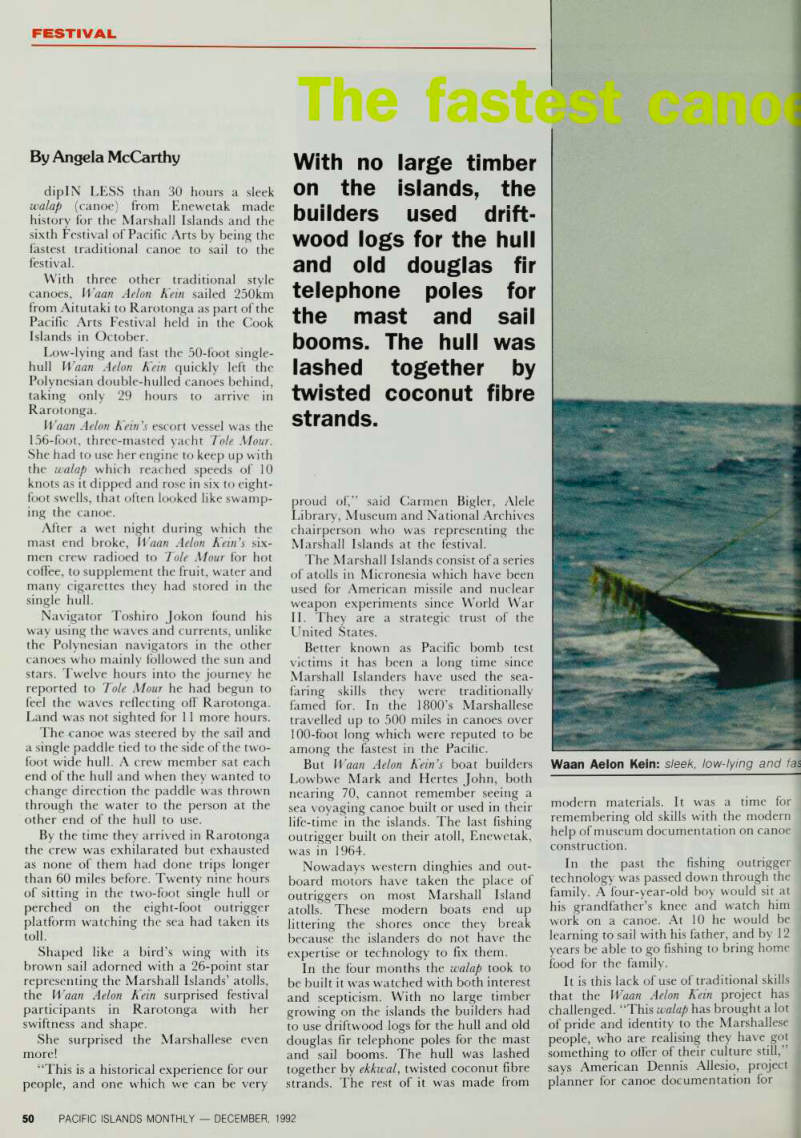
Waan Aelon Kein: sleek, low-lying and fas[?]
le Library, Museum and National Lives. dessio says Waan Aelon Kein is very amlined, and less rigid than the ible-hulled canoes which was what de it faster and more stable. or the last four years he has been umenting the construction of rshallese canoes, and in doing so has > set up five canoe building projects, an Aelon Kein being the latest one.
Le Aide museum wants to make sure •wledge of Marshallese canoe making sn’t die out with the old people. :o prevent that Allessio has docu ited information from people such as 79-year-old, one-armed man who led pandanus leaves into canoe shapes
to work out the design he wanted and then carved a model of it before making the actual canoe.
Alessio says there is a mountain of knowledge in the Marshall Islands about dance construction and sailing that hasn’t been recognised by the Marshallese or the rest of the world. He hopes this will change with the success of walap.
“The Marshallese had developed the hydraulic engineering of their canoes to an amazing level.
They are the only islands I have been to that have a shock absorber system on the outrigger,” he says.
He believes modern designers do not look enough at the Pacific canoes to see
what has been done successfully before.
“Traditionally knowledge is import ant because we can learn so much from it, but to often colonising countries like America have been too quick to show all the wonders at their world and not stopped to see what the other country has to offer. That is what has happened in the Marshall Islands.”
However with Waan Aelon Kein being the most talked about of the 16 tra ditional style canoes at the Pacific Art festival, Marshallese sea-faring expertise has been seen and acknowledged again.
Two private buyers and the New Zealand Maritime Museum have all shown interest in buying Waan Aelon Koin , or having a similar canoe built. It could be the beginning of a major revival of Marshallese walap. □
Angela McCarthy