This is the [?]arnangu
pp. 48-49 · Read in the full issue
Arts
By Liz Thompson
DREAMING stories spread thick across the under face of the rainbow cave. Rust red rocks erupt from the earths surface,
rearing and surging upwards and to
wards a common centre as though gathering momentum in their conver gence. Night sleep is rich with dreams and every now and then you are woken by the coldness of early morning hours.
Reaching from the warmth of the swag to push logs further into the central embers of the fire. Smoke rises from camps scattered amidst the trees, the moon is full and casts a white light across the spinifex humps, leading you towards the horizon. We are camping at Kata Kutara, one of the Warburton communi ties rock painting sights. The place is filled with magic and the strength of an unbroken spirit stretching thick across the land. Embracing you and enriching you and linking you, even if you're not aware of it, with the warm earth beneath your feet.
Kalka kutjarra sits somewhere be tween the Gibson and Great Victoria Desert, the land is dotted with waterholes and laden with secret and sacred stories. 11 is the sight of a stunning contemporary rock art work produced by Aboroginal artists of the Warbuton community.
Warburton is the home of a unique and explosive contemporary art event as sisted by the Warburton Arts Project Co ordinators, Albie Viegas and Gary Proc tor. Community artists are painting their stories onto both acrylic and two extra ordinary rock artsights. They are not concerned with lining the walls of commercial galleries with their work.
Instead the Warburton community council scrapes money together from grants and various sponsors and pur chases the majority of the work as part of the rapidly evolving Warburton col lection. Already containing over 95 works,the collection stays in and remains ‘held’ by the community.
This is inspiring on many levels.
Almost all the visual imagery produced by artists in Warbuton is related to the Tjukurpa, what many Europeans have mistakenly translated as the Dreamtime.
The Tjukurpa in fact has little to do with the European notion of dreaming, but, on the contrary, forms the basis of reality, outlines the laws and religious and social beliefs for Aboroginal people. The Tjukurpa embodies stories describing the events which took place during the time of creation, the travels of ancestral spirits, or creation hero’s, who journeyed across the landscape in the form of animals and humans. As they travelled they brought
features of the natural landscape into being, often singing them into existence.
Many of these stories are secret, sacred, known only to those in the community considered appropriate to hold them, those trusted by law to manage them properly. Other stories are public and more widely known and there are many layers in between. Paintings describe these stories using iconographic signs and symbols. Given this management of knowledge and the concept of ‘holding’ secret and sacred information, often
described through visual symbols, it i: entirely appropriate that paintings an held within and by the community.
The paintings, says Tommy Simms, * member of the community, “are abou stories, stories people want to tell, storie: that are important to them. Painting i; like a stamp, dead people all finished up we take over, look after things here, pas; it on. When Mr Davies doing a painting like he’s writing a big letter, talking about the place "that’s his place, talking about all of this law and everything, I
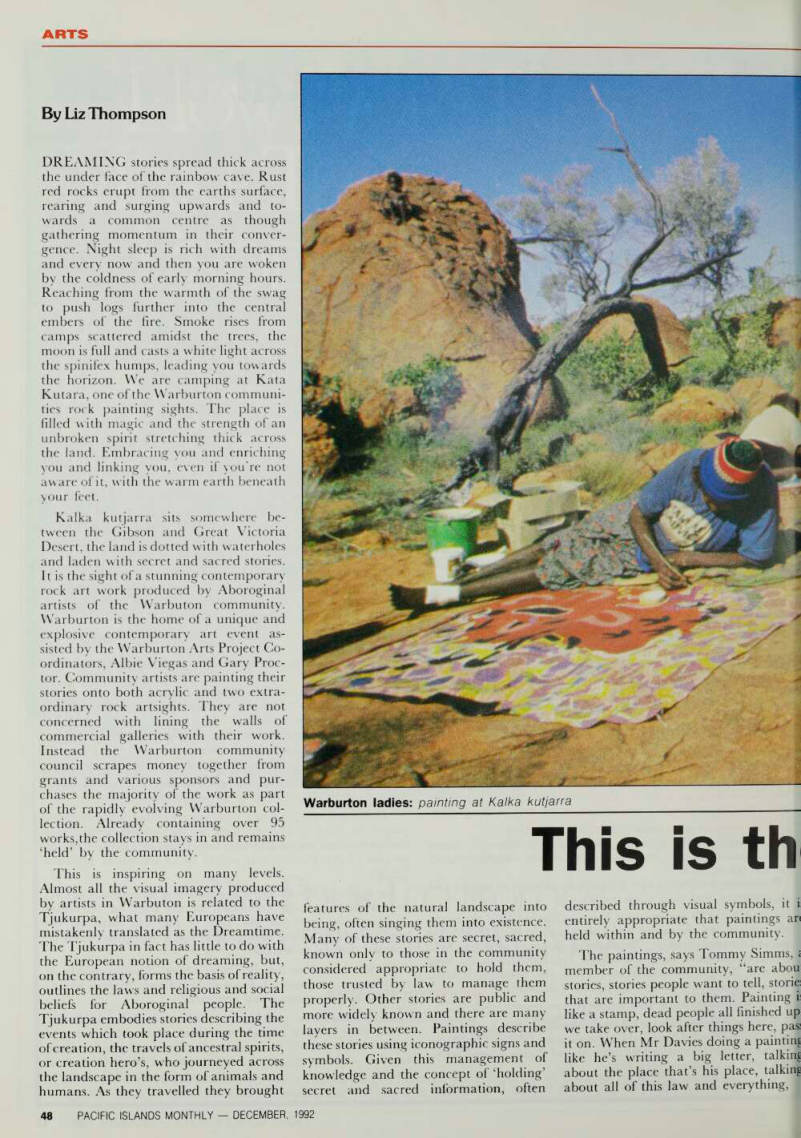
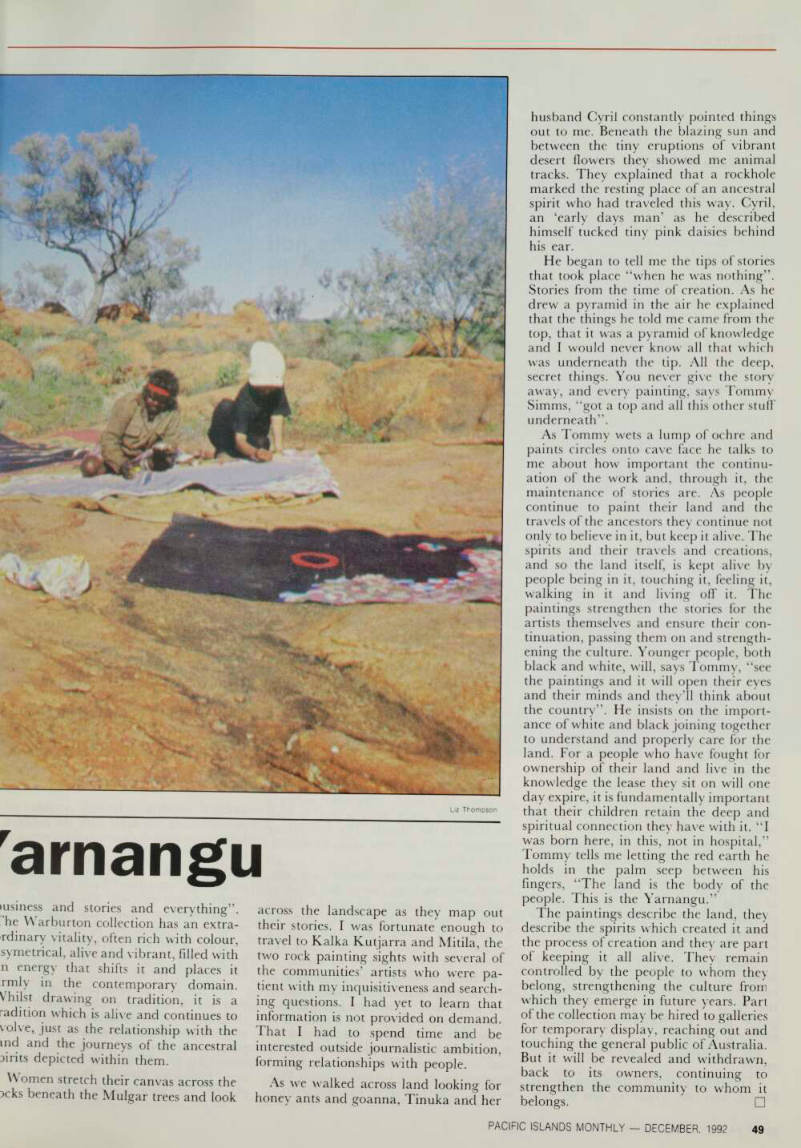
Warburton ladies: painting at Kaika kutjarra
•usiness and stories and everything”. he V\ arburton collection has an extrardinary vitality, often rich with colour, symetrical, alive and vibrant, filled with n energy that shifts it and places it rmly in the contemporary domain. vhilst drawing on tradition, it is a radition which is alive and continues to volve, just as the relationship with the md and the journeys of the ancestral Dints depicted within them.
Women stretch their canvas across the Dcks beneath the Mulgar trees and look
across the landscape as they map out their stories. I was fortunate enough to travel to Kalka Kutjarra and Mitila, the two rock painting sights with several of the communities’ artists who were pa tient with my inquisitiveness and search ing questions. I had yet to learn that information is not provided on demand, That I had to spend time and be interested outside journalistic ambition,
forming relationships with people.
As we walked across land looking for honey ants and goanna, Tinuka and her
husband Cyril constantly pointed things out to me. Beneath the blazing sun and between the tiny eruptions of vibrant desert flowers they showed me animal tracks. They explained that a rockhole marked the resting place of an ancestral spirit who had traveled this way. Cyril, an ‘early days man’ as he described himself tucked tiny pink daisies behind his ear.
He began to tell me the tips of stories that took place “when he was nothing”.
Stories from the time of creation. As he drew a pyramid in the air he explained that the things he told me came from the top, that it was a pyramid of knowledge and I would never know all that which was underneath the tip. All the deep, secret things. You never give the story away, and every’ painting, says Tommy Simms, “got a top and all this other stuff underneath”.
As Tommy wets a lump of ochre and paints circles onto cave face he talks to me about how important the continu ation of the work and, through it, the maintenance of stories are. As people continue to paint their land and the travels of the ancestors they continue not only to believe in it, but keep it alive. The spirits and their travels and creations, and so the land itself, is kept alive by people being in it, touching it, feeling it, walking in it and living off it. The paintings strengthen the stories for the artists themselves and ensure their con tinuation, passing them on and strength ening the culture. Younger people, both black and white, will, says Tommy, “see the paintings and it will open their eyes and their minds and they’ll think about the country”. He insists on the import ance of white and black joining together to understand and properly care for the land. For a people who have fought for ownership of their land and live in the knowledge the lease they sit on will one day expire, it is fundamentally important that their children retain the deep and spiritual connection they have with it. “I was born here, in this, not in hospital,”
Tommy tells me letting the red earth he holds in the palm seep between his fingers, “The land is the body of the people. This is the Yarnangu.”
The paintings describe the land, they describe the spirits which created it and the process of creation and they are part of keeping it all alive. They remain controlled by the people to whom they belong, strengthening the culture from which they emerge in future years. Part of the collection may be hired to galleries for temporary display, reaching out and touching the general public of Australia.
But it will be revealed and withdrawn, back to its owners, continuing to strengthen the community to whom it
belongs. □
Liz Thompson