See ya around, champ
pp. 52-53 · Read in the full issue
Sports
By Lito Vilisoni
HE used to duck for cover when his mates wanted to spar, and cry when his sister got him on the nose. Now, he runs from no one, has an Olympic medal under his belt, and is touted to be the
next world heavyweight champion.
He’s David Tua, the glove-shy young ster from Faleatiua, Upolu ... the West ern Samoan who came from nowhere to snatch a bronze medal at this year’s Olympic Games, winning the hearts of thousands and catching the eye of the biggest promoters in the world.
Just months after that awesome debut in Barcelona, Tua’s continuing his fairy tale climb to the top. Only 19, he’s scored the contract of a lifetime with one of the biggest boxing stables in the United States, a distinction no other Kiwi boxer has ever won.
Tua recently signed a four-year deal
worth SNZ2.O3 million (SUSI.I million) with promoter Lou Duva, the man behind current world heavyweight champ, Evander Holyfield, making him the best paid boxer in Kiwi history.
For Tua, a former kitchen-hand, the
opportunity to earn big money is hugely attractive. But it’s the chance to achieve the ultimate to become world champ that is all important. And if what they’re saying in the boxing circuit is anything to go by, it’s just a matter of time.
A small street in the heart of Mangere, Auckland, and the light blue house next to the alleyway is well known in the neighbourhood. It’s where David Tua lives. Inside, the sitting room walls and cabinets are packed with medals and trophys. Outside, a small garage with an old punching bag and a bike that’s had it. “That is where it all happens,” says the champ with a grin.
On first impressions, he’s small, almost slight (he’s five feet 10 and 200 pounds,
tiny for a heavyweight fighter), certainly
not the solid and mean looking slugger we’ve seen on television. But, yes, this is the boy wonder they dubbed “David the Destroyer” in Barcelona, and whom they are hailing the new Mike Tyson. He’s handsome and very confident with a goliathic way of looking at life.
“What’s it going to be like for the next four years? It’ll be tunnel vision ... boxing, boxing, boxing and more box
ing. If you like, I’m on a mission that’s got to be completed. I’ve got to stay focused and do it right and do it well.
That’s what I’ll be doing.”
Tua, who’ll be based in Virginia Beach, is right about the hard slog ahead of him. Veteran trainer and manager Lou Duva, the man who plans to groom Tua as Holyfield’s successor, says he won’t give the young boxer any mercyj “He’ll be eating and living work for the next four years. He’s gonna work and I’m gonna make sure he works hard. And it’s not just two hours a day ... he’s going to be working eight to 10 hours a day, whether it’s mentally or physically.”
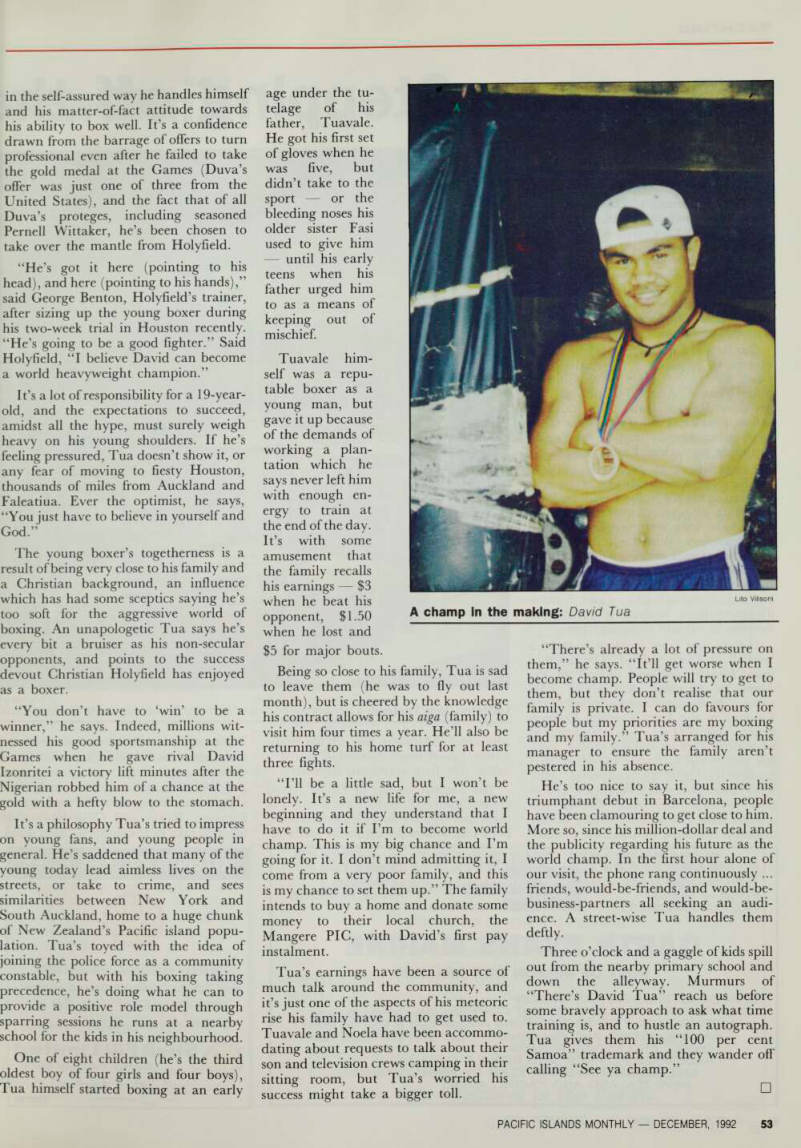
It’s a challenge Tua, who believes in giving 100 per cent (his talisman for the Games was a perky hat inscribed “100 per cent Samoa”) to everything he does, is more than ready to accept. “I’m going to be dedicated and it will be because I want to become world champ, which I will be.” If he sounds egotistical, it’s hard to damn him or fault his use of words which never includes “if’ only “when”. The world’s best have told him he’s got the right stuff, and if he’s to pull it off, he’s got to believe it too. Tua is confident of reaching the top. It’s evident
in the self-assured way he handles himself and his matter-of-fact attitude towards his ability to box well. It’s a confidence drawn from the barrage of offers to turn professional even after he failed to take the gold medal at the Games (Duva’s offer was just one of three from the United States), and the fact that of all Duva’s proteges, including seasoned Pernell Wittaker, he’s been chosen to take over the mantle from Holyfield.
“He’s got it here (pointing to his head), and here (pointing to his hands),” said George Benton, Holyfield’s trainer, after sizing up the young boxer during his two-week trial in Houston recently.
“He’s going to be a good fighter.” Said Holyfield, “I believe David can become a world heavyweight champion.”
It’s a lot of responsibility for a 19-year old, and the expectations to succeed, amidst all the hype, must surely weigh heavy on his young shoulders. If he’s feeling pressured, Tua doesn’t show it, or any fear of moving to fiesty Houston, thousands of miles from Auckland and Faleatiua. Ever the optimist, he says, “You just have to believe in yourself and God.”
The young boxer’s togetherness is a result of being very close to his family and a Christian background, an influence which has had some sceptics saying he’s too soft for the aggressive world of boxing. An unapologetic Tua says he’s every bit a bruiser as his non-secular opponents, and points to the success devout Christian Holyfield has enjoyed as a boxer.
“You don’t have to ‘win’ to be a winner,” he says. Indeed, millions wit
nessed his good sportsmanship at the
Games when he gave rival David Izonritei a victory lift minutes after the Nigerian robbed him of a chance at the gold with a hefty blow to the stomach.
It’s a philosophy Tua’s tried to impress on young fans, and young people in general. He’s saddened that many of the young today lead aimless lives on the streets, or take to crime, and sees similarities between New York and South Auckland, home to a huge chunk of New Zealand’s Pacific island popu lation. Tua’s toyed with the idea of joining the police force as a community constable, but with his boxing taking precedence, he’s doing what he can to provide a positive role model through sparring sessions he runs at a nearby school for the kids in his neighbourhood.
One of eight children (he’s the third oldest boy of four girls and four boys), Tua himself started boxing at an early
age under the tu telage of his father, Tuavale.
He got his first set of gloves when he was five, but didn’t take to the sport or the bleeding noses his older sister Fasi used to give him until his early teens when his father urged him to as a means of keeping out of mischief.
Tuavale him self was a repu table boxer as a young man, but gave it up because of the demands of working a plan tation which he says never left him with enough en ergy to train at the end of the day.
It’s with some amusement that the family recalls his earnings S 3 when he beat his opponent, $1.50 when he lost and $5 for major bouts,
Being so close to his family, Tua is sad to leave them (he was to fly out last month), but is cheered by the knowledge his contract allows for his aiga (family) to visit him four times a year. He’ll also be returning to his home turf for at least three fights.
“I’ll be a little sad, but I won’t be lonely. It’s a new life for me, a new beginning and they understand that I have to do it if I’m to become world champ. This is my big chance and I’m going for it. I don’t mind admitting it, I come from a very poor family, and this is my chance to set them up.” The family intends to buy a home and donate some money to their local church, the Mangere PIC, with David’s first pay instalment.
Tua’s earnings have been a source of much talk around the community, and it’s just one of the aspects of his meteoric rise his family have had to get used to.
Tuavale and Noela have been accommo dating about requests to talk about their son and television crews camping in their sitting room, but Tua’s worried his success might take a bigger toll.
“There’s already a lot of pressure on them,” he says. “It’ll get worse when I become champ. People will try to get to them, but they don’t realise that our family is private. I can do favours for people but my priorities are my boxing and my family.” Tua’s arranged for his manager to ensure the family aren’t pestered in his absence.
He’s too nice to say it, but since his triumphant debut in Barcelona, people have been clamouring to get close to him.
More so, since his million-dollar deal and the publicity regarding his future as the world champ. In the first hour alone of our visit, the phone rang continuously ... friends, would-be-friends, and would-be business-partners all seeking an audi ence. A street-wise Tua handles them deftly.
Three o’clock and a gaggle of kids spill out from the nearby primary school and down the alleyway. Murmurs of “There’s David Tua” reach us before some bravely approach to ask what time training is, and to hustle an autograph.
Tua gives them his “100 per cent Samoa” trademark and they wander off calling “See ya champ.”
Lilo Vilisoni
A champ in the making: David Tua