War On
pp. 24-25 · Read in the full issue
The Region
IT WAS in the wee hours of one morning in 1990 when a combined special Austra lian Federal Police (AFP) and Australian Customs Service taskforce swooped on an unsuspecting yacht moored in the calm waters of Whitsunday Passage in far northern Queensland.
On board were five people - three women and two men. Unknown to the crew the yacht had been under surveil lance for months as it made its way through South East Asia, Papua New Guinea and then to Australia.
As the yacht sailed into the Whitsundays, the taskforce put together in Townsville, swung into action. A 24-hour surveillance was put into force.
Taskforce members - all in plain clothes - took turns at night, using an array of sophisticated equipment, includ ing binoculars equiped with infra-red night vision, to watch the movement of the yacht’s crew members.
As dawn was breaking, the taskforce struck. Using a high-speed boat and one other craft, they stormed the yacht and ordered its crew to lie low while a search was conducted.
They found nothing.
The yacht even had a clearance from Papua New Guinea Customs when it had berthed at the northern town of Madang a month or so earlier. (A Supreme Court jury in Brisbane later heard the yacht also visited Lae and Port Moresby).
As the search continued, it seemed everything was in order. Until they came to the yacht’s water tank, that is.
“Come and have a look,’’one officer yelled out.
At the bottom of the tank were tonnes of compressed powdered cocaine in sealed plastic bags. Street value SAIO million.
These details were later related to a trial which lasted several months, start ing in the Brisbane District Court and ending before a Supreme Court jury which found the two men (of German extraction) guilty. They are serving lengthy jail sentences in Brisbane.
In November last year Papua New Guinea fishermen stumbled on what authorities said was the country’s largest
drug haul while digging for turtle eggs on a remote atoll off PNG’s New Ireland Province.
The 1.5 tonnes of hashish resin were found buried in the sand. Wrapped in sealed plastic bags, the number 777 embossed in gold seals was clearly stamped at the top of each carton.
Each of the 66 cartons also bore the letters RR at the bottom. Authorities estimate the street value of this 1.5-tonne consignment at between 5F31.4 million and 5F78.5 million.
Although no one was arrested, police and other government officials believed the huge consignment was brought into PNG from Asia by foreign vessels.
As the couriers failed to make con nections quickly, they decided to bury the “cargo” on Hawaii Island in the Nuguria group of islands, about 190 km north-east of Rabaul.
A week before, an unidentified yacht was reportedly seen leaving Hawaii atoll by people from nearby islands. Hawaii atoll is a popular fishing and turtle
hunting ground.
Former PNG Prime Minister Rabbie Namaliu later told Parliament foreign vessels had been entering PNG waters and ports illegally with guns and drugs.
It was difficult, he said, to monitor the movements of these yachts and ships because the monitoring system lacked the financial and manpower resources to carry out the task effectively.
PNG has asked Australia and New Zealand to help in its surveillance on
drug smuggling.
The story of the PNG drug haul is similar to another drug find in Solomon Islands (further east of PNG), in 1990.
It was reported a yacht had left the consignment on a sandy, uninhabited island to be picked up later by a foreign fishing boat. Among the stories circulat ing in Honiara at the time was one that an expatriate pilot working for the country’s national airline, Solomon Air lines, would give the fishing boat the direction to the island to make the pick up.
Instead, stranded fishermen found the drug, believed to be hashish resin, buried in the sand in large containers. It was
said to have been destined for Australia.
Again, there were no arrests.
In Fiji earlier this year, authorities seized 12 gas cylinders buried in the sand on an uninhabited island in the Southern
Lau Group.
Inside was hashish resin in paste form.
Its street value SF3O million. Hashish resin is a tar-like substance which can be smoked or mixed with drinks and taken orally. It is a concentrated form of processed marijuana and is said to be 12 per cent more potent.
Experts say drug trafficking is a megabuck industry whose operation is growing in sophistication and approach almost everyday.
The South Pacific is being increasingly used as a transit point. “It is a menace of global proportion and one which requires a global response,” one expert says.
School children are among those most vulnerable. A broad program to educate them about the dangers of the illegal use of drugs and its severe penalty is urgently needed. In Australia, for instance, pen alty for drug trafficking can land you in jail for life, a $A50,000 fine or both.
In some countries in South East Asia,
punishment for drug trafficking is death
by hanging.
Drug trafficking is a world-wide, multi-billion dollar industry, although no one can place a firm figure on its value. Its perpetrators are among the most powerful in the world because of the huge amount of money at their disposal.
In extreme circumstances as evident in recent events in Central America, the drug trade can directly threaten the international peace and security.
In the South Pacific, there is growing fear that with governments declaring war on drug barons in countries such as Italy and Colombia, the region could become easy prey for drug smugglers using legitimate business as covers.
Ease of travel and modern sophisti cated telecommunications facilities add to the fear the South Pacific may soon lose its paradise label.
Indeed, the recent drug hauls in Australia, Fiji, PNG and Solomon Islands brought home this stark reality.
So what now?.
In recent years, governments in the South Pacific, including Australia and New Zealand, have been working on ways to combat this growing threat.
Already a study has identified a program of action which the Forum Regional Security Committee (FRSC) recom mended to this year’s Forum in Honiara, Solomon Islands.
This comprehensive law enforcement package is seen as the blueprint which will provide the edge needed to combat the growing threat of transnational crimes, including drug trafficking.
The package Declaration by the South Pacific Forum on Law Enforce ment Co-operation was given the seal of approval by the recent 23rd Forum.
Among other things, this document outlines priority areas for co-operation by Forum member countries in a wide range of law enforcement issues.
Because of widely-held fears that the scale of criminal activity could acceler ate, the Forum declared law enforcement co-operation remain an important focus for the region.
Leaders of the 15-nation body noted that balanced economic and social devel opment, the primary goal of all countries in the region, could not be achieved without the assurance of safety and security.
They have agreed there is a need to tackle the problem head on. According to the declaration, priority has been given to putting in place “satisfactory legislative arrangements” covering ex tradition, mutual assistance in criminal matters and forefeiture of proceeds of crime.
How long this will take depends to a large extent on the willingness and the seriousness of each Forum government to tackle the problem.
What this will mean in the long run, however, is that there will hopefully be standard legal framework in place in Forum countries before the problem sets in.
At present there is little or no legal framework at all to help law enforcement agencies wage an effective war on drug traffickers and other notorious criminals (such as conmen). This problem is
compounded by lack of trained man power and financial resources in most, if not all, the Forum Island Countries.
The 15 members of the Forum are co operating in such areas as • Mutual Assistance in Criminal Matters Co-operation in this area means law enforcement agencies in Forum countries can assist one another in identifying persons, in searching for and seizing evidence and in arranging for witnesses to give evidence either in their own countries or in the country in which the trial takes place; • Forefeiture of the Proceeds of Crime - It has been suspected, and in a
number of cases proven, that criminal gangs derive large profits from organised crime. These profits which are often ploughed into legitimate businesses, pro vide an incentive to further criminal activity and the capital to develop criminal organisations large enough to operate on international scales.
Under consideration is the strengthen ing of national and international legal networks to ensure governments have the powers to trace, freeze and if need be, seize the agencies and proceeds of crimes.
Banks’ secrecy laws which are often used by criminals as shields for launder ing criminal profits will be targeted. This means banks operating in the South Pacific may in future be required by law to “open” their books so that law enforcement investigators searching for evidence of crime can have access to bank accounts and other documents.
Other matters under consideration include extradition arrangements within Forum member countries.
In a way, South Pacific countries still have the time to put into place a legal framework which will make the work of law enforcement agencies easier than it is now. But it will require more than just
political rhetoric.
Indeed, the war on drug traffickers has barely begun in the South Pacific. Like a storm, it is still gathering strength, as drug traffickers and their masters look for safe havens.
The question which needs to be asked now is whether Pacific leaders have the resolve and the political will to declare war on drug traffickers.
A lot is at stake.
Not only are the tranquility, peace and security of the South Pacific at stake, the lives of hundreds of thousands of inno cent youngsters are as well.
Preventing this scourge is easier than trying to deal with it once it has set in.
The South Pacific Forum Declaration on Law Enforcement Co-operation is but only a beginning.
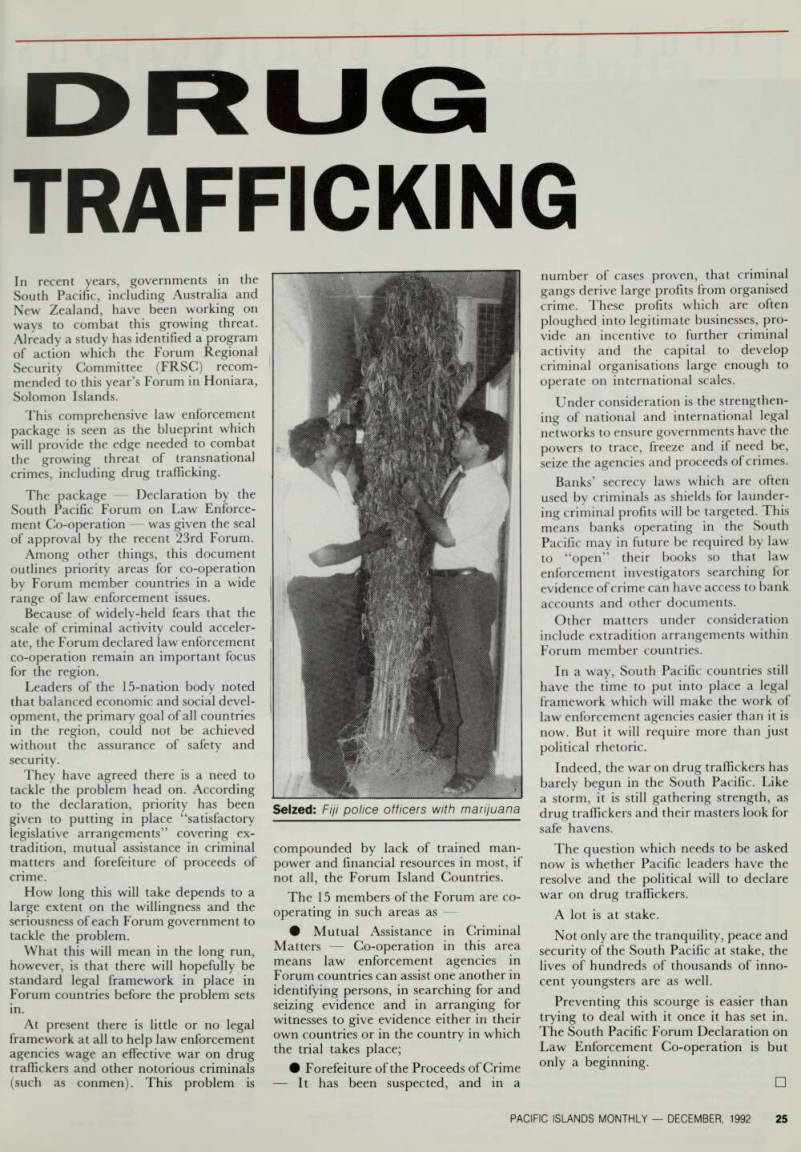
Seized: Fiji police officers with marijuana