Royalty under threat
p. 23 · Read in the full issue
Politics
By Martin Tiffany
A PRO-DEMOCRACY conference scheduled to be held in the Tongan capital Nuku’alofa late last month marked a milestone in the destiny of the tiny island kingdom. The four-day con ference should prove an important turning point in the struggle between the
pro-democracy campaigners in parlia
ment and the noble-dominated govern ment. The conference, November 24-27, was organised by the country’s pro democracy movement to discuss ways of amending the present constitution written in 1875 to allow for a more democratic style of government.
At present the Tongan parliament comprises nine commoner members
(people’s representatives) represent
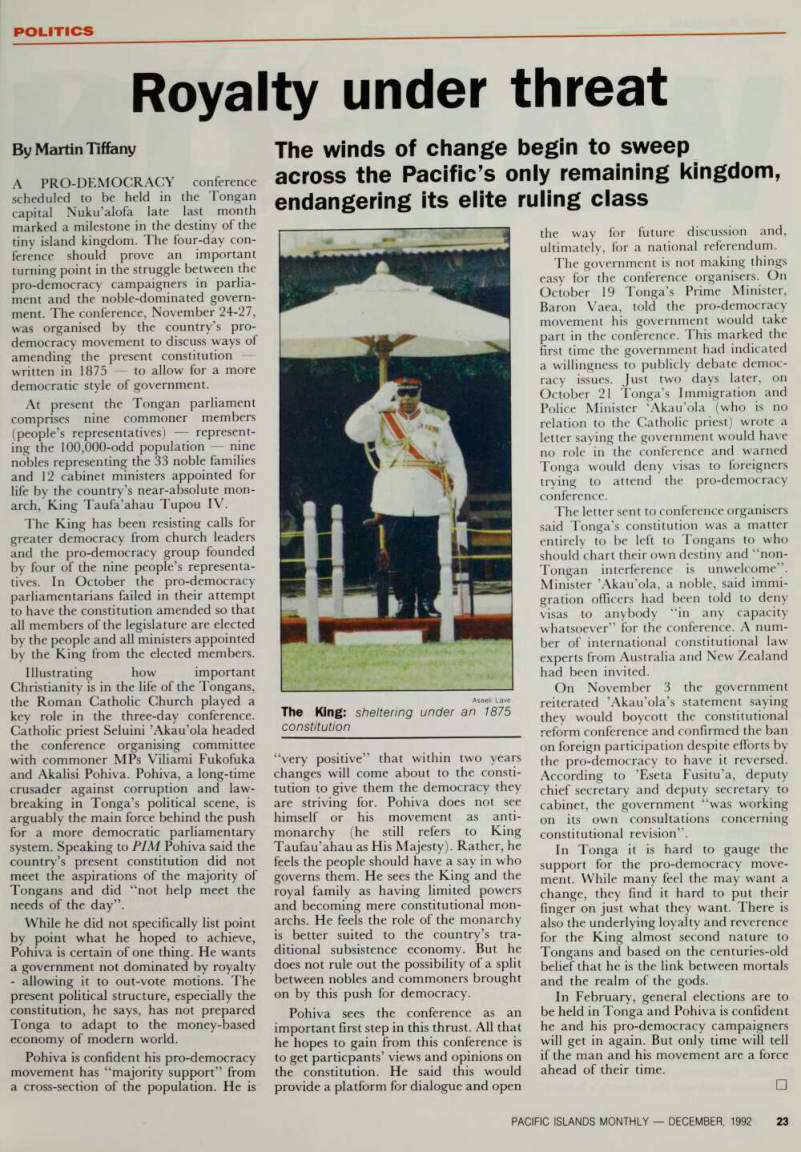
ing the 100,000-odd population nine nobles representing the 33 noble families and 12 cabinet ministers appointed for life by the country’s near-absolute mon arch, King Taufa’ahau Tupou IV.
The King has been resisting calls for greater democracy from church leaders and the pro-democracy group founded by four of the nine people’s representa tives. In October the pro-democracy parliamentarians failed in their attempt to have the constitution amended so that all members of the legislature are elected by the people and all ministers appointed by the King from the elected members.
Illustrating how important Christianity is in the life of the Tongans, the Roman Catholic Church played a key role in the three-day conference.
Catholic priest Seluini ’Akau’ola headed the conference organising committee with commoner MPs Viliami Fukofuka and Akalisi Pohiva. Pohiva, a long-time crusader against corruption and law breaking in Tonga’s political scene, is arguably the main force behind the push for a more democratic parliamentary system. Speaking to PIM Pohiva said the country’s present constitution did not meet the aspirations of the majority of Tongans and did “not help meet the needs of the day”.
While he did not specifically list point by point what he hoped to achieve, Pohiva is certain of one thing. He wants a government not dominated by royalty - allowing it to out-vote motions. The present political structure, especially the constitution, he says, has not prepared Tonga to adapt to the money-based economy of modern world.
Pohiva is confident his pro-democracy movement has “majority support” from a cross-section of the population. He is
The winds of change begin to sweep across the Pacific’s only remaining kingdom, endangering its elite ruling class
“very positive” that within two years changes will come about to the consti tution to give them the democracy are striving for, Pohiva does not see himself or his movement as anti monarchy (he still refers to King Taufau’ahau as His Majesty). Rather, he feels the people should have a say in who governs them. He sees the King and the royal family as having limited powers and becoming mere constitutional mon archs. He feels the role of the monarchy is better suited to the country’s tra ditional subsistence economy. But he does not rule out the possibility of a split between nobles and commoners brought on by this push for democracy.
Pohiva sees the conference as an important first step in this thrust. All that he hopes to gain from this conference is to get particpants’ views and opinions on the constitution. He said this would provide a platform for dialogue and open
the way for future discussion and, ultimately, for a national referendum.
The government is not making things easy for the conference organisers. On October 19 Tonga’s Prime Minister, Baron Vaea, told the pro-democracy movement his government would take part in the conference. This marked the first time the government had indicated a willingness to publicly debate democ racy issues. Just two days later, on October 21 Tonga’s Immigration and Police Minister ‘Akau’ola (who is no relation to the Catholic priest) wrote a letter saying the government would have no role in the conference and warned Tonga would deny visas to foreigners trying to attend the pro-democracy conference.
The letter sent to conference organisers said Tonga’s constitution was a matter entirely to be left to Tongans to who should chart their own destiny and “non- Tongan interference is unwelcome”.
Minister ’Akau’ola, a noble, said immi gration officers had been told to deny visas to anybody “in any capacity whatsoever” for the conference. A num ber of international constitutional law experts from Australia and New Zealand had been invited.
On November 3 the government reiterated ’Akau’ola’s statement saying they would boycott the constitutional reform conference and confirmed the ban on foreign participation despite efforts by the pro-democracy to have it reversed.
According to ’Eseta Fusitu’a, deputy chief secretary and deputy secretary to cabinet, the government “was working on its own consultations concerning constitutional revision”.
In Tonga it is hard to gauge the support for the pro-democracy move ment. While many feel the may want a change, they find it hard to put their finger on just what they want. There is also the underlying loyalty and reverence for the King almost second nature to Tongans and based on the centuries-old belief that he is the link between mortals and the realm of the gods.
In February, general elections are to be held in Tonga and Pohiva is confident he and his pro-democracy campaigners will get in again. But only time will tell if the man and his movement are a force ahead of their time.
Asaeli Lave The King: sheltering under an 1875 constitution