Democrats mak[?]lean sweep
pp. 20-21 · Read in the full issue
Politics
Democrats mak[?]lean sweep in US territoria[?]lections
PRESIDENT-ELECT Bill Clinton’s Democratic allies swept the US flag elections in the Pacific in early Novem ber.
All the major offices in American Samoa, Guam and Hawaii were won by the Democrats.
Bounced out of office were long-time American Samoa Governor Peter Tali Coleman and General Ben Blaz, the
Republican delegate from Guam.
The island winners included: Ameri can Samoa’s re-elected delegate to the House of Representatives, Eni F.H.
Faleomavaega; Eni’s running mate, A.P.
Lutali, a former Governor of the terri tory, elected again to that office, and Robert L T nderwood, the Chamorro col lege professor who upset Blaz. Guam’s Democrats fattened their usual majority in the territorial legislature.
Meanwhile, in Hawaii, there was no serious opposition for Senator Daniel
Inouye, Congresswoman Patsy Mink
and Congressman Neil Abercrombie, all Democrats, all winners. Governor Clinton carried the state handily, it being the only US jurisdiction in the Pacific with a vote for president.
The sitting Republican Governor of Guam, Joe Ada, was not up for election this year, and there were no elections in the staunchly Republican Common wealth of the Northern Mariana Islands CNMI holds theirs in odd-numbered years.
While it is true that the Democrats swept everything in sight, the island elections were separate from each other and, to some extent, reflected different dynamics.
American Samoa. Furthest from the US Mainland, geographically, culturally, and politically is American Samoa, the only US territory below the Equator. Here party labels are relatively new, but the animosities among the players go back a long time. Lutali and Coleman, for example, had run against each other repeatedly in the past with Lutali’s first victory over Coleman com ing this year. Faleomavaega, now with a large political following of his own, has been Lutali’s ally (and once served as his
Lt. Governor).
Coleman, despite his close ties to President Bush, had been in political hot water for a long time. Often absent from the island, either attending to Governor’s business in Washington, dealing with his own health, or attending the numerous gatherings of island leaders that are so attractive to politicians, Coleman faced the steady (and often detailed) criticism of the Samoa News.
The News often complained about the
As Democratic President-eU victory on US mainland, I offices in American Samoa, Gui
territory’s constant financial crisis. While the mainland government can, and does, run up colossal deficits, its checks do not bounce, it pays its bills, and provides the day-to-day services of government.
It has been different in Pago Pago. In order to avoid reducing the number of government workers, the Coleman Ad ministration has been slow to pay its suppliers. Asa result drugs at the hospital are sometimes in short supply, and the roads do not get fixed.
Coleman’s administration, according to both the Federal Department of Interior’s Inspector-General, and the General Accounting Office GAO), a Congressional watchdog agency, routinely spent money it did not have and failed to collect taxes with vigor.
It all lead to a 6554 to 4462 victory for Lutali over Coleman, with two other candidates drawing about 1500 votes between them. Lutali’s running-mate, and Lt. Governor-elect, is Tauese Sunia, younger brother to former Congressman Fofo Sunia who was forced from office by a financial scandal in 1988.
As compared to political leaders in other islands, Coleman had two strong structural advantages, and two substan tial disadvantages; he held a fixed, four year term, and did not have to worry about maintaining a parliamentary ma jority; further, he had near total control of the government’s finances, contracting authority and personnel. On the other hand, he, unlike many Pacific leaders, faced a fiercely critical daily newspaper, and overseas auditors and investigators that he could not control.
Coleman’s defeat will cause the depar ture of two of his relatives from govern ment employment; his son, Dyke Coleman, who had served as his chief of staff in recent years, and his son-in-law, Fred Radewagen, whose handsome sal ary as the territory’s representative in Washington was criticized during the campaign. Radewagen will continue to
edit his sprightly newsletter. Washingtor Pacific Report, and his wife (anc Coleman’s daughter) Amati Radewagen, will remain in her unpaic position as a member of the Republicar National Committee.
It will be interesting to see how Lutal: deals with the financial mess that he ha: inherited, one that Coleman claims stemmed, at least in part, from Lutali’s earlier administration (1985-1989). Will Lutali reduce the bloated payroll? Raisd taxes? Those are the difficult questions. A less difficult one: will he close the territory’s Washington office, as he did before, thus ousting Radewagen? Prob ably.
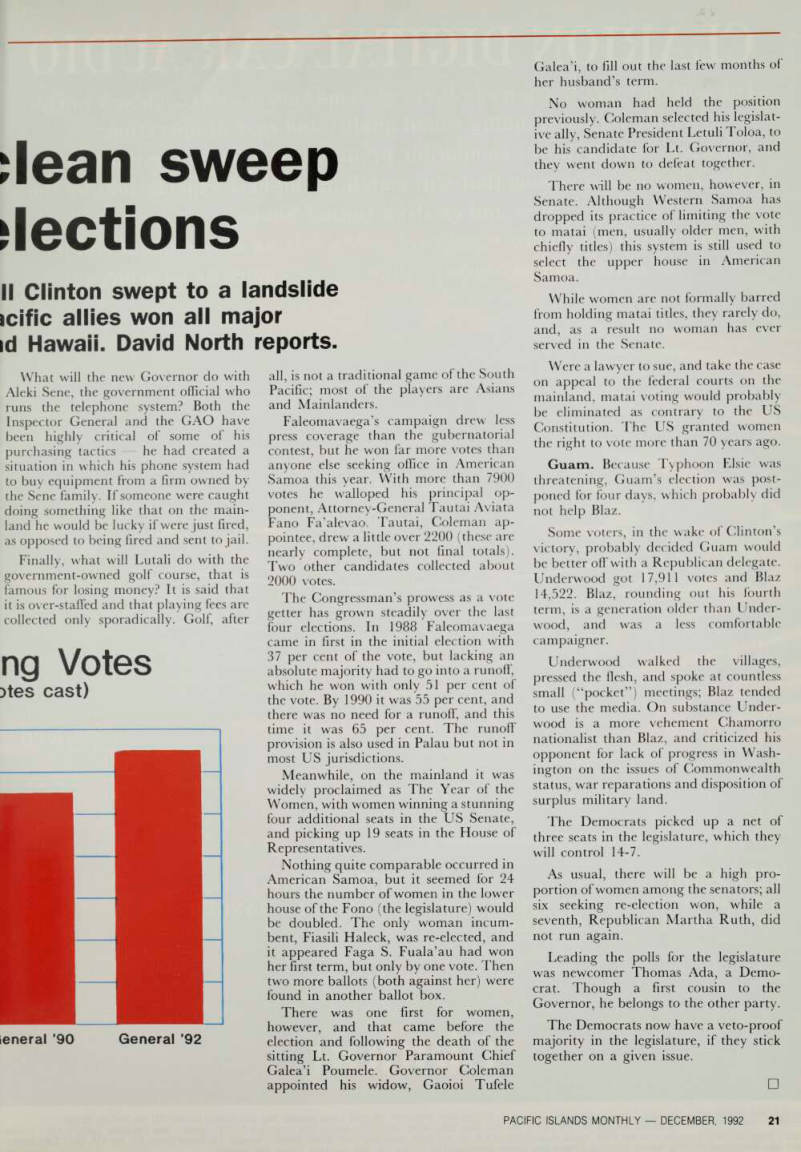
Eni’s ln< (percen
Votes cast for Eni Faleomavaega American Samoa delegate, 1988-1[?]
II Clinton swept to a landslide icific allies won all major id Hawaii. David North reports.
What will the new Governor do with Aleki Sene, the government official who runs the telephone system? Both the Inspector General and the GAO have been highly critical of some of his purchasing tactics he had created a situation in which his phone system had to buy equipment from a firm owned by the Sene family. If someone were caught doing something like that on the main land he would be lucky if were just fired, as opposed to being fired and sent to jail.
Finally, what will Lutali do with the government-owned golf course, that is famous for losing money? It is said that it is over-staffed and that playing fees are collected only sporadically. Golf, after
ng Votes >tes cast)
all, is not a traditional game of the South Pacific; most of the players are Asians and Mainlanders.
Faleomavaega’s campaign drew less press coverage than the gubernatorial contest, but he won far more votes than anyone else seeking office in American Samoa this year. With more than 7900 votes he walloped his principal op ponent, Attorney-General Tautai Aviata Fano Fa’alevao. Tautai, Coleman ap pointee, drew a little over 2200 (these arc nearly complete, but not final totals).
Two other candidates collected about 2000 votes.
The Congressman’s prowess as a vote getter has grown steadily over the last four elections. In 1988 Faleomavaega came in first in the initial election with 37 per cent of the vote, but lacking an absolute majority had to go into a runoff, which he won with only 51 per cent of the vote. By 1990 it was 55 per cent, and there was no need for a runoff, and this time it was 65 per cent. The runoff provision is also used in Palau but not in most US jurisdictions.
Meanwhile, on the mainland it was widely proclaimed as The Year of the Women, with women winning a stunning four additional seats in the US Senate, and picking up 19 seats in the House of Representatives.
Nothing quite comparable occurred in American Samoa, but it seemed for 24 hours the number of women in the lower house of the Fono (the legislature) would be doubled. The only woman incum bent, Fiasili Haleck, was re-elected, and it appeared Faga S. Fuala’au had won her first term, but only by one vote. Then two more ballots (both against her) were found in another ballot box.
There was one first for women, however, and that came before the election and following the death of the sitting Lt. Governor Paramount Chief Galea’i Poumele. Governor Coleman appointed his widow, Gaoioi Tufele
Galea’i, to fill out the last few months of her husband’s term.
No woman had held the position previously. Coleman selected his legislat ive ally, Senate President Letuli Toloa, to be his candidate for Lt. Governor, and they went down to defeat together.
There will be no women, however, in Senate. Although Western Samoa has dropped its practice of limiting the vote to matai (men, usually older men, with chiefly titles) this system is still used to select the upper house in American Samoa.
While women are not formally barred from holding matai titles, they rarely do, and, as a result no woman has ever served in the Senate.
Were a lawyer to sue, and take the case on appeal to the federal courts on the mainland, matai voting would probably be eliminated as contrary to the US Constitution. The US granted women the right to vote more than 70 years ago.
Guam. Because Typhoon Elsie was threatening, Guam’s election was post poned for four days, which probably did not help Blaz.
Some voters, in the wake of Clinton’s victory, probably decided Guam would be better off with a Republican delegate.
Underwood got 17,911 votes and Blaz 14,522. Blaz, rounding out his fourth term, is a generation older than Under wood, and was a less comfortable
campaigner.
Underwood walked the villages, pressed the flesh, and spoke at countless small (“pocket”) meetings; Blaz tended to use the media. On substance Under wood is a more vehement Chamorro nationalist than Blaz, and criticized his opponent for lack of progress in Wash ington on the issues of Commonwealth status, war reparations and disposition of surplus military land.
The Democrats picked up a net of three seats in the legislature, which they will control 14-7.
As usual, there will be a high pro portion of women among the senators; all six seeking re-election won, while a seventh, Republican Martha Ruth, did not run again.
Leading the polls for the legislature was newcomer Thomas Ada, a Demo crat. Though a first cousin to the Governor, he belongs to the other party.
The Democrats now have a veto-proof majority in the legislature, if they stick together on a given issue.