‘French no inside. Stay outside’
p. 19 · Read in the full issue
Land Rights
FISTS raised, eight Polynesian fisher men faced a French warship from their seven-metre skiff. A sign in the skiff said in French, ‘GO BACK. PRIVATE
Property Belonging To The
POMARE PARTY.’ Two heavy steel cables hung across the 20-metre width of the pass, laced through the reef on either side.
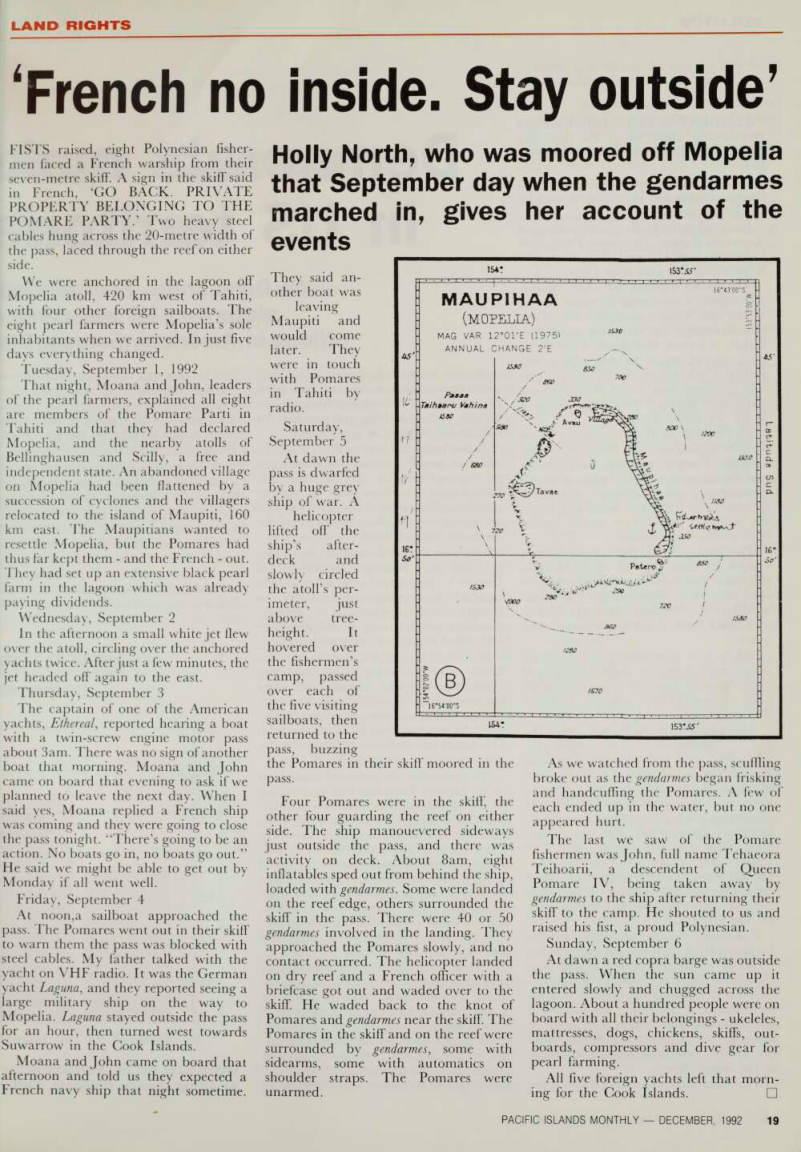
We were anchored in the lagoon off Mopelia atoll, 420 km west of Tahiti, with four other foreign sailboats. The eight pearl farmers were Mopelia’s sole inhabitants when we arrived. In just five days everything changed.
Tuesday, September 1, 1992 That night, Moana and John, leaders of the pearl farmers, explained all eight are members of the Pomare Parti in Tahiti and that they had declared Mopelia, and the nearby atolls of Bellinghausen and Scilly, a free and independent state. An abandoned village on Mopelia had been flattened by a succession of cyclones and the villagers relocated to the island of Maupiti, 160 km east. The Maupitians wanted to resettle Mopelia, but the Pomares had thus far kept them - and the French - out.
They had set up an extensive black pearl farm in the lagoon which was already paying dividends.
Wednesday, September 2 In the afternoon a small white jet flew over the atoll, circling over the anchored yachts twice. After just a few minutes, the jet headed off again to the east.
Thursday, September 3 The captain of one of the American yachts, Ethereal , reported hearing a boat with a twin-screw engine motor pass about Sam. There was no sign of another boat that morning. Moana and John came on board that evening to ask if we planned to leave the next day. When I said yes, Moana replied a French ship was coming and they were going to close the pass tonight. “There’s going to be an action. No boats go in, no boats go out.”
He said we might be able to get out by Monday if all went well.
Friday, September 4
At noon,a sailboat approached the pass. The Pomares went out in their skiff to warn them the pass was blocked with steel cables. My father talked with the yacht on VHF radio. It was the German yacht Laguna , and they reported seeing a large military ship on the way to Mopelia. Laguna stayed outside the pass for an hour, then turned west towards Suwarrow in the Cook Islands.
Moana and John came on board that afternoon and told us they expected a French navy ship that night sometime.
Holly North, who was moored off Mopelia that September day when the gendarmes marched in, gives her account of the events
They said an other boat was leaving Maupiti and would come later. They were in touch with Pomares in Tahiti by radio.
Saturday,
September 5
At dawn the pass is dwarfed by a huge grey ship of war. A
helicopter
lifted off the
ship’s after
deck and slowly circled the atoll’s per
imeter, just
above tree height. It hovered over the fishermen’s
camp, passed
over each of the five visiting sailboats, then returned to the pass, buzzing
the Pomares in their skiff moored in the pass. .
Four Pomares were in the skill, the other four guarding the reef on either side. Ihe ship manouevered sideways just outside the pass, and there was activity on deck. About Sam, eight inflatables sped out from behind the ship, loaded with gendarmes. Some were landed on the reef edge, others surrounded the skiff in the pass. There were 40 or 50 gendarmes involved in the landing. They approached the Pomares slowly, and no contact occurred. The helicopter landed on dry reef and a French officer with a briefcase got out and waded over to the skiff. He waded back to the knot of Pomares and gendarmes near the skiff. The Pomares in the skiff and on the reef were surrounded by gendarmes , some with sidearms, some with automatics on shoulder straps. The Pomares were unarmed.
As we watched from the pass, scuffling broke out as the gendarmes began frisking and handcuffing the Pomares. A few of each ended up in the water, but no one appeared hurt.
The last we saw of the Pomare fishermen was John, full name Tehaeora Teihoarii, a descendent of Queen Pomare IV, being taken away by gendarmes to the ship after returning their skiff to the camp, ffe shouted to us and raised his fist, a proud Polynesian.
Sunday, September 6 At dawn a red copra barge was outside the pass. When the sun came up it entered slowly and chugged across the lagoon. About a hundred people were on board with all their belongings - ukeleles, mattresses, dogs, chickens, skiffs, out boards, compressors and dive gear for pearl farming.
All five foreign yachts left that morn ing for the Cook Islands. □