Land disputes
pp. 16-17 · Read in the full issue
Land Rights
Land disputes in Polynesia
Pomare Party versus the Territory
By Karin von Strokirch
FHE EXPULSION of the Pomare Party from the island of Mopelia, and their subsequent hunger strike in protest, highlighted the endemic problem of indigenous land rights in French Poly nesia. These dramatic events in Septem ber, resulting from a dispute between the territorial government and the Pomare Party, were but a culmination of long standing hostilities and protracted legal battles. That the government is con stantly at loggerheads with the Pomare Party is perhaps not surprising given the latter’s militant approach to land reform and their political agenda for indepen dence and an end to nuclear testing.
The Pomare Party began to file claims to the island of Mopelia in the Leeward Islands in 1983 and has been occupying the land, first intermittently, and then permanently, ever since. Their removal became more pressing as in 1991 the territory granted land and maritime concessions on Mopelia to inhabitants of the neighbouring island of Maupiti who were keen to exploit these concessions.
The Pomare Party’s occupation of Mopelia was judged illegal by the local Appeals Court in July 1991, however, no action was taken until September this year. Due to a series of conflicts between the Pomare Party and the mayor and inhabitants of Maupiti, including violent exchange in December last year, a compromise seemed unlikely as neither side was prepared to tolerate cohabi tation with the other on Mopelia.
The dawn raid on September 5 by the fast frigate PrairiaU with 40 gendarmes , eight military men and a helicopter seemed a little out of proportion to the task of expelling eight squatters from Mopelia. Questioned on the size of the operation, the French High Commission said, to their knowledge there were up to SO'members of the Pomare Party on the island, while there was also the danger of reinforcements being sent from Tahiti to assist them, and therefore the forces employed were not considered to be
excessive. In fact, Joinville Pomare had intended to join the beleagured activists at Mopelia but was delayed by the police in Papeete and eventually turned back when he realised he was too late to prevent the expulsion.
The High Commissioner, Michel Jau, justified the eviction of the Pomare Party on the basis their occupation was “with out legal authorisation" but the timing of the “intervention by the forces of order had the ecjual objective of avoiding all risk of a grave confrontation and to protect the different Polynesian com munities who were opposed in this affair." The fear of a violent confron tation was not without basis as the imminent arrival of 100 people from the neighboring island of Maupiti was al most bound to result in conflict.
It would seem this was one dispute which the high commission would rather not have become involved in. Indigenous land rights disputes are a messy business which France would prefer to leave to the locals. The assistant to the high com missioner, Lionel Rimoux, said the mission to Mopelia was a success from a technical point of view but had to be seen as a failure given that force should only be used as a last resort. A statement from Michel Jau, added “this intervention should not be taken to be a substitute for the search for a durable solution by negotiation, dialogue and mutual com prehension." This could be seen as an indirect criticism of the territorial gov ernment for not having done enough to resolve the dispute by peaceful nego tiations and was interpreted as such by the Minister of the Sea responsible for this affair, Edouard Fritch.
Fritch argues in the government’s defence that they had done all in their power to reach a mutually agreeable solution with the Pomare Party but these efforts, including last minute attempts at conciliation, had been consistently ig nored or rejected by their leader, Joinville Pomare. The government, said Fritch, had been willing to grant con-
cessions to the Pomare Party if they! lodged a formal application to the mayor of Maupiti and ceased obstructing the
Maupiti people’s settlement of Mopelia.
Furthermore, the Pomare Party had prevented the free circulation of mari time traffic by blocking the pass which
provided the only entry to Mopelia
lagoon. Finally, much was made of the fact the Pomare Party members were cultivating marijuana on the island.
Joinville Pomare was opposed to the
settlement of Maupiti people on Mopelia
for several reasons. Firstly, because the Pomare family claimed to have ancestral rights to the land which the Maupiti people did not. Secondly, the Maupiti
people had polluted their lagoon through
water melon cultivation and associated pesticides and fertilizers, to such an extent their lagoon was unfit for pearl farming, which they now wanted to undertake at Mopelia. Pomare argued Mopelia’s lagoon would soon end up in the same state as that of Maupiti.
Finally, the Mopelia atoll is only 300 hectares and its sensitive environment would not support the presence of 100 or more new settlers from Maupiti.
The Pomare Party was cultivating pearls in the Mopelia lagoon. It was due to their success with this enterprise that the Maupiti people decided to start a pearl farm at Mopelia as well. Pomare is asking the territory pay damages of 50
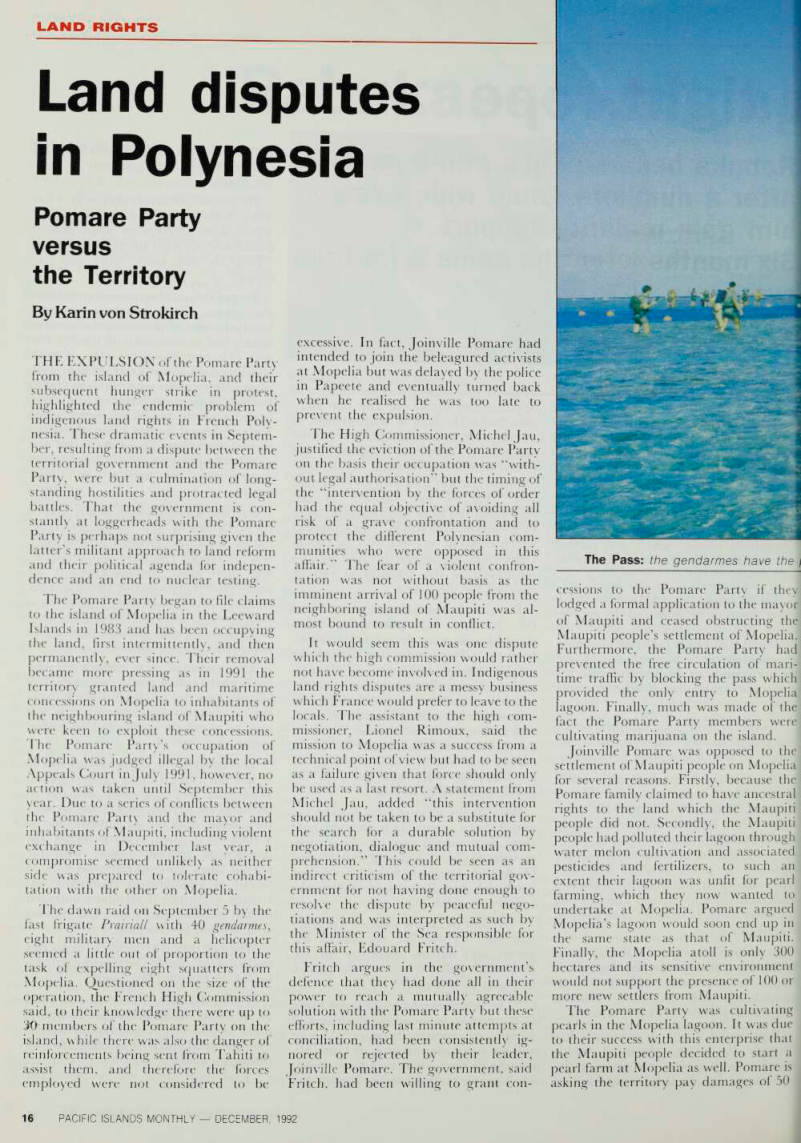
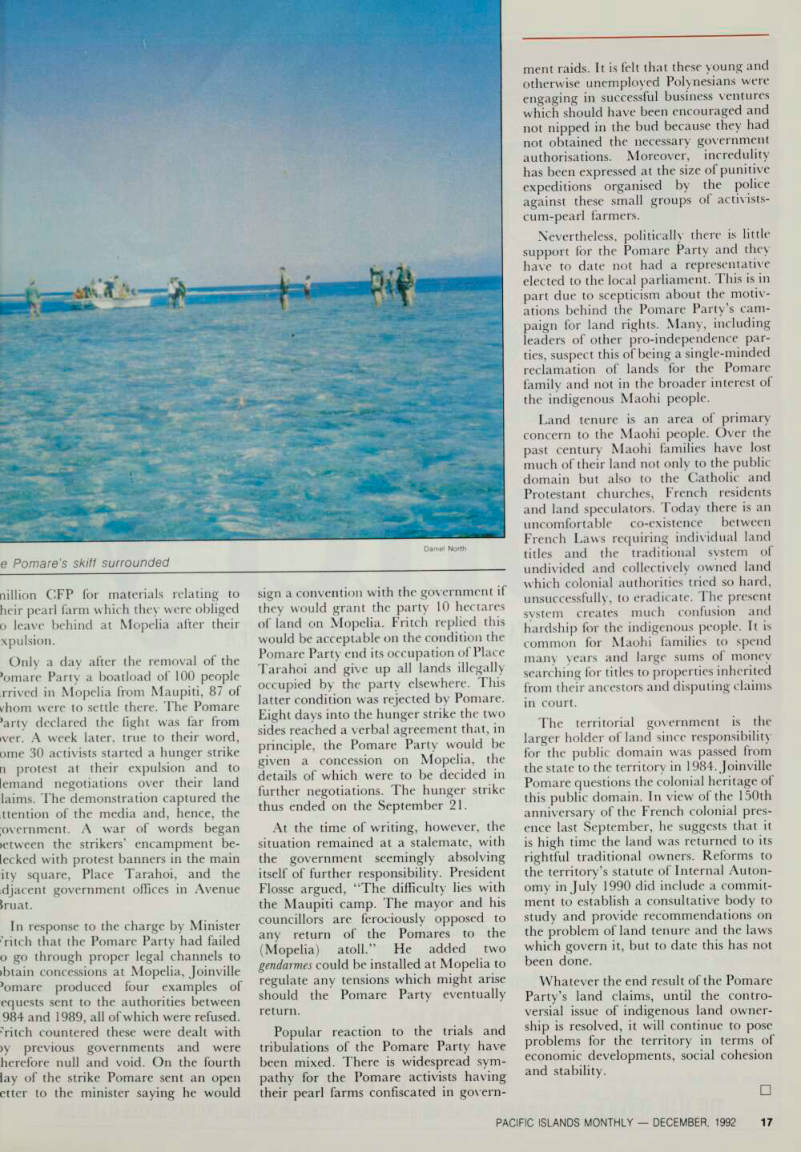
The Pass: the gendarmes have the
nillion CFP for materials relating to heir pearl farm which they were obliged o leave behind at Mopelia after their
xpulsion.
Only a day after the removal of the ‘omare Party a boatload of 100 people rrived in Mopelia from Maupiti, 87 of vhom were to settle there. The Pomare *arty declared the fight was far from iver. A week later, true to their word, ome 30 activists started a hunger strike a protest at their expulsion and to lemand negotiations over their land laims. The demonstration captured the ttention of the media and, hence, the government. A war of words began >etween the strikers’ encampment be lecked with protest banners in the main ity square, Place Tarahoi, and the idjacent government offices in Avenue Iruat.
In response to the charge by Minister Titch that the Pomare Party had failed o go through proper legal channels to »btain concessions at Mopelia, Joinville Annare produced four examples of equests sent to the authorities between 984 and 1989, all of which were refused.
Titch countered these were dealt with >y previous governments and were herefore null and void. On the fourth lay of the strike Pomare sent an open etter to the minister saying he would
sign a convention with the government if they would grant the party 10 hectares of land on Mopelia. Fritch replied this would be acceptable on the condition the Pomare Party end its occupation of Place Tarahoi and give up all lands illegally occupied by the party elsewhere. This latter condition was rejected by Pomare.
Eight days into the hunger strike the two sides reached a verbal agreement that, in principle, the Pomare Party would be given a concession on Mopelia, the details of which were to be decided in further negotiations. The hunger strike thus ended on the September 21.
At the time of writing, however, the situation remained at a stalemate, with the government seemingly absolving itself of further responsibility. President Flosse argued, “The difficulty lies with the Maupiti camp. The mayor and his councillors are ferociously opposed to any return of the Pomares to the (Mopelia) atoll.” He added two gendarmes could be installed at Mopelia to regulate any tensions which might arise should the Pomare Party eventually return.
Popular reaction to the trials and tribulations of the Pomare Party have been mixed. There is widespread sym pathy for the Pomare activists having their pearl farms confiscated in govern
ment raids. It is felt that these young and otherwise unemployed Polynesians were engaging in successful business ventures which should have been encouraged and not nipped in the bud because they had not obtained the necessary government authorisations. Moreover, incredulity has been expressed at the size of punitive
expeditions organised by the police
against these small groups of activists
cum-pearl farmers.
Nevertheless, politically there is little support for the Pomare Party and they have to date not had a representative elected to the local parliament. This is in part due to scepticism about the motiv ations behind the Pomare Party’s cam paign for land rights. Many, including leaders of other pro-independence par ties, suspect this of being a single-minded reclamation of lands for the Pomare family and not in the broader interest of the indigenous Maohi people.
Land tenure is an area of primary concern to the Maohi people. Over the past century Maohi families have lost much of their land not only to the public domain but also to the Catholic and Protestant churches, French residents and land speculators. Today there is an uncomfortable co-existence between French Laws requiring individual land titles and the traditional system of undivided and collectively owned land which colonial authorities tried so hard, unsuccessfully, to eradicate. The present svstem creates much confusion and hardship for the indigenous people. It is common for Maohi families to spend many years and large sums of money searching for titles to properties inherited from their ancestors and disputing claims in court.
The territorial government is the larger holder of land since responsibility for the public domain was passed from the state to the territory in 1984. Joinvillc Pomare questions the colonial heritage of this public domain. In view of the 150th anniversary of the French colonial pres ence last September, he suggests that it is high time the land was returned to its rightful traditional owners. Reforms to the territory’s statute of Internal Auton omy in July 1990 did include a commit ment to establish a consultative body to study and provide recommendations on the problem of land tenure and the laws which govern it, but to date this has not been done.
Whatever the end result of the Pomare Party’s land claims, until the contro versial issue of indigenous land owner ship is resolved, it will continue to pose problems for the territory in terms of economic developments, social cohesion and stability.
Daniel North
[?]e Pomare's skiff surrounded