Rabuka - walking[?] tight-rope
pp. 14-15 · Read in the full issue
Cover Story
By Mala Jagmohan
JOSEVATA Kamikamica’s assessment of the Rabuka government’s perform ance so far is that “it is trying to win the popularity stakes by attempting to please everyone through promises which will come to roost one day”. He is not alone in this assessment. There are enough people both within Sitivcni Rabuka’s coalition government and from the Opposition benches who are becom ing increasingly convinced he may not have been the right choice for prime minister.
For the man who became prime minister after winning an intricate game of numbers stacking up more parlia mentarians in his favour than the other contenders the game is far from ov er.
He is still wooing support, consolidating his position and above all trying to hold on to that support amid conflicting demands.
W hat was seen as a Rabuka asset his ability to bring together people of widely conflicting views is now working against him. He had used this ability to weave a blanket of support from the pro-multi-racialism. Indian dominated Fiji Labour Party, the ex tremist all-Fijian nationalists, the moder ate, pro-business General Voters Party and a majority of his own Fijian partv, the Soqosoqo ni Vakavulewa ni Taukei.
But the support hadn't come cheap.
There were conditions attached to the support. For the FLP it was a list of four, and included, as a priority, an immediate constitutional review. For the GVP it was to be part of a coalition and ministerial posts it ended up getting three of its five MPs as ministers. The nationalists gave their support to Ra buka on the understanding they would feature in the coalition they didn’t.
After some bad blood between the two, things appeared patched up. The SVT members 23 of the 30 MPs got ministerial posts. (Four of the seven who did not turned the posts down anyway.) Now six months later, Rabuka’s chal lenge is to hold on to the post he had promised so much to get. Keeping the support of the different groups who had backed him as prime minister is proving much more difficult than he had antici pated. Fiji Labour Party is losing patience playing the waiting game on the constitutional review and is now de manding some action.
How Rabuka will entertain its de mands, of a constitution based on racial equality, and at the same time keep
happy opposing groups who are in favour of indigenous Fijian supremacy remains to be seen. Six months after he promised an “immediate review” no one is the wiser on how or when the review will be conducted. Views differ from within the next five years, to 1996, to an announcement being made at the next
parliamentary session.
And even if the constitution were reviewed, what aspects would be con sidered for change? Would Rabuka, or his Fijian party, or even the Fijian grassroots accept anything short of absol ute political dominance?
Would this be a mere exercise in rhetoric with nothing changed?
The GVP, is far from being a silent partner in government. It has recently called for an increase in its share of seats in parliament and its pro-business/ private sector stand sometimes contra dicts Rabuka’s other policy of positive discrimination for the indigenous.
And the nationalist support seems to sway back and forth, depending on the issue at hand. They withdrew support after they were not counted in the coalition government, then they sup ported him again, then they were upset when a $lO-million out-of-court settle ment for their spokesman, Tony Stephens, fell through, then they were angry that Rabuka had, as Minister for Home Affairs, ordered the arrest of members who had blocked access to a hotel in protest over land rights issues.
Hoteliers and the business sector, on the other hand, were concerned he waited two weeks before deciding the road-blockers should be arrested.
Then there are promises Rabuka and his ministers have made, as they toured the country, in a getting-to-know the electorate exercise. What about the SI million promised to each province?
Many expected this to be provided for in the new budget;j there was no mention of it. Now Rabuka’s
deputy, Timoci!
Vesikula, is explain ing it is still very much in the govern ment’s mind and provision will be made at a later date.
As if this was not enough, those who had not backed him are increasingly be coming a force to be reckoned with. Not
only are they watching with glee, from the sidelines, the utter debacle, but they are also plotting strategies as to how and when government leadership should be
changed.
One of these would be to move a motion against him from within the party caucus a difficult proposition because the party management, they claim, is being stacked with more and more Rabuka-faithfuls, and also because, in the Fijian scheme of things, they are not willing to stand up and be counted as being against Rabuka - - not yet, anyway.
You see, the move could back-fire on them. Supposing such an attempt were made, and supposing they did not get the support they bargained for, they could very well be sacked from the party for being disloyal. This would automatically mean they would cease to occupy their seats in parliament, and by-elections would have to be called.
While the anti-Rabuka faction is confident it has at least 12 supporters, and a few doubtfuls who could sway towards them, from within the party’s 30 parliamentarians, they are not sure these people will openly defy Rabuka.
And one thing Rabuka still has on his side, is the support of the masses. If by elections were to be held, the voters could turn against those who tried to oust Rabuka, and not only would they not win back their seats, they’d be political history.
Some optimists within this group, however, feel a by-election is perhaps a necessary evil which has to be faced to bring the country to more able leader ship. They argue elections for Fijian seats are not dependent on party stands, but on traditional provincial linkages in which case the only doubtful seats to win back would be the urban ones.
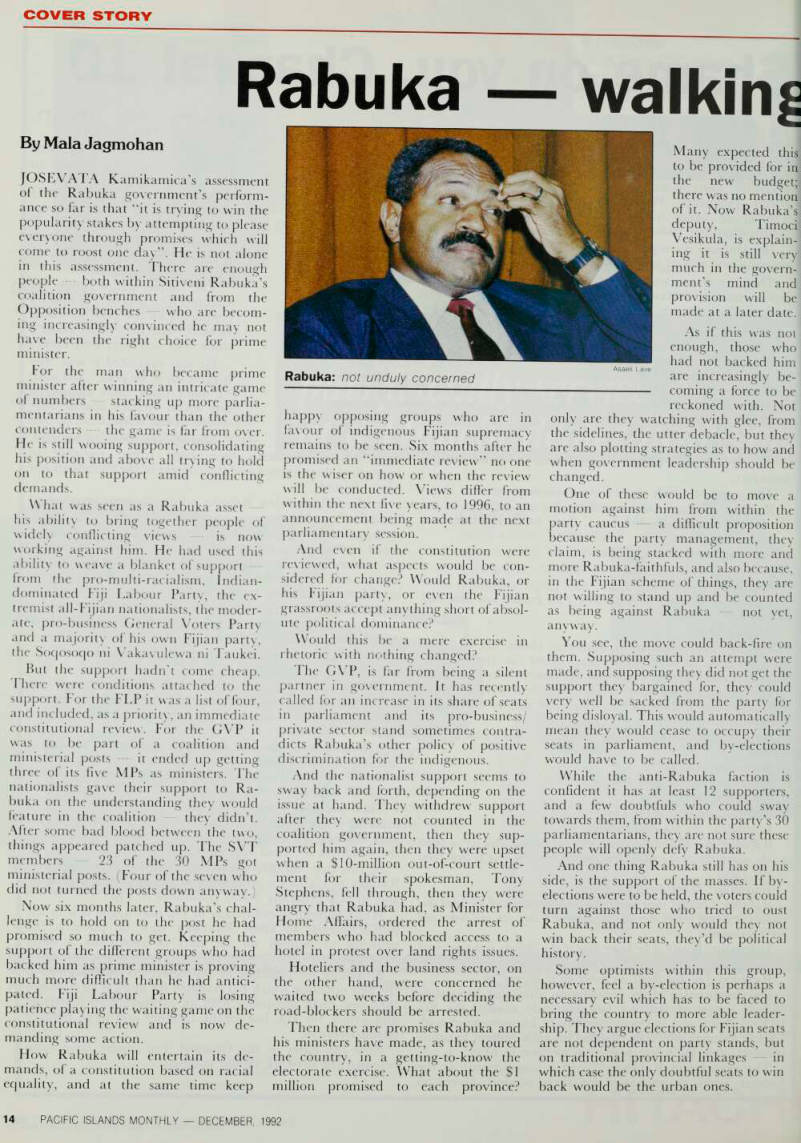
Rabuka: not unduly concerned
Asaeli Lave
Rabuka became Fiji’s prime minister after a numbers game which saw him gain majority support.
Six months later, the game is far from over.
Another strategy is to use parliament as a forum to topple leadership. While it is argued parliament does not have the right to change the prime minister since it did not appoint him in the first place (the President of the country appoints the prime minister based on who in his deliberate judgement commands the majority support of the House), a defeated government motion or an Opposition motion which gets carried can technically be seen as a vote of no confidence.
Whether this vote is against the entire government or the leader of the govern ment side is a question which the president might have to step in to resolve.
He could dissolve parliament and call for fresh elections, or he could decide the government might function better under
a new prime minister.
Another option is for members of the house to send a petition to the president, indicating a lack of support for Rabuka.
The role the Opposition parties will play in such a move is obvious. The 14 National Federation Party MPs have never been Rabuka supporters. They had backed Kamikamica, finance minis ter in the interim government before the elections, as prime minister and they
have not been inspired by Rabuka’s
leadership since to change. The FLP, on the other hand, have never been keen on Kamikamica.
So while NFP might feel Kamikamica is the most able person for the job, it might be expedient to look for an alternative, such as Ratu William Toganivalu, who got FLP’s 13 votes.
Toganivalu, a veteran politician, has through the years advocated multi racialism with a view to improving the indigenous’ lot. In fact, as far back as
1963, he had highlighted the dangers of apportioning blame on any one com munity for the lack of advancement of another. Yet he had also pointed out the dangers of economic inequality. He talked about “competing with them (Indians) cleanly and with all our might and with all our strength in our endeavour not to be their masters but to be their economic equals” a sentiment which would sit very well with the Indian Opposition. He has recently also been on record saying the constitution can be changed for the better.
But Kamikamica, himself, is not out of
the running for prime-ministership
should a crisis arise. A cooler and calmer head than Toganivalu, it is unlikely he would like to rush into a situation without having first worked out exactly which way the masses would swing. He is more likely to take the cautious wait and-see line and maybe let the people see the shortfalls of Rabuka first. But it was exactly this caution and lack of aggress ive lobbying which had cost him the prime-ministership in June.
What is the driving force behind the anti-Rabuka group? Is it through pure envy they missed out on the prime ministership? Is it a case of sour grapes?
Or do they genuinely feel they can do a better job and Rabuka is sending the country to ruin?
“He does not know what he’s doing,” said one. “There are no policies the government has on anything. In fact, their whole policy seems to be to hold on to power at any cost.”
“The promises which are being made to the people promises which reek of a popularity contest. Promises, which he will have to honour sooner or later. My concern is that when that time comes, when people realise these are nothing but
hollow words it might be too late. The country would have gone too far down the drain.”
He points out investment is at a low.
There is no growth in the private sector.
There is no attempt to boost investor confidence or to get the economy going.
“They do not know what they are
doing.”
Part of this disillusionment stems from the way the Rabuka-governmcnt handled some of the crises. In its early days it had to contend with the Fiji Post and Telecommunications saga, a prob lem inherited from the interim govern ment. After much controversy, including having the portfolio removed from Min ister Ilai Kuli, an illegal strike which Kuli appeared to be sympathetic to wards, the resignation of the board and profound apologies to the board from government, the matter was finally settled.
But the scandal which really rocked the government and forced the resig nation of attorney-general Apaitia Seru, was the Tony Stephens settled. Stephens, who had sued the government for unlawful detention during the days of the Internal Security Decree, was given a settlement by Seru amounting to some SlO million a staggeringly high figure which stunned the nation.
The payment was deferred, with parliament calling for a commission of inquiry into the whole settlement. Now the government has announced it will seek to annul the settlement in parlia ment.
This could be the motion which will be a test for the Rabuka goovernment.
While the NFP and FLP are not in favour of the payout, they do not see why they should bail the government out of a mess of its own making. While the nationalists generally agree with the payout, they are not likely to vote in favour of annulling it. And there are
enough government members outraged
by the settlement to either vote against it or abstain from voting.
Whether they will decide to make this the issue to change leadership will be known in the next few weeks.
If not, Rabuka will continue, well aware of the moves behind the scenes, of plans to oust him. He is reportedly not too concerned and feels can hold his way through a crisis.