Starting off with a bang
pp. 10-11 · Read in the full issue
By Martin Tiffany
NEWLY appointed secretary-general of the South Pacific Commision, George Sokomanu, began his appointment as head of the largest regional organisation with a bang.
Within hours of his appointment the former Vanuatu president lashed out at the “colonial club” attitude he said still existed in the region, singling out Australia for his attack.
His appointment at the 32nd South Pacific Conference in Suva on October 27-29 did not go down well with several countries, including Australia, and this is believed to have provoked the Sokomanu attack. Australia. France, the United States, the Cook Islands and French Polynesia were among countries who wanted the appointment deferred to allow for other nominations.
Former South Pacific Applied Geoscience Commission (SOPAC) direc tor Fiji’s Jioji Kotobalavu and Sokomanu were the only nominations for the post. But Kotobalavu, who was expected to get the job, withdrew only days before the conference to take up the permanent secretary position in his Prime Minister’s office.
This caught most SPC countries by surprise, some coming to the conference with no knowledge of his withdrawal. It is understood most countries especi ally the metropolitan ones would have favoured his appointment because of his proven management record with SOPAC and as one of Fiji’s top civil servants. Especially so after disclosures of financial mismanagement within the
Spc.
There was some suggestion of “con spiracy” by delegates of Sokomanu’s appointment and suspicion that Fiji was part of this.
Kotobalavu has
strongly denied
. tbe cons P|F ac y a legation. He said he was ap- Poached by the government to as -5*5! ! n tbe >r^ Tie I ! ll^ ter s °^ IC( r be res P onc led accepting. country nee{^ anc ! * re^P on e V re l oinm .g the P ub ’ .* C servace ’ n was -l ust it was so close to the meeting, kotobalavu said, “In hindsight we now realise in Fiji we should have taken the initiat ive to ensure we tell the other countries of the decision. I suppose we learn from our mis takes.
“I feel very bad and I owe them all (the other SPC countries) an apology, but there was no conspiracy just an 11th hour decision.”
Perhaps one action which fueled the conspiracy allegations was the attempt to rush the appointment of the secretary general when the conference began.
Conference chairman, Fiji’s deputy Prime Minister, Filipe Bole, said he had received requests to have the item, listed 12 on the agenda, brought forward to third or fourth slot.
This met with strong opposition from Cook Islands deputy Prime Minister
Inatio Akaruru who objected to such an important item being rushed. The move was shelved.
When the appointment item finally came up, the closed-door discussions lasted well over two hours. According to delegates Australia was behind a motion to defer the appointment. This failed and
the meeting finally agreed to Sokomanu’s
appointment.
The main objection from delegates was they had not put forward any other nominations because they were happy with Kotobalavu’s candidature. How ever as official conference spokesman Leo Keke of Nauru pointed out, all countries had been given ample time to forward nominations. He was responding to a question asking if there was a strong case to change the selection procedure for
choosing SPC leadership.
Dr Richard Herr of the University of Tasmania, speaking to PIM said there was a critical need to find a better system for the appointment of senior officers.
Herr wrote his doctoral thesis on the SPC and has attended almost every South Pacific Conference since 1971.
He said there was a need to find a process for getting a larger field of candidates and narrowing it down to a short-list agreeable to everyone.
There was no suggestion at the Suva meeting the selection process should be
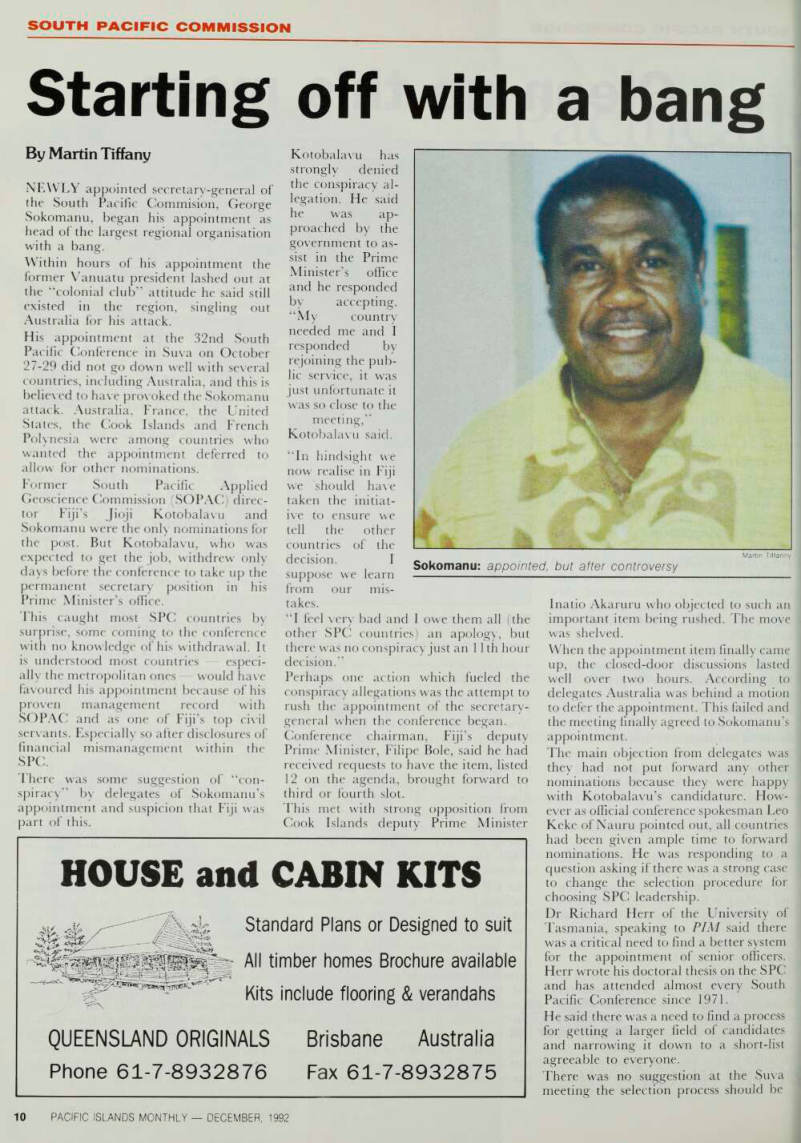
Sokomanu: appointed, but after controversy
altered the feeling being the countries knew the post was up for nominations and only Fiji and Vanuatu had put forward names.
The Sokomanu outburst, saying a colonial club did exist within the SPC, came at a press conference on the
afternoon of his appointment.
“The way the Australian government is carrying on, we’re back at the stage we should be out of,” said Sokomanu.
“Do we still need people to bulldoze us around here or let Pacific islanders do their own thing and show places like Australia and others that they can do the job as well as others?”
Australian Parliamentary Secretary to the Minister of Foreign Affairs, Stephen Martin, was not impressed with the criticism. Martin, the head of the Australian delegation to the SPC, said
Sokomanu was respected in the region
but said deferring the appointment would have possibly allowed other can didates to be nominated who possesed the “required financial and management skill” to tackle SPC’s current problems.
Martin said after this sort of outburst Australia one of the SPC’S major financial supporters didn’t feel very welcome.
He also dismissed as “absolute non.sense” suggestions that frosty relations between Port Vila and Canberra came into over the leadership issue.Sokomanu’s attack on Australia did not go down well with other meeting delegates.
In its final report the conference rapped Sokomanu’s knuckles by endors ing comments by the representatives of French Polynesia, the Cook Islands, France and Tokelau condemning an interview the secretary-general elect gave to the press. The conference noted Sokomanu had referred to in-camera discussions on the appointment of prin cipal officers and he had criticised the positions of certain member countries on this item.
Sokomanu was requested by the con ference to help maintain a spirit of regional unity and refrain from “com menting publicly on the positions of individual members”.
Meanwhile, Sokomanu said he be lieved he had the experience for the SPC saying, “what is a degree when experi ence is there for a job”. Certainly one thing Sokomanu has in his favour is as a former Vanuatu president he knows the regional heads and they view him on an equal standing. To further help his regional dealings he speaks fluent Eng lish, French, Fijian and pidgin.
Despite the differences over his ap pointment none of the countries felt this would strain their dealings with the SPC.