Clean up this mess
South Pacific Commission
By Martin Tiffany
THE big boys at the 32nd South Pacific Conference in Suva were not happy. And they warned the South Pacific Com mission to clean up its financial mess or they would reconsider their financial contributions.
Despite assurances at the October meet ing from the commissions outgoing secretary-general, Atanraoi Baiteke, that the deficit problem was under control, Australia, France, the United Kingdom and New Zealand expressed concern.
Australia is the biggest donor, contribu ting almost SUS 2 million of the S 6 million received in assessed contri butions.
Australian representative Stephen Mar
tin said his delegation could not accept Baiteke’s statement the budget deficit was under control. If the current situ ation persisted, Australia would have to review and consider scaling down the level of its extra-budgetary assistance and use some of its funds to improve the financial management of the com mission.
France said if reforms proposed by the SPG Management Systems Review Sub- Committee were not implemented, they would have to reconsider the payment date and the amount of its contributions to the SPG.
The United Kingdom representative said in 1993 they would continue their extra budgetary assistance to the projects they now supported. However, the amount of this assistance in 1994 would depend on the steps taken in 1993 to improve financial management and control.
New Zealand said it was concerned because last year’s conference had di rected the secretariat to take appropriate remedial action following consideration of last year’s audit report, but the current audit report had covered much the same
ground.
The problem the commission has been faced with over the past couple of years is financial mismanagement and a grow ing budget deficit. The 1991 deficit was first believed to be around SUSI million but according to conference spokesman, Nauru’s Leo Keke, it is between
Sussoo,Ooo And $U5750,000.
The commission’s budget consists of the core budget and an extra-budgetary fund. Seventy per cent of the core budget covers administrative costs and 30 per cent finances the work program. The extra-budgetary fund makes up the shortfall in the work program.
The 1991 auditor’s report showed a
negative balance in the core budget of SUS 2.4 million.
What the donor countries Australia, France, the United States, Britain and New Zealand want is the com mission’s financial situation monitored closely before they give any further payments.
The 17th meeting of the Committee of Representatives of Governments and Administrations (CRGA), held in Suva immediately before the conference, agreed to accept the recommendations (with two exceptions) made by the auditors for immediate implementations.
The CRGA meeting also requested the auditors to closely monitor the financial situation and the implementation of these recommendations.
The report by auditors Coopers and Lybrand for 1991 said some accounting principles applied in previous years did not conform with generally accepted accounting principles. And recommen dations made in previous audit reports had not been implemented.
The budget for 1993 of SUS 22 million was approved on the condition the new management implement recommended
changes to the commission’s financial systems and management practices.
These changes are to ensure a stricter control on expenditure, improve internal auditing and ensure the financial situ ation is closely monitored.
What was interesting was there was no attempt made to apologise or make excuses for the financial mismanage ment. It was accepted there was a problem and a solution had to be found.
What perhaps irritated some countries, the donors in particular, was that after the financial problems were brought to light at the 1991 conference they ex pected something to have been done about them. Especially after four CRGA meetings two last year and two this year. The CRGA acts as a board of management for the SPG and it was expected they would sort out the prob lem. Many countries were genuinely surprised nothing had been done.
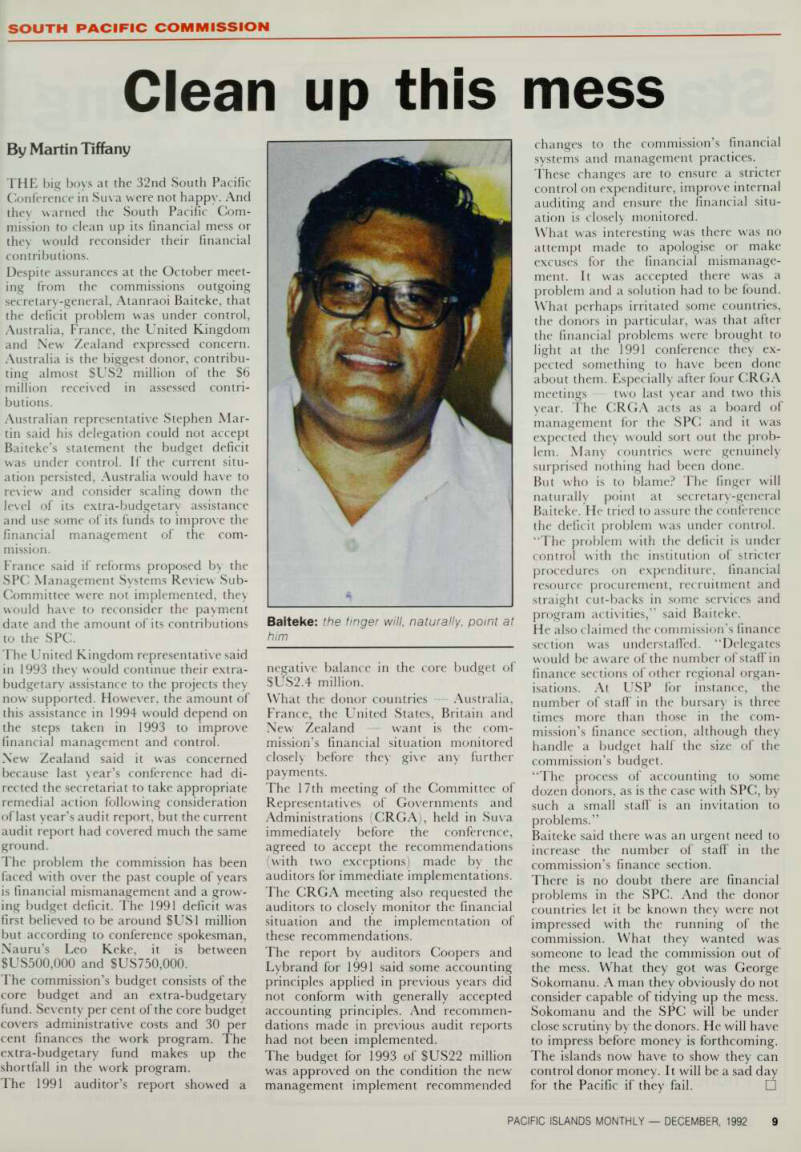
But who is to blame? The finger will naturally point at secretary-general Baiteke. He tried to assure the conference the deficit problem was under control.
“The problem with the deficit is under control with the institution of stricter
procedures on expenditure, financial
resource procurement, recruitment and straight cut-backs in some services and program activities,’’ said Baiteke.
He also claimed the commission’s finance section was understaffed. “Delegates would be aware of the number of staff in finance sections of other regional organ isations. At USP for instance, the number of staff in the bursary is three times more than those in the com mission’s finance section, although they handle a budget half the size of the commission’s budget.
“The process of accounting to some dozen donors, as is the case with SPG, by such a small staff is an invitation to
problems.”
Baiteke said there was an urgent need to increase the number of staff in the commission’s finance section.
There is no doubt there are financial problems in the SPG. And the donor countries let it be known they were not impressed with the running of the commission. What they wanted was someone to lead the commission out of the mess. What they got was George Sokomanu. A man they obviously do not consider capable of tidying up the mess.
Sokomanu and the SPG will be under close scrutiny by the donors. He will have to impress before money is forthcoming.
The islands now have to show they can control donor money. It will be a sad day for the Pacific if they fail. □
Baiteke: the finger will, naturally, point at him