Removing barriers
p. 11 · Read in the full issue
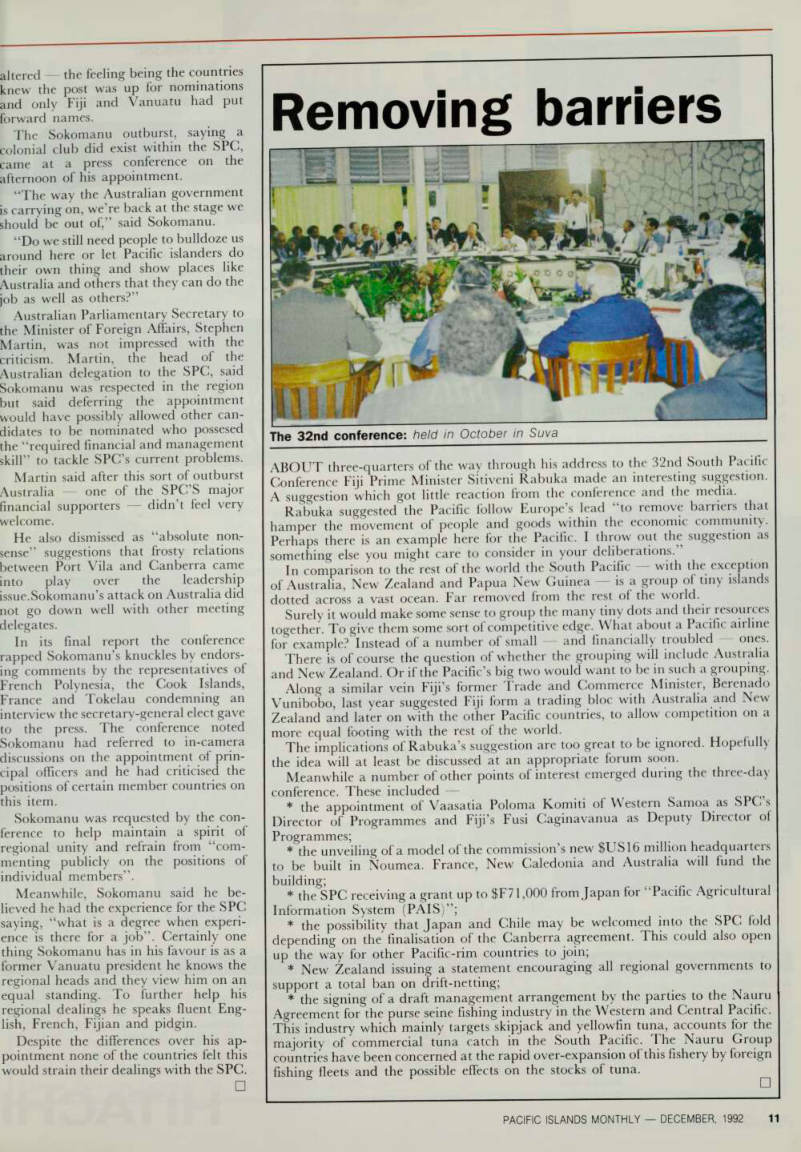
ABOUT three-quarters of the way through his address to the 32nd South Pacific Conference Fiji Prime Minister Sitiveni Rabuka made an interesting suggestion.
A suggestion which got little reaction from the conference and the media.
Rabuka suggested the Pacific follow Europe’s lead “to remove barriers that hamper the movement of people and goods within the economic community.
Perhaps there is an example here for the Pacific. I throw out the suggestion as something else you might care to consider in your deliberations.
In comparison to the rest of the world the South Pacific with the exception of Australia, New Zealand and Papua New Guinea is a group of tiny islands dotted across a vast ocean. Far removed from the rest of the world.
Surely it would make some sense to group the many tiny dots and their resources together. To give them some sort of competitive edge. What about a Pacific airline for example? Instead of a number of small and financially troubled ones.
There is of course the question of whether the grouping will include Australia and New Zealand. Or if the Pacific’s big two would want to be in such a grouping.
Along a similar vein Fiji’s former Trade and Commerce Minister, Berenado Vunibobo, last year suggested Fiji form a trading bloc with Australia and New Zealand and later on with the other Pacific countries, to allow competition on a more equal footing with the rest of the world.
The implications of Rabuka’s suggestion are too great to be ignored. Hopefully the idea will at least be discussed at an appropriate forum soon.
Meanwhile a number of other points of interest emerged during the three-day conference. These included * the appointment of Vaasatia Poloma Komiti of Western Samoa as SPG s Director of Programmes and Fiji’s Fusi Caginavanua as Deputy Director of Programmes; * the unveiling of a model of the commission’s new SUSI 6 million headquarters to be built in Noumea. France, New Caledonia and Australia will fund the building; * the SPC receiving a grant up to $F71,000 from Japan for “Pacific Agricultural Information System (PAIS)”; * the possibility that Japan and Chile may be welcomed into the SPC fold depending on the finalisation of the Canberra agreement. This could also open up the way for other Pacific-rim countries to join; * New Zealand issuing a statement encouraging all regional governments to support a total ban on drift-netting; * the signing of a draft management arrangement by the parties to the Nauru Agreement for the purse seine fishing industry in the Western and Central Pacific.
This industry which mainly targets skipjack and yellowfin tuna, accounts for the majority of commercial tuna catch in the South Pacific. The Nauru Group countries have been concerned at the rapid over-expansion of this fishery by foreign fishing fleets and the possible effects on the stocks of tuna.
The 32nd conference: held in October in Suva