Sugar’s not-so-sweet deal
p. 27 · Read in the full issue
By David North
RECENTLY announced US government decisions regarding sugar imports offered little sol ace to hard-pressed sugar pro ducers in Fiji and Papua-New Guinea.
With the prospect of substantial reductions in their access to the heavily-subsidized European sugar markets, the Fiji sugar industry learned that its quota for the subsidized US market had been reduced yet again. (The PNG quota, already established at the roc k bottom level of one (rather small) shipload, remained the same .
The US sugar system is roughly like that of the Europeans; the market is rigged by law to create artificially high price's on the US market, for the benefit of both large corporate growers of sugar cane in Florida, and for family sugar beet farms in the Middle West. The narrow ing difference between growing Ameri can production and relatively stable domestic consumption is allocated by a complex formula to overseas producers, cuch as those in Fiji and PNG.
While the US quotas are decreasing, they are worthwhile, if not as valuable as the European ones. The world (free market price] of a metric tonne of sugar was bout SI9O at the start of October, compared to 5485 for the US market price; in comparison, Fiji sold its 1990 crop in Europe for SBBO a tonne. The US price quoted above is for New York, and contains shipping and insurance costs.).
In August the US Secretary of Agri culture announced the 1992-1993 quotas for sugar imports. Fiji, which had had about 18,000 metric tonnes in 1982-83 and 11,892 in 1991-92, was allocated 10,495 tonnes lor the coming season.
PNG, which had had about 15,000 tonnes in the 1982-1983 season, was granted 7258 for eac h of the 1991-92 and the 1992-93 seasons.
L S sugar allocations are usually made for 12-month periods; this time from October 1, 1992 through September 30, 1993; the Secretary can, however, adjust these dates later, and he could also raise the quotas, should there be- a short-fall in Stateside' sugar production. (Hurricane Andrew, which did enormous damage' to southern Florida, managed to miss the Florida sugar cane fields, but later did some damage to those in Louisiana; not enough, however, to lift the overseas quotas.).
A further complication for both Fiji and PNCi may come if the North American Free Trade Agreement (NAFTA; is ratified by the I S Congress.
That would give Mexico access to US market, and would tend to encourage the growing of sugar cane in that nation, lowering still further the overseas quotas.
On a more cheerful note, the Fiji Sugar Corporation has annnounced that it has worked out a deal with Canada for the shipment of 36,000 tonnes of sugar to that nation in coming season. This is newly re-opened market (Canada grows sugar beets, but no cane), but one that might be endangered by Mexican sugar in the future. The Canadian pricing arrangements were not immediately available, but the first 1 4,000 tonnes of sugar were expected to leave from Fiji for Canada in November.
Meanwhile a freighter carrying a Canadian name. Thunder lia]\ and PNG’s entire US quota worth of sugar, left PNC on July 30, arriving in New Orleans on September 6. PNG lends to ship at (he end of (he crop year, while Fiji’s shipment to the US takes place at the beginning of the period. The Fiji ship ment of more than 10,000 tonnes (its yearly allocation) left Suva on the A opalnm Jastrzehie on September .3, arriving in Savannah, Georgia, on Octo ber 6. □
Asaeh lave
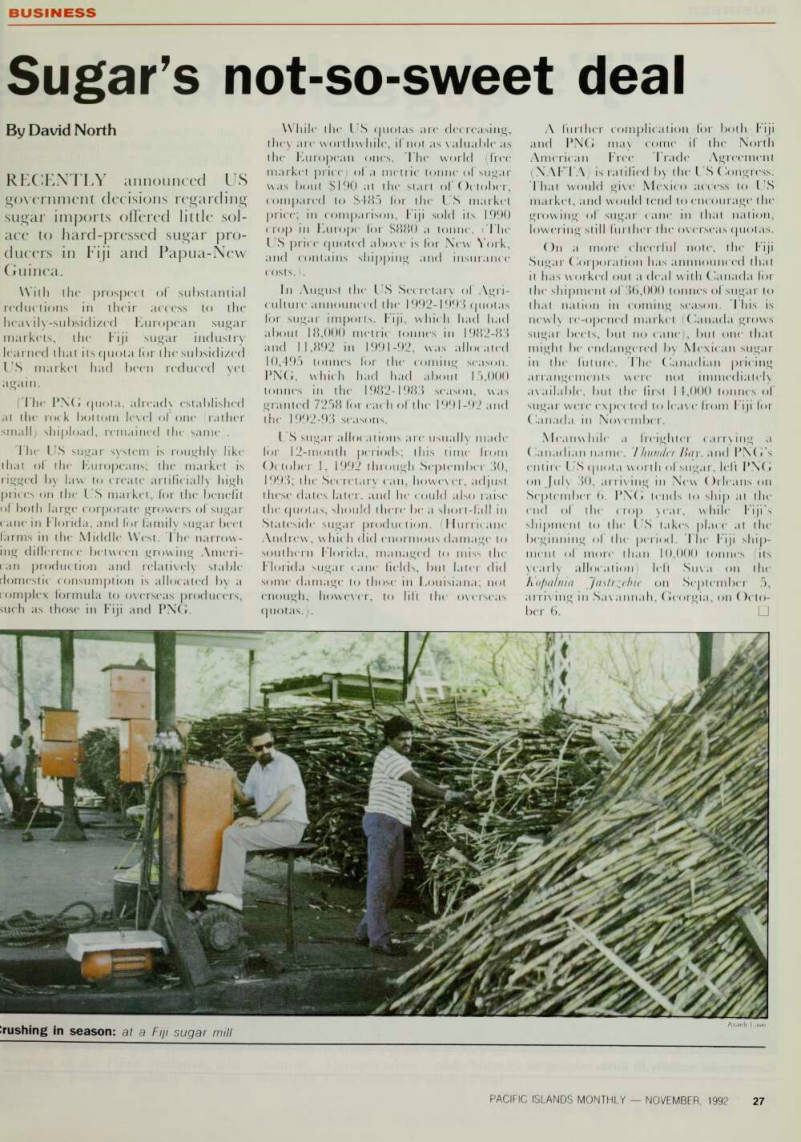
[?]ushing in season: at a Fiji sugar mill