Fiji’s struggle to bridge the economic gap
pp. 28-29 · Read in the full issue
By Akanisi Motufaga
THE 1 ack of participation of indigenous Fijians in business has been an issue for debates and discussions since the last decade. In 1982 the Great Council of Chiefs discussed it and a committee tabled their report a year later highlight ing the problems.
The political events of 1987 heightened the awareness of the lack of Fijian participation in business and led to
the implementation of a nine-point plan
by the interim government, part of which has already been implemented. After the elections in May this year, the new cabinet agreed in principle to certain policies also aimed at bridging the gap between indigenous Fijians and non- Fijians in the business sector.
The new government’s policies in cluded the setting up of a business agency, a 20-year tax-free holiday to businesses where Fijians held at leat
51-per-cent shareholding, a SI-million
grant to each provincial council, an increase in scholarship funds for Pijian education and that Fijian Holdings Limited, an investment company, be
given first priority in buying government
shares in commercial enterprises that are privatised.
These policies were a direct result of representations from the Fijian Initiat ive, a group of indigenous Fijians who act in an advisory capacity to government.
While some people have said such policies will help government achieve its aims, others have stated otherwise.
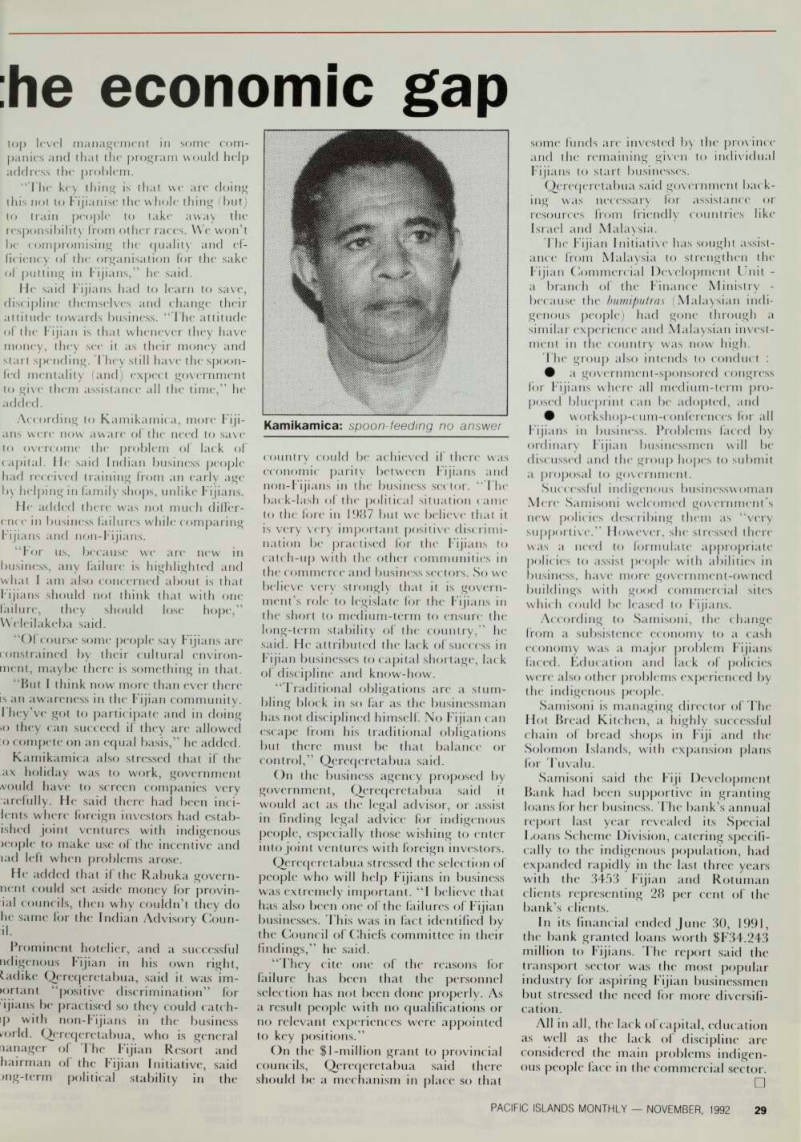
Former Finance Minister in the in terim government Josevata Kamikamica has described the new policies and grant to provincial councils as “spoon feeding." He said Fijians should not be spoon-fed but left to compete with non- Fijians on an equal footing in the business world.
But, he said, the interim government had addressed the problem by formulat
ing a nine-point plan which included,
among other things, a S2O-million interest-free grant to the Fijian Affairs Board to invest in Fijian Holdings Limited, the strengthening of the board
to implement policies aimed at improv
ing Fijians in all sectors, the setting up of a Compulsory Savings Scheme for Fijians and more concessions for Fijian loans to
be managed bv the Fiji Development
Bank.
Kamikamica attributed the problems
Fijians in business face to their lack of capital, training and discipline, as well as to the belief most Fijians have that money is the root of all evil. In order to bridge the gap between Fijian and non- Fijian representation in business. Kami kamica said young people should be trained, developed and led through the proper channel and that incentives should be provided for joint ventures.
Referring to Fijian Holdings, an in vestment firm solely for indigenous
people, Kamikamica said Fijian capital
now existed on a national level but the real problem lay within the corporate level. Fijian Holdings receives invest ment from indigenous-owned firms and individuals and buys shares in other
profitable companies.
In order to address the lack of Fijian representation in business, the company has embarked on a training scheme where Fijian graduates will be trained for a year and than hired to work for the company or its subsidiaries.
Company chief executive officer Siti veni Weleilakcba said there was a definite lack of Fijian representation in
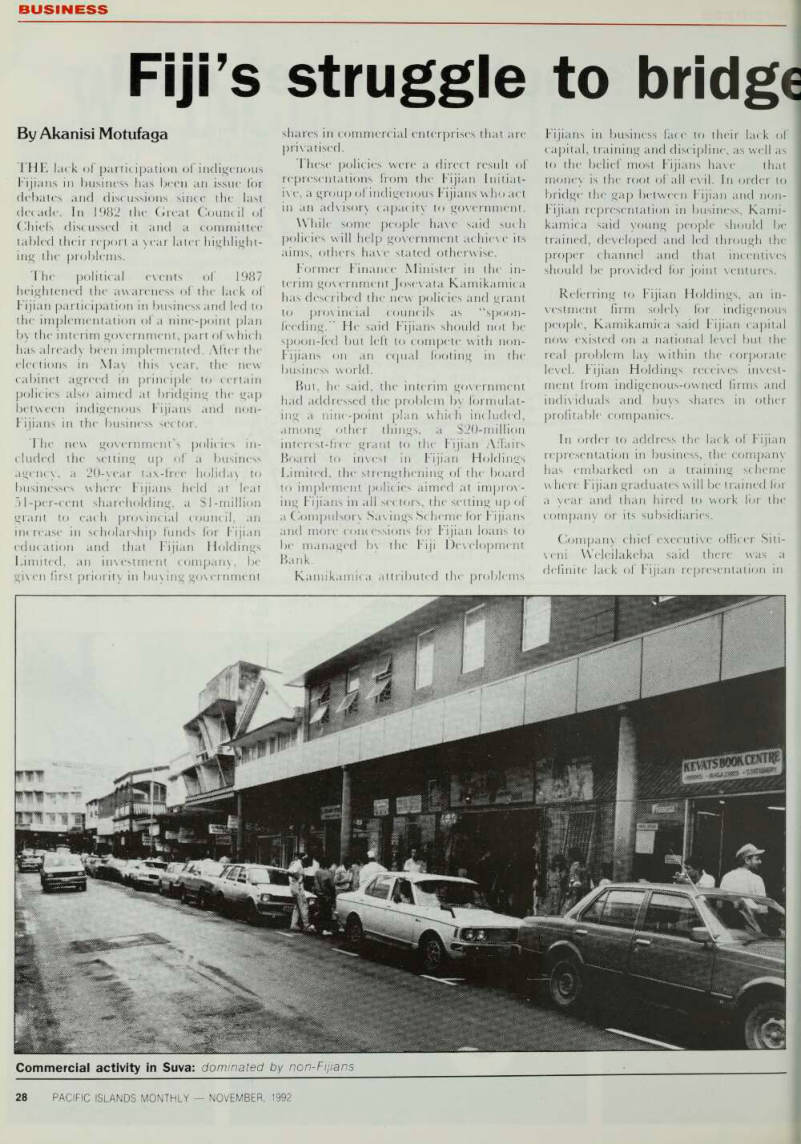
Commercial activity in Suva: dominated by non-Fijians
top level management in some com panies and that the program would help address the problem.
“The key thing is that we are doing this not to Fijianise the whole thing (but) to train people to take away the responsibility from other races. We won’t be compromising the quality and ef ficiency of the organisation for the sake of putting in Fijians,” he said.
He said Fijians had to learn to save, discipline themselves and change their attitude towards business. “The attitude of the Fijian is that whenever they have money, they see it as their money and start spending. They still have the spoon fed mentality (and) expect government to give them assistance all the time,” he added.
According to Kamikamica, more Fiji ans were now aware of the need to save to overcome the problem of lack of capital. He said Indian business people had received training from an early age by helping in family shops, unlike Fijians.
He added there was not much differ ence in business failures while comparing Fijians and non-Fijians.
“For us, because we are new in business, any failure is highlighted and what I am also concerned about is that Fijians should not think that with one failure, they should lose hope,”
Weleilakeba said.
“Of course some people say Fijians are constrained by their cultural environ ment, maybe there is something in that.
“But I think now more than ever there is an awareness in the Fijian community.
Fhey’vc got to participate and in doing >o they can succeed if they arc allowed o compete on an equal basis,” he added.
Kamikamica also stressed that if the ax holiday was to work, government vould have to screen companies very arcfully. He said there had been inei lents where foreign investors had cstab ished joint ventures with indigenous Jcople to make use of the incentive and lad left when problems arose.
He added that if the Rabuka govern nent could set aside money for provin ial councils, then why couldn’t they do he same for the Indian Advisory Coun il.
Prominent hotelier, and a successful ndigenous Fijian in his own right, ladike Qereqeretabua, said it was im portant “positive discrimination” for ijians be practised so they could catch ip with non-Fijians in the business i/orld. Qereqeretabua, who is general nanager of The Fijian Resort and hairman of the Fijian Initiative, said >ng-term political stability in the
country could be achieved if there was economic parity between Fijians and non-Fijians in the business sector. k ‘The back-lash of the political situation came to the fore in 1987 but we believe that it is very very important positive discrimi nation be practised for the Fijians to catch-up with the other communities in the commerce and business sectors. So we believe very strongly that it is govern ment’s role to legislate for the Fijians in the short to medium-term to ensure the
long-term stability of the country,” he
said. He attributed the lack of success in Fijian businesses to capital shortage, lack of discipline and know-how.
“Traditional obligations arc a stum bling block in so far as the businessman has not disciplined himself. No Fijian can escape from his traditional obligations but there must be that balance or control,” Qereqeretabua said.
On the business agency proposed by government, Qereqeretabua said it would act as the legal advisor, or assist in finding legal advice for indigenous people, especially those wishing to enter into joint ventures with foreign investors.
Qereqeretabua stressed the selection of people who will help Fijians in business was extremely important. “I believe that has also been one of the failures of Fijian businesses. This was in fact identified by the Council of Chiefs committee in their findings,” he said.
“They cite one of the reasons for failure has been that the personnel selection has not been done properly. As a result people with no qualifications or no relevant experiences were appointed to key positions,”
On the SI-million grant to provincial councils, Qereqeretabua said there should be a mechanism in place so that
some funds are invested by the province and the remaining given to individual Fijians to start businesses.
Qereqeretabua said government back ing was necessary for assistance or resources from friendly countries like Israel and Malaysia.
The Fijian Initiative has sought assist ance from Malaysia to strengthen the Fijian Commercial Development Unit a branch of the Finance Ministry because the bumiputras (Malaysian indi genous people) had gone through a similar experience and Malaysian invest ment in the country was now high.
The group also intends to conduct : • a government-sponsored congress for Fijians where all medium-term pro
posed blueprint can be adopted, and
• workshop-cum-conferences for all Fijians in business. Problems faced by ordinary Fijian businessmen will be discussed and the group hopes to submit a proposal to government.
Successful indigenous businesswoman Mere Samisoni welcomed government's new policies describing them as “very supportive.” However, she stressed there was a need to formulate appropriate policies to assist people with abilities in business, have more government-owned buildings with good commercial sites which could be leased to Fijians.
According to Samisoni, the change from a subsistence economy to a cash
economy was a major problem Fijians
faced. Education and lack of policies
were also other problems experienced by
the indigenous people.
Samisoni is managing director of The Hot Bread Kitchen, a highly successful chain of bread shops in Fiji and the Solomon Islands, with expansion plans for Tuvalu.
Samisoni said the Fiji Development Bank had been supportive in granting loans for her business. The bank’s annual report last year revealed its Special Loans Scheme Division, catering specifi cally to the indigenous population, had expanded rapidly in the last three years with the 3453 Fijian and Rotuman clients representing 28 per cent of the bank’s clients.
In its financial ended June 30, 1991, the bank granted loans worth 5F34.243 million to Fijians. The report said the transport sector was the most popular
industry for aspiring Fijian businessmen
but stressed the need for more diversifi cation.
All in all, the lack of capital, education as well as the lack of discipline are considered the main problems indigen ous people face in the commercial sector.
Kamikamica: spoon-feeding no answer