Regulating casinos- a goverment challenge
pp. 24-25 · Read in the full issue
Business
By David North
Island governments need ing economic and having few natural re sources, often think about a particularly lush form of tourism gambling ca sinos.
They seem to provide high-rolling off-shore cus tomers, do not take up much space, do not damage the forests and the reefs, and promise jobs for the resi dents and taxes for the government.
However, as Tinian, in the Commonwealth of the Northern Mariana Island, is learning casinos (even un built, not- yet-planned ca sinos) can provide a lot of headaches for all concerned.
THE basic problem is organised crime. The rack eteers are as attracted to casinos as ants are to a picnic keeping the crimi nal out of the gambling business is a terrible chal lenge to well-established governments with strong re cords of regulating business.
What happens when you bring that challenge to an island with about 2000 people where there is no experience with urban, or ganised crime, and where the government does little more than run the schools and fill the pot-holes in the roads?
TINIAN is such an island, and its early on experiences in simply issuing a licence to a casino has been gut-wrenching.
There are three principal islands in CNMI. There is Saipan, which has the government, most of the population, and virtually all of the economic develop ment (the very controversial garment factories and the less controversial hotels for the Japanese tourists.) Then there are Rota and Tinian, only a few miles away, which had felt left out of the economic boom. Each island has three senators, so while economically weak, both Rota and Tinian have some serious political power; as a result, the CNMI constitution gives substantial local authority to each of the island governments.
Tinian wanted legalised gambling, and voted for it overwhelmingly in a 1988 referendum. Given the state of the constitution Tinian was given its way, though the CNMI leadership, which had not banned prostitution, fought the notion of legalised gambling. (And maybe they were right).
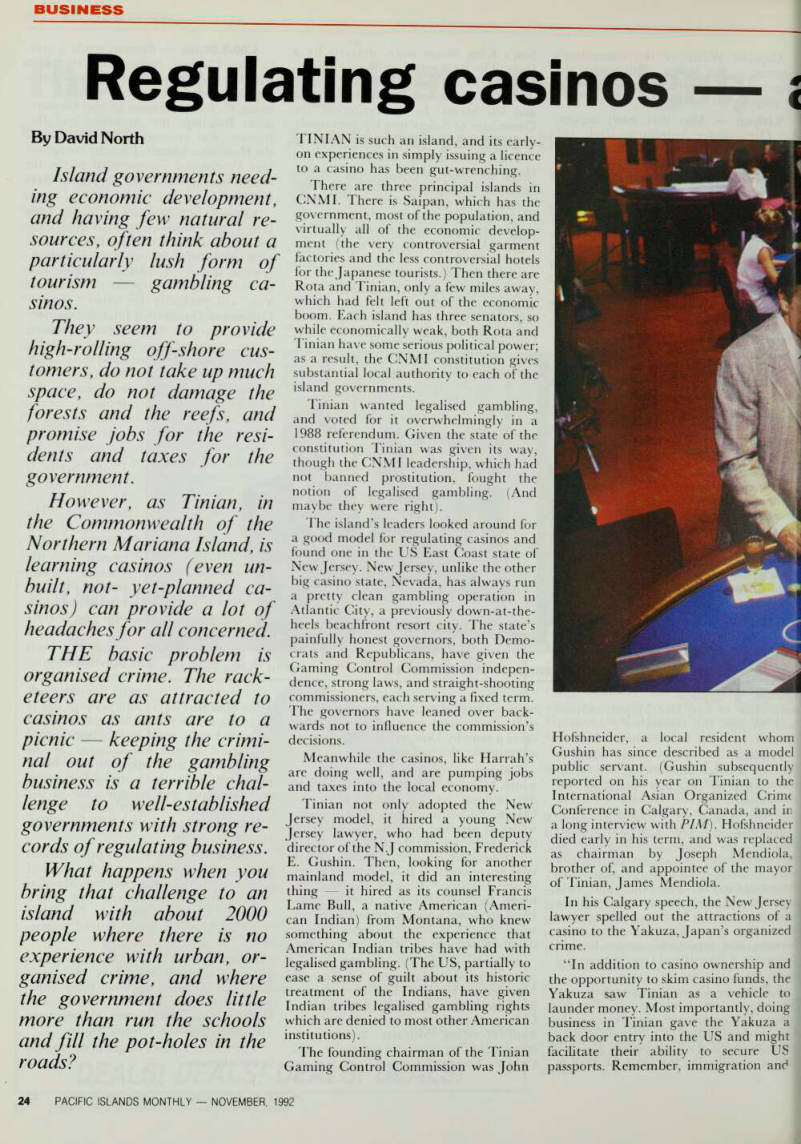
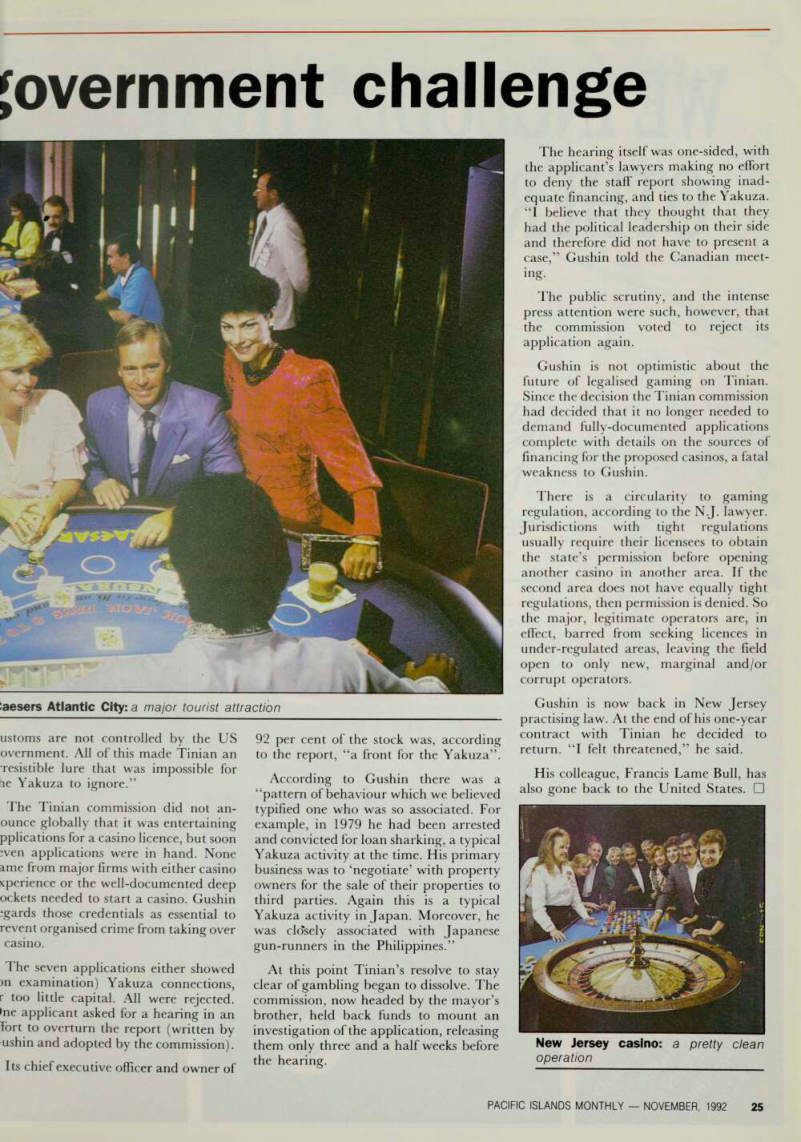
The island’s leaders looked around for a good model for regulating casinos and found one in the US East Coast state of New Jersey. New Jersey, unlike the other big casino state, Nevada, has always run a pretty clean gambling operation in Atlantic City, a previously down-at-the heels beachfront resort city. The state’s painfully honest governors, both Demo crats and Republicans, have given the Gaming Control Commission indepen dence, strong laws, and straight-shooting commissioners, each serving a fixed term.
The governors have leaned over back wards not to influence the commission’s decisions.
Meanwhile the casinos, like Harrah’s are doing well, and are pumping jobs and taxes into the local economy.
Tinian not only adopted the New Jersey model, it hired a young New Jersey lawyer, who had been deputy director of the NJ commission, Frederick E. Gushin. Then, looking for another mainland model, it did an interesting thing it hired as its counsel Francis Lame Bull, a native American (Ameri can Indian) from Montana, who knew something about the experience that American Indian tribes have had with legalised gambling. (The US, partially to ease a sense of guilt about its historic treatment of the Indians, have given Indian tribes legalised gambling rights which are denied to most other American institutions).
The founding chairman of the Tinian Gaming Control Commission was John
Hofshneider, a local resident whom Gushin has since described as a model public servant. (Gushin subsequently reported on his year on Tinian to the International Asian Organized Crime Conference in Calgary, Canada, and in a long interview with PIM ). Hofshneider died early in his term, and was replaced as chairman by Joseph Mendiola, j brother of, and appointee of the mayor of Tinian, James Mendiola.
In his Calgary speech, the New Jersey lawyer spelled out the attractions of a casino to the Yakuza, Japan’s organized crime.
“In addition to casino ownership and the opportunity to skim casino funds, the Yakuza saw Tinian as a vehicle to launder money. Most importantly, doing business in Tinian gave the Yakuza a back door entry into the US and might facilitate their ability to secure US i passports. Remember, immigration and
ustoms are not controlled by the US overnment. All of this made Tinian an resistible lure that was impossible for lie Yakuza to ignore.”
The Tinian commission did not an ounce globally that it was entertaining pplications for a casino licence, but soon ’ven applications were in hand. None ame from major firms with either casino xperience or the well-documented deep ockets needed to start a casino. Gushin igards those credentials as essential to revent organised crime from taking over casino.
The seven applications either showed
>n examination) Yakuza connections,
r too little capital. All were rejected, ►ne applicant asked for a hearing in an fort to overturn the report (written by ushin and adopted by the commission).
Its chief executive officer and owner of
92 per cent of the stock was, according to the report, “a front for the Yakuza”.
According to Gushin there was a “pattern of behaviour which we believed typified one who was so associated. For example, in 1979 he had been arrested and convicted for loan sharking, a typical Yakuza activity at the time. His primary business was to ‘negotiate’ with property owners for the sale of their properties to third parties. Again this is a typical Yakuza activity in Japan. Moreover, he was closely associated with Japanese gun-runners in the Philippines.”
At this point Tinian’s resolve to stay clear of gambling began to dissolve. The commission, now headed by the mayor’s brother, held back funds to mount an investigation of the application, releasing them only three and a half weeks before the hearing.
The hearing itself was one-sided, with the applicant’s lawyers making no effort to deny the staff report showing inad equate financing, and ties to the Yakuza.
“I believe that they thought that they had the political leadership on their side and therefore did not have to present a case,” Gushin told the Canadian meet ing.
The public scrutiny, and the intense press attention were such, however, that the commission voted to reject its application again.
Gushin is not optimistic about the future of legalised gaming on Tinian, Since the decision the Tinian commission had decided that it no longer needed to demand fully-documented applications complete with details on the sources of financing for the proposed casinos, a fatal weakness to Gushin.
There is a circularity to gaming regulation, according to the NJ. lawyer.
Jurisdictions with tight regulations usually require their licensees to obtain the state’s permission before opening another casino in another area. If the second area does not have equally tight regulations, then permission is denied. So the major, legitimate operators are, in effect, barred from seeking licences in under-regulated areas, leaving the field open to only new, marginal and/or corrupt operators.
Gushin is now back in New Jersey practising law. At the end of his one-year contract with Tinian he decided to return. “I felt threatened,” he said.
His colleague, Francis Lame Bull, has also gone back to the United States. □
laesers Atlantic City: a major tourist attraction
New Jersey casino: a pretty clean operation