The coup against sovereignty
pp. 22-23 · Read in the full issue
a historical perspective
By Ed Rampell
THE history of the Hawaian holocaust begins in 1778 with Cook’s voyages, his death at Kealakekua Bay, and the British reprisal. Protestant missionaries from New England arrived in 1820, filling a cultural vacuum created by the breaking of the precontact religion’s Kapu system in 1819. The missionries ended up as a merhant and landowning class.
By the 1880 s, the conflict between the ascendancy of the oligarchy of largely American missionary-descended mer chants and planters and native aspir ations - exacerbated by US economic and military interests erupts into violence. King Kalakaua tries unifying Polynesia into a confederacy of isles and further angers the Caucasian oligarchy with his nativstic revival of traditional culture, such as hula, and a “Merry Monarch” life style the puritans per ceived as debauched and profligate.
The US military demands exclusive rights in 1886 to Pearl Harbor as a condition for renewing the Reciprocity Treaty,which gave Hawaii planters
tariff-free access to US markets; the King and grass roots Hawaiians strongly oppose territorial cession. In January 1887, Lorrin Thurston, Sanford Dole and other oligarchs form a pro annexationist secret society, the Ha waiian League.
Triggered by a May 1887 opium scandal, the Hawaiian League and the para-military, all-Haole Honolulu Rifles confront King Kalakaua and impose the “Bayonet Constitution” allowing Kalakaua to reign but not rule. A new Cabinet is formed with Thurston as Interior Minister, Pearl Harbour is ceded to Washington, and the Reci procity Treaty is renewed.
But the sovereignty struggle continues.
Kalakaua insists on using his last political prerogative veto power. On July 30, 1889 Hawaiian nationalist Robert Wilcox and his “Redshirts” stage an armed revolt against the Bayonet Consti tution, which is put down; troops from the USS Adams patrol Honolulu. The following year Wilcox turns to the
electoral process his Hawaiian Politi cal Association joins forces with working class whites in the Mechanics’ and Workingmen’s Political Protective As sociation. Their National Reform Party wins half of the legislature’s seats, weakening the Bayonet Constitution’s cabinet, amidst talk of a constitutional convention. Suffering from ill health, King Kalakaua dies on January 20, 1891 at San Francisco.
His younger sister Liliuokalani accedes to the throne determined to revive royal power. The McKinley act removes the tariff on raw sugar entering America and gives a two-cent per pound bounty for domestic sugar, undermining the Reci procity Treaty, threatening to destroy Hawaii’s planter-ocracy. Thurston forms another cabal the Annexation Club.
In January 1893, the missionary descendants oppose opium and lottery bills as sugar’s depression deepens. On January 14 Queen Liliuokalani pro rogues the legislature and prepares for an incendiary act.
Her Majesty attempts promulgating a new constitution which two-thirds of the Hawaiians petitioned for that would reverse the Bayonet Constitution and reinvest political power in the monarchy and native electorate. Deeming her plan to be “revolutionary”, Thurston forms the Committee of Safety 12 of its original 13 members are Annexation Club members. The pro-annexationist, anti-indigenous tone of US President Harrison and Minister Stevens stimu lated the high treason.
How did the coup d’etat and American take-over of the of Hawaii happen?
Monday, January 16, 1893 9.00am-12.00pm: The Committee of Public Safety, mainly of businessmen with American backgrounds, meet at the Honolulu law office of Lorrin Thurston.
The co-conspirators arrange a mass meeting and sign a letter to US Minister John Stevens: . . the public safety is menaced and lives and property are in peril, and we appeal to you and the United States forces at your command for assistance . . . we pray for the protection of the United States forces” upon “a further request received from the committee.” 11.00 am: American attorney and committee member Henry Cooper goes to Honolulu Harbour to notify USS Boston
Captain Wiltse of the committee’s request but Wiltse, anticipating the request, had already ordered his troops to prepare for landing. 5.00 pm After their early supper, Lt. Commander Swinburne lands 162 Marines with Gatling (machine) guns, How itzer cannons, double cartridge belts filled with ammunition, and carbines on four boats at Nuuanu Avenue. The troops march up Fort Street to Merchant Street, rifles pointing in the direction of lolani Palace, seat of the Hawaiian monarchy. Some blue-jackets are posted at the US consulate and legation. The Marines march past lolani Palace on Kang Street, halting across from Kawaiahao Church. Shortly afterwards, :he invaders halt at the Atherton estate at King and Alapai Streets.
B.oopm The Committee of Safety ;et up a Provisional jovernment (PG) ind select Sanford 3ole as president.
Tuesday, Janu ary 17, 1893 iarly morning fhurston dictates a )roclamation depos ng the queen, annul ing the monarchy, ,nd creating a Pro isional Government intil America an icxes Hawaii. 9.00 am Aware f the Committee of •afety’s activities, )ueen Liliuokalani icets with Samuel )amon, a business
lan close to her. Her Majesty advises im to join the committee’s advisory ouncil, in order to influence them. 10.00 am Dole gives Minister tevens a letter announcing the estab shment of the PG and asking for US “cognition. Stevens responds: “I think ou have a great opportunity”. 2.00 pm The Queen’s cabinet linisters go to the US legation. As tevens claims to be sick, he meets briefly ath Foreign Minister Parker and atorney-General Peterson. The A-G lys Stevens refuses to assist the Queen nd threatens the Marines will intervene royalist forces fight the committee, tevens also reportedly asserts he will a Provisional Government if it set up. 2.30 pm Committee members sign hurston’s proclamation at Smith’s [lice. The committee prepares to go to Government House. A native policeman rabs the reins of a horse pulling a wagon ill of ammunition leaving E.O. Hall &
Son’s King Street store, delayed by a tram. The insurgents’ ordinance officer,
Captain John Good, shoots the police
man. The bullet enters Lialoha’s arm and left breast. In the confusion, the Committee of Safety quickly goes unob served to the Government Building.
There, at nearly empty Ali’iolani Hale, American Henry Cooper who had come to Hawaii in 1892 and is not a citizen of the Kingdom reads
Thurston’s proclamation abrogating the
monarchy and establishing a "Pro visional Government . .. until terms of a union wdth the United States have been
negotiated and agreed upon.”
The Provisional Government puts ammunition in the hall, declares martial law, closes saloons, proclaims the “death penalty for an act of treason”, and
notifies the diplomatic corps of the take over. Committee member C.L. Carter takes a note by Dole to Minister Stevens announcing the insurrection.
2.45 pm At the police station
which Marshal Wilson refuses to surrender without written orders from the Queen and her ministers the Cabinet writes to Minister Stevens a note asking if he has recognised the PG “and, if not • • . respectfully requests the assistance of your government in preserving the peace of the country.” Charles Hopkins delivers the note to the US legation.
Hopkins insists upon an immediate reply when Stevens’ daughter requests an hour delay on account of her father’s illness.
3.10 pm Hopkins returns to the
police station with a note for Foreign Minister Parker. [NOTE: There is dispute on this point and it’s timing.] The Cabinet is ready to repress the uprising until receiving Minister Stevens’ response, leading them “to surrender, and yield to America.”
4.00-5.00 pm Stevens sends a note to the Cabinet recognizing the PG.
Minister Stevens’ note to Dole announc ing: “A Provisional Government . . . being in full possession of the Govern ment Building, the Archives, and the treasury and in control of the capital of the Hawaiian Islands, I hereby recognize said Provisional Government as the de facto Government of the Hawaiian Islands.” 5.00 pm The Cabinet meets with Liluokalani. Supporters of the PG led by the Queen’s trusted adviser Damon meet with Her Majesty at lolani Palace.
Damon warns, “If you resist, there will be bloodshed and a great many killed.
You will probably be killed.” Joseph Carter and Damon tell Liliuokalani they would help her formulate any desired
protest. At torney Paul Neumann clev erly drafts the protest: “ . . . I yield to
the superior
force of the United States of America whose Minister Pleni
potentiary, His
Excellency John L. Stevens, has caused the United States troops to be landed at Hono lulu and declar ing he would support such
provisional gov
ernment. Now to avoid col
lision of armed forces and perhaps loss of life, I do, under this protest and impelled by such forces, yield my authority until such time as the Government of the United States shall, upon the facts being presented to it, undo the action of its representative and reinstate me in the authority which I claim as the Consti tuti°nal,. Sovereign of the Hawaiian Islands. 7.00 pm Dole accepts without reading the queen’s carefully crafted statement, which Dole endorses. Marshal Wilson finally surrenders the police station. Captain Samuel Nowlein’s 272-man Queen’s Royal Guard surren der.
B.oopm The PG executive and advisory councils undertake the day’s act ’ deciding to send three com missioners Thurston, Wilder, and Castle - to Washington to negotiate annexation by the United States, The independent Kingdom of Hawaii is overthrown. □
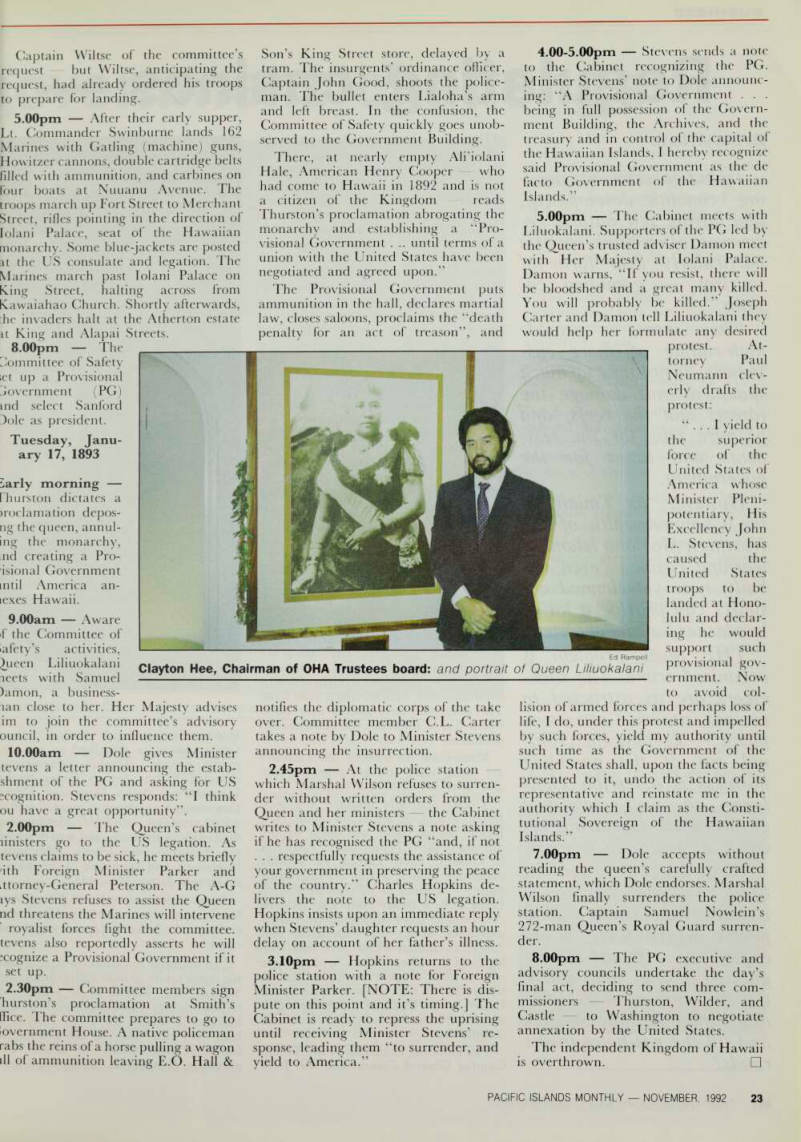
Ed Rampell Clayton Hee, Chairman of OHA Trustees board: and portrait of Queen Liliuokalani