Hawaiian nationalism
pp. 18-21 · Read in the full issue
the wild card
By Ed Rampell
A CENTURY after the deposing of Queen Liliuokalani, 95 years after US annexation, and 34 years after statehood, these Polynesians have be come an oppressed, landless and, often homeless, minority in their own ancestral homeland. Yet, a revived Hawaiian Sovereignty Movement is fighting for native land and cultural rights. As University of Hawaii Professor Noel Kent points out, the Hawaiian Sover eignty Movement is “the wild card in Hawaii politics, the only force willing to go beyond the parameters established by the powers-that-be.”
As Office of Hawaiian Affairs (OHA) trustee Moanikeala Akaka points out, “Back in the 19705, when we started the Hawaiian Renaissance, if one talked about ‘sovereignty’, you were regarded as the ‘lunatic fringe’.” But in the 19905, sovereignty has become respected at all levels even fashionable. Media polls reveal a majority of the public-at-large sympathises with Kanaka Maoli (indigen ous Hawaiian) rights.
As the centennial of the coup d’etat that toppled the sovereign Hawaiian state approaches, where is the Hawaiian Sovereignty Movement at today? Who are the key players? What exactly does “sovereignty” mean? What will happen in Hawaii this January?
“We’re at the point of civil dis obedience,” asserts activist attorney Mililani Trask, recently arrested during the Halawa Valley land/religious rights struggle. “The battle lines are being drawn. Sides are being clearly enunci ated, political positions are being taken.
There will be increased attacks on people’s personal lives by the state and feds. They are trying to squelch the native voice. There’s an incredible re sponse . . . arrest overskills ... At lolani
Palace [during the June protest] there was a SWAT team, choppers, submachine guns, 100 police versus 35 demonstrators. At Halawa 13 women versus 60 SWAP [riot police], arresting an 88-year-old woman. There’s official paranoia against civil disobedience,” insists Mililani, Kia Aina (governor) of Ka La Hui Hawaii, the Sovereign Hawaiian Nation. “This is a warning, do not get in the way of state and federal projects and cool it in January.”
Will Hawaii erupt in January like New Caledonia or a mini-Los Angeles? An explosive mix of native militancy and government repression during a sensitive anniversary could ignite with explosive results if care is not taken. Frustrated by 100 years of working within the system with little to show for it and by the US failure to resolve the Hawaiian question, today’s nationalits re-examine their past and some embrace confrontational tac tics.
Mililani concludes, “Two critical er rors were made in 1893. Number one: to trust in American justice. America has never given justice to people of colour.
Number two: the Kingdom did not assume full defence for the sovereign Hawaiian nation . . . Trust was mis placed and we are living with the ramifications today.”
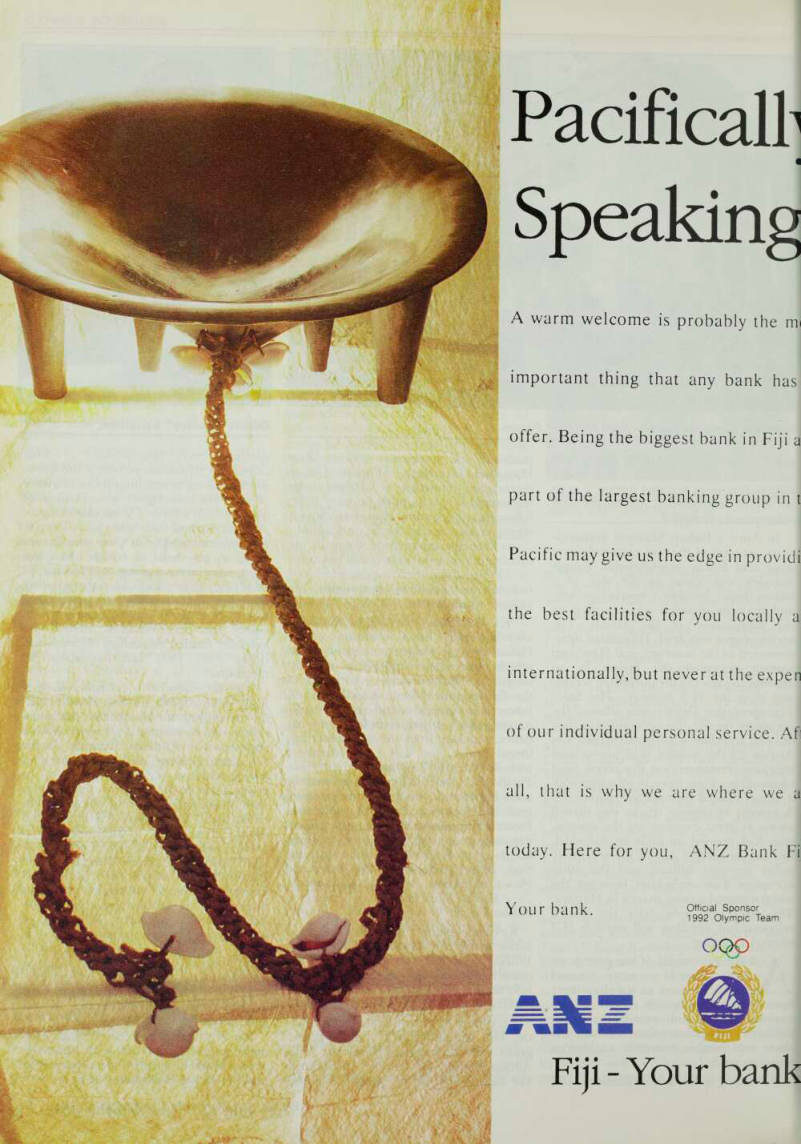
Dennis “Bumpy” Kanahele says, “It was a mistake” for Hawaiians not to militarily resist the US Marines and the coup plotters. (The Queen’s armed forces outnumbered the conspirators and Mar ines, although the latter had superior weapons). The brawny ex-con with the black panther and Polynesian tattoos is no stranger to armed resistance: “We’re born with this, brah, this whatevah you call, militant feeling. We call that our birthright. So no leave the fight, if you’re
gonna die, you all die together. So, when you got all that history in your blood we all have this ... For Hawaiians . . . it’s like one right. It’s just like part of your body,” says Bumpy, who belongs to La Ea O Hawaii’! Nei, a Hawaiian
sovereignty council.
Kawehi Gill, La Ea candidate for OHA, eschews the word “militant” in favour of a Hawaiian term: “for us we are warriors.” Bumpy was involved in an armed stand-off between a SWAT team and natives occupying an abandoned US Coast Guard base for two months at Makapuu, Oahu in 1987. He was sentenced to about a year in jail and Levi Kaawa, high chief of La Ea O Hawai’i Nei, to five years probation and 100 hours of community service which he hasn’t complied with since “I know who I am and I don’t recognise the state and the US,” declares Levi, who says he’s descended from royalty.
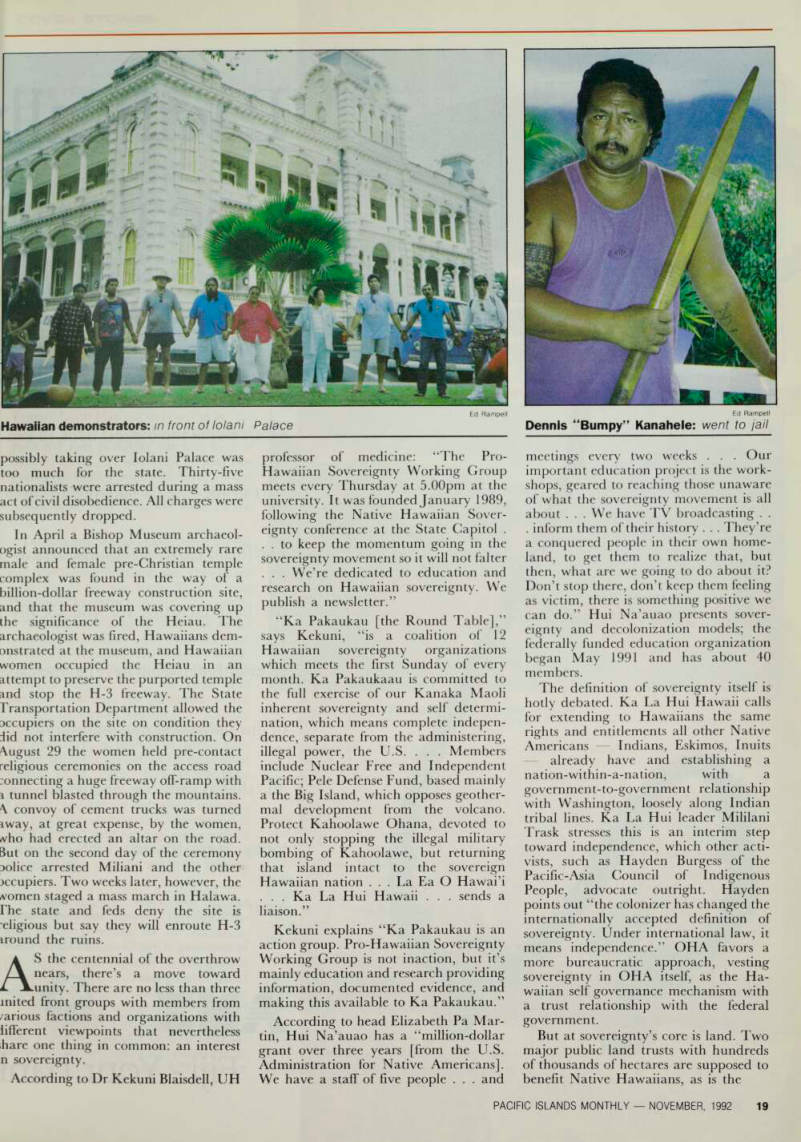
More recently, there have been two other confrontations between SWAT teams and Kanaka Maoli dissidents. On June 11, King Kamehameha Day, La Ea held a religious company and demon stration to honour Hawaii’s first mon arch’s birthday at lolani Palace. After confusion about the length of time the activists could stay in palace grounds, protesters demanded to stay overnight, disobeying a s:oopm deadline. Men led by Bumpy and Levi ascended the palace steps. The thought of militant Hawaiians
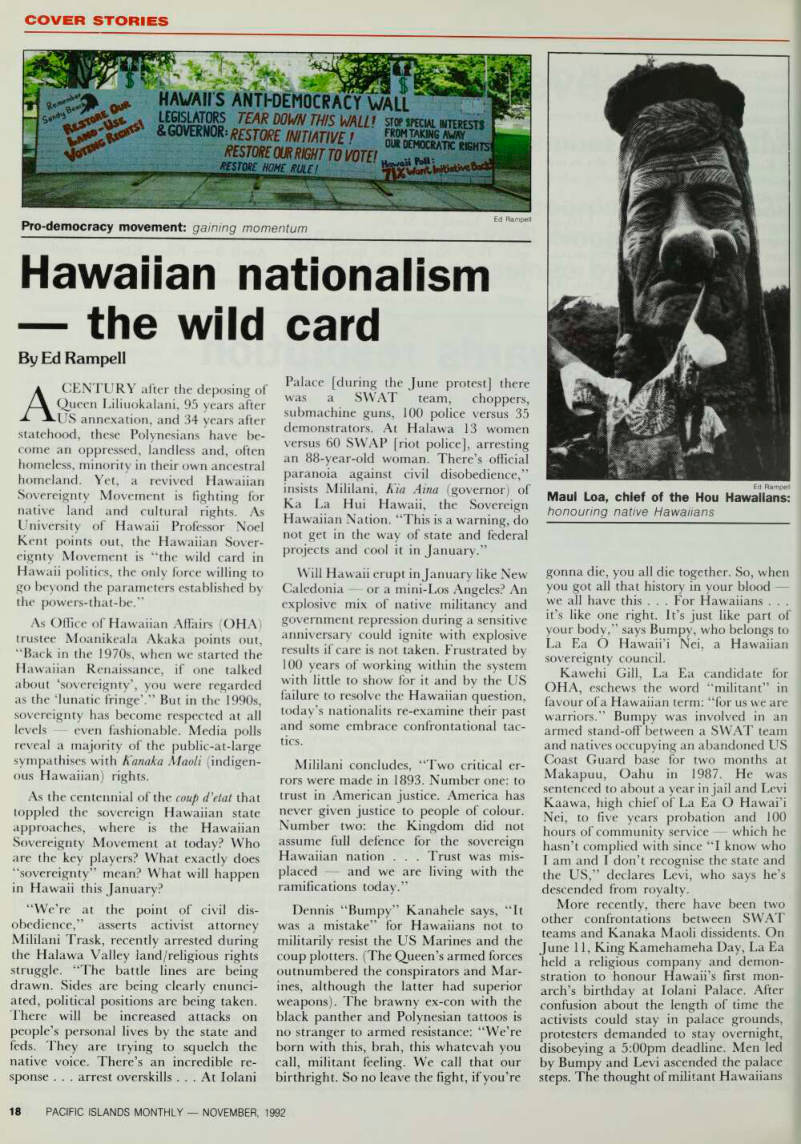
Ed Rampell Maui Loa, chief of the Hou Hawaiians: honouring native Hawaiians
possibly taking over lolani Palace was too much for the state. Thirty-five nationalists were arrested during a mass act of civil disobedience. All charges were
subsequently dropped.
In April a Bishop Museum archaeologist announced that an extremely rare male and female pre-Christian temple complex was found in the way of a billion-dollar freeway construction site, and that the museum was covering up the significance of the Heiau. The archaeologist was fired, Hawaiians demonstrated at the museum, and Hawaiian women occupied the Heiau in an attempt to preserve the purported temple and stop the H-3 freeway. The State Transportation Department allowed the accupiers on the site on condition they did not interfere with construction. On August 29 the women held pre-contact religious ceremonies on the access road :onnecting a huge freeway off-ramp with i tunnel blasted through the mountains. \ convoy of cement trucks was turned iway, at great expense, by the women, .vho had erected an altar on the road.
But on the second day of the ceremony Dolice arrested Miliani and the other occupiers. Two weeks later, however, the ,vomen staged a mass march in Halawa.
The state and feds deny the site is eligious but say they will enroute H-3 iround the rums.
AS the centennial of the overthrow nears, there’s a move toward unity. There are no less than three mited front groups with members from various factions and organizations with iifferent viewpoints that nevertheless hare one thing m common: an interest n sovereignty.
According to Dr Kekuni Blaisdell, UH
professor of medicine; “The Pro- Hawaiian Sovereignty Working Group meets every Thursday at 5.00 pm at the university. It was founded January 1989, following the Native Hawaiian Sover eignt y, conference at the State Capitol • to kee P the momentum going in the sovereignty movement so it will not falter • • • W , e re dedicated to education and research on Hawaiian sovereignty. We publish a newsletter, “Ka Pakaukau [the Round Table],” says Kekuni, “is a coalition of 12 Hawaiian sovereignty organizations which meets the first Sunday of every month. Ka Pakaukaau is committed to the full exercise of our Kanaka Maoli inherent sovereignty and self determi nation, which means complete indepen dence, separate from the administering, illegal power, the U.S. . . . Members include Nuclear Free and Independent Pacific; Pele Defense Fund, based mainly a the Big Island, which opposes geother mal development from the volcano, Protect Kahoolawe Ghana, devoted to not only stopping the illegal military bombing of Kahoolawe, but returning that island intact to the sovereign Hawaiian nation ... La Fa O Hawai’i . . . Ka La Hui Hawaii . . . sends a liaison.”
Kekuni explains “Ka Pakaukau is an action group. Pro-Hawaiian Sovereignty Working Group is not inaction, but it’s mainly education and research providing information, documented evidence, and making this available to Ka Pakaukau.”
According to head Elizabeth Pa Mar pn> j [ u j Na’auao has a “million-dollar grant over three years [from the U.S.
Administration for Native Americans].
We have a staff of five people . . . and
meetings every two weeks . . . Our important education project is the work shops, geared to reaching those unaware of what the sovereignty movement is all about . . . We have TV broadcasting . . . inform them of their history . . . They’re a conquered people in their own home land, to get them to realize that, but then, what are we going to do about it?
Don’t stop there, don’t keep them feeling as victim, there is something positive we can do.” Hui Na’auao presents sover eignty and decolonization models; the federally funded education organization began May 1991 and has about 40 members.
The definition of sovereignty itself is hotly debated. Ka La Hui Hawaii calls for extending to Hawaiians the same rights and entitlements all other Native Americans Indians, Eskimos, Inuits already have and establishing a nation-within-a-nation, with a government-to-government relationship with Washington, loosely along Indian tribal lines. Ka La Hui leader Mililani Trask stresses this is an interim step toward independence, which other acti vists, such as Hayden Burgess of the Pacific-Asia Council of Indigenous People, advocate outright. Hayden points out “the colonizer has changed the internationally accepted definition of sovereignty. Under international law, it means independence.” OHA favors a more bureaucratic approach, vesting sovereignty in OHA itself, as the Ha waiian self governance mechanism with a trust relationship with the federal government.
But at sovereignty’s core is land. Two major public land trusts with hundreds of thousands of hectares are supposed to benefit Native Hawaiians, as is the
Hawaiian demonstrators: in front of lolani Palace
Ed Rampell
Ed Rampell Dennis “Bumpy” Kanahele: went to jail
Bishop estate, Hawaii’s largest private landowner (8 per cent of land). All sovereignty models seek, in varying degrees, control of ceded and homeland lands and revenues derived from them.
More radical nationalists seek the entire chain (from Midway to Johnston Atoll) breaking up the land monopoly of private estates, closing large military bases like Pearl Harbor, and redistribut ing the land to Hawaiians.
Despite greater unification, there’s still a split in the sovereignty movement between grass roots natives and official Hawaiians. Generally, the chasm is between autonomous groups, such as Ka La Hui and La Ea, who are to the left of US and state government funded and affiliated entities, such as OHA and Governor John Waihee.
OHA is seriously factionalized.
Trustee Louis Hao publicly writes of “the turmoil of poor trustee relationships, bad publicity and probably the low level of trust in OHA . . . history. The past two years presented dismal situations . . . this cycle of self destruction.” OHA Trustee Akaka says, “OHA is too close to the state.”
Divisiveness is also exacerbated by the blood quantum dispute, with two differ ent legal classifications for Hawaiians with more or less than 50 per cent Hawaiian ancestry.
Activists seek to bring their case to the international arena. Dr Blaisdell pro claims Pro-Hawaiian Sovereignty Work ing Group’s tribunal will “kick off October 23-25, 1992, we draft and publicly announce the indictment of the US for its crimes against the Kanaka Maoli nation, this will serve notice on the US which will be invited to defend itself at the tribunal proper to be conducted August 12-21, 1993.” Kekuni interfaces with the International Indian Treaty Council (Indians are indicting Columbus for genocide during the quicentennial this October) and seeking distinguished leaders from the Pacific to participate as judges (Cuba may be asked to partici pate).
Nationalists also reach out to the United Nations. Lawyer Hayden Bur gess, of the Instittute for the Advance ment of Hawaiian Affairs is president of the Paciflc-Asia Council of Indigenous People, a non-governmental organization (NGO) affiliated with the World Council of Indigenous People and linked to the UN. Like La Ea, Burgess who presents Hawaii’s case at interna tional bodies in Geneva and elsewhere asserts Article 73 of the UN Charter
guarantees Hawaiians self determi nation. The lawyer insists Hawaii’s 1959 “plebiscite” was not a legitimate act of self determination because the vote gave Hawaiians a choice between statehood or remaining a territory, but not for independence.
Mililani and Laa Ea want Hawaii reinscribed on the UN Decolonization Committee’s list of non-self governing territories, like New Caledonia was.
They hope Pacific members of the UN will assist them in their self determination drive in the international arena, as they did the Kanaks.
What will happen in January during the observance of the centennial of the overthrow is anybody’s guess. Will na tionalists try taking over lolani Palace
and reinstating themselves on the throne?
Will the state and feds try co-opting the movement in order to prevent violence?
Will Washington announce a perma nent end to the bombing of Kahoolawe and even return it to the Hawaiians? Will the SI 12 million-plus so-called “historic ceded lands settlement” money, the state, OHA, and Governor agreed to, finally be disbursed? Will the US Con gress ratify Senator Dan Akaka’s resol ution that America apologize for the invasion? Will there be reparations?
There will be official observances.
Activist marches, demonstrations, and vigils will take place. Nationalists Haunani-Kay Trask and Puhipau are making a documentary Act of War.
Singer Marlene Sai stars as Liliuokalani in the docu-drama Betrayal. The play Liliuokalani has been staged. Mass spec
tacles recreating the 1893 coup are supposed to take place at the palace and environs.
It will be a hot time in the old town.
It remains to be seen if, when the next confrontation takes place, Governor Waihee, a Hawaiian, will heed the call of demonstrators to come and talk?
Buzz Agard of the Council of Ha waiian Organizations says in January, the Hawaiian nation should pick up where the Queen left off. “She prorogued the legislature now, 100 years later, it’s time to call it back into session.”
But what is really on everybody’s minds, especially those Hawaiians camp ing on the beaches, getting evicted, arrested, abused, ill, landless, unem ployed will there be the “enlightened justice” President Cleveland spoke of 100 long years ago?
Land rights demonstration: using ancient religion
Ed Rampell
Ed Rampell
Activist attorney: Mililani Trask