Cloth of Honour
p. 51 · Read in the full issue
By Ian Williams
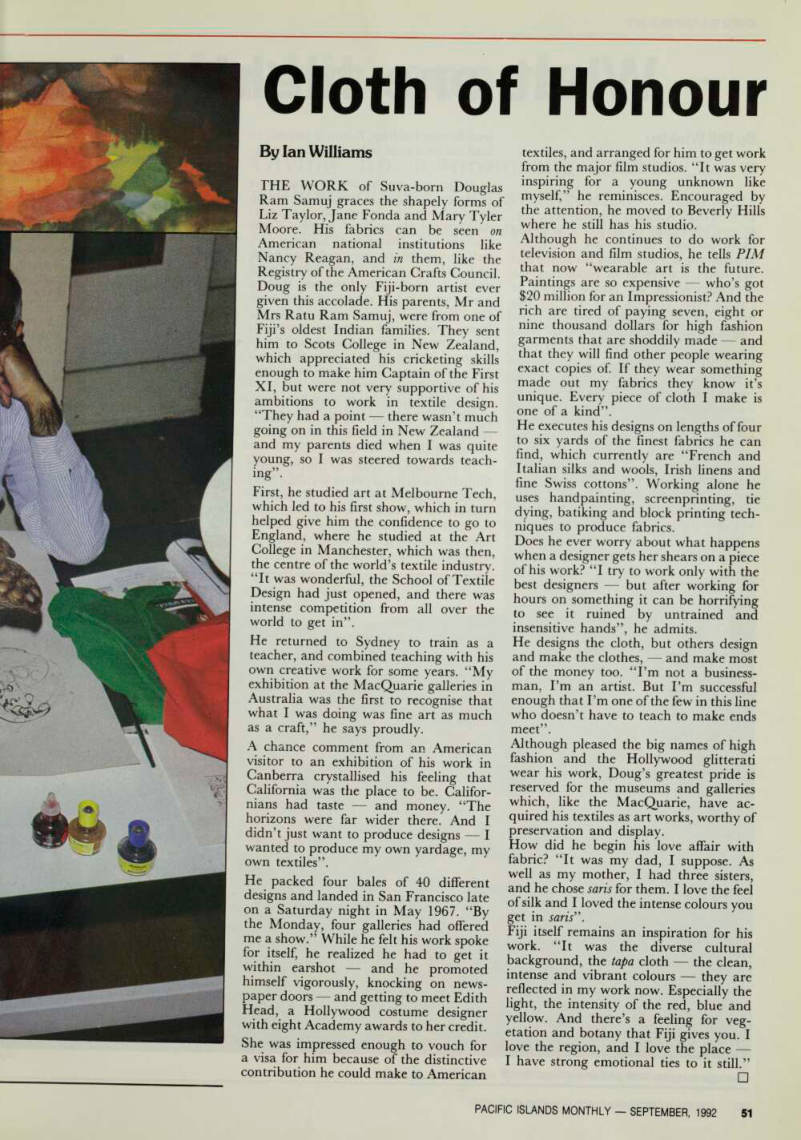
THE WORK of Suva-born Douglas Ram Samuj graces the shapely forms of Liz Taylor, Jane Fonda and Mary Tyler Moore. His fabrics can be seen on American national institutions like Nancy Reagan, and in them, like the Registry of the American Crafts Council.
Doug is the only Fiji-born artist ever given this accolade. His parents, Mr and Mrs Ratu Ram Samuj, were from one of Fiji’s oldest Indian families. They sent him to Scots College in New Zealand, which appreciated his cricketing skills enough to make him Captain of the First XI, but were not very supportive of his ambitions to work in textile design.
“They had a point there wasn’t much going on in this field in New Zealand and my parents died when I was quite young, so I was steered towards teach
ing”.
First, he studied art at Melbourne Tech, which led to his first show, which in turn helped give him the confidence to go to England, where he studied at the Art College in Manchester, which was then, the centre of the world’s textile industry.
“It was wonderful, the School of Textile Design had just opened, and there was intense competition from all over the world to get in”.
He returned to Sydney to train as a teacher, and combined teaching with his own creative work for some years. “My exhibition at the MacQuarie galleries in Australia was the first to recognise that what I was doing was fine art as much as a craft,” he says proudly.
A chance comment from an American visitor to an exhibition of his work in Canberra crystallised his feeling that California was the place to be. Califor nians had taste and money. “The horizons were far wider there. And I didn’t just want to produce designs I wanted to produce my own yardage, my own textiles”.
He packed four bales of 40 different designs and landed in San Francisco late on a Saturday night in May 1967. “By the Monday, four galleries had offered me a show.” While he felt his work spoke for itself, he realized he had to get it within earshot and he promoted himself vigorously, knocking on news paper doors and getting to meet Edith Head, a Hollywood costume designer with eight Academy awards to her credit.
She was impressed enough to vouch for a visa for him because of the distinctive contribution he could make to American
textiles, and arranged for him to get work from the major film studios. “It was very inspiring for a young unknown like myself,” he reminisces. Encouraged by the attention, he moved to Beverly Hills where he still has his studio.
Although he continues to do work for television and film studios, he tells PIM that now “wearable art is the future.
Paintings are so expensive who’s got $2O million for an Impressionist? And the rich are tired of paying seven, eight or nine thousand dollars for high fashion garments that are shoddily made and that they will find other people wearing exact copies of. If they wear something made out my fabrics they know it’s unique. Every piece of cloth I make is one of a kind”.
He executes his designs on lengths of four to six yards of the finest fabrics he can find, which currently are “French and Italian silks and wools, Irish linens and fine Swiss cottons”. Working alone he
uses handpainting, screenprinting, tie
dying, batiking and block printing tech
niques to produce fabrics.
Does he ever worry about what happens when a designer gets her shears on a piece of his work? “I try to work only with the best designers but after working for hours on something it can be horrifying to see it ruined by untrained and insensitive hands”, he admits.
He designs the cloth, but others design and make the clothes, and make most of the money too. “I’m not a business man, I’m an artist. But I’m successful enough that I’m one of the few in this line who doesn’t have to teach to make ends meet”.
Although pleased the big names of high fashion and the Hollywood glitterati wear his work, Doug’s greatest pride is reserved for the museums and galleries which, like the MacQuarie, have ac quired his textiles as art works, worthy of preservation and display.
How did he begin his love affair with fabric? “It was my dad, I suppose. As well as my mother, I had three sisters, and he chose saris for them. I love the feel of silk and I loved the intense colours you get in saris”.
Fiji itself remains an inspiration for his work. “It was the diverse cultural background, the tapa cloth the clean, intense and vibrant colours they are reflected in my work now. Especially the light, the intensity of the red, blue and yellow. And there’s a feeling for veg etation and botany that Fiji gives you. I love the region, and I love the place I have strong emotional ties to it still.”