Pacific Islands Monthly

mME
: B, r t A m % 0 , * '-/.I
r.'ss-jss s ,^r,r^s!s v ;rrjKrs“srs s;“ l s*s,."s.*srrs *»3; French Fotyne.t, cpt3oo; Ton,, P 3; USA US$3; Vanuatu VT2OO; WeaJn Samoa T 3.25. -Recommend ° °" ' S,a " < '*
Advertisements & other items, pp. 2-4 (1 item)
$■ 'S^iCic
5 I ... m jr w ■ s* ab ' **• ■ x. » m 9 *
JfcT*
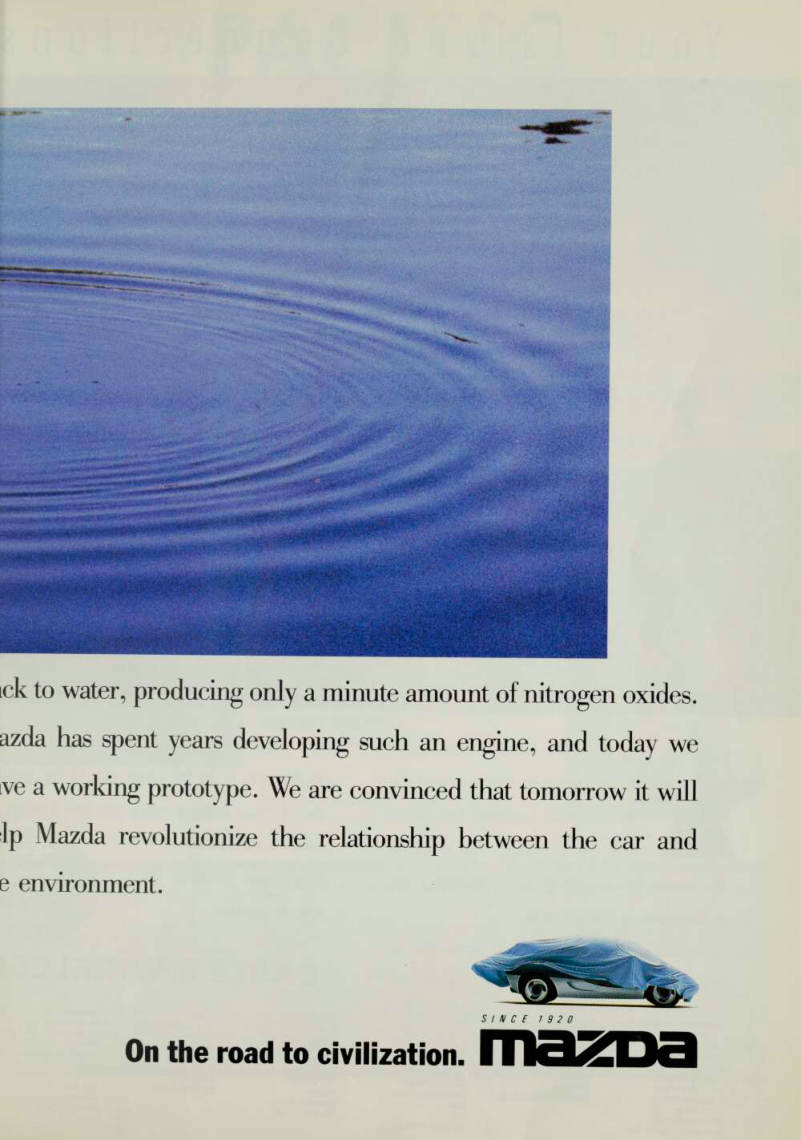
m ss*»w m ■/. * m SilS Today, many people believe that to learn to live in harmony witl nature, we must look to nature for the answers. This may be utopian idea, but like every idea that has advanced the history c civilization, a necessary one. One of these ideas, is to use hydrogel as a source of energy. It comes from water and as it bums, turn
ick to water, producing only a minute amount of nitrogen oxides, azda has spent years developing such an engine, and today we ve a working prototype. We are convinced that tomorrow it will Ip Mazda revolutionize the relationship between the car and e environment.
On the road to civilization.
Your Island
Connections
i f *
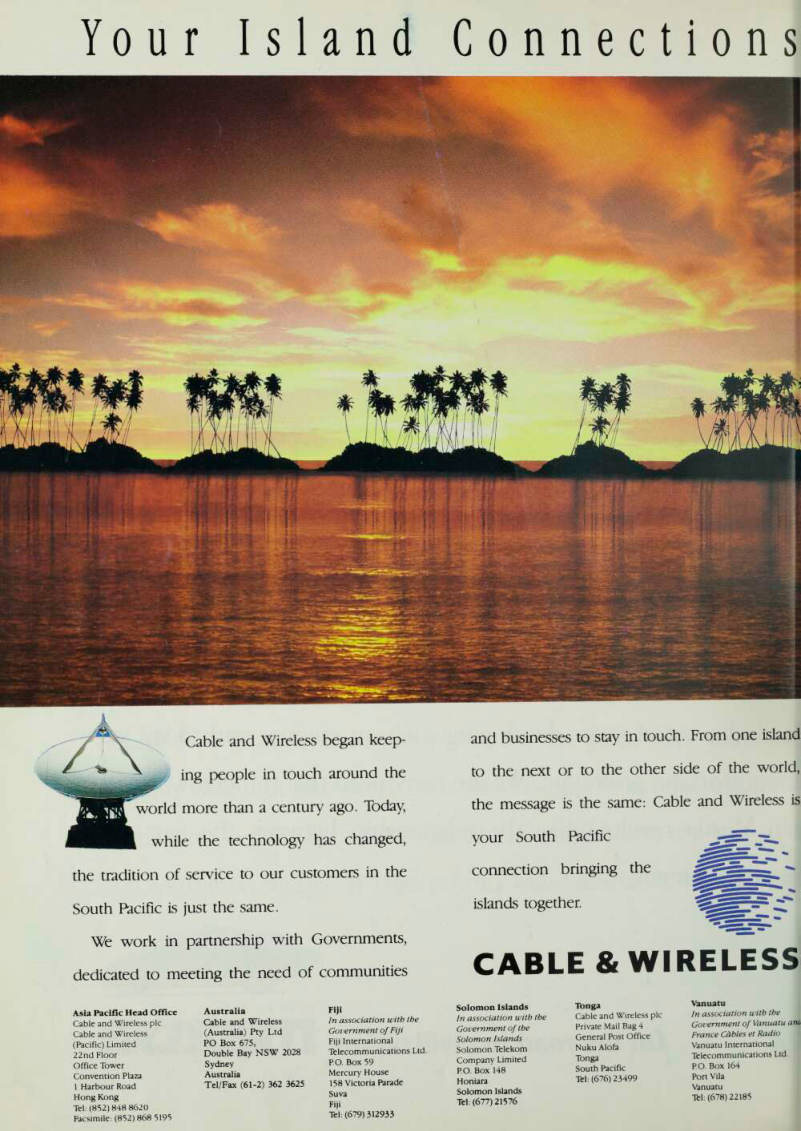
Cable and Wireless began keep-
ing people in touch around the
world more than a century ago. Today,
while the technology has changed,
the tradition of service to our customers in the
South Pacific is just the same.
We work in partnership with Governments,
dedicated to meeting the need of communities and businesses to stay in touch. From one island to the next or to the other side of the world, the message is the same: Cable and Wireless is
your South Pacific
connection bringing the
islands together.
CABLE & WIRELESS
Asia Pacific Head Office Cable and Wireless pic Cable and Wireless (Pacific) Limited 22nd Floor Office Tower Convention Plaza 1 Harbour Road Hong Kong Tel. (852) 848 8620 Facsimile; (852) 868 5195 Australia Cable and Wireless (Australia) Pty Ltd PO Box 675, Double Bay NSW 2028 Sydney Australia Tel/Fax (61-2) 362 3625 Fiji In association with the Government of Fiji Fiji International Telecommunications Ltd.
PO, Box 59 Mercury House 158 Victoria Parade Suva Fiji Tel: (679) 312933 Solomon Islands In association with the Government of the Solomon Islands Solomon Telekom Company Limited PO. Box 148 Honiara Solomon Islands Tel: (677) 21576 Tonga Cable and Wireless pic Private Mail Bag 4 General Post Office Nuku Alofa Tonga South Pacific Tel: (676) 23499 Vanuatu In association with the Government of Vanuatu am France Cables et Radio Vanuatu International Telecommunications Ltd.
P.O. Box 164 Port Vila Vanuatu Tel: (678) 22185
Pacific
Islands
Monthly
Vol 62 NO. 9
The News Magazine
September 1992
From The Editor’S
Desk 6
Letters 7
Headlines 9
Politics:
France and Tahiti clash over budgetary control 12 Melanesian Spearhead scores the right goals 14
Cover Stories:
Facing the crunch 16 The honeymoon is over 20
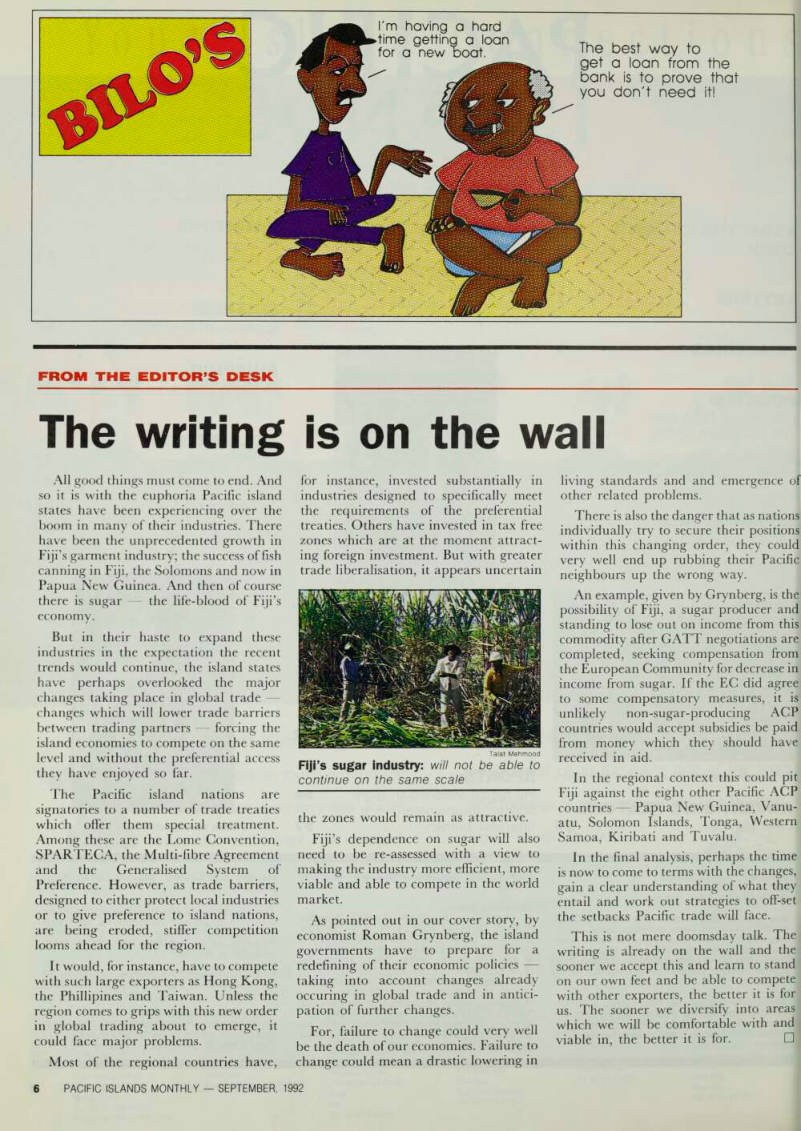
Fiji’s sugar industry: the life-blood of its economy
Advertising Feature:
_ako Mai Fiji 25
Finance:
Cashing In The boys on Merchant Street 35 Competing and Niche Marketing 39 The political connection 42 Exporting financial services 45
Bank of Hawaii
Arts:
The stamp of disapproval 46 Cloth of Honour 50
Development:
What one highland man can do 52
Sports:
Fiji regain Melanesian glory 56 Soccer tournament a financial burden 57
Yachting:
Discovering Island of the glowing sky 58
Science:
Research in the Pacific 60
Shipping:
Shipping Schedules 61
Columnists:
Alfred Sasako 21 Jemima Garrett 23 David Barber 31 Bill McCabe 55
Ram Samuj: fame in the US
Publisher: Gene Swinstead Editor: Mala Jagmohan Senior Writer: Martin Tiffany Correspondents: Al Prince, Angela McCarthy, David North, David Robie, Diana McManus, Dykes Angiki, Frank Kolma, Franck Madoeuf, lan Williams, Irene Nisbet, John Hunter, Karen Mangnall, Lovenia Enari, Lilo Vilisoni Macel Manua, Nicholas Rothwell, Pesi Fonua, Richard Dinnen, Ulafala Alavao, Wally Hiambohn.
Columnists: David Barber (Wellington), Futa Helu (Tonga, covering the Pacific Islands), Jemima Garrett (Sydney), Margot O’Neill (Washington), Julian Moti (Pacific Law), Alfred Sasako (The Forum).
Business and Advertising Manager, Charlotte Thomas Advertising Sales; • Regional Sales (South Pacific); Salendra Narayan, Tel (679) 304111, Fx (679) 303809 • Sydney, Canberra: Bob Hill Media Represen tations, Tel (61-2) 4164245, Fx (61-2) 4165064 • Brisbane: Robert Walker, Media House, Tel (61-7) 3710533, Fx (61-7) 371-8904 • Adelaide; Hastwell Williamsons Representations, Tel (61-8) 799522, Fx (61-8) 799735 • Auckland: McKay International Media Reps Ltd, Tel (64-9) 4190561, Fx (64-9) 4192243 • Japan: Universal Media Corporation, Tokyo, Tel (3) 6663036, 6663094, Cable: UNIMEDIA Tokyo, Tx 2524665.
Founded 1930 (USPS 952480). A Fiji Times Limited production.
Cover prices are recommended retail only. Regis tered by Australia Post, Publication No. NBP 1210. © Copyright Fiji Times Limited, 177 Victoria Parade. Suva. Fiji. Tel (679) 304111, Fx (679)
303809. Tx Fj2124.
Pacific Islands Monthly is published monthly by The Fiji Times Limited, a division of Nationwide News, 2 Holt Street, Surry Hills, Sydney, NSW 2010.
Send address changes to: • Pacific Islands Monthly, PO Box 1167, Suva, Fiji.
Typeset and printed by The Fiji Times Limited, 177 Victoria Parade, Suva, Fiji.
The writing is on the wall
From The Editor’S Desk
All good things must come to end. And so it is with the euphoria Pacific island states have been experiencing over the boom in many of their industries. There have been the unprecedented growth in Fiji’s garment industry; the success offish canning in Fiji, the Solomons and now in Papua New Guinea. And then of course there is sugar the life-blood of Fiji’s economy.
But in their haste to expand these industries in the expectation the recent trends would continue, the island states have perhaps overlooked the major
changes taking place in global trade
changes which will lower trade barriers between trading partners forcing the island economies to compete on the same level and without the preferential access they have enjoyed so far.
The Pacific island nations are signatories to a number of trade treaties which offer them special treatment.
Among these are the Lome Convention, SPARTECA, the Multi-fibre Agreement and the Generalised System of Preference. However, as trade barriers, designed to either protect local industries or to give preference to island nations, are being eroded, stiffer competition looms ahead for the region.
It would, for instance, have to compete with such large exporters as Hong Kong, the Phillipines and Taiwan. Unless the region comes to grips with this new order in global trading about to emerge, it
could face major problems.
Most of the regional countries have,
for instance, invested substantially in industries designed to specifically meet the requirements of the preferential treaties. Others have invested in tax free zones which are at the moment attract ing foreign investment. But with greater trade liberalisation, it appears uncertain
the zones would remain as attractive.
Fiji’s dependence on sugar will also need to be re-assessed with a view to making the industry more efficient, more viable and able to compete in the world market.
As pointed out in our cover story, by economist Roman Grynberg, the island governments have to prepare for a redefining of their economic policies taking into account changes already occuring in global trade and in antici pation of further changes.
For, failure to change could very well be the death of our economies. Failure to change could mean a drastic lowering in
living standards and and emergence of other related problems.
There is also the danger that as nations individually try to secure their positions within this changing order, they could very well end up rubbing their Pacific neighbours up the wrong way.
An example, given by Grynberg, is the possibility of Fiji, a sugar producer and standing to lose out on income from this commodity after GATT negotiations are completed, seeking compensation from the European Community for decrease in income from sugar. If the EC did agree to some compensatory measures, it is unlikely non-sugar-producing AGP countries would accept subsidies be paid from money which they should have received in aid.
In the regional context this could pit Fiji against the eight other Pacific AGP countries Papua New Guinea, Vanu atu, Solomon Islands, Tonga, Western Samoa, Kiribati and Tuvalu.
In the final analysis, perhaps the time is now to come to terms with the changes, gain a clear understanding of what they entail and work out strategies to off-set the setbacks Pacific trade will face.
This is not mere doomsday talk. The writing is already on the wall and the sooner we accept this and learn to stand on our own feet and be able to compete with other exporters, the better it is for us. The sooner we diversify into areas which we will be comfortable with and viable in, the better it is for. □
Talat Mehmood Fiji’s sugar industry: will not be able to continue on the same scale
Advertisements & other items, p. 6 (1 item)
I'm having a hard
time getting a loan for a new aoat.
The best way to get a loan from the bank is to prove that you don't need it!
Sepik
Letters
What are
the real
Kanak issues?
LIKE most Kanaks in our independence movement, I am used to foreigners giving me advice about our struggle or telling me things about my country I already know. I usually tolerate such people and accept their comments in the
spirit they are given.
But in dismissing my article as polemic and claiming the real issue in New Caledonia is the environmental, health and military implications of the nickel industry, Susi Newborn’s letter is the most racist, patronising and arrogant I have ever encountered.
Who is she to define what Kanak priorities should be? And how dare she
:all me an “unsuspecting accomplice”
in France’s plans because I didn’t discuss this particular aspect of French :olonialism in the limited space avail ible to me. Anyone with a longer issociation with these issues would mow that they have been a major :oncern of the Kanak people and an mportant focus of our struggle for lecades. As long ago as 1977, in the irst project of PALIKA’s Committee or External Relations, I helped to iroduce a 28 page booklet (including ome extracts from articles in PIM) /hich was published in English and Tench entitled, New Caledonia. Nickel: \ofits and Pollution.
Only those who have experienced it ould ever understand the personal iffering I and so many other Kanaks ave endured as a result of the poverty, ollution and repression caused by rench colonialism. So many of my imily have lived and died in the ghettos ewborn claims to be an expert on. In ic years before my grandmother died in 562, it was my job to empty bowls full disgusting green mucous from her mghing seizures; a result of living ithin metres of the Noumea nickel riel ter. She moved there to look after the /e children of her brother after his wife ho had died from the pollution. Two of ese children, who I grew up with and
were like my brother and sister, also died from the same cause. My father (59 years old), my daughter (2), two sisters (1 and 2) and a brother (9) all died of poverty related illnesses.
Since 1974, I have had an apartment in one of the housing estates within a kilometre of the smelter. Kanaks are forced to live in these areas because there is no employment on our reserves and it is too expensive and often too dangerous to live in the white suburbs.
Those who stay on the reserves are also affected by pollution. In 1983, the people from the tribes of Koinde and Ouipoint held a peaceful protest against their stream (their water and food supply) being polluted by a sawmill. They were attacked by the army and, when they killed two soldiers in self-defence, the whole village was tortured and many people imprisoned. In response to this incident, I chained myself to the French High Commission for 20 hours in the rain together with four other women from the GFKEL, and I interrupted a live television news broadcast to demand the rights of the Kanak people to have unpolluted streams.
In 1986, one of the young people from our housing estate was killed by the army in a demonstration focusing on many of the issues Newborn seems to think she has just discovered. We are acutely aware of these problems, but we also know that as long as all political and economic power in New Caledonia is controlled by France, there is little that can be done to solve them. That is why, unlike some of France’s “unsuspecting accomplices” in the environment movement, Kanak people did not open champagne and give flowers to France when (for its own politico-military reasons) it announced a 12 month break in its nuclear testing programme. It may also be why (con trary to the report in the introduction to my article) France will still not allow my husband and I to live together in New Caledonia.
Newborn may think I missed the point, but my people do not. Many Kanak people have told me how pleased they are that the issues I raised through PIM have finally been aired. Newborn seems determined to shift the focus away from our priorities and onto hers.
In their rush for the limelight, Western environmentalists have often adopted the role of knight in shining armour coming to save us ignorant natives. In recent years, some of these people have got
down off their horses and learned to listen to us. Susi Newborn has not.
Susanna Ounei-Small
Noumea New Caledonia
Lotto
fever
I refer to the article “Lotto fever hits the Cook Islands” — PIM, July 1992.
While the article reflected the success of the project in the Cook Islands, it did injustice to the Victorian Government rebate to the Cook Islands Sports and
Olympic Association.
Of the 35 per cent of subscriptions for Lotto usually retained by the Govern ment of Victoria, 99 per cent of this amount is returned to the Cook Islands.
Only 1 per cent is retained by the Victorian Government for administra tion.
I would be pleased if you would publish this correction.
John Hycenko
Melbourne Australia
Sepik
problem
WATER is the life-source of the Sepik people. There is a flood every year. But every 10 years the water level during the flood rises much higher. This is a nature bound fact. I was told, living since 1990 near the Sepik River, the water rose in 1982 and 1973 even higher. Nothing was done then.
The provincial health service came to a standstill last year due to mismanage ment by the government. It hasn’t fully recovered yet. The Sepik people are suffering from malaria, pneumonia and skin-diseases. Relief is awaited but not much has arrived up to now.
Wally Hiambohn, I guess you could have written a much better story than you did —“ln The Wake of a Disaster” {PIM, June 1992).
Pius Weingartner
Papua New Guinea
Accurate reporting
on Pacific global
warming needed
DAVENDRA Sharma’s article (“Doomsday delayed?” PIM, July 1992) is misleading on several counts. First, he stated that “government leaders in Tuvalu, Marshall Islands, Kiribati and Niue, can rest their fears of the greenhouse effect thanks to a new United Nations study”.
If Davendra checked his information and followed the international develop ment on the greenhouse problem closely, he would realise this is not a new UN study as he claimed, but it is an updated version (referred to here as IPCC92) of the 1990 Inter-governmental Panel on Climate Change (IPCC) scientific report (referred to here as IPCC9O).
Secondly, Davendra goes on to say “the report’s conclusion, based on a computer model of the world’s climate are the results of the fullest assessment possible of changes in vegetation, ocean circulation and cloud cover”. This is a particularly dangerous misrepresen tation of science. It is not the fullest assessment on these area. For example, IPCC92 did not deal with the influence of biological feedbacks (eg marine phytoplankton, which is the largest biological system on the planet) on global warming. The implications of this omission were not elaborated for the edification of policy makers. This was not the case two years ago in IPCC9O in which several ecologists and paleoecologists contributed.
When the IPCC92 report was released with the model-predictions been scaled down from what they were in IPCC9O, the minority of sceptic scientists, indus try, some major GHG emitter govern ments and to some extent the media, eager to create a controversy for news purposes, latched on to this new revised IPCC scenarios to undermine the risks we face. This has spread to our region as well. What Jim Eade of SOPAC did not state in IB Pacific , March 1992 were the reasons why these were lowered, in order to give a balance to the debate. These were the effects of the sulphate aerosols cooling effect, ozone depletion feedback, methane concentration which were not fully known in 1990 and the “sink” in the biosphere which tends to stimulate veg etation growth. A full review of impli cations of revised IPCC92 emissions scenarios is published in Nature , May 8, 1992 by Drs Wigley and Raper of the Climate Research Unit, University of East Anglia and recently in The Bulletin of the Atomic Scientists, June 1992 by our Director of Science, Dr Jeremy Leggett.
Even if the predictions are lowered, these reviews concluded that “changes in temperature and sea level are predicted to be less severe than those estimated previously but are still far beyond the limits of natural variability”. Therefore, there is no major cause for relaxing concern, because ecologists anticipate that any increase in global average temperature in excess of 0.1 degree C per century would pose grave threats to the world, being too fast to allow many ecosystems to adapt.
Davendra then made reference to Sir Hougton, chairman of the IPCC saying that “early environmentalists are guilty of scare-mongering and the doomsday scenario was never credible”. He may be right but we are all facing the task of formulating a policy response to global warming on the basis of risk assessments.
The minority of some of the sceptics scientists have subscribed us to the best case analysis of feedback interaction and ask all of us to place our faith in the expectation that negative feedbacks will come to our rescue to cool the planet.
The problem I see crippling up slowly in our region (and globally) is instead of our problem, the sceptics and footdragg ing governments, and to some extent, the media, seem to portray the issue as between “us”, environmentalists, and the “rest of the world”. We based our arguments on the latest scientific findings and even hired independent scientists.
We never went out and preached a “5 meter” sea level rise. If Davendra understood the issue well, he would realise that we are only talking about 2mm/year rise.
If we were guilty of scaremongering, I would like to draw the attention of your readers to the credible magazine, New Scientists, (March 1992) which acknowl edged the role we environmentalists played in the ozone depletion problem.
We failed to heed the warning of ozone depletion in time and our children and our grandchildren will have to live with the consequences. The impacts of global warming pose even greater threats.
Davendra therefore not only misrep resents the 1992 IPCC update report but also our efforts to steer the debate on climate change to meet the urgent response required to avoid catastrophe.
The lowering of prediction by the 1992 IPCC report should not be used as an excuse for deferring cuts in greenhouse gas emissions.
We just have to look around to see evidence of a lengthening list of environ mental degradation affecting our region.
The insurance companies have taken the “early warnings” and have pulled out of cyclone affected islands. According to the World Climate Conference Scientists statement which urged cuts, and pointed out that cuts of more than 60% would be needed to stabilise concen trations in the atmosphere so we are far from alone in this view.
The Pacific needs more accurate reporting on the most serious threat facing our region.
Penehuro Lefale
AtmospherefEnergy Campaigner (Pacific) Greenpeace New Zealand
Advertisements & other items, p. 8 (1 item)
Pacific Islands Monthly
Subscriptions rates include the cost of airspeeding to all destinations set out above.
Direct airmail rates on application.
Telephone: 304111 Fax: 303809
Diro charges
Headlines
Papua New Guinea
Cabinet
announced
PAPUA NEW GUINEA’S prime minister, Paias Wingti, announced a 27-member cabinet 10 days after taking office.
Wingti’s cabinet includes leaders of the two parties in his coalition government Sir Julius Chan and John Nilkare, and leading independent MPs who played a major role in electing him to office.
Meanwhile, former PNG prime minister Rabbie Namaliu has quit politics. His announcement, two weeks after he lost power by one parliamentary vote, said he was quitting so he could spend more time with his ill wife.
His wife, Margaret Nakikus, is in hospital in Australia
suffering from leukaemia.
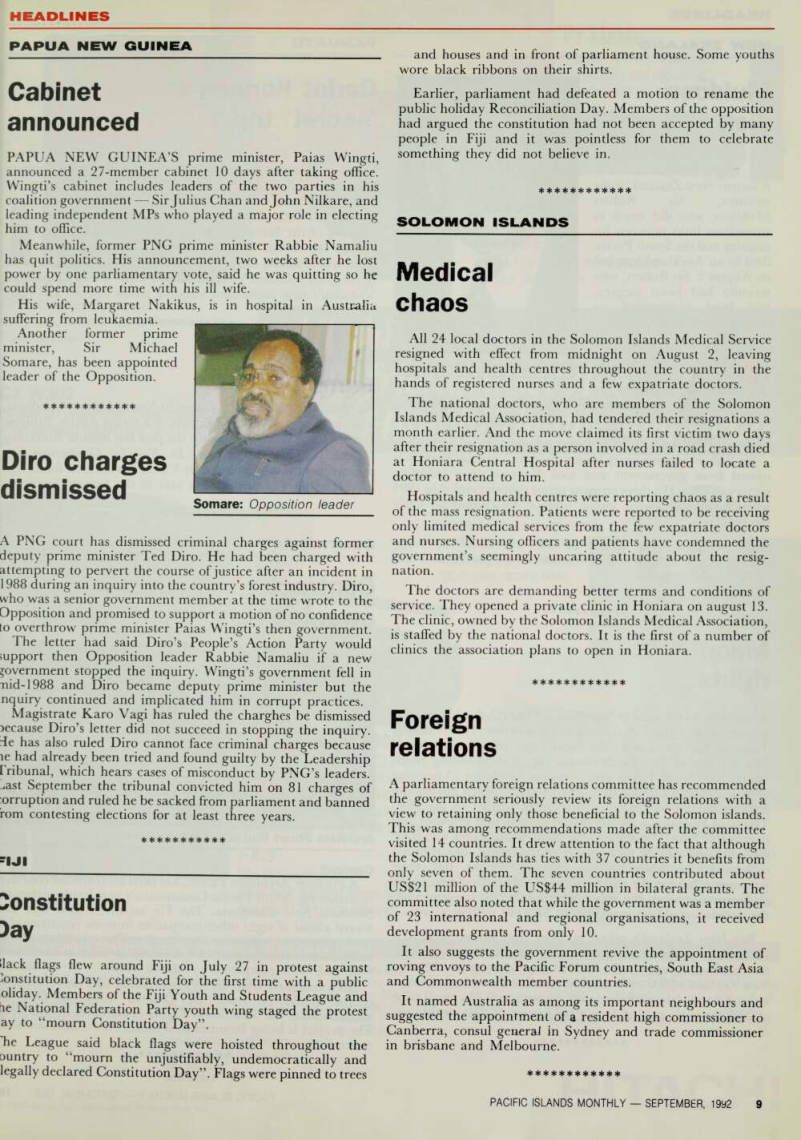
Another former prime minister, Sir Michael Somare, has been appointed leader of the Opposition.
Diro charges dismissed
A PNG court has dismissed criminal charges against former deputy prime minister Ted Diro. He had been charged with attempting to pervert the course of justice after an incident in 1988 during an inquiry into the country’s forest industry. Diro, who was a senior government member at the time wrote to the Opposition and promised to support a motion of no confidence to overthrow prime minister Paias Wingti’s then government.
The letter had said Diro’s People’s Action Party would support then Opposition leader Rabbie Namaliu if a new government stopped the inquiry. Wingti’s government fell in nid-1988 and Diro became deputy prime minister but the nquiry continued and implicated him in corrupt practices.
Magistrate Karo Vagi has ruled the charghes be dismissed because Diro’s letter did not succeed in stopping the inquiry, de has also ruled Diro cannot face criminal charges because le had already been tried and found guilty by the Leadership fribunal, which hears cases of misconduct by PNG’s leaders, September the tribunal convicted him on 81 charges of :orruption and ruled he be sacked from parliament and banned fom contesting elections for at least three years.
Somare: Opposition leader
Constitution
Fiji
Jay
•lack flags flew around Fiji on July 27 in protest against Constitution Day, celebrated for the first time with a public oliday. Members of the Fiji Youth and Students League and tie National Federation Party youth wing staged the protest ay to “mourn Constitution Day”. he League said black flags were hoisted throughout the Duntry to “mourn the unjustifiably, undemocratically and legally declared Constitution Day”. Flags were pinned to trees
and houses and in front of parliament house. Some youths wore black ribbons on their shirts.
Earlier, parliament had defeated a motion to rename the public holiday Reconciliation Day. Members of the opposition had argued the constitution had not been accepted by many people in Fiji and it was pointless for them to celebrate something they did not believe in.
Foreign
Solomon Islands
Medical
chaos
All 24 local doctors in the Solomon Islands Medical Service resigned with effect from midnight on August 2, leaving hospitals and health centres throughout the country in the hands of registered nurses and a few expatriate doctors.
The national doctors, who are members of the Solomon Islands Medical Association, had tendered their resignations a month earlier. And the move claimed its first victim two days after their resignation as a person involved in a road crash died at Honiara Central Hospital after nurses failed to locate a doctor to attend to him.
Hospitals and health centres were reporting chaos as a result of the mass resignation. Patients were reported to be receiving only limited medical services from the few expatriate doctors and nurses. Nursing officers and patients have condemned the government’s seemingly uncaring attitude about the resig nation.
The doctors are demanding better terms and conditions of service. They opened a private clinic in Honiara on august 13.
The clinic, owned by the Solomon Islands Medical Association, is staffed by the national doctors. It is the first of a number of clinics the association plans to open in Honiara. ***
Foreign
relations
A parliamentary foreign relations committee has recommended the government seriously review its foreign relations with a view to retaining only those beneficial to the Solomon islands.
This was among recommendations made after the committee visited 14 countries. It drew attention to the fact that although the Solomon Islands has ties with 37 countries it benefits from only seven of them. The seven countries contributed about US$2l million of the US$44 million in bilateral grants. The committee also noted that while the government was a member of 23 international and regional organisations, it received development grants from only 10.
It also suggests the government revive the appointment of roving envoys to the Pacific Forum countries, South East Asia and Commonwealth member countries.
It named Australia as among its important neighbours and suggested the appointment of a resident high commissioner to Canberra, consul general in Sydney and trade commissioner in brisbane and Melbourne.
rights
New Zealand
Muldoon
dies
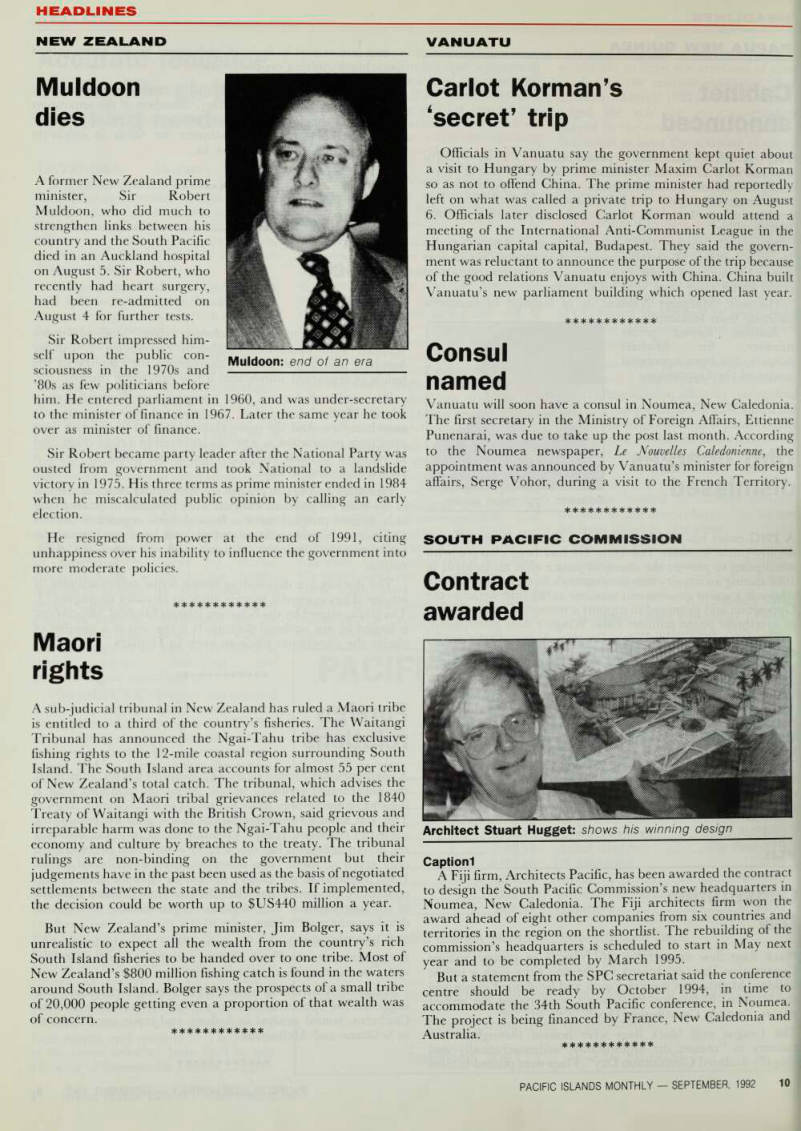
A former New Zealand prime minister, Sir Robert Muldoon, who did much to strengthen links between his country and the South Pacific died in an Auckland hospital on August 5. Sir Robert, who recently had heart surgery, had been re-admitted on August 4 for further tests.
Sir Robert impressed him self upon the public con sciousness in the 1970 s and ’Bos as few politicians before
him. He entered parliament in 1960, and was under-secretary to the minister of finance in 1967. Later the same year he took over as minister of finance.
Sir Robert became party leader after the National Party was ousted from government and took National to a landslide victory in 1975. His three terms as prime minister ended in 1984 when he miscalculated public opinion by calling an early election.
He resigned from power at the end of 1991, citing unhappiness over his inability to influence the government into more moderate policies. ***
Maori
rights
A sub-judicial tribunal in New Zealand has ruled a Maori tribe is entitled to a third of the country’s fisheries. The Waitangi Tribunal has announced the Ngai-Tahu tribe has exclusive fishing rights to the 12-mile coastal region surrounding South Island. The South Island area accounts for almost 55 per cent of New Zealand’s total catch. The tribunal, which advises the government on Maori tribal grievances related to the 1840 Treaty of Waitangi with the British Crown, said grievous and irreparable harm was done to the Ngai-Tahu people and their economy and culture by breaches to the treaty. The tribunal rulings are non-binding on the government but their judgements have in the past been used as the basis of negotiated settlements between the state and the tribes. If implemented, the decision could be worth up to SUS44O million a year.
But New Zealand’s prime minister, Jim Bolger, says it is unrealistic to expect all the wealth from the country’s rich South Island fisheries to be handed over to one tribe. Most of New Zealand’s $BOO million fishing catch is found in the waters around South Island. Bolger says the prospects of a small tribe of 20,000 people getting even a proportion of that wealth was of concern.
Muldoon: end of an era
‘secret’ trip
Vanuatu
Carlot Korman’s
Officials in Vanuatu say the government kept quiet about a visit to Hungary by prime minister Maxim Carlot Korman so as not to offend China. The prime minister had reportedly left on what was called a private trip to Hungary on August 6. Officials later disclosed Carlot Korman would attend a meeting of the International Anti-Communist League in the Hungarian capital capital, Budapest. They said the govern ment was reluctant to announce the purpose of the trip because of the good relations Vanuatu enjoys with China. China built Vanuatu’s new parliament building which opened last year. ***
Consul
named
Vanuatu will soon have a consul in Noumea, New Caledonia.
The first secretary in the Ministry of Foreign Affairs, Ettienne Punenarai, was due to take up the post last month. According to the Noumea newspaper, Le Nouvelles Caledonienne , the appointment was announced by Vanuatu’s minister for foreign affairs, Serge Vohor, during a visit to the French Territory.
Contract
South Pacific Commission
Contract awarded
Captionl A Fiji firm, Architects Pacific, has been awarded the contract to design the South Pacific Commission’s new headquarters in Noumea, New Caledonia. The Fiji architects firm won the award ahead of eight other companies from six countries and territories in the region on the shortlist. The rebuilding of the commission’s headquarters is scheduled to start in May next year and to be completed by March 1995.
But a statement from the SPC secretariat said the conference centre should be ready by October 1994, in time to accommodate the 34th South Pacific conference, in Noumea.
The project is being financed by France, New Caledonia and Australia.
Architect Stuart Hugget: shows his winning design
Advertisements & other items, p. 11 (1 item)
plus friendly service
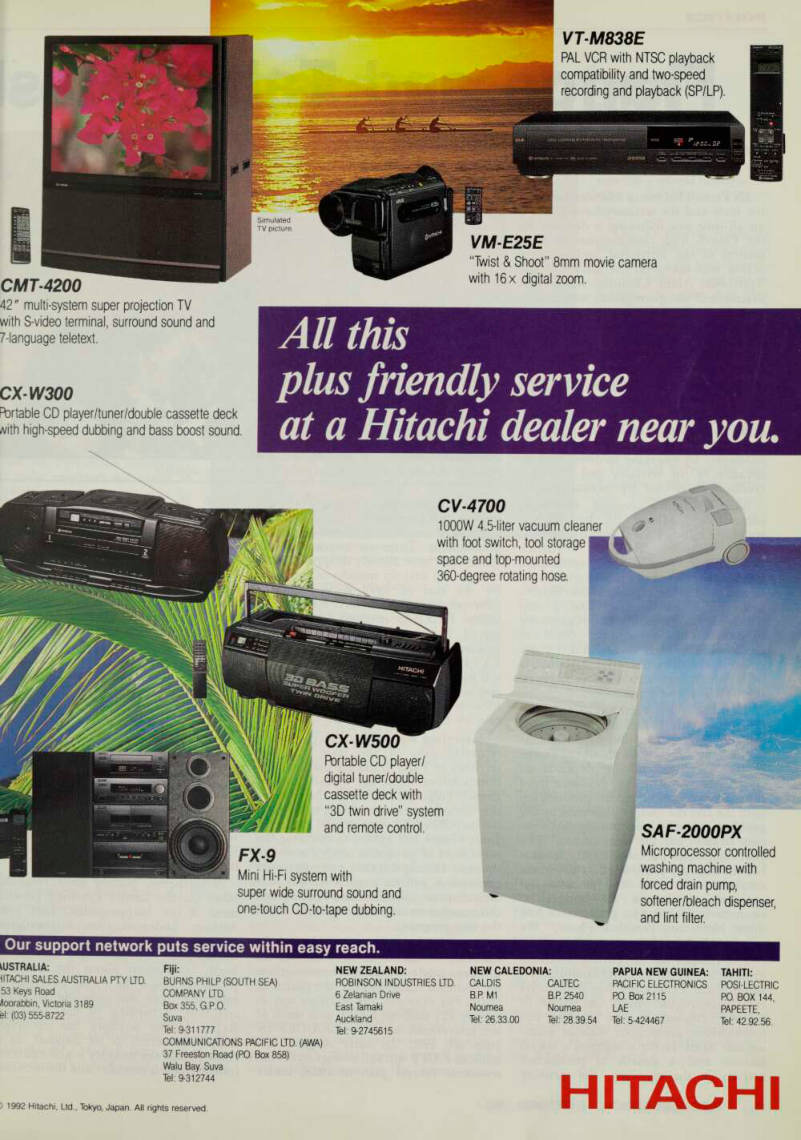
VT-MB3BE
PAL VCR with NTSC playback compatibility and two-speed recording and playback (SP/LP)
CMT42OO
42" multi-system super projection TV with S-video terminal, surround sound and 7-language teletext.
CX-W3OO
Portable CD player/tuner/double cassette deck with high-speed dubbing and bass boost sound.
VM-E2SE
“Twist & Shoot” Bmm movie camera with 16 x digital zoom.
All this
plus friendly service
at a Hitachi dealer near you.
L ■ Ta FX CV-4700 1000 W 4.5-liter vacuum cleaner , with foot switch, tool storage space and top-mounted degree rotating hose.
CX-W5OO
Portable CD player/ digital tuner/double cassette deck with “3D twin drive” system and remote control. system with super wide surround sound and one-touch CD-to-tape dubbing.
SAF-2000PX
Microprocessor controlled washing machine with forced drain pump, softener/bleach dispenser, and lint filter.
Our support network puts service within easy reach.
AUSTRALIA: Fiji:
HTACHI SALES AUSTRALIA PTY LTD. BURNS PHILP (SOUTH SEA) 53 Keys Road COMPANY LTD. ioorabbin, Victoria 3189 Box 355 G P 0 el: (03) 555-8722 Suva Tel: 9-311777
NEW ZEALAND:
ROBINSON INDUSTRIES LTD.
6 Zelanian Drive East Tamaki Auckland Tel: 9-2745615
NEW CALEDONIA:
CALDIS
B.P Ml
Noumea Tel: 26.33.00
CALTEC
B.R 2540 Noumea Tel: 28.39.54
PAPUA NEW GUINEA: TAHITI:
PACIFIC ELECTRONICS POSI-LECTRIC
RO. Box 2115 PO. BOX 144,
LAE PAPEETE,
Tel: 5-424467 Tel: 42.92.56.
COMMUNICATIONS PACIFIC LTD. (AWA)
37 Freeston Road (RO. Box 858) Walu Bay. Suva Tel: 9-312744 ) 1992 Hitachi, Ltd.. Tokyo, Japan. All rights reserved.
HITACHI
France and Tahiti clash over budgetary control
Politics
By Karin von Strokirch
IN French Polynesia relations between the state and the territory have reached an all-time low following a decision by the French high commissioner to seize control of the territorial budget. This action was taken on the advice of the Territorial Audit Chamber which had determined the government was unable to balance the 1992 budget. An inter vention of this kind by the state is unprecedented since the granting of internal autonomy to the territory in 1984.
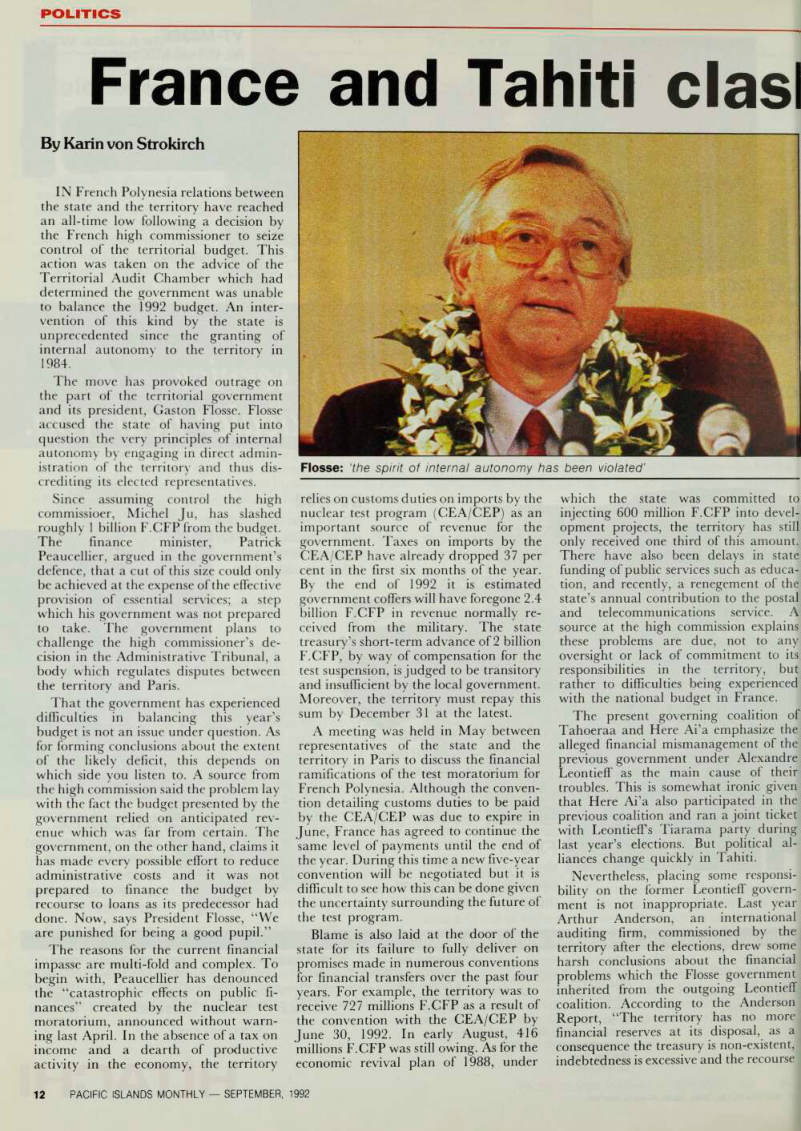
The move has provoked outrage on the part of the territorial government and its president, Gaston Flosse. Flosse accused the state of having put into question the very principles of internal autonomy by engaging in direct admin istration of the territory and thus dis crediting its elected representatives.
Since assuming control the high commissioer, Michel Ju, has slashed roughly 1 billion F.CFP from the budget.
The finance minister, Patrick Peaucellier, argued in the government’s defence, that a cut of this size could only be achieved at the expense of the effective provision of essential services; a step which his government was not prepared to take. The government plans to challenge the high commissioner’s de cision in the Administrative Tribunal, a body which regulates disputes between the territory and Paris.
That the government has experienced difficulties in balancing this year’s budget is not an issue under question. As for forming conclusions about the extent of the likely deficit, this depends on which side you listen to. A source from the high commission said the problem lay with the fact the budget presented by the government relied on anticipated rev enue which was far from certain. The government, on the other hand, claims it has made every possible effort to reduce administrative costs and it was not prepared to finance the budget by recourse to loans as its predecessor had done. Now, says President Flosse, “We are punished for being a good pupil.”
The reasons for the current financial impasse are multi-fold and complex. To begin with, Peaucellier has denounced the “catastrophic effects on public fi nances” created by the nuclear test moratorium, announced without warn ing last April. In the absence of a tax on income and a dearth of productive activity in the economy, the territory
relies on customs duties on imports by the nuclear test program (CEA/CEP) as an important source of revenue for the government. Taxes on imports by the CEA/CEP have already dropped 37 per cent in the first six months of the year.
By the end of 1992 it is estimated government coffers will have foregone 2.4 billion F.CFP in revenue normally re ceived from the military. The state treasury’s short-term advance of 2 billion F.CFP, by way of compensation for the test suspension, is judged to be transitory and insufficient by the local government.
Moreover, the territory must repay this sum by December 31 at the latest.
A meeting was held in May between representatives of the state and the territory in Paris to discuss the financial ramifications of the test moratorium for French Polynesia. Although the conven tion detailing customs duties to be paid by the CEA/CEP was due to expire in June, France has agreed to continue the same level of payments until the end of the year. During this time a new five-year convention will be negotiated but it is difficult to see how this can be done given the uncertainty surrounding the future of the test program.
Blame is also laid at the door of the state for its failure to fully deliver on promises made in numerous conventions for financial transfers over the past four years. For example, the territory was to receive 727 millions F.CFP as a result of the convention with the CEA/CEP by June 30, 1992. In early August, 416 millions F.CFP was still owing. As for the economic revival plan of 1988, under
which the state was committed to injecting 600 million F.CFP into devel opment projects, the territory has still only received one third of this amount.
There have also been delays in state funding of public services such as educa tion, and recently, a renegement of the state’s annual contribution to the postal and telecommunications service. A source at the high commission explains these problems are due, not to any oversight or lack of commitment to its responsibilities in the territory, but rather to difficulties being experienced with the national budget in France.
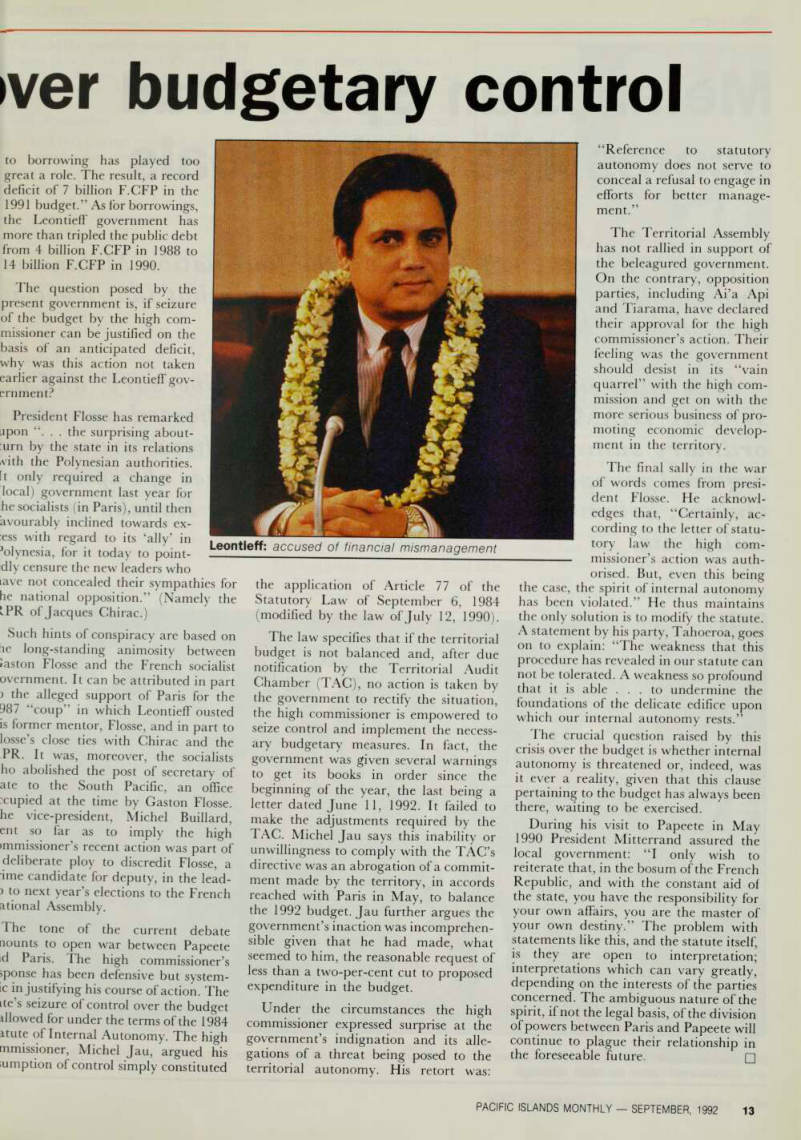
The present governing coalition of Tahoeraa and Here Ai’a emphasize the alleged financial mismanagement of the previous government under Alexandre Leontieff as the main cause of their troubles. This is somewhat ironic given that Here Ai’a also participated in the previous coalition and ran a joint ticket with LeontiefTs Tiarama party during last year’s elections. But political al liances change quickly in Tahiti.
Nevertheless, placing some responsi
bility on the former Leontieff govern ment is not inappropriate. Last year Arthur Anderson, an international auditing firm, commissioned by the territory after the elections, drew some harsh conclusions about the financial problems which the Flosse government inherited from the outgoing Leontieff coalition. According to the Anderson Report, “The territory has no more financial reserves at its disposal, as a consequence the treasury is non-existent, j indebtedness is excessive and the recourse
Flosse: 'the spirit of internal autonomy has been violated’
to borrowing has played too great a role. The result, a record deficit of 7 billion F.CFP in the 1991 budget.” As for borrowings, the Leontieff government has more than tripled the public debt from 4 billion F.CFP in 1988 to 14 billion F.CFP in 1990.
The question posed by the present government is, if seizure of the budget by the high com missioner can be justified on the basis of an anticipated deficit, why was this action not taken earlier against the Leontieff gov ernment?
President Flosse has remarked upon “. . . the surprising about ;urn by the state in its relations vith the Polynesian authorities. [t only required a change in local) government last year for he socialists (in Paris), until then avourably inclined towards ex ess with regard to its ‘ally’ in ’olynesia, for it today to point dly censure the new leaders who
lave not concealed their sympathies for he national opposition.” (Namely the LPR of Jacques Chirac.) Such hints of conspiracy are based on
ic long-standing animosity between
laston Flosse and the French socialist overnment. It can be attributed in part ) the alleged support of Paris for the 987 “coup” in which Leontieff ousted is former mentor, Flosse, and in part to losse’s close ties with Chirac and the PR. It was, moreover, the socialists ho abolished the post of secretary of ate to the South Pacific, an office xupied at the time by Gaston Flosse. he vice-president, Michel Buillard, ent so far as to imply the high •mmissioner’s recent action was part of deliberate ploy to discredit Flosse, a ime candidate for deputy, in the lead ) to next year’s elections to the French
ational Assembly.
The tone of the current debate riounts to open war between Papeete d Paris. The high commissioner’s jponse has been defensive but system ic in justifying his course of action. The ite’s seizure of control over the budget illowed for under the terms of the 1984 itute of Internal Autonomy. The high mmissioner, Michel Jau, argued his lumption of control simply constituted
the application of Article 77 of the Statutory Law of September 6, 1984 (modified by the law of July 12, 1990).
The law specifies that if the territorial budget is not balanced and, after due notification by the Territorial Audit Chamber (TAG), no action is taken by the government to rectify the situation, the high commissioner is empowered to seize control and implement the necess ary budgetary measures. In fact, the government was given several warnings to get its books in order since the beginning of the year, the last being a letter dated June 11, 1992. It failed to make the adjustments required by the TAG. Michel Jau says this inability or unwillingness to comply with the TAC’s directive was an abrogation of a commit ment made by the territory, in accords reached with Paris in May, to balance the 1992 budget. Jau further argues the government’s inaction was incomprehen sible given that he had made, what seemed to him, the reasonable request of less than a two-per-cent cut to proposed expenditure in the budget.
Under the circumstances the high commissioner expressed surprise at the government’s indignation and its alle gations of a threat being posed to the territorial autonomy. His retort was:
“Reference to statutory autonomy does not serve to conceal a refusal to engage in efforts for better manage ment.”
The Territorial Assembly has not rallied in support of the beleagured government.
On the contrary, opposition parties, including Ai’a Api and Tiarama, have declared their approval for the high commissioner’s action. Their feeling was the government should desist in its “vain quarrel” with the high com mission and get on with the more serious business of pro moting economic develop ment in the territory.
The final sally in the war of words comes from presi dent Flosse. He acknowl edges that, “Certainly, ac cording to the letter of statu tory law the high com missioner’s action was auth orised. But, even this being
the case, the spirit of internal autonomy has been violated.” He thus maintains the only solution is to modify the statute.
A stateme " t . b y party, Tahoeroa, goes u in ' Th f weakness that this P dure has J v^ aled our statu js ca n J lOl be t ? lera^ ed - A weakness so profound foundations of the dehca^edifTce'upon which our internal autonomy rests.” tl • , • , , . . ■ cructal quest,on raised by this crisis over the budget is whether internal autonomy is threatened or, indeed, was it ever a reality, given that this clause pertaining to the budget has always been there, waiting to be exercised, During his visit to Papeete in Mav 1990 President Mitterrand assured the local government: “I only wish to reiterate that, in the bosum of the French Republic, and with the constant aid of the state, you have the responsibility for your own affairs, you are the master of your own destiny.” The problem with statements like this, and the statute itself, ! s the y ar e open to interpretation; interpretations which can vary greatly, depending on the interests of the parties spirit, if not the legal of powers between Paris and Papeete will continue to plague their relationship in the foreseeable future. n
Leontieff: accused of financial mismanagement
THE MSG meeting was attended by Papua New Guinea’s new Prime Minis ter Piais Wingti, Vanuatu’s Maxime Carlot Korman, Solomon Islands’ Sol omon Mamaloni and FLNKS President
Paul Neuontyine.
The MSG summit reviewed, discussed and noted developments in the areas of general political and institutional devel opments within the South Pacific region, and potential trade and economic co operation and arrangements amongst the MSG members.
Developments in New Caledonia were also noted, and leaders agreed that this issue should continue to be addressed.
They noted a request by the FLNKS to see that the South Pacific Forum Minis terial Committee continue its visit to New Caledonia after the Matignon Accords Review towards the end of this year and before the next Forum meeting.
MSG leaders also agreed to maintain a united position on a candidate for secretary general of the South Pacific Commission and expressed support for the Vanuatu candidate, former president
Ati George Sokomanu.
While these were issues on the formal agenda it took the leaders a record one aour at the Port Vila university centre before the broke off — one side issue took greater prominence, with a successful )utcome.
It was the Bougainville crisis’ spill-over Beet into the Solomon Islands which :aused an impasse in its relations with s apua New Guinea.
Following raids by PNG security forces •n two villages in the Solomon’s Portland Group which borders Bou ainville, Mamaloni’s government sent everal diplomatic protests to PNG efore cutting off any communication at olitical level.
His position then was to refrain from dealing with the then government of Rabbie Namaliu until after PNG’s na tional election in June because he feared there may be a change in government.
Mamaloni’s fears of a change of government were well founded.
Rabbie Namaliu lost PNG’s top job to Paias Wingti on July 17 with a 55-54 vote in Parlia ment.
The new prime minister wasted no time in re establishing contact with the Solomons and was on the plane to Port Vila, via Honiara on
July 28.
When Messrs Wingti and Mamaloni met on Honiara’s Henderson Airport tarmac and hugged and greeted each other it was like two long lost brothers
reuniting.
They shared jokes and were bubbling
with laughter, a totally different time to when Rabbie Namaliu tried on numer ous occasions and each time failed to reach Mamaloni by telephone.
The two prime ministers declared after this “first contact” that the “misunder standings” had been resolved and both countries were friends again.
Said Wingti of the coldness - “I understand the feeling of the Solomon Islands. I would have felt the same if a big country with a lot of resources moved
into our territory and destroyed villages.
Mamaloni said, “The suspension of talks is now over. With the new (Wingti) administration I have great hope. We would like to remain as a mediator, we don’t want to interfere (in. the Bougain
ville crisis).
“Through talking and developing
understanding, we will be able to convince the Bougainville people to lay down their arms.”
As a sign of goodwill, Wingti, after the Honiara stop-over, offered Mamaloni and his family and Solomon Islands officials a lift to Vanuatu in his plane.
During the two days in Port Vila they had extensive discussions on how to go about addressing the spill-over effect, at the end of which they produced the “Vila Statement” which signalled a new ap proach to the issue.
This statement was based on their resolve to:
• Work together in accordance with Melanesian traditions and share interests to speedily and amicably address the spill-over effects of the Bougainville crisis; • Recognise that the historical, cul tural and human interactions of PNG and Solomon Island citizens would continue to be an important consider ation in resolving issues which affect both countries; • Adopt a comprehensive and mutu ally agreed approach to effectively deal with the crisis on Bougainville in as far as the Crisis affects both countries na tional interests and; • Reaffirm their governments’ view that the Bougainville crisis is an internal matter for PNG to resolve given the constitutional, moral and human dimen sions associated with the crisis. □
[?]ngtl: I understand the feeling of the [?]lomon Islands
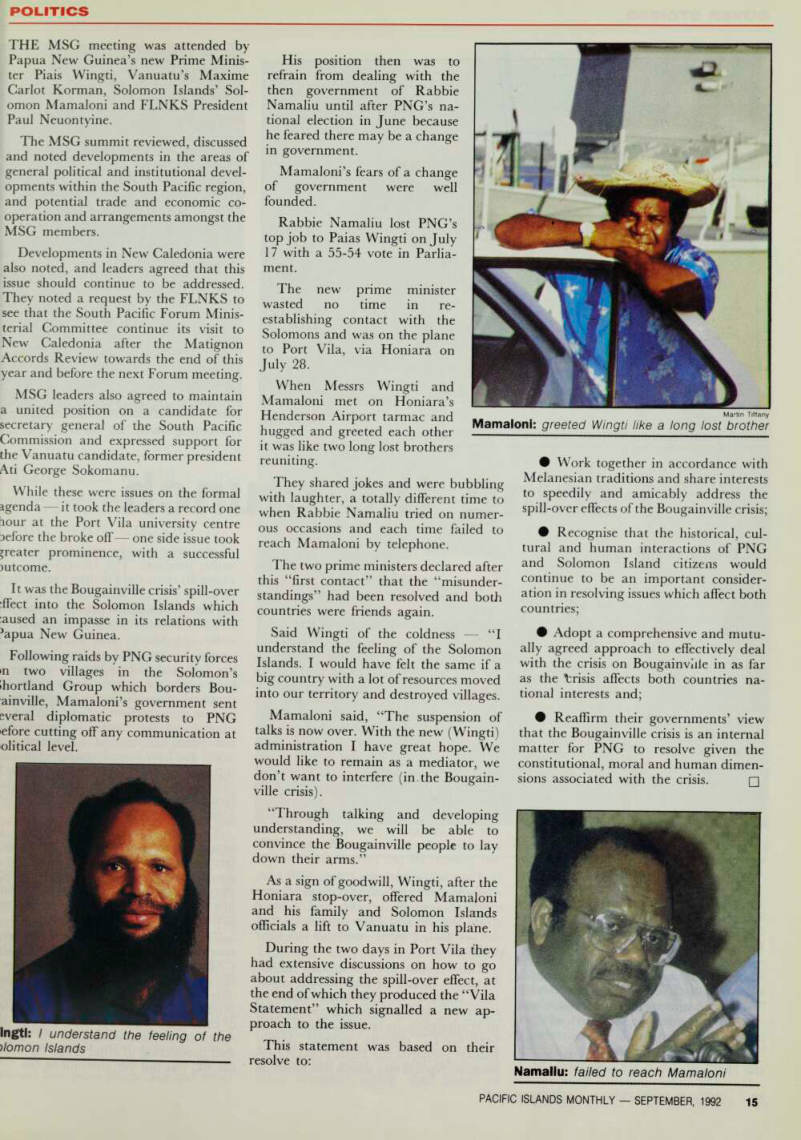
Martin Tiffany Mamaloni: greeted Wingti like a long lost brother
Namallu: failed to reach Mamaloni
Advertisements & other items, p. 14 (1 item)
Melanesian Spearhead
scores the right goals
VANUATU may not have won the four-nation Melanesia Cup challenge it hosted at the end of July hut that week it
scored goals befitting top prizes.
It celebrated its 14th independence anniversary, and as WALLY HIAMBON reports, successfully hosted an extraordinary summit of the Melanesian Spearhead Group a regional grouping of the Melanesian countries of Papua New Guinea, Solomon Islands, Vanuatu and the Kanaks of New Caledonia. * ■ ri ir7.
sir
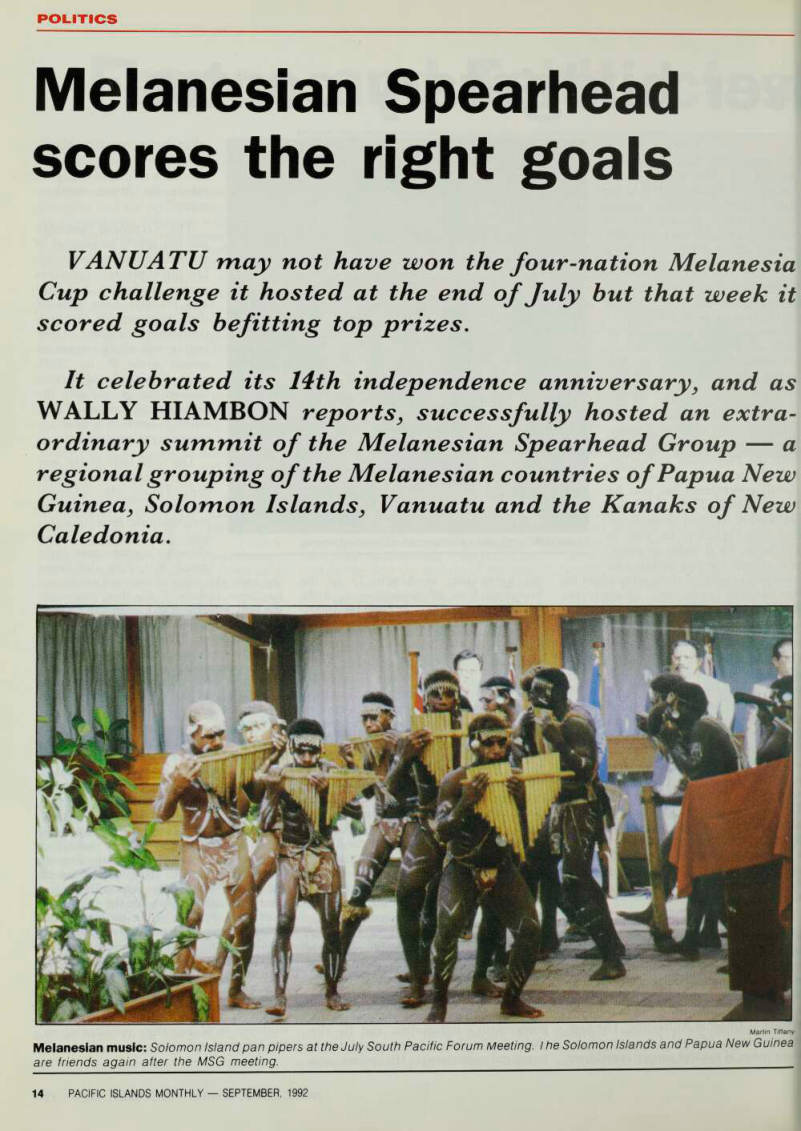
/ i s $ m \r W ■ i n - .W A 1 0 Melanesian music: Solomon Island pan pipers at the July South Pacific Forum Meeting. Ihe Solomon Islands and Papua New Guinea are friends again after the MSG meeting.
Facing the crunch

Cover Stories
By Roman Grynberg
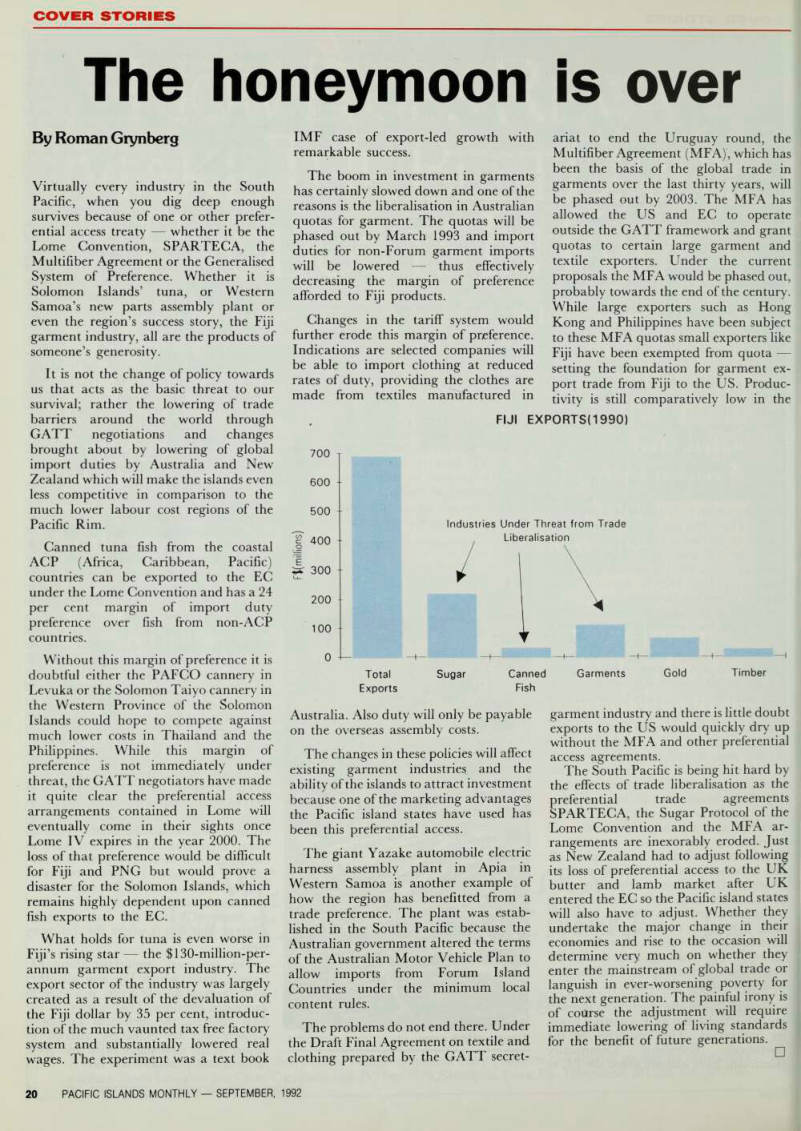
DESPITE the much bigger press gar ments and tourism get in Fiji it is sugar which remains the nation’s bread and butter, or perhaps more appropriately dalo and roti. In 1990, for example, Fiji exported 380,000 tonnes of sugar at a total value of $223 million. Sugar is twice as big as garments, three times the size of gold exports and six times bigger than tuna exports. In 1990 sugar exports were a third of total exports and despite all the difficulties, sugar is still king in Fiji.
While tourism may be bigger and garments may be newer, there is no industry like sugar that brings so much money directly into the pockets of the average Fiji citizen.
It is this widespread distribution of earnings from sugar which has made Fiji unique among island states in that from those earnings it has developed a fairly integrated economy. The sugar industry has always been a rock-solid foundation of Fiji’s futuure. However negotiations in Geneva, Brussels and Washington to reform Europe’s Common Agricultural Policy (CAP) and thereby close what is known as the Uruguay Round of GATT (General Agreement on Trade and Tariffs) may bring the roof down on Fiji’s economy Moreover the global repercussions of the changes in European sugar pricing
policy may have serious effects on relations between sugar producing countries which have peferential access to the European sugar market and those other signatories to the Lome Conven tion which do not produce sugar.
At present CAP is under unpreceden ted pressure. The greatest* pressure is coming from the US which must sustain its own system of subsidy to its agricul tural sector, in large part to give US farmers a chance to be able to compete with their highly subsidized European competitors. In 1992 alone, these subsidies will cost EC and its consumers US$l34 billion while US subsidies cost SUS7S billion. In Europe the richest 20 per cent of farmers get 80 per cent of CAP subsidies and in the US the top one per cent of farmers get 30 per cent of the subsidies, the same amount received by the poorest 80 per cent of farmers.
Thus, while both the US and EC have claimed their respective systems of agri cultural subsidy benefit mid-Western grain farmers and French peasants they are in fact massive subsidies to their millionaires.
The US has put the brakes on the Uruguay Round of negotiations of the GATT until the Europeans agree to reforms to the CAP which are acceptable to Washington. In late December of 'ast year GATT director general Arthur Dunkel prepared the Draft Final Agree ment on Agriculture which was based on
36 per cent average reduction in tariffs across products. The Dunkel plan alsc called for reductions in direct subsidies tc farmers. The US response was a grudg ing acceptance of the principle while the EC and Japan rejected it outright.
Nevertheless in late May the Eur opeans, under pressure from within by the UK and not wishing to appear tc have made the entire reform under US pressure have unilaterally proceeded with a major reform of the CAP as it applies to the trade in gain. The Europeans have moved to lower support prices and have introduced direct income supports for the compulsory setting aside of land. In other words the EC will pay farmers to set aside land and not produce grain.
The irony, if not sheer immorality, of returning to the situation of paying farmers not to produce grain while a good portion of sub-Saharan Africa starves in front of our eyes on the evening news might not even be lost on the most ardent supporters of free trade.
The US pressure for reform has been essentially in the area of grain but the CAP, as all such systems has its own internal logic. If the EC lower prices and offers to pay “set-aside” payments to stop producing grain then it is only a matter of time before the EC must reform the entire price system or farmers will simply shift production to other crops. So while the EC has not yet announced the
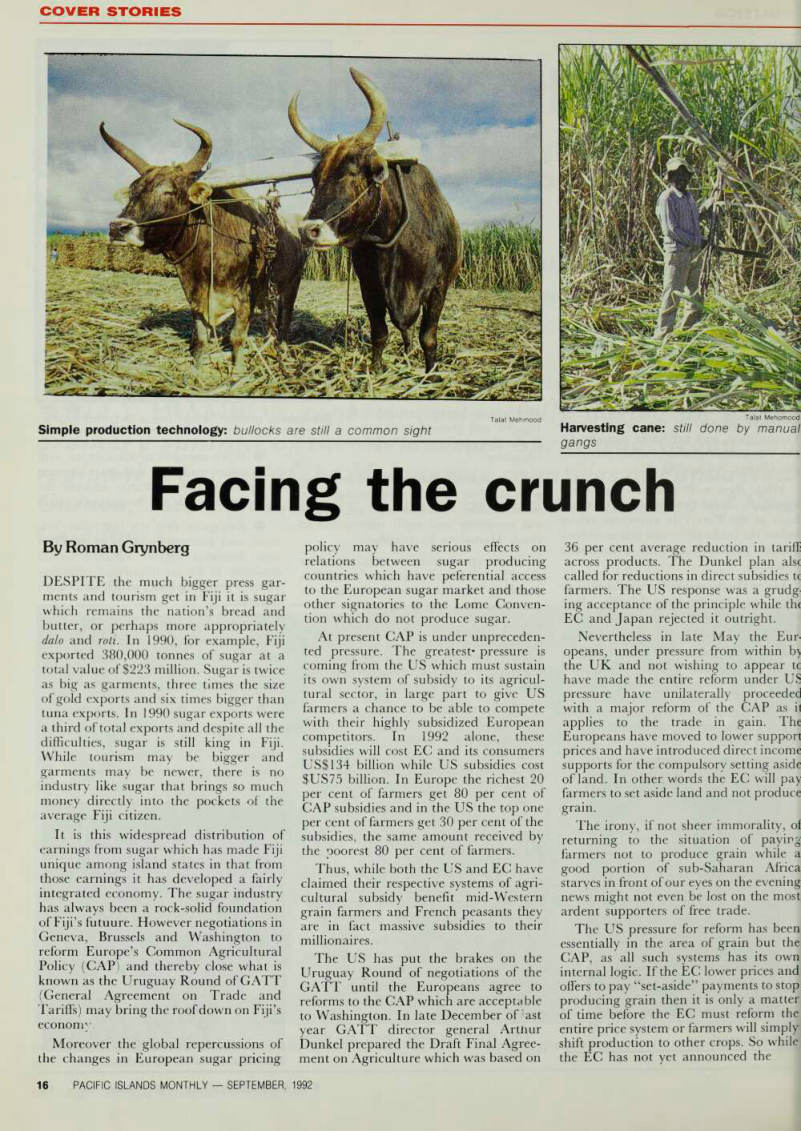
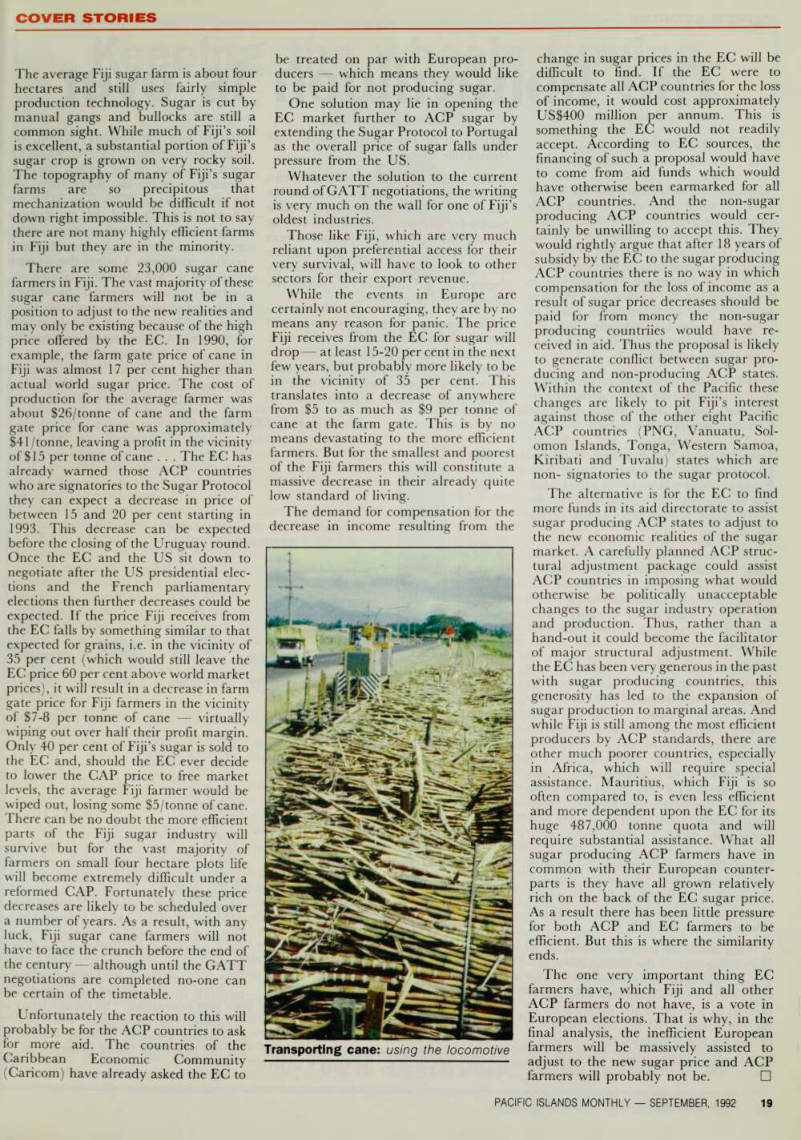
Talat Mehmood Simple production technology: bullocks are still a common sight
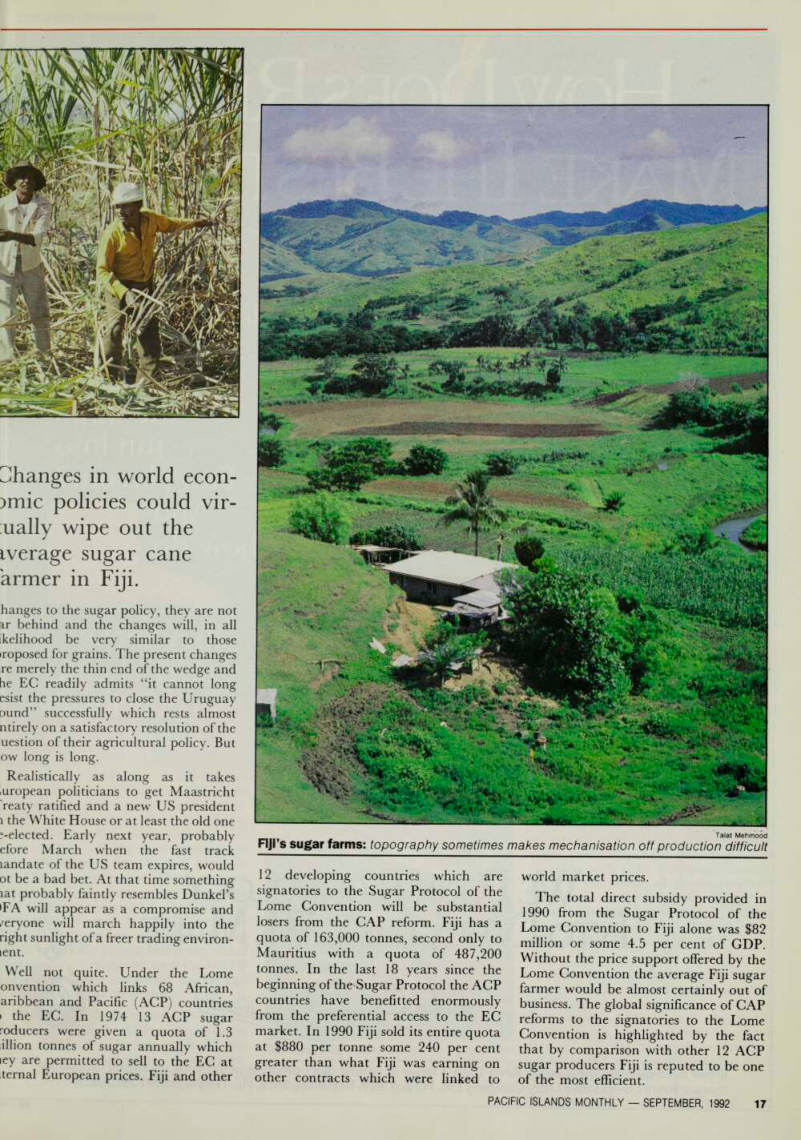
Talat Mehomood Harvesting cane: still done by manual gangs
Changes in world econ omic policies could vir
ually wipe out the
iverage sugar cane armer in Fiji.
hanges to the sugar policy, they are not ar behind and the changes will, in all ikelihood be very similar to those •roposed for grains. The present changes re merely the thin end of the wedge and be EC readily admits “it cannot long esist the pressures to close the Uruguay ound” successfully which rests almost ntirely on a satisfactory resolution of the uestion of their agricultural policy. But
ow long is long.
Realistically as along as it takes uropean politicians to get Maastricht reaty ratified and a new US president i the White House or at least the old one selected. Early next year, probably efore March when the fast track landate of the US team expires, would ot be a bad bet. At that time something lat probably faintly resembles Dunkel’s •FA will appear as a compromise and /eryone will march happily into the right sunlight of a freer trading environ ment.
Well not quite. Under the Lome onvention which links 68 African, aribbean and Pacific (AGP) countries > the EC. In 1974 13 AGP sugar roducers were given a quota of 1.3 illion tonnes of sugar annually which mey are permitted to sell to the EC at ternal European prices. Fiji and other
12 developing countries which are signatories to the Sugar Protocol of the Lome Convention will be substantial iosers from the CAP reform. Fiji has a quota of 163,000 tonnes, second only to Mauritius with a quota of 487,200 tonnes. In the last 18 years since the beginning of the Sugar Protocol the AGP countries have benefitted enormously from the preferential access to the EC market. In 1990 Fiji sold its entire quota at $BBO per tonne some 240 per cent greater than what Fiji was earning on other contracts which were linked to
world market prices.
Xhe total direct subsid ided in 1990 from the s Prot £ col of the Lome Convention to Fiji alone was $B2 million or some 4 5 cent of GDP Without the price support offered by the Lome Convention the average Fiji sugar farmer would be almost certainly out of business. The global significance of CAP reforms to the signatories to the Lome Convention is highlighted by the fact that by comparison with other 12 AGP sugar producers Fiji is reputed to be one of the most efficient.
Talat Mehmood Fiji s sugar farms: topography sometimes makes mechanisation off production difficult
The average Fiji sugar farm is about four hectares and still uses fairly simple production technology. Sugar is cut by manual gangs and bullocks are still a common sight. While much of Fiji’s soil is excellent, a substantial portion of Fiji’s sugar crop is grown on very rocky soil.
The topography of many of Fiji’s sugar farms are so precipitous that mechanization would be difficult if not down right impossible. This is not to say there are not many highly efficient farms in Fiji but they are in the minority.
There are some 23,000 sugar cane farmers in Fiji. The vast majority of these sugar cane farmers will not be in a position to adjust to the new realities and may only be existing because of the high price offered by the EC. In 1990, for example, the farm gate price of cane in Fiji was almost 17 per cent higher than actual world sugar price. The cost of production for the average farmer was about $26/tonne of cane and the farm gate price for cane was approximately $4l /tonne, leaving a profit in the vicinity of $l5 per tonne of cane . . . The EC has already warned those ACP countries who are signatories to the Sugar Protocol they can expect a decrease in price of between 15 and 20 per cent starting in 1993. This decrease can be expected before the closing of the Uruguay round.
Once the EC and the US sit down to negotiate after the US presidential elec tions and the French parliamentary elections then further decreases could be expected. If the price Fiji receives from the EC falls by something similar to that expected for grains, i.e. in the vicinity of 35 per cent (which would still leave the EC price 60 per cent above world market prices), it will result in a decrease in farm gate price for Fiji farmers in the vicinity of $7-8 per tonne of cane virtually wiping out over half their profit margin.
Only 40 per cent of Fiji’s sugar is sold to the EC and, should the EC ever decide to lower the CAP price to free market levels, the average Fiji farmer would be wiped out, losing some $5/tonne of cane.
There can be no doubt the more efficient parts of the Fiji sugar industry will survive but for the vast majority of farmers on small four hectare plots life will become extremely difficult under a reformed CAP. Fortunately these price decreases are likely to be scheduled over a number of years. As a result, with any luck, Fiji sugar cane farmers will not have to face the crunch before the end of the century although until the GATT negotiations are completed no-one can be certain of the timetable.
Unfortunately the reaction to this will probably be for the ACP countries to ask for more aid. The countries of the Caribbean Economic Community (Caricom) have already asked the EC to
be treated on par with European pro ducers which means they would like to be paid for not producing sugar.
One solution may lie in opening the EC market further to ACP sugar by extending the Sugar Protocol to Portugal as the overall price of sugar falls under pressure from the US.
Whatever the solution to the current round of GATT negotiations, the writing is very much on the wall for one of Fiji’s oldest industries.
Those like Fiji, which are very much reliant upon preferential access for their very survival, will have to look to other sectors for their export revenue.
While the events in Europe are certainly not encouraging, they are by no means any reason for panic. The price Fiji receives from the EC for sugar will drop at least 15-20 per cent in the next few years, but probably more likely to be in the vicinity of 35 per cent. This translates into a decrease of anywhere from $5 to as much as $9 per tonne of cane at the farm gate. This is by no means devastating to the more efficient farmers. But for the smallest and poorest of the Fiji farmers this will constitute a massive decrease in their already quite low standard of living.
The demand for compensation for the decrease in income resulting from the
change in sugar prices in the EC will be difficult to find. If the EC were to compensate all ACP countries for the loss of income, it would cost approximately US$4OO million per annum. This is something the EC would not readily accept. According to EC sources, the financing of such a proposal would have to come from aid funds which would have otherwise been earmarked for all ACP countries. And the non-sugar producing ACP countries would cer tainly be unwilling to accept this. They would rightly argue that after 18 years of subsidy by the EC to the sugar producing ACP countries there is no way in which compensation for the loss of income as a result of sugar price decreases should be paid for from money the non-sugar producing countriies would have re ceived in aid. Thus the proposal is likely to generate conflict between sugar pro ducing and non-producing ACP states.
Within the context of the Pacific these changes are likely to pit Fiji’s interest against those of the other eight Pacific ACP countries (PNG, Vanuatu, Sol omon Islands, Tonga, Western Samoa, Kiribati and Tuvalu) states which are non- signatories to the sugar protocol.
The alternative is for the EC to find more funds in its aid directorate to assist sugar producing ACP states to adjust to the new economic realities of the sugar market. A carefully planned ACP struc tural adjustment package could assist ACP countries in imposing what would
otherwise be politically unacceptable
changes to the sugar industry operation and production. Thus, rather than a hand-out it could become the facilitator of major structural adjustment. While the EC has been very generous in the past with sugar producing countries, this generosity has led to the expansion of sugar production to marginal areas. And while Fiji is still among the most efficient producers by ACP standards, there are other much poorer countries, especially in Africa, which will require special assistance. Mauritius, which Fiji is so often compared to, is even less efficient and more dependent upon the EC for its huge 487,000 tonne quota and will require substantial assistance. What all sugar producing ACP farmers have in common with their European counter parts is they have all grown relatively rich on the back of the EC sugar price.
As a result there has been little pressure for both ACP and EC farmers to be efficient. But this is where the similarity ends.
The one very important thing EC farmers have, which Fiji and all other ACP farmers do not have, is a vote in European elections. That is why, in the final analysis, the inefficient European farmers will be massively assisted to adjust to the new sugar price and ACP farmers will probably not be. □
Transporting cane: using the locomotive
Advertisements & other items, p. 18 (1 item)
We Pour Technology
kis
r £
UnS
r A 11 ‘ i>» i nmrumvp.
COCKTAIL
tit U'lVll 111
FUtWVR
111111 l •It
lUIRE
tIVMtLt
they make
tasty cheese
so deliciously
•it yogfcant <5-
We Pour Technology
Into Everything We Make
o Qp
Frrrrrrrrm If you need more information on Rewa Dairy's range of natural dairy products or Tetrapak packaging capabilities contact: Rewa Co-operative Dairy Company Ltd, PO Box 3678, Samabula, Suva, Fiji. Telephone: 381 288. Fax. 370190.
IH| FI 037
The honeymoon is over
By Roman Grynberg
Virtually every industry in the South Pacific, when you dig deep enough survives because of one or other prefer ential access treaty whether it be the Lome Convention, SPARTECA, the Multifiber Agreement or the Generalised System of Preference. Whether it is Solomon Islands’ tuna, or Western Samoa’s new parts assembly plant or even the region’s success story, the Fiji garment industry, all are the products of someone’s generosity.
It is not the change of policy towards us that acts as the basic threat to our survival; rather the lowering of trade barriers around the world through GATT negotiations and changes brought about by lowering of global import duties by Australia and New Zealand which will make the islands even less competitive in comparison to the much lower labour cost regions of the Pacific Rim.
Canned tuna fish from the coastal AGP (Africa, Caribbean, Pacific) countries can be exported to the EC under the Lome Convention and has a 24 per cent margin of import duty preference over fish from non-ACP countries.
Without this margin of preference it is doubtful either the PAFCO cannery in Levuka or the Solomon Taiyo cannery in the Western Province of the Solomon Islands could hope to compete against much lower costs in Thailand and the Philippines. While this margin of preference is not immediately under threat, the GATT negotiators have made it quite clear the preferential access arrangements contained in Lome will eventually come in their sights once Lome IV expires in the year 2000. The loss of that preference would be difficult for Fiji and PNG but would prove a disaster for the Solomon Islands, which remains highly dependent upon canned fish exports to the EC.
What holds for tuna is even worse in Fiji’s rising star the Sl3O-million-per annum garment export industry. The export sector of the industry was largely created as a result of the devaluation of the Fiji dollar by 35 per cent, introduc tion of the much vaunted tax free factory system and substantially lowered real wages. The experiment was a text book
IMF case of export-led growth with remarkable success.
The boom in investment in garments has certainly slowed down and one of the reasons is the liberalisation in Australian quotas for garment. The quotas will be phased out by March 1993 and import duties for non-Forum garment imports will be lowered thus effectively decreasing the margin of preference afforded to Fiji products.
Changes in the tariff system would further erode this margin of preference.
Indications are selected companies will be able to import clothing at reduced rates of duty, providing the clothes are made from textiles manufactured in
ariat to end the Uruguay round, the Multifiber Agreement (MFA)', which has been the basis of the global trade in garments over the last thirty years, will be phased out by 2003. The MFA has allowed the US and EC to operate outside the GATT framework and grant quotas to certain large garment and textile exporters. Under the current proposals the MFA would be phased out, probably towards the end of the century.
While large exporters such as Hong Kong and Philippines have been subject to these MFA quotas small exporters like Fiji have been exempted from quota setting the foundation for garment ex port trade from Fiji to the US. Produc tivity is still comparatively low in the
Fiji Exports(I99O)
Australia. Also duty will only be payable on the overseas assembly costs.
The changes in these policies will affect existing garment industries and the ability of the islands to attract investment because one of the marketing advantages the Pacific island states have used has been this preferential access.
The giant Yazake automobile electric harness assembly plant in Apia in Western Samoa is another example of how the region has benefitted from a trade preference. The plant was estab lished in the South Pacific because the Australian government altered the terms of the Australian Motor Vehicle Plan to allow imports from Forum Island Countries under the minimum local content rules.
The problems do not end there. Under the Draft Final Agreement on textile and clothing prepared by the GATT secret
garment industry and there is little doubt exports to the US would quickly dry up without the MFA and other preferential access agreements.
The South Pacific is being hit hard by the effects of trade liberalisation as the preferential trade agreements SPARTECA, the Sugar Protocol of the Lome Convention and the MFA ar rangements are inexorably eroded. Just as New Zealand had to adjust following its loss of preferential access to the UK butter and lamb market after UK entered the EC so the Pacific island states will also have to adjust. Whether they undertake the major change in their economies and rise to the occasion will determine very much on whether they enter the mainstream of global trade or languish in ever-worsening poverty for the next generation. The painful irony is of coilrse the adjustment will require immediate lowering of living standards for the benefit of future generations.
I —l
Keeping the wheels turning
ONE of the problems faced by Forum Island Countries (as developing na tions) is how to build and maintain a workforce capable of keeping the ma chinery of government and the commer cial wheel of the private sector function ing at all times.
Each year, thousands of school leavers say goodbye to the four walls of their classrooms to join their peers in paid employment. For many they may never see the inside of a classroom again.
This is where the Forum Secretariat comes in.
Each year the secretariat sponsor more than 50 people from Forum Island Countries through its fellowship scheme one of three administered by the secretariat’s Economic Development Division.
Training is provided under this
scheme in a wide range of fields. Fellowships were awarded to beneficiaries from 11 Forum Island Countries with training provided in development banking, port administration, medical and a wide range of other private sector ventures.
Under the fellowship scheme, emphasis is on practical training in a bid to address the shortage of skilled manpower in island member states.
As of last year, the scheme has been extended to member countries of the Association of South East Asian Nations (ASEAN) to strengthen the relationship between the Forum Secretariat and the ASEAN Secretariat.
This means that candidates from Forum Island Countries whose governments have endorsed their application can now be on attachment in an Asian country.
This is not the end of the good news. With funding from France through the Forum Secretariat this year, training attachments have now also been extended to the French territories in the South Pacific.
The fellowship provides the candidate with a return economy class airline ticket, course expenses and a daily living allowance.
The fellowship scheme is largely funded by Australia and New Zealand.
The Forum Secretariat’s Short Term Advisory Service (STAS) is another of the schemes administered by the Secretariat.
It operates in much the same way except that STAS is designed to offer the technical expertise needed by Forum Island Countries.
Under STAS, experts are sent to Forum Island Countries for short term periods of up to six weeks, depending on the type of consultancy being undertaken.
Established in 1979, STAS was initially funded by ESCAP/ UNDP as an aid to economic development of all Forum Island Countries. It now primarily funded by Australia.
Most, if not all, Forum Island Countries have benefitted from this scheme. For instance, in 1991 major studies on a wide range of subjects funded by STAS were undertaken in the Cook Islands, Fiji, Federated States of Micronesia, Kiribati, Marshall Islands, Niue, Solomon Islands, Papua New Guinea, Tuvalu and Vanuatu.
In fact, consultancies undertaken during the last decade ranged from plant pests control, wood fuel, petroleum purchasing to fisheries, copra research and so on.
As is the case in the Fellowship Scheme, the Forum Secretariat picks up the cost of hiring the consultant, economy class return airfare and other incidental costs on the
production of a report to both the requesting member government and the secretariat.
These must be accompanied by as much information as possible, full terms of reference for service re quired, urgency of the project, esti mated time required and the name of the consultant, if one is already identified, his curriculum vitae and other details.
The third scheme is the Industrial
Development & Training Project
(IDTP), administered by the secret ariat’s Trade & Investment Division.
Industrial Development & Train ing Project is the newest and compli ments the fellowship, STAS and the Marketing Support Fund. In the eight months of its existence, up to 10 projects ranging from advisory ser
vices to industrial training attachments outside Forum Island Countries have been organised and funded for island member governments.
IDTP has been established in recognition of the difficulties faced by enterprises in such areas as industrial technical know-how and development skills in Forum Island Countries.
It provides short-term advisory services and training assistance specifically designed for industrial enterprises engaged in manufacturing and processing activities.
The IDTP is intended for businessmen from Forum Island Countries who need technical guidance and assistance in establishing and managing new manufacturing and process ing enterprises. Established businesses in these categories can get advisory and technical assistance under the scheme to manage their business or to develop new products.
Experts will be made available for up to six weeks to provide, among other things, hands-on advisory services and training assistance to industries in all relevant areas of
manufacturing and processing operations. Through IDTP,
the secretariat provides funding to cover return economy airfares and other contractual obligations.
On-the-job industrial training attachments within the Forum region is also on offer, with funding for return economy airfares with adequate living allowance.
Intending candidates seeking assistance under any of these schemes must first write to their local secretary of foreign affairs department, seeking his endorsement.
This must be accompanied by as much information as possible including background details of the enterprise(s), types of assistance required, objectives and scope of assistance and full terms of reference for services required.
If the assistance being sought is for advisory services, then I the Secretariat would require the name of the preferred expert, his/her curriculum vitae and other relevant details.
For attachments, details of the preferred place of training, if any, estimated costs and the duration of the proposed
training would be required.
The secretary who the Forum Secretariat designated “the Official Contact” then sends the application to the secretariat in Suva with a letter endorsing the proposed training or in some cases ask the secretariat to find appropriate attach- I ments.
In most cases, approval is made within weeks of receiving
the applications.
Well, it’s up to you. Your secretariat is waiting to help.
We’ll get you there, if you are serious about yourself, businesses or your country projects. □
The Forum
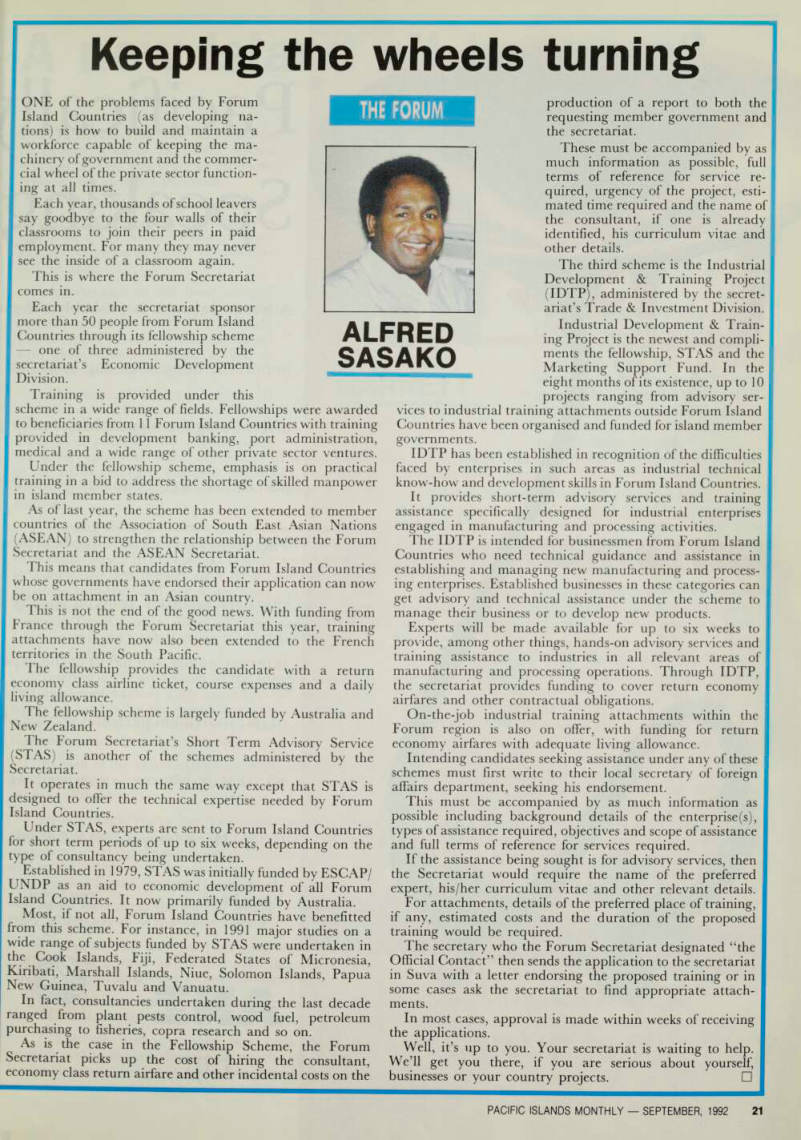
Alfred
Sasako
Advertisements & other items, p. 22 (1 item)
Pacifically
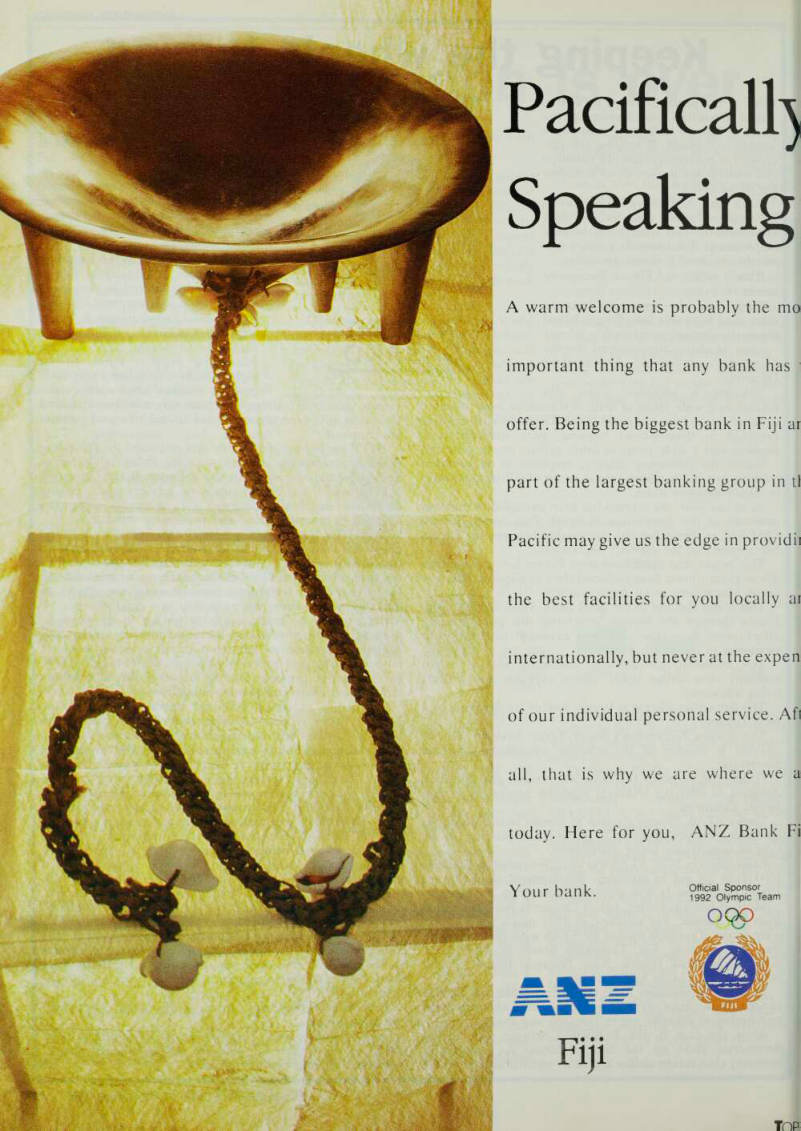
A warm welcome is probably the moi important thing that any bank has offer. Being the biggest bank in Fiji ar part of the largest banking group in tl Pacific may give us the edge in providii the best facilities for you locally ar internationally, but never at the expen of our individual personal service. Aft all, that is why we are where we ai today. Here for you, ANZ Bank Fi Your bank.
Official Sponsor 1992 Olympic Team AN
TOP
A new island oil bonanza?
PNG IS LIKELY to make ASI.3 billion in exports from of its newly opened Kutubu oil field this year; an economic bonanza by anyone’s standards.
In Sydney last month a conference of over 1000 petroleum geologists was told Tonga, Fiji, Vanuatu and Solomon Islands have good potential for commer cial oil finds.
A campaign to sell those nations’ prospects has been launched by the regional institution SOPAC (the South
Pacific Applied Geoscience Commission)
with glossy brochures being mailed to
crucial prospecting companies.
The potential for a new boom in oil exploration has been made possible by technological innovation. Although most areas with potential for commercially
viable oil exploration were checked out by oil companies in the 1970 s and early 80s, new technology has made it possible to see oil bearing structures invisible to older methods.
Opening the door to new exploration will require the resolution of remaining claims by companies holding old exploration leases. In Fiji that has already been done while in Tonga two new licences have been issued - one to a Japanese company and one to an American one. Those companies will be prospecting in the shallow water between Tonga’s main island of Tongatapu and Eua Island, and in the north between the Ha’apai and Vava’u groups of islands.
Interest in oil production in the island nations was first awakened back in 1968 when four oil seeps (areas where oil bubbles to the earth’s surface), were found on Tongatapu. Although these seeps are on land the reservoirs which feed them are offshore.
In each of the island nations currently thought to be good prospects commercial deposits would be found in shallow offshore areas.
In Fiji, Bligh Water has been confirmed as having underwater seeps, in Vanuatu the best possibilities lie in shallow water along the east coasts of Santo and Malekula and in the Solomons in four shallow basins including the Iron Bottom Sound, just off Guadalcanal.
In all these areas the seafloor would need to be less than 200 metres from the water surface.
With island oil and gas reservoirs expected to be relatively small, water any deeper than this would push already huge drilling costs to uneconomic levels.
While shallow water has its advantages for drilling it has big disadvantages for the environment.
It is usually near to sensitive coral reefs and fishing grounds and to the coastlines along which people live. It is also close to shore-based mangrove swamps and other
areas used as breeding grounds by many marine species.
In fact the environmental stakes in oil development are just as high as the financial stakes.
Oil spills, as we have seen from the Exxon Valdez disaster in Alaska, can spread their destructive ten tacles across hundreds of square kilometres.
The authority’s spokesperson, Craig Sambal, says worst case disas ters come not from tanker accidents but from oil rig blowouts. That’s when a fault develops with the valve system which controls the flow of oil, allowing pressure to build up and eventually explode. The result is an uncontrollable oil gush.
For small island nations this sort of problem presents
particular difficulties.
Neither the country nor oil company is likely to have the money to have a full range of containent equipment on hand. Flying it from overseas could lose valuable time and in many cases would be quite difficult with large booms and pumps having to be shipped from the nearest
big airport.
While blowouts are rare, other smaller problems are not. Marine life is highly sensitive to oil. As Craig Sambal puts it “if it comes in contact with with coral it’s ‘good
bye coral’”.
In Australia the Great Barrier Reef Marine Park Authority has been tackling the damage done by the tiny amounts of oil dumped out in the bilge water of commercial shipping. If this is having an impact the dangers associated with an oil rig are easy to see.
People reliant on nearby fishing grounds and their national governments are likely to face some difficult dilemmas when they come to decide just how far traditional rights over marine resources can be said to extend and what sort of compensation may be necessary.
Another problem is the integrity of oil companies. Of around 200 oil production companies working the world’s frontier areas, some industry sources suggest only 100 could be trusted to stick to legislation or agreements signed with partner governments. The better known and more reputable companies may be more willing to stick to agreements but will not hesitate to push for the most advantageous interpretation of any clean-up or safety requirements.
With each oil rig built taking time and sometimes hundreds of millions of dollars of investment to put in place, petroleum production is the big league.
Small countries would not be able to find the money necessary to mount a major clean up if a company fell short of the standards expected of it.
Australia
Jemima
Garrett
Advertisements & other items, p. 24 (1 item)
Printing Excellence
Four Basic Colours
YELLOW BLACK
Plus
Fiji Times Commercial Printing
«fss ill m
Equals
Printing Excellence
* & It is quite amazing what our experienced master printers, with the latest in printing technology, can produce from four basic colours.
Full colour packaging and food labels that look good enough to eat; award winning full colour brochures and posters: magazines, calendars, books, stickers, fabric labels and billboards with pictures that leap right out of the printed pages.
If your product requires export-quality, high impact four colour printing, then you should be talking to us first.
You’ll find our prices very competitive and our paper stock quite extensive.
FIJI TIMES
COMMERCIAL PRINTING DIVISION
Printing Excellence
HEAD OFFICE: 20 GORDON STREET, SUVA, FUI. PHONE: (679) 304111, FAX: 302011.
BRANCHES: LAUTOKA Phone: 660422 Fax: 660-352 LABASA Phone: 811644 Fax: 812649 NADI Phone: 780700 Fax; 780705
Who’s who at Lako Mai
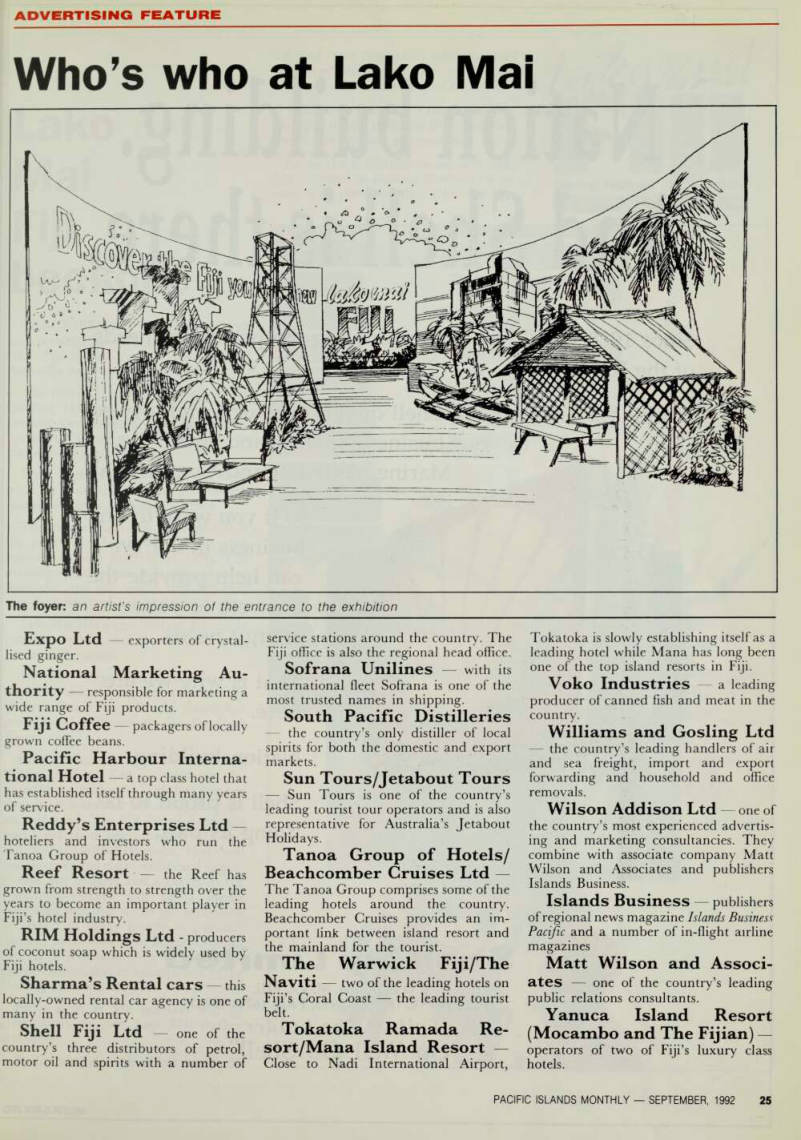
Advertising Feature
Expo Ltd exporters of crystal lised ginger.
National Marketing Au
thority responsible for marketing a
wide range of Fiji products.
Fiji Coffee packagers of locally grown coffee beans.
Pacific Harbour Interna tional Hotel a top class hotel that has established itself through many years of service.
Reddy’s Enterprises Ltd
hoteliers and investors who run the Tanoa Group of Hotels.
Reef Resort the Reef has grown from strength to strength over the years to become an important player in Fiji’s hotel industry.
RIM Holdings Ltd - producers of coconut soap which is widely used by Fiji hotels.
Sharma’s Rental cars this locally-owned rental car agency is one of many in the country.
Shell Fiji Ltd - one of the country’s three distributors of petrol, motor oil and spirits with a number of
service stations around the country. The Fiji office is also the regional head office.
Sofrana Unilines with its international fleet Sofrana is one of the most trusted names in shipping.
South Pacific Distilleries - the country’s only distiller of local spirits for both the domestic and export markets.
Sun Tours/Jetabout Tours Sun Tours is one of the country’s leading tourist tour operators and is also representative for Australia’s Jetabout Holidays.
Tanoa Group of Hotels/
Beachcomber Cruises Ltd The Tanoa Group comprises some of the leading hotels around the country.
Beachcomber Cruises provides an im portant link between island resort and the mainland for the tourist.
The Warwick Fiji/The Naviti two of the leading hotels on Fiji’s Coral Coast the leading tourist belt.
Tokatoka Ramada Re sort/Mana Island Resort Close to Nadi International Airport,
Tokatoka is slowly establishing itself as a leading hotel while Mana has long been one of the top island resorts in Fiji.
Voko Industries a leading producer of canned fish and meat in the country.
Williams and Gosling Ltd the country’s leading handlers of air and sea freight, import and export forwarding and household and office removals.
Wilson Addison Ltd one of the country’s most experienced advertis ing and marketing consultancies. They combine with associate company Matt Wilson and Associates and publishers Islands Business.
Islands Business publishers of regional news magazine Islands Business Pacific and a number of in-flight airline magazines Matt Wilson and Associ ates one of the country’s leading public relations consultants.
Yanuca Island Resort
(Mocambo and The Fijian)
operators of two of Fiji’s luxury class hotels.
The foyer: an artist’s impression of the entrance to the exhibition
Advertisements & other items, p. 26 (1 item)
Nation building.
And Shell is there.
Since 1928, Shell has been providing the petroleum needs of the Fiji Islands.
Offering a full range of Shell quality products and services to your businesses, large and small. In Marine, Aviation and Commercial.
So if you want to do business in Fiji, we can help provide the answers to your energy needs.
That is why we are here.
Nation building.
Shell is proud to be doing its part.
Shell Fiji Limited
P O BOX 168. SUVA. FIJI.
TELEPHONE: (679) 313933, FAX: (679) 302279
Follow The Leader "Go Well Go Shell"
GEORGE RUBINE 89*2
Fiji
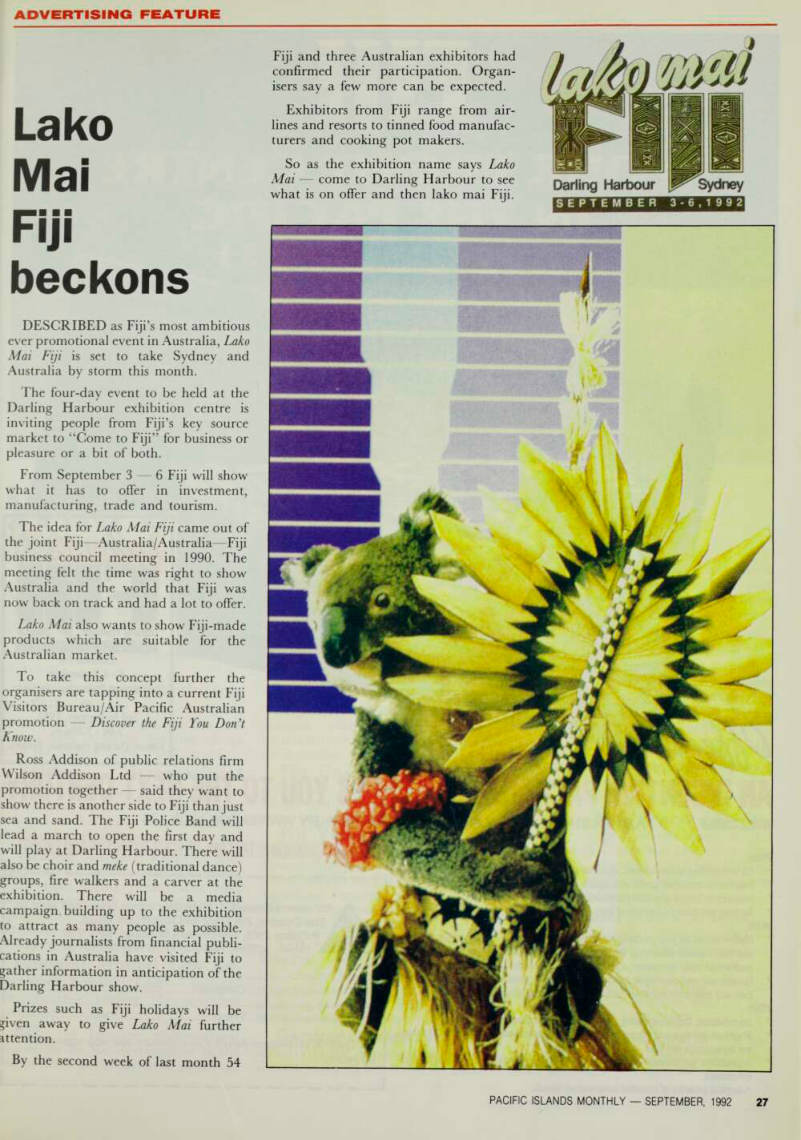
Lako Mai Fiji beckons
DESCRIBED as Fiji’s most ambitious ever promotional event in Australia, Lako Mai Fiji is set to take Sydney and Australia by storm this month.
The four-day event to be held at the Darling Harbour exhibition centre is
inviting people from Fiji’s key source
market to “Come to Fiji” for business or pleasure or a bit of both.
From September 3 6 Fiji will show what it has to offer in investment, manufacturing, trade and tourism.
The idea for Lako Mai Fiji came out of the joint Fiji —Australia/Australia —Fiji business council meeting in 1990. The meeting felt the time was right to show Australia and the world that Fiji was now back on track and had a lot to offer, Lako Mai also wants to show Fiji-made products which are suitable for the Australian market.
To take this concept further the organisers are tapping into a current Fiji Visitors Bureau/Air Pacific Australian promotion Discover the Fiji You Don't Know.
Ross Addison of public relations firm Wilson Addison Ltd who put the promotion together said they want to show there is another side to Fiji than just sea and sand. The Fiji Police Band will lead a march to open the first day and will play at Darling Harbour. There will also be choir and meke (traditional dance) groups, fire walkers and a carver at the exhibition. There will be a media campaign, building up to the exhibition to attract as many people as possible.
Already journalists from financial publi cations in Australia have visited Fiji to gather information in anticipation of the Darling Harbour show.
Prizes such as Fiji holidays will be ipven away to give Lako Mai further attention.
By the second week of last month 54
Fiji and three Australian exhibitors had confirmed their participation. Organ isers say a few more can be expected.
Exhibitors from Fiji range from air lines and resorts to tinned food manufac turers and cooking pot makers.
So as the exhibition name says Lako Mai — come to Darling Harbour to see what is on offer and then lako mai Fiji.
Advertisements & other items, p. 28 (1 item)
Your Profit Centre
IN THE PACIFIC
f-*. > < ■ ■ & * / I ft .-V ‘*r , * * r.* m 4 i - >»•%>■ v'V* P Darling Harbour Sy*iey mr. 3S£.^
Lakomai Fiji
3 - 6 September Investment Promotion Seminar on 3rd September, 1992. 2.00 - 7.00p.m.
Venue: Darling Harbour, Sydney.
AN INCENTIVE PACKAGE THAT TAKES YOU TO THE NEXT CENTURY
INCLUDES
• TAX HOLIDAY FOR 13 YEARS
PLUS
* No withholding tax on interest, dividend and royalty for 13 years. * Freedom to repatriate profits and capital. * Freedom to import specialist personnel. * Banking and financial services of international standard.
PLUS
* Market access for your products to U.SA, Canada, japan, E.E.C. Countries, Australia and New Zealand either duty-free or at substantially reduced duties under perferential trade agreements Fiji has with these countries. * Reliable and well-developed Infrastructure including good international air and sea links and telecommunications facilities such as 1.5. D., Telex, Fax, etc
PLUS
* An educated, English-speaking, easily trainable and cheaper labour force. * Minimum red tape and the services of one-stop government agency (F.T.1.8) to cut „ out bureaucratic red tape. * A consistent government economic policy favouring private enterprise and foreign investment. * A tropical paradise of beautiful sundrenched islands.
IMPORT DUTY WAIVER FOR 13 YEARS
THE ONLY CONDITION IS THAT 95% OF YOUR OUTPUT BE FOR EXPORT r For more information, fill in the coupon below and send to: The Director, Fiji Trade and Investment Board, P.0.80x 2303, Government Buildings, Suva, FIJI.
Phone: 315988, Telex. 2355 FJ, Fax: 301783, Suva, FIJI.
F Tl B
Name:
Title; Company:
Address: Phone: Telex: Fax: Fiji Trade & Investment Board, Government's one-stop agency for Investors.
L J
Who’s who at Lako Mai
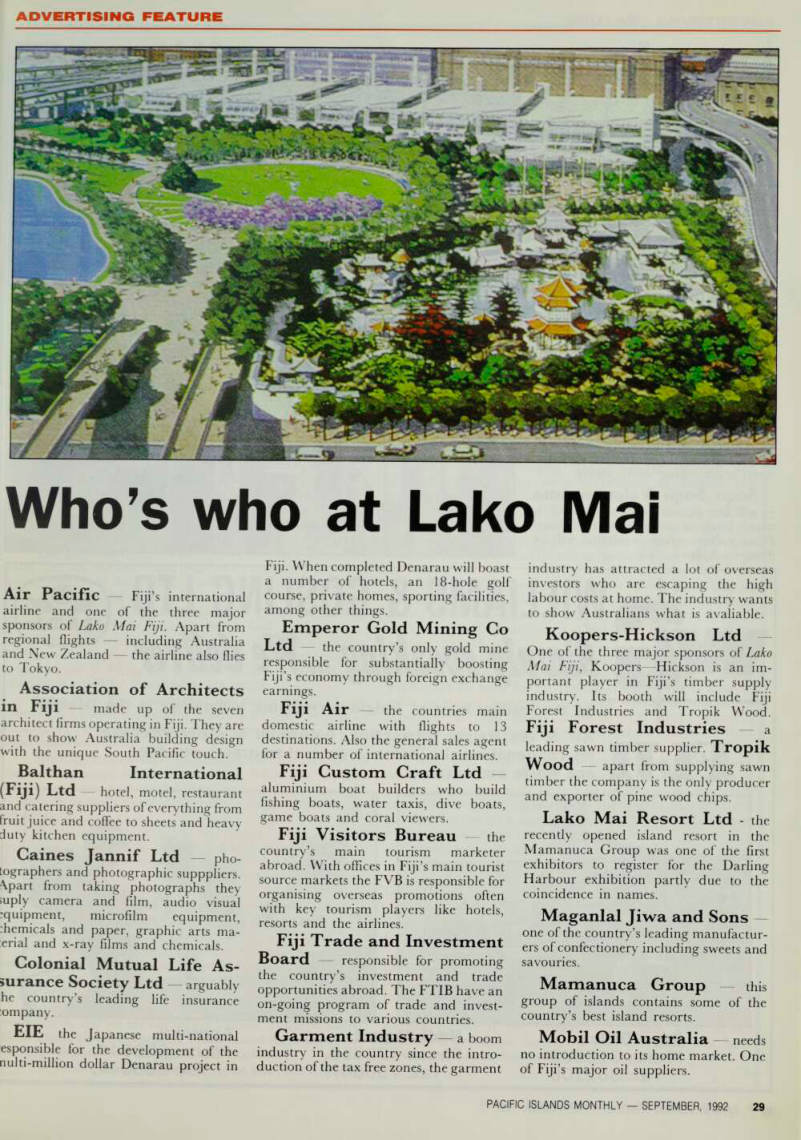
Air Pacific Fiji’s international airline and one of the three major sponsors of Lako Mai Fiji. Apart from regional flights including Australia and New Zealand the airline also flies to Tokyo. a • r a i • . Associauon of Architects in rljl made up of the seven architect firms operating in Fiji. They are out to show Australia building design with the unique South Pacific Touch
Balthan International
(Fiji) Ltd hotel motel restaurant V AjAy liiu iiuiei, rnotei, restaurant and catering suppliers of everything from fruit juice and coffee to sheets and heavy duty kitchen equipment.
Caines Jannif Ltd h fnmnhm and nhnfnrrronKm o c °" \pan from taking they ;uply camera and film, audio visual ■quipment, microfilm equipment, chemicals and paper, graphic arts maers! and x-ray films and chemicals.
Colonial Mutual Life As-
iurance Society Ltd arguably
tie country s leading life insurance ompany.
EIE the Japanese multi-national esponsible for the development of the nulti-million dollar Denarau project in
Fiji. When completed Denarau will boast a number of hotels, an 18-hole golf course, private homes, sporting facilities, among other things.
Emperor Gold Mining Co
I +A f . , ■ *** thc count [Y s onl Y g°l d mme
responsible for substantially boosting
Fiji s economy through foreign exchange
earnings. Fiji Air the countries main domestic airline with flights to 13 destinations. Also the general sales agent for a number of international airlines.
Fiji Custom Craft Ltd aluminium boat builders who build , . , . . . , ds h ln g boats, water taxis, dive boats, game and coral viewers.
Fiji Visitors Bureau the country’s main tourism marketer abroad. With offices in Fiji’s main tourist sourc e markets the FVB is responsible for or g ani , sm g overseas promotions often
"tts a^ ’
-j,... , T
U 1 I ra.de and Investment
Boar( * responsible for promoting on-going program of trade and investment missions to various countries.
Garment Industry a boom industry in the country since the introduction of the tax free zones, the garment
industry has attracted a lot of overseas investors who are escaping the high labour costs at home. The industry wants to show Australians what is avaliable.
Knnnpr« RiVkcnn TtA
xVOOpers-rIICKSOn Ltd
One of the three major sponsors of Lako Mai Fiji , Koopers—Hickson is an im portant player in Fiji’s timber supply industry. Its booth will include Fiji Forest Industries and Tropik Wood.
Fiji Forest Industries a i .• • ,
“g sawn tlmbe ' suppher. Tropik
Wood , a P art from supplying sawn timber the company is the only producer and exporter of pine wood chips, .
Lako Mai Resort Ltd - the recently opened island resort in the Mamanuca Group was one of the first exhibitors to register for the Darling Harbour exhibition partly due to the coincidence m names.
Maganlal Jiwa and Sons
one of the country’s leading manufactur ers of confectionery including sweets and savouries.
M.manuc. Group - ,hi.
S rou P of islands contains some of the country s best island resorts.
Mobil Oil Australia needs no introduction to its home market. One of Fiji’s major oil suppliers.
Advertisements & other items, p. 29 (1 item)
Advertising Feature
Ftib Subsidised
Booths:
Broadway Mufflers
manufacturers of double wrapped aluminised mufflers which they fit while you wait. They also manufacture com plete exhaust systems for all make and model cars.
C. Prasad Exports export ers of local shell jewellery and handi crafts.
Domalco manufacturers and exporters of aluminium utensils, stainless steel utensils and pressure cookers.
Government Handicraft retailer of authentic local handicrafts.
Pacific Green this company produces some very fine furniture from coconut trees. It says it is the first company in the world to master the technique of working with coconut and are not giving the secret away the result is something worth seeing.
Soqo Soqo Vakamarama
a Fijian women’s group one of its many facets is to promote traditional Fijian culture which is what it will be
doing in Sydney.
Advertisements & other items, p. 30 (2 items)
Advertising Feature
Simply speaking... We deliver
ATA
FIJI
WILLIAMS & GOSLING LTD.
Simply speaking... We deliver
At the leading edge of freight forwarding technology in the islands.
Air & sea freight forwarding, household & office removals international courier, heavy & general transport, storage and waste management. i , Suva Office Phone: 312633.
Fax: 302106.
Nadi Airport Phone: 722855.
Fax: 790047.
Lautoka Phone: 660644.
Fax: 665844.
The silly games we play
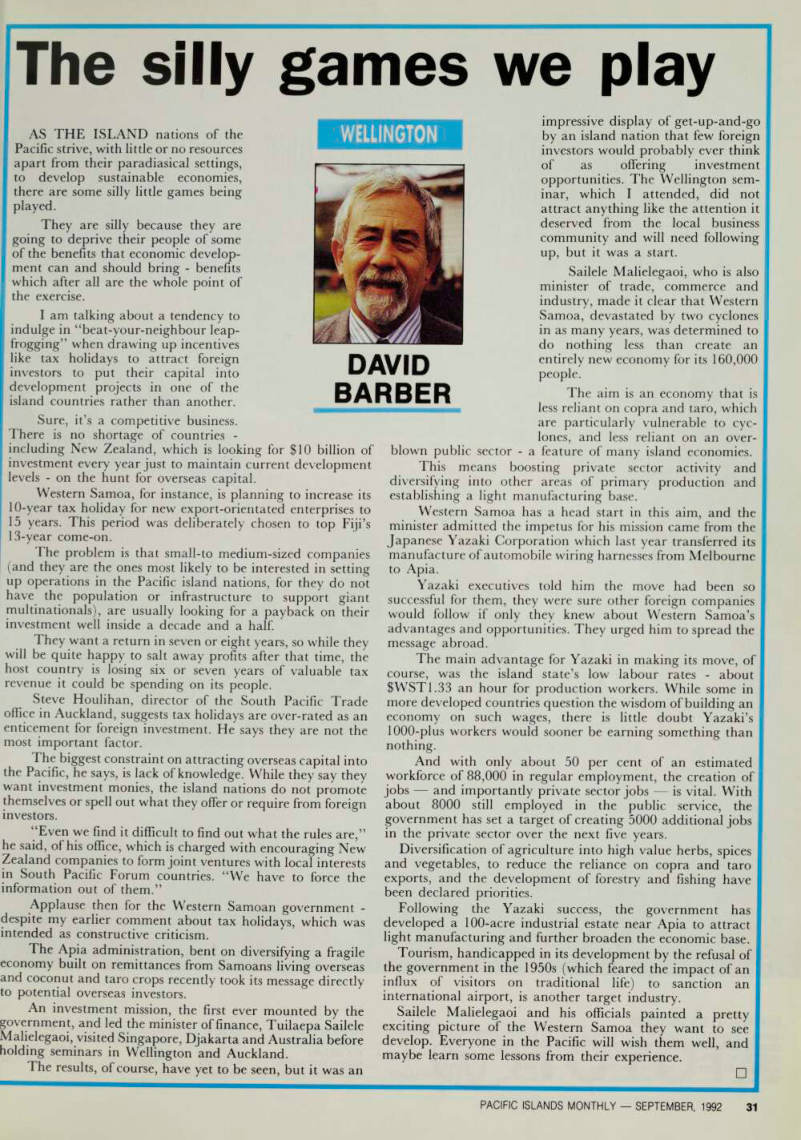
AS THE ISLAND nations of the Pacific strive, with little or no resources apart from their paradiasical settings, to develop sustainable economies, there are some silly little games being played.
They are silly because they are going to deprive their people of some of the benefits that economic develop ment can and should bring - benefits which after all are the whole point of the exercise.
I am talking about a tendency to
indulge in “beat-your-neighbour leap
frogging” when drawing up incentives like tax holidays to attract foreign investors to put their capital into development projects in one of the island countries rather than another.
Sure, it’s a competitive business.
There is no shortage of countries -
including New Zealand, which is looking for $lO billion of investment every year just to maintain current development levels - on the hunt for overseas capital.
Western Samoa, for instance, is planning to increase its 10-year tax holiday for new export-orientated enterprises to 15 years. This period was deliberately chosen to top Fiji’s 13-year come-on.
The problem is that small-to medium-sized companies (and they are the ones most likely to be interested in setting up operations in the Pacific island nations, for they do not have the population or infrastructure to support giant multinationals), are usually looking for a payback on their investment well inside a decade and a half.
They want a return in seven or eight years, so while they will be quite happy to salt away profits after that time, the host country is losing six or seven years of valuable tax revenue it could be spending on its people.
Steve Houlihan, director of the South Pacific Trade office in Auckland, suggests tax holidays are over-rated as an enticement for foreign investment. He says they are not the most important factor.
The biggest constraint on attracting overseas capital into the Pacific, he says, is lack of knowledge. While they say they want investment monies, the island nations do not promote themselves or spell out what they offer or require from foreign investors.
“Even we find it difficult to find out what the rules are,” he said, of his office, which is charged with encouraging New Zealand companies to form joint ventures with local interests in South Pacific Forum countries. “We have to force the information out of them.”
Applause then for the Western Samoan government despite my earlier comment about tax holidays, which was intended as constructive criticism.
The Apia administration, bent on diversifying a fragile economy built on remittances from Samoans living overseas and coconut and taro crops recently took its message directly to potential overseas investors.
An investment mission, the first ever mounted by the government, and led the minister of finance, Tuilaepa Sailele Malielegaoi, visited Singapore, Djakarta and Australia before holding seminars in Wellington and Auckland.
The results, of course, have yet to be seen, but it was an
impressive display of get-up-and-go by an island nation that few foreign investors would probably ever think of as offering investment opportunities. The Wellington sem inar, which I attended, did not attract anything like the attention it deserved from the local business community and will need following up, but it was a start.
Sailele Malielegaoi, who is also minister of trade, commerce and industry, made it clear that Western Samoa, devastated by two cyclones in as many years, was determined to do nothing less than create an entirely new economy for its 160,000 people.
The aim is an economy that is less reliant on copra and taro, which are particularly vulnerable to cyc lones, and less reliant on an over
blown public sector - a feature of many island economies.
This means boosting private sector activity and diversifying into other areas of primary production and establishing a light manufacturing base.
Western Samoa has a head start in this aim, and the minister admitted the impetus for his mission came from the Japanese Yazaki Corporation which last year transferred its manufacture of automobile wiring harnesses from Melbourne
to Apia.
Yazaki executives told him the move had been so successful for them, they were sure other foreign companies would follow if only they knew about Western Samoa’s advantages and opportunities. They urged him to spread the message abroad.
The main advantage for Yazaki in making its move, of course, was the island state’s low labour rates - about SWSTI.33 an hour for production workers. While some in more developed countries question the wisdom of building an economy on such wages, there is little doubt Yazaki’s 1000-plus workers would sooner be earning something than nothing.
And with only about 50 per cent of an estimated workforce of 88,000 in regular employment, the creation of jobs and importantly private sector jobs is vital. With about 8000 still employed in the public service, the government has set a target of creating 5000 additional jobs in the private sector over the next five years.
Diversification of agriculture into high value herbs, spices and vegetables, to reduce the reliance on copra and taro exports, and the development of forestry and fishing have been declared priorities.
Following the Yazaki success, the government has developed a 100-acre industrial estate near Apia to attract light manufacturing and further broaden the economic base.
Tourism, handicapped in its development by the refusal of the government in the 1950 s (which feared the impact of an influx of visitors on traditional life) to sanction an international airport, is another target industry.
Sailele Malielegaoi and his officials painted a pretty exciting picture of the Western Samoa they want to see ; develop. Everyone in the Pacific will wish them well, and maybe learn some lessons from their experience.
Wellington
David
Barber
Advertisements & other items, pp. 32-33 (1 item)
Distributors/Dealers
WITH i ROOMY OTA Vf 9 Creating a highly efficient, dynamic-looking car wou n 1111 il lIUUMI uLI/illi . be simple if it weren’t for one complicating detail; t passengers that must ride in it. Accommodating people comfortably in a pleasant, rooi interior usually means a certain amount of aerodynamic potential has to be sacrific fl %9S Exact features and specifications may vary depending on country of purchase. Please check with your nearest TOYOTA distributor/dealer for details.
AMERICAN SAMOA BURNS PHILP (S.S.) CO. LTD. PH 633-4281 GUAM & MICRONESIA... ATKINS KROLL. INC. PH 646-1876/9 NORFOLK ISLANDS BORRY’S PTY LTD. PH 2114
SOLOMON ISLANDS MENDANA MOTORS PH 30314
VANUATU VANUATU MOTORS PH 22341
COOK ISLANDS PACIFIC MOTORS LTD.
KIRIBATI TARAWA MOTORS
PAPUA NEW GUINEA .. ELA MOTORS
TAHITI NIPPON AUTOMOTO
WESTERN SAMOA BURNS PHILP (S.S.) CO. LTD.
PH 20796 PH 21090 PH 217036 PH 429819 PH 20800
FIJI ASCO MOTORS
NEW CALEDONIA .. .S.I.A.P.
SAIPAN MICROL CORPORATION)
TONGA BURNS PHILP (TONGM
! NEW COROLLA DOES IT DEfflFEIJI^'^'S:,^
igement, Toyota engineers were able to realize an efficient, wedge-shaped design ' at same time perfecting the alignment between body panels and components.
Durse our own innovative style of civilized leering makes sure that none of this comes e expense of the luxurious, leg-stretching interior. Because we realize that even a 0.33 5 useless if no one wants to drive the car.
® TOYOTA
Cashingin
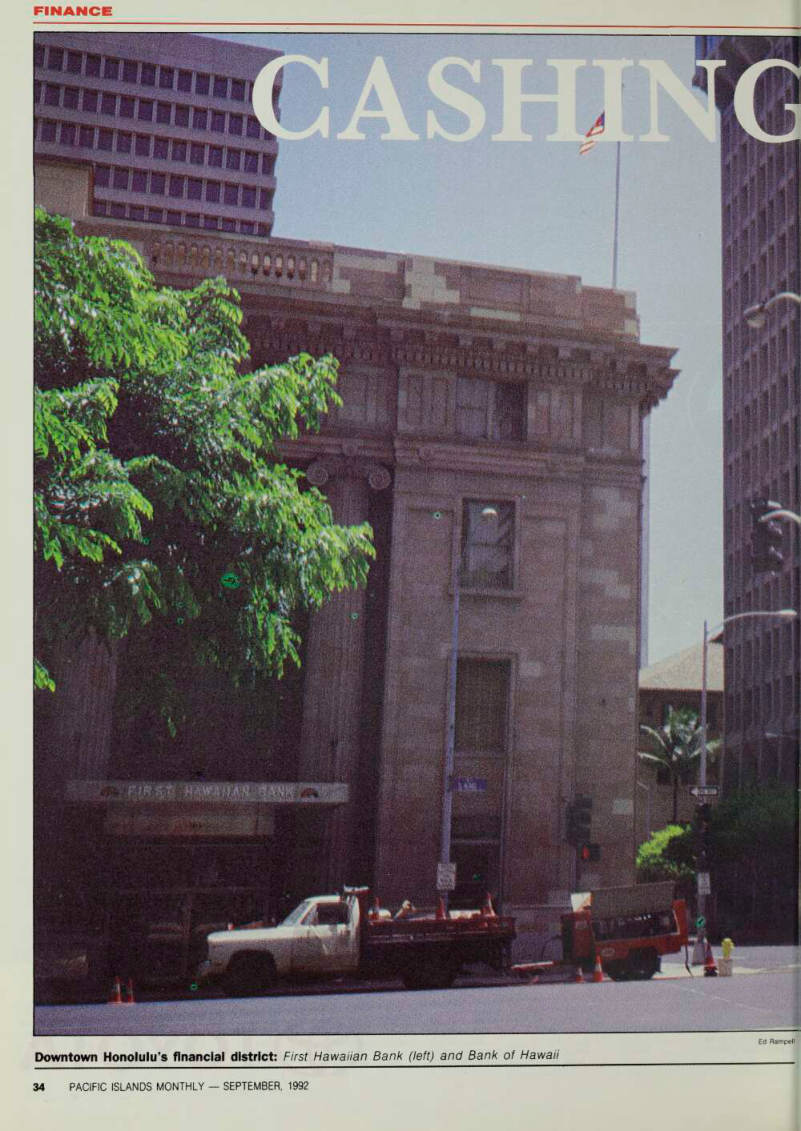
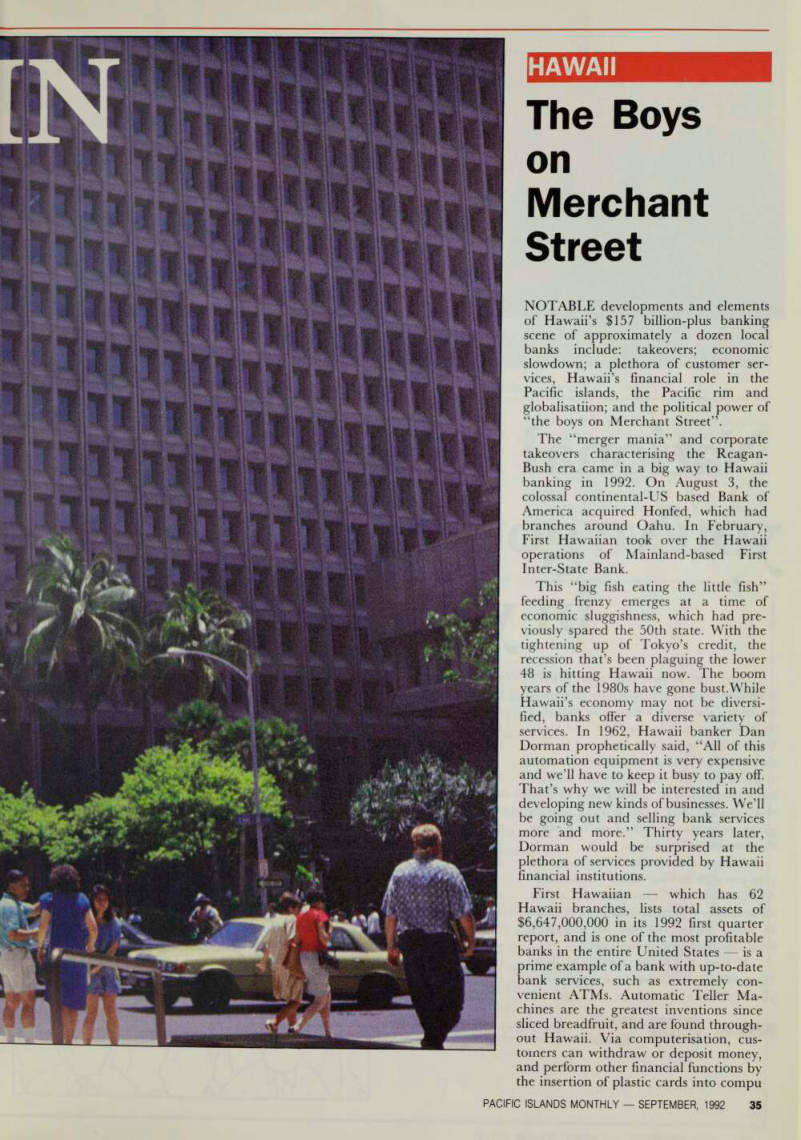

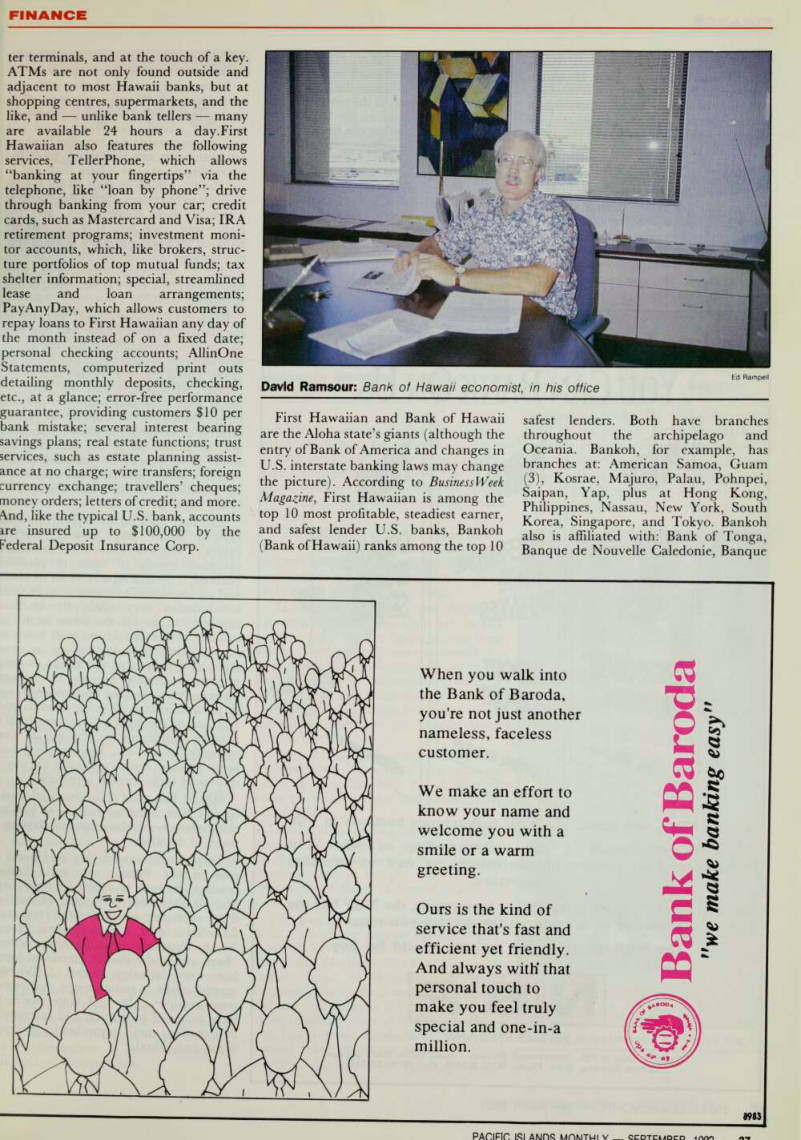
Finance
Ed Rampell
Downtown Honolulu’s financial district: First Hawaiian Bank (left) and Bank of Hawaii
Hawaii
The Boys on Merchant Street
NOTABLE developments and elements of Hawaii’s $157 billion-plus banking scene of approximately a dozen local banks include: takeovers; economic slowdown; a plethora of customer ser vices, Hawaii’s financial role in the Pacific islands, the Pacific rim and globalisatiion; and the political power of “the boys on Merchant Street”.
The “merger mania” and corporate
takeovers characterising the Reagan-
Bush era came in a big way to Hawaii banking in 1992. On August 3, the colossal continental-US based Bank of America acquired Honfed, which had branches around Oahu. In February, First Hawaiian took over the Hawaii operations of Mainland-based First Inter-State Bank.
This “big fish eating the little fish” feeding frenzy emerges at a time of economic sluggishness, which had pre viously spared the 50th state. With the tightening up of Tokyo’s credit, the recession that’s been plaguing the lower 48 is hitting Hawaii now. The boom years of the 1980 s have gone bust. While Hawaii’s economy may not be diversi fied, banks offer a diverse variety of services. In 1962, Hawaii banker Dan Dorman prophetically said, “All of this automation equipment is very expensive and we’ll have to keep it busy to pay off.
That’s why we v/ill be interested in and developing new kinds of businesses. We’ll be going out and selling bank services more and more.” Thirty years later, Dorman would be surprised at the plethora of services provided by Hawaii financial institutions.
First Hawaiian which has 62 Hawaii branches, lists total assets of $6,647,000,000 in its 1992 first quarter report, and is one of the most profitable banks in the entire United States is a prime example of a bank with up-to-date bank services, such as extremely con venient ATMs. Automatic Teller Ma chines are the greatest inventions since sliced breadfruit, and are found through out Hawaii. Via computerisation, cus tomers can withdraw or deposit money, and perform other financial functions by the insertion of plastic cards into compu
ter terminals, and at the touch of a key.
ATMs are not only found outside and adjacent to most Hawaii banks, but at shopping centres, supermarkets, and the like, and unlike bank tellers many are available 24 hours a day. First Hawaiian also features the following services, Teller Phone, which allows “banking at your fingertips” via the telephone, like “loan by phone”; drive through banking from your car; credit cards, such as Mastercard and Visa; IRA retirement programs; investment moni tor accounts, which, like brokers, struc ture portfolios of top mutual funds; tax shelter information; special, streamlined lease and loan arrangements; PayAnyDay, which allows customers to repay loans to First Hawaiian any day of the month instead of on a fixed date; personal checking accounts; Allin One Statements, computerized print outs
detailing monthly deposits, checking,
etc., at a glance; error-free performance guarantee, providing customers $lO per bank mistake; several interest bearing savings plans; real estate functions; trust services, such as estate planning assist ance at no charge; wire transfers; foreign
currency exchange; travellers’ cheques;
money orders; letters of credit; and more, like the typical U.S. bank, accounts ire insured up to $lOO,OOO by the
Federal Deposit Insurance Corp.
First Hawaiian and Bank of Hawaii are the Aloha state’s giants (although the entry of Bank of America and changes in U.S. interstate banking laws may change the picture). According to Business Week Magazine, First Hawaiian is among the top 10 most profitable, steadiest earner, and safest lender U.S. banks, Bankoh (Bank of Hawaii) ranks among the top 10
safest lenders. Both have branches throughout the archipelago and Oceania. Bankoh, for example, has branches at: American Samoa, Guam (3), Kosrae, Majuro, Palau, Pohnpei, Saipan, Yap, plus at Hong Kong, Philippines, Nassau, New York, South Korea, Singapore, and Tokyo. Bankoh also is affiliated with: Bank of Tonga, Banque de Nouvelle Caledonie, Banque
David Ramsour: Bank of Hawaii economist, in his office
Ed Rampell
de Tahiti, Pacific Commercial Bank, Ltd., Western Samoa. First Hawaiian has two Guam branches, a Tokyo office, and, like Bankoh’s Nassau operation, a foreign branch at the Caymans for offshore banking for tax haven purposes.
Are all of the services listed above available at the Pacific island branches?
David Ramsour senior vice president and chief economist of Bankoh candidly says: “What you are really talking about in the Pacific islands quite often is like trying to run a restaurant of major proportions in a community of 100 people. There is simply no way you can support more than one restaurant, and even that one tends to be relatively
expensive on a per customer basis. So the result is, in most instances in the Pacific islands, you have no more than one bank, or maybe two banks at the most, that can survive and pay staff on the basis of the amount of business that can be generated in that community. This means also that per customer charges tend to be higher and those aspects of banking in a small community always seem to be more of an issue for the clients in a small community than they are in larger communities.”
The economist adds that Bankoh’s Pacific island branches are “not profit able in the same sense a bank operation in a large community such as in this state may be ... The basis, the justification for
those operations in these'small communi ties are the relationships that participants in those communities have with the marketplace in Hawaii or some other part of the Pacific. The service we prefer to offer ... really revolves around our capacity to provide a network of banking establishments and facilities to serve the customer, no matter where they are in the Pacific. I think on their own it’s quite difficult to operate a stand alone bank in many of these communities, and the basic way you are able to provide banking services is justified on the basis of a broader marketplace that ties in with trade or financial transactions with another part of the Pacific, Asia, or the mainland USA.”
Bankoh’s Ramsour states: “Very few of the banks in Hawaii have had any role within the development, uh, the resort development process of the last five to six years. This is due to a number of reasons, primary of which is that the Japanese banks were able and willing to provide larger amounts of capital at lower interest rates than the local institutions and so almost all of the financing for resort development by Japanese of the past five to six years have been provided by Japanese financial institutions and that’s where it remains.”
Ramsour goes on to explain the role Hawaii banks play vis-a-vis foreign capital: “When a Japanese or Australian company comes to town to conduct business, it needs a repository for its funds and an institution to transfer funds. And we function very effectively in that capacity, as do all the other banks in town. The foreign investor in town is simply using these institutions as con duits, and holders of the assets, as they prepare to develop projects or conduct business in one fashion or another, so we do see the coming and going of funds into and out of the banks. But there hasn’t been a fundamental change in our capacity to perform business that has been affected significantly by the con ditions of these foreign investors.”
Hence, Hawaii’s main financial insti tutions play a passive role at best as middleman in the economic develop ment of the state.
Despite constant braying on Hawaii’s role in the Pacific rim and Pacific century, the local bourgeoisie’s insularity and passivity has prevented Honolulu
from emerging as a dynamic regional
financial center, as an Oceania Hong Kong. Ramsour says Bankoh focuses “here and in the Pacific islands on local borrowers, industry, clients ... We do extend credit to some groups that come from outside ... By and large, we’re a local financial institution and interested in extending credit to productive groups, firms, individuals.
Advertisements & other items, pp. 36-38 (2 items)
With
National MBf Master Card
you’ve got the whole world
in your hands.
Now, for the first time ever, there’s
a unique credit card specially designed
for today’s modern Fijian. The National MBf Master Card is the First and Only
Fiji Dollar Credit Card accepted locally
and at over 9 million outlets worldwide.
It gives you Revolving Credit, so you have the option of settling just 10% of the amount due each month which gives you the option of saving your finances for other things.
And as a Cash Card, it obviously gets you cash at over 80,000 Master Card 8 ATMS worldwide. Plus Cash on Card at all branches of National Bank of Fiji and at more than 100,000 Master Card locations throughout the world.
If you hold the National MBf Master Card, we know how impressive your financial status is and so National MBf Master Card is issued by National MBf Finance (Fiji) Ltd. in conjunction with National Bank of Fiji under the affiliate licence of MBf Card Services Sdn. Bhd. from Master Card International Inc. To apply call 302232 or pick-up an application form at any branch of National Bank of Fiji.
mmm [rurra
you automatically enjoy preferential
treatment when you apply for a Current Account with The National Bank of Fiji.
They will also give you Refinancing
Facilities.
When you travel, National MBf Master Card provides you with a high value Insurance Plan for Travel Accident and Travel Inconveniences.
National MBf Master Card also gives you Travel Assistance through Master Assist™ 24 hours a day, every day of the year.
The Master Assist™ programme will help you in many kinds of
emergencies: legal and medical
referrals, medical repatriation, emergency assistance, lost document, luggage retrieval assistance and emergency cash.
This is just a glimpse of the benefits from National MBf Master Card. There’s no reason now to feel second best.
Apply for The First Fiji Dollar Credit Card today, and you’ve got the whole world in your hands.
NATIONAL BANK OF FIJI
(Ml
lillh (ill
inmiimmuu
s«iit||gisa aaei
■ mm H> it -«• *z
National
MBf Master Card.
When you walk into the Bank of Baroda, you’re not just another nameless, faceless customer.
We make an effort to know your name and welcome you with a smile or a warm greeting.
Ours is the kind of service that’s fast and efficient yet friendly.
And always with that personal touch to make you feel truly special and one-in-a million. © 8983
we make banking easy
If Its International Services
You Can Bank On Us.
As Fiji’s own bank, the NBF understands business in Fiji.
And that means a full understanding of what Fiji businessmen require internationally as well as overseas investors.
If it involves export, import, or investment, the NBF has the expertise to provide all the service you require.
The NBF, covering Fiji and the World for you.
NBF
FIJI’S OWN BANK
National Bank of Fiji, International Division - Head Office Trade Service Sabrina Building, Suva. Phone: (679) 311999. Fax: (679) 303217
Finance
37
PAHIFin ISI AND.Q MnMTI-ll V CCDTCUDCO moo
Competing
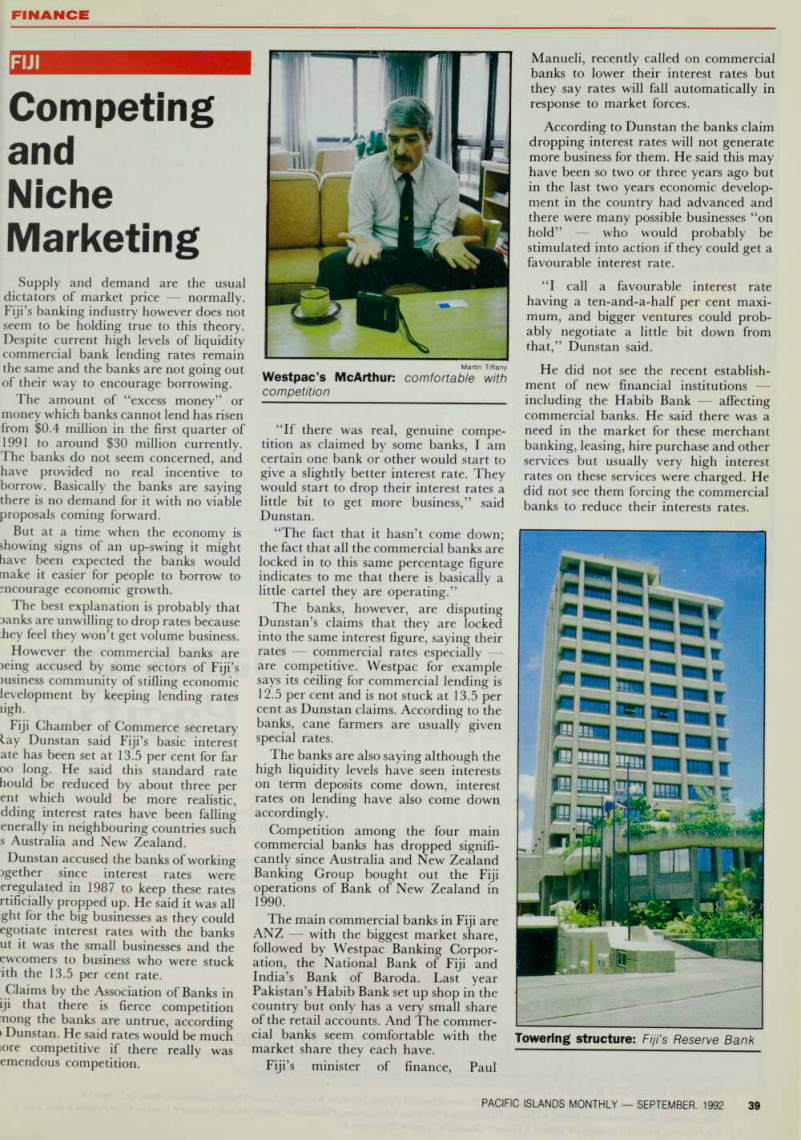
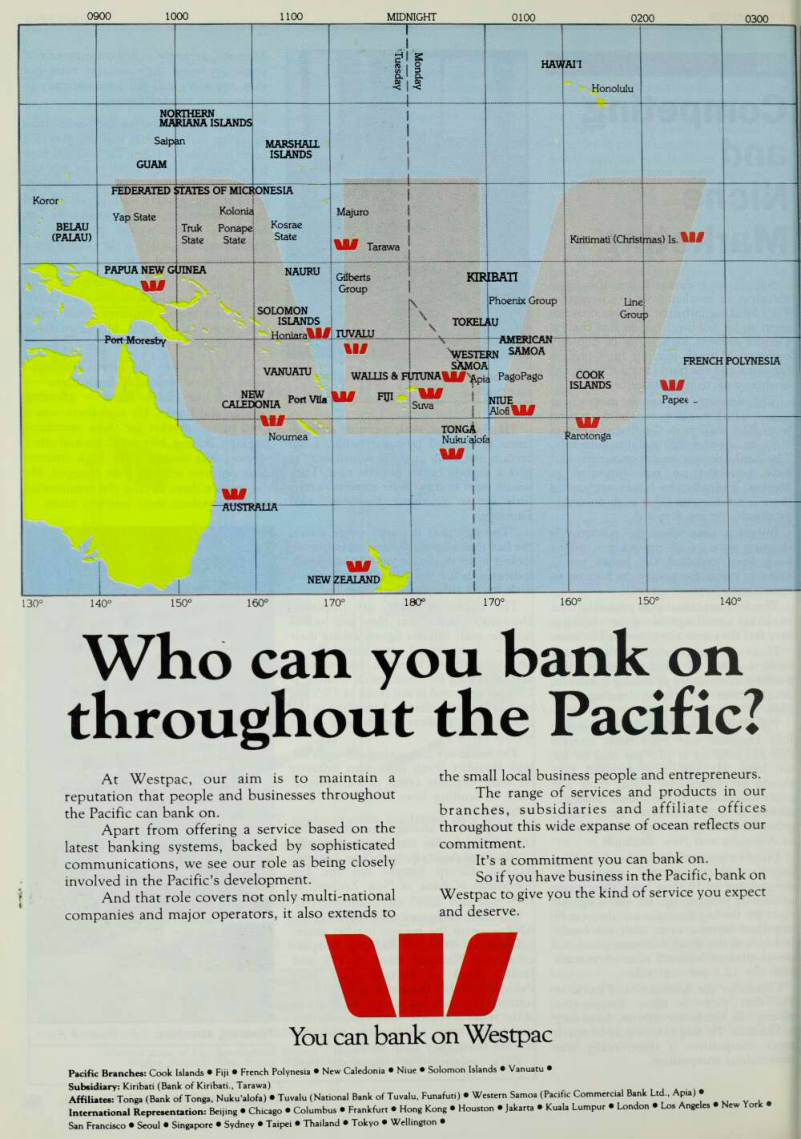
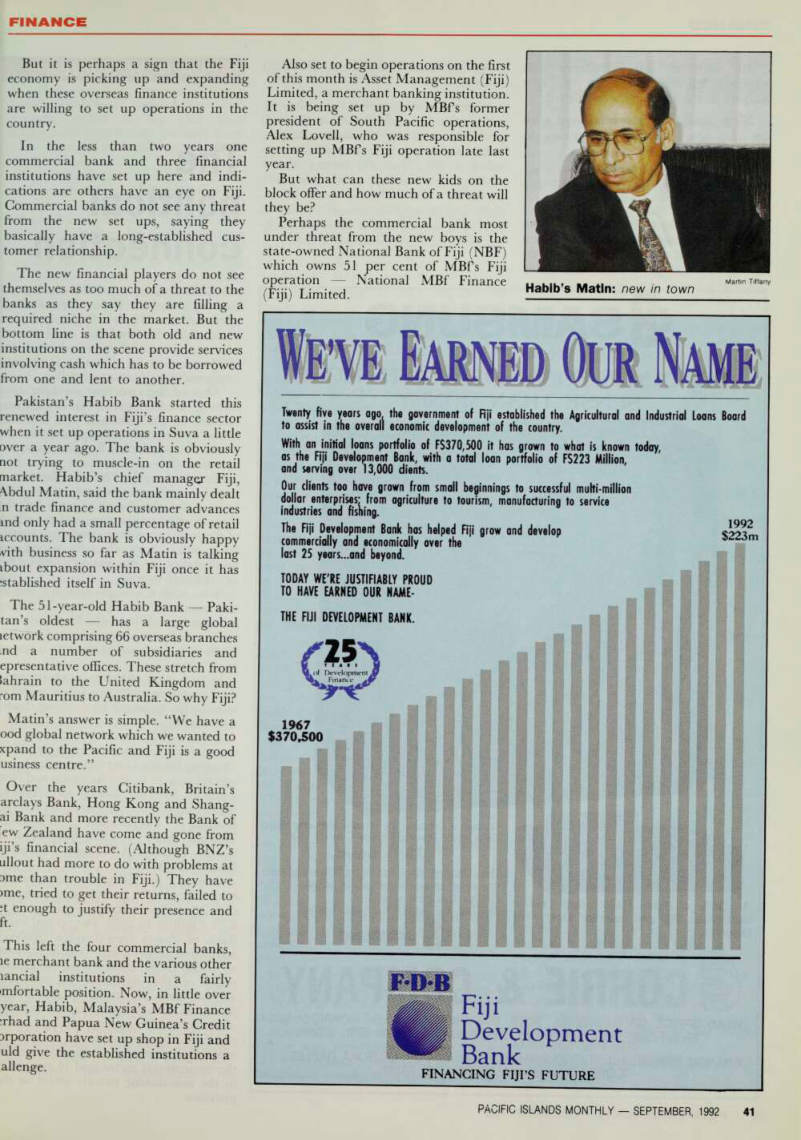

Fiji
Competing and Niche Marketing
Supply and demand are the usual dictators of market price normally.
Fiji’s banking industry however does not seem to be holding true to this theory.
Despite current high levels of liquidity commercial bank lending rates remain the same and the banks are not going out of their way to encourage borrowing.
The amount of “excess money” or money which banks cannot lend has risen from 50.4 million in the first quarter of 1991 to around S3O million currently.
The banks do not seem concerned, and have provided no real incentive to borrow. Basically the banks are saying there is no demand for it with no viable
proposals coming forward.
But at a time when the economy is showing signs of an up-swing it might have been expected the banks would make it easier for people to borrow to encourage economic growth.
The best explanation is probably that Danks are unwilling to drop rates because hey feel they won’t get volume business.
However the commercial banks are )eing accused by some sectors of Fiji’s
)usiness community of stifling economic
levelopment by keeping lending rates
ligh.
Fiji Chamber of Commerce secretary lay Dunstan said Fiji’s basic interest ate has been set at 13.5 per cent for far oo long. He said this standard rate hould be reduced by about three per ent which would be more realistic, dding interest rates have been falling enerally in neighbouring countries such s Australia and New Zealand.
Dunstan accused the banks of working sgether since interest rates were eregulated in 1987 to keep these rates rtificially propped up. He said it was all ght for the big businesses as they could egotiate interest rates with the banks ut it was the small businesses and the ewcomers to business who were stuck ith the 13.5 per cent rate.
Claims by the Association of Banks in iji that there is fierce competition mong the banks are untrue, according ► Dunstan. He said rates would be much ore competitive if there really was emendous competition.
“If there was real, genuine compe tition as claimed by some banks, I am certain one bank or other would start to give a slightly better interest rate. They would start to drop their interest rates a little bit to get more business,” said Dunstan.
“The fact that it hasn’t come down; the fact that all the commercial banks are locked in to this same percentage figure indicates to me that there is basically a little cartel they are operating.”
The banks, however, are disputing Dunstan’s claims that they are locked into the same interest figure, saying their rates commercial rates especially are competitive. Westpac for example says its ceiling for commercial lending is 12.5 per cent and is not stuck at 13.5 per cent as Dunstan claims. According to the banks, cane farmers are usually given special rates.
The banks are also saying although the high liquidity levels have seen interests on term deposits come down, interest rates on lending have also come down
accordingly.
Competition among the four main commercial banks has dropped signifi cantly since Australia and New Zealand
Banking Group bought out the Fiji
operations of Bank of New Zealand in 1990.
The main commercial banks in Fiji are ANZ with the biggest market share,
followed by Westpac Banking Corpor
ation, the National Bank of Fiji and India’s Bank of Baroda. Last year Pakistan’s Habib Bank set up shop in the country but only has a very small share of the retail accounts. And The commer cial banks seem comfortable with the market share they each have.
Fiji’s minister of finance, Paul
Manueli, recently called on commercial banks to lower their interest rates but they say rates will fall automatically in response to market forces.
According to Dunstan the banks claim dropping interest rates will not generate more business for them. He said this may have been so two or three years ago but in the last two years economic develop ment in the country had advanced and there were many possible businesses “on hold” who would probably be stimulated into action if they could get a favourable interest rate.
“I call a favourable interest rate having a ten-and-a-half per cent maxi mum, and bigger ventures could prob ably negotiate a little bit down from that,” Dunstan said.
He did not see the recent establish ment of new financial institutions including the Habib Bank affecting commercial banks. He said there was a need in the market for these merchant banking, leasing, hire purchase and other services but usually very high interest rates on these services were charged. He did not see them forcing the commercial banks to reduce their interests rates.
Martin Tiffany Westpac’s McArthur: comfortable with competition
Towering structure: Fiji's Reserve Bank
But it is perhaps a sign that the Fiji economy is picking up and expanding when these overseas finance institutions are willing to set up operations in the country.
In the less than two years one commercial bank and three financial institutions have set up here and indi cations are others have an eye on Fiji.
Commercial banks do not see any threat from the new set ups, saying they basically have a long-established cus tomer relationship.
The new financial players do not see themselves as too much of a threat to the banks as they say they are filling a required niche in the market. But the bottom line is that both old and new institutions on the scene provide services involving cash which has to be borrowed from one and lent to another.
Pakistan’s Habib Bank started this renewed interest in Fiji’s finance sector when it set up operations in Suva a little over a year ago. The bank is obviously not trying to muscle-in on the retail market. Habib’s chief manager Fiji, Matin, said the bank mainly dealt n trade finance and customer advances md only had a small percentage of retail iccounts. The bank is obviously happy vith business so far as Matin is talking ibout expansion within Fiji once it has established itself in Suva.
The 51 -year-old Habib Bank Paki tan’s oldest has a large global letwork comprising 66 overseas branches nd a number of subsidiaries and epresentative offices. These stretch from Bahrain to the United Kingdom and "om Mauritius to Australia. So why Fiji?
Matin’s answer is simple. “We have a ood global network which we wanted to xpand to the Pacific and Fiji is a good usiness centre.”
Over the years Citibank, Britain’s
arclays Bank, Hong Kong and Shang
ai Bank and more recently the Bank of ew Zealand have come and gone from iji’s financial scene. (Although BNZ’s allout had more to do with problems at 3me than trouble in Fiji.) They have >me, tried to get their returns, failed to ?t enough to justify their presence and ft.
This left the four commercial banks, le merchant bank and the various other lancial institutions in a fairly imfortable position. Now, in little over year, Habib, Malaysia’s MBf Finance Thad and Papua New Guinea’s Credit Drporation have set up shop in Fiji and uld give the established institutions a
allenge.
Also set to begin operations on the first of this month is Asset Management (Fiji) Limited, a merchant banking institution.
It is being set up by MBfs former president of South Pacific operations, Alex Lovell, who was responsible for setting up MBfs Fiji operation late last year.
But what can these new kids on the block offer and how much of a threat will they be?
Perhaps the commercial bank most under threat from the new boys is the state-owned National Bank of Fiji (NBF) which owns 51 per cent of MBfs Fiji operation National MBf Finance (Fiji) Limited.
Martin Tiffany Habib's Matin: new in town
So, with all this confidence and expected growth where do the new players in the financial scene fit in?
Niche marketing is a term used a lot by the new financial institutions to explain why they are in Fiji.
But is there any more potential for these niche market players and are any more eyeing Fiji?
Yes, according to McArthur. “There are other banks we are aware of which are looking but the market in Fiji is only so big, so you’ve got to have a resonable
sort of representation and network to get synergy.
“I am sure others will come as they try and service their own clients but they will probably tend to be niche markets.
When there is a capital market estab lished in Fiji, that will attract certain niche players but they won’t necessarily be banks - not traditional retail banks, there will be advisors, people coming in providing advice rather than full bank ing services,” explained McArthur. □
Advertisements & other items, pp. 40-42 (1 item)
throughout the Pacific?
0900 1000 1100 MIDNIGHT 0100 Q2OO Q3QQ 130° 140° 150° 160° 170° 180° 170° 160° 150° 140°
Who can you bank on
At Westpac, our aim is to maintain a reputation that people and businesses throughout the Pacific can bank on.
Apart from offering a service based on the latest banking systems, backed by sophisticated communications, we see our role as being closely involved in the Pacific’s development.
And that role covers not only .multinational companies and major operators, it also extends to the small local business people and entrepreneurs.
The range of services and products in our branches, subsidiaries and affiliate offices throughout this wide expanse of ocean reflects our commitment.
It’s a commitment you can bank on.
So if you have business in the Pacific, bank on Westpac to give you the kind of service you expect and deserve.
You can bank on Westpac
Pacific Branches: Cook Islands • Fiji • French Polynesia • New Caledonia • Niue • Solomon Islands • Vanuatu • Subsidiary: Kiribati (Bank of Kiribati., Tarawa) , , A . , Affiliates: Tonga (Bank of Tonga, Nukualofa) • Tuvalu (National Bank of Tuvalu. Funafuti) • Western Samoa (Pacific Commercial Bank Ltd., pia) International Representation: Beijing • Chicago • Columbus • Frankfurt • Hong Kong • Houston • Jakarta • Kuala Lumpur • London • Los Angeles New Yor San Francisco • Seoul • Singapore • Sydney • Taipei • Thailand • Tokyo • Wellington •
We’ve Earned Our Name
Twenty five years ago. the government of Fiji established the Agricultural and Industrial Loans Board to assist in the overall economic development of the country.
With an initial loans portfolio of F 5370,500 it has grown to what is known today, as the Fiji Development Bank, with a total loan portfolio of F 5223 Million, and serving over 13,000 clients.
Our clients too have grown from small beginnings to successful multi-million dollar enterprises: from agriculture to tourism, manufacturing to service industries and fishing.
The Fiji Development Bank has helped Fiji grow and develop commercially and economically over the last 25 years...and beyond.
TODAY WE'RE JUSTIFIABLY PROUD
TO HAVE EARNED OUR NAME-
THE FIJI DEVELOPMENT BANK.
of Development L Finance _A 1967 $370300 I
F-D-B
Fiji
Development
Bank
FINANCING FIJI’S FUTURE
«g SAMSUNG
The World’s Latest
PRODUCTS FOR PEOPLE WITH MORE
SENSE THAN MONEY
Available at Burns Philp Home Centres throughout Fiji and selected Duty Free Dealers.
SOLE DISTRIBUTORS:
To own a Samsung TV Screen, Samsung Video Deck and Samsung Remote Control Unit!
That’d Great!
That makes the Samsung Combination the most inexpensive of its kind.
Go for the best view.
Should be ideal for your home! <8
SAMSUNG
CORRIE & COMPANY
HEAD OFFICE G.P.O. BOX 45, SUVA TLX: FJ2166 CABLES: ‘CORRICO’ SUVA, TELEPHONE; 386777 BANKERS: WESTPAC, SUVA (FAX: (679) 370010 BRANCH OFFICE: 161 VITOGO PARADE P.O. BOX 83, LAUTOKA CABLES:
“CORRICO” LAUTOKA TELEPHONE: 60137
political
Papua New Guinea
The political connection
WITH a strong belief the commercial banking sector in Papua New Guinea operates mostly for “high and fast returns”, the former Trade and Industry Minister, John Giheno, had signalled 1992 as a year for directing funds into “national development areas”.
“One of the criticisms we hear con stantly,” he had said in last September, “relates to the failure of the financial sector to respond appropriately to the needs of new, small or fledgling domestic
operations”.
Bank-bashing in PNG has become a popular political pastime since 1989 because of the forced closure of the Bougainville copper mine and the effects of depressed economic conditions world wide which have virtually wiped out profitability in the nation’s important
agricultural sector.
Now, with a new government, led by two successful businessmen prime minister Paias Wingti and his deputy and finance and planning minister, Sir Julius Chan a new wave of rhetoric is bound to develop.
Indeed, soon after his appointment to the Finance portfolio, Sir Julius vowed to reshape the economy by working closely with banks.
Since 1990, there have been five commercial banks operating in PNG (Niugini Lloyds International Bank Ltd was taken over by the Australia and New Zealand Banking Group (PNG) Ltd (ANZ) in July, 1990). They are the PNG
Banking Corporation (PNGBC),
Westpac Bank PNG Ltd, Bank of South Pacific, ANZ and Indosuez Niugini Bank Ltd.
Overall, in 1990, the commercial banks recorded a pre-tax operating loss of K 2.9 million compared to a profit of K 21.2 million in 1989. The central bank, Bank of Papua New Guinea (BPNG), attributed the decline to “significant loan write-offs by all commercial banks as a result of the downturn in economic activity and the crisis in the North Solomons Province following the closure of Bougainville copper mine”. It said a significant proportion of the loan write offs were related to credit advanced to the agricultural sector and to customers in the non-mining private sector in the
province.
The dramatic financial losses associated with the mine were reflected in the annual results of the commercial banks, though some local banking executives privately stated at the time post- Bougainville results may not have accu rately mirrored the real financial losses on the island.
The BPNG reported in 1991 commer cial banks had lent K 379 million. Only 12 per cent was advanced to households and less than 4 per cent of the total went to housing. Business lending represented 84 per cent of the total. Since 1988, PNG statistics show lending to business has increased from 77 per cent to 84 per cent in 1991, while household lending has decreased from 15 per cent to 12 per cent in the same period. Home loans rep resents less than half the household lending in each of the four years.
High interest rates and short repay ment periods (usually less than seven years) prompted the government to establish the PNG Home Finance Co Ltd in 1990. The aim was to give low and middle level income earners easier access :o housing finance. Its success will not be evident for another few years partly because statistical reporting in PNG akes a notoriously long time to eventu ite and, even then, past experience has hown much reporting to be ineffective [flowing malpractice and corruption to lourish.
The BPNG stepped up supervision of he societies and issued new directives in 988 to govern their management and peration. As of June, 1991, there were 22 societies with a membership of 04,275 (this compares with 155 societies
i 1980 with membership of 115,406).
\)tal assets under their control was L lOO.l million in 1991, compared with L 37.7 million in 1980.
But of the 122 societies which are igistered with the central bank, only 32 re active. Loans to members by June, 991, totalled K 66.7 million. (The total Dimmercial banks’ household loan port ilio was K 45.7 million in 1991).
BPNG said in 1990 most loans from .vings and loan societies were for school es, purchase and repair of motor chicles, building materials and tools, air res and holidays, medical and funeral :penses and “a substantial increase in ide prices and wedding expenses”.
Merchant banks and finance com mies in PNG, of which there are no ore than half a dozen, reported an ;erall net profit 0fK0.6 million in 1990 >.4.3 million in 1989). Again, as with mmercial banks, these institutions are ared to service the business sector with Dst of their money extended for lease lancing and commercial lending. A ar ago BPNG launched a special Kl 2 Hion financing facility made available the European Investment Bank, EIB, support the development of
nationally-owned small to medium sized business enterprises.
A rapidly growing organisation rep resenting grassroot small businesses, Liklik Bisbis Manmeri Association (Likba), was quick to criticise the facility as ineffective for the majority of small business operators as the loans ranged from K 60,000 to K 500,000. Likba’s president, Nalden Matautu, contended most small businesses were seeking amounts of less than K 20,000 and the facility would not benefit the majority of PNG’s business operators.
His concerns were later that year backed by BPNG governor Sir Henry Toßobert when he said commercial banks lacked the expertise to deal with loans for small businessmen. Sir Henry said small enterprises normally sought loans ranging from KlOOO to K4OOO.
Sir Julius, critical of the bank’s operation and ineffectiveness, wants
changes possibly converting it into a
rural lending arm of the government owned and profitable PNGBC.
The rural sector, barely keeping above water, has since received news of yet another commercial bank being formed to provide funds for low to middle-sized rural customers. According to the former finance and planning minister, Paul Pora, who granted the licence to the Archdiocesan Development Fund Bank ing Group Ltd, in June 1992, people in rural areas had been denied banking services for too long. The Catholic church owns 51 per cent and PNG companies and individuals are to own the remainder.
A foreign merchant bank indicated it is interested in gaining a silence of the profits to be made here. Former Queens land premier Sir Joh Bjelke Petersen, now president of Murray Merchant Pacific Bank, flew into Port Moresby last December in the company of Paul Pora.
Sir John claimed to have a K2OO million credit line from European banks for investments in the Pacific and PNG had “major potential”.
The Vanuatu-registered bank has not been heard of since publicly at least but Sir Joh indicated at the time he was interested in the highly profitable area of resource development.
Sir Julius Chan, fiercely protective of PNG’s natural assets, warned during the 1992 election campaign “shady deals with shadowy offshore entrepreneurs and financiers” would be fully investigated, particularly in the minerals and energy sector.
And almost a victim of the axe in February this year, while finance minis ter Pora was still the boss, was PNGBC managing director Sir Mekere Moranta.
Coincidentally, the attempt to sack Sir Mekere was reportedly revenge for a K 2.6 million loan he approved for Island Aviation, a small airline owned by Sir
Julius. The then prime minister, Rabbie Namaliu, also denied he intended to sack Sir Mekers for approving the loan to Sir Julius.
Bank staff who did not want to be named suggested another reason for the removal of Sir Mekere. They said politicians who owe the bank a lot of money could be responsible. The next day, in PNG’s daily newspaper the Post Courier , it was revealed Pora was K 4 million in debt and most of his businesses had been placed in voluntary receiver
ship.
Sir Mekere had faced similar ac cusations previously in March 1990. MP Joseph Aoae claimed Paul Pora had received “preferential treatment” from the PNGBC when an K 804,000 loan was granted to a company whose directors included Pora. Sir Mekere defended his decision, saying the loan was granted on strictly commercial lines.
The attempt to sack Sir Mekere,
PNGBC managing
director, was reportedly revenge for a K 2.6 million loan he approved for Island Avi ation, a small air line owned by Sir Julius Chan.
But financial sector corruption and mismanagement was highlighted in July last year with the demise of the finance institution, Inter-Pacific Finance Ltd.
The National Court instructed the com pany be wound up after it failed to repay contributor’s money and interest.
The liquidators later reported K2.2 million deficiency between assets and liabilities.
And then there is the Traditional Wealth Exchange Bank set up in East New Britain Province. Dealing in shell money, Tabu and the Kina and Toea, the bank is the brainchild of provincial politician Henry Tokubak who said he aimed to provide financial assistance to simple villagers who may have been turned away from commercial banks when seeking a loan.
“My doors are open to anyone at all,”
Tokubak said.
Advertisements & other items, p. 44 (1 item)
Stylish and Compact
flfi PIONEER'
The Art of Entertainment
In today's active society, a compact and modular Hi-Fi component stereo system is the perfect answer to home entertainment. The Contempo series gives you all you could ask for in both convenience and sound quality, as well as a stylish design that complements your living space.
Hi-Fi Compact System
illlt «
||r irli
In spite of its compact design, Contempo is pack ed with a variety of high-tech features that prod uce high-quality sound in almost any listening s pace. Conlempo's specially engineered function s compensate for the loss of sound presence in I imiled spaces. As a result, Contempo sound is c risp and clear, no matter where you are in the r oom. What's more, Pioneer Smart Operation c apabilities make the Contempo system simple to use. A touch of the START/SET button and t he system delivers quality hi-fi sound. Various Contempo models will suit almost any taste with a choice of Single, Twin and Multi-play CD capabilities. And all of the Contempo m odels employ 1-Bil DLC (Direct Linear Con version) technology for extremely high-qu ality sound. Add to this an ASES (Auto Sy
nchronized Editing System) provided on I
he Double Auto-Reverse Cassette Deck th at lets you program Contempo to automat
ically create professional-sounding cassett
e recordings. All of this makes Contempo t he ideal personal entertainment system. In spite of its compact design, Contempo is p acked with a variety of high-tech features that produce high-quality sound in almos
t any listening space. Conlempo's specia
lly engineered functions compensate for the loss of sound presence in limited sp aces. As a result, Contempo sound is cr isp and clear, no matter where you are in the room. What s more, Pioneer Sm art Operation capabilities make the C ontempo system simple to use. A touch of I he START/SET button and the system deliv ers quality hi-fi sound. Various Contempo models will suit almost any taste with a c hoice of Single, Twin and Multi-play CD capabilities. And all of the Contempo models employ 1-Bil DLC (Direct Li near Conversion) technology for e
xtremely high-quality sound. Add
to this an ASES (Auto Synchroniz ed Editing System) provided on t he Double Auto-Reverse Casse lie Deck that lets you progr am Contempo to automat
ically creat professional-
sounding cassette recor dings. All of this makes Contempo the ideal pe rsonal entertainment sy stem. In spite of its co mpact design, Contemp o is packed with a variet y of high-tech features that produce high-quality sound in almost any listening space. Con! empo's specially engineered functi ons compensate for the loss of sou nd presence in limited spaces. As a result, Contempo sound is crisp an X-P77 c. i d clear, no matter where you are in the room . What's more. Pioneer Smart Operation capa bilities make the Contempo system simple to u se. A touch of the START/SET button and the sy stem delivers quality hi-fi sound. Various Conte mpo models will suit almost any taste with a cho ice of Single, Twin and Multi-play CD capabilities And all of the Contempo models employ 1-Bit D LC (Direct Linear Conversion) technology for extr emely high-quality sound. Add to this an ASES (A uto Synchronized Editing System) provided on I he Double Auto-Reverse Cassette Deck that let s you program Contempo to automatically ere
ate professional-sounding cassette recordings.
All of this makes Contempo the ideal personal e ntertainment system. In spite of its compact des ign, Contempo is packed with a variety of high-t ech features that produce high-quality sound in almost any listening space. Conlempo's specially engineered functions compensate for the loss of sound presence in limited spaces. As a re suit, Contempo sound is crisp and clear, no matter where you are in the room.
What's more, Pioneer Smart Opera tion capabilities make the Conte mpo system simple to use. A t ouch of the START/SET b utton and the system
i delivers quality
u hi-fi sound.
Various' Co nlempo models :: 305 W
(PMPO)
will suit almost any taste with a choice of Singl e. Twin and Multi-play CD capabilities. And all of the Contempo models employ 1-Bit DLC (Di red Linear Conversion) technology for extrem ely high-quality sound. Add to this an ASES (A uto Synchronized Editing System) provided o n the Double Auto-Reverse Cassette Deck th at lets you program Contempo to automatic ally create professional-sounding cassette r ecordings. All of this makes Contempo the ideal personal entertainment system. In sp ite of its compact design, Contempo is pa eked with a variety of high-tech features that produce high-quality sound in aim ost any listening space. Conlempo's sp ecially engineered functions compensa te for the loss of sound presence in lim iled spaces. As a result, Contempo sou nd is crisp and clear, no matter where you are in the room. What's more, Pion eer Smart Operation capabilities make t he Contempo system simple to use. In s pile of its compact design, Contempo is pack ed with a variety of high-tech tea tores that produce high-quality sound i n almost any listening space. Contemp o's specially engineered functions com pensate for the loss of sound presence in limited spaces. As a result, Conte mpo sound is crisp and clear, no ma ■ 305 W (PMPO) ■ Digital sound field
processor ■ L.P.S. (Listening Point
Selector) ■ One-touch KARAOKE (Vocal i
Cancel) ■ Sound jog dial for sound image
control and S.F.C. effect ■ Auto
Synchronized Editing System (A.S.E.S.)
ready ■ P.Bass (Power Bass)
* X-P55/X-PSSM (305 W PMPO), X-P33 (21OW PMPO) ana X-Pll (200 W PMPO) Contempo models are also available
For further information, please contact:
Australia: Pioneer Electronics Australia Pty. Ltd. (Incorporated in Victoria), 178- 184 Boundary Road, Braeside Victoria 3195 Tel: 580-9911 Fiji Islands: Brijlal & Company, G.P.O. Box No. 362, Suva, Fiji Islands Tel: 22258 New Zealand: Monaco Corporation Ltd., 41 Poland Road, Glenfield, Auckland,
New Zealand Tel: (09)444-9144
Norfolk Island: Burnt Pine Traders Ltd., P.O. Box 21, Norfolk Island Vanuatu: Burns Philp (Vanuatu) Ltd., Vila, Vanuatu Nauru Island: Jacob Enterprises, P.O. Box N 0.4, Republic of Nauru Tahiti: Tahiti Hi-Fi, P.O. Box 848, Papeete, Tahiti New Caledonia: Menard Pacifique Sari, B.P. 3899, Noumea, New Caledonia
Tel: 27-62-23
American Samoa: Transpac Corporation, P.O. Box 1477, Pago Pago, America
Samoa 96799 Tel: 633-5224
Rarotonga: South Seas International Ltd., P.O. Box 49, Rarotonga, Cook Islanir
Tel: 2327
Exporting
Cook Islands
Exporting financial services
THE GUARANTEE of security, client protection, confidentiality and privacy form the foundation of the Cook Islands □ffshore banking industry.
“Gur lips are sealed,” a spokes person for the latest arrival, the Hongkong Bank Trustee (Cook Islands) Ltd, a division of the Hongkong Bank
►aid, declining an interview.
Undoubtedly offshore banking is a
icnsitive issue involving questions of
overeignty as well as vested political merest.
David McNair, a director of iouthpac Trust Ltd, one of the two bunding trust companies unique in >eing staffed and owned solely by locals without affiliation to outside institutions, lowever, did speak.
“What we have done here as part of commercial incentive to make the Cook slands’ offshore finance centre attractive > to provide a statutory means of privacy diich is the equivalent in commercial srms of an individual’s right of privacy i those countries that do have such tatutes,” he said.
Questions as to client numbers,
mount of money passing through,
'here that money comes from, where it oes to, he describes as naive. Details are mply not available.
Confidentiality is reinforced by
were penal provisions. Describing it 5 an “institutionalised form of privacy,”
IcNair says to dispel the air of mystery tie has to understand the principles on hich it exists.
“We simply export financial scr ees. What distinguishes the Cook lands is that it is a new, viable gnificant and successful export industry •eating minimum social impact on the mntry,” he says. This industry earns te government NZ$l.3 million annu ly. With a legal system based on the nglish Common Law model and com ned with separate and specific offshore lance centre legislation, firm asset
protection laws are in place. Unbending laws exist to repel undesirable infil tration.
To fall beyond the law would be financial suicide in this small but inter nationally competitive, politically sound and lucrative tax haven. The prime minister, Sir Geoffrey Henry, has prom ised an immediate revoking of licence following any hint of scandal, without right of appeal.
Surprisingly, despite a lack of hard facts, the industry occasionally attracts suggestions that South Pacific financial institutions might be used for money laundering purposes and other serious financial irregularities.
This material is speculative and the reliability of it is undetermined, certainly in the Cook Islands jurisdiction.
But, in February this year, at a law enforcement conference in Fiji, concern was expressed about the potential dangers of money laundering through tax havens such as Vanuatu and the Cook Islands.
Trevor Clark, chief executive of Standard Chartered said at the time, “I never heard question of the Cooks being used for this purpose.”
Police commissioner Tepure Tapaitau backed him up by saying no investigation or official complaint had been made known to the police.
“Serious police and customs net working in conjunction with Australia, Asia, the FBI and DEA is in force,” he said.
Ask anyone in the business and they will tell you the ethics and credibility of the Cook Islands institutions are sound.
No doubt has ever been 1 cast in that direction since it’s inception, a decade ago.
During this time the industry saw an important reinforcement of credibility, when the Cook Islands became one of three nations to be registered on the
Hong Kong stock exchange as an
alternative offshore domicile for locally listed companies last year.
McNair says, “We are leaders in this respect. Our integrity is unchallenged, otherwise it would have been out of the question for Standard Chartered and Honkong Bank to come here,”
The time zone is almost unique highly convenient for dealing with the West Coast of the USA and East and South East Asia. Handy when dealing with highly complex transactions such as cross border aircraft leasing contracts.
Modern satellite communications,
essential to the industry, were installed in 1980.
This may explain the frustration experienced recently in the industry when, after an arson attack in May on the government administration block, a report stated company records were destroyed. The cost to assure clients international company records were in tact and undamaged was substantial.
Client pacification when communica tions were down, was a nightmare, a spokesperson said at the time.
Offering a client service is not as simple as it may seem. A local person, once rang several trust companies mak ing a US$l million investment enquiry.
“I was given a sharp shift. ‘No,’ was the very firm and unanimous answer,” he said.
McNair says this is quite under standable. “Residents are not permitted to use the offshore legislation.”
“People cannot just come on to the beach with a sack of money,” says Geoff
Barry, acting manager at the European
Pacific Banking Corporation, which was affiliated to European Pacific Trust (Cook Islands) Ltd - the Cook Islands’ other founding and largest financial institution until August last year. Then, Standard Chartered, an international banking group represented in over 50 countries, with administered assets of US$l7.2 billion registered with its financial division, Chartered Financial Holdings, bought the assets of European Pacific.
Maine Brown, acting secretary of the Monetary Board explains: “For example, all applications for a banking licence must come through one of the seven trust companies. Proof of registration, who the clients and auditors are and in what currency transactions will take place are issues closely vetted before Monetary Board approval is granted.
Fees of US$25OO, renewable annually, are payable up front. Companies must be registered as international companies in the Cook Islands. Liquid assets must be in excess of US$2 million for a ‘B’ class, and US$lO million for an ‘A’ class licence.
“It’s one way of keeping it clean,” he says, “Cook Islands fees are probably the highest in the Pacific Basin to attract only people with integrity. We have an understanding with the trust companies to keep their noses absolutely clean.”
McNair puts it this way: “Self regu lation in co-operation with government has operated effectively for 10 years”. □
Reports from Ed Rampell in Hawaii; Martin Tiffany in Fiji; Wally Hiamhohn in Papua New Guinea; and Christine Hatcher in the Cook Islands.
The stamp of disapproval
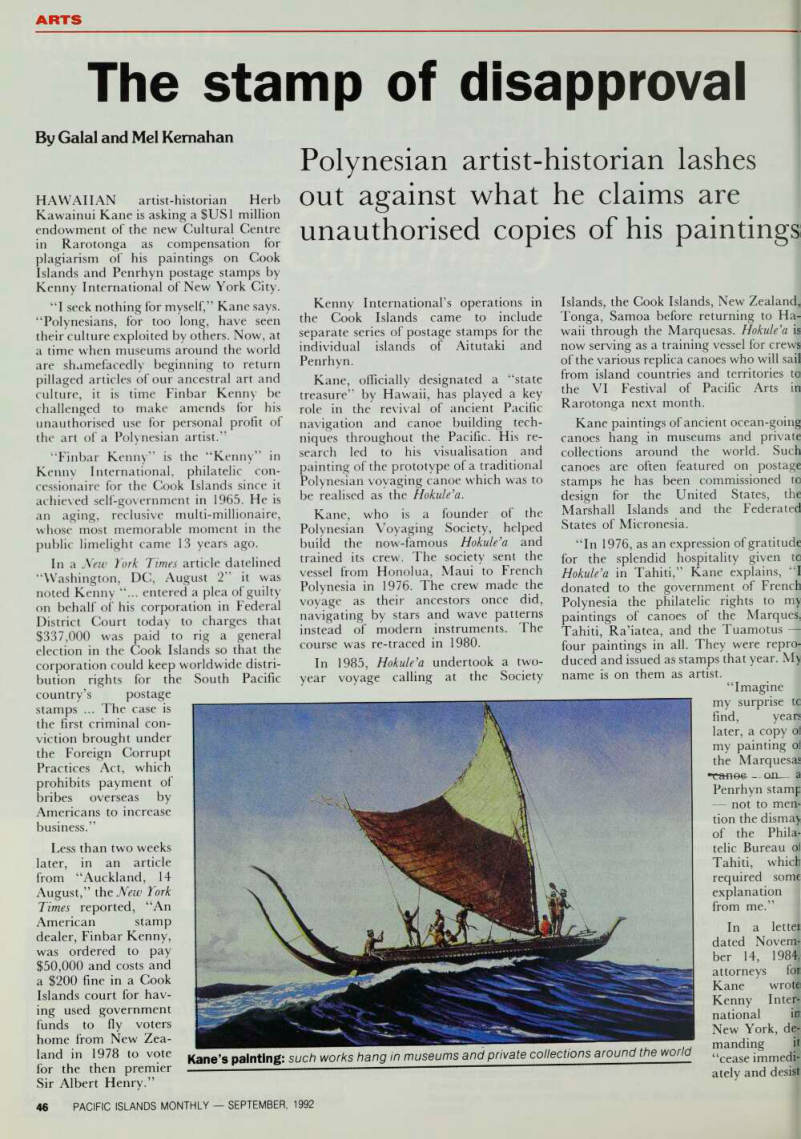
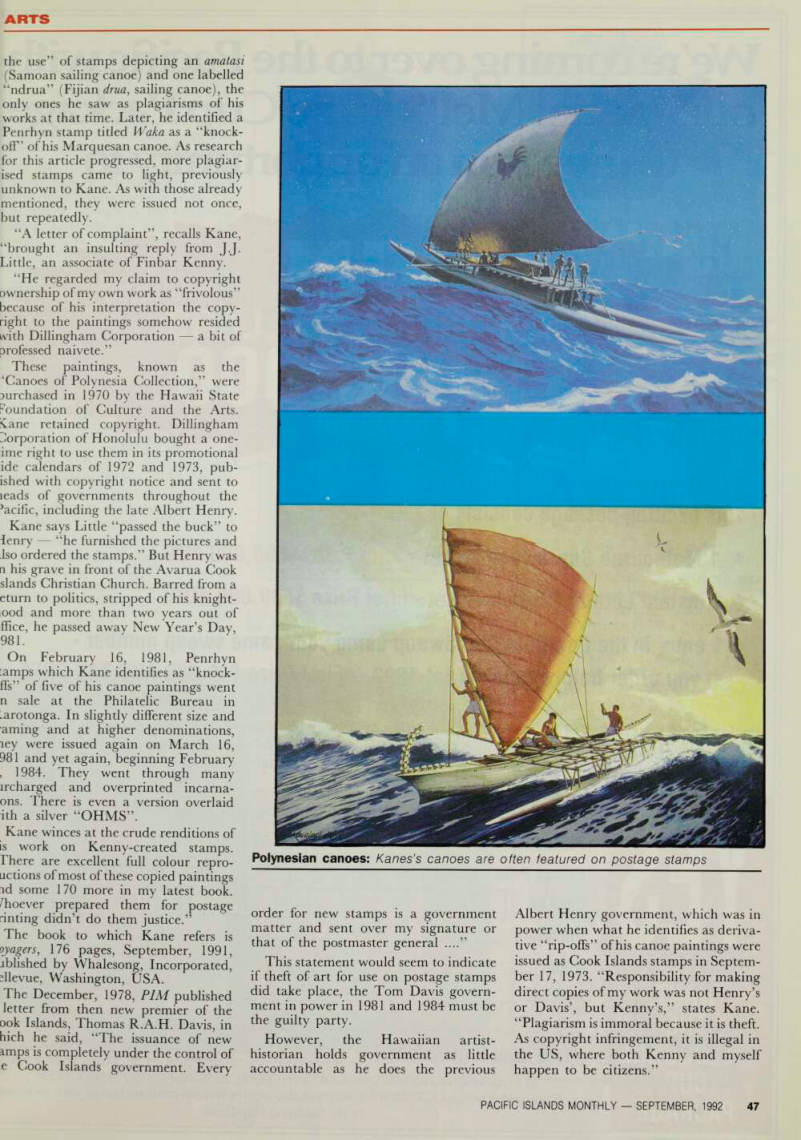

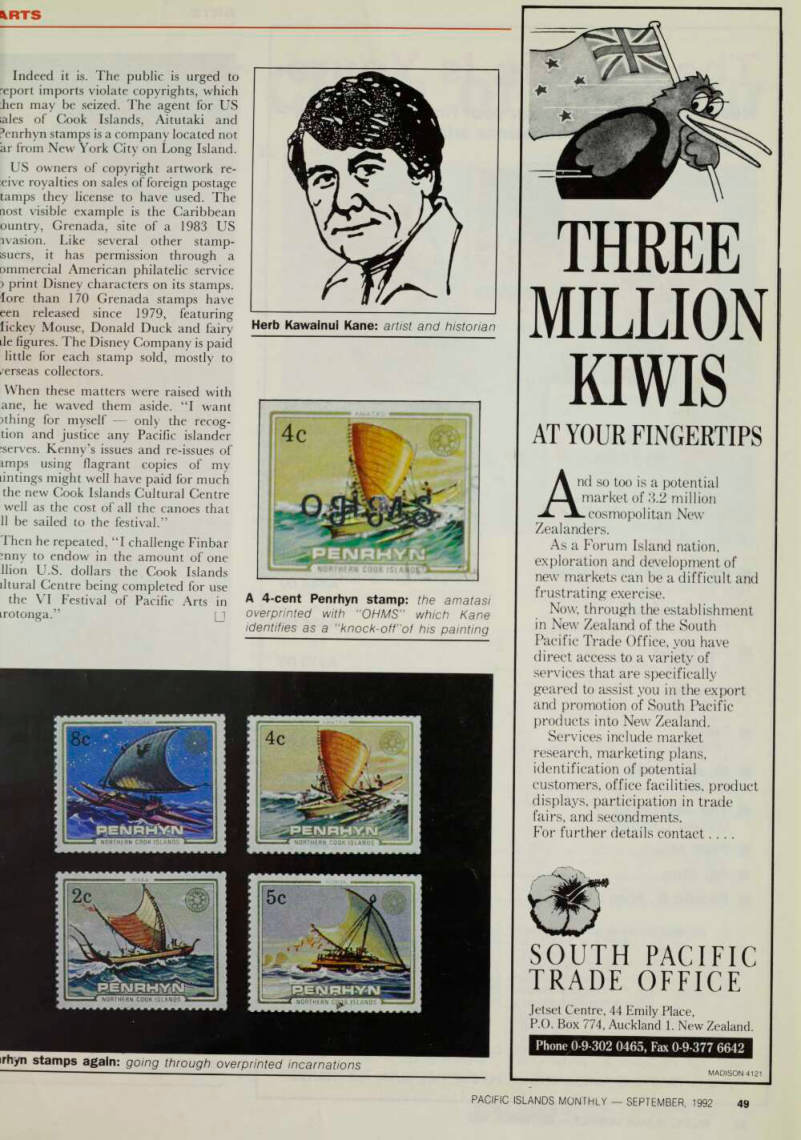
Arts
By Galal and Mel Kernahan
HAWAIIAN artist-historian Herb Kawainui Kane is asking a SUSI million endowment of the new Cultural Centre in Rarotonga as compensation for plagiarism of his paintings on Cook Islands and Penrhyn postage stamps by Kenny International of New York City.
“I seek nothing for myself,” Kane says.
“Polynesians, for too long, have seen their culture exploited by others. Now, at a time when museums around the world are shamefacedly beginning to return pillaged articles of our ancestral art and culture, it is time Finbar Kenny be challenged to make amends for his unauthorised use for personal profit of the art of a Polynesian artist.”
“Finbar Kenny” is the “Kenny” in Kenny International, philatelic con cessionaire for the Cook Islands since it achieved self-government in 1965. He is an aging, reclusive multi-millionaire, whose most memorable moment in the public limelight came 13 years ago.
In a New York Times article datelined “Washington, DC, August 2” it was noted Kenny “... entered a plea of guilty on behalf of his corporation in Federal District Court today to charges that $337,000 was paid to rig a general election in the Cook Islands so that the corporation could keep worldwide distri bution rights for the South Pacific
country’s postage
stamps ... The case is the first criminal con viction brought under the Foreign Corrupt Practices Act, which prohibits payment of bribes overseas by Americans to increase business.”
Less than two weeks later, in an article from “Auckland, 14 August,” the New York Times reported, “An American stamp dealer, Finbar Kenny, was ordered to pay $50,000 and costs and a $2OO fine in a Cook Islands court for hav ing used government funds to fly voters home from New Zea land in 1978 to vote for the then premier Sir Albert Henry.”
Polynesian artist-historian lashes out against what he claims are unauthorised copies of his paintings;
Kenny International’s operations in the Cook Islands came to include separate series of postage stamps for the individual islands of Aitutaki and Penrhyn.
Kane, officially designated a “state treasure” by Hawaii, has played a key role in the revival of ancient Pacific navigation and canoe building tech niques throughout the Pacific. His re search led to his visualisation and painting of the prototype of a traditional Polynesian voyaging canoe which was to be realised as the Hokule’a.
Kane, who is a founder of the
Polynesian Voyaging Society, helped
build the now-famous Hokule’a and trained its crew. The society sent the vessel from Honolua, Maui to French Polynesia in 1976. The crew made the voyage as their ancestors once did, navigating by stars and wave patterns instead of modern instruments. The course was re-traced in 1980.
In 1985, Hokule’a undertook a two year voyage calling at the Society
Islands, the Cook Islands, New Zealand, Tonga, Samoa before returning to Ha waii through the Marquesas, Hokule’a is now serving as a training vessel for crews of the various replica canoes who will sail from island countries and territories to the VI Festival of Pacific Arts in Rarotonga next month.
Kane paintings of ancient ocean-going canoes hang in museums and private collections around the world. Such canoes are often featured on postage stamps he has been commissioned to design for the United States, the Marshall Islands and the Federated States of Micronesia.
“In 1976, as an expression of gratitude for the splendid hospitality given to Hokule’a in Tahiti,” Kane explains, “I donated to the government of French Polynesia the philatelic rights to my paintings of canoes of the Marques, Tahiti, Ra’iatea, and the Tuamotus four paintings in all. They were repro duced and issued as stamps that year. My name is on them as artist.
“Imagine my surprise tc find, years later, a copy ol my painting ol the Marquesas Ttmoe - on— a Penrhyn stamp not to men tion the dismay of the Phila telic Bureau ol Tahiti, which required some
explanation
from me.”
In a letter dated Novem ber 14, 1984, attorneys for Kane wrote Kenny Inter national in New York, de manding it “cease immedi ately and desist
Kane’s painting: such works hang in museums and private collections around the world
the use” of stamps depicting an amatasi (Samoan sailing canoe) and one labelled “ndrua” (Fijian drua , sailing canoe), the only ones he saw as plagiarisms of his works at that time. Later, he identified a Penrhyn stamp titled Waka as a “knock off’ of his Marquesan canoe. As research for this article progressed, more plagiar ised stamps came to light, previously unknown to Kane. As with those already mentioned, they were issued not once, but repeatedly.
“A letter of complaint”, recalls Kane, “brought an insulting reply from JJ.
Little, an associate of Finbar Kenny.
“He regarded my claim to copyright ownership of my own work as “frivolous” because of his interpretation the copy right to the paintings somehow resided
with Dillingham Corporation a bit of
professed naivete.”
These paintings, known as the ‘Canoes of Polynesia Collection,” were purchased in 1970 by the Hawaii State Foundation of Culture and the Arts. iCane retained copyright. Dillingham Corporation of Honolulu bought a one ime right to use them in its promotional ide calendars of 1972 and 1973, pub ished with copyright notice and sent to leads of governments throughout the ’acific, including the late Albert Henry.
Kane says Little “passed the buck” to fenry “he furnished the pictures and Iso ordered the stamps.” But Henry was n his grave in front of the Avarua Cook slands Christian Church. Barred from a eturn to politics, stripped of his knight ood and more than two years out of flice, he passed away New Year’s Day, 981.
On February 16, 1981, Penrhyn :amps which Kane identifies as “knock ffs” of five of his canoe paintings went n sale at the Philatelic Bureau in .arotonga. In slightly different size and aming and at higher denominations, icy were issued again on March 16,
981 and yet again, beginning February
, 1984. They went through many
ircharged and overprinted incarna ons. There is even a version overlaid ith a silver “OHMS”, Kane winces at the crude renditions of is work on Kenny-created stamps, fhere are excellent full colour repro uctions of most of these copied paintings id some 170 more in my latest book.
Whoever prepared them for postage riming didn’t do them justice.”
The book to which Kane refers is
oyagers , 176 pages, September, 1991,
iblished by Whalesong, Incorporated,
dlevue, Washington, USA.
The December, 1978, PIM published letter from then new premier of the ook Islands, Thomas R.A.H. Davis, in hich he said, “The issuance of new amps is completely under the control of e Cook Islands government. Every
order for new stamps is a government matter and sent over my signature or that of the postmaster general ...”
This statement would seem to indicate if theft of art for use on postage stamps did take place, the Tom Davis govern ment in power in 1981 and 1984 must be the guilty party.
However, the Hawaiian artist historian holds government as little accountable as he does the previous
Albert Henry government, which was in power when what he identifies as deriva tive “rip-offs” of his canoe paintings were issued as Cook Islands stamps in Septem ber 17, 1973. “Responsibility for making direct copies of my work was not Henry’s or Davis’, but Kenny’s,” states Kane.
“Plagiarism is immoral because it is theft.
As copyright infringement, it is illegal in the US, where both Kenny and myself happen to be citizens.”
Polynesian canoes: Kanes's canoes are often featured on postage stamps
Indeed it is. The public is urged to r eport imports violate copyrights, which Ten may be seized. The agent for US lales of Cook Islands, Aitutaki and 3 enrhyn stamps is a company located not ar from New York City on Long Island.
US owners of copyright artwork re vive royalties on sales of foreign postage tamps they license to have used. The aost visible example is the Caribbean ountry, Grenada, site of a 1983 US ivasion. Like several other stamp isuers, it has permission through a ommercial American philatelic service print Disney characters on its stamps, lore than 170 Grenada stamps have een released since 1979, featuring lickey Mouse, Donald Duck and fairy lie figures. The Disney Company is paid little for each stamp sold, mostly to /erseas collectors.
When these matters were raised with ane, he waved them aside. “I want )thing for myself only the recog tion and justice any Pacific islander serves. Kenny’s issues and re-issues of imps using flagrant copies of my tin tings might well have paid for much the new Cook Islands Cultural Centre well as the cost of all the canoes that 11 be sailed to the festival.”
Then he repeated, “I challenge Finbar mny to endow in the amount of one llion U.S. dollars the Cook Islands iltural Centre being completed for use the VI Festival of Pacific Arts in irotonga.” □
[?]rhyn stamps again: going through overprinted incarnations
Herb Kawainui Kane: artist and historian
A 4-cent Penrhyn stamp: the amatasi overprinted with “OHMS” which Kane identifies as a “knock-off’of his painting
Ellen Gienge[?] Douglas Ram Samuj: at the drawing board
Advertisements & other items, pp. 48-50 (1 item)
our special Melbourne Cup Package
We're coming over to the Pacific with
to give you an opportunity to
This exciting package consists of: * 1 Melbourne Cup Sweep Ticket - First Prize $500,000 AUD * 11nstant Lottery Scratch Ticket - First Prize $500,000 AUD * 1 entry in the Caulfield Cup Sweep using your same sweep number if you order before October Ist 1992. - First Prize $lO,OOO AUD TAX FREE.
So don't hold your horses! Send this coupon with either cash, your credit card details, or bank cheque to us NOW: TMS. THE MAIL SERVICE. Suite 5, 55 Flemington Road, North Melbourne, Victoria, 3051. Australia.
G.P.O. Box 2937 DD, Melbourne, 3001. Australia. Fax: Country Code 61/3/329 2166.
YES
WANT
THE
MELBOURNE
CUP
PACKAGE
The $25 U.S. accepted in Cash, Bank Cheque, Credit Cards or a Postal note!
Please tick - □ 1 PACKAGE FOR $25.00 U.S!
Please Print - Credit Card Type Card Expiry date Post Code Phone Number (if available) We will send you a Melbourne Cup Sweep Ticket, an Instant Lottery Scratch Ticket.
If you order before OCTOBER Ist you will also receive written confirmation of your inclusion in the Caulfield Cup Draw.
THREE
MILLION
KIWIS
AT YOUR FINGERTIPS
And so too is a potential market of 3.2 million cosmopolitan New Zealanders.
As a Forum Island nation, exploration and development of new markets can be a difficult and frustrating exercise.
Now. through the establishment in New Zealand of the South Pacific Trade Office, you have direct access to a variety of services that are specifically geared to assist you in the export and promotion of South Pacific products into New Zealand.
Services include market research, marketing plans, identification of potential customers, office facilities, product displays, participation in trade fairs, and secondments.
For further details contact...
SOUTH
TRADE
PACIFIC
OFFICE
Jetset Centre, 44 Emily Place, P.O. Box 774, Auckland 1. New Zealand.
Phone 0-9-302 0465, Fax 0-9-377 6642
MADISON 4121
The Pacific Is Yours
Have all the information at your fingertips order PIM publications NOW!
PACIFIC
I m 5 fZ .
ill
- I:
Papua
New Guinea
PACIFIC
ISLANDS
FIJI
ISLANDS
■ Pacific Islands Yearbook 16th Edition ■ Fiji Handbook Business & Travel Guide ■ Fiji Times A History of Fiji ■ Vanuatu A-Guide ■ Tonga A-Guide ■ Cook Islands A-Guide ■ The Journal of William Lockerby ■ PNG Map ■ Fiji Map ■ Pacific Is. Map A 545.00 A 514.95 Aslo.oo A 514.95 A 514.95 A 514.95 A 53.50 .. A 53.50 .. A 53.50 . A 53.50 Number of copies being ordered: Pacific Is. Yearbook Fiji Handbook Fiji Times History Vanuatu A-Guide Tonga A-Guide Cook Islands A-Guide The Journal of W/Lockerby PNG Map Fiji Map Pacific Islands Map Enclosed is A$ for payment Debit A$ my
□ VISA Q MASTER
Card No Expiry Date My Name Postal Address Country Tel Post to: PACIFIC ISLANDS MONTHLY. PO BOX 1167, SUVA, FIJI ISLANDS.
Cloth of Honour
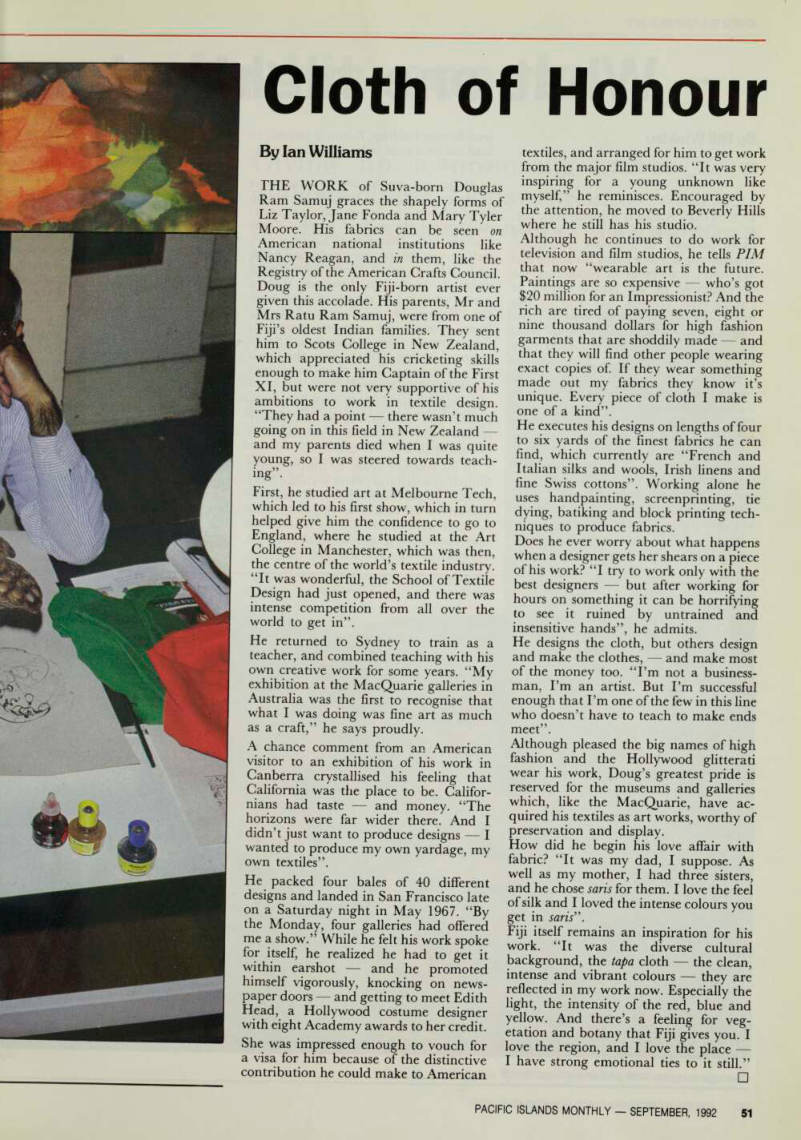
By Ian Williams
THE WORK of Suva-born Douglas Ram Samuj graces the shapely forms of Liz Taylor, Jane Fonda and Mary Tyler Moore. His fabrics can be seen on American national institutions like Nancy Reagan, and in them, like the Registry of the American Crafts Council.
Doug is the only Fiji-born artist ever given this accolade. His parents, Mr and Mrs Ratu Ram Samuj, were from one of Fiji’s oldest Indian families. They sent him to Scots College in New Zealand, which appreciated his cricketing skills enough to make him Captain of the First XI, but were not very supportive of his ambitions to work in textile design.
“They had a point there wasn’t much going on in this field in New Zealand and my parents died when I was quite young, so I was steered towards teach
ing”.
First, he studied art at Melbourne Tech, which led to his first show, which in turn helped give him the confidence to go to England, where he studied at the Art College in Manchester, which was then, the centre of the world’s textile industry.
“It was wonderful, the School of Textile Design had just opened, and there was intense competition from all over the world to get in”.
He returned to Sydney to train as a teacher, and combined teaching with his own creative work for some years. “My exhibition at the MacQuarie galleries in Australia was the first to recognise that what I was doing was fine art as much as a craft,” he says proudly.
A chance comment from an American visitor to an exhibition of his work in Canberra crystallised his feeling that California was the place to be. Califor nians had taste and money. “The horizons were far wider there. And I didn’t just want to produce designs I wanted to produce my own yardage, my own textiles”.
He packed four bales of 40 different designs and landed in San Francisco late on a Saturday night in May 1967. “By the Monday, four galleries had offered me a show.” While he felt his work spoke for itself, he realized he had to get it within earshot and he promoted himself vigorously, knocking on news paper doors and getting to meet Edith Head, a Hollywood costume designer with eight Academy awards to her credit.
She was impressed enough to vouch for a visa for him because of the distinctive contribution he could make to American
textiles, and arranged for him to get work from the major film studios. “It was very inspiring for a young unknown like myself,” he reminisces. Encouraged by the attention, he moved to Beverly Hills where he still has his studio.
Although he continues to do work for television and film studios, he tells PIM that now “wearable art is the future.
Paintings are so expensive who’s got $2O million for an Impressionist? And the rich are tired of paying seven, eight or nine thousand dollars for high fashion garments that are shoddily made and that they will find other people wearing exact copies of. If they wear something made out my fabrics they know it’s unique. Every piece of cloth I make is one of a kind”.
He executes his designs on lengths of four to six yards of the finest fabrics he can find, which currently are “French and Italian silks and wools, Irish linens and fine Swiss cottons”. Working alone he
uses handpainting, screenprinting, tie
dying, batiking and block printing tech
niques to produce fabrics.
Does he ever worry about what happens when a designer gets her shears on a piece of his work? “I try to work only with the best designers but after working for hours on something it can be horrifying to see it ruined by untrained and insensitive hands”, he admits.
He designs the cloth, but others design and make the clothes, and make most of the money too. “I’m not a business man, I’m an artist. But I’m successful enough that I’m one of the few in this line who doesn’t have to teach to make ends meet”.
Although pleased the big names of high fashion and the Hollywood glitterati wear his work, Doug’s greatest pride is reserved for the museums and galleries which, like the MacQuarie, have ac quired his textiles as art works, worthy of preservation and display.
How did he begin his love affair with fabric? “It was my dad, I suppose. As well as my mother, I had three sisters, and he chose saris for them. I love the feel of silk and I loved the intense colours you get in saris”.
Fiji itself remains an inspiration for his work. “It was the diverse cultural background, the tapa cloth the clean, intense and vibrant colours they are reflected in my work now. Especially the light, the intensity of the red, blue and yellow. And there’s a feeling for veg etation and botany that Fiji gives you. I love the region, and I love the place I have strong emotional ties to it still.”
What one highland ma[?]an do for his people
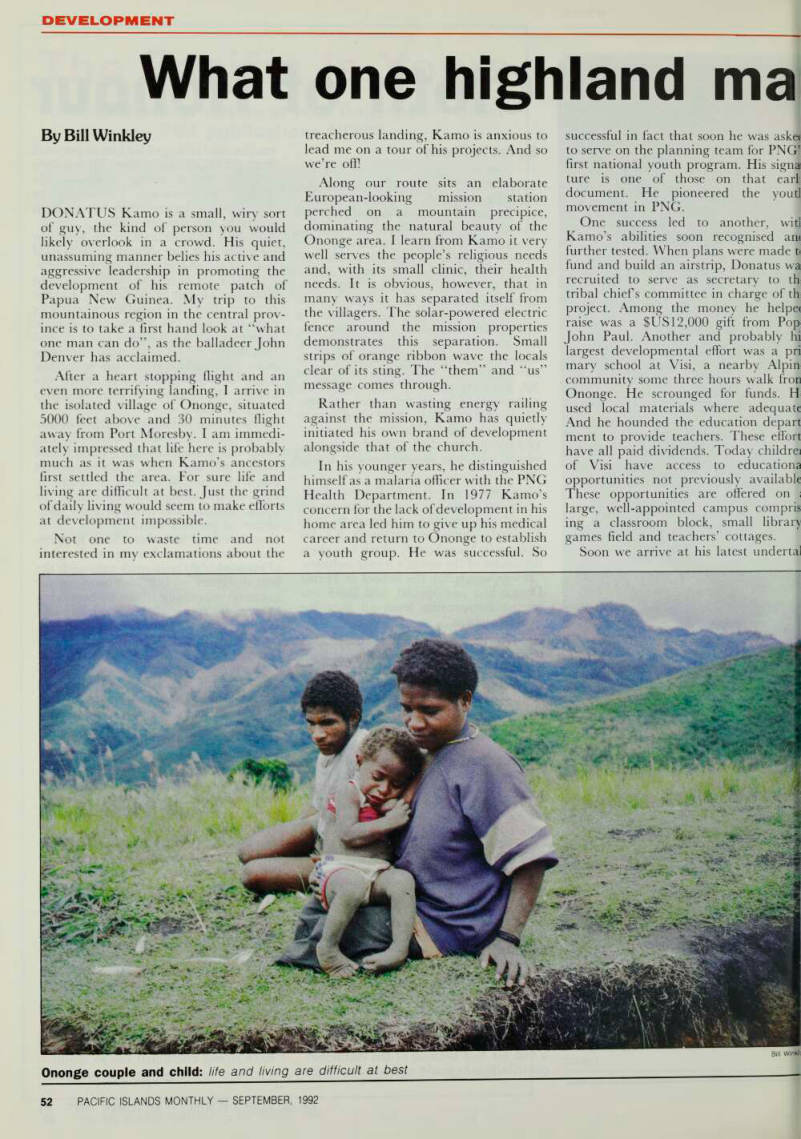
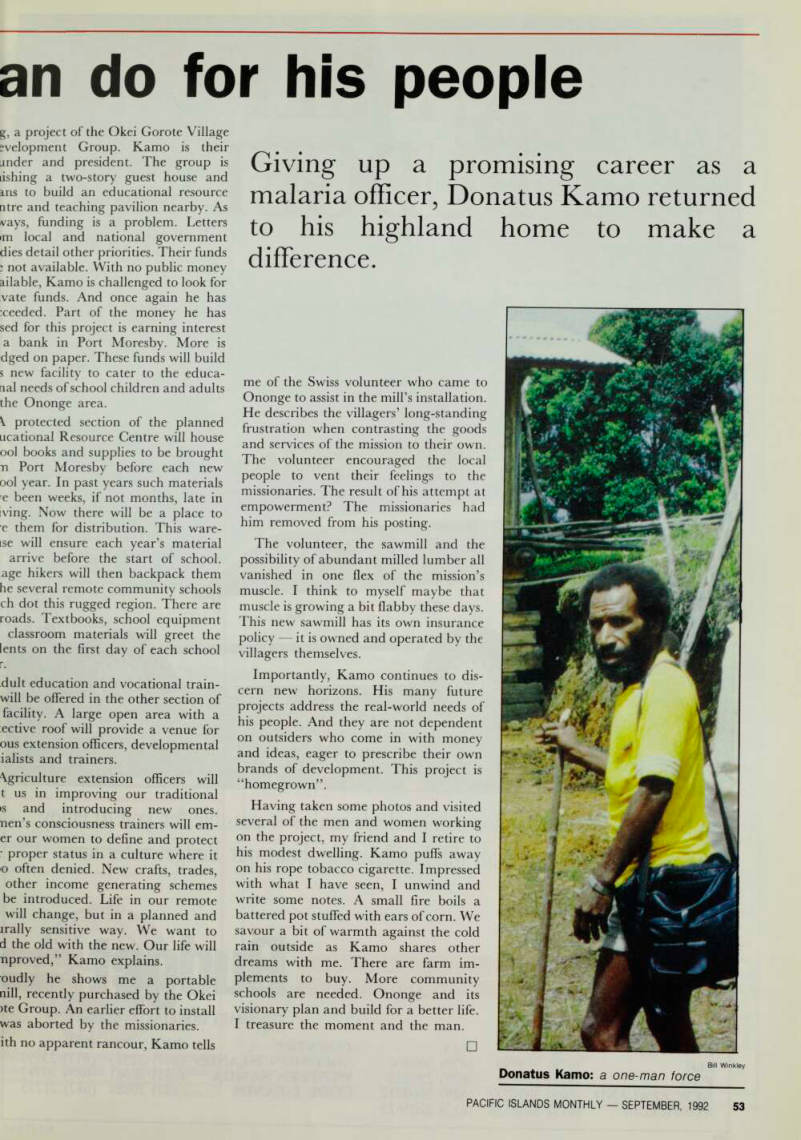
Development
By Bill Winkley
DONATUS Kamo is a small, wiry sort of guy, the kind of person you would likely overlook in a crowd. His quiet, unassuming manner belies his active and
aggressive leadership in promoting the
development of his remote patch of Papua New Guinea. My trip to this mountainous region in the central prov ince is to take a first hand look at “what one man can do”, as the balladeer John Denver has acclaimed.
After a heart stopping flight and an even more terrifying landing, I arrive in the isolated village of Ononge, situated 5000 feet above and 30 minutes flight away from Port Moresby. I am immedi ately impressed that life here is probably much as it was when Kamo’s ancestors first settled the area. For sure life and living are difficult at best. Just the grind of daily living would seem to make efforts
at development impossible.
Not one to waste time and not interested in my exclamations about the
treacherous landing, Kamo is anxious to lead me on a tour of his projects. And so we’re off Along our route sits an elaborate European-looking mission station perched on a mountain precipice, dominating the natural beauty of the Ononge area. I learn from Kamo it very well serves the people’s religious needs and, with its small clinic, their health needs. It is obvious, however, that in many ways it has separated itself from the villagers. The solar-powered electric fence around the mission properties demonstrates this separation. Small strips of orange ribbon wave the locals clear of its sting. The “them” and “us” message comes through.
Rather than wasting jenergy railing against the mission, Kamo has quietly initiated his own brand of development alongside that of the church.
In his younger years, he distinguished himself as a malaria officer with the PNG Health Department. In 1977 Kamo’s concern for the lack of development in his home area led him to give up his medical career and return to Ononge to establish a youth group. He was successful. So
successful in fact that soon he was askef to serve on the planning team for PNG* first national youth program. His signa ture is one of those on that earl 1 , document. He pioneered the youtl movement in PNG.
One success led to another, witl Kamo’s abilities soon recognised an« further tested. When plans were made tt fund and build an airstrip, Donatus wa recruited to serve as secretary to th tribal chiefs committee in charge of th project. Among the money he helpe( raise was a SUS 12,000 gift from Pop John Paul. Another and probably hi largest developmental effort was a pri mary school at Visi, a nearby Alpin community some three hours walk fron Ononge. He scrounged for funds. H used local materials where adequate And he hounded the education depart ment to provide teachers. These effort have all paid dividends. Today childrei of Visi have access to educationa
opportunities not previously available
These opportunities are offered on ; large, well-appointed campus compris ing a classroom block, small library games field and teachers’ cottages.
Soon we arrive at his latest undertal
Ononge couple and child: life and living are difficult at best
g, a project of the Okei Gorote Village “velopment Group. Kamo is their under and president. The group is lishing a two-story guest house and ms to build an educational resource atre and teaching pavilion nearby. As
vays, funding is a problem. Letters
im local and national government dies detail other priorities. Their funds ; not available. With no public money ailable, Kamo is challenged to look for vate funds. And once again he has :ceeded. Part of the money he has sed for this project is earning interest a bank in Port Moresby. More is dged on paper. These funds will build s new facility to cater to the educa nal needs of school children and adults
the Ononge area.
V protected section of the planned acational Resource Centre will house 00l books and supplies to be brought n Port Moresby before each new 00l year. In past years such materials e been weeks, if not months, late in iving. Now there will be a place to e them for distribution. This ware ise will ensure each year’s material arrive before the start of school, age hikers will then backpack them he several remote community schools ch dot this rugged region. There are
roads. Textbooks, school equipment
classroom materials will greet the lents on the first day of each school dult education and vocational train will be offered in the other section of facility. A large open area with a ective roof will provide a venue for
ous extension officers, developmental
ialists and trainers. \griculture extension officers will t us in improving our traditional •s and introducing new ones, nen’s consciousness trainers will em er our women to define and protect ' proper status in a culture where it o often denied. New crafts, trades, other income generating schemes be introduced. Life in our remote will change, but in a planned and irally sensitive way. We want to d the old with the new. Our life will nproved,” Kamo explains, oudly he shows me a portable
nill, recently purchased by the Okei
)te Group. An earlier effort to install was aborted by the missionaries, ith no apparent rancour, Kamo tells
Giving up a promising career as a malaria officer, Donatus Kamo returned to his highland home to make a difference.
me of the Swiss volunteer who came to Ononge to assist in the mill’s installation.
He describes the villagers’ long-standing frustration when contrasting the goods and services of the mission to their own.
The volunteer encouraged the local people to vent their feelings to the missionaries. The result of his attempt at empowerment? The missionaries had him removed from his posting.
The volunteer, the sawmill and the possibility of abundant milled lumber all vanished in one flex of the mission’s muscle. I think to myself maybe that muscle is growing a bit flabby these days.
This new sawmill has its own insurance policy it is owned and operated by the villagers themselves.
Importantly, Kamo continues to dis cern new horizons. His many future projects address the real-world needs of his people. And they are not dependent on outsiders who come in with money and ideas, eager to prescribe their own brands of development. This project is
“homegrown”.
Having taken some photos and visited several of the men and women working on the project, my friend and I retire to his modest dwelling. Kamo puffs away on his rope tobacco cigarette. Impressed with what I have seen, I unwind and write some notes. A small fire boils a battered pot stuffed with ears of corn. We savour a bit of warmth against the cold rain outside as Kamo shares other dreams with me. There are farm im plements to buy. More community schools are needed. Ononge and its visionary plan and build for a better life.
I treasure the moment and the man.
Bill Winkley Donatus Kamo: a one-man force
Advertisements & other items, pp. 53-55 (2 items)
an do for his people
53
PACIFIC ISLANDS MONTHLY - SEPTEMBER, 1992
Budget
m
i)xx
& w*m
S d'M
a rr Si ** 3* fi is* -6 K & fi!
Budget’s great value-for-money deals makes it possible for you to enjoy South Pacific with all the family. Ask about our Budget rates now.
COUNTRY
FIJI
PNG
NEW ZEALAND
AUSTRALIA
PHONE
(679) 315899 (675) 254111 (649) 3096737 (613) 3206333
FAX
(679) 302450 (675) 257853 (649) 3660212 (613) 3265623
sßudgpt
THE SMART MONEY IS ON BUDGET
COUNTRY PHONE FAX
SOLOMON ISLANDS (677) 22313 (677) 23593
WESTERN SAMOA (685) 20561 (685) 20393
COOK ISLANDS (682) 20888 (682) 21275
BUDETOOI-E
How Batham
Learned
The Best Way
To Serve
Pawpaw
To The
Australian
Market.
They asked us.
Batham International of Fiji produces fruit and fruit juices. In particular, enough pawpaw to supply a major market ike Australia. But they weren’t sure what brm to ship it in. Who would be most nterested. Or how to get it distributed.
At the South Pacific Trade Commission ve used our extensive resources to find >ut everything Batham needed to set up heir rather fruitful new venture. Just one »f the many ways we are able to help msinessmen from Pacific Forum countries.
If you’re starting up, improving or xpanding a local business, we can help ou too. Especially if you want to move nto the export market.
And it’s all absolutely free.
To find out more, just post or fax us he coupon below. If you’re in a hurry, 3el free to phone. fame ompany ddress £ I z m evel 6, 50 Park Street, Sydney NSW 2000. hone: (612) 283 5933, Fax: (612) 283 5948 Adventors 1212
A bankable proposal
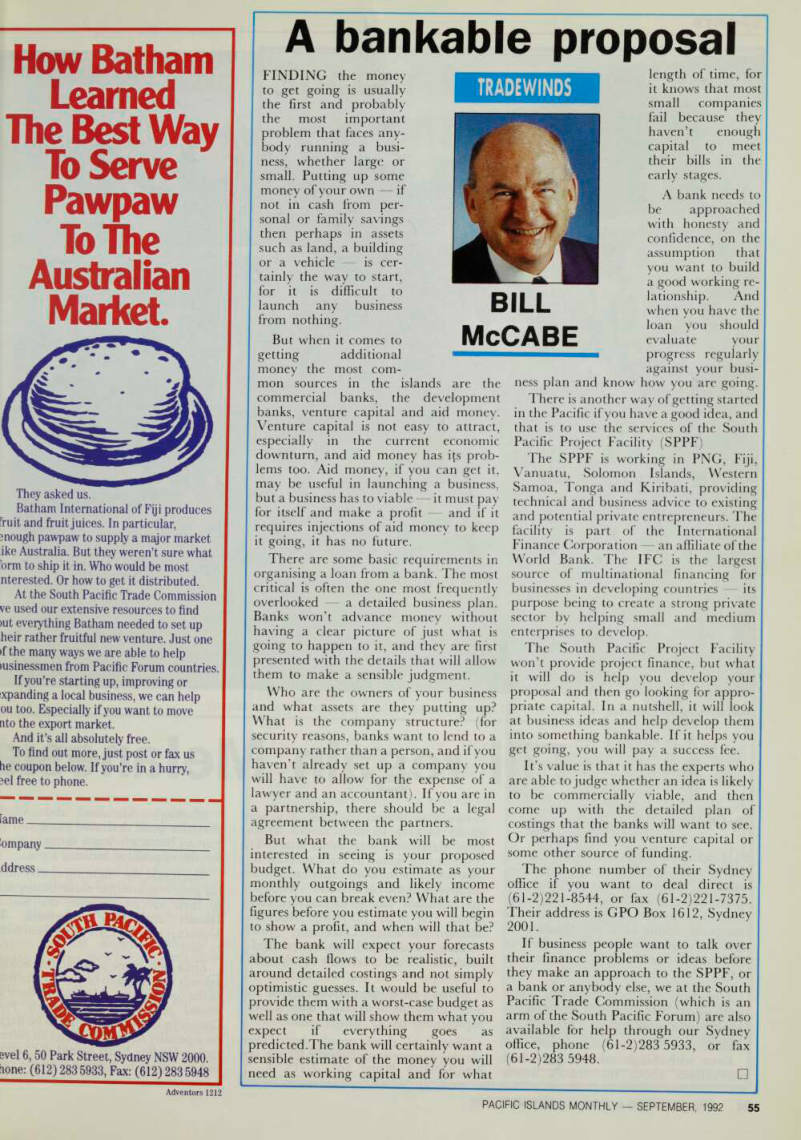
FINDING the money to get going is usually the first and probably the most important problem that faces any
body running a busi
ness, whether large or small. Putting up some money of your own if not in cash from per
sonal or family savings
then perhaps in assets such as land, a building or a vehicle is cer tainly the way to start, for it is difficult to launch any business
from nothing.
But when it comes to
getting additional
money the most com
mon sources in the islands are the commercial banks, the development banks, venture capital and aid money.
Venture capital is not easy to attract, especially in the current economic downturn, and aid money has its prob lems too. Aid money, if you can get it. may be useful in launching a business, but a business has to viable it must pay for itself and make a profit and if it requires injections of aid money to keep it going, it has no future.
There are some basic requirements in organising a loan from a bank. The most critical is often the one most frequently overlooked a detailed business plan.
Banks won’t advance money without having a clear picture of just what is going to happen to it, and they are first presented with the details that will allow them to make a sensible judgment.
Who are the owners of your business and what assets are they putting up?
What is the company structure? (for security reasons, banks want to lend to a company rather than a person, and if you haven’t already set up a company you will have to allow for the expense of a lawyer and an accountant). If you are in a partnership, there should be a legal agreement between the partners.
But what the bank will be most interested in seeing is your proposed budget. What do you estimate as your
monthly outgoings and likely income
before you can break even? What are the figures before you estimate you will begin to show a profit, and when will that be?
The bank will expect your forecasts about cash flows to be realistic, built around detailed costings and not simply optimistic guesses. It would be useful to provide them with a worst-case budget as well as one that will show them what you expect if everything goes as predicted. The bank will certainly want a sensible estimate of the money you will need as working capital and for what
Tradewinds
length of time, for it knows that most small companies fail because they haven’t enough capital to meet their bills in the early stages.
A bank needs to be approached with honesty and confidence, on the
assumption that
you want to build a good working re lationship. And when you have the loan you should evaluate your progress regularly against your busi
ness plan and know how you are going.
There is another way of getting started in the Pacific if you have a good idea, and that is to use the services of the South Pacific Project Facility (SPPF) The SPPF is working in PNG, Fiji, Vanuatu, Solomon Islands, Western Samoa, Tonga and Kiribati, providing technical and business advice to existing and potential private entrepreneurs. The facility is part of the International Finance Corporation an affiliate of the World Bank. The IFC is the largest source of multinational financing for businesses in developing countries its purpose being to create a strong private sector by helping small and medium enterprises to develop.
The South Pacific Project Facility won’t provide project finance, but what it will do is help you develop your proposal and then go looking for appro priate capital. In a nutshell, it will look at business ideas and help develop them into something bankable. If it helps you get going, you will pay a success fee.
It’s value is that it has the experts who are able to judge whether an idea is likely to be commercially viable, and then come up with the detailed plan of costings that the banks will want to see.
Or perhaps find you venture capital or some other source of funding.
The phone number of their Sydney office if you want to deal direct is (61-2)221-8544, or fax (61-2)221-7375.
Their address is GPO Box 1612, Sydney 2001.
If business people want to talk over their finance problems or ideas before they make an approach to the SPPF, or a bank or anybody else, we at the South Pacific Trade Commission (which is an arm of the South Pacific Forum) are also
available for help through our Sydney
office, phone (61-2)283 5933, or fax (61-2)283 5948.
Bill
Mccabe
Fiji regain Melanesia [?] Lory
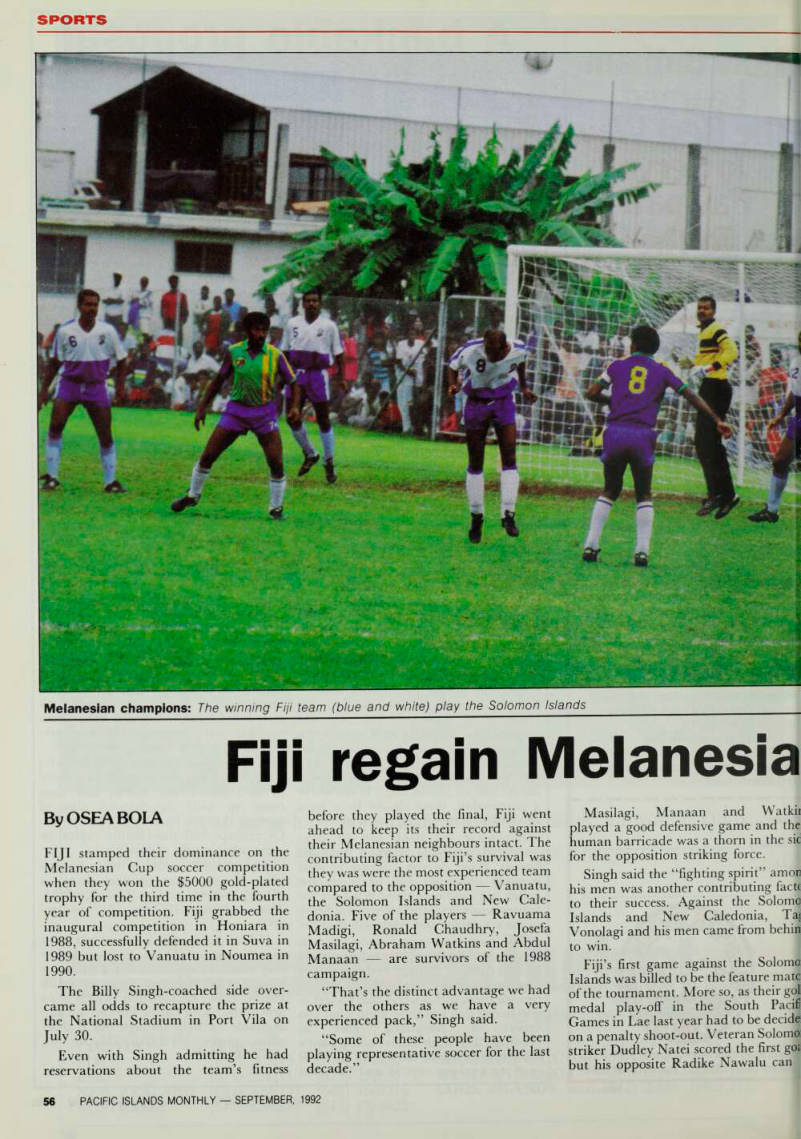
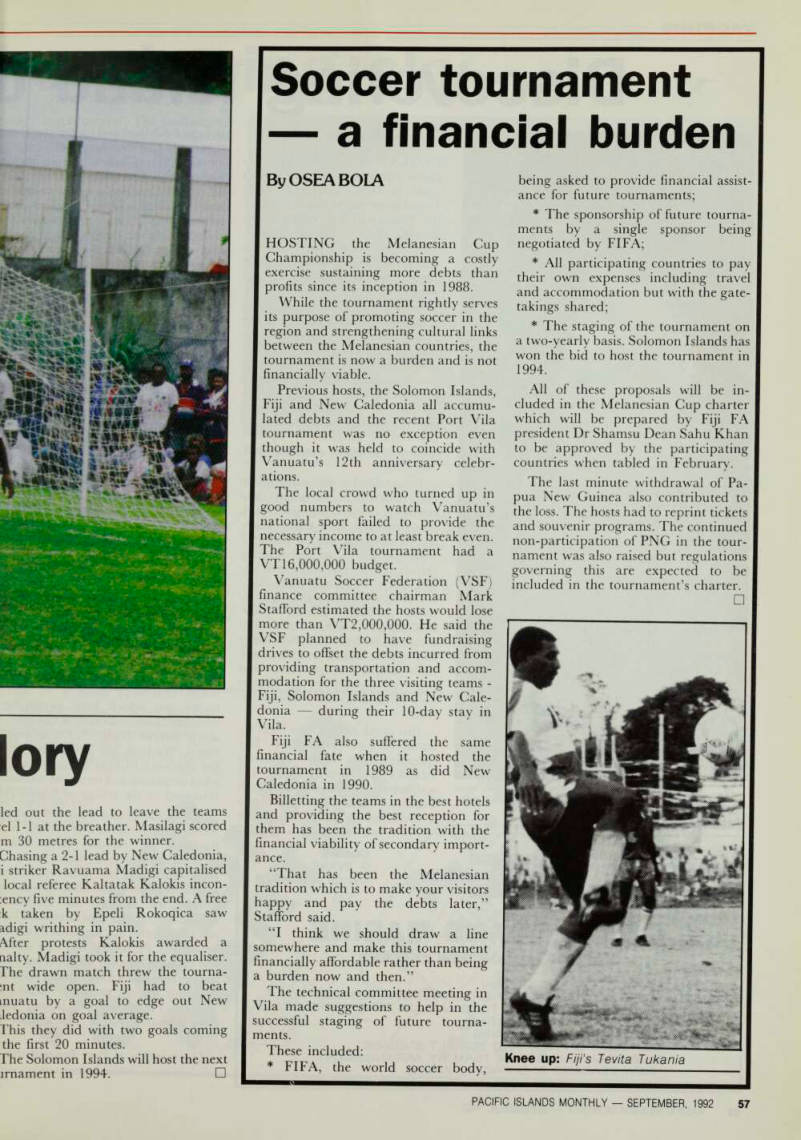
Sports
By Osea Bola
FIJI stamped their dominance on the Melanesian Cup soccer competition when they won the $5OOO gold-plated trophy for the third time in the fourth year of competition. Fiji grabbed the inaugural competition in Honiara in 1988, successfully defended it in Suva in 1989 but lost to Vanuatu in Noumea in 1990.
The Billy Singh-coached side over came all odds to recapture the prize at the National Stadium in Port Vila on July 30.
Even with Singh admitting he had reservations about the team’s fitness
before they played the final, Fiji went ahead to keep its their record against their Melanesian neighbours intact. The contributing factor to Fiji’s survival was they was were the most experienced team compared to the opposition Vanuatu, the Solomon Islands and New Cale donia. Five of the players Ravuama Madigi, Ronald Chaudhry, Josefa Masilagi, Abraham Watkins and Abdul Manaan are survivors of the 1988 campaign.
“That’s the distinct advantage we had over the others as we have a very
experienced pack,” Singh said.
“Some of these people have been playing representative soccer for the last decade.”
Masilagi, Manaan and Watkii played a good defensive game and the human barricade was a thorn in the sic for the opposition striking force.
Singh said the “fighting spirit” amon his men was another contributing facte to their success. Against the Solomo Islands and New Caledonia, Taj Vonolagi and his men came from behin to win.
Fiji’s first game against the Solomo Islands was billed to be the feature mate of the tournament. More so, as their goli medal play-off in the South Paciff Games in Lae last year had to be decide on a penalty shoot-out. Veteran Solomo: striker Dudley Natei scored the first go* but his opposite Radike Nawalu can
Melanesian champions: The winning Fiji team (blue and white) play the Solomon Islands
led out the lead to leave the teams el 1-1 at the breather. Masilagi scored m 30 metres for the winner.
Chasing a 2-1 lead by New Caledonia, i striker Ravuama Madigi capitalised local referee Kaltatak Kalokis incon ;ency five minutes from the end. A free k taken by Epeli Rokoqica saw
adigi writhing in pain.
After protests Kalokis awarded a aalty. Madigi took it for the equaliser.
The drawn match threw the tourna ;nt wide open. Fiji had to beat inuatu by a goal to edge out New ledonia on goal average.
This they did with two goals coming the first 20 minutes.
The Solomon Islands will host the next irnament in 1994, □
- a financial burden
Soccer tournament - a financial burden
By Osea Bola
HOSTING the Melanesian Cup Championship is becoming a costly exercise sustaining more debts than profits since its inception in 1988.
While the tournament rightly serves its purpose of promoting soccer in the region and strengthening cultural links between the Melanesian countries, the tournament is now a burden and is not financially viable.
Previous hosts, the Solomon Islands, Fiji and New Caledonia all accumu lated debts and the recent Port Vila tournament was no exception even though it was held to coincide with Vanuatu’s 12th anniversary celebr ations.
The local crowd who turned up in good numbers to watch Vanuatu’s national sport failed to provide the necessary income to at least break even.
The Port Vila tournament had a VT 16,000,000 budget.
Vanuatu Soccer Federation (VSF) finance committee chairman Mark Stafford estimated the hosts would lose more than VT2,000,000. He said the VSF planned to have fundraising drives to offset the debts incurred from providing transportation and accom modation for the three visiting teams - Fiji, Solomon Islands and New Cale donia during their 10-day stay in Vila.
Fiji FA also suffered the same financial fate when it hosted the tournament in 1989 as did New Caledonia in 1990.
Billetting the teams in the best hotels and providing the best reception for them has been the tradition with the
financial viability of secondary import
ance.
“That has been the Melanesian tradition which is to make your visitors happy and pay the debts later,”
Stafford said.
“I think we should draw a line somewhere and make this tournament financially affordable rather than being a burden now and then.”
The technical committee meeting in Vila made suggestions to help in the successful staging of future tourna ments.
These included: * FIFA, the world soccer body,
being asked to provide financial assist ance for future tournaments; * The sponsorship of future tourna ments by a single sponsor being negotiated by FIFA; * All participating countries to pay their own expenses including travel and accommodation but with the gate
takings shared;
* The staging of the tournament on a two-yearly basis. Solomon Islands has won the bid to host the tournament in 1994.
All of these proposals will be in cluded in the Melanesian Cup charter which will be prepared by Fiji FA president Dr Shamsu Dean Sahu Khan to be approved by the participating countries when tabled in February.
The last minute withdrawal of Pa pua New Guinea also contributed to the loss. The hosts had to reprint tickets and souvenir programs. The continued non-participation of PNG in the tour nament was also raised but regulations governing this are expected to be included in the tournament’s charter. n
Knee up: Fiji's Tevita Tukania
Discovering island o[?]he glowing sky
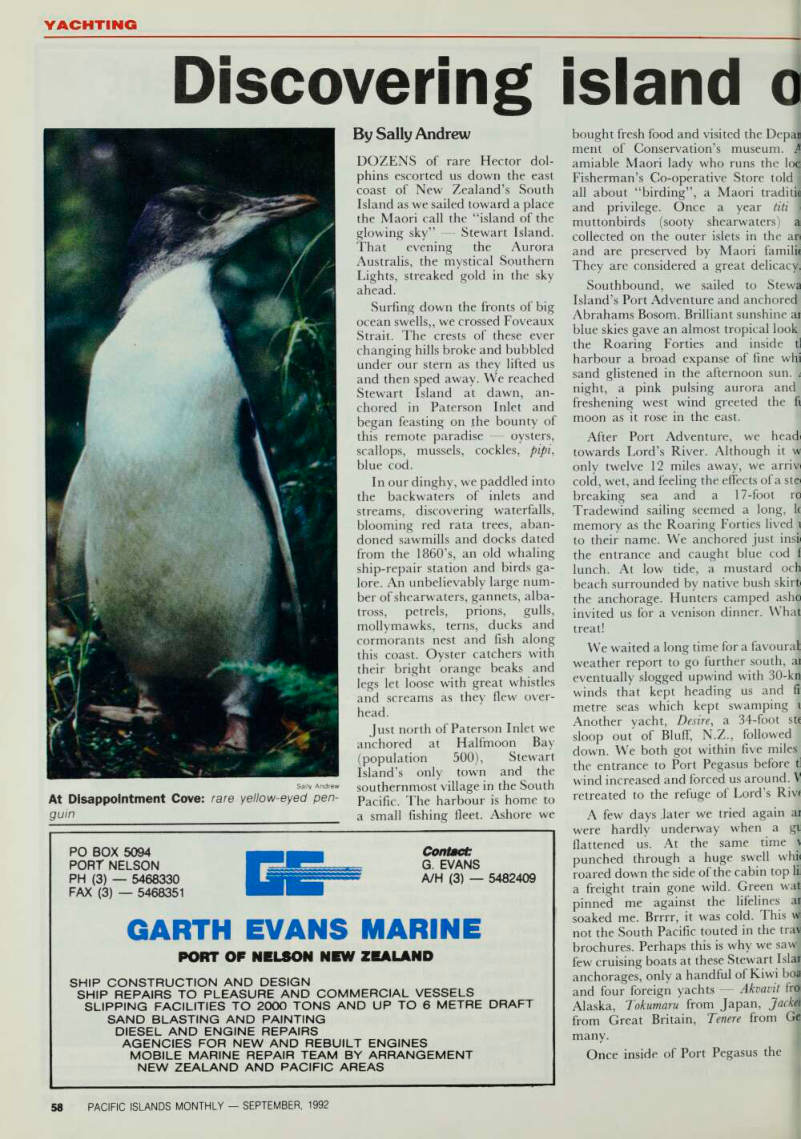
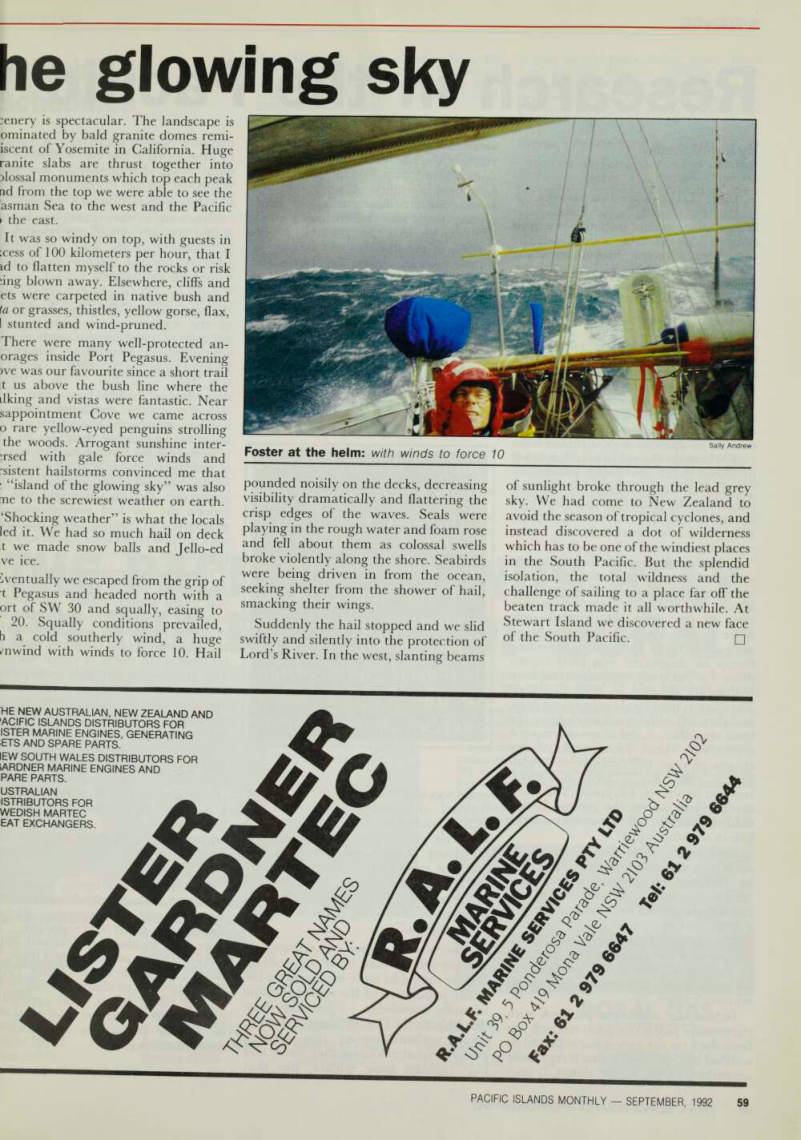
Yachting
By Sally Andrew
DOZENS of rare Hector dol phins escorted us down the east coast of New Zealand’s South Island as we sailed toward a place the Maori call the “island of the glowing sky” Stewart Island.
That evening the Aurora Australis, the mystical Southern Lights, streaked gold in the sky ahead.
Surfing down the fronts of big ocean swells,, we crossed Foveaux Strait. The crests of these ever changing hills broke and bubbled under our stern as they lifted us and then sped away. We reached Stewart Island at dawn, an chored in Paterson Inlet and began feasting on the bounty of this remote paradise oysters, scallops, mussels, cockles, pipi , blue cod.
In our dinghy, we paddled into the backwaters of inlets and streams, discovering waterfalls, blooming red rata trees, aban doned sawmills and docks dated from the 1860’s, an old whaling ship-repair station and birds ga lore. An unbelievably large num ber of shearwaters, gannets, alba
tross, petrels, prions, gulls,
mollymawks, terns, ducks and cormorants nest and fish along this coast. Oyster catchers with their bright orange beaks and legs let loose with great whistles and screams as they flew over head.
Just north of Paterson Inlet we anchored at Halfmoon Bay (population 500), Stewart Island’s only town and the southernmost village in the South Pacific. The harbour is home to a small fishing fleet. Ashore we
bought fresh food and visited the Depau ment of Conservation’s museum, P amiable Maori lady who runs the loc Fisherman’s Co-operative Store told all about “birding”, a Maori traditio and privilege. Once a year titi i muttonbirds (sooty shearwaters) a. collected on the outer islets in the an and are preserved by Maori family They are considered a great delicacy.
Southbound, we sailed to Stewa Island’s Port Adventure and anchored Abrahams Bosom. Brilliant sunshine ai blue skies gave an almost tropical look the Roaring Forties and inside tl harbour a broad expanse of fine whi sand glistened in the afternoon sun. i night, a pink pulsing aurora and freshening west wind greeted the ft moon as it rose in the east.
After Port Adventure, we headi towards Lord’s River. Although it w only twelve 12 miles away, we arrivi cold, wet, and feeling the effects of a stei breaking sea and a 17-foot ro Tradewind sailing seemed a long, k memory as the Roaring Forties lived i to their name. We anchored just insii the entrance and caught blue cod f lunch. At low tide, a mustard och beach surrounded by native bush skirti the anchorage. Hunters camped asho invited us for a venison dinner. What treat!
We waited a long time for a favourat weather report to go further south, ar eventually slogged upwind with 30-kn winds that kept heading us and fi metre seas which kept swamping i Another yacht, Desire, a 34-foot ste sloop out of Bluff, N.Z., followed down. We both got within five miles the entrance to Port Pegasus before tl wind increased and forced us around. V retreated to the refuge of Lord’s Rive A few days .later we tried again ai were hardly underway when a gu flattened us. At the same time v punched through a huge swell whi« roared down the side of the cabin top lii a freight train gone wild. Green wat pinned me against the lifelines ar soaked me. Brrrr, it was cold. This w not the South Pacific touted in the trav brochures. Perhaps this is why we saw! few cruising boats at these Stewart Islar anchorages, only a handful of Kiw i boa and four foreign yachts Akvavit fro; Alaska, Tokumaru from Japan, Jackei from Great Britain, Tenere from Ge many.
Once inside of Port Pegasus the
Sally Andrew At Disappointment Cove: rare yellow-eyed pen guin
:enery is spectacular. The landscape is ominated by bald granite domes remi iscent of Yosemite in California. Huge ranite slabs are thrust together into glossal monuments which top each peak nd from the top we were able to see the asman Sea to the west and the Pacific > the east.
It was so windy on top, with guests in :cess of 100 kilometers per hour, that I id to flatten myself to the rocks or risk ang blown away. Elsewhere, cliffs and ets were carpeted in native bush and ta or grasses, thistles, yellow gorse, flax, I stunted and wind-pruned.
There were many well-protected an orages inside Port Pegasus. Evening >ve was our favourite since a short trail t us above the bush line where the liking and vistas were fantastic. Near sappointment Cove we came across
o rare yellow-eyed penguins strolling
the woods. Arrogant sunshine inter red with gale force winds and distent hailstorms convinced me that • “island of the glowing sky” was also ne to the screwiest weather on earth. ‘Shocking weather” is what the locals led it. We had so much hail on deck t we made snow balls and Jello-ed ve ice.
Eventually we escaped from the grip of t Pegasus and headed north with a ort of SW 30 and squally, easing to 20. Squally conditions prevailed, h a cold southerly wind, a huge mwind with winds to force 10. Hail
pounded noisily on the decks, decreasing
visibility dramatically and flattering the
C^ S P edges of the waves. Seals were P* a y m g * n the rou gh water and foam rose a bout them as colossal swells broke violently along the shore. Seabirds bei ng driven in the ocean, see^m g shelter from the shower of hail, smack i n g their wings.
Suddenly the hail stopped and we slid swiftly and silently into the protection of Lord’s River. In the west, slanting beams
of sunlight broke through the lead grey sky. We had come to New Zealand to avoid the season of tropical cyclones, and instead discovered a dot of wilderness which has to be one of the windiest places in the South Pacific. But the splendid isolation, the total wildness and the challenge of sailing to a place far off the beaten track made it all worthwhile. At Stewart Island we discovered a new face the South Pacific. □
Foster at the helm: with winds to force 10
Sally Andrew
Advertisements & other items, pp. 58-59 (2 items)
Garth Evans Marine
PO BOX 5094
PORT NELSON
PH (3) 5468330
FAX (3) 5468351
Contact
G. EVANS
A/H (3)
GARTH EVANS MARINE
PORT OF NELSON NEW ZEALAND
SHIP CONSTRUCTION AND DESIGN
SHIP REPAIRS TO PLEASURE AND COMMERCIAL VESSELS SLIPPING FACILITIES TO 2000 TONS AND UP TO 6 METRE
SAND BLASTING AND PAINTING
DIESEL AND ENGINE REPAIRS
AGENCIES FOR NEW AND REBUILT ENGINES
MOBILE MARINE REPAIR TEAM BY ARRANGEMENT
NEW ZEALAND AND PACIFIC AREAS
5482409
DRAFT
HE NEW AUSTRALIAN, NEW ZEALAND AND
ACIFIC ISLANDS DISTRIBUTORS FOR
ISTER MARINE ENGINES, GENERATING
ETS AND SPARE PARTS.
lEW SOUTH WALES DISTRIBUTORS FOR
iARDNER MARINE ENGINES AND
PARE PARTS.
USTRALIAN
ISTRIBUTORS FOR
WEDISH MARTEC
EAT EXCHANGERS.
<0 &
he glowing sky
Research in the Pacific
Science
By Ian Williams
SCIENTIFIC co-operation between the United States and Pacific island states has genuine potential, thinks American Stuart Schwartzstein. In March he completed a month long tour of the region for the US National Science Foundation and his report outlines several possibilities for co-operation.
“It may just look like a lot of water when you look at the globe but the Pacific is an important area when you consider how much of the world’s surface it covers”. Not surprisingly, he suggests marine science as one suitable subject for joint work. His other suggested topics include work on bio-diversity, the num ber and inter-relations of species. There is room for epidemiological studies how ever, where the change in island diets has produced many new health problems.
“It was not a series of tropical paradises”, he said of his tour, in which he visited Fiji, Nauru, Samoa, Tonga, FSM and the Marshalls. In some countries he was dismayed by the “wholesale adoption of American pop and consumer culture, and the over crowding”, that he saw. He stresses the islands should not be treated as if they were all the same. “Each of them is different, with a separate set of problems and strengths”. But one over-riding theme he discovered was local resent ment. Far too many researchers had been thoroughly colonial in their attitudes.
They came, used local facilities and help, and then left without acknowledging the local contribution, let alone sharing the results with them. Perhaps that is one reason he does not consider anthropo logical research. “I have a visceral reaction against it, I suppose. You know the old joke about the typical Pacific family, a mother, father, two kids and the
live-in anthropologist”.
As a result, some governments now insist on a deposit from researchers to be returned on presentation of their results or to be waived if the researchers worked in collaboration with a local partner.
For example Tonga insists on a $2OOO deposit and the approval of the project by Cabinet while would-be researchers in Samoa need the permission of the prime minister’s office.
Indeed, an additional problem with the colonial past is that what research has been done on the area is not collected or codified in a way that makes it regionally accessible. “One of the things I gave
some thought to as one of the next steps, is the possibility of an integrated co-ordinating data-base of research a thorough inventory of work that has been done”, Schwartzstein told PIM, adding there was the intriguing possi bility there may be research papers lurking in the libraries and archives of former colonial powers like Japan and Germany which could be useful in assessing changes in biodiversity.
“You know,” he adds, “there might even be some material in Finland. The library is Helsinki was one of the copyright libraries of the old Tsarist Russian empire, and may contain works by Russian seafarers and scientists”. In fact, Perestroika may yet reveal research done by naval and scientific teams.
Joint scientific re search between the Pa cific and the United States is more than just appearing like the ant and the elephant trying to march in step. There is genuine
potential co-operation
in the region could increase in the future.
He was impressed with the breadth of regional co-operation in bodies like SPREP and SOPAC and suggests a key role would be played by the University of the South Pacific in Fiji.
“It’s not going to rival Caltech, M.I.T. or Oxford or Cambridge, but I do see it as being highly respected, with great prospects of developing research relevant to the region.”
However, it is not just universities, and atom-smashing that make for science.
“There should be more education for the whole population of the region in basic scientific knowledge just like there should be in the United States”, he adds.
“Even without tourism, they need to preserve what resources they have, and that includes basic science, like that
dumping raw sewage in lagoons is going to have a deleterious effect on them. In many ways, Pacific islands are more vulnerable not just to global change, bui to self-inflicted environmental disasters.’?
Hence one of the report’s conclusion! is that not only should any research be collaborative with local institution! wherever possible, it should also include a training component.
Of course his expedition taught him the hard way one of the major problem! of the region the sheer logisth difficulty of traversing thousands of mile: with infrequent travel links. “Sometime: I had to make a choice between spending one day or five in a place depending on the next connection”. Th< lack of equipment and supplies in mam outlying islands, the shorter life-span o scientific equipment designed for th temperate zone, and even the lack o electricity on some islands, all conspire t( hinder many advanced forms of scientifu endeavour. But on the bright side, h< reports the use and understanding o computers is growing, and, combinec with satellite technology, opens up mam
possibilities.
How was his mission greeted? “Th( government officials I spoke to were, a you might expect, mostly interested ii economic development. But some were of course, concerned with the environ ment”. However, he came away with th< impression the threat of global warmini
and catastrophic potential consequence
had overshadowed the real stress placet on the islands’ eco-systems by th< growing populations and import o consumer goods like motor vehicles.
On the American side, he had equalk mixed responses. “I have to say, tha with the exception of the Americai charge d’affaires to Western Samoa, th U.S. State Department was not ver interested in what I was doing th ambassador in Ponphei did not hav time to see me”, he says with hea\r irony.
USAID in Washington, however, i interested. Its assistant administrator Fo research and development, Richarc Bissell, was much more positive, “Wi have been looking for ideas and Stuar Schwartzstein’s paper provides them. Wi have a program in the South Pacifu that’s grown from almost nothing bus we are under heavy fiscal pressure ii Congress. If we survive that, then we’l be looking forward to increasing oui work in the region.”
Shipping
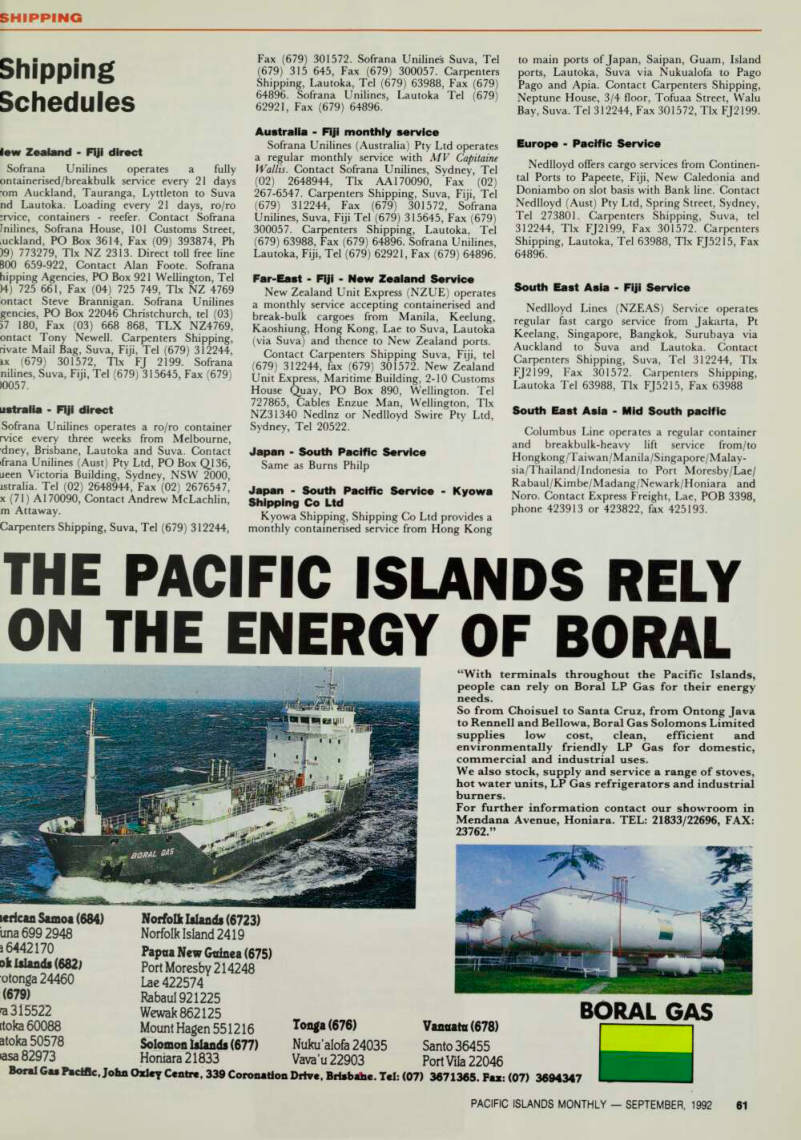
Schedules
lew Zealand - Fiji direct Sofrana Unilines operates a fully ontainerised/breakbulk service every 21 days *om Auckland, Tauranga, Lyttleton to Suva nd Lautoka. Loading every 21 days, ro/ro :rvice, containers - reefer. Contact Sofrana Inilines, Sofrana House, 101 Customs Street, lUckland, PO Box 3614, Fax (09) 393874, Ph )9) 773279, Tlx NZ 2313. Direct toll free line 800 659-922, Contact Alan Foote. Sofrana hipping Agencies, PO Box 921 Wellington, Tel H) 725 661, Fax (04) 725 749, Tlx NZ 4769 ontact Steve Brannigan. Sofrana Unilines gencies, PO Box 22046 Christchurch, tel (03) )7 180, Fax (03) 668 868, TLX NZ4769, ontact Tony Newell. Carpenters Shipping, rivate Mail Bag, Suva, Fiji, Tel (679) 312244, ix (679) 301572, Tlx FJ 2199. Sofrana nilines, Suva, Fiji, Tel (679) 315645, Fax (679) 10057. ustralia - Fiji direct Sofrana Unilines operates a ro/ro container rvice every three weeks from Melbourne, dney, Brisbane, Lautoka and Suva. Contact frana Unilines (Aust) Pty Ltd, PO Box Q 136, iieen Victoria Building, Sydney, NSW 2000, istralia. Tel (02) 2648944, Fax (02) 2676547, x (71) A 170090, Contact Andrew McLachlin, m Attaway.
Carpenters Shipping, Suva, Tel (679) 312244,
Fax (679) 301572. Sofrana Unilines Suva, Tel (679) 315 645, Fax (679) 300057. Carpenters Shipping, Lautoka, Tel (679) 63988, Fax (679) 64896. Sofrana Unilines, Lautoka Tel (679) 62921, Fax (679) 64896.
Australia - Fiji monthly service Sofrana Unilines (Australia) Pty Ltd operates a regular monthly service with MV Capitaine Wallis. Contact Sofrana Unilines, Sydney, Tel (02) 2648944, Tlx AA170090, Fax (02)
267-6547. Carpenters Shipping, Suva, Fiji, Tel
(679) 312244, Fax (679) 301572, Sofrana Unilines, Suva, Fiji Tel (679) 315645, Fax (679) 300057. Carpenters Shipping, Lautoka, Tel (679) 63988, Fax (679) 64896. Sofrana Unilines, Lautoka, Fiji, Tel (679) 62921, Fax (679) 64896.
Far-East - Fiji - New Zealand Service New Zealand Unit Express (NZUE) operates a monthly service accepting containerised and break-bulk cargoes from Manila, Keelung, Kaoshiung, Hong Kong, Lae to Suva, Lautoka (via Suva) and thence to New Zealand ports.
Contact Carpenters Shipping Suva, Fiji, tel
(679) 312244, fax (679) 301572. New Zealand Unit Express, Maritime Building, 2-10 Customs House Quay, PO Box 890, Wellington. Tel 727865, Cables Enzue Man, Wellington, Tlx NZ31340 Nedlnz or Nedlloyd Swire Pty Ltd, Sydney, Tel 20522.
Japan - South Pacific Service Same as Burns Philp Japan - South Pacific Service - Kyowa Shipping Co Ltd Kyowa Shipping, Shipping Co Ltd provides a
monthly containerised service from Hong Kong
to main ports of Japan, Saipan, Guam, Island ports, Lautoka, Suva via Nukualofa to Pago Pago and Apia. Contact Carpenters Shipping, Neptune House, 3/4 floor, Tofuaa Street, Walu Bay, Suva. Tel 312244, Fax 301572, Tlx FJ2199.
Europe - Pacific Service Nedlloyd offers cargo services from Continen tal Ports to Papeete, Fiji, New Caledonia and Doniambo on slot basis with Bank line. Contact Nedlloyd (Aust) Pty Ltd, Spring Street, Sydney, Tel 273801. Carpenters Shipping, Suva, tel 312244, Tlx FJ2199, Fax 301572. Carpenters Shipping, Lautoka, Tel 63988, Tlx FJ5215, Fax 64896.
South East Asia - Fiji Service Nedlloyd Lines (NZEAS) Service operates regular fast cargo service from Jakarta, Pt Keelang, Singapore, Bangkok, Surubaya via Auckland to Suva and Lautoka. Contact Carpenters Shipping, Suva, Tel 312244, Tlx FJ2199, Fax 301572. Carpenters Shipping, Lautoka Tel 63988, Tlx FJ5215, Fax 63988 South East Asia - Mid South pacific Columbus Line operates a regular container and breakbulk-heavy lift service from/to Hongkong/Taiwan/Manila/Singapore/Malay sia/Thailand/Indonesia to Port Moresby/Lae/ Rabaul/Kimbe/Madang/Newark/Honiara and Noro. Contact Express Freight, Lae, POB 3398, phone 423913 or 423822, fax 425193.
Far East - Mid South Pacific China Navigations New Guinea Pacific Line operates a regular container and breakbulk heavy lift service from Hong Kong, Taiwan, Manila, Singapore, Malaysia, Thailand to Port Moresby, Lae, Rabaul, Kieta and Honiara.
Cargo from the same eastern ports to the South Pacific Ports of Noumea, Santo, Vila, Papeete,
PagoPago, Apia, Nukualofa, Rarotonga and
Tarawa will be shipped via Japan or Busan on the monthly Bali Hai Service. Contact Steam ships Shipping, Port Moresby, PO Box 634, Tel 220283 or 220289.
Australia - New Caledonia - Fiji - Samoas - Tonga Pacific Forum Line operates a fully containerised service (general, reefer and ro-ro) from Sydney and Brisbane to Noumea, Lautoka,
Suva, Apia, Pago Pago, Nuku’alofa, Sydney.
Cargo centralised from Adelaide and Mel bourne. Contact: Pacific Forum Line, PO Box 796, Auckland; Union Bulkships, 333 George St, Sydney, Brisbane and Melbourne; Union Co, Lautoka; Pacific Forum Line, Suva, Nuku’alofa;
Pacific Forum Line, Apia; Polynesia Shipping,
Pago Pago. Sofrana Unilines operates a roro/ container service every three weeks from Mel bourne, Sydney and Brisbane to Noumea, Suva and Lautoka with transhipment to the Samoas
and Tonga.
New Zealand - Australia - PNG - Solomon Islands Pacific Forum Line operates a containerised and ro-ro service from Lyttleton, Napier and Auckland to Brisbane, Port Moresby, Lae, Honiara, Brisbane then to New Zealand.
Contact: Pacific Forum, Auckland, Christ church; Union Bulkships, Brisbane; Steamships
Shipping Port Moresby and Lae Sullivan Ltd, Honiara; Seabridge, Wellington.
NZ - Fiji Translink Pacific Shipping Fiji Agents are: Campbells Shipping Agency Ltd, Ph 314189 Fax 300144 Suva; Ph 662231 Fax 662251 Lautoka.
Auckland Agents: McKay Shipping Ph (9) 390229 Fax (9) 3032931. Tauranga Agents, seatrade agencies Ph (75) 754989 Fax (75) 758380.
NZ - Fiji - Pago - Apia - Nuk Translink Pacific Shipping operates a monthly sailing with Polynesian Link, which carries Dry Container, reefers and breakbulk cargoes. NZ Agents McKay Shipping Shipping AKLD Ph 390229, Fax 3032931. Fiji Agents Campbells Shipping Agency & ltd Ph 314189 Fax 300144 NZ - Noumea - Wallis - Futuna Translink Pacific Agency operate a container Breakbulk service once a month from NZ through Fiji and Noumea to Wallis & Futuna.
South East Asia - Fiji - Noumea - Papeete - Chile Service “Seaspac” A joint Chilean CCNI/CSAU Service offers a regular monthly sailing from Djakarta and Singapore to Noumea, Fiji, Papeete, and Chile. Cargo also federated to Singapore from Korea, Hong Kong, Taiwan, Malaysia, Bangkok. Fiji Agents: Campbells Shipping Agency Ltd, ph. 314189, Fax 300144.
Australia - Fiji Service Chief container services under Australia Pacific Island Line Unitize Sofrana and PFL vessels to provide a twice monthly, service from Australia. Fiji Agents Campbells Shipping Agency Ltd Ph 314189 Fax 300144. System
Agents Nedlloyd Swire Ph(2) 2512699. Mell bourne Yarra Shipping Ph (3) 6936300. Bris?
bane, Nedlloyd Swire, ph (7) 8321551.
Australia - Fiji - Noumea - Vila - Santa Marsmond Express Lines operate a breakbull service from Goodwood Island Australia to Fiji Noumea, Vila Santo and Honiara. Continuous receiving depots in Sydney and Brisbane enabld this vessel to bring cargoes from these parts. Fij
Agents Campbells Shipping Agency Ltd, ph
314189, Fax 300144. Brisbane Agents Ships pings & Marketing Ph (7) 2628082. Sydney
Agents Seabord Agencies (2) 3172325.
Australia - New Caledonia - Fiji - Hawaii ■ North America ACT Pace Pacific (ACTA Shipping) operate: a fully containerised/break bulk service every 17-20 from Melbourne, Sydney, Brisbane t( Noumea, Suva and Lautoka. The vessels cons tinue on to the West Coast of North America calling Honolulu at frequent intervals. Ships an ACT and ACT 12. Contacts: ACTA Pty Ltd Sydney Ph 2869666, Tx 121369, Fx 2869610!
ACTA Pty Ltd, Melbourne Ph 6112000, Ti 30949, Fx 6293055. ACTA Pty Ltd, Brisbane PI 2213116 m Tx 40719, Fx 2298143. SATO Noumea Ph 281122, Tx 3163, Fx 278532. Burn Philp Shipping, Suva Ph 311777, Tx 2168, Fj 301127; Burns Philp Shipping, Lautoka PI 60777, Tx 5146, Fx 65850.
West Coast off North America - Fiji - New Zealand Blue Star Line Pacific Coast Service operate: a fully containerised/break bulk service every 2; days from Vancouver, Seattle, San Francisco Los Angeles to Pago Pago, Suva and Nev Zealand ports. The vessels continue to call Suvt on the Northbound voyage from New Zealanc every fortnight to pick up Fiji exports such a: garments, fresh ginger, etc. for Hawaii and Wes: Coast of North America ports. Blue Star Lint also provides a through service to East Coast tc North America. Ships are Wellington Star Southland Star and California Star. Contacts: Blue Star Line, San Francisco Ph 9282026, T> 184925, Fx 6730355; Blue Star Line, Vancouvei Ph 6817300, Tx 0451326, Fx 6835797 Interocean Steamship Corp, Seattle Ph 68298201 Tx 321101, Fx 3437421; Blue Star Line, Los Angeles Ph 5970454, Tx 408564, Fx 59787101 New Zealand Line, Wellington, Ph 739029, T> 3583, Fx 4992468; New Zealand Line, Aucklanc Ph 390965, Tx 2556, Fx 3032039; Burns Philp Shipping, Suva Ph 311777, Tx 2168, Fx 301127 Burns Philp Shipping, Lautoka Ph 60777, T> 5146, Fx 65850.
Japan - South Pacific Service Bali Hai Line a joint service of China Mitsui OSK Line and NYK Lint operates a fully containerised/break bulk service I'om Korea, Japan to South Pacific ports on a ifnonthly basis serving ports of Pusan, Kobe ’Nagoya, Yokohama, Tarawa, Lautoka, Suva.
Apia, Pago Pago, Papeete, Nukualofa, Noumea
Vila, Santo. The ships are also fully specialised to carry vehicles on ro/ro basis. Ships are Cora Islander and Pacific Islander. Contacts: John Swire & Sons, Tokyo Ph 32309220, Tx 22248/ Fx 3239288; Nippon Yusen Kaisha, Tokyo PF 3284516, Tx 22236, Fx 32846332; Mtsul OSK Lines, Tokyo Ph 35877086, Tx 22266, Fx 35877732; Burns Philp Shipping, Suva (C/Islander) Ph 311777, Tx 2168, Fx 301127;
Carpenters Shipping, Suva (P/Islander) Ph
312244, Tx 2199, Fx 301572; Burns Philp: Shipping, Lautoka Ph 60777, Tx 5146, Fx -65850; Carpenters Shipping Ph 63988, Tx 5215, Fx 64896.
Advertisements & other items, pp. 61-64 (1 item)
The Pacific Islands Rely
ON THE ENERGY OF BORAL
m >icrican Samoa (684) ima 699 2948 i 6442170 ok Islands (682; otonga 24460 (679) ra 315522 [toka 60088 atoka 50578 •asa 82973 Norfolk Islands (6723) Norfolk Island 2419 Papua New Guinea (675) Port Moresby 214248 Lae 422574 Rabaul 921225 Wewak 862125 Mount Hagen 551216 Solomon Islands (677) Honiara 21833 “With terminals throughout the Pacific Islands, people can rely on Boral LP Gas for their energy needs.
So from Choisuel to Santa Cruz, from Ontong Java to Rennell and Bellowa, Boral Gas Solomons Limited supplies low cost, clean, efficient and environmentally friendly LP Gas for domestic, commercial and industrial uses.
We also stock, supply and service a range of stoves, hot water units, LP Gas refrigerators and industrial burners.
For further information contact our showroom in Mendana Avenue, Honiara. TEL: 21833/226%, FAX: 23762.”
Tonga(676) Nukualofa 24035 Vava’u 22903 Vanuatu (678) Santo 36455 Port Vila 22046
BORAL GAS
Bora! Gas Pacific, John Oxley Centre, 339 Coronation Drive, Brisbane. Tel: (07) 3671365. Pax: (07) 3694347
KYOWA
KYOWA
SHIPPING
CO., LTD.
Liner Service to Paciffic Islands
FROM OJAPAN
OKOREA
OTAIWAN
O THAILAND
TO OSAIPAN
©FEDERATED STATES
OF MICRONESIA
©MARSHAL ISLANDS
©AMERICAN SAMOA
©NEW CALEDONIA
©FIJI
©HONG KONG
©SINGAPOR
OPHILIPR
O MALAYSIA
oindoJßa, 5 sE p m
©GUA
©YAP
©PALAU
©WESTERN
©SOLOMON ISLANDS
HEAD OFFICE
6th Floor , Kikushima Bldg 2-3, Hamamalsucho 2-ch Phor>«: 03(437)2885 (Rep ) C«bl««: MARIQUEEN
OSAKA OFFICE
Dai San Fuji Bldg. 3-13. Itachibon 1-chome, Osak, Phon*: 06(533)5821 (Rep ) C«bl*»: MARIQUEEN
NATIONAL
LIBRARY OF AUSTRALIA
PACIFIC
SLANDS
Q N T H L
fifih€T PLfIC
For the benefit of our readers who would like to place a small classified advertisement in our magazine, Market Place will assist you in selling personal items, accommodation, real estate, boating or a service ... in fact anything you would like to sell to our over 50,000 readers.
Market Place Advertising Rates are structured to allow you to place as many advertisements as you wish, economically.
FISHING VESSEL
24) PROCESSING FISHING VESSEL, built
>B7, aluminium, 95’ (28m), DNV Class, very od accommodation for 15, Cat main engine, frig comprises blast tunnel, glazing room, ckaging room and 3 large storage freezers.
lARTER CRAFT MARINE, BC/15 Tedder Av,
nn Beach Q 4217 Australia. Phone -75-916334 Fax 61-75-329788
BARGE FOR SALE
15) LANDING BARGE, 90’ (27m), carrying pacity 120 tons. Twin GM BV7I main gines, good accom, large fuel & water cargo
pacity. CHARTER CRAFT MARINE, BC/15
jder Av, Main Beach, Q 4217 Aust. Ph. -75-916334 Fax 61-75-329788.
BOOKS
)liophile, a secondhand bookshop in Sydney, <een to buy good books on the Pacific. Also, rent book catalogue “Pacific & Southeast a” now available free on request, iliophile, 24 Glenmore Road, Paddington, W 2021, Australia. Ph. 61 2 331 1411. c 61 2 361 3371.
SMALL SHIP WANTED
ft to 150 ft older-style, general cargo ship nted. Please send details to: T.P.T. P.O. * 64, Mordialloc 3195, Australia, or Fax -5809416.
FLYING CAREERS
jht Attendants, Pilots. Career into Pacific, , Australia, Asia Airlines. Free info, Aviation ifessionals, Box 28051, Remuera, Auckd, Phone (64-9) 522-1330, Fax (64-9) 2-0380.
FOR SALE
nerator 270 KVA 3Ph 415 V: Mirroless/ jsh TL6 MX2. Auto start and switch over. As n unit $U545,000 Ph No. 61-3-8897-418.
IRIED SEA CUCUMBERS WANTED
afood importer is interested in buying ndfish (Metriatyla Scabra), Black Fish ;tinopyga Lecanora) on basis of monthly pment. Please contact Wealthy Ocean rporation, P.O. Box 36 503 Taipei, wan Telex: 19882 WOCO, Fax: (8862) 24455, Phone: (8862) 7661036.
FOR SALE
Black-lipped Mother of Pearl Shell. Large or small quantities. Contact MOP Fax: (682) 21-543.
DEVELOPMENT GUIDEBOOK
AVAILABLE NOW: Free guide to development of commercial projects on Pacific Island sites.
Suggestions, ideas, and guidelines for planning, design, construction and operation.
Special emphasis on alternate energy systems, ecologically responsible design. Call, fax or write for a copy, with no cost or obligation: TRB/Architects, Ltd., 1001 Bishop Street, Honolulu, Hawaii 96813. Phone (808) 528-2020; fax (808) 523-1264.
NEW BOOK!
TAKE NECESSARY ACTION authors Chris & Louise Harkness ex PNG. Available from publishers: Robert Brown & Assoc. 7 Atherton St Buranda Qld 4102 Australia. Hardcover 352 pages. Exciting PNG Highlands Fiction set pre-Independence era. $24.95 plus postage $5 Aust. $9.50 Overseas.
SCRAP METAL
Tall ingots operate from Brisbane, Australia and make frequent visits to the Pacific Islands which they have done for twenty-five years. We are buyers of Copper, Brass, Aluminium, Lead, Cable etc. Inspection no problems. Telephone 61 7 8922033. Fax 61 78922077.
TRAVEL GUIDES
Australian citizen planning to move to Fiji early 1993 seeks partnership or purchase small business in tourism or manufacturing preferably in western district.
Have considerable business experience and used to hard work.
Visiting Fiji July/August 1992.
John Gardner, 1/43 Beach Rd, Brighton SA 5048 Australia.
KAYAKS & ACCESSORIES
“YOUR KAYAKING SOURCE IN THE PACIFIC.”
* Scupper Pro, Prijon, Easy Rider, Aquaterra Kayaks. * Werner, Carlisle, Brand “X” paddles. * “Spex” amphibious eyewear. * Rip Curl wetsuits and more!
For more information on pricing and our products call: (805) 238-7994 Extension 4369 or write: KAYAKS Etc. P.O. Box 667 APO AP 96555, Kwajalein, Marshall Islands.
TATTOO SUPPLY
Everything. Write for price list. Tattoo Supply, P.O. Box 3068 Clontarf, Australia. Qld. 4019.
ADVERTISING
Thinking of advertising in the South Pacific?
Think no more!
Use Pacific Islands Monthly, the oldest and most widely circulated South Pacific news magazine Contact Salendra Narayan on Ph: (679) 304111 or Fax: (679) 303809
PACIFIC
SLANDS
IMONT H L Y I
MRRK6T PLRC6 CRN UJOAK
WOND6RS FOR VOU ...
Promote your business, or service, sell your household items, cars or heavy machinery etc.
ONLY AUSSI PER WORD.
NO COMPANY LOGO. NO
DISPLAY. NO BOLD TYPE.
Just forward your Advertisement together with payment to: PACIFIC ISLANDS MONTHLY "Market Place", P.O. Box 1167, Suva, Fiji.
CONDITIONS:
1. All Advertisements are subject to acceptance and approval of publisher. 2. Advertisements are published as space permits: we cannot guarantee date of insertion. 3. All advertisements must be prepaid and should be typed or printed clearly. 4. Deadline for receipt of advertisements is the 10th of the month prior to issue.
5. PACIFIC ISLANDS MONTHLY
assumes no responsibility for any service other than publishing paid advertisements in this section.
here we were first in * first 75 years.
1985 First place in the world’s most gruelling j rally: Mitsubishi Pajero/Montero overall winner Paris-Dakar in the unmodified 4WD production class. 1986 First for the year: Pajero/Montero.
Received 4x4 top award of the year from “4 x 4 Australia” and “Bushdriver” magazines, UK’s “What Car” magazine, and was voted Car of the Year in Spain. 1987 First automobile manufacturer in the world to be awarded the Blue Environment Seal by a jury: for the invention of an active carbon filter system for the fuel tank inlet. Evaporating fuel is trapped and channelled to the engine after starting. 1987 First needle-bearing roller rocker arm in the world. It significantly increases engine efficiency. In contrast to conventional rocker arms, the needle roller cuts power needed for valve control by 30 to 50 percent, reducing fuel consumption and improving torque. 1987 First car in the world with permanently integrated 4WD, 4WS, 4ABS and 4-wheel independent suspension: the Mitsubishi Galant GTi 16V Dynamic-4. 1989 First Import Car of the Year in the USA; the Mitsubishi Galant. Awarded by the prestigious “Motor Trend” magazine. 1990 First electronic trace and traction control system (TCL) in the world: fitted to the Mitsubishi Sigma. 1991 First linear air-fuel ratio sensor; the Mitsubishi Vertical Vortex Engine (MW).
Ensures optimal air-fuel mix at any revs. 1992 First, second and third places in the Paris-Cape Town Rally. The Mitsubishi Pajero/Montero sweeps overall honours.
1917 First Japanese passenger car to go into series production: the Mitsubishi Model-A with 35 ps. Room for seven passengers. 1918 First truck from Mitsubishi: four prototypes were developed, two three-tonners and two four-tonners. 1931 First Japanese vehicle diesel engine; the Mitsubishi 450 AD. The success of this direct injection engine made Mitsubishi the pacesetter in the commercial vehicle sector. 1932 First large bus: the Mitsubishi 846. Japan’s biggest (38 seats) and most powerful (100 ps) bus. It heralded the start of Mitsubishi’s production line buses. 1934 First Japanese 4WD passenger car powered by a diesel engine; the Mitsubishi PX33. 1935 First Japanese diesel-driven bus: the Mitsubishi 8D46. Powered by a newly developed pre-combustion type diesel engine. 1936 First Japanese diesel-powered truck in series production: the Mitsubishi TD 45. 1947 First service bus with electric drive: the Mitsubishi MB 46. 1950 First rear-engine Japanese bus in series production: the Mitsubishi Fuso Rl.
Delivered 130 ps and seats 76 passengers. 1951 First Japanese truck with 8 ton load capacity: it featured a revolutionary suspension, which became the forerunner of the air-suspension system for commercial vehicles. 1959 First Japanese tilt-cab truck with a load capacity of 8 tons: the Mitsubishi T3BO.
Today’s heavy-duty truck range traces its roots back to this medium to long-range hauler
1960 First Japanese family car aerodynamically designed in a wind tunnel; the Mitsubishi 500. Forefather of the Mitsubishi Colt. 1961 First prize in the annual Japan Machinery Academy Award for the 4DP diesel engine.
Regarded as the most efficient of its class. 1962 First self-loading truck in the world: the Mitsubishi Self-Loader. 1963 First high-speed sightseeing bus: the MARB2O. Equipped with the world’s most powerful turbocharged diesel engine (290 ps), and capable of 134 km/h. 1965 First Japanese fastback passenger car: the Mitsubishi Colt 800 1967 First 8 ton truck with a top speed of over 115 km/h: the TBlO. Powered by the 6IX, 2 engine. 1975 First vibration-free differential shaft in the world: the Silent Shaft technology.
Two differential shafts run with double revs, rotating a reciprocal crankshaft.
They ensure silky smooth running. Many leading competitors acquired the license from Mitsubishi. 1980 First Japanese turbocharged diesel engine for passenger cars: Astron 2300. First used in the Mitsubishi Galant. 1982 First automobile manufacturer in the world to offer a complete product range of turbo engines. Used in the Mitsubishi Colt, Lancer, Galant, Sapporo and Starion. 1982 First engine in Japan with modulated engine displacement: Orion 1400 MD.
First used in the Mitsubishi Lancer. 1984 First ranking automobile in Germany: the Mitsubishi Galant. Received the prestigious West German automobile award “Das Goldene Lankrad.”
The challenge of being first. It has always sparked a natural competitive instinct in Mitsubishi Motors. From Japan s first series production car, the Model-A, to the Galant Dynamic-4, the world’s first production car to incorporate both 4 wheel drive and 4 wheel steering, we have consistently pursued our goals with a singular determination to be the best.
But for all the pleasure we receive in being first
with technological breakthroughs, our primary goal
is not merely to finish ahead of everyone else. Rather, our pursuit of accolades is designed to keep us sharp and innovative, a necessity today as we face the challenge of building cars which are safer for both human beings and the environment.
Most recently, this has led to research in the HSR-111, an entirely recyclable car emphasising safety and environmental efficiency. Among its many advanced functions, the HSR-111 monitors the level of driver concentration, reads speed signs, and registers and corrects its position in relationship to both painted lanes and other vehicles on the highway.
Our research in the HSR-111 is only one of the ways Mitsubishi Motors is investing in a future which we believe will lead to many more firsts.
AMERICAN SAMOA: PACIFIC MARKETING INC. PO Box 698, Pago Pago, Tel 699-9140 / AUSTRALIA: MITSUBISHI MOTORS AUSTRALIA LTD. 1284 South Road, Clovelly Park, South Australia, Tel (08) 2757297 / FIJI: NIVIS MOTOR & MACHINERY CO LTD G PO Box 150, Suva, Tel 383411 / GUAM: GUAM INTERNATIONAL MOTORS INC. PO Box 8638, Tamunmg Guam, Tel 6467622 / NEW CALEDONIA: SOCIETE DTMPORTATION D'AUTO DU PACIFIQUESUD S.A. PO. 8 0x2548, Noumea, ■fel 274-144 / NEW ZEALAND: MITSUBISHI MOTORS NEW ZEALAND LTD. Private Bag Ponrua, Tel 237-0109 / NORFOLK ISLAND: BORRY'S PTY LTD. PO Box 169, Tel. 2114 / PAPUA NEW GUINEA: TOBA PTY LTD. PO Box 503 Tel 217-874 / SAIPAN; E'SAIPAN MOTORS INC. PO Box 569, Tel 234-7343 / SOLOMON ISLANDS: HARVEST PACIFIC LTD. G.PO. Box 823, Honiara, lei 30407 / TAHITI (FRENCH POLYNESIA): SOPADEP SA. POOox 1617, Papeete, Tel 427393 / TONGA: SITANI MAPI CO., LTD. PO Box 83, Nuku Alola, Tel. 24044 I VANUATU; SOCOMETRA VANUATU LTD, B P 06, Route de Lagon, Pori Vila, Tel 2314 / WESTERN SAMOA: MOTOR DISTRIBUTORS (SAMOA) LTD. PO. Box 576, Apia, Tel 20957
MOTORS