Pacific
Islands
Mo Nthly
Inside;
• VAT and its implications • PNG’s new government • The 23rd South Pacific Forum • Special Report: The cultural renaissance
August 1992
>iJH
r.'s«: k, rr j; Hawaii uss * ««* •*— *«•* • nz» ; N „ rt „, k
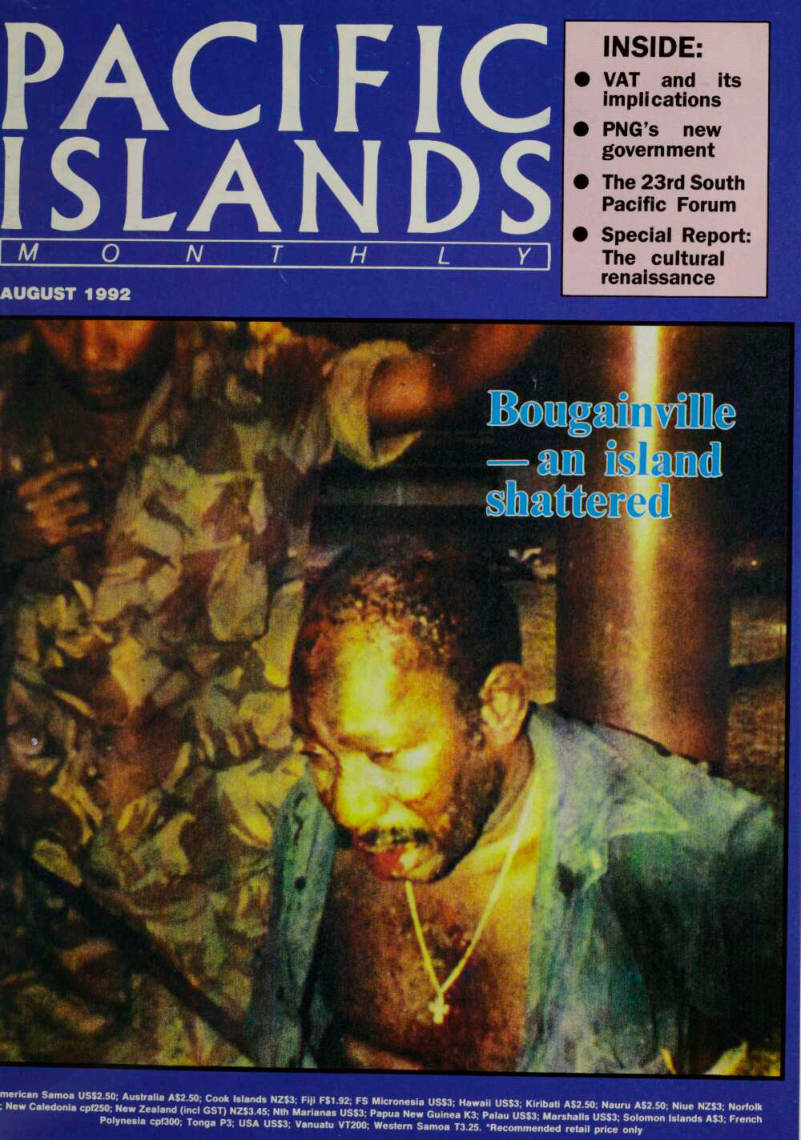
COVER; Aloysius Minangton, a Bougainvillean environmentalist, held captive by the PNG defence force troops in 1989. Minangton, who was researching the effects of Bougainville Copper Ltd, later died while still in captivity. Official cause of his death was pneumonia.
Advertisements & other items, p. 2 (1 item)
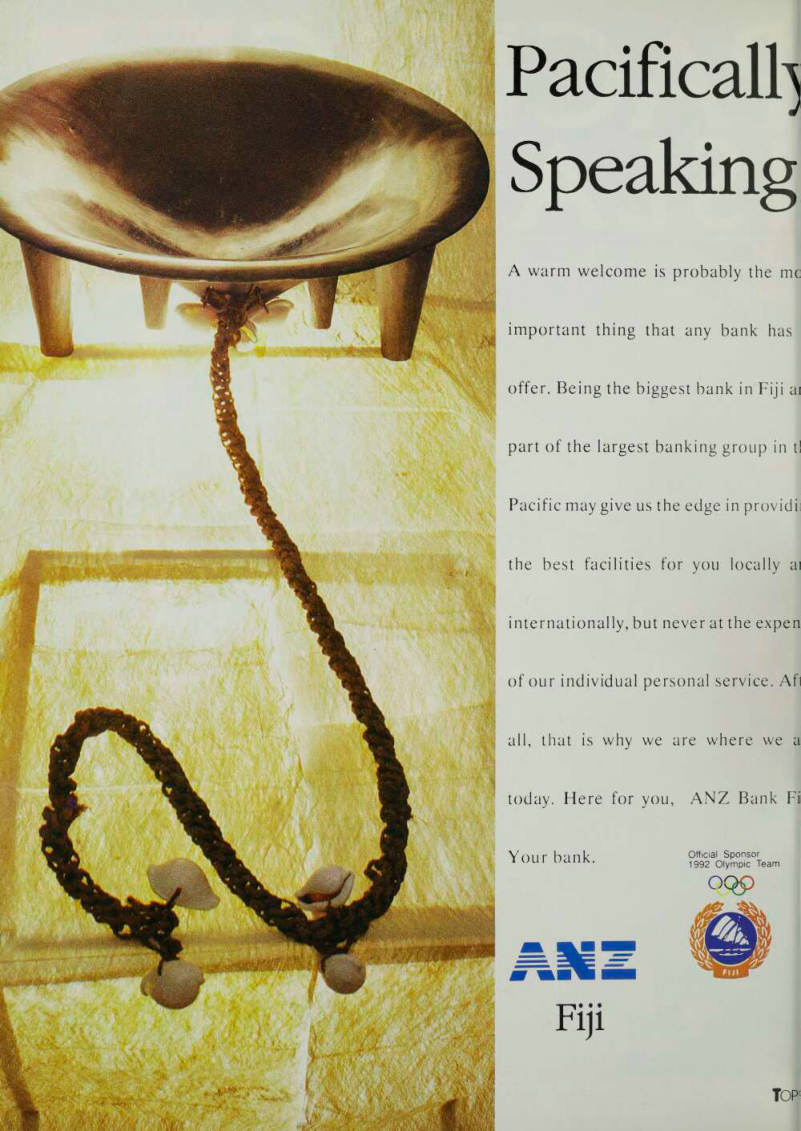
Pacifically
A warm welcome is probably the me i important thing that any bank has offer. Being the biggest bank in Fij i ai part of the largest banking group in tl Pacific may give us the edge in providii the best facilities for you locally ai nternationally, but never at the expen of our individual personal service. Afi all, that is why we are where we a today. Here for you, ANZ Bank Fii Your bank.
Official Sponsor 1992 Olympic Team
oqp
ANZ
mm ■pi • • •
Fiji
Pacific
Islands
Mo Nthly
Vol 62 No. 8
The News Magazine
August 1992
From The
Editor’S Desk 4
Headlines 5
Politics:
PNG’s new government 9 The man who is PM 11
Business:
"iji’s new tax proposal, and /vhat it means 13 Swallowing the bitter pill of reform 16
Afomen:
Sreating an awareness of women’s changing role 21
Bougainville:
Politics or humanity? 23 The enemy must leave 26
The Forum:
What about the real issues? 27 The Honiara decisions 29
Environment:
Low priority for AOSIS 32
Anniversary:
The Battle of Guadalcanal 33 Men who were there 35
Special Report:
The art of survival 37 Culture and commerce 39 Chamorro rights groups seek sovereignty 41 The lost world of Iran Jaya 43 A cultural awakening 45
Books:
The Polynesian King 47
Sports:
Up, up and away 49 The battle of the giants 50
Yachting:
Fellowship at Christmas Island 53
Shipping:
Shipping schedules 57
Columnists:
David Barber 19 Margot O’Neill 20 Alfred Sasako 48
Publisher: Gene Swinstead Editor: Mala Jagmohan Senior Writer: Martin Tiffany Correspondents: Al Prince, Angela McCarthy. David Morth, David Robie, Diana McManus, Dykes Angiki, -rank Kolma, Franck Madoeuf, lan Williams, Irene Yisbet, John Hunter, Karen Mangnall, Lovenia Enari, Jlo Vilisoni Macel Manua, Nicholas Rothwell, Pesi -onua, Richard Dinnen, Ulafala Alavao, Wally tiambohn.
Columnists: David Barber (Wellington), Futa Helu Tonga, covering the Pacific Islands), Jemima jarrett (Sydney), Margot O’Neill (Washington), lulian Moti (Pacific Law), Alfred Sasako (The : orum).
Business and Advertising Manager, Charlotte Thomas Advertising Sales: • Regional Sales (South Pacific); Salendra Narayan, Tel (679) 304111, Fx (679) 303809 • Sydney, Canberra: Bob Hill Media Represen tations, Tel (61-2) 4164245. Fx '6l-2) 4165064 • Brisbane: Robert Walker, Media House, Tel (61-7) 3710533, Fx (61-7) 371-8904 • Adelaide: Hastwell Williamsons Representations, Tel (61-8) 799522, Fx (61-8) 799735 • Auckland: McKay International Media Reps Ltd Tel (64-9) 4190561, Fx (64-9) 4192243 • Japan; Universal Media Corporation, Tokyo, Tel (3) 6663036, 6663094, Cable: UNIMEDIA Tokyo, Tx 2524665.
Founded 1930 (DSPS 952480). A Fiji Times Limited production.
Cover prices are recommended retail only. Regis tered by Australia Post, Publication No. NBP 1210. © Copyright Fiji Times Limited, 177 Victoria Parade, Suva. Fiji. Tel (679) 304111, Fx 679)
303809, Tx Fj2124.
Pacific Islands Monthly is published monthly by The Fiji Times Limited, a division of Nationwide News, 2 Holt Street, Surry Hills, Sydney, NSW 2010.
Send address changes to: • Pacific Islands Monthly, PO Box 1167, Suva, Fiji.
Typeset and printed by The Fiji Times Limited, 177 Victoria Parade, Suva, Fiji.
Bishop Zale: Bougainville representative
The Forum: line-up of leaders
Coming to grips with Bougainville
From The Editor's Desk
Last month’s South Pacific Forum meeting in Honiara in the Solomon Islands was a resounding success in terms of being cordial, non-controversial and discussing all the Tight’ issues. There were resolutions made on trade, econ omic advancement, environment, re gional law enforcement, and so on. But the burning issue in the region, the Bougainville dilemma, did not so much as even rate a mention.
Not only did it not even make it on the meeting agenda, the whole Bougainville question was cleanly swept under the carpet as if it did not exist. Despite being the hottest story in Honiara as far as the media was concerned, the regional leaders did not see it fit to discuss the issue, let alone make a resolution on it.
And that is not for a want of trying by the people of Bougainville. There was a formidable contingent from the island including Bishop Zale and Mike Forster and there was also Rosemary Gillespie’s account, backed by what she said were signed statements of the horrors the people of Bougainville suffered at the hands of the Papua New Guinea defence force troops.
Gillespie, a lawyer fighhting for hu man rights, spent time on the island and was, by all accounts, giving an indepen dent assessment of the situation there.
But our leaders preferred to refer to the whole Bougainville saga as an internal matter for PNG to sort out.
Given PNG has a point in not wanting to give in to the secessionist demands.
Once a precedent is set, there is no telling
where it will end. But it cannot be denied that there are claims of gross abuse of human rights coming from Bougainville.
PNG, of course, denies there is any truth in these claims. Bougainville people insist they are true.
So, on humanitarian grounds, wouldn’t it have made sense for the
Forum leaders to call for an independent observer mission to be sent to Bougain ville to decide once and for all how much truth there is in the stories? Wouldn’t it have made sense, on humanitarian grounds, to find to what extent the people of Bougainville are affected by the blockade imposed by PNG.
It does not take much imagination to work out what could happen to the island’s people without medical supplies and personnel; without basic essentials of education for the children now growing up there; and without links to the outside world.
From accounts Pacific Islands Monthly has received, people are surviving on a subsistence level only and relying on make-shift measures to cope with their problems. There are tales of people dying of curable diseases and minor infections because they do not have the medical back-up. They have, according to one account, gone back a hundred years in time from a once prosperous area with a bright future to a ghost town with no hope in sight.
What has surprised most people is the non-reaction the problem received at the Forum meeting. The situation, on our very own door-step and with no signs of abating, needs to be addressed. And what better forum to get an objective, independent hearing than the South Pacific Forum meeting last month. n I
Gillespie: told of horrors on Bougainville
Advertisements & other items, p. 4 (1 item)
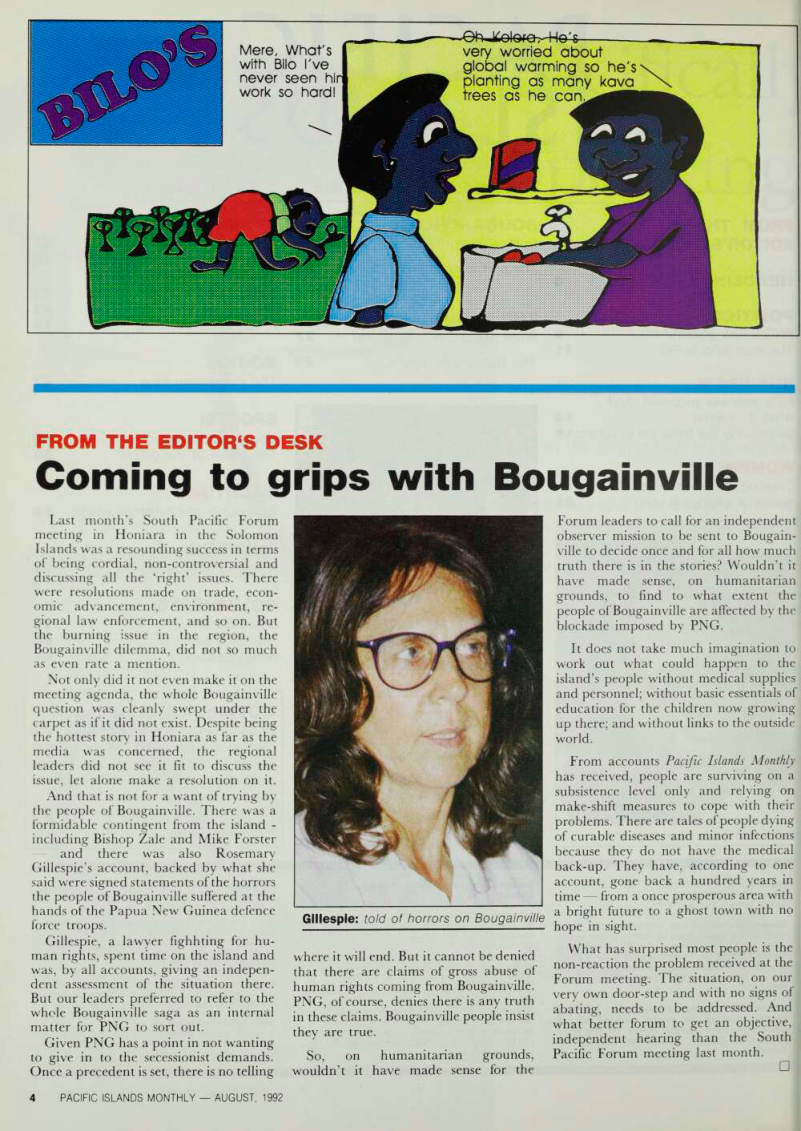
Mere, What's
with Bilo I've never seen hi work so hard! very worried about global warming so he's planting as many kava trees as he can, I
Diplomat
Headlines
Solomons
dies
The United Nations flag flew at half mast in New York when word reached the Secretariat of the fatal heart attack suffered by Francis Bugotu, the Ambassador of the Solomon Islands of the United Nations, the USA, and Canada. He was attending the South Pacific Forum in Honiara.
Born in Guadalcanal in 1937, he was educated in New
Zealand, Scot land and Eng land. An active Anglican church member, he be gan his working life as a teacher and then later graduated to be :ome permanent >ecretary of Edu :ation. Then he itarted a new ca 'eer as practi :ally the proto ype Pacific iiplomat. In 1976 he carried >ut post graduate studies md diplomatic
raining in Queensland and Canberra. From 1978 to 1982 he vas the Solomons’ secretary for Foreign Affairs and the imbassador to the rest of the world. From 1982 to 1986 he was ecretary general of the South Pacific Commission.
He became the Solomons’ ambassador to the United Nations n 1990. His concern for the welfare of the peoples of the South ’acific was reflected in his ventilation of their problems at the JN, and his colleagues were united in their shock at the news nd in their appreciation of a diplomat whose unassuming •oliteness was combined with real ability and sensitivity. □
Medical debts
settled
A scare in the Solomon Islands that the country’ would soon Lin out of medical supplies has eased. The Controller of Government supplies, Jim Katovai, said medical authorities in le country can now place orders for medical supplies through urchasing agents in Britain and Australia.
The earlier concern stemmed from the government not aying outstanding accounts with overseas agents. Katovai said xe government’s account with British Crown Agents had been :ttled. He said new orders may be placed soon when the □lomon Islands government and the Crown Agents agreed on $US 110,000 advance facility proposed by the company.
He said the accounts with Kerr Brothers of Australia also had een re-opened after outstanding accounts were settled, atovai said his division was giving priority to orders for icdical supplies over all other general supplies.
Bugotu: always an innovator
Strained
Vanuatu
relations
Australia has cancelled a naval visit to Vanuatu in protest at the expulsion of its acting high commissioner in Port Vila.
HMAS Jervis Bay and HMAS Darwin were due to visit Vanuatu from July 9 to 12, but Foreign Minister Gareth Evans said it would not be appropriate to proceed with the visit in light of the Vanuatu government’s actions.
Vanuatu has accused the diplomat, James Pearson, of interference in the state’s internal affairs and gave him 24 hours to leave the country. Senator Evans spoke with Vanuatu’s Prime Minister, Maxime Carlot, but failed to convince him to rescind the deicison which Australia claims was unjustified. But Carlot did agree to give Pearson an extra day for his departure.
Diplomatic relations between Port Vila and Canberra froze over Australia’s reaction to the Business Licence Act amendments. Vanuatu described the reaction as “hasty” and an interference in its internal affairs.
The amendment gave Vanuatu’s Finance Minister powers to refuse or revoke business licences without giving reasons and without having his decision challenged in court. Pearson was reported to have said its impact on the Vanuatu economy could affect Australian aid to the country.
In reply, Vanuatu’s deputy Prime Minister, Gethy Regenvanu, said policy matters to do with the coutnry’s economy remained solely with the Vanuatu government, exercising its internal, sovereign and constitutional rights.
He said he did not need “gratuitous explanations” on the
internationally accepted diplomatic practices under which
Australia’s concerns were chanelled.
deposits
Easter Islands
Mineral
A team of scientists from Chile and Germany is to search the sea-bed off Chile’s Easter Island for deposits of iron, copper and other minerals which are known to exist there. The deposits have been created by undersea volcanic activity and were discovered 10 years ago by a team from the German Institute of Geological Sciences and Natural Resources.
Some of the samples taken at the time were almost pure. The new survey will be to map out deposits which could be of commercial significance. A spokesman for the institute said many governments were eager to engage in deep-sea mining.
He said requests for mineral concessions elsewhere in the Pacific had already been made by France, Germany, Russia and Japan.
Independence
Hawaii
Tourism decline
Hawaii’s embattled tourism industry experienced more than a seven per cent decline in visitors in May, compared with May 1991. The decline came entirely from the US Mainland, from where visitor arrivals plummeted over 17 per cent in comparison with the previous year.
But vacationers travelling to Hawaii from other points including Pacific and Asian areas, Europe and Canada all increased significantly. Compared with a year ago, visitors from New Zealand grew almost five per cent, while those from Australia increased more than 27 per cent.
Total visitor arrivals for May this year was 552,000, compared to 513,000 the previous year. Hawaii tourism officials attribute part of the decline from the US to bargain airfares in effect throughout continental United States. As a result, they say, vacationers are travelling to other US and North American destinations instead of to Hawaii.
Other analysts suggest, however, that Hawaii might be pricing itself out of the mass tourist market, as costs of having a holiday there continue to rise. The decline in visitor numbers has also resulted in a decline in the number of airline seats available between Honolulu and US trans-Pacific gateways such as Los Angeles and San Francisco. □ ***
Independence
protest
Native Hawaiians marked American Independence Day celebrations with a demonstration to demand Hawaii’s independence from the United States. The rally took place in front of the Tolana Palace in Honolulu. Hundreds of protestors demanded the return of Hawaiian sovereignty, culture and land rights. Hawaiian militant Dennis Kanahele said the demonstrators were seeking to reverse history. Hawaii was proclaimed a republic under the protection of the United States in 1894 and later became a state of the US. □
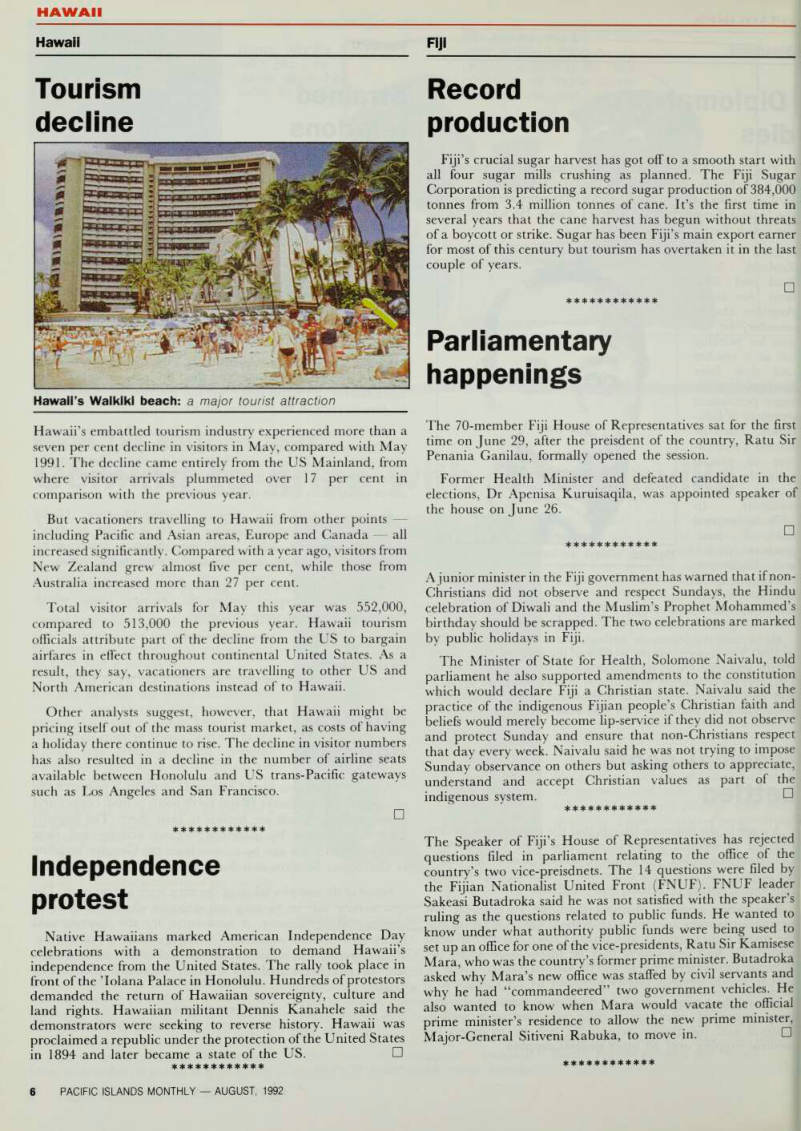
Hawaii’s Waikiki beach: a major tourist attraction
Parliamentary
Fiji
Record
production
Fiji’s crucial sugar harvest has got off to a smooth start with all four sugar mills crushing as planned. The Fiji Sugar Corporation is predicting a record sugar production of 384,000 tonnes from 3.4 million tonnes of cane. It’s the first time in several years that the cane harvest has begun without threats of a boycott or strike. Sugar has been Fiji’s main export earner for most of this century but tourism has overtaken it in the last couple of years. □ *♦*♦♦**♦♦*♦*
Parliamentary
happenings
The 70-member Fiji House of Representatives sat for the first time on June 29, after the preisdent of the country, Ratu Sir Penania Ganilau, formally opened the session.
Former Health Minister and defeated candidate in the elections, Dr Apenisa Kuruisaqila, was appointed speaker of the house on June 26. □ *** A junior minister in the Fiji government has warned that if non- Christians did not observe and respect Sundays, the Hindu celebration of Diwali and the Muslim’s Prophet Mohammed’s birthday should be scrapped. The two celebrations are marked by public holidays in Fiji.
The Minister of State for Health, Solomone Naivalu, told parliament he also supported amendments to the constitution which would declare Fiji a Christian state. Naivalu said the practice of the indigenous Fijian people’s Christian faith and beliefs would merely become lip-service if they did not observe and protect Sunday and ensure that non-Christians respect that day every week. Naivalu said he was not trying to impose Sunday observance on others but asking others to appreciate, understand and accept Christian values as part of the indigenous system. D *** The Speaker of Fiji’s House of Representatives has rejected questions filed in parliament relating to the office of the country’s two vice-preisdnets. The 14 questions were filed by the Fijian Nationalist United Front (FNUF). FNUF leader Sakeasi Butadroka said he was not satisfied with the speaker s ruling as the questions related to public funds. He wanted to know under what authority public funds were being used to set up an office for one of the vice-presidents, Ratu Sir Kamisese Mara, who was the country’s former prime minister. Butadroka asked why Mara’s new office was staffed by civil servants and why he had “commandeered” two government vehicles. He also wanted to know when Mara would vacate the official prime minister’s residence to allow the new prime minister, Major-General Sitiveni Rabuka, to move in. D
dissipating
Australia
Acid's
concern
Australia’s umbrella trade union organisation, the Austra lian Council of Trade Unions, says the federal government’s
Broadcasting Services Bill threatens investigative journalism.
The ACTU president, Martin Ferguson, has written to all members of the Federal Parliamentary Labour Caucus calling on them to amend the proposed legislation. Ferguson says the bill gives the proposed Australian Broadcasting Authority unprecedented power to demand that journalists reveal their sources. In a letter, Ferguson goes on to describe the authority’s powers as draconian and unparalleled. He says he is far from assured by Communications Minister Bob Collins, who has said the authority will take a prudent and reasonable approach in using its powers. □ ***
Indigenous
rights
The descendents of South Sea islanders taken to Australia as indentured labourers last century are taking their grievances to the United Nations. The estimated 20,000 islanders want formal recognition as a black minority.
The islanders’ spokesman, Nasuven Enares, has been invited to speak at July’s session of the United Nations Working Group Dn Indigenous Populations in Geneva. Enares said she would tell the UN the Australian government had ignored her people >ince they were taken there a century ago as virtual slaves.
She said islanders had suffered the same discrimination as the \borigines but without the benefits of recognition as a black ninority. Enares will ask the UN to pressure Australia to iccord islanders the same access to education, housing and velfare. □ ***
El Nino
dissipating
Scientists at Australia’s National Climate Centre say the Irought which has ravaged crops and cost hundreds of millions if dollars in the Asia and South Pacific region appears to be ver. They said it was because the climatic phenomenon known s El Nino was dissipating. The scientists said the world was ow seeing the declining phase of El Nino which has been fleeting global weather patterns since early last year. They aid Australia could expect a quick recovery from drought
onditions. □
democrats’
nove
he Australian Democrats will move to refer an investigation ito the matters arising from the Marshall Islands affair to a •int parliamentary working group on political ethics.
The proposal, approved at a Democrats meeting, would suit in a code of conduct and was likely to meet with the Dproval of the Keating government which is keen to limit rther political damage from the Marshall Islands affair.
Under Democrat leader John Coulter’s proposal the ethics orking group would report on its findings during the first tting of 1993. □
legislation
Western Samoa
Fire
NEW legislation by which the Western Samoan government is seeking to protect itself from lawsuits resulting from the negligence of its own fire brigade has met with strong criticism.
Opposition MP Leseisiuao Palemene said the government was deserting its duty.
The fire brigade, which falls under the responsibility of the prime min ister’s department, lacks money and resources and suffers from poor infrastructural support, including a lack of necessary water pressure in most parts of the capital, Apia, to put out fires.
The poor state of the fire brigade is potentially dangerous as many of the old buildings in the city are made of wood. Prime minister Tofilau Eti Alesena defended the legislation say-
ing the protection was needed against the possibility of major fire related payouts due to the action or inaction of firemen.
Tofilau said the government would be in difficulty if it ended up with multi-million tala claims. One of the country’s biggest damage awards was made in an out-of-court settlement which cost the government and Mobil Oil S320,000. □
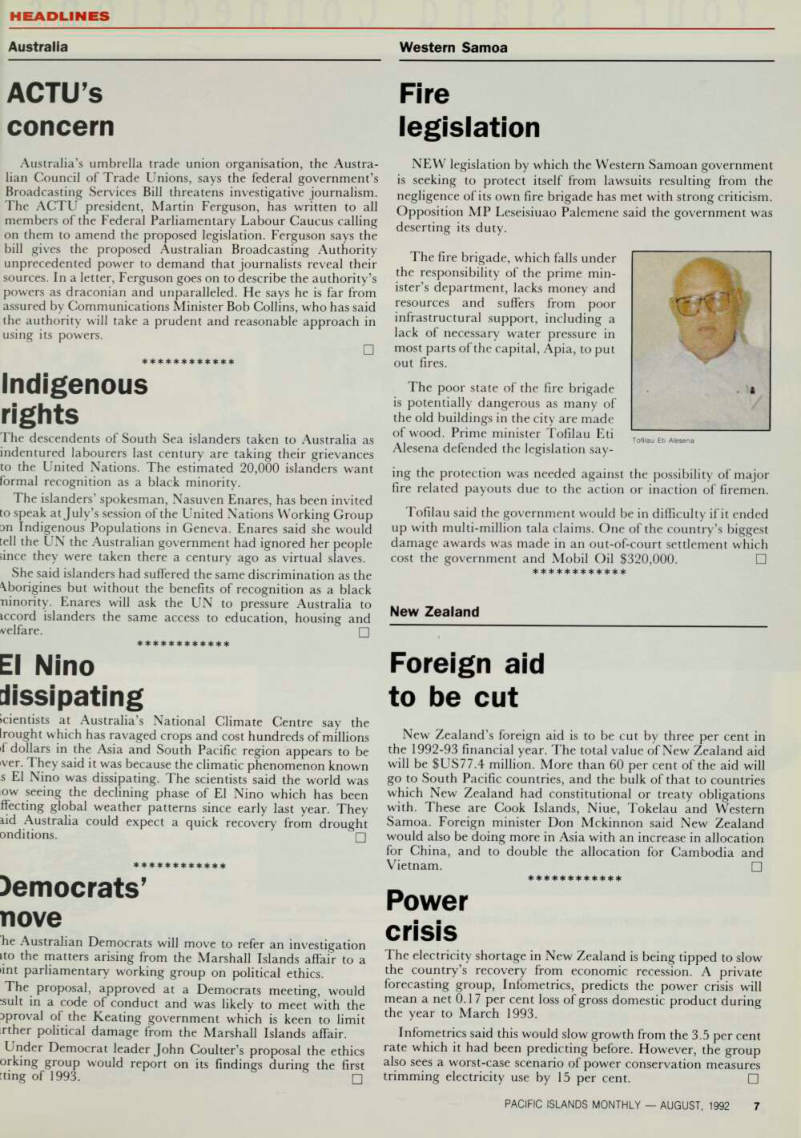
Tofilau Eti Alesena
Foreign aid
New Zealand
to be cut
New Zealand’s foreign aid is to be cut by three per cent in the 1992-93 financial year. The total value of New Zealand aid will be 5U577.4 million. More than 60 per cent of the aid will go to South Pacific countries, and the bulk of that to countries which New Zealand had constitutional or treaty obligations with. These are Cook Islands, Niue, Tokelau and Western Samoa. Foreign minister Don Mckinnon said New Zealand would also be doing more in Asia with an increase in allocation for China, and to double the allocation for Cambodia and Vietnam. □ ***
Power
crisis
The electricity shortage in New Zealand is being tipped to slow the country’s recovery from economic recession. A private forecasting group, Infometrics, predicts the power crisis will mean a net 0.17 per cent loss of gross domestic product during the year to March 1993.
Infometrics said this would slow growth from the 3.5 per cent rate which it had been predicting before. However, the group also sees a worst-case scenario of power conservation measures trimming electricity use by 15 per cent. □
Advertisements & other items, p. 8 (1 item)
Cable & Wireless
Cable and Wireless began keep-
ing people in touch around the
world more than a century ago. Today
while the technology has changed,
the tradition of service to our customers in the
South Pacific is just the same.
We work in partnership with Governments,
dedicated to meeting the need of communities and businesses to stay in touch. From one island to the next or to the other side of the world, the message is the same: Cable and Wireless is
your South Pacific
connection bringing the
islands together.
CABLE & WIRELESS
Asia Pacific Head Office Cable and Wireless pic Cable and Wireless (Pacific) Limited 22 nd Floor Office Tower Convention Plaza 1 Harbour Road Hong Kong Tel: (852) 848 8620 Facsimile: (852) 868 5195 Australia Cable and Wireless (Australia) Pty Ltd PO Box 675, Double Bay NSW 2028 Sydney Australia Tel/Fax (61-2) 362 3625 Fiji In association with the Government of Fiji Fiji International Telecommunications Ltd.
P.O. Box 59 Mercury House 158 Victoria Parade Suva Fiji Tel: (679) 312933 Solomon Islands In association with the Government of the Solomon Islands Solomon Telekom Company Limited P.O. Box 148 Honiara Solomon Islands Tel: (677) 21576 Tonga Cable and Wireless pic Private Mail Bag 4 General Post Office Nuku Alofa Tonga South Pacific Tel: (676) 23499 Vanuatu In association with the Government of Vanuatu and France Cables et Radio Vanuatu International Telecommunications Ltd.
P.O. Box 164 Port Vila Vanuatu Tel: (678) 22185
PNG’s new government
Politics
Over 2.3 million Papua New Guineans went to the polls on June 13 to elect its fourth post-independence parliament.
When the results were declared on July 13, the country had voted out the majority of sitting members of parliament. Frank Kolma reports on the elections and the challenges facing the new government.
PAIAS WINGTI was re-elected prime minister on the casting vote of the speaker when Papua New Guinea’s fourth post-independence parliament met on July 17. For the first time parliament was tied 54-54 in the selection for prime minister. Earlier, speaker Bill Skate himself had won only narrowly 55 votes to 54.
A senior public servant said soon afterwards ; “Fifty-four is no working majority”. The passage of important bills will be difficult. Wingti’s first test is only four months away when he will need to pass his budget.
When he announces his ministry and under-secretaries on August 3, many disgruntled members of parliament will already be thinking of switching sides to the opposition and preparing a vote of no confidence in 18 months.
This is Wingti’s third term as prime minister, having first won government on November 21, 1985. He later gained government after the 1987 elections and then lost in a motion of no confidence to aut-going prime minister Rabbie Namaliu.
Announcing a caretaker ministry com prising party leaders in his camp, Wingti Dromised his team would manage the xmntry in an “open and honest way”.
Fhe full ministry will be announced on \ugust 3. He said : “Let me assure all of PNG that we have a cohesive team, a earn that has governed before and will govern this country for the next five /ears. This is nothing new to me. The last ime I lost was not through the people )ut the floor of parliament in a motion )f no confidence because I fought :orruption.”
Outgoiung prime minister Namaliu
aid after his defeat, he would consider lis leadership of the Pangu Pati. “It’s a lecision I will have to consider over the icxt few days. I said yesterday that my amily will obviously be a major con ideration.”
Namaliu accused Wingti of using icavy-handed tactics, denying elected aembers freedom of speech and keeping hem under guard. In the lead-up to the
formation of the government, coalition members comprising Pangu Pati, People’s Action Party, Melanesian Al liance and indpendents led by former finance and planning minister Paul Pora camped in Madang on the northcoast.
The former opposition, comprising Wingti’s People’s Democratic Move ment, People’s Progress Party, govern ment defector, League for National
Advancement and a collection of inde pendents camped in the Mine Bay province on the eastern tip of the mainland.
There was speculation both Namaliu
and Wingti’s leaderships were challenged
at the camps, mainly from within their own parties. The close contest for the prime minsiter’s post again indicated the severe attrition among members.
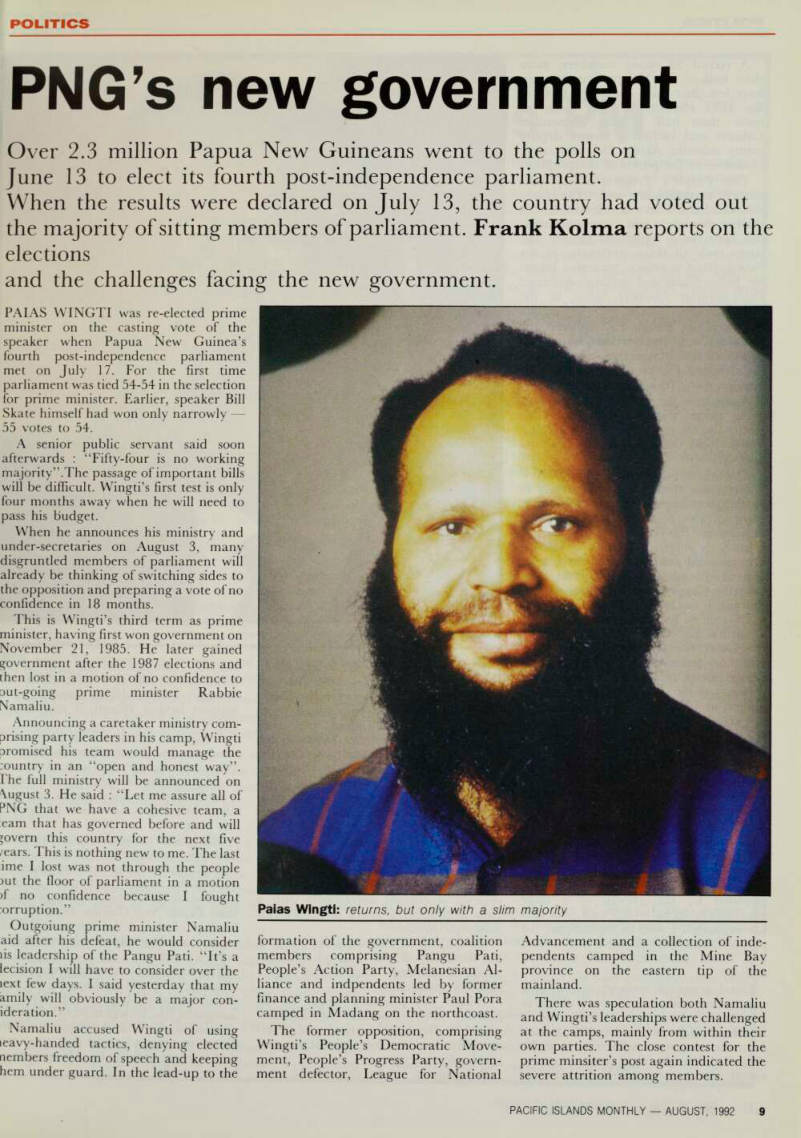
Palas Wingti: returns, but only with a slim majority
A record 59 sitdng members, more than half of the 109 parliamentarians have lost their seats, compared to 45 in the 1987 elections. Fifteen ministers, more than half of the 28-member Cabinet and including former deputy prime minister Akoka Doi, also were casualties to the power of the people.
The People’s Progress Party per
formed exceptionally well. The party bounced back from a humiliating loss in the last election to win six new members this time. In a significant victory, the party took all three electorates in the New Ireland province, returning leader Sir Julius Chan and dethroning Pangu Pad minister Michael Sinan in the process.
The ruling Pangu Pad suffered the worst defeat in the elections, losing half of the 30 sitting members who entered the elections. Fifteen retained their seats and the party picked up four new ones.
Apart from the narrow victory of out going prime minister Namaliu in his electorate, the party lost its joint deputy leader John Giheno and four Cabinet ministers.
The fourth parliament of Papua New Guinea, just elected is said by many to be the most important for the country.
Most of the country’s large resource projects are just coming on stream. The country is set to becoming a leading international gold producer. Its copper and silver exports, even without Bou gainville Copper’s contribution, are sig nificant. It has known petroleum reserves of 200 million barrels and vast quantities of natural gas, commercial production of which is still being debated. By 1993 and 1994, an estimated K 2 billion will be earned from minerals and petroleum exports alone, compared with K 636 million in 1990.
Yet it is feared much of this money will not benefit the majority of the people of Papua New Guinea. In the countryside access to drinking water, energy, trans port and other facilities is limited.
Education and health facilities are totally inadequate and declining in quality throuhgout the country. Build ings, roads and bridges, much of them from pre-independence days, are in need of maintenance.
These problems have been com pounded by the growth of a large government sector which took over and has expanded a web of regulations, the predominant effect of which has been to bog down investment and economic
activity.
Good economic policies of the new government and particularly its ability to implement these policies will decide whether much of the windfall money from the resource developments can be chanelled into the right areas to create longer term employment opportunities.
PNG may have, in the Wingti/Chan partnership, a good deal. Their first and second terms in office between November 1985 and July 1988 emphasised economic development. Indeed, they took over an economy the International Monetary Fund reported was “on the brink of collapse” in 1985. Eighteen months later the World Bank commended government economic policies as being on track to provide a sound basis for development.
But the resource developers are more inclined to view the new administration with suspicion. In election campaigns, Wingti promised radical changes and reviews of current agreements with a view to processing much of PNG’s raw materials on-shore.
He said log exports would be banned, the feasibility of gold and oil refineries would be seriously studied and copper smelters considered.
Wingti has promised much of the mnoney from resource development would be diverted to agricultural development, towards free education and rural infrastructure.
Bougainville sticks out like a sore
thumb. Although on the eve of the formation of the new government the Bougainville Republican Army threw its support behind Wingti, it may live to regret that.
Wingti has also stated his government would review the situation on Bougain ville and discuss the various options carefully. Once an option is selected, he would order every government agency to direct its energies towards implementing the plan.
His options are to ask for and continue dialogue and continue the present very slow filtration of restoration programs; to send in the troops to attempt a military solution; or give the island independence from Papua New Guinea. With the first having failed and the last option fairly remote, a military solution looms danger ously attractive.
The irony is that getting the approval of parliament will perhaps be the new prime minister’s biggest test. With the margin he has, he will need to talk to the opposition closely and compromise a lot or try to attract several defectors from that camp in order to be able to perform his task well. D
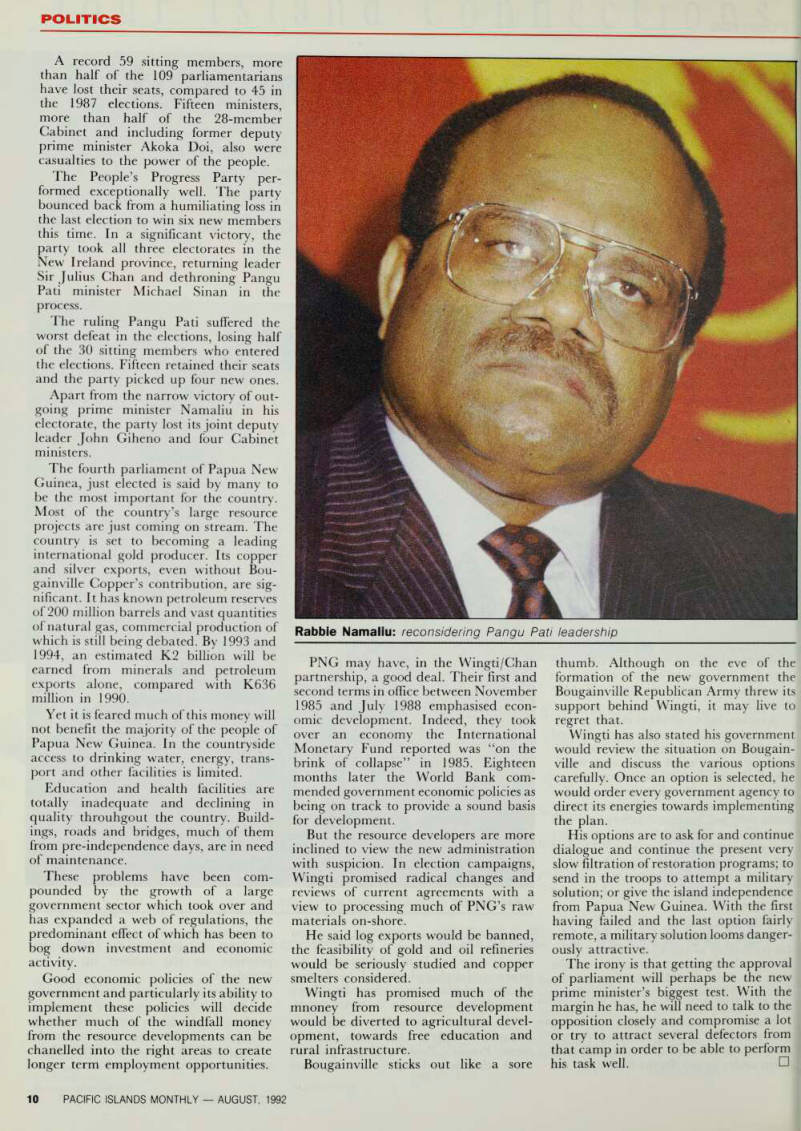
Rabble Namaliu: reconsidering Pangu Pati leadership
The man who is PM
By Frank Kolma
NEW PNG prime minister Paias Wingti is four years younger than his predecessor Rabbie Namaliu. But for the two former Pangu Pati colleagues, leadership styles are very different.
Namaliu is a committee man, always ready to compromise and reach a concensus. Wingti is more decisive, choosing to deal witth a problem with the minimum of consultaion very quickly. Wingti conducts the consultation before he is faced with a problem.
During his short term as prime minister, Wingti banned overseas trips for all his ministers except the finance and foreign affairs ministers. But he travelled extensively to every part of the country talking to everbody who shook hands with him.
“What’s happening here? Have you heard about me?
What are the major problems around here?” These were typical questions he would ask people.
He hated and shied away from the Port Moresby cocktail parties. He said lobbyists and self-interested and pompous individuals with very little concern for the country frequented these parties.
But he was interested, none-the-less, in what went on. An officer would be sent along to more important gatherings.
Journalists would find themselves being interviewed about public opinion or reaction to a government decision. Church leaders and selected business leaders were consulted.
In March 1985, when Wingti broke ranks with the Pangu Pati with 19 others, the International Monetary Fund reported PNG’s economy was on the brink of collapse.
Wingti regained government on November 21, the same year, after moving a motion of no confidence in former leader and political mentor, Sir Michael Somare.
He made economic development the top priority of his government and paid particular emphasis on agriculture. He divided departments and ministeries into economic, infra structure and social ministeries, and gave them attention in that order.
Wingti chose one of the country’s most able and ix perienced finance ministers, Sir Julius Chan, to be his cputy and to head his economic drive. Eighteen months ater, the World Bank reported PNG’s economic policies were lound and on track to form the basis of rapid economic growth.
Due to Bougainville and low commodity prices the two nstitutions were back in 1989, bailing out the country and imposing massive restructuring, the results of which will not >e known until 1995. Both Wingti and Chan abhorred the overseas borrowings. Loan repayment was the single biggest xpenditure item of each of their three budgets.
Wingti kept telling people on his village travels : “The aoney is in the land. Turn to the land. If you want
something, you contribute 50 per cent in hard work and the government will contribute 50 per cent in infrastructure.”
The message worked. And he kept his word. When coffee rust was discovered in the highlands, he called a state of emergency and poured millions of kina into the coffee industry to combat and rehabilitate small growers’ plan tations. The operation was successful in most respects but the establishment of the Coffee Development Agency and its political overtones in the 1987 elections caused concern and the Namaliu government amalgamated the independent agency under the new Coffee Industry Corproation.
Wingti banned overseas travel and demanded performance from his ministers to the point of being absurd. He instructed ministers once not to go to discos and not to get drunk in public. He demanded equal performance from public servants, choosing to direct rather than be guided by advice from them.
In foreign policy, Wingti chose to deal with close neighbours first and then with the outside. He told Australia the loose arrangements between various agencies of the two governments should be brought together under one umbrella.
It resulted in the Joint Declaration of Principles.
The same was applied to Indonesia with the signing of the Treaty of Mutual Friendship.
Wingti initiated the Melanesian Spearhead Group among Solomon Islands, Vanuatu and PNG, now under threat by the spill-over effect of Bougainville troubles into the Solomons.
But the Wingti of 1985 may not be the same as the Wingti of 1992. He seems to have lost much of the enthusiasm, spending a lot of time with his businesses. But he has not lost his appeal with the people. The charismatic appeal the bearded highlander has had continues to hold his listeners’ attention at any forum he chooses to address.
Wingti is one of 18 brothers and sisters born of the many wives his Western Highlands Jiga chieftan Wingti Wimpai had. He entered the University of Papua New Guinea to study “a bit of everything” from politics, arts to economics.
Wingti left after three years and tried his hand at peanut planting before he contested elections in 1977 for the Hagen Open seat. He scored 2900 votes to defeat his nearest rival by 300 votes. He stood on a Pangu ticket in 1982 and won again by 2000 votes.
He was made Pangu Party deputy leader and headed several ministeries, Wingti headed a number of radical elements in the Pangu camp in the likes of Nahau Rooney and Gabriel Ramoi. But he judged there was far too much competition for Somare’s job. He had to get out if he had any hope of leading a party.
A clever strategist, he bided his time until discontent was high in Pangu, before making the break. He succeeded.
In 1987 he switched from Hagen Open to Western Highlands regional. A province that had returned him with
an overwhelming majority.
And they did the same this year again. □
Advertisements & other items, p. 12 (1 item)
our special Melbourne Cup Package
We're coming over to the Pacific with
to give you an opportunity to
This exciting package consists of: * 1 Melbourne Cup Sweep Ticket - First Prize $500,000 AUD * 1 Instant Lottery Scratch Ticket - First Prize $500,000 AUD * 1 entry in the Caulfield Cup Sweep using your same sweep number if you order before October Ist 1992. - First Prize $lO,OOO AUD TAX FREE.
So don't hold your horses! Send this coupon with either cash, your credit card details, or bank cheque to us NOW: TMS. THE MAIL SERVICE. Suite 5, 55 Flemington Road, North Melbourne, Victoria, 3051. Australia.
G.P.O. Box 2937 DD, Melbourne, 3001. Australia. Fax: Country Code 61/3/329 2166.
The $25 U.S. accepted in Cash, Bank Cheque, Credit Cards or a Postal note!
Please tick - 1 PACKAGE FOR $25.00 U.S!
Please Print - Credit Card Type Card Expiry date Card no Signature Name Address Post Code Phone Number (if available) We will send you a Melbourne Cup Sweep Ticket, an Instant Lottery Scratch Ticket.
If you order before OCTOBER Ist you will also receive written confirmation of your inclusion in the Caulfield Cup Draw.
Fiji’s new tax proposal,

Business
Fiji’s new tax proposal, and what it means
Fiji implemented its
Value Added Tax scheme in July, but the fight against it continues
By Asha Lakhan
A GENERAL consumption tax hit the stores of Fiji last month despite heavy pressure on the new Rabuka government to at least defer its implementation, if not scrap it altogether. Known as the Value Added Tax, it imposes a levy on almost all goods and services in the country, with a few exemptions. It came into effect after a year of government publicity describing it as “good for you, me and Fiji”.
With the implementation of VAT, Fiji ;wallows yet another dose of the Interna ional Monetarey Fund/World Bank Drescription for Third World countries in
inancial problems.
Critics of VAT claim the Fiji govern nent was under severe financial con traints to introduce VAT. It took over >ower to find the national treasury drtually bankrupt and unable to service ts overseas debts. It had little option but o bow to World Bank pressure, making arther loans dependent on a continu tion of IMF/World Bank recommended tructural adjustment programs, includ ig VAT. The program, SAP as it is ecoming known, is the standard pana ea recommended by these two financial istitutions for ailing Third World econ mies. It entails a “liberalisation” policy imed at export oriented growth and
involving trade and market deregulation, tax reforms, cutbacks in government expenditure and privatisation.
The overall theme of VAT is to reduce the anti-export bias and it entails a move away from a direct to an indirect tax base. It shifts the indirect tax base from imports to domestic consumption. Before VAT, direct taxes accounted for 43 per cent and indirect taxes 57 per cent of Fiji’s tax revenue. Individual income taxes made up 26 per cent of total tax mco ™ e for government and corporate ' ax 15 P er “ nt In ‘"direct taxes, import “ ut y contributed nearly one-third (34 P er cent ) °* t ” e revenue - VAT, according to the Fiji government, will be revenue neutral; it replaces tlie 10 per cent customs duty, excise duty and the hotel turnover and miscellaneous turnover taxes. In 1990 these four taxes contributed just over $295 million in government revenue Although the governmen t has not said how much VAT is expected to collect, if it is to be revenue ne ‘' tral ltwlll have to raise at least $295 m ! lh ° n . l I " truth > however, the sums raised will have to be more than this if the tax is to make up for loss of additional government revenuee from a 7.5 per cent reduction m company tax (from 37.5 to 30 per cent) in line with the income tax reductlon ( from 40 to 30 per cent).
Critics of VAT in Fiji see it as a highly
regressive form of taxation which shifts the tax burden from those most able to pay to those least able to do so. To use a standard cliche, the argumennt is VAT will “make the poor poorer and the rich richer”, A close look at concessions granted by the former minister of finance in Fiji’s previous interim government, Josevata Kamikmaica, shows the largest benefici aries of tax concessions which came in line with VAT are those in the higher income brackets. People earning at the threshold level of $4500 gain 0.5 per cent from the reudction in monetary terms this means an addition of about 47 cents in the weekly pay packet.
Fiji’s average income is between $6OOO to $7OOO a year this group benefits to the tune of 4.7 per cent and 6.2 per cent respectively, while those earning 515,000 and over get more than a 10-per-cent reduction in tax, with increases in the pay packet ranging from 523 a week to SIOS for those earning up to 583,000 a year.
Fiji trade unionist and Fiji Labour
Party leader Mahendra Chaudhry,
speaking in parliament during an Oppo sition motion to defer VAT until it could be debated in parliament, pointed out that a person earning more than 545,000 would have to buy 530,000 worth of goods a year before he began to feel the pinch of VAT, after a S3OOO a year tax concession. In comparison, a person earning 53500 a year, or on a weekly pay of $7O, would spend an extra S3OO a year because of VAT, making him worse off by 525 a week.
A person earning $5200 or SIOO a week would get a tax concession of SI 15 a year but would spend S 8 a week or $4OO a year more because of VAT. He will be ou * P oc^et b Y about S3OO a year.
Besides, government s tax concessions must be viewed against the scrapping of a lot of previous allowances such as the 5255 personal rebate, dependent allowance of SlOO for a parent and Sl5O for brother or sister, the $750 allowance for
people over 55, $5OO home purchase on interests and the $5OO cyclone reserve cover, among others.
The most vehement criticism of VAT arises from the premise that the poor, or those in low income groups spend a greater proportion of their income on food and other essentials of life compared to those in the higher income brackets.
Says Father Kevin Barr of the Fiji Forum for Justice, Peace, and Integrity of
Creation, and one of Fiji’s most ouspoken critics of VAT : “A consumption tax as a share of income falls sharply as income rises. Poor people have to spend all the money they have on the necessities of life.
Middle income people spend most of what they earn. But the rich people have plenty of money left over after they have purchased all the goods and services they want.
“This then creates vertical inequity, that is, the gap between the rich and the poor increases; as well as horizontal inequity, those with more people to support pay more tax than those on the same income with less people to sup port.”
The regressivity of VAT is borne out also through statistics provided by the report of the former interim govern ment’s task force on poverty last year.
The report found the poor, 10 per cent of households with the lowest incomes, spend 66 per cent of their weekly income on food, beverages and tobacco. While the 10 per cent of the top income group spend only 43 per cent of their income on essential items.
The report established the poverty line at $5OOO a year. According to 1989 Fiji income statistics, this places about 23 per cent of Fiji’s workers living at or below the poverty line. It had recommended research be undertaken on the impact of VAT on the poor.
Statistics from Canada, which intro duced a seven-per-cent general sales tax in 1991, show families earning below 515,000 spend almost seven per cent of their income on GST. At the same time those earning above $300,000 spend only two per cent of their incomes.
Understandably the most vocal oppo sition to VAT is from trade unions, church groups and non-government social welfare organisations. Critics feel the greatest impact of VAT will be on households earning less than $15,000 a year this makes up just over 81 per cent of Fiji’s population (based on 1989 statistics). They feel VAT will stunt economic growth by reducing the pur chasing power of consumers.
The government counters critics by arguing that VAT is essential for the promotion of economic growth and to reduce the burden of direct taxation in order to reward hard work and enter prise. It admits VAT is a regressive form of taxation and that it will erode purchasing power.
To counteract the latter it provided tax concessions to simultaneously come into effect from July 1 the scrapping of the 2.5 basic tax, raising the tax threshold from the previous $3OOO to $4500 and an overall reduction in pay as you earn tax from 0.5 per cent for the lowest income groups to 11.3 per cent for those earning $lOO,OOO a year.
To further cushion the impact of VAT on the poor, it has made certain items VAT free such as fresh farm produce or unprocessed local foods, including fish and fresh poultry, school fees and general school-related items such as text books, uniforms, etc. Prescription medicine and bus fares are also exempted items.
In addiiton, it has allocated a $7-million grant to non-government organisations for distribution to the poor Government argues that because of
the neutralising effects of scrapping the
10 per cent customs and excise duties, the actual overall impact of VAT on the Consumer Price Index will be a minimal two to three per cent. A survey of lupermarket shelves, however, shows arices of most essential everyday house lold items have risen more than five per :ent since July 1. In a few cases price ncreases have escalated as much as 28 to !0 per cent.
Opponents of VAT argue the initial ►rice increase will be as high as seven to ight per cent and, despite government iropaganda, even the cost of VAT xempted items, such as market produce nd bus fares will rise because of the hike i cost of transporting goods, the cost of iputs such as petrol, spare parts, tyres, tc.
Petrol prices have gone up by five mts a litre - a close to seven-per-cent icrease as a result of VAT. Critics see second tier of price increases after about year of VAT with escalating wage miands forced by higher cost of living id increased cost of input in pro iction.
Trdae unions see increased wage ;mands being met by a spate of union ishing tactics from both government
id employers.
The government’s price monitoring is ing done by the Prices and Incomes ►ard. Board secretary Vishnu Baldeo id his office carries out spot-checks on ms at will. Traders have to submit all icing documentation for inspection. He most small traders had opted to sorb the 10 per cent increase from July on items such as apparel, shoes and icr non-essential general merchandise skip the hassle and paperwork con ned to VAT.
Fhe government’s S 7 million allo
ion for the poor has already prompted ticism at the manner in which it is ng implemented, or not implemented, such, no criteria have been an mced for identifying the poor and the ;dy who would qualify to benefit from fund. fhe Canadian example has shown
that such schemes do not really counter the regressivity of a consumption tax.
The Canadian government has intro duced a “refundable sales tax credit” scheme which allows low income families to apply for a refund of part of the sales tax paid.
But experience has shown at least 15 per cent of low income families will get no benefits from such a scheme because they will not apply for it. Secondly, they expect inflaiton to erode the value at which the threshold begins to phase out.
The Canadian National Council of Welfare estimates within two years the credit will be lost to 100,000 families and by the fifth year, 500,000 families.
The wisdom of such schemes to compensate the poor is best summed up by one of Canada’s foremost anti consumption activists, Neil Brooks : “It makes no sense to impose a tax on low income families and then try to relieve its regressive effects by giving them a cash refund. For one thing, this adds substan tially to complexity of the tax system for families that can least afford to deal with the compliance costs of correctly filling out forms, sending in notices and then trying to reconcile their tax bill with refunds that they might have received.”
Opponents of VAT in Fiji point out that if in countries like Canada and New Zealand, which have pretty advanced social welfare programs, a general sales and services tax has such profound impact on the poor, the situation will be worse in Fiji where there is no social welfare scheme to cushion the low income family from the adverse effects of VAT. No scheme, that is, apart from the government’s pathetic destitute allow ance.
Although the Fiji government im plemented VAT from July 1, the anti- VAT groups have not abandoned their fight to have the unpopular tax scrapped.
An attmept to have the tax deferred until it could be at least debated in parliament failed when the governemnt side closed ranks and voted en bloc in favour of the tax.
The success or failure of the fight against VAT will no doubt have pro found effects on the entire “liberalisation” program Fiji is now putting into action.
When more than 70 countries world wide have already succumbed to the World Bank/IMF pressure for stringent reforms what chance does little Fiji have of warding them off? □
Advertisements & other items, pp. 13-15 (1 item)
Before and After Adjustment
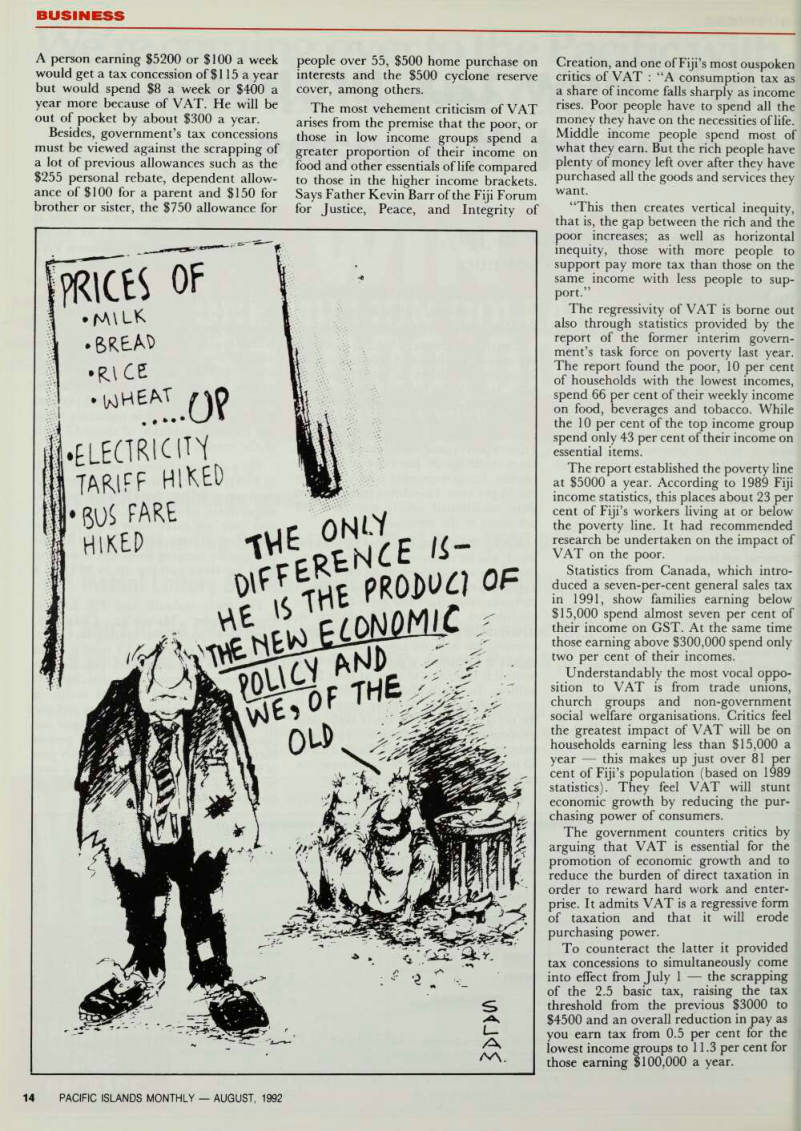
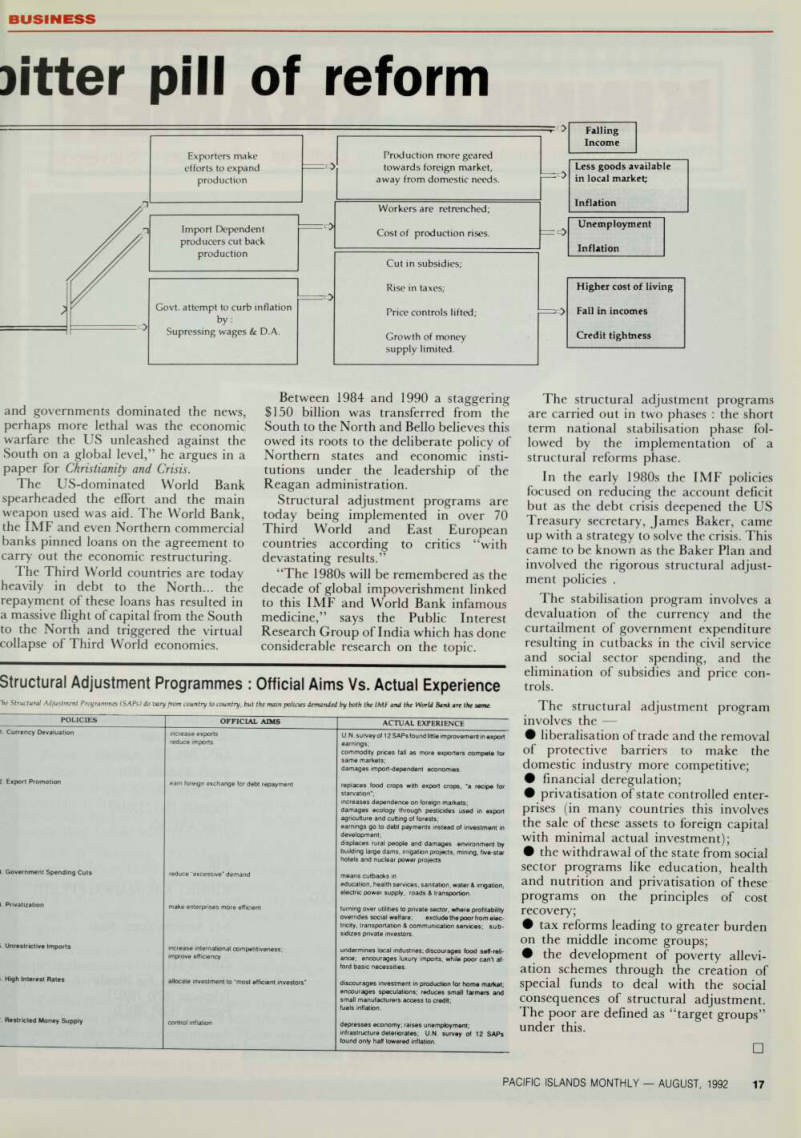
The following chart based on one of the World Bank's own studies (1988) "Adjustment Lending . An Evaluation of Ten Years of Experience' illustrates that the structural adjustment programmes undertaken by 15 sub-Saharn African countries failed in at least five areas . (annual avenge % for 1 S sub-Saharan Afnean countries with SAPs) Invastmant/GOP Annual GDP growth Budget def»cit/GOP Currant account/GOP Debt eervtce/cxpons Private consumption pt capita growth (Vo Sou'ce Aono Bank Lends, g An [valuator oi Ten »m. s ot ttpenence '9BB I Before adjustment I After adjustment ’5 20 25 1. The share of Gross Domestic Product (GDP) devoted to investment fell, rather than rising as intended; 2. Annual economic growth declined'; 3. Budget deficits as a share of GDP increased; 4. The proportion of export earnings that had to be devoted to debt payment increased; and 5. The decline in per capita consumption continued unabated.
PRICES OF
LK.
■ 6REM)
•R\ce
• wHE^..O?
I*£LECTRK
TARIFF HIKED
* s)(> FARE
HIKED
r r . 0 * °' f ,( trit PRO mi 0F
■ EiONOMIC
wt U ,v. ; S?
X* -3%*^ , '"^■a.r A A/V
PROMOTION! PROMOTIONI PROMOTION!
SHASTA SODA
Product: Soft Drinks Packing: 12 oz./24 oz. 2,000 per 20ft FCL Shipment: Next sail Price: U 554,49 FOB Seattle, Washington Term: 30 days L/C «*• »•> • *% All orders must be placed at the South Pacific sales office in Tonga. Ph, No. (676) 21-105 Fax No. (676) 23-139. Contact Willis L. ’Unga. P.O. Box 2481 Nukualofa, Tonga
DEALS! DEALS! DEALS! DEALS!
Swallowing the pitter pill of reform
By Asha Lakhan
medicine, reports show countries of Africa, Latin America and the Central America are worse off economically with serious social dislocations and environ mental devastation. Africa’s Gross Na tional Product fell by an average of 2.2 per cent in the 1980 s and is now back to what it was at the time of independence in the 19605.
A United Nations advisory group has reported that throughout the continent health systems are collapsing for lack of medicine, schools are without books and universities lack library and laboratory facilities.
In Latin America, per capita income in 1990 was at the same level it was a decade ago and rural areas are reported to be suffering from severe malnutrition.
In Chile, wages have declined 40 per cent in real terms since the early ’7os.
In Mexico 50 per cent of the popu lation is unemployed and the real purchasing power is reported to be down to two-thirds of what it was in 1970.
World Bank/IMF experts view this social devastation as the bitter medicine that southern countries have to swallow
to regain economic health, says Walden Bello, executive director of the Institute for Food and Development Policy.
He contends the structural adjustment policies were never intended “as a transition to prosperity but as a perma nent conditiion of economic suffering to ensure the South would never rises again to challenge the North”.
Bello says the policy emerged after the 1975 Conference on International Econ omic Co-operation in Paris when there was a real threat of Southern govern ments, including the OPEC countries, aligning against the North in a New International Economic Order.
The threat didn’t eventuate “because OPEC did not deliver but even the near emergence of a unified Southern econ omic bloc controlling strategic commodi ties gave the Northern countries a bad scare”.
The event contributed to the Reagan election victory in the United States with his coming to power on the agenda to discipline the Third World.
“While the US military adventures against radical Third World movements
THE IMF/World Bank “panacea” known as the structural adjustment policy is coming under increasing fire from concerned groups of economists and academics.
After almost two decades of the bitter
and governments dominated the news, perhaps more lethal was the economic warfare the US unleashed against the South on a global level,” he argues in a paper for Christianity and Crisis.
The US-dominated World Bank spearheaded the effort and the main weapon used was aid. The World Bank, the IMF and even Northern commercial banks pinned loans on the agreement to carry out the economic restructuring.
The Third World countries are today heavily in debt to the North... the repayment of these loans has resulted in a massive flight of capital from the South to the North and triggered the virtual collapse of Third World economies.
Between 1984 and 1990 a staggering $l5O billion was transferred from the South to the North and Bello believes this owed its roots to the deliberate policy of Northern states and economic insti tutions under the leadership of the
Reagan administration.
Structural adjustment programs are today being implemented in over 70 Third World and East European countries according to critics “with
devastating results.”
“The 1980 s will be remembered as the decade of global impoverishment linked to this IMF and World Bank infamous medicine,” says the Public Interest Research Group of India which has done considerable research on the topic.
The structural adjustment programs are carried out in two phases : the short term national stabilisation phase fol lowed by the implementation of a structural reforms phase.
In the early 1980s the IMF policies focused on reducing the account deficit but as the debt crisis deepened the US Treasury secretary, James Baker, came up with a strategy to solve the crisis. This came to be known as the Baker Plan and involved the rigorous structural adjust
ment policies .
The stabilisation program involves a devaluation of the currency and the curtailment of government expenditure resulting in cutbacks in the civil service and social sector spending, and the elimination of subsidies and price con trols.
The structural adjustment program involves the — • liberalisation of trade and the removal of protective barriers to make the domestic industry more competitive; • financial deregulation; • privatisation of state controlled enter prises (in many countries this involves the sale of these assets to foreign capital with minimal actual investment); • the withdrawal of the state from social sector programs like education, health and nutrition and privatisation of these programs on the principles of cost recovery; • tax reforms leading to greater burden on the middle income groups; • the development of poverty allevi ation schemes through the creation of special funds to deal with the social consequences of structural adjustment.
The poor are defined as “target groups” under this. □
Advertisements & other items, p. 16 (1 item)
(Aust)
BELL FOUNDERS
Precision Bronze Bells Made in Australia * Decorative Church Bells * Carillons, Pearls, Chimes * Manual or Electrical Operation * Computer Controlled Systems * Ringing and Support Systems * Export and Installation 2/20 Clearvlew Place Brookvale NSW 2100 Australia Phone (02) 905 0051 Fax (02) 905 4220
Structural Adjustment Programmes : Official Aims Vs. Actual Experience
'he Structural Adjustment Programmes (SAPs) do vary from country to country, but the mam policies demanded by both the IMP and the World Bank are the same
Policies
Official Aims
Actual Experience
Currency Devaluation increase exports reduce imports UN survey of 12 SAPs found little improvement inexpert earnings; commodity prices fall as more exporters compete lor same markets; damages import-dependent economies I. Export Promotion earn foreign exchange tor debt repayment replaces food crops with export crops, "a recipe for starvation"; increases dependence on foreign markets. damages ecology through pesticides used in export agriculture and cutting of forests; earnings go to debt payments instead of investment in development; displaces rural people and damages environment by building large dams, irrigation projects, mining, five-star hotels and nuclear power protects . Government Spending Cuts reduce "excessive" demand means cutbacks in education, health services, sanitation, water & irrigation, electric power supply, roads S Iransportion i. Privatization make enterprises more efficient turning over utilities to private sector, where profitability overrides social welfare; exclude the poor from electricity. transportation & communication services; subsidizes private investors. i. Unreslrictive Imports increase international competitiveness; improve efficiency undermines local industries; discourages food self-reliance; encourages luxury imports, while poor cant afford basic necessities.
High Interest Rates allocate investment to "most efficient investors" discourages investment in production for home market; encourages speculations; reduces small farmers and small manufacturers access to credit; fuels inflation.
Restricted Money Supply control inflation depresses economy, raises unemployment; infrastructure deteriorates; U.N survey of 12 SAPs found only half lowered inflation.
Advertisements & other items, pp. 17-18 (2 items)
)itter pill of reform
17
PACIFIC ISLANDS MONTHLY AUGUST, 1992
BUSINESS
Kinhill Kramer
Managers Consulting Engineers Architects Surveyors
edibility. ..continuity...
commitment. ..quality.. .excellence are all terms synonymous with Papua New Guinea's leading engineering consultant.
mi vim
M •u..lu;ni
mu iinn
■ 'iiifi IllllllllllllilllWllllll
PAPUA NEW GUINEA
Head Office Port Moresby
KINHILL KRAMER PTY LTD.,
Kinhill Kramer Building Cnr Islander Drive & Wards Road
HOHOLA
National Capital District
PO Box 1948, BOROKO,
Papua New Guinea Telephone (675) 256033 Facsimile (675) 211049
Telex CAMAKRA NE 23050
OVERSEAS OFFICES
Solomon Islands
KINHILL KRAMER (SOLOMON ISLANDS)
Fourth Floor NPF Building Mendana Avenue PO Box 377 Honiara, Solomon Islands Telephone (677) 21996 Facsimile (677) 22190 Vanuatu
KINHILL KRAMER (VANUATU) LTD.,
Ist FLoor, Drugstore Building Kumul Highway P.O. Box 96, Port Vila Vanuatu Telephone (678) 23 457 Facsimile (678) 22 455 Australia Head Office Adelaide
LTD KINHILL ENGINEERS PTY. LTD,,
200 East Terrace, GPO Box 2702, Adelaide South Australia 5001 Telephone (08) 2237011 Facsimile (08) 2320163 Telex AA82364 Fiji
KINHILL KACIMAIWAI PTY LTD
First Floor, 6-12 Andrews Street, Nadi Fiji Islands PO Box 9213 Nadi Airport, Fiji Islands Telephone (679) 780033 Facsimile (679) 780131 A MEMBER OF THE KikNiu GROUP OF COMPANIES
Of tourism and tradition
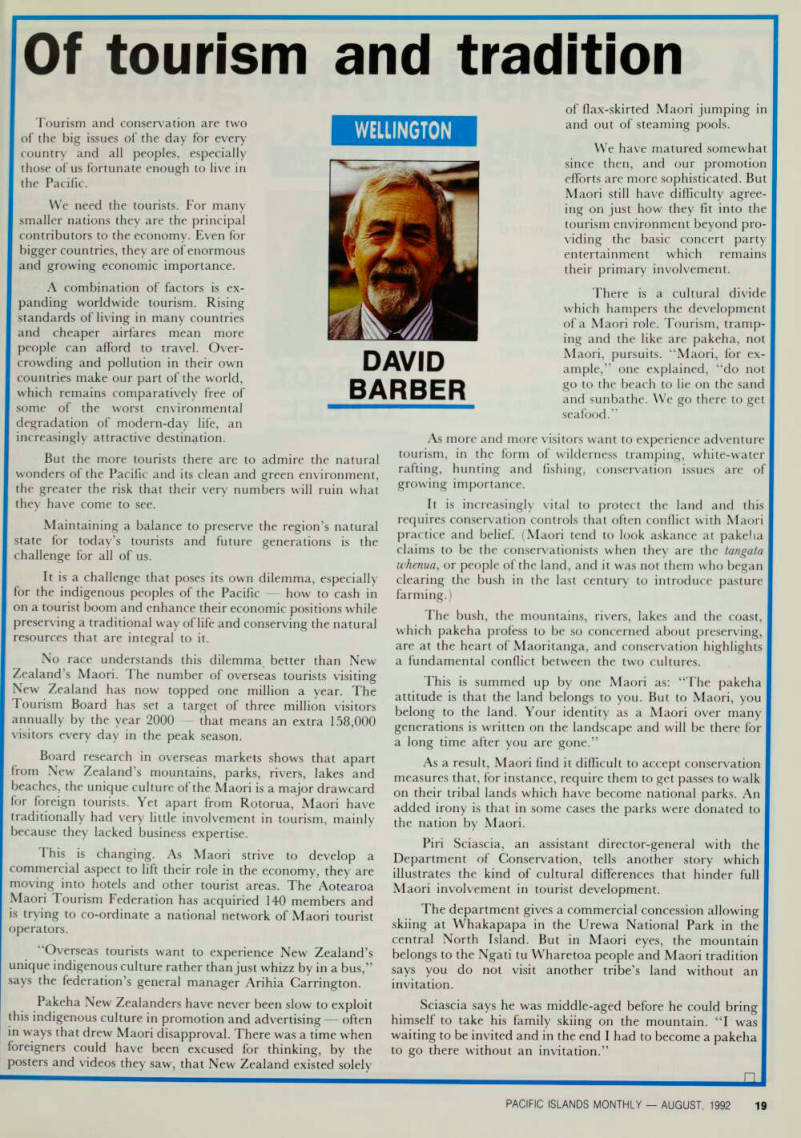
Tourism and conservation are two of the big issues of the day for every country and all peoples, especially those of us fortunate enough to live in the Pacific.
We need the tourists. For many smaller nations they are the principal contributors to the economy. Even for bigger countries, they are of enormous and growing economic importance.
A combination of factors is ex
panding worldwide tourism. Rising
standards of living in many countries and cheaper airfares mean more people can afford to travel. Over crowding and pollution in their own countries make our part of the world, which remains comparatively free of some of the worst environmental degradation of modern-day life, an increasingly attractive destination.
But the more tourists there are to admire the natural wonders of the Pacific and its clean and green environment, the greater the risk that their very numbers will ruin what they have come to see.
Maintaining a balance to preserve the region’s natural state for today’s tourists and future generations is the challenge for all of us.
It is a challenge that poses its own dilemma, especially for the indigenous peoples of the Pacific how to cash in on a tourist boom and enhance their economic positions while preserving a traditional way of life and conserving the natural resources that are integral to it.
No race understands this dilemma better than New Zealand’s Maori. The number of overseas tourists visiting New Zealand has now topped one million a year. The Tourism Board has set a target of three million visitors annually by the year 2000 that means an extra 158,000 visitors every day in the peak season.
Board research in overseas markets shows that apart from New Zealand’s mountains, parks, rivers, lakes and beaches, the unique culture of the Maori is a major drawcard for foreign tourists. Yet apart from Rotorua, Maori have traditionally had very little involvement in tourism, mainly because they lacked business expertise.
This is changing. As Maori strive to develop a commercial aspect to lift their role in the economy, they are moving into hotels and other tourist areas. The Aotearoa Maori Tourism Federation has acquiried 140 members and is trying to co-ordinate a national network of Maori tourist operators.
“Overseas tourists want to experience New Zealand’s unique indigenous culture rather than just whizz by in a bus,” says the federation’s general manager Arihia Carrington.
Pakeha New Zealanders have never been slow to exploit this indigenous culture in promotion and advertising often in ways that drew Maori disapproval. There was a time when foreigners could have been excused for thinking, by the posters and videos they saw, that New Zealand existed solely
Wellington
of flax-skirted Maori jumping in and out of steaming pools.
We have matured somewhat since then, and our promotion efforts are more sophisticated. But Maori still have difficulty agree ing on just how they fit into the tourism environment beyond pro viding the basic concert party entertainment which remains their primary involvement.
There is a cultural divide
which hampers the development
of a Maori role. Tourism, tramp ing and the like are pakeha, not Maori, pursuits. “Maori, for ex ample,” one explained, “do not go to the beach to lie on the sand and sunbathe. We go there to get seafood.”
As more and more visitors want to experience adventure tourism, in the form of wilderness tramping, white-water rafting, hunting and fishing, conservation issues are of growing importance.
It is increasingly vital to protect the land and this requires conservation controls that often conflict with Maori practice and belief. (Maori tend to look askance at pakeha claims to be the conservationists when they are the tangata whenua, or people of the land, and it was not them who began clearing the bush in the last century to introduce pasture
farming.)
The bush, the mountains, rivers, lakes and the coast, which pakeha profess to be so concerned about preserving, are at the heart of Maoritanga, and conservation highlights a fundamental conflict between the two cultures.
This is summed up by one Maori as: “The pakeha attitude is that the land belongs to you. But to Maori, you belong to the land. Your identity as a Maori over many generations is written on the landscape and will be there for a long time after you are gone.”
As a result, Maori find it difficult to accept conservation measures that, for instance, require them to get passes to walk on their tribal lands which have become national parks. An added irony is that in some cases the parks were donated to the nation by Maori.
Piri Sciascia, an assistant director-general with the Department of Conservation, tells another story which illustrates the kind of cultural differences that hinder full Maori involvement in tourist development.
The department gives a commercial concession allowing skiing at Whakapapa in the Urewa National Park in the central North Island. But in Maori eyes, the mountain belongs to the Ngati tu Wharetoa people and Maori tradition says you do not visit another tribe’s land without an invitation.
Sciascia says he was middle-aged before he could bring himself to take his family skiing on the mountain. “I was waiting to be invited and in the end I had to become a pakeha to go there without an invitation.”
David
Barber
A Samoan in Kazakhstan
WHEN a delegation of US Repub lican Party activists visited the Republic of Kazakhstan in the former Soviet Union recently, one of its members especially captured the local limelight.
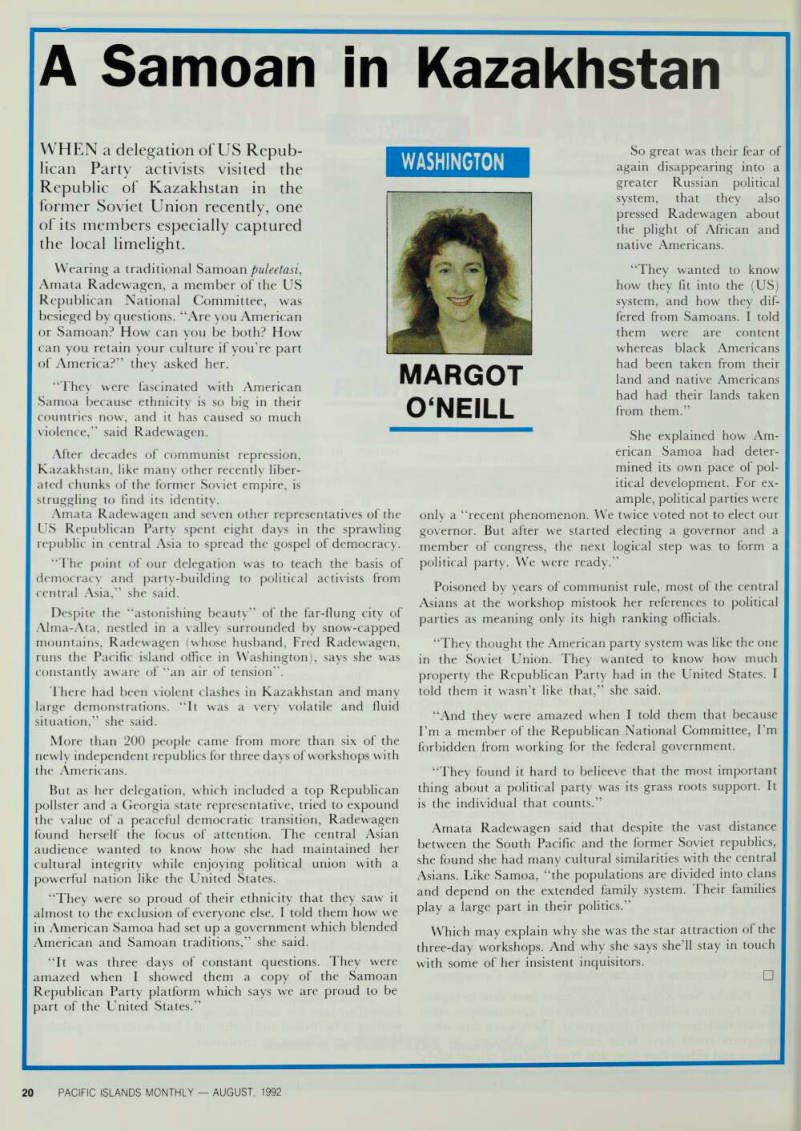
Wearing a traditional Samoan puleetasi , Amata Radewagen, a member of the US Republican National Committee, was besieged by questions. “Are you American or Samoan? How can you be both? How can you retain your culture if you’re part of America?” they asked her.
“They were fascinated with American Samoa because ethnicity is so big in their countries now, and it has caused so much violence,” said Radewagen.
After decades of communist repression, Kazakhstan, like many other recently liber ated chunks of the former Soviet empire, is struggling to find its identity.
Amata Radewagen and seven other representatives of the US Republican Party spent eight days in the sprawling republic in central Asia to spread the gospel of democracy.
“The point of our delegation was to teach the basis of democracy and party-building to political activists from central Asia,” she said.
Despite the “astonishing beauty” of the far-flung city of Alma-Ata, nestled in a valley surrounded by snow-capped mountains, Radewagen (whose husband, Fred Radewagen, runs the Pacific island office in Washington), says she was constantly aware of “an air of tension ".
There had been violent clashes in Kazakhstan and many large demonstrations. “It was a very volatile and fluid situation,” she said.
More than 200 people came from more than six of the newly independent republics for three days of workshops with the Americans.
But as her delegation, which included a top Republican pollster and a Georgia state representative, tried to expound the value of a peaceful democratic transition, Radewagen found herself the focus of attention. The central Asian audience wanted to know how she had maintained her cultural integrity while enjoying political union with a powerful nation like the United States.
“They were so proud of their ethnicity that they saw it almost to the exclusion of everyone else. I told them how we in American Samoa had set up a government which blended American and Samoan traditions,” she said.
“It was three days of constant questions. They were amazed when I showed them a copy of the Samoan Republican Party platform which says we are proud to be part of the United States.”
Washington
So great was their fear of again disappearing into a greater Russian political system, that they also pressed Radewagen about the plight of African and native Americans.
“They wanted to know how they fit into the (US) system, and how they dif fered from Samoans. I told them were are content whereas black Americans had been taken from their land and native Americans had had their lands taken from them.”
She explained how Am erican Samoa had deter mined its own pace of pol itical development. For ex
ample, political parties were
only a “recent phenomenon. We twice voted not to elect our governor. But after we started electing a governor and a member of congress, the next logical step was to form a political party. We were ready.”
Poisoned by years of communist rule, most of the central Asians at the workshop mistook her references to political parties as meaning only its high ranking officials.
“They thought the American party system was like the one in the Soviet Union. They wanted to know how much property the Republican Party had in the United States. I told them it wasn’t like that,” she said.
“And they were amazed when I told them that because I’m a member of the Republican National Committee, I’m forbidden from working for the federal government.
“They found it hard to belieeve that the most important thing about a political party was its grass roots support. It is the individual that counts.”
Amata Radewagen said that despite the vast distance between the South Pacific and the former Soviet republics, she found she had many cultural similarities with the central Asians. Like Samoa, “the populations are divided into clans and depend on the extended family system. Their families play a large part in their politics.”
Which may explain why she was the star attraction of the three-day workshops. And why she says she’ll stay in touch with some of her insistent inquisitors.
Margot
O‘Neill
of women’s changing role
Women
Creating an awareness of women’s changing role
By Eileen Tugum-Kolma
MOST South Pacific island nations have in their constitution a mention of the need to involve women in the develop ment process. But in reality this does not
happen.
Very few women are involved in making decisions regarding development projects. And governments continue to treat women as a special issue, and plan for them separately, instead of including them in the major plans for countries, or
in mainstream development as many develop ment workers are calling it to day.
Josephine Gena, Assistant Secretary for the Women’s Division says, “Women are being treated as a relatively un important sec tor rather than as half the popu lation requiring attention from all sectors and with the poten tial to contrib ute productively to the country’s development.
“Programs to increase
women’s participation and productivity
ire organised separately from main itream programs.”
That is why women and development workers in the region are mounting pressure on their governments and plan lers to change this. Firms steps are being aken to facilitate this change.
Responding to calls by women to iddress this issue, the United Nations
development Programme (UNDP),
Jnited Nations Development Fund for Vomen (UNIFEM), and the Australian development Assistance Bureau AIDAB) have given money for a egional project called Pacific Women in
dainstreaming Development,
Four countries are testing the project
Papua New Guinea, Cook Islands, Tuvalu, and the Marshall Islands.
It aims to: • create an awareness of the role of women in the country’s development and the need to incorporate women’s con cerns into mainstream development planning; • examine how policies are made and why they are necessary; • review information on status of women in each country and; • discuss how women can become better negotiators to assiist in getting women off the special list and onto the mainstream
political, social and economical life of a nation.
In Papua New Guinea where tra ditional attitudes are hard to break, the task of sensitising the population to this issue seems daunting. But the positive response to gender workshops and from
workshop participants hold some hope.
Paul Baglame, a staff development and training officer with the Department of Home Affairs and Youth which is responsible for women’s affairs in Papua New Guinea was overwhelmed: “This workshop has just been an eye-opener for me. It has helped me see my own prejudices and attitudes towards men and women. I see that many of these prejudices and attitudes oppress our
women and we must change them.”
He wanted more men to attend similar
workshops.
“I was so blind. I needed someone, something like this to help me solve my problem. And my problem is just my attitude which is conditioned by my culture and my customs. And I see that many of our attitudes oppress women and we must change them.”
While the Pacific Mainstreaming Proj ect workshops in Papua New Guinea were completed in April this year, gender sensitising will not end there.
Both the participants and the women’s
movement in tend to keep the momentum going. While
participants
have been talk ing about it and trying in their own little ways to sensi tise others, in their homes, at coffee shops, on the streets, the Women’s Div ision is organis ing four re
gional work
shops on gen
der sensitising
for provincial planners and women’s leaders in Aug ust and Sep tember.
Co-ordinat =
or for these workshops Margaret Ratu Misso said: “Our planners are the ones who need to be sensitised most. It is their lack of awareness of women’s needs that continues to exclude women in main
stream development planning.”
There is also scheduled to be a gender sensitising program for politicians and bureaucrats in July as a lead-up to the launching of the National Women’s
Policy.
Misso said: “It’s a long battle to change men’s attitude but we will change it.
“We just have to keep thinking and talking about the multiple roles of women.” □
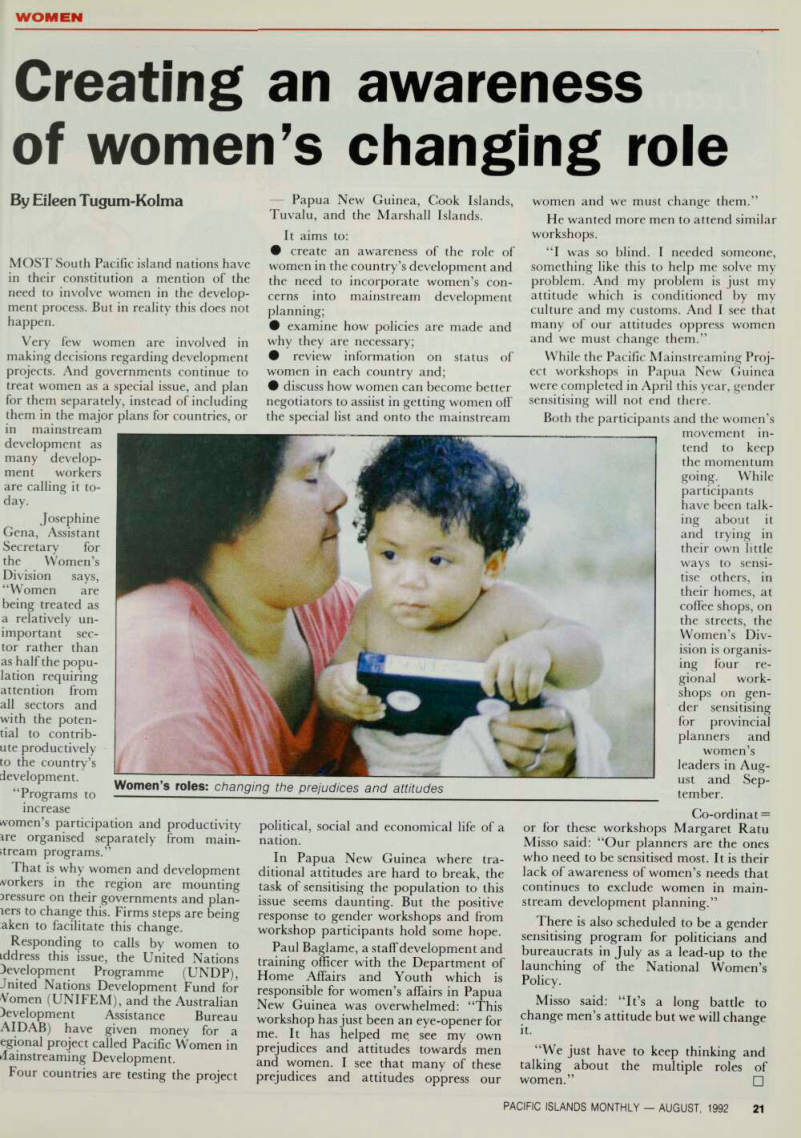
Women’s roles: changing the prejudices and attitudes
Advertisements & other items, p. 22 (1 item)
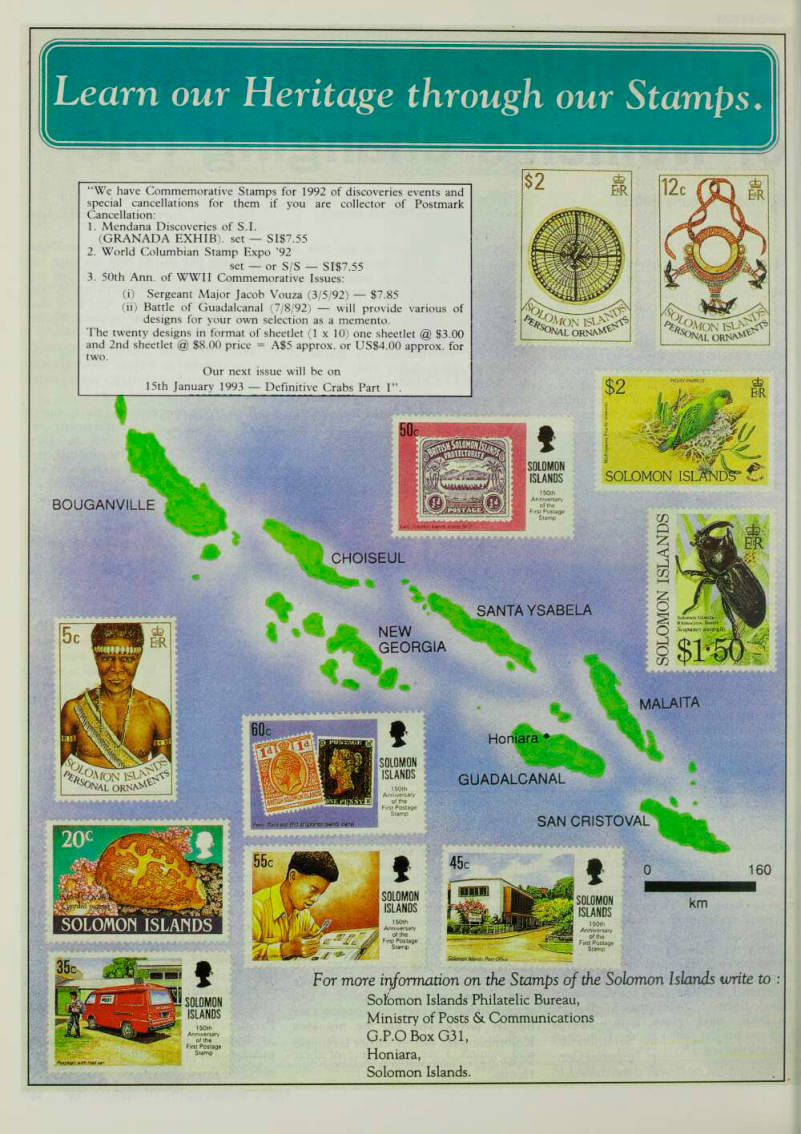
Learn our Heritage through our Stamps .
“We have Commemorative Stamps for 1992 of discoveries events and special cancellations for them if you are collector of Postmark Cancellation: 1. Mendana Discoveries of S.I.
(GRANADA EXHIB). set 5187.55
2. World Columbian Stamp Expo ’92 set or S/S 5187.55 3. 50th Ann. of WWII Commemorative Issues: (i) Sergeant Major Jacob Vouza (3/5/92) 57.85 (ii) Battle of Guadalcanal (7/8/92) will provide various of designs for your own selection as a memento.
The twenty designs in format of sheetlet (1 x 10) one sheetlet @ 53.00 and 2nd sheetlet @ SB.OO price = ASS approx, or USS4.OO approx, for two.
Our next issue will be on 15th January 1993 Definitive Crabs Part I”. $2 •ilc/ 12 ER ER
BOUGANVILLE
SOLOMON
ISLANDS
zmsmWl'
m
SOLOMON ISLAND
CHOISEUL
SANTA YSABELA
ER ft?
NEW
GEORGIA
x Q 2 < x O o sl' o
MALAITA
m 35c m
SOLOMON
ISLANDS
I l A 1 A
SOLOMON
ISLANDS
Ptm TO X'S&non 55c
SOLOMON
ISLANDS
Honiara •
GUADALCANAL
SAN CRISTOVAL
SOLOMON
ISLANDS
160 km For more information on the Stamps of the Solomon Islands write to Soromon Islands Philatelic Bureau, Ministry of Posts & Communications G.P.O Box G3l, Honiara, Solomon Islands.
Politics Or Humanity?
xiTi *1 • -ii 1 n , i • While regional leaders retuse to dISCUSS .p. . , - • ry-, • nn .
Bougainville, Martin 1 litany writes ° 7 , y that reports of human rights abuse l o continue to pour out of the area.
THE CRACKLE of the radio filters through the night air and breaks through the murmur of voices. Conversation ceases as all ears strain to listen to the announcer. “The Bishop has crossed the boarder,” smiles Martin Miriori as he looks up from beside the radio. There were smiles all around for the small victory. Such small victories keep the
people of Bougainville go ing.
Bishop John Zale of the United Church of the Bou gainville region has made it through the Papua New Guinea security forces pa trols around Bougainville and is on his way to the Solomon Islands. With him he is bringing a little more hope, another possibility to bring the plight of his people to the attention of the world.
He is on his way to Honiara where the heads of 15 regional countries are meeting for the annual South Pacific Forum. Per haps they can help.
The voice of Radio Free Bougainville crackles again as the announcer dedicates his next song Evil Ways to the Papua New Guinea security forces.
This breaks a few faces into smiles.
The smiles belie the seriousness of the cause Bishop Zale and Miriori, secretary of state and hu man rights co-ordinator, are fighting for. They rep resent the self-styled Bou gainville interim govern ment which wants inde pendence for the copper rich island from PNG.
Traditionally and
:ulturally Bougainville is
Dart of the Solomon Islands. It is only Doundries drawn by
colonialists in recent times that have made it part of PNG. The interim government says they represent the majority of the people and they want to break from PNG. PNG says about two thirds of the Bougainvilleans want to remain with them.
Who do you believe?
“Why not allow the people to decide
for themselves,” asks Mike Forster, Bougainville’s United Nations represen tative. “Give us self-determination and the people can decide what they want, just stop the violence and the killing.”
The PNG government has imposed a blockade on Bougainville stopping supplies of food and medicine going in.
The interim-government says thousands have died because of a lack of medicine and accuses the PNG security forces of terrorising and killing innocent people.
PNG says its forces only attack mem bers of the Bougainville Revolutinary Army (BRA). They say the Bougainvilleans are being terrorised by the BRA and they are protecting the people. The interim-government says the BRA is a necessary evil which protects
the people.
Who do you be lieve?
Bishop Zale made it safely to Honiara but the regional heads of government could see no good reason to dis cuss the matter. The two-day 23rd South Pacific Forum meeting ended on July 9 with no official mention of Bougainville. It was perhaps the biggest news in Honiara but it never made the meet
ing agenda.
It wasn’t for the want of trying by the interim-government.
Well before the Forum started it was lobbying for Bougainville to be put on the agenda.
Bishop Zale, Forster, Miriori and Moses Havini, Bouganville interim-government representative in Aus tralia, held press con ferences, wrote letters and lobbied to get the Bougainville issue on the agenda and dis cussed at this Forum.
They were politely
told it was an internal matter for PNG, Even though PNG defence patrol boats have crossed the
Bougainville Revolutionary Army: a necessary evil?
boarder into the Solomon Islands and attacked villagers, it was an internal matter. Although the Solomon govern ment has been sympathetic to the cause of Bougainville, granting Miriori a two year residential permit, it perhaps diplomatically avoided the issue. But relations between PNG and the Solomon Islands have been strained in recent months.
The finger has more then once pointed at Australia for supplying weapons, ammunition and helicopters to PNG who in turn use these against civilians on
Bougainville.
Asked if he had any concerns about the situation in Bougainville, Australian prime minister, Paul Keating, replied he was concerned there was an armed secessionist movement on Bougainville.
‘I have witnessed their atrocitI have heard their lies, and they have been proved to be lies . J
— Bishop £ale
“It’s a matter of concern to us, to the neighbourhood, but I think the Forum regard it as an internal problem for Papua New Guinea, as we did,” Keating said.
Forster laughs sarcastically at this.
“Before the second world war the League of Nations said the Jews in Germany were an internal matter, in the 1960 s Australia said South Africa’s racial problems were an internal matter, now they say Bougainville is an internal matter,” Forster said shaking his head.
“When will people realise that it is no longer an internal matter, no longer a political matter, but a matter of hu manity.”
Keating was asked if he thought there will come a point when it will stop being an internal situation.
“We’re hoping that a political settle ment can be arrived at, and in my discussions with prime minister Mamaloni I urged that the quicker dialogue be re-established between the Solomon Islands and Papua New Guinea, the better, ” replied Keating.
He said if it were to be proved that Australian-supplied Iroquois helicopters were being used as gun-ships in a “defensive manner” this would be con trary to the conditions under which they were given to PNG, and Australia would suggest to the PNG government they be withdrawn from the service area.
However, Keating said Australia could not take them back.
Australian human rights lawyer Rosemarie Gillespie, 51, ran PNG’s blockade to reach central Bougainville and return in time for the Forum. She says she has proof the Iroquois helicop ters are used as gun-ships and shoot at unarmed civilians.
In Honiara she
produced statuatory
declarations which tell of the horror of the war on the
Bougainvilleans by
the defence forces. If they are true then the purpose of the South Pacific Fo rum should be ques tioned is it any thing more then a tight-knit group which meets annu ally for a bit of back slapping and a good time?
One declaration from a Moses Tseraha Kukun tells of how “PNG armed forces poured petrol on Chief Joshua Sevo and burned him to death... This year Stenis Latu was shot, tied to a log, taken up in a heli copter while still alive, and thrown to his death from the
helicopter People
are being tortured
under interrogation,
with knives and
razor blades. Reports say they are cut ... bit by bit ... until the person bleeds to death. Two brothers, Lawrence and Michael Koal, and Tobias died that way.”
Another declaration from Reverend John Wesley Ririan of Kieta says a PNG patrol boat flying the Red Cross flag shot at them while they were fishing.
Steven Lipa of Engoa Village writes he was with Gillespie on June 10, this year, in a banana boat travelling from Kariki to Engoa. He said when the boat was near Oema Island in Solomon waters a PNG army plane came from the north, circled over them, then swooped low,
firing at them.
Lipa said they had to jump out of the boat run over the reef and hide in the bush. Both he and Gillespie cut their feet badly on the reef.
The 30 or so other statutory declar ations Gillespie produced tell of similar attacks by the PNG forces and of the atrocities they commit.
Fairy stories or fact?
According to PNG foreign secretary, Gabriel Dusava, Gillespie’s declarations have no credibility as they are signed by people only known to her. He also accuses her of breaking PNG law by
entering the country illegally.
Dusava said Gillespie would have been let into Bougainville had she requested the PNG government. The Bougainville claims in Honiara obviously worried PNG prime minister Rabbie Namaliu enough to issue a statement titled “More BRA Lies in Honiara” during the Forum
meeting.
In it he urged the Australian and other regional governments not to respond to every allegation made by the BRA and its agenda in Honiara.
Namaliu said the BRA had a vested interest in undermining PNG’s relations with its Pacific neighbours, including
Bishop Zale: slipped through PNG patrols
Australia. “If the security forces are so bad, why is it that thousands of villagers and their families have fled from the BRA and have sought the protection of the security forces and the administra tion?
“The thousands of innocent men, women and children, living in our care centres, have a very different message.”
The Bougainville delegation in Honi ara replied to this by saying the “care centres” spoken of by PNG are no more than concentration camps of the PNG army created after the destruction of Bouganville villages. They ask why, if the people in the care centres are so happy, does PNG not let observers in to see for themselves.
The interim government says the failure of the Forum to address the Bougainville situation is filled with hypocrisy.
“There are precedents within the Forum member countries for the separ ation of Bougainville from PNG against the tide of colonialism. The ex-colony of Gilbert and Ellis Islands into Kiribati and Tuvalu is a case in point, the Federated States of Micronesia is an other,” they say.
Forster says all his group is asking for is an observer mission to come and see for itself.
Bishop Zale who slipped through PNG army patrols to reach the Forum says PNG has been lying to the world.
“I tell you this in all good conscience and in the sight of God the Father. I have witnessed their atrocities, I have heard their lies and they have been proved to be lies,” said Bishop Zale. “The PNG government has lied to us so many times, and had lied to the world so many times, that they have no truth left in them.
They have promised us many times that the blockade will be lifted and the medical supplies allowed in. They have promised us they will talk with us, they have promised us essential services, school supplies, cooking pots, clothing, tea and sugar, they have promised us they will cease using the gun to solve the issue. Nothing has come.”
When Forster brought up their case at the UN he was told he should try and get it raised at a regional forum first. He and the others tried that and have failed.
The 23rd South Pacific Forum is over.
Radio Free Bougainville buzzes into life again. It is Bougainville chiefs with desperation in their voices. They ask how the people of the Pacific, their brothers, can just ignore them.
The Pacific leaders don’t hear the call.
They are busy with their cocktail parties, their dinners and their speeches. Empty words that mean nothing to the children of Bougainville who die on a dirt floor as their mothers give birth to them under the light of a kerosene light.
Fact or fiction? □
Advertisements & other items, p. 24 (1 item)
Ib
WHAT does it cost to holiday in the Solomon Islands?
WHEN is the best time to holiday in the Solomon Islands?
WHERE are the best dive sights in the Solomon Islands? a * V You’ll enjoy your Solomon Islands encounter.
Rock pool at Uepi Island.
These and any other questions about travel to and in the Solomon Islands can be answered by calling the Solomon Islands Tourist Authority.
The friendly and helpful staff can add extra value and extra dimension to your Solomon Islands holiday by advising on your itinerary, by giving you little tips on dining, on health requirements, on accommodation, on currency and anything else of particular interest.
Tjf®'
*** Solomon Islands Tourist Au
SUITE 20, 37 ALEXANDER STREET,
CROWS NEST N.S.W. 2065
TELEPHONE: (02) 438 4555.
FAX: (02) 438 5197.
PO BOX 321 HONIARA,
SOLOMON ISLANDS.
... 1 . . . .1 |i o • • i TELEPHONE: (677) 22442, tourist destination m the world, bo enjoy it now! fax: <677) 23986 The Solomon Islands is perhaps the last great undiscovered
‘The enemy must leave’
“Mothers And
children cannot go to the garden to get food. Many of them,
particularly during
June, had to hide in caves because of the threat from Papua New Guinea govern ment who used heli copters to spray the people with chemi cals. Even now many are in the bush hiding.”
These are the words of Ruby Mirinka, 40, deputy matron at Arawa general
Hospital, speaking
in Honiara last month. A few days
earlier she had arrived in the Solomon Islands after escaping from Bougain ville.
She and her husband paddled out in a canoe at night to avoid being spotted by Papua New Guinea patrol boats and helicopters. She had to leave behind her three children to come to Honiara for medical treatment.
Because of the lack of medicine and medical facilities the hospital now only runs a basic out-patients service. There is no electricity, running water or other essential services on Bougainville.
Sewerage tanks have not been emptied in four years.
“Little babies are suffering from colds and developing chest infections because they don’t have clothes, this is the fourth year.
“New-born babies are not protected from illnesses because there is no immunisation. Many of the babies that are born, die...
Children now no longer go to school on Bougainville. Previously the island had some of the best education facilities and one of the highest literacy rates in Papua New Guinea.
The lack of doctors further adds to the problems. “In south and central (Bou gainville) there are only three doctors two in Arawa itself. But even though doctors and a few nurses are available it is hopeless because we need things to work with such things as drugs. Basi cally the whole hospital is shut down.
“The main thing which I see and we all see is that people can cope and start from scratch if there are no enemies around.”
“We can survive on garden food which
is much healthier but because the PNG soldiers are around and there is bomb ing from the air from helicop ters, the en vironment is not safe for people to relax and be free to do as they like and help them selves.”
“The enemy must leave and let the people be free.”
Mirinka says despite the
hardships the people are far from giving up. She when the situation gets hard and there is bombing the people are even more determined to be free.
“When you have a mosquito around biting you want that mosquito to go away and that is the feeling the people have.”
Mirinka says she sees the PNG defence force helicopter nearly every week and has witnessed the army aeroplane firing on the town of Arawa. She had to hide under the hospital to escape.
She said since defence force soldiers had left it was much quieter, there was more respect and it safe for women to walk alone at night.
“From my observation of BRAs they are doing their duty, protecting the island, not harassing or doing anything to us.”
The only food the people on Bougain ville have is what they grow in their gardens and this can sometimes become scarce when there is a change of season.
There is no salt, no sugar, no infant formula, no tea, no coffee, no anything.
Mirinka says it can become hard but somehow they survive.
She said those who lived on the coast used to go fishing but now they don’t because they are scared of patrol boats.
She said even if she had the chance to get her family off Bougainville she wouldn’t as the island was her home.
That feeling, she said, is shared by all
Bougainvilleans.
She has no money to return with the much needed supplies. She goes back with little more then hope. Hope that some how, some way, the madness will end. □
Ruby Mirinka: hopina the madness ends
real issues?
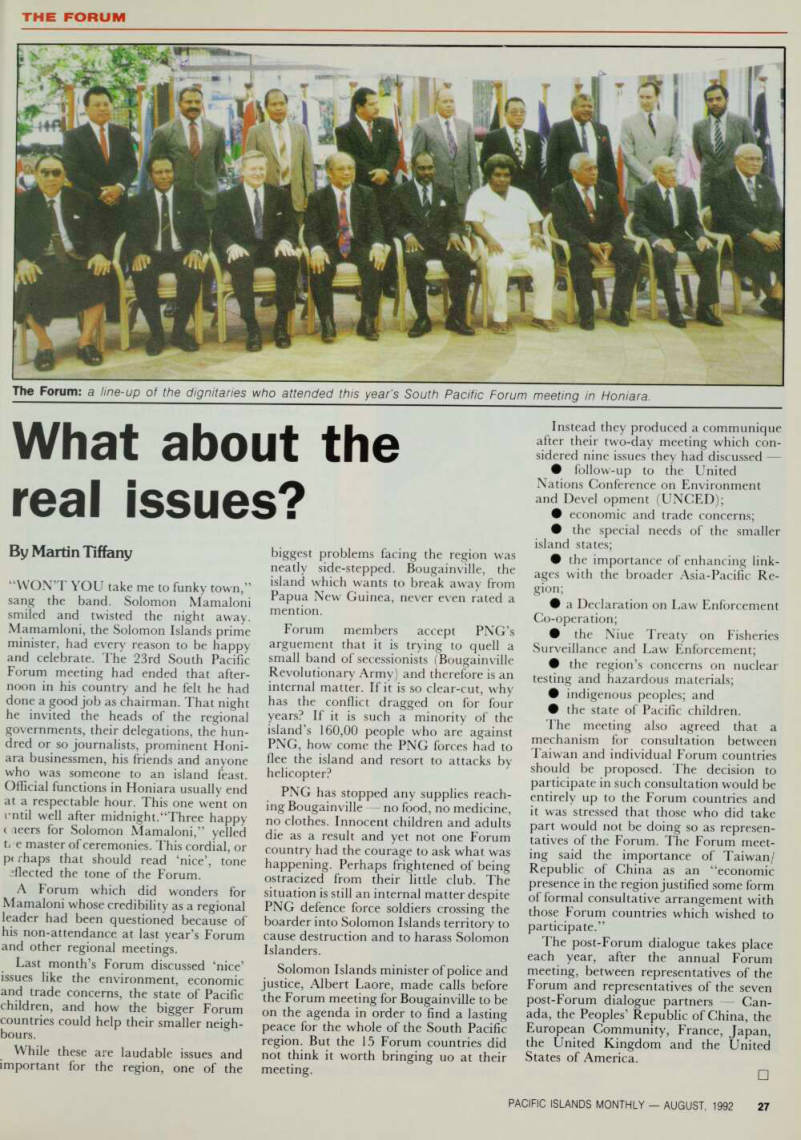
The Forum
What about the real issues?
By Martin Tiffany
“WON’T YOU take me to funky town,” sang the band. Solomon Mamaloni smiled and twisted the night away.
Mamamloni, the Solomon Islands prime minister, had every reason to be happy and celebrate. The 23rd South Pacific Forum meeting had ended that after noon in his country and he felt he had done a good job as chairman. That night he invited the heads of the regional governments, their delegations, the hun dred or so journalists, prominent Honi ara businessmen, his friends and anyone who was someone to an island feast.
Official functions in Honiara usually end at a respectable hour. This one went on until well after midnight.“ Three happy c aeers for Solomon Mamaloni,” yelled ti e master of ceremonies. This cordial, or p< rhaps that should read ‘nice’, tone the tone of the Forum.
A Forum which did wonders for Mamaloni whose credibility as a regional leader had been questioned because of his non-attendance at last year’s Forum and other regional meetings.
Last month’s Forum discussed ‘nice’ issues like the environment, economic and trade concerns, the state of Pacific children, and how the bigger Forum countries could help their smaller neigh bours.
While these are laudable issues and important for the region, one of the
biggest problems facing the region was
neatly side-stepped. Bougainville, the
island which wants to break away from Papua New Guinea, never even rated a mention.
Forum members accept PNG’s arguement that it is trying to quell a small band of secessionists (Bougainville Revolutionary Army) and therefore is an internal matter. If it is so clear-cut, why has the conflict dragged on for four years? If it is such a minority of the island’s 160,00 people who are against PNG, how come the PNG forces had to flee the island and resort to attacks by
helicopter?
PNG has stopped any supplies reach ing Bougainville no food, no medicine, no clothes. Innocent children and adults die as a result and yet not one Forum country had the courage to ask what was
happening. Perhaps frightened of being
ostracized from their little club. The situation is still an internal matter despite PNG defence force soldiers crossing the boarder into Solomon Islands territory to cause destruction and to harass Solomon Islanders.
Solomon Islands minister of police and justice, Albert Laore, made calls before the Forum meeting for Bougainville to be on the agenda in order to find a lasting peace for the whole of the South Pacific region. But the 15 Forum countries did not think it worth bringing uo at their
meeting.
Instead they produced a communique after their two-day meeting which con sidered nine issues they had discussed • follow-up to the United Nations Conference on Environment and Development (UNCED); • economic and trade concerns; • the special needs of the smaller island states; • the importance of enhancing link ages with the broader Asia-Pacific Re gion; • a Declaration on Law Enforcement
Co-operation;
• the Niue Treaty on Fisheries Surveillance and Law Enforcement; • the region’s concerns on nuclear testing and hazardous materials;
• indigenous peoples; and
• the state of Pacific children.
The meeting also agreed that a mechanism for consultation between Taiwan and individual Forum countries should be proposed. The decision to participate in such consultation would be entirely up to the Forum countries and it was stressed that those who did take part would not be doing so as represen tatives of the Forum. The Forum meet ing said the importance of Taiwan/ Republic of China as an “economic presence in the region justified some form of formal consultative arrangement with those Forum countries which wished to participate.”
The post-Forum dialogue takes place each year, after the annual Forum meeting, between representatives of the Forum and representatives of the seven post-Forum dialogue partners Can ada, the Peoples’ Republic of China, the
European Community, France, Japan,
the United Kingdom and the United States of America. n
The Forum; a line-up of the dignitaries who attended this year’s South Pacific Forum meeting in Honiara.
Advertisements & other items, p. 28 (1 item)
Telek
“ ■ **. - *sm -m m 'smT.
** W'Wmmm
0i
From Our Islands
in the Sun ...
... to every corner of our planet, Solomon Telekom puts the world at your fingertips.
With rapid advances in communications
technology, Solomon Telekom is proud to
be at the forefront in providing the latest
in innovative developments.
• International Direct Dialing (IDD) International Direct Dial telephone sendee is available from most hotel rooms and other telephones in Solomon Islands. • Cardphones International and national telephone sendees are available from all cardphones which are located at prominent locations in Solomon Islands. • Credit card calling Make your call with Mastercard, Amex or Visa from our Telekom office in Honiara or call and ask for our credit card service. • Other services from Telekom A full range of services are available from Telekom including facsimile, data, paging telex and leased services. Contact Solomon Telekom on 23647f0r further details.
TELEK
TELEKwM
Solomon Telekom Company Limite ... providing communication services for
businesspeople, visitors and residents of
Solomon Islands.
The Honiara decisions
By Martin Tiffany
THE SMALLER member countries of the South Pacific Forum look set to gain from trade initiatives put forward at the recent Forum meeting. The Forum urged all other regional organisations to pay greater attention to the special needs of the small island states in their programs. The day before the two-day Forum meeting the five small nations of the Forum Kiribati, Tuvalu, the Cook Islands, Nauru and Niue held their second economic summit.
The five agreed to work together to develop trade, their private sectors and marine resources. The Hawaii-based
Pacific Islands Development Programme
will fund a meeting of the private sector of the five in Rarotonga. Meanwhile Fiji outlined development assistance initiat ives to assist the small nations by providing access to their education facilities through a scholarship scheme.
Trade and the economy were high up on the agenda. The meeting stressed the importance of putting in place domestic economic policies in light of the private sector’s role in ensuring economic growth.
The meeting stressed the importance of establishing more effective interna tional links, in particular with the countries of the Asia/ Pacific Rim.
In another move the heads of govern ment sent a letter to the Group of Seven (G 7) industrialised nations meeting at an economic summit in Munich at the time.
The letter urged the G 7 leaders to “take the necessary political decisions to break the impasse in the Uruguay Round of Multilateral trade negotiations. The Forum noted the “sustainable develop ment would only be realised in full if developing countries, were able to ben efit from responsible management of their resources through more open and fairer trading conditions.”
In its communique the 15 Forum Hand countries reaffirmed their com m tment towards many of the environ mental issues. They also recognised global warming and sea level rise as the most serious threat facing the Pacific especially the low-lying atolls and urged early negotiations of protocols to strengthen the climate change conven tion.
The meeting urged concrete measures }e taken to develop technology for enewable energy sources, including so ar, wind and hydro and energy efficient echnologies. It said this would help nake less severe the adverse impacts of
limate change.
Indefinite extension of the French
cessation of nuclear tests was welcomed by the Forum. The Forum leaders sent an urgent letter to the President of the French Republic, urging him to suspend French nuclear testing indefinitely.
Plans by the Japanese government to ship plutonium from Europe to Japan via the Pacific caused concern. The meeting noted the risks inherent in such ship ments from surface accidents and from possible loss of cargo at sea.
The Forum asked that the shipments be made in accordance with the highest international safety and security stan dards and urged Japan to consult fully with Forum countries regarding the
proposed shipments.
The Forum considered issues relating to regional co-operation in the law enforcement field and agreed to a declaration on Law Enforcement Co operation which identifies priorities and establishes a framework within which further co-operation can be pursued. 1993 has been declared the Interna tional Year forlndigenous people of the World by the United Nations.
With this in mind the Forum meeting recognised the importance of these issues to the region and has agreed to hold a regional conference later this year. The conference will look at the broader concerns such as indigenous rights, the protection and preservation of culture including cultural property, approaches to resource and environmental manage ment and the application of customary laws.
The Forum said these regional con cerns could then be encompassed in the United States Declaration on the Rights of Indigenous Peoples and also be incorporated into considerations at the United Nations on a possible follow-up program of action within the region.
Most of the South Pacific Forum countries and member states of the
Forum Fisheries Agency (FFA) signed
the Niue Fisheries Surveillance and Law Enforcement Co-operation Treaty in Honiara last month.
Those who signed were the Cook Islands, the Federated States of Micro nesia, Nauru, New Zealand, Niue, Pa lau, Solomon Islands, Tonga, Tuvalu, Vanuatu, Western Samoa and Australia.
Fiji, Kiribati and Tokelau did not sign but they said this was because the decision to sign had yet to go through their parliaments.
The Niue treaty provides for co operation among the regional countries on surveillance of their fisheries resources to be co-ordinated from the FFA.It also provides for co-operation in law enforce ment against drug trafficking and other
organised crimes.
On the Joint Commercial Com mission proposed by President Bush, the Forum said it would go ahead in terms of the US private sector and Pacific private sector people meeting.
The question of a JCC secretariat is yet to be decided as the US has so far refused to fund a secretariat.
The Forum said it had a responsibility to Pacific children and their future.
The meeting said member govern ments must continue with adequate support for essential health and educa tional services for children, in particular for primary health care and education.
The Forum endorsed the World De claration on the Survival, Protection and Development of Children and encour aged governments yet to sign to do so.
The Forum suggested the South Pa cific Conference consider adopting “Pa cific Children” as the theme of the 1993 South Pacific Conference.
On New Caledonia and the Kanak people the Forum was encouraged by the progress made in the implementation of the Matignon Accords and reiterated its full support for the process being conducted under the Accords.
The Forum said it hoped French authorities and others would continue to expand their assistance for education and training opportunities for the Kanak population, to enable all New Cale donians to exercise their right of self determination under the best possible conditions.
The European Commission says Pacific island countries should look to the service industry to compensate for the depressed prices of traditional export commodities and to help enhance their economies.
Speaking at the post-Forum Dialogue Partners meeting the EC’s Deputy Direc tor General for Development, Philippe Soubestre, said although there was tough competition from other regions in the service industry, Pacific island countries had great potential for tourism.Soubestre said infrastructure for service industry developments in the Pacific AGP mem ber countries could be obtained from the EC.
The post-Forum meeting is seen by Forum leaders as a means of seeking the understanding and support of the Fo rum’s extra-regional partners for the Forum decisions.
All seven post-Forum dialogue part ners basically gave similar assurances they would further help the Forum countries through closer ties and further co-operation for the further development of the region, □
Advertisements & other items, pp. 30-31 (1 item)
WITH ii Creating a highly efficient, dynamic-looking car woi
n 1111 A nUUM 1 OfiM .be simple if it weren’t for one complicating detail; t passengers that must ride in it. Accommodating people comfortably in a pleasant, root interior usually means a certain amount of aerodynamic potential has to be sacrific 4 * Exact features and specifications may vary depending on country of purchase. Please check with your nearest TOYOTA distnbutor/dealer for details.
DISTRIBUTORS/DEALERS
AMERICAN SAMOA BURNS PHILP (S.S.) CO. LTD. PH 633-4281 GUAM & MICRONESIA,... ATKINS KROLL. INC. PH 646-1876/9 NORFOLK ISLANDS BORRY’S PTY LTD. PH 2114
SOLOMON ISLANDS MENDANA MOTORS PH 30314
VANUATU VANUATU MOTORS PH 22341
COOK ISLANDS PACIFIC MOTORS LTD. PH 20796
KIRIBATI TARAWA MOTORS PH 21090
PAPUA NEW GUINEA ...ELA MOTORS PH 217036
TAHITI NIPPON AUTOMOTO PH 429819
WESTERN SAMOA BURNS PHILP (S.S.) CO. LTD. PH 20800
FIJI ASCO MOTORS
NEW CALEDONIA .. S.I.A.P.
SAIPAN MICROL CORPORATIO
TONGA BURNS PHILP (TONGA
Until now. Using a concept called total airflow nagement, Toyota engineers were able to realize an efficient, wedge-shaped design ile at the same time perfecting the alignment between body panels and components, course our own innovative style of civilized Sneering makes sure that none of this comes the expense of the luxurious, leg-stretching e interior. Because we realize that even a 0.33 is useless if no one wants to drive the car.
® TOYOTA
Low priority for AOSIS
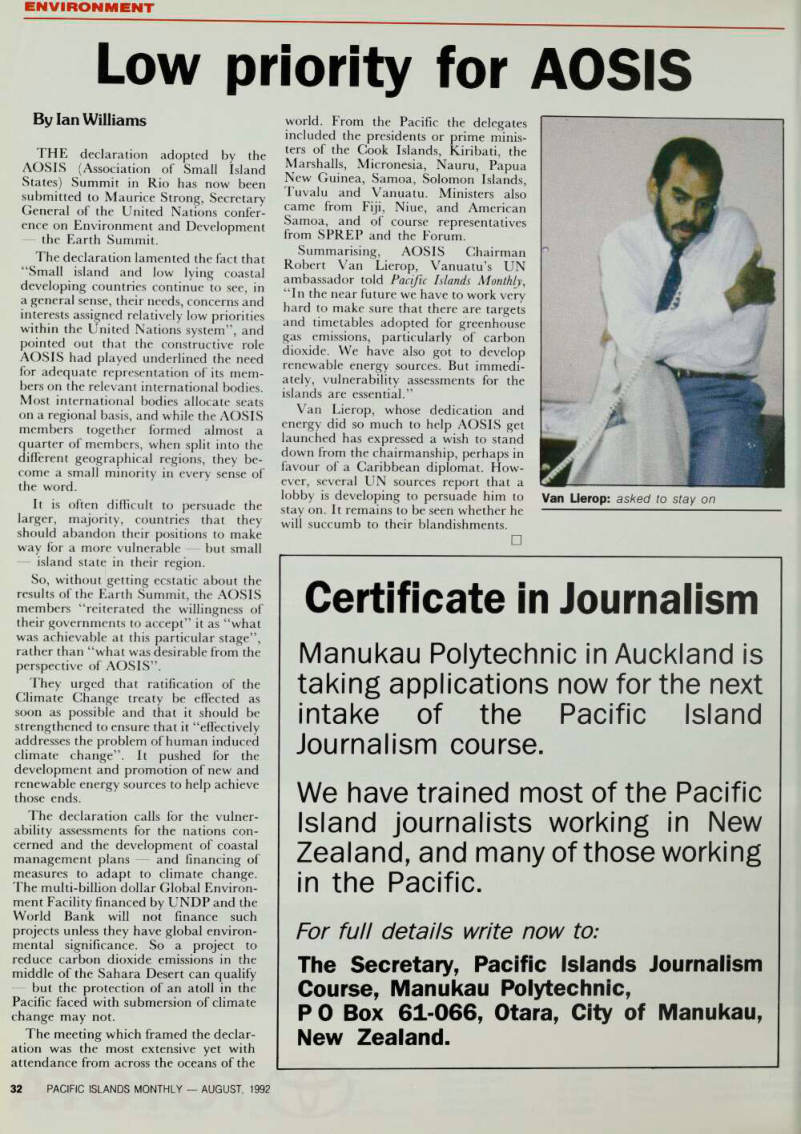
Environment
By lan Williams
THE declaration adopted by the AOSIS (Association of Small Island States) Summit in Rio has now been submitted to Maurice Strong, Secretary General of the United Nations confer ence on Environment and Development the Earth Summit.
The declaration lamented the fact that “Small island and low lying coastal developing countries continue to see, in a general sense, their needs, concerns and interests assigned relatively low priorities within the United Nations system”, and pointed out that the constructive role AOSIS had played underlined the need for adequate representation of its mem bers on the relevant international bodies.
Most international bodies allocate seats on a regional basis, and while the AOSIS members together formed almost a quarter of members, when split into the different geographical regions, they be come a small minority in every sense of the word.
It is often difficult to persuade the larger, majority, countries that they should abandon their positions to make way for a more vulnerable but small island state in their region.
So, without getting ecstatic about the results of the Earth Summit, the AOSIS members “reiterated the willingness of their governments to accept” it as “what was achievable at this particular stage”, rather than “what was desirable from the perspective of AOSIS”.
They urged that ratification of the Climate Change treaty be effected as soon as possible and that it should be strengthened to ensure that it “effectively addresses the problem of human induced climate change”. It pushed for the development and promotion of new and renewable energy sources to help achieve those ends.
The declaration calls for the vulner ability assessments for the nations con cerned and the development of coastal management plans and financing of measures to adapt to climate change.
The multi-billion dollar Global Environ ment Facility financed by UNDP and the World Bank will not finance such projects unless they have global environ mental significance. So a project to reduce carbon dioxide emissions in the middle of the Sahara Desert can qualify but the protection of an atoll in the Pacific faced with submersion of climate change may not.
The meeting which framed the declar ation was the most extensive yet with attendance from across the oceans of the
world. From the Pacific the delegates included the presidents or prime minis ters of the Cook Islands, Kiribati, the Marshalls, Micronesia, Nauru, Papua New Guinea, Samoa, Solomon Islands, Tuvalu and Vanuatu. Ministers also came from Fiji, Niue, and American Samoa, and of course representatives from SPREP and the Forum.
Summarising, AOSIS Chairman Robert Van Lierop, Vanuatu’s UN ambassador told Pacific Islands Monthly , “In the near future we have to work very hard to make sure that there are targets and timetables adopted for greenhouse gas emissions, particularly of carbon dioxide. We have also got to develop renewable energy sources. But immedi ately, vulnerability assessments for the islands are essential.”
Van Lierop, whose dedication and energy did so much to help AOSIS get launched has expressed a wish to stand down from the chairmanship, perhaps in favour of a Caribbean diplomat. How ever, several UN sources report that a lobby is developing to persuade him to stay on. It remains to be seen whether he will succumb to their blandishments.
Van Lierop: asked to stay on
Advertisements & other items, p. 32 (1 item)
Certificate in Journalism
Manukau Polytechnic in Auckland is taking applications now for the next intake of the Pacific Island Journalism course.
We have trained most of the Pacific Island journalists working in New Zealand, and many of those working in the Pacific.
For full details write now to: The Secretary, Pacific Islands Journalism Course, Manukau Polytechnic, PO Box 61-066, Otara, City of Manukau, New Zealand.
Guadalcanal
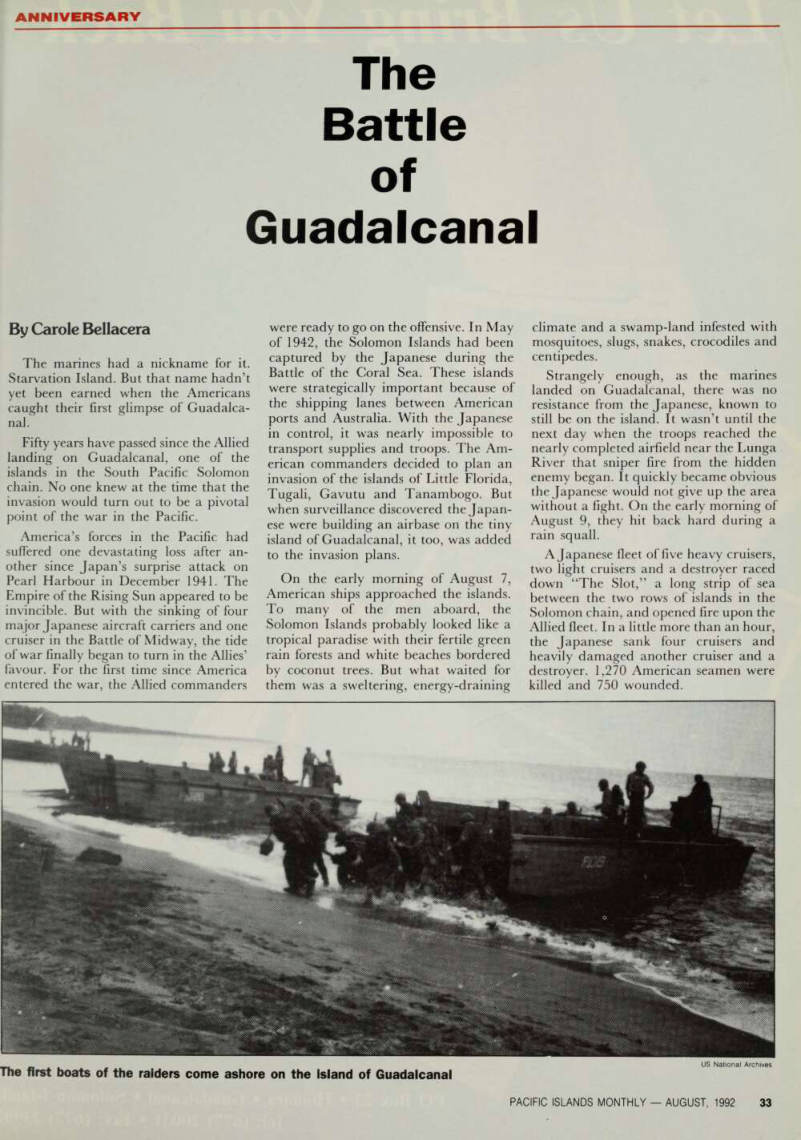
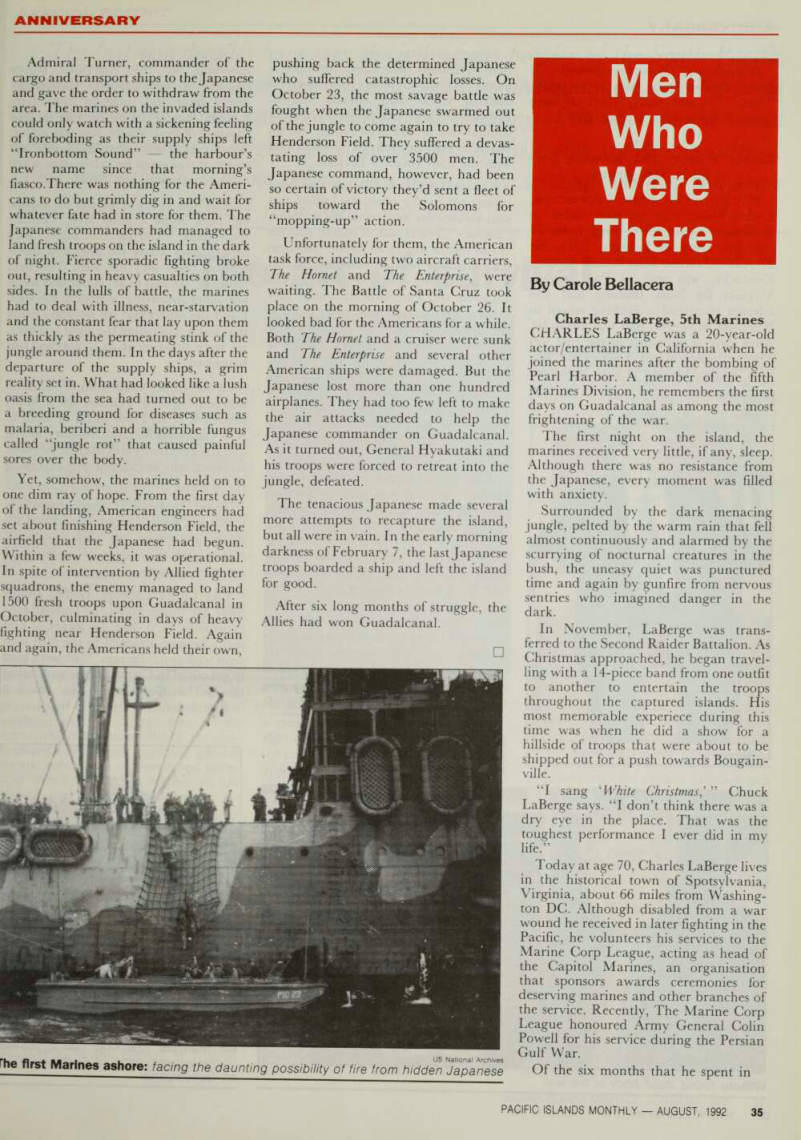
Anniversary
The Battle of Guadalcanal
By Carole Bellacera
The marines had a nickname for it.
Starvation Island. But that name hadn’t yet been earned when the Americans caught their first glimpse of Guadalca nal.
Fifty years have passed since the Allied landing on Guadalcanal, one of the islands in the South Pacific Solomon chain. No one knew at the time that the invasion would turn out to be a pivotal point of the war in the Pacific.
America’s forces in the Pacific had suffered one devastating loss after an other since Japan’s surprise attack on Pearl Harbour in December 1941. The Empire of the Rising Sun appeared to be invincible. But with the sinking of four major Japanese aircraft carriers and one cruiser in the Battle of Midway, the tide of war finally began to turn in the Allies’ favour. For the first time since America entered the war, the Allied commanders
were ready to go on the offensive. In May of 1942, the Solomon Islands had been captured by the Japanese during the Battle of the Coral Sea. These islands were strategically important because of the shipping lanes between American ports and Australia. With the Japanese in control, it was nearly impossible to transport supplies and troops. The Am erican commanders decided to plan an invasion of the islands of Little Florida, Tugali, Gavutu and Tanambogo. But when surveillance discovered the Japan ese were building an airbase on the tiny island of Guadalcanal, it too, was added to the invasion plans.
On the early morning of August 7, American ships approached the islands.
To many of the men aboard, the Solomon Islands probably looked like a tropical paradise with their fertile green rain forests and white beaches bordered by coconut trees. But what waited for them was a sweltering, energy-draining
climate and a swamp-land infested with mosquitoes, slugs, snakes, crocodiles and centipedes.
Strangely enough, as the marines landed on Guadalcanal, there was no resistance from the Japanese, known to still be on the island. It wasn’t until the next day when the troops reached the nearly completed airfield near the Lunga River that sniper fire from the hidden enemy began. It quickly became obvious the Japanese would not give up the area without a fight. On the early morning of August 9, they hit back hard during a
rain squall.
A Japanese fleet of five heavy cruisers, two light cruisers and a destroyer raced down “The Slot,” a long strip of sea between the two rows of islands in the Solomon chain, and opened fire upon the Allied fleet. In a little more than an hour, the Japanese sank four cruisers and heavily damaged another cruiser and a destroyer. 1,270 American seamen were killed and 750 wounded.
US National Archives
The first boats of the raiders come ashore on the island of Guadalcanal
Admiral Turner, commander of the cargo and transport ships to the Japanese and gave the order to withdraw from the area. The marines on the invaded islands could only watch with a sickening feeling of foreboding as their supply ships left “Ironbottom Sound” the harbour’s new name since that morning’s fiasco. There was nothing for the Ameri cans to do but grimly dig in and wait for whatever fate had in store for them. The Japanese commanders had managed to land fresh troops on the island in the dark of night. Fierce sporadic fighting broke out, resulting in heavy casualties on both sides. In the lulls of battle, the marines had to deal with illness, near-starvation and the constant fear that lay upon them as thickly as the permeating stink of the jungle around them. In the days after the departure of the supply ships, a grim reality set in. What had looked like a lush oasis from the sea had turned out to be a breeding ground for diseases such as malaria, beriberi and a horrible fungus called “jungle rot” that caused painful sores over the body.
Yet, somehow, the marines held on to one dim ray of hope. From the first day of the landing, American engineers had set about finishing Henderson Field, the airfield that the Japanese had begun.
Within a few weeks, it was operational.
In spite of intervention by Allied fighter squadrons, the enemy managed to land 1500 fresh troops upon Guadalcanal in October, culminating in days of heav y fighting near Henderson Field. Again and again, the Americans held their own,
pushing back the determined Japanese who suffered catastrophic losses. On October 23, the most savage battle was fought when the Japanese swarmed out of the jungle to come again to try to take Henderson Field. They suffered a devas tating loss of over 3500 men. The Japanese command, however, had been so certain of victory they’d sent a fleet of ships toward the Solomons for
“mopping-up” action.
Unfortunately for them, the American task force, including two aircraft carriers, The Hornet and The Enterprise , were waiting. The Battle of Santa Cruz took place on the morning of October 26. It looked bad for the Americans for a while.
Both The Hornet and a cruiser were sunk and The Enterprise and several other American ships were damaged. But the Japanese lost more than one hundred airplanes. They had too few left to make the air attacks needed to help the Japanese commander on Guadalcanal.
As it turned out, General Hyakutaki and his troops were forced to retreat into the
jungle, defeated.
The tenacious Japanese made several more attempts to recapture the island, but all were in vain. In the early morning darkness of February 7, the last Japanese troops boarded a ship and left the island for good.
After six long months of struggle, the Allies had won Guadalcanal. □
The first Marines ashore; facing the daunting possibility of fire from hidden Japanese
Advertisements & other items, p. 34 (1 item)
Let us anng You Back
V V VV'-‘ 9 \ »■ * *• * m ’C •#* * \ * * Z 5 ts f .‘7 ?£ > * * *
Solomon Airlines
Solomon Islands National Airline PO Box 23 • Honiara • Guadalcanal • Solomon Islands Tel: (677) 20031 • Fax: (677) 23992
Were
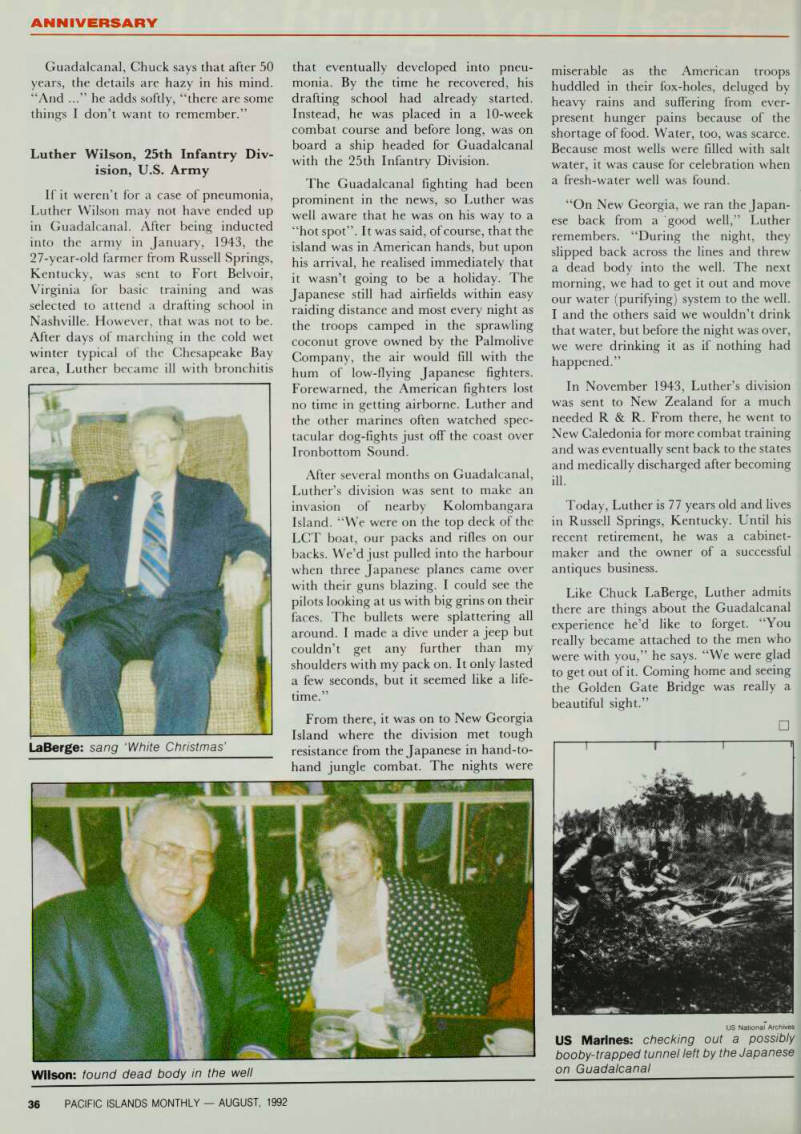
Men Who Were There
By Carole Bellacera
Charles Laßerge, sth Marines CHARLES Laßerge was a 20-year-old actor/entertainer in California when he joined the marines after the bombing of Pearl Harbor. A member of the fifth Marines Division, he remembers the first days on Guadalcanal as among the most frightening of the war.
The first night on the island, the marines received very little, if any, sleep.
Although there was no resistance from the Japanese, every moment was filled with anxiety.
Surrounded by the dark menacing jungle, pelted by the warm rain that fell almost continuously and alarmed by the scurrying of nocturnal creatures in the bush, the uneasy quiet was punctured time and again by gunfire from nervous sentries who imagined danger in the dark.
In November, Laßerge was trans ferred to the Second Raider Battalion. As Christmas approached, he began travel ling with a 14-piece band from one outfit to another to entertain the troops throughout the captured islands. His most memorable experiece during this time was when he did a show for a hillside of troops that were about to be shipped out for a push towards Bougain ville.
“I sang ‘ White Christmas ,’ ” Chuck Laßerge says. “I don’t think there was a dry eye in the place. That was the toughest performance I ever did in my life.”
Today at age 70, Charles Laßerge lives in the historical town of Spotsylvania, Virginia, about 66 miles from Washing ton DC. Although disabled from a war wound he received in later fighting in the Pacific, he volunteers his services to the Marine Corp League, acting as head of the Capitol Marines, an organisation that sponsors awards ceremonies for deserving marines and other branches of the service. Recently, The Marine Corp League honoured Army General Colin Powell for his service during the Persian Gulf War.
Of the six months that he spent in
Guadalcanal, Chuck says that after 50 years, the details are hazy in his mind.
“And ...” he adds softly, “there are some things I don’t want to remember.”
Luther Wilson, 25th Infantry Div ision, U.S. Army If it weren’t for a case of pneumonia, Luther Wilson may not have ended up in Guadalcanal. After being inducted into the army in January, 1943, the 27-year-old farmer from Russell Springs, Kentucky, was sent to Fort Belvoir, Virginia for basic training and was selected to attend a drafting school in Nashville. However, that was not to be.
After days of marching in the cold wet winter typical of the Chesapeake Bay area, Luther became ill with bronchitis
that eventually developed into pneu monia. By the time he recovered, his drafting school had already started.
Instead, he was placed in a 10-week combat course and before long, was on board a ship headed for Guadalcanal with the 25th Infantry Division.
The Guadalcanal fighting had been prominent in the news, so Luther was well aware that he was on his way to a “hot spot”. It was said, of course, that the island was in American hands, but upon his arrival, he realised immediately that it wasn’t going to be a holiday. The Japanese still had airfields within easy raiding distance and most every night as the troops camped in the sprawling coconut grove owned by the Palmolive Company, the air would fill with the hum of low-flying Japanese fighters.
Forewarned, the American fighters lost no time in getting airborne. Luther and the other marines often watched spec tacular dog-fights just off the coast over Ironbottom Sound.
After several months on Guadalcanal, Luther’s division was sent to make an
invasion of nearby Kolombangara
Island. “We were on the top deck of the LCT boat, our packs and rifles on our backs. We’d just pulled into the harbour when three Japanese planes came over with their guns blazing. I could see the pilots looking at us with big grins on their faces. The bullets were splattering all around. I made a dive under a jeep but couldn’t get any further than my shoulders with my pack on. It only lasted a few seconds, but it seemed like a life time.”
From there, it was on to New Georgia Island where the division met tough resistance from the Japanese in hand-to hand jungle combat. The nights were
miserable as the American troops huddled in their fox-holes, deluged by heavy rains and suffering from ever present hunger pains because of the shortage of food. Water, too, was scarce.
Because most wells were filled with salt water, it was cause for celebration when a fresh-water well was found.
“On New Georgia, we ran the Japan ese back from a good well,” Luther remembers. “During the night, they slipped back across the lines and threw a dead body into the well. The next morning, we had to get it out and move our water (purifying) system to the well.
I and the others said we wouldn’t drink that water, but before the night was over, we were drinking it as if nothing had
happened.”
In November 1943, Luther’s division was sent to New Zealand for a much needed R & R. From there, he went to New Caledonia for more combat training and was eventually sent back to the states and medically discharged after becoming ill.
Today, Luther is 77 years old and lives in Russell Springs, Kentucky. Until his recent retirement, he was a cabinet maker and the owner of a successful antiques business.
Like Chuck Laßerge, Luther admits there are things about the Guadalcanal experience he’d like to forget. “You really became attached to the men who were with you,” he says. “We were glad to get out of it. Coming home and seeing the Golden Gate Bridge was really a beautiful sight.”
LaRerge: sang ‘White Christmas’
Wilson: found dead body in the well
US National Archives US Marines: checking out a possibly booby-trapped tunnel left by the Japanese on Guadalcanal
Special Report
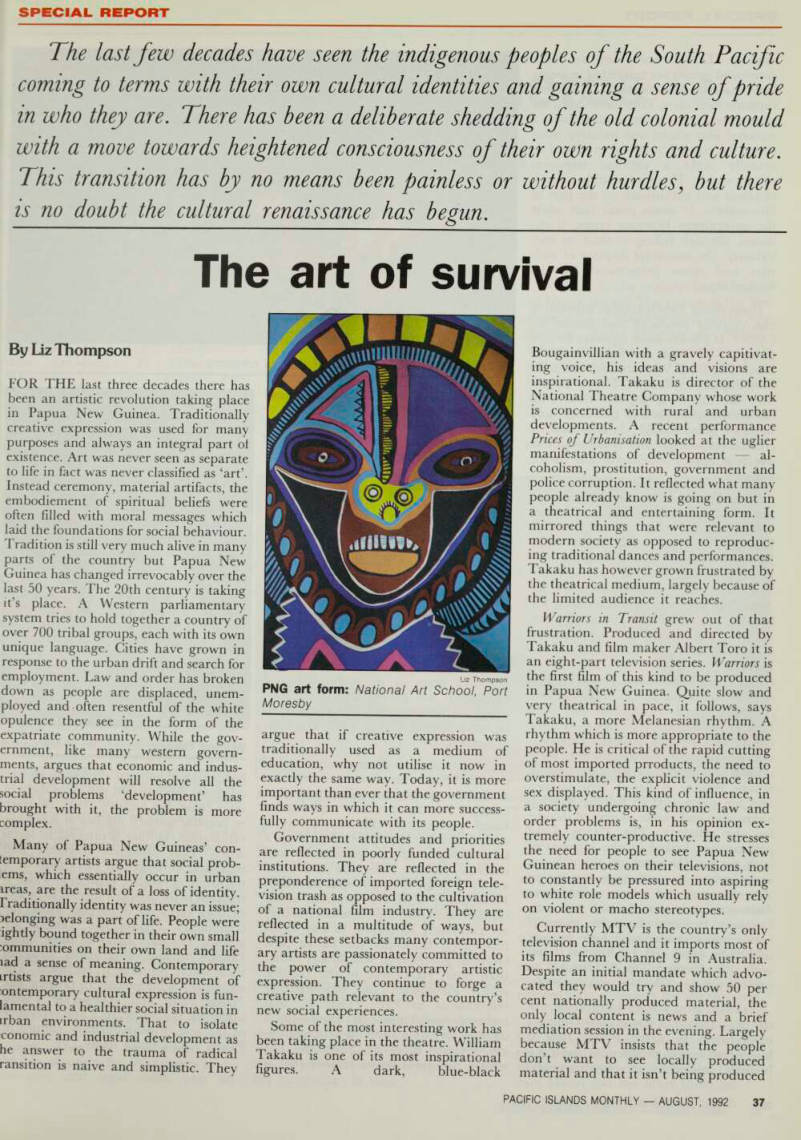
The last few decades have seen the indigenous peoples of the South Pacific coming to terms with their own cultural identities and gaining a sense of pride in who they are. There has been a deliberate shedding of the old colonial mould with a move towards heightened consciousness of their own rights and culture.
This transition has by no means been painless or without hurdles, but there is no doubt the cultural renaissance has begun.
The art of survival
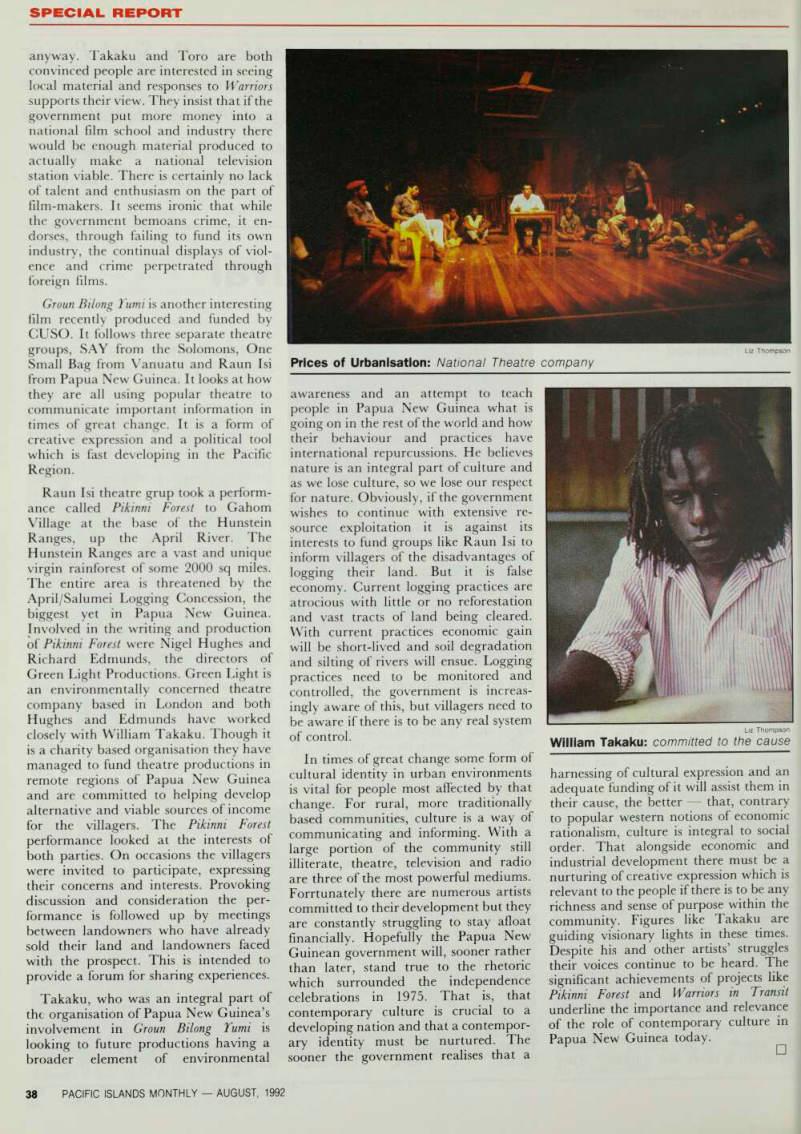
By Liz Thompson
FOR THE last three decades there has been an artistic revolution taking place in Papua New Guinea. Traditionally creative expression was used for many purposes and always an integral part ol existence. Art was never seen as separate to life in fact was never classified as ‘art’.
Instead ceremony, material artifacts, the embodiement of spiritual beliefs were often filled with moral messages which laid the foundations for social behaviour.
Tradition is still very much alive in many parts of the country but Papua New Guinea has changed irrevocably over the last 50 years. The 20th century is taking it’s place. A Western parliamentary system tries to hold together a country of over 700 tribal groups, each with its own unique language. Cities have grown in response to the urban drift and search for employment. Law and order has broken down as people are displaced, unem ployed and often resentful of the white opulence they see in the form of the expatriate community. While the gov ernment, like many western govern ments, argues that economic and indus trial development will resolve all the
social problems ‘development’ has
brought with it, the problem is more complex.
Many of Papua New Guineas’ con temporary artists argue that social prob ems, which essentially occur in urban ireas, are the result of a loss of identity.
Fraditionally identity was never an issue; belonging was a part of life. People were ightly bound together in their own small immunities on their own land and life
lad a sense of meaning. Contemporary
irtists argue that the development of :ontemporary cultural expression is fun lamental to a healthier social situation in irban environments. That to isolate conomic and industrial development as he answer to the trauma of radical
ransition is naive and simplistic. They
argue that if creative expression was traditionally used as a medium of education, why not utilise it now in exactly the same way. Today, it is more important than ever that the government finds ways in which it can more success fully communicate with its people.
Government attitudes and priorities are reflected in poorly funded cultural institutions. They are reflected in the preponderence of imported foreign tele vision trash as opposed to the cultivation of a national film industry. They are reflected in a multitude of ways, but despite these setbacks many contempor ary artists are passionately committed to the power of contemporary artistic expression. They continue to forge a creative path relevant to the country’s new social experiences.
Some of the most interesting work has been taking place in the theatre. William Takaku is one of its most inspirational figures. A dark, blue-black
Bougainvillian with a gravely capitivat ing voice, his ideas and visions are inspirational. Takaku is director of the National Theatre Company whose work is concerned with rural and urban
developments. A recent performance
Prices of Urbanisation looked at the uglier manifestations of development al coholism, prostitution, government and police corruption. It reflected what many people already know is going on but in a theatrical and entertaining form. It mirrored things that were relevant to modern society as opposed to reproduc ing traditional dances and performances.
Takaku has however grown frustrated by the theatrical medium, largely because of the limited audience it reaches.
Warriors in Transit grew out of that frustration. Produced and directed by Takaku and film maker Albert Toro it is an eight-part television series. Warriors is the first film of this kind to be produced in Papua New Guinea. Quite slow and very theatrical in pace, it follows, says Takaku, a more Melanesian rhythm. A rhythm which is more appropriate to the people. He is critical of the rapid cutting of most imported prroducts, the need to overstimulate, the explicit violence and sex displayed. This kind of influence, in a society undergoing chronic law and order problems is, in his opinion ex tremely counter-productive. He stresses the need for people to see Papua New Guinean heroes on their televisions, not to constantly be pressured into aspiring to white role models which usually rely on violent or macho stereotypes.
Currently MTV is the country’s only television channel and it imports most of its films from Channel 9 in Australia.
Despite an initial mandate which advo cated they would try and show 50 per cent nationally produced material, the only local content is news and a brief mediation session in the evening. Largely because MTV insists that the people don’t want to see locally produced material and that it isn’t being produced
Liz Thompson PNG art form: National Art School, Port Moresby
anyway. Takaku and Toro are both convinced people are interested in seeing local material and responses to Warriors supports their view. They insist that if the government put more money into a national film school and industry there would be enough material produced to actually make a national television station viable. There is certainly no lack of talent and enthusiasm on the part of film-makers. It seems ironic that while the government bemoans crime, it en dorses, through failing to fund its own industry, the continual displays of viol ence and crime perpetrated through foreign films.
Groun Bilong Tumi is another interesting film recently produced and funded by CUSO. It follows three separate theatre groups, SAY from the Solomons, One Small Bag from Vanuatu and Raun Isi from Papua New Guinea. It looks at how they are all using popular theatre to communicate important information in times of great change. It is a form of creative expression and a political tool which is fast developing in the Pacific Region.
Raun Isi theatre grup took a perform ance called Pikinni Forest to Gahom Village at the base of the Hunstein Ranges, up the April River. The Hunstein Ranges are a vast and unique virgin rainforest of some 2000 sq miles.
The entire area is threatened by the April/Salumei Logging Concession, the biggest yet in Papua New Guinea.
Involved in the writing and production of Pikinni Forest were Nigel Hughes and Richard Edmunds, the directors of Green Light Productions. Green Light is an environmentally concerned theatre company based in London and both Hughes and Edmunds have worked closely with William Takaku. Though it is a charity based organisation they have managed to fund theatre productions in remote regions of Papua New Guinea and are committed to helping develop alternative and viable sources of income for the villagers. The Pikinni Forest performance looked at the interests of both parties. On occasions the villagers were invited to participate, expressing their concerns and interests. Provoking discussion and consideration the per formance is followed up by meetings between landowners who have already sold their land and landowners faced with the prospect. This is intended to provide a forum for sharing experiences.
Takaku, who was an integral part of the organisation of Papua New Guinea’s involvement in Groun Bilong Tumi is looking to future productions having a broader element of environmental
awareness and an attempt to teach people in Papua New Guinea what is going on in the rest of the world and how their behaviour and practices have international repurcussions. He believes nature is an integral part of culture and as we lose culture, so we lose our respect for nature. Obviously, if the government wishes to continue with extensive re source exploitation it is against its interests to fund groups like Raun Isi to inform villagers of the disadvantages of logging their land. But it is false economy. Current logging practices are atrocious with little or no reforestation and vast tracts of land being cleared.
With current practices economic gain will be short-lived and soil degradation and silting of rivers will ensue. Logging practices need to be monitored and controlled, the government is increas ingly aware of this, but villagers need to be aware if there is to be any real system of control.
In times of great change some form of cultural identity in urban environments is vital for people most affected by that change. For rural, more traditionally based communities, culture is a way of communicating and informing. With a large portion of the community still illiterate, theatre, television and radio are three of the most powerful mediums.
Forrtunately there are numerous artists committed to their development but they are constantly struggling to stay afloat financially. Hopefully the Papua New Guinean government will, sooner rather than later, stand true to the rhetoric which surrounded the independence celebrations in 1975. That is, that contemporary culture is crucial to a developing nation and that a contempor ary identity must be nurtured. The sooner the government realises that a
harnessing of cultural expression and an adequate funding of it will assist them in their cause, the better that, contrary to popular western notions of economic rationalism, culture is integral to social order. That alongside economic and industrial development there must be a nurturing of creative expression which is relevant to the people if there is to be any richness and sense of purpose within the community. Figures like Takaku are guiding visionary lights in these times.
Despite his and other artists’ struggles their voices continue to be heard. The significant achievements of projects like Pikinni Forest and Warriors in Transit underline the importance and relevance of the role of contemporary culture in Papua New Guinea today.
Prices of Urbanisation: National Theatre company
Liz Thompson
Liz Thompson William Takaku: committed to the cause
Culture and Commerce
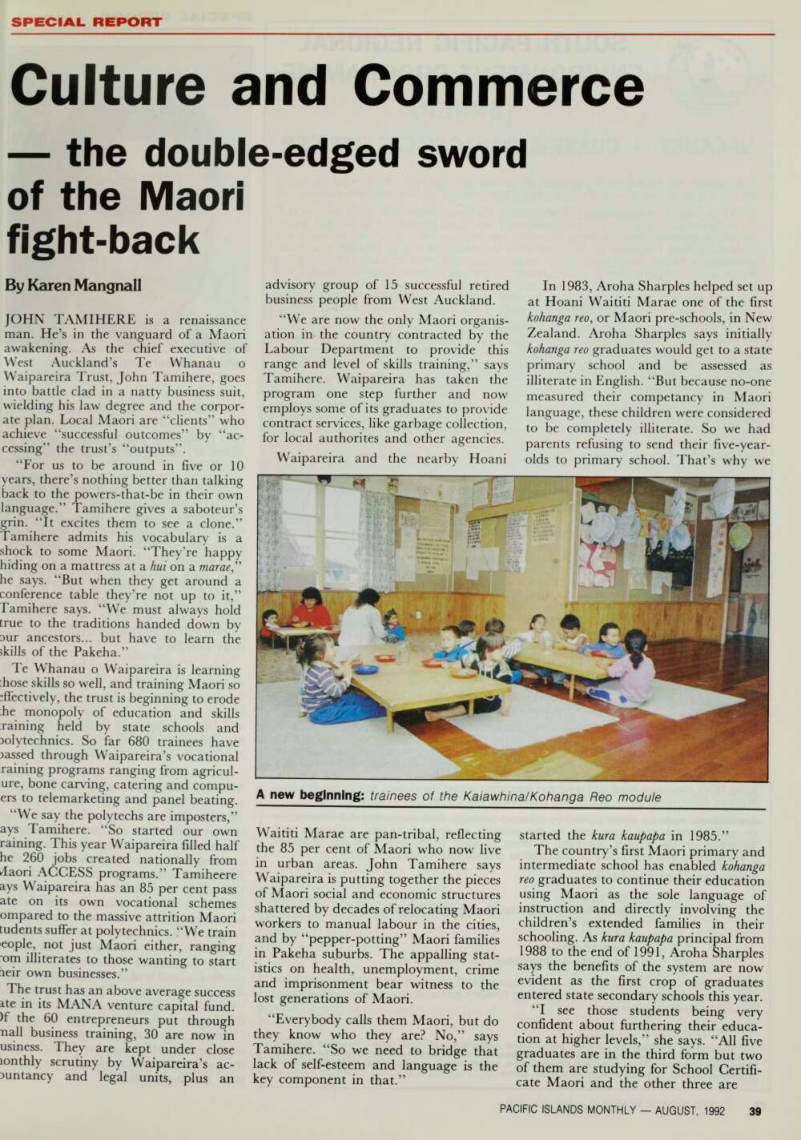
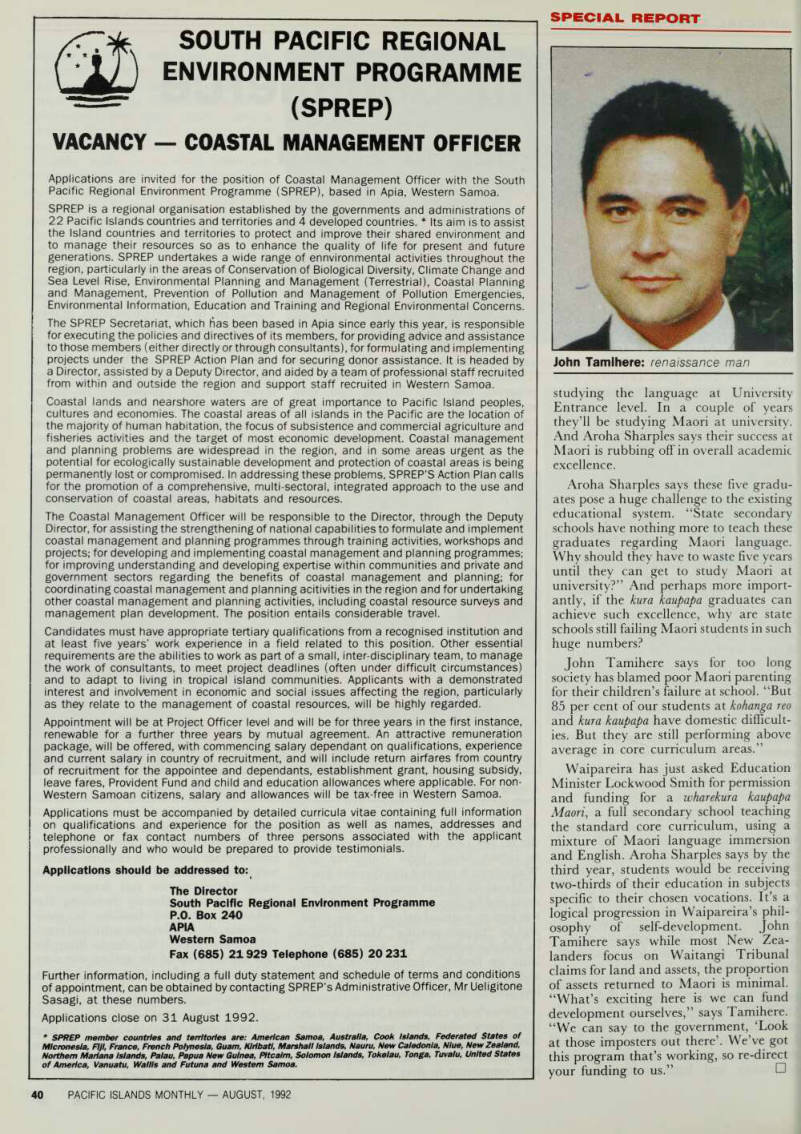
the double-edged sword of the Maori fight-back
By Karen Mangnal
JOHN TAMIHERE is a renaissance man. He’s in the vanguard of a Maori awakening. As the chief executive of West Auckland’s Te Whanau o Waipareira Trust, John Tamihere, goes into battle clad in a natty business suit, wielding his law degree and the corpor ate plan. Local Maori are “clients” who achieve “successful outcomes” by “ac cessing” the trust’s “outputs”.
“For us to be around in five or 10 years, there’s nothing better than talking back to the powers-that-be in their own language.” Tamihere gives a saboteur’s grin. “It excites them to see a clone.”
Tamihere admits his vocabulary is a
shock to some Maori. “They’re happy
hiding on a mattress at a hui on a marae,” he says. “But when they get around a conference table they’re not up to it,”
Tamihere says. “We must always hold true to the traditions handed down by Dur ancestors... but have to learn the skills of the Pakeha.”
Te Whanau o Waipareira is learning Bose skills so well, and training Maori so dfectively, the trust is beginning to erode he monopoly of education and skills raining held by state schools and polytechnics. So far 680 trainees have
passed through Waipareira’s vocational
raining programs ranging from agricul ure, bone carving, catering and compu ers to telemarketing and panel beating.
“We say the polytechs are imposters,” ays Tamihere. “So started our own raining. This year Waipareira filled half
he 260 jobs created nationally from
daori ACCESS programs.” Tamiheere ays Waipareira has an 85 per cent pass ate on its own vocational schemes ompared to the massive attrition Maori tudents suffer at polytechnics. “We train eople, not just Maori either, ranging om illiterates to those wanting to start neir own businesses.”
The trust has an above average success ate in its MANA venture capital fund. )f the 60 entrepreneurs put through nail business training, 30 are now in usiness. They are kept under close
lonthly scrutiny by Waipareira’s ac
puntancy and legal units, plus an
advisory group of 15 successful retired business people from West Auckland.
“We are now the only Maori organis ation in the country contracted by the Labour Department to provide this range and level of skills training,” says Tamihere. Waipareira has taken the program one step further and now employs some of its graduates to provide contract services, like garbage collection, for local authorites and other agencies.
Waipareira and the nearby Hoani
Waititi Marae are pan-tribal, reflecting the 85 per cent of Maori who now live in urban areas. John Tamihere says Waipareira is putting together the pieces of Maori social and economic structures shattered by decades of relocating Maori workers to manual labour in the cities, and by “pepper-potting” Maori families in Pakeha suburbs. The appalling stat istics on health, unemployment, crime and imprisonment bear witness to the lost generations of Maori.
“Everybody calls them Maori, but do they know who they are? No,” says Tamihere. “So we need to bridge that lack of self-esteem and language is the key component in that.”
In 1983, Aroha Sharpies helped set up at Hoani Waititi Marae one of the first kohanga reo , or Maori pre-schools, in New Zealand. Aroha Sharpies says initially kohanga reo graduates would get to a state primary school and be assessed as illiterate in English. “But because no-one measured their competancy in Maori language, these children were considered to be completely illiterate. So we had parents refusing to send their five-year olds to primary school. That’s why we
started the kura kaupapa in 1985.”
The country’s first Maori primary and intermediate school has enabled kohanga reo graduates to continue their education using Maori as the sole language of instruction and directly involving the children’s extended families in their
schooling. As kura kaupapa principal from
1988 to the end of 1991, Aroha Sharpies says the benefits of the system are now evident as the first crop of graduates entered state secondary schools this year.
“I see those students being very confident about furthering their educa tion at higher levels,” she says. “All five graduates are in the third form but two of them are studying for School Certifi cate Maori and the other three are
A new beginning: trainees of the Kaiawhina/Kohanga Reo module
studying the language at University Entrance level. In a couple of years they’ll be studying Maori at university.
And Aroha Sharpies says their success at Maori is rubbing off in overall academic excellence.
Aroha Sharpies says these five gradu ates pose a huge challenge to the existing educational system. “State secondary schools have nothing more to teach these graduates regarding Maori language.
Why should they have to waste five years until they can get to study Maori at university?” And perhaps more import antly, if the kura kaupapa graduates can achieve such excellence, why are state schools still failing Maori students in such huge numbers?
John Tamihere says for too long society has blamed poor Maori parenting for their children’s failure at school. “But 85 per cent of our students at kohanga reo and kura kaupapa have domestic difficult ies. But they are still performing above average in core curriculum areas.”
Waipareira has just asked Education Minister Lockwood Smith for permission and funding for a wharekura kaupapa Maori , a full secondary school teaching the standard core curriculum, using a mixture of Maori language immersion and English. Aroha Sharpies says by the third year, students would be receiving two-thirds of their education in subjects specific to their chosen vocations. It’s a
logical progression in Waipareira’s phil
osophy of self-development. John Tamihere says while most New Zea landers focus on Waitangi Tribunal claims for land and assets, the proportion of assets returned to Maori is minimal.
“What’s exciting here is we can fund development ourselves,” says Tamihere.
“We can say to the government, ‘Look at those imposters out there’. We’ve got this program that’s working, so re-direct your funding to us.” O
John Tamihere: renaissance man
Advertisements & other items, p. 40 (1 item)
(Sprep)
SOUTH PACIFIC REGIONAL
ENVIRONMENT PROGRAMME
VACANCY COASTAL MANAGEMENT OFFICER
Applications are invited for the position of Coastal Management Officer with the South Pacific Regional Environment Programme (SPREP), based in Apia, Western Samoa.
SPREP is a regional organisation established by the governments and administrations of 22 Pacific Islands countries and territories and 4 developed countries. * Its aim is to assist the Island countries and territories to protect and improve their shared environment and to manage their resources so as to enhance the quality of life for present and future generations. SPREP undertakes a wide range of ennvironmental activities throughout the region, particularly in the areas of Conservation of Biological Diversity, Climate Change and Sea Level Rise, Environmental Planning and Management (Terrestrial), Coastal Planning and Management, Prevention of Pollution and Management of Pollution Emergencies, Environmental Information, Education and Training and Regional Environmental Concerns.
The SPREP Secretariat, which lias been based in Apia since early this year, is responsible for executing the policies and directives of its members, for providing advice and assistance to those members (either directly or through consultants), for formulating and implementing projects under the SPREP Action Plan and for securing donor assistance. It is headed by a Director, assisted by a Deputy Director, and aided by a team of professional staff recruited from within and outside the region and support staff recruited in Western Samoa.
Coastal lands and nearshore waters are of great importance to Pacific Island peoples, cultures and economies. The coastal areas of all islands in the Pacific are the location of the majority of human habitation, the focus of subsistence and commercial agriculture and fisheries activities and the target of most economic development. Coastal management and planning problems are widespread in the region, and in some areas urgent as the potential for ecologically sustainable development and protection of coastal areas is being permanently lost or compromised. In addressing these problems, SPREP’S Action Plan calls for the promotion of a comprehensive, multi-sectoral, integrated approach to the use and conservation of coastal areas, habitats and resources.
The Coastal Management Officer will be responsible to the Director, through the Deputy Director, for assisting the strengthening of national capabilities to formulate and implement coastal management and planning programmes through training activities, workshops and projects; for developing and implementing coastal management and planning programmes; for improving understanding and developing expertise within communities and private and government sectors regarding the benefits of coastal management and planning; for coordinating coastal management and planning acitivities in the region and for undertaking other coastal management and planning activities, including coastal resource surveys and management plan development. The position entails considerable travel.
Candidates must have appropriate tertiary qualifications from a recognised institution and at least five years’ work experience in a field related to this position. Other essential requirements are the abilities to work as part of a small, inter-disciplinary team, to manage the work of consultants, to meet project deadlines (often under difficult circumstances) and to adapt to living in tropical island communities. Applicants with a demonstrated interest and involvement in economic and social issues affecting the region, particularly as they relate to the management of coastal resources, will be highly regarded.
Appointment will be at Project Officer level and will be for three years in the first instance, renewable for a further three years by mutual agreement. An attractive remuneration package, will be offered, with commencing salary dependant on qualifications, experience and current salary in country of recruitment, and will include return airfares from country of recruitment for the appointee and dependants, establishment grant, housing subsidy, leave fares, Provident Fund and child and education allowances where applicable. For non- Western Samoan citizens, salary and allowances will be tax-free in Western Samoa.
Applications must be accompanied by detailed curricula vitae containing full information on qualifications and experience for the position as well as names, addresses and telephone or fax contact numbers of three persons associated with the applicant professionally and who would be prepared to provide testimonials.
Applications should be addressed to: The Director South Pacific Regional Environment Programme P.O. Box 240
APIA
Western Samoa Fax (685) 21929 Telephone (685) 20 231 Further information, including a full duty statement and schedule of terms and conditions of appointment, can be obtained by contacting SPREP’s Administrative Officer, Mr Ueligitone Sasagi, at these numbers.
Applications close on 31 August 1992. * SPREP member countries and territories are: American Samoa, Australia, Cook Islands, Federated States of Micronesia, FIJI, France, French Polynesia, Guam, Kiribati, Marshall Islands, Nauru, New Caledonia, Niue, New Zealand.
Northern Mariana Islands, Palau, Papua New Guinea, Pltcalm, Solomon Islands, Tokelau, Tonga, Tuvalu, United States of America, Vanuatu, Wallis and Futuna and Western Samoa.
sovereignty
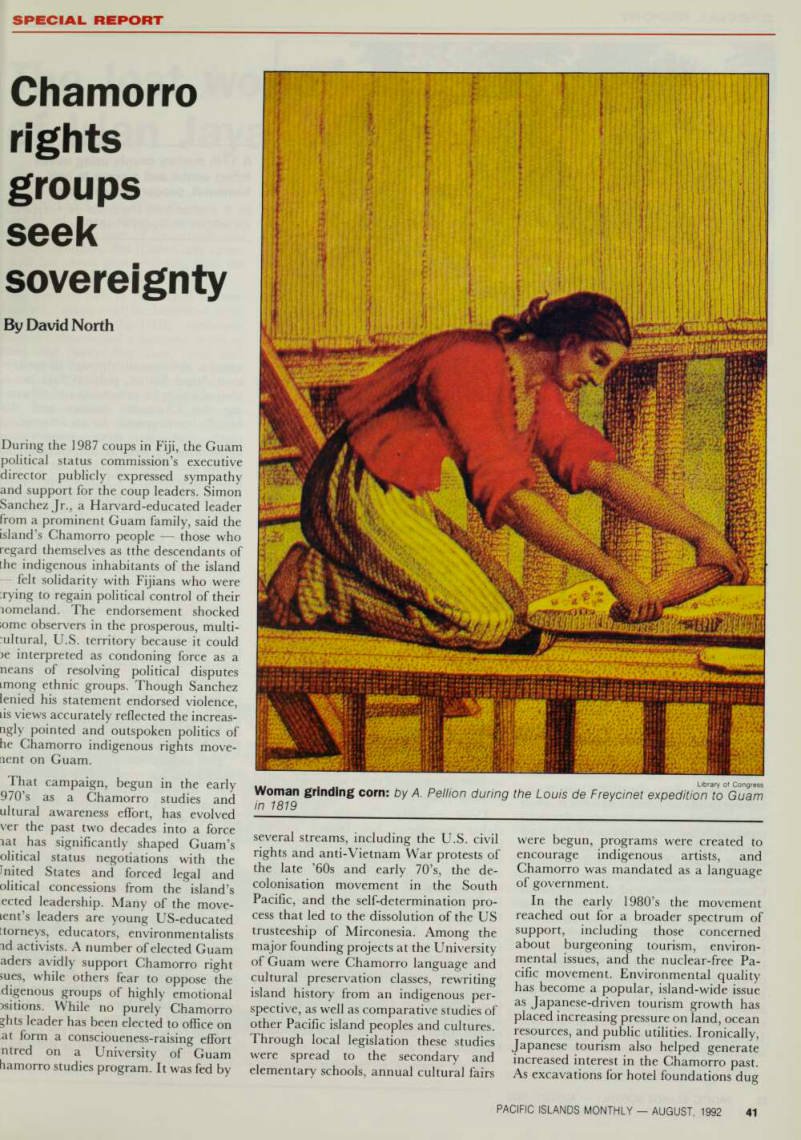
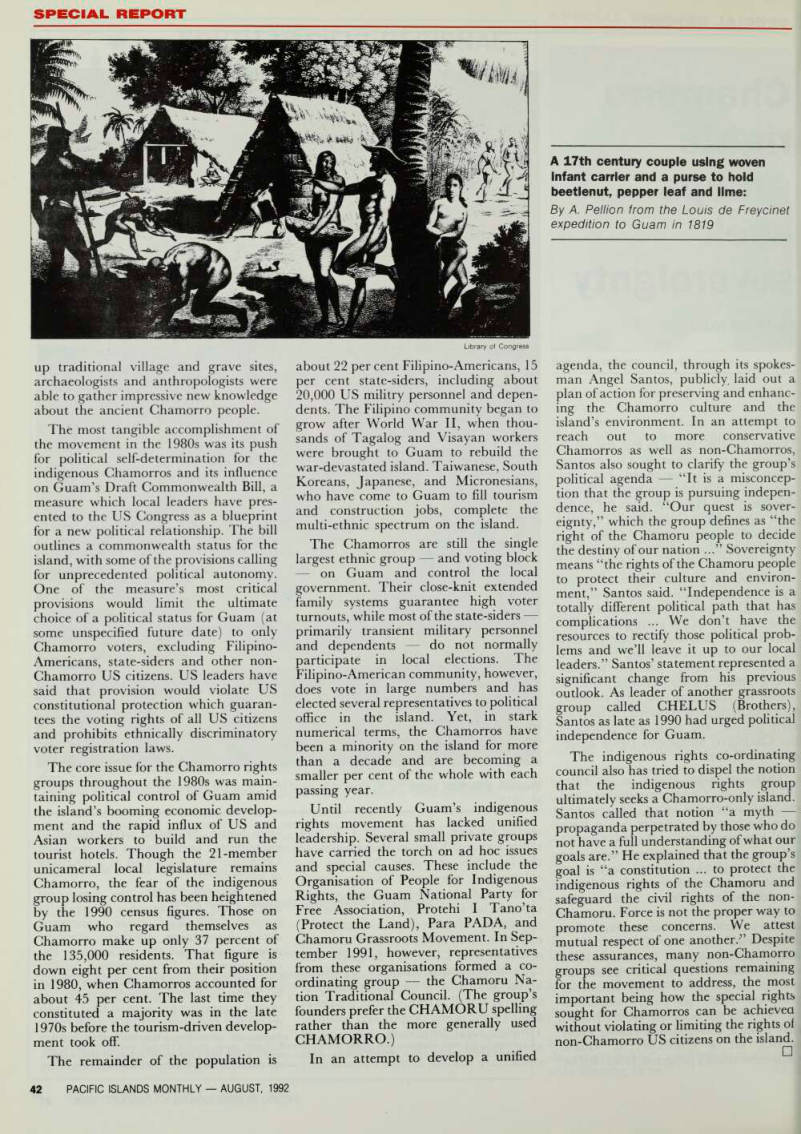
Chamorro rights groups seek sovereignty
By David North
During the 1987 coups in Fiji, the Guam political status commission’s executive director publicly expressed sympathy and support for the coup leaders. Simon Sanchez Jr., a Harvard-educated leader from a prominent Guam family, said the island’s Chamorro people those who regard themselves as tthe descendants of the indigenous inhabitants of the island felt solidarity with Fijians who were rying to regain political control of their lomeland. The endorsement shocked ;ome observers in the prosperous, multi :ultural, U.S. territory because it could )e interpreted as condoning force as a neans of resolving political disputes imong ethnic groups. Though Sanchez lenied his statement endorsed violence, lis views accurately reflected the increas ngly pointed and outspoken politics of he Chamorro indigenous rights move nent on Guam.
That campaign, begun in the early 970’s as a Chamorro studies and ultural awareness effort, has evolved ver the past two decades into a force
lat has significantly shaped Guam’s
olitical status negotiations with the Inited States and forced legal and olitical concessions from the island’s ected leadership. Many of the move icnt’s leaders are young US-educated ttorneys, educators, environmentalists id activists. A number of elected Guam aders avidly support Chamorro right sues, while others fear to oppose the digenous groups of highly emotional isitions. While no purely Chamorro leader has been elected to office on at form a conscioueness-raising effort ntred on a University of Guam hamorro studies program. It was fed by
several streams, including the U.S. civil rights and anti-Vietnam War protests of the late ’6os and early 70’s, the de colonisation movement in the South Pacific, and the self-determination pro cess that led to the dissolution of the US trusteeship of Mirconesia. Among the major founding projects at the University of Guam were Chamorro language and cultural preservation classes, rewriting island history from an indigenous per spective, as well as comparative studies of other Pacific island peoples and cultures.
Through local legislation these studies were spread to the secondary and elementary schools, annual cultural fairs
were begun, programs were created to encourage indigenous artists, and Chamorro was mandated as a language of government.
In the early 1980’s the movement reached out for a broader spectrum of support, including those concerned about burgeoning tourism, environ mental issues, and the nuclear-free Pa cific movement. Environmental quality has become a popular, island-wide issue as Japanese-driven tourism growth has placed increasing pressure on land, ocean resources, and public utilities. Ironically, Japanese tourism also helped generate increased interest in the Chamorro past.
As excavations for hotel foundations dug
Library of Congress Woman grinding corn: by A. Pellion during the Louis de Freycinet expedition to Guam in 1819
up traditional village and grave sites, archaeologists and anthropologists were able to gather impressive new knowledge about the ancient Chamorro people.
The most tangible accomplishment of the movement in the 1980 s was its push for political self-determination for the indigenous Chamorros and its influence on Guam’s Draft Commonwealth Bill, a measure which local leaders have pres ented to the US Congress as a blueprint for a new political relationship. The bill outlines a commonwealth status for the island, with some of the provisions calling
for unprecedented political autonomy.
One of the measure’s most critical provisions would limit the ultimate choice of a political status for Guam (at some unspecified future date) to only Chamorro voters, excluding Filipino- Americans, state-siders and other non- Chamorro US citizens. US leaders have said that provision would violate US constitutional protection which guaran tees the voting rights of all US citizens
and prohibits ethnically discriminatory
voter registration laws.
The core issue for the Chamorro rights groups throughout the 1980 s was main taining political control of Guam amid the island’s booming economic develop ment and the rapid influx of US and Asian workers to build and run the tourist hotels. Though the 21-member unicameral local legislature remains Chamorro, the fear of the indigenous group losing control has been heightened by the 1990 census figures. Those on Guam who regard themselves as Chamorro make up only 37 percent of the 135,000 residents. That figure is down eight per cent from their position in 1980, when Chamorros accounted for about 45 per cent. The last time they constituted a majority was in the late 1970 s before the tourism-driven develop ment took off.
The remainder of the population is
about 22 per cent Filipino-Americans, 15 per cent state-siders, including about 20,000 US militry personnel and depen dents. The Filipino community began to grow after World War 11, when thou sands of Tagalog and Visayan workers were brought to Guam to rebuild the war-devastated island. Taiwanese, South Koreans, Japanese, and Micronesians, who have come to Guam to fill tourism and construction jobs, complete the multi-ethnic spectrum on the island.
The Chamorros are still the single largest ethnic group and voting block on Guam and control the local government. Their close-knit extended family systems guarantee high voter turnouts, while most of the state-siders
primarily transient military personnel
and dependents do not normally participate in local elections. The Filipino-American community, however, does vote in large numbers and has elected several representatives to political office in the island. Yet, in stark numerical terms, the Chamorros have been a minority on the island for more than a decade and are becoming a smaller per cent of the whole with each
passing year.
Until recently Guam’s indigenous rights movement has lacked unified leadership. Several small private groups have carried the torch on ad hoc issues and special causes. These include the Organisation of People for Indigenous Rights, the Guam National Party for Free Association, Protehi I Tano’ta (Protect the Land), Para PADA, and Chamoru Grassroots Movement. In Sep tember 1991, however, representatives from these organisations formed a co ordinating group the Chamoru Na tion Traditional Council. (The group’s founders prefer the CHAMORU spelling rather than the more generally used
Chamorro.)
In an attempt to develop a unified
agenda, the council, through its spokes man Angel Santos, publicly, laid out a plan of action for preserving and enhanc ing the Chamorro culture and the island’s environment. In an attempt to reach out to more conservative Chamorros as well as non-Chamorros, Santos also sought to clarify the group’s political agenda “It is a misconcep tion that the group is pursuing indepen dence, he said. “Our quest is sover eignty,” which the group defines as “the right of the Chamoru people to decide the destiny of our nation ...” Sovereignty means “the rights of the Chamoru people to protect their culture and environ ment,” Santos said. “Independence is a totally different political path that has complications ... We don’t have the resources to rectify those political prob lems and we’ll leave it up to our local leaders.” Santos’ statement represented a significant change from his previous outlook. As leader of another grassroots group called CHELUS (Brothers), Santos as late as 1990 had urged political independence for Guam.
The indigenous rights co-ordinating council also has tried to dispel the notion that the indigenous rights group ultimately seeks a Chamorro-only island.
Santos called that notion “a myth propaganda perpetrated by those who do not have a full understanding of what our goals are.” He explained that the group’s goal is “a constitution ... to protect the indigenous rights of the Chamoru and safeguard the civil rights of the non- Chamoru. Force is not the proper way to promote these concerns. We attest mutual respect of one another/’ Despite these assurances, many non-Chamorro groups see critical questions remaining for the movement to address, the most important being how the special rights sought for Chamorros can be achieved without violating or limiting the rights of non-Chamorro US citizens on the island.
Library of Congress
A 17th century couple using woven Infant carrier and a purse to hold beetlenut, pepper leaf and lime: By A. Pellion from the Louis de Freycinet expedition to Guam in 1819
of Irian Jaya
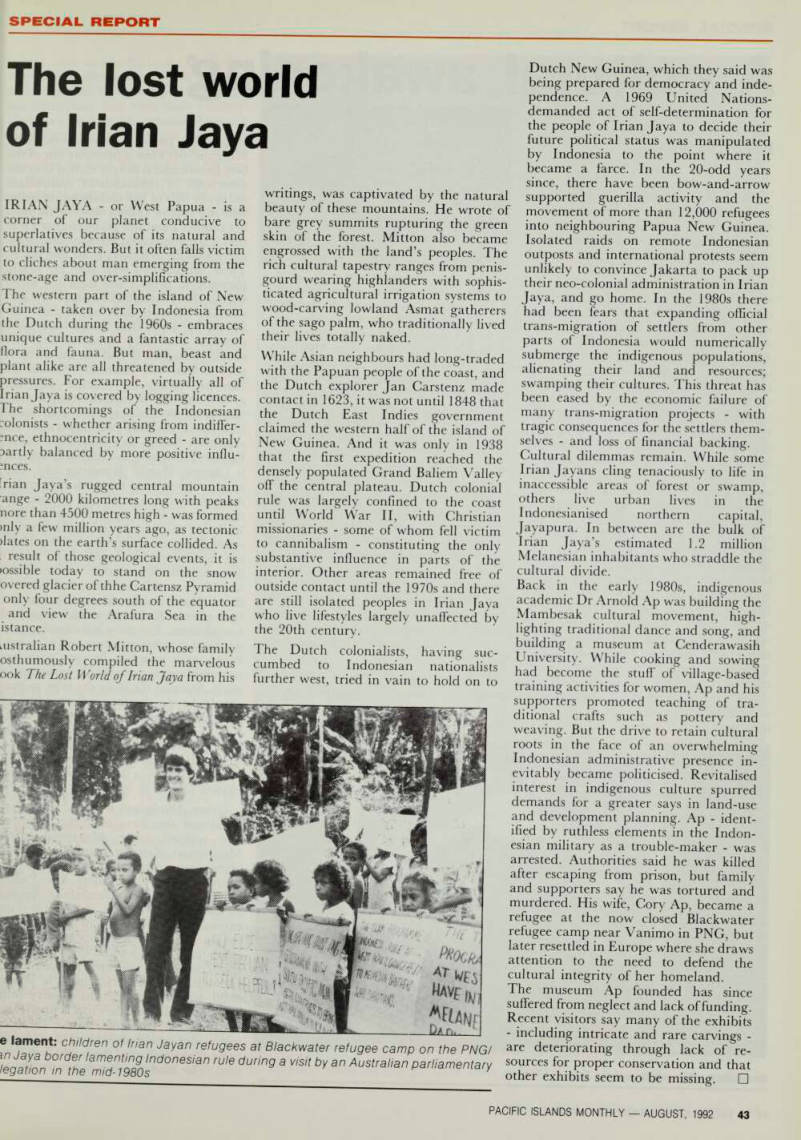
The lost world of Irian Jaya
IRIAN JAVA - or West Papua - is a corner of our planet conducive to superlatives because of its natural and cultural wonders. But it often falls victim to cliches about man emerging from the stone-age and over-simplifications.
The western part of the island of New Guinea - taken over by Indonesia from the Dutch during the 1960 s - embraces unique cultures and a fantastic array of flora and fauna. But man, beast and plant alike are all threatened by outside pressures. For example, virtually all of Irian Jaya is covered by logging licences.
The shortcomings of the Indonesian :olonists - whether arising from indiffer ence, ethnocentricity or greed - are only Dartly balanced by more positive influ ences.
Tian Jaya’s rugged central mountain ange - 2000 kilometres long with peaks nore than 4500 metres high - was formed >nly a few million years ago, as tectonic dates on the earth’s surface collided. As result of those geological events, it is ►ossible today to stand on the snow overed glacier of thhe Cartensz Pyramid only four degrees south of the equator and view the Arafura Sea in the istance. lUstralian Robert Mitton, whose family osthumously compiled the marvelous ook The Lost World of Irian Jaya from his
writings, was captivated by the natural beauty of these mountains. He wrote of bare grey summits rupturing the green skin of the forest. Mitton also became engrossed with the land’s peoples. The rich cultural tapestry ranges from penis gourd wearing highlanders with sophis ticated agricultural irrigation systems to wood-carving lowland Asmat gatherers of the sago palm, who traditionally lived their lives totally naked.
While Asian neighbours had long-traded with the Papuan people of the coast, and the Dutch explorer Jan Carstenz made contact in 1623, it was not until 1848 that the Dutch East Indies government claimed the western half of the island of New Guinea. And it was only in 1938 that the first expedition reached the densely populated Grand Baliem Valley off the central plateau. Dutch colonial rule was largely confined to the coast until World War 11, with Christian missionaries - some of whom fell victim to cannibalism - constituting the only substantive influence in parts of the interior. Other areas remained free of outside contact until the 1970 s and there are still isolated peoples in Irian Jaya who live lifestyles largely unaffected by the 20th century.
The Dutch colonialists, having suc cumbed to Indonesian nationalists further west, tried in vain to hold on to
Dutch New Guinea, which they said was being prepared for democracy and inde pendence. A 1969 United Nations demanded act of self-determination for the people of Irian Jaya to decide their future political status was manipulated by Indonesia to the point where it became a farce. In the 20-odd years since, there have been bow-and-arrow supported guerilla activity and the movement of more than 12,000 refugees into neighbouring Papua New Guinea.
Isolated raids on remote Indonesian outposts and international protests seem unlikely to convince Jakarta to pack up their neo-colonial administration in Irian Jaya, and go home. In the 1980 s there had been fears that expanding official trans-migration of settlers from other parts of Indonesia would numerically
submerge the indigenous populations,
alienating their land and resources; swamping their cultures. This threat has been eased by the economic failure of many trans-migration projects - with tragic consequences for the settlers them selves - and loss of financial backing.
Cultural dilemmas remain. While some Irian Jayans cling tenaciously to life in inaccessible areas of forest or swamp, others live urban lives in the Indonesianised northern capital, Jayapura. In between are the bulk of Irian Jaya’s estimated 1.2 million Melanesian inhabitants who straddle the cultural divide.
Back in the early 1980 s, indigenous academic Dr Arnold Ap was building the Mambesak cultural movement, high lighting traditional dance and song, and building a museum at Cenderawasih
University, While cooking and sowing
had become the stuff of village-based training activities for women, Ap and his supporters promoted teaching of tra ditional crafts such as pottery and weaving. But the drive to retain cultural roots in the face of an overwhelming Indonesian administrative presence in evitably became politicised. Revitalised interest in indigenous culture spurred demands for a greater says in land-use
and development planning. Ap - ident
ified by ruthless elements in the Indon esian military as a trouble-maker - was arrested. Authorities said he was killed after escaping from prison, but family and supporters say he was tortured and murdered. His wife, Cory Ap, became a refugee at the now closed Blackwater refugee camp near Vanimo in PNG, but later resettled in Europe where she draws attention to the need to defend the cultural integrity of her homeland.
The museum Ap founded has since suffered from neglect and lack of funding.
Recent visitors say many of the exhibits - including intricate and rare carvings are deteriorating through lack of re sources for proper conservation and that other exhibits seem to be missing. □
[?] lament: children of Irian Jayan refugees at Blackwater refugee camp on the PNG/ [?]n Jaya border lamenting Indonesian rule during a visit by an AuStralian parliamentary [?]egation in the mid-1980s
A cultural awakening
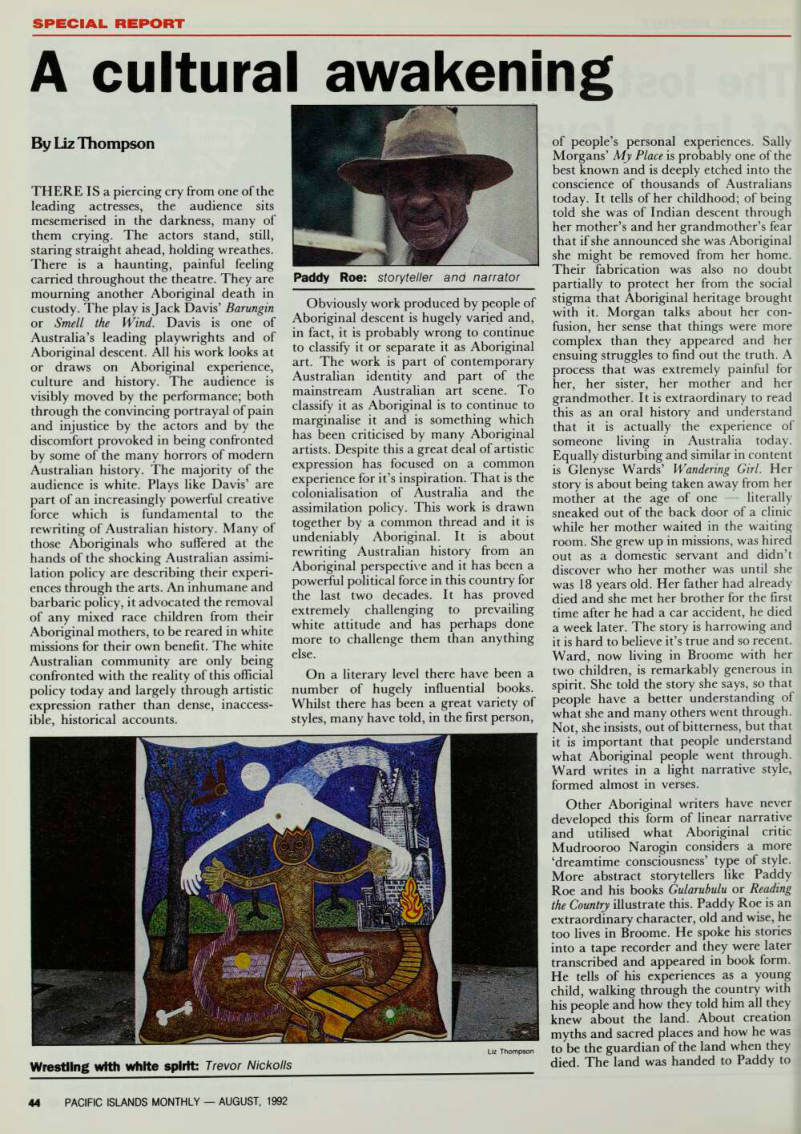
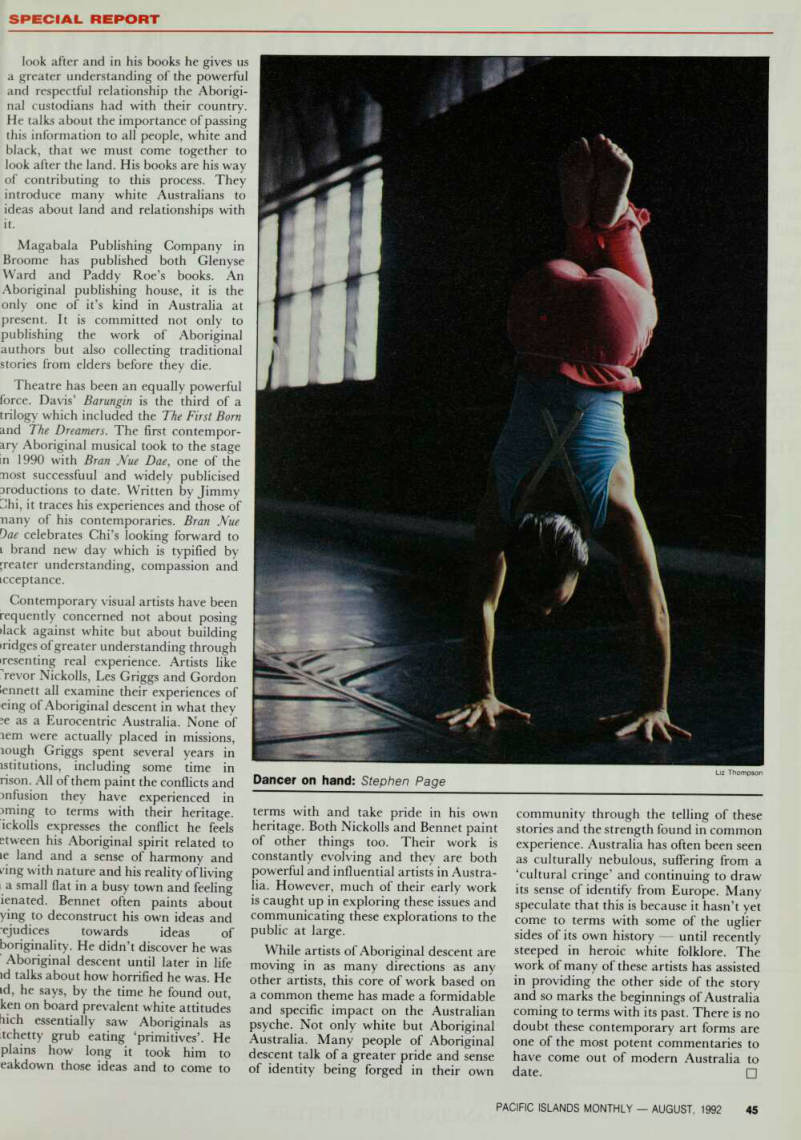
By Liz Thompson
THERE IS a piercing cry from one of the leading actresses, the audience sits mesemerised in the darkness, many of them crying. The actors stand, still, staring straight ahead, holding wreathes.
There is a haunting, painful feeling carried throughout the theatre. They are mourning another Aboriginal death in custody. The play is Jack Davis’ Barungin or Smell the Wind. Davis is one of Australia’s leading playwrights and of Aboriginal descent. All his work looks at or draws on Aboriginal experience, culture and history. The audience is visibly moved by the performance; both through the convincing portrayal of pain and injustice by the actors and by the discomfort provoked in being confronted by some of the many horrors of modern Australian history. The majority of the audience is white. Plays like Davis’ are part of an increasingly powerful creative force which is fundamental to the rewriting of Australian history. Many of those Aboriginals who suffered at the hands of the shocking Australian assimi lation policy are describing their experi ences through the arts. An inhumane and barbaric policy, it advocated the removal of any mixed race children from their Aboriginal mothers, to be reared in white missions for their own benefit. The white Australian community are only being confronted with the reality of this official policy today and largely through artistic expression rather than dense, inaccess ible, historical accounts.
Obviously work produced by people of Aboriginal descent is hugely varied and, ln fact > « 15 probably wrong to continue to cla ?f lf V 11 °. r separate it as Aboriginal art - Tbe wor J k ls . Part °£ contemporary Australian identity and part of the mainstream Australian art scene. To dasslf >' >* as Aboriginal is to continue to marginalise it and is something which has bee " criticised by many Aboriginal artlsts - Des P‘ te tbls a S r f at deal ofartlstlc expression has focused on a common experience for it s inspiration. That is he colomalisation of Australia and the assimilation policy. This work is drawn together by a common thread and it is undeniably Aboriginal. It is about Australian history from an Aboriginal perspective and it has been a P. owe . rful P ohtlcal fOT . ce m this country for the last . two decades. I has proved
extremely challenging to prevailing
white attitude and has perhaps done „ , K E, .i- „ more to challenge them than anything 5 7 & On a literary level there have been a number of hugely influential books, Whilst there has been a great variety of styles, many have told, in the first person,
of people’s personal experiences. Sally Morgans’ My Place is probably one of the best known and is deeply etched into the conscience of thousands of Australians today. It tells of her childhood; of being told she was of Indian descent through her mother’s and her grandmother’s fear that if she announced she was Aboriginal she might be removed from her home.
Their fabrication was also no doubt partially to protect her from the social stigma that Aboriginal heritage brought with it. Morgan talks about her con fusion, her sense that things were more complex than they appeared and her ensuing struggles to find out the truth. A process that was extremely painful for her, her sister, her mother and her grandmother. It is extraordinary to read this as an oral history and understand that it is actually the experience of someone living in Australia today.
Equally disturbing and similar in content is Glenyse Wards’ Wandering Girl. Her story is about being taken away from her mother at the age of one literally sneaked out of the back door of a clinic while her mother waited in the waiting room. She grew up in missions, was hired out as a domestic servant and didn’t discover who her mother was until she was 18 years old. Her father had already died and she met her brother for the first time after he had a car accident, he died a week later. The story is harrowing and it is hard to believe it’s true and so recent.
Ward, now living in Broome with her two children, is remarkably generous in spirit. She told the story she says, so that people have a better understanding of what she and many others went through.
Not, she insists, out of bitterness, but that it is important that people understand what Aboriginal people went through.
Ward writes in a light narrative style, formed almost in verses.
Other Aboriginal writers have never developed this form of linear narrative and utilised what Aboriginal critic Mudrooroo Narogin considers a more ‘dreamtime consciousness’ type of style.
More abstract storytellers like Paddy Roe and his books Gularubulu or Reading the Country illustrate this. Paddy Roe is an extraordinary character, old and wise, he too lives in Broome. He spoke his stories into a tape recorder and they were later transcribed and appeared in book form.
He tells of his experiences as a young child, walking through the country with his people and how they told him all they knew about the land. About creation myths and sacred places and how he was to be the guardian of the land when they died. The land was handed to Paddy to
Liz Thompson
Wrestling with white spirit: Trevor Nickolls
Paddy Roe: storyteller and narrator
look after and in his books he gives us a greater understanding of the powerful and respectful relationship the Aborigi nal custodians had with their country.
He talks about the importance of passing this information to all people, white and black, that we must come together to look after the land. His books are his way of contributing to this process. They introduce many white Australians to ideas about land and relationships with it.
Magabala Publishing Company in Broome has published both Glenyse Ward and Paddy Roe’s books. An Aboriginal publishing house, it is the only one of it’s kind in Australia at present. It is committed not only to publishing the work of Aboriginal authors but also collecting traditional stories from elders before they die.
Theatre has been an equally powerful force. Davis’ Barungin is the third of a trilogy which included the The First Born and The Dreamers. The first contempor ary Aboriginal musical took to the stage in 1990 with Bran Nue Dae, one of the nost successfuul and widely publicised aroductions to date. Written by Jimmy 3hi, it traces his experiences and those of nany of his contemporaries. Bran Nue Dae celebrates Chi’s looking forward to i brand new day which is typified by
greater understanding, compassion and
icceptance.
Contemporary visual artists have been requently concerned not about posing >lack against white but about building
»ridges of greater understanding through
•resenting real experience. Artists like Tevor Nickolls, Les Griggs and Gordon •ennett all examine their experiences of eing of Aboriginal descent in what they ;e as a Eurocentric Australia. None of icm were actually placed in missions, lough Griggs spent several years in istitutions, including some time in rison. All of them paint the conflicts and Dnfusion they have experienced in Dming to terms with their heritage, ickolls expresses the conflict he feels
etween his Aboriginal spirit related to
ic land and a sense of harmony and ring with nature and his reality of living a small flat in a busy town and feeling ienated. Bennet often paints about ying to deconstruct his own ideas and ejudices towards ideas of boriginality. He didn’t discover he was Aboriginal descent until later in life id talks about how horrified he was. He id, he says, by the time he found out, ken on board prevalent white attitudes
tiich essentially saw Aboriginals as
tchetty grub eating ‘primitives’. He
plains how long it took him to eakdown those ideas and to come to
terms with and take pride in his own heritage. Both Nickolls and Bennet paint of other things too. Their work is constantly evolving and they are both powerful and influential artists in Austra lia, However, much of their early work is caught up in exploring these issues and communicating these explorations to the public at large.
While artists of Aboriginal descent are moving in as many directions as any other artists, this core of work based on a common theme has made a formidable and specific impact on the Australian psyche. Not only white but Aboriginal
Australia. Many people of Aboriginal
descent talk of a greater pride and sense of identity being forged in their own
community through the telling of these stories and the strength found in common experience. Australia has often been seen as culturally nebulous, suffering from a ‘cultural cringe’ and continuing to draw its sense of identify from Europe. Many speculate that this is because it hasn’t yet come to terms with some of the uglier sides of its own history until recently steeped in heroic white folklore. The work of many of these artists has assisted in providing the other side of the story and so marks the beginnings of Australia coming to terms with its past. There is no doubt these contemporary art forms are one of the most potent commentaries to have come out of modern Australia to date. □
Dancer on hand: Stephen Page
Liz Thompson
Advertisements & other items, p. 46 (1 item)
Fiji
Twenty five years ago, the government of Fiji established the Agricultural and Industrial Loans Board to assist in the overall economic development of the country.
With an initial loans portfolio of F 5370,500 it has grown to what is known today, as the Fiji Development Bank, with a total loan portfolio of F 5223 Million, and serving over 13,000 Clients.
Our clients too have grown from small beginnings to successful multi-million dollar enterprises; from agriculture to tourism, manufacturing to service industries and fishing.
The Fiji Development Bank has helped Fiji grow and develop commercially and economically over the last 25 years...and beyond. iiii
TODAY WE’RE JUSTIFIABLY PROUD
TO HAVE EARNED OUR NAME-
m mi
THE FIJI DEVELOPMENT BANK.
US 19 25 m iii 11 of Development iv Finance d. ■
H HI HR
■ ■ H i ■ u u m m i i ■I m u ■ m mm wm m m m m m i B A
Fiji
Development
Bank
FINANCING FIJI’S FUTURE
The Polynesian king
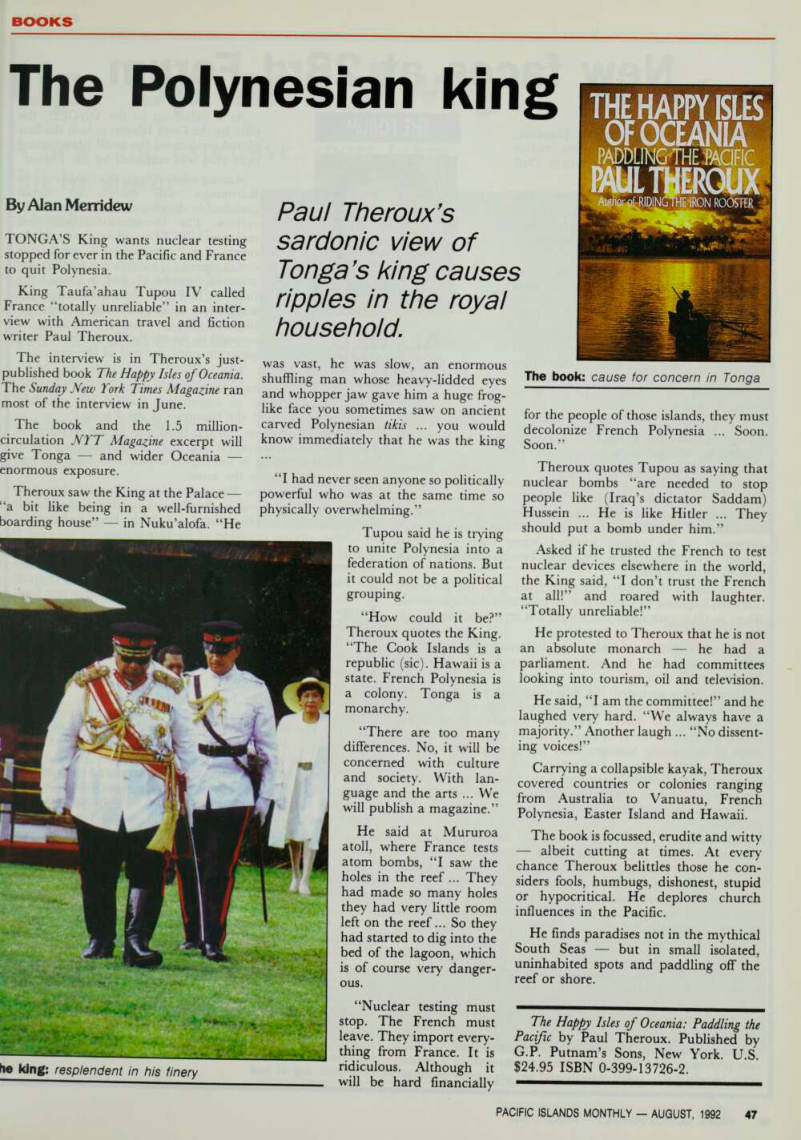
Books
By Alan Merridew TONGA’S King wants nuclear testing stopped for ever in the Pacific and France to quit Polynesia.
King Taufa’ahau Tupou IV called France “totally unreliable” in an inter view with American travel and fiction writer Paul Theroux.
The interview is in Theroux’s just published book The Happy Isles of Oceania.
The Sunday New York Times Magazine ran most of the interview in June.
The book and the 1.5 million circulation NTT Magazine excerpt will give Tonga and wider Oceania enormous exposure.
Theroux saw the King at the Palace “a bit like being in a well-furnished boarding house’ ’ in Nuku’alofa. “He
Paul Theroux’s sardonic view of Tonga’s king causes ripples in the royal household.
was vast, he was slow, an enormous shuffling man whose heavy-lidded eyes and whopper jaw gave him a huge frog like face you sometimes saw on ancient carved Polynesian tikis ... you would know immediately that he was the king “I had never seen anyone so politically powerful who was at the same time so
physically overwhelming.”
Tupou said he is trying to unite Polynesia into a federation of nations. But it could not be a political grouping.
“How could it be?”
Theroux quotes the King.
“The Cook Islands is a republic (sic). Hawaii is a state. French Polynesia is a colony. Tonga is a monarchy.
“There are too many differences. No, it will be concerned with culture and society. With lan guage and the arts ... We will publish a magazine.”
He said at Mururoa atoll, where France tests atom bombs, “I saw the holes in the reef ... They had made so many holes they had very little room left on the reef... So they had started to dig into the bed of the lagoon, which is of course very danger ous.
“Nuclear testing must stop. The French must leave. They import every thing from France, It is ridiculous. Although it will be hard financially
for the people of those islands, they must decolonize French Polynesia ... Soon.
Soon.”
Theroux quotes Tupou as saying that nuclear bombs “are needed to stop people like (Iraq’s dictator Saddam) Hussein ... He is like Hitler ... They should put a bomb under him.”
Asked if he trusted the French to test nuclear devices elsewhere in the world, the King said, “I don’t trust the French at all!” and roared with laughter.
“Totally unreliable!”
He protested to Theroux that he is not an absolute monarch he had a parliament. And he had committees looking into tourism, oil and television.
He said, “I am the committee!” and he laughed very hard. “We always have a majority.” Another laugh ... “No dissent ing voices!”
Carrying a collapsible kayak, Theroux covered countries or colonies ranging from Australia to Vanuatu, French Polynesia, Easter Island and Hawaii.
The book is focussed, erudite and witty albeit cutting at times. At every chance Theroux belittles those he con siders fools, humbugs, dishonest, stupid or hypocritical. He deplores church influences in the Pacific.
He finds paradises not in the mythical South Seas but in small isolated, uninhabited spots and paddling off the reef or shore.
The Happy Isles of Oceania: Paddling the Pacific by Paul Theroux. Published by G.P. Putnam’s Sons, New York. U.S.
$24.95 Isbn 0-399-13726-2.
The king; resplendent in his finery
The book: cause for concern in Tonga
New faces at 23rd Forum
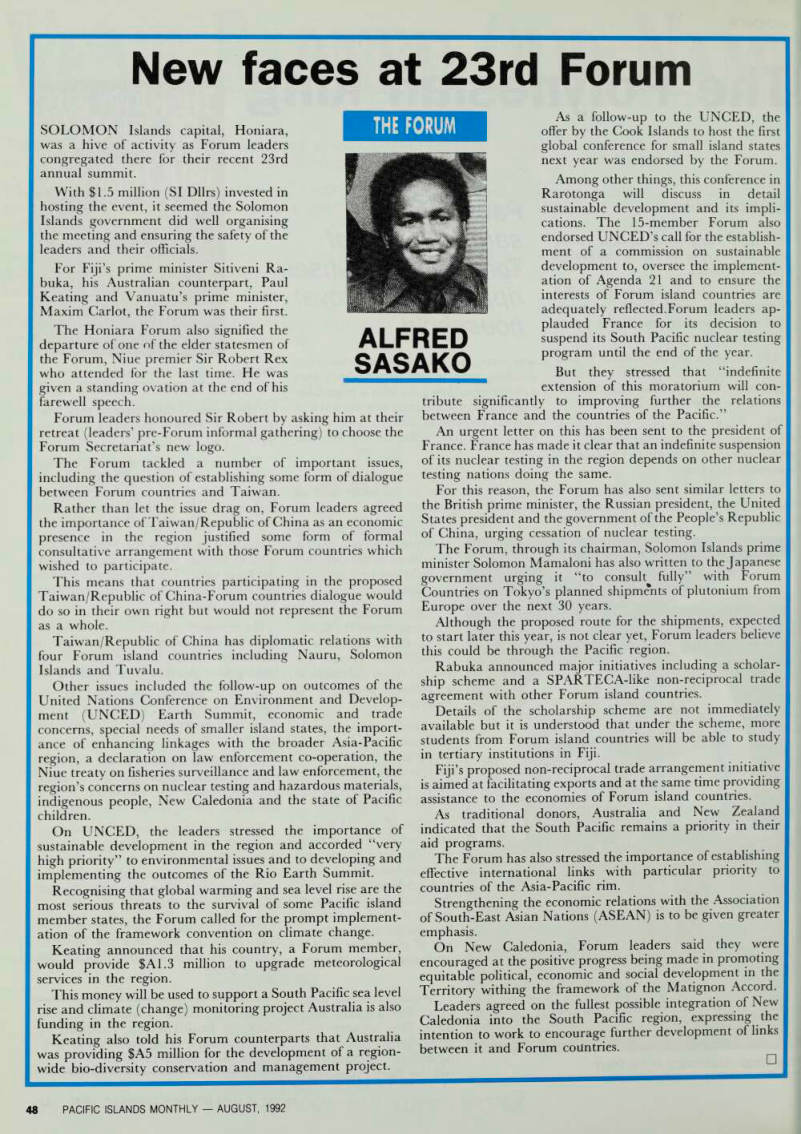
SOLOMON Islands capital, Honiara, was a hive of activity as Forum leaders congregated there for their recent 23rd annual summit.
With $1.5 million (SI Dllrs) invested in hosting the event, it seemed the Solomon Islands government did well organising the meeting and ensuring the safety of the leaders and their officials.
For Fiji’s prime minister Sitiveni Ra buka, his Australian counterpart, Paul Keating and Vanuatu’s prime minister, Maxim Carlot, the Forum was their first.
The Honiara Forum also signified the departure of one of the elder statesmen of the Forum, Niue premier Sir Robert Rex who attended for the last time. He was given a standing ovation at the end of his farewell speech.
Forum leaders honoured Sir Robert by asking him at their retreat (leaders’ pre-Forum informal gathering) to choose the Forum Secretariat’s new logo.
The Forum tackled a number of important issues, including the question of establishing some form of dialogue between Forum countries and Taiwan.
Rather than let the issue drag on, Forum leaders agreed the importance of Taiwan/Republic of China as an economic presence in the region justified some form of formal consultative arrangement with those Forum countries which wished to participate.
This means that countries participating in the proposed Taiwan/Republic of China-Forum countries dialogue would do so in their own right but would not represent the Forum as a whole.
Taiwan/Republic of China has diplomatic relations with four Forum island countries including Nauru, Solomon Islands and Tuvalu.
Other issues included the follow-up on outcomes of the United Nations Conference on Environment and Develop ment (UNCED) Earth Summit, economic and trade concerns, special needs of smaller island states, the import ance of enhancing linkages with the broader Asia-Pacific region, a declaration on law enforcement co-operation, the Niue treaty on fisheries surveillance and law enforcement, the region’s concerns on nuclear testing and hazardous materials, indigenous people, New Caledonia and the state of Pacific children.
On UNCED, the leaders stressed the importance of sustainable development in the region and accorded “very high priority” to environmental issues and to developing and implementing the outcomes of the Rio Earth Summit.
Recognising that global warming and sea level rise are the most serious threats to the survival of some Pacific island member states, the Forum called for the prompt implement ation of the framework convention on climate change.
Keating announced that his country, a Forum member, would provide SAI.3 million to upgrade meteorological services in the region.
This money will be used to support a South Pacific sea level rise and climate (change) monitoring project Australia is also funding in the region.
Keating also told his Forum counterparts that Australia was providing SAS million for the development of a region wide bio-diversity conservation and management project.
The Forum
As a follow-up to the UNCED, the offer by the Cook Islands to host the first global conference for small island states next year was endorsed by the Forum.
Among other things, this conference in Rarotonga will discuss in detail sustainable development and its impli cations. The 15-member Forum also endorsed UNCED’s call for the establish ment of a commission on sustainable development to, oversee the implement ation of Agenda 21 and to ensure the interests of Forum island countries are adequately reflected. Forum leaders ap plauded France for its decision to suspend its South Pacific nuclear testing program until the end of the year.
But they stressed that “indefinite extension of this moratorium will con
tribute significantly to improving further the relations between France and the countries of the Pacific.”
An urgent letter on this has been sent to the president of France. France has made it clear that an indefinite suspension of its nuclear testing in the region depends on other nuclear testing nations doing the same.
For this reason, the Forum has also sent similar letters to the British prime minister, the Russian president, the United States president and the government of the People’s Republic of China, urging cessation of nuclear testing.
The Forum, through its chairman, Solomon Islands prime minister Solomon Mamaloni has also written to the Japanese government urging it “to consult fully” with Forum Countries on Tokyo’s planned shipments of plutonium from Europe over the next 30 years.
Although the proposed route for the shipments, expected to start later this year, is not clear yet, Forum leaders believe this could be through the Pacific region.
Rabuka announced major initiatives including a scholar ship scheme and a SPARTECA-like non-reciprocal trade agreement with other Forum island countries.
Details of the scholarship scheme are not immediately available but it is understood that under the scheme, more students from Forum island countries will be able to study in tertiary institutions in Fiji.
Fiji’s proposed non-reciprocal trade arrangement initiative
is aimed at facilitating exports and at the same time providing assistance to the economies of Forum island countries.
As traditional donors, Australia and New Zealand indicated that the South Pacific remains a priority in their aid programs.
The Forum has also stressed the importance of establishing effective international links with particular priority to countries of the Asia-Pacific rim.
Strengthening the economic relations with the Association of South-East Asian Nations (ASEAN) is to be given greater
emphasis.
On New Caledonia, Forum leaders said they were encouraged at the positive progress being made in promoting equitable political, economic and social development in the Territory withing the framework of the Matignon Accord.
Leaders agreed on the fullest possible integration of New Caledonia into the South Pacific region, expressing the intention to work to encourage further development of links between it and Forum countries.
Alfred
Sasako
Up, Up and Away
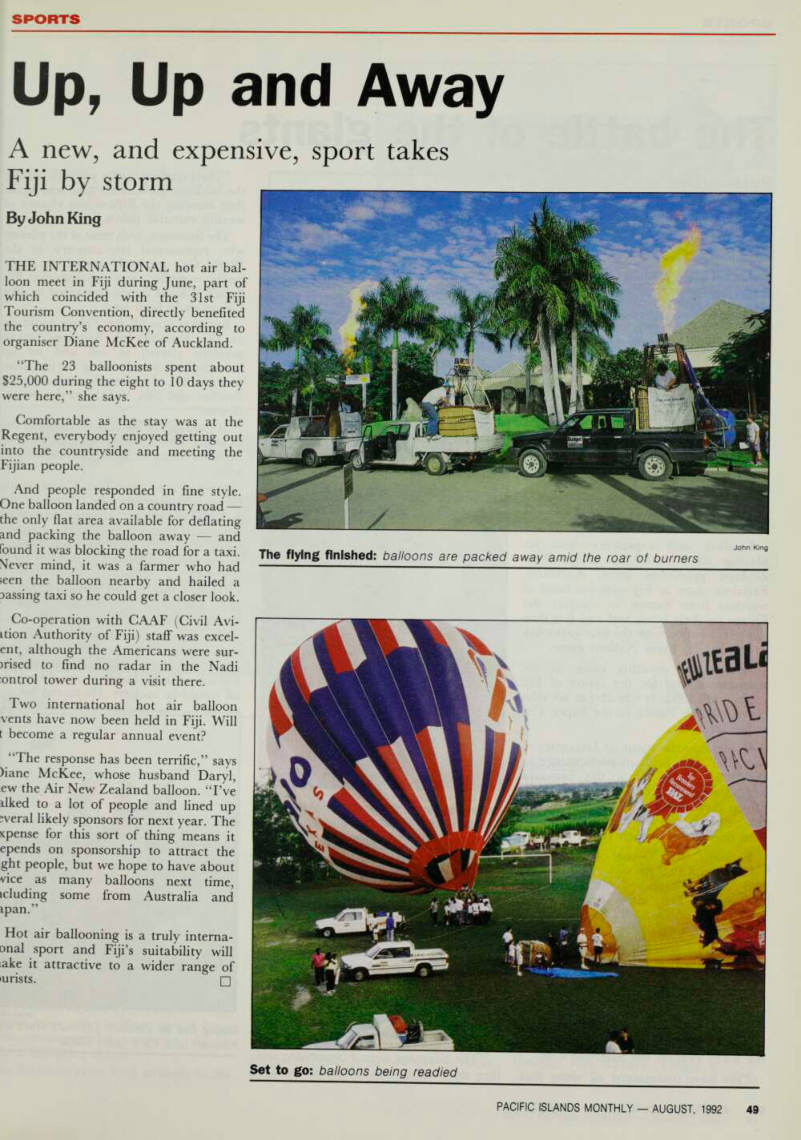
Sports
A new, and expensive, sport takes
Fiji by storm
By John King
THE INTERNATIONAL hot air bal loon meet in Fiji during June, part of which coincided with the 31st Fiji Tourism Convention, directly benefited the country’s economy, according to organiser Diane McKee of Auckland.
“The 23 balloonists spent about $25,000 during the eight to 10 days they were here,” she says.
Comfortable as the stay was at the Regent, everybody enjoyed getting out into the countryside and meeting the Fijian people.
And people responded in fine style.
One balloon landed on a country road the only flat area available for deflating and packing the balloon away and found it was blocking the road for a taxi.
Never mind, it was a farmer who had seen the balloon nearby and hailed a massing taxi so he could get a closer look.
Co-operation with CAAF (Civil Avi ition Authority of Fiji) staff was excel ent, although the Americans were sur ged to find no radar in the Nadi ontrol tower during a visit there.
Two international hot air balloon vents have now been held in Fiji. Will t become a regular annual event?
“The response has been terrific,” says )iane McKee, whose husband Daryl, ew the Air New Zealand balloon. “I’ve ilked to a lot of people and lined up iveral likely sponsors for next year. The spense for this sort of thing means it epends on sponsorship to attract the ght people, but we hope to have about vice as many balloons next time, icluding some from Australia and ipan.”
Hot air ballooning is a truly interna
onal sport and Fiji’s suitability will
ake it attractive to a wider range of
•urists. □
John king The flying finished: balloons are packed away amid the roar of burners
Set to go: balloons being readied
The battle of the giants
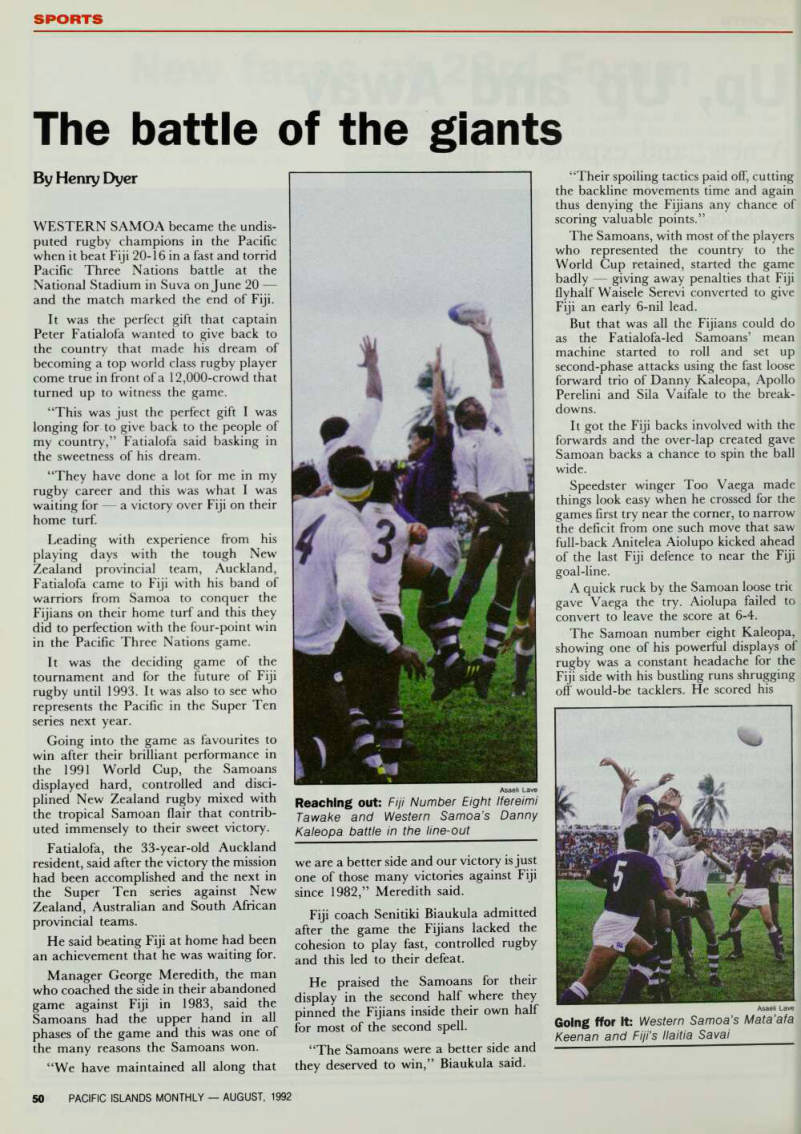
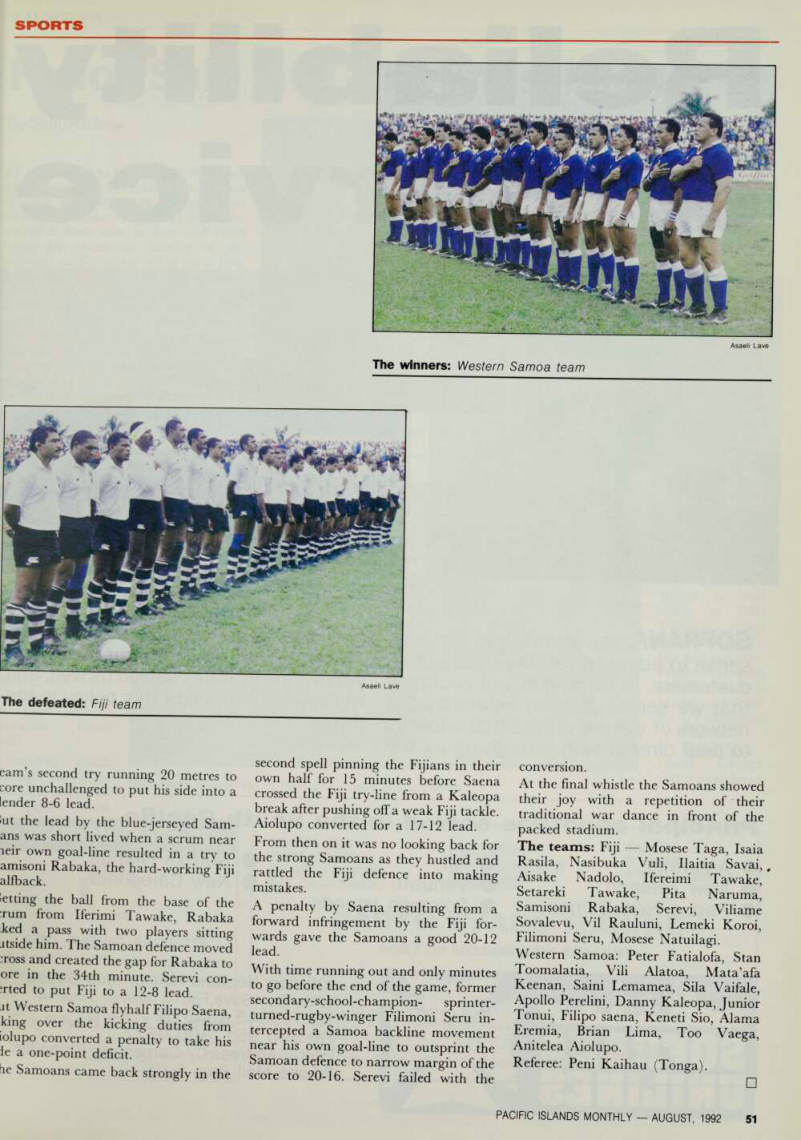
By Henry Dyer
WESTERN SAMOA became the undis puted rugby champions in the Pacific when it beat Fiji 20-16 in a fast and torrid Pacific Three Nations battle at the National Stadium in Suva on June 20 and the match marked the end of Fiji.
It was the perfect gift that captain Peter Fatialofa wanted to give back to the country that made his dream of becoming a top world class rugby player come true in front of a 12,000-crowd that turned up to witness the game.
“This was just the perfect gift I was longing for to give back to the people of my country,” Fatialofa said basking in the sweetness of his dream.
“They have done a lot for me in my rugby career and this was what I was waiting for a victory over Fiji on their home turf.
Leading with experience from his playing days with the tough New Zealand provincial team, Auckland, Fatialofa came to Fiji with his band of warriors from Samoa to conquer the Fijians on their home turf and this they did to perfection with the four-point win in the Pacific Three Nations game.
It was the deciding game of the tournament and for the future of Fiji rugby until 1993. It was also to see who represents the Pacific in the Super Ten series next year.
Going into the game as favourites to win after their brilliant performance in the 1991 World Cup, the Samoans displayed hard, controlled and disci plined New Zealand rugby mixed with the tropical Samoan flair that contrib uted immensely to their sweet victory.
Fatialofa, the 33-year-old Auckland resident, said after the victory the mission had been accomplished and the next in the Super Ten series against New Zealand, Australian and South African
provincial teams.
He said beating Fiji at home had been an achievement that he was waiting for.
Manager George Meredith, the man who coached the side in their abandoned game against Fiji in 1983, said the Samoans had the upper hand in all phases of the game and this was one of the many reasons the Samoans won.
“We have maintained all along that
we are a better side and our victory is just one of those many victories against Fiji since 1982,” Meredith said.
Fiji coach Senitiki Biaukula admitted after the game the Fijians lacked the cohesion to play fast, controlled rugby and this led to their defeat.
He praised the Samoans for their display in the second half where they pinned the Fijians inside their own half for most of the second spell.
“The Samoans were a better side and they deserved to win,” Biaukula said.
“Their spoiling tactics paid off, cutting the backline movements time and again thus denying the Fijians any chance of scoring valuable points.”
The Samoans, with most of the players who represented the country to the World Cup retained, started the game badly giving away penalties that Fiji flyhalf Waisele Serevi converted to give Fiji an early 6-nil lead.
But that was all the Fijians could do as the Fatialofa-led Samoans’ mean machine started to roll and set up second-phase attacks using the fast loose forward trio of Danny Kaleopa, Apollo Perelini and Sila Vaifale to the break downs.
It got the Fiji backs involved with the forwards and the over-lap created gave Samoan backs a chance to spin the ball wide.
Speedster winger Too Vaega made things look easy when he crossed for the games first try near the corner, to narrow the deficit from one such move that saw full-back Anitelea Aiolupo kicked ahead of the last Fiji defence to near the Fiji
goal-line.
A quick ruck by the Samoan loose trie gave Vaega the try. Aiolupa failed to convert to leave the score at 6-4.
The Samoan number eight Kaleopa, showing one of his powerful displays of rugby was a constant headache for the Fiji side with his bustling runs shrugging off would-be tacklers. He scored his
Asaeli Lave Reaching out: Fiji Number Eight Ifereimi Tawake and Western Samoa’s Danny Kaleopa battle in the line-out
Going ffor It: Western Samoa’s Mata’afa Keenan and Fiji’s llaitia Savai
cam’s second try running 20 metres to core unchallenged to put his side into a lender 8-6 lead.
'Ut the lead by the blue-jerseyed Sam ans was short lived when a scrum near leir own goal-line resulted in a try to amisoni Rabaka, the hard-working Fiji allback. letting the ball from the base of the Turn from Iferimi Tawake, Rabaka ked a pass with two players sitting itside him. The Samoan defence moved :ross and created the gap for Rabaka to ore in the 34th minute. Serevi con ned to put Fiji to a 12-8 lead, it Western Samoa flyhalf Filipo Saena, king over the kicking duties from iolupo converted a penalty to take his le a one-point deficit. lie Samoans came back strongly in the
second spell pinning the Fijians in their own half for 15 minutes before Saena crossed the Fiji try-line from a Kaleopa break after pushing offa weak Fiji tackle.
Aiolupo converted for a 17-12 lead.
From then on it was no looking back for the strong Samoans as they hustled and rattled the Fiji defence into making mistakes.
A penalty by Saena resulting from a forward infringement by the Fiji for wards gave the Samoans a good 20-12 lead.
With time running out and only minutes to go before the end of the game, former
secondary-school-champion- sprinter
turned-rugby-winger Filimoni Seru in tercepted a Samoa backline movement near his own goal-line to outsprint the Samoan defence to narrow margin of the score to 20-16. Serevi failed with the
conversion.
At the final whistle the Samoans showed their joy with a repetition of their traditional war dance in front of the packed stadium.
The teams; Fiji Mosese Taga, Isaia Rasila, Nasibuka Vuli, Ilaitia Savai, Aisake Nadolo, Ifereimi Tawake, Setareki Tawake, Pita Naruma, Samisoni Rabaka, Serevi, Viliame Sovalevu, Vil Rauluni, Lemeki Koroi, Filimoni Seru, Mosese Natuilagi.
Western Samoa: Peter Fatialofa, Stan Toomalatia, Vili Alatoa, Mata’afa Keenan, Saini Lemamea, Sila Vaifale, Apollo Perelini, Danny Kaleopa, Junior Tonui, Filipo saena, Keneti Sio, Alama Eremia, Brian Lima, Too Vaega, Anitelea Aiolupo.
Referee: Peni Kaihau (Tonga). □
Asaeli Lave
The winners: Western Samoa team
Asaeli Lave
The defeated: Fiji team
Advertisements & other items, p. 52 (1 item)
Reliability
wi CAKflu 9 f TU
.SUVA
i; SOFRANA has always had the good sense to adapt to suit the needs of its customers. In the majority of countries that we serve, we have established a network of agency offices that allow us to deal directly with you, giving us the ability to deliver a better, more personalised service to suit your needs. In years gone by it has served us well, and will continue to follow this policy in the future.
Principal countries served in the South Pacific • Australia • Fiji • Norfolk Islands • New Zealand • Vanuatu • New Caledonia • Papua New Guinea • Solomon Islands ? sth floor,Neptune House,Tofua Street, Walu Bay,Suva,Fiji.
Te1:315645,304528.
Fax:3oo 951, 300 057.
Postal Address:C/-Carpenters Shipping.
Private Mail Bag, Suva.
Fellowship at Christmas Island
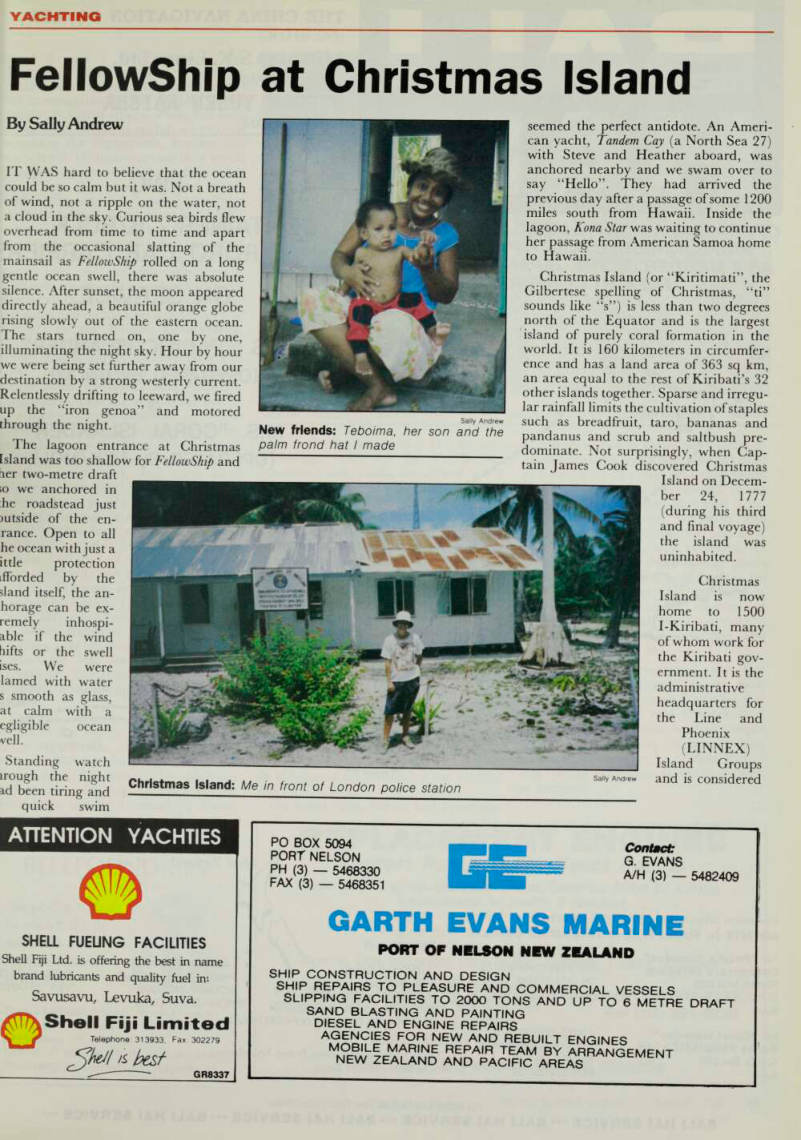
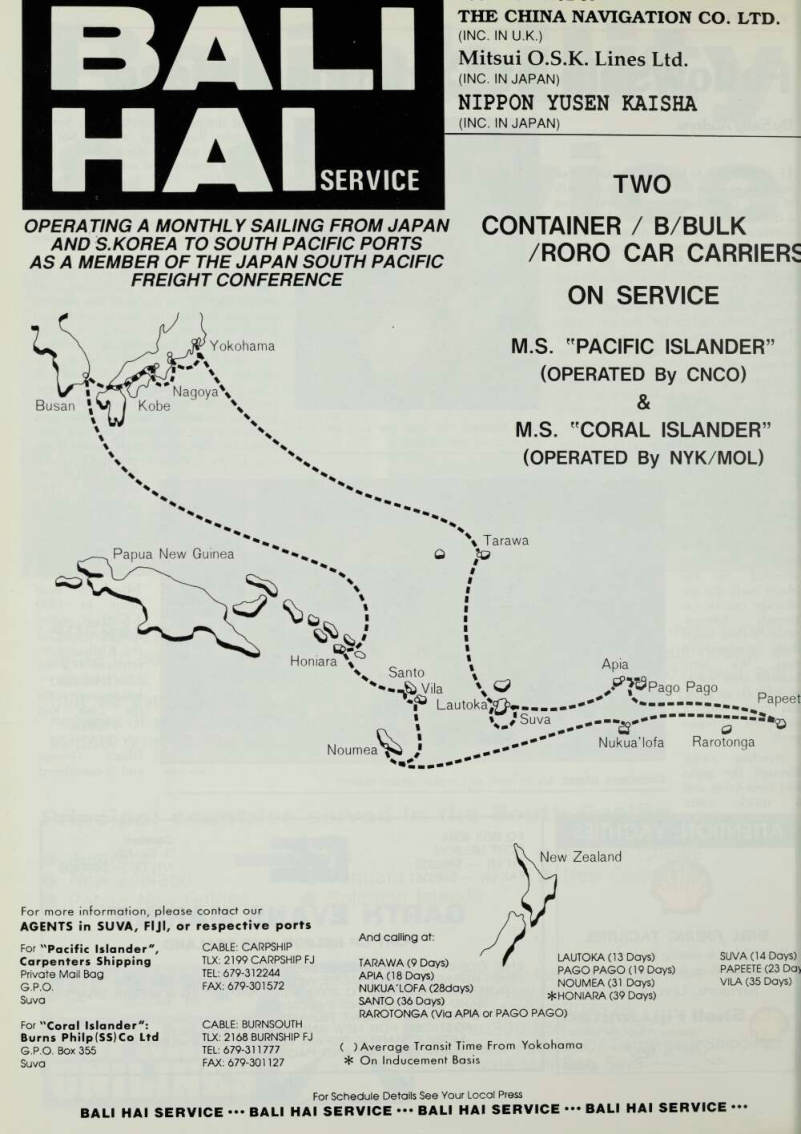
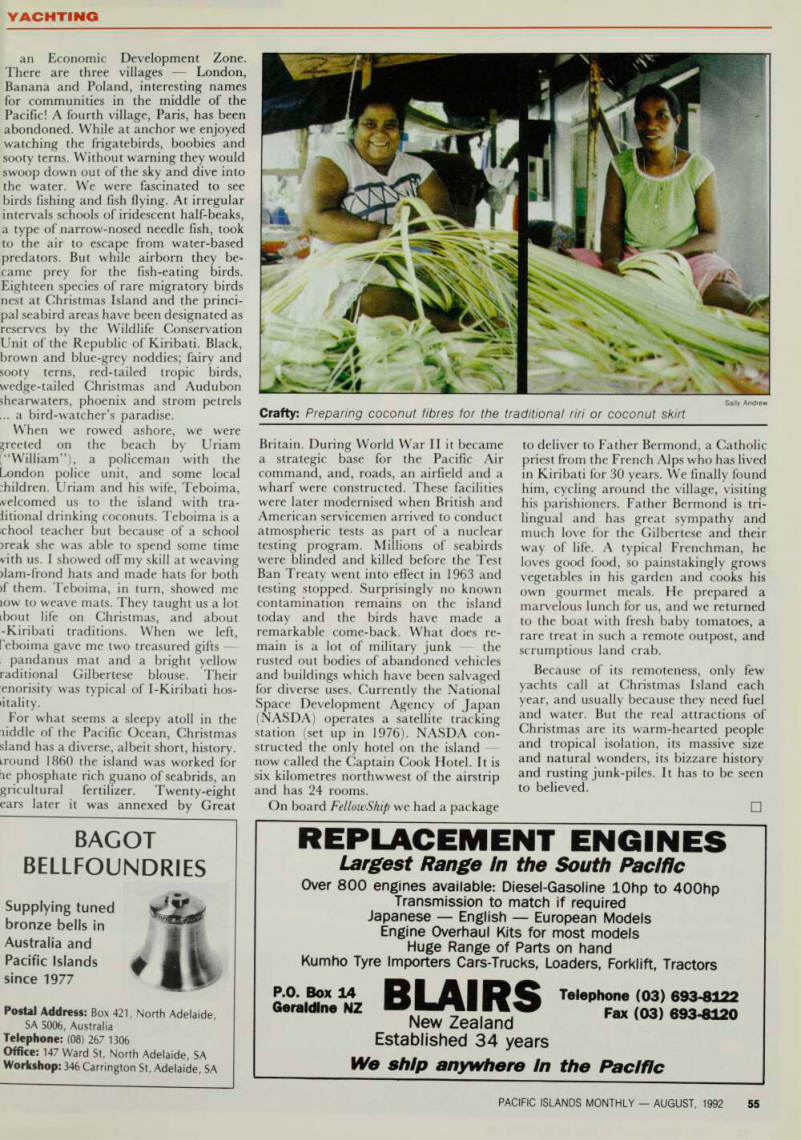
Yachting
By Sally Andrew
IT WAS hard to believe that the ocean could be so calm but it was. Not a breath of wind, not a ripple on the water, not a cloud in the sky. Curious sea birds flew overhead from time to time and apart from the occasional slatting of the mainsail as Fellowship rolled on a long gentle ocean swell, there was absolute silence. After sunset, the moon appeared directly ahead, a beautiful orange globe rising slowly out of the eastern ocean.
The stars turned on, one by one, illuminating the night sky. Hour by hour we were being set further away from our destination by a strong westerly current.
Relentlessly drifting to leeward, we fired up the “iron genoa” and motored through the night.
The lagoon entrance at Christmas Island was too shallow for Fellowship and icr two-metre draft
\o we anchored in he roadstead just mtside of the en rance. Open to all he ocean with just a
ittle protection
ifforded by the fland itself, the an horage can be ex
remely inhospi
able if the wind hifts or the swell ises. We were lamed with water s smooth as glass, at calm with a egligible ocean veil.
Standing watch
irough the night ad been tiring and quick swim
seemed the perfect antidote. An Ameri can yacht, Tandem Cay (a North Sea 27) with Steve and Heather aboard, was anchored nearby and we swam over to say “Hello”. They had arrived the previous day after a passage of some 1200 miles south from Hawaii. Inside the lagoon, Kona Star was waiting to continue her passage from American Samoa home to Hawaii.
Christmas Island (or “Kiritimati”, the Gilbertese spelling of Christmas, “ti” sounds like “s”) is less than two degrees north of the Equator and is the largest island of purely coral formation in the world. It is 160 kilometers in circumfer ence and has a land area of 363 sq km, an area equal to the rest of Kiribati’s 32 other islands together. Sparse and irregu lar rainfall limits the cultivation of staples such as breadfruit, taro, bananas and pandanus and scrub and saltbush pre dominate. Not surprisingly, when Cap tain James Cook discovered Christmas
Island on Decem ber 24, 1777 (during his third and final voyage) the island was uninhabited.
Christmas Island is now home to 1500 I-Kiribati, many of whom work for the Kiribati gov ernment. It is the administrative
headquarters for
the Line and Phoenix
(Linnex)
Island Groups
and is considered
Sally Andrew New friends: Teboima, her son and the palm frond hat I made
Christmas Island: Me in front of London police station
Sally Andrew
an Economic Development Zone.
There are three villages London, Banana and Poland, interesting names for communities in the middle of the Pacific! A fourth village, Paris, has been abondoned. While at anchor we enjoyed watching the frigatebirds, boobies and sooty terns. Without warning they would swoop down out of the sky and dive into the water. We were fascinated to see birds fishing and fish flying. At irregular intervals schools of iridescent half-beaks, a type of narrow-nosed needle fish, took to the air to escape from water-based predators. But while airborn they be came prey for the fish-eating birds.
Eighteen species of rare migratory birds nest at Christmas Island and the princi pal seabird areas have been designated as reserves by the Wildlife Conservation Unit of the Republic of Kiribati. Black, brown and blue-grey noddies; fairy and sooty terns, red-tailed tropic birds, wedge-tailed Christmas and Audubon shearwaters, phoenix and strom petrels ... a bird-watcher’s paradise.
When we rowed ashore, we were greeted on the beach by Uriam (“William”), a policeman with the London police unit, and some local :hildren. Uriam and his wife, Teboima, welcomed us to the island with tra litional drinking coconuts. Teboima is a chool teacher but because of a school )reak she was able to spend some time vith us. I showed off my skill at weaving )lam-frond hats and made hats for both )f them. Teboima, in turn, showed me low to weave mats. They taught us a lot ibout life on Christmas, and about -Kiribati traditions. When we left, feboima gave me two treasured gifts pandanus mat and a bright yellow raditional Gilbertese blouse. Their enorisity was typical of I-Kiribati hos •itality.
For what seems a sleepy atoll in the liddle of the Pacific Ocean, Christmas sland has a diverse, albeit short, history, iround 1860 the island was worked for be phosphate rich guano of seabrids, an
gricultural fertilizer. Twenty-eight
ears later it was annexed by Great
Britain. During World War II it became a strategic base for the Pacific Air command, and, roads, an airfield and a wharf were constructed. These facilities were later modernised when British and American servicemen arrived to conduct atmospheric tests as part of a nuclear testing program. Millions of seabirds were blinded and killed before the Test Ban Treaty went into effect in 1963 and testing stopped. Surprisingly no known contamination remains on the island today and the birds have made a remarkable come-back. What does re main is a lot of military junk the rusted out bodies of abandoned vehicles and buildings which have been salvaged for diverse uses. Currently the National Space Development Agency of Japan (NASDA) operates a satellite tracking station (set up in 1976). NASDA con structed the only hotel on the island now called the Captain Cook Hotel. It is six kilometres northwwest of the airstrip and has 24 rooms.
On board Fellowship we had a package
to deliver to Father Bermond, a Catholic priest from the French Alps who has lived in Kiribati for 30 years. We finally found him, cycling around the village, visiting his parishioners. Father Bermond is tri lingual and has great sympathy and much love for the Gilbertese and their way of life. A typical Frenchman, he loves good food, so painstakingly grows vegetables in his garden and cooks his own gourmet meals. He prepared a marvelous lunch for us, and we returned to the boat with fresh baby tomatoes, a rare treat in such a remote outpost, and scrumptious land crab.
Because of its remoteness, only few yachts call at Christmas Island each year, and usually because they need fuel and water. But the real attractions of Christmas are its warm-hearted people and tropical isolation, its massive size and natural wonders, its bizzare history and rusting junk-piles. It has to be seen to believed.
Crafty: Preparing coconut fibres for the traditional riri or coconut skirt
Sally Andrew
Advertisements & other items, pp. 53-56 (1 item)
Garth Evans Marine
ATTENTION YACHTIES
SHELL FUEUNG FACILITIES
Shell Fiji Ltd. is offering the best in name brand lubricants and quality fuel in: Savusavu, Levuka, Suva. © Shell Fiji Limited Telephone 313933. Fax 302279 & best ~~• GR8337
PO BOX 5094
PORT NELSON
PH (3) 5468330
FAX (3) 5468351
Contact
G. EVANS
A/H (3)
GARTH EVANS MARINE
PORT OF NELSON NEW ZEALAND
SHIP CONSTRUCTION AND DESIGN
SHIP REPAIRS TO PLEASURE AND COMMERCIAL VESSELS SLIPPING FACILITIES TO 2000 TONS AND UP TO 6 METRE
SAND BLASTING AND PAINTING
DIESEL AND ENGINE REPAIRS
AGENCIES FOR NEW AND REBUILT ENGINES
M w°FW L 7PAf?Mn TEAM BY ARRANGEMENT
NEW ZEALAND AND PACIFIC AREAS
5482409
DRAFT
THE CHINA NAVIGATION CO. LTD
(INC. IN U.K.)
Mitsui O.S.K. Lines Ltd.
(INC. IN JAPAN)
NIPPON YUSEN KAISHA
(INC. IN JAPAN)
SERVICE
TWO
OPERATING A MONTHLY SAILING FROM JAPAN
AND S.KOREA TO SOUTH PACIFIC PORTS
AS A MEMBER OF THE JAPAN SOUTH PACIFIC
FREIGHT CONFERENCE
CONTAINER / B/BULK
/RORO CAR CARRIERS
ON SERVICE
Nagoya\
Busan Iv| / Kobe
Yokohama
M.S. "PACIFIC ISLANDER”
(OPERATED By CNCO)
M.S. "CORAL ISLANDER”
(OPERATED By NYK/MOL)
Papua New Guinea
\ Tarawa
CO <3 % & Cj
Honiara \
Jo Santo Vila i i % % Noumea ...»
'P LautokaV}w-
\ O'S' Suva
Apia
Pago
' Ha|
* mmm 3 5
Nukualofa Rarotonga
Papeet
r< £ For more information, please contact our AGENTS in SUVA, FIJI, or respective ports For "Pacific Islander"
Carpenters Shipping Private Mail Bag
G.P.O.
Suva
CABLE: CARPSHIP
TLX: 2199 CARPSHIP FJ
TEL: 679-312244
FAX; 679-301572
And calling at:
TARAWA (9 Days)
APIA (18 Days) NUKUALOFA (28days) SANTO (36 Days) New Zealand
LAUTOKA (13 Days)
PAGO PAGO (19 Days)
NOUMEA (31 Days)
* HONIARA (39 Days)
SUVA (14 Days)
PAPEETE (23 Dav
VILA (35 Days) For "Coral Islander": Burns Philp(SS)Co Ltd G.P.O. Box 355 Suva
CABLE: BURNSOUTH
TLX: 2168 BURNSHIP FJ
TEL: 679-311777
FAX; 679-301127
RAROTONGA (Via APIA or PAGO PAGO)
( ) Average Transit Time From Yokohama 5k On Inducement Basis For Schedule Details See Your Local Press BALI HAI SERVICE ••• BALI HAI SERVICE ••• BALI HAI SERVICE ••• BALI HAI SERVICE ••
REPLACEMENT ENGINES
Largest Range In the South Pacific
Over 800 engines available: Diesel-Gasoline lOhp to 400 hp Transmission to match if required Japanese English European Models Engine Overhaul Kits for most models Huge Range of Parts on hand Kumho Tyre Importers Cars-Trucks, Loaders, Forklift, Tractors P.O. Box 14 Geraldine HZ 3LA IRS Te,e P hone (03) 693-8122 IteTzea " F “ ( 031 6M - 8 “° Established 34 years We ship anywhere In the Pacific
BAGOT
BELLFOUNDRIES
Supplying tuned
bronze bells In Australia and Pacific Islands since 1977 Postal Address: Box 421, North Adelaide, SA 5006, Australia Telephone: (08) 267 1306 Office: 147 Ward St, North Adelaide, SA Workshop: 346 Carrington St, Adelaide, SA
1 »A •£L 2&//S /O Ml “*^l t anci p a&»a •***...
'•'w...
SJ&SSS&*
Great service. Better times
We are proud to announce the latest addition to our fleet - a brand-new, ex-factory Boeing 737-500 Series jet which now makes us an all-Boeing airline. The 737-500 with its roomy interior and state-of-the-art technology brings a new level of service and comfort plus an improved schedule and faster times to Australia, New Zealand and our regional destinations. It will also enable the re-introduction of our popular Suva-Auckland- Suva direct service twice a week.
Cargo capacity, to our Pacific Island destinations in particular, will also be substantially increased. Now, wherever you travel on Air Pacific, you’ll enjoy the same high standard of service and appointments. In-flight movies, audio entertainment, on-board duty-free shopping, superb food and wines as well as the opportunity for regional passengers to experience our exclusive Tabua Class- a class of travel all on its own.
The new Boeing 737-500 will certainly mean great service and better times for everyone We look forward to welcoming you aboard soon.
AIR PACIFIC
FIJI’S INTERNATIONAL AIRLINE
Air Pacific’s new Boeing 737-500 takes off August 24th.
WkSON-ADDISON 07.386
Shipping

Schedules
New Zealand - Fiji direct Sofrana Unilines operates a fully containerised/breakbulk service every 21 days from Auckland, Tauranga, Lyttleton to Suva and Lautoka. Loading every 21 days, ro/ro service, containers - reefer. Contact Sofrana Unilines, Sofrana House, 101 Customs Street, Auckland, PO Box 3614, Fax (09) 393874, Ph (09) 773279, Tlx NZ 2313. Direct toll free line 0800 659-922, Contact Alan Foote. Sofrana Shipping Agencies, PO Box 921 Wellington, Tel (04) 725 661, Fax (04) 725 749, Tlx NZ 4769 Contact Steve Brannigan. Sofrana Unilines Agencies, PO Box 22046 Christchurch, tel (03) 367 180, Fax (03) 668 868, TLX NZ4769, Contact fony Newell. Carpenters Shipping, Private Mail Bag, Suva, Fiji, Tel (679) 312244, Fax (679) 301572, Tlx FJ 2199. Sofrana Unilines, Suva, Fiji, Tel (679) 315645, Fax (679) 300057. \ustralia - Fiji direct Sofrana Unilines operates a ro/ro container ervice every three weeks from Melbourne, iydney, Brisbane, Lautoka and Suva. Contact lofrana Unilines (Aust) Pty Ltd, PO Box Q 136, !>ueen Victoria Building, Sydney, NSW 2000, Australia. Tel (02) 2648944, Fax (02) 2676547, r lx (71) A 170090, Contact Andrew McLachlin, lam Attaway.
Carpenters Shipping, Suva, Tel (679) 312244, 'ax (679) 301572. Sofrana Unilines Suva, Tel 579) 315 645, Fax (679) 300057. Carpenters
Shipping, Lautoka, Tel (679) 63988, Fax (679) 64896. Sofrana Unilines, Lautoka Tel (679) 62921, Fax (679) 64896.
Australia - Fiji monthly service Sofrana Unilines (Australia) Pty Ltd operates a regular monthly service with MV Capitaine Wallis. Contact Sofrana Unilines, Sydney, Tel (02) 2648944, Tlx AA170090, Fax (02) 267-6547. Carpenters Shipping, Suva, Fiji, Tel (679) 312244, Fax (679) 301572, Sofrana Unilines, Suva, Fiji Tel (679) 315645, Fax (679) 300057. Carpenters Shipping, Lautoka, Tel (679) 63988, Fax (679) 64896. Sofrana Unilines, Lautoka, Fiji, Tel (679) 62921, Fax (679) 64896.
Far-East - Fiji - New Zealand Service New Zealand Unit Express (NZUE) operates a monthly service accepting containerised and break-bulk cargoes from Manila, Keelung, Kaoshiung, Hong Kong, Lae to Suva, Lautoka (via Suva) and thence to New Zealand ports.
Contact Carpenters Shipping Suva, Fiji, tel (679) 312244, fax (679) 301572. New Zealand Unit Express, Maritime Building, 2-10 Customs House Quay, PO Box 890, Wellington. Tel 727865, Cables Enzue Man, Wellington, Tlx NZ31340 Nedlnz or Nedlloyd Swire Pty Ltd, Sydney, Tel 20522.
Japan - South Pacific Service Same as Burns Philp Japan - South Pacific Service - Kyowa Shipping Co Ltd Kyowa Shipping, Shipping Co Ltd provides a monthly containerised service from Hong Kong
to main ports of Japan, Saipan, Guam, Island ports, Lautoka, Suva via Nukualofa to Pago Pago and Apia. Contact Carpenters Shipping, Neptune House, 3/4 floor, Tofuaa Street, Walu Bay, Suva. Tel 312244, Fax 301572, Tlx FJ2199.
Europe - Pacific Service Nedlloyd offers cargo services from Continen tal Ports to Papeete, Fiji, New Caledonia and Doniambo on slot basis with Bank line. Contact Nedlloyd (Aust) Pty Ltd, Spring Street, Sydney, Tel 273801. Carpenters Shipping, Suva, tel 312244, Tlx FJ2199, Fax 301572. Carpenters Shipping, Lautoka, Tel 63988, Tlx FJ5215, Fax 64896.
South East Asia - Fiji Service Nedlloyd Lines (NZEAS) Service operates regular fast cargo service from Jakarta, Pt Keelang, Singapore, Bangkok, Surubaya via Auckland to Suva and Lautoka. Contact Carpenters Shipping, Suva, Tel 312244, Tlx FJ2199, Fax 301572. Carpenters Shipping, Lautoka Tel 63988, Tlx FJ5215, Fax 63988 South East Asia - Mid South pacific Columbus Line operates a regular container and breakbulk-heavy lift service from/to
Hongkong/Taiwan/Manila/Singapore/Malay
sia/Thailand/Indonesia to Port Moresby/Lae/
Rabaul/Kimbe/Madang/Newark/Honiara and
Noro. Contact Express Freight, Lae, POB 3398, phone 423913 or 423822, fax 425193.
Far East - Mid South Pacific China Navigations New Guinea Pacific Line operates a regular container and breakbulk heavy lift service from Hong Kong, Taiwan,
Manila, Singapore, Malaysia, Thai land to Port Moresby, Lae, Rabaul, Kieta and Honiara. Cargo from the same eastern ports to the South Pacific Ports of Noumea, Santo, Vila, Papeete,
PagoPago, Apia, Nukualofa, Rarotonga
and Tarawa will be shipped via Japan or Busan on the monthly Bali Hai Service.
Contact Steamships Shipping, Port Moresby, PO Box 634, Tel 220283 or 220289.
Australia - New Caledonia - Fiji - Samoas - Tonga Pacific Forum Line operates a fully containerised service (general, reefer and ro-ro) from Sydney and Brisbane to Noumea, Lautoka, Suva, Apia, Pago Pago, Nuku’alofa, Sydney. Cargo cen tralised from Adelaide and Melbourne.
Contact: Pacific Forum Line, PO Box 796, Auckland; Union Bulkships, 333 George St, Sydney, Brisbane and Mel bourne; Union Co, Lautoka; Pacific Forum Line, Suva, Nuku’alofa; Pacific
Forum Line, Apia; Polynesia Shipping,
Pago Pago. Sofrana Unilines operates a roro/container service every three weeks from Melbourne, Sydney and Brisbane to Noumea, Suva and Lautoka with transhipment to the Samoas and Tonga.
New Zealand - Australia - PNG - Solomon Islands Pacific Forum Line operates a containerised and ro-ro service from Lyttleton, Napier and Auckland to Brisbane, Port Moresby, Lae, Honiara, Brisbane then to New Zealand. Contact: Pacific Forum, Auckland, Christchurch;
Union Bulkships, Brisbane; Steamships
Shipping Port Moresby and Lae Sullivan Ltd, Honiara; Seabridge, Wellington,
NZ - Fiji Translink Pacific Shipping Fiji Agents are: Campbells Shipping Agency Ltd, Ph 314189 Fax 300144 Suva; Ph 662231 Fax 662251 Lautoka. Auckland Agents: McKay Shipping Ph (9) 390229 Fax (9) 3032931. Tauranga Agents, seatrade agencies Ph (75) 754989 Fax (75) 758380.
NZ - Fiji - Pago - Apia - Nuk Translink Pacific Shipping operates a monthly sailing with Polynesian Link, which carries Dry Container, reefers and breakbulk cargoes. NZ Agents McKay Shipping Shipping AKLD Ph 390229, Fax 3032931. Fiji Agents Campbells Shipping Agency & ltd Ph 314189 Fax 300144 NZ - Noumea - Wallis - Futuna Translink Pacific Agency operate a container Breakbulk service once a month from NZ through Fiji and Noumea to Wallis & Futuna.
South East Asia - Fiji - Noumea - Papeete - Chile Service “Seaspac” A joint Chilean CCNI/ CSAU Service offers a regular monthly sailing from Djakarta and Singapore to Noumea, Fiji, Papeete, and Chile. Cargo also federated to Singapore from Korea, Hong Kong, Taiwan, Malaysia, Bang kok. Fiji Agents; Campbells Shipping Agency Ltd, ph. 314189, Fax 300144.
Australia - Fiji Service Chief container services under Austra lia Pacific Island Line Unitize Sofrana and PFL vessels to provide a twice monthly, service from Australia. Fiji
Agents Campbells Shipping Agency Ltd Ph 314189 Fax 300144. System Agents Nedlloyd Swire Ph(2) 2512699. Melbourne Yarra Shipping Ph (3) 6936300. Brisbane, Nedlloyd Swire, ph (7) 8321551.
Australia - Fiji - Noumea - Vila - Santa Marsmond Express Lines operate a breakbulk service from Goodwood Island Australia to Fiji, Noumea, Vila Santo and Honiara. Continuous receiv ing depots in Sydney and Brisbane enable this vessel to bring cargoes from these parts. Fiji Agents Campbells Shipping Agency Ltd, ph. 314189, Fax 300144. Brisbane Agents Shippings & Marketing Ph (7) 2628082. Sydney Agents Seabord Agencies (2) 3172325.
Australia - New Caledonia - Fiji - Hawaii - North America ACT Pace Pacific (ACTA Shipping) operates a fully containerised/break bulk service every 17-20 from Melbourne, Sydney, Brisbane to Noumea, Suva and Lautoka. The vessels continue on to the West Coast of North America calling Honolulu at frequent intervals. Ships are ACT and ACT 12. Contacts: ACTA Pty Ltd, Sydney Ph 2869666, Tx 121369, Fx 2869610. ACTA Pty Ltd, Melbourne Ph 6112000, Tx 30949, Fx 6293055. ACT A Pty Ltd, Brisbane Ph 2213116 m Tx 40719, Fx 2298143. SATO, Noumea Ph 281122, Tx 3163, Fx 278532. Burns Philp Shipping, Suva Ph 31 1777, Tx 2168, Fx 301127; Burns Philp Shipping, Lautoka Ph 60777, Tx 5146, Fx 65850.
Advertisements & other items, pp. 57-60 (1 item)
The Bank Line
YOUR EXPERTS IN THE SOUTH PACIFIC
A SERVICE OF ANDREW WEIR SHIPPING
■ ■ me ank •E. m Contact us on PH: (675) 422988 FAX: (675) 422925
TLX: 44265 NE
The Bank Line, P O Box 2225. Lae, Morobe Province, Papua New Guinea
THE NEW AUSTRALIAN, NEW ZEALAND AND
PACIFIC ISLANDS DISTRIBUTORS FOR
LISTER MARINE ENGINES, GENERATING
SETS AND SPARE PARTS.
NEW SOUTH WALES DISTRIBUTORS FOR
GARDNER MARINE ENGINES AND
SPARE PARTS.
AUSTRALIAN
DISTRIBUTORS FOR
SWEDISH MARTEC
HEAT EXCHANGERS.
V % * 1992
AUG
if/M
W. to i</ 'm M- * <9
oO^oT
Jp *T
4> p° / a 5 A °v S' A t- ■s“ * <6 & j>r <r b £■ T PAPIPIP ISI AMDS MDNTHI Y AUGUST. 1992
NATIONAL
LIBRARY OF AUSTRALIA
PACIFIC
SLANDS
I MON T H L ~VH
MflfiKCT PlflCi
For the benefit of our readers who would like to place a small classified advertisement in our magazine, Market Place will assist you in selling personal items, accommodation, real estate boating or a service ...in fact anything you would like to sell to our over 50,000 readers.
Market Place Advertising Rates are structured to allow you to place as many advertisements as you wish, economically.
FISHING VESSEL
124) PROCESSING FISHING VESSEL, built
987, aluminium, 95’ (28m), DNV Class, very Dod accommodation for 15, Cat main engine, efrig comprises blast tunnel, glazing room, ackaging room and 3 large storage freezers.
HARTER CRAFT MARINE. BC/15 Tedder Av,
ain Beach Q 4217 Australia. Phone 1-75-916334 Fax 61-75-329788
BARGE FOR SALE
15) LANDING BARGE. 90’ (27m), carrying pacity 120 tons. Twin GM BV7I main gines, good accom, large fuel & water cargo
pacity. CHARTER CRAFT MARINE, BC/15
dder Av, Main Beach, Q 4217 Aust. Ph. .-75-916334 Fax 61-75-329788.
BOOKS
Dliophile, a secondhand bookshop in Sydney, keen to buy good books on the Pacific. Also, rrent book catalogue “Pacific & Southeast ia" now available free on request.
Jliophile, 24 Glenmore Road, Paddington, iW 2021, Australia. Ph. 61 2 331 1411. x 61 2 361 3371.
SMALL SHIP WANTED
)ft to 150 ft older-style, general cargo ship mted. Please send details to: T.P.T. P.O. ix 64, Mordialloc 3195, Australia, or Fax 1-5809416.
WANTED
are seeking an AGENT in your area to
Dply VEGETABLE IVORY NUT PALM SEEDS,
snt would be required to supervise collec- T drying and bagging for export. For further Donation contact: D. WILKINSON, PO BOX
5, ROUND CORNER, 2158, NEW SOUTH
LES, AUSTRALIA. PHONE 61 2 8993988
: 61 2 6344507.
PLANE FOR SALE
HEN NORMAN (045) ISLANDER BN2A-26
3HP. Full IFR, GPS, Avionics coupled, snded baggage compartment, High uplift ght, high floatation gear, completely registered, re-trimmed, re painted, new Cerate of Airworthiness, low times, immacui condition. Suit new aircraft buyer, or rator of VIP/tourist services. For full ticulars fax Papua New Guinea (675) 5588.
OMMERCIAL VESSELS FOR SALE
Due to Licence restrictions, approximately 60 modern, steel & timber, Gulf of Carpentaria trawlers will be available to Pacific Islands beginning in September at drastically reduced prices. Sizes range from 50 to 100 feet. Write or call Ben Lexcen Brokers, Doug Meyer, 1 Jodrell St. Innisfail, Queensland Australia 4860 (70) 614601 Delivery available.
FLYING CAREERS
Flight Attendants, Pilots. Career into Pacific, NZ, Australia, Asia Airlines. Free info, Aviation Professionals, Box 28051, Remuera, Auckland, Phone (64-9) 522-1330, Fax (64-9) 522-0380.
NEW BOOK!
TAKE NECESSARY ACTION authors Chris & Louise Harkness ex PNG. Available from publishers: Robert Brown & Assoc. 7 Atherton St Buranda Qld 4102 Australia. Hardcover 352 pages. Exciting PNG Highlands Fiction set pre-Independence era. $24.95 plus postage $5 Aust. $9.50 Overseas.
SCRAP METAL
Tall ingots operate frotq Brisbane, Australia and make frequent visits to {tie Pacific Islands which they have done for tfe«r%-five years. We are buyers of Copper, Brass, AlMminium, Lead, Cable etc. Inspection no\brobffcBs. Telephone
7 8922033. Fax 6T 789^077.
TRAVEL GUIDES
Australian citizen planning to move to Fiji early 1993 seeks partnership or purchase small business in tourism or manufacturing preferably in western district.
Have considerable business experience and used to hard work.
Visiting Fiji July/August 1992.
John Gardner, 1/43 Beach Rd, Brighton SA 5048 Australia.
KAYAKS & ACCESSORIES
“YOUR KAYAKING SOURCE IN THE PACIFIC.”
* Scupper Pro, Prijon, Easy Rider, Aquaterra Kayaks. * Werner, Carlisle, Brand “X” paddles. * Spex” amphibious eyewear. * Rip Curl wetsuits and more!
For more information on pricing and our products call: (805) 238-7994 Extension 4369 or write: KAYAKS Etc. P.O. Box 667 APO AP 96555, Kwajalein, Marshall Islands.
TATTOO SUPPLY
Everything. Write for price list. Tattoo Supply, P.O. Box 3068 Clontarf, Australia. Qld. 4019.
DRIED SEA CUCUMBERS WANTED
Seafood importer is interested in buying Sandfish (Metriatyla Scabra), Black Fish (Actinopyga Lecanora) on basis of monthly shipment. Please contact Wealthy Ocean Corporation, P.O. Box 36 503 Taipei, Taiwan Telex: 19882 WOCO, Fax: (8862) 7624455, Phone: (8862) 7661036.
PACIFIC
SLANDS
[ M Q N T H j Y~]
MRRK€T PLflC€ CAN WORK
UUOND€RS FOR VOU ...
Promote your business, or service, sell your household
items, cars or heavy machinery
etc.
ONLY AUSSI PER WORD.
NO COMPANY LOGO. NO
DISPLAY. NO BOLD TYPE.
Just forward your Advertisement together with payment to: PACIFIC ISLANDS MONTHLY “Market Place”, P.O. Box 1167, Suva, Fiji.
CONDITIONS:
1. All Advertisements are subject to acceptance and approval of publisher. 2. Advertisements are published as space permits; we cannot guarantee date of insertion. 3. All advertisements must be prepaid and should be typed or printed clearly. 4. Deadline for receipt of advertisements is the 10th of the month prior to issue.
5. PACIFIC ISLANDS MONTHLY
assumes no responsibility for any service other than publishing paid advertisements in this section.
There we were first in first 75 years.
1960 First Japanese family car aerodynamically designed in a wind tunnel: the Mitsubishi 500. Forefather of the Mitsubishi Colt. 1961 First prize in the annual Japan Machinery Academy Award for the 4DP diesel engine.
Regarded as the most efficient of its class. 1962 First self-loading truck in the world; the Mitsubishi Self-Loader. 1963 First high-speed sightseeing bus: the MARB2O. Equipped with the world’s most powerful turbocharged diesel engine (290 ps), and capable of 134 km/h. 1965 First Japanese fastback passenger car: the Mitsubishi Colt 800. 1967 First 8 ton truck with a top speed of over 115 km/h: the TBlO. Powered by the 6 DC 2 engine. 1975 First vibration-free differential shaft in the world: the Silent Shaft technology.
Two differential shafts run with double revs, rotating a reciprocal crankshaft.
They ensure silky smooth running. Many leading competitors acquired the license from Mitsubishi. 1980 First Japanese turbocharged diesel engine for passenger cars: Astron 2300. First used in the Mitsubishi Galant. 1982 First automobile manufacturer in the world to offer a complete product range of turbo engines. Used in the Mitsubishi Colt, Lancer, Galant, Sapporo and Starion. 1982 First engine in Japan with modulated engine displacement; Orion 1400 MD.
First used in the Mitsubishi Lancer. 1984 First ranking automobile in Germany: the Mitsubishi Galant. Received the prestigious West German automobile award “Das Goldene Lankrad.”
1985 First place in the world’s most gruelling
rally: Mitsubishi Pajero/Montero overall
winner Paris-Dakar in the unmodified 4WD production class. 1986 First for the year: Pajero/Montero.
Received 4x4 top award of the year from “4 x 4 Australia” and “Bushdriver" magazines, UK’s “What Car” magazine, and was voted Car of the Year in Spain. 1987 First automobile manufacturer in the world to be awarded the Blue Environment Seal by a jury; for the invention of an active carbon filter system for the fuel tank inlet. Evaporating fuel is trapped and channelled to the engine
after starting.
1987 First needle-bearing roller rocker arm in the world. It significantly increases engine efficiency. In contrast to conventional rocker arms, the needle roller cuts power needed for valve control by 30 to 50 percent, reducing fuel consumption and
improving torque.
1987 First car in the world with permanently integrated 4WD, 4WS, 4ABS and 4-wheel
independent suspension: the Mitsubishi
Galant GTi 16V Dynamic-4. 1989 First Import Car of the Year in the USA; the Mitsubishi Galant. Awarded by the
prestigious “Motor Trend” magazine.
1990 First electronic trace and traction control system (TCL) in the world; fitted to the
Mitsubishi Sigma.
1991 First linear air-fuel ratio sensor: the Mitsubishi Vertical Vortex Engine (MW).
Ensures optimal air-fuel mix at any revs. 1992 First, second and third places in the Paris-Cape Town Rally. The Mitsubishi Pajero/Montero sweeps overall honours.
1917 First Japanese passenger car to go into series production: the Mitsubishi Model-A with 35 ps. Room for seven passengers. 1918 First truck from Mitsubishi: four prototypes were developed, two three-tonners and two four-tonners. 1931 First Japanese vehicle diesel engine; the Mitsubishi 450 AD. The success of this direct injection engine made Mitsubishi the pacesetter in the commercial vehicle sector. 1932 First large bus: the Mitsubishi 846. Japan’s
biggest (38 seats) and most powerful
(100 ps) bus. It heralded the start of Mitsubishi’s production line buses. 1934 First Japanese 4WI) passenger car powered by a diesel engine; the Mitsubishi PX33. 1935 First Japanese diesel-driven bus: the Mitsubishi 8D46. Powered by a newly
developed pre-combustion type diesel
engine.
1936 First Japanese diesel-powered truck in series production: the Mitsubishi TD 45. 1947 First service bus with electric drive: the Mitsubishi MB 46. 1950 First rear-engine Japanese bus in series production: the Mitsubishi Fuso Rl.
Delivered 130 ps and seats 76 passengers. 1951 First Japanese truck with 8 ton load capacity; it featured a revolutionary suspension, which became the forerunner of the air-suspension system for commercial vehicles. 1959 First Japanese tilt-cab truck with a load capacity of 8 tons: the Mitsubishi T3BO.
Today ’s heavy-duty truck range traces its roots back to this medium to long-range hauler.
The challenge of being first. It has always sparked a natural competitive instinct in Mitsubishi Motors. From Japan s first series production car, the Model-A, to the Galant Dynamic-4, the world’s first production car to incorporate both 4 wheel drive and 4 wheel steering, we have consistently pursued our goals with a singular determination to be the best.
But for all the pleasure we receive in being first with technological breakthroughs, our primary goal is not merely to finish ahead of everyone else. Rather, our pursuit of accolades is designed to keep us sharp and innovative, a necessity today as we face the challenge of building cars which are safer for both human beings and the environment.
Most recently, this has led to research in the HSR-111, an entirely recyclable car emphasising safety and environmental efficiency. Among its many advanced functions, the HSR-111 monitors the level of driver concentration, reads speed signs, and registers and corrects its position in relationship to both painted lanes and other vehicles on the highway.
Our research in the HSR-111 is only one of the ways Mitsubishi Motors is investing in £ a future which we believe will lead to many more firsts.
A
MITSUBISHI
MOTORS