Pacific
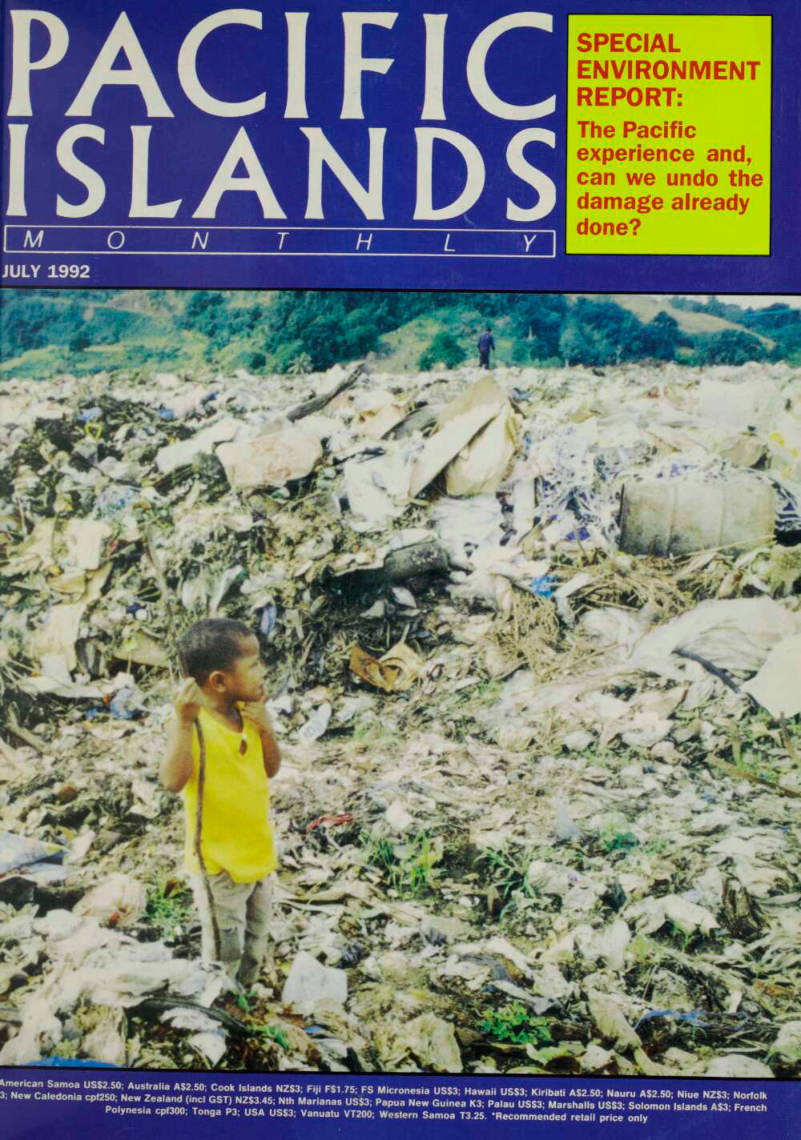
Islands
Monthly
Special
Environment
Report:
The Pacific experience and, can we undo the damage already done?
July 1992
N l I3 M Fi " Fs ' FS “ iC ' oneSia US$3; Ha " ali USJ3; Klriba « «2.50; Nauru A 52.50; Niue NZ$3; Norfolk P d i ■ GST NZS3 45 ’ N,h Mananas US$3; Papua New Guinea K 3; Palau US$3; Marshalls US$3- Solomon islands As - French Polynesia cpf3oo; Tonga P 3; USA US$3; Vanuatu VT2OO; Western Samoa T 3.25. ‘Recommended retail price only
Advertisements & other items, pp. 2-4 (1 item)
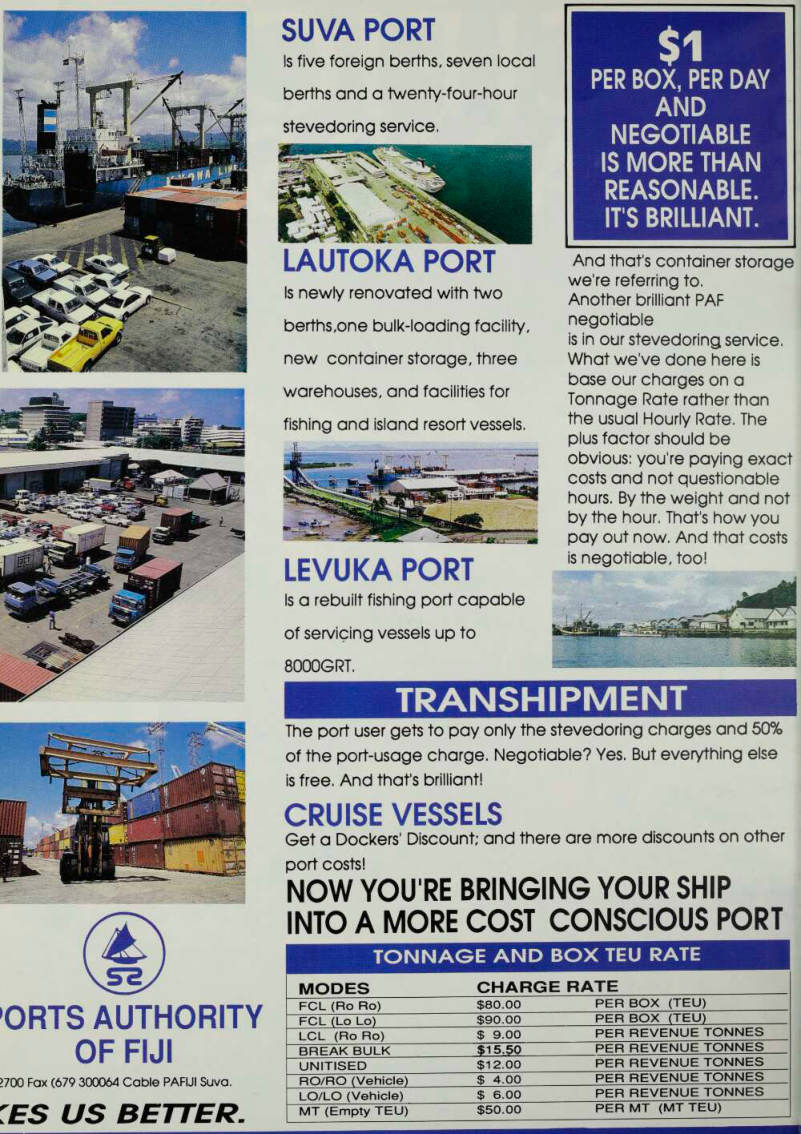
Transhipment
*s K - »s»
ORIS AUTHORITY
OF FIJI
>7OO Fax (679 300064 Cable PAFIJI Suva.
:es us better.
SUVA PORT
Is five foreign berths, seven local berths and a twenty-four-hour stevedoring service. n; $i
PER BOX, PER DAY
AND
NEGOTIABLE
IS MORE THAN
REASONABLE.
IT'S BRILLIANT.
LAUTOKA PORT
Is newly renovated with two berths,one bulk-loading facility, new container storage, three warehouses, and facilities for fishing and island resort vessels.
LEVUKA PORT
Is a rebuilt fishing port capable of servicing vessels up to
8000GRT.
And that's container storage we're referring to.
Another brilliant RAF negotiable is in our stevedoring service.
What we've done here is base our charges on a Tonnage Rate rather than the usual Hourly Rate. The plus factor should be obvious: you're paying exact costs and not questionable hours. By the weight and not by the hour. That's how you pay out now. And that costs is negotiable, too!
TRANSHIPMENT
The port user gets to pay only the stevedoring charges and 50% of the port-usage charge. Negotiable? Yes. But everything else is free. And that's brilliant!
CRUISE VESSELS
Get a Dockers' Discount; and there are more discounts on other port costs!
NOW YOU'RE BRINGING YOUR SHIP
INTO A MORE COST CONSCIOUS PORT
lUST WHEN YOU THOUGHT
i'OU'VE STRUCK THE RIGHT
:OSTS, RAF INTRODUCES THE
\IEGOTIABLES,
BRILLIANT!
In the final analysis, latever we at RAF offer
AS THE
u must be of benefit three lys: lower cost for you, i/er cost for your client; d for us, it's satisfaction in OF
SHIPPING
> knowledge that we've ved you well.
But lower cost of itself In the South Pacific Region, the Ports Authority of Fiji operates three ports of entry into the country-at Suva, Lautoka and Levuka. With other ncels out if the facilities sred are sub-standard. d PAF facilities are among best. ports and deep water anchorages at Vuda Point in the west, and Malau and Savusavu in the north.
Hi jr*--' a* h nn f WB: GPO Box 780 Fiji Islands Telephone (679)
TIME JUST MA
; *t 4 irr fc fct
THE
RIGHT
l| f i .'i ■
-MA Ll *
-F»i ■ V! &
'^• s —n r
Pacific
Islands
Monthly
Vol 62 No. 7
The News Magazine
July 1992
.Etters; 4
’Clitics:
olitics boils in American islands 6 eeping politicians money honest 7 esource development the dividing line in PNG olitics 11
[Nvironment:
aradise Lost 17 ational park 20 iribati 20 s a matter of political will 21 access for Pacific nations at Rio 25 oomsday delayed 26 reen cross 26 auru’s experience after strip mining 27
Usiness:
JG relaxes investment policy 29 ands experimentwith minimum wages 30 >n’t buy those shares 31 deal looks doubtful again 31 nday work banned 31
The Region:
Tradition lives on 41 Lotto fever hits the Cook Islands 44 A royal monument revisisted 45
Health;
Firing up the smokee debate 49
Sports:
Pacific gears up for the Olympics 51 PNG expected to do well in Barcelona 54 Fiji team prepares for European experience 55 Tonga building a strong base 55 The best of Guam 57 Cooks bank on Pera 57 W. Samoa’s achievement 57
Yachting:
Humpback whales the gentle giants 58
Books:
A lesson from time immemorial 60
Shipping:
Shipping schedules; 61
Columnists:
Jemima Garrett 15 Futa Helu 34 Bill McCabe 35 Margot O’Neill 36 David Barber 37
Publisher: Gene Swinstead Editor: Mala Jagmohan Senior Writer: Martin Tiffany Correspondents: Al Prince, Angela McCarthy, David 'Jorth, David Robie, Diana McManus, Dykes Angiki, : rank Kolma, Franck Madoeuf, tan Williams, Irene slisbet, John Hunter, Karen Mangnall, Lovenia Enari, Jlo Vilisoni Macel Manua, Nicholas Rothwell, Pesi •onua, Richard Dinnen, Ulafala Alavao, Wally liambohn.
Columnists: David Barber (Wellington), Futa Helu Tonga, covering the Pacific Islands), Jemima Jarrett (Sydney), Margot O’Neill (Washington), uhan Moti (Pacific Law), Alfred Sasako (The orum).
Business and Advertising Manager, Charlotte Thomas Advertising Sales: • Regional Sales (South Pacific); Salendra Narayan, Tel (679) 304111, Fx (679) 303809 • Sydney, Melbourne; Fergus Maclagan, Tel (61-2) 4134689, Fx (61-2) 4123918 • Brisbane: Robert Walker, Media House, Tel (61-7) 3710533, Fx (61-7) 371-8904 • Adelaide: Hastwell Williamsons Representations, Tel (61-8) 799522, Fx (61-8) 799735 • Auckland: McKay International Media Reps Ltd, Tel (64-9) 4190561, Fx (64-9) 4192243 • Japan; Universal Media Corporation, Tokyo, Tel (3) 6663036, 6663094, Cable: UNIMEDIA Tokyo, Tx 2524665.
Founded 1930 (USPS 952480). A Fiji Times Umited production.
Cover prices are recommended retail only. Regis tered by Australia Post, Publication No. NBP 1210. © Copyright Fiji Times Limited, 177 Victoria Parade. Suva. Fiji. Tel (679) 304111, Fx (679)
303809, Tx Fj2124.
Pacific Islands Monthly is published monthly by The Fiji Times Limited, a division of Nationwide News, 2 Holt Street, Surry Hills, Sydney, NSW 2010.
Send address changes to: • Pacific Islands Monthly, PO Box 1167, Suva, Fiji.
Typeset and printed by The Fiji Times Limited, 177 Victoria Parade, Suva, Fiji.
Letters
Toxic
New Caledonia
While applauding Pacific Island Monthly’s decision to publish something on Kanaky/New Caledonia from the perspective of a Kanak activist, the article by Susanna Ounei “Kanak La ments French Ploy” fails to extend a discussion on what has, and is, happening in Kanaky/New Caledonia be yond the polemic of the Matignon Accords and the assassination of Jean-Marie Tjibaou. In fact, the most insidious French ploy ever to have been conducted in this ancient archipelago does not even rate a mention the deliberate destruction and unchecked abuse of the Kanak people and their natu ral environment from a cen tury and a quarter of relent less mining and smelting of nickel.
The recent disclosure by the territorial medical au thorities that Kanaky/New Caledonia holds the world record for asthma-related deaths, comes as no surprise.
After all, the territory holds yet another record that of lung cancer in the Central and South Pacific, already linked to the nickel mining industry. Asthma, caused by sensitivity of nickel dust, was disgnosed in Europe as long ago as the early 1950’5, yet
several decades later doctors working on the problem in Kanaky/New Caledonia have chosen to ignore any relation ship between the illness which is estimated to effect up to 10 per cent of the popu lation and pollution from mining and smelting practice, blaming it instead on allergy
to pollens.
The majority of the Kanaks who live in the capital, Nou mea, are housed in low income ghettos, some built within a few metres of the smelter’s guarded gates. They innocently grow their food next to highly toxic tailings’ dumps and fish from the smelter effluent canal. The prevalent wind covers these ghettos in an incessant daily and nightly dose of red and black dust from the smelter’s array of stacks, and people
living in these death-traps
have been complaining of asthma and respiratory prob lems for years. Smelter regu lations forbid emissions when the wind is blowing in the opposite direction, and last year a public apology was
issued by the mining industry
when an inadvertent change of wind direction covered tourist sun-bathers in ‘illegal’ smelter dust. Built within metres of the lagoon, con sidered one of the most beautiful in the world, the smelter covers the waters’ surface with a cloak of dust, visible from the air, which
suffocates plankton and kills the reef. High levels of heavy metals have been found not only in the lagoon, but
throughout the territory in
both the rural and urban drinking water.
With the majority of the medical sector in Kanaky/ New Caledonia still in control of the military, and the major
mining company owned by
the French government, the territorial mining laws and the Mining Pollution Control Commission answerable to the French Atomic Energy Authority, there is obviously a vested interest in ignoring the very real connection be tween pollution from the in dustry and the territory’s alarming health and evironmental problems. Forty per cent of the world’s re sources of nickel, a stragegic metal used among other things, in the nuclear indus try, with deposits predicting too last another 200 years, are to be found in New Cale donia.
Unfortunately, various members of the Kanak inde pendence movement whose charter adopts an anti-nuclear position view nickel as a tried and tested means of ‘easy’ development. This they have done without having really challenged the damage this industry has done to the health of the people they represent. At the FLNKS Congress in April 1991, no acknowledgment was ' made by their Health Corn
mission of the already proven relationship between the min ing and smelting pollution and the poor health of the Kanak people. In 1990, the territory’s Loyalist leader and nickel mil lionaire, Jacques LaFleur, gave the Kanak-controlled Northern Province a 49 per cent share in a nickel mine. A 10-year export deal signed earlier this year has made this mining company the country’s top nickel exporter, j Both nickel and many of its compounds released during the j smelting process, have been classified as carcinogenic, mu-* tagenic and teratogenic by the ' International Agency for Re search on Cancer. The Envir onmental Protection Agency in the US lists nickel as an “Ex tremely Hazardous Sub stance”. World Health Organ isation emission standards for the smelting of nickel are set at levels far, far lower than cur rently in practice in Kanaky/ New Caledonia where there is j a paucity of official information on health problems and risks associated with the industry.
Yet amazingly, the French ploy remains undetected, even by self professed Kanak ‘ex tremists’ that of involving the Kanaks themselves as un suspecting accomplices in the steady flow of a strategic metal France’s continuining court ship with all things nuclear requires, but also as innocent participants in the destruction i of their own health and en vironment.
Susi Newborn Auckland
Continental
correction
I WOULD like to correct the impression you have given to your readers in the May issue of Pacific Islands Monthly that Continental Airlines has withdrawn op erations from the South Pacific effective June.
The article headed “Continental slashes routes Sydney Auckland trips likely to end” is not only misleading but incorrect.
On February 8 of this year, Continen tal Airlines announced that it was re arranging schedules to Melbourne and Brisbane to more closely align capacity to the current market needs. This resulted in withdrawing three non-stop services per week between Melbourne and Hono
lulu and increasing Melbourne/
Auckalnd services by one per week giving a total of five services a week from Melbourne to the USA via Auckland. In the case of Brisbane the three DC-10 services a week to Honolulu via Auck land were replaced by two 8747 s per week.
Services between Sydney and Hono lulu and Auckland were not affected and remain at seven per week on each route.
With a total of 24 flights per week into and out of Australian cities Continental Airlines is still the fourth largest interna tional carrier operating to Australia and is now in its 14th year of operations in the South Pacific .
So as you can see the source of your information is incorrect and therefore the
article is totally misleading and damag
ing to Continental Airlines.
I would appreciate if you could correct
thee impression you have given your
readers.
Brian W. Wild
General Manager Australia
Etters To The Editor Must
nclude writer’s full name, address and lome telephone number. All letters nay be edited for purposes of clarity nd space. .etters should be addressed to:
'acific Islands Monthly,
>0 Box 1167, iuva, r iji r Fax: (679) 303809
Advertisements & other items, pp. 6-7 (2 items)
&
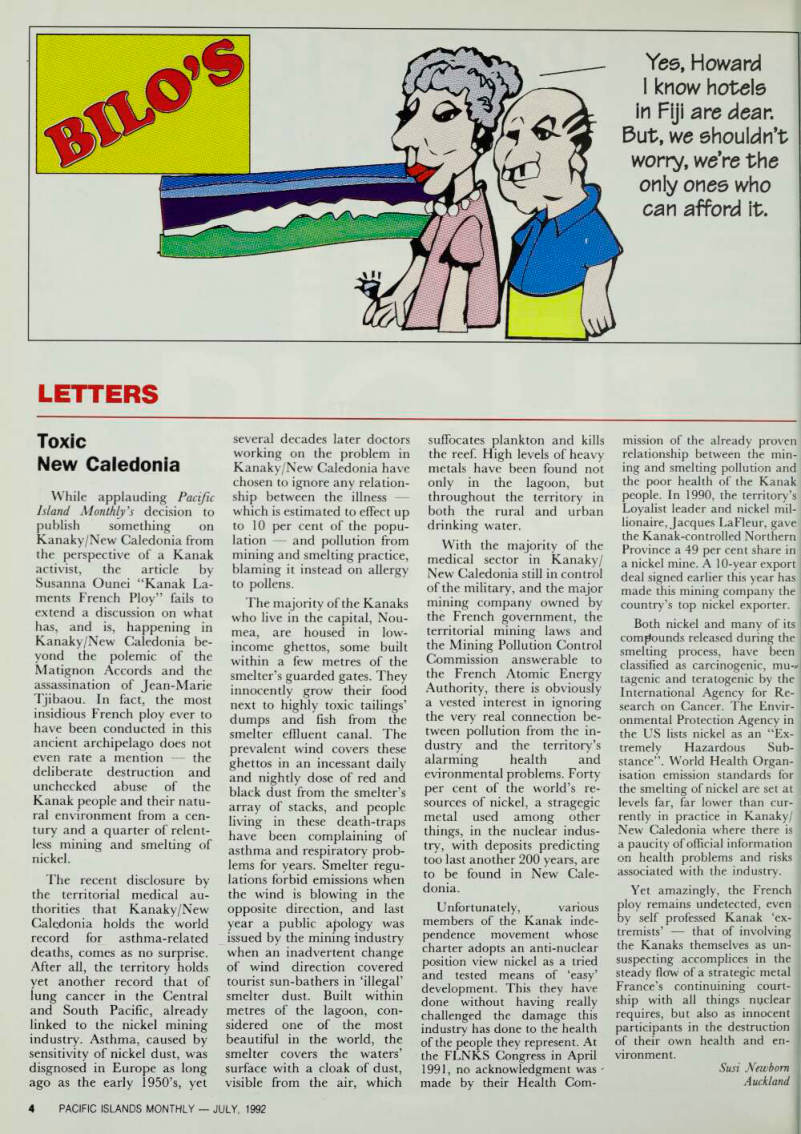
Yes, Howard I know hotels in Fiji are dear.
But, we shouldn’t worry, we’re the only ones who can afford it.
(Sprep)
SOUTH PACIFIC REGIONAL
ENVIRONMENT PROGRAMME
VACANCY COASTAL MANAGEMENT OFFICER
Applications are invited for the position of Coastal Management Officer with the South Pacific Regional Environment Programme (SPREP), based in Apia, Western Samoa.
SPREP is a regional organisation established by the governments and administrations of 22 Pacific Islands countries and territories and 4 developed countries. * Its aim is to assist the Island countries and territories to protect and improve their shared environment and to manage their resources so as to enhance the quality of life for present and future generations. SPREP undertakes a wide range of ennvironmental activities throughout the region, particularly in the areas of Conservation of Biological Diversity, Climate Change and Sea Level Rise, Environmental Planning and Management (Terrestrial), Coastal Planning and Management, Prevention of Pollution and Management of Pollution Emergencies, Environmental Information, Education and Training and Regional Environmental Concerns.
The SPREP Secretariat, which lias been based in Apia since early this year, is responsible for executing the policies and directives of its members, for providing advice and assistance to those members (either directly or through consultants), for formulating and implementing projects under the SPREP Action Plan and for securing donor assistance. It is headed by a Director, assisted by a Deputy Director, and aided by a team of professional staff recruited from within and outside the region and support staff recruited in Western Samoa.
Coastal lands and nearshore waters are of great importance to Pacific Island peoples, cultures and economies. The coastal areas of all islands in the Pacific are the location of the majority of human habitation, the focus of subsistence and commercial agriculture and fisheries activities and the target of most economic development. Coastal management and planning problems are widespread in the region, and in some areas urgent as the potential for ecologically sustainable development and protection of coastal areas is being permanently lost or compromised. In addressing these problems, SPREP’S Action Plan calls for the promotion of a comprehensive, multi-sectoral, integrated approach to the use and conservation of coastal areas, habitats and resources.
The Coastal Management Officer will be responsible to the Director, through the Deputy Director, for assisting the strengthening of national capabilities to formulate and implement coastal management and planning programmes through training activities, workshops and projects; for developing and implementing coastal management and planning programmes; for improving understanding and developing expertise within communities and private and government sectors regarding the benefits of coastal management and planning; for coordinating coastal management and planning activities in the region and for undertaking other coastal management and planning activities, including coastal resource surveys and management plan development. The position entails considerable travel.
Candidates must have appropriate tertiary qualifications from a recognised institution and at least five years’ work experience in a field related to this position. Other essential requirements are the abilities to work as part of a small, inter-disciplinary team, to manage the work of consultants, to meet project deadlines (often under difficult circumstances) and to adapt to living in tropical island communities. Applicants with a demonstrated interest and involvement in economic and social issues affecting the region, particularly as they relate to the management of coastal resources, will be highly regarded.
Appointment will be at Project Officer level and will be for three years in the first instance, renewable for a further three years by mutual agreement. An attractive remuneration package, will be offered, with commencing salary dependant on qualifications, experience and current salary in country of recruitment, and will include return airfares from country of recruitment for the appointee and dependants, establishment grant, housing subsidy, leave fares, Provident Fund and child and education allowances where applicable. For non- Western Samoan citizens, salary and allowances will be tax-free in Western Samoa.
Applications must be accompanied by detailed curricula vitae containing full information on qualifications and experience for the position as well as names, addresses and telephone or fax contact numbers of three persons associated with the applicant professionally and who would be prepared to provide testimonials.
Applications should be addressed to: The Director South Pacific Regional Environment Programme P.O. Box 240
APIA
Western Samoa Fax (685) 21929 Telephone (685) 20 231 Further information, including a full duty statement and schedule of terms and conditions of appointment, can be obtained by contacting SPREP’s Administrative Officer, Mr Ueligitone Sasagi, at these numbers.
Applications close on 31 August 1992. * SPREP member countries and territories are: American Samoa, Australia, Cook Islands, Federated States of Micronesia, Fiji, France, French Polynesia, Guam, Kiribati, Marshall Islands, Nauru, New Caledonia, Niue, New Zealand, Northern Mariana Islands, Palau, Papua New Guinea, Pltcalm, Solomon Islands, Tokelau, Tonga, Tuvalu, United States of America, Vanuatu, Wallis and Futuna and Western Samoa. 101426v6
Politics boils in
Politics
Politics boils in American islands
By David North
“The Battle of the Dinosaurs” is how the upcoming election for governor of American Samoa is being described.
Samoa's only two elected governors, life-long political opponents, will prob ably be battling again later this year when Governor Peter Tali Coleman's four-year term nears an end. The 72-year-old governor is expected to announce for re-election shortly, and he already has the endorsement of the territorial Republican Party.
Senator A.P. Lutali, also, 72, who served as governor from 1985 through 1988, has already announced his candi dacy, and he has the support of the islands’ Democrats. Coleman, the terri tory’s first elected governor, has never lost an election; a constitutional pro vision barring more than two successive four-year terms kept him off the ballot in 1984 when Lutali won. After Coleman beat Lutali in 1988 Lutali was elected to the territorial senate, where he continues
to serve.
While Lutali and Coleman are ex pected to secure 80-90 per cent or more of the votes between them, there are other candidates as well. Falema’o “Phil” Pili, for example, resigned as Deputy Treasurer of American Samoa to make the race.
Meanwhile, there are a series of other political contests in the American islands, all timed to coincide with the presidential election on the Mainland in November. • Congressman Eni F.H.
Faleomaveaga, a Democrat is running for re-election in American Samoa, and Congressman Ben Blaz, a Republican, is similarly engaged in Guam. Both these seats carry with them votes in committees and party caucuses, but not on the floor of the House of Representatives in
Washington.
• The 21-member Territorial Legis lature of Guam, now held by the Democrats 11-10, is up again, for two year terms. It is the only legislative body in Guam.
• 2 All the members of the popularly elected Samoan House of Representa tives, and half of the matai-elected Senate, are also due for election, with the lower house getting two year terms, and the upper house, four years. Members of these bodies, collectively called the Fono, usually do not divide along party lines. • American Samoa also has an elected Lieutenant Governor; candidates for this office are selected by the candidate for governor; voters then vote for a Governor-Lt. Governor team.
Fourth-term Congressman Blaz faces his toughest race this November since he defeated Congressman Antonio Won Pat back in 1984. The likely Democratic candidate for the seat is well-known, articulate, and the leading spokesman for the Chamorro Rights movement. He is Dr Robert Underwood, a professor at the University of Guam. Grandson of a U.S.
Navy officer and three Chamorro grandparents he led the Organization of People for Indigenous Rights, a group which made a major input to the Draft Commonwealth Act, which island leaders are using to try to secure a better relationship with Washington. Under wood is said to be a better campaigner than the somewhat aloof Blaz, a Repub lican and a former U.S. Marine Corps Brigadier General.
Faleomaveaga, now finishing his
second term, has battled with Governor Coleman on a series of issues, and the Governor is sure to have a candidate to run against him, but who it will be is not yet known. Two years ago Faleomaveaga soundly trounced Coleman’s candidate, Territorial Treasurer Ace Tago, who is not expected to run again.
Coleman’s candidate for the seat in Congress might be his son and chief of staff, William “Dyke” Coleman, but the betting is that it will be the territory’s Attorney General, Aviata F’alevao. Meanwhile another candi date has announced. He is Tuika Tuika, a firebrand, and a one-time member of the Fono.
Lutali’s candidate for Lt. Governor this time is Tauese Sunia, brother of Faleomaveaga’s predecessor in the U.S.
House of Representatives, Fofo Sunia.
Tauese, a former member of the Fono, had served Lutali earlier as his cam paign manager and as director of education. A non-lawyer, he is a recognised Legal Practitioner, specialis ing in land and titles disputes.
Coleman’s candidate for Lt.
Governor is not known at the moment.
The current Lt. Governor, Galea’i P.
Poumele, is in a hospital in Honolulu; should his health improve, he might run again. Otherwise it might be Treasurer Tago.
The American islands do not cast votes for the President. But while the U.S. islands do not take part in the White House voting in November, they do play a small role at the party conventions which nominate the two rivals for the office. The Republican delegates from Guam and Samoa are all pledged to George Bush, but the American Samoan delegation to the Democratic convention might play an interesting role. The Samoans have four votes (out of four thousand) at the convention, but the entire delegation is uncommitted, probably the only totally uncommitted delegation at the conven tion. If Governor Bill Clinton stumbles some more in the primaries, the delegation from Pago Pago will be heavily wooed at what will be an unusual event in recent American political history, a truly open conven tion, where the delegates actually chose the presidential nominee.
The Commonwealth of Northern Marina Islands (CNMI) is not in volved in any of this year’s elections. It dects its own officials in Novembers of xid years, and its leaders have decided unlike Guam and American Samoa) lot to have a delegate in the House of Representatives. Should CNMI ever iecide it wants a voteless seat in Congress, or to play a voting role in the inventions, all it has to do is ask. □
Advertisements & other items, p. 8 (1 item)
Executive Director
FOR SALE
M.V. NIVAGA 1
THE ABOVE VESSEL IS FOR SALE
PASSENGER RATING MAXIMUM 150
PERSONS. FULL SURVEY CERTIFICATE
VALID UNTIL FEBRUARY 1993
FITTED WITH TWIN SCREW GARDNER
FOR FURTHER PARTICULARS AND
INSPECTION
PLEASE CONTACT:-
THE GENERAL MANAGER
INTER PORTS SHIPPING CORP LTD
PO BOX 152, SUVA
TELEPHONE: 313266
FAX NO: 303389
SERVING: SUVA SAVUSAVU LABASA
TAVEUNI ROTUMA
SHIPPING RECEIVING FORWARDING
CARTAGE INSURANCE
G.R.T.
N.R.T
353 TONS
163 TONS
CARGO CAPACITY
LENGTH
250 TONS
41.48 METRES
ENGINES.
c qUNC H & The Pacific Islands Council for Blind Persons (P.1.C.) invites written applications for the position of
EXECUTIVE DIRECTOR
P.I.C. is a regional coordinating body based in Suva, serving the developing nations of Micronesia, Melanesia and Polynesia. The goals of P.I.C. are to assist indigenous organisations and agencies in preventing blindness and in serving incurably blind persons.
P.I.C. is looking for a Pacific Islander with broad management, leadership, public relations and fund raising experience. Knowledge, experience, training and proven success in a top management position with a for-profit or not-for-profit organisation are required for the person selected.
Knowledge and skill in the areas of personnel, training, budgetting, financial reporting, grantsmanship and working with a board of directors will be an advantage.
The position requires extensive overseas travel, strong planning and coordination skills and the ability to relate well to both governmental and non-governmental organisations that are members and potential members of P.I.C.
Persons interested in applying should submit a letter of application, copies of all degrees, diplomas, certificates and other qualifications, a complete and current curriculum vitae and three letters of reference to: Pacific Island Council for Blind Persons, P.O. Box 14450, Suva, FUI.
No phone calls regarding this position can be accepted. The P.I.C. office will contact those persons short-listed to arrange for interviews. The deadline for all complete applications to be in the P.I.C. office is 4.30 pm, Suva time, 31st July, 1992.
Keeping politicans
money-honest
Disclosure laws can make a difference
By David North
HOW do you keep elected poli ticians money-honest? That’s a problem throughout the Pacific and much of the world. While*there’s no cure-all for greed, the U.S. islands approach this problem with a collection of techniques including a series of spotlights pointed at the inidivdual politician’s public and private finances.
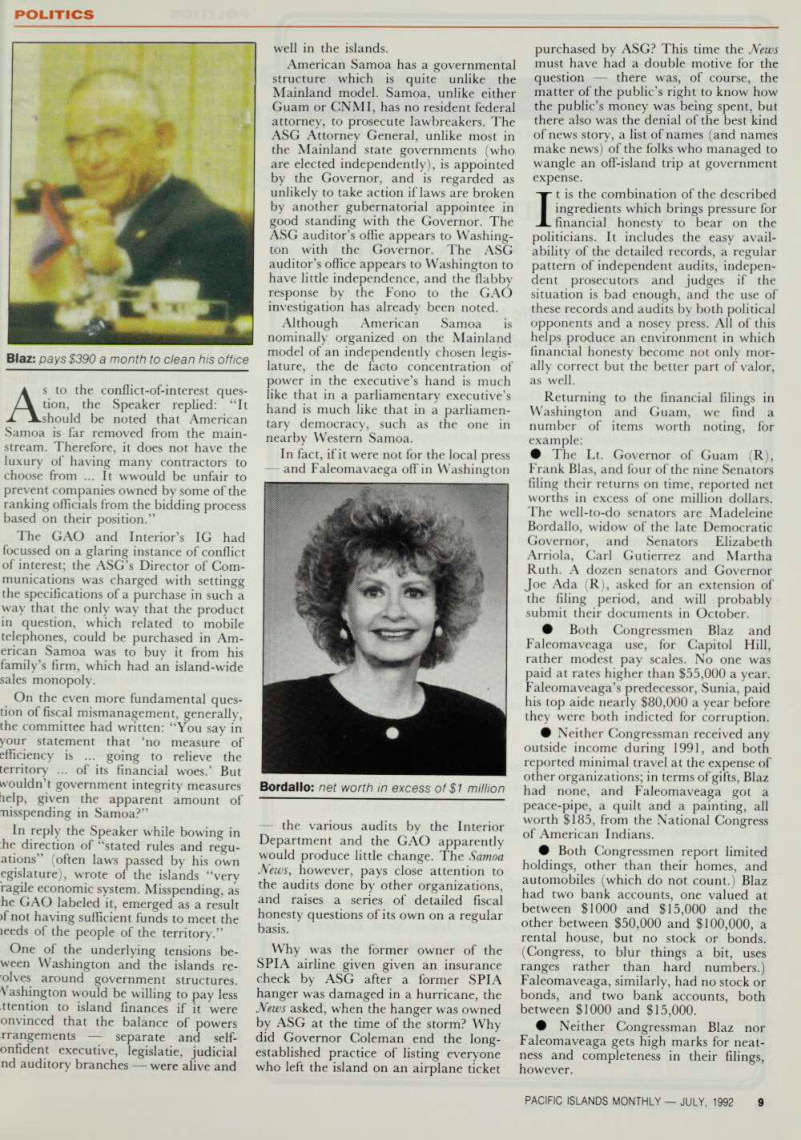
As a result, we know that: • Congressman Ben Blaz (R Guam) pays $390 per month to Maids To Order, a cleaning service which takes care of his office on the island. We also know that these maids don’t do rugs his office paid someone else for carpet
cleaning.
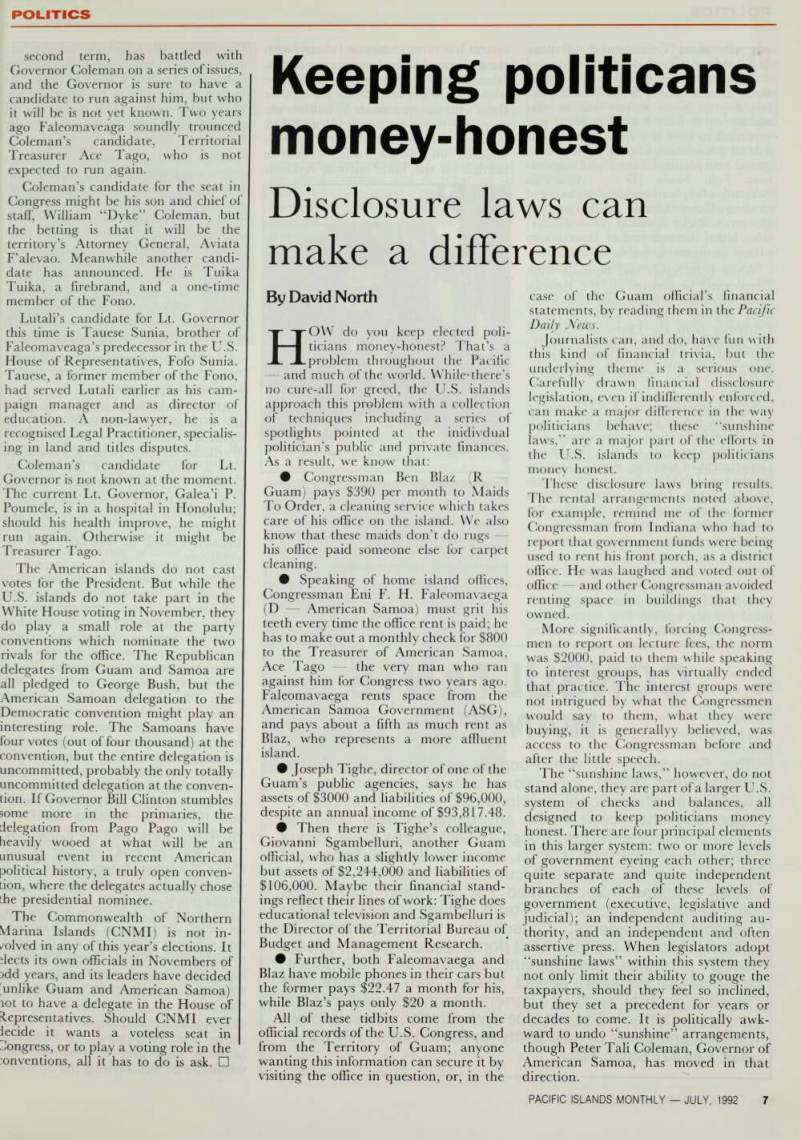
• Speaking of home island offices, Congressman Eni F. H. Faleomavaega (D American Samoa) must grit his teeth every time the office rent is paid; he has to make out a monthly check for $BOO to the Treasurer of American Samoa, Ace Tago the very man who ran against him for Congress two years ago.
Faleomavaega rents space from the American Samoa Government (ASG), and pays about a fifth as much rent as Blaz, who represents a more affluent island. • Joseph Tighe, director of one of the Guam’s public agencies, says he has assets of $3OOO and liabilities of $96,000, despite an annual income of $93,817.48. • Then there is Tighe’s colleague, Giovanni Sgambelluri, another Guam official, who has a slightly lower income but assets of $2,244,000 and liabilities of $106,000. Maybe their financial stand ings reflect their lines of work; Tighe does educational television and Sgambelluri is the Director of the Territorial Bureau of Budget and Management Research. • Further, both Faleomavaega and Blaz have mobile phones in their cars but the former pays $22.47 a month for his, while Blaz’s pays only $2O a month.
All of these tidbits come from the official records of the U.S. Congress, and from the Territory of Guam; anyone wanting this information can secure it by visiting the office in question, or, in the
case of the Guam official’s financial statements, by reading them in the Pacific Daily News.
Journalists can, and do, have fun with this kind of financial trivia, but the underlying theme is a serious one.
Carefully drawn financial dissclosure legislation, even if indifferently enforced, can make a major difference in the way politicians behave; these “sunshine laws,” are a major part of the efforts in the U.S. islands to keep politicians money honest.
These disclosure laws bring results.
The rental arrangements noted above, for example, remind me of the former Congressman from Indiana who had to report that government funds were being used to rent his front porch, as a district office. He was laughed and voted out of office and other Congressman avoided renting space in buildings that they owned.
More significantly, forcing Congress men to report on lecture fees, the norm was $2OOO, paid to them while speaking to interest groups, has virtually ended that practice. The interest groups were not intrigued by what the Congressmen would say to them, what they were buying, it is generallyy believed, was access to the Congressman before and after the little speech.
The “sunshine laws,” however, do not stand alone, they are part of a larger U.S. system of checks and balances, all designed to keep politicians money honest. There are four principal elements in this larger system; two or more levels of government eyeing each other; three quite separate and quite independent branches of each of these levels of government (executive, legislative and judicial); an independent auditing au thority, and an independent and often assertive press. When legislators adopt “sunshine laws” within this system they not only limit their ability to gouge the taxpayers, should they feel so inclined, but they set a precedent for years or decades to come. It is politically awk ward to undo “sunshine” arrangements, though Peter Tali Coleman, Governor of American Samoa, has moved in that direction.
The controversial of these elements'is that of the layers of government; U.S. flag islands con tinue to seek money from Washington, but do not want strings tied to that money, or to have federal auditors pay attention to how it is spent. And it was federal prosecutors who, in recent years, ended the political career of Congress man Fofo Sunia (D American Samoa), who plea bargained a charge of stealing Congressional funds, and of Governor Ricky Bordallo (D Guam) who killed himself rather than go to prison for misusing public funds.
While both Sunia and Bordallo were Democrates prosecuted by the Reagan Administration, it is not only Democrats who get in trouble with the feds.
Currently both the Commonwealth of the Northern Mariana Islands (CNMI) and the ASG (both with Republican Governors) are fighting with federal auditors.
Strictly speaking, the CNMI issue is more of a policy issue than an investi gation of individual malfeasance. The Inspector General of the Mainland Department of Interior, wants to exam ine the way CNMI collects income taxes.
The Governor, Larry Guerrero, argues that these are local funds, and that the feds have no right to look at them.
Without anyone saying so very loudly, the feds apparently suspect that the CNMI taxation system produces rela tively little revenue (hence the requests for federal funds), and that the system is tilted heavily against low income resi dents of the islands. CNMI's income tax
system has three elements: 1) starts with the graduated federal income tax system (though the money all stays on the island); 2) heavy refunds, 95 per cent for those with incomes under S 7 million, are then sent to the taxpayers; 3) and then another, island-oriented tax system is imposed on income, with a heavier burden on the lower income residents
than on well-to-do ones. The IG would like to look at this, and has been forced by the Governor to go into federal court, where the IG will probably win.
The auditors’ work in American Samoa is more sweeping than the efforts of the IG in CNMI. Encouraged by Faleomaveaga, and the House Interior
Committee, Washington’s independent
audit agency, the General Accounting Office (GAO) sent a team of inspectors to look at the books in Pago Pago. They also worked with a thick pile of critical reports assembled over the years by the IG’s office.
GAO found that: American Samoa’s deficit was large and rising rapidly, that it failed to collect taxes very well, and may have let some major politicians get away without paying taxes, that officials often spent money that had not been budgeted, that procurement regulations were regularly violated, and that there were conflicts of interest with ASG officials favoring their kinfolk when making ASG purchasing decisions. It also found that there was a long and persistent pattern of these problems.
The House of Representatives Interior and Insular Affairs Committee held a hearing on the subject.
Although the Fono and the Governor are often at odds with each other, the legislature did not rise to the opportunity to criticize the Governor. As a matter of fact, a close reading of the exchange between the House Committee and the Fono displayed the much larger cultural gap between Washington and Pago Pago, than it did any island-based division between the executive and the legislature.
The Committee’s questions were sharp, focussed precisely on the issues at hand (fiscal mismanage ment and corruption), and business-like to abrupt in tone. The Fono’s replies were fuzzy to non-responsive, often dealt with a broader context (like the island’s poverty), and were expressed with a soft grace. The Committee wrote, for ex ample: “The GAO has reported wide spread ignoring of procurement policies and conflicts of interest in contracting involving high-ranking officials. The Samoan administration doesn’t admit some of the procurement system’s fail ures. Do you agree with the administra tion? If not, what should be done?”
The Fono’s reply, over the signature of Tuana’itau F. Tuia, Speaker of the House of Representatives, started on an odd note: “I was surprised by the submission of additional questions since I was under the assumption duringg the course of the hearing, Mr. Chairman, that sufficient information was provided to address the audit findings. Neverthe less, the following pages contain the responses to the questions directed to me.”
Congressional committees have been asking additional questions, following hearings, since time immemorial; one wonders who was advising the Speaker.
Falaeomavaega: must grit his teeth
As to the conflict-of-interest ques tion, the Speaker replied: “It should be noted that American Samoa is far removed from the main stream. Therefore, it does not have the luxury of having many contractors to choose from ... It wwould be unfair to prevent companies owned by some of the ranking officials from the bidding process based on their position.”
The GAO and Interior’s IG had focussed on a glaring instance of conflict of interest; the ASG’s Director of Com munications was charged with settingg the specifications of a purchase in such a way that the only way that the product in question, which related to mobile telephones, could be purchased in Am erican Samoa was to buy it from his family’s firm, which had an island-wide
sales monopoly.
On the even more fundamental ques tion of fiscal mismanagement, generally, the committee had written: “You say in your statement that ‘no measure of efficiency is ... going to relieve the territory ... of its financial woes.’ But
wouldn’t government integrity measures
help, given the apparent amount of nisspending in Samoa?”
In reply the Speaker while bowing in he direction of “stated rules and regu ations” (often laws passed by his own egislature), wrote of the islands “very ragile economic system. Misspending, as he GAO labeled it, emerged as a result )f not having sufficient funds to meet the leeds of the people of the territory.”
One of the underlying tensions be ween Washington and the islands re vives around government structures.
Vashington would be willing to pay less ttention to island finances if it were onvinced that the balance of powers rrangements separate and self
onfident executive, legislatie, judicial
nd auditory branches were alive and
well in the islands.
American Samoa has a governmental structure which is quite unlike the Mainland model. Samoa, unlike either Guam or CNMI, has no resident federal attorney, to prosecute lawbreakers. The ASG Attorney General, unlike most in the Mainland state governments (who are elected independently), is appointed by the Governor, and is regarded as unlikely to take action if laws are broken by another gubernatorial appointee in good standing with the Governor. The ASG auditor’s offie appears to Washing ton with the Governor. The ASG auditor’s office appears to Washington to have little independence, and the flabby response by the Fono to the GAO investigation has already been noted.
Although American Samoa is nominally organized on the Mainland model of an independently chosen legis lature, the de facto concentration of power in the executive’s hand is much like that in a parliamentary executive’s hand is much like that in a parliamen tary democracy, such as the one in nearby Western Samoa.
In fact, if it were not for the local press and Faleomavaega off in Washington
the various audits by the Interior Department and the GAO apparently would produce little change. The Samoa News , however, pays close attention to the audits done by other organizations, and raises a series of detailed fiscal honesty questions of its own on a regular basis.
Why was the former owner of the SPIA airline given given an insurance check by ASG after a former SPIA hanger was damaged in a hurricane, the News asked, when the hanger was owned by ASG at the time of the storm? Why did Governor Coleman end the long established practice of listing everyone who left the island on an airplane ticket
purchased by ASG? This time the News must have had a double motive for the question there was, of course, the matter of the public’s right to know how the public’s money was being spent, but there also was the denial of the best kind of news story, a list of names (and names make news) of the folks who managed to wangle an off-island trip at government expense.
It is the combination of the described ingredients which brings pressure for financial honesty to bear on the politicians. It includes the easy avail ability of the detailed records, a regular pattern of independent audits, indepen dent prosecutors and judges if the situation is bad enough, and the use of these records and audits by both political opponents and a nosey press. All of this helps produce an environment in which financial honesty become not only mor ally correct but the better part of valor, as well.
Returning to the financial filings in Washington and Guam, we find a number of items worth noting, for
example:
• The Lt. Governor of Guam (R), Frank Bias, and four of the nine Senators filing their returns on time, reported net worths in excess of one million dollars.
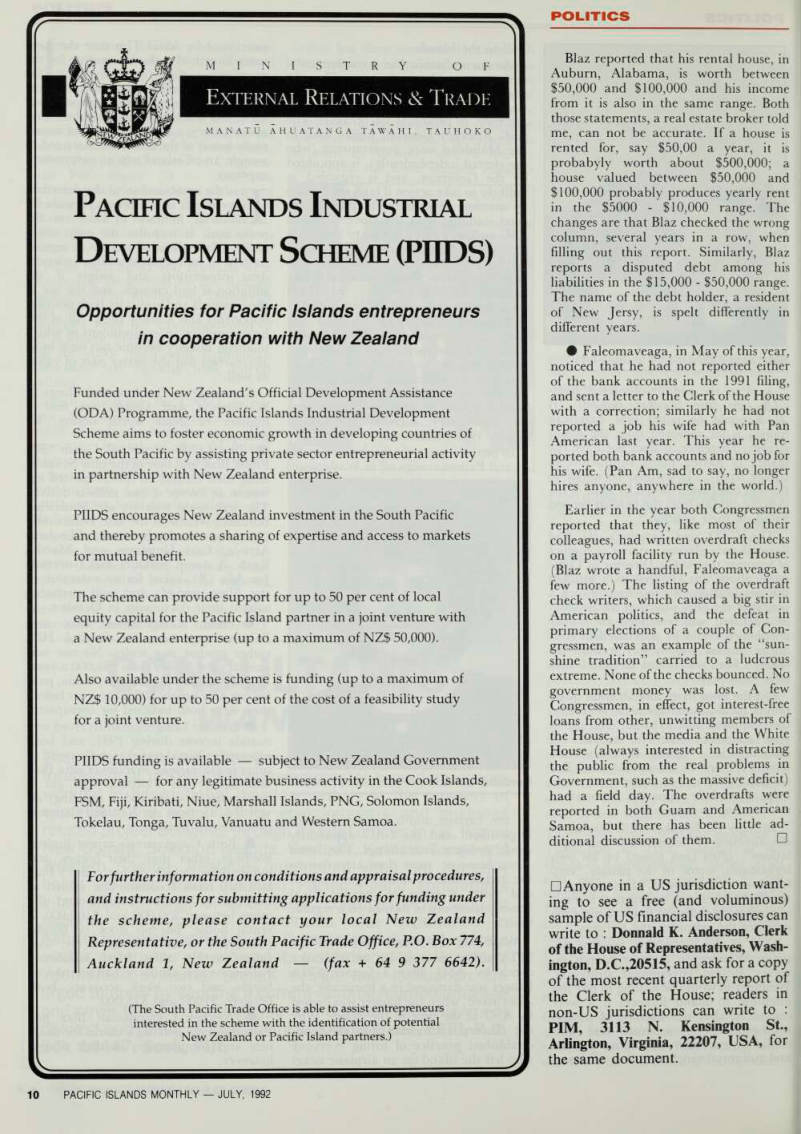
The well-to-do senators are Madeleine Bordallo, widow of the late Democratic Governor, and Senators Elizabeth Arriola, Carl Gutierrez and Martha Ruth. A dozen senators and Governor Joe Ada (R), asked for an extension of the filing period, and will probably submit their documents in October. • Both Congressmen Blaz and Faleomaveaga use, for Capitol Hill, rather modest pay scales. No one was paid at rates higher than $55,000 a year.
Faleomaveaga’s predecessor, Sunia, paid his top aide nearly $BO,OOO a year before they were both indicted for corruption. • Neither Congressman received any outside income during 1991, and both reported minimal travel at the expense of other organizations; in terms of gifts, Blaz had none, and Faleomaveaga got a peace-pipe, a quilt and a painting, all worth $lB5, from the National Congress of American Indians. • Both Congressmen report limited holdings, other than their homes, and automobiles (which do not count.) Blaz had two bank accounts, one valued at between $lOOO and $15,000 and the other between $50,000 and $lOO,OOO, a rental house, but no stock or bonds. (Congress, to blur things a bit, uses ranges rather than hard numbers.) Faleomaveaga, similarly, had no stock or bonds, and two bank accounts, both between $lOOO and $15,000. • Neither Congressman Blaz nor Faleomaveaga gets high marks for neat ness and completeness in their filings, however.
Blaz: pays $390 a month to clean his office
Bordallo: net worth in excess of $1 million
Blaz reported that his rental house, in Auburn, Alabama, is worth between $50,000 and $lOO,OOO and his income from it is also in the same range. Both those statements, a real estate broker told me, can not be accurate. If a house is rented for, say $50,00 a year, it is probabyly worth about $500,000; a house valued between $50,000 and $lOO,OOO probably produces yearly rent in the $5OOO - $lO,OOO range. The changes are that Blaz checked the wrong column, several years in a row, when filling out this report. Similarly, Blaz reports a disputed debt among his liabilities in the $15,000 - $50,000 range.
The name of the debt holder, a resident of New Jersy, is spelt differently in different years. • Faleomaveaga, in May of this year, noticed that he had not reported either of the bank accounts in the 1991 filing, and sent a letter to the Clerk of the House with a correction; similarly he had not reported a job his wife had with Pan American last year. This year he re ported both bank accounts and no job for his wife. (Pan Am, sad to say, no longer hires anyone, anywhere in the world.) Earlier in the year both Congressmen reported that they, like most of their colleagues, had written overdraft checks on a payroll facility run by the House. (Blaz wrote a handful, Faleomaveaga a few more.) The listing of the overdraft check writers, which caused a big stir in American politics, and the defeat in primary elections of a couple of Con gressmen, was an example of the “sun shine tradition” carried to a ludcrous extreme. None of the checks bounced. No government money was lost. A few Congressmen, in effect, got interest-free loans from other, unwitting members of the House, but the media and the White House (always interested in distracting the public from the real problems in Government, such as the massive deficit) had a field day. The overdrafts were reported in both Guam and American Samoa, but there has been little ad ditional discussion of them. □ □ Anyone in a US jurisdiction want ing to see a free (and voluminous) sample of US financial disclosures can write to : Donnald K. Anderson, Clerk of the House of Representatives, Wash ington, D.C.,20515, and ask for a copy of the most recent quarterly report of the Clerk of the House; readers in non-US jurisdictions can write to : PIM, 3113 N. Kensington St., Arlington, Virginia, 22207, USA, for the same document.
Advertisements & other items, pp. 10-12 (1 item)
Consultants
WANTED
The Foundation of the Peoples of the South Pacific International (FSPI), a non governmental executing agency working in international development, is in the process of expanding the scope of its environmental and business related project activities through its field offices in Fiji, Papua New Guinea, Solomon Islands, Vanuatu, Kiribati, Tonga and Western Samoa. Resumes/curriculum vitae are currently being solicited from qualified Pacific Island consultants interested in long, or short-term, country-specific and/or regional assignments. Consultants with experience in natural resource management (forestry and marine), private sector enterprise development, institutional development, information systems, project design and evaluation are urged to apply by sending a current resume/curriculum vitae and cover letter indicating type and duration of assignment desired and dates of availability to; David Wyler, FSPI, P.O.
Box 14447, Suva, FIJI.
External Relations & Trade
M
MANATU AHUATANGA TAWAHI , TAUHOKO
N
S T R Y
O F
Pacific Islands Industrial
Development Scheme (PIIDS)
Opportunities for Pacific Islands entrepreneurs
in cooperation with New Zealand
Funded under New Zealand's Official Development Assistance (ODA) Programme, the Pacific Islands Industrial Development Scheme aims to foster economic growth in developing countries of the South Pacific by assisting private sector entrepreneurial activity in partnership with New Zealand enterprise.
PIIDS encourages New Zealand investment in the South Pacific and thereby promotes a sharing of expertise and access to markets for mutual benefit.
The scheme can provide support for up to 50 per cent of local equity capital for the Pacific Island partner in a joint venture with a New Zealand enterprise (up to a maximum of NZ$ 50,000).
Also available under the scheme is funding (up to a maximum of NZ$ 10,000) for up to 50 per cent of the cost of a feasibility study for a joint venture.
PIIDS funding is available subject to New Zealand Government approval for any legitimate business activity in the Cook Islands, FSM, Fiji, Kiribati, Niue, Marshall Islands, PNG, Solomon Islands, Tokelau, Tonga, Tuvalu, Vanuatu and Western Samoa.
For further information on conditions and appraisal procedures, and instructions for submitting applications for funding under the scheme, please contact your local New Zealand Representative, or the South Pacific Trade Office, P.O. Box 774, Auckland 1, New Zealand (fax + 64 9 377 6642). (The South Pacific Trade Office is able to assist entrepreneurs interested in the scheme with the identification of potential New Zealand or Pacific Island partners.)
PNG politics
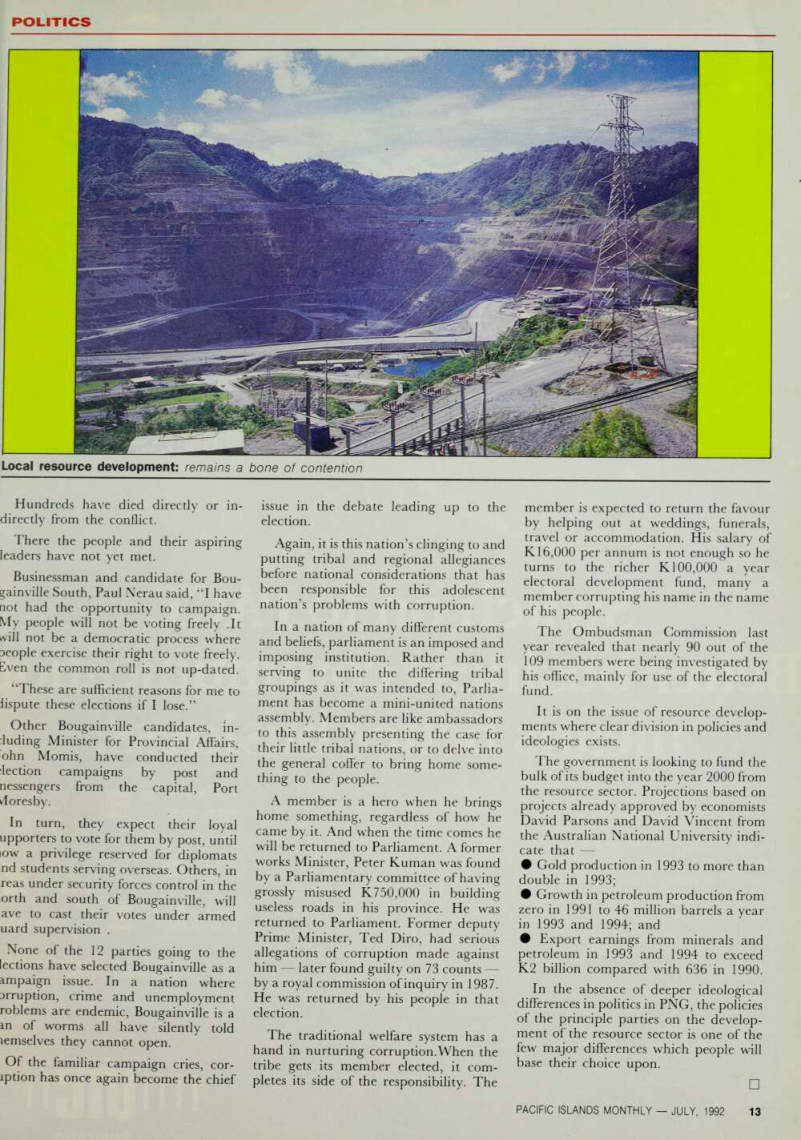
Resource development - the dividing line in PNG politics
By Frank Kolma
ECONOMIC independence will be the central issue of Papua New Guinea’s fourth Parliament, just elected. At the time of writing the make-up of that Parliament is subject to a national general election.
With proceeds from mineral and petroleum developments, the chief means of funding government activity, the resource sector has become a target for differing political party policies.
Prime Minister Rabbie Namaliu’s Pangu Pati has had a run of bad public opinion very close to the election.
Namaliu’s own achievements of the last four years in trying to assure foreign multi-national joint ventures were tor pedoed by party’s founder and Foreign Affairs Minister, Sir Michael Somare, when he declared that he would person ally influence the party after the elections to renegotiate all agreements. Somare said he would get more Papua New Guinea interests in the developments.
Prominent companies and Namaliu himself tried to make light of the suggestion, declaring that it was made in the heat of the moment on the campaign trail. Somare’s seniority, however, forced over K 220 million to be wiped off the shares of most PNG-based resource developers on the Australian stock exchange.
Opposition leader Pias Wingti grabbed the chance to put his own views on the matter.
Said Wingti: “We intend to put a ban on logs and certain things that are leaving the country in raw form. We want to see an oil refinery, a gold refinery, a copper smelter in the country.
“As a policy that is what we want to do. It will definitely be a priority.”
Earlier, again at the insistence of Somare, Cabinet agreed to set up a local National Oil and Gas company to carry out local processing of mineral and oil.
Namaliu announced that he had struck an agreement with a Japanese firm to forward sell K6OO million worth of Kutubu oil. He quickly recoiled at the reaction from the business community and the idea has not been heard of since.
Debate on on-shore processing of gold and oil has flared from time to time and a consultant couple with very close links to Cabinet ministers revealed they had
plans to raise money to build a K6OO million gold refinery and plans for a similar project in gold. Controversy on the links with senior ministers shelved that idea.
In this light, the June elections were critical.
As they were lined up for the elections, the government coalition parties of Pangu, People’s Action Party, League for National Advancement and one half of the National Party were declaring that they were committed to each other. The
Opposition parties, comprising the
People’s Democratic Movement, People’s Progress Party, United Party and the other half of National Party were equally committed to each other.
Opposition leader, Paias Wingti, said, however: “In politics, we have no permanent enemies.”
If the current Prime Minister were to lead the government again, it would have meant a continuing of current policies relating to mineral and pet roleum development, but with Somare as a persistent thorn in his side.
Should Opposition leader, Paias Wingti lead his coalition into govern ment, there is likely to be a drastic shift in policy.
It is an election that has fallen short of many expectations. It was thought, for instance, that 16 years after Indepen dence, this election would see a maturing of PNG politics.
University of PNG lecturer in politics Nao Badu states that so such develop ment has taken place.
Badu said: “There are no clear ideological differences between the par ties. All parties can be classified near the centre.
“All want the market economy, but under national control. They want state control of welfare services.
“This is not necessarily bad. Papua New Guinea has peacefully passed that critical 15 years of independence which have seen nations of Africa go down the road to dictatorships and revolutions.
We are still a thriving democracy. That is something to be proud of.”
But it is bad when the aspirations of the people supercede those of the leaders.
Over 2000 policemen, 200 soldiers and 19,000 electoral officers are ready with over 100 tonnes of ballot papers and election equipment.
Twelve political parties are jostling to be in government on July 4. With no party clearly ahead of the others, the fourth Parliament looks set to be another coalition government.
Predictions on what party leads that coalition is pure guess-work at this stage, although it can be narrowed down to the Pangu Pati of current Prime Minister Namaliu and the Opposition People’s Democratic Movement led by Paias Wingti.
Campaigning has been boring re cently, with candidates from every camp offering the same roads, bridges, hos pitals and schools. Only the issue of resource development has seen clear divisions in policies.
With more educated candidates and a public outcry for Constitutional reforms and stable government it was thought this election would see the maturing of PNG politics. It has not.
Democracy, PNG style is tribal. Free choice is the tribal leaders' will.
Since Independence on September 16, 1975, when the Australian flag was peacefully lowered, this South Pacific nation has taken the Westminster parlia mentary system of government and grafted on it its own special brand.
With so many candidates running for power and a first past the post electoral system it is most likely the candidate with the biggest number of tribesmen support ing him will win.
Election is loud and open. The principle of secret ballot remains that principle only. Tribal leaders discuss openly and decide who their people should vote for.
Wendu Mek, a woman from the Southern Highlands province who de cided to follow her own counsel last election wound up in hospital and, when discharged from the hospital, she found she was without a husband, as well.
She warned fellow women in this election: “Somehow they have spies who will find out who you vote for. I did not like the person the village decided to vote for so I voted a different person.
“I thought it was secret, but when I returned my husband broke my hand.
Later he threw my clothes out of the house. He said I brought shame to his name because he had guaranteed the village that his family would vote the man they had decided on.”
Other villages see election as an opportune time to make money. “We are a market good,” a leader in Chimbu province of the populous highlands region, “whoever wants our vote can buy it.”
In one province election has taken on a totally different turn.
A three-year secessionist uprising on Bougainville has forced a halt to govern ment services to the island and closed down one of the world’s largest open cut
mines, Bougainville Copper.
Hundreds have died directly or in directly from the conflict.
There the people and their aspiring leaders have not yet met.
Businessman and candidate for Bou gainville South, Paul Nerau said, “I have not had the opportunity to campaign.
My people will not be voting freely .It will not be a democratic process where people exercise their right to vote freely.
Even the common roll is not up-dated.
“These are sufficient reasons for me to lispute these elections if I lose.”
Other Bougainville candidates, m :luding Minister for Provincial Affairs, ohn Momis, have conducted their lection campaigns by post and nessengers from the capital, Port
Moresby.
In turn, they expect their loyal upporters to vote for them by post, until iow a privilege reserved for diplomats nd students serving overseas. Others, in reas under security forces control in the orth and south of Bougainville, will ave to cast their votes under armed uard supervision .
None of the 12 parties going to the lections have selected Bougainville as a ampaign issue. In a nation where Drruption, crime and unemployment roblems are endemic, Bougainville is a m of worms all have silently told icmselves they cannot open.
Of the familiar campaign cries, cor iption has once again become the chief
issue in the debate leading up to the election.
Again, it is this nation’s clinging to and
putting tribal and regional allegiances
f r ■ , -j l , before national considerations that has e^. n res ponsi e or tis a o escent natlon s problems with corruption.
I n a nation of many different customs and beliefs, parliament is an imposed and
imposing institution. Rather" than it
serving to unite the differing tribal groupings as it was intended to, Parliament has become a mini-united nations assembly. Members are like ambassadors to this assemb , presenting the case for their Uttle triba n H ations (Q ddve into the genera i co fy er to bring home something to the people. .
A member is a hero when he brings hom \ somet A hl “g> regardless of how he ° by lL Am ? wh J: n f he time c A °™ es he wl " be returned to Parliament. A former Minister, Peter Kuman was found b y a committee of having g , y misused K 750,000 m building Use e “ j'° ads r . m ,. hIS pr °, VlnCe He was returned to Parliament. Former deputy Prime Minister, Ted Diro, had serious allegations of corruption made against him later found guilty on 73 counts — by a ro y ai commission ermquiry in 1987.
He was returned by his people m that electl ° n - Tbe tradit ‘onal welfare system has a hand in nurturing corruption. When the tribe gets its member elected, it completes its side of the responsibility. The
member is expected to return the favour by helping out at weddings, funerals, ' r^ e l° r accommodation. His salary of , Kl6 ’ 00 ,° P e J ann “ m IS "°‘ e "°o gH S ° turns to the ncher K 100,000 a year electora , deve l o pment fund, many a member corrupting his name in the name of his peop i e r Xh e Ombudsman Commission last vear revealed that ou7 of the
K^wt^Tn^inldglmdt
his office, mainly for use of the electoral fund, T .. r . , It is on the issue of resource develop where clear division m polices and
ideologies exists.
The government is looking to fund the bulk of its budget into the year 2000 from the resource sector. Projections based on projects already approved by economists David Parsons and David Vincent from the Australian National University indi cate that - • Gold production in 1993 to more than double in 1993; • Growth in petroleum production from zero in 1991 to 46 million barrels a y ear in 1993 and 1994; and • Export earnings from minerals and petroleum in 1993 and 1994 to exceed K 2 billion compared with 636 in 1990.
In the absence Q f deeper ideological differences in politics in PNG, the policies of the Principle parties on the develop ment of the resource sector is one of the * ew ma J or differences which people will base their choice upon, □
Local resource development: remains a bone of contention
Advertisements & other items, pp. 14-16 (1 item)
Budget
.4?5 -' lipp*
iml JeS?
s* ¥ Port Moresby Mount Hagen Sal MbSs £i| £j| I i^^'f’i^-, ■ * /'■±£ : '.
together with the
Premier Car Rental Company
Check into one of our superb Hotels in any of 7 unique locations throughout
Papua New Guinea and enjoy friendly
Melanesian Hospitality as well as
access to top quality Hire Cars.
Port Moresby m ft u U m s at Madang c>% R Lae I a ir < £ r \ lllwv
LMi
i Popondetta Banal • i Lae RQ BOX 1215 BOROKO PAPUA NEW GUINEA
CENTRAL RESERVATIONS
PHONE;(67S) 252612, FAX 25 7853
Budget
rent-a-car **
VISADD
Switch on to PACT.
Better business communicatior
means better business.
:f your organisation needs a data or private network in the Pacific region but ow volume or high cost have stopped /ou doing anything about it PACT is he solution.
The PACT* network is a shared satellite system controlled via a witching facility at OTC Australia’s
?arth station in Sydney. It provides
opacity on INTELSAT satellites that subscribers throughout the Pacific can iccess on demand connecting to any )art of the region.
Sending switched data at 4,800 bit/s, ACT provides instant and economic foice, facsimile and data services.
PACT can provide network solutions for banking groups, financial institutions, mining or shipping companies, airlines, governments and the general public.
And most importantly it’s linked to the worldwide network of OTC Australia giving you connections anywhere in the Pacific, or around the world.
So, if you need a communication solution for your Pacific network, contact your local telecommunications authority or
Graham Huddy
Business Manager, Pacific OTC Australia Phone +6l 2 287 4320 Facsimile +6l 2 287 5507 r PACT is the Pacific Area Cooperative Telecommunications Network. Nations currently participating in the I. A. /V U„ 11 I- M:..~ T. 1 1 . -in,--l Anctrnlin Marshall Is Kiribati *
RDCC
Sydney PACT provides instant communication throughout the Pacific ransmission via PACT Data link controlling access to the network OTC Australia is the international arm of AOTC.
AiiQtralia
Fiji - the past forgotten
FIJI has finally put the 1987 coups behind it. That is the conclusion which has been drawn across the political spectrum in Australia after Fiji’s first post-coup election in May.
Considering the Australian govern ment's loud and long condemnation, not only of the racially inspired coups but of the post-coup constitution, the warmth with which former coup leader Major- General Sitiveni Rabuka has been wel comed as Prime Minister could come as
a surprise.
But a lot of things have changed.
Prime Minister Rabuka is emphasis ing his new moderate, consultative approach which values “consensus sol utions” to Fiji's problems.
Like* others in his party, the Soqosoqo ni Vakavulcwa ni Taukei (SVT), Gen eral Rabuka has promised changes to the constitution.
W hile the new Prime Minister says there will be no going back on his
promises to safeguard (he heritage of indigenous Fijians he also told me in interview in Suva shortly after his appointment that he would be prepared to consider an amendment to re introduce cross-vo ting. 1 hat would be a major step. It would mean at least a partial breakdow n of the post-coup v oting system which rigidly divides the races and has encouraged communal thinking.
But the biggest change in General Rabuka since 1987 has been in his attitude to the Fiji Labour Party one of the main victims of his coups.
The Labour Party won 13 of the 27 seats allocated to Fiji Indians. In return for Labour support for his bid for the* prime ministership General Rabuka promised to review the* consti tution and land tenure arrangements for Indian cane farmers, to scrap the* Value Added fax and revoke controversial labour decrees.
While that deaf with Labour may well turn out to be* the source of many of Prime Minister Rabuka’s problems it cuts across the* policy of both his own party and his main coalition partner, the General Voters Party it is also a crucial source
of his strength.
I he Labour deal not only gives the new Prime Minister c i edibility on the racial cjuestion, but by opening the door to a more consensual style* of politic s, has the potential to break down that confrontational industrial relations climate which leveloped under the interim government.
It s a step which has won instant recognition in Australia.
Australia's Prime Minister. Paul Keating, sent warm ongratulations to General Rabuka adding that a significant ispeci was that his appointment had been supported bv the Fiji
Labour Party.
Keating said he particularly welcomed Prime Minister Rabuka s "statement (fiat he* lias agreed to consider a review )f the constitution and was encouraged by his commitment o develop an environment for dialogue, compromise and igreement.
Among Australian business leaders, too, General Rabuka’s appointment has been greeted with optimism Australia is by far the biggest investor in Fiji with total iivestment conservatively estimated at S7OO million and
Australia
growing. Despite the hesitancy of many
Australian investors to put their money into Fiji before the outcome of the election was known, the fact that the former coup leader was elected Prime Minister has not concerned them.
One 7 large investor I spoke with summed it up for many when he said “thank goodness Fiji has finally got a democratically elected government”.
For Australian business it has been the election itself which has been by far the biggest hurdle.
Ihe two points in Prime Minister Rabuka’s agreement with Labour which have most frightened Fiji busi ness, the promise to scrap the Value Added lax and revoke the labour decrees, have had little impact in Australia.
In the post-election euphoria the same big investor confided that many of his colleagues had “thought the Labour Decrees too draconian”.
Ev en the VAT, which has become a sacred cow among many sections of business in Fiji (mainly because reductions in import duty predicated on the \ A I have already been made), was described by one Australian business leader as “not a life and death issue”.
Ihe untried nature of this new government may mean investors take slightly longer to feel satisfied about its stability but there is already a sense of optimism about the future.
I hat optimism is based not only on the new Prime Minister’s insistence on his new more mature and measured approach to government but on the talent and track record of his new cabinet.
Prime Minister Keating praised General Rabuka’s cabinet as “experienced and moderate”.
He we nt on to tell Parliament that Fiji was an “important partner of Australia in the South Pacific and we do look forward to developing a constructive and positive relationship with them and of course wish their new government well in its delibe rations in managing the- affairs and prospects of the Fijian
pe'ople”.
While those who have ke pt up with Fiji politics, have backed away from their past reservations and feel comfortable about the ne w government despite some' remaining differences, the same cannot necessarily be* said about the vast bulk of Australians, many of whom might eventually visit Fiji as tourists.
With few* Australian journalists allowed into Fiji over the past four years and little reporting of the changing political climate, many ordinary Australians stiff carry around the images of the coups in their heads. for the* fiji tourist industry which has been suffering a major slump General Rabuka’s agreement with Labour may have an
unexpected spin-off.
Not since* the death of former Prime Minister, Timoci Bavadra, has Fiji made such a splash in the newspaper headlines nor touched the* emotions of ordinary folk.
I he new talk of consensus may just get the message across that fiji is still the safe and delightful place for a holiday it has always been. □
Jemima
Garrett
Advertisements & other items, p. 18 (1 item)
Telekwm
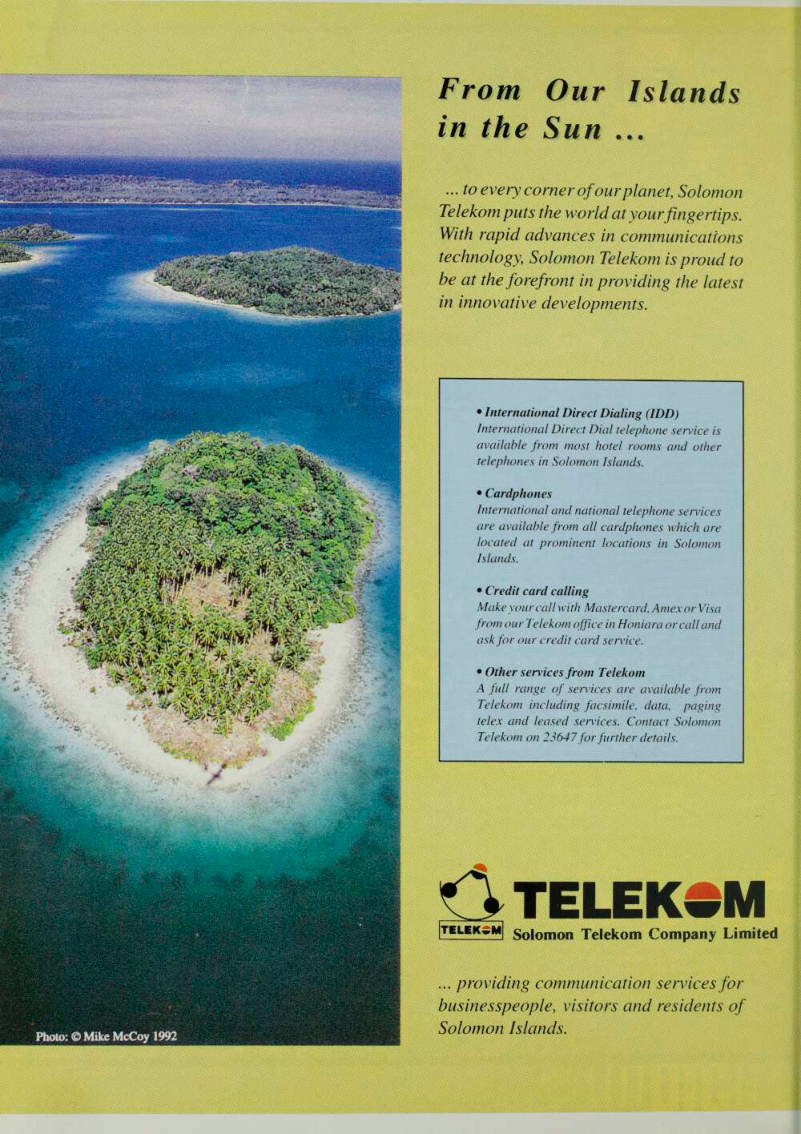
From Our Islands
in the Sun ...
... to every corner ofour planet, Solomon Telekom puts the world at your fingertips.
With rapid advances in communications
technology , Solomon Telekom is proud to be at the forefront in providing the latest
in innovative developments.
• International Direct Dialing (IDD) International Direct Dial telephone sennce is available from most hotel rooms and other telephones in Solomon Islands. • Cardphones International and national telephone services are available from all cardphones which are located at prominent locations in Solomon Islands. • Credit card calling Make your call with Mastercard, Amexor Visa from our Telekom office in Honiara or call and ask for our credit card service. • Other services from Telekom A full range of services are available from Telekom including facsimile, data, paging telex and leased sendees. Contact Solomon Telekom on 23647f0r further details.
TELEKwM
Solomon Telekom Company Limited ... providing communication services for
businesspeople, visitors and residents of
Solomon Islands.
Lost?
Environment
Paradise Lost?
Treading the delicate balance between economy and ecology
By Sean Weaver
The balance of trade, international relations, the cost of foreign borrowing, the burden of debt servicing, protection ism in developed market economies . . . sounds like the overtures of an economic summit held in the depths of a finance ministry somewhere. But without a doubt, this is also the language of conservation.
There are currently many different plans and strategies being developed for improving environmental management in the Pacific. National environmental management strategies are currently being prepared in Fiji, Samoa, Solomon Islands, the Federated States of Micro nesia, the Cook Islands, the Marshall Islands, and Tonga. Much in the way of technical expertise is being gathered together from all over the world in order to prepare the environmental panacea for the Pacific.
It all sounds fine and dandy, and one :ould be excused for feeling a warm sense T well being in thinking that environ mental disfigurement in the Pacific has lad its day. Are we really heading for a lew and benign era, when pollution will ie a thing of the past, the threat of luclear poisoning a distant memory, vhere the remaining native forests are :ept standing tall and majestic in natioal larks, and where economic production
bllows nothing but an environmentally
fiendly path?
Think again.
In some isolated cases a government nay be willing to allow its “conser ations sector” to manage a resource for ►urposes of protecting national heritage, he novelty of things like national parks, lowever, may soon wear off as the same overnment does battle on the interna ional economic stage. Here it attemps to eep the country’s economy afloat in a ast Pacific ocean (where the sea levels re predicted to rise due to global warming threatening to drown us all nyway).
The local manifestations of international pressures on Pacific Island economies are alive and well. These economic pressures are a breeding ground for environmental problems and yet they are not being fully addressed in national environmental strategies. With all the technical assistance pouring into the region we can do well in identifying the dismal state of the environment, and the types of management that should be undertaken. But little regard is being given to address the underlying causes of our environmental problems. To realistically address these causes we must seek out their roots in the economic order that forces island governments to squeeze all they can from their nations resources
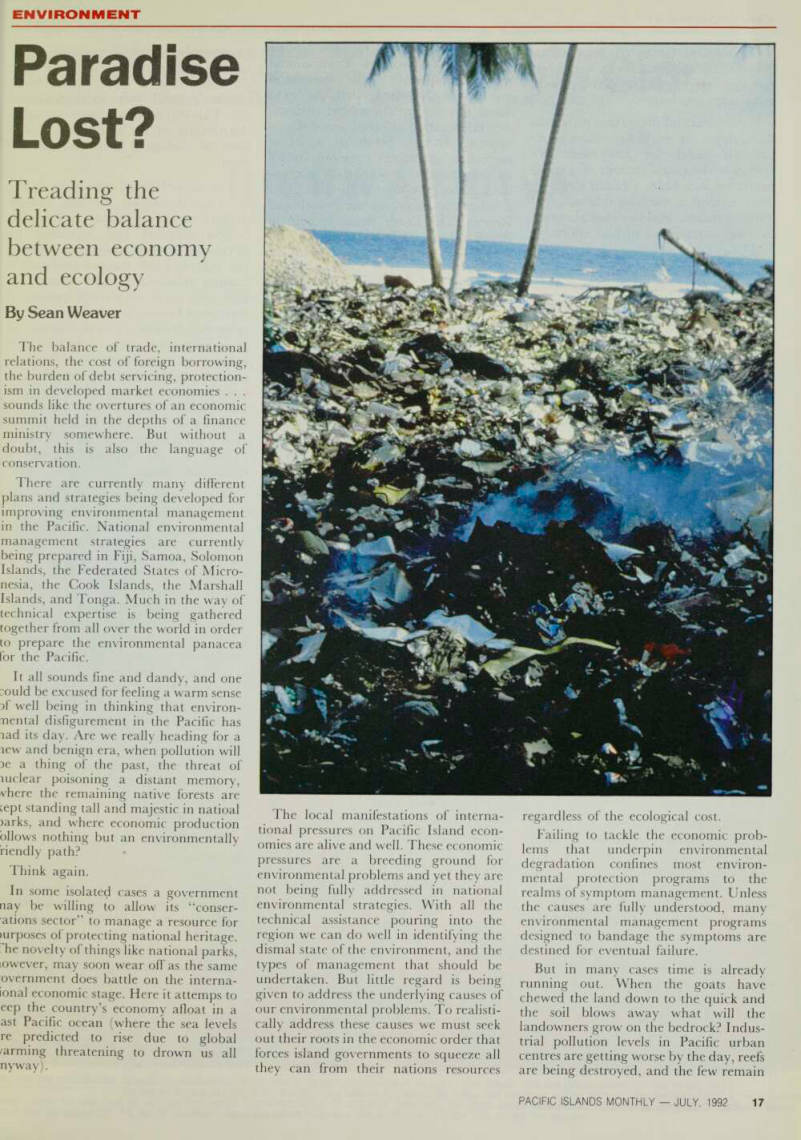
regardless of the ecological cost, Failing to tackle the economic prob- Jems that underpin environmental degradation confines most environ mental protection programs to the realms of symptom management. Unless the causes are fully understood, many environmental management programs designed to bandage the symptoms are destined for eventual failure, But in many cases time is already running out. When the goats have chewed the land down to the quick and the soil blows away what will the landowners grow on the bedrock? Indus trial pollution levels in Pacific urban centres are getting worse by the day, reefs are being destroyed, and the few remain
ing natural forests continue to be converted to plantations or non-forest landuses. We must move quickly, there is no time for delay.
Environmental protection programs throughout the world have been econ omically naive for too long. We celebrate the establishment of a small protected area here, a beach clean-up there against a swelling tide of grue some economic realities that threaten to make a farce out of past efforts.
We cannot hope to be realistic environmental managers, for the ben efit of the people and ecosystems of the Pacific, unless we are able to reshape the economic instruments of ecological
plunder.
Island governments do all they can to bring in much needed foreign exchange and also attempt to create a balance in domestic activities under the principles of optimal distribution.
But what the Pacific island nations need more than anything else is to
establish an optimal carrying capacity.
Their economy itself must be
ecologically sustainable.
But how on earth will these countries be able to take sustainability seriously in an economic climate when the balance of trade is against them, where they are forced (through protectionism in developed market economies) to trade in little else but raw materials, where foreign investment can only be attracted through the creation of tax free zones, where trans-national giants bleed their economy through transfer pricing, where they suffer from the rising burden of debt, where aid flows are stagnating amid an increase in the
cost of foreign borrowing?
Get real. What can conservation hope to achieve if it does not begin to address these kinds of issues?
Pacific island economies are locked into the international game of world trade. This is no revelation. But for ecologists and environmental man agers in the Pacific it is something we must come to grips with. These economic pressures set the context for the current historical phase of environ mental degradation. Failing to com
prehend their ecological ramifications
will simply help to perpetuate the role of eenvironmental management as a soft option for Pacific island govern ments.
The links between underdevelop ment and environmental depletion
were well recognised in 1986 by the World Commission on Environment and Development. This commission was convened by the United Nations to assess the state of the global environ mental situation vis-a-vis world devel opment. It also presented a set of minimum guidelines required by all nations to avert a potentially horren dous global environmental crisis. This is otherwise known as the Brundtland Report. The Earth Summit, held in Brazil in June, is a follow up of the 1986 commission findings to see how much or how little progress has been made since then.
Much of the Brundtland Report concentrates on international econ omic issues, highlighting economic
inequities that have substantial im pacts on the environment of both
developing and developed countries.
Little international economic re adjustment has happened since 1986 to help developing countries out of the economic shackles that bound them during their colonial histories. This is in spite of the Brundtland Report demonstrating that such moves form a vital prerequisite for an ecological and economic future for the planet.
Thus, the economic legacies of the colonial era live on in the current economic order of the Pacific region and perpetuate the dismal patterns of
metropolitan hegemony. This, of
course, has been an on going complaint of independent Pacific island nations trying to dig themselves out of the underdevelopment pit. But as we have seen, it is also the root of a pervasive
environmental evil. For susatinability to be a reality for the Pacific we need no less than a new international economic (and hence ecological) or der. This will require a more equitable distribution of the international div ision of ecological (and human) la bour.
The subordinated economies of Pa cific island nations are still heavily dependent on aid inputs and market outlets supplied and regulated by developed market economies outside the region. These nations maintain a trading relationship with island na tions that preserves a trade balance in their own favour, which sustains their economic dominance in the region. As a consequence these countries are helping to perpetuate the environ mental problems arising from econ omic pressures on natural resources in the Pacific. Because of this it is conceivable that they should play a major part in assisting Pacific island nations in the struggle towards a sustainable future.
Here is where international assist ance for economic development can be linked directly with the protection of the Pacific environment. What is good for the Pacific island economies can also be good for the ecosystems, as to relieve the pressure on their resources will create the breathing space re quired to implement effective environ mental management. This in turn will help to remove some of the principle causes of environmental degradation.
Moves towards ecological sustainable development in the Pacific become entangled in the essential problems associated with any form of develop ment in an economy subordinated by its trading partners. Because of this the Pacific will be unable to make any real environmental improvements without substantial international support.
International environmental man agement assistance will have to involve an improvement in the economic conditions within Pacific island nations and between these nations and their trading partners. Recognition of this within Pacific countries is an important step in the pursuit of ecological sustainability. But unless people begin to realise that environmental degra dation and underdevelopment are woeful siblings in the same under
privileged family, an ecologically
sustainable future for the Pacific will not lie at the end of the rainbow. □
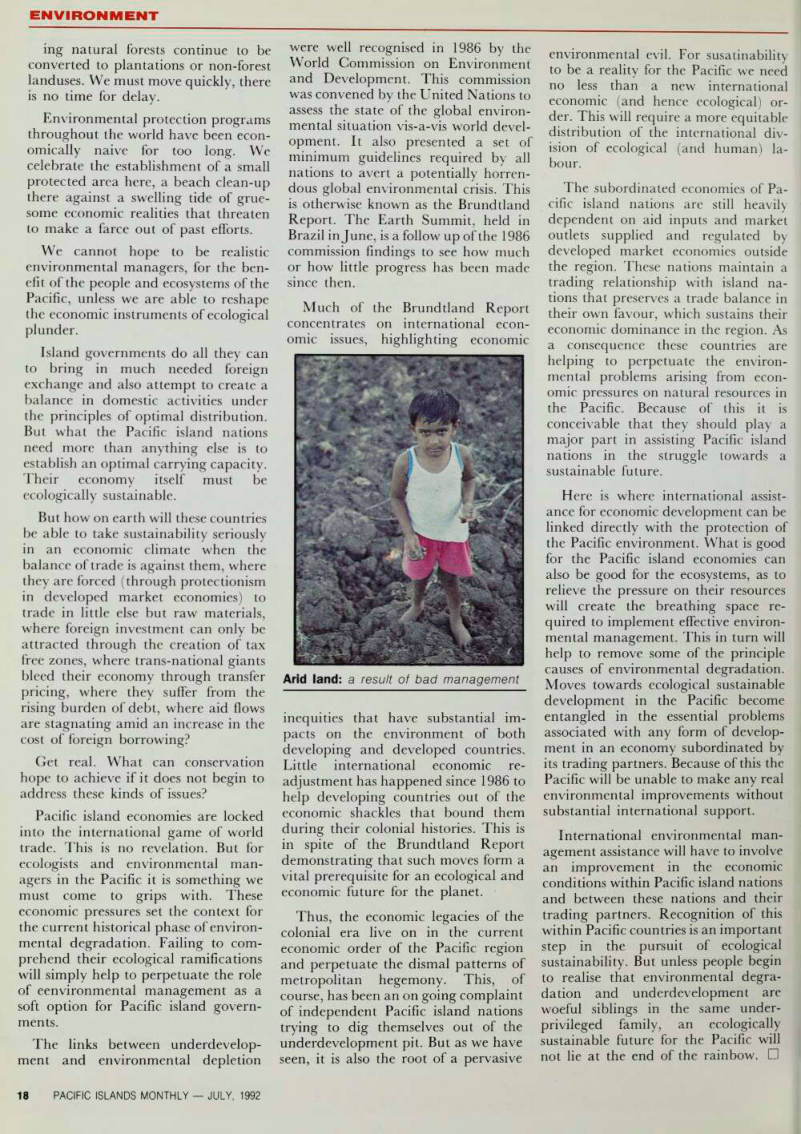
Arid land: a result of bad management
Advertisements & other items, p. 21 (1 item)
clarion
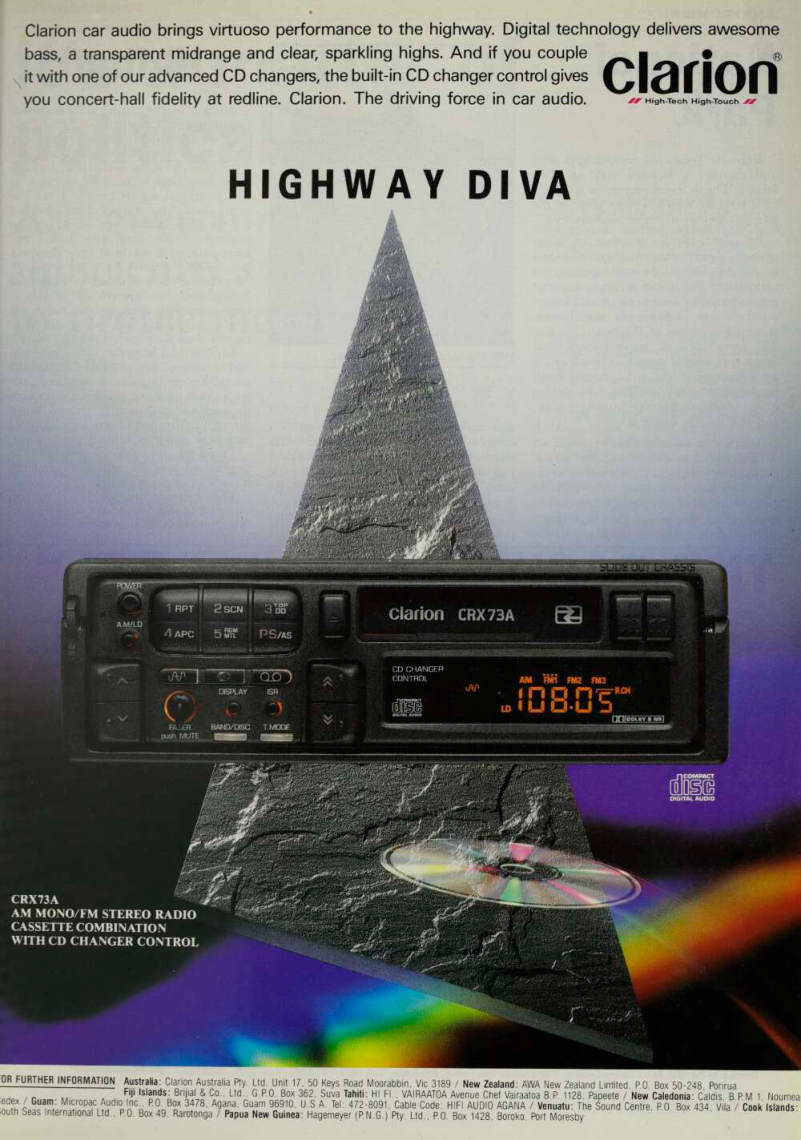
car audio brings virtuoso performance to the highway. Digital technology delivers awesome bass, a transparent midrange and clear, sparkling highs. And if you couple it with one of our advanced CD changers, the built-in CD changer control gives you concert-hall fidelity at redline. Clarion. The driving force in car audio.
High-Tech High-Touch
HIGHWAY DIVA
hr I c!SUN
clarion CRX73A
4 apc SSBT PS/AS
T~qtT)
CD CHANGER
CONTROL
AM FMI FM2 FM3
mprrc*™
u> i u u u 3
fintooEiv ■ wm
FA,£R BAND/OISC T.MOOE
push MUTE, gMB
CRX73A
AM MONO/FM STEREO RADIO
CASSETTE COMBINATION
WITH CD CHANGER CONTROL
9 Ip- C ’ .- f
)io * :/ - y ' Jr EOL '/!■■■ ■■$ ■ S. y 1 OR FURTHER INFORMATION Australia; Clarion Australia Pty. Ltd. Unit 17, 50 Keys Road Moorabbin, Vic 3189 / New Zealand: AWA New Zealand Limited, P.O. Box 50-248, Porirua oHoy /n, M A . ,l lsl n n n S n ßri SLn Co ' Ltd ' GPO Box 362 ' Suva Tahiti: Hl Fl - VAIRAATOA Avenue Chef Vairaatoa B.P 1128, Papeete / New Caledonia: Caldis BPM 1 Noumea : ol^ U lrnSn^iH dlo pn nC R ? 3 f B ’ A f D na ' Guam 9 P 6910 ' US A Tel: 472-8091, Cable Code: HIFI AUDIO AGANA / Venuatu: The Sound Centre, PO. Box 434, Vila / Cook Islands: outh Seas International Ltd., PO. Box 49, Rarotonga / Papua New Guinea: Hagemeyer (PN G.) Pty. Ltd., PO. Box 1428, Boroko, Port Moresby
National
Park
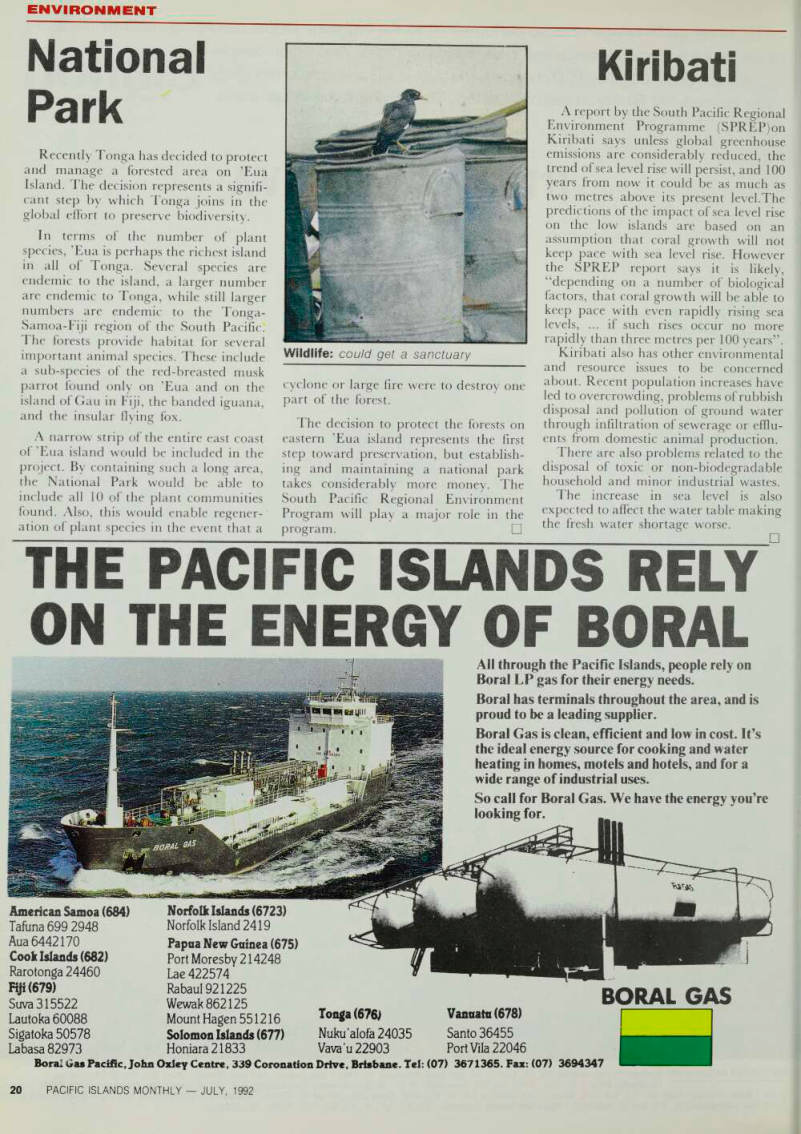
Recently Tonga has decided to protect and manage a forested area on ’Eua Island. The decision represents a signifi cant step by which Tonga joins in the global effort to preserve biodiversity.
In terms of the number of plant species, ’Eua is perhaps the richest island in all of Tonga. Several species are endemic to the island, a larger number are endemic to Tonga, while still larger numbers are endemic to the Tonga- Samoa-Fiji region of the South Pacific.
The forests provide habitat for several important animal species. These include a sub-species of the red-breasted musk parrot found only on ’Eua and on the island of Gau in Fiji, the banded iguana, and the insular flying fox, A narrow strip of the entire east coast of ’Eua island would be included in the project. By containing such a long area, the National Park would be able to include all 10 of the plant communities found. Also, this would enable regener ation of plant species in the event that a
cyclone or large fire were to destroy one part of the forest.
The decision to protect the forests on eastern ’Eua island represents the first step toward preservation, but establish ing and maintaining a national park takes considerably more money. The South Pacific Regional Environment Program will play a major role in the program. □
Wildlife: could get a sanctuary
Kiribati
A report by the South Pacific Regional Environment Programme (SPREP)on Kiribati says unless global greenhouse emissions are considerably reduced, the trend of sea level rise will persist, and 100 years from now it could be as much as two metres above its present level.The predictions of the impact of sea level rise on the low islands are based on an assumption that coral growth will not keep pace with sea level rise. However the SPREP report says it is likely, “depending on a number of biological factors, that coral growth will be able to keep pace with even rapidly rising sea levels, ... if such rises occur no more rapidly than three metres per 100 years”.
Kiribati also has other environmental and resource issues to be concerned about. Recent population increases have led to overcrowding, problems of rubbish disposal and pollution of ground water through infiltration of sewerage or efflu ents from domestic animal production.
There are also problems related to the disposal of toxic or non-biodegradable household and minor industrial wastes.
The increase in sea level is also expected to affect the water table making the fresh water shortage worse. □
Advertisements & other items, p. 22 (1 item)
The Pacific Islands Rely
ON THE ENERGY OF BORAL
HfS ■ ■1*16*11(11 ' I i ■ ■ i ' . i i t wm*. (!*5 All through the Pacific Islands, people rely on Boral LP gas for their energy needs.
Boral has terminals throughout the area, and is proud to be a leading supplier.
Boral Gas is clean, efficient and low in cost. It’s the ideal energy source for cooking and water heating in homes, motels and hotels, and for a wide range of industrial uses.
So call for Boral Gas. We have the energy you’re looking for.
American Samoa (684) Tafuna 699 2948 Aua 6442170 Cook Islands (682)
Rarotonga 24460
Ftfi(679) Suva 315522 Lautoka 60088 Sigatoka 50578 Labasa 82973 Norfolk Islands (6723) Norfolk Island 2419 Papua New Guinea (675) Port Moresby 214248 Lae 422574 Rabaul 921225 Wewak 862125 Mount Hagen 551216 Solomon Islands (677) Honiara 21833 Tonga (676) Nukualofa 24035 Vava’u 22903 Vanuatu (678) Santo 36455 Port Vila 22046
BORAL GAS
Boral oas Pacific, John Oxley Centre, 339 Coronation Drive, Brisbane. Tel: (07) 3671365. Fax: (07) 3694347
political will
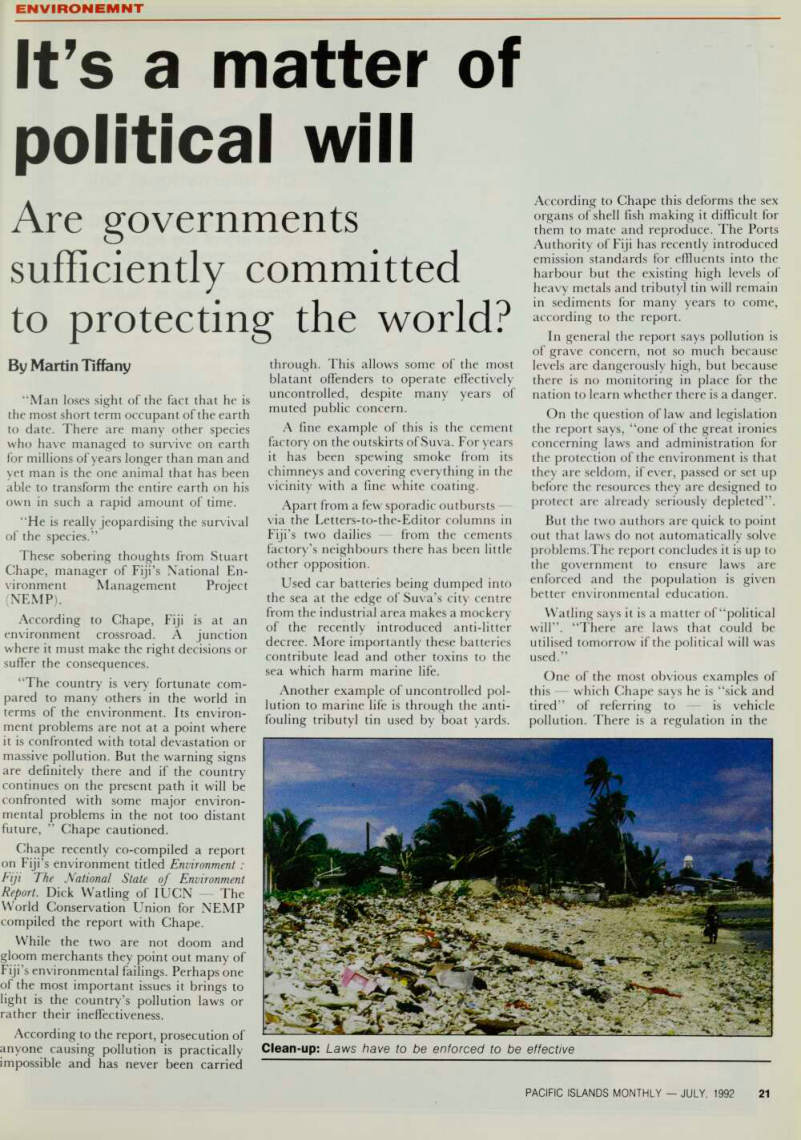
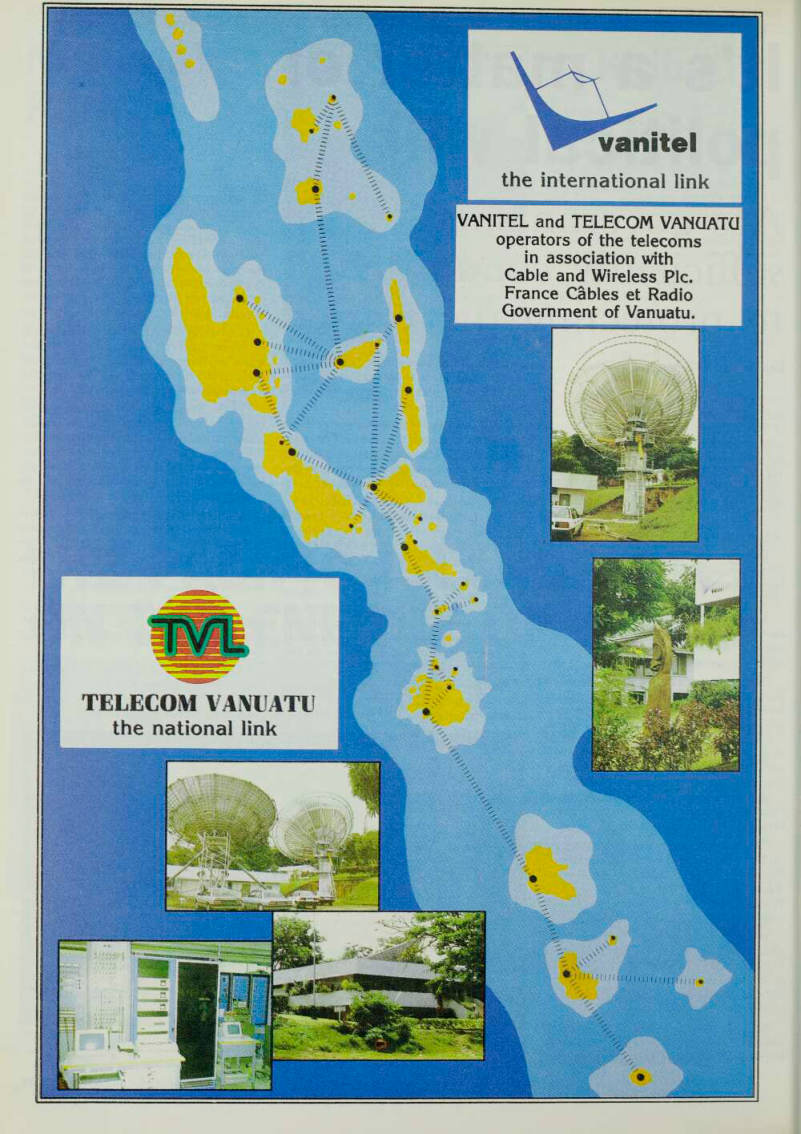
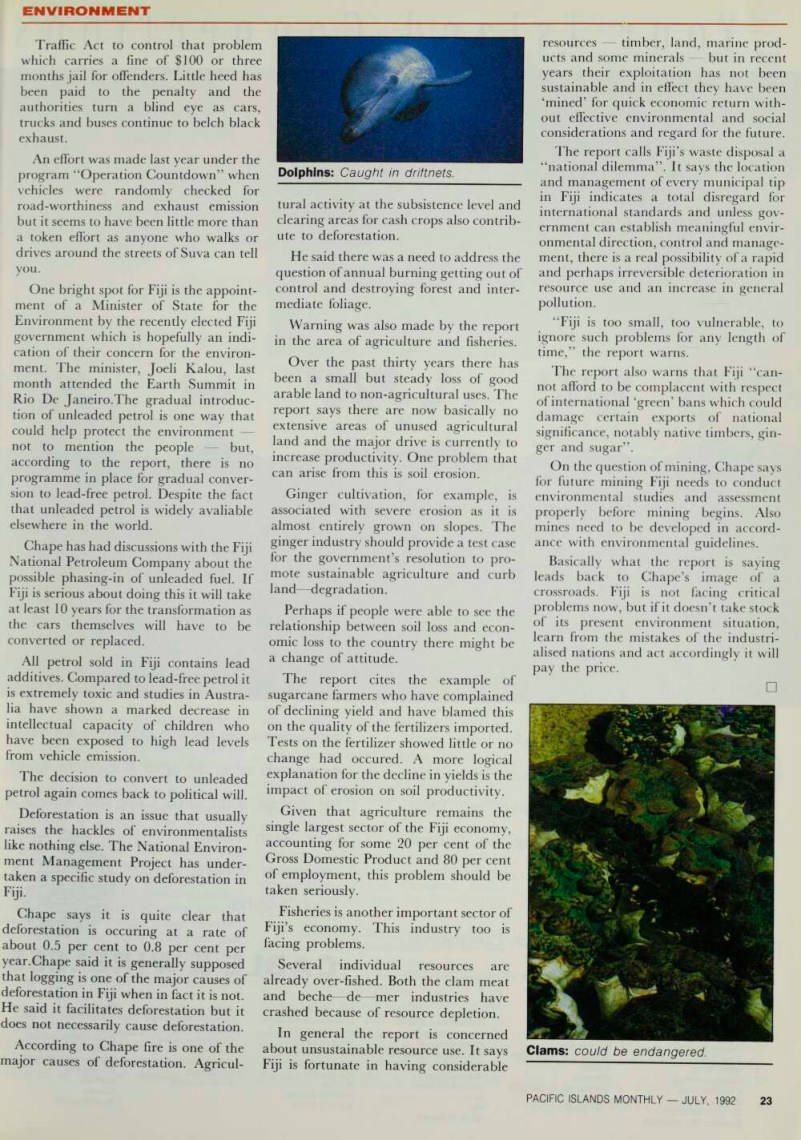
It’s a matter of political will
Are governments sufficiently committed to protecting the world?
By Martin Tiffany
“Man loses sight of the fact that he is the most short term occupant of the earth to date. There are many other species who have managed to survive on earth for millions of years longer than man and yet man is the one animal that has been able to transform the entire earth on his own in such a rapid amount of time.
“He is really jeopardising the survival of the species.”
These sobering thoughts from Stuart Chape, manager of Fiji’s National En vironment Management Project
(Nemp).
According to Chape, Fiji is at an environment crossroad. A junction where it must make the right decisions or suffer the consequences.
“The country is very fortunate com pared to many others in the world in terms of the environment. Its environ ment problems are not at a point where it is confronted with total devastation or massive pollution. But the warning signs are definitely there and if the country continues on the present path it will be confronted with some major environ mental problems in the not too distant future, ” Chape cautioned.
Chape recently co-compiled a report on Fiji’s environment titled Environment : Fiji The National State of Environment Report. Dick Wading of lUCN The World Conservation Union for NEMP compiled the report with Chape.
While the two are not doom and gloom merchants they point out many of Fiji’s environmental failings. Perhaps one of the most important issues it brings to light is the country’s pollution laws or rather their ineffectiveness.
According to the report, prosecution of anyone causing pollution is practically impossible and has never been carried
through. This allows some of the most blatant offenders to operate effectively uncontrolled, despite many years of muted public concern.
A fine example of this is the cement factory on the outskirts of Suva. For years it has been spewing smoke from its chimneys and covering everything in the vicinity with a fine white coating.
Apart from a few sporadic outbursts via the Letters-to-the-Editor columns in Fiji’s two dailies from the cements factory’s neighbours there has been little
other opposition.
Used car batteries being dumped into the sea at the edge of Suva’s city centre from the industrial area makes a mockery of the recently introduced anti-litter decree. More importantly these batteries contribute lead and other toxins to the sea which harm marine life.
Another example of uncontrolled pol lution to marine life is through the anti fouling tributyl tin used by boat yards.
According to Chape this deforms the sex organs of shell fish making it difficult for them to mate and reproduce. The Ports
Authority of Fiji has recently introduced
emission standards for effluents into the harbour but the existing high levels of heavy metals and tributyl tin will remain in sediments for many years to come, according to the report.
In general the report says pollution is of grave concern, not so much because levels are dangerously high, but because there is no monitoring in place for the nation to learn whether there is a danger.
On the question of law and legislation the report says, “one of the great ironies concerning laws and administration for the protection of the environment is that they are seldom, if ever, passed or set up before the resources they are designed to
protect are already seriously depleted”.
But the two authors are quick to point out that laws do not automatically solve problems. The report concludes it is up to the government to ensure laws are enforced and the population is given better environmental education.
VVatling says it is a matter of “political will”. “There are laws that could be utilised tomorrow if the political will was used.”
One of the most obvious examples of this which Chape says he is “sick and tired” of referring to is vehicle pollution. There is a regulation in the
Clean-up: Laws have to be enforced to be effective
Traffic Act to control that problem which carries a fine of SIOO or three months jail for offenders. Little heed has been paid to the penalty and the authorities turn a blind eye as cars, trucks and buses continue to belch black exhaust.
An effort was made last year under the program “Operation Countdown” when vehicles were randomly checked for road-worthiness and exhaust emission but it seems to have been little more than a token effort as anyone who walks or drives around the streets of Suva can tell you.
One bright spot for Fiji is the appoint ment of a Minister of State for the Environment by the recently elected Fiji government which is hopefully an indi cation of their concern for the environ ment. The minister, Joeli Kalou, last month attended the Earth Summit in Rio De Janeiro. The gradual introduc tion of unleaded petrol is one way that could help protect the environment not to mention the people but, according to the report, there is no programme in place for gradual conver sion to lead-free petrol. Despite the fact that unleaded petrol is widely available elsewhere in the world.
Chape has had discussions with the Fiji National Petroleum Company about the possible phasing-in of unleaded fuel. If Fiji is serious about doing this it will take at least 10 years for the transformation as the cars themselves will have to be converted or replaced.
All petrol sold in Fiji contains lead additives. Compared to lead-free petrol it is extremely toxic and studies in Austra lia have shown a marked decrease in intellectual capacity of children who have been exposed to high lead levels from vehicle emission.
The decision to convert to unleaded petrol again comes back to political will.
Deforestation is an issue that usually raises the hackles of environmentalists like nothing else. The National Environ ment Management Project has under taken a specific study on deforestation in
Fiji.
Chape says it is quite clear that deforestation is occuring at a rate of about 0.5 per cent to 0.8 per cent per year. Chape said it is generally supposed that logging is one of the major causes of deforestation in Fiji when in fact it is not.
He said it facilitates deforestation but it does not necessarily cause deforestation.
According to Chape fire is one of the major causes of deforestation. Agricul-
tural activity at the subsistence level and clearing areas for cash crops also contrib ute to deforestation.
He said there was a need to address the question of annual burning getting out of control and destroying forest and inter
mediate foliage.
Warning was also made by the report in the area of agriculture and fisheries.
Over the past thirty years there has been a small but steady loss of good arable land to non-agricultural uses. The report says there are now basically no extensive areas of unused agricultural land and the major drive is currently to increase productivity. One problem that can arise from this is soil erosion.
Ginger cultivation, for example, is associated with severe erosion as it is almost entirely grown on slopes. The ginger industry should provide a test case for the government’s resolution to pro mote sustainable agriculture and curb land —degradation.
Perhaps if people were able to see the relationship between soil loss and econ omic loss to the country there might be a change of attitude.
The report cites the example of sugarcane farmers who have complained of declining yield and have blamed this on the quality of the fertilizers imported.
Tests on the fertilizer showed little or no change had occured. A more logical explanation for the decline in yields is the impact of erosion on soil productivity.
Given that agriculture remains the single largest sector of the Fiji economy, accounting for some 20 per cent of the Gross Domestic Product and 80 per cent of employment, this problem should be taken seriously.
Fisheries is another important sector of Fiji’s economy. This industry too is
facing problems.
Several individual resources are already over-fished. Both the clam meat and beche —de —mer industries have crashed because of resource depletion.
In general the report is concerned about unsustainable resource use. It says Fiji is fortunate in having considerable
resources timber, land, marine prod ucts and some minerals but in recent years their exploitation has not been sustainable and in effect they have been ‘mined’ for quick economic return with out effective environmental and social considerations and regard for the future.
The report calls Fiji’s waste disposal a “national dilemma”. It says the location and management of every municipal tip in Fiji indicates a total disregard for international standards and unless gov ernment can establish meaningful envir onmental direction, control and manage ment, there is a real possibility of a rapid and perhaps irreversible deterioration in resource use and an increase in general pollution.
“Fiji is too small, too vulnerable, to ignore such problems for any length of time,” the report warns.
The report also warns that Fiji “can not afford to be complacent with respect of international ‘green’ bans which could damage certain exports of national significance, notably native timbers, gin ger and sugar”.
On the question of mining, Chape says for future mining Fiji needs to conduct environmental studies and assessment properly before mining begins. Also mines need to be developed in accord ance with environmental guidelines.
Basically what the report is saying leads back to Chape’s image of a crossroads. Fiji is not facing critical problems now, but if it doesn’t take stock of its present environment situation, learn from the mistakes of the industri alised nations and act accordingly it will pay the price.
Dolphins: Caught in driftnets.
Clams: could be endangered.
Advertisements & other items, pp. 24-26 (1 item)
vanitel
"111, "iff//. >•
TELECOM VANUATU
the national link
Wimi
vanitel
the international link
VANITEL and TELECOM VANUATU
operators of the telecoms in association with Cable and Wireless Pic.
France Cables et Radio Government of Vanuatu. :v : m Ml m *111111)11 , / 1 M1 1 .,.
Your Island Connections
*L * m *
Cable and Wireless began keep-
ing people in touch around the
world more than a century ago. Today,
while the technology has changed,
the tradition of service to our customers in the
South Pacific is just the same.
We work in partnership with Governments,
dedicated to meeting the need of communities and businesses to stay in touch. From one island to the next or to the other side of the world, the message is the same: Cable and Wireless is
your South Pacific
connection bringing the
islands together.
CABLE & WIRELESS
Asia Pacific Head Office Cable and Wireless pic Cable and Wireless (Pacific) Limited 22 nd Floor Office Tower Convention Plaza 1 Harbour Road Hong Kong Tel: (852)848 8620 Facsimile: (852) 868 5195 Australia Cable and Wireless (Australia) Pty Ltd PO Box 675, Double Bay NSW 2028 Sydney Australia Tel/Fax (61-2) 362 3625 Fiji In association with the Government of Fiji Fiji International Telecommunications Ltd.
RO. Box 59 Mercury House 158 Victoria Parade Suva Fiji Tel: (679) 312933 Solomon Islands In association with the Government of the Solomon Islands Solomon Telekom Company Limited PO. Box 148 Honiara Solomon Islands Tel: (677) 21576 Tonga Cable and Wireless pic Private Mail Bag 4 General Post Office Nuku Alofa Tonga South Pacific Tel: (676) 23499 Vanuatu In association with the Government of Vanuatu and France Cdbles et Radio Vanuatu International Telecommunications Ltd.
PO, Box 164 Port Vila Vanuatu Tel: (678) 22185
for Pacific
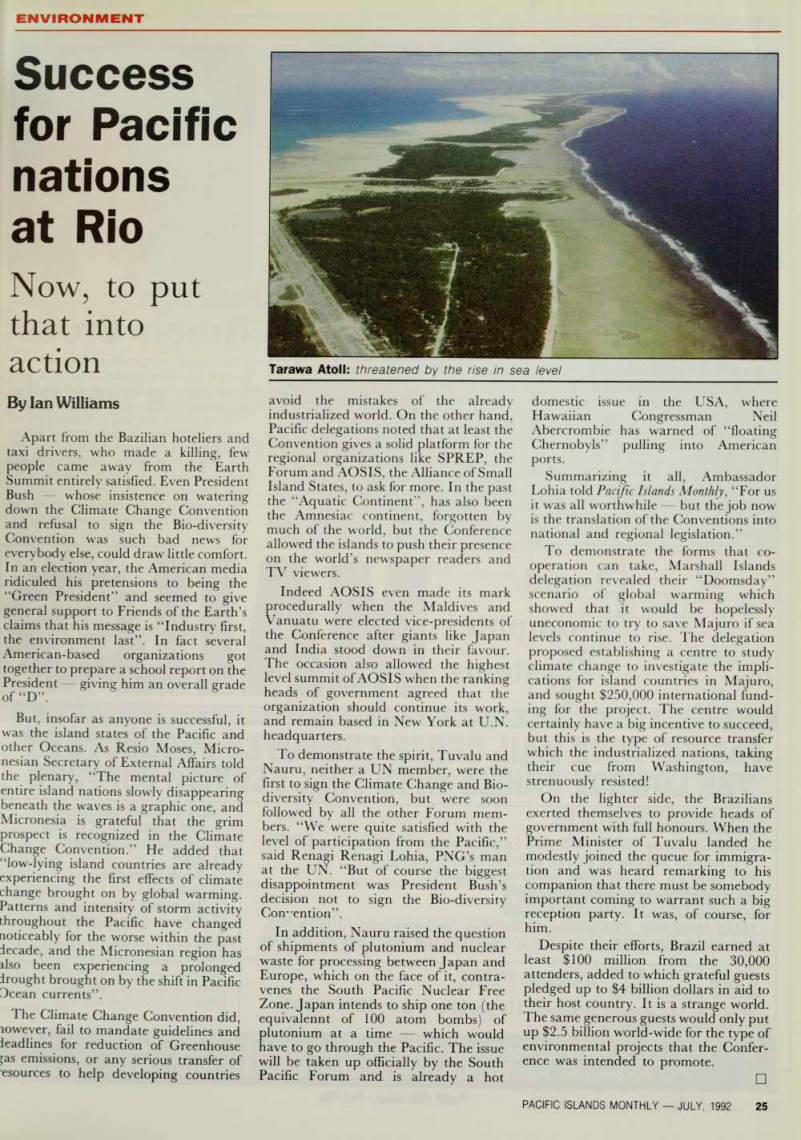
Environment
Success for Pacific nations at Rio Now, to put that into action
By Ian Williams
Apart from the Bazilian hoteliers and taxi drivers, who made a killing, few people came away from the Earth Summit entirely satisfied. Even President Bush whose insistence on watering down the Climate Change Convention and refusal to sign the Bio-diversity Convention was such bad news for everybody else, could draw little comfort.
In an election year, the American media ridiculed his pretensions to being the “Green President” and seemed to give general support to Friends of the Earth’s claims that his message is “Industry first, the environment last”. In fact several American-based organizations got together to prepare a school report on the President giving him an overall grade of “D”.
But, insofar as anyone is successful, it was the island states of the Pacific and other Oceans. As Resio Moses, Micro nesian Secretary of External Affairs told the plenary, “The mental picture of entire island nations slowly disappearing beneath the waves is a graphic one, and Micronesia is grateful that the grim prospect is recognized in the Climate Change Convention.” He added that “low-lying island countries are already experiencing the first effects of climate change brought on by global warming.
Patterns and intensity of storm activity
throughout the Pacific have changed noticeably for the worse within the past decade, and the Micronesian region has
also been experiencing a prolonged
drought brought on by the shift in Pacific Tcean currents”.
The Climate Change Convention did, lowever, fail to mandate guidelines and leadlines for reduction of Greenhouse > as emissions, or any serious transfer of esources to help developing countries
avoid the mistakes of the already industrialized world. On the other hand, Pacific delegations noted that at least the Convention gives a solid platform for the regional organizations like SPREP, the Forum and AOSIS, the Alliance of Small Island States, to ask for more. In the past the “Aquatic Continent", has also been the Amnesiac continent, forgotten by much of the world, but the Conference allowed the islands to push their presence on the world’s newspaper readers and TV viewers.
Indeed AOSIS even made its mark procedurally when the Maldives and Vanuatu were elected vice-presidents of the Conference after giants like Japan and India stood down in their favour.
The occasion also allowed the highest level summit of AOSIS when the ranking heads of government agreed that the organization should continue its work, and remain based in New York at U.N.
headquarters.
To demonstrate the spirit, Tuvalu and Nauru, neither a UN member, were the first to sign the Climate Change and Bio diversity Convention, but were soon followed by all the other Forum mem bers. “We were quite satisfied with the level of participation from the Pacific,” said Renagi Renagi Lohia, PNG’s man at the UN. “But of course the biggest disappointment was President Bush’s decision not to sign the Bio-diversity Convention”.
In addition, Nauru raised the question of shipments of plutonium and nuclear waste for processing between Japan and Europe, which on the face of it, contra venes the South Pacific Nuclear Free Zone. Japan intends to ship one ton (the equivalennt of 100 atom bombs) of plutonium at a time which would have to go through the Pacific. The issue will be taken up officially by the South Pacific Forum and is already a hot
domestic issue in the USA, where Hawaiian Congressman Neil Abercrombie has warned of “floating
Chernobyls” pulling into American
ports.
Summarizing it all, Ambassador Lohia told Pacific Islands Monthly , “For us it was all worthwhile but the job now is the translation of the Conventions into national and regional legislation.”
To demonstrate the forms that co operation can take, Marshall Islands delegation revealed their “Doomsday” scenario of global warming which showed that it would be hopelessly uneconomic to try to save Majuro if sea levels continue to rise. The delegation proposed establishing a centre to study climate change to investigate the impli cations for island countries in Majuro, and sought $250,000 international fund ing for the project. The centre would certainly have a big incentive to succeed, but this is the type of resource transfer which the industrialized nations, taking their cue from Washington, have strenuously resisted!
On the lighter side, the Brazilians exerted themselves to provide heads of government with full honours. When the Prime Minister of Tuvalu landed he modestly joined the queue for immigra tion and was heard remarking to his companion that there must be somebody important coming to warrant such a big reception party. It was, of course, for him.
Despite their efforts, Brazil earned at least $lOO million from the 30,000 attenders, added to which grateful guests pledged up to $4 billion dollars in aid to their host country. It is a strange world.
The same generous guests would only put up $2.5 billion world-wide for the type of environmental projects that the Confer ence was intended to promote. □
Tarawa Atoll: threatened by the rise in sea level
Doomsday delayed?

By Davendra Sharma
GOVERNMENT leaders in Tuvalu, Marshall Islands, Kiribati and Niue, among others, can rest their fears of the Greenhouse effect for a while thanks to a new United Nations study.
Several previous researches have indicated catastrophic changes in the earth’s climate by the middle of the 21st century.
But the new and independent study, carried out over two years, shows average temperatures will rise by only 1.5 centigrade during the next 70 years, a fraction of the increase feared by early scientists and experiments.
The UN study explains that sea levels would rise by significantly less than predicted thus giving low-lying islands a reprieve from the threat of floods. The report’s conclusions, based on a computer model of the world’s climate are the result of the fullest asessment possible of changes in veg etation, ocean circulation and cloud cover. They show temperatures will rise by an average of only 0.2 centigrade per
decade and suggest that previous pre dictions have substantially underesti mated the oceans’ capacity to absorb heat and slow down the damage caused by pollutants trapping warmth in the atmosphere.
Sir John Hougton, chairman of the United Nations-appointed scientifc group, said early environmentalists are guilty ofscare-mongering. “The dooms day scenario was never credible,” he said. “It is certain there will be some global warming. The question is how much that will be.”
Most islands in Tuvalu, Kiribati, Niue and some parts of the Cook Islands, Marshall Islands and even low lying islands in the Fiji group were feared would be submerged from rising sea levels as a result of the Greenhouse Effect.
The UN research found that sea levels would rise about 63 centimetres before the end of the next century, compared to five metres suggested in the gloomiest forecasts, □
Green Cross
Former Soviet president Mikhail Gor bachev has been elected head of a new international Green Cross, the environ mental equivalent of the Red Cross.
At a parallel meeting in Rio de Janeiro where the United Nations conference on Environment Development is being held, 270 parliamentarians and spiritual leaders voted for Gorbachev to head the
new organisation.
Gorbachev first proposed creating an international Green Cross two years ago. □
Mikhail Gorbachev: heads new body
Advertisements & other items, p. 28 (2 items)
Environment
Computer
(Cl O v Q “El“ R
acific
= ) => 3
l^ystems
sonm-CDmoitim-AccmmMm-HomHnmKs.mxmm-Bom-mmoHmmjmmmammi&soFjmmmmsMm PACIFIC WIDE MAIL ORDER COMPUTER PRODUCTS AT THE LOWEST PRICES WITH FULL SERVICE SUPPORT
5-USER NOVELL NETWORK
386DX File Server 130 MB HDD, 386 Sx Workstations, EPSON printer, LUMEN UPS, Netware 2.2 (Set up for use, including thinnet cabling) A$ 15,000,00 (on-site setup, quotation on request)
COMPUTER ACCOUNTING SYSTEM
386SX 40MB HDD, 2MB memory, EPSON New Generation printer LUMEN UPS, DOS / WINDOWS / MOUSE, ACCPAC ACCOUNTING FOR WINDOWS A$ 3850,00
IB SSSffi
HP Scanjet 11p Scanner, HP Laserjet lip plus Laser Printer, OMNIPAGE OCR Software A 55000,00 Please send more information on: □ IBM Compatible PCs (DOS) □ HP Printers & Scanners
□ UNIX
□ Novell Networking □ Multimedia □ Accounting Systems □ Software (please specify) Name: Company;...
Position: Phone:...
Address:.
Country:.
Fax: * Servicing the Pacific since 1980 * Full warranty and on going support PO Box 198, Port Vila, Vanuatu - Tel: (678) 25065 - Fax: (678) 22938 oc □Anar' ici AMnc uamtui v ii ii v -iqqo PacHk Publishing-Port Vila
Nauru’s experience
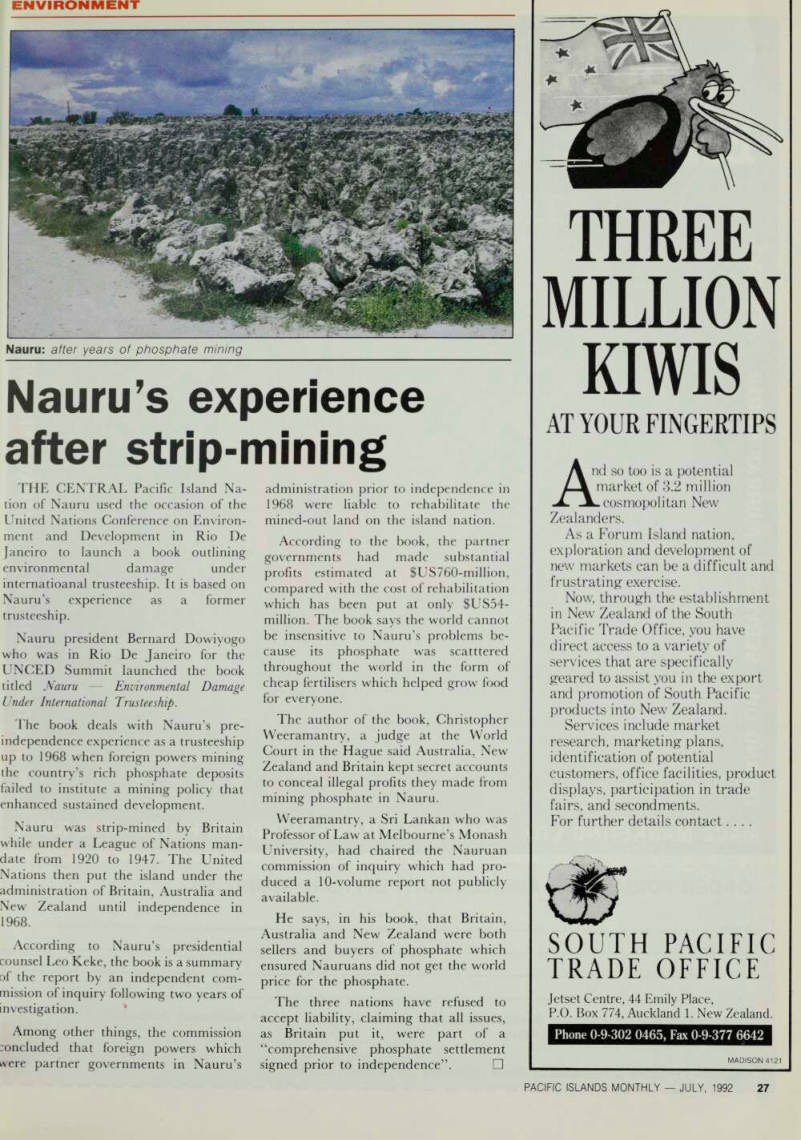
after strip-mining
THE CENTRAL Pacific Island Na tion of Nauru used the occasion of the United Nations Conference on Environ ment and Development in Rio De Janeiro to launch a book outlining environmental damage under internatioanal trusteeship. It is based on Nauru’s experience as a former
trusteeship.
Nauru president Bernard Dowiyogo who was in Rio De Janeiro for the UNCED Summit launched the book titled Nauru Environmental Damage Under International Trusteeship.
The book deals with Nauru’s pre independence experience as a trusteeship up to 1968 when foreign powers mining the country’s rich phosphate deposits failed to institute a mining policy that enhanced sustained development.
Nauru was strip-mined by Britain while under a League of Nations man date from 1920 to 1947. The United Nations then put the island under the administration of Britain, Australia and New Zealand until independence in 1968.
According to Nauru’s presidential counsel Leo Keke, the book is a summary of the report by an independent com mission of inquiry following two years of
investigation.
Among other things, the commission concluded that foreign powers which were partner governments in Nauru’s
administration prior to independence in 1968 were liable to rehabilitate the mined-out land on the island nation.
According to the book, the partner governments had made substantial profits estimated at SUS76O-million, compared with the cost of rehabilitation which has been put at only SUSS4million. The book says the world cannot be insensitive to Nauru’s problems be cause its phosphate was scatttered throughout the world in the form of cheap fertilisers which helped grow food for everyone.
The author of the book, Christopher Weeramantry, a judge at the World Court in the Hague said Australia, New Zealand and Britain kept secret accounts to conceal illegal profits they made from mining phosphate in Nauru.
Weeramantry, a Sri Lankan who was Professor of Law at Melbourne’s Monash University, had chaired the Nauruan commission of inquiry which had pro duced a 10-volume report not publicly available.
He says, in his book, that Britain, Australia and New Zealand were both sellers and buyers of phosphate which ensured Nauruans did not get the world
price for the phosphate.
The three nations have refused to accept liability, claiming that all issues, as Britain put it, were part of a “comprehensive phosphate settlement signed prior to independence”. □
Nauru: after years of phosphate mining
Advertisements & other items, pp. 29-30 (1 item)
Kiwis
THREE
MILLION
AT YOUR FINGERTIPS
cosmopolitan New Zealanders.
As a Forum Island nation, exploration and development of new markets can be a difficult and frustrating exercise.
Now, through the establishment in New Zealand of the South Pacific Trade Office, you have direct access to a variety of services that are specifically geared to assist you in the export and promotion of South Pacific products into New Zealand.
Services include market research, marketing plans, identification of potential customers, office facilities, product displays, participation in trade fairs, and secondments.
For further details contact...
SOUTH PACIFIC
TRADE OFFICE
Jetset Centre, 44 Emily Place, P.O. Box 774, Auckland 1. New Zealand. nd so too is a potential market of 3.2 million
MADISON 4121
BOTH ANNIVERSARY
BATTLE OF GUADALCANAL
7TH AVGUST 1992
o s !/) iii S: k o z <c </) &AJ o > QZ HI (f> 111 > 5 D z 0)
GUADALCANAL
1942 1992 03 c: ■ ;? -D n (a 3 m > z > -< o -< o 3 O a o > z m O T) 3 m MACE MARKETING LTD SOLOMON KITANO MENDANA HOTEL ANZ BANK
ORDER FORM: 50TH ANNIVERSARY, OFFICIAL MAGAZINE
Address Payment SBD $20.00: Enclosed: BankDraft/Money Order made payable to 50th Anniversary Committee I P.O. Box 381, Honiara, Solomon Islands.
I I Magazine Produced & Published by Mace Marketing Ltd., Sydney, N.S.W. 1 >3
PNG relaxes investment policy
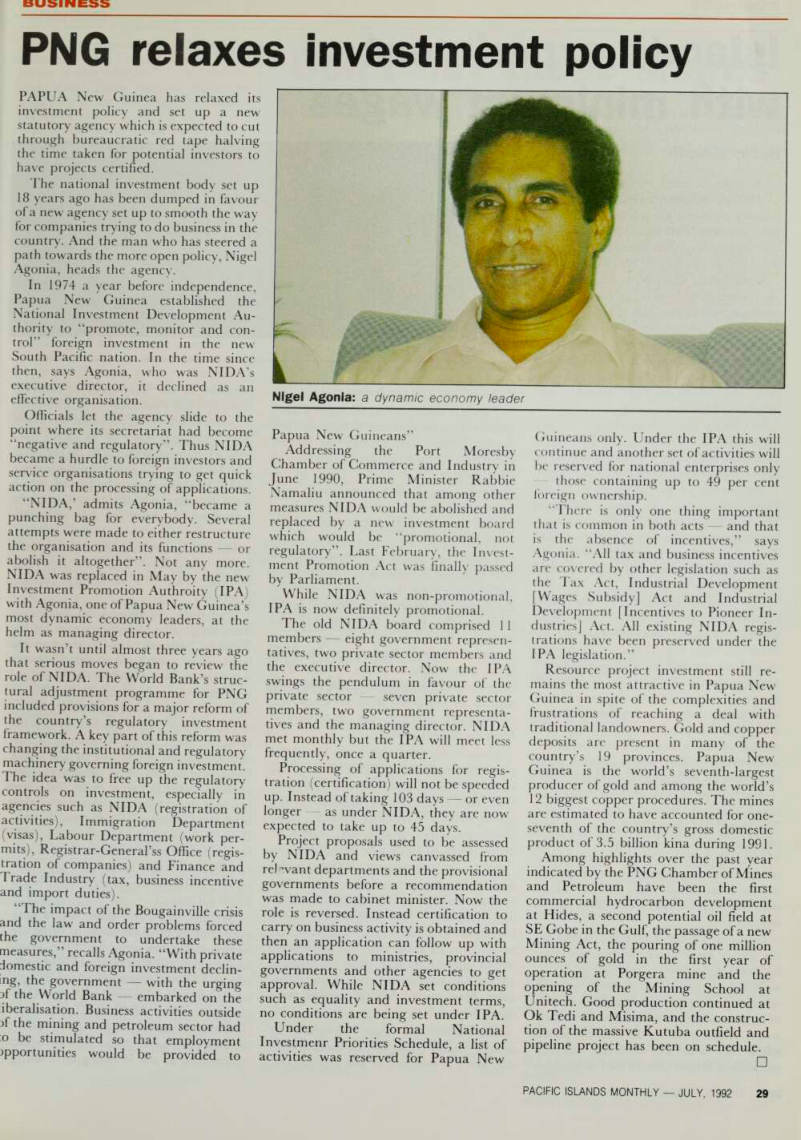
bUbINbbb
PAPUA New Guinea has relaxed its investment policy and set up a new statutory agency which is expected to cut through bureaucratic red tape halving the time taken for potential investors to have projects certified.
The national investment body set up 18 years ago has been dumped in favour of a new agency set up to smooth the way for companies trying to do business in the country. And the man who has steered a path towards the more open policy, Nigel Agonia, heads the agency.
In 1974 a year before independence, Papua New Guinea established the National Investment Development Au thority to “promote, monitor and con trol” foreign investment in the new South Pacific nation. In the time since then, says Agonia, who was NIDA’s executive director, it declined as an effective organisation.
Officials let the agency slide to the point where its secretariat had become “negative and regulatory”. Thus NIDA became a hurdle to foreign investors and service organisations trying to get quick action on the processing of applications.
“NIDA,’ admits Agonia, “became a punching bag for everybody. Several attempts were made to either restructure the organisation and its functions or abolish it altogether”. Not any more.
NIDA was replaced in May by the new Investment Promotion Authroity (IPA) with Agonia, one of Papua New Guinea’s most dynamic economy leaders, at the helm as managing director.
It wasn’t until almost three years ago that serious moves began to review the role of NIDA. The World Bank’s struc tural adjustment programme for PNG included provisions for a major reform of the country’s regulatory investment framework. A key part of this reform was changing the institutional and regulatory
machinery governing foreign investment.
The idea was to free up the regulatory controls on investment, especially in agencies such as NIDA (registration of
activities), Immigration Department
(visas), Labour Department (work per
mits), Registrar-General’ss Office (regis
tration of companies) and Finance and Trade Industry (tax, business incentive
and import duties).
The impact of the Bougainville crisis and the law and order problems forced the government to undertake these measures, recalls Agonia. “With private domestic and foreign investment declin mg, the government with the urging af the World Bank embarked on the iberalisation. Business activities outside af the mining and petroleum sector had o be stimulated so that employment )pportunities would be provided to
Papua New Guineans”
Addressing the Port Moresby Chamber of Commerce and Industry in June 1990, Prime Minister Rabbie Namaliu announced that among other measures NIDA would be abolished and replaced by a new investment board which would be “promotional, not regulatory”. Last February, the Invest ment Promotion Act was finally passed by Parliament.
While NIDA was non-promotional, IPA is now definitely promotional.
The old NIDA board comprised 11 members eight government represen tatives, two private sector members and the executive director. Now the IPA swings the pendulum in favour of the private sector seven private sector members, two government representa tives and the managing director. NIDA met monthly but the IPA will meet less frequently, once a quarter.
Processing of applications for regis tration (certification) will not be speeded up. Instead of taking 103 days or even longer as under NIDA, they are now expected to take up to 45 days.
Project proposals used to be assessed by NIDA and views canvassed from relevant departments and the provisional governments before a recommendation was made to cabinet minister. Now the role is reversed. Instead certification to carry on business activity is obtained and then an application can follow up with applications to ministries, provincial governments and other agencies to get approval. While NIDA set conditions such as equality and investment terms, no conditions are being set under IPA.
Under the formal National Investmenr Priorities Schedule, a list of activities was reserved for Papua New
Guineans only. Under the IPA this will continue and another set of activities will be reserved for national enterprises only those containing up to 49 per cent foreign ownership.
“There is only one thing important that is common in both acts and that is the absence of incentives,” says Agonia. “All tax and business incentives are covered by other legislation such as the Tax Act, Industrial Development [Wages Subsidy] Act and Industrial Development [lncentives to Pioneer In
dustries] Act. All existing NIDA regis
trations have been preserved under the
IPA legislation.”
Resource project investment still re mains the most attractive in Papua New Guinea in spite of the complexities and frustrations of reaching a deal with traditional landowners. Gold and copper deposits are present in many of the country’s 19 provinces. Papua New Guinea is the world’s seventh-largest producer of gold and among the world’s 12 biggest copper procedures. The mines are estimated to have accounted for one seventh of the country’s gross domestic product of 3.5 billion kina during 1991.
Among highlights over the past year indicated by the PNG Chamber of Mines and Petroleum have been the first
commercial hydrocarbon development
at Hides, a second potential oil field at SE Gobe in the Gulf, the passage of a new Mining Act, the pouring of one million ounces of gold in the first year of operation at Porgera mine and the opening of the Mining School at Unitech. Good production continued at Ok Tedi and Misima, and the construc tion of the massive Kutuba outfield and pipeline project has been on schedule. □
Nigel Agonia: a dynamic economy leader
Islands experiment
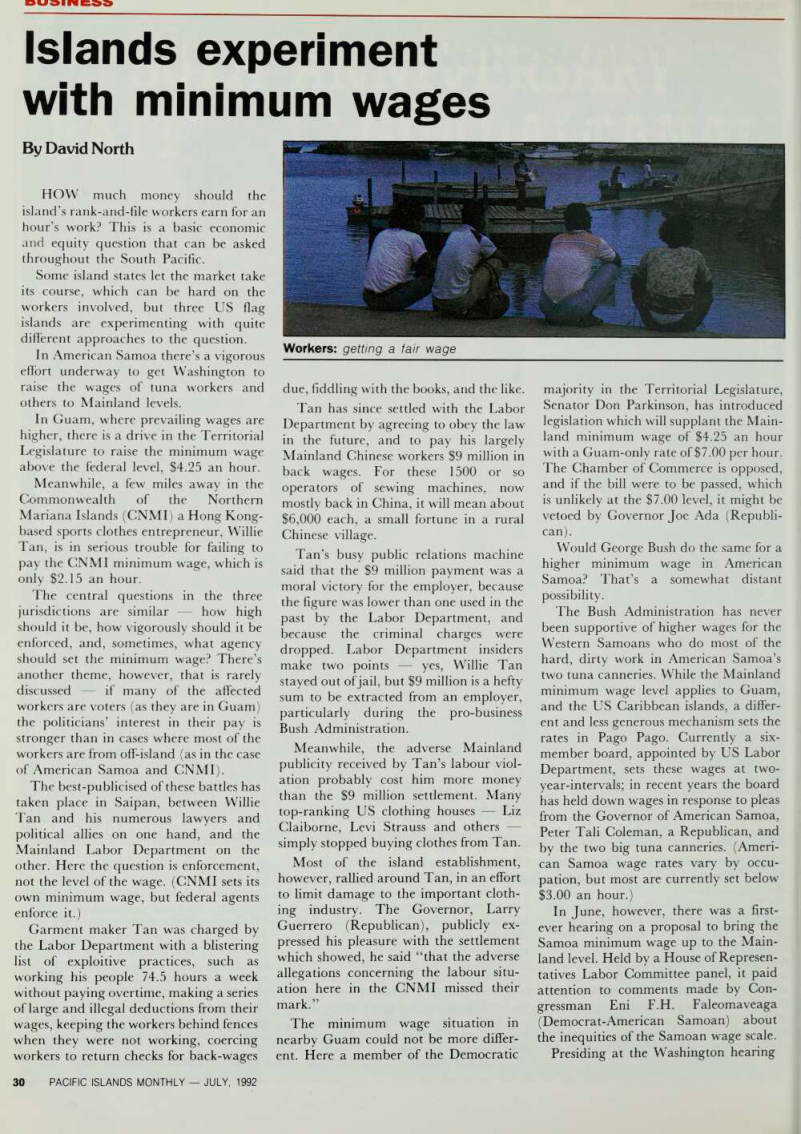
with minimum wages
By David North
HOW much money should the island’s rank-and-file workers earn for an hour’s work? This is a basic economic and equity question that can be asked throughout the South Pacific.
Some island states let the market take its course, which can be hard on the workers involved, but three US flag islands are experimenting with quite different approaches to the question.
In American Samoa there’s a vigorous effort underway to get Washington to raise the wages of tuna workers and others to Mainland levels.
In Guam, where prevailing wages are higher, there is a drive in the Territorial Legislature to raise the minimum wage above the federal level, $4.25 an hour.
Meanwhile, a few miles away in the Commonwealth of the Northern Mariana Islands (CNMI) a Hong Kong based sports clothes entrepreneur, Willie Tan, is in serious trouble for failing to pay the CNMI minimum wage, which is only $2.15 an hour.
The central questions in the three jurisdictions are similar how high should it be, how vigorously should it be enforced, and, sometimes, what agency should set the minimum wage? There’s another theme, however, that is rarely discussed if many of the affected workers are voters (as they are in Guam) the politicians’ interest in their pay is stronger than in cases where most of the workers are from off-island (as in the case of American Samoa and CNMI), The best-publicised of these battles has taken place in Saipan, between Willie Tan and his numerous lawyers and political allies on one hand, and the Mainland Labor Department on the other. Here the question is enforcement, not the level of the wage. (CNMI sets its own minimum wage, but federal agents enforce it.) Garment maker Tan was charged by the Labor Department with a blistering list of exploitive practices, such as working his people 74.5 hours a week without paying overtime, making a series of large and illegal deductions from their wages, keeping the workers behind fences when they were not working, coercing workers to return checks for back-wages
due, fiddling with the books, and the like.
Tan has since settled with the Labor Department by agreeing to obey the law in the future, and to pay his largely Mainland Chinese workers $9 million in back wages. For these 1500 or so operators of sewing machines, now mostly back in China, it will mean about $6,000 each, a small fortune in a rural Chinese village.
Tan’s busy public relations machine said that the $9 million payment was a moral victory for the employer, because the figure was lower than one used in the past by the Labor Department, and because the criminal charges were dropped. Labor Department insiders make two points yes, Willie Tan stayed out ofjail, but $9 million is a hefty sum to be extracted from an employer,
particularly during the pro-business
Bush Administration.
Meanwhile, the adverse Mainland publicity received by Tan’s labour viol ation probably cost him more money than the $9 million settlement. Many top-ranking US clothing houses Liz Claiborne, Levi Strauss and others simply stopped buying clothes from Tan.
Most of the island establishment, however, rallied around Tan, in an effort to limit damage to the important cloth ing industry. The Governor, Larry
Guerrero (Republican), publicly ex
pressed his pleasure with the settlement which showed, he said “that the adverse allegations concerning the labour situ ation here in the CNMI missed their mark.”
The minimum wage situation in nearby Guam could not be more differ ent. Here a member of the Democratic
majority in the Territorial Legislature, Senator Don Parkinson, has introduced legislation which will supplant the Main land minimum wage of $4.25 an hour with a Guam-only rate of $7.00 per hour.
The Chamber of Commerce is opposed, and if the bill were to be passed, which is unlikely at the $7.00 level, it might be vetoed by Governor Joe Ada (Republi can).
Would George Bush do the same for a higher minimum wage in American Samoa? That’s a somewhat distant
possibility.
The Bush Administration has never been supportive of higher wages for the Western Samoans who do most of the hard, dirty work in American Samoa’s two tuna canneries. While the Mainland minimum wage level applies to Guam, and the US Caribbean islands, a differ ent and less generous mechanism sets the rates in Pago Pago. Currently a six member board, appointed by US Labor Department, sets these wages at two year-intervals; in recent years the board has held down wages in response to pleas from the Governor of American Samoa, Peter Tali Coleman, a Republican, and by the two big tuna canneries. (Ameri can Samoa wage rates vary by occu pation, but most are currently set below $3.00 an hour.) In June, however, there was a first ever hearing on a proposal to bring the Samoa minimum wage up to the Main land level. Held by a House of Represen tatives Labor Committee panel, it paid attention to comments made by Con gressman Eni F.H. Faleomaveaga (Democrat-American Samoan) about the inequities of the Samoan wage scale.
Presiding at the Washington hearing
Workers: getting a fair wage
was Congressman Austin Murphy, a Democrat from Pennsylvania. The bill before it was Murphy’s own creation, and would bring Samoan minimum wages up to the Mainland level over a period of years.
Representatives of the Bush Admin istration, and of the tuna, industry argued against its passage. The tuna lobbyists were hampered, however, by news accounts in Pacific Islands Monthly (March, 1992), and in the Samoa News that the boss of H.J. Heinz, owner of one of the tuna plants, earned $75,000,000 in 1990, more than four times as much money as the 2500 workers in the Pago Pago plant.
The president of Van Camp Sea foods, which owns the other tuna factory on Pago Pago Harbour, made it very clear to the Congressmen that he was not paid $75,000,000 a year.
Faleomaveaga is concerned about the level of wages paid to the tuna workers, but has not devised a position on Murphy’s bill; his position on this matter will be important to the Labor Committee.
The House Labor Committee is considering another hearing on the same subject in Pago pago. (Con gressional hearings are sometimes held outside of Washington, but no one can remember one in American Samoa.) With the election coming up in Novem ber, time is running short; often bills introduced in one Congress do not pass on their first try, and are passed in a
later Congress.
Meanwhile, a major threat to Sai pan’s clothing industry may be on the horizon an effort in Congress to eliminate the “Made in USA” label from garments made there.
A powerful collection of 30 Congress men have asked the House of Represen tatives’ Interior and Insular Affairs Committee to hold a hearing on whether or not clothes made in the Commonwealth of Northern Mariana Islands should continue to be allowed to show the label. Without the label, it would be more difficult to sell the clothes on the Mainland.
The argument of the Congressmen, most of whom have clothing factories in their districts, is that since Washington does not control immigration to the islands, does not set the minimum wage there, and does not (they argue) effectively assure the payment of a decent wage scale why should Saipan be able to claim clothes are ‘Made in the USA?” Given the wages Daid in CNMI, its clothes compete well
vith Mainland-produced clothes.
CNMI, unlike American Samoa and juam, does not have a delegate sitting n the Congress because the local eadership has not wanted such a lelegate. It may rue that decision after
he July 9 hearing. □
Don’t buy these shares
By David North
CONFIDENCE men used to try to sell gullible investors New York City’s Brooklyn Bridge. Now they are being asked to finance an electrical generator in Palau.
That’s the thrust — if not the exact wording — of the U.S. Securities and Exchange Commission’s warning about a firm called Pacific Waste Management Inc. of Reno, Nevada (the old gambling town.) The SEC regulates America’s stock markets; when stock offerings are really suspect it takes the unusual step of suspending trading of the stock in question. It did so earlier this year for Pacific Waste’s proposal to build an electrical generator in Palau, to be fueled by toxic wastes, such as sewage sludge, used chemicals, and coal tailings. Pacific Waste said that the plant would burn the material while generating inexpensive power and would not hurt the environ ment.
Both the Mainland and the island environmental protection agencies said it was a bad idea; SEC passed along that informatiion, and noted that the plant did not yet exist, and that the consti tution of Palau had a provision banning nuclear materials and other toxic matter.
SEC also said that “questions had been raised about the company’s financial ability to build and operate such a plant.”
A mildy vigilant investor might have noticed some other warning signals, for instance: • The firm in question was incorpor ated a couple of years ago as Pacific Water Sports, Inc., then became the Detroit Engine Corporation, and then Pacific Waste Management, Inc. (Solid companies rarely change their names, certainly not repeatedly.) • The firm’s principal ally in Palau was John O. Ngiraked, a special assistant to the President of Palau (Ngiratkel Etpison) who had endorsed the proposal; Ngiraked, a former Minister of State, was recently indicted for plotting to kill Palau’s first president, and is now under house arrest in Palau. • Overseas investors were badly burned a few years earlier when a collection of fast-talking folk from the First and Third Worlds put together the IPESCO power plant in Palau. Costing more than $30,000,000 originally, the generator makes all the electricity the islands need, and more, but thanks to a combination of chicanery, corruption and the bankruptcy of the plant’s builder, nobody has paid anybody any thing for the construction of the plant.
doubtful again
Oil deal looks doubtful again
THE three oil companies operating in Fiji - Shell, Mobil and British Pet roleum say they won’t finalise an agreement with the government-owned
Fiji National Petroleum Company
(FINAPECO) until the Rabuka gov ernment clarifies its posiiton on the new arrangement.
Shell general manager Josaia Mar, said it would be prudent to find out the position of the new government.
In the lead-up to the general elecitons, prime minister Sitiveni Ra buka, had said he wanted a re examination of the supply arrangement with FINAPECO.
The company is to buy 10,000 barrels of crude from Malaysia a day for refining in Singapore and distri bution in Fiji and the South Pacific.
Mar says the agreement may not be “sufficiently good” for the consumers, but the three companies have main tained they should be able to pass on the extra costs. □
Sunday
work banned
TONGA’S Sunday Observance laws, which ban work of any kind on Sundays, are to be enforced for a Chinese construction company working at Tonga’s international airport.
Chinese workers have been working on Sundays for some time but reports from Tonga say no one is prepared to say who gave them permission to do so.
Pro-democracy member of parlia ment, Akilisi Pohiva, brought the matter to public attention when he queried it in the legislative assembly there.
It is understood the palace office in Nuku’alofa has now issued instructions to the Chinese workers to stop working on
Sundays. □
Advertisements & other items, pp. 34-35 (1 item)
The new Toyota brand mark. Three ellipses forming
a “T” which stand for our customer, our commitment to the satisfaction of that customer through our product and for our spirit of creativity. * It’s not often that you hear descriptions like rugged or durable combined with refined and elegant. But then there’s never been a vehicle quite like the new Toyota Land Cruiser Station Wagon. The unrivalled legend of off-road reliability is now unsurpassed in comfort and sophistication as well. Attention to detail is found everywhere, from the fine trim to the instrument panel to the graceful lines of its exterior. Even in places you can’t see, like the heavy-duty ladder frame and suspension design that add to the superb
luxury-car ride.
But Toyota’s innovation goes beyond providing luxury and durability. The new Land Cruiser Station Wagon, and all of our cars, are designed to create a harmony between car and driver, and to provide you with the ultimate
driving experience.
The new Toyota Land Cruiser Station Wagon. Think of it as much more than a spacious luxury sedan with fourwheel drive.
HR n i - *m m m
DISTRIBUTORS/DEALERS
AMERICAN SAMOA BURNS PHILP (S.S.) CO. LTD. PH 633-4281 GUAM & MICRONESIA ATKINS KROLL, INC. PH 646-1876/9 NORFOLK ISLANDS BORRY’S PTY LTD. PH 2114
SOLOMON ISLANDS MENDANA MOTORS PH 22884
VANUATU VANUATU MOTORS PH 2341
COOK ISLANDS PACIFIC MOTORS LTD. PH 20796
KIRIBATI TARAWA MOTORS PH 21090
PAPUA NEW GUINEA ELA MOTORS PH 217036
TAHITI NIPPON AUTOMOTO PH 429819
WESTERN SAMOA BURNS PHILP (S.S.) CO. LTD. PH 20800
FIJI A 5,
NEW CALEDONIA S.i
SAIPAN W
TONGA Bli
Cruiser
* I * a mm
mile
y is 0 V I m I m m m af PH 312666 PH 282848 PH 234-5911 ). PH 23673
® TOYOTA
Kicks, scrums, rucks, mauls...yuck
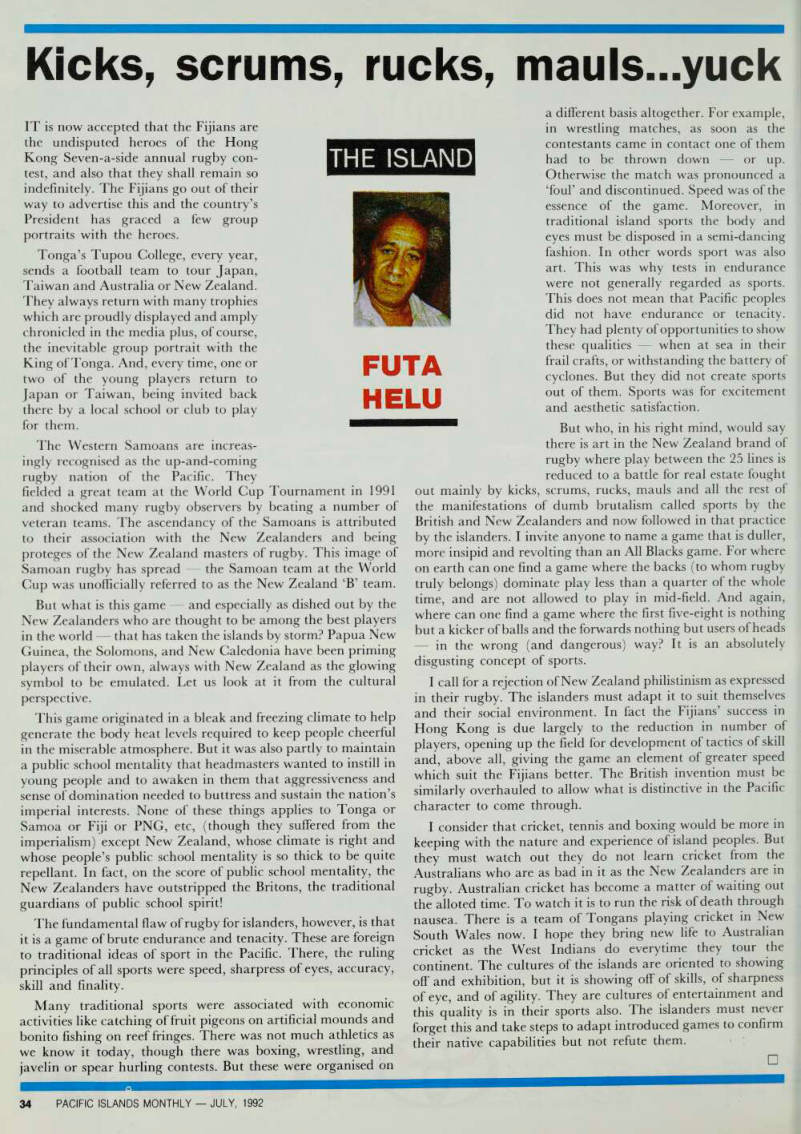
IT is now accepted that the Fijians are the undisputed heroes of the Hong Kong Seven-a-side annual rugby con test, and also that they shall remain so indefinitely. The Fijians go out of their way to advertise this and the country’s President has graced a few group portraits with the heroes.
Tonga’s Tupou College, every year, sends a football team to tour Japan, Taiwan and Australia or New Zealand.
They always return with many trophies which are proudly displayed and amply chronicled in the media plus, of course, the inevitable group portrait with the King of Tonga. And, every time, one or two of the young players return to Japan or Taiwan, being invited back there by a local school or club to play for them.
The Western Samoans are increas ingly recognised as the up-and-coming rugby nation of the Pacific. They
fielded a great team at the World Cup Tournament in 1991 and shocked many rugby observers by beating a number of veteran teams. The ascendancy of the Samoans is attributed to their association with the New Zealanders and being proteges of the New Zealand masters of rugby. This image of Samoan rugby has spread the Samoan team at the World Cup was unofficially referred to as the New Zealand ‘B’ team.
But what is this game and especially as dished out by the New Zealanders who are thought to be among the best players in the world that has taken the islands by storm? Papua New Guinea, the Solomons, and New Caledonia have been priming players of their own, always with New Zealand as the glowing symbol to be emulated. Let us look at it from the cultural
perspective.
This game originated in a bleak and freezing climate to help generate the body heat levels required to keep people cheerful in the miserable atmosphere. But it was also partly to maintain a public school mentality that headmasters wanted to instill in young people and to awaken in them that aggressiveness and sense of domination needed to buttress and sustain the nation’s imperial interests. None of these things applies to Tonga or Samoa or Fiji or PNG, etc, (though they suffered from the imperialism) except New Zealand, whose climate is right and whose people’s public school mentality is so thick to be quite repellant. In fact, on the score of public school mentality, the New Zealanders have outstripped the Britons, the traditional
guardians of public school spirit!
The fundamental flaw of rugby for islanders, however, is that it is a game of brute endurance and tenacity. These are foreign to traditional ideas of sport in the Pacific. There, the ruling principles of all sports were speed, sharpress of eyes, accuracy, skill and finality.
Many traditional sports were associated with economic activities like catching of fruit pigeons on artificial mounds and bonito fishing on reef fringes. There was not much athletics as we know it today, though there was boxing, wrestling, and javelin or spear hurling contests. But these were organised on
The Island
a different basis altogether. For example, in wrestling matches, as soon as the contestants came in contact one of them had to be thrown down or up.
Otherwise the match was pronounced a ‘foul’ and discontinued. Speed was of the essence of the game. Moreover, in traditional island sports the body and eyes must be disposed in a semi-dancing fashion. In other words sport was also art. This was why tests in endurance were not generally regarded as sports.
This does not mean that Pacific peoples did not have endurance or tenacity.
They had plenty of opportunities to show these qualities when at sea in their frail crafts, or withstanding the battery of cyclones. But they did not create sports out of them. Sports was for excitement and aesthetic satisfaction.
But who, in his right mind, would say there is art in the New Zealand brand of rugby where play between the 25 lines is reduced to a battle for real estate fought
out mainly by kicks, scrums, rucks, mauls and all the rest of the manifestations of dumb brutalism called sports by the British and New Zealanders and now followed in that practice by the islanders. I invite anyone to name a game that is duller, more insipid and revolting than an All Blacks game. For where on earth can one find a game where the backs (to whom rugby truly belongs) dominate play less than a quarter of the whole time, and are not allowed to play in mid-field. And again, where can one find a game where the first five-eight is nothing but a kicker of balls and the forwards nothing but users of heads - in the wrong (and dangerous) way? It is an absolutely disgusting concept of sports.
I call for a rejection of New Zealand philistinism as expressed in their rugby. The islanders must adapt it to suit themselves and their social environment. In fact the Fijians’ success in Hong Kong is due largely to the reduction in number of players, opening up the field for development of tactics of skill and, above all, giving the game an element of greater speed which suit the Fijians better. The British invention must be similarly overhauled to allow what is distinctive in the Pacific character to come through.
I consider that cricket, tennis and boxing would be more in keeping with the nature and experience of island peoples. But they must watch out they do not learn cricket from the Australians who are as bad in it as the New Zealanders are in rugby. Australian cricket has become a matter of waiting out the alloted time. To watch it is to run the risk of death through nausea. There is a team of Tongans playing cricket in New South Wales now. I hope they bring new life to Australian cricket as the West Indians do everytime they tour the continent. The cultures of the islands are oriented to showing off and exhibition, but it is showing off of skills, of sharpness of eye, and of agility. They are cultures of entertainment and this quality is in their sports also. The islanders must never forget this and take steps to adapt introduced games to confirm their native capabilities but not refute them.
Futa
Helu
The tools of the trade
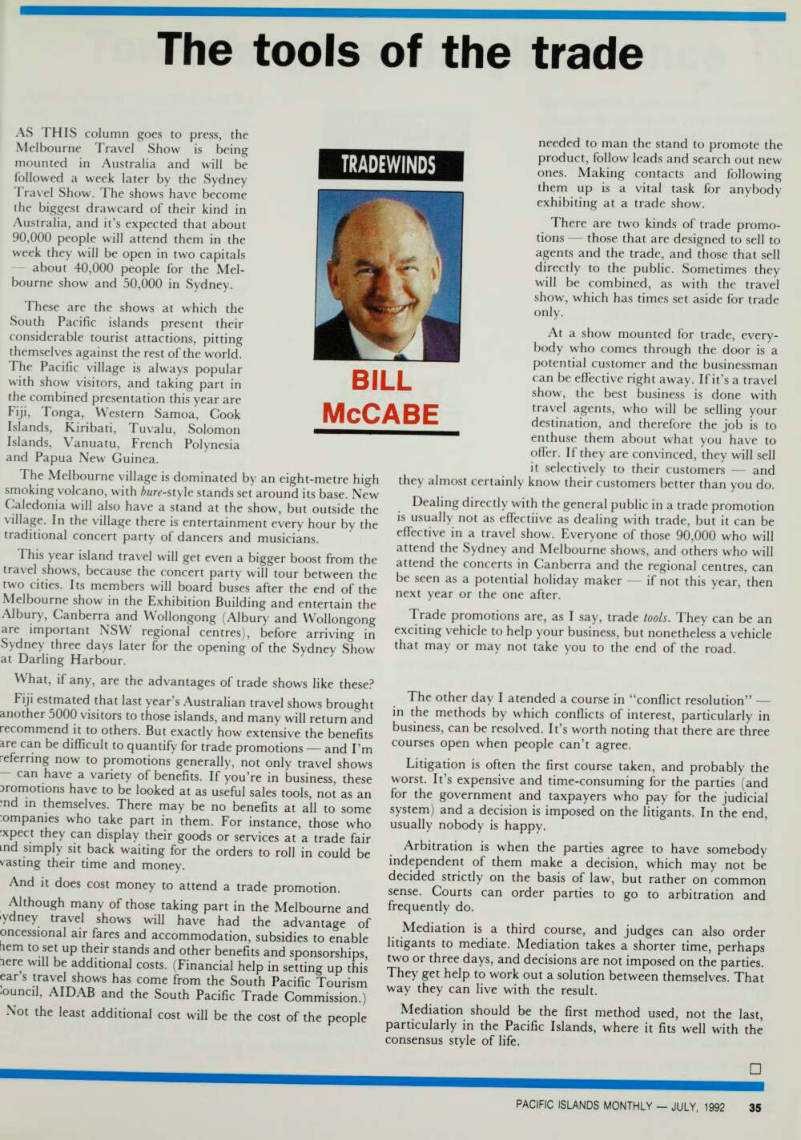
AS THIS column goes to press, the Melbourne Travel Show is being mounted in Australia and will be followed a week later by the Sydney Travel Show. The shows have become the biggest drawcard of their kind in Australia, and it’s expected that about 90,000 people will attend them in the week they will be open in two capitals about 40,000 people for the Mel bourne show and 50,000 in Sydney.
These are the shows at which the South Pacific islands present their considerable tourist attactions, pitting themselves against the rest of the world.
The Pacific village is always popular with show visitors, and taking part in the combined presentation this year are Fiji, Tonga, Western Samoa, Cook Islands, Kiribati, Tuvalu, Solomon Islands, Vanuatu, French Polynesia and Papua New Guinea.
The Melbourne village is dominated by an eight-metre high smoking volcano, with bure- style stands set around its base. New Caledonia will also have a stand at the show, but outside the village. In the village there is entertainment every hour by the traditional concert party of dancers and musicians.
This year island travel will get even a bigger boost from the travel shows, because the concert party will tour between the two cities. Its members will board buses after the end of the Melbourne show in the Exhibition Building and entertain the Albury, Canberra and Wollongong (Albury and Wollongong are important NSW regional centres), before arriving in Sydney three days later for the opening of the Sydney Show at Darling Harbour.
What, if any, are the advantages of trade shows like these?
Fiji estmated that last year’s Australian travel shows brought another 5000 visitors to those islands, and many will return and recommend it to others. But exactly how extensive the benefits are can be difficult to quantify for trade promotions and I’m referring now to promotions generally, not only travel shows - can have a variety of benefits. If you’re in business, these aromotions have to be looked at as useful sales tools, not as an nd m themselves. There may be no benefits at all to some ompanies who take part in them. For instance, those who xpect they can display their goods or services at a trade fair md simply sit back waiting for the orders to roll in could be vasting their time and money.
And it does cost money to attend a trade promotion.
Although many of those taking part in the Melbourne and ydney travel shows will have had the advantage of concessional air fares and accommodation, subsidies to enable riem to set up their stands and other benefits and sponsorships, icre will be additional costs. (Financial help in setting up this ear s travel shows has come from the South Pacific Tourism -ouncil, AIDAB and the South Pacific Trade Commission.) Not the least additional cost will be the cost of the people
Tradewinds
needed to man the stand to promote the product, follow leads and search out new ones. Making contacts and following them up is a vital task for anybody exhibiting at a trade show.
There are two kinds of trade promo tions those that are designed to sell to agents and the trade, and those that sell directly to the public. Sometimes they will be combined, as with the travel show, which has times set aside for trade only.
At a show mounted for trade, every body who comes through the door is a potential customer and the businessman can be effective right away. If it’s a travel show, the best business is done with travel agents, who will be selling your destination, and therefore the job is to enthuse them about what you have to offer. If they are convinced, they will sell it selectively to their customers and
they almost certainly know their customers better than you do.
Dealing directly with the general public in a trade promotion is usually not as effectiive as dealing with trade, but it can be effective in a travel show. Everyone of those 90,000 who will attend the Sydney and Melbourne shows, and others who will attend the concerts in Canberra and the regional centres, can be seen as a potential holiday maker — if not this year, then next year or the one after.
Trade promotions are, as I say, trade tools. They can be an exciting vehicle to help your business, but nonetheless a vehicle that may or may not take you to the end of the road.
The other day I atended a course in “conflict resolution” — in the methods by which conflicts of interest, particularly in business, can be resolved. It’s worth noting that there are three courses open when people can’t agree.
Litigation is often the first course taken, and probably the worst. It’s expensive and time-consuming for the parties (and for the government and taxpayers who pay for the judicial system) and a decision is imposed on the litigants. In the end,
usually nobody is happy.
Arbitration is when the parties agree to have somebody independent of them make a decision, which may not be decided strictly on the basis of law, but rather on common sense. Courts can order parties to go to arbitration and
frequently do.
Mediation is a third course, and judges can also order litigants to mediate. Mediation takes a shorter time, perhaps two or three days, and decisions are not imposed on the parties.
They get help to work out a solution between themselves. That way they can live with the result.
Mediation should be the first method used, not the last, particularly in the Pacific Islands, where it fits well with the consensus style of life. □
Bill
Mccabe
And justice for all?
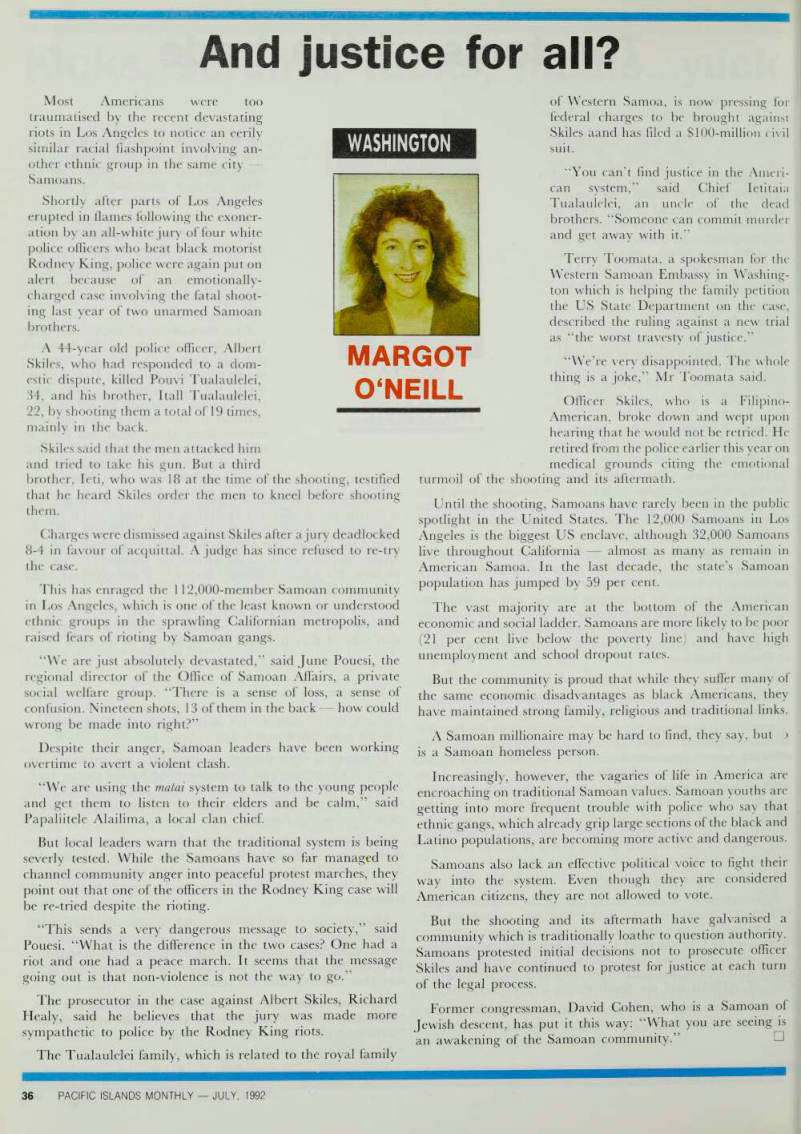
Most Americans were too traumatised by the recent devastating riots in Los Angeles to notice an eerily similar racial flashpoint involving an other ethnic group in the same city Samoans.
Shortly after parts of Los Angeles erupted in flames following the exoner ation by an all-white jury of four white police officers who beat black motorist Rodney King, police were again put on alert because of an emotionally charged case involving the fatal shoot ing last year of two unarmed Samoan brothers.
A 44-year old police officer, Albert Skiles, who had responded to a dom estic dispute, killed Pouvi Tualaulelei, 34, and his brother, I tall Tualaulelei, 22, by shooting them a total of 19 times, mainly in the back.
Skiles said that the men attacked him and tried to take his gun. But a third
brother, led, who was 18 at the time of the shooting, testified that he heard Skiles order the men to kneel before shooting them.
Charges were dismissed against Skiles after a jury deadlocked 8-4 in favour of acquittal. A judge has since refused to re-try the case.
This has enraged the 112,000-member Samoan community in Los Angeles, which is one of the least known or understood ethnic groups in the sprawling Californian metropolis, and raised fears of rioting by Samoan gangs.
“We are just absolutely devastated,” said June Pouesi, the regional director of the Office of Samoan Affairs, a private social welfare group. “There is a sense of loss, a sense of confusion. Nineteen shots, 13 of them in the back how could wrong be made into right?”
Despite their anger, Samoan leaders have been working overtime to avert a violent clash.
“We are using the matai system to talk to the young people and get them to listen to their elders and be calm,” said Papaliitele Alailima, a local clan chief.
But local leaders warn that the traditional system is being severly tested. While the Samoans have so far managed to channel community anger into peaceful protest marches, they point out that one of the officers in the Rodney King case will be re-tried despite the rioting.
“This sends a very dangerous message to society,” said Pouesi. “What is the difference in the two cases? One had a riot and one had a peace march. It seems that the message going out is that non-violence is not the way to go.”
The prosecutor in the case against Albert Skiles, Richard Healy, said he believes that the jury was made more sympathetic to police by the Rodney King riots.
The Tualaulelei family, which is related to the royal family
Washington
of Western Samoa, is now pressing for federal charges to be brought against Skiles aand has filed a $ 100-million civil suit.
“You can’t find justice in the Ameri can system,” said Chief letitaia Tualaulelei, an uncle of the dead brothers. “Someone can commit murder and get away with it.”
Terry Toomata, a spokesman for the Western Samoan Embassy in Washing ton which is helping the family petition the US State Department on the case, described the ruling against a new trial as “the worst travesty of justice.”
“We’re very disappointed. The whole thing is a joke,” Mr Toomata said.
Officer Skiles, who is a Filipino- American, broke down and wept upon hearing that he would not be retried. He retired from the police earlier this year on medical grounds citing the emotional
turmoil of the shooting and its aftermath.
Until the shooting, Samoans have rarely been in the public spotlight in the United States. The 12,000 Samoans in Los Angeles is the biggest US enclave, although 32,000 Samoans live throughout California almost as many as remain in American Samoa. In the last decade, the state’s Samoan population has jumped by 59 per cent.
The vast majority are at the bottom of the American economic and social ladder. Samoans are more likely to be poor (21 per cent live below the poverty line) and have high unemployment and school dropout rates.
But the community is proud that while they suffer many of the same economic disadvantages as black Americans, they have maintained strong family, religious and traditional links.
A Samoan millionaire may be hard to find, they say, but ) is a Samoan homeless person.
Increasingly, however, the vagaries of life in America are encroaching on traditional Samoan values. Samoan youths are getting into more frequent trouble with police who say that ethnic gangs, which already grip large sections of the black and Latino populations, are becoming more active and dangerous.
Samoans also lack an effective political voice to fight their way into the system. Even though they are considered American citizens, they are not allowed to vote.
But the shooting and its aftermath have galvanised a community which is traditionally loathe to question authority.
Samoans protested initial decisions not to prosecute officer Skiles and have continued to protest for justice at each turn of the legal process.
Former congressman, David Cohen, who is a Samoan of Jewish descent, has put it this way: “What you are seeing is an awakening of the Samoan community.”
Margot
O‘Neill
Towards greater self-reliance
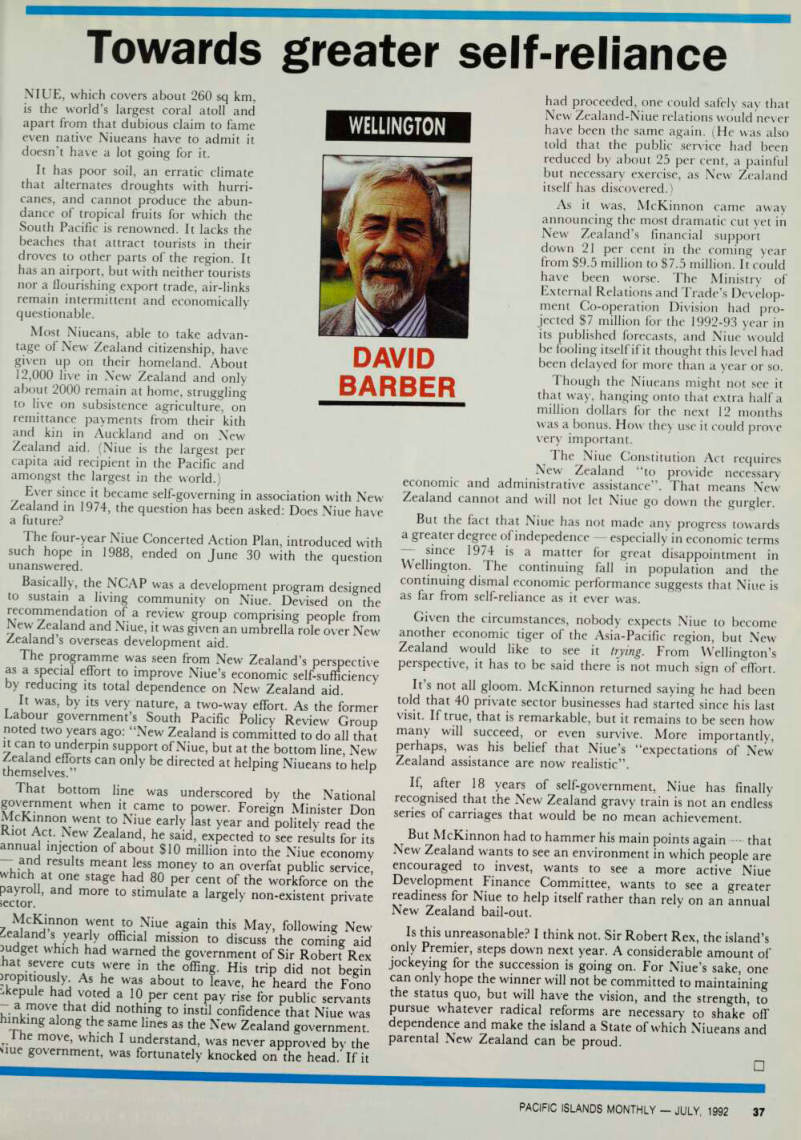
NIUE, which covers about 260 sq km, is the world’s largest coral atoll and apart from that dubious claim to fame even native Niueans have to admit it doesn’t have a lot going for it.
It has poor soil, an erratic climate that alternates droughts with hurri canes, and cannot produce the abun dance of tropical fruits for which the South Pacific is renowned. It lacks the beaches that attract tourists in their droves to other parts of the region. It has an airport, but with neither tourists nor a flourishing export trade, air-links remain intermittent and economically questionable.
Most Niueans, able to take advan tage of New Zealand citizenship, have given up on their homeland. About 12,000 live in New Zealand and only about 2000 remain at home, struggling to live on subsistence agriculture, on remittance payments from their kith and kin in Auckland and on New Zealand aid. (Niue is the largest per capita aid recipient in the Pacific and amongst the largest in the world.)
Ever since it became self-governing in association with New Zealand in 1974, the question has been asked: Does Niue have a future?
The four-year Niue Concerted Action Plan, introduced with such hope in 1988, ended on June 30 with the question unanswered.
Basically, the NCAP was a development program designed to sustain a living community on Niue. Devised on the recommendation of a review' group comprising people from New Zealand and Niue, it was given an umbrella role over New Zealand s overseas development aid.
The programme was seen from New Zealand’s perspective as a special effort to improve Niue’s economic self-sufficiency by reducing its total dependence on New Zealand aid.
It was, by its very nature, a two-way effort. As the former Labour government’s South Pacific Policy Review Group noted two years ago: “New Zealand is committed to do all that it can to underpin support of Niue, but at the bottom line, New thTmseKes^’^ 5 ** dirCCted at hel P in S Niueans to help That bottom line was underscored by the National government when it came to power. Foreign Minister Don R^A 1 ! 01^rWen 4 to i Nl , ue L earl V last Y ear and politely read the Riot Act. New Zealand, he said, expected to see results for its annual injection of about $lO million into the Niue economy and results meant less money to an overfat public service, which at one stage had 80 per cent of the workforce on the lector and t 0 Stimulate a lar & el y n on-existent private Y ent J°. ? iue . again this Ma y> following New yearly officml mission to discuss the coming aid budget which had warned the government of Sir Robert Rex tnJZ eT f T u WCre in the OfFm S- His tri P did not begin ly ; As h . e was about to leave, he heard the Fono Jcepule had voted a 10 per cent pay rise for public servants a move that did nothing to instil confidence that Niue w'as hmkmg along the same lines as the New Zealand government. 1 he move, which I understand, was never approved by the wue government, was fortunately knocked on the head. If it
Wellington
had proceeded, one could safely say that New Zealand-Niue relations would never have been the same again. (He was also told that the public service had been reduced by about 25 per cent, a painful but necessary exercise, as New Zealand itself has discovered.) As it was, McKinnon came away announcing the most dramatic cut yet in New Zealand’s financial support down 21 per cent in the coming year from $9.5 million to $7.5 million. It could have been worse. The Ministry of External Relations and Trade’s Develop ment Co-operation Division had pro jected $7 million for the 1992-93 year in its published forecasts, and Niue would be fooling itself if it thought this level had been delayed for more than a year or so.
Though the Niueans might not sec it that way, hanging onto that extra half a million dollars for the next 12 months was a bonus. How they use it could prove
very important.
The Niue Constitution Act requires New Zealand “to provide necessary economic and administrative assistance”. That means New Zealand cannot and will not let Niue go down the gurgler.
But the fact that Niue has not made any progress towards a greater degree of indepedence — especially in economic terms since 1974 is a matter for great disappointment in Wellington. The continuing fall in population and the continuing dismal economic performance suggests that Niue is as far from self-reliance as it ever was.
Given the circumstances, nobody expects Niue to become another economic tiger of the Asia-Pacific region, but New Zealand would like to see it trying. From Wellington’s perspective, it has to be said there is not much sign of effort.
It s not all gloom. McKinnon returned saying he had been told that 40 private sector businesses had started since his last visit. If true, that is remarkable, but it remains to be seen how many will succeed, or even survive. More importantly, perhaps, was his belief that Niue’s “expectations of New Zealand assistance are now realistic”.
If, after 18 years of self-government, Niue has finally recognised that the New Zealand gravy train is not an endless series of carriages that would be no mean achievement.
But McKinnon had to hammer his main points again - that New Zealand wants to see an environment in which people are encouraged to invest, wants to see a more active Niue Development Finance Committee, wants to see a greater readiness for Niue to help itself rather than rely on an annual New Zealand bail-out.
Is this unreasonable? I think not. Sir Robert Rex, the island’s only Premier, steps down next year. A considerable amount of jockeying for the succession is going on. For Niue’s sake, one can only hope the winner will not be committed to maintaining the status quo, but will have the vision, and the strength, to pursue whatever radical reforms are necessary to shake’off dependence and make the island a State of which Niueans and parental New Zealand can be proud.
David
Barber
Advertisements & other items, pp. 40-42 (1 item)
You Back
y / s V I v
Solomon Airlines
Solomon Islands National Airlii Honiara • Guadalcanal • Solomon Islam Tel; (677) 20031 • Fax: (677) 239*
KIMHILL KRAMER
Professional Project Managers Consulting Engineers Architects Surveyors edibility...continuity... commitment., .quality., .excellence are all terms synonymous with Papua New Guinea's leading engineering consultant.
■Mil lIHII
85585 S mmmmm - :
PAPUA NEW GUINEA
Head Office Port Moresby
KINHILL KRAMER PTY LTD.,
Kinhill Kramer Building Cnr Islander Drive & Wards Road
HOHOLA
National Capital District
PO Box 1948, BOROKO,
Papua New Guinea Telephone (675) 256033 Facsimile (675) 211049
Telex CAMAKRA NE 23050
OVERSEAS OFFICES
Solomon Islands
KINHILL KRAMER (SOLOMON ISLANDS)
Fourth Floor NPF Building Mendana Avenue PO Box 377 Honiara, Solomon Islands Telephone (677) 21996 Facsimile (677) 22190 Vanuatu
KINHILL KRAMER (VANUATU) LTD.,
Ist FLoor, Drugstore Building Kumul Highway P.O. Box 96, Port Vila Vanuatu Telephone (678) 23 457 Facsimile (678) 22 455 Australia Head Office Adelaide
LTD KINHILL ENGINEERS PTY. LTD.,
200 East Terrace, GPO Box 2702, Adelaide South Australia 5001 Telephone (08) 2237011 Facsimile (08) 2320163 Telex AA82364 Fiji
KINHILL KACIMAIWAI PTY LTD
First Floor, 6-12 Andrews Street, Nadi Fiji Islands PO Box 9213 Nadi Airport, Fiji Islands Telephone (679) 780033 Facsimile (679) 780131 A MEMBER OF THE KINHILL GROUP OF COMPANIES
“We have Commemorative Stamps for 1992 of discoveries events and special cancellations for them if you are collector of Postmark Cancellation: 1. Mendana Discoveries of S.I.
(GRANADA EXHIB). set 5187.55
2. World Columbian Stamp Expo ’92 set or S/S 5187.55 3. 50th Ann. of WWII Commemorative Issues: (i) Sergeant Major Jacob Vouza (3/5/92) 87.85 (ii) Battle of Guadalcanal (7/8/92) will provide various of designs for your own selection as a memento.
The twenty designs in format of sheetlet (1 x 10) one sheetlet @ 83.00 and 2nd sheetlet @ 88.00 price = AB5 approx, or U 584.00 approx, for two.
Our next issue will be on 15th January 1993 Definitive Crabs Part I”. $2
BOUGANVILLE
SOLOMON
ISLANDS
m •■••.• if Bara
SOLOMON ISL
CHOISEUL
SANTA YSABELA
NEW
GEORGIA
x Q Z < x O o $1 o x
MALAITA
I * s °Nal qrna^ mm 35c
I SOLOMON
I ISLANDS
60c m ifSp&rKr>lOKS Sf*rv 55c /
SOLOMON
I ISLANDS
ISOiti Anniversary o! IN First Postage Stamp Honiara
GUADALCANAL
SAN CRISTOVAL
SOLOMON
ISLANDS
45c
SOLOMON
ISLANDS
160 km KTt/j m*/ For more ireformation on the Stamps of the Solomon Islands write to Solomon Islands Philatelic Bureau, Ministry of Posts & Communications G.P.O Box G3l, Honiara, Solomon Islands.
Tradition lives on


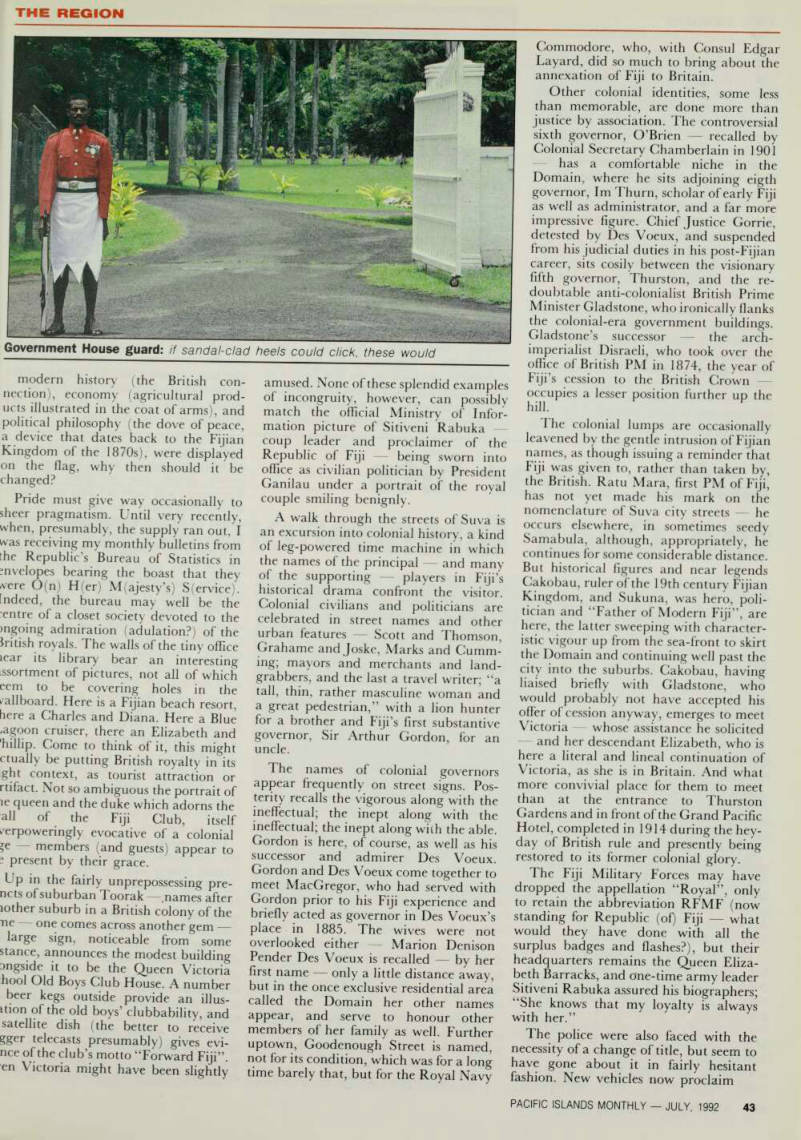
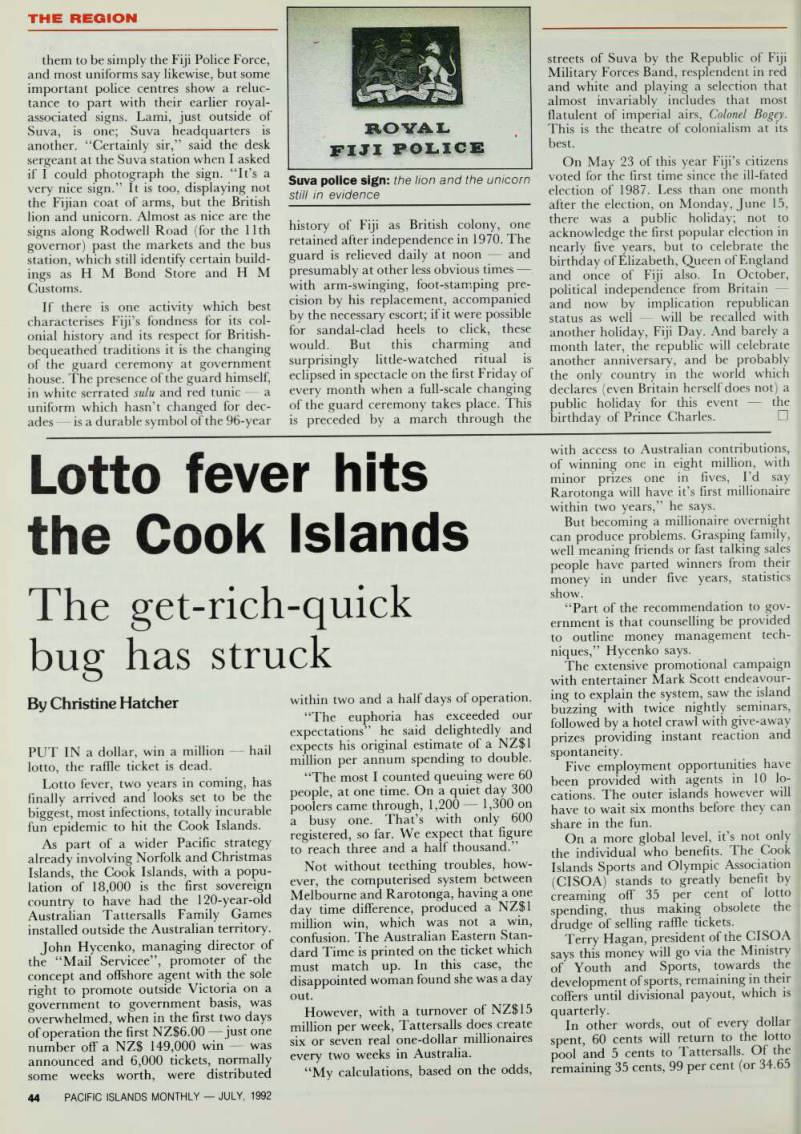
The Region
By Norman Douglas
Fragments of empire
still cling to
republican Fiji
QUEEN ELIZABETH II of Britain gazes imperiosuly from the banknotes, but is more primly profiled on the coinage, minted as recently as 1990. An even more recent announcement in early 1992 - that there would be a new issue of paper currency, informed one that the major change would be the addition of a metallic thread, not the replacement of the head of the British monarch by that of some Fijian digni tary, historic or contemporary. No serious possibility as yet of dropping the queen’s likeness in favour of that of a Ganilau or a Mara, or perhaps less controversially a Sukuna or even a Cakobau. Almost five years after Fiji pronounced itself to be a republic and was ostracised by the commonwealth, Queen Elizabeth still maintains some kind of spiritual sway over the country’s Reserve Bank.
On flag-poles all around the nation fly the standard first unfurled in 1970, as representative of Fiji now, it seemms, with its status as “sovereign democratic republic”, as when it was a proud and valued member of the old colonial boys’ commonwealth club. Although the flag displays the coat of arms of Fiji in the fly, with a number of traditional symbols, its most immediately obvious feature is the Union Jack in the upper hoist. Never mind that in the nearby incipient republic of Australia, politicians, appar ently incapable of offering the multitudes the bread of employment, have turned instead to the diversionary circus of nationalism, and are suggesting oc casionally demanding that the re moval of their flag’s British component should be one of the first steps towards a brave new republican world.
If anyone thought seriously about changing Fiji’s flag in the early days of
the republic, the prospect of the cost of such a change, together with the fact that no really heart-stirring alternative design was submitted, was enough to blunt any initial enthusiasm for the idea.
Besides, despite official protestations to the contrary, there is still a widespread belief that the country’s removal from the commonwealth is only temporary and the flag will come in handv when its
membership is restored. A postcard of the flag which enjoys wide sale in Fiji explains it this way: “While Fiji was declared a Republic in 1988 (sic), it still has close historical ties with the British Commonwealth and thus the Union Jack remains part of the flag.” Simple. At the University of the South Pacific in 1989 my mature-age students in history were quick to point out that all the symbols necessary to an understanding of Fiji’s
Gladstone and Cakobau: briefly liaising
modern history (the British con nection), economy (agricultural prod ucts illustrated in the coat of arms), and political philosophy (the dove of peace, a device that dates back to the Fijian Kingdom of the 1870 s), were displayed on the flag, why then should it be changed?
Pride must give way occasionally to sheer pragmatism. Until very recently, when, presumably, the supply ran out, I was receiving my monthly bulletins from the Republic’s Bureau of Statistics in mvelopes bearing the boast that they were O(n) H(er) M(ajesty’s) S(ervice). indeed, the bureau may well be the :entre of a closet society devoted to the mgoing admiration (adulation?) of the British royals. The walls of the tiny office lear its library bear an interesting issortment of pictures, not all of which eem to be covering holes in the /allboard. Here is a Fijian beach resort, here a Charles and Diana. Here a Blue .agoon cruiser, there an Elizabeth and 'hillip. Come to think of it, this might ctually be putting British royalty in its ght context, as tourist attraction or rtifact. Not so ambiguous the portrait of ie queen and the duke which adorns the all of the Fiji Club, itself evocative of a colonial ? e members (and guests) appear to - present by their grace.
Up in the fairly unprepossessing pre nets of suburban Toorak —.names after lother suburb in a British colony of the ne one comes across another gem large sign, noticeable from some stance, announces the modest building 3ngside it to be the Queen Victoria hool Old Boys Club House. A number beer kegs outside provide an illus ion of the old boys’ clubbability, and satellite dish (the better to receive gger telecasts presumably) gives evi nce of the club’s motto “Forward Fiji”, en Victoria might have been slightly
amused. None of these splendid examples of incongruity, however, can possibly match the official Ministry of Infor mation picture of Sitiveni Rabuka coup leader and proclaimer of the Republic of Fiji being sworn into office as civilian politician by President Ganilau under a portrait of the royal couple smiling benignly.
A walk through the streets of Suva is an excursion into colonial history, a kind of leg-powered time machine in which the names of the principal and many of the supporting players in Fiji’s historical drama confront the visitor.
Colonial civilians and politicians are celebrated in street names and other urban features Scott and Thomson, Grahame and Joske, Marks and Gumm ing; mayors and merchants and land grabbers, and the last a travel writer; “a tall, thin, rather masculine woman and a great pedestrian,” with a lion hunter for a brother and Fiji’s first substantive governor, Sir Arthur Gordon, for an uncle.
The names of colonial governors appear frequently on street signs. Pos terity recalls the vigorous along with the
ineffectual; the inept along with the
ineffectual; the inept along with the able.
Gordon is here, of course, as well as his successor and admirer Des Voeux.
Gordon and Des Voeux come together to meet MacGregor, who had served with Gordon prior to his Fiji experience and briefly acted as governor in Des Voeux’s place in 1885. The wives were not overlooked either Marion Denison Pender Des Voeux is recalled by her first name only a little distance away, but in the once exclusive residential area called the Domain her other names appear, and serve to honour other members of her family as well. Further uptown, Goodenough Street is named, not for its condition, which was for a long time barely that, but for the Royal Navy
Commodore, who, with Consul Edgar Layard, did so much to bring about the annexation of Fiji to Britain.
Other colonial identities, some less than memorable, are done more than justice by association. The controversial sixth governor, O’Brien — recalled by Colonial Secretary Chamberlain in 1901 — has a comfortable niche in the Domain, where he sits adjoining eigth governor, Im Thurn, scholar of early Fiji as well as administrator, and a far more impressive figure. Chief Justice Gorrie, detested by Des Voeux, and suspended from his judicial duties in his post-Fijian career, sits cosily between the visionary fifth governor, Thurston, and the re doubtable anti-colonialist British Prime Minister Gladstone, who ironically flanks the colonial-era government buildings.
Gladstone’s successor — the arch imperialist Disraeli, who took over the office of British PM in 1874, the year of Fiji’s cession to the British Crown occupies a lesser position further up the hill.
The colonial lumps are occasionally leavened by the gentle intrusion of Fijian names, as though issuing a reminder that Fiji was given to, rather than taken by, the British. Ratu Mara, first PM of Fiji, has not yet made his mark on the nomenclature of Suva city streets — he occurs elsewhere, in sometimes seedy Samabula, although, appropriately, he continues for some considerable distance.
But historical figures and near legends Cakobau, ruler of the 19th century Fijian Kingdom, and Sukuna, was hero, poli tician and “Father of Modern Fiji”, are here, the latter sweeping with character istic vigour up from the sea-front to skirt the Domain and continuing well past the city into the suburbs. Cakobau, having liaised briefly with Gladstone, who would probably not have accepted his offer of cession anyway, emerges to meet Victoria — whose assistance he solicited — and her descendant Elizabeth, who is here a literal and lineal continuation of Victoria, as she is in Britain. And what more convivial place for them to meet than at the entrance to Thurston Gardens and in front of the Grand Pacific Hotel, completed in 1914 during the hey day of British rule and presently being restored to its former colonial glory.
The Fiji Military Forces may have
dropped the appellation “Royal”, only
to retain the abbreviation RFMF (now standing for Republic (of) Fiji — what would they have done with all the surplus badges and flashes?), but their headquarters remains the Queen Eliza beth Barracks, and one-time army leader Sitiveni Rabuka assured his biographers; “She knows that my loyalty is always with her.”
The police were also faced with the necessity of a change of title, but seem to have gone about it in fairly hesitant fashion. New vehicles now proclaim
Government House guard: if sandal-clad heels could click, these would
them to be simply the Fiji Police Force, and most uniforms say likewise, but some important police centres show a reluc tance to part with their earlier royal associated signs. Lami, just outside of Suva, is one; Suva headquarters is another. “Certainly sir,” said the desk sergeant at the Suva station when I asked if I could photograph the sign. “It’s a very nice sign,” It is too, displaying not the Fijian coat of arms, but the British lion and unicorn. Almost as nice are the signs along Rodwell Road (for the 11 th governor) past the markets and the bus station, which still identify certain build ings as H M Bond Store and H M Customs.
If there is one activity which best characterises Fiji’s fondness for its col onial history and its respect for British bequeathed traditions it is the changing of the guard ceremony at government house. The presence of the guard himself, in white serrated sulu and red tunic a uniform which hasn’t changed for dec ades is a durable symbol of the 96-year
history of Fiji as British colony, one retained after independence in 1970. The guard is relieved daily at noon and presumably at other less obvious times with arm-swinging, foot-stamping pre cision by his replacement, accompanied by the necessary escort; if it were possible for sandal-clad heels to click, these would. But this charming and surprisingly little-watched ritual is eclipsed in spectacle on the first Friday of every month when a full-scale changing of the guard ceremony takes place. This is preceded by a march through the
streets of Suva by the Republic of Fiji Military Forces Band, resplendent in red and white and playing a selection that almost invariably includes that most flatulent of imperial airs, Colonel Bogey.
This is the theatre of colonialism at its best.
On May 23 of this year Fiji’s citizens voted for the first time since the ill-fated election of 1987. Less than one month after the election, on Monday, June 15, there was a public holiday; not to acknowledge the first popular election in nearly five years, but to celebrate the
birthday of Elizabeth, Queen of England
and once of Fiji also. In October, political independence from Britain -
and now by implication republican
status as well will be recalled with another holiday, Fiji Day. And barely a month later, the republic will celebrate another anniversary, and be probably the only country in the world which declares (even Britain herself does not) a public holiday for this event the birthday of Prince Charles. □
Suva police sign: the lion and the unicorn still in evidence
Advertisements & other items, pp. 43-44 (1 item)
Corrie & Company
m £
EVEREADY EVEREADY
GENERAL
PURPOSE
GENERAL
PURPOSE
This is the Cyclone season.
Be ever ready with Now Eveready is power-packed in metal to give you benefits you can both see and feel. • up to 13% more active ingredients give you a battery that lasts an average of 13% longer! • a new unique double sealing system ensures no leakage. • new tough metal jacket protects battery making it moreboosted performance get New Eveready. Built stronger to last longer and longer...
Distributed by:
CORRIE & COMPANY
CARPENTER STREET, RAIWAI
PHONE: SUVA 386777 FAX: 370010 LAUTOKA PHONE: 660137
TRADE MARK
CAUTIONARY
NOTICE
IN NAURU
Notice is hereby given that Matsushita Electric Industrial Co. Ltd., a corporation duly organized and existing under the laws of Japan, of 1006, Oaza Kadoma, Kadoma-shi, Osaka Prefecture, Japan, Manufacturers, is the sole proprietor in Nauru and elsewhere of the following trade marks: used in respect of:- machines and machine tools; motors; scientific, nautical, surveying and electrical apparatus and instruments (including wireless), photographic, cinematographic, optical, weighing, measuring, signalling, checking (supervision), lifesaving and teaching apparatus and instruments; coin or counter-freed apparatus: talking machines; fire-extinguishing apparatus; installations for lighting, heating, steam generating, cooking, refrigerating, drying, ventilating, water supply and sanitary purposes. used in respect of:- machines and machine tools; motors; scientific, nautical, surveying and electrical apparatus and instruments (including wireless), weighing, measuring, signalling, checking (supervision), lifesaving and teaching apparatus and instruments; coin or counter-freed apparatus, talking machines, cash registers; calculating machines; fire-extinguishing apparatus, installations for lighting, heating, steam generating, cooking, refrigerating, drying, ventilating, water supply and sanitary purposes.
The said proprietor claims all rights in respect of the above trade mark and will take all necessary legal steps against any person or company infringing their said rights.
National
Panasonic PANA
DAVIES & COLLISON
Patent Attorneys 1 Little Collins Street Melbourne Victoria 3000
AUSTRALIA
The get-rich-quick
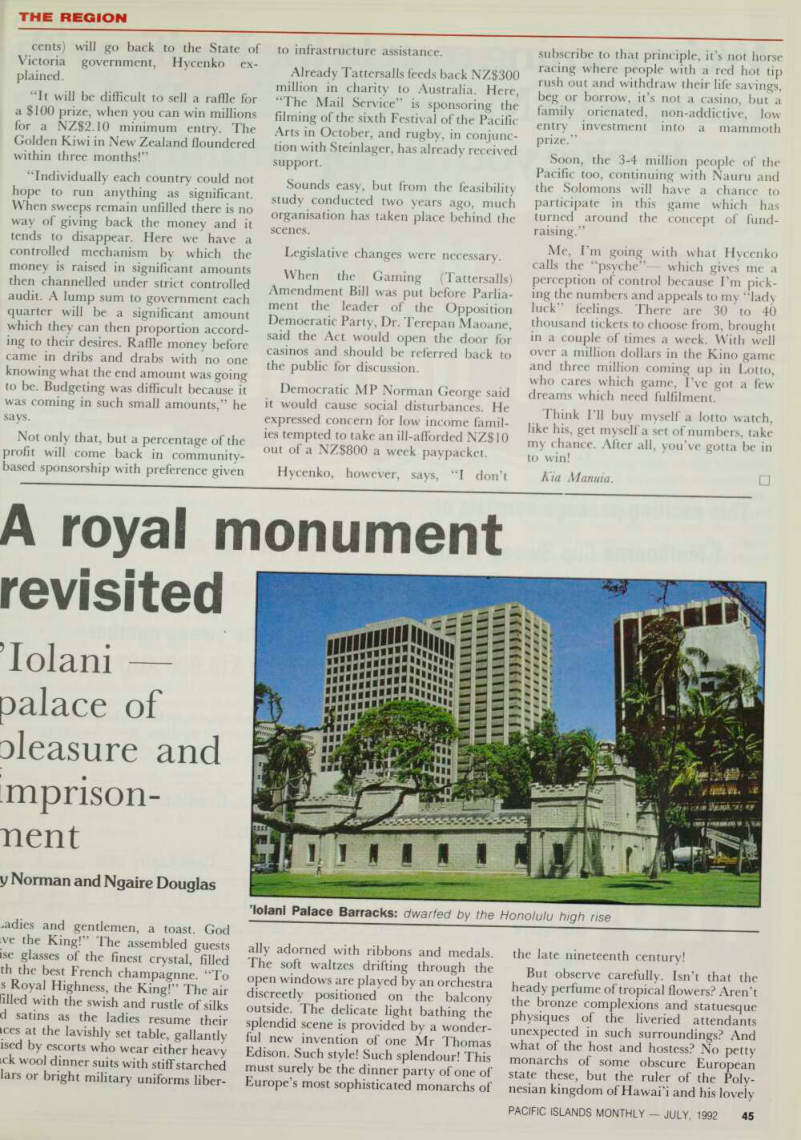
Lotto fever hits the Cook Islands The get-rich-quick bug has struck
By Christine Hatcher
PUT IN a dollar, win a million hail lotto, the raffle ticket is dead.
Lotto fever, two years in coming, has finally arrived and looks set to be the biggest, most infections, totally incurable fun epidemic to hit the Cook Islands.
As part of a wider Pacific strategy already involving Norfolk and Christmas Islands, the Cook Islands, with a popu lation of 18,000 is the first sovereign country to have had the 120-year-old Australian Tattersalls Family Games installed outside the Australian territory.
John Hycenko, managing director of
the “Mail Servicee”, promoter of the concept and offshore agent with the sole right to promote outside Victoria on a government to government basis, was overwhelmed, when in the first two days of operation the first NZ$6.OO —just one number off a NZ$ 149,000 win was announced and 6,000 tickets, normally some weeks worth, were distributed
within two and a half days of operation.
“The euphoria has exceeded our expectations” he said delightedly and expects his original estimate of a NZ$l million per annum spending to double.
“The most I counted queuing were 60 people, at one time. On a quiet day 300 poolers came through, 1,200 1,300 on a busy one. That’s with only 600 registered, so far. We expect that figure to reach three and a half thousand.”
Not without teething troubles, how ever, the computerised system between Melbourne and Rarotonga, having a one day time difference, produced a NZ$l million win, which was not a win, confusion. The Australian Eastern Stan dard Time is printed on the ticket which must match up. In this case, the disappointed woman found she was a day out.
However, with a turnover of NZ$l5 million per week, Tattersalls does create six or seven real one-dollar millionaires every two weeks in Australia.
“My calculations, based on the odds,
with access to Australian contributions, of winning one in eight million, with minor prizes one in fives, I’d say Rarotonga will have it’s first millionaire within two years,” he says.
But becoming a millionaire overnight can produce problems. Grasping family, well meaning friends or fast talking sales people have parted winners from their money in under five years, statistics show.
“Part of the recommendation to gov ernment is that counselling be provided to outline money management tech
niques,” Hycenko says.
The extensive promotional campaign
with entertainer Mark Scott endeavour ing to explain the system, saw the island buzzing with twice nightly seminars, followed by a hotel crawl with give-away prizes providing instant reaction and
spontaneity.
Five employment opportunities have
been provided with agents in 10 lo cations. The outer islands however will have to wait six months before they can share in the fun.
On a more global level, it’s not only the individual who benefits. The Cook Islands Sports and Olympic Association (CISOA) stands to greatly benefit by creaming off 35 per cent of lotto spending, thus making obsolete the drudge of selling raffle tickets.
Terry Hagan, president of the CISOA says this money will go via the Ministry of Youth and Sports, towards the development of sports, remaining in their coffers until divisional payout, which is
quarterly.
In other words, out of every dollar spent, 60 cents will return to the lotto pool and 5 cents to Tattersalls. Of the remaining 35 cents, 99 per cent (or 34.65
cents) will go back to the State of Victoria government, Hycenko ex plained.
“It will be difficult to sell a raffle for a SIOO prize, when you can win millions for a NZ$2.lO minimum entry. The Golden Kiwi in New Zealand floundered within three months!”
“Individually each country could not hope to run anything as significant.
When sweeps remain unfilled there is no way of giving back the money and it tends to disappear. Here we have a controlled mechanism by which the money is raised in significant amounts then channelled under strict controlled audit. A lump sum to government each quarter will be a significant amount which they can then proportion accord ing to their desires. Raffle money before came in dribs and drabs with no one knowing what the end amount was going to be. Budgeting was difficult because it was coming in such small amounts,” he says.
Not only that, but a percentage of the profit will come back in community based sponsorship with preference given
to infrastructure assistance.
Already Tattersalls feeds back NZ$3OO million in charity to Australia. Here, “The Mail Service” is sponsoring the filming of the sixth Festival of the Pacific Arts in October, and rugby, in conjunc tion with Steinlager, has already received support.
Sounds easy, but from the feasibility study conducted two years ago, much organisation has taken place behind the scenes.
Legislative changes were necessary.
When the Gaming (Tattersalls)
Amendment Bill was put before Parlia ment the leader of the Opposition Democratic Party, Dr. Terepan Maoane, said the Act would open the door for casinos and should be referred back to the public for discussion.
Democratic MP Norman George said it would cause social disturbances. He expressed concern for low income famil ies tempted to take an ill-afforded NZ$lO out of a NZ$BOO a week paypacket.
Hycenko, however, says, “I don’t
subscribe to that principle, it’s not horse racing where people with a red hot tip rush out and withdraw their life savings, beg or borrow, it’s not a casino, but a family orienated, non-addictive, low entry investment into a mammoth prize.”
Soon, the 3-4 million people of the Pacific too, continuing with Nauru and the Solomons will have a chance to participate in this game which has turned around the concept of fund
raising.”
Me, I’m going with what Hycenko calls the “psyche” — which gives me a perception of control because I’m pick ing the numbers and appeals to my “lady luck” feelings. There are 30 to 40 thousand tickets to choose from, brought in a couple of times a week. With well over a million dollars in the Kino game and three million coming up in Lotto, who cares which game, I’ve got a few dreams which need fulfilment.
Think I’ll buy myself a lotto watch, like his, get myself a set of numbers, take my chance. After all, you’ve gotta be in to win!
Kia Manuia. □
revisited

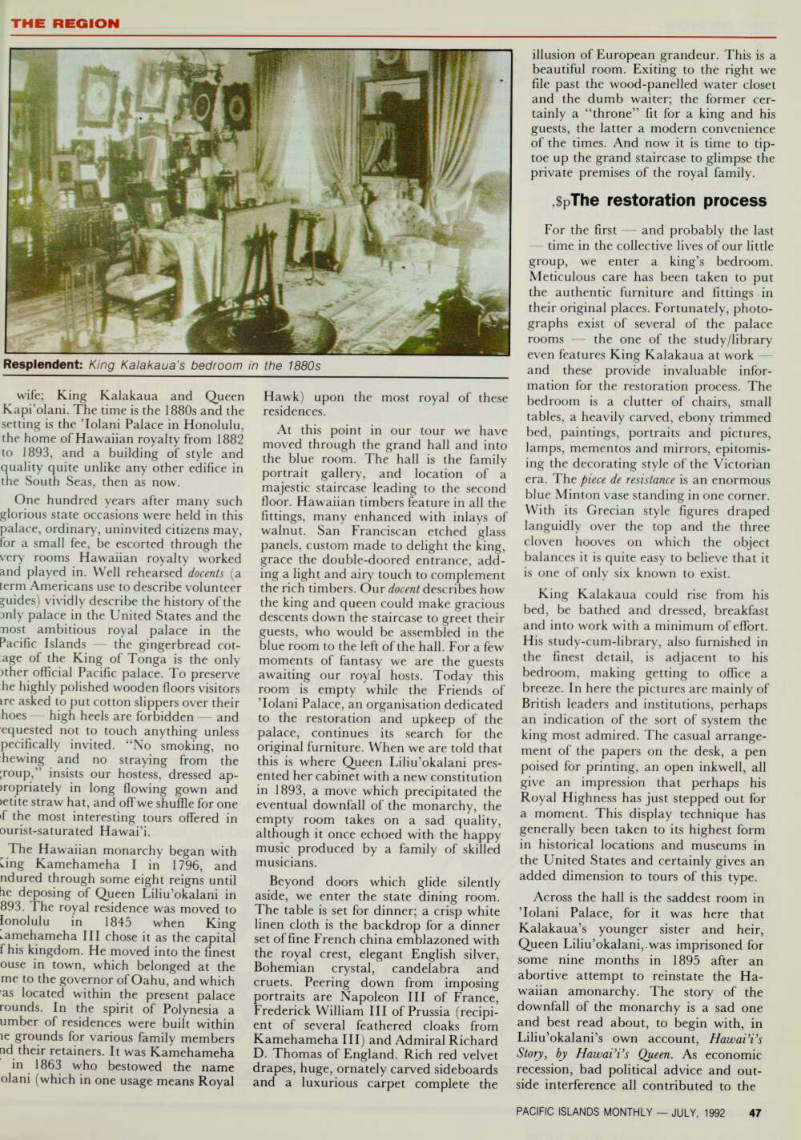
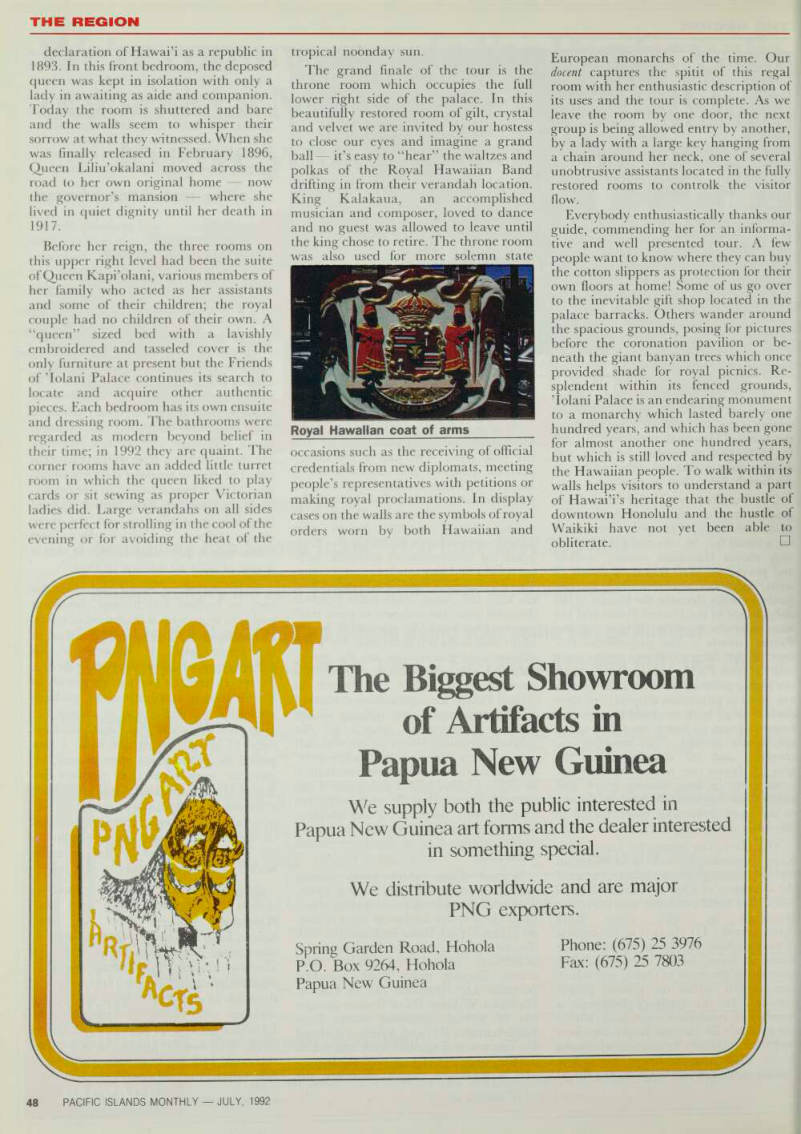
A royal monument
revisited [?]Iolanipalace of [?]leasure and [?]mprison ment
By Norman and Ngaire Douglas
and gentlemen, a toast. God ; ve the King!” The assembled guests ise glasses of the finest crystal, filled th the best French champagnne. “To s Royal Highness, the King!” The air filled with the swish and rustle of silks d satins as the ladies resume their ices at the lavishly set table, gallantly ised by escorts who wear either heavy ick wool dinner suits with stiffstarched lars or bright military uniforms liber-
ally adorned with ribbons and medals.
The soft waltzes drifting through the open windows are played by an orchestra discreetly positioned on the balcony outside. The delicate light bathing the splendid scene is provided by a wonder ful new invention of one Mr Thomas Edison. Such style! Such splendour! This must surely be the dinner party of one of Europe’s most sophisticated monarchs of
the late nineteenth century!
But observe carefully. Isn’t that the heady perfume of tropical flowers? Aren’t the bronze complexions and statuesque physiques of the liveried attendants unexpected in such surroundings? And what of the host and hostess? No petty monarchs of some obscure European state these, but the ruler of the Poly nesian kingdom of Hawai’i and his lovely
’ lolani Palace Barracks: dwarfed by the Honolulu high rise
wife; King Kalakaua and Queen Kapi’olani. The time is the 1880 s and the setting is the Tolani Palace in Honolulu, the home of Hawaiian royalty from 1882 to 1893, and a building of style and quality quite unlike any other edifice in the South Seas, then as now.
One hundred years after many such glorious state occasions were held in this palace, ordinary, uninvited citizens may, for a small fee, be escorted through the very rooms Hawaiian royalty worked and played in. Well rehearsed docents (a term Americans use to describe volunteer guides) vividly describe the history of the anly palace in the United States and the nost ambitious royal palace in the Pacific Islands the gingerbread cot age of the King of Tonga is the only )ther official Pacific palace. To preserve he highly polished wooden floors visitors ire asked to put cotton slippers over their hoes high heels are forbidden and equested not to touch anything unless pecifically invited. “No smoking, no hewing and no straying from the ;roup,” insists our hostess, dressed ap iropriately in long flowing gown and >etite straw hat, and off we shuffle for one •f the most interesting tours offered in ourist-saturated Hawai’i.
The Hawaiian monarchy began with Ling Kamehameha I in 1796, and ndured through some eight reigns until
be deposing of Queen Liliu’okalani in
893. The royal residence was moved to lonolulu in 1845 when King kamehameha HI chose it as the capital f his kingdom. He moved into the finest ouse in town, which belonged at the me to the governor of Oahu, and which as located within the present palace rounds. In the spirit of Polynesia a umber of residences were built within ic grounds for various family members ad their retainers. It was Kamehameha in 1863 who bestowed the name olani (which in one usage means Royal
Hawk) upon the most royal of these residences.
At this point in our tour we have moved through the grand hall and into the blue room. The hall is the family portrait gallery, and location of a majestic staircase leading to the second floor. Hawaiian timbers feature in all the fittings, many enhanced with inlays of walnut. San Franciscan etched glass panels, custom made to delight the king, grace the double-doored entrance, add ing a light and airy touch to complement the rich timbers. Our docent describes how the king and queen could make gracious descents down the staircase to greet their guests, who would be assembled in the blue room to the left of the hall. For a few moments of fantasy we are the guests awaiting our royal hosts. Today this room is empty while the Friends of Tolani Palace, an organisation dedicated to the restoration and upkeep of the palace, continues its search for the original furniture. When we are told that this is where Queen Liliu’okalani pres ented her cabinet with a new constitution in 1893, a move which precipitated the eventual downfall of the monarchy, the empty room takes on a sad quality, although it once echoed with the happy music produced by a family of skilled musicians.
Beyond doors which glide silently aside, we enter the state dining room.
The table is set for dinner; a crisp white linen cloth is the backdrop for a dinner set of fine French china emblazoned with the royal crest, elegant English silver, Bohemian crystal, candelabra and cruets. Peering down from imposing portraits are Napoleon HI of France, Frederick William HI of Prussia (recipi ent of several feathered cloaks from Kamehameha HI) and Admiral Richard D. Thomas of England. Rich red velvet drapes, huge, ornately carved sideboards and a luxurious carpet complete the
illusion of European grandeur. This is a beautiful room. Exiting to the right we file past the wood-panelled water closet and the dumb waiter; the former cer tainly a “throne” fit for a king and his guests, the latter a modern convenience of the times. And now it is time to tip toe up the grand staircase to glimpse the private premises of the royal family. ,* P The restoration process For the first and probably the last time in the collective lives of our little group, we enter a king’s bedroom.
Meticulous care has been taken to put the authentic furniture and fittings in their original places. Fortunately, photo graphs exist of several of the palace rooms the one of the study/library even features King Kalakaua at work and these provide invaluable infor mation for the restoration process. The bedroom is a clutter of chairs, small tables, a heavily carved, ebony trimmed bed, paintings, portraits and pictures, lamps, mementos and mirrors, epitomis ing the decorating style of the Victorian era. The piece de resistance is an enormous blue Minton vase standing in one corner.
With its Grecian style figures draped languidly over the top and the three cloven hooves on which the object balances it is quite easy to believe that it is one of only six known to exist.
King Kalakaua could rise from his bed, be bathed and dressed, breakfast and into work with a minimum of effort.
His study-cum-library, also furnished in the finest detail, is adjacent to his bedroom, making getting to office a breeze. In here the pictures are mainly of British leaders and institutions, perhaps an indication of the sort of system the king most admired. The casual arrange ment of the papers on the desk, a pen poised for printing, an open inkwell, all give an impression that perhaps his Royal Highness has just stepped out for a moment. This display technique has generally been taken to its highest form in historical locations and museums in the United States and certainly gives an added dimension to tours of this type.
Across the hall is the saddest room in Tolani Palace, for it was here that Kalakaua’s younger sister and heir, Queen Liliu’okalani,was imprisoned for some nine months in 1895 after an abortive attempt to reinstate the Ha waiian amonarchy. The story of the downfall of the monarchy is a sad one and best read about, to begin with, in Liliu’okalani’s own account, Hawai’i’s Story, by Hawai’i’s Queen. As economic recession, bad political advice and out side interference all contributed to the
Resplendent: King Kalakaua’s bedroom in the 1880s
declaration of Hawai’i as a republic in 1893. In this front bedroom, the deposed queen was kept in isolation with only a lady in awaiting as aide and companion.
Today the room is shuttered and bare and the walls seem to whisper their sorrow at what they witnessed. When she was finally released in February 1896, Queen Liliu’okalani moved across the road to her own original home now the governor’s mansion where she lived in quiet dignity until her death in 1917.
Before her reign, the three rooms on this upper right level had been the suite of Queen Kapi’olani, various members of her family who acted as her assistants and some of their children; the royal couple had no children of their own. A “queen” sized bed with a lavishly embroidered and tasseled cover is the only furniture at present but the Friends of Tolani Palace continues its search to locate and acquire other authentic pieces. Each bedroom has its own ensuite and dressing room. The bathrooms were regarded as modern beyond belief in their time; in 1992 they are quaint. The corner rooms have an added little turret room in which the queen liked to play cards or sit sewing as proper Victorian ladies did. Large verandahs on all sides were perfect for strolling in the cool of the evening or for avoiding the heat of the
tropical noonday sun.
The grand finale of the tour is the throne room which occupies the full lower right side of the palace. In this beautifully restored room of gilt, crystal and velvet we are invited by our hostess to close our eyes and imagine a grand ball it’s easy to “hear” the waltzes and polkas of the Royal Hawaiian Band drifting in from their verandah location.
King Kalakaua, an accomplished musician and composer, loved to dance and no guest was allowed to leave until the king chose to retire. The throne room was also used for more solemn state
occasions such as the receiving of official credentials from new diplomats, meeting people’s representatives with petitions or making royal proclamations. In display cases on the walls are the symbols of royal orders worn by both Hawaiian and
European monarchs of the time. Our docent captures the spitit of this regal room with her enthusiastic description of its uses and the tour is complete. As we leave the room by one door, the next group is being allowed entry by another, by a lady with a large key hanging from a chain around her neck, one of several unobtrusive assistants located in the fully restored rooms to controlk the visitor flow.
Everybody enthusiastically thanks our guide, commending her for an informa tive and well presented tour. A few people want to know where they can buy the cotton slippers as protection for their own floors at home! Some of us go over to the inevitable gift shop located in the palace barracks. Others wander around the spacious grounds, posing for pictures before the coronation pavilion or be neath the giant banyan trees which once provided shade for royal picnics. Re splendent within its fenced grounds, Tolani Palace is an endearing monument to a monarchy which lasted barely one hundred years, and which has been gone for almost another one hundred years, but which is still loved and respected by the Hawaiian people. To walk within its walls helps visitors to understand a part of Hawaii’s heritage that the bustle of downtown Honolulu and the hustle of Waikiki have not yet been able to obliterate. D
Royal Hawaiian coat of arms
Advertisements & other items, pp. 48-50 (1 item)
our special Melbourne Cup Package
We're coming over to the Pacific with
to give you an opportunity to
I I This exciting package consists of: 1 Melbourne Cup Sweep Ticket - First Prize $500,000 AUD 1 Instant Lottery Scratch Ticket - First Prize $500,000 AUD 1 entry in the Caulfield Cup Sweep using your same sweep number if you order before October Ist 1992. - First Prize $lO,OOO AUD TAX FREE.
So don't hold your horses! Send this coupon with either cash, your credit card details, or bank cheque to us NOW: TMS. THE MAIL SERVICE. Suite 5, 55 Flemington Road, North Melbourne, Victoria, 3051. Australia.
G.P.O. Box 2937 DD, Melbourne, 3001. Australia. Fax: Country Code 61/3/329 2166.
YES
The $25 U.S. accepted in Cash, Bank Cheque, Credit Cards or a Postal note Please tick - PI 1 PACKAGE FOR $25.00 U.S!
Please Print - Credit Card Type Card Expiry date Card no Signature Name Address Post Code Phone Number (if available) We will send you a Melbourne Cup Sweep Ticket, an Instant Lottery Scratch Ticket.
If you order before OCTOBER Ist you will also receive written confirmation of your inclusion in the Caulfield Cup Draw.
The Biggest Showroom
of Artifacts in
Papua New Guinea
We supply both the public interested in Papua New Guinea art forms and the dealer interested in something special.
We distribute worldwide and are major PNG exporters.
Spring Garden Road. Hohola Phone: (675) 25 3976 P.O. Box 9264. Hohola Fax: (675) 25 7803 Papua New Guinea
Firing up the smoke debate
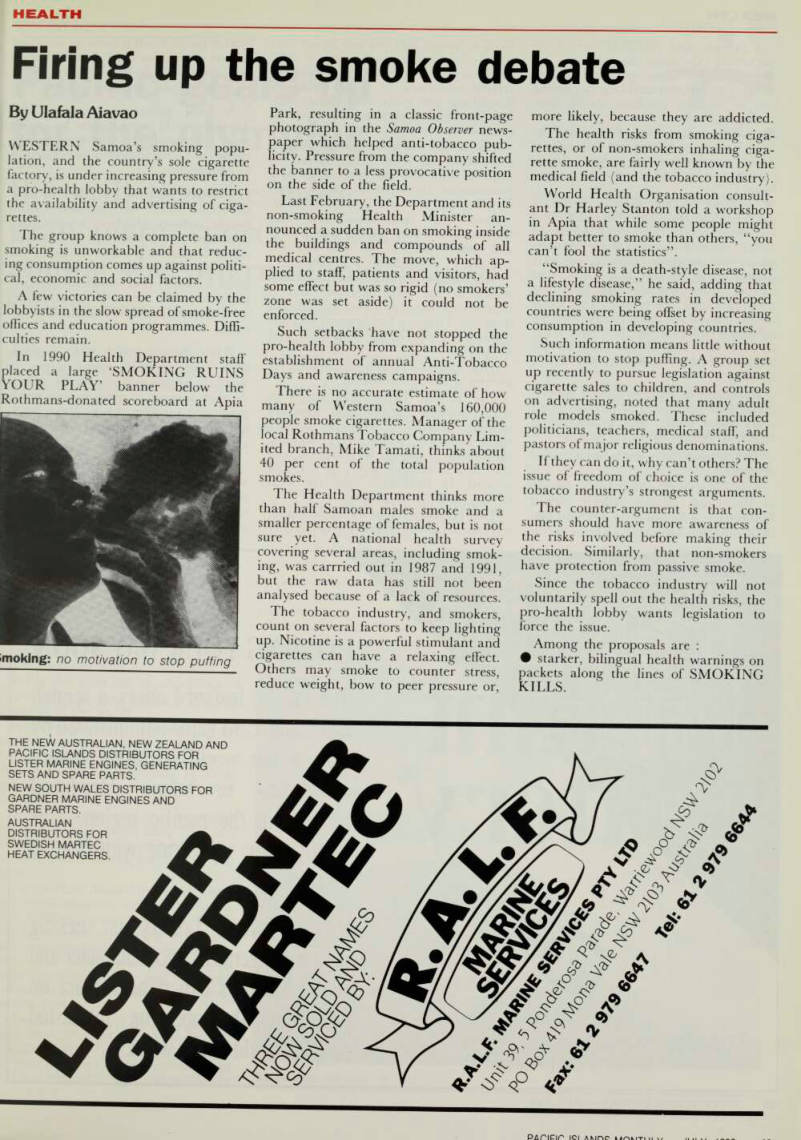
Health
By Ulafala Aiavao
WESTERN Samoa’s smoking popu lation, and the country’s sole cigarette factory, is under increasing pressure from a pro-health lobby that wants to restrict the availability and advertising of ciga rettes.
The group knows a complete ban on smoking is unworkable and that reduc ing consumption comes up against politi cal, economic and social factors.
A few victories can be claimed by the lobbyists in the slow spread of smoke-free offices and education programmes. Diffi culties remain.
In 1990 Health Department staff placed a large ‘SMOKING RUINS YOUR PLAY’ banner below the Rothmans-donated scoreboard at Apia
Park, resulting in a classic front-page photograph in the Samoa Observer news paper which helped anti-tobacco pub licity. Pressure from the company shifted the banner to a less provocative position on the side of the field.
Last February, the Department and its non-smoking Health Minister an nounced a sudden ban on smoking inside the buildings and compounds of all medical centres. The move, which ap plied to staff, patients and visitors, had some effect but was so rigid (no smokers’ zone was set aside) it could not be enforced.
Such setbacks have not stopped the pro-health lobby from expanding on the establishment of annual Anti-Tobacco Days and awareness campaigns.
There is no accurate estimate of how many of Western Samoa’s 160,000 people smoke cigarettes. Manager of the local Rothmans Tobacco Company Lim ited branch, Mike Tamati, thinks about 40 per cent of the total population smokes.
The Health Department thinks more than half Samoan males smoke and a smaller percentage of females, but is not sure yet. A national health survey covering several areas, including smok ing, was carrried out in 1987 and 1991, but the raw data has still not been analysed because of a lack of resources.
The tobacco industry, and smokers, count on several factors to keep lighting up. Nicotine is a powerful stimulant and cigarettes can have a relaxing effect.
Others may smoke to counter stress, reduce weight, bow to peer pressure or,
more likely, because they are addicted.
The health risks from smoking ciga rettes, or of non-smokers inhaling ciga rette smoke, are fairly well known by the medical field (and the tobacco industry).
World Health Organisation consult ant Dr Harley Stanton told a workshop in Apia that while some people might adapt better to smoke than others, “you can’t fool the statistics”.
“Smoking is a death-style disease, not a lifestyle disease,” he said, adding that
declining smoking rates in developed
countries were being offset by increasing consumption in developing countries.
Such information means little without motivation to stop puffing. A group set up recently to pursue legislation against cigarette sales to children, and controls on advertising, noted that many adult role models smoked. These included politicians, teachers, medical staff, and pastors of major religious denominations.
If they can do it, why can’t others? The issue of freedom of choice is one of the tobacco industry’s strongest arguments.
The counter-argument is that con sumers should have more awareness of the risks involved before making their decision. Similarly, that non-smokers have protection from passive smoke.
Since the tobacco industry will not voluntarily spell out the health risks, the pro-health lobby wants legislation to force the issue.
Among the proposals are : • starker, bilingual health warnings on packets along the lines of SMOKING
Kills.
Smoking: no motivation to stop puffing
a boring, and standard, layout on packets to take away the glamour. • increasing taxes on cigarettes to reduce consumption and help pay for the cost of treating smoking-related com-
plaints.
• banning cigarette advertising. (The
local Rothmans factory has little adverrising, possibly because it has a small, captive market and there is no competition.) • printing tar and nicotine levels on packets. The New Zealand standard is favoured because 1) it is well developed and, 2) the local cigarette factory imports all its raw materials (tobacco, cigarette papers, filters, packets, plastic wrap and cartons; from New Zealand These are then packaged before sale. The lobby beheves that if the industry can print the necessary information for New Zealanders, they can do the same lor the Samoan branch without too much trouble n . wr c Rothmans m Western Samoa imports u t r , ■ r . • , about four containers of raw _materia s 40*000 to r 6o 000 cartons r month"" 1 40,000 to 60,000 cartons a month.
The company says this is just ahead of demand.
There is a small export trade, largely to the Cook Islands, which ’ earned Western Samoa 5W5691,000 (5U5283,000) last year. The Central
Bank of Samoa said this was 18 per cent up on the previous year, however, 1990 production was affected by a cyclone related shutdown of three weeks. A flourishing gift trade also exists, with travellers taking cartons with them to relatives overseas.
The Rothmans factory, which began production 12 years ago, enjoyed 10 years of duty and tax concessions as a government incentive to locate here.
New Zealand aid helped set up the plant.
Since the concessions ran out,
Rothmans has been paying import duty
and other charges, but can still sell cheaply about SUSI a packet.
The Western Samoan government has shares in the joint venture, and is represented on the board by officials from the Treasury Department and the department of Trade, Commerce and Industry.
This poses a potential conflict of interest within government.
The Health Department hopes to
reduce cigarette consumption. Treasury
officials, mindful of Western Samoa’s small economy, wants every tax and tariff dollar it can get its hands on, and the TCI is always happy to see jobs created. In Rothmans case, the local
factory employs 52 people.
The Treasury might loosen its stance if it can be convinced that a much higher
level of public funds is spent on smoking related complaints than the community gets from a tobacco industry. Such statistics are not available yet.
A local economist suggested the Treasury could cover its bets by raising taxes on cigarettes, while dropping the excise tax on the imported raw materials to compensate.
Tackling the sale of cigarettes to children faces an unusual social hurdle. Samoan children usually buy cigarettes because they are sent by their elders to the local store. Refusing the child effectively refuses the elder, which poses a conflict that village shopkeepers prefer to avoid. Education programmes work better in this area than enforce ment.
While the pro-health lobby is confi dent that cigarette consumption in Western Samoa will eventually reduce through a range of measures, no one is predicting a sudden change. Estimates at the Apia workshop ranged from “some
years” to 20 years”
Progress will rely on whether people
want to listen to the pro-health message, and the counter-arguments the lobby can expect from the tobbaco industry and tens of thousands of smokers. □
Advertisements & other items, pp. 51-52 (2 items)
PAPICIP ICI A MHO ktrtklTl II v/
The New Australian, New Zealand And
PACIFIC ISLANDS DISTRIBUTORS FOR
LISTER MARINE ENGINES, GENERATING
SETS AND SPARE PARTS.
NEW SOUTH WALES DISTRIBUTORS FOR
GARDNER MARINE ENGINES AND
SPARE PARTS.
AUSTRALIAN
DISTRIBUTORS FOR
SWEDISH MARTEC
HEAT EXCHANGERS
Or & & //A A V // / * /?
JV % Op *v <s^ <P **
IBSpI
■pmt
■Rlery
THE MAIL SERVICE
SUITE 5,55 FLEMINGTON ROAD, NORTH MELBOURNE,
FAX: COUNTRY CODE 61 +3 329 2166
VICTORIA 3051,AUSTRALIA.
COMING YOUR WAY SOON
The Pacific Instant Lottery, a scratch and match card game administered by one of the world’s leading lottery companies is being introduced throughout the pacific region. This family game will bring with it great benefits.
Pacific Instant Lottery is seeking customer agents of good character and sound business experience to act on behalf of the operator. Interested people should fax or write.
Pacific gears up
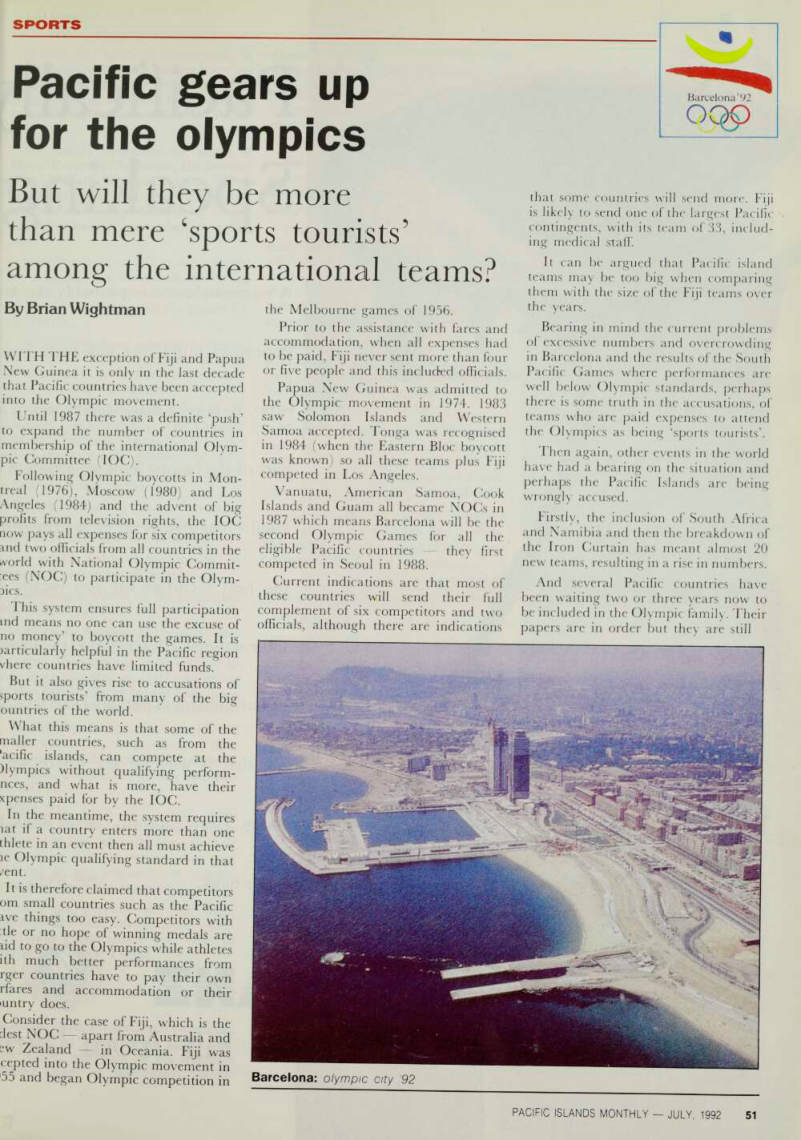
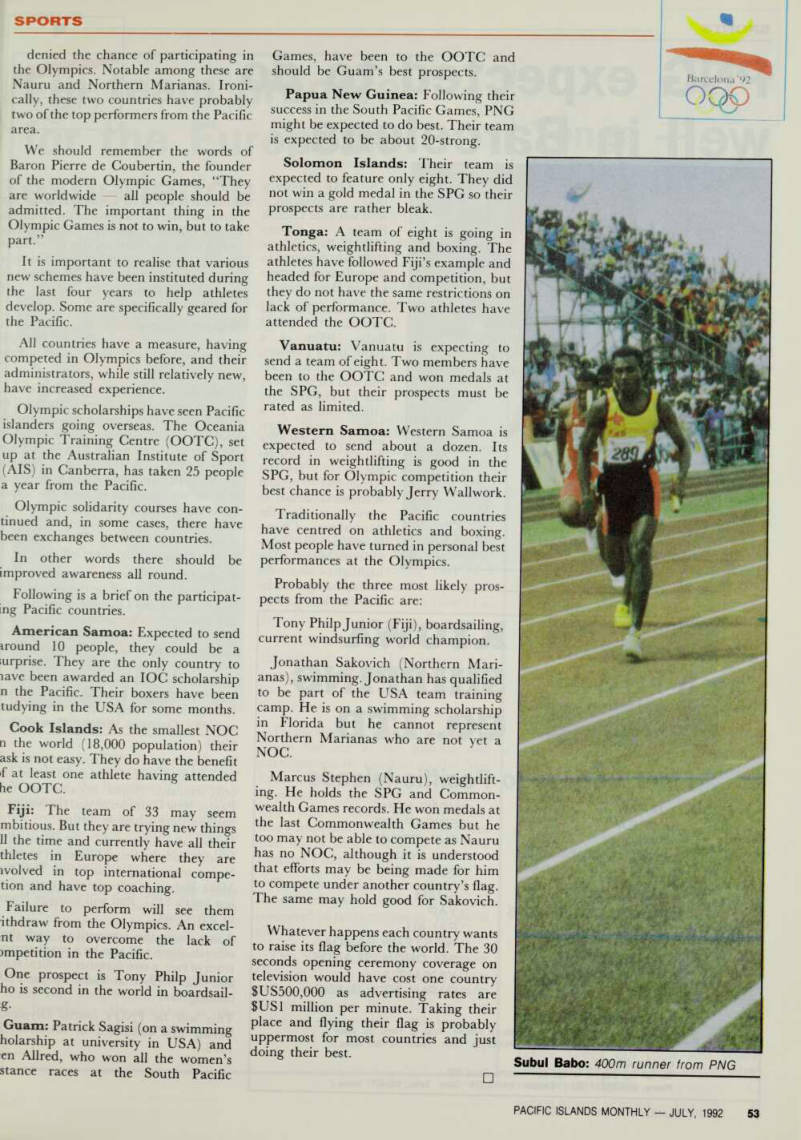
Sports
for the Olympics
But will they be more than mere ‘sports tourists’ among the international teams?
By Brian Wightman
WITH THE exception of Fiji and Papua New Guinea it is only in the last decade that Pacific countries have been accepted into the Olympic movement.
Until 1987 there was a definite ‘push’ to expand the number of countries in membership of the international Olym pic Committee (IOC).
Following Olympic boycotts in Mon treal (1976), Moscow (1980) and Los Angeles (1984) and the advent of big profits from television rights, the lOC now pays all expenses for six competitors and two officials from all countries in the world with National Olympic Commit tees (NOC) to participate in the Olym pics.
This system ensures full participation md means no one can use the excuse of no money’ to boycott the games. It is )articularly helpful in the Pacific region vhere countries have limited funds.
But it also gives rise to accusations of sports tourists’ from many of the big ountries of the world.
What this means is that some of the mailer countries, such as from the ‘acific islands, can compete at the
Mympics without qualifying perform
nces, and what is more, have their xpenses paid for by the lOC.
In the meantime, the system requires lat if a country enters more than one thlete in an event then all must achieve
ie Olympic qualifying standard in that
/ent.
It is therefore claimed that competitors om small countries such as the Pacific
ave things too easy. Competitors with
tie or no hope of winning medals are nd to go to the Olympics while athletes ith much better performances from rger countries have to pay their own rfares and accommodation or their •untry does.
Consider the case of Fiji, w hich is the dest NOC apart from Australia and “w Zealand in Oceania. Fiji was cepted into the Olympic movement in 55 and began Olympic competition in
the Melbourne games of 1956.
Prior to the assistance with fares and accommodation, when all expenses had to be paid, Fiji never sent more than four or five people and this included officials.
Papua New Guinea was admitted to the Olympic movement in 1974. 1983 saw Solomon Islands and Western Samoa accepted. Tonga was recognised in 1984 (when the Eastern Bloc boycott was known) so all these teams plus Fiji competed in Los Angeles.
Vanuatu, American Samoa, Cook Islands and Guam all became NOCs in 1987 which means Barcelona will be the second Olympic Games for all the eligible Pacific countries they first competed in Seoul in 1988.
Current indications are that most of these countries will send their full complement of six competitors and two officials, although there are indications
that some countries will send more. Fiji is likely to send one of the largest Pacific contingents, with its team of 33, includ ing medical staff.
It can be argued that Pacific island teams may be too big when comparing them with the size of the Fiji teams over the years.
Bearing in mind the current problems of excessive numbers and overcrowding in Barcelona and the results of the South Pacific Games where performances are well below Olympic standards, perhaps there is some truth in the accusations, of teams who are paid expenses to attend the Olympics as being ‘sports tourists’.
Then again, other events in the world have had a bearing on the situation and perhaps the Pacific Islands are being wrongly accused.
Firstly, the inclusion of South Africa and Namibia and then the breakdown of the Iron Curtain has meant almost 20 new teams, resulting in a rise in numbers.
And several Pacific countries have been waiting two or three years now to be included in the Olympic family. Their papers are in order but they are still
Barcelona: Olympic city 92
denied the chance of participating in the Olympics. Notable among these are Nauru and Northern Marianas. Ironi cally, these two countries have probably two of the top performers from the Pacific area.
We should remember the words of Baron Pierre de Coubertin, the founder of the modern Olympic Games, “They are worldwide all people should be admitted. The important thing in the Olympic Games is not to win, but to take part.”
It is important to realise that various new schemes have been instituted during the last four years to help athletes develop. Some are specifically geared for the Pacific.
All countries have a measure, having competed in Olympics before, and their administrators, while still relatively new, have increased experience.
Olympic scholarships have seen Pacific islanders going overseas. The Oceania
Olympic Training Centre (OOTC), set
up at the Australian Institute of Sport (AIS) in Canberra, has taken 25 people a year from the Pacific.
Olympic solidarity courses have con tinued and, in some cases, there have been exchanges between countries.
In other words there should be improved awareness all round.
Following is a brief on the participat ng Pacific countries.
American Samoa: Expected to send iround 10 people, they could be a urprise. They are the only country to lave been awarded an lOC scholarship n the Pacific. Their boxers have been tudying in the USA for some months.
Cook Islands: As the smallest NOC a the world (18,000 population) their ask is not easy. They do have the benefit f at least one athlete having attended tie OOTC.
Fiji: The team of 33 may seem mbitious. But they are trying new things 11 the time and currently have all their thletes in Europe where they are ivolved in top international compe tion and have top coaching.
Failure to perform will see them ithdraw from the Olympics. An excel nt way to overcome the lack of impetition in the Pacific.
One prospect is Tony Philp Junior ho is second in the world in boardsail g- Guam: Patrick Sagisi (on a swimming
holarship at university in USA) and
en Allred, who won all the women’s stance races at the South Pacific
Games, have been to the OOTC and should be Guam’s best prospects.
Papua New Guinea: Following their success in the South Pacific Games, PNG might be expected to do best. Their team is expected to be about 20-strong.
Solomon Islands: Their team is expected to feature only eight. They did not win a gold medal in the SPG so their prospects are rather bleak.
Tonga: A team of eight is going in athletics, weightlifting and boxing. The athletes have followed Fiji’s example and headed for Europe and competition, but they do not have the same restrictions on lack of performance. Two athletes have attended the OOTC.
Vanuatu: Vanuatu is expecting to send a team of eight. Two members have been to the OOTC and won medals at the SPG, but their prospects must be rated as limited.
Western Samoa: Western Samoa is expected to send about a dozen. Its record in weightlifting is good in the SPG, but for Olympic competition their best chance is probably Jerry Wallwork.
Traditionally the Pacific countries have centred on athletics and boxing.
Most people have turned in personal best
performances at the Olympics.
Probably the three most likely pros pects from the Pacific are:
Tony Philp Junior (Fiji), boardsailing,
current windsurfing world champion.
Jonathan Sakovich (Northern Mari anas), swimming. Jonathan has qualified to be part of the USA team training camp. He is on a swimming scholarship in Florida but he cannot represent Northern Marianas who are not yet a
Nog.
Marcus Stephen (Nauru), weightlift ing. He holds the SPG and Common wealth Games records. He won medals at the last Commonwealth Games but he too may not be able to compete as Nauru has no NOG, although it is understood that efforts may be being made for him to compete under another country’s flag.
The same may hold good for Sakovich.
Whatever happens each country wants to raise its flag before the world. The 30 seconds opening ceremony coverage on :elevision would have cost one country >USSOO,OOO as advertising rates are !USI million per minute. Taking their place and flying their flag is probably uppermost for most countries and just doing their best.
Subul Babo: 400m runner from PNG
Advertisements & other items, p. 54 (1 item)
Pacifically
I m -
A warm welcome is probably the mo important thing that any bank has t offer. Being the biggest bank in Fiji an part of the largest banking group in tf Pacific may give us the edge in providir the best facilities for you locally ar internationally, but never at the expen! of our individual personal service. Aft all, that is why we are where we a; today. Here for you, ANZ Bank Fi Your bank.
Official Sponsor 1992 Olympic Team 4
Fiji - Your bank
TOP
PNG expected to do
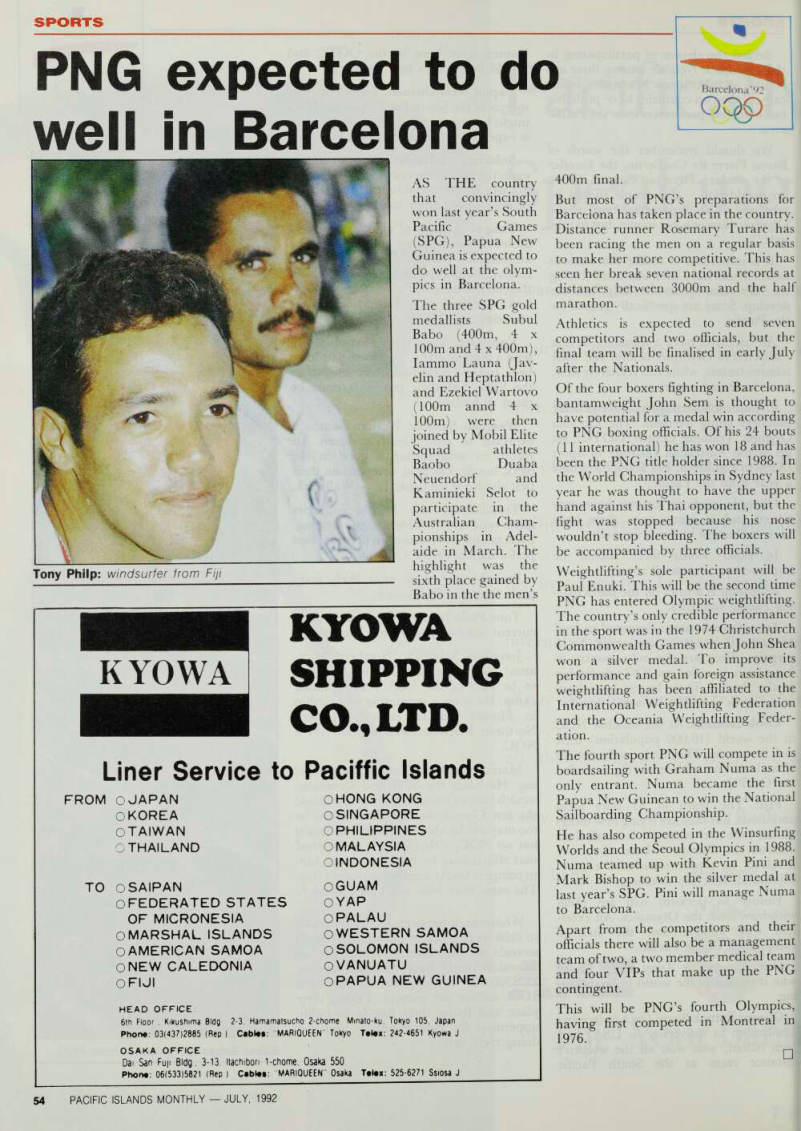
well in Barcelona
AS THE country that convincingly won last year’s South Pacific Games
(SPG), Papua New
Guinea is expected to do well at the Olym pics in Barcelona.
The three SPG gold medallists Subul Babo (400 m, 4 x 100 m and 4 x 400 m), lammo Fauna (Jav elin and Heptathlon) and Ezekiel Wartovo
(100 m annd 4 x
100 m) were then joined by Mobil Elite
Squad athletes
Baobo Duaba Neuendorf and Kaminieki Selot to participate in the Australian Cham pionships in Adel aide in March. The highlight was the sixth place gained by Babo in the the men’s
400 m final.
But most of PNG’s preparations for Barcelona has taken place in the country.
Distance runner Rosemary Turare has been racing the men on a regular basis to make her more competitive. This has seen her break seven national records at distances between 3000 m and the half marathon.
Athletics is expected to send seven competitors and two officials, but the final team will be finalised in early July after the Nationals.
Of the four boxers fighting in Barcelona, bantamweight John Sem is thought to have potential for a medal win according to PNG boxing officials. Of his 24 bouts (11 international) he has won 18 and has been the PNG title holder since 1988. In the World Championships in Sydney last year he was thought to have the upper hand against his Thai opponent, but the fight was stopped because his nose wouldn’t stop bleeding. The boxers will be accompanied by three officials.
Weightlifting’s sole participant will be Paul Enuki. This will be the second time PNG has entered Olympic weightlifting.
The country’s only credible performance in the sport was in the 1974 Christchurch Commonwealth Games when John Shea won a silver medal. To improve its performance and gain foreign assistance weightlifting has been affiliated to the International Weightlifting Federation and the Oceania Weightlifting Feder ation.
The fourth sport PNG will compete in is boardsailing with Graham Numa as the only entrant. Numa became the first Papua New Guinean to win the National
Sailboarding Championship.
He has also competed in the Winsurfing Worlds and the Seoul Olympics in 1988.
Numa teamed up with Kevin Pini and Mark Bishop to win the silver medal at last year’s SPG. Pini will manage Numa to Barcelona.
Apart from the competitors and their officials there will also be a management team of two, a two member medical team and four VIPs that make up the PNG contingent.
This will be PNG’s fourth Olympics, having first competed in Montreal in 1976.
Tony Philp: windsurfer from Fiji
Advertisements & other items, p. 56 (1 item)
Co., Ltd.
KYOWA
KYOWA
SHIPPING
CO., LTD.
Liner Service
FROM OJAPAN
OKOREA
OTAIWAN
O THAILAND
to Paciffic Islands
OHONG KONG
OSINGAPORE
OPHILIPPINES
O MALAYSIA
©INDONESIA
TO OSAIPAN
©FEDERATED STATES
OF MICRONESIA
©MARSHAL ISLANDS
©AMERICAN SAMOA
©NEW CALEDONIA
©FIJI
©GUAM
©YAP
©PALAU
©WESTERN SAMOA
©SOLOMON ISLANDS
©VANUATU
©PAPUA NEW GUINEA
HEAD OFFICE
6th Floor , Kikushima Bldg 2-3, Hamamatsucho 2-chome Mmato-ku, Tokyo 105. Japan Phona: 03(437)2885 (Rep ) Cablaa: "MARIQUEEN" Tokyo Talax: 242-4651 Kyowa J.
OSAKA OFFICE
Dai San Fuji Bldg, 3-13. Itachibon 1-chome, Osaka 550 Phona: 06(533)5821 (Rep ) Cabla*: MARIQUEEN Osaka Talax: 525-6271 Ssiosa J
experience
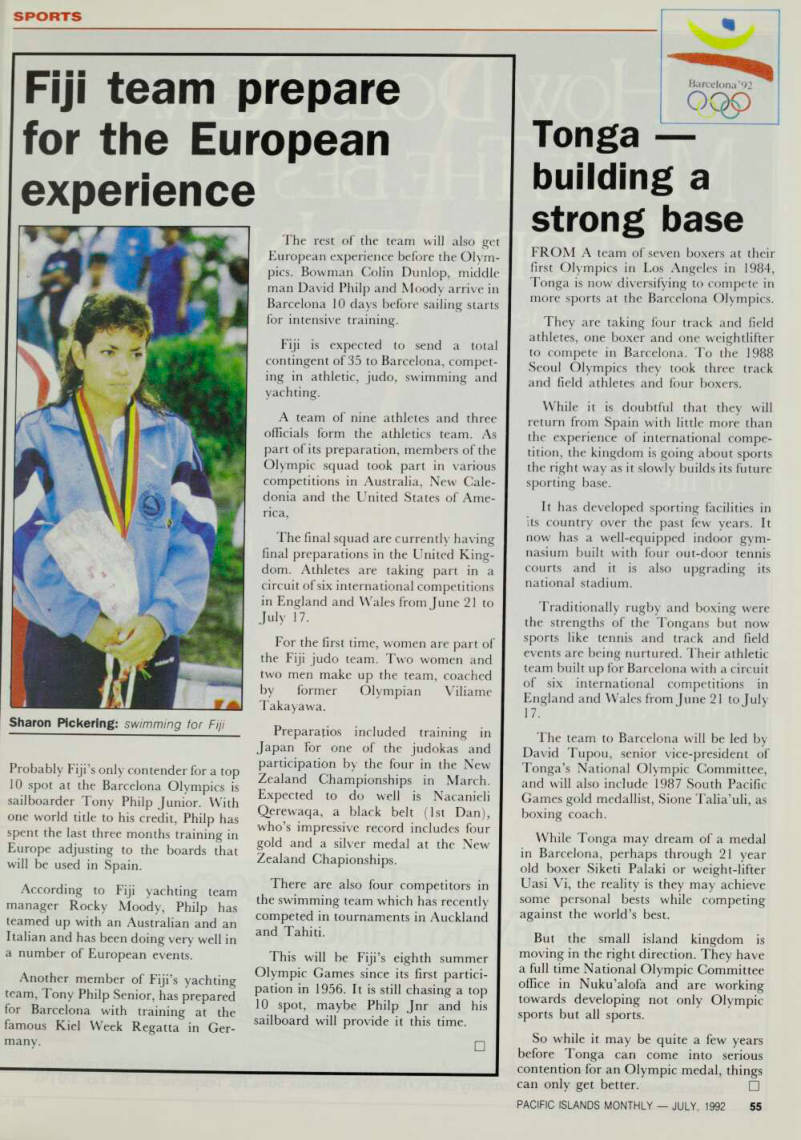
Fiji team prepare for the European experience
Probably Fiji’s only contender for a top 10 spot at the Barcelona Olympics is sailboarder Tony Philp Junior. With one world title to his credit, Philp has spent the last three months training in Europe adjusting to the boards that will be used in Spain.
According to Fiji yachting team
manager Rocky Moody, Philp has
teamed up with an Australian and an Italian and has been doing very well in a number of European events.
Another member of Fiji’s yachting team, Tony Philp Senior, has prepared for Barcelona with training at the famous Kiel Week Regatta in Ger many.
The rest of the team will also get European experience before the Olym pics. Bowman Colin Dunlop, middle man David Philp and Moody arrive in Barcelona 10 days before sailing starts for intensive training.
Fiji is expected to send a total contingent of 35 to Barcelona, compet ing in athletic, judo, swimming and
yachting.
A team of nine athletes and three officials form the athletics team. As part of its preparation, members of the Olympic squad took part in various competitions in Australia, New Cale donia and the United States of Ame rica, The final squad are currently having final preparations in the United King dom. Athletes are taking part in a circuit of six international competitions in England and Wales from June 21 to July 17.
For the first time, women are part of the Fiji judo team. Two women and two men make up the team, coached by former Olympian Viliame
Takayawa.
Preparatios included training in Japan for one of the judokas and participation by the four in the New Zealand Championships in March.
Expected to do well is Nacanieli Qerewaqa, a black belt (Ist Dan), who’s impressive record includes four gold and a silver medal at the New
Zealand Chapionships.
There are also four competitors in the swimming team which has recently competed in tournaments in Auckland and Tahiti.
This will be Fiji’s eighth summer Olympic Games since its first partici pation in 1956. It is still chasing a top 10 spot, maybe Philp Jnr and his sailboard will provide it this time.
Sharon Pickering: swimming for Fiji
building a
Tonga building a strong base
FROM A team of seven boxers at their first Olympics in Los Angeles in 1984, Tonga is now diversifying to compete in more sports at the Barcelona Olympics.
They are taking four track and field athletes, one boxer and one weightlifter to compete in Barcelona. To the 1988 Seoul Olympics they took three track and field athletes and four boxers.
While it is doubtful that they will return from Spain with little more than the experience of international compe tition, the kingdom is going about sports the right way as it slowly builds its future sporting base.
It has developed sporting facilities in its country over the past few years. It now has a well-equipped indoor gym nasium built with four out-door tennis courts and it is also upgrading its national stadium.
Traditionally rugby and boxing were the strengths of the Tongans but now sports like tennis and track and field events are being nurtured. Their athletic team built up for Barcelona with a circuit of six international competitions in England and Wales from June 21 to July 17.
The team to Barcelona will be led by David Tupou, senior vice-president of
Tonga’s National Olympic Committee,
and will also include 1987 South Pacific Games gold medallist, Sione Talia’uli, as boxing coach.
While Tonga may dream of a medal in Barcelona, perhaps through 21 year old boxer Siketi Palaki or weight-lifter Uasi Vi, the reality is they may achieve some personal bests while competing against the world’s best.
But the small island kingdom is moving in the right direction. They have a full time National Olympic Committee office in Nuku’alofa and are working towards developing not only Olympic sports but all sports.
So while it may be quite a few years before Tonga can come into serious contention for an Olympic medal, things can only get better. □
Advertisements & other items, p. 58 (1 item)
We Pour Technology
im i r A » A FVNFimm
COCKTAIL
FT:7I'TI
If ± IX 1
•ivMtit i ills 101
FLAVOUR
111111 l •it
UTRE ' .
((I
they make
tasty cheese
so deliciously
in
put real fruit
into yoghurt?
We Pour Technology
Into EverythingWe Make
Official Sponsor 1992 Olympic Team
OQO
Fprrrm rm If you need more information on Rewa Dairy's range of natural dairy products or Tetrapak packaging capabilities contact: Rewa Co-operative Dairy Company Ltd, PO Box 3678, Samabula, Suva, Fiji. Telephone: 381288. Fax: 370 190.
IHJFIO37
The best of Guam
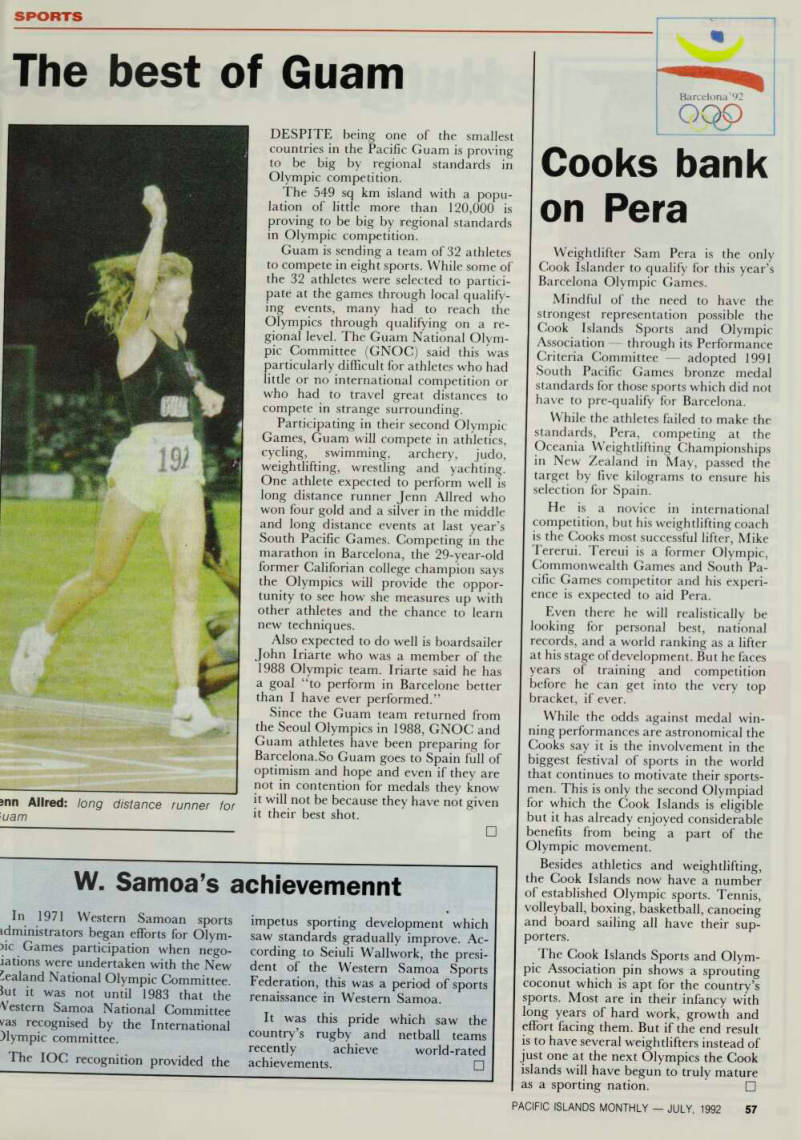
DESPITE being one of the smallest countries in the Pacific Guam is proving to be big by regional standards in
Olympic competition.
The 549 sq km island with a popu lation of little more than 120,000 is proving to be big by regional standards in Olympic competition.
Guam is sending a team of 32 athletes to compete in eight sports. While some of the 32 athletes were selected to partici pate at the games through local qualify ing events, many had to reach the
Olympics through qualifying on a re
gional level. The Guam National Olym pic Committee (GNOC) said this was particularly difficult for athletes who had little or no international competition or who had to travel great distances to compete in strange surrounding.
Participating in their second Olympic Games, Guam will compete in athletics, cycling, swimming, archery, judo,
weightlifting, wrestling and yachting.
One athlete expected to perform well is long distance runner Jenn Allred who won four gold and a silver in the middle and long distance events at last year’s South Pacific Games. Competing in the marathon in Barcelona, the 29-year-old former Califorian college champion says the Olympics will provide the oppor tunity to see how she measures up with other athletes and the chance to learn
new techniques.
Also expected to do well is boardsailer John Iriarte who was a member of the 1988 Olympic team. Iriarte said he has a goal “to perform in Barcelone better than I have ever performed.”
Since the Guam team returned from the Seoul Olympics in 1988, GNOC and Guam athletes have been preparing for Barcelona.So Guam goes to Spain full of optimism and hope and even if they are not in contention for medals they know it will not be because they have not given it their best shot.
[?]enn Allred: long distance runner for [?]uam
W. Samoa’s achievemennt
In 1971 Western Samoan sports idministrators began efforts for Olym pic Games participation when nego iations were undertaken with the New Zealand National Olympic Committee, iut it was not until 1983 that the Vestern Samoa National Committee yas recognised by the International )lympic committee.
The IOC recognition provided the
impetus sporting development which saw standards gradually improve. Ac cording to Seiuli Wallwork, the presi dent of the Western Samoa Sports Federation, this was a period of sports renaissance in Western Samoa.
It was this pride which saw the country’s rugby and netball teams recently achieve world-rated achievements. □
Cooks bank
on Pera
Weightlifter Sam Pera is the only Cook Islander to qualify for this year’s Barcelona Olympic Games.
Mindful of the need to have the strongest representation possible the Cook Islands Sports and Olympic Association through its Performance Criteria Committee adopted 1991 South Pacific Games bronze medal standards for those sports which did not have to pre-qualify for Barcelona.
While the athletes failed to make the standards, Pera, competing at the
Oceania Weightlifting Championships
in New Zealand in May, passed the target by five kilograms to ensure his selection for Spain.
He is a novice in international competition, but his weightlifting coach is the Cooks most successful lifter, Mike Tererui. Tereui is a former Olympic, Commonwealth Games and South Pa cific Games competitor and his experi ence is expected to aid Pera.
Even there he will realistically be looking for personal best, national records, and a world ranking as a lifter at his stage of development. But he faces years of training and competition before he can get into the very top bracket, if ever.
While the odds against medal win ning performances are astronomical the Cooks say it is the involvement in the biggest festival of sports in the world that continues to motivate their sports men. This is only the second Olympiad for which the Cook Islands is eligible but it has already enjoyed considerable benefits from being a part of the
Olympic movement.
Besides athletics and weightlifting, the Cook Islands now have a number of established Olympic sports. Tennis,
volleyball, boxing, basketball, canoeing
and board sailing all have their sup porters.
The Cook Islands Sports and Olym pic Association pin shows a sprouting coconut which is apt for the country’s sports. Most are in their infancy with long years of hard work, growth and effort facing them. But if the end result is to have several weightlifters instead of just one at the next Olympics the Cook islands will have begun to truly mature as a sporting nation. □
About the writer
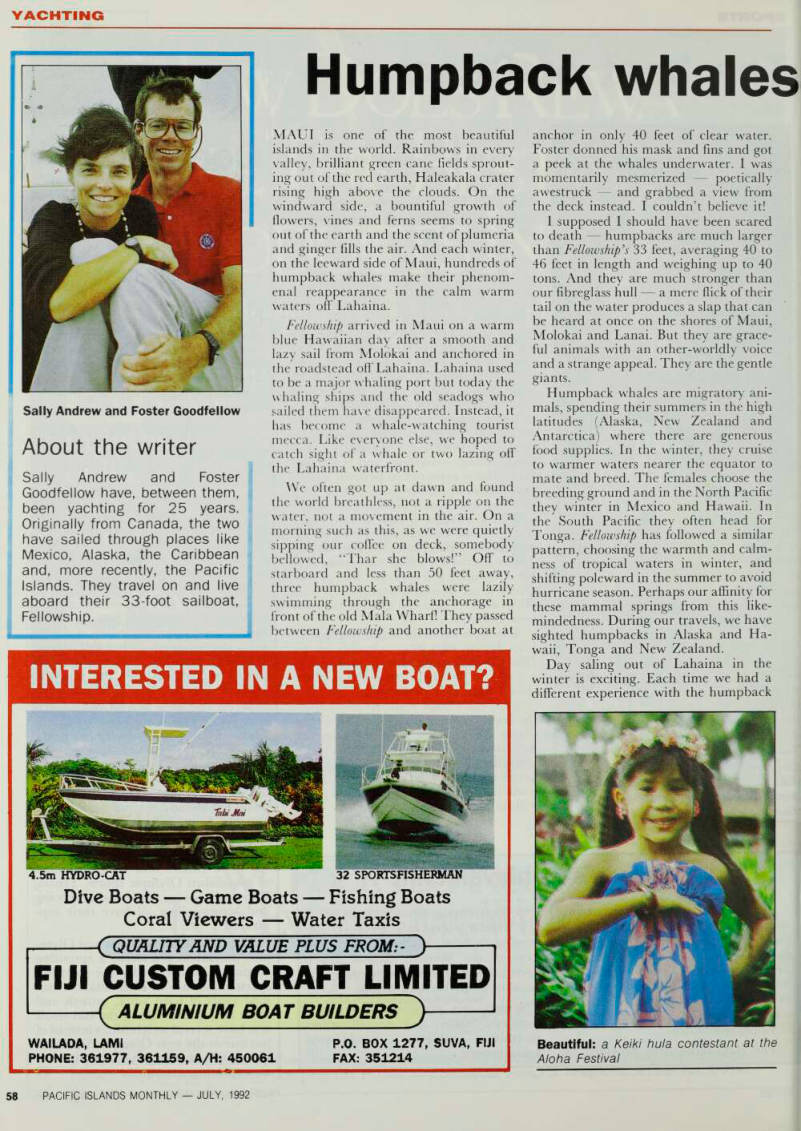
Sally Andrew and Foster Goodfellow have, between them, been yachting for 25 years.
Originally from Canada, the two have sailed through places like Mexico, Alaska, the Caribbean and, more recently, the Pacific Islands. They travel on and live aboard their 33-foot sailboat, Fellowship.
Sally Andrew and Foster Goodfellow
Humpback whales - the gentle giants
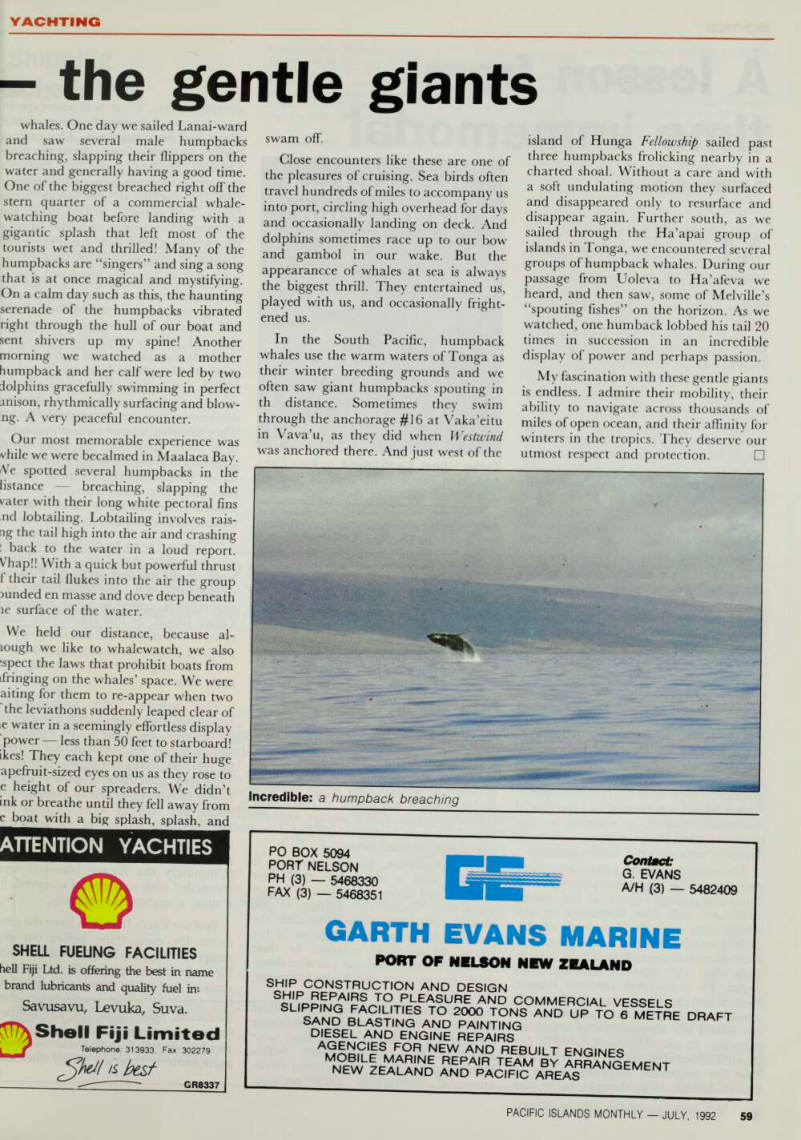
MAUI is one of the most beautiful islands in the world. Rainbows in every valley, brilliant green cane fields sprout ing out of the red earth, Haleakala crater rising high above the clouds. On the windward side, a bountiful growth of flowers, vines and ferns seems to spring out of the earth and the scent of plumeria and ginger fills the air. And each winter, on the leeward side of Maui, hundreds of humpback whales make their phenom enal reappearance in the calm warm waters off Lahaina.
Fellowship arrived in Maui on a warm blue Hawaiian day after a smooth and lazy sail from Molokai and anchored in the roadstead off Lahaina. Lahaina used to be a major whaling port but today the whaling ships and the old seadogs who sailed them have disappeared. Instead, it has become a whale-watching tourist mecca. Like everyone else, we hoped to catch sight of a whale or two lazing off the Lahaina waterfront.
We often got up at dawn and found the world breathless, not a ripple on the water, not a movement in the air. On a morning such as this, as we were quietly sipping our coffee on deck, somebody bellowed, k ‘Thar she blows!” Off to starboard and less than 50 feet away, three humpback whales were lazily swimming through the anchorage in front of the old Mala Wharf. They passed between Fellowship and another boat at
anchor in only 40 feet of clear water.
Foster donned his mask and fins and got a peek at the whales underwater. I was
momentarily mesmerized poetically
awestruck and grabbed a view from the deck instead. I couldn’t believe it!
I supposed I should have been scared to death humpbacks are much larger than Fellowship’s 33 feet, averaging 40 to 46 feet in length and weighing up to 40 tons. And they are much stronger than our fibreglass hull a mere flick of their tail on the water produces a slap that can be heard at once on the shores of Maui, Molokai and Lanai. But they are grace ful animals with an other-worldly voice and a strange appeal. They are the gentle giants.
Humpback whales are migratory ani mals, spending their summers in the high latitudes (Alaska, New Zealand and Antarctica) where there are generous food supplies. In the winter, they cruise to warmer waters nearer the equator to mate and breed. The females choose the breeding ground and in the North Pacific they winter in Mexico and Hawaii. In the South Pacific they often head for Tonga. Fellowship has followed a similar pattern, choosing the warmth and calm ness of tropical waters in winter, and shifting poleward in the summer to avoid hurricane season. Perhaps our affinity for these mammal springs from this like mindedness. During our travels, we have sighted humpbacks in Alaska and Ha waii, Tonga and New Zealand.
Day saling out of Lahaina in the winter is exciting. Each time we had a different experience with the humpback
Beautiful: a Keiki hula contestant at the Aloha Festival
whales. One day we sailed Lanai-ward and saw several male humpbacks
breaching, slapping their flippers on the
water and generally having a good time.
One of the biggest breached right off the stern quarter of a commercial whale watching boat before landing with a gigantic splash that left most of the tourists wet and thrilled! Many of the humpbacks are “singers” and sing a song that is at once magical and mystifying.
On a calm day such as this, the haunting serenade of the humpbacks vibrated right through the hull of our boat and sent shivers up my spine! Another morning we watched as a mother humpback and her calf were led by two
dolphins gracefully swimming in perfect
anison, rhythmically surfacing and blowi
ng. A very peaceful encounter.
Our most memorable experience was vhile we were becalmed in Maalaea Bay.
A/e spotted several humpbacks in the
listance breaching, slapping the
vater with their long white pectoral fins nd lobtailing. Lobtailing involves rais ng the tail high into the air and crashing : back to the water in a loud report.
Vhap!! With a quick but powerful thrust f their tail flukes into the air the group mnded en masse and dove deep beneath ic surface of the water.
We held our distance, because al lough we like to whalewatch, we also ;spect the laws that prohibit boats from fringing on the whales’ space. We were aiting for them to re-appear when two the leviathons suddenly leaped clear of e water in a seemingly effortless display power less than 50 feet to starboard! ikes! They each kept one of their huge apefruit-sized eyes on us as they rose to e height of our spreaders. We didn’t ink or breathe until they fell away from e boat with a big splash, splash, and
swam off.
Close encounters like these are one of the pleasures of cruising. Sea birds often trave i hundreds of miles to accompany us into port, circling high overhead for days and occasiona iiy ] andin „ on deck And dolphins sometimes race up to our bow and gambol in our wa ' ke But , hc appearancce of whales at sea is a , r™ , . , 7 \ th h ‘ entert * m ?? “ S ’ us US ’ 3 occaslonal ly f "ght- 1° the South Pacific, humpback whales use the warm waters of Tonga as their winter breeding grounds and we often saw giant humpbacks spouting in th distance. Sometimes they swim through the anchorage #l6 at Vaka’eitu * n ava u ’ as d ' d when Westwmd was anc^ored there. And just west of the
island of Hunga Fellowship sailed past three hum pbacks frolicking nearby in a charted shoal. Without a care and with a soft undula ting motion they surfaced and dlsa PP eared onl V to resurface and disappear again. Further south, as we $ T d f hr ° Ugh the Ha ’ a P ai grou P of islands m Tonga we encountered several of humpback whales During our passage Irom Uoleva to Ha afeva we heard, and then saw, some of Melville’s “spouting fishes” on the horizon. As we watched, one humback lobbed his tail 20 times in succession in an incredible display of power and perhaps passion, My fascination with these gentle giants j s endless. I admire their mobility their ability to navigate across thousands of miles of open ocean, and their affinity for winters in the tropics. They deserve our utmost respect and protection. □
Incredible: a humpback breaching
Advertisements & other items, pp. 60-61 (3 items)
Fiji Custom Craft Limited
INTERESTED IN A NEW BOAT?
TakiJta
4.5 m HYDRO-CAT
32 SPORTSFISHERMAN
Dive Boats Game Boats Fishing Boats
Coral Viewers Water Taxis
■C QUALITY AND VALUE PLUS FROM;- >
FIJI CUSTOM CRAFT LIMITED
( ALUMINIUM BOAT BUILDERS
WAILAOA, LAMi
PHONE: 361977, 361159, A/H; 450061
P.O. BOX 1277, SUVA, FIJI
FAX: 351214
- the gentle giants
59
PACIFIC ISLANDS MONTHLY JULY, 1992
YACHTING
Garth Evans Marine
ATTENTION YACHTIES
SHELL FUEUNG FACILITIES
hell Fiji Ltd. is offering the best in name brand lubricants and quality fuel in: Savusavu, Levuka, Suva.
Shell Fiji Limited Telephone 313933, Fax 302279 /Shell is. best -- GR8337
p 0 BOX 5094
PORT NELSON
PH (3) 5468330
FAX (3) 5468351
Contact
G. EVANS
A/H (3)
GARTH EVANS MARINE
PORT OF NELSON NEW ZEALAND
SHIP CONSTRUCTION AND DESIGN
TO PLEASURE AND COMMERCIAL VESSFI
SUf d FACILITIES TO 2000 TONS AND UP TO 6 mItRE
SAND BLASTING AND PAINTING
DIESEL AND ENGINE REPAIRS
A S?S£! CIES FOR NEW AND REBUILT ENGINES 5482409
DRAFT
time immemorial
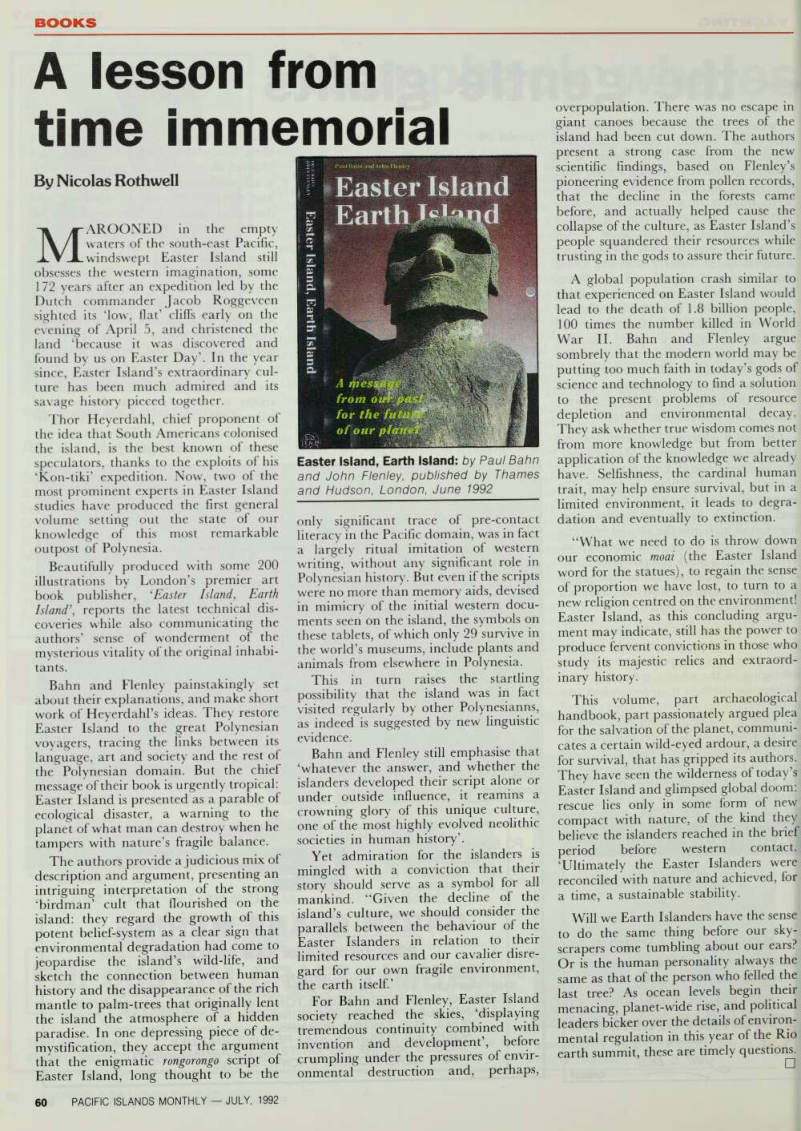
Books
A lesson from time immemorial
By Nicolas Rothwell
MAROONED in the empty waters of the south-east Pacific, windswept Easter Island still obsesses the western imagination, some 172 years after an expedition led by the Dutch commander Jacob Roggeveen sighted its ‘low, flat’ cliffs early on the evening of April 5, and christened the land ‘because it was discovered and found by us on Easter Day’. In the year since, Easter Island’s extraordinary cul ture has been much admired and its savage history pieced together.
Thor Heyerdahl, chief proponent of the idea that South Americans colonised the island, is the best known of these speculators, thanks to the exploits of his ‘Kon-tiki’ expedition. Now, two of the most prominent experts in Easter Island studies have produced the first general volume setting out the state of our knowledge of this most remarkable outpost of Polynesia.
Beautifully produced with some 200 illustrations by London’s premier art book publisher, ‘Easter Island, Earth Island’, reports the latest technical dis coveries while also communicating the authors’ sense of wonderment of the mysterious vitality of the original inhabi tants.
Bahn and Flenley painstakingly set about their explanations, and make short work of Heyerdahl’s ideas. They restore Easter Island to the great Polynesian voyagers, tracing the links between its language, art and society and the rest of the Polynesian domain. But the chief message of their book is urgently tropical: Easter Island is presented as a parable of ecological disaster, a warning to the planet of what man can destroy when he tampers with nature’s fragile balance.
The authors provide a judicious mix of description and argument, presenting an intriguing interpretation of the strong ‘birdman’ cult that flourished on the island: they regard the growth of this potent belief-system as a clear sign that environmental degradation had come to jeopardise the island’s wild-life, and sketch the connection between human history and the disappearance of the rich mantle to palm-trees that originally lent the island the atmosphere of a hidden paradise. In one depressing piece of de mystification, they accept the argument that the enigmatic rongorongo script of Easter Island, long thought to be the
only significant trace of pre-contact literacy in the Pacific domain, was in fact a largely ritual imitation of western writing, without any significant role in Polynesian history. But even if the scripts were no more than memory aids, devised in mimicry of the initial western docu ments seen on the island, the symbols on these tablets, of which only 29 survive in the world’s museums, include plants and animals from elsewhere in Polynesia.
This in turn raises the startling possibility that the island was in fact visited regularly by other Polynesians, as indeed is suggested by new linguistic evidence.
Bahn and Flenley still emphasise that ‘whatever the answer, and whether the islanders developed their script alone or under outside influence, it reamins a crowning glory of this unique culture, one of the most highly evolved neolithic societies in human history’.
Yet admiration for the islanders is mingled with a conviction that their story should serve as a symbol for all mankind. “Given the decline of the island’s culture, we should consider the parallels between the behaviour of the Easter Islanders in relation to their limited resources and our cavalier disre gard for our own fragile environment, the earth itself.’
For Bahn and Flenley, Easter Island society reached the skies, ‘displaying tremendous continuity combined with invention and development’, before crumpling under the pressures of envir onmental destruction and, perhaps,
overpopulation. There was no escape in giant canoes because the trees of the island had been cut down. The authors present a strong case from the new scientific findings, based on Flenley’s pioneering evidence from pollen records, that the decline in the forests came before, and actually helped cause the collapse of the culture, as Easter Island’s people squandered their resources while trusting in the gods to assure their future.
A global population crash similar to that experienced on Easter Island would lead to the death of 1.8 billion people, 100 times the number killed in World War II. Bahn and Flenley argue sombrely that the modern world may be putting too much faith in today’s gods of science and technology to find a solution to the present problems of resource depletion and environmental decay.
They ask whether true wisdom comes not from more knowledge but from better application of the knowledge we already have. Selfishness, the cardinal human trait, may help ensure survival, but in a limited environment, it leads to degra dation and eventually to extinction.
“What we need to do is throw down our economic moai (the Easter Island word for the statues), to regain the sense of proportion we have lost, to turn to a new religion centred on the environment!
Easter Island, as this concluding argu ment may indicate, still has the power to produce fervent convictions in those who study its majestic relics and extraord inary history.
This volume, part archaeological
handbook, part passionately argued plea
for the salvation of the planet, communi cates a certain wild-eyed ardour, a desire for survival, that has gripped its authors.
They have seen the wilderness of today s Easter Island and glimpsed global doom: rescue lies only in some form of new compact with nature, of the kind they believe the islanders reached in the brief period before western contact. ‘Ultimately the Easter Islanders were reconciled with nature and achieved, for a time, a sustainable stability.
Will we Earth Islanders have the sense to do the same thing before our sky scrapers come tumbling about our ears?
Or is the human personality always the same as that of the person who felled the last tree? As ocean levels begin their menacing, planet-wide rise, and political leaders bicker over the details of environ mental regulation in this year of the Rio earth summit, these are timely questions.
Easter Island, Earth Island: by Paul Bahn and John Flenley, published by Thames and Hudson, London, June 1992
Shipping
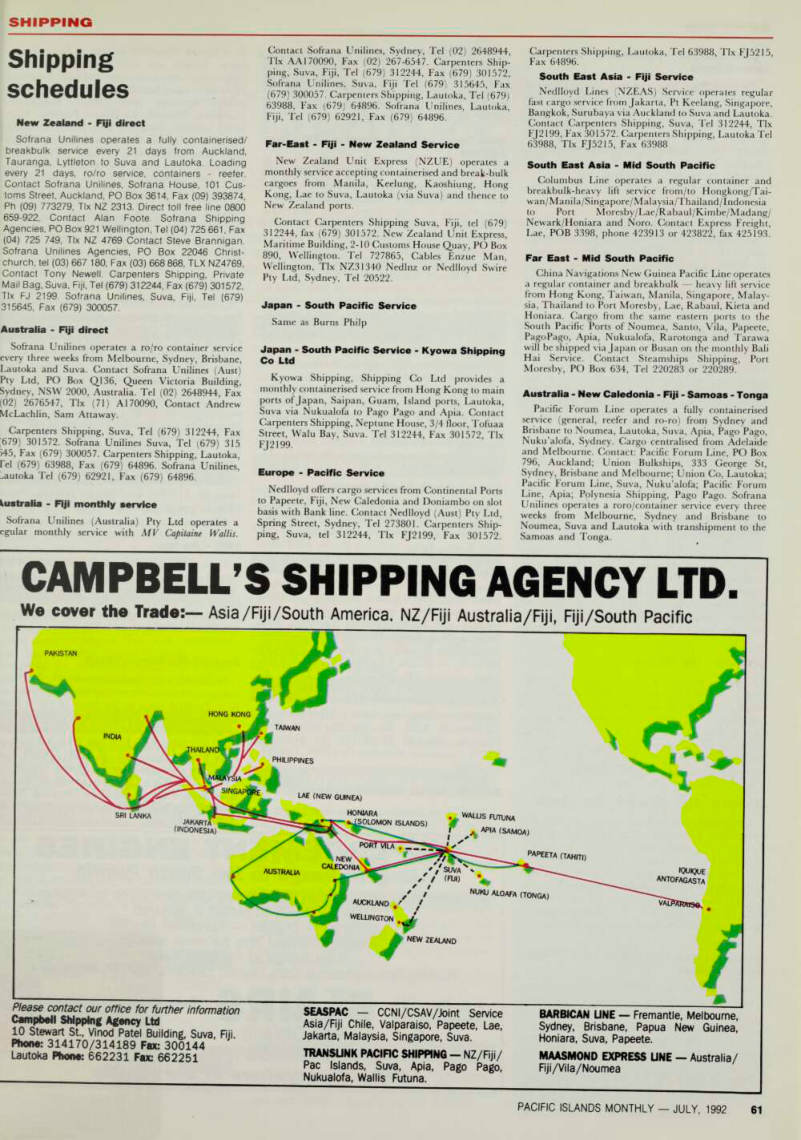
schedules
New Zealand - Fiji direct Sofrana Unilines operates a fully containerised/ breakbulk service every 21 days from Auckland, Tauranga, Lyttleton to Suva and Lautoka. Loading every 21 days, ro/ro service, containers - reefer.
Contact Sofrana Unilines, Sofrana House, 101 Cus toms Street. Auckland, PO Box 3614, Fax (09) 393874, Ph (09) 773279, Tlx NZ 2313. Direct toll free line 0800 659-922, Contact Alan Foote. Sofrana Shipping Agencies. PO Box 921 Wellington. Tel (04) 725 661, Fax (04) 725 749, Tlx NZ 4769 Contact Steve Brannigan.
Sofrana Unilines Agencies, PO Box 22046 Christ church, tel (03) 667 180, Fax (03) 668 868, TLX NZ4769, Contact Tony Newell. Carpenters Shipping, Private Mail Bag, Suva. Fiji, Tel (679) 312244, Fax (679) 301572, Tlx FJ 2199 Sofrana Unilines, Suva, Fiji, Tel (679) 315645, Fax (679) 300057.
Australia - Fiji direct Sofrana Unilines operates a ro/ro container service every three weeks from Melbourne, Sydney, Brisbane, Lautoka and Suva. Contact Sofrana Unilines (Aust) Pty Ltd, PO Box Q136, Queen Victoria Building, Sydney, NSW 2000, Australia. Tel (02) 2648944, Fax (02) 2676547, Tlx (71) A170090, Contact Andrew McLachlin, Sam Attaway.
Carpenters Shipping, Suva, Tel (679) 312244, Fax '679) 301572. Sofrana Unilines Suva, Tel (679) 315 >45, Fax (679) 300057. Carpenters Shipping, Lautoka, Pel (679) 63988, Fax (679) 64896. Sofrana Unilines, .autoka Tel (679) 62921, Fax (679) 64896.
Australia - Fiji monthly service Sofrana Unilines (Australia) Pty Ltd operates a egular monthly service with MV Capitaine Wallis.
Contact Sofrana Unilines, Sydney, Tel (02) 2648944, Tlx AA170090, Fax (02) 267-6547. Carpenters Ship ping, Suva, Fiji, Tel (679) 312244, Fax (679) 301572, Sofrana Unilines, Suva, Fiji Tel (679) 315645, Fax (679) 300057. Carpenters Shipping, Lautoka, Tel (679) 63988, Fax (679) 64896. Sofrana Unilines, Lautoka, Fiji, Tel (679) 62921, Fax (679) 64896.
Far-East - Fiji - New Zealand Service New Zealand Unit Express (NZUE) operates a monthly service accepting containerised and break-bulk cargoes from Manila, Keelung, Kaoshiung, Hong Kong, Lae to Suva, Lautoka (via Suva) and thence to New Zealand ports.
Contact Carpenters Shipping Suva, Fiji, tel (679) 312244, fax (679) 301572. New Zealand Unit Express, Maritime Building, 2-10 Customs House Quay, PO Box 890, Wellington. Tel 727865, Cables Enzue Man, Wellington, Tlx NZ31340 Nedlnz or Nedlloyd Swire Ply Ltd, Sydney, Tel 20522.
Japan - South Pacific Service Same as Burns Philp Japan - South Pacific Service - Kyowa Shipping Cos Ltd Kyowa Shipping, Shipping Cos Ltd provides a monthly containerised service from Hong Kong to main ports of Japan, Saipan, Guam, Island ports, Lautoka, Suva via Nukualofa to Pago Pago and Apia. Contact Carpenters Shipping, Neptune House, 3/4 floor, Tofuaa Street, Walu Bay, Suva. Tel 312244, Fax 301572, Tlx FJ2199.
Europe - Pacific Service Nedlloyd offers cargo services from Continental Ports to Papeete, Fiji, New Caledonia and Doniambo on slot basis with Bank line. Contact Nedlloyd (Aust) Pty Ltd, Spring Street, Sydney, Tel 273801. Carpenters Ship ping, Suva, tel 312244, Tlx FJ2199, Fax 301572.
Carpenters Shipping, Lautoka, Tel 63988, Tlx FJ5215, Fax 64896.
South East Asia - Fiji Service Nedlloyd Lines (NZEAS) Service operates regular fast cargo service from Jakarta, Pt Keelang, Singapore, Bangkok, Surubaya via Auckland to Suva and Lautoka.
Contact Carpenters Shipping, Suva, Tel 312244, Tlx FJ2199, Fax 301572. Carpenters Shipping, Lautoka Tel 63988, Tlx FJ5215, Fax 63988 South East Asia - Mid South Pacific Columbus Line operates a regular container and breakbulk-heavy lift service from/to Hongkong/Tai wan/Manila/Singapore/Malaysia/Thailand/Indonesia to Port Moresby/Lae/Rabaul/Kimbe/Madang/ Newark/Honiara and Noro. Contact Express Freight, Lae, POB 3398, phone 423913 or 423822, fax 425193.
Far East - Mid South Pacific China Navigations New Guinea Pacific Line operates a regular container and breakbulk heavy lift service from Hong Kong, Taiwan, Manila, Singapore, Malay sia, Thailand to Port Moresby, Lae, Rabaul, Kieta and Honiara. Cargo from the same eastern ports to the South Pacific Ports of Noumea, Santo, Vila, Papeete, PagoPago, Apia, Nukualofa, Rarotonga and Tarawa will be shipped via Japan or Busan on the monthly Bali Hai Service. Contact Steamships Shipping, Port Moresby, PO Box 634, Tel 220283 or 220289.
Australia - New Caledonia - Fiji - Samoas - Tonga Pacific Forum Line operates a fully containerised service (general, reefer and ro-ro) from Sydney and Brisbane to Noumea, Lautoka, Suva, Apia, Pago Pago, Nukualofa, Sydney. Cargo centralised from Adelaide and Melbourne. Contact: Pacific Forum Line, PO Box 796, Auckland; Union Bulkships, 333 George St, Sydney, Brisbane and Melbourne; Union Cos, Lautoka; Pacific Forum Line, Suva, Nukualofa; Pacific Forum Line, Apia; Polynesia Shipping, Pago Pago. Sofrana Unilines operates a roro/container service every three weeks from Melbourne, Sydney and Brisbane to Noumea, Suva and Lautoka with transhipment to the Samoas and Tonga.
New Zealand - Australia - PNG - Sol omon Islands Pacific Forum Line operates a containerised and ro-ro service from Lyttleton, Napier and Auckland to Brisbane, Port Moresby, Lae, Honiara, Brisbane then to New Zealand.
Contact: Pacific Forum, Auckland, Christ church; Union Bulkships, Brisbane; Steamships Shipping Port Moresby and Lae Sullivan Ltd,
Honiara; Seabridge, Wellington.
NZ - Fiji Translink Pacific Shipping Fiji Agents are: Campbells Shipping Agency Ltd, Ph 314189 Fax 300144 Suva; Ph 662231 Fax 662251 Lautoka.
Auckland Agents: McKay Shipping Ph (9)
390229 Fax (9) 3032931. Tauranga Agents,
seatrade agencies Ph (75) 754989 Fax (75) 758380.
NZ - Fiji - Pago - Apia - Nuk Translink Pacific Shipping operates a monthly sailing with Polynesian Link, which carries Dry Container, reefers and breakbulk cargoes. NZ
Agents McKay Shipping Shipping AKLD Ph
390229, Fax 3032931. Fiji Agents Campbells
Shipping Agency & ltd Ph 314189 Fax 300144 NZ - Noumea - Wallis - Futuna Translink Pacific Agency operate a container Breakbulk service once a month from NZ through Fiji and Noumea to Wallis & Futuna.
South East Asia - Fiji - Noumea - Papeete - Chile Service
“Seaspac” A joint Chilean CCNI/CSAU
Service offers a regular monthly sailing from
Djakarta and Singapore to Noumea, Fiji,
Papeete, and Chile. Cargo also federated to
Singapore from Korea, Hong Kong, Taiwan,
Malaysia, Bangkok. Fiji Agents: Campbells
Shipping Agency Ltd, ph. 314189, Fax 300144.
Australia - Fiji Service Chief container services under Australia Pacific Island Line Unitize Sofrana and PFL vessels to provide a twice monthly, service from
Australia. Fiji Agents Campbells Shipping
Agency Ltd Ph 314189 Fax 300144. System
Agents Nedlloyd Swire Ph(2) 2512699. Mel
bourne Yarra Shipping Ph (3) 6936300. Bris
bane, Nedlloyd Swire, ph (7) 8321551.
Australia - Fiji - Noumea - Vila - Santa Marsmond Express Lines operate a breakbulk service from Goodwood Island Australia to Fiji, Noumea, Vila Santo and Honiara. Continuous receiving depots in Sydney and Brisbane enable this vessel to bring cargoes from these parts. Fiji
Agents Campbells Shipping Agency Ltd, ph.
314189, Fax 300144. Brisbane Agents Ship pings & Marketing Ph (7) 2628082. Sydney
Agents Seabord Agencies (2) 3172325.
Australia - New Caledonia - Fiji - Hawaii - North America ACT Pace Pacific (ACTA Shipping) operates a fully containerised/break bulk service every 17-20 from Melbourne, Sydney, Brisbane to Noumea, Suva and Lautoka. The vessels con tinue on to the West Coast of North America calling Honolulu at frequent intervals. Ships are ACT and ACT 12. Contacts: ACTA Pty Ltd, Sydney Ph 2869666, Tx 121369, Fx 2869610.
ACTA Pty Ltd, Melbourne Ph 6112000, Tx
30949, Fx 6293055. ACTA Pty Ltd, Brisbane Ph 2213116 m Tx 40719, Fx 2298143. SATO, Noumea Ph 281122, Tx 3163, Fx 278532. Burns Philp Shipping, Suva Ph 311777, Tx 2168, Fx 301127; Burns Philp Shipping, Lautoka Ph 60777, Tx 5146, Fx 65850.
West Coast of North America - Fiji - New Zealand Blue Star Line Pacific Coast Service operates a fully containerised/break bulk service every 23 days from Vancouver, Seattle, San Francisco, Los Angeles to Pago Pago, Suva and New Zealand ports. The vessels continue to call Suva on the Northbound voyage from New Zealand every fortnight to pick up Fiji exports such as garments, fresh ginger, etc. for Hawaii and West Coast of North America ports. Blue Star Line also provides a through service to East Coast to North America. Ships are Wellington Star, Southland Star and California Star. Contacts: Blue Star Line, San Francisco Ph 9282026, Tx 184925, Fx 6730355; Blue Star Line, Vancouver Ph 6817300, Tx 0451326, Fx 6835797; Interocean Steamship Corp, Seattle Ph 6829820, Tx 321101, Fx 3437421; Blue Star Line, Los Angeles Ph 5970454, Tx 408564, Fx 5978710.
New Zealand Line, Wellington, Ph 739029, Tx 3583, Fx 4992468; New Zealand Line, Auckland Ph 390965, Tx 2556, Fx 3032039; Burns Philp Shipping, Suva Ph 311777, Tx 2168, Fx 301127; Burns Philp Shipping, Lautoka Ph 60777, Tx 5146, Fx 65850.
Japan - South Pacific Service Bali Hai Line a joint service of China Navigation, Mitsui OSK Line and NYK Line operates a fully containerised/break bulk service from Korea, Japan to South Pacific ports on a monthly basis serving ports of Pusan, Kobe, Nagoya, Yokohama, Tarawa, Lautoka, Suva,
Apia, Pago Pago, Papeete, Nuku’alofa, Noumea,
Vila, Santo. The ships are also fully specialised to carry vehicles on ro/ro basis. Ships are Coral Islander and Pacific Islander. Contacts: John Swire & Sons, Tokyo Ph 32309220, Tx 22248, Fx 3239288; Nippon Yusen Kaisha, Tokyo Ph 3284516, Tx 22236, Fx 32846332; Mtsul OSK Lines, Tokyo Ph 35877086, Tx 22266, Fx 35877732; Burns Philp Shipping, Suva (C/Islander) Ph 311777, Tx 2168, Fx 301127;
Carpenters Shipping, Suva (P/Islander) Ph
312244, Tx 2199, Fx 301572; Burns Philp Shipping, Lautoka Ph 60777, Tx 5146, Fx 65850; Carpenters Shipping Ph 63988, Tx 5215, Fx 64896.
Europe - South Pacific Service Bank Line Limited operates a monthly service
from United Kingdom, Europe to South Pacific ports. Vessels are fully equipped to carry containers, break bulk cargo and have deep tank facilities to carry bulk liquid such as oil, etc. The service operates from Hull, Rotterdam, Hamburg, Dunkirk, Le Havre, Papeete, Apia, Suva, Lautoka, Noumea, Vila, Santo, Honiara, Papua New Guinea Group, Singapore and back
to Europe/Continent. Ships: Forthbank,
Ivybank, Clydebank, Moraybank. Contacts:
Bank Line, London Ph 2650808, Tx 887392, Fx 4814784, Bank Line, Lae Ph 421235, Tx 44265, Fx 422925; Bank Line, Sydney, Ph 9063173, Tx 24063, Fx 9061430; Burns Philp Shipping, Suva Ph 31 1777, Tx 2168, Fx 301127; Burns Philp Shipping, Lautoka Ph 60777, Tx 5146, Fx 65850.
Europe - Pacific Service Columbus Line services Continental ports to Papeete and Noumea on slotbasis with CGM.
Contact AMI, Papeete, phone 428972, fax 432184; CGM, Noumea phone 687 273321, fax 687 274183.
Australia - Vanuatu - Fiji Sitmar Cruises operates a year round cruise programme for Sydney to Vanuatu, Fiji. The programme also includes a number of calls to a number of islands such as Dravuni, Yasawa-i- Rara, Rotuma, Mystery Island, etc.
Contact: Sitmar Cruises, Sydney Ph 2560111, Tx 20712, Fx 2560101; Burps Philp Shipping, Suva Ph 311777, Tx 2168, Fx 301127; Burns Philp Shipping, Lautoka Ph 60777, Tx 5146, Fx 65850.
PNG - Europe Columbus Line offers regular and fast services from Lae to Genoa/Marseile/Antwerp/
Felixstowe/Hamburg/Bremen/Dunkirk/Le
Havre and Algeciras on slot basis with CGM.
Contact Express Freight, Lae,, POB 3398, phone 423913 or 423822, fax 425193.
Aust/NZ-Fiji-Samoa-Tonga W Islands Line operate breakbulk, FCL and refrigerated container service from Australia and New Zealand ports to the ports of Apia, Pago pago, Nukualofa, Vavau, Suva and Lautoka.
Aust agents: Mainstar Maritime Agencies, Ph (612) 317 2356, Fax (612) 669 5704. NZ Agents: Niue Trading Company, Ph (649) 790935, Fax (649) 790949. Apia agent; Morris Hedstrom.
Vavau: W Islands Line. Nukualofa, W Islands Line. Pago Pago: Burns Philp Shipping. Suva/ Lautoka: Bilibili Shipping. USD
Advertisements & other items, pp. 63-66 (1 item)
Campbell’S Shipping Agency Ltd.
We cover the Trade;— Asia/Fiji/South America. NZ/Fiji Australia/Fiji, Fiji/South Pacific
PAKISTAN
HONG KONG
TAIWAN
INDIA
LAN
• 4*
PHILIPPINES
u x
LAE (NEW GUINEA)
HONIARA
»JSOLOMON ISLANDS)
WALUS FUTUNA
LANKA
, JAKARTA
(INDONESIA)
A APIA (SAMOA)
I ' \
PAPEETA (TAHITI)
1 NEW V
caledoniaV
/ / SUVA ' V—
/ / (ail)
/ NUWJ ALOAEA (TONGA)
iquique
ANTOFAGASTA
AUSTRALIA
AUCKLAND
WELLINGTON .
NEW ZEALAND
Please contact our office for further information
Campbell Shipping Agency Ltd
10 Stewart St., Vinod Patel Building, Suva, Fiji.
Phone: 314170/314189 Fax: 300144 Lautoka Phone: 662231 Fax: 662251 SEASPAC CCNI/CSAV/Joint Service Asia/Fiji Chile, Valparaiso, Papeete, Lae, Jakarta, Malaysia, Singapore, Suva.
TRANSUNK PACIFIC SHIPPING - NZ/Fiji/
Pac Islands, Suva, Apia, Pago Pago, Nukualofa, Wallis Futuna.
BARBICAN LINE Fremantle, Melbourne, Sydney, Brisbane, Papua New Guinea, Honiara, Suva, Papeete.
MAASMOND EXPRESS UNE - Australia/
Fiji/Vila/Noumea
REPLACEMENT ENGINES
Largest Range In the South Pacific Over 800 engines available: Diesel-Gasoline lOhp to 400 hp Transmission to match if required Japanese English European Models Engine Overhaul Kits for most r Huge Range of Parts on ha Kumho Tyre Importers Cars-Trucks, Loaders P.O. Box 14 Geraldine HZ
BLAIRS
Telep New Zealand Established 34 years IVe ship anywhere In the NAT lON A 1
LIBRARY OF AUSTRALI
ACIFI
ISLANDS
M O N T H
RRKCT PLflC
For the benefit of our readers who would like to place a small classified advertisement in our magazine, Market Place will assist you in selling personal items, accommodation, real estate, boating or a service ... in fact anything you would like to sell to our over 50,000 readers.
Market Place Advertising Rates are structured to allow you to place as many advertisements as you wish, economically.
FISHING VESSEL
L 24) PROCESSING FISHING VESSEL, built
987, aluminium, 95’ (28m), DNV Class, very Dod accommodation for 15, Cat main engine, efrig comprises blast tunnel, glazing room, ackaging room and 3 large storage freezers.
HARTER CRAFT MARINE, BC/15 Tedder Av,
ain Beach Q 4217 Australia. Phone 1-75-916334 Fax 61-75-329788
BARGE FOR SALE
■l5) LANDING BARGE, 90’ (27m), carrying ipacity 120 tons. Twin GM BV7I main igines, good accom, large fuel & water cargo
ipacity. CHARTER CRAFT MARINE, BC/15
dder Av, Main Beach, Q 4217 Aust. Ph.
L-75-916334 Fax 61-75-329788.
BOOKS
bliophile, a secondhand bookshop in Sydney, keen to buy good books on the Pacific. Also, rrent book catalogue “Pacific & Southeast ia” now available free on request, bliophile, 24 Glenmore Road, Paddington, >W 2021, Australia. Ph. 61 2 331 1411.
X 61 2 361 3371.
YACHT
uising Yacht required. Late 92 Ex Canton to plore Phoenix Group. Share cost basis. For )re info. D. Miles, 306 Highsted Road, ristchurch 5, New Zealand.
WANTED
- are seeking an AGENT in your area to
pply VEGETABLE IVORY NUT PALM SEEDS,
ent would be required to supervise collecn, drying and bagging for export. For further ormation contact: D. WILKINSON, PO BOX
5, ROUND CORNER, 2158, NEW SOUTH
AUSTRALIA. PHONE 61 2 8993988,
K 61 2 6344507.
ADVERTISEMENT
lILPALS Philatelics/Penpals Magazine >92 issue SUSS >9l issue SUS 3 nd for your copy to: ilpals, Box 6508, Nasinu.
“TRAVEL VIDEOS’’
lA-PACIFIC VIDEOS. Write: Santoi (PIM), Box 1, Waimanalo. Hawaii 96795.
COMMERCIAL VESSELS FOR SALE
Due to Licence restrictions, approximately 60 modern, steel & timber, Gulf of Carpentaria trawlers will be available to Pacific. Islands beginning in September at drastically reduced prices. Sizes range from 50 to 100 feet. Write or call Ben Lexcen Brokers, Doug Meyer, 1 Jodrell St. Innisfail, Queensland Australia 4860 (70) 614601 Delivery available.
FLYING CAREERS
Flight Attendants, Pilots. Career into Pacific, NZ, Australia, Asia Airlines. Free info, Aviation Professionals, Box 28051, Remuera, Auckland, Phone (64-9) 522-1330, Fax (64-9) 522-0380.
NEW BOOK!
TAKE NECESSARY ACTION authors Chris & Louise Harkness ex PNG. Available from publishers: Robert Brown & Assoc. 7 Atherton St Buranda Qld 4102 Australia. Hardcover 352 pages. Exciting PNG Highlands Fiction set pre-Independence era. $24.95 plus postage $5 Aust. $9.50 Overseas.
CONSULTANT
Resort Consultant, increase your profits with our on-site Management and Marketing, Resortcorp, PO Box 2292, Kamuela, Hawaii 96743.
SCRAP METAL
Tall ingots operate from Brisbane, Australia and make frequent visits to the Pacific Islands which they have done for twenty-five years. We are buyers of Copper, Brass, Aluminium, Lead, Cable etc. Inspection no problems. Telephone 61 7 8922033. Fax 61 78922077.
TRAVEL GUIDES
Australian citizen planning to move to Fiji early 1993 seeks partnership or purchase small business in tourism or manufacturing preferably in western district.
Have considerable business experience and used to hard work.
Visiting Fiji July/August 1992.
John Gardner, 1/43 Beach Rd, Brighton SA 5048 Australia.
FOR SALE
Generator 270 KVA 3Ph 415 V: Mirroless/ Brush TL6 MX2. Auto start and switch over. As new unit $U545,000 Ph No. 61-3-8897.
TATTOO SUPPLY
Everything. Write for price list. Tattoo Supply.
P.O. Box 3068 Clontarf, Australia. Old. 4019.
SURVEYOR
with 20 years experience in topographic, subdiv., egineering surveys in Europe, Libya, Indonesia, PNG, Nauru, Australia seeks employment in Pacific Region. C.V. & references available. Stanislaw Nowak, 6/44 Dalton Street, CAIRNS 4870, AUSTRALIA, Phone: 070-546954.
PACIFIC
SLANDS
fMONT H L Y I
MRRKCT PLRC€ CRN WORK
WONDCRS FOR VOU ...
Promote your business, or service, sell your household
items, cars or heavy machinery
etc.
ONLY AUSSI PER WORD.
NO COMPANY LOGO. NO
DISPLAY. NO BOLD TYPE.
Just toward your Advertisement together with payment to: PACIFIC ISLANDS MONTHLY "Market Place ", P.O. Box 1167, Suva, Fiji.
CONDITIONS:
1- All Advertisements are subject to acceptance and approval of publisher. 2. Advertisements are published as space permits; we cannot guarantee date of insertion. 3. All advertisements must be prepaid and should be typed or printed clearly. 4. Deadline for receipt of advertisements is the 10th of the month prior to issue.
5. PACIFIC ISLANDS MONTHLY
assumes no responsibility for any service other than publishing paid advertisements in this section.
here we were first in < ' first 75 years.
1985 First place in the world’s most gruelling rally; Mitsubishi Pajero/Montero overall winner Paris-Dakar in the unmodified 4WD production class. 1986 First for the year: Pajero/Montero.
Received 4x4 top award of the year from “4 x 4 Australia” and “Bushdriver” magazines, UK’s “What Car” magazine, and was voted Car of the Year in Spain. 1987 First automobile manufacturer in the world to be awarded the Blue Environment Seal by a jury: for the invention of an active carbon filter system for the fuel tank inlet. Evaporating fuel is trapped and channelled to the engine after starting. 1987 First needle-bearing roller rocker arm in the world. It significantly increases engine efficiency. In contrast to conventional rocker arms, the needle roller cuts power needed for valve control by 30 to 50 percent, reducing fuel consumption and improving torque. 1987 First car in the world with permanently integrated 4WD, 4WS, 4ABS and 4-wheel independent suspension: the Mitsubishi Galant GTi 16V Dynamic-4. 1989 First Import Car of the Year in the USA: the Mitsubishi Galant. Awarded by the prestigious “Motor Trend” magazine. 1990 First electronic trace and traction control system (TCL) in the world: fitted to the Mitsubishi Sigma. 1991 First linear air-fuel ratio sensor; the Mitsubishi Vertical Vortex Engine (MW).
Ensures optimal air-fuel mix at any revs. 1992 First, second and third places in the Paris-Cape Town Rally. The Mitsrjushi Pajero/Montero sweeps overall honours.
First Japanese passenger car to go into series production: the Mitsubishi Model-A with 35 ps. Room for seven passengers.
First truck from Mitsubishi: four prototypes were developed, two three-tonners and two four-tonners.
First Japanese vehicle diesel engine: the Mitsubishi 450 AD. The success of this direct injection engine made Mitsubishi the pacesetter in the commercial vehicle sector.
First large bus: the Mitsubishi 846. Japan’s biggest (38 seats) and most powerful (100 ps) bus. It heralded the start of Mitsubishi’s production line buses.
First Japanese 4WD passenger car powered by a diesel engine: the Mitsubishi PX33.
First Japanese diesel-driven bus: the Mitsubishi 8D46. Powered by a newly developed pre-combustion type diesel engine.
First Japanese diesel-powered truck in series production: the Mitsubishi TD 45.
First service bus with electric drive: the Mitsubishi MB 46.
First rear-engine Japanese bus in series production; the Mitsubishi Fuso Rl.
Delivered 130 ps and seats 76 passengers.
First Japanese truck with 8 ton load capacity: it featured a revolutionary suspension, which became the forerunner of the air-suspension system for commercial vehicles.
First Japanese tilt-cab truck with a load capacity of 8 tons: the Mitsubishi T3BO.
Today’s heavy-duty truck range traces its roots back to this medium to long-range hauler.
1960 First Japanese family car aerodynamically designed in a wind tunnel: the Mitsubishi 500. Forefather of the Mitsubishi Colt. 1961 First prize in the annual Japan Machinery Academy Award for the 4DP diesel engine.
Regarded as the most efficient of its class. 1962 First self-loading truck in the world: the Mitsubishi Self-Loader. 1963 First high-speed sightseeing bus: the MARB2O. Equipped with the world’s most powerful turbochaiged diesel engine (290 ps), and capable of 134 km/h. 1965 First Japanese fastback passenger car; the Mitsubishi Colt 800. 1967 First 8 ton truck with a top speed of over 115 km/h; the TBlO. Powered by the 6 DC 2 engine. 1975 First vibration-free differential shaft in the world: the Silent Shaft technology.
Two differential shafts run with double revs, rotating a reciprocal crankshaft.
They ensure silky smooth running. Many leading competitors acquired the license from Mitsubishi. 1980 First Japanese turbochaiged diesel engine for passenger cars: Astron 2300. First used in the Mitsubishi Galant. 1982 First automobile manufacturer in the world to offer a complete product range of turbo engines. Used in the Mitsubishi Colt, Lancer, Galant, Sapporo and Starion. 1982 First engine in Japan with modulated engine displacement: Orion 1400 MD.
First used in the Mitsubishi Lancer. 1984 First ranking automobile in Germany: the Mitsubishi Galant. Received the prestigious West German automobile award “Das Goldene Lankrad.”
: challenge of being first. It has always sparked latural competitive instinct in Mitsubishi tors. From Japan’s first series production car, Model-A, to the Galant Dynamic-4, the world’s t production car to incorporate both 4 wheel /e and 4 wheel steering, we have consistently sued our goals with a singular determination >e the best. lut for all the pleasure we receive in being first h technological breakthroughs, our primary goal ot merely to finish ahead of everyone else. Rather, pursuit of accolades is designed to keep us sharp 1 innovative, a necessity today as we face the challenge of building cars which are safer for both human beings and the environment.
Most recently, this has led to research in the HSR-111, an entirely recyclable car emphasising safety and environmental efficiency. Among its many advanced functions, the HSR-111 monitors the level of driver concentration, reads speed signs, and registers and corrects its position in relationship to both painted lanes and other vehicles on the highway.
Our research in the HSR-111 is only one of the ways Mitsubishi Motors is investing in a future which we believe will lead to many more firsts.
PACIFIC MARKETING INC. RO Box 698. Pago Pago. Tel 699-9140 / AUSTRALIA: MITSUBISHI MOTORS AUSTRALIA LTD. 1284 South Road. Clovelly Park, South Australia, Tel (08) 2757297 1 FU1: NIVIS MOTOR & MACHINERY G.RO Box 150. Suva. Tel 383411 / GUAM; GUAM INTERNATIONAL MOTORS INC. PO. 80x8638. Tamumng Guam, Tel 6467622 I NEW CALEDONIA; SOCIETE DTMPORTATION D'AUTD DU S.A. PO 80x2548, Noumea. 44 / NEW ZEALAND: MITSUBISHI MOTORS NEW ZEALAND LTD Private Bag Ponrua, Tel 237-0109 / NORFOLK ISLAND: BORRY’S PTY LTD. PO Box 169, Tel. 2114 / PAPUA NEW GUINEA: TOBA PTY LTD, PO 74 / SAIPAN: E'SAIPAN MOTORS INC. PO Box 569. Tel. 234 7343 / SOLOMON ISLANDS: HARVEST PACIFIC LTD. G.RO. Box 823, Honiara. Tel 30407 / TAHITI (FRENCH POLYNESIA): SOPADEP SA. Papeete Tel 4273 M/ TONGA: 4API CO., LTD. PO Box 83, Nuku'Alola. Tel 24044 / VANUATU: SOCOMETRA VANUATU LTD. B.P 06 Route de Lagon. Port-Vila, Tel. 2314 / WESTERN SAMOA: MOTOR DISTRIBUTORS (SAMOA) LTD. RO. Box 576, Apia. Tel 20957 A
MITSUBISHI
MOTORS