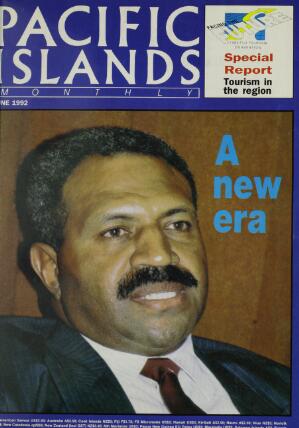
Pacific
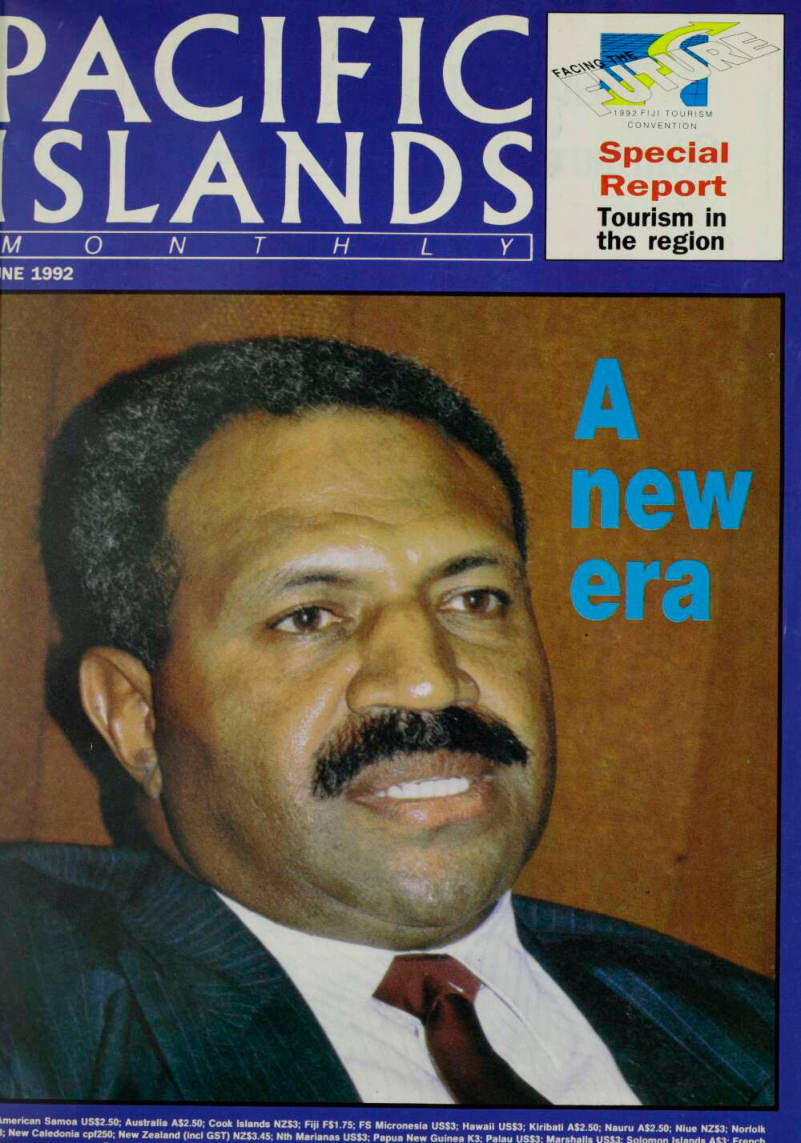
Islands
Monthy
NE 1992
6 I f ll if fi m. m m I
US il“i. AU, ? Sl i a A *?; so , : J?°° k l,,an< ' B NZS3; Fifl Fsl7s; FS Microncsia U SH; Hawaii US$3; Kiribati A 52.50; Nauru A 52.50; Niue NZ$3; Norfolk . Caledonia cpf2so, New Zealand (Incl GST) NZ53.45; Nth Marianas US$3; Papua New Guinea K 3; Palau US$3: Marshalls US$3: Solomon Islands AM- French
Advertisements & other items, p. 2 (1 item)
Communication Equipment in Fiji.
Post & Telecom Mean Total
•■■IB IdStar niriM Cl - k % V 00* * To do effective business in Fiji means having the best communication equipment available.
And that's where Fiji Post & Telecom can help.
For Post & Telecom can provide anything from a single line telephone system, to the latest digital PABX, with all the after-sale service and training
you require.
So if you are looking for communication equipment in Fiji, look no further than Post & Telecom. ?
FIJI POST & TELECOMMUNICATIONS LTD.
SUVA: 304019, 304443, FAX: 210527, TELEX: 2188FJ. LAUTOKA: TEL: 662111, FAX; 666600, TELEX; 5145FJ.
LABASA: TEL: 811800, FAX: 812766, TELEX: 8260FJ
GR6OI
Pacific
Islands
Monthl Y
Vol 62 No. 6
The News Magazine
June 1992
Cover Stories:
The making of a prime minister 7 Springing a surprise or two 8
Politics:
Papua New Guinea prepares for elections 11 Fight against corruption 12
The Region:
The fall of Richardson 15
Fire:
Rarotonga recovers after blaze 16 Roaring inferno 16
Special Report:
Tourism at what price? 19 Creating a unique image 25 A sporting alternative 27 Growth in tourism predicted 29
Environment;
Hoping for stronger commitment 33 fhe proof we fear could kill us 35
Business:
-iji’s fuel proposal 37 -air weather friends 51 mpediment to growth 51 3overnment-owned TV service 53 Decline in growth 53
Floods:
n the wake of disaster 45
Sooks:
'enus passes by once again 46
Arts:
Shades of Samoa 48
Science:
Breakthrough for the lowly frog 49
Diving;
Close encounters 55
Shipping:
Shipping schedules 56
Films:
Black Harvest 58
Letters 5
Columnists;
Alfred Sasako 32 Margot O’Neill 34 David Barber 39 Bill McCabe 40 Julian Moti 41 Jemima Garrett 43
Publisher: Gene Swinslead Editor: Mata Jagmohan Senior V/riter: Martin Tiffany Correspondents; At Prince, Angela McCarthy, David David Robie, Diana McManus, Dykes Angiki. -rank Kolma, Franck Madoeuf, lan Williams, Irene Misbet, John Hunter, Karen Mangnati, Lovenia Enari, Jto Vilisoni, Macel Manua, Nicholas Rothwell. Pesi -onua, Richard Oinnen, Ulafala Aiavao Wally -tiambohn Columnists: David Barber (Wellington), Futa Held Tonga, covering (he Pacific Islands), Jemima Garrett Sydney), Margot O’Neil! (Washington), Julian Moti Pacific Law), Alfred Sasako (The Forum)
Business and Advertising Manager: Charlotte Thomas Advertising Sales: • Regional Sates (South Pacific): Salendra Narayan Tet (679) 304111, Fx (679) 303809 • Sydney, Melbourne: Fergus Maclagan, Tel (61-2) 4134689, Fx (61-2) 4123918 • Brisbane: Robert Walker, Media House, Tel (61-7) 3710533, Fx (61-7) 371-8904 • Adelaide: Hastwelt Williamsons Representations Tel (61-8) 799522, Fx (61-8) 799735 • Auckland: McKay International Media Reps Ltd Tet (64-9) 4190561, Fx (64-9) 4192243 • Japan: Universal Media Corporation, Tokyo, Tel (3) 6663036, 6663094, Cable. UNIMEDIA Tokyo Tx 2524665
Founded 1930 (USPS 952480). A Fiji Times Limited production.
Cover prices are recommended retail only. Registered by Australia Post, Publication No. NBP 1210. (C) Copyright Fiji Times Limited, 177 Victoria Parade, Suva, Fiji. Tel (679) 304111. Fx (679) 303809. Tx FJ2124.
Pacific Islands Monthly is published monthly by The Fiji Times Limited, a division of Nationwide News, 2 Holt Street, Surry Hills, Sydney, NSW 2010, Send address changes to: • Pacific islands Monthly, PO Box 1167, Suva Fiji.
Typeset and printed by The Fiji Times Limited, 177 Victoria Parade. Suva, Fiji
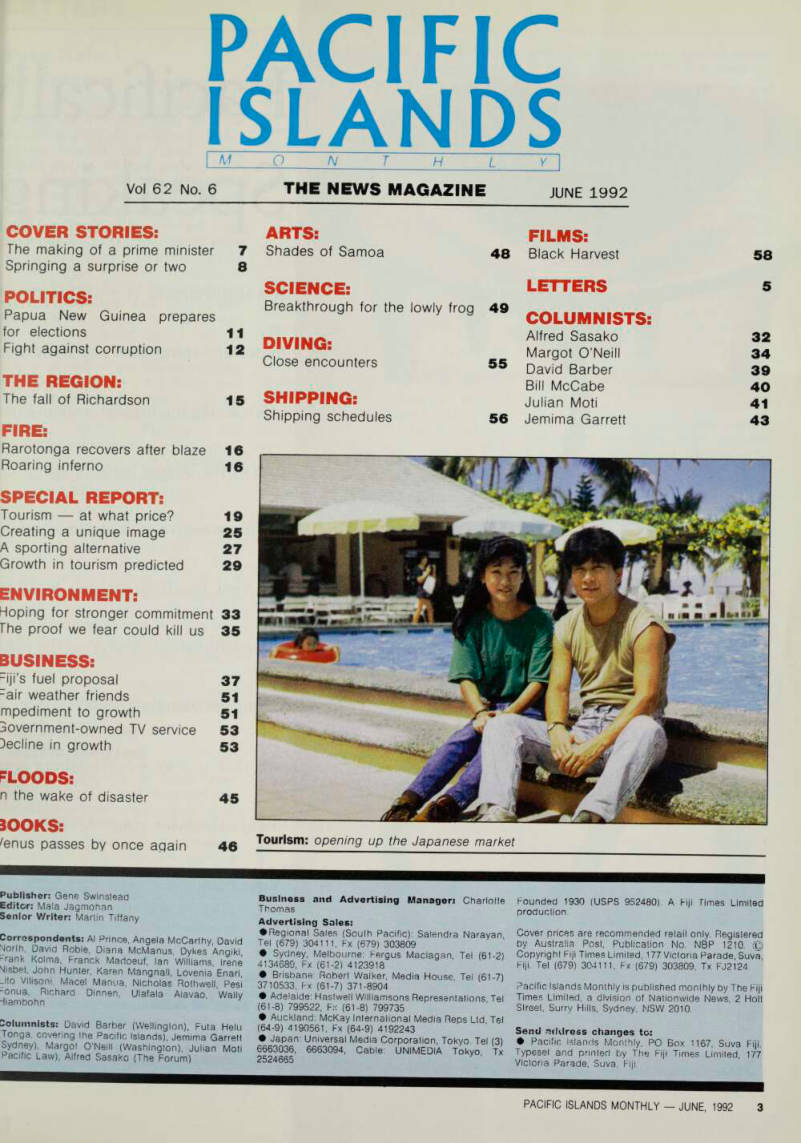
Tourism: opening up the Japanese market
Advertisements & other items, p. 4 (1 item)
Pacificalb
A warm welcome is probably the mi important thing that any bank has offer. Being the biggest bank in Fiji ai part of the largest banking group in Pacific may give us the edge in provid the best facilities for you locally a internationally, but never at the exper of our individual personal service. Al all, that is why we are where we a today. Here for you, ANZ Bank F' Your bank.
Official Sponsor 1992 Olympic Team
o op
Ton
’acific Region
Letters
Futa Helu -
an Enigma
OF your regular columnists Jemima Garrett remains your most informa tive, Futa Helu the most enigmatic.
Having worked and visited in the Pacific over a 10-year period, I am very familiar with the Melanesian indirect way of addressing important things, and 1 have some familiarity with the ‘Pacific Way’; indeed I am sympathetic to both and count some islanders amongst my closest friends.
Futa Flelu, however, remains an enigma to me. His articles are actually quite direct, along with ‘Pacific-like’ hints. Yet the appears to ‘tear down’, but does not ‘build up’. I can be sympathetic to his exposure of the failings of some of my Western contin gent and forbears - yet I fail to find adequate hints of solutions to the problems he writes about. His recent f March 1992) ‘Playing into priviligentia hands is no exception: I :an say ‘yes, yes ... yes’ to a number of filings he points out, but where are aroposed solutions/alternatives?
I would like a response from a Pacific islander, who can point out vhat I’m missing or at least tell met 'hat benefits they get from Futa delu’s articles. There is, of course, a )lace in society for someone to disturb he status quo. If that is indeed his nain purpose in writing, it would help ne to know it - and I’ll stop searching or hints of solutions to the problems he aises.
Ralph E. Ireland
Ox on England OX9 4QE
English in the
’acific Region
’LEASE allow me to make your eaders aware of an area of interest that have been following for several years, have been working to prepare a umber of Australian government 'bools for their role in training udents from the Pacific nations I refer to the area of technical nghsh training and the task of helping udents for whom English is a second rnguagc. For many of these people, ‘clinical English may well be a Liiguage that is totally off the planet, y this, I mean the language written in lany technical text books in insti
itions of higher learning both in
ustralia and in the Pacific zone.
The problem is that these reference
books are written for readers with skill in English as a first language. Even these readers may well find consider able difficulty with the abstract level of expression in these books. For overseas students, the difficulty can be enor mous.
I often remind Australians of the
difficulty they would face if they
attended a course in Germany and were required to read abstract German textbooks and listen to a teacher who
spoke quickly in colloquial and ab
stract German. Little use could be made of the technology of a railway system or of an automated car as
sembly plant, to name only two
aspects.
An argument can be mounted for both sides of the issue. In the era of global exchange of information, all students of the world have the right of access to all knowledge. On the other hand, the financial constraints that apply to all nations will dictate that focus be placed on the level of technology that is relevant to the progress of the nation.
Technical textbooks can be written in a way that intimidates the reader.
The words used can be too complex.
Complex ideas can be explained by use of complex words. Sentences can be too long with a number of ideas linked by commas. The writer may have focused the level of expression at what he/she sees as the
level of the clever student. Limited use can be made of diagrams and flow charts.
The worst feature of many technical textbooks is that each chapter is not accompanied by mastery activities. The student has no other option than to read and try to memorize the information. I always advise teachers to insert at the end of each chapter up to 40 questions or tasks that lead the student through the main points of the chapter. Once the students have completed the tasks, they have understood and applied the basic know ledge of each chapter.
It is also important that any textbook have a glossary of terms and an extended spelling list. In this way, students can seek explanation of terms and be able to use the forms of words. A student may be able to use the word “compress” but does not know that this word is also accompanied by “compression”, “compressor” and “com pressed”.
I have always advocated that overseas students be supported by a language teacher who works in the technical insti tution. For this reason, I was pleased to visit the Solomon Islands College of Higher Education to view the employment of English teachers working within the tech nical schools of the College. This is a very important development. The college is not the first technical institution to use such an approach. However, it was very pleasing to see such a development in the Pacific zone.
B.D. Copeland
Victoria, Australia
Advertisements & other items, pp. 5-6 (1 item)
Let us bring the Islands to you!
Pacific Islands Monthly has been covering the region for 61 years. Today we’re the only magazine which brings you full colour coverage and reliable, extensive editorial on a full range of Islands’ topics from politics and business to history, art and culture. And, for fun, we take you off the beaten track with yachting and tourism.
Fill in the coupon and post or fax it, and let us bring the Islands to you.
YES,
want to experience the Islands through Pacific Islands Monthly.
I enclose my cheque/bankdraft for $ (payable to Pacific Islands Monthly) or debit $ to my □ Visacard □ Mastercard Card No Name: Expiry Date: City: Signature: Country: Po#t to: Pacific Islands Monthly, P.O.
Box 1167, Suva, Fiji; or Fax: (679) 303809
RATES
per annum
Your Island Connections
m *
Cable and Wireless began keep-
ing people in touch around the
world more than a century ago. Today
while the technology has changed,
the tradition of service to our customers in the
South Pacific is just the same.
We work in partnership with Governments,
dedicated to meeting the need of communities and businesses to stay in touch. From one island to the next or to the other side of the world, the message is the same: Cable and Wireless is
your South Pacific
connection bringing the
islands together.
CABLE & WIRELESS
Asia Pacific Head Office Cable and Wireless pic Cable and Wireless (Pacific) Limited 22 nd Floor Office Tower Convention Plaza 1 Harbour Road Hong Kong Tel; (852) 848 8620 Facsimile: (852) 868 5195 Australia Cable and Wireless (Australia) Pty Ltd PO Box 675, Double Bay NSW 2028 Sydney Australia Tel/Fax (61-2) 362 3625 Fiji In association with the Government of Fiji Fiji International Telecommunications Ltd.
PO. Box 59 Mercury House 158 Victoria Parade Suva Fiji Tel: (679) 312933 Solomon Islands In association with the Government of the Solomon Islands Solomon Telekom Company Limited PO. Box 148 Honiara Solomon Islands Tel: (677) 21576 Tonga Cable and Wireless pic Private Mail Bag 4 General Post Office Nuku Alofa Tonga South Pacific Tel: (676) 23499 Vanuatu In association with the Government of Vanuatu i France Cables et Radio Vanuatu International Telecommunications Ltd.
PO. Box 164 Port Vila Vanuatu Tel- i 6781 22185
Making
Cover Stories
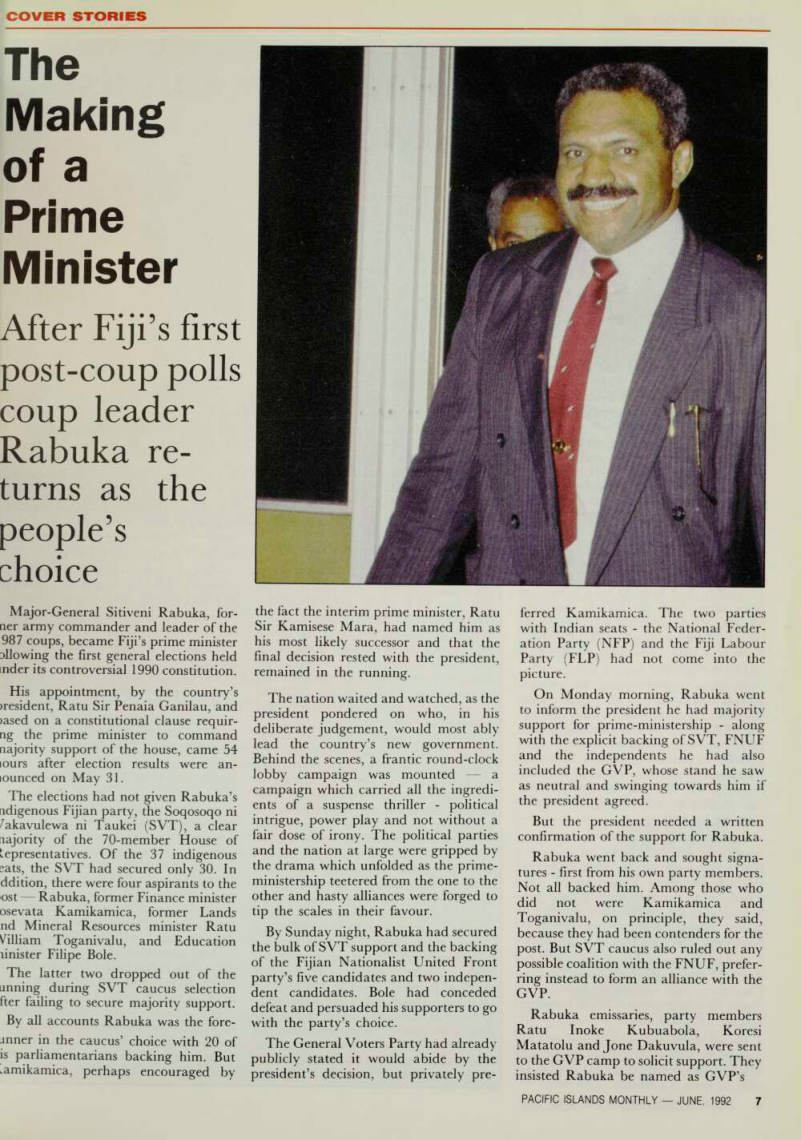
The Making of a Prime Minister
After Fiji’s first
post-coup polls
coup leader Rabuka re turns as the
people’s
choice
Major-General Sitiveni Rabuka, for ner army commander and leader of the 987 coups, became Fiji’s prime minister Dllowing the first general elections held inder its controversial 1990 constitution.
His appointment, by the country’s resident, Ratu Sir Penaia Ganilau, and >ased on a constitutional clause requir ng the prime minister to command najority support of the house, came 54 lours after election results were an lounced on May 31.
The elections had not given Rabuka’s idigenous Fijian party, the Soqosoqo ni ni Taukei (SVT), a clear lajority of the 70-member House of t.epresentatives. Of the 37 indigenous sats, the SVT had secured only 30. In ddition, there were four aspirants to the ost Rabuka, former Finance minister osevata Kamikamica, former Lands nd Mineral Resources minister Ratu William Toganivalu, and Education linister Filipe Bole.
The latter two dropped out of the inning during SVT caucus selection
fter failing to secure majority support.
By all accounts Rabuka was the fore inner in the caucus’ choice with 20 of is parliamentarians backing him. But
.amikamica, perhaps encouraged by
the fact the interim prime minister, Ratu Sir Kamisese Mara, had named him as his most likely successor and that the final decision rested with the president, remained in the running.
The nation waited and watched, as the president pondered on who, in his deliberate judgement, would most ably lead the country’s new government.
Behind the scenes, a frantic round-clock lobby campaign was mounted a campaign which carried all the ingredi ents of a suspense thriller - political intrigue, power play and not without a fair dose of irony. The political parties and the nation at large were gripped by the drama which unfolded as the prime ministership teetered from the one to the other and hasty alliances were forged to tip the scales in their favour.
By Sunday night, Rabuka had secured the bulk of SVT support and the backing of the Fijian Nationalist United Front party’s five candidates and two indepen dent candidates. Bole had conceded defeat and persuaded his supporters to go with the party’s choice.
The General Voters Party had already publicly stated it would abide by the president’s decision, but privately pre
ferred Kamikamica. The two parties with Indian seats - the National Feder ation Party (NFP) and the Fiji Labour Party (FLP) had not come into the picture.
On Monday morning, Rabuka went to inform the president he had majority support for prime-ministership - along with the explicit backing of SVT, FNUF and the independents he had also included the GVP, whose stand he saw as neutral and swinging towards him if the president agreed.
But the president needed a written confirmation of the support for Rabuka.
Rabuka went back and sought signa tures - first from his own party members.
Not all backed him. Among those who did not were Kamikamica and Toganivalu, on principle, they said, because they had been contenders for the post. But SVT caucus also ruled out any possible coalition with the FNUF, prefer ring instead to form an alliance with the
Gvp.
Rabuka emissaries, party members Ratu Inoke Kubuabola, Koresi Matatolu and Jone Dakuvula, were sent to the GVP camp to solicit support. They insisted Rabuka be named as GVP’s
choice for prime minister and heavy pressure was brought to bear, according to GVP vice-president, Matt Wilson.
Matatolu even staged a walk-out % but to no avail. The GVP did not endorse Rabuka. Kamikamica had also visited the GVP camp and received a ‘warm welcome’.
By Monday night, Rabuka was confi dent he had majority support and let it rest at that, intending to make the visit to the president the following morning.
Unknown to him fresh developments had taken place. The NFP, with 14 seats, had pledged its support for Kamikamica, and coupled with GVP’s tacit backing, the balance swung in his favour.
It was by chance that Rabuka’s supporters learned of the changes and immediately went to work in the middle of the night. The supporters were largely from the FNUF camp and included its campaign manager, Tony Stephens, candidate Ratu Osea Gavidi and Fred Caine, who had campaigned for Rabuka during the elections.
The group, operating from FNUF campaign office in Suva, realised there was only one option left - to win over FLP, before daybreak if possible, to avert any possibility of Kamikamica reaching the president the next morning.
That was easier said than done. The FLP was part of the coalition govern ment Rabuka had overthrown five years earlier and its leader, Mahendra Chaudhry, had been its most outspoken critic since. And, the FNUF, tradition ally staunch nationalists, were known for their extremist positions, a fact not likely to sit well with Chaudhry, an advocate of racial equality.
Stephens called upon his friend, Koseni Waqabitu, an FLP vice president. Waqabitu set to work contact ing FLP executives and candidates until he felt there appeared a chance it might opt for Rabuka. Chaudhry was also contacted in the early hours of Tuesday morning. He listened, did not rule out the possibility, and arranged a party meeting for B.ooam.
The meeting decided to set pre conditions in exchnage for its support that parliament would activate moves towards scrapping Value Added Tax, scheduled to become effective from July 1; reviewing the constitution; revoking of labour reforms and reveiwing agricul tural land leases; as soon as it convened.
Rabuka responded favourably and the deal was sealed. By midday on Tuesday Chaudhry had delivered his party’s choice for prime minister to the president and at 4.00 pm Rabuka was sworn in.
Rabuka returned to a meeting with his own party and at 5.15 Ratu Inoke and Matatolu approached the GVP with an offer to form a coalition. This move
outraged the FNUF, which had as umed it would be SVT’s coalition >artner in government. But it appeared he SVT caucus was adamant in not iligning itself with the nationalist group.
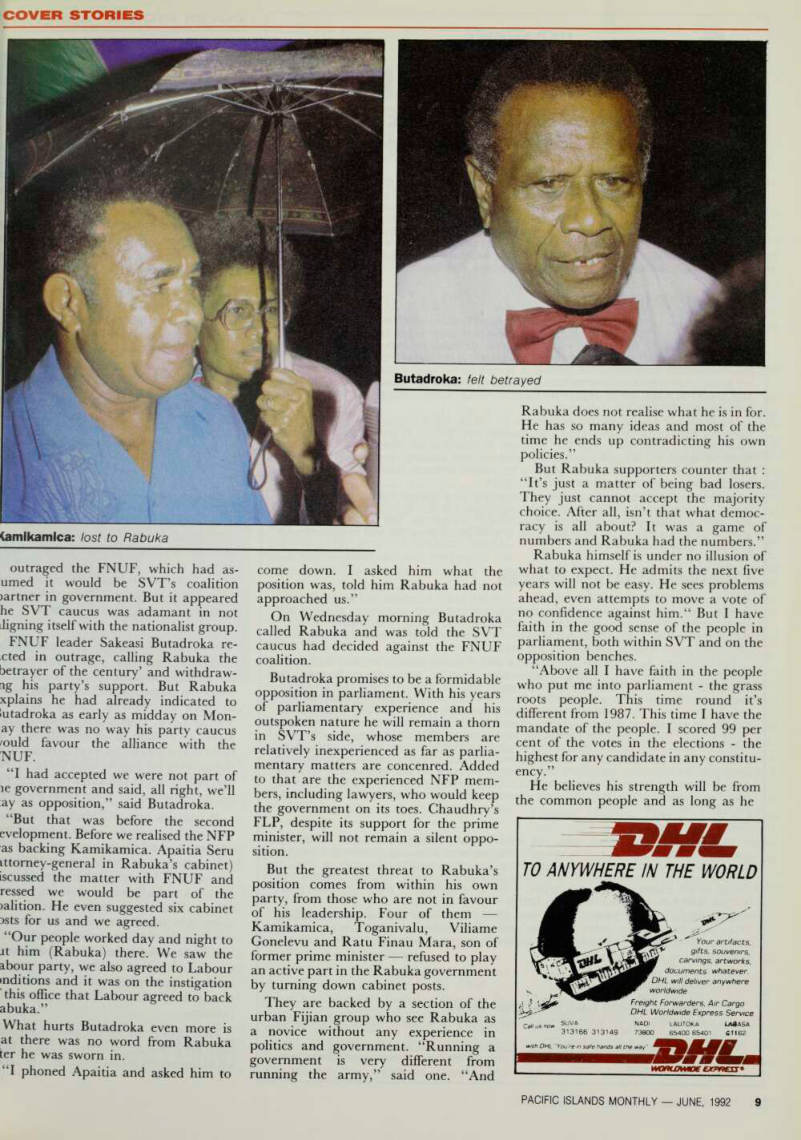
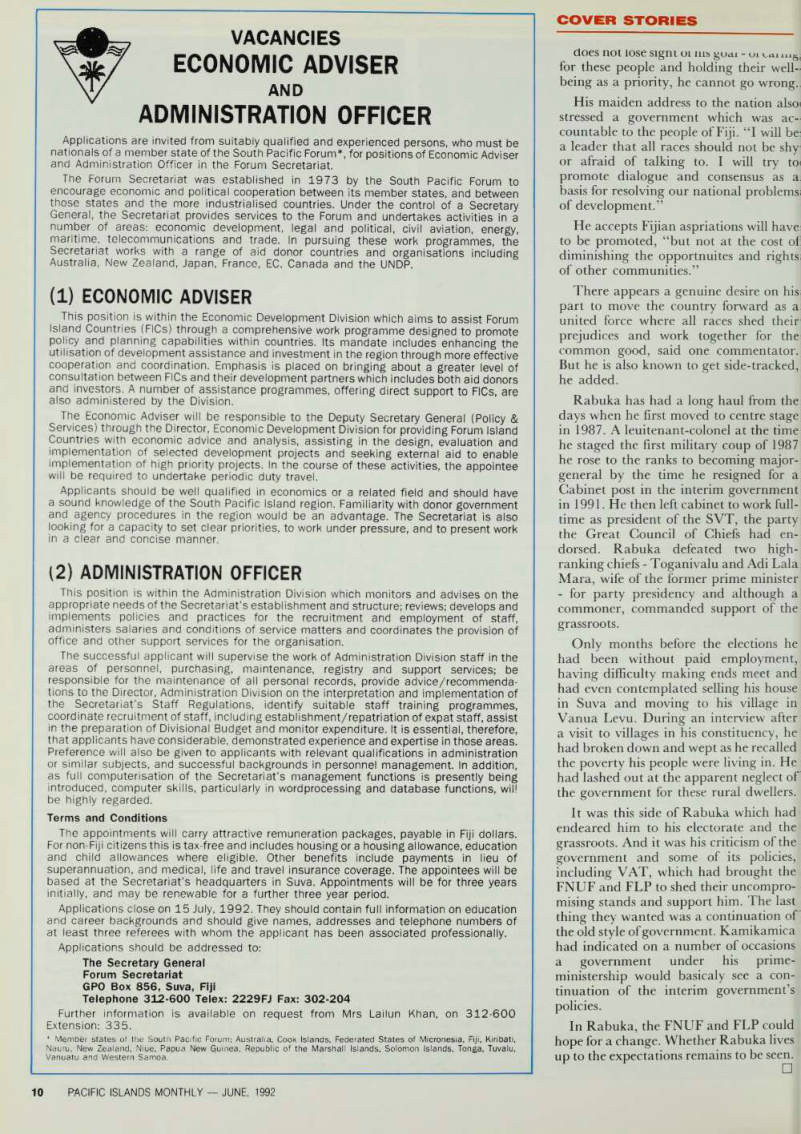
FNUF leader Sakeasi Butadroka re nted in outrage, calling Rabuka the betrayer of the century’ and withdraw ng his party’s support. But Rabuka xplains he had already indicated to lutadroka as early as midday on Mon ay there was no way his party caucus fould favour the alliance with the
Nuf.
“I had accepted we were not part of ic government and said, all right, we’ll ay as opposition,” said Butadroka.
“But that was before the second evelopment. Before we realised the NFP as backing Kamikamica. Apaitia Seru ittorney-general in Rabuka’s cabinet) iscussed the matter with FNUF and ressed we would be part of the >alition. He even suggested six cabinet Dsts for us and we agreed.
“Our people worked day and night to Jt him (Rabuka) there. We saw the a hour party, we also agreed to Labour •nditions and it was on the instigation this office that Labour agreed to back abuka.”
What hurts Butadroka even more is at there was no word from Rabuka ter he was sworn in.
“I phoned Apaitia and asked him to
come down. I asked him what the position was, told him Rabuka had not approached us.”
On Wednesday morning Butadroka
called Rabuka and was told the SVT caucus had decided against the FNUF coalition.
Butadroka promises to be a formidable opposition in parliament. With his years of parliamentary experience and his outspoken nature he will remain a thorn in SVT’s side, whose members are relatively inexperienced as far as parlia mentary matters are concenred. Added to that are the experienced NFP mem bers, including lawyers, who would keep the government on its toes. Chaudhry’s FLP, despite its support for the prime minister, will not remain a silent oppo sition.
But the greatest threat to Rabuka’s position comes from within his own party, from those who are not in favour of his leadership. Four of them Kamikamica, Toganivalu, Viliame Gonelevu and Ratu Finau Mara, son of former prime minister refused to play an active part in the Rabuka government by turning down cabinet posts.
They are backed by a section of the urban Fijian group who see Rabuka as a novice without any experience in politics and government. “Running a government is very different from running the army,” said one. “And
Rabuka does not realise what he is in for.
He has so many ideas and most of the time he ends up contradicting his own policies.”
But Rabuka supporters counter that : “It’s just a matter of being bad losers.
They just cannot accept the majority choice. After all, isn’t that what democ racy is all about? It was a game of numbers and Rabuka had the numbers.”
Rabuka himself is under no illusion of what to expect. He admits the next five years will not be easy. He sees problems ahead, even attempts to move a vote of no confidence against him.“ But I have faith in the good sense of the people in parliament, both within SVT and on the
opposition benches.
“Above all I have faith in the people who put me into parliament - the grass roots people. This time round it’s different from 1987. This time I have the mandate of the people. I scored 99 per cent of the votes in the elections - the highest for any candidate in any constitu ency,”
He believes his strength will be from the common people and as long as he
Kamikamica: lost to Rabuka
Butadroka: felt betrayed
does not lose signt 01 ms gum - ui taimJ for these people and holding their well being as a priority, he cannot go wrong.
His maiden address to the nation also' stressed a government which was ac countable to the people of Fiji. “I will be a leader that all races should not be shy or afraid of talking to. I will try to promote dialogue and consensus as a basis for resolving our national problems of development.”
He accepts Fijian aspriations will have to be promoted, “but not at the cost of diminishing the opportnuites and rights of other communities,”
There appears a genuine desire on his part to move the country forward as a united force where all races shed their prejudices and work together for the common good, said one commentator.
But he is also known to get side-tracked, he added.
Rabuka has had a long haul from the days when he first moved to centre stage in 1987. A leuitenant-colonel at the time he staged the first military coup of 1987 he rose to the ranks to becoming major general by the time he resigned for a Cabinet post in the interim government in 1991. He then left cabinet to work full time as president of the SVT, the party the Great Council of Chiefs had en dorsed. Rabuka defeated two high ranking chiefs - Toganivalu and Adi Lala Mara, wife of the former prime minister - for party presidency and although a commoner, commanded support of the grassroots.
Only months before the elections he had been without paid employment, having difficulty making ends meet and had even contemplated selling his house in Suva and moving to his village in Vanua Levu. During an interview after a visit to villages in his constituency, he had broken down and wept as he recalled the poverty his people were living in. He had lashed out at the apparent neglect of the government for these rural dwellers.
It was this side of Rabuka which had endeared him to his electorate and the grassroots. And it was his criticism of the government and some of its policies, including VAT, which had brought the FNUF and FTP to shed their uncompro mising stands and support him. The last thing they wanted was a continuation of the old style of government. Kamikamica had indicated on a number of occasions a government under his prime ministership would basicaly see a con tinuation of the interim government’s policies.
In Rabuka, the FNUF and FTP could hope for a change. Whether Rabuka lives up to the expectations remains to be seen.
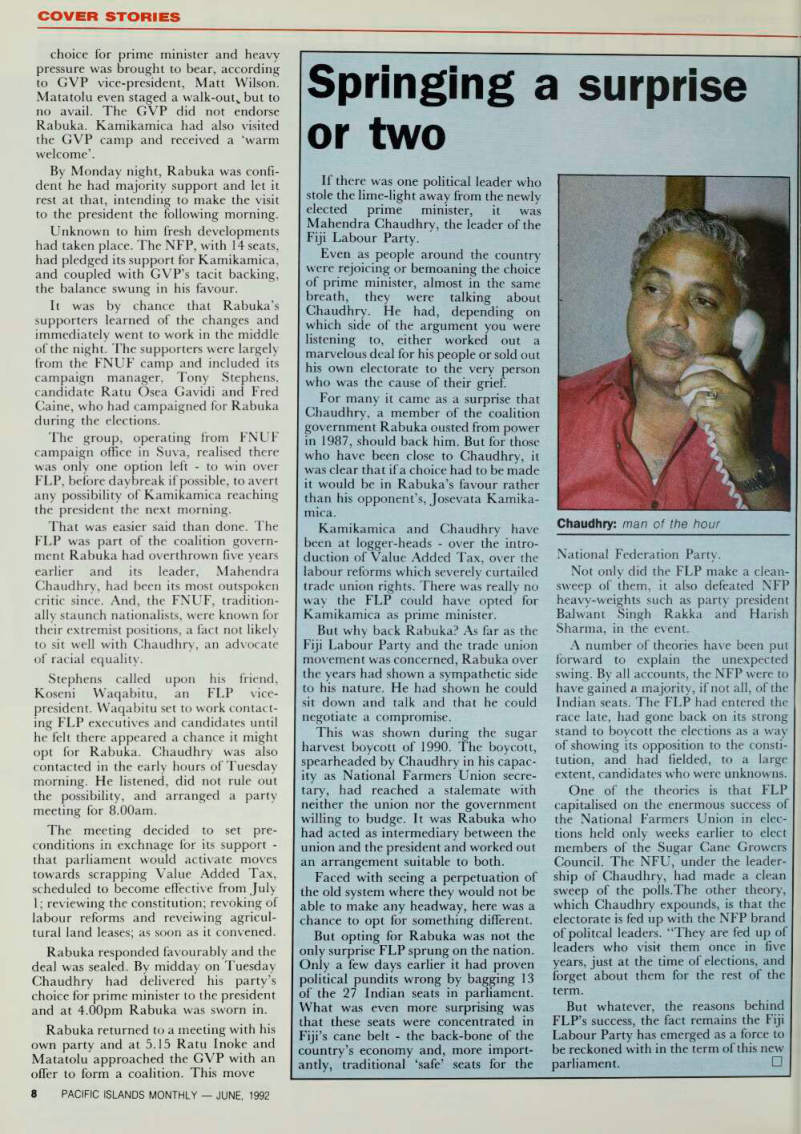
Springing a surprise
or two
If there was one political leader who stole the lime-light away from the newly elected prime minister, it was Mahendra Chaudhry, the leader of the Fiji Labour Party.
Even as people around the country were rejoicing or bemoaning the choice of prime minister, almost in the same breath, they were talking about Chaudhry. He had, depending on which side of the argument you were listening to, either worked out a marvelous deal for his people or sold out his own electorate to the very person who was the cause of their grief.
For many it came as a surprise that Chaudhry, a member of the coalition government Rabuka ousted from power in 1987, should back him. But for those who have been close to Chaudhry, it was clear that if a choice had to be made it would be in Rabuka’s favour rather than his opponent’s, Josevata Kamika mica.
Kamikamica and Chaudhry have been at logger-heads - over the intro duction of Value Added Tax, over the labour reforms which severely curtailed trade union rights. There was really no way the FLP could have opted for Kamikamica as prime minister.
But why back Rabuka? As far as the Fiji Labour Party and the trade union movement was concerned, Rabuka over the years had shown a sympathetic side to his nature. He had shown he could sit down and talk and that he could negotiate a compromise.
This was shown during the sugar harvest boycott of 1990. The boycott, spearheaded by Chaudhry in his capac ity as National Farmers Union secre tary, had reached a stalemate with neither the union nor the government willing to budge. It was Rabuka who had acted as intermediary between the union and the president and worked out an arrangement suitable to both.
Faced with seeing a perpetuation of the old system where they would not be able to make any headway, here was a chance to opt for something different.
But opting for Rabuka was not the only surprise FLP sprung on the nation.
Only a few days earlier it had proven
political pundits wrong by bagging 13
of the 27 Indian seats in parliament.
What was even more surprising was that these seats were concentrated in Fiji’s cane belt - the back-bone of the country’s economy and, more import antly, traditional ‘safe’ seats for the
National Federation Party.
Not only did the FLP make a clean sweep of them, it also defeated NFP heavy-weights such as party president Balwant Singh Rakka and Harish Sharma, in the event, A number of theories have been put forward to explain the unexpected swing. By all accounts, the NFP were to have gained a majority, if not all, of the Indian seats. The FLP had entered the race late, had gone back on its strong stand to boycott the elections as a way of showing its opposition to the consti tution, and had fielded, to a large extent, candidates who were unknowns.
One of the theories is that FLP capitalised on the enermous success of the National Farmers Union in elec tions held only weeks earlier to elect members of the Sugar Cane Growers Council. The NFU, under the leader ship of Chaudhry, had made a clean sweep of the polls. The other theory, which Chaudhry expounds, is that the electorate is fed up with the NFP brand of politcal leaders. “They are fed up of leaders who visit them once in five years, just at the time of elections, and forget about them for the rest of the term.
But whatever, the reasons behind FLP’s success, the fact remains the Fiji Labour Party has emerged as a force to be reckoned with in the term of this new
parliament. O
Chaudhry: man of the hour
Advertisements & other items, pp. 9-10 (1 item)
To Anywhere In The World
•SjM**
Your artifacts, gifts, souvenirs, carvings, artworks, documents whatever.
DHL will deliver anywhere worldwide Freight Forwarders. Air Cargo DHL Worldwide Express Service
NADI LAUTOKA lAOASA
73000 65400 65401 Cl 162
VACANCIES
ECONOMIC ADVISER
AND
ADMINISTRATION OFFICER
Applications are invited from suitably qualified and experienced persons, who must be nationals of a member state of the South Pacific Forum*, for positions of Economic Adviser and Administration Officer in the Forum Secretariat.
The Forum Secretariat was established in 1973 by the South Pacific Forum to encourage economic and political cooperation between its member states, and between those states and the more industrialised countries. Under the control of a Secretary General, the Secretariat provides services to the Forum and undertakes activities in a number of areas: economic development, legal and political, civil aviation, energy, maritime, telecommunications and trade. In pursuing these work programmes, the Secretariat works with a range of aid donor countries and organisations including Australia, New Zealand, Japan, France, EC. Canada and the UNDP.
This position is within the Economic Development Division which aims to assist Forum Island Countries (FICs) through a comprehensive work programme designed to promote policy and planning capabilities within countries. Its mandate includes enhancing the utilisation of development assistance and investment in the region through more effective cooperation and coordination. Emphasis is placed on bringing about a greater level of consultation between FICs and their development partners which includes both aid donors and investors. A number of assistance programmes, offering direct support to FICs, are also administered by the Division.
The Economic Adviser will be responsible to the Deputy Secretary General (Policy & Services) through the Director, Economic Development Division for providing Forum Island Countries with economic advice and analysis, assisting in the design, evaluation and implementation of selected development projects and seeking external aid to enable implementation of high priority projects. In the course of these activities, the appointee will be required to undertake periodic duty travel.
Applicants should be well qualified in economics or a related field and should have a sound knowledge of the South Pacific Island region. Familiarity with donor government and agency procedures in the region would be an advantage. The Secretariat is also looking for a capacity to set clear priorities, to work under pressure, and to present work in a clear and concise manner.
This position is within the Administration Division which monitors and advises on the appropriate needs of the Secretariat’s establishment and structure; reviews; develops and implements policies and practices for the recruitment and employment of staff, administers salaries and conditions of service matters and coordinates the provision of office and other support services for the organisation.
The successful applicant will supervise the work of Administration Division staff in the areas of personnel, purchasing, maintenance, registry and support services; be responsible for the maintenance of all personal records, provide advice/recommendations to the Director, Administration Division on the interpretation and implementation of the Secretariat’s Staff Regulations, identify suitable staff training programmes, coordinate recruitment of staff, including establishment/repatriation of expat staff, assist in the preparation of Divisional Budget and monitor expenditure. It is essential, therefore, that applicants have considerable, demonstrated experience and expertise in those areas.
Preference will also be given to applicants with relevant qualifications in administration or similar subjects, and successful backgrounds in personnel management. In addition, as full computerisation of the Secretariat’s management functions is presently being introduced, computer skills, particularly in wordprocessing and database functions, will be highly regarded.
Terms and Conditions The appointments will carry attractive remuneration packages, payable in Fiji dollars.
For non-Fiji citizens this is tax-free and includes housing or a housing allowance, education and child allowances where eligible. Other benefits include payments in lieu of superannuation, and medical, life and travel insurance coverage. The appointees will be based at the Secretariat's headquarters in Suva. Appointments will be for three years initially, and may be renewable for a further three year period.
Applications close on 15 July, 1992. They should contain full information on education and career backgrounds and should give names, addresses and telephone numbers of at least three referees with whom the applicant has been associated professionally.
Applications should be addressed to: The Secretary General Forum Secretariat GPO Box 856, Suva, Fiji Telephone 312-600 Telex: 2229FJ Fax: 302-204 Further information is available on request from Mrs Lailun Khan, on 312-600 Extension: 335. * Member states of the South Pacific Forum; Australia, Cook Islands. Federated States of Micronesia, Fiji, Kiribati, Nauru, New Zealand. Niue, Papua New Guinea, Republic of the Marshall Islands, Solomon Islands, Tonga, Tuvalu, Vanuatu and Western Samoa.
(1) ECONOMIC ADVISER
(2) ADMINISTRATION OFFICER
prepares for elections
Poliitcs
Papua New Guinea prepares for elections
As the country gets ready for the polls corruption has become a central issue
By Wally Hiambohn
PRIME Minister Rabbie Namaliu came in this afternoon looking tired and worn out.
When he spoke to reporters you would have thought he had a cold and was losing his voice.
And the government jet had arrived in Port Moresby at 7.05 pm, an hour behind schedule.
Earlier this morning one of Namaliu’s staunch Pangu Pati MPs, Menu
Hessingut, collapsed and died.
foreign Affairs Minister Sir Michael Somare was resting at his Port Moresby home with swollen feet. He had to drag himself on crutches to meet a visiting Solomon Islands parliamentary del egation.
Opposition leader Paias Wingti is hardly in Port Moresby to sign his press statements so it is done by the office girl.
Yes, it is hectic. This is the time of the
tough PNG national election the fourth since independence in 1975.
The election dates are: March 26 issue of writs and nominations open, April 24 close of nominations, June 13 polling begins, June 27 end of polling, July 15 return of writs.
As the past three had proven, the jungle law of survival of the fittest rings true in these elections a philosophy that is forcing current and intending politicians to comb the remotest jungles, walk the toughest terrains and swim the biggest rivers to get to that extra voter who in this intense battle could cast the
winning vote.
As in the past three, it is expected again that half the current MPs will lose their seats.
Except for those vying for the city’s four seats, Port Moresby, home to the politicians for the past five years, has been deserted by them.
Government ministers drop in for a day or two to sort out official business and disappear for weeks before they are
seen again.
But despite their absence from Port Moresby, media organisations are bom barded with press statements on almost every issue.
Namaliu has in the past two months
gone on regualar provincial campaign
ing visits In fact, in the last week he has flown to six different provinces, leaving as early as 6am and returning at dusk.
A total of 1653 candidates have been nominated to contest the country’s 109 seats in Parliament, an average of 16 candidates per electorate.
The number of candidates is 40 more than in the last election in 1987 despite an increase in the nomintion fee from KlOO to KlOOO a candidatee. It proved beyond doubt that a Supreme Court challenge by the Ombudsman Commission that the fee increase im pinged on the rights of people was
unnecessary.
The largest number of candidates for any one electorate is 48 for the Sinasina- Youngumgi seat in the Highlands. Only two, on the other hand, have been nominated for Namatanai in New Ire land.
Namaliu and his five-party coalition have pledged to stick together to form the government after the election while the
three-party Opposition has given a
similar undertaking.
Both sides are confident of forming the government in July.
A total of 16 parties have put up candidates, the major parties being Namaliu’s Pangu, Wingti’s People’s Democratic Movement, the People’s
Action Party, People’s Progress Party,
Melanesian Alliance and National Party.
While all parties have raised key issues such as agricultural development, em ployment, education and health in their election platforms, these all have been pushed to the background with the emergence of another more current issue.
Corruption is on the lips of almost every politician. It stems from very recent cases where several politicians have been prosecuted on corruption
charges.
Former deputy prime minister Ted Diro’s celebrated case was one of them.
In the term of this parliament 10 MPs have been prosecuted for corruption and have subsequently resigned their offices to escape penalty.
All except Diro are recontesting their seats, a move which would have wide ranging implications. If any of them wins his seat would automatically be subject to reprosecution.
Prime Minister Namaliu and his Finance Minister Paul Pora have been implicated in several such cases for their parts in approving hundreds of thou sands of public funds for private use by MPs.
A leadership tribunal which found one of Namaliu’s ministers guilty of corrup tion recommended that both be investi
gated.
The case has been referred to police for invesitgation and possible criminal chargescould be laid.
Namaliu has denied any wrong-doing.
Almost every day the two sides are issuing statements accusing the each other of corruption.
Opposition leader Paias Wingti has vowed to investigate, prosecute and jail all leaders who have misused public
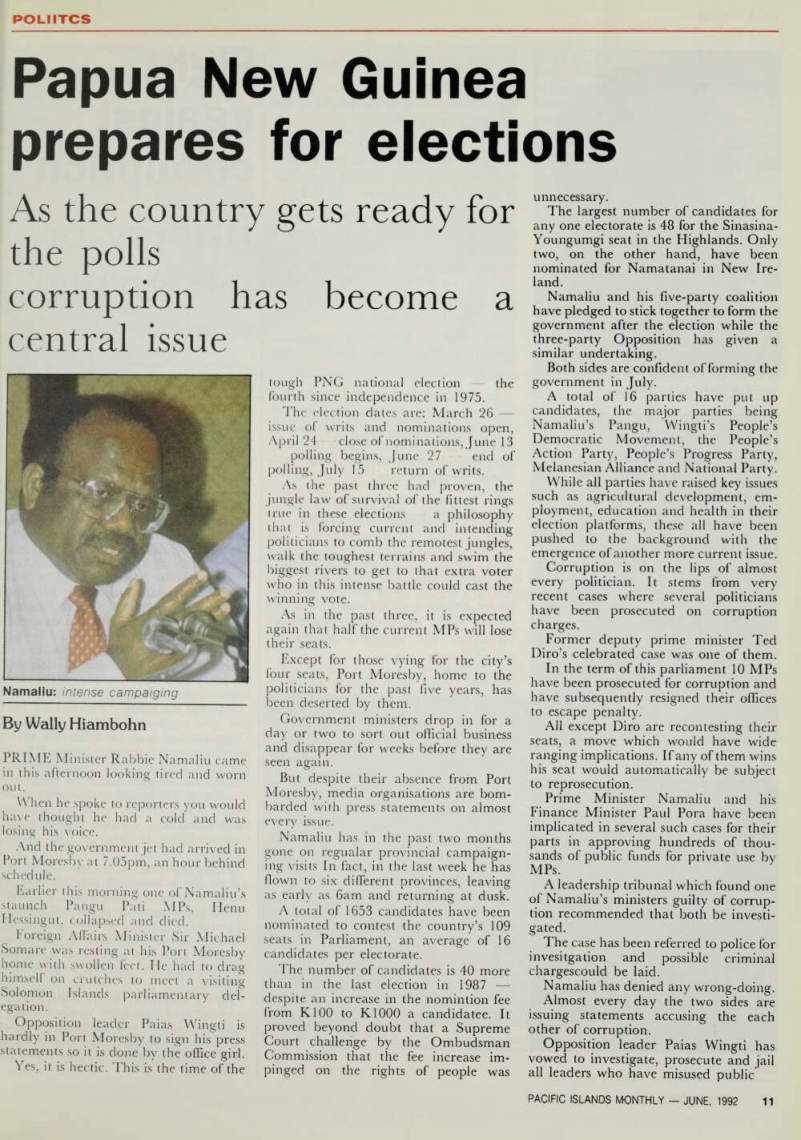
Namaliu: intense campaiging
,Sp money if he wins government.
“I will make sure they are all behind bars,” Wingti said at the height of the debate on corruption.
“This election will be about good and evil, good government and bad govern ment, it will be about corruption in high places and accountability,” he said.
Wingti’s deputy, Peoples Progress
Party leader Sir Julius Chan, a former prime minister, told university students this month; “Whether anyone likes it or not, the central issue being addressed during this campaignn is the scary one — corruption in high places.”
“We are so close to a grass-roots revolution that quite frankly, I’m scared.”
Sir Julius said greed and corruption had broken the political party system down to “almost beyond redemption” and politicians had no loyalty to party policies and platforms which they en dorsed during elections.
“They come and go from one party to another like fleas switching dogs,” he said.
In a move to gain electoral support, Prime Minister Namaliu announced on May 14 that he would, if he retained power, establish an anti-corruption au thority with independent powers to investigate and prosecute leaders in volved in corruption.
“The recent focus on the misuse of public money has resulted in bribery related corruption of public officials by
businessmen being largely ignored.” He
spoke of extending investigations to those who offered bribes.
He also accused the Opposition of
corruption saying they were the “worst
culprits”.
“While they were in power they dished out thousands of kina in public funds,” he said.
“They squandered millions of kina earmarked for civic action programs and transport sectoral funds. These funds are still unaccounted for today.
“Who can believe Chan and Wingti to be clean.
“They are using the election campaign to cover up for their corrupt deals when they were in power.” □
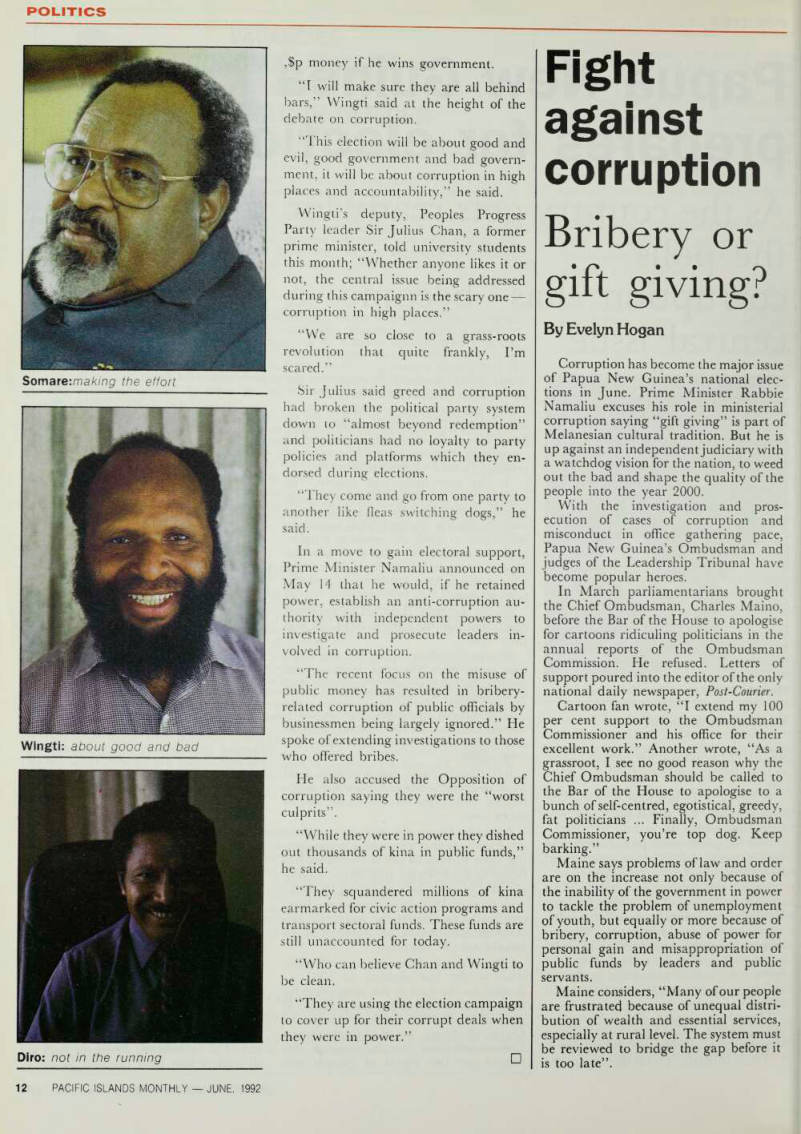
Soma re: making the effort
Wingti: about good and bad
Diro: not in the running
Bribery or
Fight against corruption Bribery or gift giving?
By Evelyn Hogan
Corruption has become the major issue of Papua New Guinea’s national elec tions in June. Prime Minister Rabbie Namaliu excuses his role in ministerial corruption saying “gift giving” is part of Melanesian cultural tradition. But he is up against an independent judiciary with a watchdog vision for the nation, to weed out the bad and shape the quality of the people into the year 2000.
With the investigation and pros ecution of cases of corruption and misconduct in office gathering pace, Papua New Guinea’s Ombudsman and judges of the Leadership Tribunal have become popular heroes.
In March parliamentarians brought the Chief Ombudsman, Charles Maine, before the Bar of the House to apologise for cartoons ridiculing politicians in the annual reports of the Ombudsman Commission. He refused. Letters of support poured into the editor of the only national daily newspaper, Post-Courier.
Cartoon fan wrote, “I extend my 100 per cent support to the Ombudsman Commissioner and his office for their excellent work.” Another wrote, “As a grassroot, I see no good reason why the Chief Ombudsman should be called to the Bar of the House to apologise to a bunch of self-centred, egotistical, greedy, fat politicians ... Finally, Ombudsman Commissioner, you’re top dog. Keep barking.”
Maine says problems of law and order are on the increase not only because of the inability of the government in power to tackle the problem of unemployment of youth, but equally or more because of bribery, corruption, abuse of power for personal gain and misappropriation of public funds by leaders and public servants.
Maine considers, “Many of our people are frustrated because of unequal distri bution of wealth and essential services, especially at rural level. The system must be reviewed to bridge the gap before it is too late”.
On 27 March 1992 the Leadership Tribunal, chaired by Justice Moses Jalina. handed down a decision finding Labour and Employment Minister in the Namaliu government. Tony Ila, guilty of 43 counts of misconduct in office.
Justice Jalina described Ila as a “power broker”., “There were hectic negotiations be tween Ila and members of the Panga Pati to try and prevent him and other Morobe MPs he was courting from switching to the Opposition and over throwing the government.
It was during this time of political uncertainty in Prime Minister Namaliu’s government that Ila made requests for financial assistance”. The tribunal strongly recommended that both Prime Minister Namaliu and Finance Minister Paul Pora be investigated for their past in Ha’s misconduct.
The Public Prosecutor has officially recommended a police investigation of Namaliu and Pora for possible offences including misappropriation of funds, bribery and corruption under the crimi nal code.
Before the June elections another four former ministers on the Namaliu govern ment are to be brought before a Leadership Tribunal on a total of 65 ;harges of corruption and misconduct, fhe four are alleged to have demanded money from the government in 1990 jnder the threat of supporting an opposition motion of no-confidence.
The abstract concepts in the Leader ship Code seem • not to have been :omprehended by- many leaders who laively believe they are above the law.
Last year Ted Diro, former Deputy Prime Minister and leader of the Papuan \ction Party, was found guilty by a eadership tribunal of bribery and cor
ruption. But the Governor General, Sir Serei Eri, could not bring himself to sack his “good friend” and resigned instead.
With Diro unable to nominate for parliament, Eri now stands for Diro’s cold seat.
The considerable expense of Ombudsman investigations and Leader ship Tribunal hearings needs to lead more quickly to prosecution under the Criminal Code. It has taken four years from when Diro was first implicated for corruption in the forest industry in the Barnett Inquiry in 1988 until he was finally charged on April 21, 1992 for attempting to pervert the course of
justice.
But there is now a relentless determi nation to pursue these cases. Former
judge of the National Court of PNG, Brian Brunton, says that in PNG the professionals in the regulatory agencies have become dedicated to cleaning up politics. The Ombudsman Commission has strong leadership with Charles Maino. Additional competent staff have been recruited and they have the re sources to continue with what will be an inevitable series of prosecutions.
A string of cases heard by Leadership Tribunals show that no member of parliament is above the law. The evi dence presented has been incontrovert ible. Each new case establishes precedents for the future with clear empirical examples of the meaning of clauses in the Leadership Code.
The Post-Courier stated in an editorial, “These elections are very important.
They will either make or break us as a nation. The voters must question some of the most visible wealth of leaders who will be contesting these elections ...
Where did they get the funds to pay for these expensive vehicles, houses and tradestores, considering that many busi nessmen, who have worked hard all their lives, have not accumulated such wealth white those who have held public office for only short periods have so much.
There will be many upsets in the June elections. Pundits predict that up to 75 per cent of sitting members will not be returned. Politicians are dependant upon the support of traditional leaders and a
healthy grassroots democracy where
misuse of public funds was never an accepted part of the cultural tradition. □
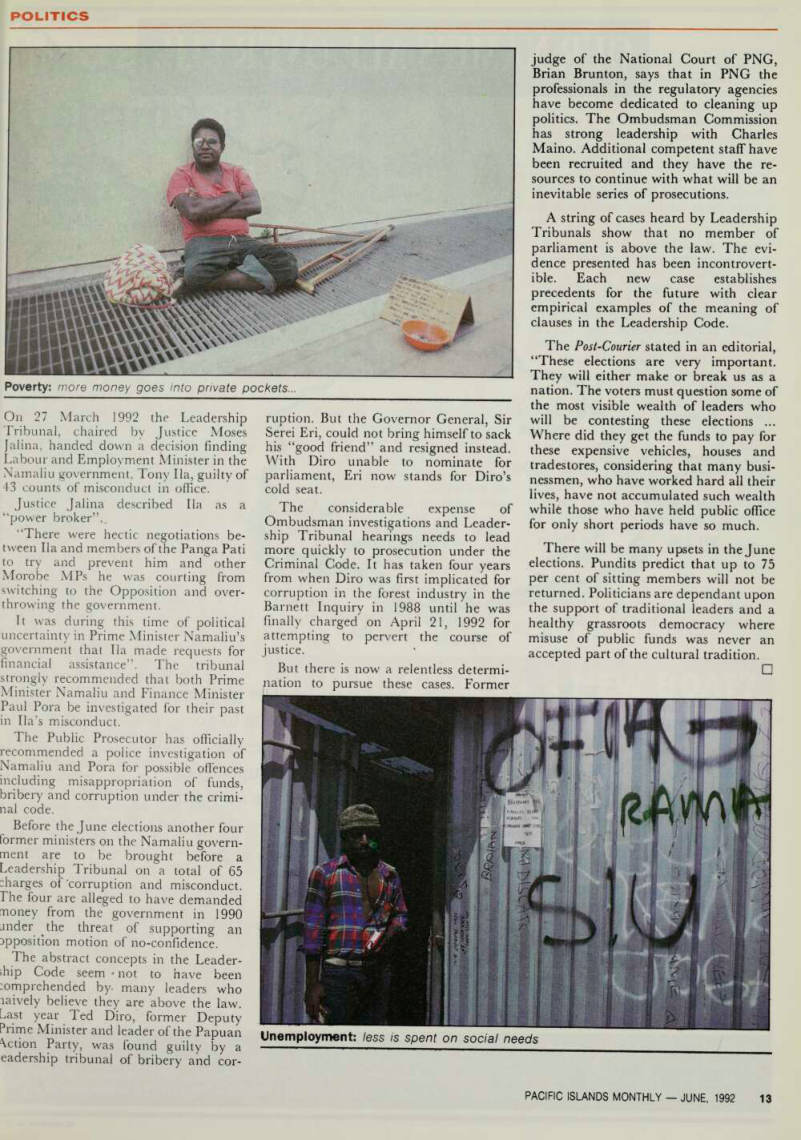
Poverty: more money goes into private pockets...
Unemployment: less is spent on social needs
Advertisements & other items, p. 14 (1 item)
Avis
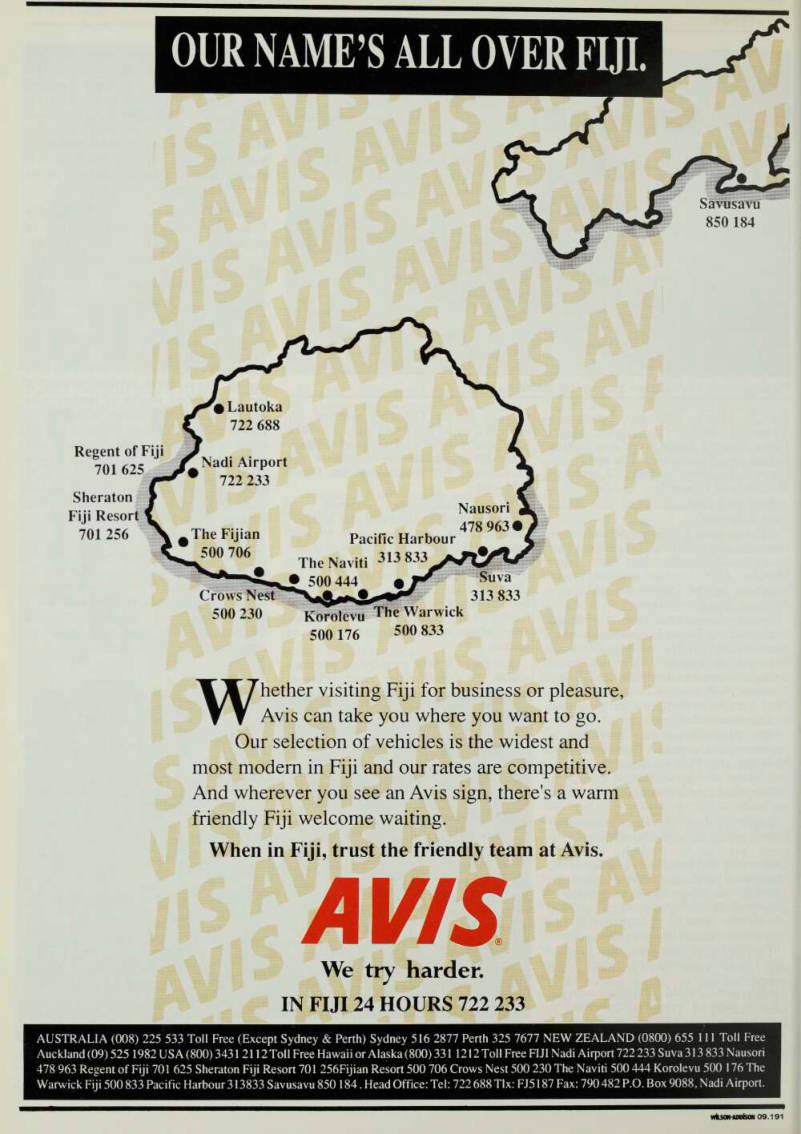
OUR NAME’S ALL OVER FIJI.
Savusavu 850 184 Regent of Fiji 701 625 Sheraton Fiji Resort 701 256 • Lautoka 722 688 Nadi Airport 722 233 Nauson 4 478 963 • Pacific Harbour TheNaviti 313 833 a, • 500 444 « r' The Fijian 500 706 Crows 500 230 va 313 833 Korolevu 500 176 Warwick 500 833 Whether visiting Fiji for business or pleasure, Avis can take you where you want to go.
Our selection of vehicles is the widest and most modem in Fiji and our rates are competitive.
And wherever you see an Avis sign, there's a warm
friendly Fiji welcome waiting.
When in Fiji, trust the friendly team at Avis.
AVIS
We try harder.
IN FIJI 24 HOURS 722 233
AUSTRALIA (008) 225 533 Toll Free (Except Sydney & Perth) Sydney 516 2877 Perth 325 7677 NEW ZEALAND (0800) 655 111 Toll Free Auckland (09) 525 1982 USA (800) 3431 2112 Toll Free Hawaii or Alaska (800) 331 1212 Toll Free FIJI Nadi Airport 722 233 Suva 313 833 Nausori 478 963 Regent of Fiji 701 625 Sheraton Fiji Resort 701 256 Fijian Resort 500 706 Crows Nest 500 230 The Naviti 500 444 Korolevu 500 176 The Warwick Fiji 500 833 Pacific Harbour 313833 Savusavu 850 184. Head Office: Tel: 722 688 Tlx: FJ5187 Fax: 790482 P.O. Box 9088, Nadi Airport.
The fall of
The Region
The fall of Richardson
By Craig Skehan
BIZARRE happenings in the smattering of Micronesian atolls of the Marshall Islands Republic have brought down the most powerful Australian cabinet minis ter. It was not so much Richardson’s ministerial responsibility for transport and communications policy that made him powerful, as his well earned repu tation as both king-maker and slayer.
Richardson, as leader of the right-wing faction of the Australian Labour Party, twice played a key role in the change over of the Labour leadership, first from Bill Hayden to Bob Hawke and more recently from Hawke to Paul Keating.
As a polititical fixer, Richardson has long been part of a tribal Labour culture in which you ‘look after your mates’. It was an old school and Labour mate,
Sydney businessman Gregory Symons,
who arrived in the Marshall Islands capital of Majuro in July last year with a briefcase containing the outline of a grand scheme.
The idea was to have Chinese invesgtors from Taiwan and Hong Kong finance a SUS4O million technology and education complex in Majuro in return for Marshall Islands passports.
In April this year, Marshall Islands
attorney general Dennis McPhillips
claimed the Chinese were misled into believing Marshall Islands passports would give them immediate entry into the United States, when in fact there was
a five-year waiting period for foreigners
taking up local citizenship.
Then came the political bombshell.
McPhillips opposed Symons being al ;ow'ed to return to Australia to work on his legal defence on the grounds that there was no bilateral extradition treaty n existence and Symons had powerful :ontacts in Australia. The attorney general presented in court a glowing 'eference from Richardson that Symons lad used in Majuro to promote his nvestment scheme. “It is my under itanding this particular minister is one of he most powerful ministers in the
Australian government,” McPhillips
old chief justice Neil Rutledge. “He vields great powder.”
Then it was later revealed that on April 6 when Symons was in court,
lichardson had personsally telephoned
he President of the Marshall Islands,
Amata Kabua, asking that Symons be
dlowed to leave the country.
Back in Canberra, Federal Opposition eader John Hewson went on the attack
over Richardson s claim that he was acting personally in calling the President and not as an Australian government representative. The Australian Oppo sition also picked holes in Richardson’s claim that he had not been aware of Symons’ business activities, including the Marshall Islands scheme, when he wrote the reference. Some clever investigative reporting by the Australian media showed that Symons had in 1989 gone into voluntary bankruptcy, with debts of nearly SAI.S million, but later secured official export assistance grants.
Richardson said he had not been aware of the bankruptcy or the grants. But a report on his relations with Symons
demanded by Keating revealed that assistance by Richardson’s office for Symons had gone further than previously stated. This help extended to represen tations to the Australian Embassy in Fiji for a visa for a Taiwanese man connected to the Marshall Islands scheme.
Richardson resigned from the ministry rather than suffer the indignation of being sacked. The story dubbed ‘The Marshall Islands Affair’ had dominated the Australian media for more than a week.
Back in the Marshall Islands, the sorry episode is also causing waves. In court, during a preliminary hearing which determined the charges against Symons should go to trial, defence attorney Strauss attempted to subpoena leading officials and acting Marshall Islands President Kunio Lemari. He contends the Marshall Islands government had effectively sanctioned a range of illegal passport selling operations. Strauss says in one case there was even an official send-off for seven Chinese who were subsequently detained and had their passports taken by US immigration officials at Honolulu Airport. There have also been claims in court that senior Marshall Islands officials now giving evidence against Symons were previously paid thousands of dollars by Symons to act as consultants.
Symons, 43 years old but with boyish good looks, said, in Majuro, he deeply regretted the impact of events on Richardson, who is his wife’s cousin.
With a trial expected to begin in August, there is scope for further revelations, and
political spin-offs Down-Under. □
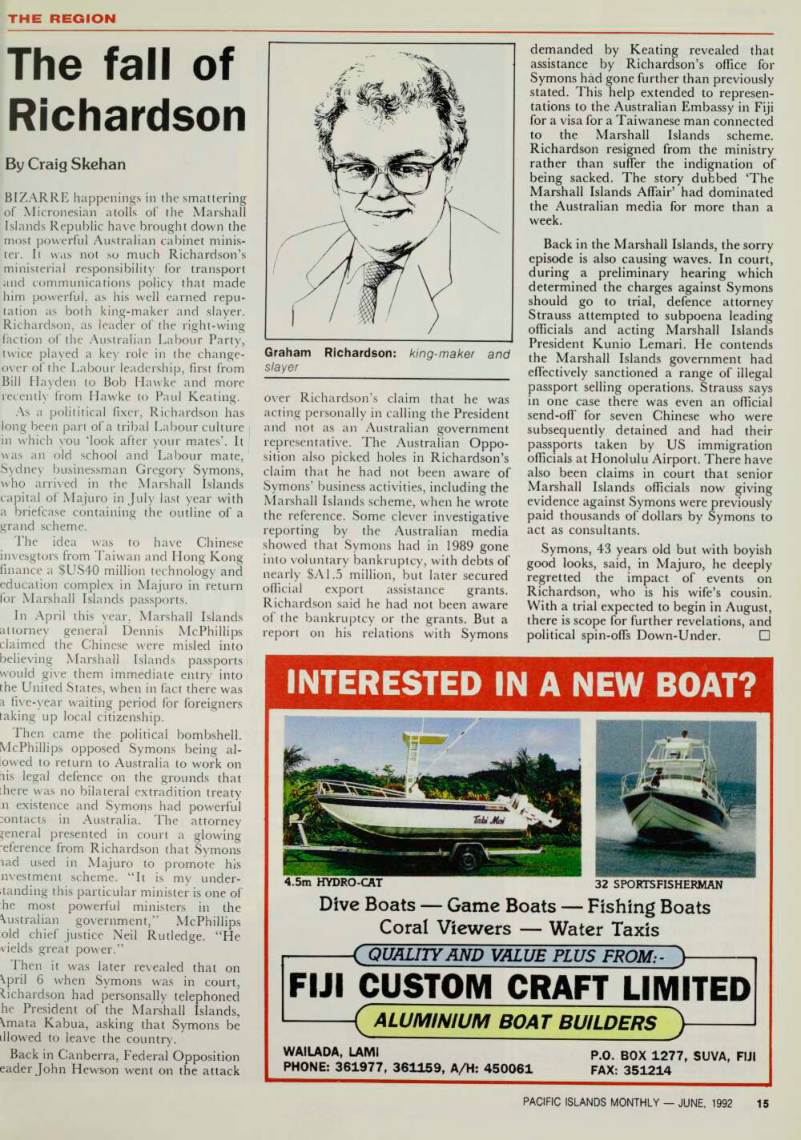
Graham Richardson: king-maker and slayer
Advertisements & other items, p. 15 (1 item)
( Aluminium Boat Builders )
INTERESTED IN A NEW BOAT?
f -) 'h Thki Mat
4.5 m HYDRO-CAT
32 SPORTSFISHERMAN
Dive Boats Game Boats Fishing Boats Coral Viewers Water Taxis
( QUALITY AND VALUE PLUS FROM:
FIJI CUSTOM CRAFT LIMITED
( ALUMINIUM BOAT BUILDERS )
WAILAOA, LAMI P.O. BOX SUVA F |j| PHONE: 361977, 361159, A/H: 450061 FAX; 351214
Rarotonga
Fire
Rarotonga recovers after blaze
By Anna Buckley
I’irc on Rarotonga has caused more damage than two cyclones pul together according to one Cook Islands govern ment official.
Government buildings, including the
Prime Minister’s Department, depart ments of justice and Lands. Internal Affairs and Surveys, the historic court house, and the national telephone exchange were destroyed in.a dramatic lire in the capital on Sunday. Ma\ 10.
Arson i> suspected. The official cause ol the lire is still unknown. But Elder lulai Pere ol the Apostolic Church warned everyone to be on guard because “government buildings were the target this time, but yours or mine could be next “It is our fervent prayer that we all see and realise the seriousness of this lire burning holocaust and join with our Christian warriors in praying against this evil." he says.
I he lire follows an outburst of arson attacks over the Easter weekend in w hich the Seventh Day Adventist Church, shops and offices were burnt to the ground. A 17-year-old from the capital, who admitted responsibility for all but one ol the attacks is currently awaiting trial.
“It will take at leat six months for government to gel back to normal" says government .>poke*man fere Tangiiti.
He estimates damages worth S 7 million to government property. A safe with S2OOO cash and govcrnmen t documents was rescued by residents w ho Ibrmed a human chain. Records of births, deaths, marriages and land claims since 1987 have been lost, many confidential Cabi net files destroyed. 50.5 million of' equipment was lost from the Surveys
department alone.
Chief executive of Cook Islands Tele com Stuart Davies estimates losses at S 3 million. A temporary network connect ing 100 priority users was set up within days; but it will take at least three months for the country’s 3000 phone lines to be restored. ’ J he fire is now out* says Elder 7'utai Pere, ‘ but personal burnings by divine judgement of the person responsible...in the lake ol Satan and his Angels of Darkness will be forever and ever’. □
Roaring[?]nferno
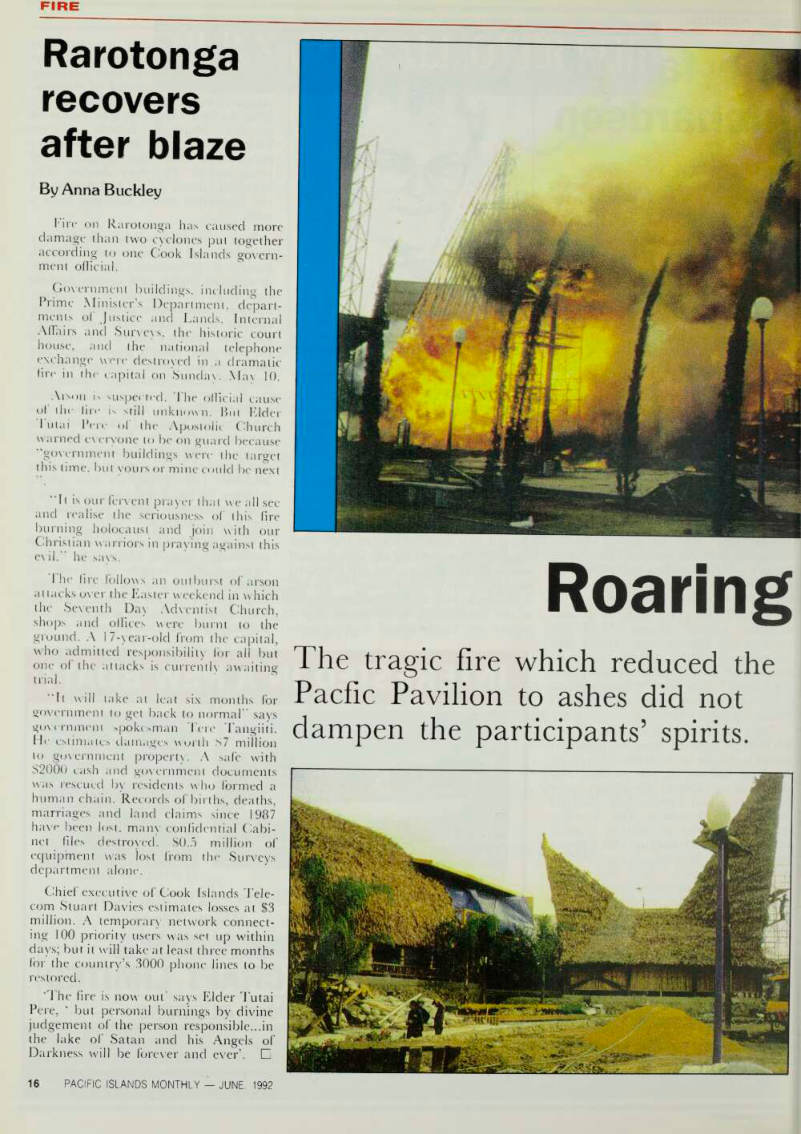
The tragic fire which reduced the Pacfic Pavilion to ashes did not
dampen the participants’ spirits.
Commissioner general Kaliopate Tavola reports the spirit of co operation is alive and well in Seville.
HE Pacific Pavilion in Spain, magnificent ediface of three
aditional island buildings
e bure kalou, hems tambaran and le with every hope of :coming a beacon of light for e region in Europe for the next : months as far as tourism, \dc and investment were con rned, was lost in a fire on
Dod Friday, just two days
fore the official opening of :po’92 on Easter Monday, Dril 20. 1 he burnt thatched roofs and walls the three traditional buildings, rticularly the roof of the bare kalou d fale , sustained fair damage. The ler parts, while scarred by the flame, I not show much damage. No lives re lost and nobody was hurt. The ■ did not damage the whole base nt area and the stage for our ■formances. This area contains the
administration area, storage, changing facilities for the performances and the common room for all staff.
The cause of the fire was focussed on the welding system that was taking place before the fire broke out. (The welding was to do with the sprinkler system which was designed to prevent such fires!). It was reported that the police took the welder, a New Zealand national, in for questioning but he was soon released and his passport returned to him after it was proved that the incident was an accident.
The Pacific has received generous support from many of the countries represented at Expo. Since the fire, there have been messages of sympathy and expressions of support for an immediate recovery and for continued participation of the South Pacific Pavilion in Expo 92. Commissioner general lan Fraser of New Zealand has offered office and other facilities for our staff. He has also offered us use of all staff facilities in the pavilion. All social fees have been waived for us. He has also offered manpower, at no cost to us, for the recovery work on our site.
The Australian commissioner gen eral, Doug McClelland, has offered the Pacific Pavilion part of the ground floor display area in their 534-million
Pavilion for our artefacts and light box
displays.
Visitors to the Pavilion have given Pavilion staff nothing but praise for
their participation following the
tragedy. Television coverage of the Pacific by French, Swiss, Spanish, Australian and other national stations were highlighted at the Pacific Expo 92 opening. The press and media cover age was seen in millions of homes
throughout Europe, and, despite the
fire, media attention has escalated on the region.
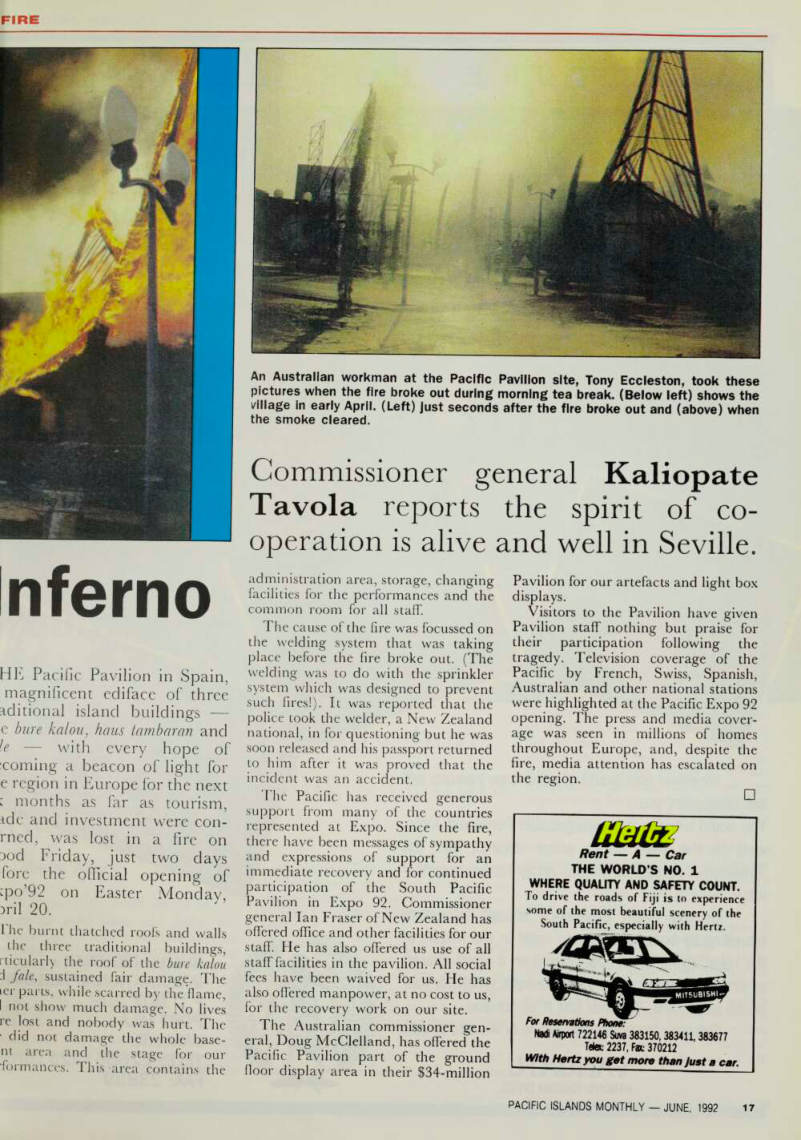
An Australian workman at the Pacific Pavilion site, Tony Eccleston, took these pictures when the fire broke out during morning tea break. (Below left) shows the village in early April. (Left) just seconds after the fire broke out and (above) when the smoke cleared.
Advertisements & other items, pp. 17-18 (1 item)
UidiiL
Rent A Car
THE WORLD S NO. 1
WHERE QUALITY AND SAFETY COUNT.
To drive the roads of Fiji is to experience some of the most beautiful scenery of the South Pacific, especially with Hertz.
For Reservations Phone: Nadi Airport 722146 Suva 383150,383411,383677 Tetec 2237, Fat 370212 With Hertz you get more than Just a car.
Whatever your brand of adventure, Vanuatu will not disappoint you.
You could witness the unforgettable Pentecost Jump, walk to the edge of an active volcano, dive the ‘President Coolidge’ or witness ancient tribal ceremonies.
Or you might experience enough adventure travelling by boat back to your hotel in the middle of the night, flying to an outer island an a small aircraft or simply shopping at the local markets. Whatever your brand adventure, Vanuatu has it all for you.
See your travel agents, airline or write to or call.
VANUATU
NATIONAL TOURISM OFFICE
FA- 'O a
KUMUL HIGHWAY
INTERNATIONAL BUILDING
P 0 BOX 209
PORT VILA
VANUATU
TELE: 22685/22515
FAX: 23889
Tourism

Special Report
Tourism at what price?
The cost of a holiday here could be turning visitors away
By Martin Tiffany
7 IJI the way the world should be. seven or eight years ago under that manner the country seemed to have got ts image especially its tourism image - right. A land full of beautiful sunshine, fiendly people and miles of white sandy reaches with affordable accommodation md a quality of life that was the envy of he rest of the world. fhen in May, 1987 the unthinkable lappened a coup in paradise, fol owed, not long after, by another. The
world watched, stunned. They certainly did not come to get a first hand look as visitor numbers plummeted from a healthy 257,824 in 1986 to 189,866 in 1987.
Not being a country to take things lying down, Fiji picked itself up, brushed itself off and recorded a record 278,996 visitors in 1990 and 259,350 last year. Although Fiji’s are being sung by pre-coup visitors, what sort of image has the country now got for the intending tourist? ‘Pricey’ and ‘expensive’ are two words that come to the fore when Fiji tourism
is mentioned expensive airfares, ex
pensive accommodation, expensive
meals at hotels.
Comparisons given are with specials to Bali or Hawaii where for around AS96O you can get airfares from Australia plus five nights accommodation. That amount would get you little more than your normal airfare to Fiji. It is interest ing to note that travel agents and wholesalers in Australia and New Zea land say Air Pacific airfares to Fiji are competitive although things can get expensive on the ground. But the percep tion of people is that it is expensive to go for a holiday to Fiji.
Tourism industry people naturally argue
that their prices are competitive, they too have good package deals and perhaps most importantly — can Bali compare to
the Fiji experience?
The fact remains that the perception of Fiji in major tourism markets especi ally Australia is one of a costly destination at a time when tourists are more price-driven than ever. Perhaps one of the faults has been that it is mainly the bigger, and more expensive, hotels and resorts which are able to promote
themselves widely especially in conjunc
tion with Fiji Visitors Bureau (FVB) promotions.
Tourists: are the islands still beckoning them?
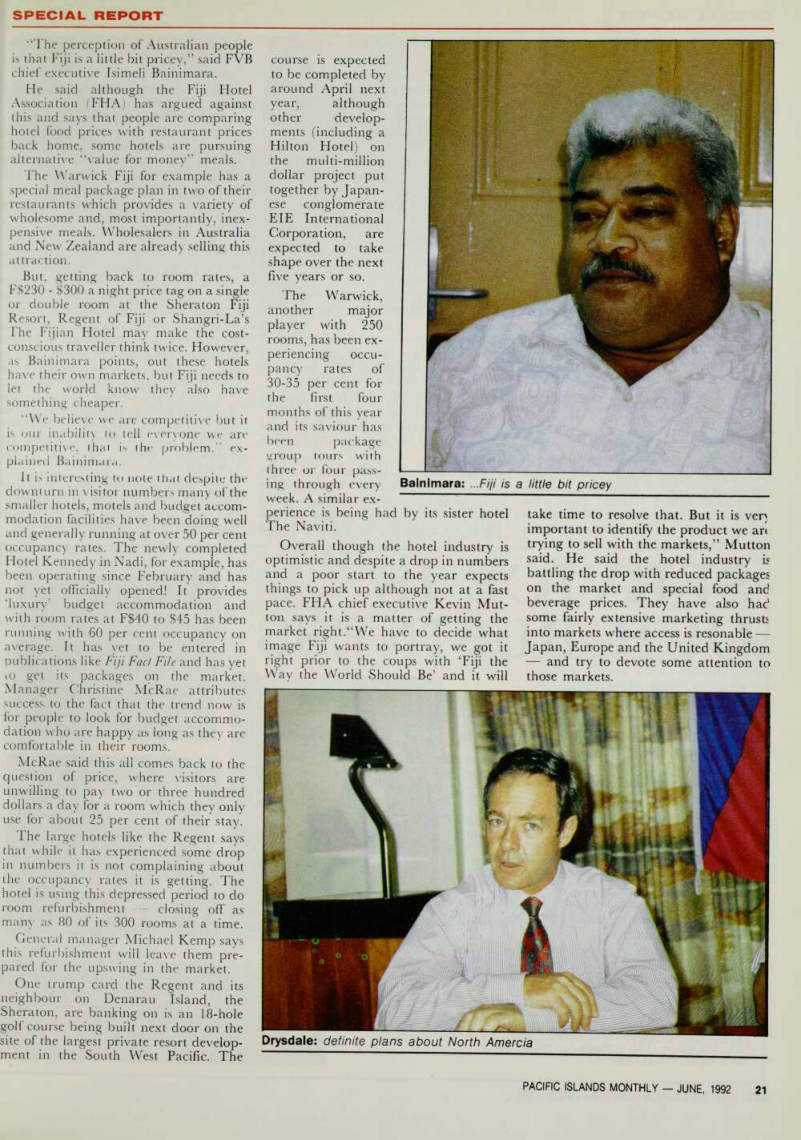
“The perception of Australian people is that Fiji is a little bit pricey,” said FVB chief executive Isimeli Bainimara.
He said although the Fiji Hotel Association (FHA) has argued against this and says that people are comparing hotel food prices with restaurant prices back home, some hotels are pursuing alternative “value for money” meals.
The Warwick Fiji for example has a special meal package plan in two of their restaurants which provides a variety of wholesome and, most importantly, inex pensive meals. Wholesalers in Australia and New Zealand are already selling this attraction.
But. getting back to room rates, a FS23O - $3OO a night price tag on a single or double room at the Sheraton Fiji Resort, Regent of Fiji or Shangri-La’s The Fijian Hotel may make the cost conscious traveller think twice. However, as Bainimara points, out these hotels have their own markets, but Fiji needs to let the world know they also have something cheaper.
“We believe we are competitive but it is our inability to tell everyone we are competitive, that is the problem, ex plained Bainimara.
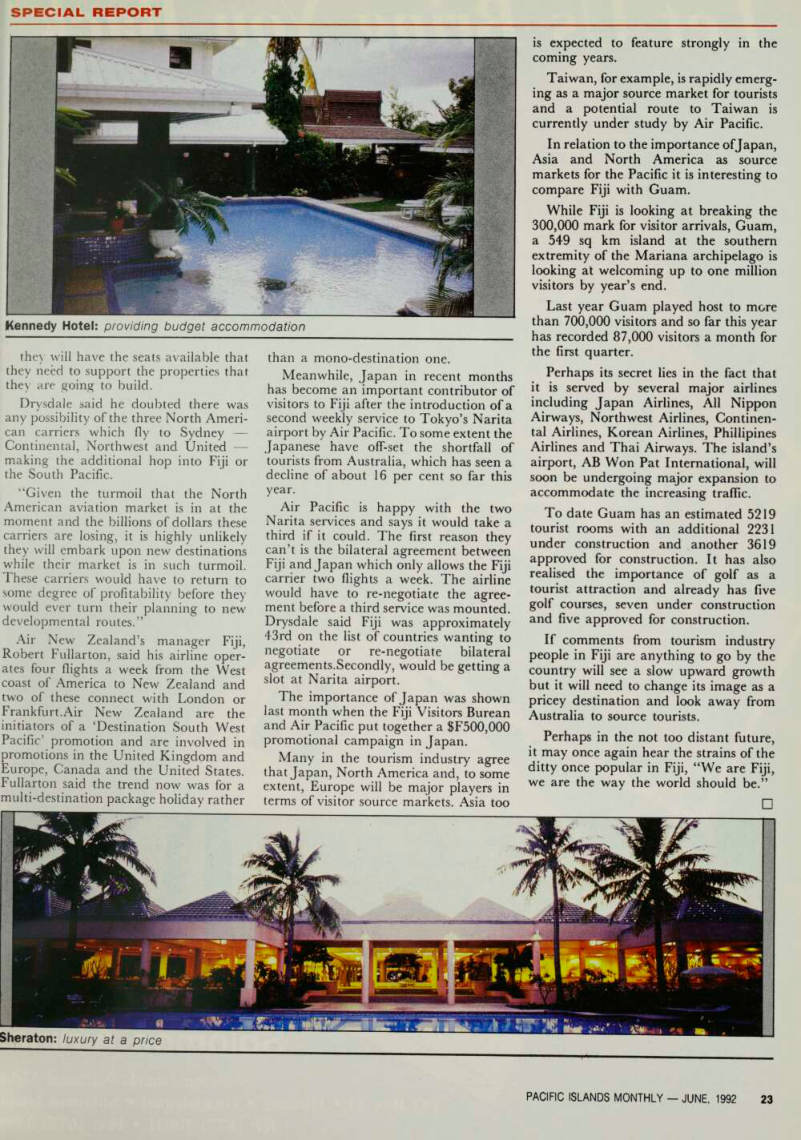
It is interesting to note that despite the downturn in visitor numbers many of the smaller hotels, motels and budget accom modation facilities have been doing well and generally running at over 50 per cent occupancy rates. The newly completed Hotel Kennedy in Nadi, for example, has been operating since February and has not yet officially opened! It provides ‘luxury’ budget accommodation and with room rates at Fs4o to $45 has been running with 60 per cent occupancy on average. It has yet to be entered in publications like Fiji Fad File and has yet io get its packages on the market.
Manager Christine Mcßae attributes success to the fact that the trend now is for people to look for budget accommo dation who are happy as long as they are comfortable in their rooms.
Mcßae said this all comes back to the question of price, where visitors are unwilling to pay two or three hundred dollars a day for a room which they only use for about 25 per cent of their stay.
The large hotels like the Regent says that while it has experienced some drop in numbers it is not complaining about the occupancy rates it is getting. The hotel is using this depressed period to do room refurbishment closing off as many as 80 of its 300 rooms at a time.
General manager Michael Kemp says this refurbishment will leave them pre pared for the upswing in the market.
One trump card the Regent and its neighbour on Denarau Island, the Sheraton, are banking on is an 18-hole golf course being built next door on the site of the largest private resort develop ment in the South West Pacific. The
course is expected to be completed by around April next year, although
other develop
ments (including a Hilton Hotel) on the multi-million dollar project put together by Japan ese conglomerate EIE International
Corporation, are
expected to take shape over the next five years or so.
The Warwick, another major player with 250 rooms, has been ex
periencing occu
pancy rates of 30-35 per cent for the first four months of this year and its saviour has been package group tours with three or four pass ing through every week. A similar ex-
perience is being had by its sister hotel The Naviti.
Overall though the hotel industry is optimistic and despite a drop in numbers and a poor start to the year expects things to pick up although not at a fast pace. FHA chief executive Kevin Mut ton says it is a matter of getting the market right.“We have to decide what image Fiji wants to portray, we got it right prior to the coups with ‘Fiji the Way the World Should Be’ and it will
take time to resolve that. But it is ven important to identify the product we an trying to sell with the markets,” Mutton said. He said the hotel industry is battling the drop with reduced packages on the market and special food and
beverage prices. They have also had
some fairly extensive marketing thrusts into markets where access is resonable Japan, Europe and the United Kingdom and try to devote some attention to those markets.
Bainimara: ...Fiji is a little bit pricey
Drysdale: definite plans about North Amercia
According to Mutton this seems to be working especially in the European sector which in time could cause a major redefining of the market from which Fiji sources tourists.
In conjunction with this European thrust Air New Zealand last month announced plans to invite 150 British travel agents to a four-day event in November. Called ‘Project Pride’, the event is aimed at boosting the profile of Fiji and Air New Zealand’s other South
West Pacific destinations in the UK market.
As a small isolated island nation, Fiji is at the mercy of international air carriers to bring in the bulk of its tourists.
When American carrier Continental Airlines pulled out its services following the coups the number of North American visitors plummeted from around 70,000 in 1986 to around 36,000. The numbers however rose to 47,084 last year.
Also, Canadian Airlines did not live up to promises and has dropped all services to Fiji so the country is not getting the numbers out of Canada it expected. The carriers ceased services based on cold economic facts.
But eyes are once again turning to North America (and Canada).
Bainimara, Mutton and Tourism Council of the South Pacific (TCSP) director Malakai Gucake, among many others, agree the sooner a North Ameri can service is started the better.
Air Pacific’s chief executive Andrew Drysdale said it has “very definite plans” to operate services to North America in the future and this formed part of its five year plan.
“The intent is to commence in 1994 with the introduction of charter services initially, just during the peak season, and then as the charter services become viable to gradually extend the period
during the year until they eventually become a regular service,” Drysdale
explained.
“We believe that with the turnaround in the US economy now having begun, by 1994 the market will have grown to the point where we would hope it would be viable. But I would point out, as the Prime Minister said when he first announced this at last year’s tourism convention, that it must be viable.”
“We in the Pacific have to find a formula whereby we can make it viable and were working on that now.”
On the possibility of an American carrier flying to Fiji, Drysdale said both he and his management team have done a great deal in an attempt to encourage an American carrier to fly to Fiji.
“A major North American carrier has the domestic marketing power to be able to turn on the American tourist to fly to Fiji. And that was clearly proven when Continental Airlines was operating here from the US and we had the highest ever of North American arrivals, in fact in one year I think it was 1986 the North American arrivals nearly equalled the Australian visitor arrivals,” said Drysdale.
He said, however, that long-term stability needs Air Pacific to fly the route the way that tourism developers and investors can be reasonably sure that
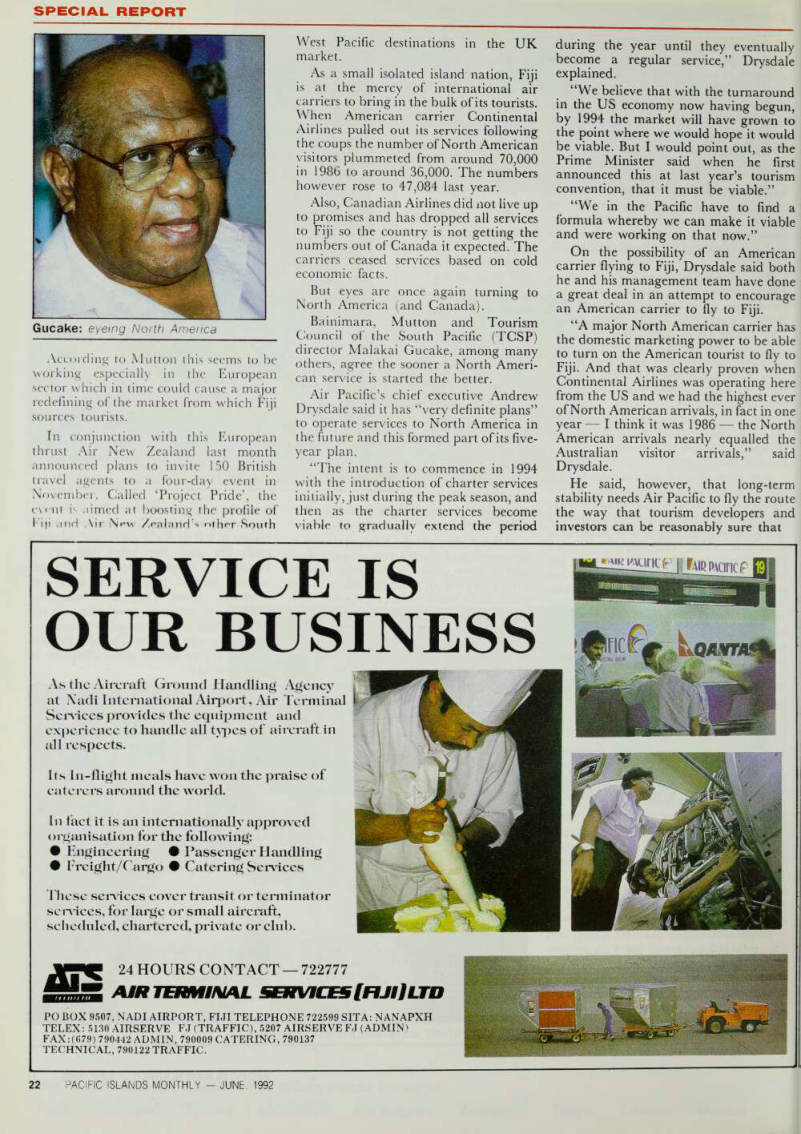
Gucake: eyeing North America
the) will have the seats available that they need to support the properties that they are going to build.
Drysdale said he doubted there was any possibility of the three North Ameri can carriers which fly to Sydney Continental, Northwest and United making the additional hop into Fiji or the South Pacific.
“Given the turmoil that the North American aviation market is in at the moment and the billions of dollars these carriers are losing, it is highly unlikely they will embark upon new destinations while their market is in such turmoil.
These carriers would have to return to some degree of profitability before they would ever turn their planning to new
developmental routes.”
Air New Zealand’s manager Fiji, Robert Fullarton, said his airline oper ates four flights a week from the West coast of America to New Zealand and two of these connect with London or Frankfurt. Air New Zealand are the initiators of a ‘Destination South West Pacific’ promotion and are involved in promotions in the United Kingdom and Europe, Canada and the United States.
Fullarton said the trend now was for a multi-destination package holiday rather
than a mono-destination one.
Meanwhile, Japan in recent months has become an important contributor of visitors to Fiji after the introduction of a second weekly service to Tokyo’s Narita airport by Air Pacific. To some extent the Japanese have off-set the shortfall of tourists from Australia, which has seen a decline of about 16 per cent so far this year.
Air Pacific is happy with the two Narita services and says it would take a third if it could. The first reason they can’t is the bilateral agreement between Fiji and Japan which only allows the Fiji carrier two flights a week. The airline would have to re-negotiate the agree ment before a third service was mounted.
Drysdale said Fiji was approximately 43rd on the list of countries wanting to negotiate or re-negotiate bilateral agreements. Secondly, would be getting a slot at Narita airport.
The importance of Japan was shown last month when the Fiji Visitors Burean and Air Pacific put together a 5F500,000
promotional campaign in Japan.
Many in the tourism industry agree that Japan, North America and, to some extent, Europe will be major players in terms of visitor source markets. Asia too
is expected to feature strongly in the coming years.
Taiwan, for example, is rapidly emerg ing as a major source market for tourists and a potential route to Taiwan is currently under study by Air Pacific.
In relation to the importance of Japan, Asia and North America as source markets for the Pacific it is interesting to compare Fiji with Guam.
While Fiji is looking at breaking the 300,000 mark for visitor arrivals, Guam, a 549 sq km island at the southern extremity of the Mariana archipelago is looking at welcoming up to one million visitors by year’s end.
Last year Guam played host to more than 700,000 visitors and so far this year has recorded 87,000 visitors a month for the first quarter.
Perhaps its secret lies in the fact that it is served by several major airlines including Japan Airlines, All Nippon Airways, Northwest Airlines, Continen tal Airlines, Korean Airlines, Phillipines Airlines and Thai Airways. The island’s airport, AB Won Pat International, will soon be undergoing major expansion to accommodate the increasing traffic.
To date Guam has an estimated 5219 tourist rooms with an additional 2231 under construction and another 3619 approved for construction. It has also realised the importance of golf as a tourist attraction and already has five golf courses, seven under construction and five approved for construction.
If comments from tourism industry people in Fiji are anything to go by the country will see a slow upward growth but it will need to change its image as a pricey destination and look away from Australia to source tourists.
Perhaps in the not too distant future, it may once again hear the strains of the ditty once popular in Fiji, “We are Fiji, we are the way the world should be.”
Kennedy Hotel: providing budget accommodation
Sheraton: luxury at a price
Advertisements & other items, pp. 20-24 (1 item)
Shopping,
sports.
traffic
VISITORS
BUREAU
Experience life, Fiji style.
GPO Box 92 Suva Fiji Tel 302433 Fax 300970 Telex FJ2IBO For futher information contact FVB offices around the world Nadi Auckland Sydney Melbourne Los Angeles Vancouver Tokyo London Munich
SERVICE IS
OUR BUSINESS
As the Aircraft Ground Handling Agency at Nadi International Airport, Air Terminal Services provides the equipment and experience to handle all types of aircraft in all respects.
Its In-flight meals have won the praise of caterers around the world.
I n fact it is an internationally approved organisation for the following: • Engineering Passenger Handling • f reight/C argo Catering Services These services cover transit or terminator services, for large or small aircraft, scheduled, chartered, private or club.
liriippwppi
U
\rnnc
AM V / SS
24 HOURS CONTACT 722777
AIR TERMINAL SERVICES [FIJII LTD
PO BOX 9507, NADI AIRPORT, FIJI TELEPHONE 722599 SITA: NANAPXH TELEX: 5130 AIRSERVE FJ (TRAFFIC), 5207 AIRSERVE FJ (ADMIN'
FAX:(O79) 790442 ADMIN, 790009 CATERING, 790137
TECHNICAL, 790122 TRAFFIC.
You Back
t X V Solomon Airlines Solomon Islands National Airline • Honiara • Guadalcanal • Solomon Islands Tel: (677) 20031 • Fax: (677) 23991
Creating a unique image
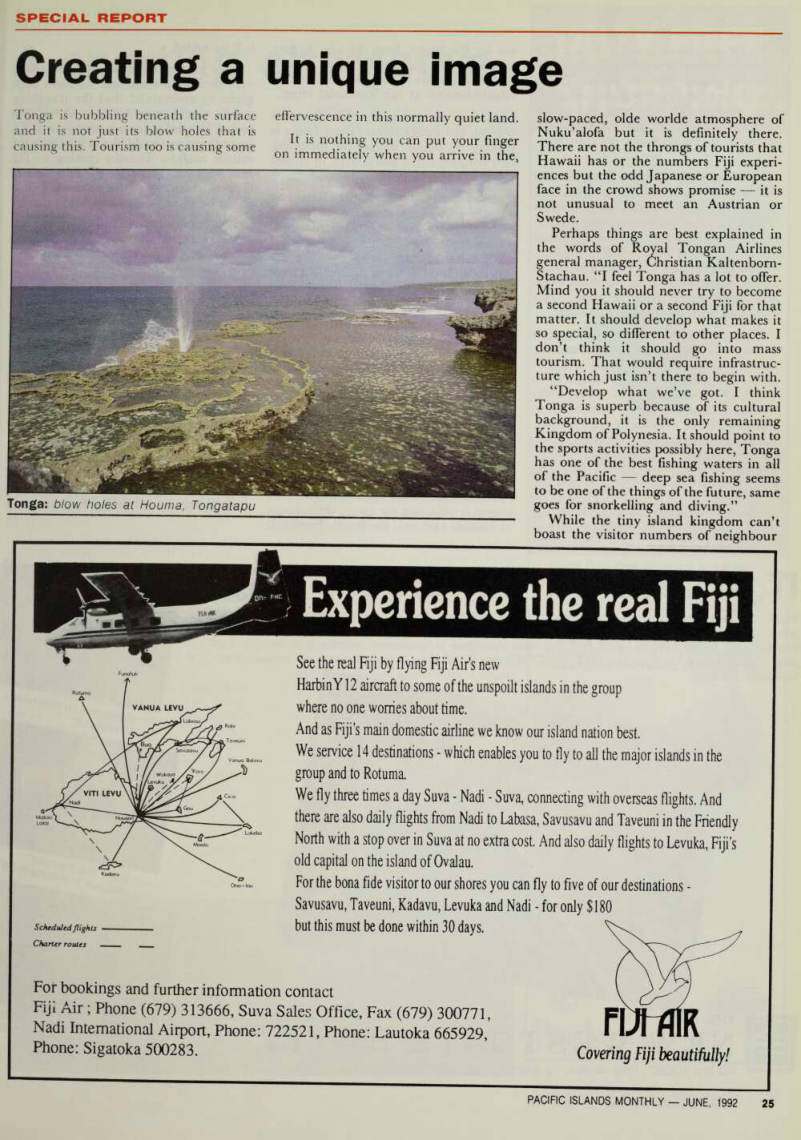
Tonga is bubbling beneath the surface and it is not just its blow holes that is causing this. Tourism too is causing some
effervescence in this normally quiet land.
It is nothing you can put your finger on immediately when you arrive in the,
slow-paced, olde worlde atmosphere of Nuku’alofa but it is definitely there.
There are not the throngs of tourists that Hawaii has or the numbers Fiji experi ences but the odd Japanese or European face in the crowd shows promise it is not unusual to meet an Austrian or Swede.
Perhaps things are best explained in the words of Royal Tongan Airlines general manager, Christian Kaltenborn- Stachau. “I feel Tonga has a lot to offer.
Mind you it should never try to become a second Hawaii or a second Fiji for that matter. It should develop what makes it so special, so different to other places. I don’t think it should go into mass tourism. That would require infrastruc ture which just isn’t there to begin with.
“Develop what we’ve got. I think Tonga is superb because of its cultural background, it is the only remaining Kingdom of Polynesia. It should point to the sports activities possibly here, Tonga has one of the best fishing waters in all of the Pacific deep sea fishing seems to be one of the things of the future, same goes for snorkelling and diving.”
While the tiny island kingdom can’t boast the visitor numbers of neighbour
Tonga; blow holes at Houma, Tongatapu
Fiji, it can at least proudly show a 20.8 per cent increase in tourist arrivals for the 1990/91 period. For the period Tonga was in the minority of regional countries that showed an increase in tourist arrivals during a time affected by recession in many major tourism mar kets.
Another bright light for Tonga is that North America and Europe accounted for a great part ofTonga’s tourist arrivals last year two markets which, accord ing to tourism pundits, will be important for the future of South Pacific tourism.
Out of a total of 21,524 visitors to Tonga last year 5283 came from North America and 3570 came from Europe. This compares with 3444 from Australia.
Perhaps Tonga’s tourism picture can
be put into better perspective when the country of 696.71 sq km and a popu lation of around 100,000 is compared to Papua New Guinea. For 1991 PNG recorded 39,051 visitors compared to Tonga’s 21,524. Taking it even further, the Solomon Islands last year had 11,105 tourist arrivals (although this was an increase of 1910 from 1990 s figure of 9195).
In and around Nuku’alofa there are signs that tourism is considered import
ant for the future, from the new airport terminal to the many sign boards advertising tours to the TSI million plus refurbishments at the Ramanlal Hotel.
About a 10-minute boat ride from the capital, the Pangaimotu Island resort is looking at major upgrading including new cottages and a golf course, to attract visitors particularly from Japan.
Away from Nuku’alofa the Hapai and Vava’u groups are ideal for yachts and already attract a number of international yachtsmen. Two large international companies offering yachts for hire are setting up shop in Vava’u. One will have 36 yachts while the other is talking about 18, ranging in length from 36 to 58 feet.
“Consider that each yacht will take about five people and now we have 54 yachts at five people each that is like a fairly large sized hotel. Most yacht people come for one week only so that turnover could keep our Twin Otters
flying to Vava’u quite busy,” said
Kaltenborn-Stachau.
“The South Pacific is big news in Europe right now. The European tourists have been all over Europe, all over North America and South America. The Gulf region is off-limits for now, Africa is out of bounds and yes, the South Pacific, it
is,” he added.
“We understand that this route is a very profitable route and we have been given to understand that the travelling public would enjoy using a jet on that sector. We feel there is business for RTA in addition we would like to tape into the tourist market. Tourists coming to Fiji may very well like to see the Kingdom of Tonga which is so different from Fiji, it could be an add-on to a vacation there.”
Kaltenborn-Stachau is a German na tional seconded to Tonga as an aviation advisor to the government airline.
Royal Tongan Airlines (formerly domestic carrier Friendly Island Air ways) began international operations last November between Nuku’alofa and Nadi and Nuku’alofa and Auckland using a leased Solomon Airlines 737.
Although the leg to Nadi has been scrapped the Auckland service has proved viable and an important con nection along with the six flights a week between Nadi and Nukualofa by Fiji’s national flag carrier Air Pacific.
So while the tourism pot is not expected to boil over with crowds of visitors pouring into this tiny kingdom, it is definitely on a healthy simmer.
Advertisements & other items, pp. 25-26 (1 item)
Omir
VANUA
LEVU
VITI
LEVU
Scheduled flights Charter routes See the real Fiji by flying Fiji Air's new Harbin Yl2 aircraft to some of the unspoilt islands in the group where no one worries about time.
And as Fiji's main domestic airline we know our island nation best.
We service 14 destinations - which enables you to fly to all the major islands in the group and to Rotuma.
We fly three times a day Suva - Nadi - Suva, connecting with overseas flights. And there are also daily flights from Nadi to Labasa, Savusavu and Taveuni in the Friendly North with a stop over in Suva at no extra cost. And also daily flights to Levuka, Fiji's old capital on the island of Ovalau.
For the bona fide visitor to our shores you can fly to five of our destinations - Savusavu, Taveuni, Kadavu, Levuka and Nadi - for only $lBO but this must be done within 30 days.
For bookings and further information contact Fiji Air; Phone (679) 313666, Suva Sales Office, Fax (679) 300771, Nadi International Airport, Phone: 722521, Phone: Lautoka 665929, Phone: Sigatoka 500283.
OMIR
Covering Fiji beautifully!
IT ALL REVOLVES AROUND US !
Ideally situated between Nadi International Airport and Nadi Town. The New Westgate offers its guests a host of amenities and activities either on site or nearby. If you're transiting to one of the nearby outer island resorts, you'll find The New Westgate a convenient, comfortable location for your Nadi stopover. Look for the FREE WESTGATE SHUTTLE VAN at the international arrivals area or Phone 790044. 3 t * % 3 -
THE
NEW WESTGATE HOTEL
PO.Box 10097, Nadi Airport, Fiji Islands. Phone: (679) 790044 Fax: (679) 790071
A sporting alternative
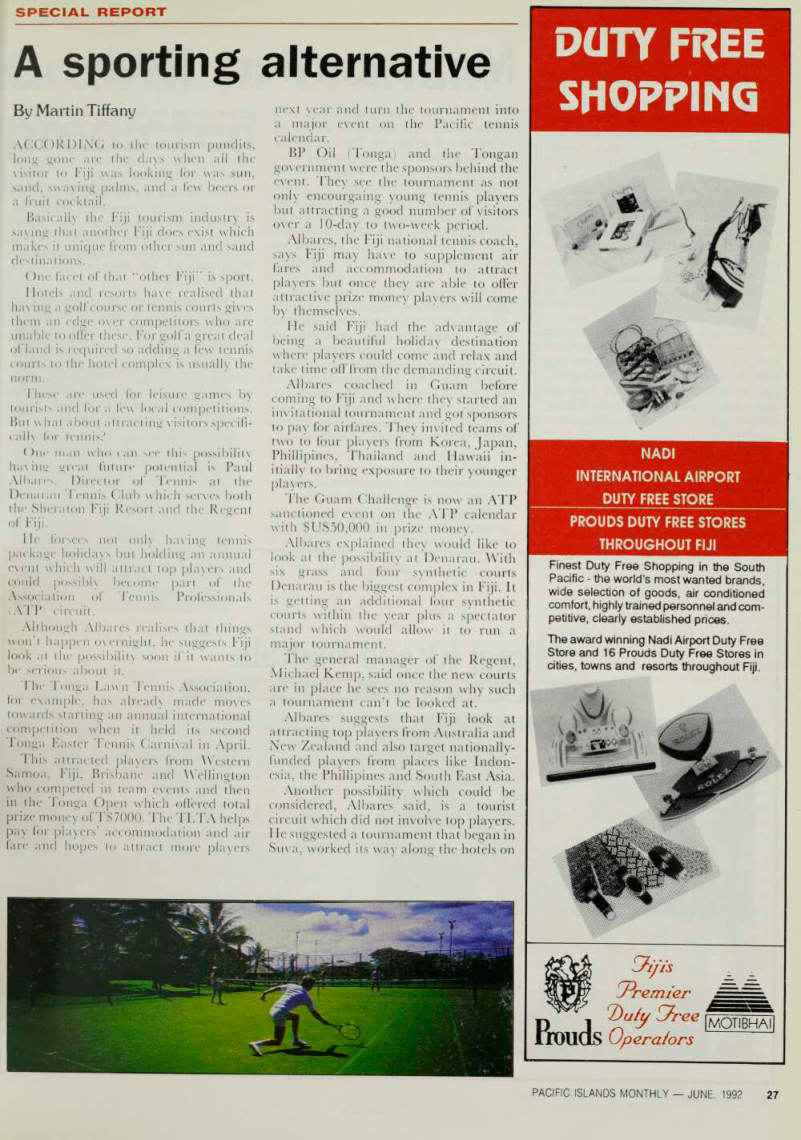
By Martin Tiffany
ACCORDING to the tourism pundits, long gone are the days when all the visitor to Fiji was looking for was sun, sand, swaying palms, and a few beers or a fruit cocktail.
Basicalb the Fiji tourism industry is saying that another Fiji does exist which makes it unique from other sun and sand destinations.
One facet of that “other Fiji" is sport.
Hotels and resorts have realised that having a golf course or tennis courts gives them an edge over competitors who are unable to offer these. For golf a great deal of land is required so adding a few tennis courts to the hotel complex is usually the norm. 1 hese are used for leisure games by tourists and for a few local competitions.
But what about attracting visitors specifi cally lor tennis?
Oiu- man who can see this possibilit\ having great future potential is Paul Albares. Director o( Tennis at the Denarau Tennis Club which serves both the Sheraton Fiji Resort and the Regent of Fiji.
He forsees not only having tennis
package holidays but holding an annual
event which will attract top players and could possibly become part of the Association of Tennis Professionals (ATP circuit.
Although Albares realises that things won’t happen overnight, he suggests Fiji look at the possibility soon if it wants to be serious about it.
The Tonga Lawn Tennis Association, for example, has already made moves towards starling an annual international competition when it held its second Tonga Easter Tennis Carnival in April.
This attracted players from Western Samoa, Fiji, Brisbane and Wellington who competed in team events and then in the Tonga Open which offered total prize money ofTS7OOO. The TLTA helps pay for players’ accommodation and air fare and hopes to attract more players
next year and turn the tournament into a major event on the Pacific tennis calendar.
BP Oil (Tonga) and the Tongan government were the sponsors behind the event. They see the tournament as not only encourgaing young tennis players but attracting a good number of visitors over a 10-day to two-week period.
Albares, the Fiji national tennis coach, says Fiji may have to supplement air fares and accommodation to attract players but once they are able to offer attractive prize money players will come by themselves.
He said Fiji had the advantage of being a beautiful holiday destination where players could come and relax and take time off from the demanding circuit.
Albares coached in Guam before coming to Fiji and where they started an invitational tournament and got sponsors to pay for airfares. They invited teams of two to four players from Korea, Japan, Phillipincs, Thailand and Hawaii in itially to bring exposure to their younger players.
The Guam Challenge is now an ATP sanctioned event on the ATP calendar with SUSSO,OOO in prize money.
Albares explained they would like to look at the possibility at Denarau. With six grass and four synthetic courts Denarau is the biggest complex in Fiji. It is getting an additional four synthetic courts within the year plus a spectator stand which would allow it to run a major tournament.
The general manager of the Regent, Michael Kemp, said once the new courts are in place he sees no reason why such a tournament can’t be looked at.
Albares suggests that Fiji look at attracting top players from Australia and New Zealand and also target nationally funded players from places like Indon esia, the Phillipincs and South Fast Asia.
Another possibility which could be considered, Albares said, is a tourist circuit which did not involve top players.
He suggested a tournament that began in Suva, worked its way along the hotels on
the Coral Coast and ended at Denarau where a classic could be held.
This would be easier to organise and could be looked at in the shorter-term but “ down the road some time (we could) look at having a major event that would be the biggest in the region” said Albares.
In early May a group of Australian sports journalists were invited to Fiji by the Fiji Visitors Bureau and Air Pacific to look at sports facilities at various hotel and resorts especially tennis facilities. The journalists suggested that a circuit or a major tournament be organised to attract visitors.
From such a circuit or tournament the young players would be able to see and play against top competition and possibly one or two outstanding Fiji players would emerge and help the country become a regional tennis force.
Albares said this would allow players to compete in places like New Zealand with a resonable chance.
All this and attracting the all import ant tourist dollar □
Advertisements & other items, p. 27 (1 item)
Doty Free
SHOPPING
« \ d* £ t
INTERNATIONAL AIRPORT
DUTY FREE STORE
PROUDS DUTY FREE STORES
THROUGHOUT FIJI
Finest Duty Free Shopping in the South Pacific - the world's most wanted brands, wide selection of goods, air conditioned comfort, highly trained personnel and competitive, clearly established prices.
The award winning Nadi Airport Duty Free Store and 16 Prouds Duty Free Stores in cities, towns and resorts throughout Fiji. \ I
i yM kj
■ A * 55
IJIS
7*l remier
7)u/y o^2
ree
[/ViOTIBHAII
Prouds Operators
Mega-carriers likely
HINTS at the possible formation of a “mega-carrier” for Southwest Pacific by Fiji’s national airline Air Pacific, Austra lia’s Qantas and Air New Zealand were made in April by Australian travel magazine Travel Week.
The Fiji Hotel Association has reser vations about this union saying it would be disastrous for tourism viability be cause it would eliminate competition between the carriers and result in a rise in air fares.
However, Air Pacific’s chief executive, Andrew Drysdale, explains that some sort of South Pacific consortium could be formed between the airlines in the future to strengthen their position against the
huge northern hemisphere carriers.
“Throughout the world the process of deregulation of aviation was intended to create multiple numbers of carriers who could compete with each other for the benefit of the consumer,” Drysdale said.
“The result has been the demise of a lot of carriers and the emergence of mega-carriers who completely dominate aviation in the northern hemisphere.
“There’s been talk for many years now for the carriers in the Southwest Pacific
to consider to amalgamate in some form in a corporate effort.
“They still wouldn’t become mega carriers but at least they would be stronger than as individuals.
Drysdale said Air Pacific is of the view that commercial agreements should be reached and maintained by them, Qantas and Air New Zealand. He said the three airlines already had a number of agreements but there needed to be more work done.
“We must be very careful we don’t get forgotten in the rush to form some form of commercial alliances that we do
participate.
“This is not necessarily shareholding.
Shareholding is one way but not the only way and commercial alliances are prob ably easier to form, easier to modify as commercial pressures change.”
Drysdale said that while Air Pacific didn’t disagree with the concept of cross shareholding it felt that it would be quicker and more flexible to have commercial agreements between the airlinesl.
Advertisements & other items, p. 28 (1 item)
Hotel Kiiaijo Tusitala
a %
WESTERN SAMOA
In the very heart of Polynesia lie the beautiful islands of Western Samoa. Here you will discover the Hotel Kitano Tusitala.
Service is legendary and the cuisine superb you are dining in the elegance of Stevensons Restaurant or poolside in the Apaula Terrace.
Guestrooms are international standard with airconditioning, Television and full private facilities.
And there is a full range of services for the business traveller.
The Hotel Kitano Tusitala has nightly entertainment, at the Ocean Terrace Bar, and weekly * Island Night (Flafla) * Polynesian Entertainment * Poolside Barbecue plus many others. All in a breathtaking tropical
garden setting.
For details contact your Travel Agent. Business Travel Co-ordlnator Polynslan Airlines or the Hotel Kitano Tusitala P.O. Box 101. Apia. Western Samoa Phone: (685) 21122 Fax: (685) 23652
predicted
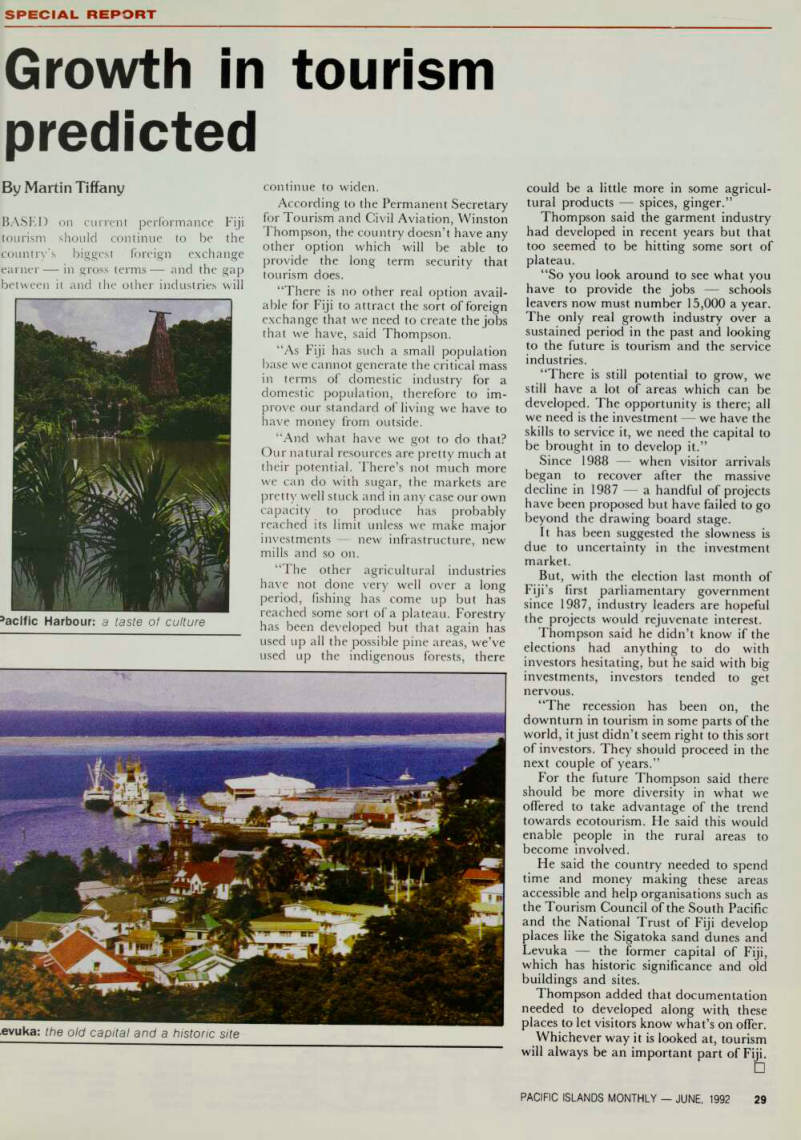
Growth in tourism predicted
By Martin Tiffany
BASED on current performance Fiji tourism should continue to be the
country's biggest foreign exchange
earner in gross terms and the gap between it and the other industries will
continue to widen.
According to the Permanent Secretary for Tourism and Civil Aviation, Winston Thompson, the country doesn’t have any other option which will be able to provide the long term security that tourism does.
“There is no other real option avail able for Fiji to attract the sort of foreign exchange that we need to create the jobs that we have, said Thompson.
“As Fiji has such a small population base we cannot generate the critical mass in terms of domestic industry for a domestic population, therefore to im prove our standard of living we have to have money from outside.
“And what have we got to do that?
Our natural resources are pretty much at their potential. There’s not much more we can do with sugar, the markets are pretty well stuck and in any case our own capacity to produce has probably reached its limit unless we make major investments new infrastructure, new mills and so on.
“The other agricultural industries have not done very well over a long period, fishing has come up but has reached some sort of a plateau. Forestry has been developed but that again has used up all the possible pine areas, we’ve used up the indigenous forests, there
could be a little more in some agricul tural products spices, ginger.”
Thompson said the garment industry had developed in recent years but that too seemed to be hitting some sort of plateau.
“So you look around to see what you have to provide the jobs schools leavers now must number 15,000 a year.
The only real growth industry over a sustained period in the past and looking to the future is tourism and the service industries.
“There is still potential to grow, we still have a lot of areas which can be developed. The opportunity is there; all we need is the investment we have the skills to service it, we need the capital to be brought in to develop it.”
Since 1988 when visitor arrivals began to recover after the massive decline in 1987 a handful of projects have been proposed but have failed to go beyond the drawing board stage.
It has been suggested the slowness is due to uncertainty in the investment market.
But, with the election last month of Fiji’s first parliamentary government since 1987, industry leaders are hopeful the projects would rejuvenate interest.
Thompson said he didn’t know if the elections had anything to do with investors hesitating, but he said with big investments, investors tended to get nervous.
“The recession has been on, the downturn in tourism in some parts of the world, it just didn’t seem right to this sort of investors. They should proceed in the next couple of years.”
For the future Thompson said there should be more diversity in what we offered to take advantage of the trend towards ecotourism. He said this would enable people in the rural areas to become involved.
He said the country needed to spend time and money making these areas accessible and help organisations such as the Tourism Council of the South Pacific and the National Trust of Fiji develop places like the Sigatoka sand dunes and Levuka the former capital of Fiji, which has historic significance and old buildings and sites.
Thompson added that documentation needed to developed along with these places to let visitors know what’s on offer.
Whichever way it is looked at, tourism will always be an important part of Fiji.
I —l
Pacific Harbour: a taste of culture
[?]evuka: the old capital and a historic site
Advertisements & other items, pp. 30-31 (1 item)
luxury-car ride.
The new Toyota brand mark. Three ellipses forming a “T” which stand for our customer, our commitment to the satisfaction of that customer through our product and for our spirit of creativity.
P* It’s not often that you hear descriptions like rugged or durable combined with refined and elegant. But then there’s never been a vehicle quite like the new Toyota Land Cruiser Station Wagon. The unrivalled legend of off-road reliability is now unsurpassed in comfort and sophistication as well. Attention to detail is found everywhere, from the fine trim to the instrument panel to the graceful lines of its exterior. Even in places you can’t see, like the heavy-duty ladder frame and suspension design that add to the superb
But Toyota’s innovation goes beyond providing luxury and durability. The new Land Cruiser Station Wagon, and all of bur cars, are designed to create a harmony between car and driver, and to provide you with the ultimate
driving experience.
The new Toyota Land Cruiser Station Wagon. Think of it as much more than a spacious luxury sedan with fourwheel drive. ... • i J 2 •V s
DISTRIBUTORS/DEALERS
AMERICAN SAMOA BURNS PHILP (S.S.) CO. LTD. PH 633-4281 GUAM & MICRONESIA ATKINS KROLL, INC. PH 646-1876/9 NORFOLK ISLANDS BORRY’S PTY LTD. PH 2114
SOLOMON ISLANDS MENDANA MOTORS PH 22884
VANUATU VANUATU MOTORS PH 2341
COOK ISLANDS PACIFIC MOTORS LTD. PH 20796
KIRIBATI TARAWA MOTORS PH 21090
PAPUA NEW GUINEA ELA MOTORS PH 217036
TAHITI NIPPON AUTOMOTO PH 429819
WESTERN SAMOA BURNS PHILP (S.S.) CO. LTD. PH 20800
FIJI A 4
NEW CALEDONIA S£
SAIPAN
TONGA BE
TOYOTA
What is the Forum?
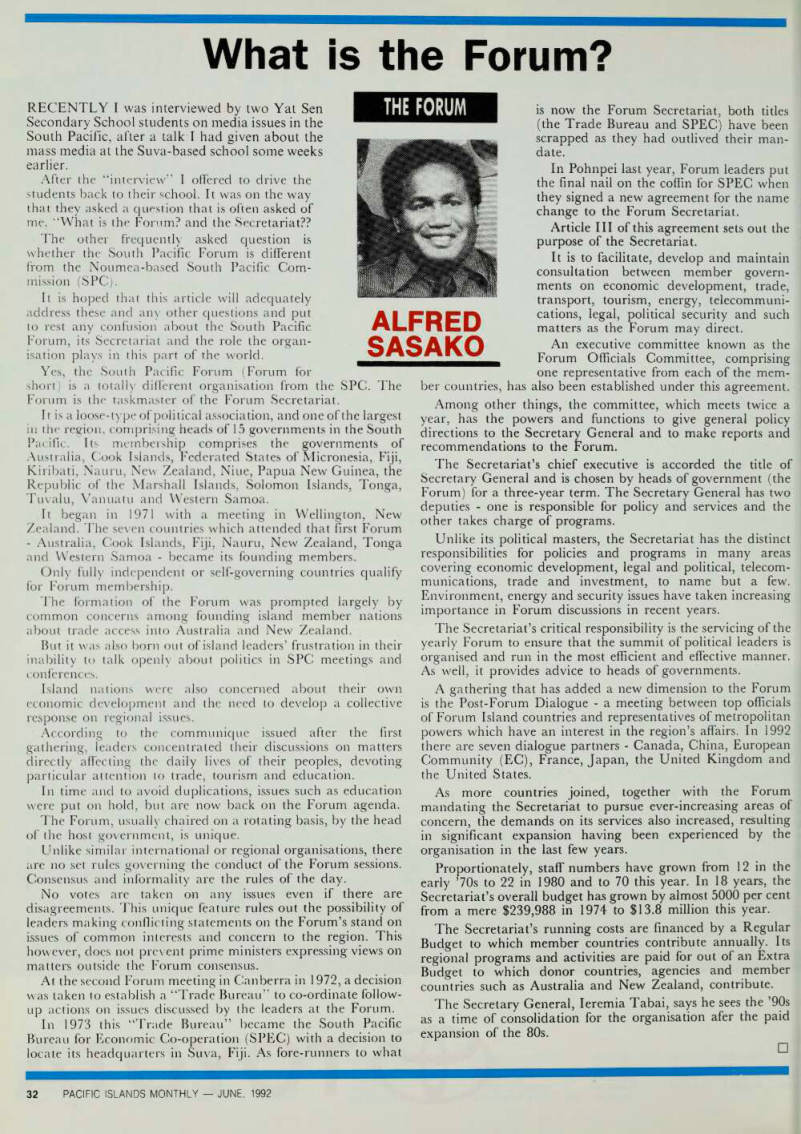
RECENTLY 1 was interviewed by two Yat Sen Secondary School students on media issues in the South Pacific, after a talk I had given about the mass media at the Suva-based school some weeks earlier.
After the “interview” I offered to drive the students back to their school. It was on the way that they asked a question that is often asked of me. “What is the Forum? and the Secretariat??
The other frequently asked question is w'hether the South Pacific Forum is different from the Noumea-based South Pacific Com
mission (SPC).
It is hoped that this article will adequately address these and any other questions and put to rest any confusion about the South Pacific Forum, its Secretariat and the role the organ isation plays in this part of the world.
Yes, the South Pacific Forum (Forum for
short) is a totally different organisation from the SPC. The Forum is the taskmaster of the Forum Secretariat.
It is a loose-type of political association, and one of the largest in the region, comprising heads of 15 governments in the South Pacific. Its membership comprises the governments of Australia, Cook Islands, Federated States of Micronesia, Fiji, Kiribati, Nauru, New Zealand, Niue, Papua New Guinea, the Republic of the Marshall Islands, Solomon Islands, Tonga, Tuvalu, Vanuatu and Western Samoa.
It began in 1971 with a meeting in Wellington, New Zealand. The seven countries which attended that first Forum - Australia, Cook Islands, Fiji, Nauru, New Zealand, Tonga and Western Samoa - became its founding members.
Only fully independent or self-governing countries qualify for Forum membership.
The formation of the Forum was prompted largely by common concerns among founding island member nations about trade access into Australia and New' Zealand.
But it was also born out of island leaders’ frustration in their inability to talk openly about politics in SPC meetings and conferences.
Island nations were also concerned about their own economic development and the need to develop a collective response on regional issues.
According to the communique issued after the first gathering, leaders concentrated their discussions on matters directly affecting the daily lives of their peoples, devoting particular attention to trade, tourism and education.
In time and to avoid duplications, issues such as education were put on hold, but are now' back on the Forum agenda.
The Forum, usually chaired on a rotating basis, by the head of the host government, is unique.
Unlike similar international or regional organisations, there are no set rules governing the conduct of the Forum sessions.
Consensus and informality are the rules of the day.
No votes are taken on any issues even if there are disagreements. This unique feature rules out the possibility of leaders making conflicting statements on the Forum’s stand on issues of common interests and concern to the region. This how ever, does not prevent prime ministers expressing views on matters outside the Forum consensus.
At the second Forum meeting in Canberra in 1972, a decision w as taken to establish a “Trade Bureau” to co-ordinate follow up actions on issues discussed by the leaders at the Forum.
In 1973 this “Trade Bureau” became the South Pacific Bureau for Economic Co-operation (SPEC) with a decision to locate its headquarters in Suva, Fiji. As fore-runners to what
The Forum
is now the Forum Secretariat, both titles (the Trade Bureau and SPEC) have been scrapped as they had outlived their man date.
In Pohnpei last year, Forum leaders put the final nail on the coffin for SPEC when they signed a new agreement for the name change to the Forum Secretariat.
Article 111 of this agreement sets out the purpose of the Secretariat.
It is to facilitate, develop and maintain consultation between member govern ments on economic development, trade, transport, tourism, energy, telecommuni cations, legal, political security and such matters as the Forum may direct.
An executive committee known as the Forum Officials Committee, comprising one representative from each of the mem
ber countries, has also been established under this agreement.
Among other things, the committee, which meets twice a year, has the powers and functions to give general policy directions to the Secretary General and to make reports and recommendations to the Forum.
The Secretariat’s chief executive is accorded the title of Secretary General and is chosen by heads of government (the Forum) for a three-year term. The Secretary General has two deputies - one is responsible for policy and services and the other takes charge of programs.
Unlike its political masters, the Secretariat has the distinct responsibilities for policies and programs in many areas covering economic development, legal and political, telecom munications, trade and investment, to name but a few.
Environment, energy and security issues have taken increasing importance in Forum discussions in recent years.
The Secretariat’s critical responsibility is the servicing of the yearly Forum to ensure that the summit of political leaders is organised and run in the most efficient and effective manner.
As well, it provides advice to heads of governments.
A gathering that has added a new dimension to the Forum is the Post-Forum Dialogue - a meeting between top officials of Forum Island countries and representatives of metropolitan powers which have an interest in the region’s affairs. In 1992 there are seven dialogue partners - Canada, China, European Community (EC), France, Japan, the United Kingdom and the United States.
As more countries joined, together with the Forum mandating the Secretariat to pursue ever-increasing areas of concern, the demands on its services also increased, resulting in significant expansion having been experienced by the organisation in the last few years.
Proportionately, staff numbers have grown from 12 in the early ’7os to 22 in 1980 and to 70 this year. In 18 years, the Secretariat’s overall budget has grown by almost 5000 per cent from a mere $239,988 in 1974 to $13.8 million this year.
The Secretariat’s running costs are financed by a Regular Budget to which member countries contribute annually. Its regional programs and activities are paid for out of an Extra Budget to which donor countries, agencies and member countries such as Australia and New Zealand, contribute.
The Secretary General, leremia Tabai, says he sees the ’9os as a time of consolidation for the organisation afer the paid expansion of the 80s.
Alfred
Sasako
Hoping for stronger commitment
By lan Williams
MUCH better than nothing, but not nearly enough, was the Pacific reaction to negotiation of an International Con vention on Climate Change in New York. The Convention will be the centrepiece of the “Earth Summit” the United Nations Conference on Environ ment and Development in Rio this month, and the most tangible achieve ment of a jamboree that will bring together more people than the popu lation of some Pacific states.
The Convention is, depending on who is speaking, a breakthrough, because for the first time the United States has officially accepted the real possibility of global warming; or a sell-out, because the price exacted by Washington was that there should be no concrete commit ments to reduce emissions of the carbon dioxide that causes the effect.
One thing that almost everbody ayjfed on was the effect that the 37 members <*f the Alliance of Small Island Strifes had on negotiations, ensuring that the survival of whole nations was not totally ignored by the delegates of larger countries. After the acceptance of the compromise, president Bush, who has curtailed his overseas trips in deference to domestic criticism during the election v ear, announced that he would be going o Rio, thereby giving the US seal of ipproval.
Lance Laack from the Marshall islands mission to the UN summed it up, ‘We had hoped for a stronger commit nent and stronger insurance provisions, fhc original draft had a date of 2000 by vhich to stabilize emissions, and we felt hat even that was too late. But the igreed text dropped even that. On the >ther hand, we’re happy that there was Convention, and we are trying to look ,n it as the most that was politically tossible a first step. After all we are •robably the country most likely to be ffected first by sea level rise.”
Vanuatu’s Robert Van Lierop, the hairman of AOSIS told PIM “I don’t iiink we could have gotten any better ecause the commitment to specific ommitments was just not there in the Jnited States, and without them, there no point having a convention”. He was Iso worried that what financing there 'as would be through the World Bank’s fiobal Environment Facility which is ‘stricted to projects with a global npact. “Most small islands are the front ne states on this issue. We need finance •r immediate response measures to the fects of global w'arming we don’t roduce greenhouse gases in any big
way!” he pointed out.
Nonetheless, he says “The overall package is that the convention contains some very important things for small island developing countries it’s not the most desirable package, but it is the achievable one”.
He adds “The convention sets in train a process, that can be added to, and evolve later into what is absolutely necessary”.
Paul Hohnen, Greenpeace’s global warming expert, lamented the fickleness of developed world attention, “Despite our efforts, we still get a greater response when our magazine has a furry animal on its cover than when it has a picture of hurricane damage.”
Malaysia, which has been vociferous in its resentment of the way the industrial ised world has tried to evade its respon sibilities, refused to agree with the compromise, saying that it was funda mentally flawed, “and virtually dictated on a take it or leave it basis” by the “so called new international order”.
That bitterness was echoed by the coalition of environmental groups who charged that “coal and oil interests, representing only a small sector of world industry, have used their wealth and power to distort science and blackmail governments . . . future generations will have to pay the price”.
The developing countries recognize the importance of returning to their 1990 level of emissions of greenhouse gases by the end of the century. It makes no provision for what happens after that and many scientists think that the 1990 level was already far too high. It does however provide for at least two reviews before 2000 of the commitments which could tighten up controls.
The developing countries agree to co operate in policies to limit emissions and to enhance greenhouse “sinks”, like tropical forests, which absorb carbon dioxide. In return developed countries shall provide new and additional financial resources to meet the agreed full costs incurred by the developing countries in complying with their obli gations” and to provide financial re sources including for the transfer of technology” to meet the costs incurred.
One small concession won by the developing countries was that they would be represented on the Global Environment Facility instead of, as at present, decisions being taken only by donor countries and agencies.
As a foretaste of what is to come for Pacific Islands, PIM was shown a copy of a draft study on the effect of global warming on the Marshall Islands, co
ordinated by SPREP and carried out by the Marshallese government, it suggests that it would be economically impossible to try to protect many outlying islands and atolls against sea level rise. The islands’ fresh water supply would be badly affected by the rise in sea level contracting the aquifers and local agri culture would become increasingly diffi cult. Even if the capital were available, the materials to build sea wall protection are not readily available on the islands.
The implications of overcrowding and progressive retreat from islands would threaten the whole system of tenure on which the social structure rests.
Indeed, in the worst case scenario of one metre rise over 100 years, it suggests that “retreat” abandonment of the islands is the only realistic option.
Even some of the interim solutions a shift from agriculture to mariculture, for example, is threatened by another phenomenon suggested by a Greenpeace report coral bleaching. Corals are very sensitive to small increases in water temperatures, and the destruction of reefs poses big dangers for the industry and the very physical structure of many islands.
The prospects of “cultural erosion” followed by very real threats to sover eignty, for the Marshalls and for other Pacific states should not be dismissed as mere doomsday talk. The relative slow ness of the changes gives some time for remedial measures in the islands them selves, but the main remedy is in the hands of the developed world.
Will the citizens of the US give up cheap petrol and gas-guzzling cars to save the cultures and livelihoods of peoples thousands of miles away? Rio will be for show. The real beginning took place in New York with the convention and there is a lot of work to be done to persuade the US and its leaders.
Advertisements & other items, p. 33 (1 item)
We live in a world of Ethnic
Ethnic and Religious Violence Man continuing his inhumanity to Man Write for this F booklet: “The Reason for Suffering”
Why Almighty God permits
PAIN and SUFFERING
TO THE CHRISTADELPHIANS
G.P.O. BOX 881
ADELAIDE
S.A. 5001
AUSTRALIA
The world will be waiting, again
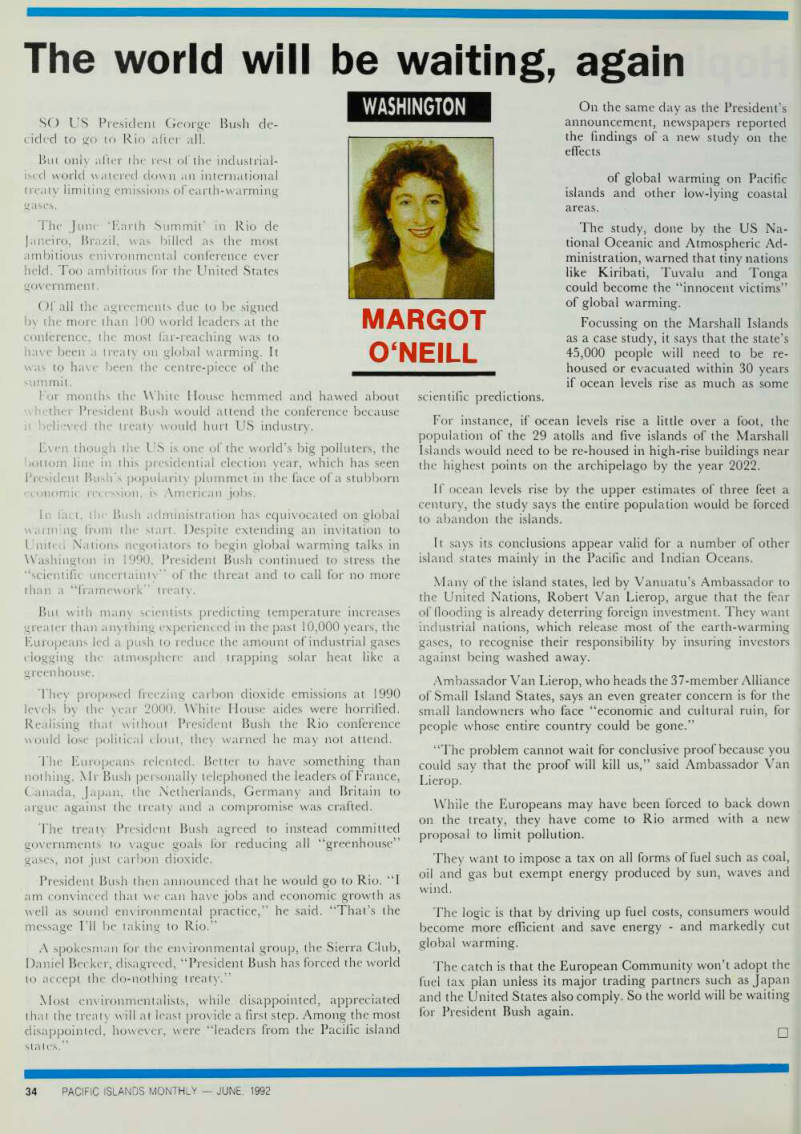
SO US President George Bush de cided to go to Rio after all.
But only after the rest of the industrial ised world watered down an international treaty limiting emissions of earth-warming gases.
The June ‘Earth Summit’ in Rio de Janeiro, Brazil, was billed as the most ambitious enivronmental conference ever held. Too ambitious for the United States government.
Of all the agreements due to be signed by the more than 100 world leaders at the conference, the most far-reaching was to have been a treaty on global warming. It was to have been the centre-piece of the summit.
l or months the While House hemmed and hawed about whether President Bush would attend the conference because it believed the treaty would hurt US industry.
Even though the US is one of the.world’s big polluters, the bottom line in this presidential election year, which has seen President Bush’s popularity plummet in the face of a stubborn economic recession, is American jobs.
In fact, the Bush administration has equivocated on global wanning from the start. Despite extending an invitation to United Nations negotiators to begin global warming talks in Washington in 1990. President Bush continued to stress the “scientific uncertainty” of the threat and to call for no more than a “framework” treaty.
But with many scientists predicting temperature increases greater than anything experienced in the past 10,000 years, the Europeans led a push to reduce the amount of industrial gases clogging the atmosphere and trapping solar heat like a
greenhouse.
They proposed freezing carbon dioxide emissions at 1990 levels by the year 2000. White Llouse aides were horrified.
Realising that without President Bush the Rio conference would lose political clout, they warned he may not attend.
The Europeans relented. Better to have something than nothing. Mr Bush personally telephoned the leaders of France, Canada, Japan, the Netherlands, Germany and Britain to argue against the treaty and a compromise was crafted.
The treaty President Bush agreed to instead committed governments to vague goals for reducing all “greenhouse” gases, not just carbon dioxide.
President Bush then announced that he would go to Rio. “I am convinced that we can have jobs and economic growth as well as sound environmental practice,” he said. “That’s the message I’ll be taking to Rio.”
A spokesman for the environmental group, the Sierra Club, Daniel Becker, disagreed, “President Bush has forced the world to accept the do-nothing treaty.”
Most environmentalists, while disappointed, appreciated that the treaty will at least provide a first step. Among the most disappointed, however, were “leaders from the Pacific island stales.”
Washington
On the same day as the President’s announcement, newspapers reported the findings of a new study on the effects of global warming on Pacific islands and other low-lying coastal areas.
The study, done by the US Na tional Oceanic and Atmospheric Ad ministration, warned that tiny nations like Kiribati, Tuvalu and Tonga could become the “innocent victims” of global warming.
Focussing on the Marshall Islands as a case study, it says that the state’s 45,000 people will need to be re housed or evacuated within 30 years if ocean levels rise as much as some
scientific predictions.
For instance, if ocean levels rise a little over a foot, the population of the 29 atolls and five islands of the Marshall Islands would need to be re-housed in high-rise buildings near the highest points on the archipelago by the year 2022.
If ocean levels rise by the upper estimates of three feet a century, the study says the entire population would be forced to abandon the islands.
It says its conclusions appear valid for a number of other island states mainly in the Pacific and Indian Oceans.
Many of the island states, led by Vanuatu’s Ambassador to the United Nations, Robert Van Lierop, argue that the fear of flooding is already deterring foreign investment. They want industrial nations, which release most of the earth-warming gases, to recognise their responsibility by insuring investors against being washed away.
Ambassador Van Lierop, who heads the 37-member Alliance of Small Island States, says an even greater concern is for the small landowners who face “economic and cultural ruin, for people whose entire country could be gone.”
“The problem cannot wait for conclusive proof because you could say that the proof will kill us,” said Ambassador Van
Lierop.
While the Europeans may have been forced to back down on the treaty, they have come to Rio armed with a new
proposal to limit pollution.
They want to impose a tax on all forms of fuel such as coal, oil and gas but exempt energy produced by sun, waves and wind.
The logic is that by driving up fuel costs, consumers would become more efficient and save energy - and markedly cut global warming.
The catch is that the European Community won’t adopt the fuel tax plan unless its major trading partners such as Japan and the United States also comply. So the world will be waiting for President Bush again.
Margot
O‘Neill
The proof we fear
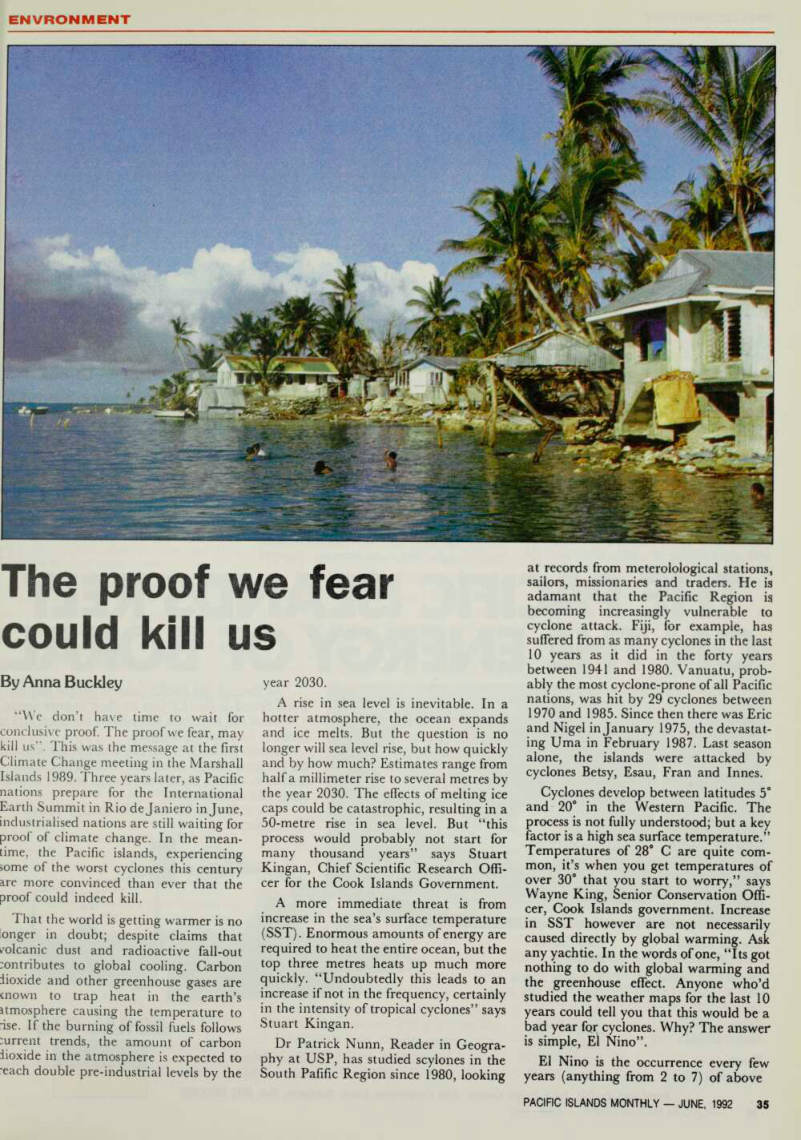
Envronment
The proof we fear could kill us
By Anna Buckley
“We don’t have time to wait for conclusive proof. The proof we fear, may kill us”. This was the message at the first Climate Change meeting in the Marshall Islands 1989. Three years later, as Pacific nations prepare for the International Earth Summit in Rio de Janiero in June, industrialised nations are still waiting for proof of climate change. In the mean time, the Pacific islands, experiencing some of the worst cyclones this century are more convinced than ever that the proof could indeed kill.
That the world is getting warmer is no longer in doubt; despite claims that /olcanic dust and radioactive fall-out :ontributes to global cooling. Carbon dioxide and other greenhouse gases are mown to trap heat in the earth’s itmosphere causing the temperature to ■ise. If the burning of fossil fuels follows :urrent trends, the amount of carbon dioxide in the atmosphere is expected to 'each double pre-industrial levels by the
year 2030.
A rise in sea level is inevitable. In a hotter atmosphere, the ocean expands and ice melts. But the question is no longer will sea level rise, but how quickly and by how much? Estimates range from half a millimeter rise to several metres by the year 2030. The effects of melting ice caps could be catastrophic, resulting in a 50-metre rise in sea level. But “this process would probably not start for many thousand years” says Stuart Kingan, Chief Scientific Research Offi cer for the Cook Islands Government.
A more immediate threat is from increase in the sea’s surface temperature (SST). Enormous amounts of energy are required to heat the entire ocean, but the top three metres heats up much more quickly, “Undoubtedly this leads to an increase if not in the frequency, certainly in the intensity of tropical cyclones” says
Stuart Kingan.
Dr Patrick Nunn, Reader in Geogra phy at USP, has studied scylones in the South Pafific Region since 1980, looking
at records from meterolological stations, sailors, missionaries and traders. He is adamant that the Pacific Region i$
becoming increasingly vulnerable to
cyclone attack. Fiji, for example, has suffered from as many cyclones in the last 10 years as it did in the forty years between 1941 and 1980. Vanuatu, prob ably the most cyclone-prone of all Pacific nations, was hit by 29 cyclones between 1970 and 1985. Since then there was Eric and Nigel in January 1975, the devastat ing Uma in February 1987. Last season alone, the islands were attacked by cyclones Betsy, Esau, Fran and Innes.
Cyclones develop between latitudes 5° and 20° in the Western Pacific. The process is not fully understood; but a key factor is a high sea surface temperature.”
Temperatures of 28° C are quite com mon, it’s when you get temperatures of over 30° that you start to worry,” says Wayne King, Senior Conservation Offi cer, Cook Islands government. Increase in SST however are not necessarily
caused directly by global warming. Ask
any yachtie. In the words of one, “Its got nothing to do with global warming and the greenhouse effect. Anyone who’d studied the weather maps for the last 10 years could tell you that this would be a bad year for cyclones. Why? The answer is simple, El Nino”.
El Nino is the occurrence every few years (anything from 2 to 7) of above
average ocean .surface temperatures between South America and the Interna tional Dateline, associated with changes in atmospheric circulation. The last major El Nino was during 1982/3 when severe drought in Australia brought the phenomenon to international attention.
“South Pacific societies are innocent victims of a 300-year orgy of fossil fuel burning in the Northern hemisphere in the name of industrialisation” claims the Association of Small Islands States (AOSIS). Recently the nature of the emergency has changed. Small islands states will become uninhabitable before they are submerged. But the message is the same.
Association of Small Island States (AOSIS) is now a powerful pressure group. Since its formation, it has grown from a coalition of 28 “victim” states campaigning for industrialized nations to cut carbon emissions, to a 36-member lobby demanding financial compen sation for vulnerable states, increased research into alternatively energy sources, and ‘fast and fair” transfer of
environmentally sound technologies.
Most developed nations have not agreed to try and stabilise their carbon emissions at 1990 levels by 1995. And, as recom mended by AOSIS, will produce state ments describing the steps that they have taken. That many other not so small islands such as Sri Lanka and Singapore now want to join, as well as some who are
not islands at all, namely Guinea Bissau, is testimony to the success of AOSIS.
AOSIS sees itself as the conscience of the convention. It stresses that small island states are a special case. “We in the Pacific contribute little or nothing to the problem. Yet we will be the first to suffer and will be affected proportion ately more,” says the Rt Hon Bikenibeau Paenia, Prime Minister of Tuvalu. Small island nations deserve special attention on account of both their environmental fragility and their economic vulnerability.“ You only have to look at the negotiating table in New York to see where the resources are. The US can produce a technical expert in every field.
As far as the Cook Islands is concerned, there’s only me,” says Patricia Tuara, Climate Change Representative for the Cook Islands. “Like many Pacific Islands we don’t have the resources but we know best what the problem is.
At the meeting on Climate Change in New York in April, AOSIS presented plans for an international insurance mechanism to compensate small island nations for loss and damage caused by climate change. Contributions would be based on the level of carbon emissions and a country’s ability to pay, measured in terms of GDP. The response from industrial nations was a familiar one. We sympathize with your plight but we need to be realistic. This is a complex issue requiring further consideration. Several
African nations suggested compensation for drought and desertification should be included in the insurance scheme.
As custodians of a tenth of the earth’s surface, South Pacific nations have an important role to play in the Earth Summit in Rio. “With an estimated population of 5.8 million, the region’s capacity to protect its fragile environ ment against damage from both internal actions and external influences is con strained. However, the region accepts responsibility placed on our numerically small community as it is essential for the sustainable development of the region as a whole” says Vili Fuvao, Director of South Pacific Regional Environment Programme (SPREP). It is a responsibil ity that has not been taken lightly.
Eighteen Pacific nations have worked hard to co-ordinate their efforts in preparation for the Earth Summit. The environmental problems facing the Pa cific are diverse; but Pacific Islands have shown solidarity in the preliminary negotiating rounds. Supporting their neighbours, so as to compete with the block voting of other regional groups.
For selfish if not humanitarian reasons, industrialized nations want Pacific Islands to be preserved, if only to keep the South Pacific dream alive. Let’s hope in Rio, however, that Pacific nations can extract more than sympathy, however heartfelt, from the West.
Advertisements & other items, p. 36 (1 item)
The Pacific Blands Rely
ON THE ENERGY OF BORAL
Norfolk Islands Norfolk Island 2419 Papua New Guinea Port Moresby 214248 Lae 422574 Rabaul 921225 Wewak 862125 Tonga Nukualofa 24035 All through the Pacific Islands, people rely on Boral Speed-E-Gas LP Gas for their energy needs.
Boral has terminals throughout the area, and is proud to be a leading supplier.
Speed-E-Gas is clean, efficient and low in cost.
It's the ideal energy source for cooking and water heating in homes, motels and hotels, and for a wide range of industrial uses.
So call Boral. We have the energy you’re ’ooking for. ■ i am Cook Islands Rarotonga 24460 American Samoa Pago Pago 699 2948 m Suva 315522 Lautoka 60088 Sigatoka 50578 Labasa 82973 Vanuatu Santo 36455 Port Vila 22046
BORAL GAS
Solomon Islands Honiara 21833 Boral Gas Pacific, John Oxley Centre. 339 Coronation Dave. Brisbane. Tel: (07) 3671365
Fiji’s fuel proposal
Business
Whether FINAPECO means cheaper fuel remains to be seen
By Martin Tiffany
THE three multi-national oil companies operating in Fiji - Mobil, Shell and British Petroleum have finally agreed to buy petroleum products from the government-owned Fiji National Pet
roleum Company (FINAPECO). How
ever, neither they nor FINAPECO has said on what terms the agreement was reached.
Since FINAPECO was established in December 1 990 to be the sole importer yf petroleum products into Fiji, the three multi-nationals have objected to it. The jii companies had said it would basically be a one-supplier, one-ship operation *ith no support infrastructure and that uel would cost them more.
At a meeting of regional energy ministers in Fiji on August 29 —30, 1991 he oil companies presented figures vhich showed they would have to pay 53.10 more per barrel to FINAPECO.
FINAPECO has defended itself saying t has the backing of an international letroleum company with access to eflneries world-wide through ESSO Singapore which is a subsidiary of the ;iant EXXON Corporation. Prices, they ay, would be equal to or lower than the
•il companies’.
While in office Fiji’s former Minister of inance, Josevata Kamikamica, had said hat oil prices should not be higher in Fiji nd if a profit were made by FINAPECO his would be passed on to the consumer hrough a reduced fuel tax currently bout 50 per cent of bowser sale price.
The oil companies now have agreed to uy from FINAPECO but have kept uiet on why they have finally decided ) do so. FINAPECO general manager ikuila Savu refused to comment when pproached by Pacific Islands Monthly.
Fiji’s Prime Minister, Ratu Sir .amises Mara, said the ultimate objec ve of establishing FINAPECO is to itablish a Fiji or regional oil refiner) 7 .
In his report on the interim
government’s achievements he said the first step was to establish FINAPECO to buy crude oil, refine it and supply the refined products to the existing oil companies for distribution. Ratu Sir Kamisese said this would give Fiji some control over the source and cost of the fuel. He said he hoped the newly-elected government would closely study the viability of establishing a Fiji or regional oil refinery as it would not only provide security in a volatile industry but also give the economy extra capacity for growth.
FINAPECO’s Savu has said, however, the establishment of an oil refinery in Fiji did not necessarily guarantee cheaper oil prices as prices were set internationally.
He said studies were still underway on
the viability of establishing a refinery.
Meanwhile, a report on Fiji’s environ ment, released by the Fiji government last month, says; “Some years ago there was a suggestion that Fiji should acquire its own refinery, but this option is now generally regarded as not economically viable due to the scale and the make-up of the demand.”
The report, titled Environment : Fiji The National State of the- Environ ment Report, was prepared for the Fiji government by lUCN the World Conservation Union for the National
Environment Management Project.
Savu said if a refinery were established the cost of transportation would be cut and a refinery would bring in investment and an increase in shipping. Also oil by products would be available more
cheaply.
The formation of FINAPECO and the selection of ESSO Singapore as its partner after tenders were called inter nationally, attracted strong opposition from the oil lobby in Australia, New Zealand and the Pacific region.
Ratu Sir Kamisese said he strongly believed the treatment Fiji got from the oil companies was unjust adding that those in position of government leader ship “have a responsibility to defend the
nation’s economic interests when they are threatened”.
He said that the oil industry in Fiji had been controlled by a multi-national oligopoly for about 50 years.
“To me, it was a situation in which government intervention would be stra tegic - similar to action we took in the 1970 s with the sugar industry,” said Ratu Sir Kamisese.
“The oil oligopoly’s contribution to, or involvement in, the Fiji economy, outside its own immediate infrastructure, is virtually non-existent. There is not a single simple blending plant, or even a joint move by the oil companies to establish an oil refinery here.
“It appeared that whatever profits have been made over the years have been regularly repatriated out of the country.”
He said that developing countries, when moving into manufacturing and industry to complement their agricul ture, found that control of their energy sector became more and more crucial in determining the direction and pace of economic advancement.
Ratu Sir Kamisese said that when considering the possibility of establishing a Fiji petroleum company, government thinking was influenced by its inability to persuade the oil companies to help them, an offer of crude oil for sale by some South —East Asian countries and trade boycotts by Australia and New Zealand unions in 1987.
FINAPECO expects its first shipment of petroleum next month from Malaysia
via Singapore.
Under the agreement with Malaysia, FINAPECO buys 10,000 barrels of crude oil a day from Malaysia’s PETCO. Esso refines this in Singapore and ships 210,000 barrels to Fiji each month. 2.52 million barrels, worth FSISS million, are expected to imported by FINAPECO each year.
The Malaysian company PETCO is a divison of Petronas Trading Corporation which is a subsidiary of the Malaysian state-owned Petroleum National Berhad.
Basically all the Fiji consumer can do is wait until the first tanker from
Singapore docks.
Advertisements & other items, p. 38 (1 item)
Sdprc
SOUTH PACIFIC APPUED GEOSCIENCE COMMISSION
VACANCIES
Applications are invited from nationals of SOPAC member countries for the following positions in the SOPAC Technical Secretariat located in Suva, Fiji.
COASTAL GEOLOGIST
The Coastal Geologist is responsible for conducting detailed studies of geological processes in coastal and nearshore areas to assist with coastal development planning and mineral resource management.
COASTAL ENGINEER
The Coastal Engineer is responsible for the collection and interpretation of oceanographic data from coastal areas to assist with development planning, for advice on coastal stability, cyclone impact, protection structures and harbour development, and for training activities in these fields.
MARINE GEOLOGIST
The Marine Geologist is responsible for assessment of detrital minerals and construction material potential in coastal and nearshore areas, collection and interpretation of geophysical and geological data, including seabed mapping, for coastal development projects, and for training activities in these fields.
TRAINING CO-ORDINATOR
The Training Co-ordinator is responsiole for the development and implementation of the SOPAC Training Programme which includes a Certificate Programme in Earth Science and Marine Geology, Scholarship Scheme, Fellowship Scheme, Workshop and Seminars.
ELECTRONICS ENGINEER
The Electronics Engineer is responsible for maintaining geophysical, navigation, computing and communications equipment; fabricating specialised electronic survey equipment; developing software packages for field data processing; carrying out coastal and nearshore field surveys; providing technical advice to SOPAC scientists and member country staff; conducting training activities; and supervising three electronics technicians.
ENVIRONMENTAL ENGINEER/GEOLOGIST
The Environmental Epgineer/Geologist is responsible for conducting detailed studies of coastal and nearshore areas including physical oceanography and coastal sedimentology, and conducting site studies to provide engineering and environmental information to ensure that coastal developments will be environmentally sound.
SOPAC
SOPAC is an inter-governmental organisation comprising fourteen South Pacific countries as members* with one associate member. The primary objective of SOPAC is to assist its member countries in the identification and assessment of the marine mmeral and other non-living resource potential of their offshore areas within their respective national Exclusive Economic Zones, in the planning and management of development in their coastal areas, and in the training of their nationals in all relevant areas within the SOPAC Work Programme.
REMUNERATION
An attractive remuneration package will be offered in accordance with the SOPAC terms and conditions of employment depending on qualifications, experience and prevailing salary levels in country of recruitment.
For an appointee from outside Fiji, salary will be supplemented by an establishment grant, housing allowance, child allowance and education assistance, and remuneration will be exempted from Fiji income tax.
Further information may be obtained from the Finance & Administration Controller on Telephone (679) 381-377 or Fax: (679) 370-040.
Details of general terms and conditions of employment will be mailed on request.
QUALIFICATIONS
A post graduate degree in the relevant field from a recognised university, between 5-10 years professional experience, and proficiency in oral and written English.
APPLICATION
All applications should be fully documented and include relevant details of qualifications and experience, and names of three referees.
Applications, clearly indicating the position being applied for, should be addressed to the Director, SOPAC Technical Secretariat, Private Mail Bag, Suva, Fiji.
The deadline for applications is 15th June 1992. * SOPAC member countries are: Australia, Cook Islands, Fiji, Federated States of Micronesia, Guam, Kiribati, New Zealand, Marshall Islands, Papua New Guinea, Solomon Islands, Tonga, Tuvalu, Vanuatu, Western Samoa. Associate member New Caledonia.
The future lies in your hands
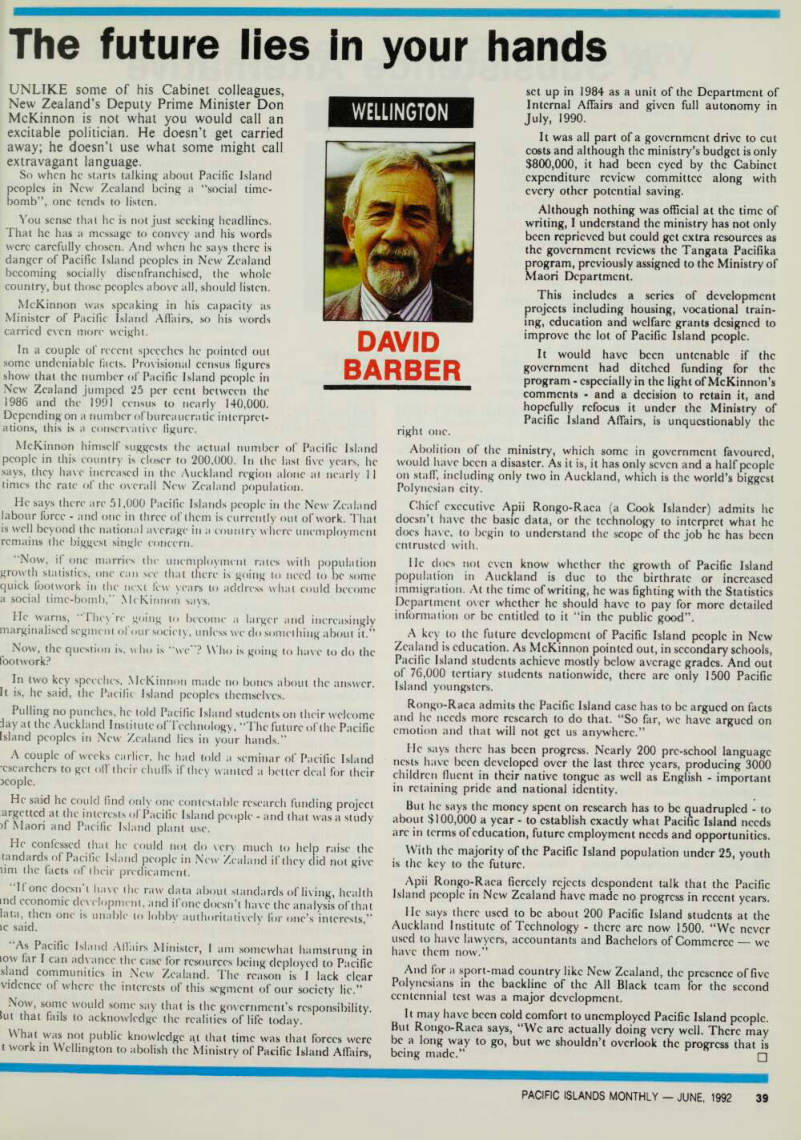
UNLIKE some of his Cabinet colleagues, New Zealand’s Deputy Prime Minister Don McKinnon is not what you would call an excitable politician. He doesn’t get carried away; he doesn’t use what some might call
extravagant language.
So when he starts talking about Pacific Island peoples in New Zealand being a “social time bomb”, one tends to listen.
You sense that he is not just seeking headlines.
That he has a message to convey and his words were carefully chosen. And when he says there is danger of Pacific Island peoples in New Zealand becoming socially disenfranchised, the whole country, but those peoples above all, should listen.
McKinnon was speaking in his capacity as Minister of Pacific Island Affairs, so his words carried even more weight.
In a couple of recent speeches he pointed out some undeniable facts. Provisional census figures show that the number of Pacific Island people in New Zealand jumped 25 per cent between the 1986 and the 1991 census to nearly 140,000.
Depending on a number ofburcaucratic interpret ations, this is a conservative figure.
McKinnon himself suggests the actual number of Pacific Island people in this country is closer to 200,000. In the last five years, he says, they have increased in the Auckland region alone at nearly 11 times the rate of the overall New Zealand population.
He says there arc 51,000 Pacific Islands people in the New Zealand labour force - and one in three of them is currently out of work. That is well beyond the national average in a country where unemployment remains the biggest single concern.
“Now, il one marries the unemployment rates with population growth statistics, one can see that there is going to need to be some quick footwork in the next few years to address what could become a social lime-bomb,“ McKinnon says.
He warns, “ They re going to become a larger and increasingly marginalised segment ol our society, unless we do something about it.”
Now, the question is. who is “we ? Who is going to have to do the footwork?
In two key speeches, McKinnon made no bones about the answer.
It is, he said, the Pacific Island peoples themselves.
Pulling no punches, he told Pacific Island students on their welcome day at the Auckland Institute ofTechnology, “The future of the Pacific Island peoples in New Zealand lies in yoiir hands."
A couple of weeks earlier, he had told a seminar of Pacific Island •cscarchcrs to get oil their chufl's if they wanted a better deal for their
Dcoplc.
He said he could find only one contestable research funding project argetted at the interests ol Pacific Island people - and that was a study )f Maori and Pacific Island plant use.
He confessed that he could not do very much to help raise the tandards of Pacific Island people in New Zealand if they did not give lim the facts of (heir predicament.
"If one doesn’t have (he raw data about standards of living, health ind economic development, and ifonc doesn’t have the analysis of that lata, then one is unable to lobby authoritatively for one’s interests,” ic said.
As Pacific Island Affairs Minister, 1 am somewhat hamstrung in tow far I can advance the ease for resources being deployed to Pacific sland communities in New Zealand. The reason is I lack clear vidcncc of where the interests of this segment of our society lie.”
Now, some would some say that is the government’s responsibility, hit that tails (o acknowledge the realities of life today.
V\hat was not public knowledge at that time was that forces were t work m Wellington to abolish the Ministry of Pacific Island Affairs,
Wellington
set up in 1984 as a unit of the Department of Internal Affairs and given full autonomy in July, 1990.
It was all part of a government drive to cut costs and although the ministry’s budget is only SBOO,OOO, it had been eyed by the Cabinet expenditure review committee along with every other potential saving.
Although nothing was official at the time of writing, I understand the ministry has not only been reprieved but could get extra resources as the government reviews the Tangata Pacifika program, previously assigned to the Ministry of Maori Department.
This includes a series of development projects including housing, vocational train ing, education and welfare grants designed to improve the lot of Pacific Island people.
It would have been untenable if the government had ditched funding for the program - especially in the light of McKinnon’s comments - and a decision to retain it, and hopefully refocus it under the Ministry of Pacific Island Affairs, is unquestionably the
right one.
Abolition of the ministry, which some in government favoured, would have been a disaster. As it is, it has only seven and a half people on staff, including only two in Auckland, which is the world’s biggest Polynesian city.
Chief executive Apii Rongo-Raca (a Cook Islander) admits he doesn’t have the basic data, or the technology to interpret what he docs have, to begin to understand the scope of the job he has been entrusted with.
He does not even know whether the growth of Pacific Island population in Auckland is due to the birthrate or increased immigration. At the time of writing, he was fighting with the Statistics Department over whether he should have to pay for more detailed information or be entitled to it “in the public good”.
A key to the future development of Pacific Island people in New Zealand is education. As McKinnon pointed out, in secondary schools, Pacific Island students achieve mostly below average grades. And out of 76,000 tertiary students nationwide, there arc only 1500 Pacific Island youngsters.
Rongo-Raca admits the Pacific Island ease has to be argued on facts and he needs more research to do that. “So far, we have argued on emotion and that will not get us anywhere.”
He says there has been progress. Nearly 200 pre-school language nests have been developed over the last three years, producing 3000 children fluent in their native tongue as well as English - important
in retaining pride and national identity.
But he says the money spent on research has to be quadrupled - to about 5100,000 a year - to establish exaedy what Pacific Island needs arc in terms of education, future employment needs and opportunities.
With the majority of the Pacific Island population under 25, youth is the key to the future.
Apii Rongo-Raca fiercely rejects despondent talk that the Pacific Island people in New Zealand have made no progress in recent years.
He says there used to be about 200 Pacific Island students at the Auckland Institute of Technology - there arc now 1500. “We never used to have lawyers, accountants and Bachelors of Commerce we have them now.”
And for a sport-mad country like New Zealand, the presence of five Polynesians in the backlinc of the All Black team for the second centennial test was a major development.
It may have been cold comfort to unemployed Pacific Island people.
But Rongo-Raca says, “We arc actually doing very well. There may be a long way to go, but we shouldn’t overlook the progress that is being made.” n
David
Barber
A Subsistence Alternative
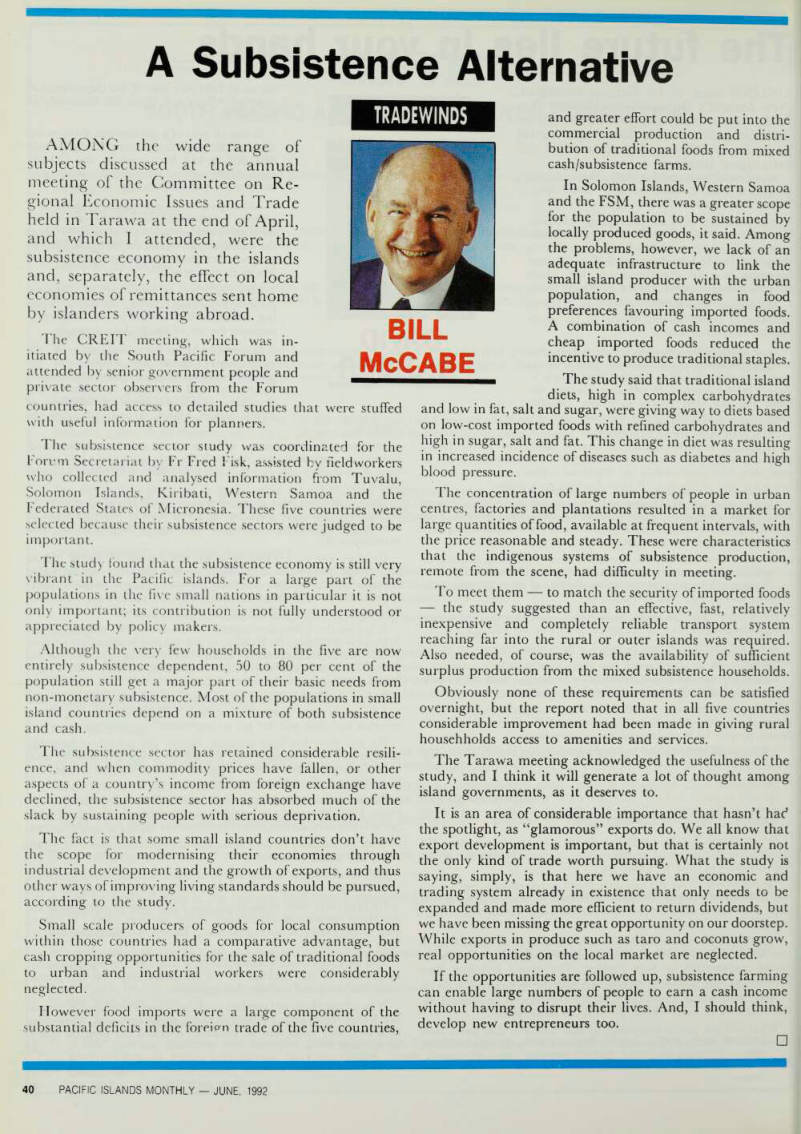
AMONG the wide range of subjects discussed at the annual meeting of the Committee on Re gional Economic Issues and Trade held in Tarawa at the end of April, and which 1 attended, were the subsistence economy in the islands and, separately, the effect on local economies of remittances sent home by islanders working abroad.
The CREIT meeting, which was in itiated by the South Pacific Forum and attended by senior government people and private sector observers from the Forum
countries, had access to detailed studies that were stuffed with useful information for planners.
The subsistence sector study was coordinated for the l orum Secretariat by Fr Fred Fisk, assisted by held workers who collected and analysed information from Tuvalu, Solomon Islands, Kiribati, Western Samoa and the Federated States of Micronesia. These five countries were selected because their subsistence sectors were judged to be
important.
The stud) found that the subsistence economy is still very vibrant in the Pacific islands. For a large part of the populations in the five small nations in particular it is not only important; its contribution is not fully understood or
appreciated by policy makers.
Although the very few households in the five are now entirely subsistence dependent, 50 to 80 per cent of the population still get a major part of their basic needs from non-monetary subsistence. Most of the populations in small island countries depend on a mixture of both subsistence and cash.
The subsistence sector has retained considerable resili ence, and when commodity prices have fallen, or other aspects of a country’s income from foreign exchange have declined, the subsistence sector has absorbed much of the slack by sustaining people with serious deprivation.
The fact is that some small island countries don’t have the scope for modernising their economies through industrial development and the growth of exports, and thus other ways of improving living standards should be pursued,
according to the study.
Small scale producers of goods for local consumption within those countries had a comparative advantage, but cash cropping opportunities for the sale of traditional foods to urban and industrial workers were considerably neglected.
However food imports were a large component of the substantial deficits in the foreip-n trade of the five countries,
Tradewinds
and greater effort could be put into the commercial production and distri bution of traditional foods from mixed cash/subsistence farms.
In Solomon Islands, Western Samoa and the FSM, there was a greater scope for the population to be sustained by locally produced goods, it said. Among the problems, however, we lack of an adequate infrastructure to link the small island producer with the urban population, and changes in food
preferences favouring imported foods.
A combination of cash incomes and cheap imported foods reduced the incentive to produce traditional staples.
The study said that traditional island diets, high in complex carbohydrates
and low in fat, salt and sugar, were giving way to diets based on low-cost imported foods with refined carbohydrates and high in sugar, salt and fat. This change in diet was resulting in increased incidence of diseases such as diabetes and high blood pressure.
The concentration of large numbers of people in urban centres, factories and plantations resulted in a market for large quantities of food, available at frequent intervals, with the price reasonable and steady. These were characteristics that the indigenous systems of subsistence production, remote from the scene, had difficulty in meeting.
To meet them to match the security of imported foods the study suggested than an effective, fast, relatively inexpensive and completely reliable transport system reaching far into the rural or outer islands was required.
Also needed, of course, was the availability of sufficient surplus production from the mixed subsistence households.
Obviously none of these requirements can be satisfied overnight, but the report noted that in all five countries considerable improvement had been made in giving rural househholds access to amenities and services.
The Tarawa meeting acknowledged the usefulness of the study, and I think it will generate a lot of thought among island governments, as it deserves to.
It is an area of considerable importance that hasn’t had the spotlight, as “glamorous” exports do. We all know that export development is important, but that is certainly not the only kind of trade worth pursuing. What the study is saying, simply, is that here we have an economic and trading system already in existence that only needs to be expanded and made more efficient to return dividends, but we have been missing the great opportunity on our doorstep.
While exports in produce such as taro and coconuts grow, real opportunities on the local market are neglected.
If the opportunities are followed up, subsistence farming can enable large numbers of people to earn a cash income without having to disrupt their lives. And, I should think, develop new entrepreneurs too.
Bill
Mccabe
Settling disputes the Pacific way
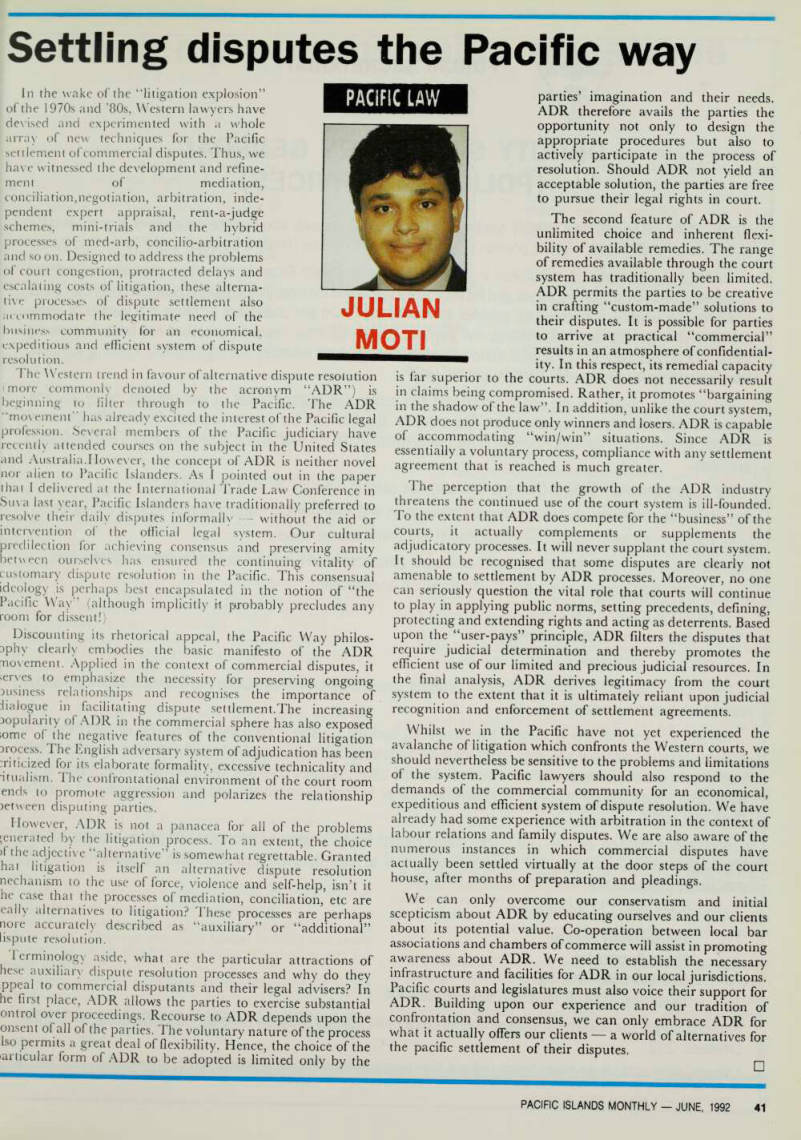
In the wake of the “litigation explosion” of the 1970 s and ’Bos, Western lawyers have devised and experimented with a whole array of new techniques for the Pacific settlement of commercial disputes. Thus, we have witnessed the development and refine ment of mediation, conciliation,negotiation, arbitration, inde pendent expert appraisal, rent-a-judge schemes, mini-trials and the hybrid processes of med-arb, concilio-arbitration and so on. Designed to address the problems of court congestion, protracted delays and escalating costs of litigation, these alterna tive processes of dispute settlement also accommodate the legitimate need of the business community for an economical, expeditious and efficient system of dispute resolution.
The Western trend in favour of alternative dispute resolution more commonly denoted by the acronym “ADR”) is beginning to filter through to the Pacific. The ADR “movement has already excited the interest of the Pacific legal profession. Several members of the Pacific judiciary have recently attended courses on the subject in the United States and Australia. However, the concept of ADR is neither novel nor alien to Pacific Islanders. As I pointed out in the paper that I delivered at the International Trade Law Conference in Suva last year, Pacific Islanders have traditionally preferred to resolve their daily disputes informally without the aid or intervention of the official legal system. Our cultural predilection for achieving consensus and preserving amity between ourselves has ensured the continuing vitality of customary dispute resolution in the Pacific. This consensual ideology is perhaps best encapsulated in the notion of “the Pacific Way (although implicitly ft probably precludes any room for dissent!) Discounting its rhetorical appeal, the Pacific Way philos ophy clearly embodies the basic manifesto of the ADR movement. Applied in the context of commercial disputes, it ;erves to emphasize the necessity for preserving ongoing ms in ess relationships and recognises the importance of dialogue in facilitating dispute settlement. The increasing Dopularity of ADR in the commercial sphere has also exposed 'Ome of the negative features of the conventional litigation process. The English adversary system of adjudication has been :ri ticized for its elaborate formality, excessive technicality and itualism. Ihe confrontational environment of the court room ends to promote aggression and polarizes the relationship
)etween disputing parties.
However, ADR is not a panacea for all of the problems generated by the litigation process. To an extent, the choice )f the adjective “alternative” is somewhat regrettable. Granted hat litigation is itself an alternative dispute resolution nechanism to the use of force, violence and self-help, isn’t it he case that the processes of mediation, conciliation, etc are eaily alternatives to litigation? Ihese processes are perhaps nore accurately described as “auxiliary” or “additional”
lispute resolution.
1 criminology aside, what are the particular attractions of hese auxiliary dispute resolution processes and why do they PPeal to commercial disputants and their legal advisers? In he first place, ADR allows the parties to exercise substantial ontrol over proceedings. Recourse to ADR depends upon the onsent of all of the parties. The voluntary nature of the process Iso permits a great deal of flexibility. Hence, the choice of the articular form of ADR to be adopted is limited only by the
Pacific Law
parties’ imagination and their needs.
ADR therefore avails the parties the opportunity not only to design the appropriate procedures but also to actively participate in the process of resolution. Should ADR not yield an acceptable solution, the parties are free to pursue their legal rights in court.
The second feature of ADR is the unlimited choice and inherent flexi bility of available remedies. The range of remedies available through the court system has traditionally been limited.
ADR permits the parties to be creative in crafting “custom-made” solutions to their disputes. It is possible for parties to arrive at practical “commercial” results in an atmosphere of confidential ity. In this respect, its remedial capacity
is far superior to the courts. ADR does not necessarily result in claims being compromised. Rather, it promotes “bargaining in the shadow of the law”. In addition, unlike the court system, ADR does not produce only winners and losers. ADR is capable of accommodating “win/win” situations. Since ADR is essentially a voluntary process, compliance with any settlement agreement that is reached is much greater.
The perception that the growth of the ADR industry threatens the continued use of the court system is ill-founded.
To the ex tent that ADR does compete for the “business” of the courts, it actually complements or supplements the adjudicatory processes. It will never supplant the court system.
It should be recognised that some disputes are clearly not amenable to settlement by ADR processes. Moreover, no one can seriously question the vital role that courts will continue to play in applying public norms, setting precedents, defining, protecting and extending rights and acting as deterrents. Based upon the “user-pays” principle, ADR filters the disputes that require judicial determination and thereby promotes the efficient use of our limited and precious judicial resources. In the final analysis, ADR derives legitimacy from the court system to the extent that it is ultimately reliant upon judicial recognition and enforcement of settlement agreements.
Whilst we in the Pacific have not yet experienced the avalanche of litigation which confronts the Western courts, we should nevertheless be sensitive to the problems and limitations of the system. Pacific lawyers should also respond to the demands of the commercial community for an economical, expeditious and efficient system of dispute resolution. We have already had some experience with arbitration in the context of labour relations and family disputes. We are also aware of the numerous instances in which commercial disputes have actually been settled virtually at the door steps of the court house, after months of preparation and pleadings.
We can only overcome our conservatism and initial scepticism about ADR by educating ourselves and our clients about its potential value. Co-operation between local bar associations and chambers of commerce will assist in promoting awareness about ADR. We need to establish the necessary infrastructure and facilities for ADR in our local jurisdictions.
Pacific courts and legislatures must also voice their support for ADR. Building upon our experience and our tradition of confrontation and consensus, we can only embrace ADR for what it actually offers our clients a world of alternatives for the pacific settlement of their disputes.
Julian
Moti
Advertisements & other items, p. 42 (1 item)
'sjy VACANCY
UPUFORUM secretariat
DEPUTY SECRETARY GENERAL
(POLICY & SERVICES)
Applications are invited from suitably qualified and experienced persons, who must be nationals of a member state of the South Pacific Forum*, for the position of Deputy Secretary General (Policy & Services) in the Forum Secretariat.
The Forum Secretariat was established in 1973 by the South Pacific Forum to encourage economic and political cooperation between its member states, and between those states and the more industrialised countries. Under the control of a Secretary General, the Secretariat provides services to the Forum and undertakes activities in a number of areas: economic development, legal and political, civil aviation, energy, maritime, telecommunications and trade. In pursuing these work programmes, the Secretariat works with a range of aid donor countries and organisations including Australia, New Zealand, Japan, France, EC, Canada and the UNDP.
This executive position in the Forum Secretariat has substantial responsibilities in management, policy advising, economic development and representation. The occupant together with the Deputy Secretary General (Programmes) provides support to the Secretary General in his management of the Secretariat and serving the Forum and associated meetings.
The Deputy Secretary General (Policy & Services) has specific oversight for staff involved in: policy and legal issues, law enforcement cooperation and such political matters as may concern the Forum; economic analysis, development coordination and environmental liaison; liaison with member governments and with other governments and regional and international organisations; finance, management services, and infrastructural development; corporate planning and evaluation; information and computer services; office and conference support.
The position requires leadership, managerial, advising, communication, representation and analytical skills and regional and international awareness.
The appointment will carry an attractive remuneration package, payable in Fiji dollars. For non-Fiji citizens this is taxfree and includes housing or a housing allowance and education and child allowances where eligible. Other benefits include payments in lieu of superannuation, and medical, life and travel insurance coverage. The appointee will be based at the Secretariat’s headquarters in Suva. The appointment will be for three years initially, and may be renewable for a further three year period.
Applications close on 24 July, 1992. They should contain full information on education and career backgrounds and should give names, addresses and telephone numbers of at least three referees with whom the applicant has been associated professionally.
Applications should be addressed to: The Secretary General Forum Secretariat GPO Box 856, Suva, Fiji Telephone 312-600 Telex: 2229FJ Fax: 302-204 Further information is available on request from Mr Bruce Davis, (Deputy Secretary General, Policy & Services), on 312-600 Extension: 202. * Member states of the South Pacific Forum; Australia, Cook Islands, Federated States of Micronesia, Fiji, Kiribati, Nauru, New Zealand, Niue, Papua New Guinea, Republic of the Marshall Islands, Solomon Islands, Tonga, Tuvalu, Vanuatu and Western Samoa.
Border problems raise questions
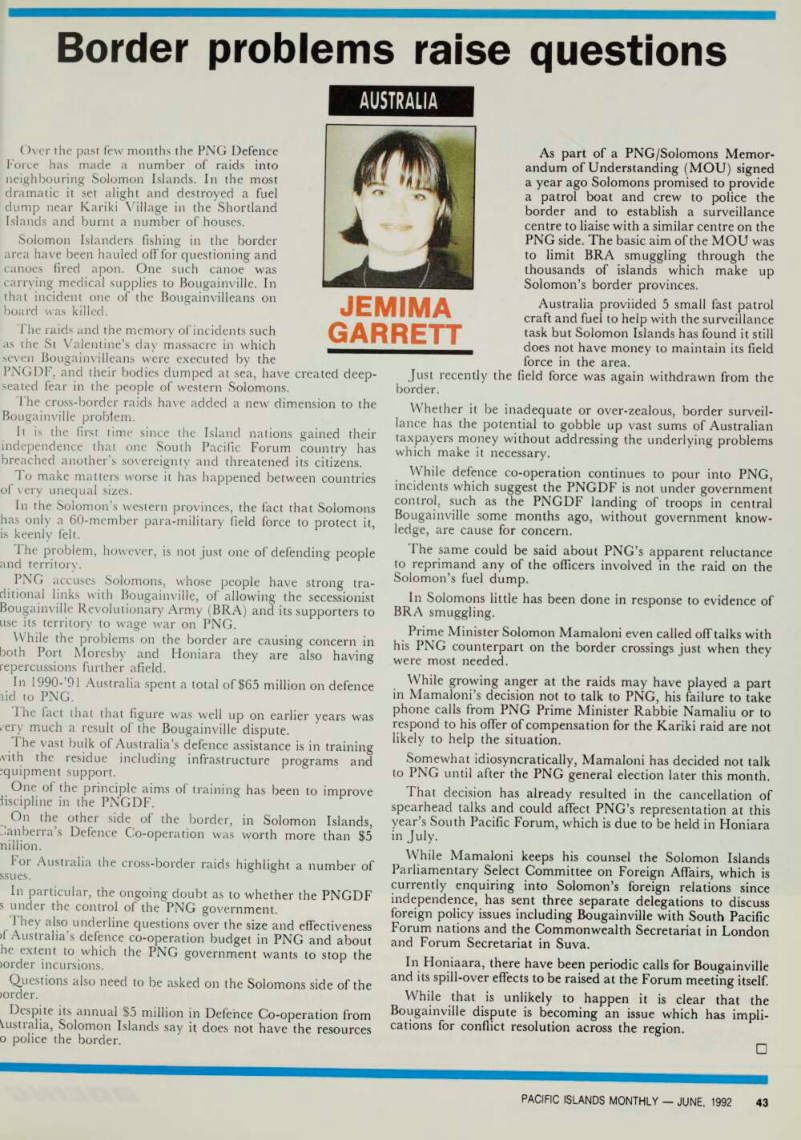
Over the past few months the PNG Defence Force has made a number of raids into neighbouring Solomon Islands. In the most dramatic it set alight and destroyed a fuel dump near Kariki Village in the Shortland Islands and burnt a number of houses.
Solomon Islanders fishing in the border area have been hauled off for questioning and canoes fired apon. One such canoe was carrying medical supplies to Bougainville. In that incident one of the Bougainvilleans on board was killed.
The raids and the memory of incidents such as the St Valentine’s day massacre in which seven Bougainvilleans were executed by the
PNGDF, and their bodies dumped at sea, have created deep seated fear in the people of western Solomons.
The cross-border raids have added a new dimension to the Bougainville problem.
It is the first time since the Island nations gained their independence that one South Pacific Forum country has breached another’s sovereignty and threatened its citizens. 7o make matters worse it has happened between countries of very unequal sizes.
In the Solomon’s western provinces, the fact that Solomons has only a 60-member para-military field force to protect it,
is keenly felt.
The problem, however, is not just one of defending people and territory.
PNG accuses Solomons, whose people have strong tra ditional links with Bougainville, of allowing the secessionist Bougainville Revolutionary Army (BRA) and its supporters to use its territory to wage war on PNG.
While the problems on the border are causing concern in both Port Moresby and Honiara they are also having repercussions further afield.
In 1990-’9l Australia spent a total ofS65 million on defence fid to PNG. 1 he fact that that figure was well up on earlier years was /ery much a result of the Bougainville dispute.
The vast bulk of Australia’s defence assistance is in training -vith the residue including infrastructure programs and
equipment support.
One of the principle aims of training has been to improve iiscipline in the PNGDF.
On the other side of the border, in Solomon Islands, Canberra s Defence Co-operation was worth more than S 5 nillion.
For Australia the cross-border raids highlight a number of ssues.
In particular, the ongoing doubt as to whether the PNGDF s under the control of the PNG government.
They also underline questions over the size and effectiveness >f Australia’s defence co-operation budget in PNG and about he extent to which the PNG government wants to stop the >order incursions.
Questions also need to be asked on the Solomons side of the >order.
Despite its annual $5 million in Defence Co-operation from Wstialia, Solomon Islands say it does not have the resources o police the border.
Australia
As part of a PNG/Solomons Memor andum of Understanding (MOU) signed a year ago Solomons promised to provide a patrol boat and crew to police the border and to establish a surveillance centre to liaise with a similar centre on the PNG side. The basic aim of the MOU was to limit BRA smuggling through the thousands of islands which make up Solomon’s border provinces.
Australia proviided 5 small fast patrol craft and fuel to help with the surveillance task but Solomon Islands has found it still does not have money to maintain its field force in the area.
Just recently the field force was again withdrawn from the border.
Whether it be inadequate or over-zealous, border surveil lance has the potential to gobble up vast sums of Australian taxpayers money without addressing the underlying problems which make it necessary.
While defence co-operation continues to pour into PNG, incidents which suggest the PNGDF is not under government control, such as the PNGDF landing of troops in central Bougainville some months ago, without government know ledge, are cause for concern.
The same could be said about PNG’s apparent reluctance to reprimand any of the officers involved in the raid on the Solomon’s fuel dump.
In Solomons little has been done in response to evidence of BRA smuggling.
Prime Minister Solomon Mamaloni even called off talks with his PNG counterpart on the border crossings just when they were most needed.
While growing anger at the raids may have played a part in Mamaloni’s decision not to talk to PNG, his failure to take phone calls from PNG Prime Minister Rabbie Namaliu or to respond to his offer of compensation for the Kariki raid are not likely to help the situation.
Somewhat idiosyncratically, Mamaloni has decided not talk to PNG until after the PNG general election later this month.
That decision has already resulted in the cancellation of spearhead talks and could affect PNG’s representation at this year’s South Pacific Forum, which is due to be held in Honiara in July.
While Mamaloni keeps his counsel the Solomon Islands Parliamentary Select Committee on Foreign Affairs, which is currently enquiring into Solomon’s foreign relations since independence, has sent three separate delegations to discuss foreign policy issues including Bougainville with South Pacific Forum nations and the Commonwealth Secretariat in London and Forum Secretariat in Suva.
In Honiaara, there have been periodic calls for Bougainville and its spill-over effects to be raised at the Forum meeting itself.
While that is unlikely to happen it is clear that the Bougainville dispute is becoming an issue which has impli cations for conflict resolution across the region.
Jemima
Garrett
Advertisements & other items, p. 44 (1 item)
With its new 737-400, Solomon Airlines
connects you to the world.
Solomon Airlines has just introduced Boeing 737-400 service to its passengers, an important step forward in the airlines continuing goal to provide world-class service to the Solomons and important destinations in the region.
The -400 represents the latest generation of the 737 family, the most popular in aviation history. More than 2,950 Boeing 737 s have been ordered by 155 airlines around the world.
The new-generation 737 family of jetliners is the most dependable in aviation history, with a schedule reliability record of better than 99%.
We re proud that Solomon selected Boeing, and look forward to working with the airline in the years ahead.
Sepik faces new problems
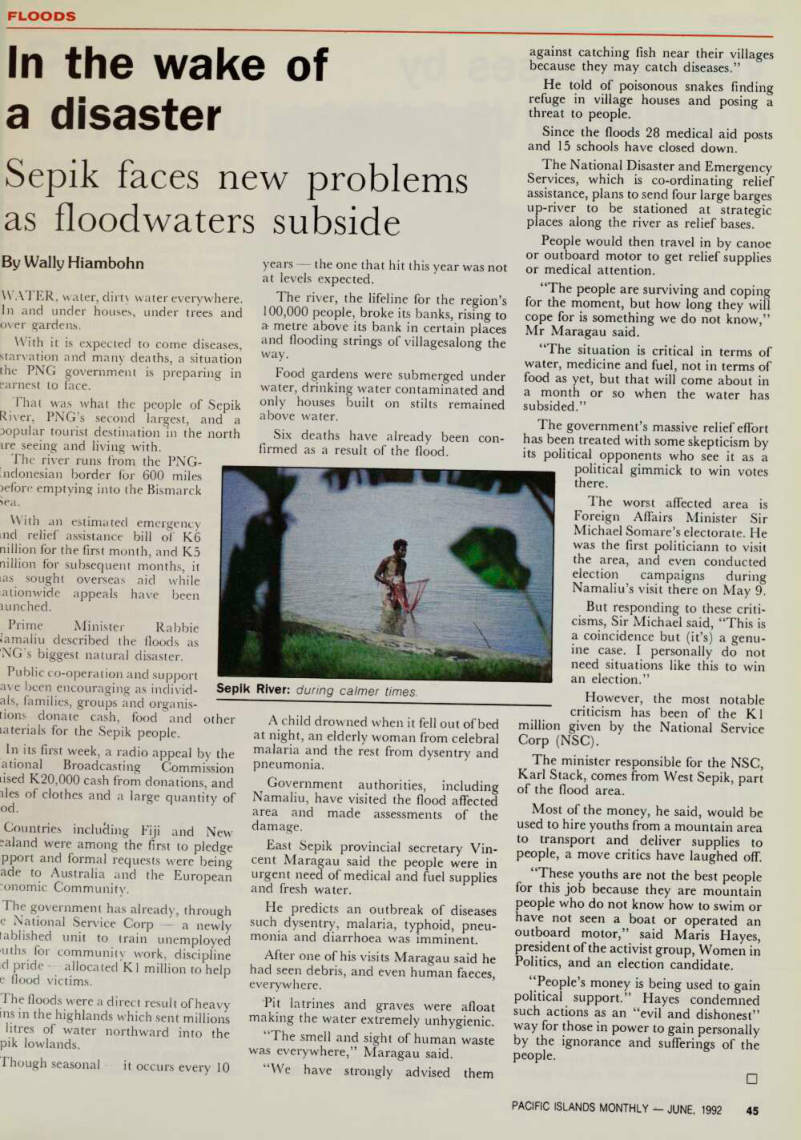
Floods
In the wake of a disaster
Sepik faces new problems as floodwaters subside
By Wally Hiambohn
WAT ER, water, dirty water everywhere.
In and under houses, under trees and over gardens.
With it is expected to come diseases, starvation and many deaths, a situation the PNG government is preparing in earnest to face.
Thai was what the people of Sepik River, PNG’s second largest, and a jopular tourist destination in the north ire seeing and living with.
The river runs from the PNG ndonesian border for 600 miles >efore emptying into the Bismarck >ea.
With an estimated emergency md relief assistance bill of K 6 nillion for the first month, and K 5 aillion for subsequent months, it ias sought overseas aid while ationwide appeals have been lunched.
Prime Minister Rabbie Jamaliu described the floods as NG’s biggest natural disaster.
Public co-operation and support ave been encouraging as individ als, families, groups and organis
tions donate cash, food " and other laterials for the Sepik people.
In its first week, a radio appeal by the ational Broadcasting Commission ased K 20,000 cash from donations, and des of clothes and a large quantity of od.
Countries including Fiji and New ?aland were among the first to pledge Pport and formal requests were being ade to Australia and the European
:onomic Community.
The government has already, through e National Sendee Corp a newly tablished unit to train unemployed uths for community work, discipline d pride allocated K 1 million to help e flood victims.
The floods were a direct result of heavy ins in the highlands which sent millions litres of water northward into the pik lowlands.
Though seasonal it occurs every 10
years the one that hit this year was not at levels expected.
The river, the lifeline for the region’s 100,000 people, broke its banks, rising to a metre above its bank in certain places
and flooding strings of villagesalong the
way.
Food gardens were submerged under water, drinking water contaminated and only houses built on stilts remained above water.
Six deaths have already been con firmed as a result of the flood.
A child drowned when it fell out of bed at night, an elderly woman from celebral malaria and the rest from dysentry and pneumonia.
Government authorities, including Namaliu, have visited the flood affected area and made assessments of the
damage.
East Sepik provincial secretary Vin cent Maragau said the people were in urgent need of medical and fuel supplies and fresh water.
He predicts an outbreak of diseases such dysentry, malaria, typhoid, pneu monia and diarrhoea was imminent.
After one of his visits Maragau said he had seen debris, and even human faeces, everywhere.
Pit latrines and graves were afloat making the water extremely unhygienic.
The smell and sight of human waste was everywhere,” Maragau said.
We have strongly advised them
against catching fish near their villages because they may catch diseases.”
He told of poisonous snakes finding refuge in village houses and posing a threat to people.
Since the floods 28 medical aid posts and 15 schools have closed down.
The National Disaster and Emergency Services, which is co-ordinating relief assistance, plans to send four large barges up-river to be stationed at strategic places along the river as relief bases.
People would then travel in by canoe or outboard motor to get relief supplies or medical attention.
“The people are surviving and coping for the moment, but how long they will cope for is something we do not know,”
Mr Maragau said.
“The situation is critical in terms of water, medicine and fuel, not in terms of food as yet, but that will come about in a month or so when the water has subsided.”
The government’s massive relief effort has been treated with some skepticism by its political opponents who see it as a
political gimmick to win votes there.
The worst affected area is Foreign Affairs Minister Sir Michael Somare’s electorate. He was the first politician!! to visit the area, and even conducted election campaigns during Namaliu’s visit there on May 9.
But responding to these criti cisms, Sir Michael said, “This is a coincidence but (it’s) a genu ine case. I personally do not need situations like this to win an election.”
However, the most notable criticism has been of the KI
million given by the National Service
Corp (NSC).
The minister responsible for the NSC, Karl Stack, comes from West Sepik, part of the flood area.
Most of the money, he said, would be used to hire youths from a mountain area to transport and deliver supplies to people, a move critics have laughed off.
“These youths are not the best people for this job because they are mountain people who do not know how to swim or have not seen a boat or operated an outboard motor,” said Maris Hayes, president of the activist group, Women in Politics, and an election candidate.
“People’s money is being used to gain political support.” Hayes condemned such actions as an “evil and dishonest” way for those in power to gain personally by the ignorance and sufferings of the people.
Sepik River: during calmer times.
once again
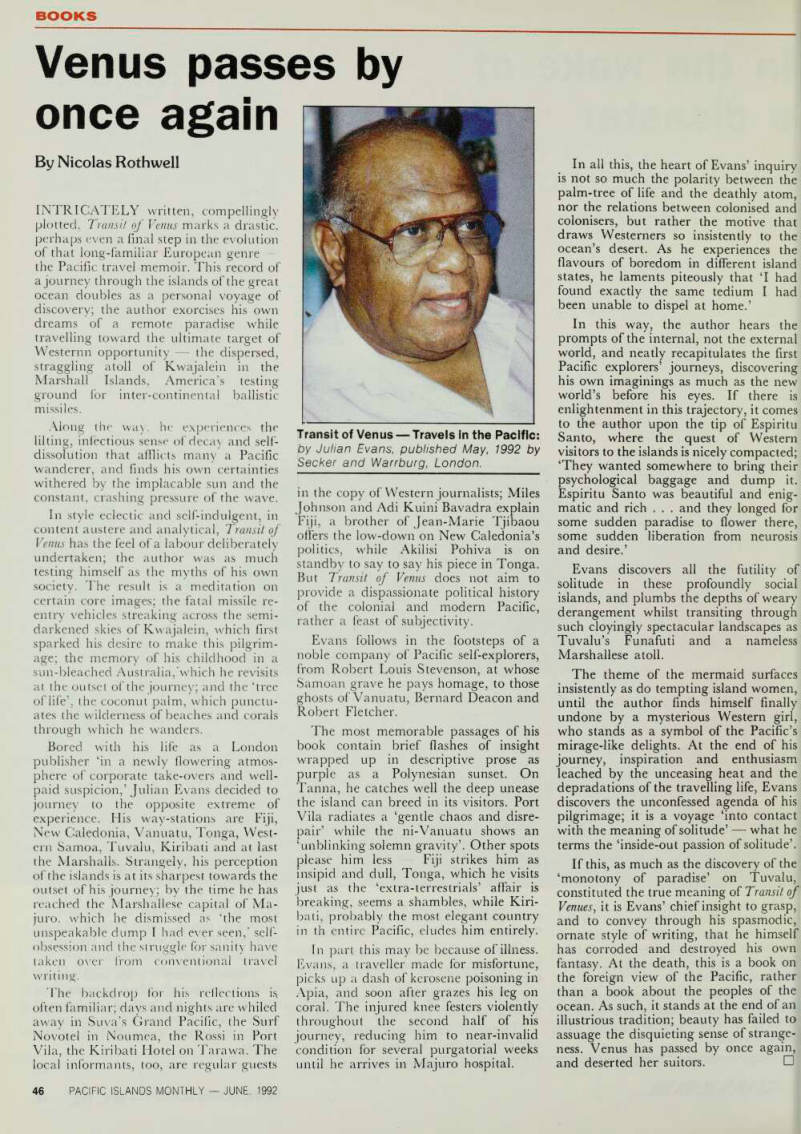
Books
Venus passes by once again
By Nicolas Rothwell
INTRICATELY written, compellingly plotted. Transit of Venus marks a drastic, perhaps even a final step in the evolution of that long-familiar European genre the Pacific travel memoir. This record of a journey through the islands of the great ocean doubles as a personal voyage of discovery; the author exorcises his own dreams of a remote paradise while travelling toward the ultimate target of
Westernn opportunity the dispersed,
straggling atoll of Kwajalein in the Marshall Islands, America’s testing ground for inter-continental ballistic missiles.
Along the wa). he experiences the lilting, infectious sense of decay and self dissolution that afflicts many a Pacific wanderer, and finds his own certainties withered by the implacable sun and the constant, crashing pressure of the wave.
In style eclectic and self-indulgent, in content austere and analytical, Transit of Venus has the feel of a labour deliberately undertaken; the author was as much testing himself as the myths of his own society. The result is a meditation on certain core images; the fatal missile re entry vehicles streaking across the semi darkened skies of Kwajalein, which first sparked his desire to make this pilgrim age; the memory of his childhood in a sun-bleached Australia, which he revisits at the outset of the journey; and the ‘tree of life’, the coconut palm, which punctu ates the wilderness of beaches and corals through which he wanders.
Bored with his life as a London publisher ‘in a newly flowering atmos phere of corporate take-overs and well paid suspicion,’Julian Evans decided to journey to the opposite extreme of experience. His way-stations are Fiji, New Caledonia, Vanuatu, Tonga, West ern Samoa, Tuvalu, Kiribati and at last the Marshalls. Strangely, his perception of the islands is at its sharpest towards the outset of his journey; by the time he has reached the Marshallese capital of Ma juro. which he dismissed as 'the most unspeakable dump I had ever seen,’ self obsession and the struggle for sanity have taken over from conventional travel writing.
The backdrop for his reflections is often familiar; days and nights are whiled away in Suva’s Grand Pacific, the Surf Novotel in Noumea, the Rossi in Port Vila, the Kiribati Hotel on Tarawa. The local informants, too, are regular guests
in the copy of Western journalists; Miles Johnson and Adi Kuini Bavadra explain Fiji, a brother of Jean-Marie Tjibaou offers the low-down on New Caledonia’s politics, while Akilisi Pohiva is on standby to say to say his piece in Tonga.
But Transit of Venus does not aim to provide a dispassionate political history of the colonial and modern Pacific, rather a feast of subjectivity.
Evans follows in the footsteps of a noble company of Pacific self-explorers, from Robert Louis Stevenson, at whose Samoan grave he pays homage, to those ghosts of Vanuatu, Bernard Deacon and Robert Fletcher.
The most memorable passages of his book contain brief flashes of insight wrapped up in descriptive prose as purple as a Polynesian sunset. On Tanna, he catches well the deep unease the island can breed in its visitors. Port Vila radiates a ‘gentle chaos and disre pair’ while the ni-Vanuatu shows an ‘unblinking solemn gravity’. Other spots please him less Fiji strikes him as insipid and dull, Tonga, which he visits just as the ‘extra-terrestrials’ affair is breaking, seems a shambles, while Kiri bati, probably the most elegant country in th entire Pacific, eludes him entirely.
In part this may be because of illness.
Evans, a traveller made for misfortune, picks up a dash of kerosene poisoning in Apia, and soon after grazes his leg on coral. The injured knee festers violently throughout the second half of his journey, reducing him to near-invalid condition for several purgatorial weeks until he arrives in Majuro hospital.
In all this, the heart of Evans’ inquiry is not so much the polarity between the palm-tree of life and the deathly atom, nor the relations between colonised and colonisers, but rather the motive that draws Westerners so insistently to the ocean’s desert. As he experiences the flavours of boredom in different island states, he laments piteously that ‘I had found exactly the same tedium I had been unable to dispel at home.’
In this way, the author hears the prompts of the internal, not the external world, and neatly recapitulates the first
Pacific explorers’ journeys, discovering
his own imaginings as much as the new world’s before his eyes. If there is enlightenment in this trajectory, it comes to the author upon the tip of Espiritu Santo, where the quest of Western visitors to the islands is nicely compacted; ‘They wanted somewhere to bring their psychological baggage and dump it.
Espiritu Santo was beautiful and enig matic and rich . . . and they longed for some sudden paradise to flower there, some sudden liberation from neurosis and desire.’
Evans discovers all the futility of solitude in these profoundly social islands, and plumbs the depths of weary derangement whilst transiting through such cloyingly spectacular landscapes as Tuvalu’s Funafuti and a nameless Marshallese atoll.
The theme of the mermaid surfaces insistently as do tempting island women, until the author finds himself finally undone by a mysterious Western girl, who stands as a symbol of the Pacific’s mirage-like delights. At the end of his
journey, inspiration and enthusiasm
leached by the unceasing heat and the depradations of the travelling life, Evans discovers the unconfessed agenda of his pilgrimage; it is a voyage ‘into contact with the meaning of solitude’ what he terms the ‘inside-out passion of solitude’.
If this, as much as the discovery of the ‘monotony of paradise’ on Tuvalu, constituted the true meaning of Transit of Venues , it is Evans’ chief insight to grasp, and to convey through his spasmodic, ornate style of writing, that he himself has corroded and destroyed his own fantasy. At the death, this is a book on the foreign view of the Pacific, rather than a book about the peoples of the ocean. As such, it stands at the end of an illustrious tradition; beauty has failed to assuage the disquieting sense of strange ness. Venus has passed by once again, and deserted her suitors. □
Transit of Venus Travels in the Pacific: by Julian Evans, published May, 1992 by Seeker and Warrburg, London.
Advertisements & other items, p. 47 (1 item)
Beautiful Labels Every Time
CASIO
Whatever It Is, The CASIO KL-2000 Can Label It.- Q CL
€Z-LAO€L PAINTCA
a a a a a a a image Li
12 IXI 5.4
Jeorse Brown
% • ibmm
• 9mm CASIO A
?£"* KL 200 ° O O
P (wjo.HIS) 0
AUTOF6EO MARCH PAINT
cm cm peed print
CIS iMEMO ■ SEARCH ftFQNT i STYLE I EFFECT » SIZE 4 FORM ‘ SYMBOL fIIUUST UPATTERN COMMUNICATION
Si^9iSSiae@ea
7* 8* 9 0
|€2-UlB€i PRlNT€ft|
KL-2000 FUNCTION Q.W E R T Y U I O P <-n
... « ULNIaI I r
W- CAPS A I rs| ® ® Q 'H| ® 'space)
SHIFT ZXCVBNM SET
i •Two tape sizes : 18mm and 9mm •Up to 4 lines of print per label (with 18mm tape)
•3 fonts and 4 styles
•40 character sizes (with 18mm tape)
•654 built-in characters, symbols and illustrations
' Memory storage for up to 1,388 characters
' Rechargeable battery built-in
'A variety of tape colors are available * Print data from CASIO Digital Diary models
AUSTRALIA MOBEX PTY. LTD.
UNIT 1, GIBBES STREET
CHATSWOOD N.S.W. 2067
FIJI ISLANDS BRULAL & CO., LTD.
G.P.O. BOX NO. 362
SUVA, FUI ISLANDS
NEW CALEDONIA BRECKWOLDT SARL
8P2369 NOUMEA
NEW CALEDONIA
MENARD PACIFIQUE
10 RUE JEAN JAURES
8P3899 NOUMEA, NEW CALEDONIA
NEW ZEALAND MONACO CORF. LTD.
41 POLAND ROAD, GLENFIELD
AUCKLAND, NEW ZEALAND
NORFOLK ISLANDS BURNT PINE TRADERS LTD.
P.0.80X21, NORFOLK ISLANDS
PAPUA NEW GUINEA SENG CO NIUGINI PTY. LTD.
P.0.80X 1886, BOROKU
PAPUA NEW GUINEA
TAHITI MAISON AUROSE
30, RUE COLLETTE
PAPEETE. TAHITI
VANUATU FUNG KUEI
P.0.80X51, PORT VILA
VANUATU
CASIO COMPUTER CO., LTD.
Tokyo, Japan
Shades of
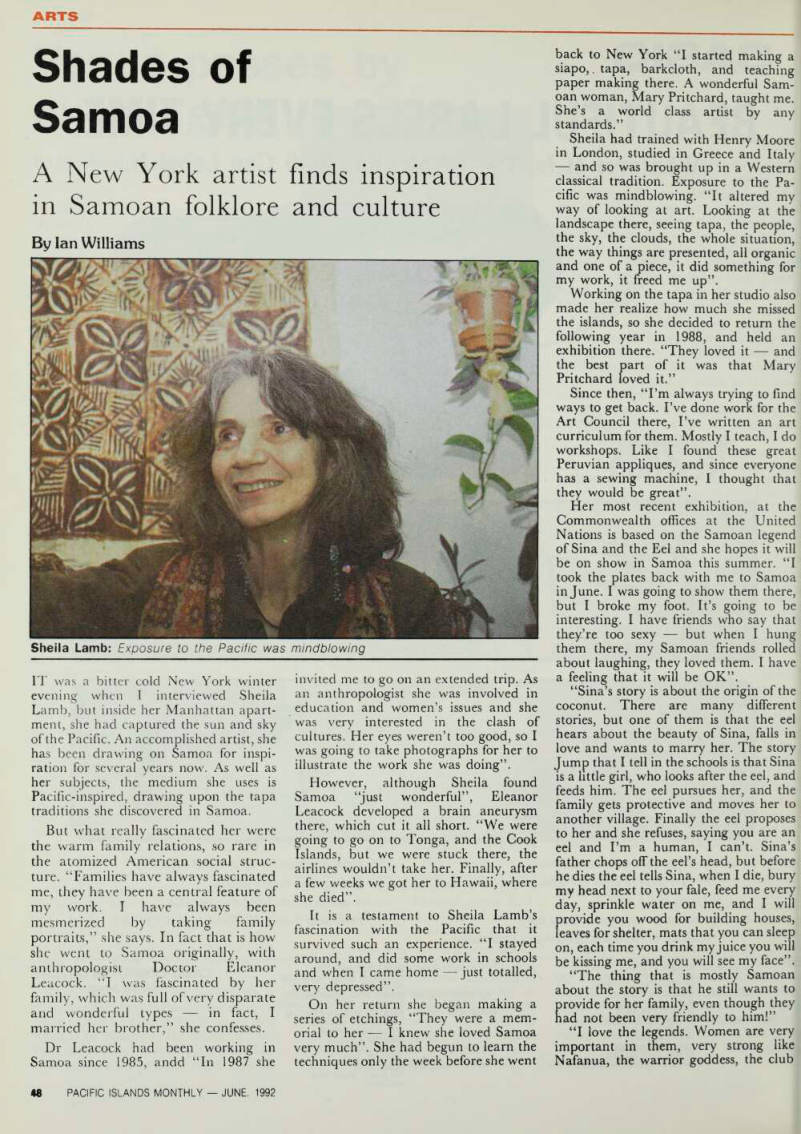
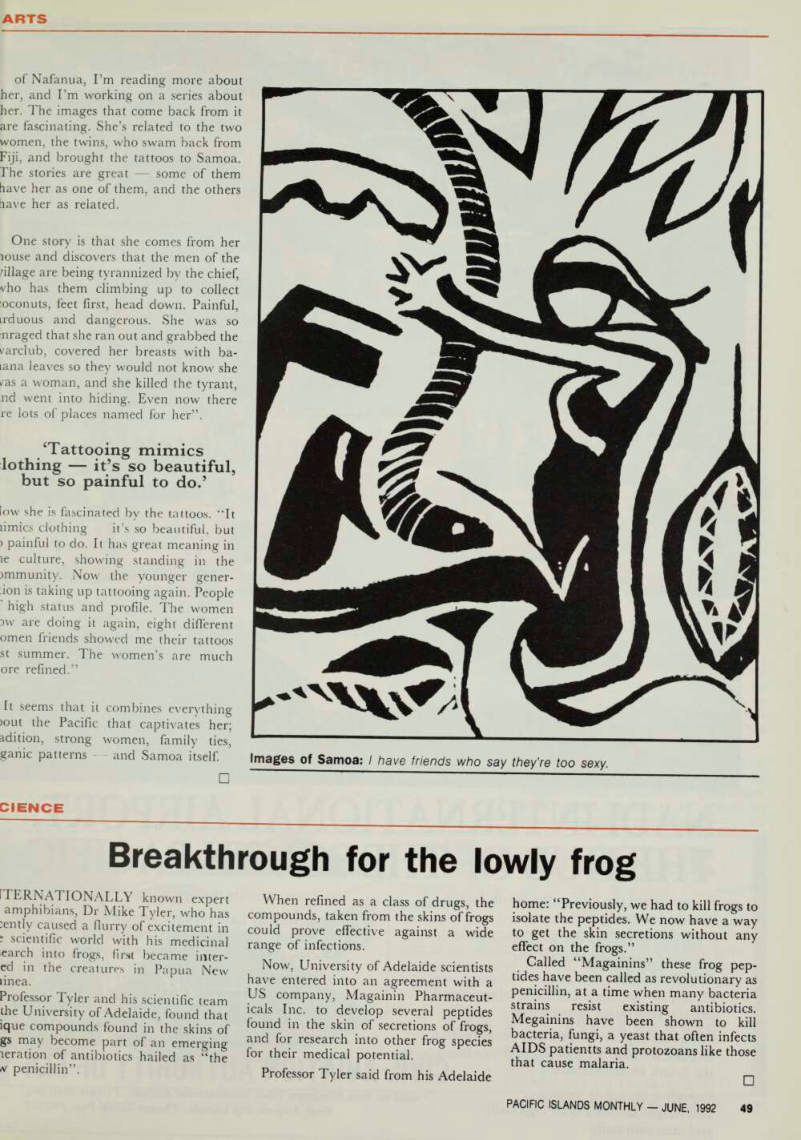
Arts
Shades of Samoa
A New York artist finds inspiration in Samoan folklore and culture
By Ian Williams
IT was a bitter cold New York winter evening when I interviewed Sheila Lamb, but inside her Manhattan apart ment, she had captured the sun and sky of the Pacific. An accomplished artist, she has been drawing on Samoa for inspi ration for several years now. As well as her subjects, the medium she uses is Pacific-inspired, drawing upon the tapa traditions she discovered in Samoa.
But what really fascinated her were the warm family relations, so rare in the atomized American social struc ture. “Families have always fascinated me, they have been a central feature of my work. T have always been
mesmerized by taking family
portraits,” she says. In fact that is how she went to Samoa originally, with anthropologist Doctor Eleanor Leacock, “I was fascinated by her family, which was full of very disparate and wonderful types in fact, I married her brother,” she confesses.
Dr Leacock had been working in Samoa since 1985, andd “In 1987 she
invited me to go on an extended trip. As an anthropologist she was involved in education and women’s issues and she was very interested in the clash of cultures. Her eyes weren’t too good, so I was going to take photographs for her to illustrate the work she was doing”.
However, although Sheila found Samoa “just wonderful”, Eleanor Leacock developed a brain aneurysm there, which cut it all short. “We were going to go on to Tonga, and the Cook Islands, but we were stuck there, the airlines wouldn’t take her. Finally, after a few weeks we got her to Hawaii, where she died”.
It is a testament to Sheila Lamb’s fascination with the Pacific that it survived such an experience. “I stayed around, and did some work in schools and when I came home —just totalled, very depressed”.
On her return she began making a series of etchings, “They were a mem orial to her I knew she loved Samoa very much”. She had begun to learn the techniques only the week before she went
back to New York “I started making a siapo,. tapa, barkcloth, and teaching paper making there. A wonderful Sam oan woman, Mary Pritchard, taught me.
She’s a world class artist by any standards.”
Sheila had trained with Henry Moore in London, studied in Greece and Italy and so was brought up in a Western classical tradition. Exposure to the Pa cific was mindblowing. “It altered my way of looking at art. Looking at the
landscape there, seeing tapa, the people,
the sky, the clouds, the whole situation, the way things are presented, all organic and one of a piece, it did something for my work, it freed me up”.
Working on the tapa in her studio also made her realize how much she missed the islands, so she decided to return the following year in 1988, and held an exhibition there. “They loved it and the best part of it was that Mary Pritchard loved it.”
Since then, “I’m always trying to find ways to get back. I’ve done work for the Art Council there, I’ve written an art curriculum for them. Mostly I teach, I do workshops. Like I found these great Peruvian appliques, and since everyone has a sewing machine, I thought that
they would be great”.
Her most recent exhibition, at the Commonwealth offices at the United Nations is based on the Samoan legend of Sina and the Eel and she hopes it will be on show in Samoa this summer. “I took the plates back with me to Samoa in June. I was going to show them there, but I broke my foot. It’s going to be interesting. I have friends who say that they’re too sexy but when I hung them there, my Samoan friends rolled about laughing, they loved them. I have a feeling that it will be OK”.
“Sina’s story is about the origin of the coconut. There are many different stories, but one of them is that the eel hears about the beauty of Sina, falls in love and wants to marry her. The story Jump that I tell in the schools is that Sina is a little girl, who looks after the eel, and feeds him. The eel pursues her, and the family gets protective and moves her to another village. Finally the eel proposes to her and she refuses, saying you are an eel and I’m a human, I can’t. Sina’s father chops off the eel’s head, but before he dies the eel tells Sina, when I die, bury my head next to your fale, feed me every day, sprinkle water on me, and I will provide you wood for building houses, leaves for shelter, mats that you can sleep on, each time you drink my juice you will be kissing me, and you will see my face”.
“The thing that is mostly Samoan about the story is that he still wants to provide for her family, even though they had not been very friendly to him!”
“I love the legends. Women are very important in them, very strong like Nafanua, the warrior goddess, the club
Sheila Lamb: Exposure to the Pacific was mindblowing
of Nafanua, I’m reading more about her, and I’m working on a series about her. The images that come back from it are fascinating. She’s related to the two women, the twins, who swam back from Fiji, and brought the tattoos to Samoa.
The stories are great some of them have her as one of them, and the others have her as related.
One story is that she comes from her louse and discovers that the men of the dllage are being tyrannized by the chief, vho has them climbing up to collect :oconuts, feet first, head down. Painful, irduous and dangerous. She was so nraged that she ran out and grabbed the /arclub, covered her breasts with ba nana leaves so they would not know she /as a woman, and she killed the tyrant, nd went into hiding. Even now there re lots of places named for her”.
‘Tattooing mimics
lothing it’s so beautiful,
but so painful to do. 5 iow she is fascinated by the tattoos. “It limics clothing it’s so beautiful, but ) painful to do. It has great meaning in
le culture, showing standing in the
immunity. Now the younger gener al! is taking up tattooing again. People high status and profile. The women dw are doing it again, eight different omen friends showed me their tattoos st summer. The women’s are much ore refined.”
It seems that it combines everything >out the Pacific that captivates her; adition, strong women, family ties, ganic patterns and Samoa itself.
images of Samoa: I have friends who say they're too sexy.
Breakthrough for the lowly frog
Cience
[TERNATIONALLY known expert amphibians, Dr Mike Tyler, who has :ently caused a flurry of excitement in * scientific world with his medicinal earch into frogs, first became inter ed in the creatures in Papua New linea.
Professor Tyler and his scientific team the University of Adelaide, found that ique compounds found in the skins of gs may become part of an emerging leration of antibiotics hailed as “the n penicillin”.
When refined as a class of drugs, the compounds, taken from the skins of frogs could prove effective against a wide range of infections.
Now, University of Adelaide scientists have entered into an agreement with a US company, Magainin Pharmaceut icals Inc. to develop several peptides found in the skin of secretions of frogs, and for research into other frog species for their medical potential.
Professor Tyler said from his Adelaide
home: “Previously, we had to kill frogs to isolate the peptides. We now have a way to get the skin secretions without any effect on the frogs.”
Called “Magainins” these frog pep tides have been called as revolutionary as penicillin, at a time when many bacteria strains resist existing antibiotics.
Megainins have been shown to kill bacteria, fungi, a yeast that often infects AIDS patientts and protozoans like those that cause malaria.
Advertisements & other items, p. 50 (1 item)
Nadi International Airport,
✓ I lli .. T a
JB “f L
■rvriy. . > iMTJUBF r,yprn , . v^M il imi, 5 * * -. *o* ■
NADI INTERNATIONAL AIRPORT,
THE HUB OF THE SOUTH PACIFIC
We are called the hub of the South Pacific Islands, located in Fiji.
Equipped to service the world’s most advanced passenger aircraft, the Boeing 747-400.
Or any of the many scheduled international carriers that utilize our services.
For as the region’s largest and most modern It is a reponsibility that we take very seriously.
That is why we have recently spent over $l2 million upgrading and expanding our facilities; preparing for the future, today.
To find out more about the gateway of .South Pacific Islands, Nadi International Airport, send for our free brochure. airport, we havie become the gateway to tta'south Pacific islands CIVIL AVIATION AUTHORITY OF FIJI Providing complete passenger . sen j to and freight facilities both regionally and internationally. : Free Brochure, Nadi International Airport, Private Mail Bag, Nadi Airport, Fiji Islands. Phone: 72500 Fax: 790325 GR794&
Cyclone damage leads to

Business
Fair weather friends
Cyclone damage leads to a review of building standards
By Ulafala Aiavao
WHEN times are good, insurers can allbrd to offer a range of services on the premise that a few damage claims will not swamp their reserves.
But a few major disasters, especially in the small Pacific Island states can cripple insurers.
In Western Samoa, the major prop erty insurer, National Pacific Insurance, enjoyed a long period of relatively fair weather as far as cyclone claims were :oncerned.
But NPI, operating in Western iiamoa. American Samoa, Tonga and Vine, was tested in its tenth year of iperation when Cyclone Tusi caused noderate damage in American Samoa.
Then came Cyclone Ofa in February 990 resulting in claims from all four sland countries where NPI had clients, n Western Samoa, Ofa claims were ibout WSSIO million (USS4.I million;.
In December 1991 Cyclone Val vreaked further havoc. The National Disaster Council estimated Val-related lamage at WSS7I3 million (USS 292
nillion), nearly half of it involving
•uildings and dwellings.
NPI, and overseas companies which •ear some of the cyclone risk through re isuring the coverage, were fortunate hat relatively few properties were isured.
Its exposure to Val claims was about VS$2O million (USSB.2 million) -slightly higher than Western Samoa’s Dtal export earnings last year.
With about 1000 policies covering rivate homes, and about the same umber in the corporate sector, NPI is
now refusing re-newing them as they
expire. Clients can only re-new their policies if they pay higher premiums and, more importantly, if they can come up with an engineer’s certificate stating their building is cyclone-resistant, i.e. it can withstand windspeeds of up to 123 miles an hour. Shortly after Val, Prime Minister Tofilau Eti Alesana criticised the shoddy workmanship in many damaged or destroyed homes and the Public Works Department began look ing at a building code. (NPI bases its assessments on Fiji standards).
When New Zealand carpenters came to help repair a number of Samoan schools damaged by Val, they found concrete walls with no reinforcing steel.
Timber structures had little bracing and roof purlins were either too far apart or had too few nails.
The impact of NPI seeking stricter standards for cyclone cover has a flow on effect in other areas.
Lending agenciess have an interest in
ensuring buildings they fund can attract
insurance cover.
With community facilities such as schools, most of the general labour usually is provided by the village, not the builder.
NPI and engineers estimate an aver age home can be strengthened for an
Extra Wss2,Ooo-Wsss,Ooo (Ussboo To
U 552,500).
The added investment, representing three to five per cent of the total construction cost, is cheaper than trying to rebuild the entire house.
Impediment
to growth
By lan Williams
SAMOAN Attorney General Leaupepe
Sanerivi, warned press at the UN of a previously unlooked for impediment to development. National Pacific Insurance has stopped offering cyclone cover in his country and in neighbouring American Samoa the Travelers Insurance Com pany pulled out after Cyclone Val. “We have had three cyclones in the past four years each of a ferocity that is supposed to occur every 80 to 100 years,” said the Attorney General, adding, “Ofa in 1990 caused around SUSI7O million in dam age and last December Cyclone Val killed 12 people”.
“Insurance companies have now an nounced that they will not insure Western Samoa against future disasters from cyclones. This is the type of climatic event scientists have told us to expect to increase with the advent of global warming . . . Western Samoa had already suffered and continues to suffer the painful effects of what it believes were the adverse effects of induced climate change.” Only 20 per cent of buildings in Apia are constructed to meet the type of cyclone-resistant standards that lenders are now insisting on.
Most insurance companies reinsure their risks on the world market, but NPTs general manager, David Russell, referred to the difficulties in finding anyone prepared to take the risk. Since most modern means of finance, for homes, businesses, require insurance, or unaffordable anti-cyclone structures, this problem could pose a major threat to the development of the Pacific islands.
The AOSIS (Alliance of Small Island States) countries proposed that the nations which produce the greenhouse gases should contribute to a fund to insure investment in the islands. □
Advertisements & other items, pp. 51-52 (1 item)
®Il Fujicolor
135 95 CN
FUJICOLOR
Fujicolor Super HR II 100 launches the next generation of color photography. And from the moment you try it you’ll experience a level of photographic quality you only imagined possible with crisp, sharp, colorful images. No matter where your travels take you. So explore the future with Fujicolor Super HR II 100. For photos that are truly out of this world.
®il FUJICOLOR
Fiji Distributors: BRIJLAL & CO. LTD.
G.P.O. Box 362, Suva, Fiji Ph: (679) 304133 Fax: (679) 302777
% 'i m ft m M % M k « « % i ssa?
'A V If
IjJaIM o~y\
tf'O'A > PVV'«
iVu/> aUvA morz ,
Where would you find white powder reaches overhung with coconut palms, •caching down to tropical blue water?
Where would you find diving in coral ;eas so clear and warm?
Where would you find top class resorts featuring world class cuisine, sporting activities, shows, casino and
night clubs?
Where would you find a live volcano and ancient custom villages, fresh grown market produce and some of the friendliest people you’ll ever meet?
Where? Vanuatu, that’s where. An untouched paradise on earth.
Melbourne: Phone 03-417 3977, Fax 03-417 5977.
Sydney; Phone 02-223 8333, Fax 02-223 8781.
Brisbane: Phone 07-221 2566, Fax 07-233 2330. Auckland: Phone 09-373 3435, Fax 09-358 1413.
Noumea: Phone 28 66 77, Fax 27 40 50.
Nadi: Phone 733 521. \[om The Untouched Paradise
(§# AIR VANUATU
growth
Govt-owned TV service Decline in
AFTER keeping people guessing for months Fiji’s caretaker cabinet finally made a decision last month on the country’s permanent television service.
Despite submissions from five interna tional and two local concerns, it was decided the permanent service would be 100 per cent government-owned.
Television New Zealand has been providing temporary service since Octo ber.
Under this temporary arrangement TVNZ owned and operated Fiji One and leased on-air time to government-owned Fiji National Video Centre (FNVC) for news bulletins and other locally pro duced items.
Under the proposed government takeover, the Fiji One operation will be bought by the government and is expected to be combined with FNVC to provide the core of a Fiji television service. Negotiations are now underway for the sale of Fiji One.
According to TVNZ’s general man ager international operation, Jon Blomfield, TVNZ proposes to enter into “programme supply” and “management services” agreements with the Fiji gov ernment.
TVNZ would provide staff to assist with business planning and technical, programme and production expertise.
Blomfield said TVNZ was “very happy indeed” with the proposal. TVNZ jointly tendered with Sky Television for the 39 per cent shares in the Fiji
Broadcasting and Television Corpor
ation put on tender in March this year.
Many predicted the partnership would be awarded the partnership.
Initially it was expected 39 per cent of FBTL shares would go to one of the seven who tendered, 10 per cent to Fiji Post and Telecommunications Limited and the remaining 51 per cent would be held by government.
Apisalome Tudreu, permanent secre tary for Information, Broadcasting, Tele vision and Telecommunications, said none of the seven had met government requirements.
A detailed contract between TVNZ and the Fiji government for the proposed arrangement has yet to be signed. A TVNZ executive was in Fiji last month to work out the details of the contract which is expected to be signed this month. □
WESTERN Samoa’s Finance Minister Tuilaepa Sailele expects economic growth this year to decline by four to six per cent, as a result of devastation from Cyclone Val last December.
The balance of payments will have an estimated deficit of WSS20 million (USS8.2 million) this year due to a steep rise in import payments and poor export performance.
Exports in the first quarter of 1992 were WSS12 million (USS4.9 million), although three quarters of this was in the form of automotive wiring exported by Yazaki Samoa Ltd.
Tuilaepa tabled a government budget on May 20 with an expenditure of WSS238.8 million (USS97.9 million) for the 1992/93 fiscal year beginning July 1.
Measures to curb spending will be introduced. These include monthly budget reviews, controls on the use of government vehicles and a staff ceiling on the public service. □
Advertisements & other items, pp. 53-54 (1 item)
nßery
MBMBH
HHnt
THE MAI SERVICE
SUITE 5,55 REMINGTON ROAD, NORTH MELBOURNE, VICTORIA 3051, AUSTRALIA.
FAX: COUNTRYCODE 61 +3 329 2166.
COMING YOUR WAY SOON
The Pacific Instant Lottery, a scratch and match card game administered by one of the world’s leading lottery
companies is being introduced
throughout the pacific region. This family game will bring with it great benefits.
Pacific Instant Lottery is seeking customer agents of good character and sound business experience to act on behalf of the operator. Interested people should fax or write.
KINHILL KRAMER
Professional Project Managers Consulting Engineers Architects Surveyors
edibility...continuity...
commitment.. .quality., .excellence v/ • • v| vi u v v> i i v 11 v v are all terms synonymous with Papua
New Guinea's leading engineering
consultant.
All HA
IB
Bii
II
iiiiiiiiiiiiiiiiiiiiii
mini mu
lIWI
■IP"" <lll 111 M tUM 10 , . mm
PAPUA NEW GUINEA
Head Office Port Moresby
KINHILL KRAMER PTY LTD.,
Kinhill Kramer Building Cnr Islander Drive & Wards Road
HOHOLA
National Capital District
PO Box 1948, BOROKO,
Papua New Guinea Telephone (675) 256033 Facsimile (675) 211049
Telex CAMAKRA NE 23050
OVERSEAS OFFICES Australia Solomon Islands Head Office Adelaide KINHILL KRAMER (SOLOMON ISLANDS) LTD KUNHILL ENGINEERS PTY. LTD.
Fourth Floor NPF Building Mendana Avenue PO Box 377 Honiara, Solomon Islands Telephone (677) 21996 Facsimile (677) 22190 Vanuatu
KINHILL KRAMER (VANUATU) LTD.,
Ist FLoor, Drugstore Building Kumul Highway P.O. Box 96, Port Vila Vanuatu Telephone (678) 23 457 Facsimile (678) 22 455 200 East Terrace, GPO Box 2702, Adelaide South Australia 5001 Telephone (08) 2237011 Facsimile (08) 2320163 Telex AA82364
Fiji
KINHILL KACIMAIWAI PTY LTD
First Floor, 6-12 Andrews Street, Nadi Fiji Islands PO Box 9213 Nadi Airport, Fiji Islands Telephone (679) 780033 Facsimile (679) 780131
A MEMBER OF THE
KiPhiu
GROUP OF COMPANIES
Close
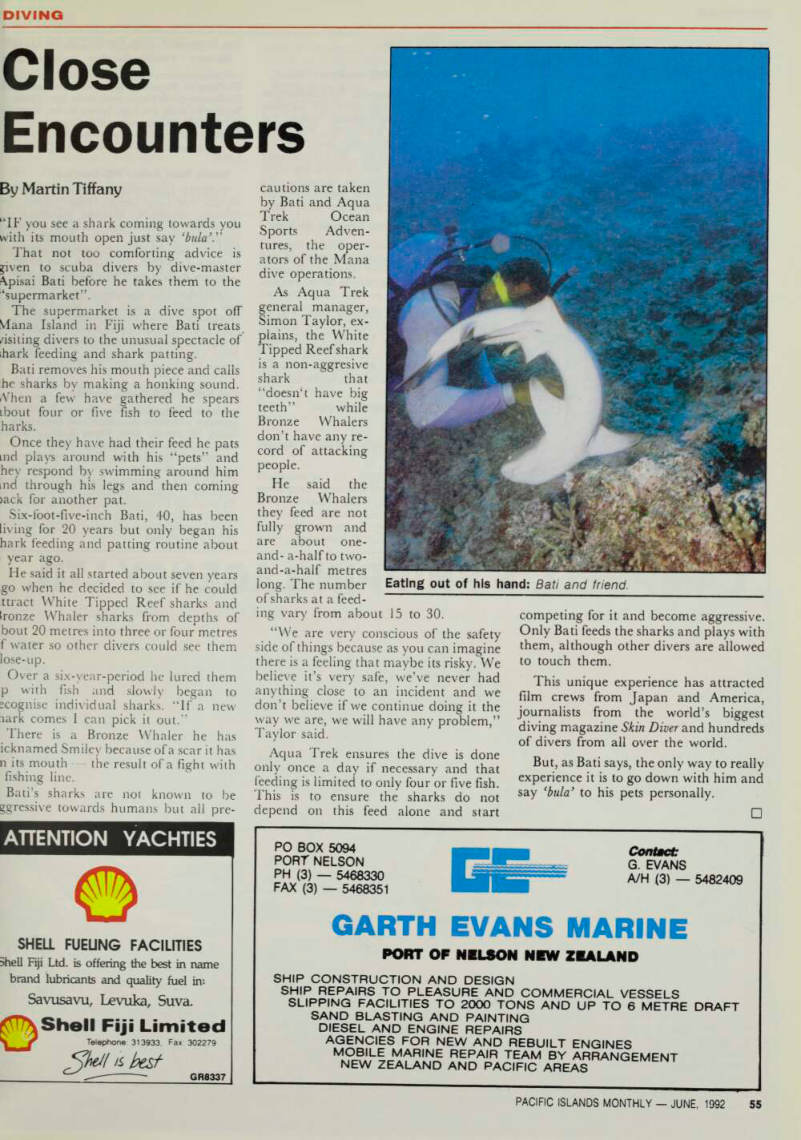
Diving
Close Encounters
By Martin Tiffany
I TF you see a shark coming towards you with its mouth open just say ‘bula’."
That not too comforting advice is jiven to scuba divers by dive-master \pisai Bati before he takes them to the ‘supermarket”.
The supermarket is a dive spot off Vlana Island in Fiji where Bati treats risking divers to the unusual spectacle of ihark feeding and shark patting.
Bati removes his mouth piece and calls he sharks by making a honking sound. rVhen a few have gathered he spears ibout four or five fish to feed to the harks.
Once they have had their feed he pats ind plays around with his “pets” and hey respond by swimming around him md through his legs and then coming >ack for another pat.
Six-foot-five-inch Bati, 40, has been living for 20 years but only began his hark feeding and patting routine about year ago.
He said it all started about seven years go when he decided to see if he could ttract White Tipped Reef sharks and Ironze Whaler sharks from depths of bout 20 metres into three or four metres f water so other divers could see them
lose-up.
Over a six-year-period he lured them p with fish and slowly began to scognise individual sharks. “If a new lark comes I can pick it out.”
There is a Bronze Whaler he has icknamed Smiley because of a scar it has n its mouth the result of a fight with
fishing line.
Bati’s sharks are not known to be ggressive towards humans but all pre
cautions are taken by Bati and Aqua Trek Ocean Sports Adven tures, the oper ators of the Mana dive operations.
As Aqua Trek general manager, Simon Taylor, ex plains, the White Tipped Reef shark is a non-aggresive shark that “doesn't have big teeth” while Bronze Whalers don’t have any re cord of attacking people.
He said the Bronze Whalers they feed are not fully grown and are about one and- a-half to two and-a-half metres long. The number of sharks at a feed
ing vary from about 15 to 30.
“We are very conscious of the safety side of things because as you can imagine there is a feeling that maybe its risky. We believe it’s very safe, we’ve never had anything close to an incident and we don’t believe if we continue doing it the way we are, we will have any problem,”
Taylor said.
Aqua Trek ensures the dive is done only once a day if necessary and that feeding is limited to only four or five fish.
This is to ensure the sharks do not depend on this feed alone and start
competing for it and become aggressive.
Only Bad feeds the sharks and plays with them, although other divers are allowed to touch them.
This unique experience has attracted film crews from Japan and America, journalists from the world’s biggest diving magazine Skin Diver and hundreds of divers from all over the world.
But, as Bati says, the only way to really experience it is to go down with him and say f bula ’ to his pets personally.
Eating out of his hand: Bati and friend.
Advertisements & other items, p. 55 (1 item)
Garth Evans Marine
ATTENTION YACHTIES
SHELL FUEUNG FACILITIES
Shell Fiji Ltd. is offering the best in name brand lubricants and quality fuel in: Savusavu, Levuka, Suva. © Shell Fiji Limited Telephone 313933, Fa* 302279 s?!e// /s best
GRB337
PO BOX 5094
PORT NELSON
PH (3) 5468330
FAX (3) 5468351
Eb Contact
G. EVANS
A/H (3)
GARTH EVANS MARINE
PORT OF NELSON NEW ZEALAND
SHIP CONSTRUCTION AND DESIGN
SHIP REPAIRS TO PLEASURE AND COMMERCIAL VESSELS SLIPPING FACILITIES TO 2000 TONS AND UP TO 6 METRE
SAND BLASTING AND PAINTING
DIESEL AND ENGINE REPAIRS
AGENCIES FOR NEW AND REBUILT ENGINES
M^?J, L lr- MAR,NE REPAIR TEAM BY ARRANGEMENT
NEW ZEALAND AND PACIFIC AREAS
5482409
DRAFT
Shipping
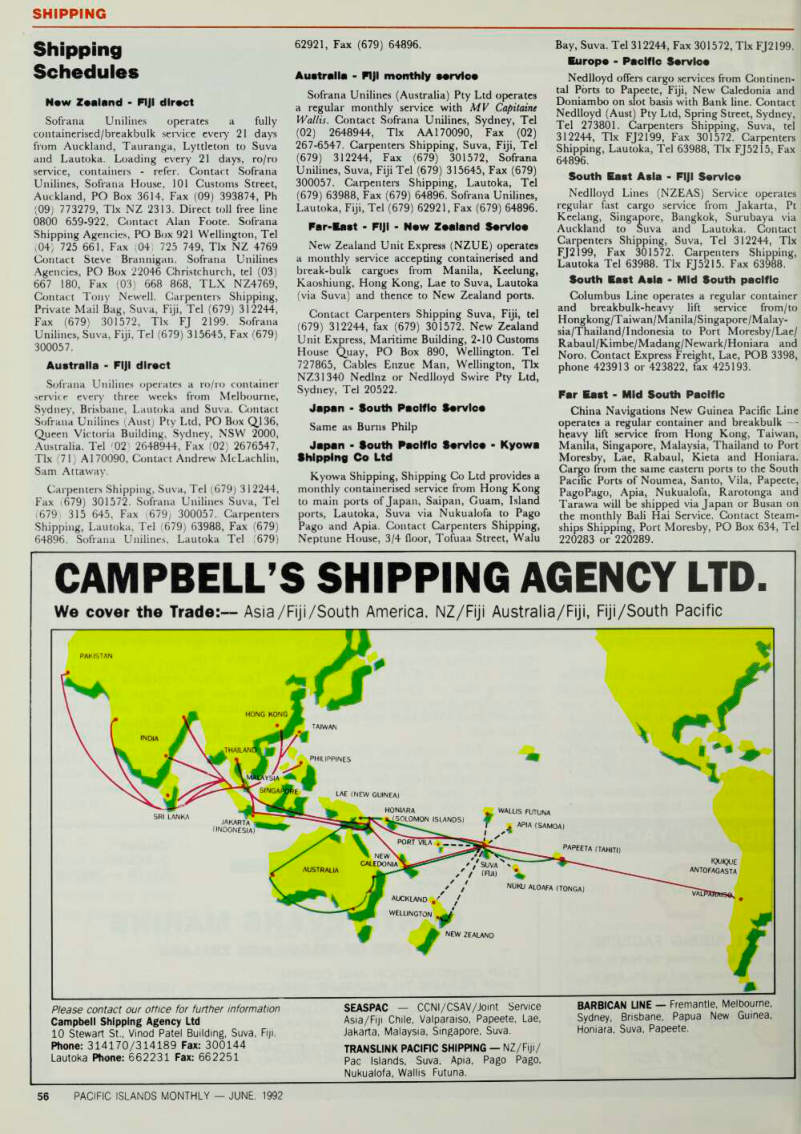
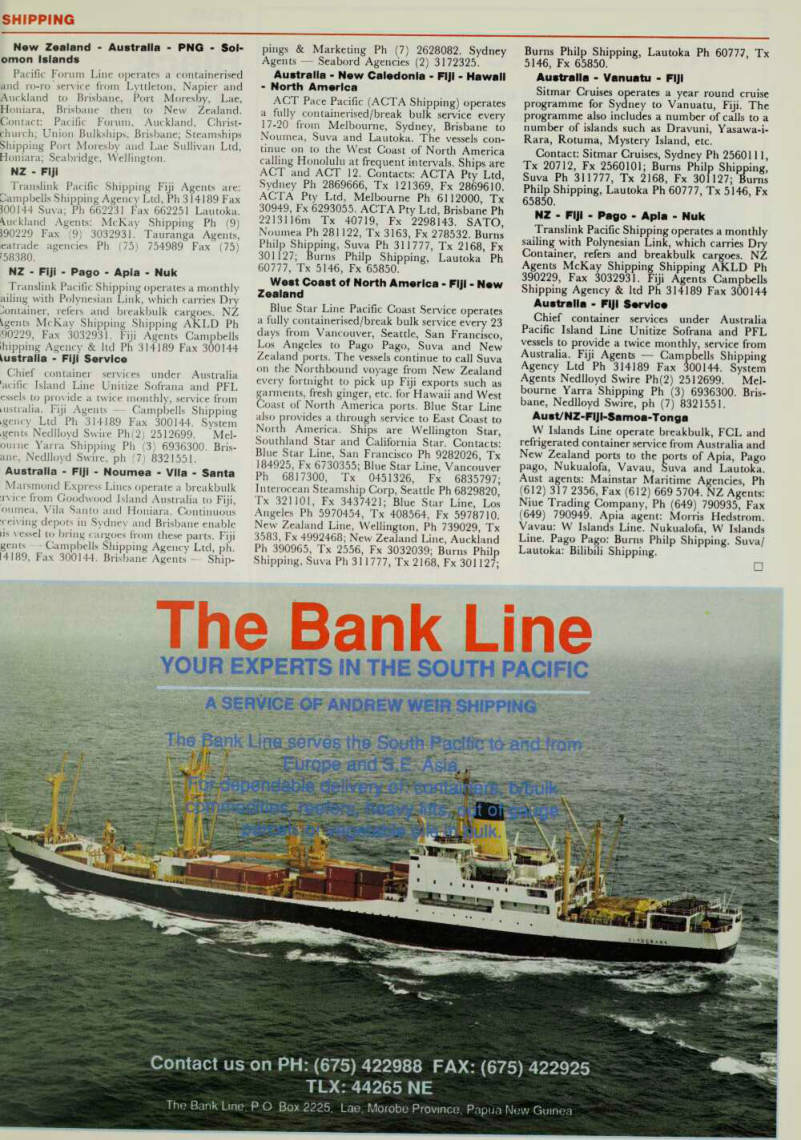
Schedules
Hew Zealand - FIJI direct Sofrana Unilines operates a fully containeriscd/breakbulk service every 21 days from Auckland, Tauranga, Lyttleton to Suva and Lautoka. Loading every 21 days, ro/ro service, containers - refer. Contact Sofrana Unilines, Sofrana House, 101 Customs Street, Auckland, PO Box 3614, Fax (09) 393874, Ph (09) 773279, Tlx NZ 2313. Direct toll free line 0800 659-922, Contact Alan Foote. Sofrana Shipping Agencies, PO Box 921 Wellington, Tel 725 661, Fax ;04 725 749, Tlx NZ 4769 Contact Steve Brannigan. Sofrana Unilines Agencies, PO Box 22046 Christchurch, tel (03) 667 180, Fax (03) 668 868, TLX NZ4769, Contact Tony Newell. Carpenters Shipping, Private Mail Bag, Suva, Fiji, Tel (679) 312244, Fax (679) 301572, Tlx FJ 2199. Sofrana Unilines, Suva, Fiji, Tel (679) 315645, Fax (679) 300057.
Australia - FIJI direct Sofrana Unilines operates a ro/ro container service ever)' three weeks from Melbourne, Sydney, Brisbane, Lautoka and Suva. Contact Sofrana Unilines (Aust) Pty Ltd, PO Box Q136, Queen Victoria Building, Sydney, NSW 2000, Australia. Tel 02' 2648944, Fax (02) 2676547, Tlx (71) A170090, Contact Andrew McLachlin, Sam Attaway.
Carpenters Shipping, Suva, Tel (679) 312244, Fax (679) 301572. Sofrana Unilines Suva, Tel (679) 315 645, Fax (679) 300057. Carpenters Shipping, Lautoka, Tel (679) 63988, Fax (679) 64896. Sofrana Unilines, Lautoka Tel (679)
62921, Fax (679) 64896.
Australia - Fiji monthly sorvloa Sofrana Unilincs (Australia) Pty Ltd operates a regular monthly service with MV Capitaine Wallis. Contact Sofrana Unilincs, Sydney, Tel (02) 2648944, Tlx AA170090, Fax (02) 267-6547. Carpenters Shipping, Suva, Fiji, Tel (679) 312244, Fax (679) 301572, Sofrana Unilines, Suva, Fiji Tel (679) 315645, Fax (679) 300057. Carpenters Shipping, Lautoka, Tel (679) 63988, Fax (679) 64896. Sofrana Unilincs, Lautoka, Fiji, Tel (679) 62921, Fax (679) 64896.
Far-East - FIJI - Now Zealand Service New Zealand Unit Express (NZUE) operates a monthly service accepting containerised and break-bulk cargoes from Manila, Keelung, Kaoshiung, Hong Kong, Lae to Suva, Lautoka (via Suva) and thence to New Zealand ports.
Contact Carpenters Shipping Suva, Fiji, tel (679) 312244, fax (679) 301572. New Zealand Unit Express, Maritime Building, 2-10 Customs House Quay, PO Box 890, Wellington. Tel 727865, Cables Enzue Man, Wellington, Tlx NZ31340 Ncdlnz or Nedlloyd Swire Pty Ltd, Sydney, Tel 20522.
Japan - South Pacific Service Same as Burns Philp Japan - South Pacific Service - Kyowa Shipping Co Ltd Kyowa Shipping, Shipping Co Ltd provides a monthly containerised service from Hong Kong to main ports of Japan, Saipan, Guam, Island ports, Lautoka, Suva via Nukualofa to Pago Pago and Apia. Contact Carpenters Shipping, Neptune House, 3/4 floor, Tofuaa Street, Walu
Bay, Suva. Tel 312244, Fax 301572, Tlx FJ2199.
Europe - Pacific Sarvica Nedlloyd offers cargo services from Continen tal Ports to Papeete, Fiji, New Caledonia and Doniambo on slot basis with Bank line. Contact Nedlloyd (Aust) Pty Ltd, Spring Street, Sydney, Tel 273801. Carpenters Shipping, Suva, tel 312244, Tlx FJ2199, Fax 301572. Carpenters Shipping, Lautoka, Tel 63988, Tlx FJ5215, Fax 64896.
South East Asia - FIJI Service Nedlloyd Lines (NZEAS) Service operates regular fast cargo service from Jakarta, Pt Keelang, Singapore, Bangkok, Surubaya via Auckland to Suva and Lautoka. Contact Carpenters Shipping, Suva, Tel 312244, Tlx FJ2199, Fax 301572. Carpenters Shipping, Lautoka Tel 63988. Tlx FJ5215. Fax 63988.
South East Asia - Mid South pacific Columbus Line operates a regular container and breakbulk-heavy lift service from/to Hongkong/Taiwan/Manila/Singapore/Malay sia/Thailand/Indonesia to Port Moresby/Lae/ Rabaul/Kimbe/Madang/Newark/Honiara and Noro. Contact Express Freight, Lae, POB 3398, phone 423913 or 423822, fax 425193.
Far East - Mid South Pacific China Navigations New Guinea Pacific Line operates a regular container and breakbulk heavy lift service from Hong Kong, Taiwan, Manila, Singapore, Malaysia, Thailand to Port Moresby, Lae, Rabaul, Kieta and Honiara.
Cargo from the same eastern ports to the South Pacific Ports of Noumea, Santo, Vila, Papeete, Pago Pago, Apia, Nukualofa, Rarotonga and Tarawa will be shipped via Japan or Busan on the monthly Bali Hai Service. Contact Steam ships Shipping, Port Moresby, PO Box 634, Tel 220283 or 220289.
New Zealand - Australia - PNG - Sol omon Islands Pacific Forum Line operates a containerised and ro-ro service from Lyttleton, Napier and Auckland to Brisbane, Port Moresby, Lae, Honiara, Brisbane then to New Zealand.
Contact: Pacific Forum, Auckland, Christ
church; Union Bulkships, Brisbane; Steamships
Shipping Port Moresby and Lae Sullivan Ltd,
Honiara; Seabridge, Wellington.
NZ - Fiji Translink Pacific Shipping Fiji Agents are: Campbells Shipping Agency Ltd, Ph 314189 Fax 100144 Suva; Ph 662231 Fax 662251 Lautoka. ~nd Agents; McKay Shipping Ph (9) 190229 Fax (9) 3032931.' Tauranga Agents, icatrade agencies Ph (75) 754989 Fax (75) ? 58380.
NZ - Fiji - Pago - Apia - Nuk Translink Pacific Shipping operates a monthly ailing with Polynesian Link, which carries Dry Container, refers and breakbulk cargoes. NZ
Agents McKay Shipping Shipping AKLD Ph
90229, Fax 3032931. Fiji Agents Campbells •hipping Agency & ltd Ph 314189 Fax 300144 Australia - Fiji Service Chief container services under Australia 'acific Island Line Unitize Sofrana and PFL cssels to provide a twice monthly, service from
kustralia. Fiji Agents Campbells Shipping
agency Ltd Ph 314189 Fax 300144. System agents Nedlloyd Swire Ph(2) 2512699. Mel on me Yarra Shipping Ph (3) 6936300. Bris ane, Nedlloyd Swire, ph (7) 8321551.
Australia - Fiji - Noumea - Vila - Santa Marsmond Express Lines operate a breakbulk mice from Goodwood Island Australia to Fiji, oumea, Vila Santo and Honiara. Continuous reiving depots in Sydney and Brisbane enable lis vessel to bring cargoes from these parts. Fiji gents Campbells Shipping Agency Ltd, ph. 14189, Fax 300144. Brisbane Agents Ship
pings & Marketing Ph (7) 2628082. Sydney Agents Seabord Agencies (2) 3172325.
Australia - New Caledonia - Fiji - Hawaii - North America ACT Pace Pacific (ACTA Shipping) operates a fully containcriscd/brcak bulk service every 17-20 from Melbourne, Sydney, Brisbane to Noumea, Suva and Lautoka. The vessels con tinue on to the West Coast of North America calling Honolulu at frequent intervals. Ships are ACT and ACT 12. Contacts: ACTA Pty Ltd, Sydney Ph 2869666, Tx 121369, Fx 2869610.
ACTA Pty Ltd, Melbourne Ph 6112000, Tx 30949, Fx 6293055. ACTA Pty Ltd, Brisbane Ph 2213116 m Tx 40719, Fx 2298143. SATO, Noumea Ph 281122, Tx 3163, Fx 278532. Burns Philp Shipping, Suva Ph 311777, Tx 2168, Fx 301127; Burns Philp Shipping, Lautoka Ph 60777, Tx 5146, Fx 65850.
West Coast of North America - FIJI - New Zealand Blue Star Line Pacific Coast Service operates a fully containerised/break bulk service every 23 days from Vancouver, Seattle, San Francisco, Los Angeles to Pago Pago, Suva and New Zealand ports. The vessels continue to call Suva on the Northbound voyage from New Zealand every fortnight to pick up Fiji exports such as garments, fresh ginger, etc. for Hawaii and West Coast of North America ports. Blue Star Line also provides a through service to East Coast to North America. Ships are Wellington Star, Southland Star and California Star. Contacts: Blue Star Line, San Francisco Ph 9282026, Tx 184925, Fx 6730355; Blue Star Line, Vancouver Ph 6817300, Tx 0451326, Fx 6835797; Interocean Steamship Corp, Seattle Ph 6829820, Tx 321101, Fx 3437421; Blue Star Line, Los Angeles Ph 5970454, Tx 408564, Fx 5978710.
New Zealand Line, Wellington, Ph 739029, Tx 3583, Fx 4992468; New Zealand Line, Auckland Ph 390965, Tx 2556, Fx 3032039; Burns Philp Shipping, Suva Ph 31 1777, Tx 2168, Fx 301127;
Burns Philp Shipping, Lautoka Ph 60777, Tx 5146, Fx 65850.
Australia - Vanuatu - Fiji Sitmar Cruises operates a year round cruise programme for Sydney to Vanuatu, Fiji. The programme also includes a number of calls to a number of islands such as Dravuni, Yasawa-i- Rara, Rotuma, Mystery Island, etc.
Contact: Sitmar Cruises, Sydney Ph 2560111, Tx 20712, Fx 2560101; Burns Philp Shipping, Suva Ph 311777, Tx 2168, Fx 301127; Burns Philp Shipping, Lautoka Ph 60777, Tx 5146, Fx 65850.
N 2 - FIJI - Pago - Apia - Nuk Translink Pacific Shipping operates a monthly sailing with Polynesian Link, which carries Dry Container, refers and breakbulk cargoes. NZ Agents McKay Shipping Shipping AKLD Ph 390229, Fax 3032931. Fiji Agents Campbells Shipping Agency & ltd Ph 314189 Fax 300144 Australia - Fiji Service Chief container services under Australia Pacific Island Line Unitize Sofrana and PFL vessels to provide a twice monthly, service from Australia. Fiji Agents Campbells Shipping Agency Ltd Ph 314189 Fax 300144. System Agents Nedlloyd Swire Ph(2) 2512699. Mel bourne Yarra Shipping Ph (3) 6936300. Bris bane, Nedlloyd Swire, ph (7) 8321551.
Aust/NZ-FIJI-Samoa-Tonga VV Islands Line operate breakbulk, FCL and refrigerated container service from Australia and New Zealand ports to the ports of Apia, Pago pago, Nukualofa, Vavau, Suva and Lautoka.
Aust agents; Mainstar Maritime Agencies, Ph (612) 317 2356, Fax (612) 669 5704. NZ Agents: Niue Trading Company, Ph (649) 790935, Fax (649) 790949. Apia agent: Morris Hedstrom.
Vavau: W Islands Line. Nukualofa, W Islands Line. Pago Pago: Burns Philp Shipping. Suva/ Lautoka; Bilibili Shipping. □
Advertisements & other items, pp. 56-58 (1 item)
Campbell’S Shipping Agency Ltd
We cover the Trade:— Asia/Fiji/South America. NZ/Fiji Australia/Fiji, Fiji/South Pacific % r \
INDIA
SINGA
V
OORT
VILA
iqukjue
CALEDONIA
AUCKLAND
WELLINGTON
new ZEALAND
Please contact our office for further information Campbell Shipping Agency Ltd 10 Stewart St., Vinod Patel Building, Suva, Fiji.
Phone: 314170/314189 Fax: 300144 Lautoka Phone: 662231 Fax: 662251 SEASPAC CCNI/CSAV/Joint Service Asia/Fiji Chile, Valparaiso, Papeete, Lae, Jakarta, Malaysia, Singapore, Suva.
TRANSLINK PACIFIC SHIPPING NZ/Fiji/
Pac Islands, Suva, Apia, Pago Pago, Nukualofa, Wallis Futuna.
BARBICAN LINE Fremantle, Melbourne, Sydney, Brisbane, Papua New Guinea, Honiara, Suva, Papeete.
The Bank Line
YOUR EXPERTS IN THE SOUTH PACIFIC
A SERVICE OF ANOREW WEIR SHIPPING
Jssj?|nfe Sbytfc PacfficrtomndJrcSn
**»»fh~#- ■ *Z S* V.-^ T ' r -:&* sappr m*. -
BeroH&i
* -*• m i - Ml r- Contact us on PH: (675) 422988 FAX: (675) 422925
TLX: 44265 NE
The Bank Line, P O Box 2225. Lae. Morobo Province, Papua New Guinea
The Pacific Is Yours
Have all the information at your fingertips order PIM publications NOW!
PACIFIC
ISLANDS
& r^ \sl *)\ *
Papua
New Guinea
PACIFIC
ISLANDS
FIJI
ISLANDS
■ Pacific Islands Yearbook 16th Edition ■ Fiji Handbook Business & Travel Guide ■ Fiji Times A History of Fiji. ■ Vanuatu A-Guide ■ Tonga A-Guide ■ Cook Islands A-Guide ■ The Journal of William Lockerby ■ PNG Map ■ Fiji Map ■ Pacific Is. Map Oa * 1382 m Q v *V ■ V * A 545.00 A 514.95 Aslo.oo A 514.95 A 514.95 A 514.95 A $3.50 . A 53.50 . A 53.50 . A 53.50 Number of copies being ordered: Pacific Is. Yearbook Fiji Handbook Fiji Times History Vanuatu A-Guide Tonga A-Guide Cook Islands A-Guide The Journal of W/Lockerby PNG Map Fiji Map Pacific Islands Map Enclosed is A$ for payment Debit A$ my
□ VISA □ MASTER
Card No Expiry Date My Name Postal Address Country Tel Post to: PACIFIC ISLANDS MONTHLY. PO BOX 1167, SUVA, FIJI ISLANDS.
Black
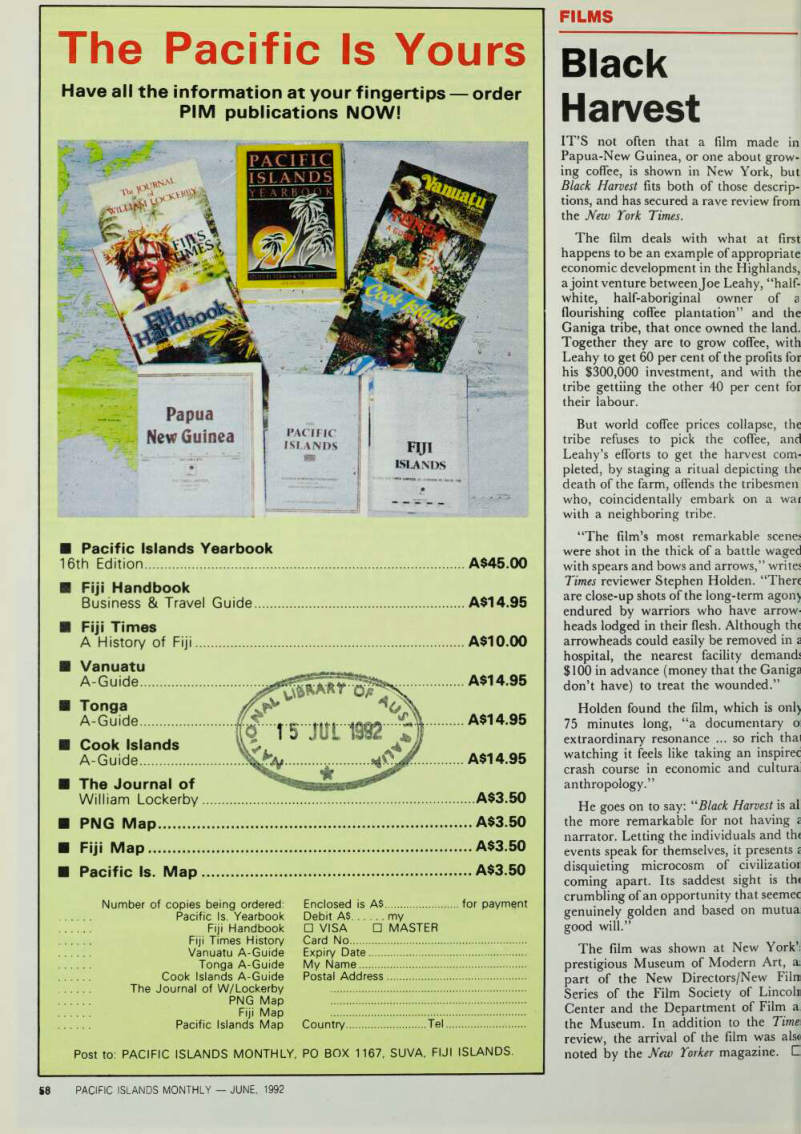
Films
Black Harvest
IT’S not often that a film made in Papua-New Guinea, or one about grow ing coffee, is shown in New York, but Black Harvest fits both of those descrip tions, and has secured a rave review from the New York Times.
The film deals with what at first happens to be an example of appropriate economic development in the Highlands, a joint venture between Joe Leahy, “half white, half-aboriginal owner of a flourishing coffee plantation” and the Ganiga tribe, that once owned the land.
Together they are to grow coffee, with Leahy to get 60 per cent of the profits for his $300,000 investment, and with the tribe gettiing the other 40 per cent for their labour.
But world coffee prices collapse, the tribe refuses to pick the coffee, and Leahy’s efforts to get the harvest com pleted, by staging a ritual depicting the death of the farm, offends the tribesmen who, coincidentally embark on a war with a neighboring tribe.
“The film’s most remarkable scenes were shot in the thick of a battle waged with spears and bows and arrows,” writes Times reviewer Stephen Holden. “There are close-up shots of the long-term agon) endured by warriors who have arrow heads lodged in their flesh. Although the arrowheads could easily be removed in z hospital, the nearest facility demands $lOO in advance (money that the Ganiga don’t have) to treat the wounded.”
Holden found the film, which is onl) 75 minutes long, “a documentary o extraordinary resonance ... so rich thai watching it feels like taking an inspirec crash course in economic and cultura
anthropology.”
He goes on to say: “Black Harvest is al the more remarkable for not having a narrator. Letting the individuals and the events speak for themselves, it presents a disquieting microcosm of civilizatior coming apart. Its saddest sight is the crumbling of an opportunity that seemec genuinely golden and based on mutua
good will.”
The film was shown at New York’: prestigious Museum of Modern Art, a: part of the New Directors/New Film Series of the Film Society of Lincob Center and the Department of Film a the Museum. In addition to the Time! review, the arrival of the film was alsc noted by the New Yorker magazine. C
Advertisements & other items, pp. 59-60 (1 item)
/fAC\¥\t\
ISLANDS
_jMfIRK€T PLACE/
For the benefit of our readers who would like to place a small classified advertisement in our magazine, Market Place will assist you in selling personal items, accommodation, real estate, boating or a service ... in fact anything you would like to sell to our over 50,000 readers.
Market Place Advertising Rates are structured to allow you to place as many advertisements as you wish, economically.
FISHING VESSEL
(124) PROCESSING FISHING VESSEL, built
1987, aluminium, 95’ (28m), DNV Class, very good accommodation for 15, Cat main engine.
Refrig comprises blast tunnel, glazing room, Dackaging room and 3 large storage freezers.
CHARTER CRAFT MARINE, BC/15 Tedder Av,
Main Beach Q 4217 Australia. Phone 31-75-916334 Fax 61-75-329788
BARGE FOR SALE
415) LANDING BARGE, 90’ (27m), carrying capacity 120 tons. Twin GM BV7I main mgines, good accom, large fuel & water cargo
opacity. CHARTER CRAFT MARINE, BC/15
edder Av, Main Beach, Q 4217 Aust. Ph. >l-75-916334 Fax 61-75-329788.
BOOKS
bibliophile, a secondhand bookshop in Sydney, s keen to buy good books on the Pacific. Also, urrent book catalogue “Pacific & Southeast isia” now available free on request, bibliophile, 24 Glenmore Road, Paddington, ISW 2021, Australia. Ph. 61 2 331 1411 ax 61 2 361 3371.
YACHT
ruising Yacht required. Late 92 Ex Canton to xplore Phoenix Group. Share cost basis. For lore info. D. Miles, 306 Highsted Road, hristchurch 5, New Zealand.
WANTED
/e are seeking an AGENT in your area to
upply VEGETABLE IVORY NUT PALM SEEDS,
gent would be required to supervise collecon, drying and bagging for export. For further (formation contact: D. WILKINSON, PO BOX
55, ROUND CORNER, 2158, NEW SOUTH
ALES, AUSTRALIA. PHONE 61 2 8993988
\X 61 2 6344507.
ADVERTISEMENT
igazine T
NATIONAL
LIBRARY OF AUSTRALIA
>IM), Box
NEW BOOK!
TAKE NECESSARY ACTION authors Chris & Louise Harkness ex PNG. Available from publishers: Robert Brown & Assoc. 7 Atherton St Buranda Qld 4102 Australia. Hardcover 352 pages. Exciting PNG Highlands Fiction set pre-Independence era. $24.95 plus postage $5 Aust. $9.50 Overseas.
CONSULTANT
Resort Consultant, increase your profits with our on-site Management and Marketing.
Resortcorp, PO Box 2292, Kamuela, Hawaii 96743.
SCRAP METAL
Tall ingots operate from Brisbane, Australia and make frequent visits to the Pacific Islands which they have done for twenty-five years. We are buyers of Copper, Brass, Aluminium, Lead, Cable etc. Inspection no problems. Telephone 61 7 8922033. Fax 61 78922077. ...
TRAVEL GUIDES
Australian citizen planning to move to Fiji early 1993 seeks partnership or purchase small business in tourism or manufacturing preferably in western district.
Have considerable business experience and used to hard work.
Visiting Fiji July/August 1992.
John Gardner, 1/43 Beach Rd, Brighton SA 5048 Australia.
EXECUTIVE POSITION REQUIRED
Australian Citizen, with Comprehensive Experience in Financial & Personnel Management and in Sales & Marketing in the South Pacific; previously responsible for purchasing, warehousing, large scale distribution programs for multiple location operations; extensive knowledge of import & export trades in South Pacific, S.E. Asia and North America.
Ten years experience in expatriate positions with excellent references available. Long term contract preferred.
All enquiries in strict confidence to: The Candidate P.O. Box 599 Burwood, N.S.W. 2134 Australia.
SURVEYOR
with 20 years experience in topographic, subdiv., egineering surveys in Europe, Libya, Indonesia, PNG, Nauru, Australia seeks employment in Pacific Region. C.V. & references available. Stanislaw Nowak, 6/44 Dalton Street, CAIRNS 4870, AUSTRALIA, Phone: 070-546954.
FOR SALE
Generator 270 KVA 3Ph 415 V: Mirroless/ Brush TL6 MX2. Auto start and switch over. As new unit $U545,000 Ph No. 61-3-8897.
PACIFIC
SLANDS
IMONT H L Y I
MRRK6T PLRCC CRN UJORK
UJONDCRS FOR VOU ...
Promote your business, or service, sell your household items, cars or heavy machinery etc.
ONLY AUSSI PER WORD.
NO COMPANY LOGO. NO
DISPLAY. NO BOLD TYPE.
Just forward your Advertisement together with payment to: PACIFIC ISLANDS MONTHLY “Market Place".
P.O. Box 1167, Suva, Fiji.
CONDITIONS:
1. All Advertisements are subject to acceptance and approval of publisher. 2. Advertisements are published as space permits; we cannot guarantee date of insertion. 3. All advertisements must be prepaid and should be typed or printed clearly. 4. Deadline for receipt of advertisements is the 10th of the month prior to issue.
5. PACIFIC ISLANDS MONTHLY
assumes no responsibility for any service other than publishing paid advertisements in this section.
We put
a lot of thought into
our first car.
°in
PAC_
75 years later,
our cars
think a lot about you.
They were shipbuilders. Probably the best in their time. But this elite team of engineers wouldn’t stop at conquering the sea.
In a special part of their workshop, a dream was taking shape. A peculiar, motor-driven buggy that would run smoother and handle better than any horseless carriage ever had. In fact, the prototype was so successful that they assembled twenty more making the 1917 Mitsubishi Model-A Japan’s first series production car.
That moment made Japanese motor vehicle history, and launched Mitsubishi’s 75 year tradition of automotive firsts. But while the same spirit of innovation lives on, it has evolved into much more than a knack for advanced engineering. At Mitsubishi today, automotive innovation is the discovery of new and unexpected ways to enhance the relationship between cars and people. And between technology and our earth.
Driver and passenger safety as touchstones for every new idea. Cleanliness and conservation as ultimate virtues to pursue. These are but some of the arenas where Mitsubishi designers and engineers demonstrate their commitment to human and environment-conscious innovation. And their achievements continue to include important industry firsts each refueling the same pride and determination that propelled those ambitious shipbuilders so long ago AMERICAN SAMOA: PACIFIC MARKETING INC. PO Box 698, Pago Pago. Tel 699-9140 / AUSTRALIA: MITSUBISHI MOTORS AUSTRALIA LTD. 1284 South Road. Clovelly Park. South Australia. Tel (08) 2757297 / FIJI: NIVIS MOTOR & MACHINERY CO. LTD. G.PO. Box 150, Suva. Tel 383411 / GUAM: GUAM INTERNATIONAL MOTORS INC. PO Box 8638, Tamuning Guam. Tel. 6467622 / NEW CALEDONIA: SOCIETE D’IMPORTATION D’AUTO DU PACIFIQUE SUD S.A. PO Box 2548, Noumea.
Tel 274 144 / NEW ZEALAND: MITSUBISHI MOTORS NEW ZEALAND LTD. Private Bag Ponrua. Tel 237-0109 / NORFOLK ISLAND: BORRY’S PTY LTD. PO Box 169. Tel 2114 / PAPUA NEW GUINEA: TOBA PTY LTD. PO Box Tel 217 874 / SAIPAN: E’SAIPAN MOTORS INC. PO Box 569. Tel 234-7343 / SOLOMON ISLANDS: HARVEST PACIFIC LTD. G.PO. Box 823, Honiara. Tel. 30407 / TAHITI (FRENCH POLYNESIA): SOPADEP S.A. PO Box 1617. Papeete, Tel 427393/ TONGA: SITANI MAFI CO., LTD. PO Box 83. Nuku Alofa. Tel 24044 / VANUATU: SOCOMETRA VANUATU LTD. BP 06. Route de Lagon, Port-Vila. Tel. 2314 / WESTERN SAMOA: MOTOR DISTRIBUTORS (SAMOA) LTD. PO Box 576. Apia, Tel 20957 A
MITSUBISHI
MOTORS