Pacific
Islands
Monthly
aWK Kanaks
KpSfefcUie
Accoitls
May 1992
br
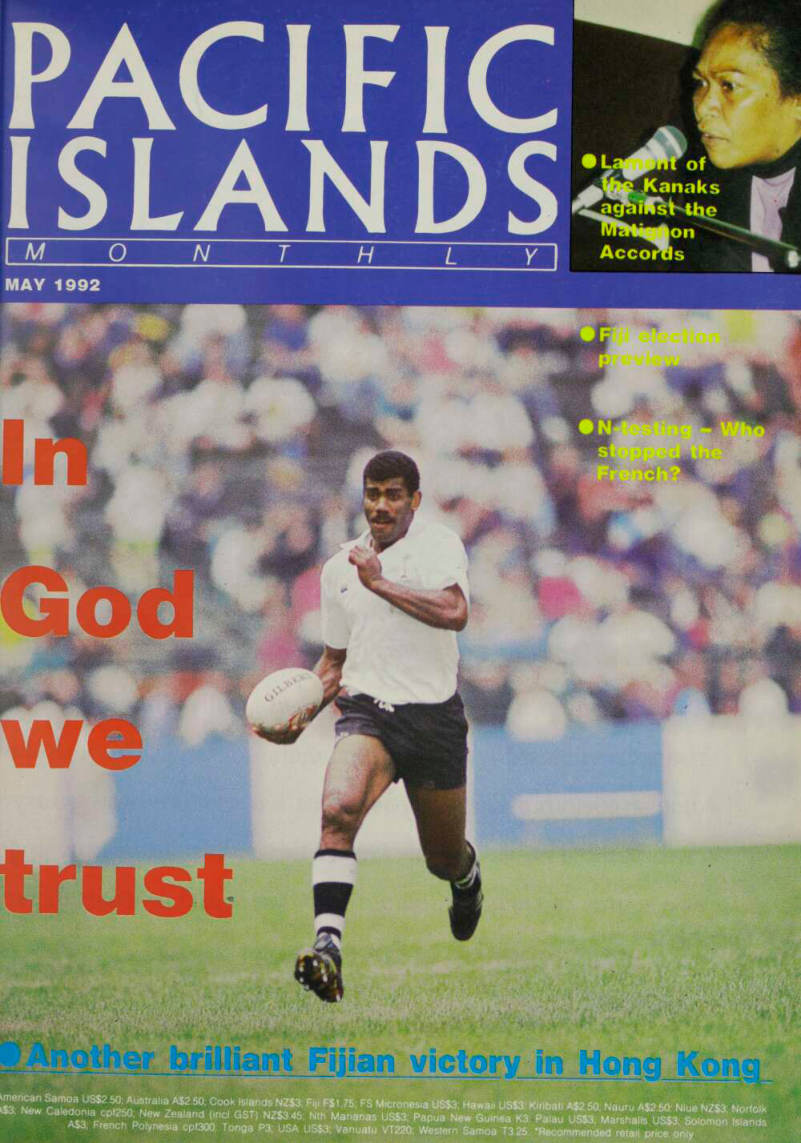
-f? ■• - '3BB -'UftC M '■ hh -~- |£*3C/r^ we
trust
briHiaiit Fijian victory in Hong K-rvm
M: Cook lslands N2s3: Fi|i Fsl 76; FS Mi "onesia US$3; Hawaii US$3: Kiribati A 52.50; Naum As 2 50- Niue NZ$3 Norfolk Zealan ,lJ| nC T l GST) NZs34s ' N,h Marianas us « pa P“> New Guinea K3; Palau US$3; Marshalls US$3 Islands As 3, French Polynesia cpf3oo; Tonga P 3; USA US$3: Vanuatu VT22O; Western Samoa T 326. 'Recommended retail price only
Advertisements & other items, pp. 2-4 (1 item)
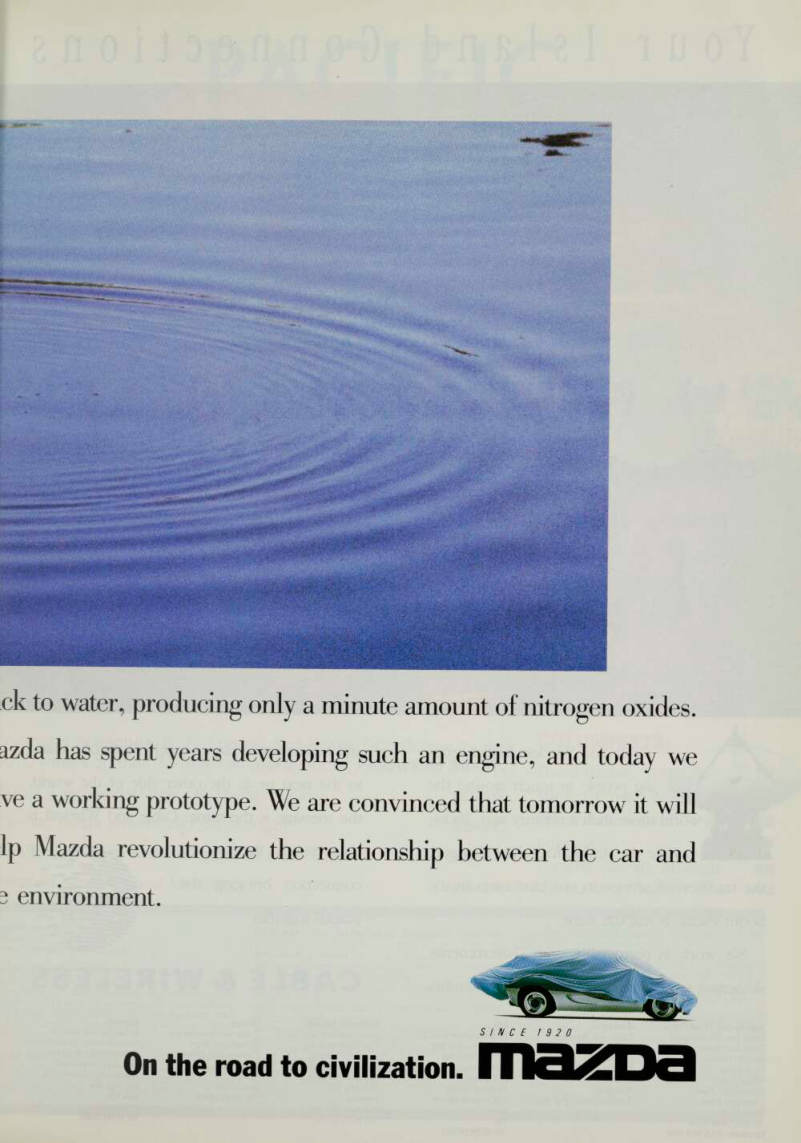
Today, many people believe that to learn to live in harmony witf
nature, we must look to nature for the answers. This may be utopian idea, but like every idea that has advanced the history o civilization, a necessary one. One of these ideas, is to use hydrogen as a source of energy. It comes horn water and as it bums, turn
ck to water, producing only a minute amount ol nitrogen oxides, azda has spent years developing such an engine, and today we ve a working prototype. We are convinced that tomorrow it will Ip Mazda revolutionize the relationship between the car and 3 environment.
On the road to civilization. ft
Your Island Connections
i *
Cable and Wireless began keep-
ing people in touch around the
world more than a century ago. Today,
while the technology has changed,
the tradition of service to our customers in the
South Pacific is just the same.
We work in partnership with Governments,
dedicated to meeting the need of communities and businesses to stay in touch. From one island to the next or to the other side of the world, the message is the same: Cable and Wireless is
your South Pacific
connection bringing the
islands together.
CABLE & WIRELESS
Asia Pacific Head Office Cable and Wireless pic Cable and Wireless (Pacific) Limited 22nd Floor Office Tower Convention Plaza 1 Harbour Road Hong Kong Tel: (852) 848 8620 Facsimile: (852) 868 5195 Australia Cable and Wireless (Australia) Pty Ltd PO Box 675, Double Bay NSW 2028 Sydney Australia Tel/Fax (61-2) 362 3625 Fiji In association with the Government of Fiji Fiji International Telecommunications Ltd.
PO. Box 59 Mercury House 158 Victoria Parade Suva Fiji Tel: (679) 312933 Solomon Islands In association with the Government of the Solomon Islands Solomon Telekom Company Limited PO. Box 148 Honiara Solomon Islands Tel: (677) 21576 Tonga Cable and Wireless pic Private Mail Bag 4 General Post Office Nuku Alofa Tonga South Pacific Tel: (676) 23499 Vanuatu In association with the Government of Vanuatu and France Cables et Radio Vanuatu International Telecommunications Ltd.
PO. Box 164 Port Vila Vanuatu Tel: (678) 22185
Pacific
Islands
Monthly
Vol 62 N 0.5
The News Magazine
May 1992
Over Stories:
► The FLNKS is due to evaluate its position on the Matignon ccords this year. But, writes Susanna Ounei, disillusioned Dung Kanaks are already deciding. A David Robie-edited <tract of a new book published last month, Tu Galala: Social hange in the Pacific , reveals the impact of the Accords on le Kanaks 8-11 Fiji goes to the polls from May 23-30. A special preview of what is ;pected to produce a new brand of politics 12-13 ... and the changing role of the Great Council of Chiefs in Fiji’s political ture 14-15 Western Samoa: Negative inflation has been recorded for the first time er. But after Cyclones Ofa and Val, more monetary oblems are forseen 18 Sports: Fiji’s glorious and unprecedented three-in-a-row victory at the )ng Kong Sevens. Coach Ratu Kitione Tuibua tells of the divine help from >aven and multi-million dollar changes to future Hong Kong Sevens nue 43-47 ver photo: Hong Kong Sevens* yer of the Tournament Mesake Rasari action during the Cathay Pacific/ ngkong Bank international rugby on sevens last month.
Yachting adventure: Sally Andrew and Foster Goodfellow try the icific waters on their 33-foot Yamaha sailboat. Fellowship 36-37 0 Sumo; The Samoan they call Dump Truck 48-49.
Tennis: Tonga powers into the limelight 36-37.
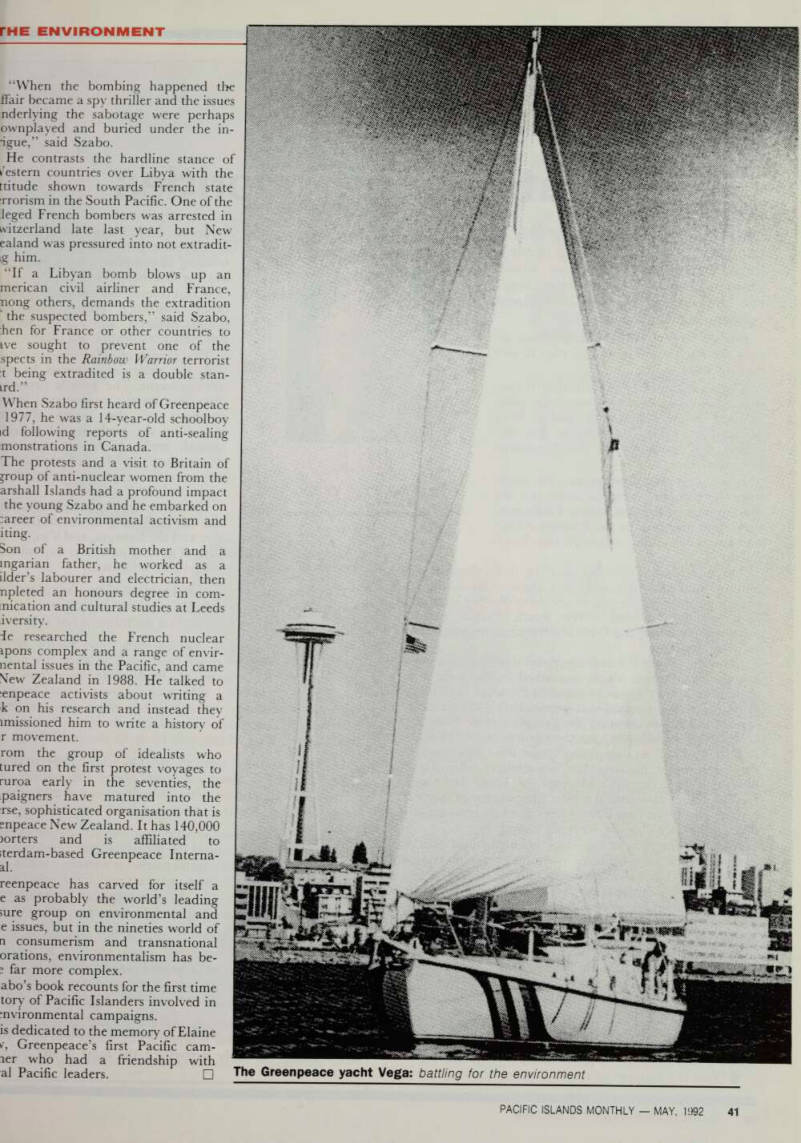
The Environment: And who stopped the French? 39, 41.
Aviation, Shipping and Motoring 24-34.
Columnists:
David Barber, Wellington 16 Margot O’neill, Washington 17 Alfred Sasako. the Forum 22 Futa Helu 23 Jemima Garrett, Australia 35 Bill McCabe, Trade 42
Liblisher: Gene SwinsJead ditor: Mala Jagmohan snlor Writer: Martin Tiffany orrespondents: Al Prince, Angela McCarthy, David irlh, David Robie. Diana McManus, Dykes Angiki, ank Kolma, Franck Madoeuf, lan Williams, Irene sbet. John Hunter,' Karen Mangnall. Lovenia Enari, to Vilisoni Macel Manua, Nicholas Rothwell, Pesi mua, Richard Dinnen, Ulafala Aiavao Wally ambohn Dlumnists: David Barber (Wellington), Futa Helu onga, covering the Pacific Islands), Jemima Garrett ydney), Margot O'Neill (Washington), Julian Motl acific Law). Alfred Sasako (The Forum)
Business and Advertising Manager: Charlotte Thomas Advertising Sales: • Regional Safes (South Pacific): Salendra Narayan, Tel (679) 304111, Fx (679) 303809 • Sydney, Melbourne: Fergus Maclagan, Tel (61-2) 4134689, Fx-(61.-2) 4123918 • Brisbane: Robert Walker, Media House, Tel (61-7) 3710533, Fx (61-7) 371-8904 • Adelaide; Haslwell Williamsons Representations Tel (61-8) 799522, Fx (61-8) 799735 • Auckland: McKay International Media Reps Ltd, Tel (64-9) 4190561, Fx (64-9) 4192243 • Japan: Universal Media Corporation, Tokyo. Tel (3) 6663036, 6663094, Cable: UNIMEDIA Tokyo, Tx 2524665
Founded 1930 (USPS 952480). A Fiji Times Limited production Cover prices are recommended retail only. Registered by Australia Post, Publication No. NBP 1210. © Copyright Fiji Times Limited, 177 Victoria Parade, Suva, Fiji. Tel (679) 304111, Fx (679) 303809, Tx FJ2124.
Pacific Islands Monthly is published monthly by The Fiji Times Limited, a division of Nationwide News, 2 Holt Street, Surry Hills, Sydney, NSW 2010.
Send address changes to; • Pacific Islands Monthly, PC Box 1167, Suva Fiji.
Typeset and printed by The Fiji Times Limited, 177 Victoria Parade, Suva, Fiji,
New editor
Pacific Islands Monthly publisher Gene Swinstead has appointed Mala Jagmohan (pictured) the new editor effective May 4.
She replaces Jale Moala, who has been appointed editor of The Fiji Times . Jagmohan comes to PIM with eight years of experience as a journalist with the daily newspapers, Fiji Sun , The Fiji Times and Thz Daily Post.
Jagmohan, 33, is married to Vinod and they have two daugthters. □
part of life?
Letters
Aid, a natural part of life?
THE article written by Futa Helu (Aid aiding corruption PIM, October, 1991) is
timely because foreign aid,
whether it is bilaterally pro vided by one country to another, or part of a regional assistance programme, is an essential ingredient in the economies of all Pacific Island countries.
There is all too often an obtuseness surrounding the processes by which aid is ob tained and delivered. The jar gon of international aid agencies does not lend itself to easy understanding of the processes involved, or necess arily, the value of the product which is provided at the end of the line. We can and should change that by demanding plain English.
It is probably impossible to answer in general terms Futa Helu’s question on who benefits from aid; the theory is that everyone does. The donor wins political points, and a stronger and more stable trading part ner, and the recipient receives cash, services, or goods which assist national development.
The South Pacific has two major regional aid agencies of its own. The South Pacific Commission, which was estab lished in the early 1950 s by the then colonial powers as a bulkwark against future Japan ese military, or other alien national expansionism in the region, and the South Pacific Forum, which was established several decades later to assist the economic development of the newly independent South Pacific Island nations.
Cynics would argue that the Japanese have obtained what they want by peaceful commer cial means, and the cold war no longer exists, so why continue the South Pacific Commission?
Similarly it could be said many South Pacific Island nations will never become economi cally independent because they lack adequate natural re sources. The reality is that both organisations have played vital roles in both social and econ omic development and filled gaps in national infrastructures which did not exist in colonial, or early post colonial times.
Both organisations deal in regional programmes and are largely uncompetitive with each other because they pro vide different services in specific areas such as health, education, telecommunications etc.
These days the Forum is regarded as the supreme re gional organisation as its poli cies are set by the Heads of Governments of independent countries, at the annual Heads of Government Forum Meet ing.
The delivery of bilateral aid is very much a concern of the two countries concerned, the donor and recipient nation, and providing both nations have democratic political sys tems, the governments con cerned are politically answer able to the public on expendi ture.
Obviously it is possible for a donor nation to help support a friendly government in a recipi ent country. All it has to do is provide funding for a pet proj ect of that government which is likely to buy votes or favours for it.
The ending of the Cold War may make this practice less common as the Western Camp now has little to fear from communism. Any trade-offs in this area may in the future be more to do with buying com mercial concessions within the developing country or votes within the United Nations on matters of national interest.
It is unrealistic and naive to say this does not happen, or will not happen in the future.
There are, however, many persons of high integrity within international aid agencies, and national bureaucracies, who tend to fight against such things and the power of the bureauc racy should not be underesti mated when it comes to manipulating politicians.
This is not to say that bureaucracies are any more honest than politicians, as many are not, but society, both
at national and international levels has its own checks and balances.
What Futa Helu is probably striving for is an adequate system of checks and balances on foreign aid so that the public at large can police the extremes of corruption in this area.
In some of the more open democratic societies freedom of information acts and the nor mal Westminster parliamen tary system does give reason able opportunity to check and control aid provision and re ceipt, particularly where bilat eral aid is concerned. The situation does become a lot foggier with regard to regional and major international aid programmes. The United Na tions is an open forum where issues can be discussed and recorded for public benefit, but that does not eliminate politick ing by pressure group nations for programmes suited to their needs but not necesssarily use ful to others. The UN can also be ineffective in blocking many things which are harmful to developing nations, such as deforestation, because devel oped nations require the re sources.
If we look at our own two regional institutions, the South Pacific Commission and the South Pacific Forum, there is probably a greater account ability to governments of this region, both donor and recipi ent, than with the UN or other international bodies. It is prob ably due more to the intimacy of the region than to any in built public accountability measures.
The Forum Heads of Gov ernment meet in private and most of the regional meetings held by the Forum Secretariat are not open to the public. This makes it difficult to impossible for members of the public to trace the dollars and cents through the system.
What percentage of each aid project is used up in adminis tration for example, and is all
LETTERS TO THE EDITOR must include writer’s full name, address and home telephone number. Letters may be edited for clarity or space. They should be faxed to (679) 303809, or mailed to; Pacific Islands Monthly PO Box 1167 Suva, Fiji Islands
the expenditure justified? Or why should one regional devel opment project be handled more efficiently or given greater priority than another?
I doubt if there is any serious corruption but there may be justification to seeking answers in the other two areas.
The South Pacific Com mission is a more open organ isation. The press are invited to attend its meetings, but it does not deal in the heady stuff of regional policies at Heads of Government level.
The irony is that few media representatives bother to cover the commission’s meetings, but they do tend to line up to cover the closed Forum Secretariat
meetings.
I sincerely hope that both Rowan Callick’s and Futa Helu’s articles prompt greater public interest in foreign aid.
The lives of millions of Pacific Islanders are so dependent on it that they have every reason to know where it is coming from and who sets the priorities.
Even in so-called developed nations like New Zealand there is a lasting need for the public to keep track of its international financial dealings. New Zea land for example has not been a recipient of international foreign aid but it has, during the last few decades, been the recipient of huge foreign loans.
This has been money bor rowed excessively and without due public attention, or con cern, until too late now the New Zealand economy is in full recession trying to square the books.
Pacific Islanders have to be eternally alert that political strings are not too demanding and that the cost of administer ing the aid by international and regional institutions does not dilute the aid to such an extent that there is little left in the coffer for the actual task.
It is not necessarily the “white faces” sitting in the aid agencies who will “milk-off” aid money in the form of excessive wages and salaries, there are plenty of Pacific Islanders who are both experi enced and adept at this game too. At the end of the day all forms of corruption are a hu man affair and no particular race of human beings has a form of exclusivity in this area.
Roy Vaughan Auckland
Advertisements & other items, p. 7 (1 item)
South Pacific
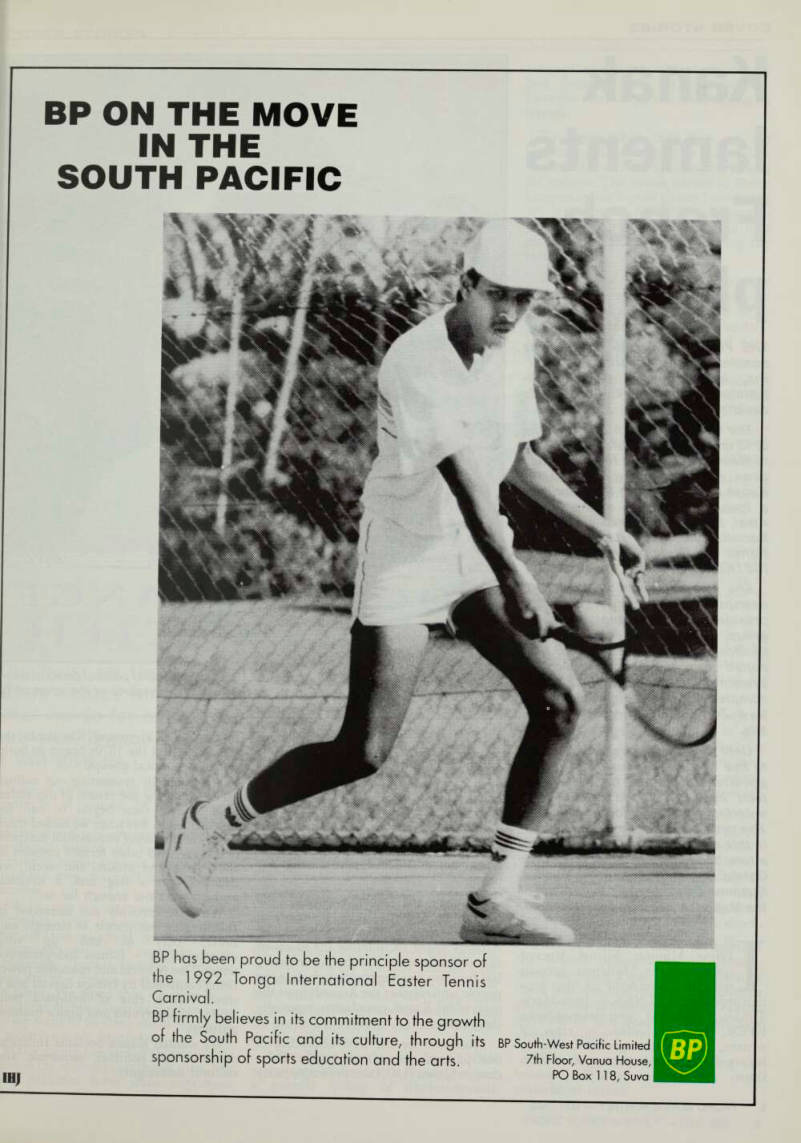
BP ON THE MOVE
IN THE
1 I IX : - ■ . m t: * m ft 7 BP has been proud to be the principle sponsor of the 1992 Tonga International Easter Tennis Carnival.
BP firmly believes in its commitment to the growth of the South Pacific and its culture, through its BP South-West Pacific Limited sponsorship of sports education and the arts. 7th Floor, Vanua House, PO Box 118, Suva
ploy

Cover Stories
Kanak laments French ploy
THE FLNKS Is due to evaluate Its position on the accords this year.
But, writes Susana Ounel, disil lusioned young Kanaks are already deciding.
The writer was born Into a family of 15 children on the island of Ouvea in New Caledonia in 1945. She has been active in the movement for Kanak liberation since 1969, and was a founding member of the group Atsai, the parties Pa Ilka and Kanak Socialist Liberation (LKS), and the Kanak and Exploited Workers Union
(Ustke).
She was publisher of the FLNKS newspaper, Bwenando. As founding president of the Kanak women’s group. GFKEL, she served on the political bureau of the FLNKS. Ex pelled from the French education system at the age of 15, she has just completed a degree in sociology at New Zealand’s Canterbury Univer sity.
Until recently she has been forced to live in exile because the French government banned her New Zea land husband, David Small, from entering New Caledonia with her.
The restriction has now been lifted.
In this article, an edited extract from a new book published last month. Tu Galaia: Social Change in the Pacific, Susanna Ounel reveals the impact of the Matignon Accords on her people.
IN August 1988, when then French Prime Minister Michel Rocard concluded the Matignon Accords with the presidents of the pro independence FLNKS, Jean-Marie Tjibaou, and the anti-independence RPCR, Jacques Lafleur, a clear, if written, part of the agreement was to isolate the so-called extremists on both sides.
How is it that our independence movement can have some elements acceptable to France and others that must be excluded?
The history of Kanak liberation ~,r . . , struggle shows that many of the political aims and strategies that earned myself and others the extremist label have since gamed wide support among our people.
Contrary to popular myth, the Matignon Accords have never been
accepted by the Kanak people. The
Accords might be isolating the so-called extremists from the French government, but they are also beginning to isolate the people who support the Accords from the v i i -n mass of the Kanak population, especially the y° uth ' Frustrated by the slow reformism of our parents’ generation in the Galedonian Union (UC, later the major party
in the FLNKS), young Kanaks in the late 1960 s and the 1970 s began to build our own political groups, We began by reasserting our culture fnd demanding the return of our stolen land - and then began to call lor ind ndence . But whe * we , ooked more clo J at the sort o fneocolonial indepen dence iven to other former co)onies in , he Pacific and around the world, we decided that a flag and a national anthem were not enough for us.
We were certainly not interested in encouraging our people to struggle and suffer, only to end up with neocolonialism - formal independence ™. th aH the and economic power bein ,f controlled by foreign capital and a small Kanak elite of well-paid poll civi| servants and jun £ r business partners.
We wanted Kanak Socialist Indepen dence - full political, economic and cultural sovereignty.
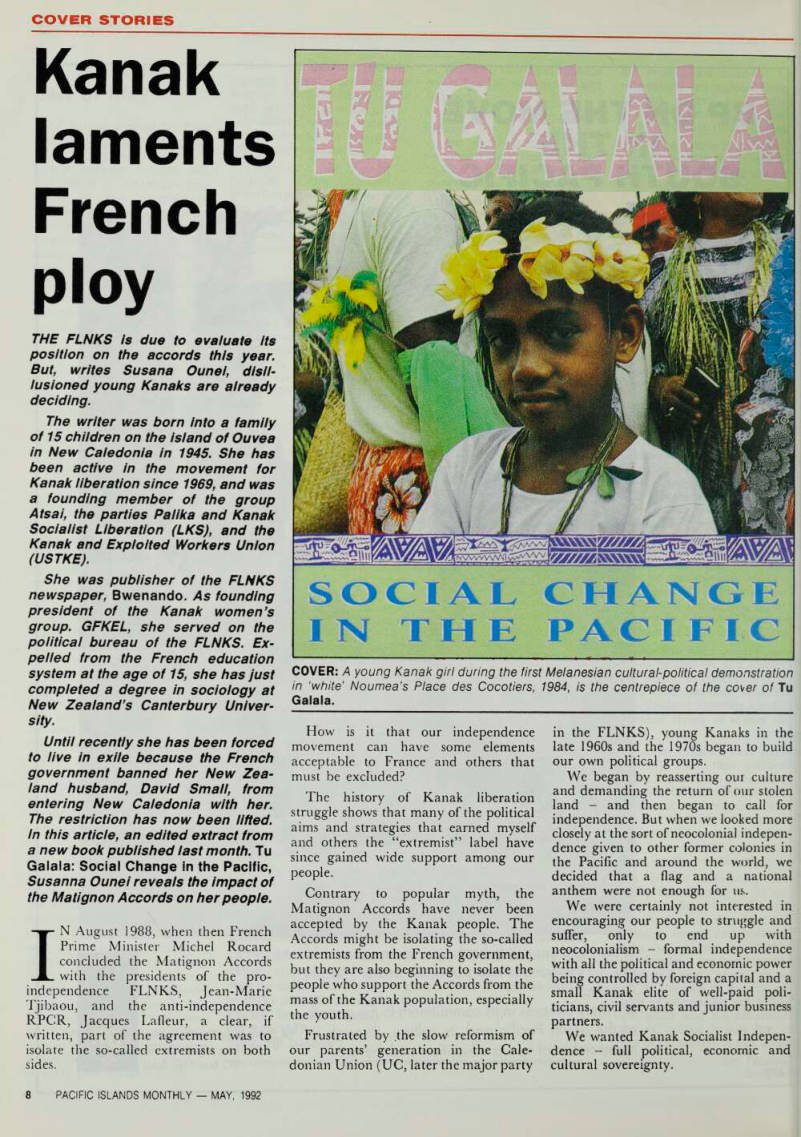
COVER: A young Kanak girl during the first Melanesian cultural-political demonstration in 'white' Noumea's Place des Cocotiers, 1984, is the centrepiece of the cover of Tu Galala.
dthough we were branded as extremists, /e quickly attracted a big following specially among Kanak youth.
Our hope for the
UtUTG comes from
vhat we do for ourselves,
ln f ...u-* . .
101 wnat France decides
t will give us/
Some of us also raised the issue of the eatment of women in our society, ;enage pregnancy, rape and violence gainst women are common. And in the lovement women are expected to be ■cretaries, cooks, cleaners and mistresses hile the men make all the important cisions.
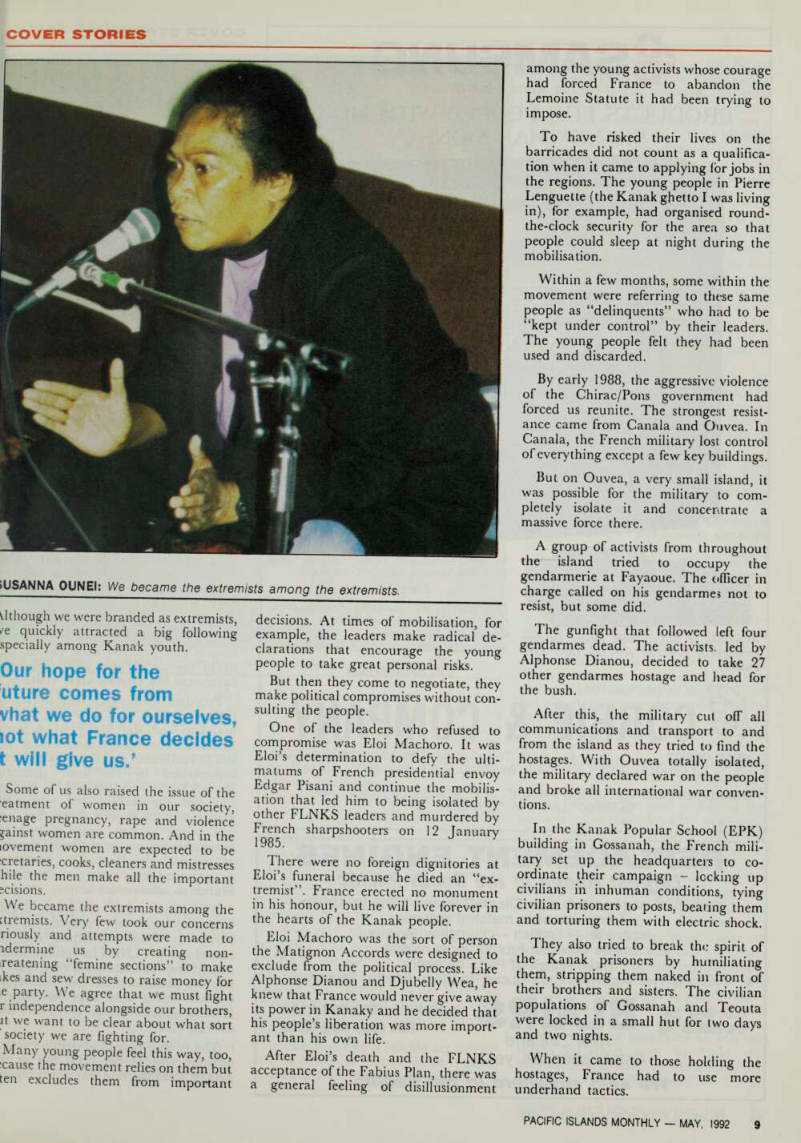
We became the extremists among the :tremists. Very few took our concerns riously and attempts were made to idermine us by creating nonreatenmg “femine sections” to make ikes and sew dresses to raise money for e party. We agree that we must fight r independence alongside our brothers, it we want to be clear about what sort society we are fighting for.
Many young people feel this way, too, ir s^r ve r nt r r ies ° n them but ten excludes them from important
decisions. At times of mobilisation, for example, the leaders make radical de clarations that encourage the young pe ° ple '° take great personal risks nut then they come to negotiate, they make political compromises without con sul!!ng the P eo P le ° ne of the leaders who refused to compromise was Eloi Machoro. It was Elois to defy the ulti matums of French presidential envoy Ebgar Pisani and continue the mobilis a!!°n , hin ] t 0 bei , n § isolated by 2. ther u L V KS Ileaders 1 l eaders and murdered by shar P shooters on 12 January There were no foreign dignitories at Eloi’s funeral because he died an “ex tremist”. France erected no monument * n b i s honour, but he will live forever in tbe hearts of the Kanak people, Eloi Machoro was the sort of person the Matignon Accords were designed to exclude from the political process. Like Alphonse Dianou and Djubelly Wea, he knew that France would never give away its power in Kanaky and he decided that his people’s liberation was more import ant than his own life.
After Eloi’s death and the FLNKS acce P tance of the Fabius Plan, there was a general feeling of disillusionment
among the young activists whose courage had forced France to abandon the Lemoine Statute it had been trying to impose.
To have risked their lives on the barricades did not count as a qualifica tion when it came to applying lor jobs in the regions. The young people in Pierre Lenguette (the Kanak ghetto I was living in), for example, had organised round the-clock security for the area so that people could sleep at night during the mobilisation.
Within a few months, some within the movement were referring to these same people as “delinquents” who had to be “kept under control” by their leaders.
The young people felt they had been used and discarded.
By early 1988, the aggressive violence of the Chirac/Pons government had forced us reunite. The strongest resist ance came from Canala and Ouvea. In Canala, the French military lost control of everything except a few key buildings.
But on Ouvea, a very small island, it was possible for the military to com pletely isolate it and concentrate a massive force there.
A group of activists from throughout the island tried to occupy the gendarmerie at Fayaoue. The ofiicer in charge called on his gendarmes not to resist, but some did.
The gunfight that followed left four gendarmes dead. The activists, led by Alphonse Dianou, decided to take 27 other gendarmes hostage and head for the bush.
After this, the military cut off all communications and transport to and from the island as they tried to find the hostages. With Ouvea totally isolated, the military declared war on the people and broke all international war conven tions.
In the Kanak Popular School (EPK) building in Gossanah, the French mili tary set up the headquarters to co ordinate their campaign - locking up civilians in inhuman conditions, tying civilian prisoners to posts, beating them and torturing them with electric shock.
They also tried to break the spirit of the Kanak prisoners by humiliating them, stripping them naked in front of their brothers and sisters. The civilian populations of Gossanah and Teouta were locked in a small hut for two days and two nights.
When it came to those holding the hostages, France had to use more underhand tactics.
[?]USANNA OUNEI: We became the extremists among the extremists.
Alphonse Dianou and the others had engaged in negotiations in good faith and agreed on a date (just after the French
presidential elections) for releasing the
hostages.
But France had only used the “nego tiations” - like its control of the news media - as a means of preparing for its real goal of treating our people with such barbarity that no one would dare challenge the French again. Their assault on the cave on 5 May, 1938, was designed to the maximum casualties.
Four activists (Alphonse Dianour, Vince LavHua, Samuel Wamo and Martin Haiwe) were executed after they had surrendered and so was Ammossa Waina who was only there (with French permission) to bring food to the cave.
The bodies were dumped in a tin shed at the airport and left there for three days.
Most were burnt and/or mutilated almost beyond recognition. They were buried in a mass grave in Hwadrilla.
When Saddam Hussein pul his pris oners of war on television France joined the chorus calling for him to be tried for war crimes. Where was the international outrage about French war crimes on Ouvea? It was covered over by the
Matignon Accords.
The blood of our brothers killed by the French military had barely died. And, without even visiting Ouvea or consult ing the movement, a few leaders made a deal with France.
The Matignon Accords were signed in blood the blood of my brothers and cousins and nephews from Ouvea. Be neath the appearance of the peaceful agreement lies extreme state violence.
President Mitterand was in power before, during and after the Ouvea massacre and the Matignon Accords.
Bernard Pons and Jacques Chirac are still in Parliament and the military is still commanded by the same generals.
Michel Rocard was not directly respon sible for the torture and executions himself, but the implicit threat that such acts could happen again helped his government to regain authority over my people and our land. The Matignon Accords are simply a more subtle way for France to achieve this aim.
A massive media campaign urging voters to back the accords in the November 1988 referendum was en dorsed by the FLNKS leadership, which argued that Kanaks should vote “yes” to free the political prisoners. The results showed that a very large numbers of Kanaks ignored the party leaders and did not vote.
The overall rate of abstention in the territory was 37 per cent, but in the Kanak areas the rate was much higher.
rhe highest of all was Ouvea (97 per cent Canak), when more than 54 per cent of egistered voters did not vote and a jrther six per cent voted “no”.
Even some of the prisoners’ wives told le they had boycotted the vote. And 3me of the prisoners themselves told me hat they opposed the accords and were ngry at being used to push people to ote.’
Since the Matignon Accords, there has een growing concern within the inde endence movement - including many ho are prepared to work within the ccords - about the close relationship etween elements in the Caledonian hiion (UC) and right-wing Caldoche ettler) groups.
These concerns came to a head in the iimicipal council elections in March, )89, when in some areas the UC allied sell with anti-independence groups and gainst other parties in the FLNKS.
While there are very real splits within ie independence movement, the col lial authorities are also actively seeking
to divide us even further. One of the most important state agencies involved in this psychological warfare is the Studies and Liaison Bureau (BEL), which was set up during the Algerian war of independence with the aim of “contaminating” the liberation movement.
One ofßEL’s most effective campaigns was to convince people that Djubelly Wea’s assassination of Jean-Marie Tjibaou and Yeiwene Yeiwene on May 4, 1989, was the result of a complex conspiracy involving a wide group of people in Kanaky and abroad. The conspiracy rumour sparked off a destruc tive witch-hunt within the movement.
I was very close to Djubelly Wea, politically and personally he was my uncle and was married to my cousin. No one, not even his wife or brothers, knew what he was planning to do. The gun Djubelly used was not smuggled in from abroad but was brought to Ouvea by the
French military.
It was obviously a suicide act carried out in front of hundreds of people, including Jean-Marie’s bodyguards.
History will decide how the Kanak
people will judge Djubelly. What French
officials and foreign commentators think of him is of no importance. The Kanak people know that Djubelly was not a nobody and he was not a hired hit-man.
Even those who disagree with his action cannot deny that he was a sincere and committed political leader who sacrificed his own life for what he believed in increasingly.
Kanak people are recognising the real dangers in the Matignon Accords and are coming to understand what pushed Djubelly Wea to his last sacrificial act.
The French governnment likes to talk about all the money it is giving to aid “development” in Kaiiaky. One of the weaknesses of our movement is that it has never resolved this issue of what kind of development we want - what kind of future society we want to build.
The Kanak people are not paying the price for these issues being ignored. The money from the Matignon Accords is not meeting the real needs of the Kanak people - it is going on big contracts for French multinationals.
The Matignon Accords are good business for the big companies, providing them with political stability and financial subsidies.
If the development of Kanaky is designed to make our country the same as France, Kanak people know what roles arc reserved for us - beggars and servants! Our hope for the future comes from what we do for ourselves not what France decides it will give us.
Kanak youth are now highly politi cised - loo politically aware to allow a few Kanak leaders to set up a neo colonial state in collaboration with the French government and local business men. There are hardly any political people of my generation who are re spected by the youth. The young ones took all the risks and have gained none of the rewards.
The Matignon Accords have alienated and excluded more than just a handful of so-called “extremists”. Among the Kanak people, few ever embraced the accords enthusiastically, a few more went along with them because (hey had already been signed, and others voted for them out of a concern for the political prisoners. The most cynical of all are the young people - and they are the majority. They are the force of our movement and they are the future.
The FLNKS is due to evaluate its position on the accords (his year, but young people are already making (heir assessment. As one young activist told me: “Every time the young people die, it is a few leaders who fill their pockels* We are sick of being used. When they come back to see us for barricades we will tell them, it’s their turn to build the barricades and stand in front - but we will not go to die for them.” □
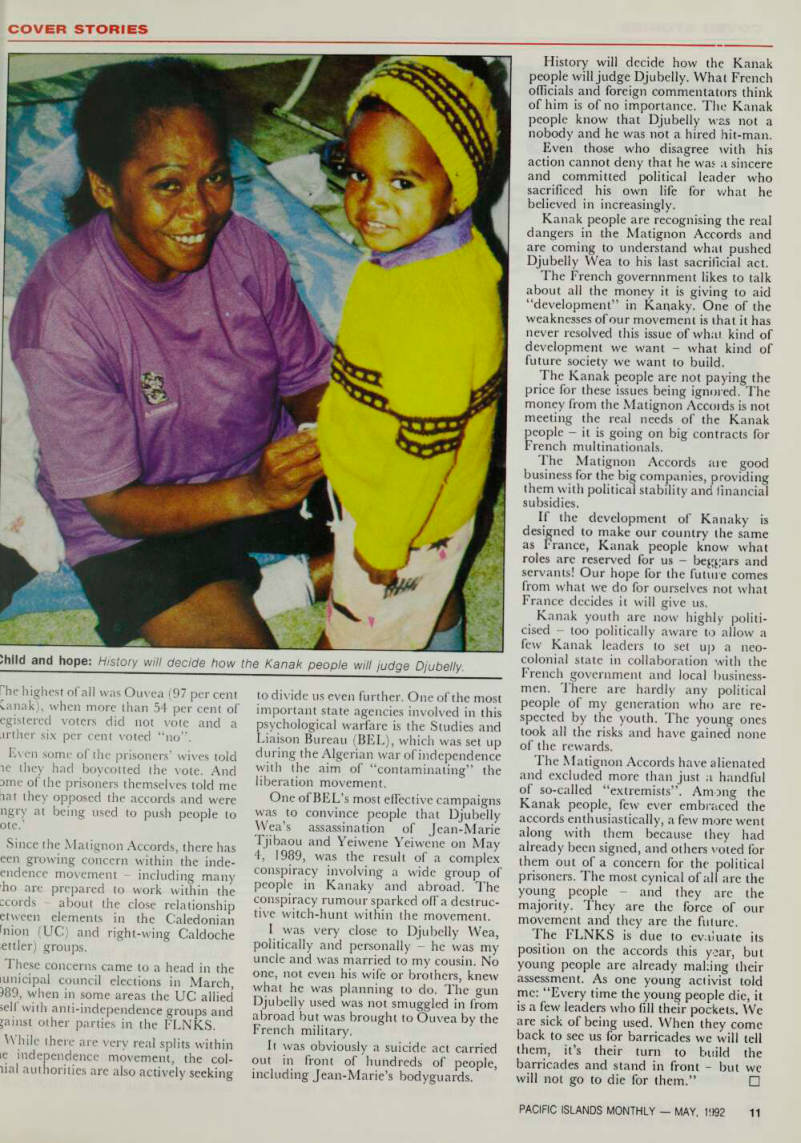
Child and hope: History will decide how the Kanak people will judge Djubelly.
Advertisements & other items, p. 10 (1 item)
Eg Samsung
The World’s Latest
PRODUCTS FOR PEOPLE WITH MORE
SENSE THAN MONEY
To own a Samsung TV Screen, Samsung Video Deck and Samsung Remote Control Unit!
That’<i Great!
That makes the Samsung Combination the most inexpensive of its kind.
Available at Burns Philp Home Centres 9° St Y'^ w throughout Fiji and selected Duty Free Should be ideal for your home.
Dea/m Cg SAMSUNG
SOLE DISTRIBUTORS: **
CORRIE & COMPANY
HEAD OFFICE G.P.O. BOX 45, SUVA TLX: FJ2166 CABLES; ‘CORRICO’ SUVA.
TELEPHONE; 386777 BANKERS: WESTPAC, SUVA (FAX: (679) 370010 BRANCH OFFICE: 161 VITOGO PARADE P.O. BOX 83. LAUTOKA CABLES;
“CORRICO” LAUTOKA TELEPHONE: 60137
REPLACEMENT ENGINES
Largest Range In the South Pacific Over 800 engines available: Diesel-Gasoline lOhp to 400 hp Transmission to match if required Japanese English European Models Engine Overhaul Kits for most models Huge Range of Parts on hand Kumho Tyre Importers Cars-Trucks, Loaders, Forklift, Tractors P.O. Box 14 Geraldine NZ New Zealand Established 34 years We ship anywhere In the Pacific
BLAIRS '""T
of politics
Post-coup elections - new brand
By Mala Jagmohan
FIVE years after the military coup which toppled the last democratically elected government, Fiji is going to the polls later this month.
The elections, spread over eight days
from May 23, already promise to be an interesting test case for the contro versial new Constitution, for political parties based largely along racial lines and for the system of government that will eventuate.
A record number of political parties are contesting the 70 seats in the House
of Representatives.
Leading the line-up of parties is the Great Council of Chiels-sponsorcd Soqosoqo n i Vakavulewa ni Taukei party which is fielding candidates for all of the 37 Fijian seals.
It is led by none other than former army commander and coup leader Major-General Sitivcni Rabuka.
The National Federation Party, tra ditionally based on Indian support, is contesting all the 27 Indian seats. It had been expected to win most, if not all, Indian seals until the Fiji Labour Party reversed its stand to boycott elections at the eleventh hour. The change in stand is seen by many to work to against the Indians - serving only to split their votes.
Last ditch attempts to form an alliance between the two Indian-dominated par lies failed, bringing about a campaign strategy that is more bent on gunning for the other rather than looking at issues.
The Fijian Nationalist United Front, the All National Congress, the New Labour Movement, the General Voters
Party, Fiji Indian Congress, Fiji Liberal
Party could pick up some seats, but do not pose a threat to the big three.
An interesting development has been that despite criticisms against the Consti tution with its racial overtones, no party has shown itself to be truly multi-racial.
Fiji Labour Tarty for all its multi
racial policy is fielding mainly Indian
candidates. Apisai Tora’s All National Congress, once claiming to be the only multi-racial party contesting the elec tions, has also not managed to muster enough Indian candidates.
Even though it appears fairly clear at this stage that the majority of the Fijian scats will go to the SVT, and the Indian votes to NFP and some to the FLP, the
nature of the new government is uncer tain. For a start, the prime-ministership; battle is split three ways within SVT - Rabuka as partry leader expects to geti the job, but veteran politician Rati®, William Toganivalu has expressed inter est and so has former Finance Minister!
Josevata Kamikamica.
Assuming the three do nol give their aspirations for the high office, thein parliamentarians will definitely be split! over the choice.
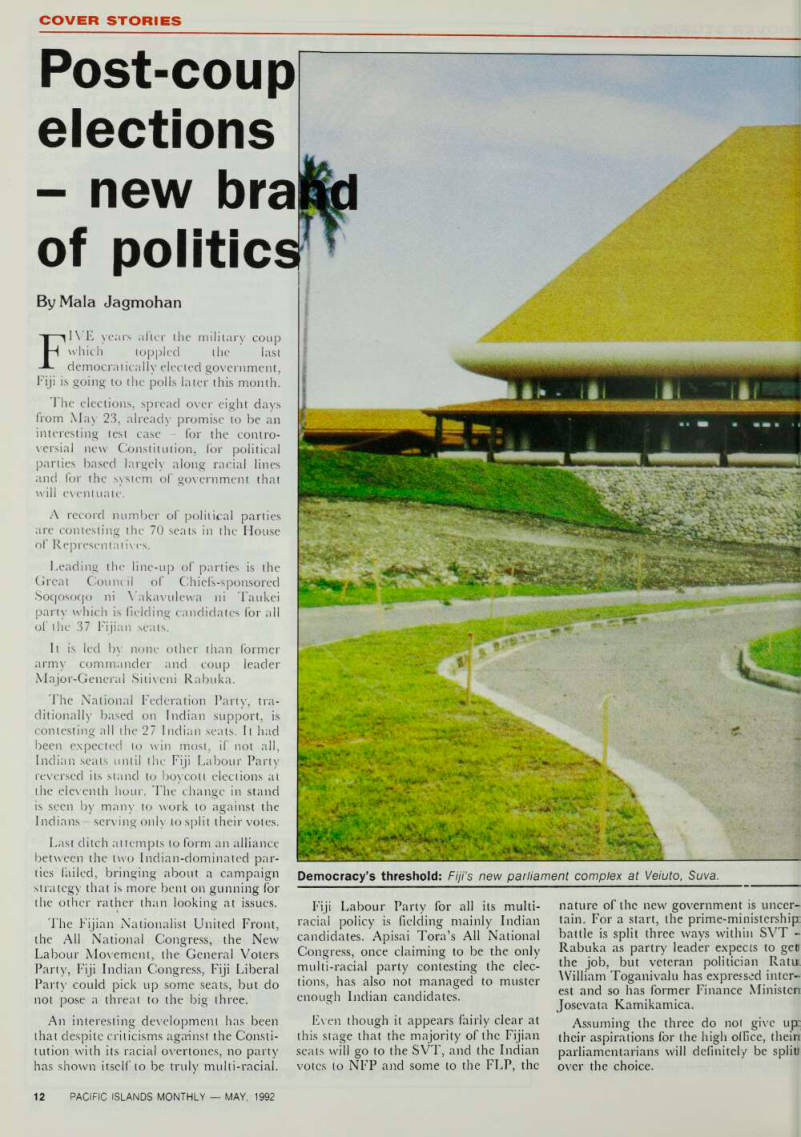
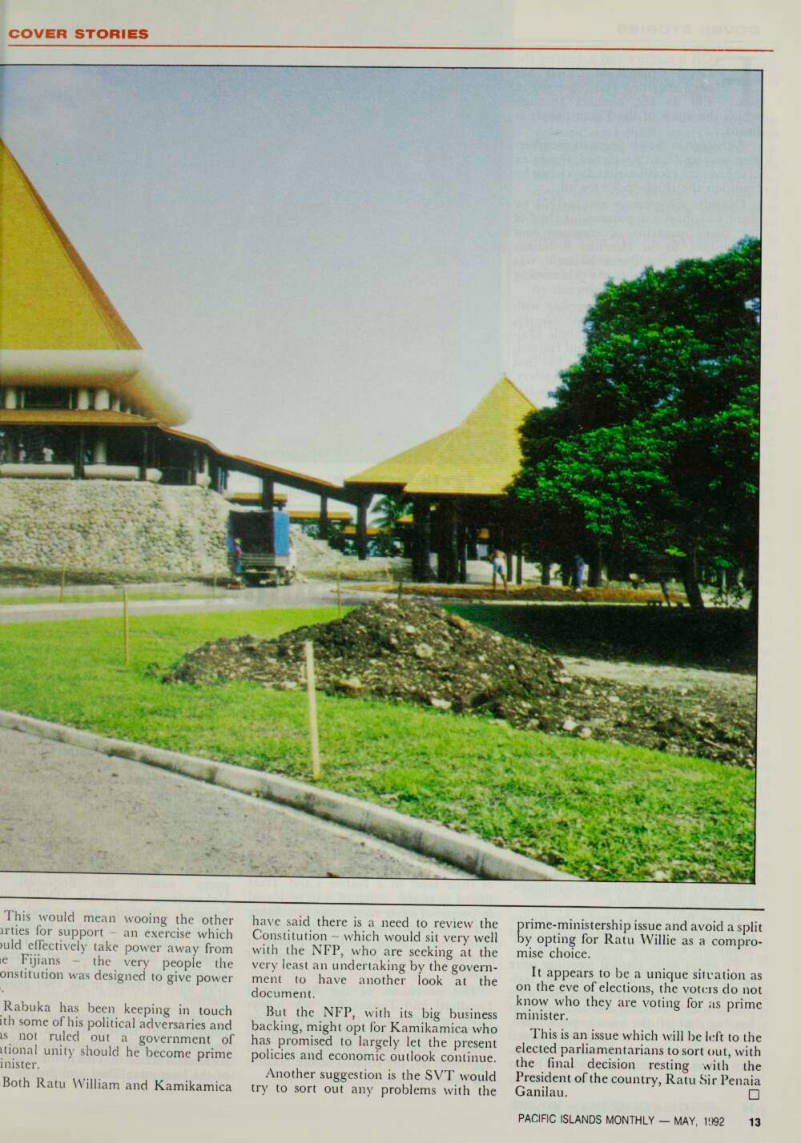
Democracy’s threshold: Fiji’s new parliament complex at Veiuto, Suva.
This would mean wooing the other irties for support - an exercise which >uld effectively take power away from ie Fijians - the very people the onstitution was designed to give power Rabuka has been keeping in touch ith some of his political adversaries and is not ruled out a government of itional unity should he become prime mister.
Both Ratu William and Kamikamica
have said there is a need to review the Constitution - which would sit very well with the NFP, who are seeking at the very least an undertaking by the govern ment to have another look at the document.
But the NFP, with its big business backing, might opt for Kamikamica who has promised to largely let the present policies and economic outlook continue.
Another suggestion is the SVT would try to sort out any problems with the
prime-ministership issue and avoid a split by opting for Ratu Willie as a compro mise choice.
It appears to be a unique situation as on the eve of elections, the voters do not know who they are voting for as prime minister.
This is an issue which will be left to the elected parliamentarians to sort out, with the final decision resting with the President of the country, Ratu Sir Penaia Ganilau. n
Changing roles of Fiji’s
Great Council of Chiefs
FOR a century and a quarter the Great Council of Chiefs has been regarded and respected in Fiji as the channel through which the voice of the Fijian people is heard.
Although in recent years its member ship has significantly widened, the name of the council recalls earlier days when by tradition the chiefs spoke for all.
Consider the message sent in 1874 by Ratu Cakobau, the paramount chief of the time by virtue of conquest and recognition, to Sir Hercules Robinson who, on behalf of Queen Victoria, was
discussing the possibility of Fiji becoming
a Colony of the British Crown.
“We, the King of Fiji, together with other high chiefs of Fiji, give our country, Fiji, unreservedly to Her Britannic Maj esty, Queen of Great Britain and Ireland, and we trust and fully repose in her that she will rule us justly and affectionately, that we may continue to live in peace and prosperity.”
The group from which this message came could be considered a predecessor of the Great Council of Chiefs. It was a gathering of the heads of the chiefly kingdoms which the Deed of Cession combined to create Fiji as a national entity with defined boundaries.
The kingdoms were rivals that were frequently at war. Groupings of them changed from time to time as a result of the wars and of dynastic alliances among the chiefly families. The influence of these ancient kingdoms, and the loyalty they command among their people,
remain powerful today when, following
one of the measures taken by the first British Governor, Sir Arthur Gordon, they have the name of provinces.
Cession brought peace, and a unity born of common loyalty and allegiance to Queen Victoria as a chief above those of any of the individual kingdoms or the groupings into what have become known as confederacies.
The high chiefs of all the kingdoms gathered at Ba after Cession to instal Gordon as Governor, representing Queen Victoria in Fiji.
He saw the advantage of periodic meetings as an opportunity to consult the chiefs on matters concerning the Fijian people, and he created, as part of the machinery of the Colonial Government, a formal advisory body.
It was first called simply the Native Council, later the Council of Chiefs, and finally the Great Council of Chiefs.
To begin with, council meetings were occasions of spectacular ceremonial, last ing for nearly a month, with elaborate presentations, dancing and an amount of feasting that left the hosts impoverished, but this phase passed and the council settled down to annual, more business like affairs. The council no longer meets at fixed intervals, but is convened as
By Sir Leonard Usher
required. Throughout the colonial
period, the council remained almost solely advistory but the advice was a two way affair.
The Governor asked the Council of Chiefs what they thought about Govern ment proposals that would particularly affect Fijians. The council drew the attention of the Governor and his advisers to matters, sometimes small, sometimes of high significance, that were of concern to Fijians somewhere in Fiji.
The act of extraordinary generosity and faith by which Fijians gave control of their land to a Native Land Trust Board to enable much of it to be leased to people of other races came into being only after, following much discussion at many levels among the Fijian people, it was approved by the Great Council of Chiefs.
The provisions of the Agricultural Landlord and Tenant Act, which lays down procedures for the orderly leasing of Fijian land, with defined security of tenure, were also submitted to, and approved by, the council before becom
ing law.
The Fijians members of the Legislative Council who went to London in the late 1960 s for the conferences which resulted in Fiji becoming an independent natiom reported to the Great Council of Chiefs both before and after the two confer ences.
The council was called together aftei the first of the 1987 coups and in the succeeding years considered and ap proved successive drafts of the Consti tution which in its final form was,
promulgated in 1990, giving Fijians
enhanced representation in Parliament.: In anticipation of the election of that Parliament, the Great Council of
created anew, solely Fijian, political
party named the Soqosoqo n;i Vakavulewa ni Taukei (SVT), thus bringing effectively to an end as as political party The Alliance, made up oa Fijian, Indian and General Elector constituent bodies, which had governed) Fiji continuously from Independence in 1970 until its defeat in the 1987 general! election.
There was no consultation with the council before Sitiveni Rabuka, after the second of the two coups in 1987, took the dictatorial action that led to the breaking of the long-established and greatly
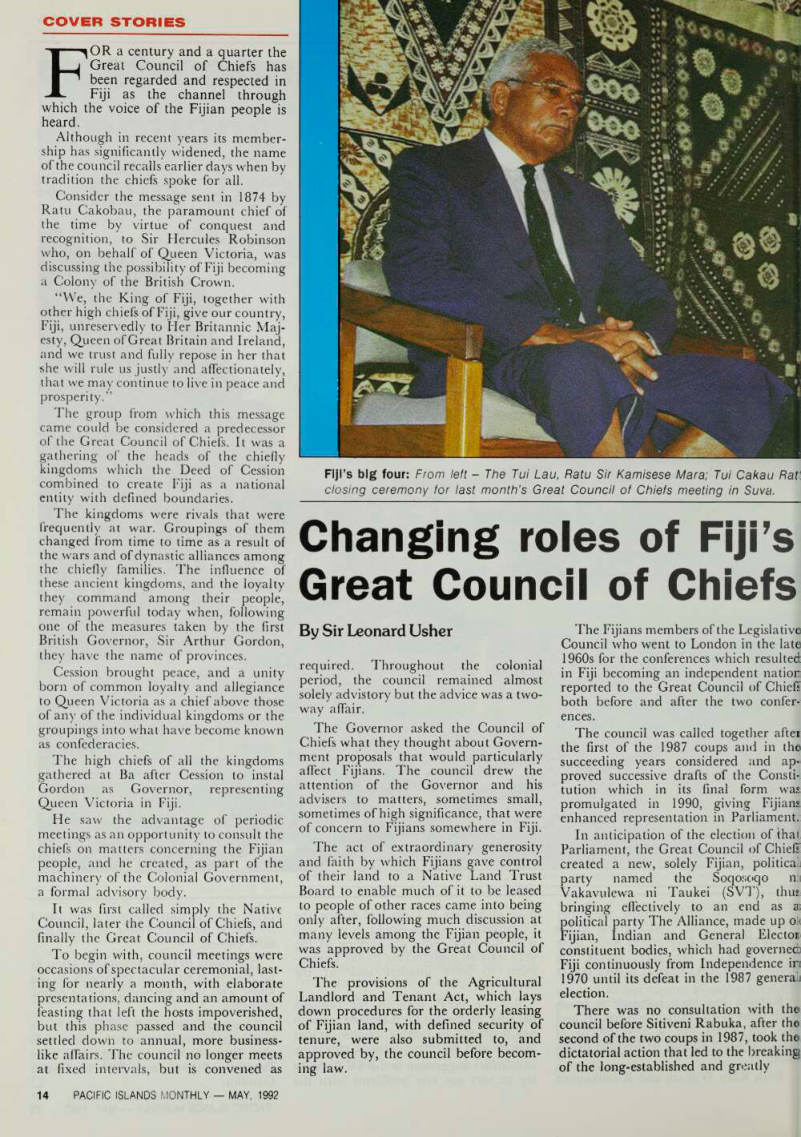
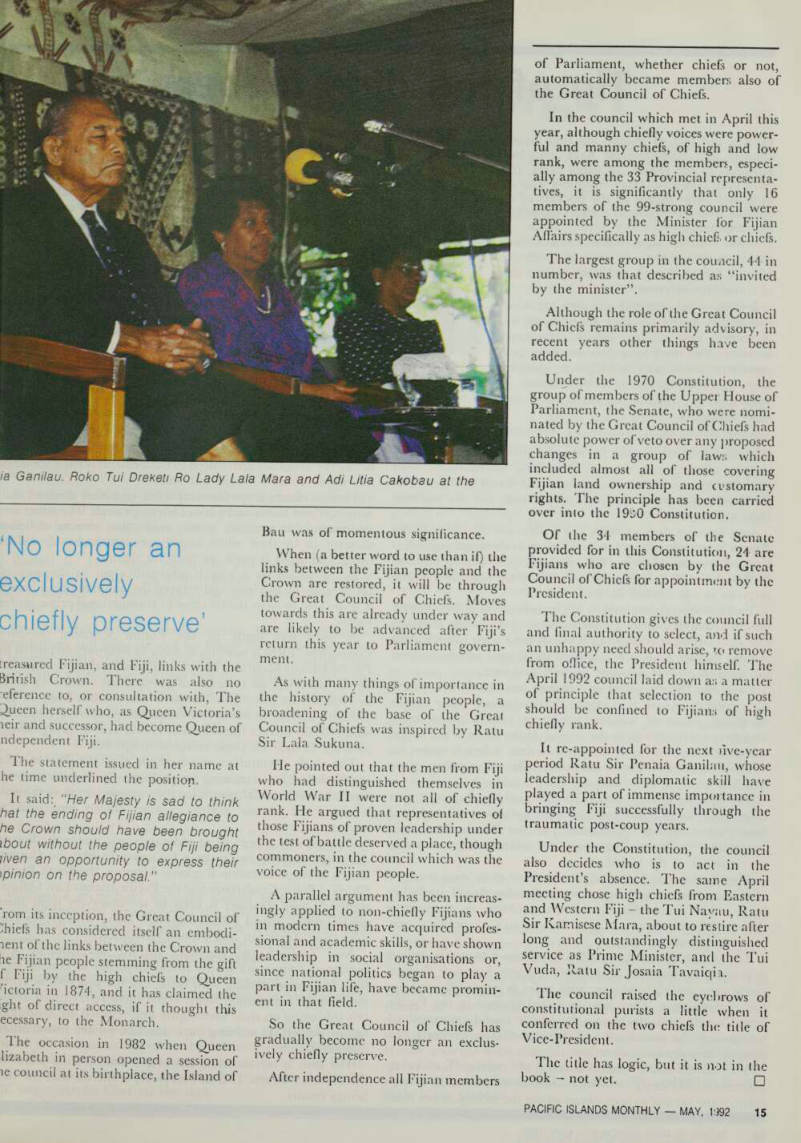
Fiji’s big four: From left - The Tui Lau, Ratu Sir Kamisese Mara; Tui Cakau Rat closing ceremony for last month's Great Council of Chiefs meeting in Suva.
‘No longer an exclusively chiefly preserve’
treasured Fijian, and Fiji, links with the British Crown. There was also no 'eferencc to, or consultation with, The iueen herself who, as Queen Victoria’s icir and successor, had become Queen of independent Fiji.
The statement issued in her name at he time underlined the position.
It said:. “Her Majesty is sad to think hat the ending of Fijian allegiance to he Crown should have been brought 'bout without the people of Fiji being liven an opportunity to express their > pinion on the proposal."
Vom its inception, the Great Council of chiefs has considered itself an embodi icnt of the links between the Crown and le Fijian people stemming from the gift f Fiji by the high chiefs to Queen Victoria in 1874, and it has claimed the ght of direct access, if it thought this ecessary, to the Monarch. 1 he occasion in 1982 when Queen lizabeth in person opened a session of ie council at its birthplace, the Island of
Ban was of momentous significance.
When (a better word to use than if) the links between the Fijian people and the Crown are restored, it will be through the Great Council of Chiefs. Moves towards this are already under way and are likely to be advanced after Fiji’s return this year to Parliament govern ment.
As with many things of importance in the history of the Fijian people, a broadening of the base of the Great Council of Chiefs was inspired by Ratu Sir Lala Sukuna.
He pointed out that the men from Fiji who had distinguished themselves in World War II were not all of chiefly rank. He argued that representatives of those Fijians of proven leadership under the test of battle deserved a place, though commoners, in the council which was the voice of the Fijian people.
A parallel argument has been increas ingly applied to non-chiefly Fijians who in modern times have acquired profes sional and academic skills, or have shown leadership in social organisations or, since national politics began to play a part in Fijian life, have became promin ent in that field.
So the Great Council of Chiefs has gradually become no longer an exclus ively chiefly preserve.
After independence all Fijian members
of Parliament, whether chiefs or not, automatically became members also of the Great Council of Chiefs.
In the council which met in April this year, although chiefly voices were power ful and manny chiefs, of high and low rank, were among the members, especi ally among the 33 Provincial representa tives, it is significantly that only 16 members of the 99-strong council were appointed by the Minister for Fijian Affairs specifically as high chief, or chiefs.
The largest group in the council, 44 in number, was that described as “invited by the minister”.
Although the role of the Great Council of Chiefs remains primarily advisory, in recent years other things have been added.
Under the 1970 Constitution, the group of members of the Upper House of Parliament, the Senate, who were nomi nated by the Great Council of Chiefs had absolute power of veto over any proposed changes in a group of laws which included almost all of those covering Fijian land ownership and customary rights. The principle has been carried over into the 19c0 Constitution.
Of the 34 members of the Senate provided for in this Constitution, 24 are Fijians who arc chosen by the Great Council of Chiefs for appointment by the President.
The Constitution gives the council full and final authority to select, and if such an unhappy need should arise, to remove from oflice, the President himself. The April 1992 council laid down as a matter of principle that selection to the post should be confined to Fijians of high chiefly rank.
It re-appointed for the next five-year period Ratu Sir Penaia Ganilau, whose leadership and diplomatic skill have played a part of immense importance in bringing Fiji successfully through the traumatic post-coup years.
Under the Constitution, the council also decides who is to act in the President’s absence. The same April meeting chose high chiefs from Eastern and Western Fiji - the Tui Nayau, Ratu Sir Kamisese Mara, about to restire after
long and outstandingly distinguished
service as Prime Minister, and the Tui Vuda, Ratu Sir Josaia Tavaiqia.
The council raised the eyebrows of constitutional purists a little when it conferred on the two chiefs the title of Vice-President.
The title has logic, but it is not in the book - not yet. □
[?]a Ganilau. Roko Tui DreKeti Ro Lady Lala Mara and Adi Litia Cakobau at the
Advertisements & other items, p. 14 (1 item)
Cover Stories
Tip of the dirty iceberg
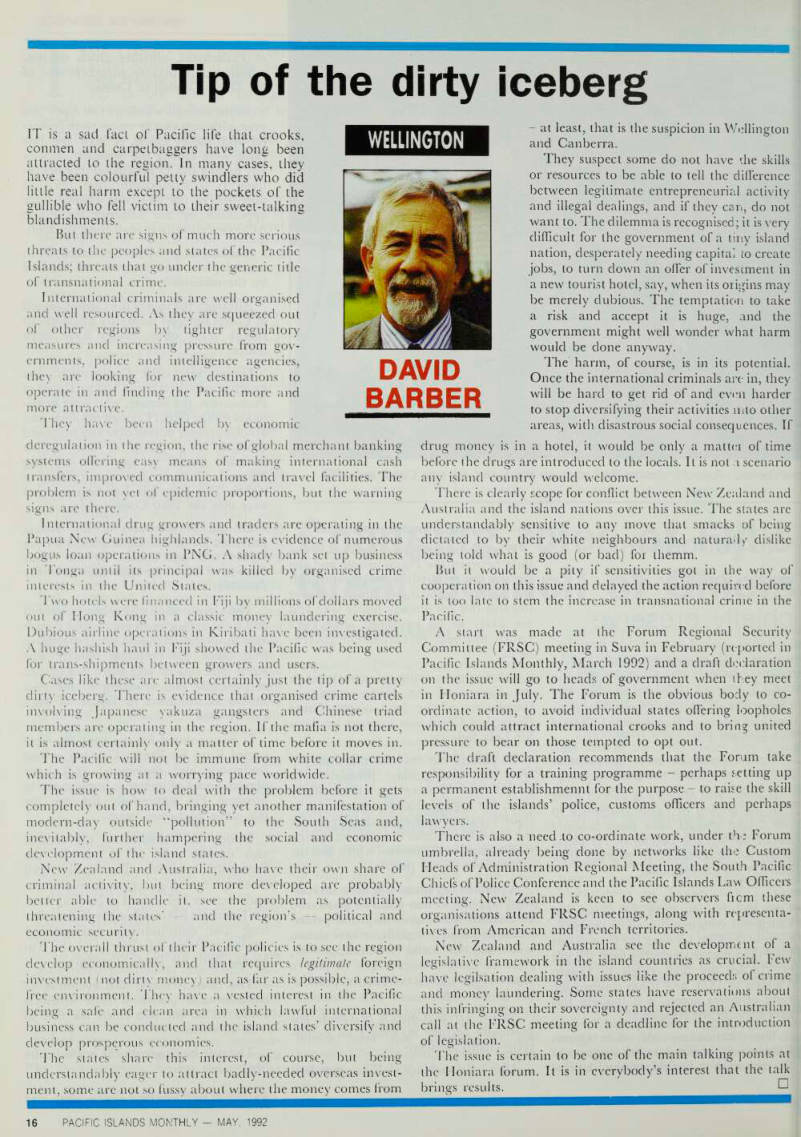
IT is a sad fact of Pacific life that crooks, conmen and carpetbaggers have long been attracted to the region. In many cases, they have been colourful petty swindlers who did little real harm except to the pockets of the gullible who fell victim to their sweet-talking blandishments.
But there are signs of much more serious threats to the peoples and states of the Pacific Islands; threats that go under the generic title of transnational crime.
International criminals are well organised and w ell resourced. As they are squeezed out of other regions by tighter regulatory measures and increasing pressure from gov ernments, police and intelligence agencies, they are looking for new 7 destinations to operate in and finding the Pacific more and more attractive.
They have been helped by economic
deregulation in the region, the rise of global merchant banking systems offering easy means of making international cash transfers, improved communications and travel facilities. The problem is not yet of epidemic proportions, but the warning signs arc there.
International drug growers and traders are operating in the Papua New Guinea highlands. There is evidence of numerous bogus loan operations in PNG. A shady bank set up business in Tonga until its principal was killed by organised crime interests in the United Stales.
Two hotels were financed in Fiji by millions ofdollars moved out of Hong Kong in a classic money laundering exercise.
Dubious airline operations in Kiribati have been investigated.
A huge hashish haul in Fiji showed the Pacific w r as being used for trans-shipments between growers and users.
Cases like these are almost certainly just the tip of a pretty dirty iceberg. There is evidence that organised crime cartels involving Japanese yakuza gangsters and Chinese triad members arc operating in the region. If the mafia is not there, it is almost certainly only a matter of time before it moves in.
The Pacific will not be immune from white collar crime wdiich is growing at a worrying pace w'orldwdde.
The issue is how to deal with the problem before it gets completely out of hand, bringing yet another manifestation of modern-day outside “pollution” to the South Seas and, inevitably, further hampering the social and economic development of the island states.
New' Zealand and Australia, who have their own share of criminal activity, but being more developed arc probably better able to handle it, see the problem as potentially threatening the states’ and the region’s political and economic security.
The overall thrust of their Pacific policies is to see the region develop economically, and that requires legitimate foreign investment (not dirty money) and, as far as is possible, a crime free environment. They have a vested interest in the Pacific being a safe and clean area in which lawful international business can be conducted and the island stales’ diversify and develop prosperous economies.
The slates share this interest, of course, but being understandably eager to attract badly-needed overseas invest ment, some are not so fussy about where the money comes from
Wellington
- at least, that is the suspicion in Wellington and Canberra.
They suspect some do not have the skills or resources to be able to tell the difference between legitimate entrepreneurial activity and illegal dealings, and if they can, do not want to. The dilemma is recognised; it is very difficult for the government of a tiny island nation, desperately needing capital to create jobs, to turn down an offer of investment in a new tourist hotel, say, when its origins may be merely dubious. The temptation to take a risk and accept it is huge, and the government might well wonder what harm would be done anyway.
The harm, of course, is in its potential.
Once the international criminals are in, they will be hard to get rid of and even harder to stop diversifying their activities into other areas, with disastrous social consequences. If
drug money is in a hotel, it would be only a matter of time before the drugs are introduced to the locals. It is not a scenario any island country would welcome.
There is clearly scope for conflict between New Zealand and Australia and the island nations over this issue. The states are understandably sensitive to any move that smacks of being dictated to by their white neighbours and naturally dislike being told what is good (or bad) for themm.
But it would be a pity if sensitivities got in the way of cooperation on this issue and delayed the action required before it is 100 late to stem the increase in transnational crime in the Pacific.
A start was made at the Forum Regional Security Committee (FRSC) meeting in Suva in February (reported in Pacific Islands Monthly, March 1992) and a draft declaration on the issue will go to heads of government when ibey meet in Honiara in July. The Forum is the obvious body to co ordinate action, to avoid individual states offering loopholes which could attract international crooks and to bring united pressure to bear on those tempted to opt out.
The draft declaration recommends that the Forum take responsibility for a training programme - perhaps setting up a permanent establishmennt for the purpose - to raise the skill levels of the islands’ police, customs officers and perhaps
lawyers.
There is also a need to co-ordinate work, under the Forum umbrella, already being done by networks like the Custom Heads of Administration Regional Meeting, the South Pacific Chiefs of Police Conference and the Pacific Islands Law Officers meeting. New Zealand is keen to see observers ficm these organisations attend FRSC meetings, along with representa tives from American and French territories.
New Zealand and Australia see the development of a legislative framework in the island countries as crucial. Few have legilsation dealing with issues like the proceeds of crime and money laundering. Some states have reservations about this infringing on their sovereignty and rejected an Australian call at the FRSC meeting for a deadline for the introduction
of legislation.
The issue is certain to be one of the main talking points at the Honiara forum. It is in everybody’s interest that the talk brings results.
David
Barber
Off to Rio, George?
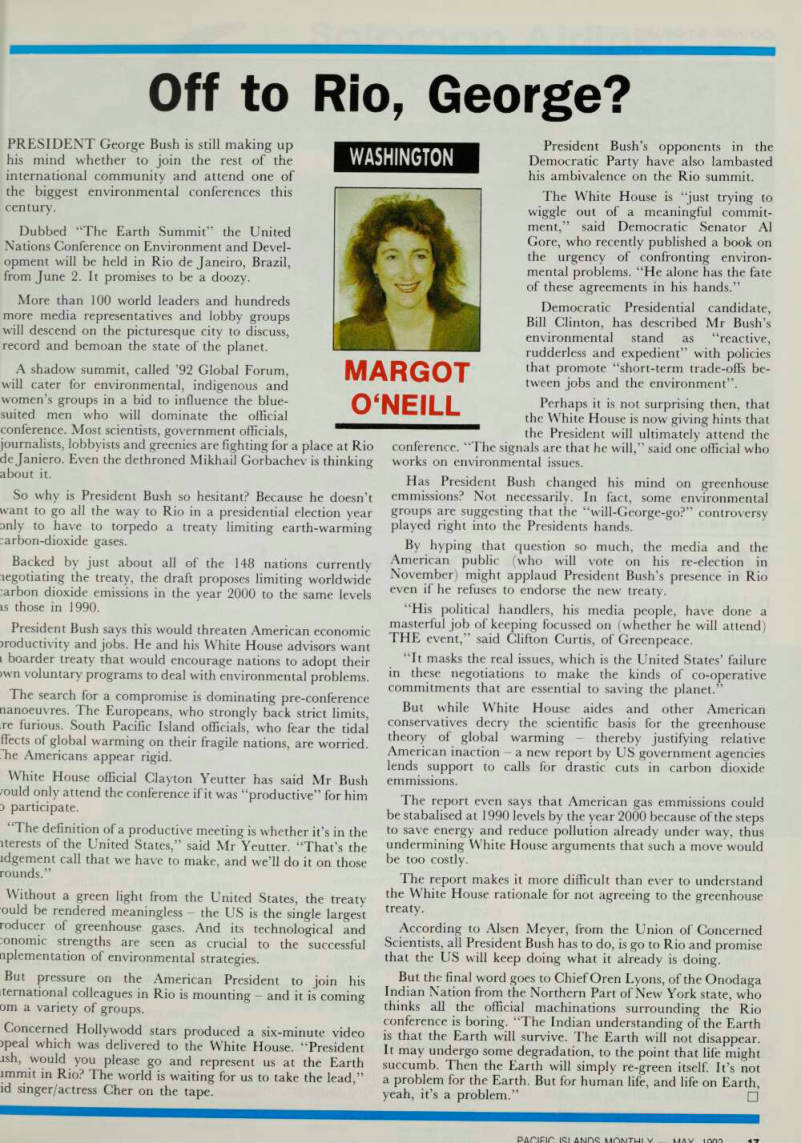
PRESIDENT George Bush is still making up his mind whether to join the rest of the international community and attend one of the biggest environmental conferences this century.
Dubbed “The Earth Summit” the United Nations Conference on Environment and Devel opment will be held in Rio de Janeiro, Brazil, from June 2. It promises to be a doozy.
More than 100 world leaders and hundreds more media representatives and lobby groups will descend on the picturesque city to discuss, record and bemoan the state of the planet.
A shadow summit, called ’92 Global Forum, will cater for environmental, indigenous and women’s groups in a bid to influence the blue suited men who will dominate the official conference. Most scientists, government officials,
journalists, lobbyists and greenies are fighting for a place at Rio de Janiero. Even the dethroned Mikhail Gorbachev is thinking about it.
So why is President Bush so hesitant? Because he doesn’t want to go all the way to Rio in a presidential election year Dnly to have to torpedo a treaty limiting earth-warming
:arbon-dioxide gases.
Backed by just about all of the 148 nations currently icgotiating the treaty, the draft proposes limiting worldwide :arbon dioxide emissions in the year 2000 to the same levels is those in 1990.
President Bush says this would threaten American economic productivity and jobs. He and his White House advisors want i boarder treaty that would encourage nations to adopt their >wn voluntary programs to deal with environmental problems.
The search for a compromise is dominating pre-conference nanoeuvres. The Europeans, who strongly back strict limits, re furious. South Pacific Island officials, who fear the tidal Beets of global warming on their fragile nations, are worried, "he Americans appear rigid.
White House official Clayton Yeutter has said Mr Bush only attend the conference if it was “productive” for him
d participate.
“The definition of a productive meeting is whether it’s in the iterests of the United States,” said Mr Yeutter. “That’s the idgement call that we have to make, and we’ll do it on those rounds.”
Without a green light from the United States, the treaty ould be rendered meaningless the US is the single largest roducer of greenhouse gases. And its technological and :onomic strengths are seen as crucial to the successful aplementation of environmental strategies.
But pressure on the American President to join his ternational colleagues in Rio is mounting - and it is coming om a variety of groups.
Concerned Hollywodd stars produced a six-minute video ppeal which was delivered to the White House. “President ash, would you please go and represent us at the Earth immit in Rio? The world is waiting for us to take the lead,” id singer/actress Cher on the tape.
Washington
President Bush’s opponents in the Democratic Party have also lambasted his ambivalence on the Rio summit.
The White House is “just trying to wiggle out of a meaningful commit ment,” said Democratic Senator A 1 Gore, who recently published a book on the urgency of confronting environ mental problems. “He alone has the fate of these agreements in his hands.”
Democratic Presidential candidate, Bill Clinton, has described Mr Bush’s environmental stand as “reactive, rudderless and expedient” with policies that promote “short-term trade-offs be tween jobs and the environment”.
Perhaps it is not surprising then, that the White House is now giving hints that the President will ultimately attend the
conference. “The signals are that he will,” said one official who works on environmental issues.
Has President Bush changed his mind on greenhouse emmissions? Not necessarily. In fact, some environmental groups are suggesting that the “will-George-go?” controversy played right into the Presidents hands.
By hyping that question so much, the media and the American public (who will vote on his re-election in November) might applaud President Bush’s presence in Rio even if he refuses to endorse the new treaty.
“His political handlers, his media people, have done a masterful job of keeping focussed on (whether he will attend) THE event,” said Clifton Curtis, of Greenpeace.
“It masks the real issues, which is the United States’ failure in these negotiations to make the kinds of co-operative commitments that are essential to saving the planet.”
But while White House aides and other American conservatives decry the scientific basis for the greenhouse theory of global warming - thereby justifying relative American inaction - a new report by US government agencies lends support to calls for drastic cuts in carbon dioxide emmissions.
The report even says that American gas emmissions could be stabalised at 1990 levels by the year 2000 because of the steps to save energy and reduce pollution already under way, thus undermining White House arguments that such a move would be too costly.
The report makes it more difficult than ever to understand the White House rationale for not agreeing to the greenhouse treaty.
According to Alsen Meyer, from the Union of Concerned Scientists, all President Bush has to do, is go to Rio and promise that the US will keep doing what it already is doing.
But the final word goes to Chief Oren Lyons, of the Onodaga Indian Nation from the Northern Part of New York state, who thinks all the official machinations surrounding the Rio conference is boring. “The Indian understanding of the Earth is that the Earth will survive. The Earth will not disappear.
It may undergo some degradation, to the point that life might succumb. Then the Earth will simply re-green itself. It’s not a problem for the Earth. But for human life, and life on Earth, yeah, it’s a problem.” □
Margot
O'neill
Advertisements & other items, p. 17 (1 item)
17
PAPIPin IQ I AMHQ UnMTUII V UAV inno
More trouble looms for Samoa
By Ulafala Aiavao
THE good news for Western Samoa is that it recorded its first ever negative inflation rate last year. eipPriccs were down 1.3 per cent over the previous 12 month period.
The Central Bank of Samoa said in its latest quarterly report (October- Dccember 1991) released last month that the negative inflation was due to monet ary policy and improved supplies of local
produce.
In December, however, prices rose as local foodstuffs were devastated by Cyc lone Val.
The bad news is that almost all other economic markers worsened last year, partly because of Cyclone Ofa damage in
February 1990.
Imports last year of WS$232 million (US$95 million) were 25 per cent up on the previous year, and the highest import level so far.
Half the imports by value were for intermediate goods, while there were also substantial import items for road con struction and a major hydro-electric
project underway.
One quarter of total imports were for consumption goods, said the CBS report.
By contrast, the declining level of exports had dropped to just WS$lB million (US$7.3 million) last year. In
short, imports were more than 12 limes the value of exports.
Damage by Cyclone Ofa in February 1990 to cocoa and coconut plantations meant that exports of copra oil and cocoa were negligible last year.
Eighty one per cent of total export came from just three products - taro WS$6.9 million (US$2.B m), coconut cream US$2.l million and automotive harnesses US$l.l million Exports of automotive harnesses began last August from a branch of the Japanese firm Yazaki which, by year’s end, already accounted for 15 per cent of Western Samoa’s exports by value.
That percentage will increase as Yazaki operations are largely unaffected by the more recent devastation from Cyclone Val last December.
Also, Yazaki is expanding into a US$2.2 factory now under construction that will be leased from the Western Samoan government.
However, damage from the latest cyclone is so severe it will be 12 months before the local copra mill or coconut cream processors can count on a recovery in local coconut supplies.
Taro exports were banned soon after Cyclone Val (except to nearby American Samoa). This kept stocks on the local market and prices fairly stable in the wake of temporary food shortages, but
will have a negative effect on taro export earnings.
Private remittances from overseas, which usually equal about half the government budget, dropped 19 per cent last year to US$3O million.
One reason for the high fall was that 1990 remittances were boosted by sym
pathy payments following Cyclone Ofa
earlier that year.
Another reason is continued economic recession in the major tourism source countries of New Zealand, Australia and the United States.
The 1991 remittances figure is one of the lowest in five years, matching only the 1980 inflow. Western Samoa’s bal ance of payments in 1991 had an overall surplus of US$l.2 million, compared with US$l5.5 million a year earlier.
The Central Bank of Samoa said the current account deficit of US$4O.5 mil lion was the highest so far, and only substantial inflows on the capital account of US$4l.B million allowed a small surplus in the balance of payments.
Gross reserves at the end of December were about US$6B million, enough for seven months of imports of goods and services. This coverage was 20 per cent less than the same month a year earlier. □
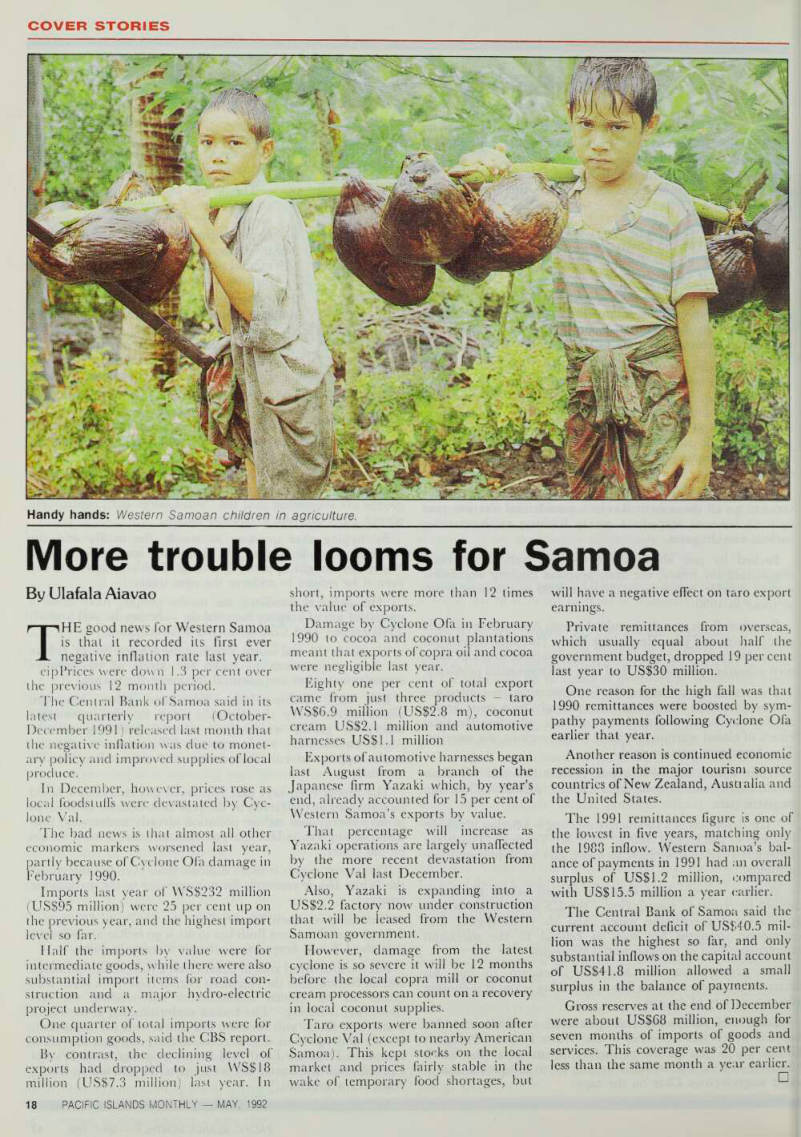
Handy hands: Western Samoan children in agriculture.
Advertisements & other items, pp. 19-21 (1 item)
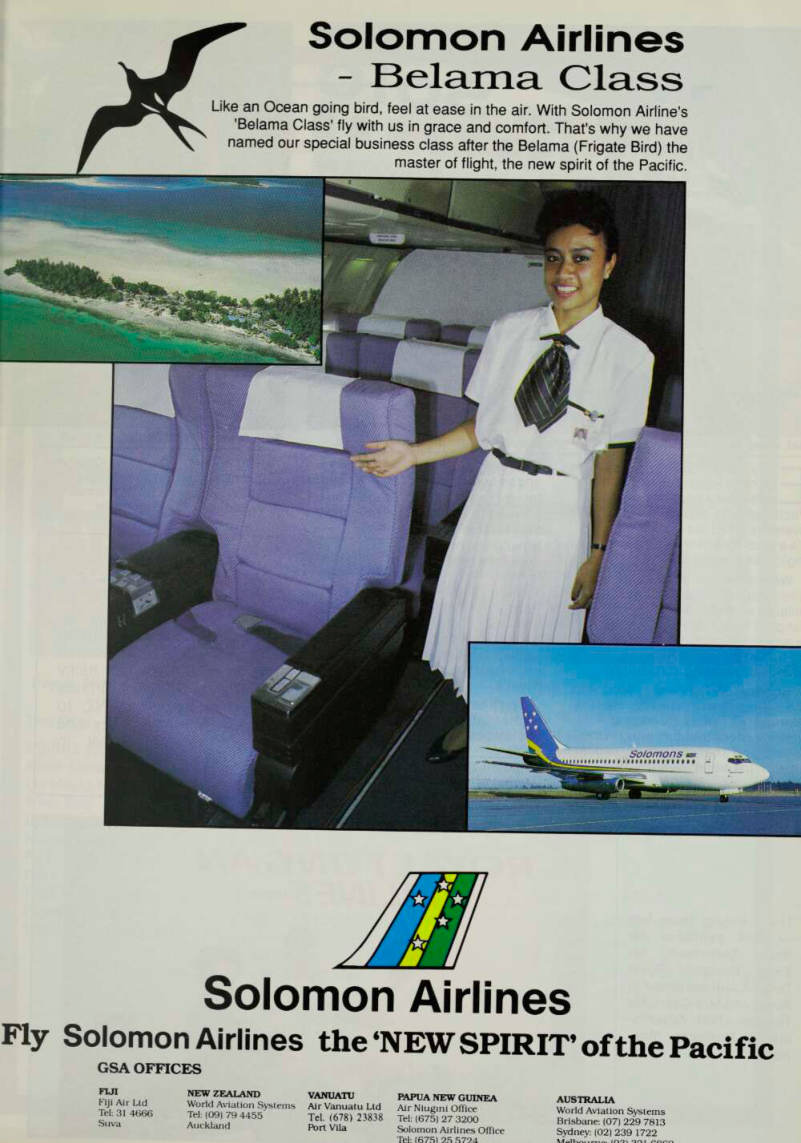
Solomon Airlines
- Bel am a Class
Like an Ocean going bird, feel at ease in the air. With Solomon Airline’s 'Belama Class' fly with us in grace and comfort. That's why we have named our special business class after the Belama (Frigate Bird) the master of flight, the new spirit of the Pacific.
J ' Solomons
Solomon Airlines
Fly Solomon Airlines the‘NEW SPIRIT’of the Pacific
GSA OFFICES
FUI NEW ZEALAND
Fiji Air Ltd World Aviation Systems Tel; 31 4666 Tel: (09) 79 4455 Suva Auckland
VANUATU PAPUA NEW GUINEA
Air Vanuatu Ltd Air Niugmi Office Tel. (678) 23838 Tel: (675) 27 3200 Port Vila Solomon Airlines Office Tel: (6751 25 5724
AUSTRALIA
World Aviation Systems Brisbane: (07) 229 7813 Sydney; (02) 239 1722
m k M<k* W ' * Wv y
m II P *
ROYAL T
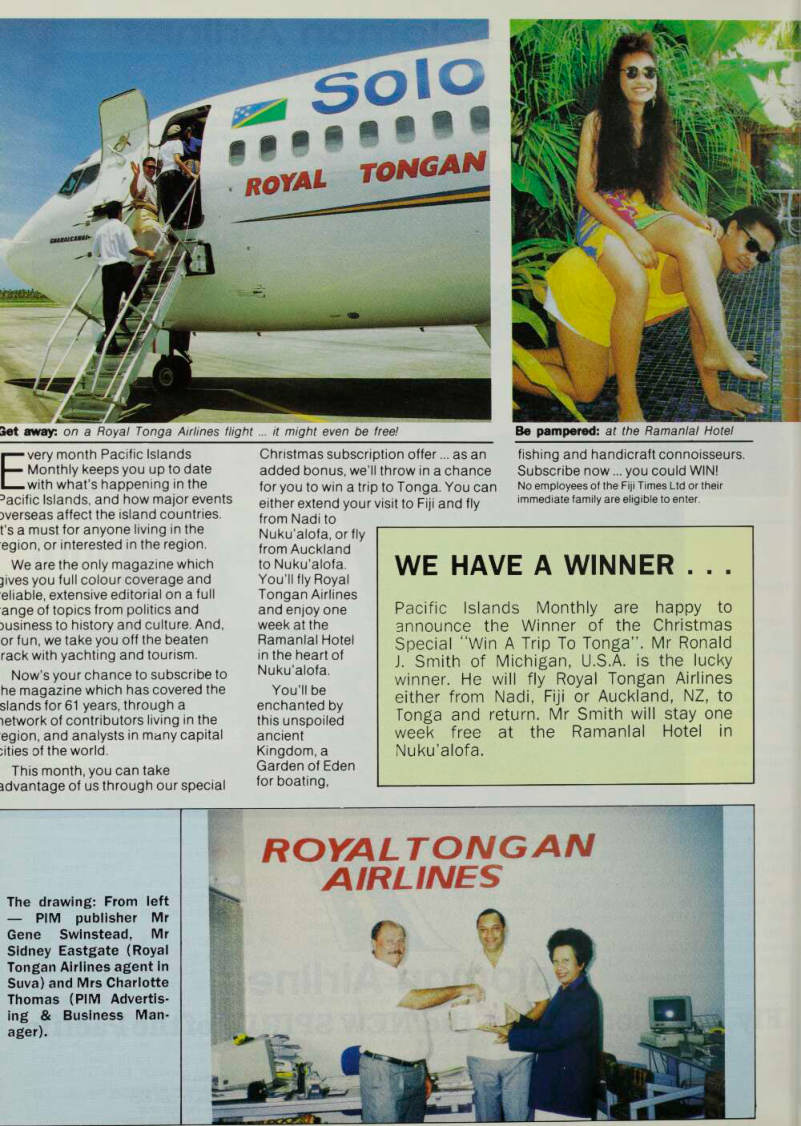
* .V - « 4 Set away: on a Royal Tonga Airlines flight ... it might even be free!
Be pampered: at the Ramanlal Hotel very month Pacific Islands Monthly keeps you up to date with what’s happening in the Pacific Islands, and how major events overseas affect the island countries, t’s a must for anyone living in the egion, or interested in the region.
We are the only magazine which jives you full colour coverage and eliable, extensive editorial on a full ange of topics from politics and )usiness to history and culture. And, or fun, we take you off the beaten rack with yachting and tourism.
Now’s your chance to subscribe to he magazine which has covered the slands for 61 years, through a letwork of contributors living in the egion, and analysts in many capital cities of the world.
This month, you can take advantage of us through our special Christmas subscription offer... as an added bonus, we’ll throw in a chance for you to win a trip to Tonga. You can either extend your visit to Fiji and fly from Nadi to Nukualofa, or fly from Auckland to Nuku’alofa.
You’ll fly Royal Tongan Airlines and enjoy one week at the Ramanlal Hotel in the heart of Nuku’alofa.
You’ll be enchanted by this unspoiled ancient Kingdom, a Garden of Eden for boating, fishing and handicraft connoisseurs.
Subscribe now... you could WIN!
No employees of the Fiji Times Ltd or their immediate family are eligible to enter.
WE HAVE A WINNER . . .
Pacific Islands Monthly are happy to announce the Winner of the Christmas Special "Win A Trip To Tonga”. Mr Ronald J. Smith of Michigan, U.S.A. is the lucky winner. He will fly Royal Tongan Airlines either from Nadi, Fiji or Auckland, NZ, to Tonga and return. Mr Smith will stay one week free at the Ramanlal Hotel in Nuku’alofa.
The drawing: From left PIM publisher Mr Gene Swinstead, Mr Sidney Eastgate (Royal Tongan Airlines agent In Suva) and Mrs Charlotte Thomas (PIM Advertising & Business Manager).
ROYALTONGAN
AIRLINES
( r
KINHILL KRAMER
Professional Project Managers Consulting Engineers Architects Surveyors
edibility...continuity...
commitment.. .quality.. .excellence are all terms synonymous with Papua New Guinea's leading engineering consultant. iiiiiiiiiii'i MU Papua New Guinea Solomon Islands Head Office Port Moresby
KINHILL KRAMER PTY LTD.,
Kinhill Kramer Building Cnr Islander Drive & Wards Road
HOHOLA
National Capital District
PO Box 1948, BOROKO,
Papua New Guinea Telephone (675) 256033 Facsimile (675) 211049
Telex CAMAKRA NE 23050
KINHILL KRAMER (SOLOMON ISLANDS)
Fourth Floor NPF Building Mendana Avenue PO Box 377 Honiara, Solomon Islands Telephone (677) 21996 Facsimile (677) 22190 Vanuatu
KINHILL KRAMER (VANUATU) LTD.,
Ist FLoor, Drugstore Building Kumul Highway P.O. Box 96, Port Vila Vanuatu Telephone (678) 23 457 Facsimile (678) 22 455
LTD KINHILL KACIMAIWAI PTY LTD
First Floor, 6-12 Andrews Street, Nadi Fiji Islands PO Box 9213 Nadi Airport, Fiji Islands Telephone (679) 780033 Facsimile (679) 780131 Australia Head Office Adelaide
KINHILL ENGINEERS PTY. LTD.,
200 East Terrace, GPO Box 2702, Adelaide South Australia 5001 Telephone (08) 2237011 Facsimile (08) 2320163 Telex AA82364 A MEMBER OF THE KUIHIU GROUP OF COMPANIES
Pushing for solar systems
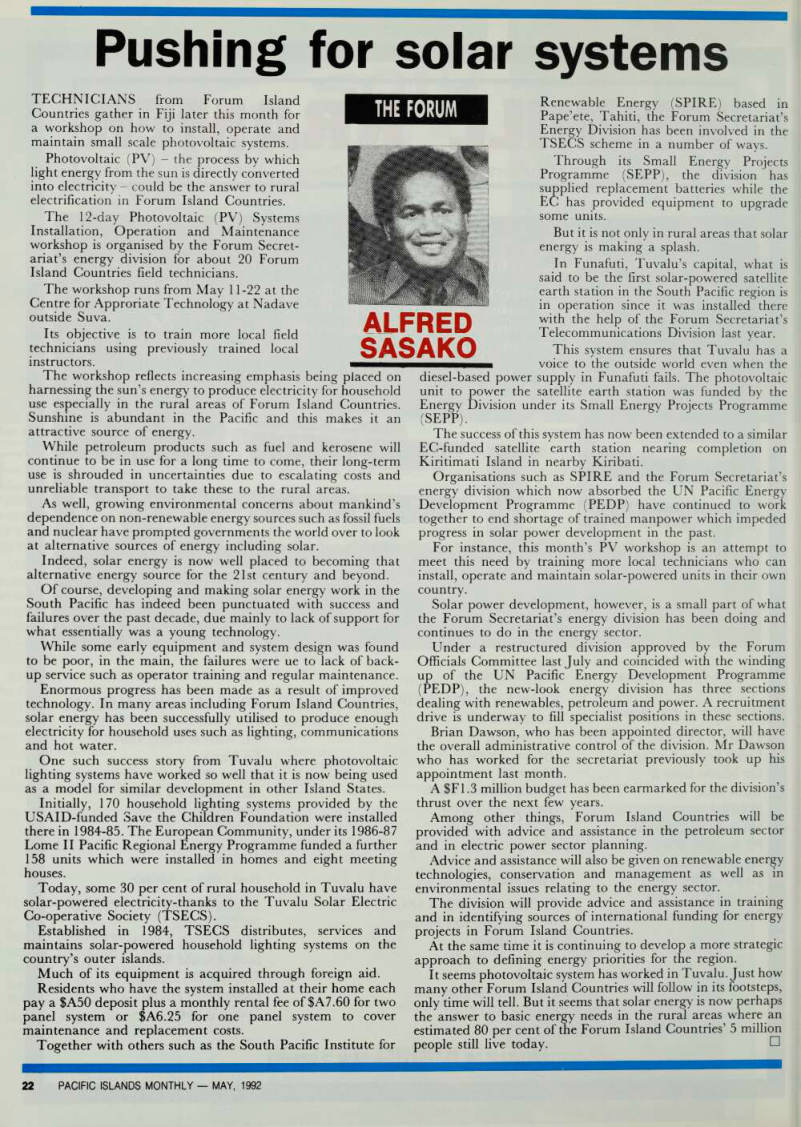
TECHNICIANS from Forum Island Countries gather in Fiji later this month for a workshop on how to install, operate and maintain small scale photovoltaic systems.
Photovoltaic (PV) - the process by which light energy from the sun is directly converted into electricity - could be the answer to rural electrification in Forum Island Countries.
The 12-day Photovoltaic (PV) Systems Installation, Operation and Maintenance workshop is organised by the Forum Secret ariat’s energy division for about 20 Forum Island Countries field technicians.
The workshop runs from May 11-22 at the Centre for Approriate Technology at Nadave outside Suva.
Its objective is to train more local field technicians using previously trained local instructors.
The workshop reflects increasing emphasis being placed on harnessing the sun’s energy to produce electricity for household use especially in the rural areas of Forum Island Countries.
Sunshine is abundant in the Pacific and this makes it an attractive source of energy.
While petroleum products such as fuel and kerosene will continue to be in use for a long time to come, their long-term use is shrouded in uncertainties due to escalating costs and unreliable transport to take these to the rural areas.
As well, growing environmental concerns about mankind’s dependence on non-renewable energy sources such as fossil fuels and nuclear have prompted governments the world over to look at alternative sources of energy including solar.
Indeed, solar energy is now well placed to becoming that alternative energy source for the 21st century and beyond.
Of course, developing and making solar energy work in the South Pacific has indeed been punctuated with success and failures over the past decade, due mainly to lack of support for what essentially was a young technology.
While some early equipment and system design was found to be poor, in the main, the failures were ue to lack of back up service such as operator training and regular maintenance.
Enormous progress has been made as a result of improved technology. In many areas including Forum Island Countries, solar energy has been successfully utilised to produce enough electricity for household uses such as lighting, communications and hot water.
One such success story from Tuvalu where photovoltaic lighting systems have worked so well that it is now being used as a model for similar development in other Island States.
Initially, 170 household lighting systems provided by the USAID-funded Save the Children Foundation were installed there in 1984-85. The European Community, under its 1986-87 Lome II Pacific Regional Energy Programme funded a further 158 units which were installed in homes and eight meeting houses.
Today, some 30 per cent of rural household in Tuvalu have solar-powered electricity-thanks to the Tuvalu Solar Electric
Co-operative Society (TSECS).
Established in 1984, TSECS distributes, services and maintains solar-powered household lighting systems on the country’s outer islands.
Much of its equipment is acquired through foreign aid.
Residents who have the system installed at their home each pay a SASO deposit plus a monthly rental fee of 5A7.60 for two panel system or SAG.2S for one panel system to cover maintenance and replacement costs.
Together with others such as the South Pacific Institute for
The Forum
Renewable Energy (SPIRE) based in Pape’ete, Tahiti, the Forum Secretariat’s Energy Division has been involved in the TSECS scheme in a number of ways.
Through its Small Energy Projects Programme (SEPP), the division has supplied replacement batteries while the EC has provided equipment to upgrade some units.
But it is not only in rural areas that solar energy is making a splash.
In Funafuti, Tuvalu’s capital, what is said to be the first solar-powered satellite earth station in the South Pacific region is in operation since it was installed there with the help of the Forum Secretariat’s Telecommunications Division last year.
This system ensures that Tuvalu has a voice to the outside world even when the
diesel-based power supply in Funafuti fails. The photovoltaic unit to power the satellite earth station was funded by the Energy Division under its Small Energy Projects Programme
(Sepp).
The success of this system has now been extended to a similar EC-funded satellite earth station nearing completion on Kiritimati Island in nearby Kiribati.
Organisations such as SPIRE and the Forum Secretariat’s energy division which now absorbed the UN Pacific Energy Development Programme (PEDP) have continued to work together to end shortage of trained manpower which impeded progress in solar power development in the past.
For instance, this month’s PV workshop is an attempt to meet this need by training more local technicians who can install, operate and maintain solar-powered units in their own country.
Solar power development, however, is a small part of what the Forum Secretariat’s energy division has been doing and continues to do in the energy sector.
Under a restructured division approved by the Forum Officials Committee last July and coincided with the winding up of the UN Pacific Energy Development Programme (PEDP), the new-look energy division has three sections dealing with renewables, petroleum and power. A recruitment drive is underway to fill specialist positions in these sections.
Brian Dawson, who has been appointed director, will have the overall administrative control of the division. Mr Dawson who has worked for the secretariat previously took up his appointment last month.
A SFI.3 million budget has been earmarked for the division’s thrust over the next few years.
Among other things, Forum Island Countries will be provided with advice and assistance in the petroleum sector and in electric power sector planning.
Advice and assistance will also be given on renewable energy technologies, conservation and management as well as in environmental issues relating to the energy sector.
The division will provide advice and assistance in training and in identifying sources of international funding for energy projects in Forum Island Countries.
At the same time it is continuing to develop a more strategic approach to defining energy priorities for the region.
It seems photovoltaic system has worked in Tuvalu. Just how many other Forum Island Countries will follow in its footsteps, only time will tell. But it seems that solar energy is now perhaps the answer to basic energy needs in the rural areas where an estimated 80 per cent of the Forum Island Countries’ 5 million people still live today. D
Alfred
Sasako
Political blocs of the islands
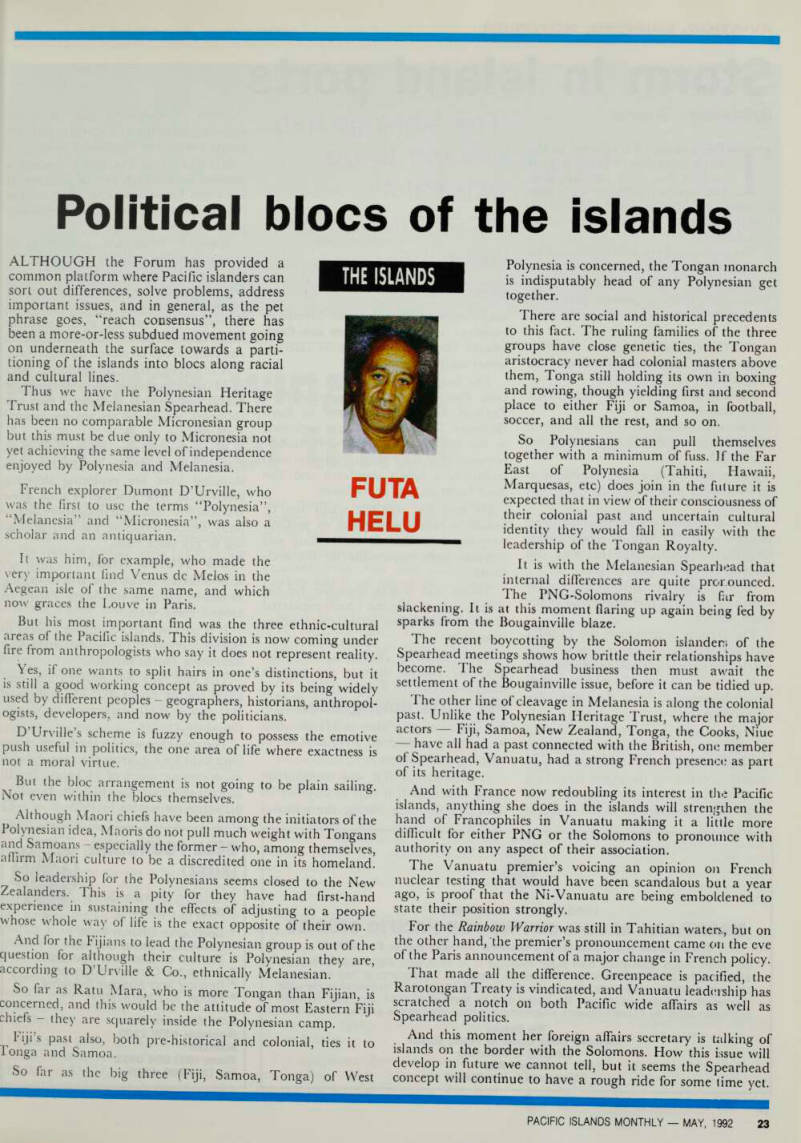
ALTHOUGH the Forum has provided a common platform where Pacific islanders can sort out differences, solve problems, address important issues, and in general, as the pet phrase goes, “reach consensus’’, there has been a more-or-less subdued movement going on underneath the surface towards a parti tioning of the islands into blocs along racial and cultural lines.
Thus we have the Polynesian Heritage Trust and the Melanesian Spearhead. There has been no comparable Micronesian group but this must be due only to Micronesia not yet achieving the same level of independence enjoyed by Polynesia and Melanesia.
French explorer Dumont D’Urville, who was the first to use the terms “Polynesia”, “Melanesia” and “Micronesia”, was also a scholar and an antiquarian.
It was him, for example, who made the very important find Venus dc Melos in the Aegean isle of the same name, and which now graces the Louve in Paris.
But his most important find was the three ethnic-cultural areas of the Pacific islands. This division is now coming under fire from anthropologists who say it does not represent reality.
Yes, if one wants to split hairs in one’s distinctions, but it is still a good working concept as proved by its being widely used by different peoples - geographers, historians, anthropol ogists, developers, and now by the politicians.
D’Urville’s scheme is fuzzy enough to possess the emotive push useful in politics, the one area of life where exactness is not a moral virtue.
But the bloc arrangement is not going to be plain sailing.
Not even within the blocs themselves.
Although Maori chiefs have been among the initiators of the I olynesian idea, Maoris do not pull much weight with Tongans and Samoans - especially the former - who, among themselves, affirm Maori culture to be a discredited one in its homeland.
So leadership for the Polynesians seems closed to the New Zealanders. This is a pity for they have had first-hand experience in sustaining the effects of adjusting to a people whose whole way of life is the exact opposite of their own.
And for the Fijians to lead the Polynesian group is out of the question for although their culture is Polynesian they are according to D’Urville & Co., ethnically Melanesian.
So far as Ratu Mara, who is more Tongan than Fijian, is concerned, and this would be the attitude of most Eastern Fiji chiefs they are squarely inside the Polynesian camp.
Hji s past also, both pre-historical and colonial, ties it to longa and Samoa.
So far as the big three (Fiji, Samoa, Tonga) of West
The Islands
Polynesia is concerned, the Tongan monarch is indisputably head of any Polynesian get together.
There arc social and historical precedents to this fact. The ruling families of the three groups have close genetic ties, the Tongan aristocracy never had colonial masters above them, Tonga still holding its own in boxing and rowing, though yielding first and second place to either Fiji or Samoa, in football, soccer, and all the rest, and so on.
So Polynesians can pull themselves together with a minimum of fuss. If the Far East of Polynesia (Tahiti, Hawaii, Marquesas, etc) does join in the future it is expected that in view of their consciousness of their colonial past and uncertain cultural identity they would fall in easily with the leadership of the Tongan Royalty.
It is with the Melanesian Spearhead that internal differences are quite pronounced.
The PNG-Solomons rivalry is far from
slackening. It is at this moment flaring up again being fed by sparks from the Bougainville blaze.
The recent boycotting by the Solomon islander; of the Spearhead meetings shows how brittle their relationships have become. The Spearhead business then must await the settlement of the Bougainville issue, before it can be tidied up.
The other line of cleavage in Melanesia is along the colonial past. Unlike the Polynesian Heritage Trust, where the major actors — Fiji, Samoa, New Zealand, Tonga, the Cooks, Niue — have all had a past connected with the British, one member of Spearhead, Vanuatu, had a strong French presence as part of its heritage.
And with France now redoubling its interest in the Pacific islands, anything she does in the islands will strengthen the hand of Francophiles in Vanuatu making it a little more difficult for either PNG or the Solomons to pronounce with authority on any aspect of their association.
The Vanuatu premier’s voicing an opinion on French nuclear testing that would have been scandalous but a year ago, is proof that the Ni-Vanuatu are being emboldened to state their position strongly.
For the Rainbow Warrior was still in Tahitian waters, but on the other hand, the premier’s pronouncement came on the eve of the Paris announcement of a major change in French policy.
That made all the difference. Greenpeace is pacified, the Rarotongan Treaty is vindicated, and Vanuatu leadership has scratched a notch on both Pacific wide affairs as well as
Spearhead politics.
And this moment her foreign affairs secretary is talking of islands on the border with the Solomons. How this issue will develop in future we cannot tell, but it seems the Spearhead concept will continue to have a rough ride for some lime yet.
Futa
Helu
Storm in island ports
Aviation, Shipping, Motoring
By Davendra Sharma
‘The sinkings had nothing to do with safety procedures, they were just bad luck’
THE sinking of a quarter of the ships registered in Cook Islands in past five years has tarnished the country’s image as a safe international finance centre, the Interna tional Transport Workers Federation has claimed.
The claim has been strongly denied by the Cook Islands Government.
The union claims that the Cook Islands has failed to ensure that ships registered there adhere to safety stan dards.
The Cooks Islands Minister for Ship ping, Vaine Tairea, angrily denies the allegations.
He describes them as “an insult to the Cook Islands”.
The union claims that five of the 20 Cook Islands registered ships have sunk since 1987.
Tairea said the sinkings had nothing to do with safety procedures, they were just bad luck.
He said all ships registered in the Cook Islands must fall within international classification safety standards and also meet international conventions.
Inquiries into the sinkings have so far shown overloading and weather to be the main factors.
The Danish chairman of the ITWF’s seafaring section, Mois Sorensen, said the loss of five of the fleet’s 20 vessels has got to be a world record. He said his union would be asked to hang the label “flag of convenience”.
It also urged the federation’s London secretariat to place union inspectors throughout the world on alert to pay special attention to the safety standards of Cook Islands vessels visiting their ports. The federation would request
major shipping entities like Llyods to withdraw classifications from any Cook Islands vessels failing to meet interna tional safety standards.
The last two ships to sink were the Celtic Kiwi in the high seas north of New Zealand and Polynesian Link in Suva Harbour. Tairea said all ships registered in the capital of Avarua were strictly required to fall within international classification safety standards and also meet international conventions.
He said the sinkings could not be linked to safety procedures as prelimi nary inquiries showed overloading and weather were responsible for the acci dents.
Tairea said it was improper for the I MU to claim that the vessels registered in Avarua fall below international safety standards.
Cook Islands, Vanuatu and the Marshall Islands operate the region’s main registries for foreign ships.
Fiji ports downgraded
Fiji also received a blow in March when it was downgraded on a regional list of efficient port centres.
It means that Fiji was treading on dangerous lines if it fails to improve its image in shipping circles, the national
chamber of commerce said. It could easily be regarded as an unsafe port for transit cargo, the chamber warned.
It argued that Fiji was becoming a concern for the high rate of pilferage at Suva and Lautoka wharfs. High costs of freight, insurance and security were also potential bottle-necks.
Malaysia, meanwhile, intends to in crease shipping and air links with Fiji following the visit by its Prime Minister, Dr Mahathir, to Nadi last year. Dr Mahathir had said then that Kuala Lumpur could use Fiji as a transit for cargo ships to South America. Flights to Auckland are to be routed through Nadi.
A Malaysian trade delegation to Suva in March announced that shipping and possibly air links between the two countries would be set up by around June or July.
Malaysia’s foreign affairs secretary, Datuk Ahmad Jaafar, said Malaysian shipping lines are exploring shipping services to Fiji through Papua New Guinea. A Malaysia-Singapore com pany, Borneo Shipping, has been operat ing to Fiji since 1988.
New cruise liner
Anew luxury cruise liner will be calling at tourist ports in the South Pacific in around three years.
It is part of P&O Shipping’s plans to bolster services in the region, attracting increasing tourist interest.
The company has ordered the new liner, costing about SUS3OO million to cart almost 2000 passengerss on round the-world cruises.
The new ship will be the fastest cruise liner built for a quarter of a century with an operating speed of 24 knots. It will become the company’s flagship. It will be delivered for service in 1995. □
Advertisements & other items, p. 24 (1 item)
(Aust)
UNIVERSITY OF CANTERBURY
MACMILLAN BROWN CENTRE TOR PACIFIC STUDIES
Research and Visiting Fellows Programme for 1993 The Centre invites applications from those interested in its RESEARCH AND VISITING FELLOWS progijmme for 1993. Successful Applicants will be selected on the relevance of their interests to the Centre’s activities. Applicants without conventional qualifications will be considered on the basis of experience and research interest. The closing date for applications is 31 July 1992. For more information about the Centre’s research programme and Fellowships please write to: The Director Macmillan Brown Centre for Pacific Studies University of Canterbury Private Bag Christchurch 1, New Zealand
BELL FOUNDERS
(AUST)
Precision Bronze Bells Made in Australia * Decorative Church Bells * Carillons, Pearls, Chimes * Manual or Electrical Operation * Computer Controlled Systems * Ringing and Support Systems * Export and Installation 2/20 Clearvlew Place Brookvale NSW 2100 Australia Phone (02) 905 0051 Fax (02) 905 4220
Airlines winging
into better times
AS the dark cloud f slowly begin to lift of the Pacific’s key tourism markets, the major tourist carriers to the islands should soon begin to see
the light.
According to a recent independent Asia/ Pacific airline survey, major carriers in Asia and the Pacific can look forward to a prosperous 1992. i.l,* a ■ r c In the latest Asian Investment Strategy eview, a researc report by Singapore soc ro er ern ynch and Company, says regional airlines can expect to improve on last year’s results. The report said worldwide economic problems and the Gulf War had held down passenger traffic but a rebound was expected this year. x It predicted that trans-Padfic traffic ■vould grow at 10-15 per cent in 1992 :ompared with 5-10 per cent last vear. This i nrrre „ as . t, c
nnr?<t Li Tint l l?
jJ C S 7 ° . 01 ", jpenca, str f' la and New Zealand which are slowly ommg out of the gnps of recession.
Recent business surveys in New Zealand, or example, have shown that business :onfidence, investment intentions and ex- >ort markets are all on the way up and the ountry is optimistic about its economy. likewise Australia is showing similar signs •f promise.
Australia’s trade performance over the 'ast 12 months has shown a dramatic urnaround, according to the treasurer, °hn Dawkins.
He said the 26 per cent fall in the current m f, SA67 S r°n a ' ly adjUSted H ,: n t HA677 rnilhon contmued the ownward trend evident in recent months.
The current account deficit was now runnlng at 34 per cent below the levels of a year ago ' According to the report, growth is also expected from Asia and Europe, two markets which are becoming increasingly important for the Pacific.
T f , Japan, lor example, has been the saviour of Fiji s national earner Air Pacific and the country s tounsm sector, making up for the shortfall from traditional markets. p already flies two services to T , .7 a *reaay mes two services to J a P an s anta Airport and the airline’s chairman > Gerald Barrack, recently reiterated that lf they could S et a third slot at Nanta they would not hesitate to take it.
Tu pre l o[ , 1 r . . J- “ , ' l,e( n a stf P s in the ngh s. dlr J ect,on to take advantage of the predlcted nse ln tourlst numbers. a i . , , n . , , M weeldy fll g ht b Y rj CW Zea and > lts Poem § 7b7 > to Honolulu from Auckland via Tonga and Western Samoa has opened up the Eur- PP ean market and allows Europeans to nc^ude Tonga and Samoa on their around tbe wor^d tickets.
Western Samoa’s Polynesian Airlines last month replaced its Boeing 727 aircraft with a Boeing 737-300 to enable the airline to make more frequent flights.
And in January a memorandum of understanding was signed between the Kiribati and Nauru governments allowing Air Nauru to bridge Kiribati with Monolulu a " d Suva ™, e ag ™‘ a >l<™ Air Nauru t 0 USe the landing rights held by Kiribati’s national carrier, Air Tungaru. The Kiri-
bati Goverment, have for years, tried to make Air Tungaru viable on these interna tional routes but it ended up costing them a fortune.
Kiribati’s Minister for Transport, Inatoa Tabania, is confident this new arrangement will make the route viable.
In another move, Air Pacific, Qantas and Air New Zealand are reported to have been discussing operating a mega-carrier in the Southwest Pacific.
Although the three airlines are tight lipped about the proposal, it is understood that it will be similar to a proposal to merge British Airways, Northwest and KLM and formalise seat sharing arrangements.
However, the Fiji Hotel Association is worried that this would be disastrous to tourism viability in the long term. It believes it would result in the elimination of competition between the carriers and a subsequent rise in airfares.
Meanwhile, Air Pacific, in response to the “rapidly evolving competitive environ ment in the South West Pacific” and the “changing marketplace”, will replace its two ATR-42 aircraft with a brand new, high technology, Boeing 737-500 series aircraft in August.
The airline said the 8737-500 was chosen as it is not only capable of operating to all current regional ports and supporting their 8747 and 8767 on the international routes, but was the ideal aircraft to pioneer new services to cities such as Cairns, Wellington and Christchurch. Air Pacific also plans to use the aircraft to re-introduce a Suva- Auckland service later this year.
The airline is also keeping a close eye on Australia and New Zealand and. are looking at the option of leasing another 737-500 aircraft should the two countries recover from recession which should stimu late a demand for services.
So while Royal Tongan Airlines’ cancel lation of their recently-started Nuku’alofa- Nadi service has left a hole in Pacific aviation overall, regional carriers look set for a sunny future if they keep a close eye on global trends and act accordingly. □
AIR NEW ZEALAND: One of the big two operating in the region.
Toyota
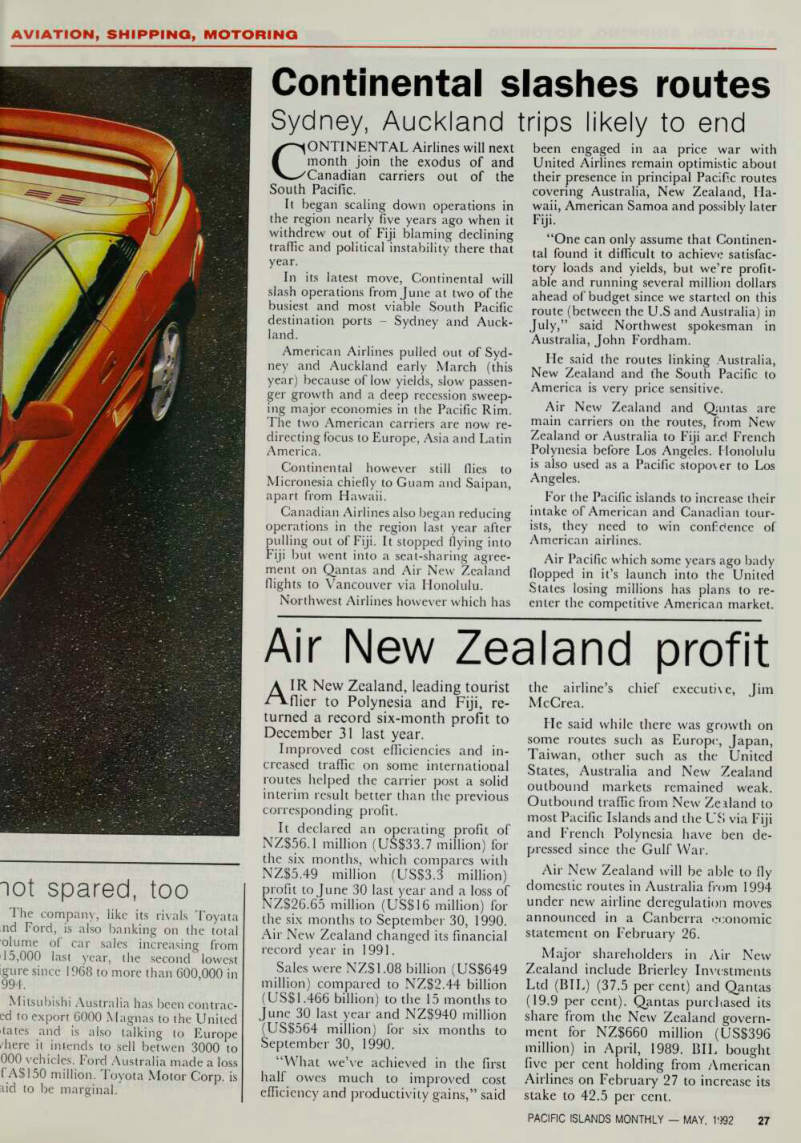
shifts into top gear
JAPAN’S Toyota corporation is emerging a frontrunner in the re gion’s car manufacturing with a massive expansion in Australia in a SA42O million (SUS3I7 million) state of-art plant.
It follovys Toyota’s record output and sales performance in recent years. Toyota won the prestigious Australian Quality Award last year and became the only Pacific manufacturer to do so. It Won because of low cost (fuel) vehicles, especially cars it makes and outsells competitors in the Pacific.
Toyota’s expansion ironically co
incides with the closure of a giant Nissan Motors manufacturing plant in the State of Victoria - the heartland of car manufacturing in Australia.
Australian minister for Industry, Technology and Commerce, Senator John Button, said at the opening of a international motor show recently that despite the Nissan closure and a general slow-down in the motor industry in Australia and the Pacific, there is room for growth and expansion in manufactur ing to supply the region.
“1 cannot contemplate Australia as a society without a motor industry. It has become central to much of our manufac turing,” he said.
Button warned, however, that it was important to keep check on prices of Australian-made cars against those im
ported directly from Japan or Europe.
Prices of Australian-produced cars rose three per cent above CPI in 1991 and also two per cent above the increase on imported cars.
Toyota joined forces with world auto motive industry giant, General Motors Corporation in March to enter in new manufacturing schemes in Australia. The two companies admit that the marriage of manufacturing and marketing con venience has been on the cards since July, 1989.
The deal is designed to improve long term productivity for both companies.
For the past three years both Holden and Toyota have been involved in a mutually beneficial model sharing programme.
Nissan, meanwhile, is closing dozens of dealers around Australia and the Pacific in a clean-up campaign before the company ends its Australian manufac-
Hiring operations in October.
Toyota has been increasing its other business in the Pacific islands through an involvement in” Burns Philp (South Seas)
Company Limited.
Last May (1991) Toyota Tsusho struck a deal with BP by buying out 25.5 per cent of the South Seas Company.
The company has since been streamlin ing operations, selling out of the mer chandising and hardware business but strengthening its motoring division.
Last January when it sold out the bulk of its century-old business in Vanuatu, Toyota took over Vanuatu Motors.
Typical Toyota pride: Designed for the sports car connoisseur.
Mitsubishi Australia
MITSUBISHI Motors Australia, owned 99.6 per cent by Japans’ Mitsubishi Motors, was hit by the automotive recession in the Pacific region 2nd high initial costs for new models.
It suffered a SASO million (SUS3B million) turnaround in earnings for the year to December 31. It posted a 5A23.8 million loss, compared to the 5A25.9 million profit in 1990. Mitsubishi is reviewing operations in the Pacific. It would be completed by September.
The company, like its rivals Toyata nd Ford, is also banking on the total olume of car sales increasing from 15,000 last year, the second lowest igure since 1968 to more than 600,000 in 994.
Mitsubishi Australia has been contrac ed to export 6000 Magnas to the United 'tates and is also talking to Europe /here it intends to sell betwen 3000 to 000 vehicles. Ford Australia made a loss f AS 150 million. Toyota Motor Corp. is lid to be marginal.
Continental slashes routes
Sydney, Auckland trips likely to end
CONTINENTAL Airlines will next month join the exodus of and Canadian carriers out of the South Pacific.
It began scaling down operations in the region nearly five years ago when it
withdrew out of Fiji blaming declining
traffic and political instability there that year.
In its latest move, Continental will slash operations from June at two of the busiest and most viable South Pacific destination ports - Sydney and Auck land.
American Airlines pulled out of Syd ney and Auckland early March (this year) because of low yields, slow passen ger growth and a deep recession sweep ing major economies in the Pacific Rim.
The two American carriers are now re directing focus to Europe, Asia and Latin America.
Continental however still flics to Micronesia chiefly to Guam and Saipan, apart from Hawaii.
Canadian Airlines also began reducing operations in the region last year after pulling out of Fiji. It stopped flying into Fiji but went into a seat-sharing agree ment on Qantas and Air New Zealand flights to Vancouver via Honolulu.
Northwest Airlines however which has
been engaged in aa price war with United Airlines remain optimistic about their presence in principal Pacific routes covering Australia, New Zealand, Ha waii, American Samoa and possibly later
Fiji.
“One can only assume that Continen tal found it difficult to achieve satisfac tory loads and yields, but we’re profit able and running several million dollars ahead of budget since we started on this route (between the U.S and Australia) in July,” said Northwest spokesman in Australia, John Fordham.
He said the routes linking Australia, New Zealand and the South Pacific to America is very price sensitive.
Air New Zealand and Qantas are main carriers on the routes, from New Zealand or Australia to Fiji and French Polynesia before Los Angeles. Honolulu is also used as a Pacific stopover to Los
Angeles.
For the Pacific islands to increase their intake of American and Canadian tour ists, they need to win confidence of American airlines.
Air Pacific which some years ago bady flopped in it’s launch into the United States losing millions has plans to re enter the competitive American market.
Air New Zealand profit
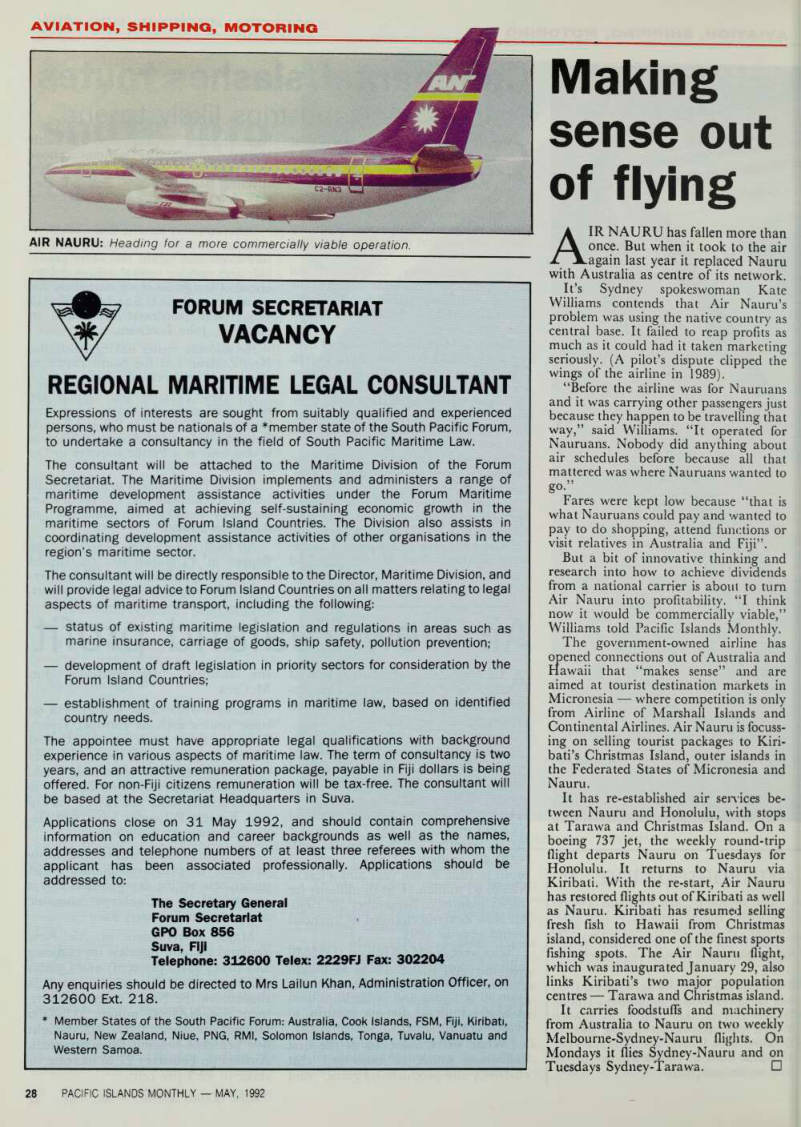
AIR New Zealand, leading tourist flier to Polynesia and Fiji, re turned a record six-month profit to December 31 last year.
Improved cost efficiencies and in creased traffic on some international routes helped the carrier post a solid interim result better than the previous corresponding profit.
It declared an operating profit of NZ$56.1 million (US$33.7 million) for the six months, which compares with NZ$5.49 million (US$3.3 million) profit to June 30 last year and a loss of NZ$26.65 million (US$16 million) for the six months to September 30, 1990.
Air New Zealand changed its financial record year in 1991.
Sales were NZ$1.08 billion (US$649 million) compared to NZ$2.44 billion (US$1,466 billion) to the 15 months to June 30 last year and NZ$940 million (US$564 million) for six months to September 30, 1990.
“What we’ve achieved in the first half owes much to improved cost efficiency and productivity gains,” said
the airline’s chief executive, Jim McCrea.
H e said while there was growth on some routes such as Europe, Japan, Taiwan, other such as the United States> Australia and New Zealand outbound ma ,kets remained weak, Outbound traffic from New Zealand to most Pacific Islands and the US via Fiji a nd French Polynesia have ben de pressed since the Gulf War.
Air New Zealand will be able to fly domestic routes in Australia from 1994 under nevv airline deregulation moves announced in a Canberra economic statement on February 26.
Major shareholders in Air New Zealand include Brierley Investments Ltd (BIL) (37.5 per cent) and Qantas (19.9 per cent). Qantas purchased its share from the New Zealand govern ment for NZS66O million (US$396
million) in April, 1989. BIL bought
five per cent holding from American Airlines on February 27 to increase its stake to 42.5 per cent.
AIR NAURU: Heading for a more commercially viable operation.
Advertisements & other items, p. 27 (1 item)
not spared, too
27
PACIFIC ISLANDS MONTHLY MAY, Vm
AVIATION, SHIPPING, MOTORING
of flying
Making sense out of flying
AIR NAURU has fallen more than once. But when it took to the air again last year it replaced Nauru with Australia as centre of its network.
It’s Sydney spokeswoman Kate Williams contends that Air Nauru’s problem was using the native country as central base. It failed to reap profits as much as it could had it taken marketing seriously. (A pilot’s dispute clipped the wings of the airline in 1989).
“Before the airline was for Nauruans and it was carrying other passengers just because they happen to be travelling that way,” said Williams. “It operated for Nauruans. Nobody did anything about air schedules before because all that mattered was where Nauruans wanted to go.”
Fares were kept low because “that is what Nauruans could pay and wanted to pay to do shopping, attend functions or visit relatives in Australia and Fiji”.
But a bit of innovative thinking and research into how to achieve dividends from a national carrier is about to turn Air Nauru into profitability. “I think now it would be commercially viable,”
Williams told Pacific Islands Monthly.
The government-owned airline has opened connections out of Australia and Hawaii that “makes sense” and are aimed at tourist destination markets in Micronesia where competition is only from Airline of Marshall Islands and Continental Airlines. Air Nauru is focuss ing on selling tourist packages to Kiri bati’s Christmas Island, outer islands in the Federated States of Micronesia and Nauru.
It has re-established air services be tween Nauru and Honolulu, with stops at Tarawa and Christmas Island. On a boeing 737 jet, the weekly round-trip flight departs Nauru on Tuesdays for Honolulu. It returns to Nauru via Kiribati. With the re-start, Air Nauru has restored flights out of Kiribati as well as Nauru. Kiribati has resumed selling fresh fish to Hawaii from Christmas island, considered one of the finest sports fishing spots. The Air Nauru flight, which was inaugurated January 29, also links Kiribati’s two major population centres Tarawa and Christmas island.
It carries foodstuffs and machinery from Australia to Nauru on two weekly
Melbourne-Sydney-Nauru flights. On
Mondays it flies Sydney-Nauru and on Tuesdays Sydney-Tarawa. □
Advertisements & other items, p. 28 (1 item)
W/ Vacancy
FORUM SECRETARIAT
REGIONAL MARITIME LEGAL CONSULTANT
Expressions of interests are sought from suitably qualified and experienced persons, who must be nationals of a *member state of the South Pacific Forum, to undertake a consultancy in the field of South Pacific Maritime Law.
The consultant will be attached to the Maritime Division of the Forum Secretariat. The Maritime Division implements and administers a range of maritime development assistance activities under the Forum Maritime Programme, aimed at achieving self-sustaining economic growth in the maritime sectors of Forum Island Countries. The Division also assists in coordinating development assistance activities of other organisations in the region’s maritime sector.
The consultant will be directly responsible to the Director, Maritime Division, and will provide legal advice to Forum Island Countries on all matters relating to legal aspects of maritime transport, including the following: status of existing maritime legislation and regulations in areas such as marine insurance, carriage of goods, ship safety, pollution prevention; development of draft legislation in priority sectors for consideration by the Forum Island Countries; establishment of training programs in maritime law, based on identified country needs.
The appointee must have appropriate legal qualifications with background experience in various aspects of maritime law. The term of consultancy is two years, and an attractive remuneration package, payable in Fiji dollars is being offered. For non-Fiji citizens remuneration will be tax-free. The consultant will be based at the Secretariat Headquarters in Suva.
Applications close on 31 May 1992, and should contain comprehensive information on education and career backgrounds as well as the names, addresses and telephone numbers of at least three referees with whom the applicant has been associated professionally. Applications should be addressed to: The Secretary General Forum Secretariat GPO Box 856 Suva, FIJI Telephone: 312600 Telex: 2229FJ Fax: 302204 Any enquiries should be directed to Mrs Lailun Khan, Administration Officer, on 312600 Ext. 218. * Member States of the South Pacific Forum: Australia, Cook Islands, FSM, Fiji, Kiribati, Nauru, New Zealand, Niue, PNG, RMI, Solomon Islands, Tonga, Tuvalu, Vanuatu and Western Samoa.
hopping
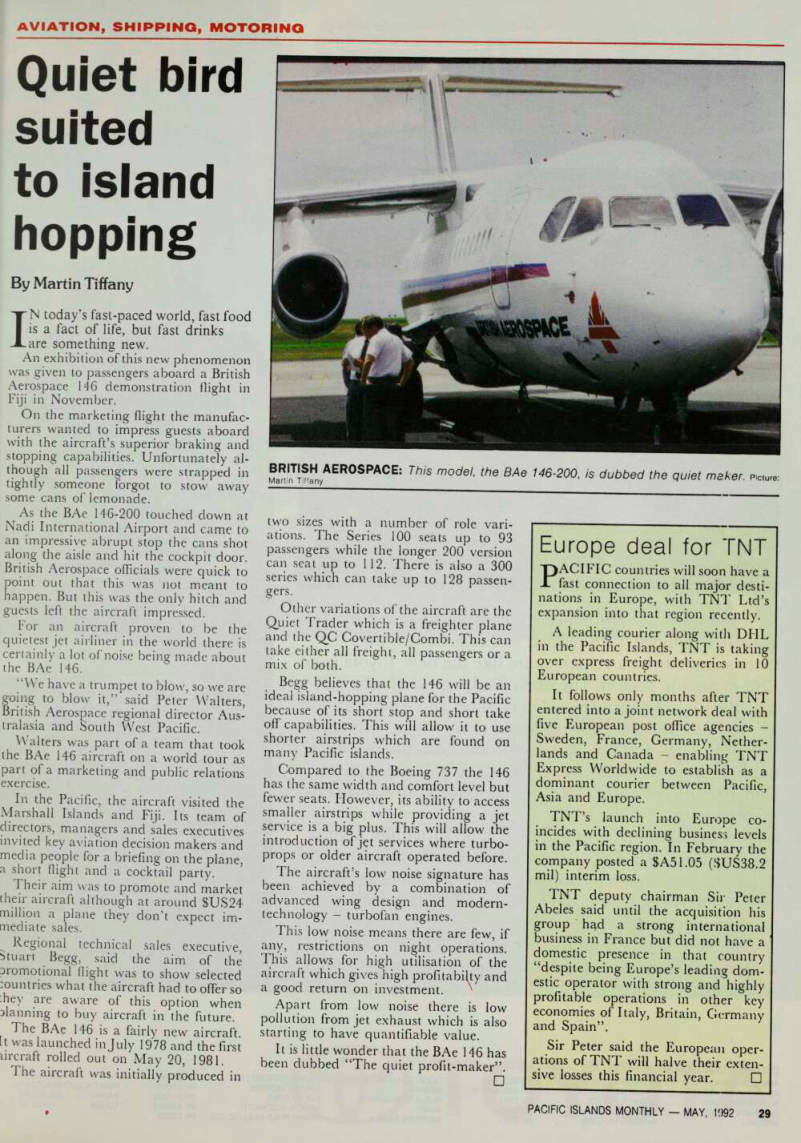
Quiet bird suited to island hopping
By Martin Tiffany
IN today’s fast-paced world, fast food is a fact of life, but fast drinks are something new.
An exhibition of this new phenomenon was given to passengers aboard a British Aerospace 146 demonstration flight in Fiji in November.
On the marketing flight the manufac turers wanted to impress guests aboard with the aircraft’s superior braking and stopping capabilities. Unfortunately al though all passengers were strapped in tightly someone forgot to stow away some cans of lemonade.
As the BAe 146-200 touched down at Nadi International Airport and came to an impressive abrupt stop the cans shot along the aisle and hit the cockpit door.
British Aerospace officials were quick to point out that this was not meant to happen. But this was the only hitch and guests left the aircraft impressed.
For an aircraft proven to be the quietest jet airliner in the world there is certainly a lot of noise being made about the BAe 146.
“We have a trumpet to blow, so we are going to blow it,” said Peter Walters, British Aerospace regional director Aus tralasia and South West Pacific.
Walters was part of a team that took the BAe 146 aircraft on a world tour as part of a marketing and public relations exercise.
In the Pacific, the aircraft visited the Marshall Islands and Fiji. Its team of directors, managers and sales executives invited key aviation decision makers and media people for a briefing on the plane, a short flight and a cocktail party.
Their aim was to promote and market their aircraft although at around SUS 24 million a plane they don’t expect im mediate sales.
Regional technical sales executive, Stuart Begg, said the aim of the promotional flight was to show selected :ountries what the aircraft had to offer so :hey are aware of this option when Manning to buy aircraft in the future.
The BAe 146 is a fairly new aircraft, it was launched in July 1978 and the first urcraft rolled out on May 20, 1981.
The aircraft was initially produced in
two sizes with a number of role vari ations. The Series 100 seats up to 93 passengers while the longer 200 version can seat up to 112. There is also a 300 series which can take up to 128 passen gers.
Other variations of the aircraft are the Quiet Trader which is a freighter plane and the QC Covertible/Combi. This can take either all freight, all passengers or a mix of both.
Begg believes that the 146 will be an ideal island-hopping plane for the Pacific because of its short stop and short take off capabilities. This will allow it to use shorter airstrips which are found on many Pacific islands.
Compared to the Boeing 737 the 146 has the same width and comfort level but fewer seats. However, its ability to access smaller airstrips while providing a jet service is a big plus. This will allow the introduction of jet services where turbo props or older aircraft operated before.
The aircraft’s low noise signature has been achieved by a combination of advanced wing design and modern technology - turbofan engines.
This low noise means there are few, if any, restrictions on night operations.
This allows for high utilisation of the aircraft which gives high profitabilty and a good return on investment. ' Apart from low noise there is low pollution from jet exhaust which is also starting to have quantifiable value.
It is little wonder that the BAe 146 has been dubbed “The quiet profit-maker”. □
BRITISH AEROSPACE: This model. the BAe 146 - 200. is dubbed the quiet maker. Picture: Martin Tiffany
Europe deal for TNT
PACIFIC countries will soon have a fast connection to all major desti nations in Europe, with TNT Ltd’s expansion into that region recently.
A leading courier along with DHL in the Pacific Islands, TNT is taking over express freight deliveries in 10
European countries.
It follows only months after TNT entered into a joint network deal with five European post office agencies - Sweden, France, Germany, Nether lands and Canada — enabling TNT Express Worldwide to establish as a dominant courier between Pacific, Asia and Europe.
TNT’s launch into Europe co incides with declining business levels in the Pacific region. In February the company posted a SA51.05 (SUS38.2 mil) interim loss.
TNT deputy chairman Sir Peter Abeles said until the acquisition his group hc*d a strong international business in France but did not have a domestic presence in that country
“despite being Europe’s leading dom
estic operator with strong and highly profitable operations in other key economies of Italy, Britain, Germany
and Spain”.
Sir Peter said the European oper ations of TNT will halve their exten sive losses this financial year. □
Advertisements & other items, pp. 30-31 (1 item)
luxury-car ride.
The new Toyota brand mark. Three ellipses forming a “T” which stand for our customer, our commitment to the satisfaction of that customer through our product and for our spirit of creativity.
It’s not often that you hear descriptions like rugged or durable combined with refined and elegant. But then there’s never been a vehicle quite like the new Toyota Land Cruiser Station Wagon. The unrivalled legend of off-road reliability is now unsurpassed in comfort and sophistication as well. Attention to detail is found everywhere, from the fine trim to the instrument panel to the graceful lines of its exterior. Even in places you can’t see, like the heavy-duty ladder frame and suspension design that add to the superb
But Toyota’s innovation goes beyond providing luxury and durability. The new Land Cruiser Station Wagon, and all of our cars, are designed to create a harmony between car and driver, and to provide you with the ultimate
driving experience.
The new Toyota Land Cruiser Station Wagon. Think of it as much more than a spacious luxury sedan with fourwheel drive. fi e m m M
DISTRIBUTORS/DEALERS
AMERICAN SAMOA BURNS PHILP (S.S.) CO. LTD. PH 633-4281 GUAM & MICRONESIA ATKINS KROLL, INC. PH 646-1876/9 NORFOLK ISLANDS BORRY’S PTY LTD. PH 2114
SOLOMON ISLANDS MENDANA MOTORS PH 22884
VANUATU VANUATU MOTORS PH 2341
COOK ISLANDS PACIFIC MOTORS LTD. PH 20796
KIRIBATI TARAWA MOTORS PH 21090
PAPUA NEW GUINEA ELA MOTORS PH 217036
TAHITI NIPPON AUTOMOTO PH 429819
WESTERN SAMOA BURNS PHILP (S.S.) CO. LTD. PH 20800
FIJI A S 3
NEW CALEDONIA 5.1.1.
SAIPAN MICH
TONGA BUU
miser SHI
m ■ »■ m »ii R 0
nans
: v v t L~ s^^ziiirzz: r ig^>.
IwJ
mz mw.
W*\72*r*mL^ '<( PH 312666 PH 282848 PH 234-5911 PH 23673
<s£) TOYOTA
Air Caledonie jab pays off
AIR CALEDONIE has in recent years constantly monitored and tried to tap into Fiji’s Australian and Japanese tourist market by sending a weekly flight to Nadi.
It’s campaign picked up momentum last year when the territorial government joined forces with the airline for top-level negotiations with Fiji aviation and Air Pacific officials for a possible service from Nadi-Noumea.
But Air Pacific’s response was the same it gives other islands seeking new or additional flights: it has a five-year plan to follow. The plan apparently looks at expanding its scope into Asian ports such as Taipei, Nagoya, Osaka, Seoul and Hong Kong as well as North America.
A second proposal put to Air Pacific chief executive Andrew Drysdale was: a ATR-42 weekly flight to Wallis & Futuna.
Air Pacific claimed tourist, business or general passenger traffic between Nadi and Wallis and Futuna or Noumea were insufficient to sustain a regular service.
Traffic to Noumea is often erratic and that to Wallis & Futuna is “very, very low”, Air Caledonie was told. What Air Pacific could do instead was mount fortnightly charter flights.
Fiji has the right to fly a weekly service to Noumea.
Air Caledonie, which was earlier enthusiastic about a possible Tokyo- Nadi-Noumea connection has shelved that idea. UTA now services Noumea from Tokyo but traffic has not been all that promising last year.
Air Caledonie has been attempting to raise Japanese awareness in New Cale donie through EIE (Electronic & Indus trial Enterprises Inc), a wealthy property developer which since 1987 has been tapping new markets in the South Pacific.
EIE was given a 15 per cent stake in Air Caledonie in which the territorial government is a major partner, Sofrana Unilines and a resort group.
Air Caledonie International was founded in 1983 by Sofrana Unilines
shipping company and the then terri torial government. Since taking lo the air it has extended weekly services to Auckland (one), Melbourne (one), Bris bane (one), Nadi (one), and Papeete (one), Sydney (two), Wallis & Futuna (two), and Port Vila (four).
Air Caledonie managed a sales of SUS 22 million in 1990 but the figure declined last year because of a slowdown in Australian and New Zealand traffic.
Sales is also anticipated to stay de pressed this year because of the rather gradual improvement in outbound travel from Australia and also as a result of recent damages incurred by tropical
cyclones.
Air Caledonie’s executives that the airline’s continued profitability de pends largely not on increasing schedules but new hotels, especially Sheraton and Accor.
It’s said in Noumea that the chicken and egg principle cannot be held to be true to airlines and hotels in New Caledonia because the territory attracts a vast number of tourists on cruiseship visits.
tap island
US carriers tap island resources
WHILE major American carriers are cutting or streamlining oper ations in the South Pacific, Ha waiian Airlines is expanding and taking new initiatives.
From April it introduced new weekly schedules to three Polynesian ports incorporating non-stop flights from Los Angeles to Pagopago as well as between Honolulu and Tonga.
Hawaiian’s director of corporate communications, Keoni Wagner, said the airline also had plans to start a weekly between Honolulu and Apia.
He asserts that there is increasing demand for passenger traffic and also outbound and inbound cargo from the three island destinations - Ameri can Samoa, Western Samoa and Tonga.
Thousands of Polynesians from the region live in Hawaii or California.
Air New Zealand which provides a crucial link from the South Pacific to the American West coast also com menced a weekly return flight con necting Honolulu with Auckland via Apia and Nuku’alofa.
• Northwest Airlines, another American giant, is also eying new routes in the Central Pacific with emphasis on Micronesia. From next month it will add daily non-stop jet flights between Honolulu and Guam, against Continental Airlines and Air Micronesia.
Northwest has plans to add daily services between Guam and Seoul and several weekly schedules between Agana and Japanese island of Okinawa.
Northwest president John Dasburg said some of the main Pacific routes have been under-served and the new flights would boost traffic.
Advertisements & other items, p. 32 (1 item)
Fasteners
STAINLESS STEEL
SOUTHPACIFIC SPECIALISTS^
Full range
BOLTS, NUTS, THREADED RODS,
SOCKETS, ETC, ETC.
7, Avenue du Docteur Schweitzer
Z.I. • B.P. 52
69881 MEYZIEU CEDEX!
FRANCE
FAX; (33) 72 02 74 17
TO ANYWHERE IN THE WORLD
Your artifacts, gifts, souvenirs, carvings, artworks, documents whatever.
DHL will deliver anywhere worldwide Freight Forwarders, Air Cargo DHL Worldwide Express Service
NADI LAUTOKA (.AfIASA
73800 65400 65401 Ctl62 01 U <1 313166 313149
UMi
Rent A Car
THE WORLD S NO. 1
WHERE QUALITY AND SAFETY COUNT.
To drive the roads of Fiji is to experience some of the most beautiful scenery of the South Pacific, especially with Hertz.
A For Reservations Phone: Nadi Airport 722146 Suva 383150,383411,383677 Tetee 2237, Fat 370212 With Hertz you get more than Just a car.
Hiccups in PNG system
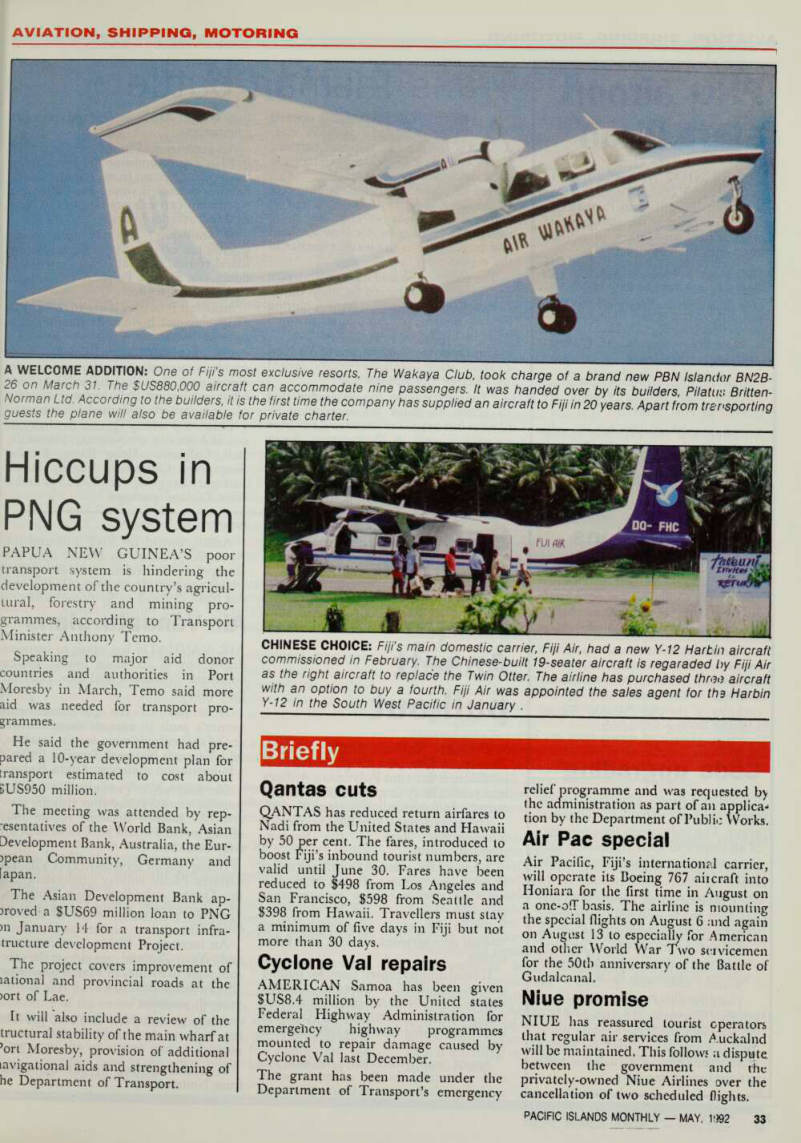
PNG system
Papua New Guinea’S Poor
transport system is hindering the development of the country’s agricul tural, forestry and mining pro
grammes, according to Transport
Minister Anthony Tcmo.
Speaking to major aid donor countries and authorities in Port Moresby in March, Temo said more aid was needed for transport pro grammes.
He said the government had pre pared a 10-year development plan for transport estimated to cost about KUS9SO million.
The meeting was attended by rep -esentatives of the World Bank, Asian Development Bank, Australia, the Eur
)pean Community, Germany and
[apan.
The Asian Development Bank ap jroved a SUS 69 million loan to PNG > n January 14 for a transport infra tructure development Project.
The project covers improvement of lational and provincial roads at the >ort of Lae.
It will also include a review of the tructural stability of the main wharf at >on Moresby, provision of additional lavigational aids and strengthening of
he Department of Transport.
A WELCOME ADDITION: One of Fiji's most exclusive resorts. The Wakaya Club, took charge of a brand new PBN Islander BN2B 26 on March 31. The $US880,000 aircraft can accommodate nine passengers. It was handed over by its builders, Pilatus Britten- Norman Ltd. According to the builders, it is the first time the company has supplied an aircraft to Fiji in 20 years. Apart from transporting guests the plane will also be available for private charter.
CHINESE CHOICE: Fiji's main domestic carrier, Fiji Air, had a new Y-12 Harbin aircraft commissioned in February. The Chinese-built 19-seater aircraft is regaraded by Fiji Air as the right aircraft to replace the Twin Otter. The airline has purchased three aircraft with an option to buy a fourth. Fiji Air was appointed the sales agent for the Harbin Y-12 in the South West Pacific in January.
Advertisements & other items, p. 33 (1 item)
sStt°» are
Briefly
Qantas cuts
oamtac u.. j 4 by 50 per cent. The fares, introduced to
sStt°» are
™] < LT ' 1 fee 30 ’ Fares A hav , c bee "
axarAra « 3
>398 from Hawaii, Travtllm m«l «av a minimum of five days in Fiji but not more than 30 days. 7
Cyclone Val repairs
AMERICAN Samoa has been given SUSB.4 million by the United states Federal Highway Administration for emergency highway programmes mounted to repair damage caused by Cyclone Val last December. V rp, ine grant has been made under the Department of Transport’s emergency
relief programme and was requested by the administration as part of an applica- Alf P2C SpGCldl Air Padfic - international carrier, will operate its Boeing 767 aircraft into
"rs/ir **» t ».»
Sj™ t "7"'
WL* S ‘ 6 i d ? am / " '° r A "? cncan and oil<ci Woild War Two servicemen for the 50th anniversary of the Battle of - B1
Mill© P W ITIIS©
mtttf , n, , , operators win |! P Tn ? U- U ''fmf- Al ' c . kalnd be mai ltamed - Tl,,s follow; 11 dls P ute between the govemment and the privately-owned Niue Airlines over the cancellation of two scheduled flights.
Trans-Tasman battle
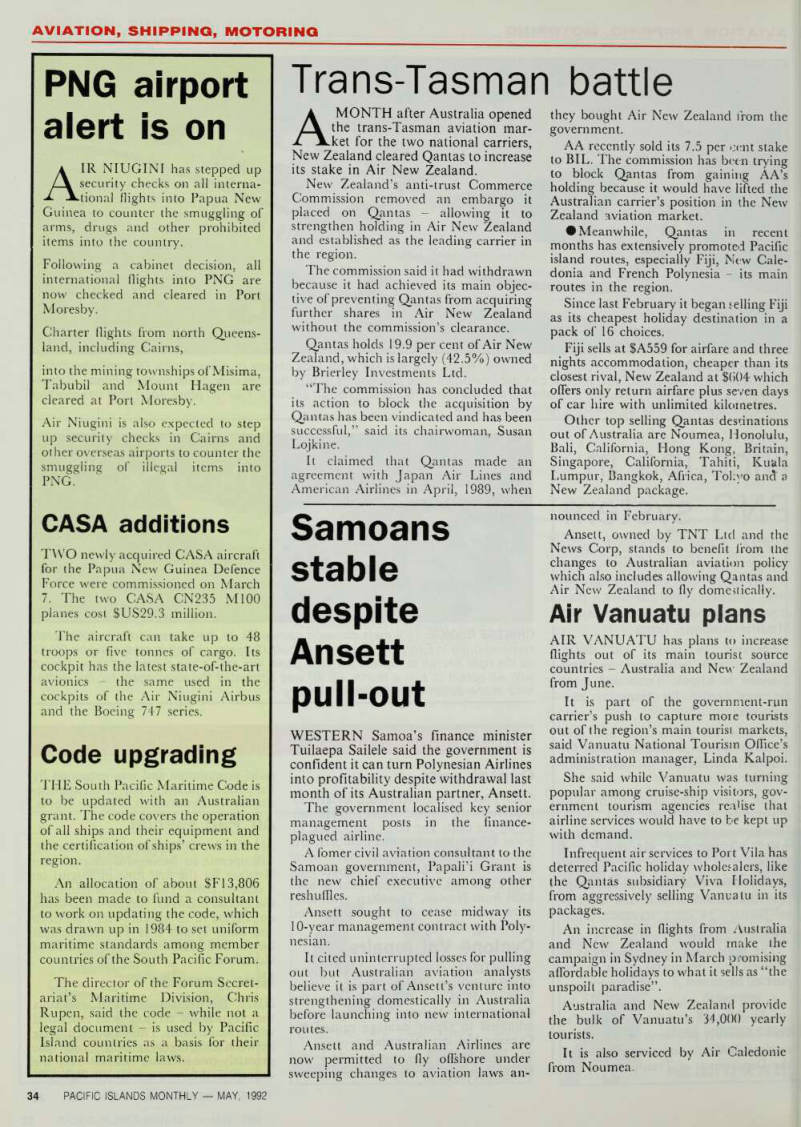
A MONTH after Australia opened the trans-Tasman aviation mar ket for the two national carriers, New Zealand cleared Qantas to increase its stake in Air New Zealand.
New Zealand’s anti-trust Commerce Commission removed an embargo it placed on Qantas - allowing it to strengthen holding in Air New Zealand and established as the leading carrier in the region.
The commission said it had withdrawn because it had achieved its main objec tive of preventing Qantas from acquiring further shares in Air New Zealand without the commission’s clearance.
Qantas holds 19.9 per cent of Air New Zealand, which is largely (42.5%) owned by Brierley Investments Ltd.
“The commission has concluded that its action to block the acquisition by Qantas has been vindicated and has been successful,” said its chairwoman, Susan Lojkine.
It claimed that Qantas made an agreement with Japan Air Lines and American Airlines in April, 1989, when
they bought Air New Zealand from the government.
AA recently sold its 7.5 per cent stake to BIL. The commission has been trying to block Qantas from gaining AA’s holding because it would have lifted the Australian carrier’s position in the New Zealand aviation market. • Meanwhile, Qantas in recent months has extensively promoted Pacific island routes, especially Fiji, New Cale donia and French Polynesia - its main routes in the region.
Since last February it began selling Fiji as its cheapest holiday destination in a pack of 16 choices.
Fiji sells at 5A559 for airfare and three nights accommodation, cheaper than its closest rival, New Zealand at 5604 which offers only return airfare plus seven days of car hire with unlimited kilometres.
Other top selling Qantas destinations out of Australia are Noumea, Honolulu, Bali, California, Hong Kong, Britain, Singapore, California, Tahiti, KuUla Lumpur, Bangkok, Africa, Tokyo and a New Zealand package.
despite
Samoans stable despite Ansett pull-out
WESTERN Samoa’s finance minister Tuilaepa Sailele said the government is confident it can turn Polynesian Airlines into profitability despite withdrawal last month of its Australian partner, Ansett.
The government localised key senior management posts in the finance plagued airline.
A fomer civil aviation consultant to the Samoan government, Papali’i Grant is the new chief executive among other reshuffles.
Ansett sought to cease midway its 10-year management contract with Poly nesian.
It cited uninterrupted losses for pulling out but Australian aviation analysts believe it is part of Ansett’s venture into strengthening domestically in Australia before launching into new international routes.
Ansett and Australian Airlines are now permitted to fly offshore under sweeping changes to aviation laws an
nounccd in February.
Ansel t, owned by TNT Lid and the News Corp, stands to benefit from the changes to Australian aviation policy which also includes allowing Qantas and Air New Zealand to fly domcuically.
Air Vanuatu plans
AIR VANUATU has plans to increase flights out of its main tourist source countries - Australia and New Zealand from June.
It is part of the government-run carrier’s push to capture more tourists out of the region’s main tourisi markets, said Vanuatu National Tourism Office’s administration manager, Linda Kalpoi.
She said while Vanuatu was turning popular among cruise-ship visitors, gov ernment tourism agencies realise that airline services would have to be kept up with demand.
Infrequent air services to Port Vila has deterred Pacific holiday wholesalers, like the Qantas subsidiary Viva Holidays, from aggressively selling Vanuatu in its
packages.
An increase in flights from Australia and New Zealand would make the
campaign in Sydney in March promising
affordable holidays to what it sells as “the
unspoilt paradise”.
Australia and New Zealand provide the bulk of Vanuatu’s 34,000 yearly tourists.
It is also serviced by Air Caledonie from Noumea.
Advertisements & other items, p. 34 (1 item)
PNG airport
alert is on
AIR NIUGINI has stepped up security checks on all international flights into Papua New Guinea to counter the smuggling of arms, drugs and other prohibited items into the country.
Following a cabinet decision, all international flights into PNG are now checked and cleared in Port
Moresby.
Charter flights from north Queensland, including Cairns, into the mining townships of Misima, Tabubil and Mount Hagen are cleared at Port Moresby.
Air Niugini is also expected to step up security checks in Cairns and other overseas airports to counter the smuggling of illegal items into
PNG.
CASA additions
TWO newly acquired CASA aircraft for the Papua New Guinea Defence Force were commissioned on March 7. The two CASA CN235 MlOO planes cost 5U529.3 million.
The aircraft can take up to 48 troops or five tonnes of cargo. Its cockpit has the latest state-of-the-art avionics - the same used in the cockpits of the Air Niugini Airbus and the Boeing 747 series.
Code upgrading
THE South Pacific Maritime Code is to be updated with an Australian grant. The code covers the operation of all ships and their equipment and the certification of ships’ crews in the
region.
An allocation of about 5F13,806 has been made to fund a consultant to work on updating the code, which was drawn up in 1984 to set uniform maritime standards among member countries of the South Pacific Forum.
The director of the Forum Secretariat’s Maritime Division, Chris Rupen, said the code - while not a legal document - is used by Pacific Island countries as a basis for their national maritime laws.
No French flattery
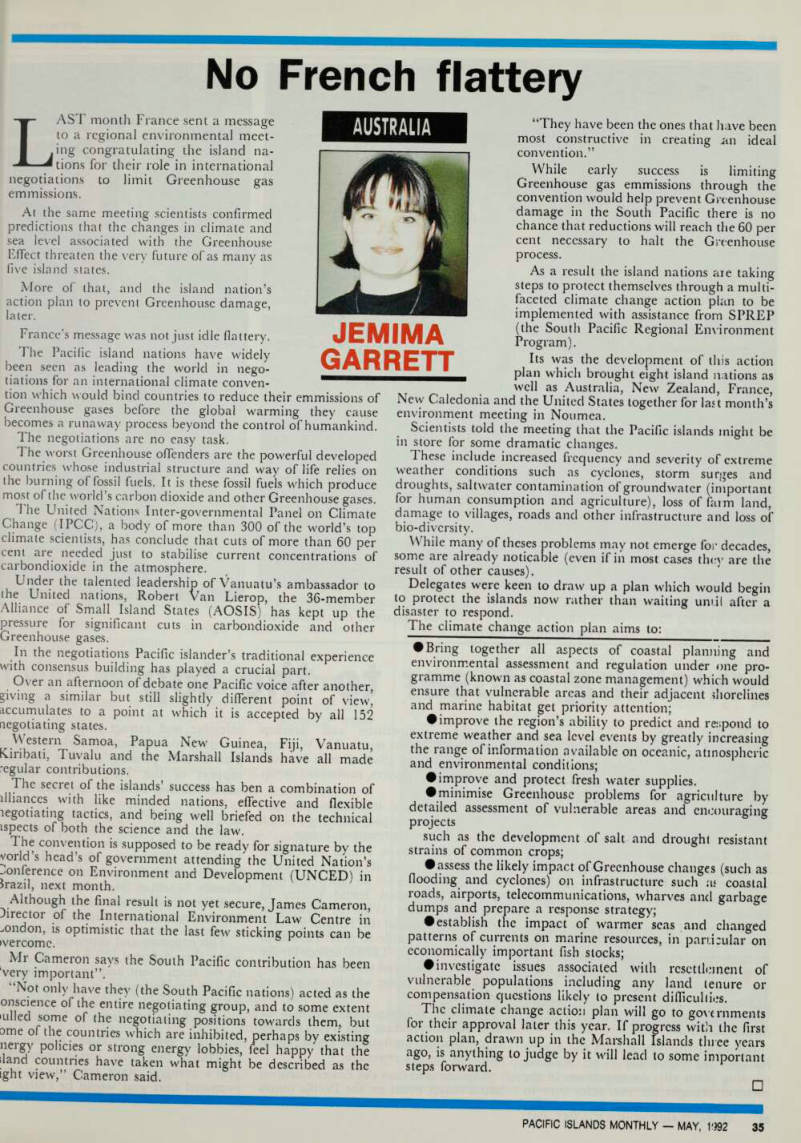
LAST month France sent a message to a regional environmental meet ing congratulating the island na tions for their role in international negotiations to limit Greenhouse gas emmissions.
At the same meeting scientists confirmed predictions that the changes in climate and sea level associated with the Greenhouse Effect threaten the very future of as many as five island states.
More of that, and the island nation’s action plan to prevent Greenhouse damage, later.
France’s message was not just idle flattery.
The Pacific island nations have widely been seen as leading the world in nego tiations for an international climate conven
tion which would bind countries to reduce their emmissions of Greenhouse gases before the global warming they cause becomes a runaway process beyond the control of humankind.
The negotiations are no easy task.
The worst Greenhouse offenders are the powerful developed countries whose industrial structure and way of life relies on the burning of fossil fuels. It is these fossil fuels which produce most of the world’s carbon dioxide and other Greenhouse gases.
The United Nations Inter-governmental Panel on Climate Change (IPCC), a body of more than 300 of the world’s top climate scientists, has conclude that cuts of more than 60 per cent are needed just to stabilise current concentrations of carbondioxide in the atmosphere.
Under the talented leadership of Vanuatu’s ambassador to the United nations, Robert Van Lierop, the 36-member Alliance of Small Island States (AOSIS) has kept up the pressure for significant cuts in carbondioxide and other
Greenhouse gases.
In the negotiations Pacific islander’s traditional experience with consensus building has played a crucial part.
Over an afternoon of debate one Pacific voice after another, giving a similar but still slightly different point of view, accumulates to a point at which it is accepted by all 152
negotiating states.
Western Samoa, Papua New Guinea, Fiji, Vanuatu, Kiribati, Tuvalu and the Marshall Islands have all made 'egular contributions.
The secret of the islands’ success has ben a combination of ilhances with like minded nations, effective and flexible legotiating tactics, and being well briefed on the technical ispects of both the science and the law.
The convention is supposed to be ready for signature by the vorld’s head’s of government attending the United Nation’s conference on Environment and Development (UNCED) in Jrazil, next month.
Although the final result is not yet secure, James Cameron, Jirector of the International Environment Law Centre in .xmdon, is optimistic that the last few sticking points can be •vercomc.
Mr Cameron says the South Pacific contribution has been very important”.
“Not only have they (the South Pacific nations) acted as the onscience of the entire negotiating group, and to some extent •tilled some of the negotiating positions towards them, but ome of the countries which are inhibited, perhaps by existing nergy policies or strong energy lobbies, feel happy that the iland countries have taken what might be described as the ight view,” Cameron said.
Australia
“They have been the ones that have been most constructive in creating an ideal convention.”
While early success is limiting Greenhouse gas emmissions through the convention would help prevent Greenhouse damage in the South Pacific there is no chance that reductions will reach the 60 per cent necessary to halt the Greenhouse process.
As a result the island nations are taking steps to protect themselves through a multi faceted climate change action plan to be implemented with assistance from SPREP (the South Pacific Regional Environment Program).
Its was the development of this action plan which brought eight island nations as well as Australia, New Zealand, France,
New Caledonia and the United States together for last month’s environment meeting in Noumea.
Scientists told the meeting that the Pacific islands might be in store for some dramatic changes.
These include increased frequency and severity of extreme weather conditions such as cyclones, storm surges and droughts, saltwater contamination of groundwater (important for human consumption and agriculture), loss of farm land, damage to villages, roads and other infrastructure and loss of
bio-diversity.
While many of theses problems may not emerge for decades, some are already noticable (even if in most cases they are the result of other causes).
Delegates were keen to draw up a plan which would begin to protect the islands now rather than waiting umil after a disaster to respond.
The climate change action plan aims to:
• Bring together all aspects of coastal planning and environmental assessment and regulation under one pro gramme (known as coastal zone management) which would ensure that vulnerable areas and their adjacent shorelines and marine habitat gel priority attention; • improve the region’s ability to predict and respond to extreme weather and sea level events by greatly increasing the range of information available on oceanic, atmospheric and environmental conditions; • improve and protect fresh water supplies. • minimise Greenhouse problems for agriculture by detailed assessment of vulnerable areas and encouraging projects such as the development of salt and drought resistant strains of common crops; • assess the likely impact of Greenhouse changes (such as Hooding and cyclones) on infrastructure such m coastal roads, airports, telecommunications, wharves and garbage dumps and prepare a response strategy; • establish the impact of warmer seas and changed patterns of currents on marine resources, in particular on economically important fish slocks; • investigate issues associated with resettlement of vulnerable populations including any land tenure or compensation questions likely to present diflicullies.
The climate change action plan will go to governments for their approval later this year. If progress with the first action plan, drawn up in the Marshall Islands three years ago, is anything to judge by it will lead to some important steps forward.
Jemima
Garrett
Swishing closer to the top
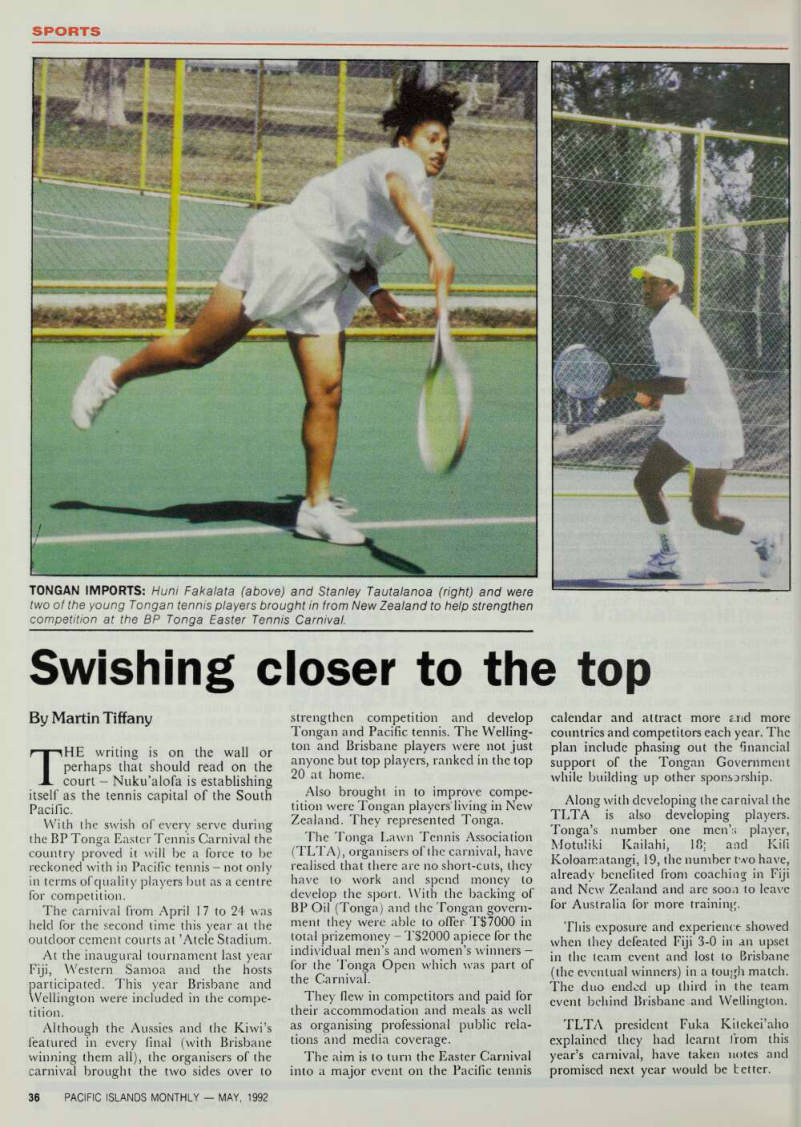
Sports
By Martin Tiffany
THE writing is on the wall or perhaps that should read on the court - Nukualofa is establishing itself as the tennis capital of the South Pacific VViih ihe swish of everv serve Hnrinir , h 0l^ vei 7 serve during the BP Tonga Easter Tennis Carnival the country oroved it will be a force to be reckonedwUh in Pacific tennis - not only in terms of quality players but as a centre for competition.
The carnival from April 17 to 24 was held for the second lime this year at the outdoor cement courts at *Atele Stadium.
At the inaugural tournament last year Fiji, Western Samoa and the hosts participated. This year Brisbane and Wellington were included in the compe tition.
Although the Aussies and the Kiwi’s featured in every final (with Brisbane winning them all), the organisers of the carnival brought the two sides over to
strengthen competition and develop Tongan and Pacific tennis. The Welling ton and Brisbane Payers were not just “nyone but top players, ranked in the top M al home ' , Also brought in to improve compe tition were Tongan players' living in New Zealand. They represented Tonga. ,s fhefonga Lawn fennis Association (1 E 1 A), organisers ol the carnival, have realised thauhere are no short-cuts, they have to work and spend money to develop the sport. With the backing of BP Oil (Tonga) and the Tongan govern ment they were able to offer IS7OOO in total prizemoney - TS2OOO apiece for the individual mens and women s winners for the Tonga Open which was part of tne Urnival ; They flew m competitors and paid for their accommodation and meals as well
as organising professional public rela
tions anc * media coverage.
The aim is to turn the Easter Carnival into a major event on the Pacific tennis
calendar and attract more and more countries and competitors each year. The plan include phasing out the financial support of the Tongan Government wbll< -‘ Guiding up other sponsorship.
Alone with dcve'ommr the carnival the „ I ™° A n g developing the carnival the TLI A is also developing playcis.
Tonga’s number one men’s player, Mo » !iki Kailahi 18: and ‘ kjf, .. . . , , Koloamatang. 19 the number two have, a r Jj a NT * nc ! e , roni coac un s n J M J I anc * cw Zealand and arc soon to leave for Australia lor more training, 'rJii S exposure and experience showed when the defeated Fiji 3-0 in an upset j n t j lc (eam cve nt and lost to Brisbane (the eventual winners) in a tough match, The duo ended up third in the team cycnt bddnd Brisbane and Wellington, TLTA president Fuka Kitekei’aho explained they had learnt from this year’s carnival, have taken notes and promised next year would be better.
TONGAN IMPORTS: Huni Fakalata (above) and Stanley Tautalanoa (right) and were two of the young Tongan tennis players brought in from New Zealand to help strengthen competition at the BP Tonga Easter Tennis Carnival.
Tonga eyes bigger tourney
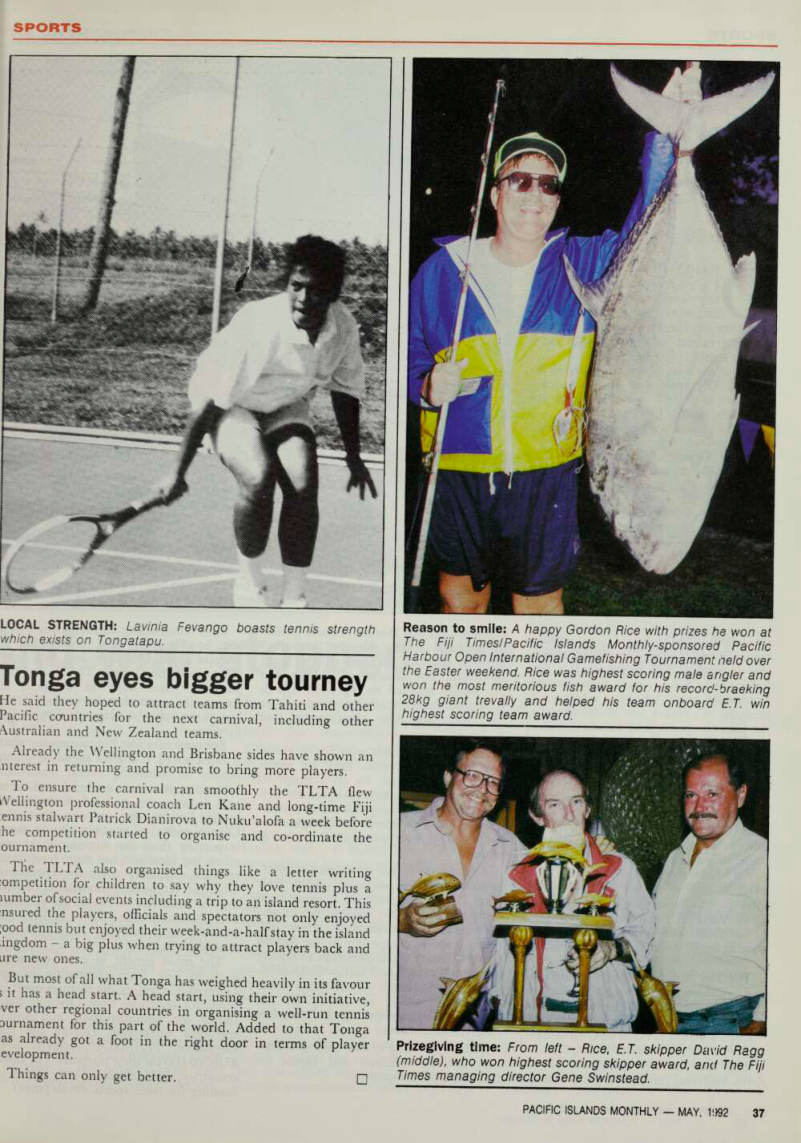
He said they hoped to attract teams from Tahiti and other Pacific countries for the next carnival, including other Australian and New Zealand teams.
Already the Wellington and Brisbane sides have shown an merest in returning and promise to bring more players.
To ensure the carnival ran smoothly the TLTA flew Wellington professional coach Len Kane and long-time Fiji ennis stalwart Patrick Dianirova to Nuku’alofa a week before he competition started to organise and co-ordinate the ournament.
The TLTA also organised things like a letter writing ompetition for children to say why they love tennis plus a lumber of social events including a trip to an island resort. This nsuied the players, officials and spectators not only enjoyed ,ood tennis but enjoyed their week-and-a-halfstay in the island ingdom - a big plus when trying to attract players back and Lire new ones.
But most of all what Tonga has weighed heavily in its favour ; it has a head start. A head start, using their own initiative, ver other regional countries in organising a well-run tennis Durnament for this part of the world. Added to that Tonga as already got a foot in the right door in terms of player
evelopment.
Things can only get better. □
LOCAL STRENGTH: Lavinia Fevango boasts tennis strength which exists on Tongatapu.
Reason to smile: A happy Gordon Rice with prizes he won at
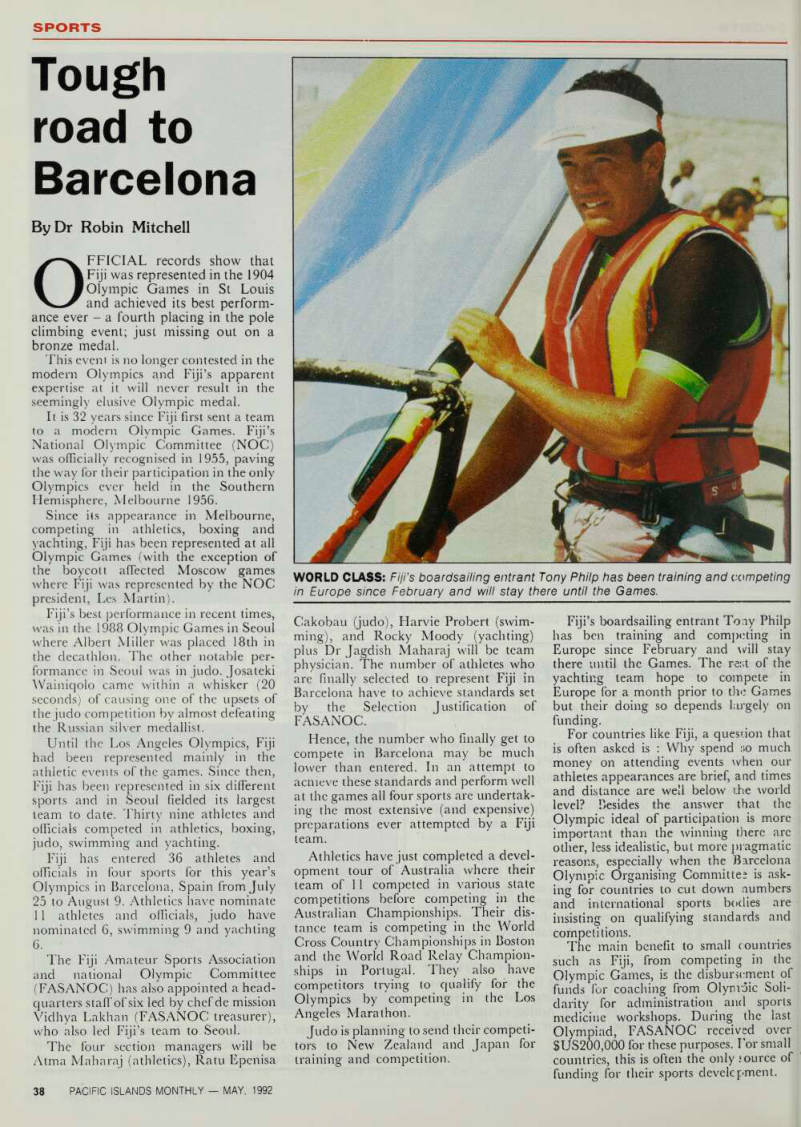
The Fiji Times/Pacific Islands Monthly-sponsored Pacific Harbour Open International Gamefishing Tournament held over the Easter weekend. Rice was highest scoring male angler and won the most meritorious fish award for his record-braeking 28kg giant trevally and helped his team onboard E.T. win highest scoring team award.
Prizegiving time: From left - Rice. E.T. skipper David Ragg (middle), who won highest scoring skipper award, and The Fiji Times managing director Gene Swinstead.
Tough road to Barcelona
By Dr Robin Mitchell
OFFICIAL records show that Fiji was represented in the 1904 Olympic Games in St Louis and achieved its best perform ance ever - a fourth placing in the pole climbing event; just missing out on a bronze medal.
This event is no longer contested in the modern Olympics and Fiji’s apparent expertise at it will never result in the seemingly elusive Olympic medal.
It is 32 years since Fiji first sent a team to a modern Olympic Games. Fiji’s National Olympic Committee (NOG)
was officially recognised in 1955, paving
the way for their participation in the only Olympics ever held in the Southern Hemisphere, Melbourne 1956.
Since its appearance in Melbourne, competing in athletics, boxing and yachting, Fiji has been represented at all Olympic Games (with the exception of the boycott affected Moscow games where Fiji was represented by the NOG president, Les Martin).
Fiji’s best performance in recent times, was in the 1988 Olympic Games in Seoul where Albert Miller was placed 18th in the decathlon. The other notable per formance in Seoul was in judo. Josateki Wainiqolo came within a whisker (20 seconds) of causing one of the upsets of the judo competition by almost defeating the Russian silver medallist.
Until the Los Angeles Olympics, Fiji had been represented mainly in the athletic events of the games. Since then, Fiji has been represented in six different sports and in Seoul fielded its largest team to date. Thirty nine athletes and officials competed in athletics, boxing, judo, swimming and yachting.
Fiji has entered 36 athletes and officials in four sports for this year’s Olympics in Barcelona, Spain from July 25 to August 9. Athletics have nominate 11 athletes and officials, judo have nominated 6, swimming 9 and yachting 6.
The Fiji Amateur Sports Association and national Olympic Committee (FASANOC) has also appointed a head quarters staff of six led by chef de mission Vidhya Lakhan (FASANOC treasurer), who also led Fiji’s team to Seoul.
The four section managers will be Atma Maharaj (athletics), Ratu Epcnisa
Cakobau (judo), Harvie Probert (swimming), and Rocky Moody (yachting) plus Dr Jagdish Maharaj will be team physician. The number of athletes who are finally selected to represent Fiji in Barcelona have to achieve standards set by the Selection Justification of
Fasanoc.
Hence, the number who finally get to compete in Barcelona may be much lower than entered. In an attempt to acmeve these standards and perform well at the games all four sports are undertaking the most extensive (and expensive) preparations ever attempted by a Fiji j *,.,. , , , .
Athletics have just completed a development tour of Australia where their team of 11 competed in various stale competitions before competing in the Australian Championships. Their distance team is competing in the World Crosscountry Championships in Boston and the World Road Relay Championships in Portugal. They also have competitors trying to qualify for the Olympics by competing in the Los Angeles Marathon.
Judo is planning to send their competitors to New Zealand and Japan for training and competition.
Fiji’s boardsailing entrant Tony Philp has ben training and competing in Europe since February and will stay there until the Games. The rest of the yachting team hope to compete in Europe for a month prior to the Games but their doing so depends largely on funding.
For countries like Fiji, a question that is often asked is : Why spend so much money on attending events when our athletes appearances are brief, and times and distance are well below die world level? besides the answer that the Olympic ideal of participation is more important than the winning there arc other, less idealistic, but more pragmatic reasons, especially when the Barcelona Olympic Organising Committee is ask ing for countries to cut down numbers and international sports bodies are insisting on qualifying standards and
competitions.
The main benefit to small countries such as Fiji, from competing in the Olympic Games, is the disbursement of funds for coaching from Olympic Soli darity for administration and sports medicine workshops. During the last Olympiad, FASANOC received over SUS2OO,OOO for these purposes. For small countries, this is often the only source of funding for their sports development.
WORLD CLASS: Fiji’s boardsailing entrant Tony Philp has been training and competing in Europe since February and will stay there until the Games.
And who stopped the French?
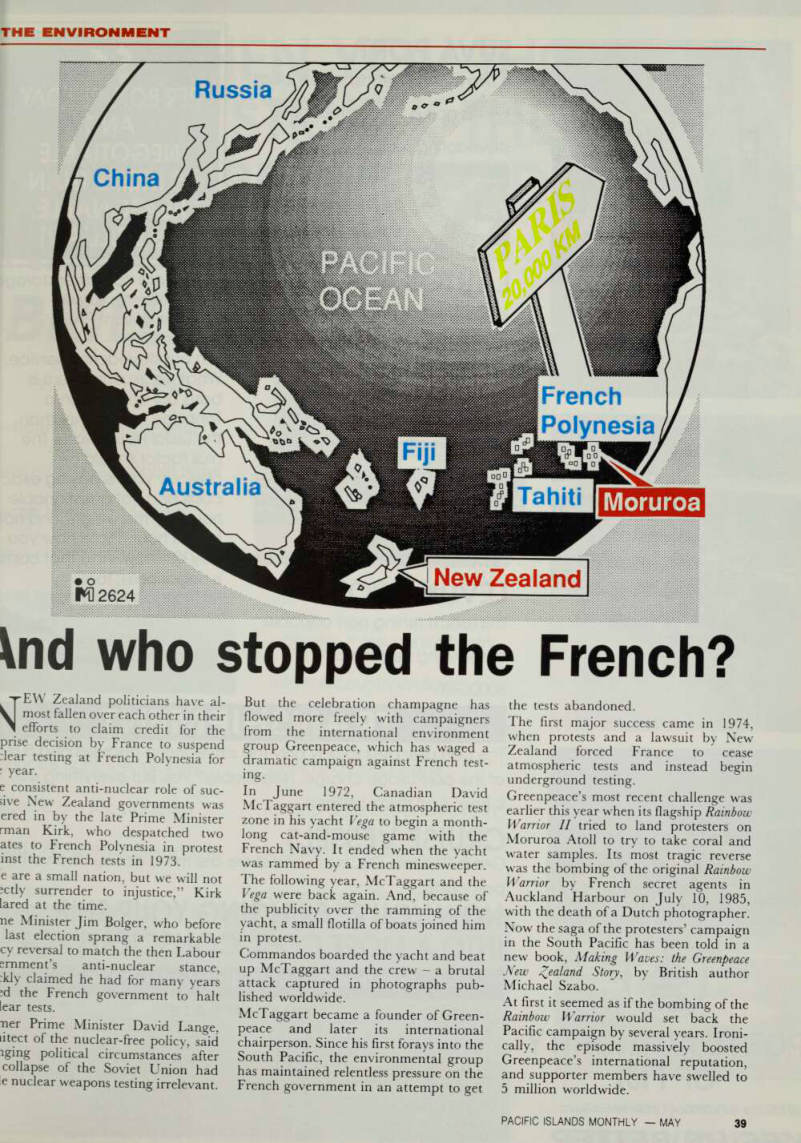
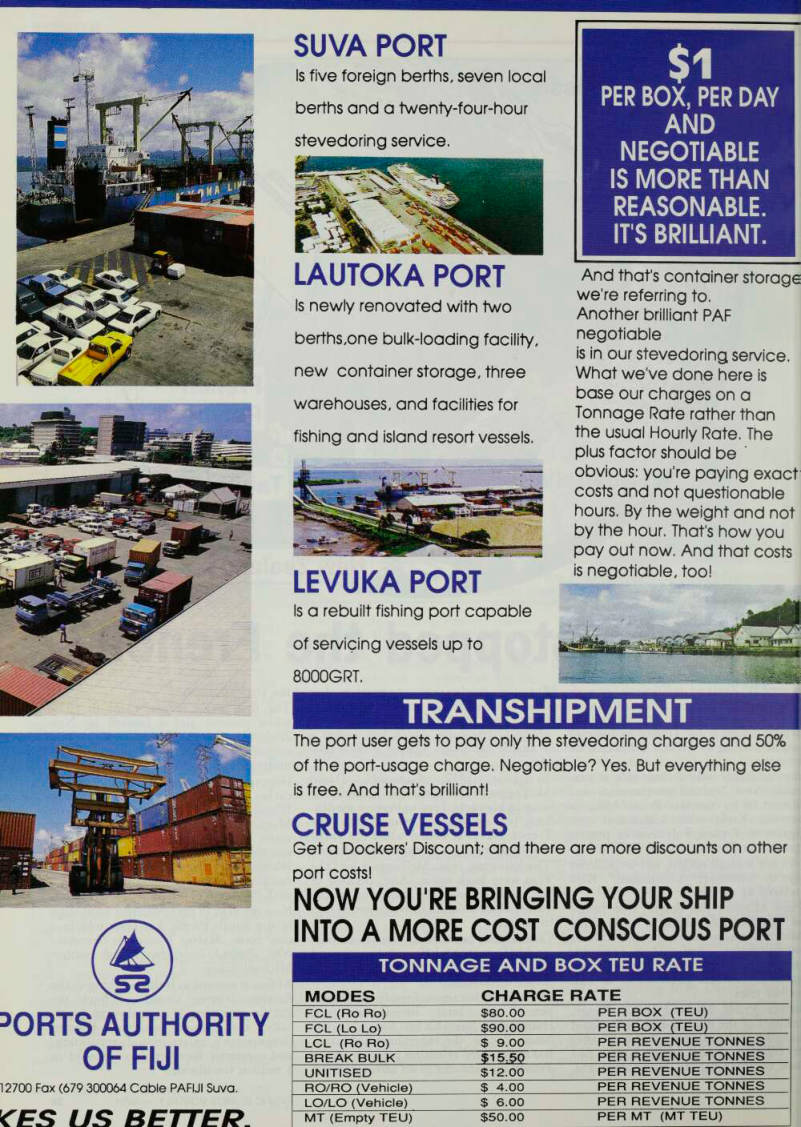
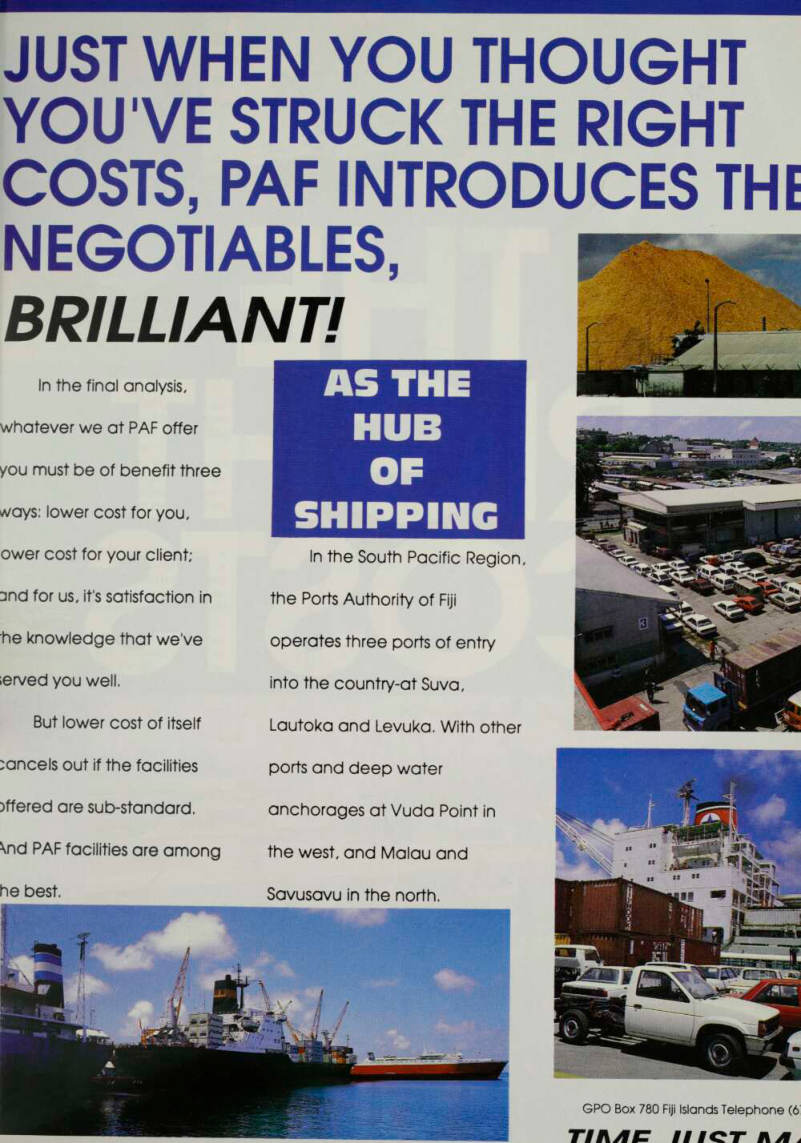
The Environment
yEW Zealand politicians have al most fallen over each other in their 1 efforts to claim credit for the prise decision by France to suspend dear testing at French Polynesia for ; year. e consistent anti-nuclear role of suc >ive New Zealand governments was ered in by the late Prime Minister rman Kirk, who despatched two ates to French Polynesia in protest inst the French tests in 1973. e are a small nation, but we will not -ctly surrender to injustice,” Kirk lared at the time. ne Minister Jim Bolger, who before last election sprang a remarkable cy reversal to match the then Labour eminent s anti-nuclear stance, :kly claimed he had for many years td the French government to halt iear tests. ner Prime Minister David Lange, litect of the nuclear-free policy, said 1 gi J1 g political circumstances after collapse of the Soviet Union had e nuclear weapons testing irrelevant.
But the celebration champagne has flowed more freely with campaigners from the international environment group Greenpeace, which has waged a dramatic campaign against French test
ing.
In June 1972, Canadian David McTaggart entered the atmospheric test zone in his yacht Vega to begin a month long cat-and-mouse game with the French Navy. It ended when the yacht was rammed by a French minesweeper.
The following year, McTaggart and the Vega were back again. And, because of the publicity over the ramming of the yacht, a small flotilla of boats joined him in protest.
Commandos boarded the yacht and beat up McTaggart and the crew - a brutal attack captured in photographs pub lished worldwide.
McTaggart became a founder of Green peace and later its international chairperson. Since his first forays into the South Pacific, the environmental group has maintained relentless pressure on the French government in an attempt to get
the tests abandoned.
The first major success came in 1974, when protests and a lawsuit by New Zealand forced France to cease atmospheric tests and instead begin underground testing.
Greenpeace’s most recent challenge was earlier this year when its flagship Rainbow Warrior II tried to land protesters on Moruroa Atoll to try to take coral and water samples. Its most tragic reverse was the bombing of the original Rainbow Warrior by French secret agents in Auckland Harbour on July 10, 1985, with the death of a Dutch photographer.
Now the saga of the protesters’ campaign in the South Pacific has been told in a new book, Making Waves: the Greenpeace New Zealand Story , by British author Michael Szabo.
At first it seemed as if the bombing of the Rainbow Warrior would set back the Pacific campaign by several years. Ironi
cally, the episode massively boosted
Greenpeace’s international reputation, and supporter members have swelled to 5 million worldwide.
“When the bombing happened the ffair became a spy thriller and the issues nderlying the sabotage were perhaps ownplayed and buried under the in igue,” said Szabo.
He contrasts the hardline stance of Western countries over Libya with the ttitude shown towards French state rrorism in the South Pacific. One of the leged French bombers was arrested in witzerland late last year, but New ealand was pressured into not extradit ig him.
“If a Libyan bomb blows up an merican civil airliner and France, nong others, demands the extradition ' the suspected bombers,” said Szabo, hen for France or other countries to ive sought to prevent one of the spects in the Rainbow Warrior terrorist t being extradited is a double stan ird.”
When Szabo first heard of Greenpeace 1977, he was a 14-year-old schoolboy
id following reports of anti-sealing
monstrations in Canada.
The protests and a visit to Britain of ?roup of anti-nuclear women from the arshall Islands had a profound impact the young Szabo and he embarked on :areer of environmental activism and
king.
Son of a British mother and a mgarian father, he worked as a ilder’s labourer and electrician, then npleted an honours degree in com nication and cultural studies at Leeds iversity. ie researched the French nuclear ipons complex and a range of envir nental issues in the Pacific, and came New Zealand in 1988. He talked to eenpeace activists about writing a k on his research and instead they imissioned him to write a history of r movement. rom the group of idealists who tured on the first protest voyages to ruroa early in the seventies, the paigners have matured into the rse, sophisticated organisation that is snpeace New Zealand. It has 140,000 )orters and is affiliated to
iterdam-based Greenpeace Interna
al. reenpeace has carved for itself a e as probably the world’s leading >ure group on environmental and e issues, but in the nineties world of a consumerism and transnational orations, environmentalism has be- J far more complex, abo’s book recounts for the first time tory of Pacific Islanders involved in
environmental campaigns,
is dedicated to the memory of Elaine v, Greenpeace’s first Pacific earn er who had a friendship with al Pacific leaders. □
The Greenpeace yacht Vega: battling for the environment
Advertisements & other items, pp. 40-42 (1 item)
Transhipment
SUVA PORT
And that's container storage we're referring to.
Another brilliant RAF negotiable is in our stevedoring service.
What we've done here is base our charges on a Tonnage Rate rather than the usual Hourly Rate. The plus factor should be obvious: you're paying exact costs and not questionable hours. By the weight and not by the hour. That's how you pay out now. And that costs is negotiable, too!
Is a rebuilt fishing port capable of servicing vessels up to
8000GRT.
TRANSHIPMENT
The port user gets to pay only the stevedoring charges and 50% of the port-usage charge. Negotiable? Yes. But everything else is free. And that's brilliant!
CRUISE VESSELS
Get a Dockers' Discount; and there are more discounts on other port costs!
NOW YOU'RE BRINGING YOUR SHIP
INTO A MORE COST CONSCIOUS PORT
Is five foreign berths, seven local berths and a twenty-four-hour stevedoring service.
LAUTOKA PORT
Is newly renovated with two berths.one bulk-loading facility, new container storage, three warehouses, and facilities for fishing and island resort vessels. .IS-
LE VUKA PORT
$1
PER BOX, PER DAY
AND
NEGOTIABLE
IS MORE THAN
REASONABLE.
IT'S BRILLIANT.
JUST WHEN YOU THOUGHT
YOU'VE STRUCK THE RIGHT
COSTS, PAF INTRODUCES THE
NEGOTIABLES,
BRILLIANT!
In the final analysis, whatever we at PAF offer you must be of benefit three ways: lower cost for you, ower cost for your client; 2nd for us, it's satisfaction in he knowledge that we've lerved you well.
But lower cost of itself cancels out if the facilities )ffered are sub-standard. \nd PAF facilities are among he best.
AS THE
OF
SHIPPING
In the South Pacific Region, the Ports Authority of Fiji operates three ports of entry into the country-at Suva, Lautoka and Levuka. With other ports and deep water anchorages at Vuda Point in the west, and Malau and Savusavu in the north. * f I % m Si « f £3^ GPO Box 780 Fiji Islands Telephone (6:
lI ICT II J! ,
f 'n WE o‘*S>muoß* m m
THE
RIGHT
V. i
!m M? TTM
L« ** &
urn- C 3
Private sector priorities
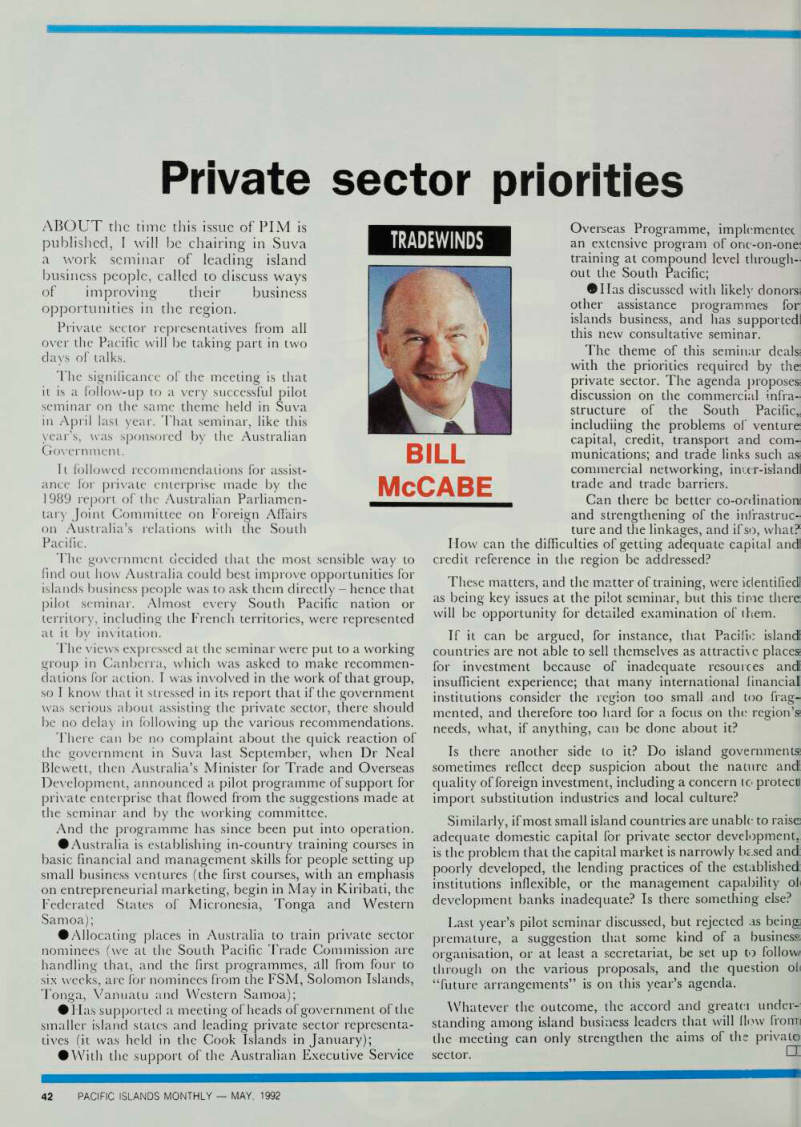
ABOUT the time this issue of PIM is published, I will be chairing in Suva a work seminar of leading island business people, called to discuss ways of improving their business
opportunities in the region.
Private sector representatives from all over the Pacific will be taking part in two days of talks.
The significance of the meeting is that it is a follow-up to a very successful pilot seminar on the same theme held in Suva in April last year. That seminar, like this year’s, was sponsored by the Australian Government.
It followed recommendations for assist ance for private enterprise made by the 1989 report of the Australian Parliamen tary Joint Committee on Foreign Affairs on Australia’s relations with the South Pacific.
The government decided that the most sensible way to find out how Australia could best improve opportunities for islands business people was to ask them directly - hence that pilot seminar. Almost every South Pacific nation or territory, including the French territories, were represented at it by invitation.
The views expressed at the seminar were put to a working group in Canberra, which was asked to make recommen dations for action. 1 was involved in the work of that group, so I know that it stressed in its report that if the government was serious about assisting the private sector, there should be no delay in following up the various recommendations.
There can be no complaint about the quick reaction of the government in Suva last September, when Dr Neal Blcwett, then Australia’s Minister for Trade and Overseas Development, announced a pilot programme of support for private enterprise that flowed from the suggestions made at the seminar and by the working committee.
And the programme has since been put into operation. • Australia is establishing in-country training courses in basic financial and management skills for people setting up small business ventures (the first courses, with an emphasis on entrepreneurial marketing, begin in May in Kiribati, the Federated States of Micronesia, Tonga and Western Samoa); • Allocating places in Australia to train private sector nominees (we at the South Pacific Trade Commission are handling that, and the first programmes, all from four to six weeks, are for nominees from the FSM, Solomon Islands, Tonga, Vanuatu and Western Samoa); • Has supported a meeting of heads of government of the smaller island states and leading private sector representa tives (it was held in the Cook Islands in January); • With the support of the Australian Executive Service
Tradewinds
Overseas Programme, implemented
an extensive program of one-on-one; training at compound level through out the South Pacific; • lias discussed with likely donors* other assistance programmes for islands business, and has supported! this new consultative seminar.
The theme of this seminar deals*
with the priorities required by the;
private sector. The agenda proposes* discussion on the commercial infra structure of the South Pacific, t includiing the problems of venture; capital, credit, transport and com munications; and trade links such as* commercial networking, imer-islandl trade and trade barriers.
Can there be better co-ordinationr and strengthening of the infrastruc ture and the linkages, and if so, what?
How can the difficulties of getting adequate capital and! credit reference in the region be addressed?
These matters, and the matter of training, were identified! as being key issues at the pilot seminar, but this time there will be opportunity for detailed examination of I hem.
If it can be argued, for instance, that Pacific island! countries are not able to sell themselves as attractive places? for investment because of inadequate resources and! insufficient experience; that many international financial institutions consider the region too small and too frag mented, and therefore too hard for a focus on the region’s needs, what, if anything, can be done about it?
Is there another side (o it? Do island governments sometimes reflect deep suspicion about the nature and! quality of foreign investment, including a concern to protect) import substitution industries and local culture?
Similarly, if most small island countries are unable to raise adequate domestic capital for private sector development, is the problem that the capital market is narrowly based and: poorly developed, the lending practices of the established institutions inflexible, or the management capability of development banks inadequate? Is there something else?
Last year’s pilot seminar discussed, but rejected as being premature, a suggestion that some kind of a business; organisation, or at least a secretariat, be set up to follows through on the various proposals, and the question of “future arrangements” is on this year’s agenda.
Whatever the outcome, the accord and greatei under standing among island business leaders that will flow froim the meeting can only strengthen the aims of the private sector.
Bill
Mccabe
Glory
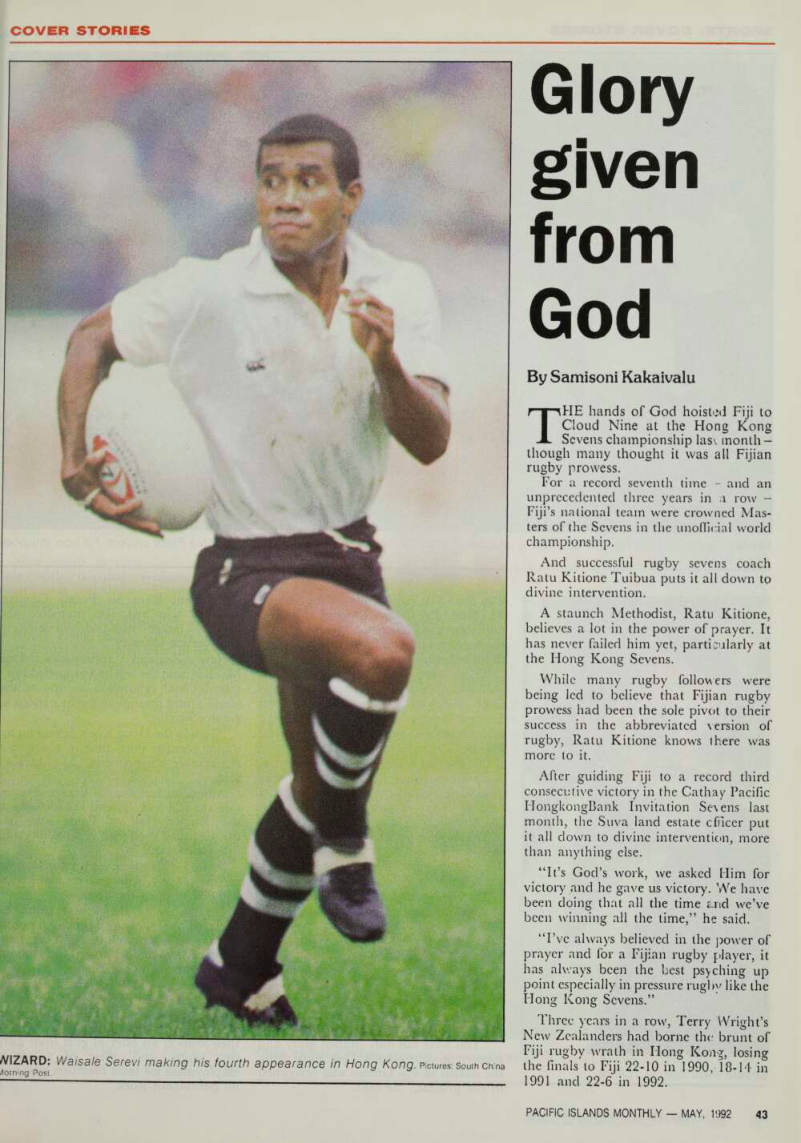
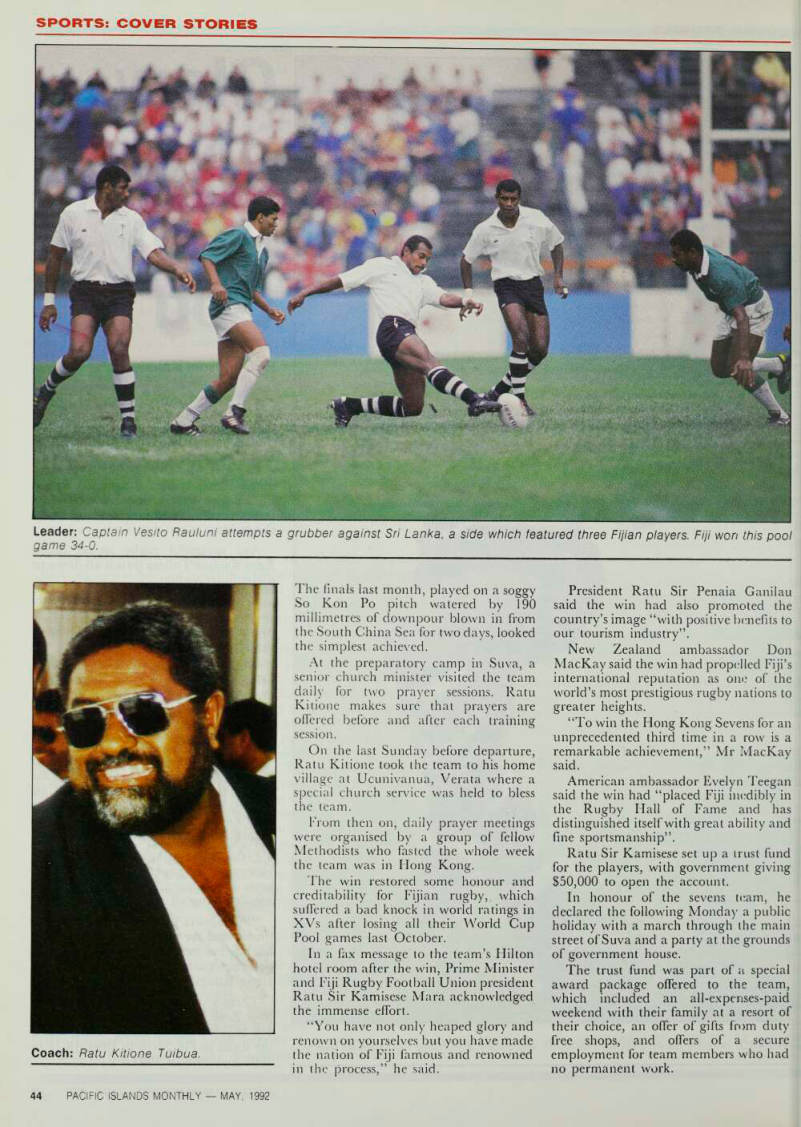
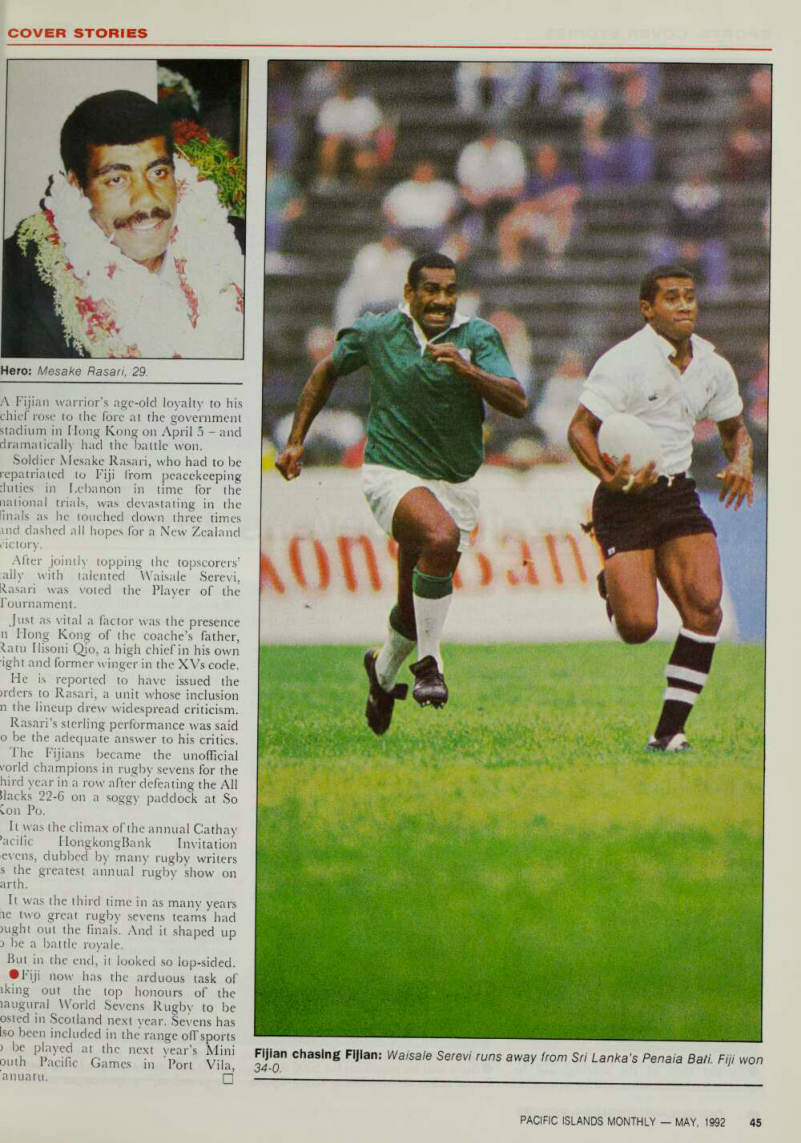
given from God
By Samisoni Kakaivalu
THE hands of God hoisted Fiji to Cloud Nine at the Hong Kong Sevens championship lasv month though many thought it was all Fijian rugby prowess.
For a record seventh time - and an unprecedented three years in a row - Fiji’s national team were crowned Mas ters of the Sevens in the unofficial world championship.
And successful rugby sevens coach Ratu Kitione Tuibua puts it all down to divine intervention.
A staunch Methodist, Ratu Kitione, believes a lot in the power of prayer. It has never failed him yet, particularly at the Hong Kong Sevens.
While many rugby followers were being led to believe that Fijian rugby prowess had been the sole pivot to their success in the abbreviated version of rugby, Ratu Kitione knows there was more to it.
After guiding Fiji to a record third consecutive victory in the Cathay Pacific HongkongDank Invitation Sevens last month, the Suva land estate cfficcr put it all clown to divine intervention, more than anything else.
“It’s God’s work, we asked Him for victory and he gave us victory. We have been doing that all the time and we’ve been winning all the time,” he said.
“I’ve always believed in the power of prayer and for a Fijian rugby player, it has always been the best psyching up point especially in pressure rugby like the Hong Kong Sevens.”
Three years in a row, Terry Wright’s New Zealanders had borne the brunt of Fiji rugby wrath in Hong Kong, losing the finals to Fiji 22-10 in 1990, 18-14 in 1991 and 22-6 in 1992.
WIZARD: Waisale Serevi making his fourth appearance in Hong Kong. pictures south china Morning Post.
The finals last month, played on a soggy So Kon Po pitch watered by 190 millimetres of downpour blown in from the South China Sea for two days, looked the simplest achieved.
At the preparatory camp in Suva, a senior church minister visited the team daily for two prayer sessions. Ratu Kitione makes sure that prayers are offered before and after each training session.
On the last Sunday before departure, Ratu Kitione took the team to his home village at Ucunivanua, Verata where a special church service was held to bless the team.
From then on, daily prayer meetings were organised by a group of fellow Methodists who fasted the whole week the team was in Hong Kong.
The win restored some honour and creditability for Fijian rugby,, which suffered a bad knock in world ratings in XVs after losing all their World Cup Pool games last October.
In a fax message to the team’s Hilton hotel room after the win, Prime Minister and Fiji Rugby Football Union president Ratu Sir Kamisese Mara acknowledged the immense effort.
“You have not only heaped glory and renown on yourselves but you have made the nation of Fiji famous and renowned in the process,” he said.
President Ratu Sir Penaia Ganilau said the win had also promoted the country’s image “with positive benefits to our tourism industry”.
New Zealand ambassador Don Mac Kay said the win had propelled Fiji’s international reputation as one of the world’s most prestigious rugby nations to
greater heights.
“To win the Hong Kong Sevens for an unprecedented third time in a row is a remarkable achievement,” Mr Mac Kay said.
American ambassador Evelyn Teegan said the win had “placed Fiji inedibly in the Rugby Hall of Fame and has distinguished itself with great ability and
fine sportsmanship”.
Ratu Sir Kamisese set up a trust fund for the players, with government giving 550,000 to open the account.
In honour of the sevens team, he declared the following Monday a public holiday with a march through the main street of Suva and a party at the grounds of government house.
The trust fund was part of a special award package offered to the team, which included an all-expenses-paid weekend with their family at a resort of their choice, an offer of gifts from duty free shops, and offers of a secure employment for team members who had no permanent work.
Leader: Captain Vesito Rauluni attempts a grubber against Sri Lanka, a side which featured three Fijian players. Fiji won this pool game 34-0.
Coach: Ratu Kitione Tuibua.
A Fijian warrior’s age-old loyalty to his chief rose to the fore at the government stadium in Hong Kong on April 5 - and dramatically had the battle won.
Soldier Mesakc Rasari, who had to be
repatriated to Fiji from peacekeeping
:luties in Lebanon in time for the national trials, was devastating in the finals as he touched down three times ;md dashed all hopes for a New Zealand victory.
After jointly lopping the topscorers’ ally with talented Waisale Serevi, Llasari was voted the Player of the Fournament.
Just as vital a factor was the presence n Hong Kong of the coache’s father, llisoni Qio, a high chief in his own ight and former winger in the XVs code.
He is reported to have issued the irders to Rasari, a unit whose inclusion
n the lineup drew widespread criticism.
Rasari’s sterling performance was said o be the adequate answer to his critics.
The Fijians became the unofficial yorld champions in rugby sevens for the bird year in a row after defeating the All hacks 22-6 on a soggy paddock at So £.on Po.
It was the climax of the annual Cathay
*acific Hongkongßank Invitation
evens, dubbed by many rugby writers s the greatest annual rugby show on arth.
It was the third time in as many years le two great rugby sevens teams had )ught out the finals. And it shaped up 3 be a battle royale.
But in the end, it looked so lop-sided. • Fiji now has the arduous task of iking out the lop honours of the laugural World Sevens Rugby to be °s ted in Scotland next year. Sevens has Iso been included in the range off sports ) be played at the next year’s Mini outh Pacific Games in Port Vila, anuatu. n
Hero: Mesake Rasari, 29.
Fijian chasing Fijian: Waisale Serevi runs away from Sri Lanka’s Penaia Bati. Fiji won 34-0.
Racing against Sevens time
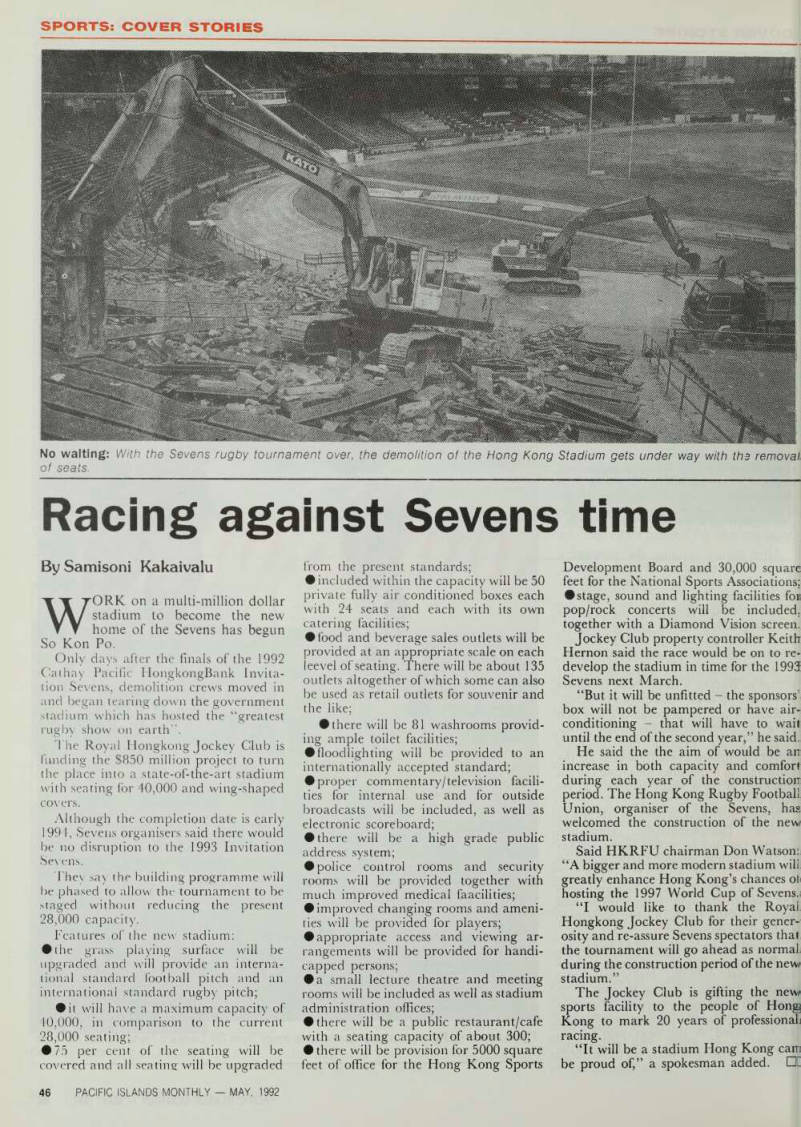
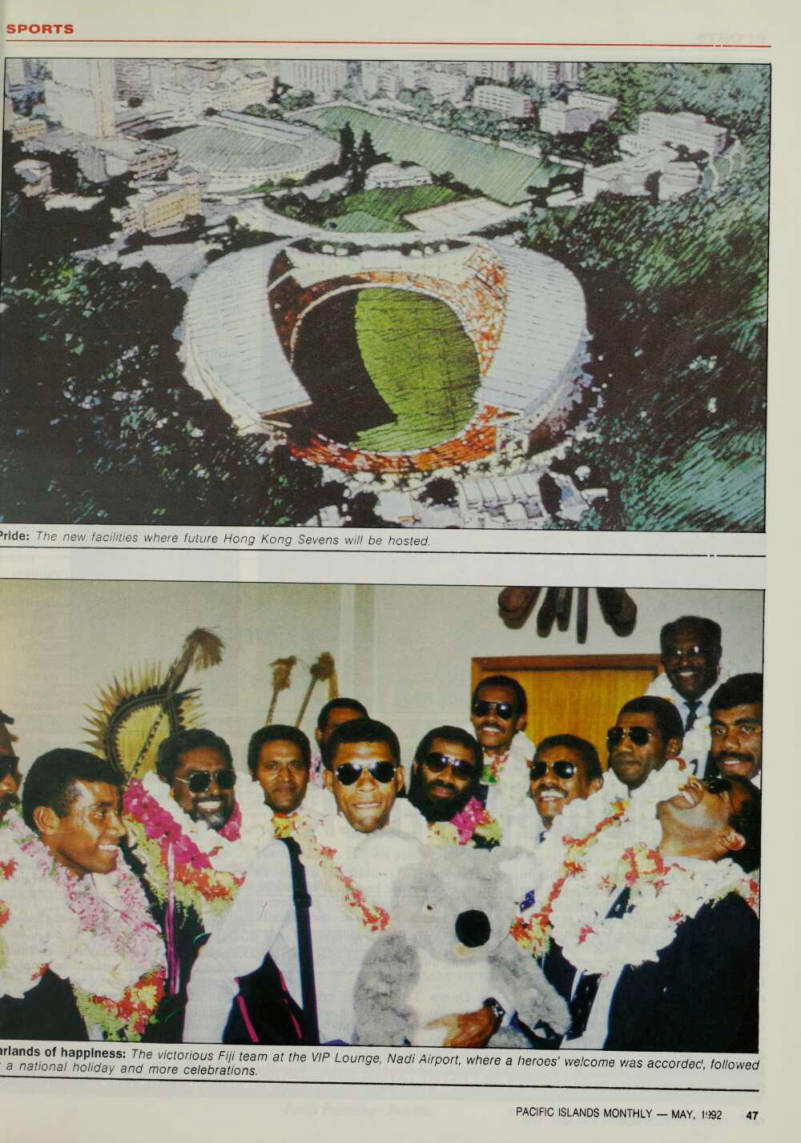
By Samisoni Kakaivalu
from the present standards; • included within the capacity will be 50 private fully air conditioned boxes each with 24 seats and each with its own catering facilities; • food and beverage sales outlets will be provided at an appropriate scale on each leevel of seating. There will be about 135 outlets altogether of which some can also be used as retail outlets for souvenir and the like; • there will be 81 washrooms provid ing ample toilet facilities; • floodlighting will be provided to an internationally accepted standard; • proper commentary/television facili ties for internal use and for outside broadcasts will be included, as well as electronic scoreboard; • there will be a high grade public address system; • police control rooms and security rooms will be provided together with much improved medical faacilities; • improved changing rooms and ameni ties will be provided for players; • appropriate access and viewing ar rangements will be provided for handi capped persons; • a small lecture theatre and meeting rooms will be included as well as stadium administration offices; • there will be a public restaurant/cafe with a seating capacity of about 300; • there will be provision for 5000 square feet of office for the Hong Kong Sports
Development Board and 30,000 square feet for the National Sports Associations; • stage, sound and lighting facilities fori pop/rock concerts will be included, together with a Diamond Vision screen, Jockey Club property controller Keith Hernon said the race would be on to re develop the stadium in time for the 1992 Sevens next March.
“But it will be unfitted - the sponsors', box will not be pampered or have air conditioning - that will have to wait until the end of the second year,” he said, He said the the aim of would be an increase in both capacity and comfort during each year of the construction period. The Hong Kong Rugby FootballJ Union, organiser of the Sevens, has welcomed the construction of the new stadium.
Said HKRFU chairman Don Watsons “A bigger and more modern stadium wiliJ greatly enhance Hong Kong’s chances ot< hosting the 1997 World Cup of Sevens.; “I would like to thank the Royal; Hongkong Jockey Club for their gener osity and re-assure Sevens spectators that the tournament will go ahead as normal; during the construction period of the newA stadium.”
The Jockey Club is gifting the newA sports facility to the people of Hong Kong to mark 20 years of professional! racing.
“It will be a stadium Hong Kong cam be proud of,” a spokesman added. Q.
WORK on a multi-million dollar stadium to become the new home of the Sevens has begun So Kon Po.
Only days after the finals of the 1992 Cathay Pacific Hongkongßank Invita tion Sevens, demolition crews moved in and began tearing down the government stadium which has hosted the “greatest rugby show on earth ".
The Royal Hongkong Jockey Club is funding the SB5O million project to turn the place into a state-of-the-art stadium with seating for 40,000 and wing-shaped covers.
Although the completion date is early 1994, Sevens organisers said there would be no disruption to the 1993 Invitation Sevens.
They say the building programme will be phased to allow the tournament to be staged without reducing the present 28,000 capacity.
Features of the new stadium: • the grass playing surface will be upgraded and will provide an interna tional standard football pitch and an international standard rugby pitch; • it will have a maximum capacity of 40,000, in comparison to the current 28,000 seating; • 75 per cent of the seating will be covered and all seating will be upgraded
No waiting: With the Sevens rugby tournament over, the demolition of the Hong Kong Stadium gets under way with the remova of seats.
[?] ride: The new facilities where future Hong Kong Sevens will be hosted.
[?]rlands of happiness: The victorious Fiji team at the VIP Lounge, Nadi Airport, where a heroes' welcome was accorded, followed a national holiday and more celebrations.
Advertisements & other items, p. 49 (1 item)
Sports
The Samoan they
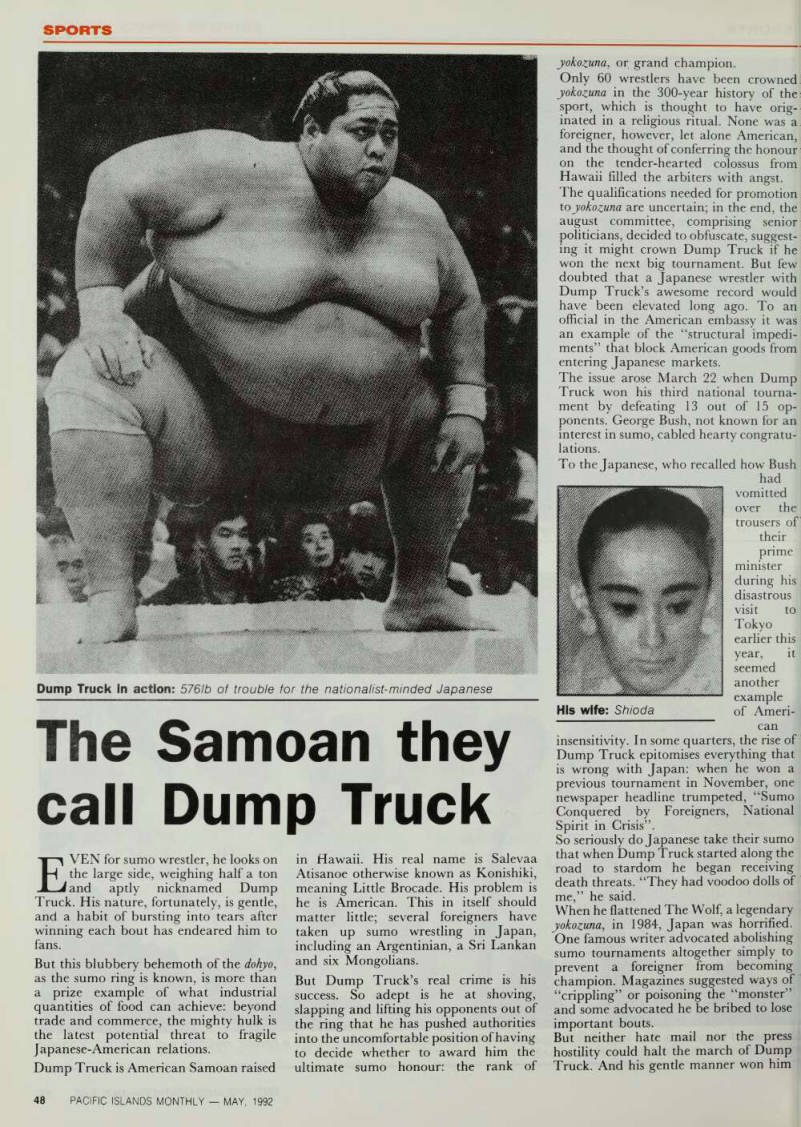

call Dump Truck
EVEN for sumo wrestler, he looks on the large side, weighing half a ton and aptly nicknamed Dump Truck. His nature, fortunately, is gentle, and a habit of bursting into tears after winning each bout has endeared him to fans.
But this blubbery behemoth of the dohyo, as the sumo ring is known, is more than a prize example of what industrial quantities of food can achieve: beyond trade and commerce, the mighty hulk is the latest potential threat to fragile Japanese-American relations.
Dump Truck is American Samoan raised
in Hawaii. His real name is Salevaa Atisanoe otherwise known as Konishiki, meaning Little Brocade. His problem is he is American, This in itself should matter little; several foreigners have taken up sumo wrestling in Japan, including an Argentinian, a Sri Lankan six Mongolians, But Dump Truck’s real crime is his success. So adept is he at shoving, slapping and lifting his opponents out of t h e ring that he has pushed authorities into the uncomfortable position of having to decide whether to award him the ultimate sumo honour: the rank of
yokozum, or grand champion.
Only 60 wrestlers have been crowned yokozum in the 300-year history of the sport, which is thought to have orig inated in a religious ritual. None was a foreigner, however, let alone American, and the thought of conferring the honour on the tender-hearted colossus from Hawaii filled the arbiters with angst.
The qualifications needed for promotion to yokozum are uncertain; in the end, the august committee, comprising senior politicians, decided to obfuscate, suggest ing it might crown Dump Truck if he won the next big tournament. But few doubted that a Japanese wrestler with Dump Truck’s awesome record would have been elevated long ago. To an official in the American embassy it was an example of the “structural impedi ments” that block American goods from entering Japanese markets.
The issue arose March 22 when Dump Truck won his third national tourna ment by defeating 13 out of 15 op ponents. George Bush, not known for an interest in sumo, cabled hearty congratu lations.
To the Japanese, who recalled how Bush
had vomitted over the trousers of their prime minister during his disastrous visit to Tokyo earlier this year, it seemed another
example
of Ameri can
insensitivity. In some quarters, the rise of Dump Truck epitomises everything that is wrong with Japan: when he won a previous tournament in November, one newspaper headline trumpeted, “Sumo Conquered by Foreigners, National Spirit in Crisis”.
So seriously do Japanese take their sumo that when Dump Truck started along the road to stardom he began receiving death threats. “They had voodoo dolls of me,” he said.
When he flattened The Wolf, a legendary yokozum, in 1984, Japan was horrified.
One famous writer advocated abolishing sumo tournaments altogether simply to prevent a foreigner from becoming champion. Magazines suggested ways of “crippling” or poisoning the “monster” and some advocated he be bribed to lose important bouts.
But neither hate mail nor the press hostility could halt the march of Dump Truck. And his gentle manner won him
Dump Truck In action: 576lb of trouble for the nationalist-minded Japanese
His wife: Shioda
fans among younger, less nationalistic Japanese intrigued by his habit of bursting into tears after bouts.
Soon he was a celebrity. When he married Sumika Shioda, a petite, 27-year-old model - her waist is the size of One of Dump Truck’s thighs - a quarter of Japanese households tuned into the five television coverage.
Inevitably Dump Truck’s enemies
allege that the 5761 b (261 kg) giant lacks real skills and simply overwhelms his foes with flab. They say that as a foreigner, he lacks Japanese shingitai, or “fighting spirit”.
But their criticisms smack of sour grapes. “Frankly speaking, I think foreigners have more of the Japanese spirit and they are hungrier,” said one master of a sumo stable.
Even top Japanese wrestlers are failing to inspire. The Wolf retired suddenly last year. Some said he wanted to avoid the ignominy of more defeat at the hands of foreigners. The country’s only other yokoguna has hardly been seen in recent months because he has been “sick”.
To the uninitiated, sumo wrestling looks like a game of mindless strength as the contestants, clad in nothing but a bizarre loin-cloth, try to force each other 3ut of the ring. An American author of in unflattering book on sumo described
it as “two fat fag
gots undressing
each other in a sandbox”.
But to the Japan ese it is a national cult. Apprentice ship involves years of relentless gorging on a stew of fish, meat and veg etables: the result is thighs the size of tree trunks and rolling folds of fat that are the hall mark of any self
respecting wrestler.
Dump Truck
cannot be criticised in the falb depart ment. But a mem ber of the Sumo Association of
Japan said Dump
Truck had yet to prove he deserved it, despite his im pressive triumph in the last tourna ment. □
Dump Truck: one of the best but not Japanese
Advertisements & other items, p. 51 (1 item)
Cjomputer
Q, v O O Pr
acific
J PACIFIC WIDE MAIL ORDER COMPUTER PRODUCTS AT THE LOWEST PRICES WITH FULL SERVICE SUPPORT!
5-USER NOVELL NETWORK
irnf D 5 File Se ? e , r ,l 30MB HDD, 386 Sx Workstations, EPSON printer, LUMEN Jff*' 2.2 (Set up for use, including thinnet cabling) 15,000,00 (on-site setup, quotation on request)
COMPUTER ACCOUNTING SYSTEM
nnt S^i°u^n^ I !\^«?T^T. EPSON New Generation printer LUMEN UPS, DOS / WINDOWS / MOUSE, ACCPAC ACCOUNTING FOR WINDOWS A$ 3850,00
C 3 pao-a e bJ scanmincsbtim
HP Sranjet I Ip Scanner, HP Laserjet lip plus User Printer, OMNIPAGE OCR Software A 55000,00 Please send more information on: □ IBM Compatible PCs (DOS) □ HP Printers & Scanners
□ UNIX
□ Novell Networking □ Multimedia □ Accounting Systems □ Software (please specify) Na«e: C0mpaiy:...
Position: Pkofce: Address: C0uatry:...
Fax: * Servicing the Pacific since 1980 * Full warranty and on going support PO Box 198, Port Vila, Vanuatu - Tel; (678) 25065 - Fax: (678) 22938 Pacific Publishing - Port Vila
PACIFIC ISLANDS MONTHLY MAY K«9
The return of
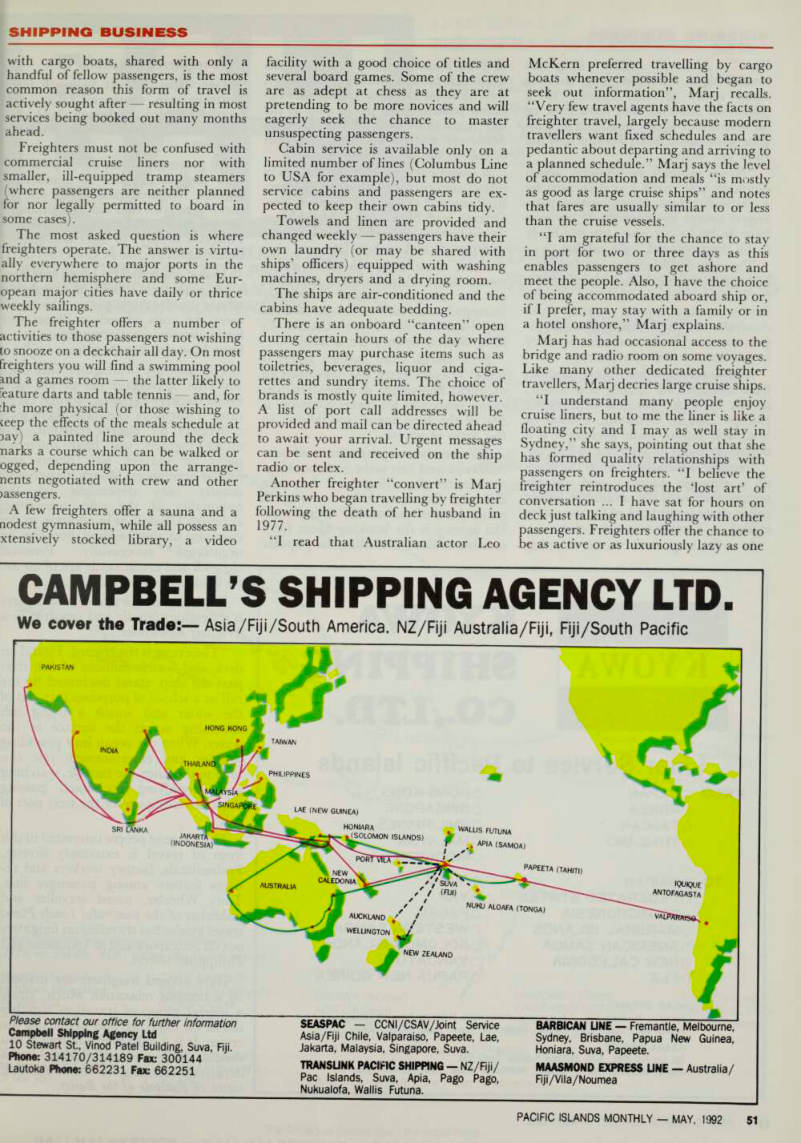
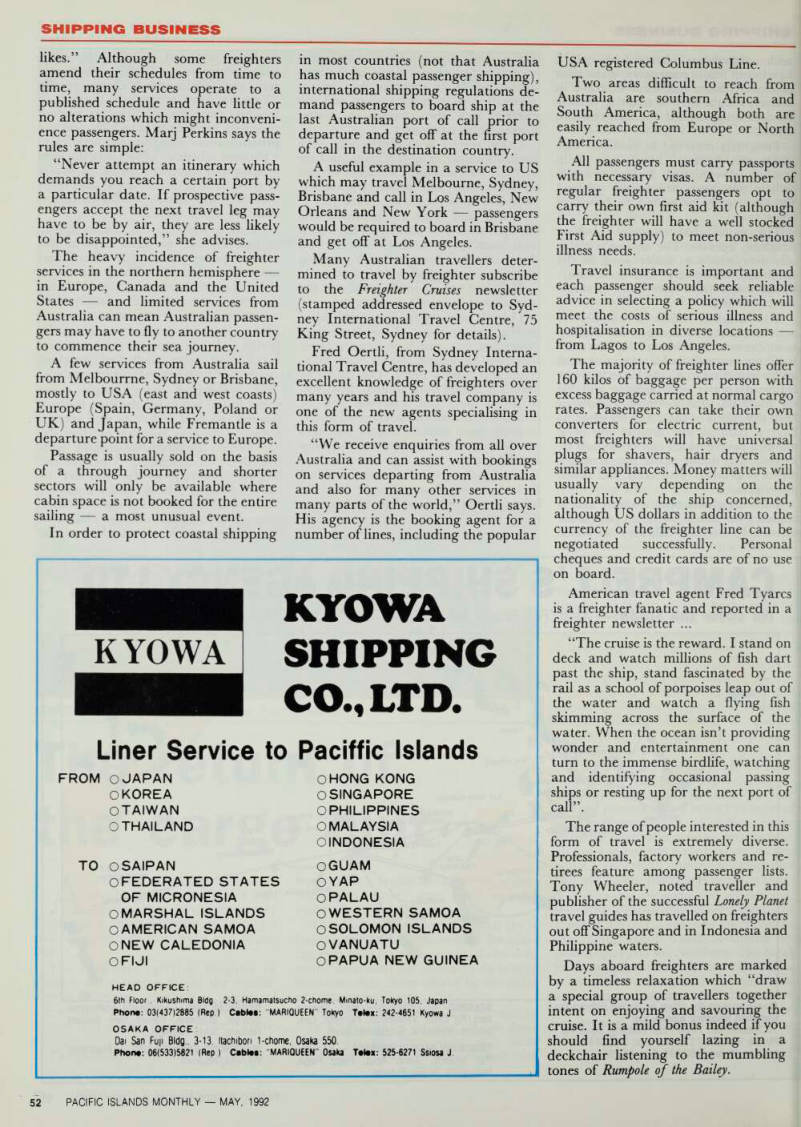
Shipping Business
The return of the cargo cult
A MODE of travel, commonly sought after in years past and suffering from a contemporary decline in public awareness, is making a spirited comeback in interest and popu
larity.
The passenger carrying freighter or cargo boat continues to ply the worlds’ oceans offering travellers a sense of
unhurried tranquility, nostalgia, ro
mance and a very special travel experi ence.
The passenger freighter provides care
free days in a restful environment, where passengers make time their servant rather than their master.
The delightful setting of sea and sky is interrupted only by occasional fascinat ing port calls (at times to out-of-the-way exotic locations) for considerably longer durations than those offered by commer cial passenger liners.
One service growing in popularity with Australians is cruising on the Arnui 11, a copra freighter, which sails from Tahiti each three weeks around the
Marquesas Islands. The Aranui ll service, which enables an irresistible “discovery” of Tahiti, the Tuamotu and Marquesas Islands some of the most remote and beautiful spots in the world (where life has scarcely changed since Captain in Cook sailed by in 1769) is reminiscent of the Somerset Maugham era, when travel was to be savoured and enjoyed moment by moment and destination were often incidental to or an unintended part of the journey.
Many tourists have also tried the Nivaga 11, a government-run freighter servicing Tuvalu’s scattered islands.
Nivaga II often makes the long journey out of the Tuvalu waters to exotic destinatioans like Tokelau, Kiribati and Western Samoa.
The romance and nostalgia rep resented by freighter “cruising” has proven a tantalising obsession for Ray and Estelle Cook. They have cruised on lengthy voyages twice to the West Coast of America and to Japan in addition to a number of shorter trips between European ports.
“Freighter travel is unique and we see it very much as a link with our youth,”
Estelle explained. “It can be a very frustrating form of travel unless one has a very flexible approach to the time a voyage may take and a clear acceptance that schedules could be amended prior to or, occasionally, even during the sail ing”.
The reference to flexibility is import ant. Freighters carry cargo first (with freight dictating which ports will be visited). However, this should not be taken to imply that service to passengers is anything less than excellent.
The majority of freighters accommo date 12 passengers (exceeding 12 passen gers requires a doctor to be carried aboard), offering a good standard of accommodation in single or double cabins with beds (not bunks), most with
private facilities.
The lack of a doctor leads to some restrictions on who may (ravel pregnant women, infants under one year or aged persons with a history of heart of similar illness cannot be carried. Some freighter companies require persons over 70 years to provide a medical certificate, while a very small number of companies will not accept passengers over (hat age.
The meals are good and wholesome, featuring a reasonable variety, mostly of European style cuisine, and are served in the dining room which is shared by passenngers and ship’s officers. T he meal times are plentiful main meals plus a substantial morning and afternoon tea and supper. Passengers will have their turns at the Captain’s table, where they are regaled by tales of past cruising adventures.
The pure joy and relaxation a.-sociated
NIVAGA II: serving Tuvalu and other Pacific islands
with cargo boats, shared with only a handful of fellow passengers, is the most common reason this form of travel is actively sought after resulting in most services being booked out many months ahead.
Freighters must not be confused with commercial cruise liners nor with smaller, ill-equipped tramp steamers (where passengers are neither planned for nor legally permitted to board in some cases).
The most asked question is where freighters operate. The answer is virtu ally everywhere to major ports in the northern hemisphere and some Eur opean major cities have daily or thrice weekly sailings.
The freighter offers a number of activities to those passengers not wishing to snooze on a deckchair all day. On most freighters you will find a swimming pool and a games room the latter likely to feature darts and table tennis and, for :he more physical (or those wishing to ceep the effects of the meals schedule at aay) a painted line around the deck narks a course which can be walked or ogged, depending upon the arrange nents negotiated with crew and other >assengers.
A few freighters offer a sauna and a nodest gymnasium, while all possess an xtensively stocked library, a video
facility with a good choice of titles and several board games. Some of the crew are as adept at chess as they are at pretending to be more novices and will eagerly seek the chance to master unsuspecting passengers.
Cabin service is available only on a limited number of lines (Columbus Line to USA for example), but most do not service cabins and passengers are ex pected to keep their own cabins tidy.
Towels and linen are provided and changed weekly passengers have their own laundry (or may be shared with
ships’ officers) equipped with washing
machines, dryers and a drying room.
The ships are air-conditioned and the
cabins have adequate bedding.
There is an onboard “canteen” open during certain hours of the day where passengers may purchase items such as toiletries, beverages, liquor and ciga rettes and sundry items. The choice of brands is mostly quite limited, however.
A list of port call addresses will be provided and mail can be directed ahead to await your arrival. Urgent messages can be sent and received on the ship radio or telex.
Another freighter “convert” is Marj Perkins who began travelling by freighter following the death of her husband in 1977.
“I read that Australian actor Leo
McKern preferred travelling by cargo boats whenever possible and began to seek out information”, Marj recalls.
“Very few travel agents have the facts on freighter travel, largely because modern travellers want fixed schedules and are pedantic about departing and arriving to a planned schedule.” Marj says the level of accommodation and meals “is mostly as good as large cruise ships” and notes that fares are usually similar to or less than the cruise vessels.
“I am grateful for the chance to stay in port for two or three days as this enables passengers to get ashore and meet the people. Also, I have the choice of being accommodated aboard ship or, if I prefer, may stay with a family or in a hotel onshore,” Marj explains.
Marj has had occasional access to the bridge and radio room on some voyages.
Like many other dedicated freighter travellers, Marj decries large cruise ships.
“I understand many people enjoy cruise liners, but to me the liner is like a floating city and I may as well stay in Sydney,” she says, pointing out that she has formed quality relationships with passengers on freighters. “I believe the freighter reintroduces the ‘lost art’ of conversation ... I have sat for hours on deck just talking and laughing with other Dassengers. Freighters offer the chance to dc as active or as luxuriously lazy as one
likes.” Although some freighters
amend their schedules from time to time, many services operate to a published schedule and have little or no alterations which might inconvenience passengers. Marj Perkins says the rules are simple: “Never attempt an itinerary which demands you reach a certain port by a particular date. If prospective passengers accept the next travel leg may have to be by air, they are less likely to be disappointed,” she advises.
The heavy incidence of freighter services in the northern hemisphere in Europe, Canada and the United States and limited services from Australia can mean Australian passengers may have to fly to another country to commence their sea journey.
A few services from Australia sail from Melbourrne, Sydney or Brisbane, mostly to USA (east and west coasts)
Europe (Spain, Germany, Poland or
UK) and Japan, while Fremantle is a departure point for a service to Europe.
Passage is usually sold on the basis of a through journey and shorter sectors will only be available where cabin space is not booked for the entire sailing a most unusual event.
In order to protect coastal shipping
in most countries (not that Australia has much coastal passenger shipping),
international shipping regulations de
mand passengers to board ship at the last Australian port of call prior to departure and get off at the first port of call in the destination country.
A useful example in a service to US which may travel Melbourne, Sydney, Brisbane and call in Los Angeles, New Orleans and New York passengers would be required to board in Brisbane and get off at Los Angeles.
Many Australian travellers deter mined to travel by freighter subscribe to the Freighter Cruises newsletter
(stamped addressed envelope to Syd
ney International Travel Centre, 75
King Street, Sydney for details).
Fred Oertli, from Sydney Interna tional Travel Centre, has developed an excellent knowledge of freighters over many years and his travel company is one of the new agents specialising in this form of travel.
“We receive enquiries from all over Australia and can assist with bookings on services departing from Australia and also for many other services in many parts of the world,” Oertli says.
His agency is the booking agent for a number of lines, including the popular
USA registered Columbus Line.
Two areas difficult to reach from Australia are southern Africa and South America, although both are easily reached from Europe or North America.
All passengers must carry passports with necessary visas. A number of regular freighter passengers opt to carry their own first aid kit (although the freighter will have a well stocked First Aid supply) to meet non-serious illness needs.
Travel insurance is important and each passenger should seek reliable advice in selecting a policy which will meet the costs of serious illness and hospitalisation in diverse locations from Lagos to Los Angeles.
The majority of freighter lines offer 160 kilos of baggage per person with excess baggage carried at normal cargo rates. Passengers can take their own converters for electric current, but most freighters will have universal plugs for shavers, hair dryers and similar appliances. Money matters will usually vary depending on the nationality of the ship concerned, although US dollars in addition to the currency of the freighter line can be
negotiated successfully. Personal
cheques and credit cards are of no use on board.
American travel agent Fred Tyarcs is a freighter fanatic and reported in a freighter newsletter ...
“The cruise is the reward. I stand on deck and watch millions of fish dart past the ship, stand fascinated by the rail as a school of porpoises leap out of the water and watch a flying fish skimming across the surface of the water. When the ocean isn’t providing wonder and entertainment one can turn to the immense birdlife, watching
and identifying occasional passing
ships or resting up for the next port of call”.
The range of people interested in this form of travel is extremely diverse.
Professionals, factory workers and re tirees feature among passenger lists.
Tony Wheeler, noted traveller and publisher of the successful Lonely Planet travel guides has travelled on freighters out off Singapore and in Indonesia and
Philippine waters.
Days aboard freighters are marked by a timeless relaxation which “draw a special group of travellers together intent on enjoying and savouring the cruise. It is a mild bonus indeed if you should find yourself lazing in a deckchair listening to the mumbling tones of Rumpole of the Bailey.
Advertisements & other items, pp. 53-55 (1 item)
Campbell’S Shipping Agency Ltd.
We cover the Trade: — Asia /Fiji/South America. NZ/Fiji Australia/Fiji, Fiji/South Pacific * *
HONG KONG
TAIWAN
INDIA
THAI LAN
I
PHILIPPINES
* I
LAE (NEW GUINEA)
. WALUS FUTUNA
r . APIA (SAMOA)
JAKARTA
(INDONESIA)
POR
PAPEETA (TAHITI)
NEW N
CALEDONIA
* i SUVA «.
/ / (FIJI)
/ / NUKU ALOAFA (TONGA)
AUCKLAND ' 1
iqliique
AUSTRALIA
ANTOFAGASTA
WELLINGTON
NEW ZEALAND
Please contact our office for further information Campbell Shipping Agency Ltd 10 Stewart St, Vinod Patel Building, Suva, Fiji.
Phone: 314170/314189 Fax; 300144 Lautoka Phone: 662231 Fax: 662251 SEASPAC CCNI/CSAV/Joint Service Asia/Fiji Chile, Valparaiso, Papeete, Lae, Jakarta, Malaysia, Singapore, Suva.
TRANSUNK PACIFIC SHIPPING - NZ/Fiji/
Pac Islands, Suva, Apia, Pago Pago, Nukualofa, Wallis Futuna.
BARBICAN LINE Fremantle, Melbourne, Sydney, Brisbane, Papua New Guinea, Honiara, Suva, Papeete.
MAASMOND EXPRESS UNE - Australia/
Fiji/Vila/Noumea
KYOWA
KYOWA
SHIPPING
CO., LTD.
Liner Service
FROM OJAPAN
OKOREA
©TAIWAN
©THAILAND
TO ©SAIPAN
©FEDERATED STATES
OF MICRONESIA
©MARSHAL ISLANDS
©AMERICAN SAMOA
©NEW CALEDONIA
©FIJI
to Paciffic Islands
©HONG KONG
©SINGAPORE
©PHILIPPINES
©MALAYSIA
©INDONESIA
©GUAM
©YAP
©PALAU
©WESTERN SAMOA
©SOLOMON ISLANDS
©VANUATU
©PAPUA NEW GUINEA
HEAD OFFICE
6th Floor . Kikushima Bldg 2-3, Hamamatsucho 2-chome. Mmato-ku, Tokyo 105. Japan Phone: 03(437)2885 (Rep ) Cable*: "MARIQUEEN Tokyo Telex: 242-4651 Kyowa J.
OSAKA OFFICE
Dai San Fuji Bldg. 3-13. Itachibon 1-chome, Osaka 550.
Phone: 06(533)5821 (Rep ) Cables: MARIQUEEN" Osaka Telex: 525-6271 Ssiosa J
A
A JOINT SERVICE OF
THE CHINA NAVIGATION CO. LTD.
(INC. IN U.K.)
Mitsui O.S.K. Lines Ltd.
(INC. IN JAPAN)
NIPPON YUSEN KAISHA
(INC. IN JAPAN)
SERVICE
TWO
~)PERA TING A MONTHL Y SAILING FROM JAPAN
AND S.KOREA TO SOUTH PACIFIC PORTS
4S A MEMBER OF THE JAPAN SOUTH PACIFIC
FREIGHT CONFERENCE
CONTAINER / B/BULK
/RORO CAR CARRIERS
ON SERVICE
Busan • % Yokohama WV % Naqoya\ Kobe '
M.S. "PACIFIC ISLANDER”
(OPERATED By CNCO)
M.S. "CORAL ISLANDER”
(OPERATED By NYK/MOL)
Papua New Guinea \ Tarawa £0 & to % % Honiara x % V Santo Apia Vila \ O LautokaVJ*"---
1 \»/Suva
Noumea P’>t2p ago Pago *•< S Nukualofa Papeete 0 '© Rarotonga more information, please contact our :NTS in SUVA, FIJI, or respective ports 'Pacific Islander", centers Shipping ite Mail Bag D.
CABLE: CARPSHIP
TLX: 2199 CARPSHIP FJ
TEL: 679-312244
FAX: 679-301572
And calling at: New Zealand Coral Islander": is Philp (SS)Co Ltd D. Box 355
CABLE: BURNSOUTH
TLX: 2168 BURNSHIP FJ
TEL: 679-311777
FAX; 679-301127
TARAWA (9 Days) f LAUTOKA (13 Days) APIA (18 Days) PAGO PAGO (19 Days) NUKUALOFA (28days) NOUMEA (31 Days) SANTO (36 Days) * HONIARA (39 Days)
RAROTONGA (Via APIA or PAGO PAGO)
SUVA (14 Days)
PAPEETE (23 Days)
VILA (35 Days) ) Average Transit Time From Yokohama On Inducement Basis
R A I
U A I CBDIIIAI
For Schedule Details See Your Local Press n m. ■
Schedules
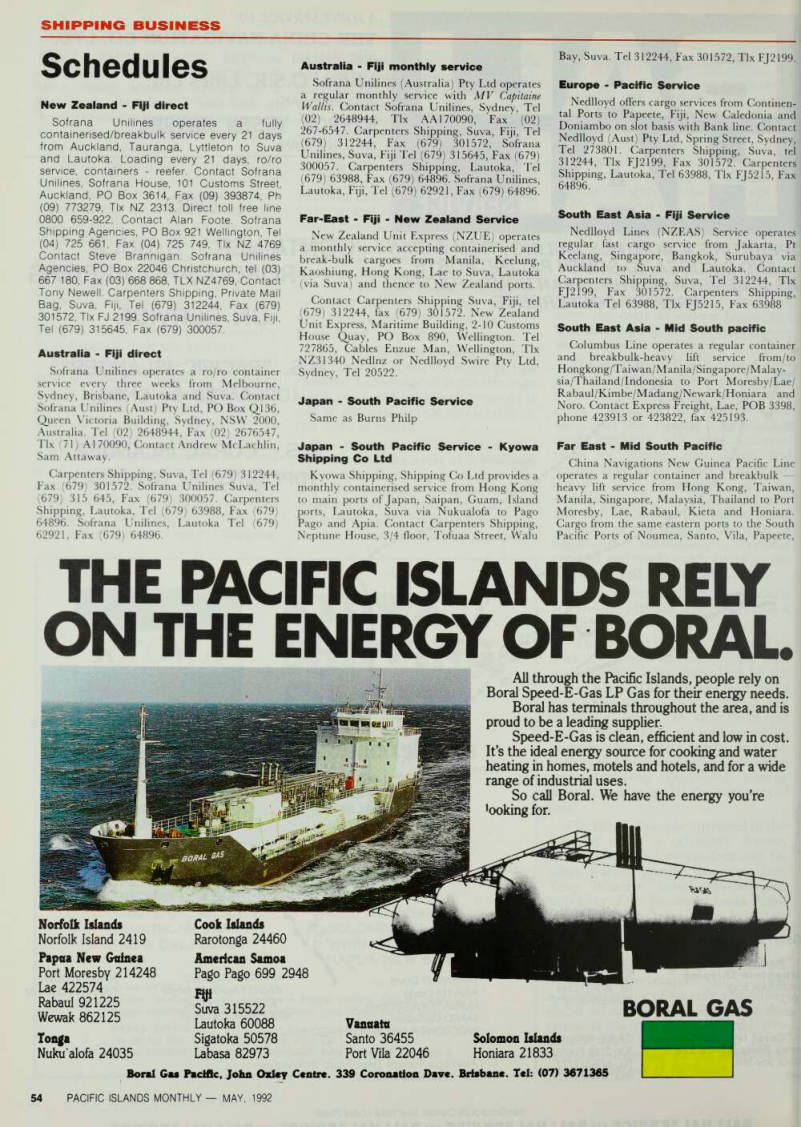
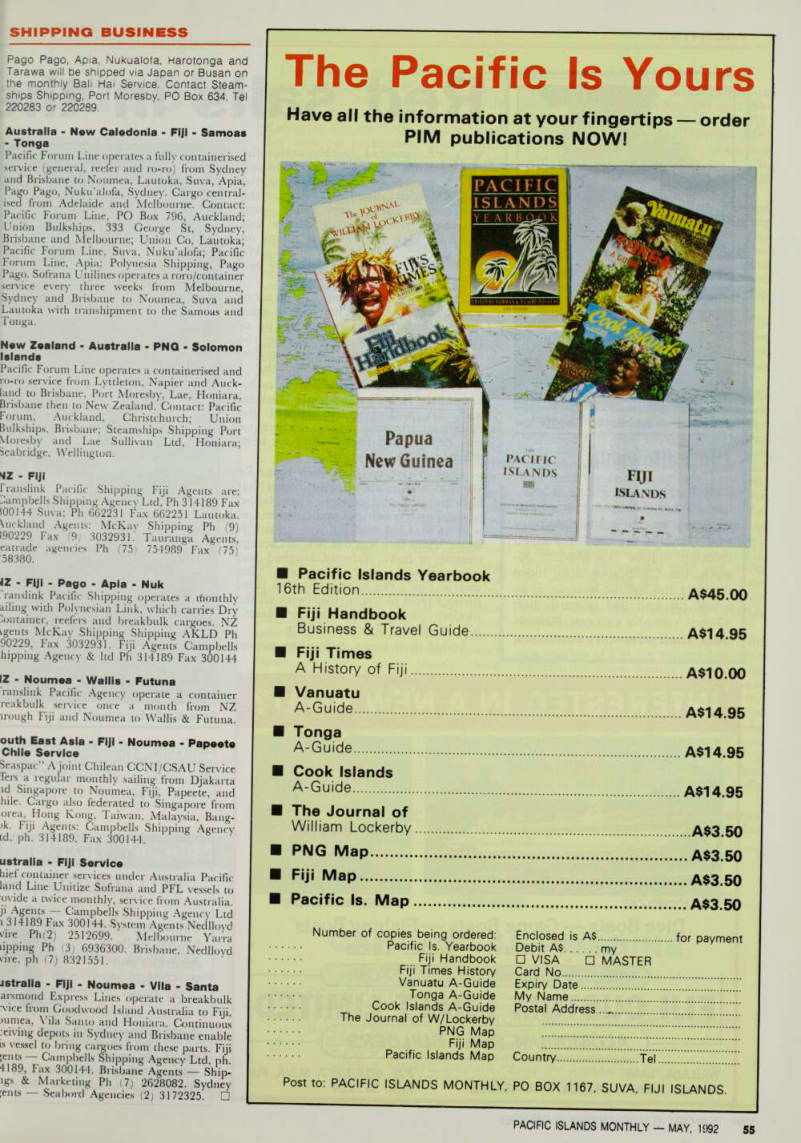
New Zealand - Fiji direct Sofrana Unilines operates a fully containerised/breakbulk service every 21 days from Auckland, Tauranga, Lyttleton to Suva and Lautoka. Loading every 21 days, ro/ro service, containers - reefer. Contact Sofrana Unilines, Sofrana House, 101 Customs Street, Auckland, PO Box 3614, Fax (09) 393874, Ph (09) 773279, Tlx NZ 2313. Direct toll free line 0800 659-922, Contact Alan Foote. Sofrana Shipping Agencies, PO Box 921 Wellington, Tel (04) 725 661, Fax (04) 725 749, Tlx NZ 4769 Contact Steve Brannigan. Sofrana Unilines Agencies, PO Box 22046 Christchurch, tel (03) 667 180, Fax (03) 668 868, TLX NZ4769, Contact Tony Newell. Carpenters Shipping, Private Mail Bag, Suva, Fiji, Tel (679) 312244, Fax (679) 301572, Tlx FJ 2199. Sofrana Unilines, Suva, Fiji, Tel (679) 315645, Fax (679) 300057.
Australia - Fiji direct Sofrana Unilines operates a ro/ro container service every three weeks from Melbourne, Sydney, Brisbane, Lautoka and Suva. Contact Sofrana Unilines (Aust) Pty Ltd, PO Box Q 136,
Queen Victoria Building, Sydney, NSW 2000,
Australia. Tel (02) 2648944, Fax (02) 2676547, Tlx (71) A 170090, Contact Andrew McLachlin, Sam Attaway.
Carpenters Shipping, Suva, Tel (679) 312244, Fax (679) 301572. Sofrana Unilines Suva, Tel (679) 315 645, Fax (679) 300057. Carpenters Shipping, Lautoka, Tel (679) 63988, Fax (679) 64896. Sofrana Unilines, Lautoka Tel (679) 62921, Fax (679) 64896.
Australia - Fiji monthly service Sofrana Unilines (Australia) Pty Ltd operates a regular monthly service with MV Capitaine Wallis. Contact Sofrana Unilines, Sydney, Tel (02) 2648944, Tlx AA170090, Fax (02) 267-6547. Carpenters Shipping, Suva, Fiji, Tel (679) 312244, Fax (679) 301572, Sofrana Unilines, Suva, Fiji Tel (679) 315645, Fax (679) 300057. Carpenters Shipping, Lautoka, Tel (679) 63988, Fax (679) 64896. Sofrana Unilines, Lautoka, Fiji, Tel (679) 62921, Fax (679) 64896.
Far-East - Fiji - New Zealand Service New Zealand Unit Express (NZUE) operates a monthly service accepting containerised and break-bulk cargoes from Manila, Keelung, Kaoshiung, Hong Kong, Lae to Suva, Lautoka (via Suva) and thence to New Zealand ports.
Contact Carpenters Shipping Suva, Fiji, tel (679) 312244, fax (679) 301572. New Zealand Unit Express, Maritime Building, 2-10 Customs House Quay, PO Box 890, Wellington. Tel 727865, Cables Enzue Man, Wellington, Tlx NZ31340 Nedlnz or Nedlloyd Swire Pty Ltd, Sydney, Tel 20522.
Japan - South Pacific Service Same as Burns Philp Japan - South Pacific Service - Kyowa Shipping Co Ltd Kyowa Shipping, Shipping Co Ltd provides a monthly containerised service from Hong Kong to main ports of Japan, Saipan, Guam, Island ports, Lautoka, Suva via Nukualofa to Pago
Pago and Apia. Contact Carpenters Shipping,
Neptune House, 3/4 floor, Tofuaa Street, Walu
Bay, Suva. Tel 312244, Fax 301572, Tlx FJ2199.
Europe - Pacific Service Nedlloyd offers cargo services from Continen tal Ports to Papeete, Fiji, New Caledonia and Doniambo on slot basis with Bank line. Contact Nedlloyd (Aust) Pty Ltd, Spring Street, Sydney, Tel 273801. Carpenters Shipping, Suva, tel 312244, Tlx FJ2199, Fax 301572. Carpenters Shipping, Lautoka, Tel 63988, Tlx FJ5215, Fax 64896.
South East Asia - Fiji Service Nedlloyd Lines (NZEAS) Service operates regular fast cargo service from Jakarta, Pt
Keelang, Singapore, Bangkok, Surubaya via
Auckland to Suva and Lautoka. Contact Carpenters Shipping, Suva, Tel 312244, Tlx FJ2199, Fax 301572. Carpenters Shipping, Lautoka Tel 63988, Tlx FJ5215, Fax 63988 South East Asia - Mid South pacific Columbus Line operates a regular container and breakbulk-heavy lift service from/to
Hongkong/Taiwan/Manila/Singapore/Malay
sia/Thailand/Indonesia to Port Moresby/Lae/
Rabaul/Kimbe/Madang/Newark/Honiara and
Noro. Contact Express Freight, Lae, POB 3398, phone 423913 or 423822, fax 425193.
Far East - Mid South Pacific China Navigations New Guinea Pacific Line operates a regular container and breakbulk heavy lift service from Hong Kong, Taiwan, Manila, Singapore, Malaysia, Thailand to Port Moresby, Lae, Rabaul, Kieta and Honiara.
Cargo from the same eastern ports to the South Pacific Ports of Noumea, Santo, Vila, Papeete,
Pago Pago, Apia, Nukualofa, Harotonga and Tarawa will be shipped via Japan or Busan on the monthly Bali Hai Service. Contact Steam ships Shipping, Port Moresby, PO Box 634, Tel 220283 or 220289.
Australia - New Caledonia - FIJI - Samoas - Tonga Pacific Forum Line operates a fully containerised service (general, reefer and ro-ro) from Sydney and Brisbane to Noumea, Lautoka, Suva, Apia, Pago Pago, Nuku’alofa, Sydney. Cargo central ised from Adelaide and Melbourne. Contact: Pacific Forum Line, PO Box 796, Auckland; Union Bulkships, 333 George St, Sydney, Brisbane and Melbourne; Union Co, Lautoka; Pacific Forum Line, Suva. Nuku’alofa; Pacific Forum Line, Apia; Polynesia Shipping, Pago Pago. Sofrana Unilines operates a roro/container service every three weeks from Melbourne, Sydney and Brisbane to Noumea, Suva and Lautoka with transhipment to the Samoas and Tonga.
New Zealand - Australia - PNQ - Solomon Islands Pacific Forum Line operates a containerised and ro-ro service from Lyttleton, Napier and Auck land to Brisbane, Port Moresby, Lae, Honiara, Brisbane then to New Zealand. Contact: Pacific Forum, Auckland, Christchurch; Union Bulkships, Brisbane; Steamships Shipping Port Moresby and Lae Sullivan Ltd, Honiara;
Seabridge, Wellington.
MZ - Fiji Franslink Pacific Shipping Fiji Agents are: Campbells Shipping Agencv Ltd, Ph 314189 Fax 100144 Suva; Ph 662231 Fax 662251 Lautoka.
Auckland Agents: McKay Shipping Ph (9) 190229 Fax (9 3032931.' Tauranga Agents, eatrade agencies Ph (75) 754989 Fax (75) 58380, |Z - FIJI - Pago - Apia - Nuk Tanslink Pacific Shipping operates a monthly ailing with Polynesian Link, which carries Dry Container, reefers and brcakbulk cargoes. NZ vgents McKay Shipping Shipping AKLD Ph 90229, Fax 3032931. Fiji Agents Campbells hipping Agency & ltd Ph 314189 Fax 300144 IZ - Noumea - Wallis - Futuna ranslink Pacific Agency operate a container reakbulk service once a month from NZ trough Fiji and Noumea to Wallis & Futuna. outh East Asia - FIJI - Noumea - Papeete Chile Service Seaspac” A joint Chilean CCNI/CSAU Service Ters a regular monthly sailing from Djakarta id Singapore to Noumea, Fiji, Papeete, and hile. Cargo also federated to Singapore from orea, Hong Kong, Taiwan, Malaysia, Bang )k. Fiji Agents; Campbells Shipping Agency td, ph. 314189. Fax 300144. X ustratia - FIJI Service hief container services under Australia Pacific land Line Unitize Sofrana and PFL vessels to ovide a twice monthly, service from Australia, ji Agents Campbells Shipping Agency Ltd i 314189 Fax 300144. System Agents Nedlloyd vire Ph(2) 2512699. Melbourne Yarra upping Ph (3) 6936300. Brisbane. Nedlloyd ure, ph (7) 8321551. jstralia - FIJI - Noumea - Vila - Santa arsmond Express Lines operate a brcakbulk •vice from Goodwood Island Australia to Fiji, nunea, Vila Santo and Honiara. Continuous eivmg depots in Sydney and Brisbane enable is vessel to bring cargoes from these parts. Fiji jents Campbells Shipping Agency Ltd. ph. 4189, Fax 300144. Brisbane Agents Ship igs & Marketing Ph (7j 2628082. Sydney rents Seabord Agencies (2) 3172325. □
Advertisements & other items, pp. 56-57 (1 item)
On The Energy Of Boral
THE PACIFIC ISLANDS RELY
All through the Pacific Islands, people rely on Boral Speed-E-Gas LP Gas for their energy needs.
Boral has terminals throughout the area, and is proud to be a leading supplier.
Speed-E-Gas is clean, efficient and low in cost.
It’s the ideal energy source for cooking and water heating in homes, motels and hotels, and for a wide range of industrial uses.
So call Boral. We have the energy you’re ’ooking for. *■« Norfolk Islands Norfolk Island 2419 Papua New Guinea Port Moresby 214248 Lae 422574 Rabaul 921225 Wewak 862125 Cook Islands Rarotonga 24460 American Samoa Pago Pago 699 2948 Tonga Nukualofa 24035 Suva 315522 Lautoka 60088 Sigatoka 50578 Labasa 82973 Vanuatu Santo 36455 Port Vila 22046
BORAL GAS
Solomon Islands Honiara 21833 Boral Gas Pacific, John Oxley Centre. 339 Coronation Dave. Brisbane. Tel: (07) 3671365
The Pacific Is Yours
Have all the information at your fingertips order PIM publications NOW!
, O V’HSN V
. V v ' -v
PACIFIC
ISLANDS
\ m>x ■ m y m K
Papua
New Guinea ■ Pacific Islands Yearbook 16th Edition ■ Fiji Handbook Business & Travel Guide ■ Fiji Times A History of Fiji ■ Vanuatu A-Guide ■ Tonga A-Guide ■ Cook Islands A-Guide ■ The Journal of William Lockerby ■ PNG Map ■ Fiji Map ■ Pacific Is. Map A 545.00 A 514.95 Aslo.oo A 514.95 A 514.95 A 514.95 A 53.50 . A 53.50 . A 53.50 . A 53.50 Number of copies being ordered: Enclosed is A$ for payment Pacific Is. Yearbook Debit A$ my Fiji Handbook □ VISA □ MASTER •• • • Fiji Times History Card No •■ • Vanuatu A-Guide Expiry Date ••• Tonga A-Guide My Name Cook Islands A-Guide Postal Address The Journal of W/Lockerby PNG Map Fiji Map Pacific Islands Map Country te1...
Post to: PACIFIC ISLANDS MONTHLY, PO BOX 1167. SUVA, FIJI ISLANDS.
Red sails in the sunset
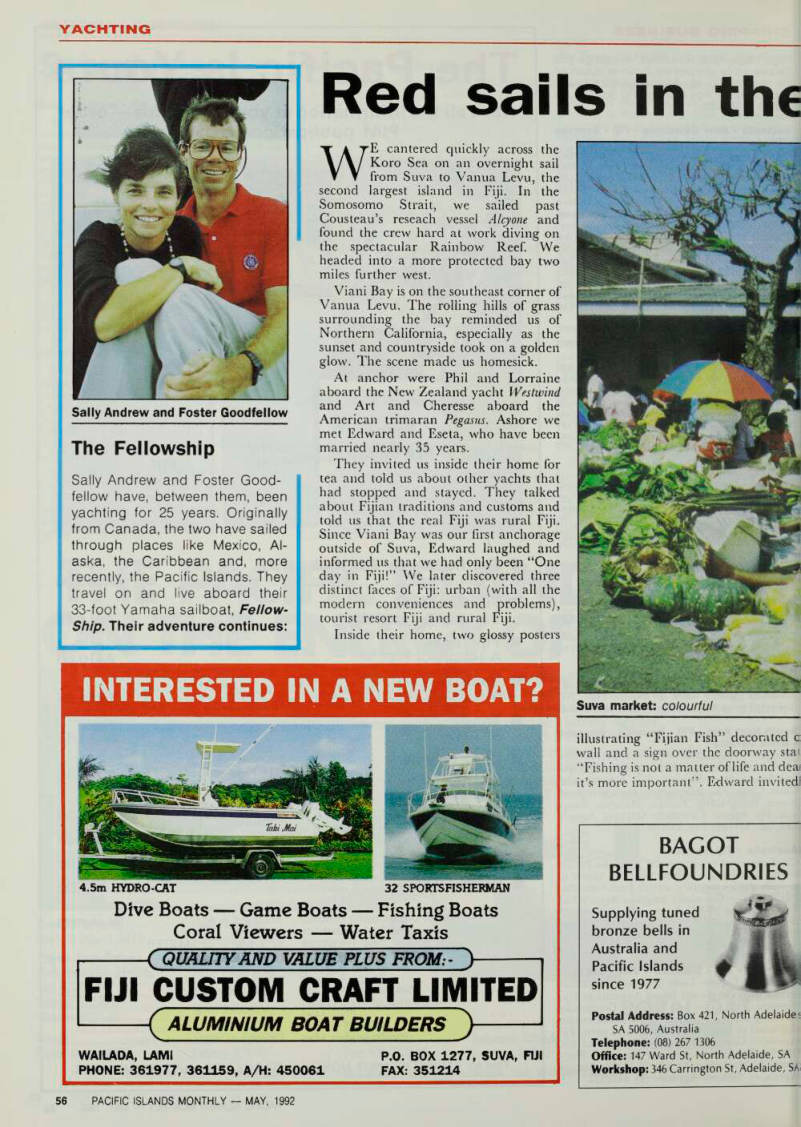
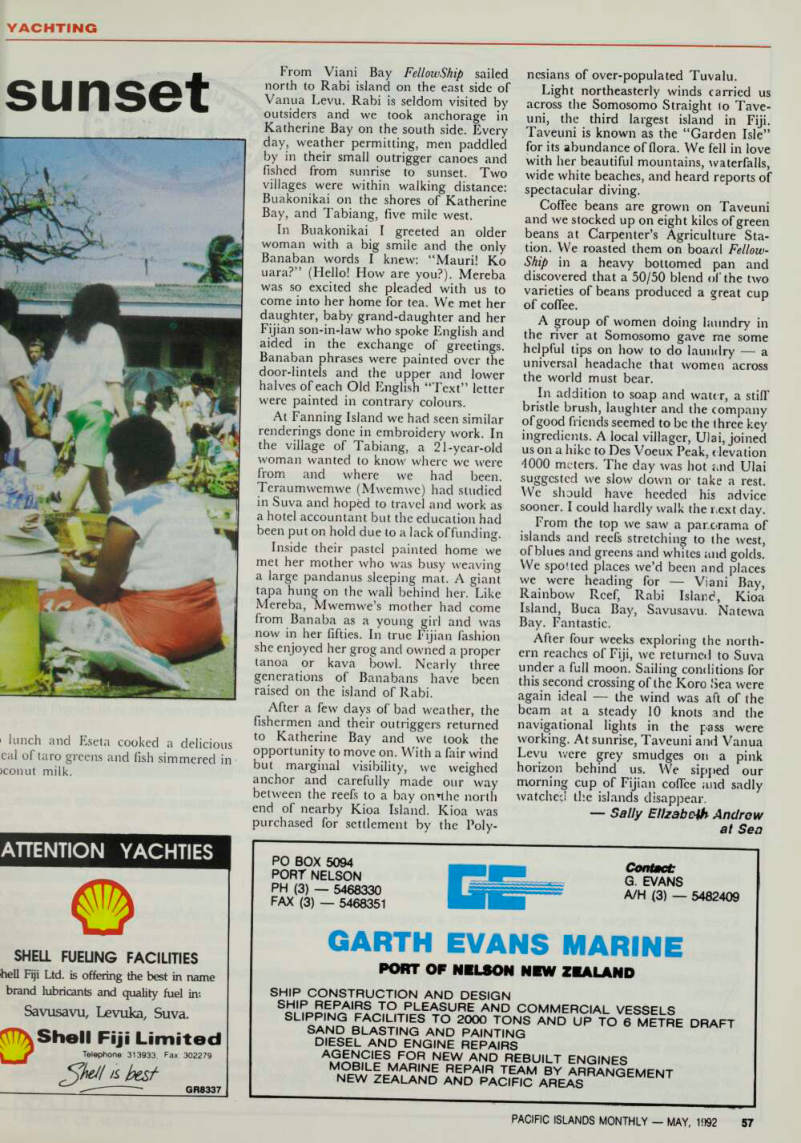
The Fellowship
Sally Andrew and Foster Good fellow have, between them, been yachting for 25 years. Originally from Canada, the two have sailed through places like Mexico, Al aska, the Caribbean and, more recently, the Pacific Islands. They travel on and live aboard their 33-foot Yamaha sailboat, Fellow ship. Their adventure continues:
WE cantered quickly across the Koro Sea on an overnight sail from Suva to Vanua Levu, the second largest island in Fiji. In the Somosomo Strait, we sailed past Cousteau’s reseach vessel Alcyone and found the crew hard at work diving on the spectacular Rainbow Reef. We headed into a more protected bay two miles further west.
Viani Bay is on the southeast corner of Vanua Levu. The rolling hills of grass surrounding the bay reminded us of Northern California, especially as the sunset and countryside took on a golden glow. The scene made us homesick.
At anchor were Phil and Lorraine aboard the New Zealand yacht Westwind and Art and Cheresse aboard the American trimaran Pegasus. Ashore we met Edward and Eseta, who have been married nearly 35 years.
They invited us inside their home for tea and told us about other yachts that had stopped and stayed. They talked about Fijian traditions and customs and told us that the real Fiji was rural Fiji.
Since Viani Bay was our first anchorage outside of Suva, Edward laughed and informed us that we had only been “One day in Fiji!” We later discovered three distinct faces of Fiji: urban (with all the modern conveniences and problems), tourist resort Fiji and rural Fiji.
Inside their home, two glossy posters
illustrating “Fijian Fish” decorated c wall and a sign over the doorway stai “Fishing is not a matter of life and deal it’s more important”. Fxlward invitedl
Sally Andrew and Foster Goodfellow
Suva market: colourful
* lunch and Eseta cooked a delicious cal of taro greens and fish simmered in >conut milk.
From Viani Bay Fellowship sailed north to Rabi island on the east side of Vanua Levu. Rabi is seldom visited by outsiders and we took anchorage in Katherine Bay on the south side. Every day, weather permitting, men paddled by in their small outrigger canoes and fished from sunrise to sunset. Two villages were within walking distance: Buakonikai on the shores of Katherine Bay, and Tabiang, five mile west.
In Buakonikai I greeted an older woman with a big smile and the only Banaban words I knew: “Mauri! Ko uara?” (Hello! How are you?). Mereba was so excited she pleaded with us to come into her home for tea. We met her daughter, baby grand-daughter and her Fijian son-in-law who spoke English and aided in the exchange of greetings.
Banaban phrases were painted over the door-lintels and the upper and lower halves of each Old English “Text” letter were painted in contrary colours.
At Fanning Island we had seen similar renderings done in embroidery work. In the village of Tabiang, a 21-year-old woman wanted to know where we were from and where we had been.
Teraumwemwe (Mwemwc) had studied in Suva and hoped to travel and work as a hotel accountant but the education had been put on hold due to a lack offending.
Inside their pastel painted home we met her mother who was busy weaving a large pandanus sleeping mat. A giant tapa hung on the wall behind her. Like Mereba, Mwemwe’s mother had come from Banaba as a young girl and was now in her fifties. In true Fijian fashion she enjoyed her grog and owned a proper tanoa or kava bowl. Nearly three generations of Banabans have been raised on the island of Rabi.
After a few days of bad weather, the fishermen and their outriggers returned to Katherine Bay and we took the opportunity to move on. With a fair wind but marginal visibility, we weighed anchor and carefully made our way between the reefs to a bay on*the north end of nearby Kioa Island. Kioa was purchased for settlement by the Poly
nesians of over-populated Tuvalu.
Light northeasterly winds carried us across the Somosomo Straight lo Tave uni, the third largest island in Fiji.
Taveuni is known as the “Garden Isle” for its abundance of flora. We fell in love with her beautiful mountains, waterfalls, wide white beaches, and heard reports of
spectacular diving.
Coffee beans are grown on Taveuni and we stocked up on eight kilos of green beans at Carpenter’s Agriculture Sta tion. We roasted them on board Fellow ship in a heavy bottomed pan and discovered that a 50/50 blend of the two varieties of beans produced a great cup of coffee.
A group of women doing laundry in the river at Somosomo gave me some helpful lips on how to do laundry a universal headache that women across the world must bear.
In addition to soap and water, a stiff' bristle brush, laughter and the company of good friends seemed to be the three key ingredients. A local villager, U)ai, joined us on a hike to Des Voeux Peak, elevation 4000 meters. The day was hot and Ulai suggested we slow down or take a rest.
We should have heeded his advice sooner. I could hardly walk the next clay.
From the top we saw a panorama of islands and reefs stretching to the west, of blues and greens and whites and golds.
We spotted places we’d been and places we were heading for Viani Bay, Rainbow Reef, Rabi Island, Kioa Island, Buca Bay, Savusavu. Natewa
Bay. Fantastic.
After four weeks exploring the north ern reaches of Fiji, we returned to Suva under a full moon. Sailing conditions for this second crossing of the Koro Sea were again ideal the wind was aft of the beam at a steady 10 knots and the navigational lights in the pass were working. At sunrise, Taveuni and Vanua Levu were grey smudges on a pink horizon behind us. We sipped our morning cup of Fijian coffee and sadly watched the islands disappear.
Sally Elizabeth Andrew at Sea
Advertisements & other items, pp. 58-62 (1 item)
(Aluminium Boat Jilders )
INTERESTED IN A NEW BOAT?
13 Tab.
Mm
4.5 m HYDRO-CAT
32 SPORTSFISHERMAN
Dive Boats Game Boats Fishing Boats
Coral Viewers Water Taxis
< QUALITY AND VALUE PLUS FROMT~)-
FIJI CUSTOM CRAFT LIMITED
(ALUMINIUM BOAT JILDERS )
WAILADA, LAMI
PHONE; 361977, 361159, A/H: 450061
P.O. BOX 1277, SUVA, FIJI
FAX: 351214
BAGOT
BELLFOUNDRIES
since 1977 Postal Address: Box 421, North Adelaides SA 5006, Australia Telephone: (08) 267 1306 Office: 147 Ward St, North Adelaide, SA Workshop: 346 Carrington St, Adelaide, SA Supplying tuned bronze bells in Australia and Pacific Islands
ATTENTION YACHTIES
SHELL FUEUNG FACILITIES
hell Fiji Ltd. is offering the best in name brand lubricants and quality fuel in: Savusavu, Levuka, Suva. © Shell Fiji Limited Telephone 313933, Fax 302279 is. hesf < y GR8337
PO BOX 5094
PORT NELSON
PH (3) 5468330
FAX (3) 5468351
Contact
G. EVANS
A/H (3)
GARTH EVANS MARINE
PORT OF NELSON NEW ZEALAND
SHIP CONSTRUCTION AND DESIGN
PLEASURE and commercial vessels SLIPPING FACILITIES TO 2000 TONS AND UP TO 6 METRE
SAND BLASTING AND PAINTING
DIESEL AND ENGINE REPAIRS
FOR NEW AND REBUILT ENGINES
'%szeaSS£ a B r Y eas RANGEMENT 5482409
DRAFT
sopnc
SOUTH PACIFIC APPLIED GEOSCIEN
VACANCIES
Applications are invited from nationals of SOPAC member countries for the following positions located in Suva, Fiji. 07
OMI^ON
.4 V ★ echnical Secretariat,
COASTAL GEOLOGIST
The Coastal Geologist is responsible for conducting detailed studies of geological processes in coastal and nearshore areas to assist with coastal development planning and mineral resource management.
COASTAL ENGINEER
The Coastal Engineer is responsible for the collection and interpretation of oceanographic data from coastal areas to assist with development planning, for advice on coastal stability, cyclone impact, protection structures and harbour development, and for training activities in these fields.
MARINE GEOLOGIST
The Marine Geologist is responsible for assessment of detrital minerals and construction material potential in coastal and nearshore areas, collection and interpretation of geophysical and geological data, including seabed mapping, for coastal development projects, and for training activities in these fields.
TRAINING CO ORDINATOR
The Training Co-ordinator is responsible for the development and implementation of the SOPAC Training Programme which includes a Certificate Programme in Earth Science and Marine Geology, Scholarship Scheme, Fellowship Scheme, Workshop and Seminars.
ELECTRONICS ENGINEER
The Electronics Engineer is responsible for maintaining geophysical, navigation, computing and communications equipment; fabricating specialised electronic survey equipment; developing software packages for field data processing; carrying out coastal and nearshore field surveys; providing technical advice to SOPAC scientists and member country staff; conducting training activities: and supervising three electronics technicians.
ENVIRONMENTAL ENGINEER/GEOLOGIST
The Environmental Epgineer/Geologist is responsible for conducting detailed studies of coastal and nearshore areas including physical oceanography and coastal sedimentology, and conducting site studies to provide engineering and environmental information to ensure that coastal developments will be environmentally sound.
SOPAC
SOPAC is an intergovernmental organisation comprising fourteen South Pacific countries as members* with one associate member. The primary objective of SOPAC is to assist its member countries in the identification and assessment of the marine mineral and other non-living resource potential of their offshore areas within their respective national Exclusive Economic Zones, in the planning and management of development in their coastal areas, and in the training of their nationals in all relevant areas within the SOPAC Work Programme.
REMUNERATION
An attractive remuneration package will be offered in accordance with the SOPAC terms and conditions of employment depending on qualifications, experience and prevailing salary levels in country of recruitment.
For an appointee from outside Fiji, salary will be supplemented by an establishment grant, housing allowance, child allowance and education assistance, and remuneration will be exempted from Fiji income tax.
Further information may be obtained from the Finance & Administration Controller on Telephone (679) 381-377 or Fax: (679) 370-040.
Details of general terms and conditions of employment will be mailed on request.
QUALIFICATIONS
A post graduate degree in the relevant field from a recognised university, between 5-10 years professional experience, and proficiency in oral and written English.
APPLICATION
All applications should be fully documented and include relevant details of qualifications and experience, and names of three referees.
Applications, clearly indicating the position being applied for, should be addressed to the Director, SOPAC Technical Secretariat, Private Mail Bag, Suva, Fiji.
The deadline for applications is 15th June 1992. * SOPAC member countries are: Australia, Cook Islands, Fiji, Federated States of Micronesia, Guam, Kiribati, New Zealand, Marshall Islands, Papua New Guinea, Solomon Islands, Tonga, Tuvalu, Vanuatu, Western Samoa. Associate member New Caledonia. 104591V2
PACIFIC
ISLANDS
f~M O N T H L Y MfifiK€T PlfiCe
For the benefit of our readers who would like to place a small classified advertisement in our magazine, Market Place will assist you in selling personal items, accommodation, real estate boating or a service ... in fact anything you would like to sell to our over 50,000 readers Market Place Advertising Rates are structured to allow you to place as many advertisements as you wish, economically.
FISHING VESSEL
124) PROCESSING FISHING VESSEL, built
.987, aluminium, 95’ (28m), DNV Class, very ood accommodation for 15, Cat main engine, efrig comprises blast tunnel, glazing room, ackaging room and 3 large storage freezers.
HARTER CRAFT MARINE, BC/15 Tedder Av,
lain Beach Q 4217 Australia. Phone 1-75-916334 Fax 61-75-329788
BARGE FOR SALE
U 5) LANDING BARGE, 90’ (27m), carrying ipacity 120 tons. Twin GM BV7I main igines, good accom, large fuel & water cargo
ipacity. CHARTER CRAFT MARINE, BC/15
idder Av, Main Beach, Q 4217 Aust. Ph.
L-75-916334 Fax 61-75-329788.
BOOKS
bliophile, a secondhand bookshop in Sydney, keen to buy good books on the Pacific. Also, rrent book catalogue “Pacific & Southeast ia” now available free on request, bliophile, 24 Glenmore Road, Paddington, >W 2021, Australia. Ph. 61 2 331 1411 x 61 2 361 3371.
YACHT
uising Yacht required. Late 92 Ex Canton to plore Phoenix Group. Share cost basis. For >re info. D. Miles, 306 Highsted Road, ristchurch 5, New Zealand.
WANTED
■ are seeking an AGENT in your area to
Dply VEGETABLE IVORY NUT PALM SEEDS,
snt would be required to supervise colleci, drying and bagging for export. For further Drmation contact: D. WILKINSON, PO BOX
'''OUTH
988, acific, Nation Auck- -64-9)
LIBRARY OF AUSTRALIA
NATIOIVAF
NEW BOOK!
TAKE NECESSARY ACTION authors Chris & Louise Harkness ex PNG. Available from publishers: Robert Brown & Assoc. 7 Atherton St Buranda Qld 4102 Australia. Hardcover 352 pages. Exciting PNG Highlands Fiction set pre-Independence era. $24.95 plus postage $5 Aust. $9.50 Overseas.
CONSULTANT
Resort Consultant, increase your profits with our on-site Management and Marketing.
Resortcorp, PO Box 2292, Kamuela, Hawaii 96743.
SCRAP METAL
Tall ingots operate from Brisbane, Australia and make frequent visits to the Pacific Islands which they have done for twenty-five years. We are buyers of Copper, Brass, Aluminium, Lead, Cable etc. Inspection no problems. Telephone 61 7 8922033. Fax 61 78922077.
EXECUTIVE POSITION REQUIRED
Australian Citizen, with Comprehensive Experience in Financial & Personnel Management and in Sales & Marketing in the South Pacific; previously responsible for purchasing, warehousing, large scale distribution programs for multiple location operations; extensive knowledge of import & export trades in South Pacific, S.E. Asia and North America.
Ten years experience in expatriate positions with excellent references available. Long term contract preferred.
All enquiries in strict confidence to: The Candidate P.O. Box 599 Burwood, N.S.W. 2134 Australia.
TRAVEL GUIDES
Australian citizen planning to move to Fiji early 1993 seeks partnership or purchase small business in tourism or manufacturing preferably in western district.
Have considerable business experience and used to hard work.
Visiting Fiji July/August 1992.
John Gardner, 1/43 Beach Rd, Brighton SA 5048 Australia.
FOR SALE
MOTOR TUG WIRANA'
Built in Australia 1971 LO.A. 32.83 M, Beam 8.94 M, Grt 316.85, Propulsion English Electric Diesel, 12-Cylinder, 2640 BHP at 900 RPM, Free running speed about 14KN, Fuel capacity 170,000 litres, Single variable pitch propeller 26 ton bollard pull, fitted with towing winch, classed DNV 1 A 1 tug.
Vessel Inspectable Cairns, North Queensland.
Sellers seeking prompt sale ‘As is where is’
PACIFIC
SLANDS
M O N T H L r~|
MRRKCT PLRCC CRN UJORK
WONDCRS FOR VOU ...
Promote your business, or service, sell your household
items, cars or heavy machinery
etc.
ONLY AUSSI PER WORD.
NO COMPANY LOGO. NO
DISPLAY. NO BOLD TYPE.
Just forward your Advertisement together with payment to: PACIFIC ISLANDS MONTHLY "Market Place”, P.O. Box 1167, Suva, Fiji.
CONDITIONS:
1. All Advertisements are subject to acceptance and approval of publisher. 2. Advertisements are published as space permits: we cannot guarantee date of insertion. 3. All advertisements must be prepaid and should be typed or printed clearly. 4. Deadline for receipt of advertisements is the 10th of the month prior to issue.
5. PACIFIC ISLANDS MONTHLY
assumes no responsibility for any service other than publishing paid advertisements in this section.
We put
a lot of thought into
our first car.
?AO
75 years later,
our cars
think a lot about you.
They were shipbuilders. Probably the best in their time. But this elite team of engineers wouldn’t stop at conquering the sea.
In a special part of their workshop, a dream was taking shape. A peculiar, motor-driven buggy that would run smoother and handle better than any horseless carriage ever had. In fact, the prototype was so successful that they assembled twenty more making the 1917 Mitsubishi Model-A Japan’s first series production ear.
That moment made Japanese motor vehicle history, and launched Mitsubishi’s 75 year tradition of automotive firsts. But while the same spirit of innovation lives on, it has evolved into much more than a knack for advanced engineering. At Mitsubishi today, automotive innovation is the discovery of new and unexpected ways to enhance the relationship between cars and people. And between technology and our earth.
Driver and passenger safety as touchstones for every new idea. Cleanliness and conservation as ultimate virtues to pursue. These are but some of the arenas where Mitsubishi designers and engineers demonstrate their commitment to human and environment-conscious innovation. And their achievements continue to include important industry firsts each refueling the same pride and determination that propelled those ambitious shipbuilders so long ago J ANNIVERSARY AMERICAN SAMOA. PACIFIC MARKETING INC, PO Box 698. Pago Pago, Tel 699-9140 / AUSTRALIA; MITSUBISHI MOTORS AUSTRALIA LTD. 1284 South Road, Clovelly Park, South Australia, Tel (08) 2757297 / FIJI: NIVIS MOTOR 8 MACHINERY CO. LTD. G.RO. Box 150. Suva. Tel. 383411 / GUAM: GUAM INTERNATIONAL MOTORS INC. PO. Box 8638, Tamunmg Guam, Tel. 6467622 / NEW CALEDONIA: SOCIETE DTMPORTATION D’AUTO DU PACIFIQUE SUD S.A. PO Box 2548, Noumea, Tel. 274 144 / NEW ZEALAND: MITSUBISHI MOTORS NEW ZEALAND LTD. Private Bag. Pofirua, Tel 237-0109 / NORFOLK ISLAND: BORRY’S PTY LTD. PO. Box 169, Tel 2114 / PAPUA NEW GUINEA: TOBA PTY LTD. PO Box 503, Port Moresby.
Tel. 217-874 / SAIPAN: E SAIPAN MOTORS INC. PO Box 569, Tel 234 7343 / SOLOMON ISLANDS: HARVEST PACIFIC LTD. GPO 80x823, Honiara, Tel 30407 / TAHITI (FRENCH POLYNESIA): SOPADEPSA. PO Box 1617, Papeete, Tel 427393 / TONGA: SITANI MAPI CO., LTD. PO Box 83. Nuku Alola. Tel 24044 / VANUATU: SOCOMETRA VANUATU LTD. B P 06, Route de Lagon, Port-Vila. Tel 2314 / WESTERN SAMOA; MOTOR DISTRIBUTORS (SAMOA) LTD. PO Box 576, Apia, Tel. 20957 A
MITSUBISHI
MOTORS