Pacific
Islands
Monthly
April 1992
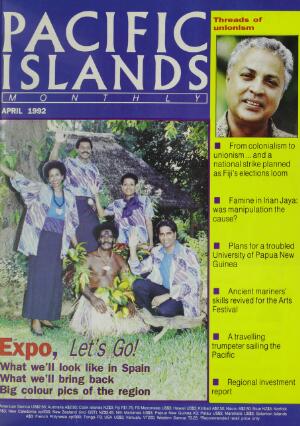
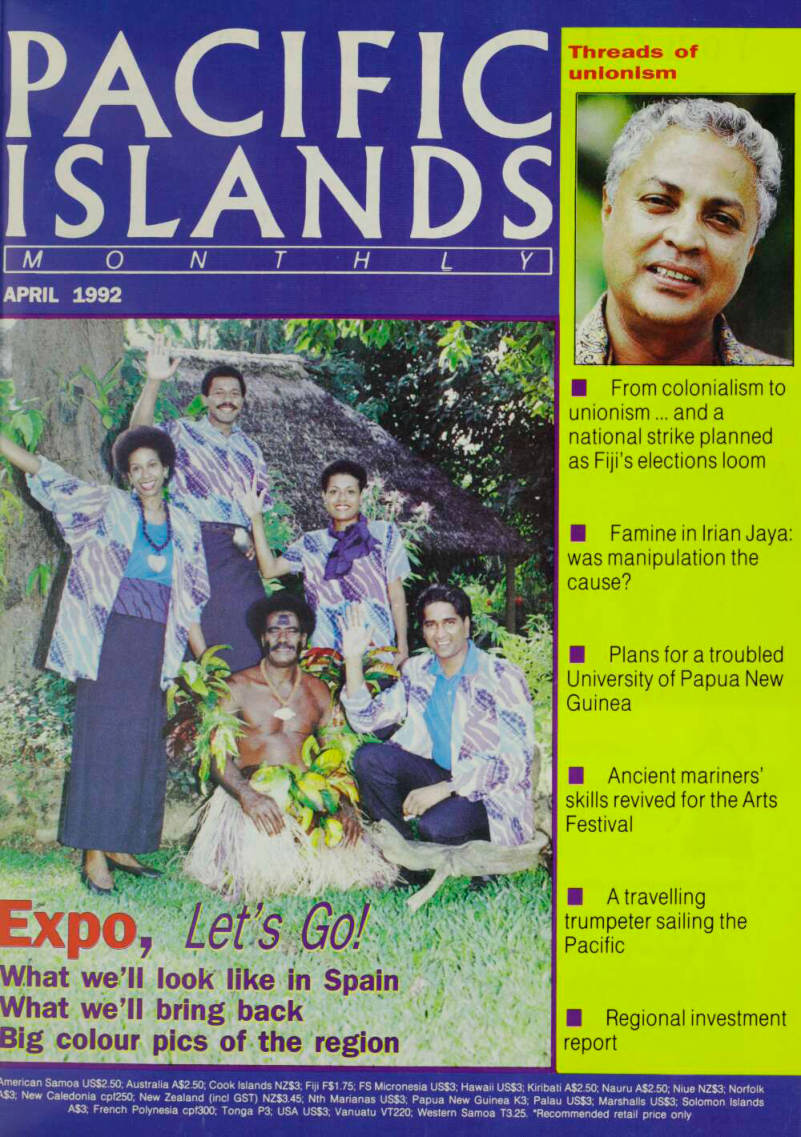
Expo, ‘Let's Go!
What we’ll look like in Spam What we’ll bring back Big colour pics of the region
Threads of unionism
■ From colonialism to unionism... and a national strike planned as Fiji's elections loom ■ Famine in Irian Jaya: was manipulation the cause? ■ Plans for a troubled University of Papua New Guinea ■ Ancient mariners’ skills revived for the Arts Festival ■ A travelling trumpeter sailing the Pacific ■ Regional investment report
™ ?? moa uss2 s°; Australia A 52.50; Cook Islands NZ$3; Fiji F 51.75; FS Micronesia US$3; Hawaii US$3; Kiribati A 52.50; Nauru A 52.50; Niue NZ$3; Norfolk $3, New Caledonia cpf2so; New Zealand (incl GST) NZ53.45; Nth Marianas US$3; Papua New Guinea K 3; Palau US$3; Marshalls US$3 - Solomon Islands As 3; French Polynesia cpf3oo; Tonga P 3; USA US$3; Vanuatu VT22O; Western Samoa T 3.25. ‘Recommended retail price only
Advertisements & other items, p. 2 (1 item)
Your Island Connections
f *
Cable and Wireless began keep-
ing people in touch around the
world more than a century ago. Today,
while the technology has changed,
the tradition of service to our customers in the
South Pacific is just the same.
We work in partnership with Governments,
dedicated to meeting the need of communities and businesses to stay in touch. From one island to the next or to the other side of the world, the message is the same: Cable and Wireless is
your South Pacific connection bringing the
islands together.
CABLE & WIRELESS
THE WORLD TELEPHONE COMPANY
Asia Pacific Head Office Cable and Wireless pic Cable and Wireless (Pacific) Limited 22 nd Floor Office Tower Convention Plaza 1 Harbour Road Hong Kong Tel: i'Bs2) 848 8723 Facsimile: (852) Bf>B 5200 Australia Cable and Wireless (Australia) Pty. Ltdr Level 66, M L C. Centre 19 Martin Place Sydney
NSW 2000
Tel: (61-2) 2382252 Fiji In association with the Government of Fiji Fiji International Telecommunications Ltd.
P.O. Box 59 Mercury House 158 Victoria Parade Suva Fiji Tel: (679) 312933 Solomon Islands In association with the Government of the Solomon Islands Solomon Telekom Company Limited P.O. Box 148 Honiara Solomon Islands Tel: (677) 21576 Tonga Cable and Wireless pic Private Mail Bag 4 General Post Office Nuku Alofa Tonga South Pacific Tel: (676) 23499 Vanuatu In association with the Government of Vanuatu and France Cables et Radio Vanuatu International Telecommunications Ltd.
P.O. Box 164 Port Vila Vanuatu Tel: (678) 22185
Pacific
Islands
Monthly
Vol. 62 N 0.4
The News Magazine
April 1992
Sover Stories:
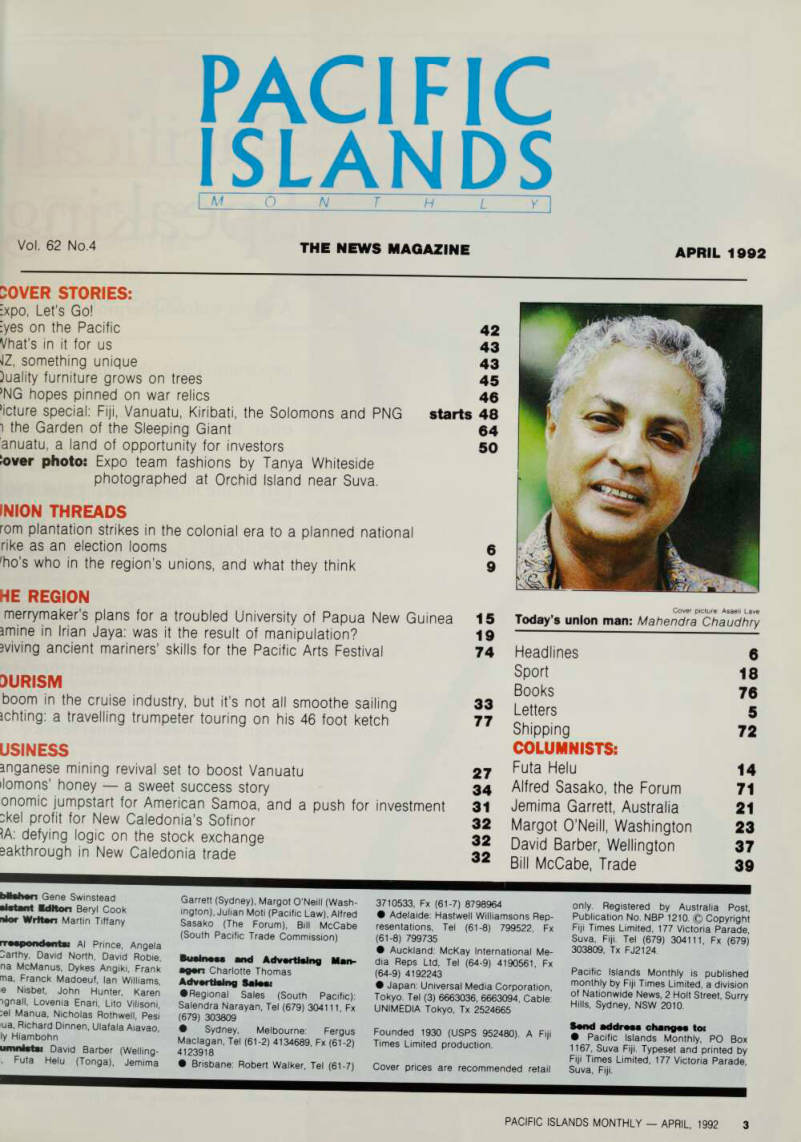
ixpo, Let’s Go! iyes on the Pacific 42 Vhat’s in it for us 43 JZ, something unique 43 Duality furniture grows on trees 45 J NG hopes pinned on war relics 46 *icture special; Fiji, Vanuatu, Kiribati, the Solomons and PNG starts 48 i the Garden of the Sleeping Giant 64 anuatu, a land of opportunity for investors 50 tover photo; Expo team fashions by Tanya Whiteside photographed at Orchid Island near Suva.
Inion Threads
rom plantation strikes in the colonial era to a planned national rike as an election looms 6 f ho’s who in the region’s unions, and what they think 9
He Region
merrymaker’s plans for a troubled University of Papua New Guinea 15 imine in Irian Jaya: was it the result of manipulation? 19 wiving ancient mariners’ skills for the Pacific Arts Festival 74
3Urism
boom in the cruise industry, but it’s not all smoothe sailing 33 ichting: a travelling trumpeter touring on his 46 foot ketch 77
Usiness
anganese mining revival set to boost Vanuatu 27 •lomons’ honey a sweet success story 34 onomic jumpstart for American Samoa, and a push for investment 31 -kel profit for New Caledonia’s Sofinor 32 defying logic on the stock exchange 32 sakthrough in New Caledonia trade 32
Headlines 6 Sport is Books 76 Letters 5 Shipping 72
Columnists:
Futa Helu 14 Alfred Sasako, the Forum 71 Jemima Garrett, Australia 21 Margot O’Neill, Washington 23 David Barber, Wellington 37 Bill McCabe. Trade 39
Mhhai Gene Swinstead Blatant Editor: Beryl Cook idor Wrften Martin Tiffany 'respondents: Al Prince, Angela Sarthy, David North, David Robie, na McManus, Dykes Angiki, Frank ma, Franck Madoeuf, lan Williams, e Nisbet, John Hunter, Karen ignall, Lovenia Enari, Lito Vilisoni, :el Manua, Nicholas Rothwell, Pesi ua, Richard Dinnen, Ulafala Aiavao, ly Hiambohn umnists: David Barber (Welling , Futa Helu (Tonga), Jemima
Garrett (Sydney). Margot O’Neill (Wash ington), Julian Moti (Pacific Law), Alfred Sasako (The Forum), Bill McCabe (South Pacific Trade Commission) Business and Advertising Man agar: Charlotte Thomas Advertising Salas: • Regional Sales (South Pacific); Salendra Narayan, Tel (679) 304111, Fx (679) 303809 • Sydney, Melbourne: Fergus Maclagan, Tel (61-2) 4134689, Fx (61-2) 4123918 • Brisbane: Robert Walker. Tel (61-7)
3710533, Fx (61-7) 8798964 • Adelaide: Hastwell Williamsons Rep resentations, Tel (61-8) 799522, Fx (61-8) 799735 • Auckland; McKay International Me dia Reps Ltd, Tel (64-9) 4190561, Fx (64-9) 4192243 • Japan: Universal Media Corporation, Tokyo. Tel (3) 6663036, 6663094, Cable: UNIMEDIA Tokyo, Tx 2524665 Founded 1930 (USPS 952480). A Fiji Times Limited production.
Cover prices are recommended retail
only. Registered by Australia Post, Publication No. NBP 1210. © Copyright Fiji Times Limited, 177 Victoria Parade, Suva, Fiji. Tel (679) 304111, Fx (679)
303809, Tx Fj2124.
Pacific Islands Monthly is published monthly by Fiji Times Limited, a division of Nationwide News, 2 Holt Street, Surry Hills, Sydney, NSW 2010.
SiHi address changes to: • Pacific Islands Monthly, PO Box 1167, Suva Fiji. Typeset and printed by Fiji Times Limited, 177 Victoria Parade, Suva, Fiji.
Cover picture: Asaeli Lave Today's union man: Mahendra Chaudhry
Advertisements & other items, pp. 4-5 (1 item)
Pacificall
A warm welcome is probably the rm important thing that any bank has offer. Being the biggest bank in Fiji a part of the largest banking group in Pacific may give us the edge in provid the best facilities for you locally internationally, but never at the expen of our individual personal service. Aft all, that is why we are where we s today. Here for you, ANZ Bank F Your bank.
Official Sponsor 1992 Olympic Team
CQO
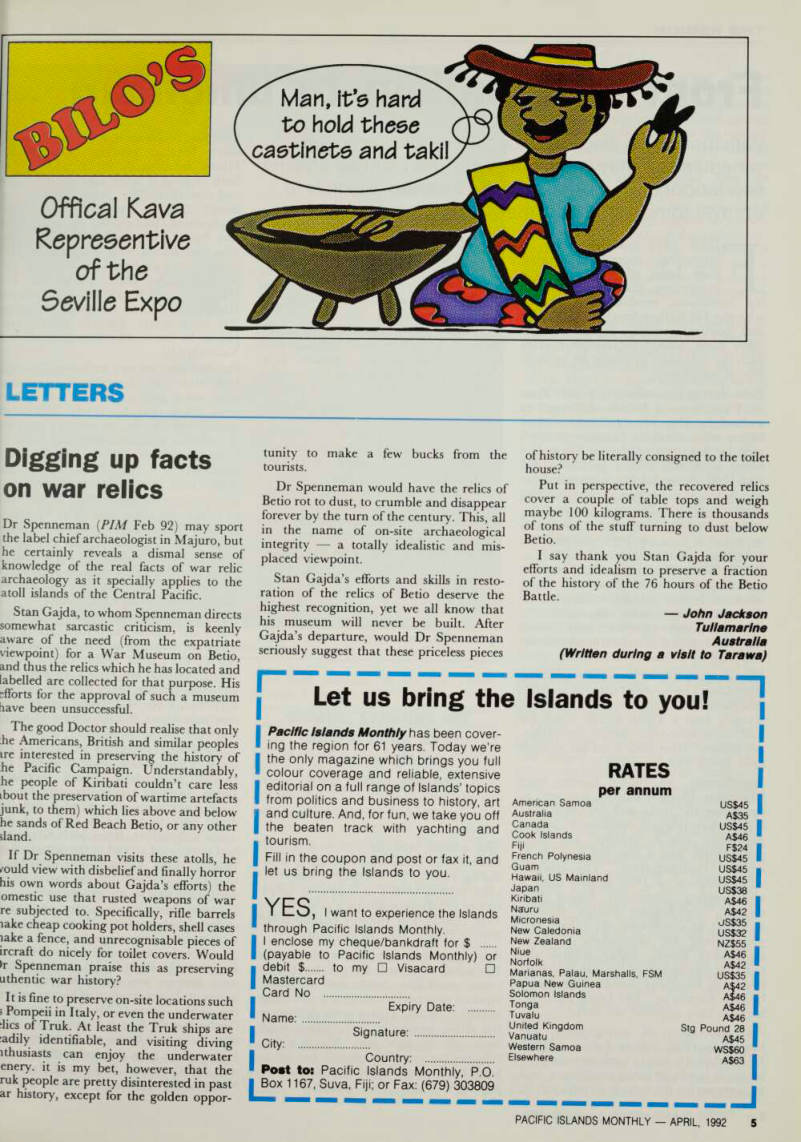
Off\ca\
Kepreeentive
of the
Seville Expo
Man, Its hard to hold these castinets and takil
Digging up facts
Letters
Digging up facts on war relics
Dr Spenneman (PIM Feb 92) may sport the label chief archaeologist in Majuro, but he certainly reveals a dismal sense of knowledge of the real facts of war relic archaeology as it specially applies to the atoll islands of the Central Pacific.
Stan Gajda, to whom Spenneman directs somewhat sarcastic criticism, is keenly aware of the need (from the expatriate viewpoint) for a War Museum on Betio, and thus the relics which he has located and labelled are collected for that purpose. His efforts for the approval of such a museum have been unsuccessful.
The good Doctor should realise that only he Americans, British and similar peoples ire interested in preserving the history of
he Pacific Campaign. Understandably,
he people of Kiribati couldn’t care less ibout the preservation of wartime artefacts junk, to them) which lies above and below he sands of Red Beach Betio, or any other sland.
If Dr Spenneman visits these atolls, he /ould view with disbelief and finally horror his own words about Gajda’s efforts) the omestic use that rusted weapons of war re subjected to. Specifically, rifle barrels lake cheap cooking pot holders, shell cases lake a fence, and unrecognisable pieces of ircraft do nicely for toilet covers. Would >r Spenneman praise this as preserving uthentic war history?
It is fine to preserve on-site locations such > Pompeii in Italy, or even the underwater :lics of Truk. At least the Truk ships are :adily identifiable, and visiting diving ithusiasts can enjoy the underwater enery. it is my bet, however, that the ruk people are pretty disinterested in past ar history, except for the golden oppor
tunity to make a few bucks from the tourists.
Dr Spenneman would have the relics of Betio rot to dust, to crumble and disappear forever by the turn of the century. This, all in the name of on-site archaeological integrity a totally idealistic and mis placed viewpoint.
Stan Gajda’s efforts and skills in resto ration of the relics of Betio deserve the highest recognition, yet we all know that his museum will never be built. After Gajda’s departure, would Dr Spenneman seriously suggest that these priceless pieces
of history be literally consigned to the toilet house?
Put in perspective, the recovered relics cover a couple of table tops and weigh maybe 100 kilograms. There is thousands of tons of the stuff turning to dust below Betio.
I say thank you Stan Gajda for your efforts and idealism to preserve a fraction of the history of the 76 hours of the Betio Battle.
John Jackson
Tullamarlne Australia (Written during a visit to Tarawa)
Advertisements & other items, p. 5 (1 item)
Let us bring the Islands to you!
Pacific Islands Monthly has been covering the region for 61 years. Today we’re the only magazine which brings you full colour coverage and reliable, extensive editorial on a full range of Islands’ topics from politics and business to history, art and culture. And, for fun, we take you off the beaten track with yachting and tourism.
Fill in the coupon and post or fax it, and let us bring the Islands to you.
YES,
I want to experience the Islands through Pacific Islands Monthly.
I enclose my cheque/bankdraft for $ (payable to Pacific Islands Monthly) or debit $ to my □ Visacard □ Mastercard Card No Expiry Date: Name; City: Signature; Country: Post to: Pacific Islands Monthly, P.O.
Box 1167, Suva, Fiji; or Fax; (679) 303809
RATES
per annum American Samoa US$45 Australia as3s Canada US$45 Cook Islands as 46 Fiji Fs24 French Polynesia US$45 Guam US$45 Hawaii, US Mainland US$45 Japan US$3B Kiribati A s 46 Nauru As 42 Micronesia jss3s New Caledonia US$32 New Zealand NZ$55 Niue As 46 Norfolk as 42 Marianas, Palau, Marshalls, FSM US$35 Papua New Guinea As 42 Solomon Islands as 46 Ton ga As 46 Tuvalu as 46 United Kingdom stg Pound 28 Vanuatu as4s Western Samoa WS$6O Elsewhere as 63
From colonialism to unionism
The Region
With the first Fiji election since the 1987 military coups scheduled for May and a national strike planned against new labour laws, journalist Craig Skehan attempts to unravel some historical threads of organised unionism
FIJI’S 1879 colonial policy of importing indentured labour from India to work sugarcane plantations, often in dehumanis ing conditions, established a pattern
whereby Fiji Indians fought for economic
and political security. Fijians, on the other hand, tended to align themselves with the colonisers in return for guaran tees of supremacy.
Even during the indenture period there were instances of Indian challenges to authority. The history books record strikes on individual plantations oper ated by Australia’s Colonial Sugar Re fining Company (GSR) in 1886, 1887 and 1888. Some leaders were jailed.
Another strike by Indian labourers in 1907 resulted in three men being wounded by police bullets. Frustrations exploded in January, 1920, just after the indenture system ended. Striking Indian Public Works Department and munici pal employees were joined by sugar workers. In the second week, defence force machinegunners intimidated a thousand protesting strikers into dispers ing. The colonial administration saw the stoppage as politically motivated.
New Zealand dispatched soldiers and the Australian Government sent the warship
Marguerite. Indian women allegedly
severely beat a Fijian special constable and three European special constables.
An indian striker died from his wounds
after being shot by police.
Significantly, an Indian lawyer from Mauritius, Manilal Doctor, was seen as fomenting the strike and deported from Fiji. Indian lawyers continue to play a prominent role in politics, and some people wish that it was still possible to deport “troublemakers”. The colonial administration of 1920 helped instil a view among prominent Fijians that disloyal, anti-Empire Indian radicals were out to undermine the colony and seize power for themselves. Whereas indigenous Fijians today control the military, the power of the gun was then firmly in European hands. One group became known as “The Loyal Indians” because they opposed the strike.
An association of canegrowers was formed in 1920, and in February 1921 GSR labourers began striking over pay, access to land and living conditions, and to pressure for the release of men still in
prison from the 1920 strike. The stoppage went until August and, although it fizzled, again attitudes had been hardened. Many of the Indians involved became more anti-European and op posed to the colonial system.
The Fiji Times newspaper editorialised that while industrious Indians were welcome, “the agitating parasite is as great a curse to Fiji as he is to any other land and we want him blotted out.”
In 1920 and 1921, minority Muslims joined with striking Hindus. However, this co-operation broke down with in creasing free immigration from India and rising Hindu/Muslim rivalry. Hindu fundamentalist Arya Samaj carried a pan-Indian political message, while the Fiji Muslim League founded in 1926 sought better understanding between “the Government and its subjects”.
Many representative organisations de veloped along racial lines. In 1939, a new industrial issue caused further polaris ation. Indians refused to serve in World War II because they were not to be given the same pay and conditions as Eur opeans. Fijians, however, found common cause with Empire and went to war.
The agitating parasite Is as great a curse to FIJI as he Is to any other land The FIJI Times, 1920
The schism, and its historical ramifi cations, was reinforced through a strike during 1943 by Indian cane farmers over cane prices. Critics saw this as tanta mount to sabotage during a crisis. By the 1946 census, Fiji Indians outnumbered Native Fijians, fuelling paranoia.
A boom in the sugar industry during the 1950 s led to a push for greater Indian access to Fijian land, and rekindled tensions over only short-term leases being available. Rural Fijians were drifting to the cities, especially Suva where there were not enough jobs. Many urban refugees became disillusioned and alien ated. Food prices were rising faster than pay rates.
Common problems to some extent broke down barriers between Indians and Fijians, manifest by the involvement of both races in a bitter and violent strike and rioting in 1959. James Anthony, of mixed Indian, Irish and Polynesian: background, was among the leaders, ag was Apisai Mohammed Tora, a Fijiarr who had flirted with communism andf made an extraordinary conversion to the Muslim faith. Their union was the Wholesale and Retail Workers Generali Union, which had coverage including* 300 oil industry workers, mostly em ployed by the multi-nationals Shell and!
Vacuum Oil.
Pay demands led to a strike on Monday,, December 7, By December 9, Europeans* were being used to drive petrol tankers* with police guards. While the uniom guaranteed supplies for essential services,, the colonial administration used police to< break pickets at retail outlets. Bus and! taxi drivers, if they failed to join the; strike, were physically intimidated.
Europeans were particularly singled out: as targets for abuse and rocks by angry 1 crowds. When unionists were refused J permission to hold an outdoor meeting in j Suva, violence escalated into rioting,, Despite police baton charges and use of] teargas, there was extensive damage to< major stores and some looting.
Gangs of youths rampaged though the night and Burns Philp manager Bruce Brownlee was critically injured. A roll call of Fiji’s most senior Chiefs inter vened, calling on Fijians to end the violence. Among them was the current President, Ratu Sir Penaia Ganilau, and now incumbent Interim Prime Minister Ratu Sir Kamisese Mara.
Some Chiefs suggested that the good name of Fijians was being blackened by Indian ringleaders. Union secretary James Anthony reportedly slept for 12 hours after being prescribed a sleeping draft, only to awake to find that the union’s President, Ratu Meli Gonewai, had negotiated an end to the dispute. For years to come, Fijian unions went back to greater organisation on racial lines, with some official encouragement.
In 1960 there was another prolonged strike in the cane fields. Harvest boycotts were to become an almost annual event.
The fact that today Fiji has a National Farmers’ ‘Union’ (NFU), even though most farmers are self-employed, is no accident. It is a product of history where the miller, once GSR but now the Government’s Sugar Corporation, has often been seen as an establishment foe.
Fiji’s politics from the early 1960 s to the mid 1980 s were dominated by the National Federation Party (NFP),
funded by the leaders of the 1960 strike, nd the Fijian Association, formed in esponse to industrial militancy. The issociation’s combination with the Gen
ral Voters (Europeans, part-Europeans
nd Chinese), as well as an Indian rump, r as known as the Alliance Party.
While political leaders stepped back om confrontation in 1969 to allow mtative agreement on a 1970 indepen ence Constitution, subject to later “view, the friendliness did not last, lections in 1972, 1977 and 1982 were laracterised by disputes over Consti itional provisions. Some politicians :ploited sensitivities over land, access to lucation and availability of govern ent jobs. But Ratu Mara held on to the ime Ministership until April 1987, hen he faced a new force.
The Fiji Labour Party had been rmed in 1985, following a wages freeze 1984. It preached multi-racial class ditics and was headed by a former esident of the Fiji Public Service isociation, Dr Timoci Bavadra.
Another leading light in the formation the Labour Party was an old adversary Ratu Mara, Mahendra Chaudhry,
who held positions in the Fiji Trades Union Congress (FTUC), the Public Service Association and the National Farmers’ Union. Ratu Mara resented what he saw as Chaudhry’s confrontationist approach and accused him of attempting to politicise the public service. Some Alliance members con sidered the FTUC and Labour to be anti-American communist fronts.
There was another side to the union movement. For example Taniela “Big Dan” Veitata of the Dockworkers’ and Seamen’s Union was involved in agi tation following election in April 1987 of a Labour/NFP coalition headed by Bavadra as Prime Minister. One of the strangest decisions of the interim Govern ment was to make Veitata minister responsible for implementing industrial relation policies. Another of the militants involved in destabilising Bavadra was Tora.
There were orchestrated demonstra tions, roadblocks and firebombings. Siti veni Rabuka’s May coup ousting Bavadra, avowedly to avoid civil viol ence and restore Fijian political domi nance, followed. Chaudhry, as a
shortlived Finance Minister in the Bavadra Government, was bitter. Critics say he has since used his union positions to extract revenge with a political agenda not necessarily beneficial to the worker.
One associate of the 44-year-old Chaudhry says his experience as a Government auditor gave him an indepth understanding of the decision making system. He has well-placed friends and has been known to receive confidential Government documents vir tually hot off the press. However, a sometimes self-righteous attitude, and a tendency to be dismissive of contrary views, have made enemies of some union
colleagues.
Among those purportedly working to
undermine him have been the President of the FTUC, Michael Columbus, who has been involved in unionism since the 19505. There are reportedly moves to use an FTUC delegates’ conference in May to force Chaudhry to give up his FTUC position to allow employment of a fulltime national secretary, who would be subject to greater control. Chaudhry has something of a reputation for stack ing meetings to get his own way. Those seeking to bring him down a peg or two are generally regarded as wishing to take the trade union movement in a more
conciliatory direction.
The Government has taken a different path in trying to reduce Chaudhry’s power. New Labor laws have resulted in him being charged before the courts with breaching a provision banning an indi vidual from holding more than one industrial position Chaudhry still has three such organisational hats. The Australian Government and the Interna tional Confederation of Free Trade Unions have been among those outside
Fiji opposing the action.
Other provisions of the new laws include secret ballots for union elections and strikes, ending of automatic em ployer deductions of union members’ dues, and provision for unions to pay monetary damages for illegal strikes.
Chaudhry has said there will be a national strike and protest over the laws, which include jail terms for breaches, but has not said when. With the first post coup elections scheduled for May, there remains a danger of such a protest resulting in a major confrontation. In the past, however, national union leaders have not been able to maintain momen tum for such actions. Any bans applied by the Australian Council Trade Unions (ACTU) and New Zealand unions, with which the FTUC has close contacts, could bring the situation to a head
quickly.
In January this year, the Interim Government was irate over Australian Transport Workers’ Union (TWU) bans applied against some of Fiji’s Air Pacific flights, at the request of Fiji trade unions.
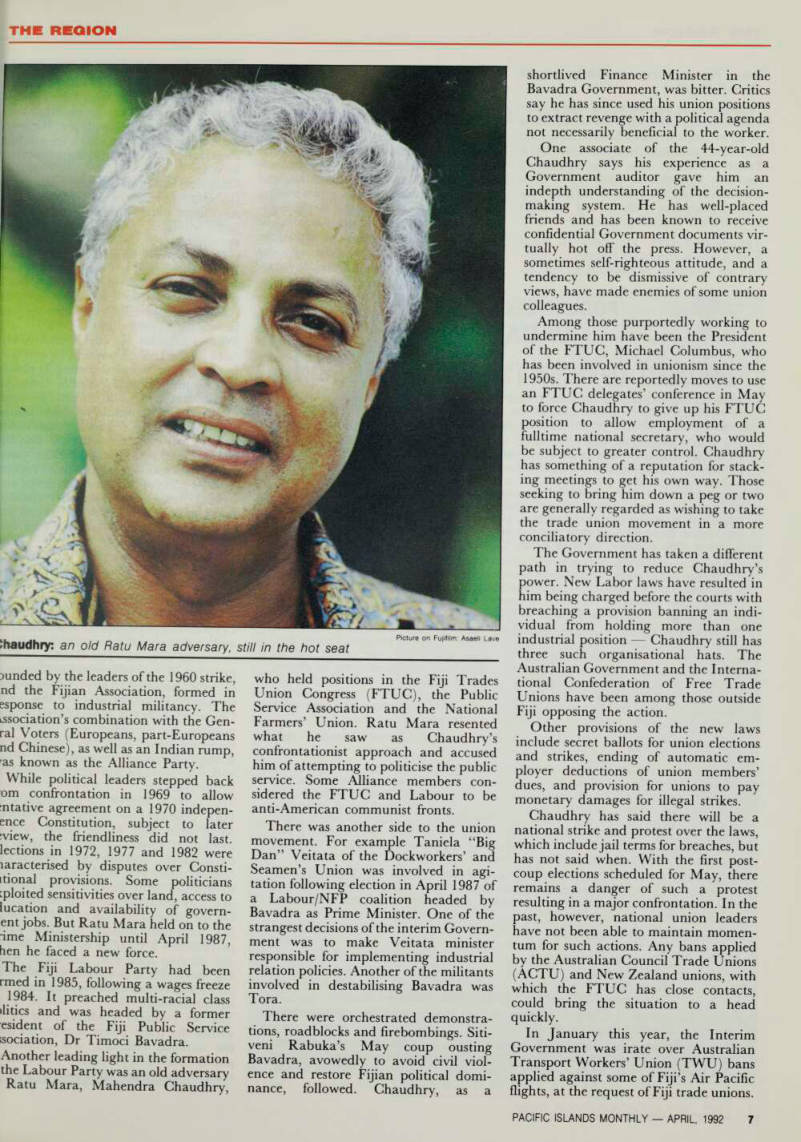
Chaudhry: an old Ratu Mara adversary, still in the hot seat
Picture on Fujifilm: Asaeli Lave
Some Fiji ministers reportedly wanted
Chaudhry jailed.
Deputy Prime Minister Josevata Kami kamica, seen as backing the labour laws in an attempt to paint himself as a man with the personal toughness to be a Prime Minister, this time counselled restraint. Nonetheless, bitterness in Gov ernment circles over the Air Pacific bans ran deep because it threatened attempts to overcome a tourism slump.
The labour laws are part of what Kamikamica and other economic minis ters see as a need to develop an export
oriented economy propelled by market forces. For people like Chaudhry, the Government has no mandate for such changes because of the way it came to power.
Chaudhry has continued to cling to the need to boycott the forthcoming elections under what he sees as a racist and undemocratic Constitution guaranteeing an ethnic Fijian House of Representa tives majority. That stance has brought him increasingly into conflict with more pragmatic colleagues involved with the Labour Party. Even Adi Kuini Bavadra,
whose former husband, the late Timoci: Bavadra, was involved with Labour’s birth, recently said publicly she believed; there was no practical option other thair Labour going along with the National Federation Party in fielding election; candidates and encouraging supporters to vote.
Only time will reveal a clearer picture on the wisdom or folly of the boycott stance.: As things stand, the Labour Party is badly wounded, possibly fatally. Promin ent defectors Columbus among them have already formed a ‘New Laboun Party’ which will try and put MPs into: Parliament to fight against the Consti tution from within. Chaudhry has been involved in vitriolic exchanges on the 3 issue with former allies.
While Chaudhry has had a massive set back on the Labour boycott, he can takes heart from a morale-boosting landslides win for the National Farmers’ Union in hotly contested, and much delayed, elections for the industry’s Cane Grow ers’ Council. His more conservatives opponents in this arena argued that the country’s 23,000 mainly Indian cane farmers had lost out badly from regulan protests interrupting cane harvesting and!
milling. Evidently a majority decided!
that Chaudhry’s militant tactics had put) more money in their pockets than had! been lost.
In the middle of last year, there was the deep irony of coup leader Rabuka* intervening with Chaudhry and Colum bus as a peacemaker to successfully end! a long harvest boycott over Sugan Corporation payments for raw cane, and! avert a threatened national strike against) industrial decrees. The decrees, whichi included 14-year jail terms for disruption! of vital industries, were subsequentlys scrapped. Ironically, despite the coupsg Chaudhry believed that at least it wasa possible to sit down and exchange views with the former army\ strongman who is now bidding, along* with Kamikamica and others, to becomes Prime Minister.
The current degree of polarisation oft Fiji’s politics and industrial relations? partly goes back to the bitter days oft indenture, colonial polices of separates development, and the legacy of political! opportunism. The establishment tendedl to identify with development interests? and fear challenges to their authority.
On the other hand, concepts of maximis ing industrial muscle to force gains? perpetuated a cycle of conflict which is? still playing itself out. Arguably, what) Fiji needs, if it is to transform into stability and mistrust into trust, is a£ circuit-breaker.
The big question is whether the forces? within the trade union movement, andf the national elections, will provide such a opportunity. The costs off the alternative are high indeed. □ C
Advertisements & other items, p. 8 (1 item)
Project Officer (Maritime Division)
FORUM SECRETARIAT
VACANCY
Applications are invited from suitably qualified and experienced persons, who must be nationals of a *member state of the South Pacific Forum, for the position of Project Officer with the Forum Secretariat’s Maritime Division.
The Forum Secretariat was established in 1973 by the South Pacific Forum to encourage economic and political cooperation between its member states, and between those states and the more industrialised countries. Under the control of a Secretary General the Secretariat undertakes a number of regional work programmes for the benefit of Forum Island Countries covering economic development, legal and political services, civil aviation, energy, maritime, telecommunications and trade sectors. In pursuing these work programmes, the Secretariat works with a range of aid donor countries and organisations including Australia, New Zealand, Canada, Japan, EC and the UNDP.
The Maritime Division implements and administers a range of maritime development assistance activities under the Forum Maritime Programme, aimed at achieving selfsustaining economic growth in the maritime sectors of Forum Island Countries. The Division also assists in coordinating development assistance activities of other organisations in the region’s maritime sector.
The Project Officer will be directly responsible to the Director, Maritime Division and will assist with the implementation of projects under the Forum Maritime Programme, in order to maximise economic returns. More specifically, the officer will be responsible for the preparation, implementation and critical analysis of project proposals, participation as counterpart to consultants appointed under the projects, and assistance to the Director in fulfilling the Division’s wider regional responsibilities. The appointee must have appropriate qualifications with experience in project appraisal, implementation and management.
The Project Officer will undertake periodic duty travels as required for consultations with member countries on projects as well as attending meetings.
The appointment will carry an attractive remuneration package, payable in Fiji dollars. For non-Fiji citizens this is tax-free and includes housing, or a housing allowance and education and child allowances where eligible. Other benefits include paymentns in lieu of superannuation, and medical, life and travel insurance coverage. The appointee will be based at the Secretariat Headquarters in Suva.
Appointment is for 12 months initially after which time the activities and requirements of the Programme will be reviewed to determine whether or not there is a need to extend the term of appointment.
Applications close on 30 April, 1992 and should contain full information on education and career backgrounds and should give names, addresses and telephone numbers of at least three referees with whom the applicant has been associated professionally.
Applications should be addressed to: The Secretary General Forum Secretariat GPO Box 856 Suva, FIJI Telephone: 312600 Telex: 2229FJ Fax: 302204 Further information is available on request from Mrs Lailun Khan, Administration Officer, on 312600 Ext. 218. * Member States of the South Pacific Forum: Australia, Cook Islands, Federated States of Micronesia, Fiji, Kiribati, Nauru, New Zealand, Niue, Papua New Guinea, Republic of the Marshall Islands, Solomon Islands, Tonga, Tuvalu, Vanuatu and Western Samoa.
MARKET-DRIVEN government
To market, to market
policies are seen by economists as a realistic approach to difficult times. Unions throughout the Pacific Islands, however, view it differently. They see their role of protecting workers' interests as crucial in such times.
More than 180 delegates from 12 Pacific nations gathered in Wellington, New Zealand, in mid-February for a conference on trade union rights and a regional social and economic charter organised by the Brisbane-based South Pacific and Dceanic Council of Trade Unions
:Spoctu).
Paha Fasi (an economics teacher at fikipunga High School, a trustee member )f the Pacific Island Employment Development Trust, and the only Pacific slander on the executive council of the s ost-Primary Teachers' Association), said Jew Zealand’s Employment Contract Act las forced many Pacific Islanders to work without proper contracts for low pay and lelow minimum conditions. “In these hard conomic times, it is a question of survival, le or she will take a job at any pay rate r on any conditions.’’ Some people worked several part-time jobs seven days week, and social and health cuts had dded to the pressure, he said, he conference also unanimously ondemned Fiji’s new industrial decrees, hich the interim Government sees as the asis for a stable industrial environment ivouring economic growth. The Wellington meeting came less than a week fter Mahendra Chaudhry, (a former abinet minister in the late Dr Timoci avadra’s short-lived coalition Dvernment deposed by Major-General tiveni Rabuka), was charged under the acrees with holding office in two unions once. He was being paid as general icretary of the Fiji Public Servants’ jsociation and voluntarily headed the ational Farmers’ Union for several years. ie unions believe the Fiji Government’s jcrees are authoritarian and draconian.
Duncil of Trade Unions President Ken Duglas also said the 1987 coups created e conditions for changes in textile anufacturing in Australia and New ialand through Fiji’s cheap labour ilicies for foreign companies and anti lion curbs. ivld Robie interviewed union leaders »m the region about employment issues, d the role and development of unions in 5 region. □
Marrying culture and democracy
French Polynesia Marrying culture and democracy
The ocean is not a barrier Hirohiti Tefaarere, secretary-general of Ta hiti’s A Tia I Mua: (10,000 members) WE are trying to marry culture with modern democracy.
You must remember the ocean is not a barrier it is a means of communication. Our ances tors conquered the Pacific in canoes. The peoples of the Pacific jumped from the era of the canoe to the era of computers and space shuttles in one generation.
No other community has had to do that. Somewhere inside I feel still ill at ease with our problems back home the social and economic problems ahead.
When we formed Tia Mua seven and a half years ago we sought democracy for our people. At first we used the CFDT [socialist union in metropolitan France] as our model. We also pursued bilateral contacts with other unions abroad like the mineworkers union in Germany, hospitality workers in Belgium, an Israeli union, and the Australian Council of Trade Unions. And to maintain our links with French culture we built a relation ship with the Kanak and Exploited Workers’ Union [USTKE] and OSOENC in New Caledonia.
In seven years we went from nowhere
to become the first ranked union in Ta hiti. Last year at Brisbane we ap proached SPOCTUS to sup port our campaign against the nuclear bomb nuclear testing is such an important issue for us. It is so destructive of our social struc ture and the environ ment. We have often demonstrated pub licly on Moruroa Atoll against the tests. There have been frequent strikes on the atoll. It shows that we Tahitians are mature. We demand a “popular consulta tion” of Tahitians about nuclear testing - not a national referendum [which by law includes all French citizens in metropolitan France]. The motto of our union is “Land, education
and a job”. All our action hinges on these three rights.
For us the labour movement in the South Pacific is confronted with three vital issues the environment and the European trade bloc that comes into force on January 1, 1993. We’re not ready! Let us look each other in the eye.
We are not ready.
My mother used to tell me, “Hiro, your name was never sullied by any of your ancestors.” I look at the mirror and ask am I worthy of my name. Hirohiti means the “greatest god of warriors”. It also means “god of thieves”, Tefaarere means “flowing river valley” and the name of our union means “honest and forward”. For us these words have some impact, which is why I understand our Maori cousins. Unions are a recent invention, but the people of the Pacific go back 2000 or 3000 years.
I stress our cultural values . . . Speak about productivity and gross national product and it doesn’t mean anything to me. But speak of the land, food, fishing, agriculture and then I understand. Pacific unions need support in setting up our credit unions, health cooperatives, and legal and accounting cooperatives. □
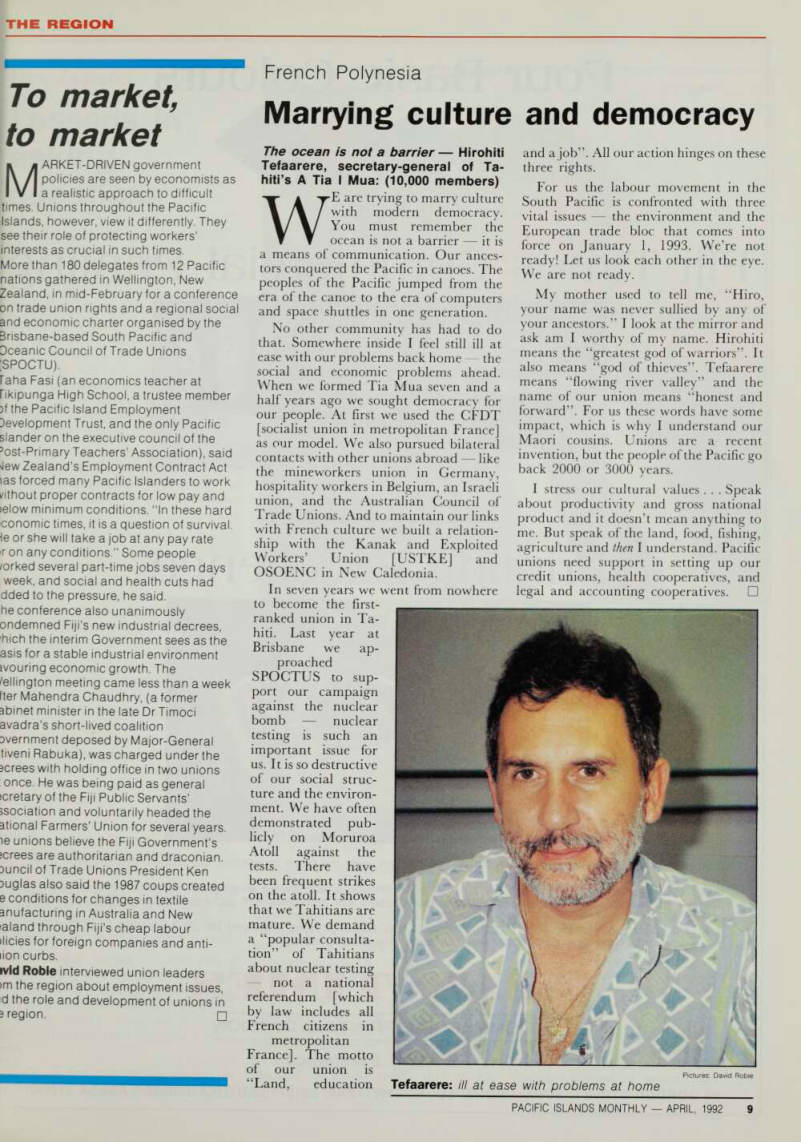
Pictures: David Robie
Tefaarere: ill at ease with problems at home
Advertisements & other items, p. 10 (1 item)
Printing Excellence
Four Basic Colours
YELLOW
CYAN \/ BLACK
Plus
Fiji Times Commercial Printing
uthrotte
Equals
Printing Excellence
<> It is quite amazing what our experienced master printers, with the latest in printing technology, can produce from four basic colours.
Full colour packaging and food labels that look good enough to eat; award winning full colour brochures and posters; magazines, calendars, books, stickers, fabric labels and billboards with pictures that leap right out of the printed pages.
If your product requires export-quality, high impact four colour printing, then you should be talking to us first.
You’ll find our prices very competitive and our paper stock quite extensive.
fIJI TIMES
COMMERCIAL PRINTING DIVISION
Printing Excellence
20 GORDON STREET, SUVA. PHONE: SUVA 3041*11. FAX: 301521 LAUTOKA 660352. LABASA 812649,
asking
New Zealand - Niue
Lessons in asking questions
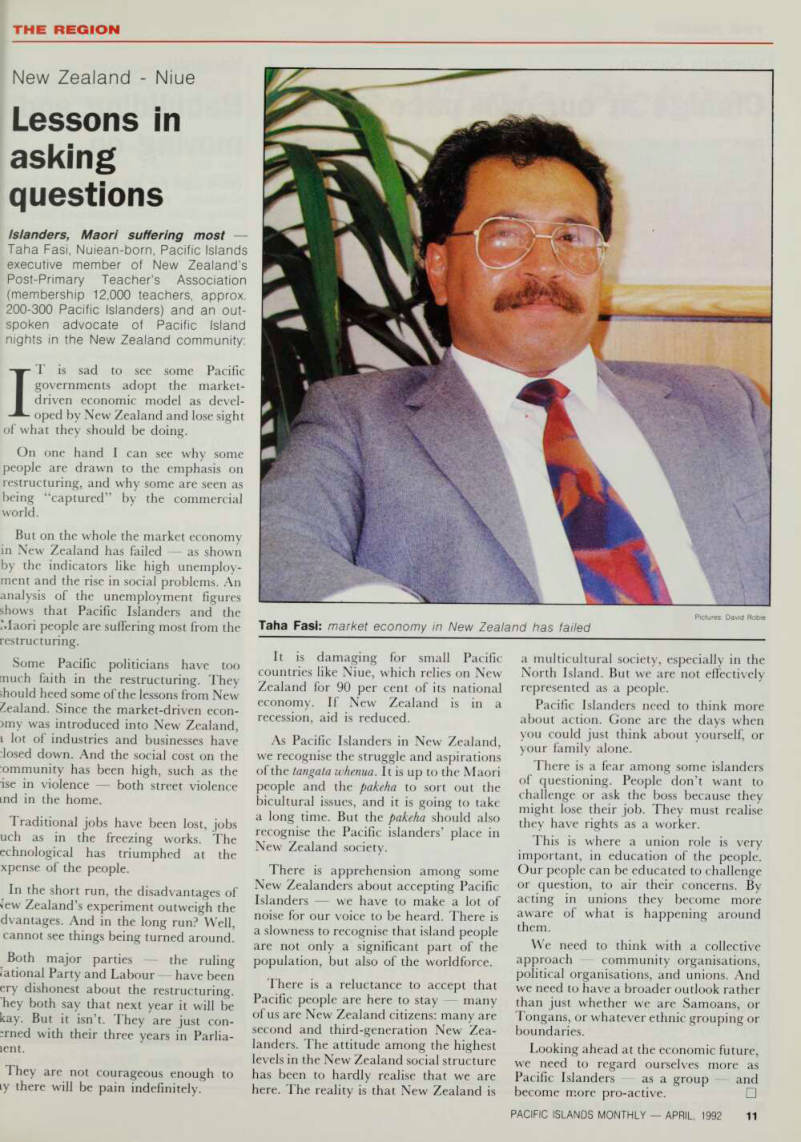
Islanders, Maori suffering most Taha Fasi, Nuiean-born, Pacific Islands executive member of New Zealand’s Post-Primary Teacher’s Association (membership 12,000 teachers, approx. 200-300 Pacific Islanders) and an out spoken advocate of Pacific Island nights in the New Zealand community: IT is sad to see some Pacific governments adopt the market driven economic model as devel oped by New Zealand and lose sight of what they should be doing.
On one hand I can see why some people are drawn to the emphasis on restructuring, and why some are seen as being “captured” by the commercial world.
But on the whole the market economy in New Zealand has failed as shown by the indicators like high unemploy ment and the rise in social problems. An analysis of the unemployment figures shows that Pacific Islanders and the Maori people are suffering most from the restructuring.
Some Pacific politicians have too much faith in the restructuring. They should heed some of the lessons from New Zealand. Since the market-driven econ omy was introduced into New Zealand, i lot of industries and businesses have dosed down. And the social cost on the immunity has been high, such as the ise in violence both street violence md in the home.
Traditional jobs have been lost, jobs uch as in the freezing works. The echnological has triumphed at the xpense of the people.
In the short run, the disadvantages of Jew Zealand’s experiment outweigh the dvantages. And in the long run? Well, cannot see things being turned around.
Both major parties the ruling fational Party and Labour have been ery dishonest about the restructuring, 'hey both say that next year it will be kay. But it isn’t. They are just con !rned with their three years in Parlia lent.
They are not courageous enough to iy there will be pain indefinitely.
It is damaging for small Pacific countries like Niue, which relies on New Zealand for 90 per cent of its national economy. If New Zealand is in a recession, aid is reduced.
As Pacific Islanders in New Zealand, we recognise the struggle and aspirations of the tangata whenua. It is up to the Maori people and the pakeha to sort out the bicultural issues, and it is going to take a long time. But the pakeha should also recognise the Pacific islanders’ place in New Zealand society.
There is apprehension among some New Zealanders about accepting Pacific Islanders we have to make a lot of noise for our voice to be heard. There is a slowness to recognise that island people are not only a significant part of the population, but also of the worldforce.
There is a reluctance to accept that Pacific people are here to stay many of us are New Zealand citizens: many are second and third-generation New Zea landers. The attitude among the highest levels in the New Zealand social structure has been to hardly realise that we are here. The reality is that New Zealand is
a multicultural society, especially in the North Island. But we are not effectively represented as a people.
Pacific Islanders need to think more about action. Gone are the days when you could just think about yourself, or your family alone.
There is a fear among some islanders of questioning. People don’t want to challenge or ask the boss because they might lose their job. They must realise they have rights as a worker.
This is where a union role is very important, in education of the people.
Our people can be educated to challenge or question, to air their concerns. By acting in unions they become more aware of what is happening around them.
We need to think with a collective approach community organisations, political organisations, and unions. And we need to have a broader outlook rather than just whether we are Samoans, or Tongans, or whatever ethnic grouping or boundaries.
Looking ahead at the economic future, we need to regard ourselves more as Pacific Islanders as a group and become more pro-active. □
Taha Fasi: market economy in New Zealand has failed
Pictures: David Robie
Change at our own pace
Western Samoa Change at our own pace
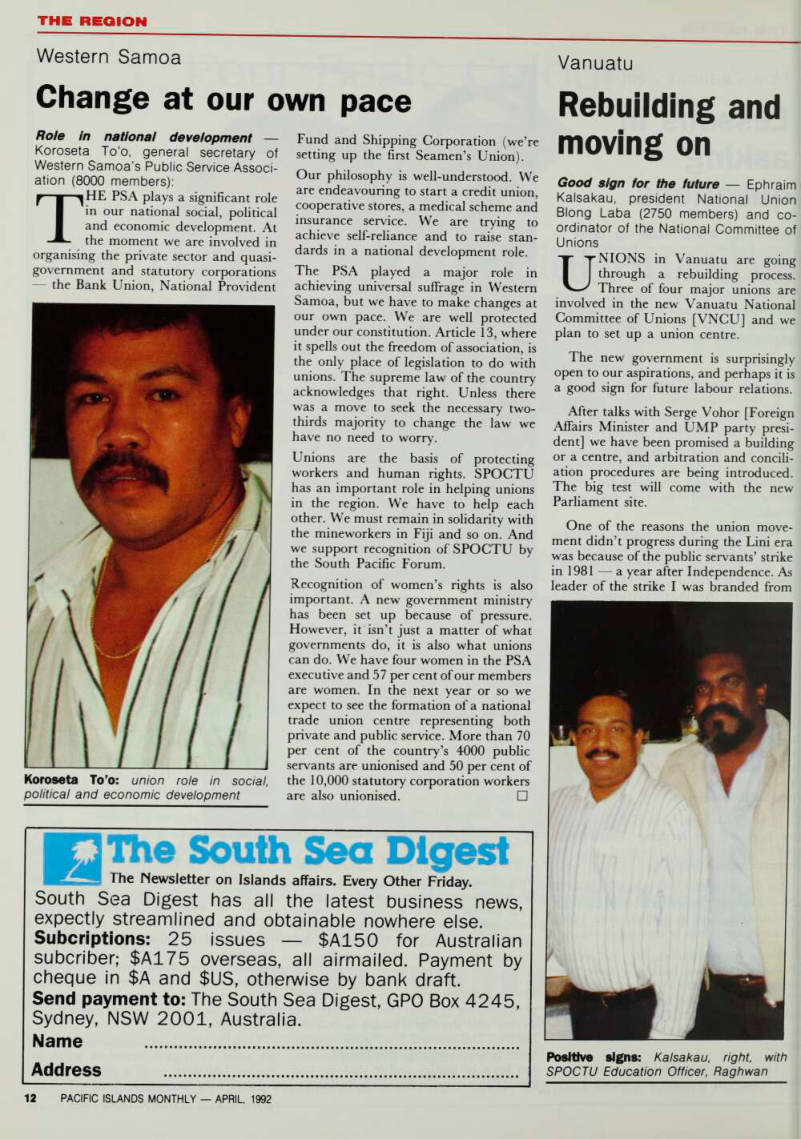
Role In national development Koroseta To’o, general secretary of Western Samoa’s Public Service Associ ation (8000 members): THE PSA plays a significant role in our national social, political and economic development. At the moment we are involved in organising the private sector and quasi government and statutory corporations the Bank Union, National Provident
Fund and Shipping Corporation (we’re setting up the first Seamen’s Union).
Our philosophy is well-understood. We are endeavouring to start a credit union, cooperative stores, a medical scheme and insurance service. We are trying to achieve self-reliance and to raise stan dards in a national development role.
The PSA played a major role in achieving universal suffrage in Western Samoa, but we have to make changes at our own pace. We are well protected under our constitution. Article 13, where it spells out the freedom of association, is the only place of legislation to do with unions. The supreme law of the country acknowledges that right. Unless there was a move to seek the necessary two thirds majority to change the law we have no need to worry.
Unions are the basis of protecting workers and human rights. SPOCTU has an important role in helping unions in the region. We have to help each other. We must remain in solidarity with the mineworkers in Fiji and so on. And we support recognition of SPOCTU by the South Pacific Forum.
Recognition of women’s rights is also important. A new government ministry has been set up because of pressure.
However, it isn’t just a matter of what governments do, it is also what unions can do. We have four women in the PSA executive and 57 per cent of our members are women. In the next year or so we expect to see the formation of a national trade union centre representing both private and public service. More than 70 per cent of the country’s 4000 public servants are unionised and 50 per cent of the 10,000 statutory corporation workers are also unionised. □
Koroseta To’o: union role in social, political and economic development
Rebuilding and
Vanuatu Rebuilding and moving on
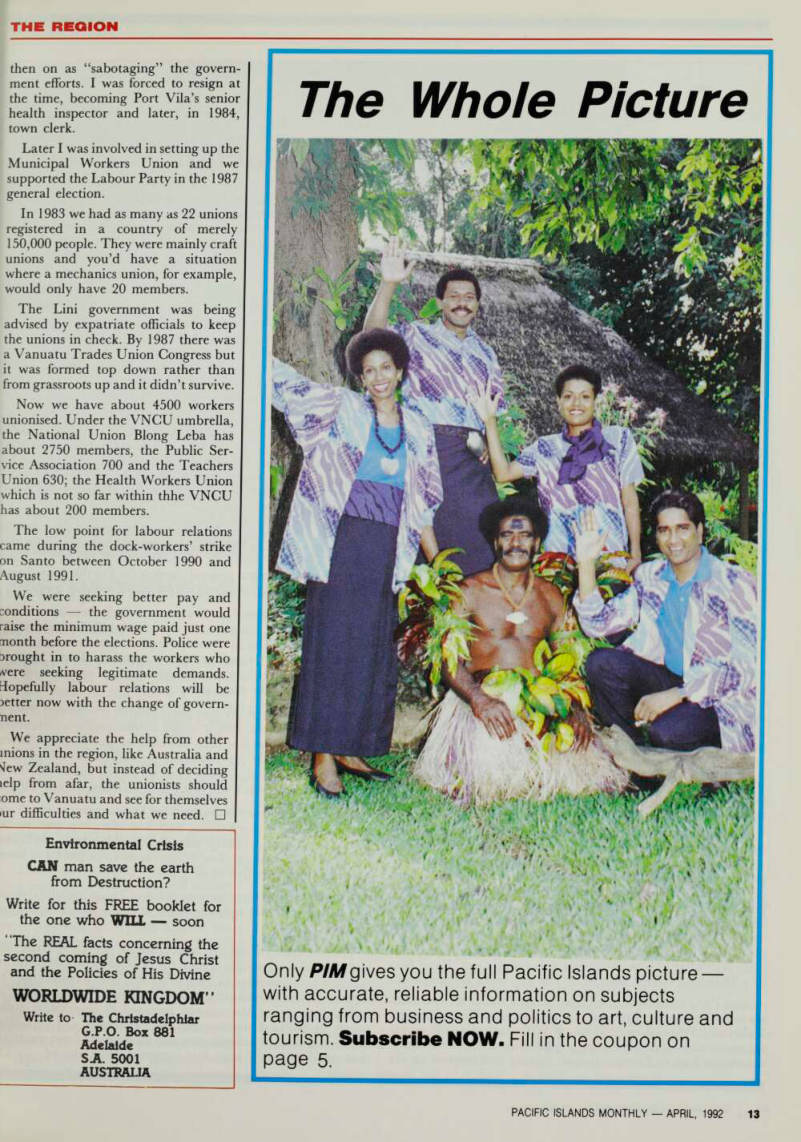
Good sign for the future Ephraim Kalsakau, president National Union Blong Laba (2750 members) and co ordinator of the National Committee of Unions UNIONS in Vanuatu are going
through a rebuilding process.
Three of four major unions are involved in the new Vanuatu National Committee of Unions [VNCU] and we plan to set up a union centre.
The new government is surprisingly open to our aspirations, and perhaps it is a good sign for future labour relations.
After talks with Serge Vohor [Foreign Affairs Minister and UMP party presi dent] we have been promised a building or a centre, and arbitration and concili ation procedures are being introduced.
The big test will come with the new Parliament site.
One of the reasons the union move ment didn’t progress during the Lini era was because of the public servants’ strike in 1981 a year after Independence. As leader of the strike I was branded from
Positive signs: Kalsakau, right, with SPOCTU Education Officer, Raghwan
then on as “sabotaging” the govern ment efforts. I was forced to resign at the time, becoming Port Vila’s senior health inspector and later, in 1984, town clerk.
Later I was involved in setting up the Municipal Workers Union and we supported the Labour Party in the 1987
general election.
In 1983 we had as many as 22 unions registered in a country of merely 150,000 people. They were mainly craft unions and you’d have a situation where a mechanics union, for example, would only have 20 members.
The Lini government was being advised by expatriate officials to keep the unions in check. By 1987 there was a Vanuatu Trades Union Congress but it was formed top down rather than from grassroots up and it didn’t survive.
Now we have about 4500 workers unionised. Under the VNCU umbrella, the National Union Blong Leba has about 2750 members, the Public Ser vice Association 700 and the Teachers Union 630; the Health Workers Union which is not so far within thhe VNCU has about 200 members.
The low point for labour relations came during the dock-workers’ strike on Santo between October 1990 and August 1991.
We were seeking better pay and conditions the government would raise the minimum wage paid just one month before the elections. Police were Drought in to harass the workers who
vere seeking legitimate demands.
Hopefully labour relations will be Detter now with the change of govern nent.
We appreciate the help from other mions in the region, like Australia and 'Jew Zealand, but instead of deciding iclp from afar, the unionists should ome to Vanuatu and see for themselves •ur difficulties and what we need. □
Advertisements & other items, pp. 12-13 (2 items)
Hie South Sea Digest
£
The Newsletter on Islands affairs. Every Other Friday.
South Sea Digest has all the latest business news, expectly streamlined and obtainable nowhere else.
Subcriptions: 25 issues SAISO for Australian subcriber; SAI7S overseas, all airmailed. Payment by cheque in $A and SUS, otherwise by bank draft.
Send payment to: The South Sea Digest, GPO Box 4245, Sydney, NSW 2001, Australia.
Name Address
The Whole Picture
w IJ
' w m * f Mt \ m ** & -
r r v &
-• m r KN
■ v: ;^fe '; Vr?'
* , .>' ■ 4 *Ji\ «■*•;% ; .t ■ »• J . < Only RIM gives you the full Pacific Islands picture with accurate, reliable information on subjects ranging from business and politics to art, culture and tourism. Subscribe NOW. Fill in the coupon on page 5.
Environmental Crisis CAN man save the earth from Destruction?
Write for this FREE booklet for the one who WILL soon “The REAL facts concerning the second coming of Jesus Christ and the Policies of His Divine
WORLDWIDE KINGDOM”
Write to The Christadelphiar G.P.O. Box 881 Adelaide SA. 5001
AUSTRALIA
Party Politics a la Pacific
THE principle of all transplantation is that the introduced item, in order to thrive, must adapt to the new environment. In many cases, the transplant in time loses all resemblance to the original but the name.
This is the case with the church. It has had to accommodate characteristics of the local cultures a streak of cargoism in PNG and the Solomons, a bit of hysteria in Fiji, all feasting and politics in Tonga, priestcraft and churchianity in Samoa, and many other things got mixed in together with the moral hotchpotch that Christianity represents in the Pacific. Therefore we pride ourselves over Pacific theology, Pacific Way (really a formula for getting the weak states to accept the will of the strong ones and called “consensus”), and many other Pacific thingamibobs. But all these are transplants with the übiquitous coconut cream dressing
and served lukewarm, that is, in a nauseating condition.
Party politics is one of these imports. It is incredible to see how much this foreign institution is remodelled to suit local conditions, more strictly, local interests. This is not peculiar to the Pacific, of course. One finds the same sort of thing everywhere in the world. What is unique to the Pacific islands is that they use and recast this institution without an inkling of what it is, especially the fact that it does embody values which are absent from island societies e.g. liberalism, democracy, the work ethic, republicanism, criticism and so on.
Pacific societies have moralities whose values include sharing (a strategy for survival in resource-poor environments), loyalty (of the weak to the strong), humility (reinforced by the oppressive side of Christian ethics), etc. But none ever had any of the values of liberal humanism. They have always been the target of violent persecution and bullying.
As a result, party programmes in the Islands have for their content part of this oppressive and slave morality. That is, so far as liberal and humanist sentiments are concerned their party politics is simply vacuous.
Although PNG has had parties for some time, though perhaps not as long as Fiji, it is only now with Rabi Namaliu that we see a leader in that country who tries to infuse PNG politics with a sense of humanist tradition. But the dead weight of her rural myriads with their innocent but uninformed perception is just too unwieldy and disproportionately huge compared to the miniscule progressive section of society. The sociopolitical effect of this force will continue to plague PNG for as long as the wide gap between a Namaliu’s or a Lohia’s comprehension of how things work in today’s world and that of a Highland village headman. The gap must be destroyed.
And PNG must wean itself from being a buffer for Australia vis-a-vis Indonesia. Especially now that the Timor business looks risky. Where does PNG stand? With Australia or Portugal i.e. with kith and kin or principle? Moreover, PNG must sometimes look to Europe, though looking to Europe is an art
The Islands
that has to be acquired. But the country is now all wrapped up in party wars where the no confidence vote is the favourite weapon. And Bougainville, a problem that Australia had a big hand in creating, will for some time yet be the standing symbol of PNG unhealed social ills.
The situation in Fiji illustrates how far this can go. Here you have a confrontation between business interests, ethnic elements who are downtrodden but may be potentially blackguards all, and a traditional privileged class whose sole aim in this life and the next is to perfect social parasitism. The sum of their politics is the clash between those specific interests.
Rabuka, for instance, seeing a bleak future in his career if his party does not come home in the “next” election, wags an index finger to drive home the point: he and his party have no respectable platform. No liberty, no human rights, no tolerance, no opposition, just plain sadism alias
traditional privilege.
In fact the control he may not be aware of it marks and is the symbol of the turning point in Fiji politics: the end of the traditional form and the beginning of the new. I dare prophesy, however, no general election for Fiji this year. I was right last time and am dead sure I again will be this time.
Tonga is a laughing predicament not only because she has never had parties, but powerful churches which have the same social effect, but also in the way people reveal their ignorance and intolerance regarding party politics. Many people especially chiefs, their relatives and freeloaders and most people with power, do not want party politics.
Arguments offered say that party politics is a ‘foreign thing’, a convenient phrase, that it would double public expenditure (public expenditure has been doubling at shorter and shorter periods and mostly for villainous reasons), that the present system is a lesser evil than what we do not know, that such a change would wreck the peace and stability we now enjoy.
The pro-democracy movement led by young representatives of the people, is accelerating and is shaping up well to be Tonga’s first political party, though it wouldn’t be in the books for quite some time yet. But Tonga seems to be poised to have parties in the next five or so years.
It will be another nail into the coffin of Tonga’s feudal system as loyalties shift and reshuffle under the new consciousness for change.
The leadership of the two most powerful churches, Wesleyan and Catholic, are solidly behind the pro-democracy movement which is going to stage in November this year a conference on aspects of the constitution that may need revision. Such a colloquium is just the cement required to materialise such things as political parties. But the organisers will certainly experience a lot of intimidation and harassment from quarters that stand to lose if basic law is ever so little altered. □
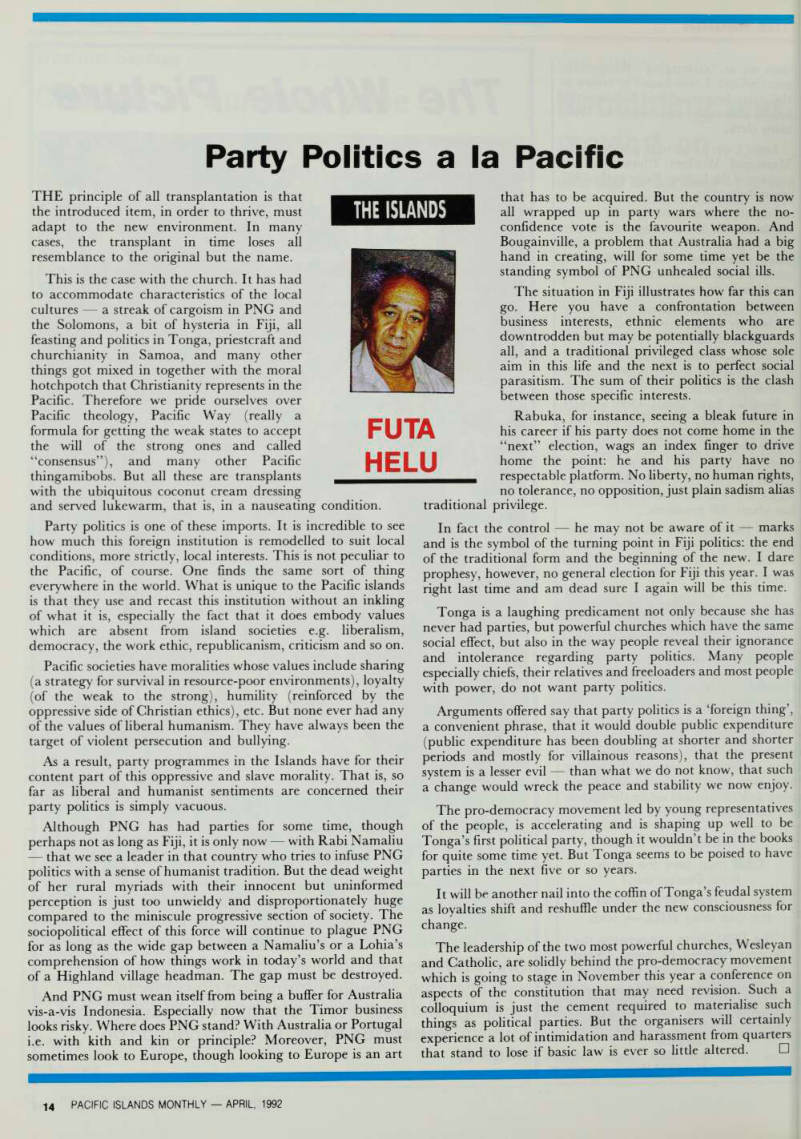
Futa
Helu
Merry-maker’s UPNG plans
Headlines
By Martin Tiffany
TRYING to twist your tongue around Joseph Sukwianomb’s surname can prove a bit of a mouthful when you first meet him. But after he gives you a quick linguistics lesson, you soon get it sounding acceptable.
In his native Papua New Guinean his surname means road to festivity or, as he likes to translate it, “merry-maker”.
As the new vice-chancellor of the University of Papua New Guinea (UPNG), his translation fits quite well with his plans for the institution.
The Port Moresby-based university was shut down for the second semester last July following student unrest which involved violence and damaging prop erty. Students at UPNG and its sister university, the University of Technology in Lae, boycotted lectures for several weeks before the shutdown in protest against pay increases for parliamen tarians and constitutional office holders.
The students defied orders to sit for examinations and some were charged by police for violence and property damage.
Apart from the PNG students, others from the Solomon Islands, Vanuatu,
Western Samoa and Kiribati were sent home because of the unrest.
Sukwianomb’s predecessor, Professor John Lynch, resigned to join the Univer sity of the South Pacific and leaves the new VC the unenviable task of getting the university back on its feet.
However Sukwianomb is looking for ward to it, and speaks with obvious enthusiasm about “pulling the university back together”. He is undertaking a major public relations exercise and has plans to make the university a lively and
exciting place.
“The university was closed down and students been sent home; we have to build confidence again which will take quite a while,” said Sukwianomb.
He said the public relations exercise will be geared a lot towards the govern ments of the students who were sent home.
“We have to make up for it, build up the university have a university day, present the university to the community, organise cultural events.
“Sometimes a university can become a boring place; you want to make it the centre of cultural revival, organise student activities ... do something cre ative. A university should not be a place
where you just go and read text books, it can be an exciting place you look forward to tomorrow and the next day, as there is something happening.”
Sukwianomb said that, apart from lectures, there should be other things happening of which the students are a part. He also wants to get staff more involved in the university.
Sukiwianomb would like to see the fences and iron gates that surround the university removed. He believes these do not represent the principal of a free and democratic institution.
Sukwianomb, 38, is no stranger to UPNG having obtained his Bachelor of Education there and later lecturing at the university. He also obtained a Master of Arts from the University of Nairobi in Kenya, and tutored there at the
Kenyatta University College.
While in Kenya he met his wife Njeri and they have a son and a daughter. His son, Nelson Mandela, is named after the leader of the African National Congress because Sukwianomb was “supportive of the cause of South Africa”.
In October 1988, Sukwianomb left UPNG on secondment to join the Nuku’alofa-based South Pacific Alliance for Family Health (SPAFH) as secretary general. He started another three-year term last year, but resigned when he was offered the vice-chancellor’s post late last year. He took up his current post at UPNG on February 3. □
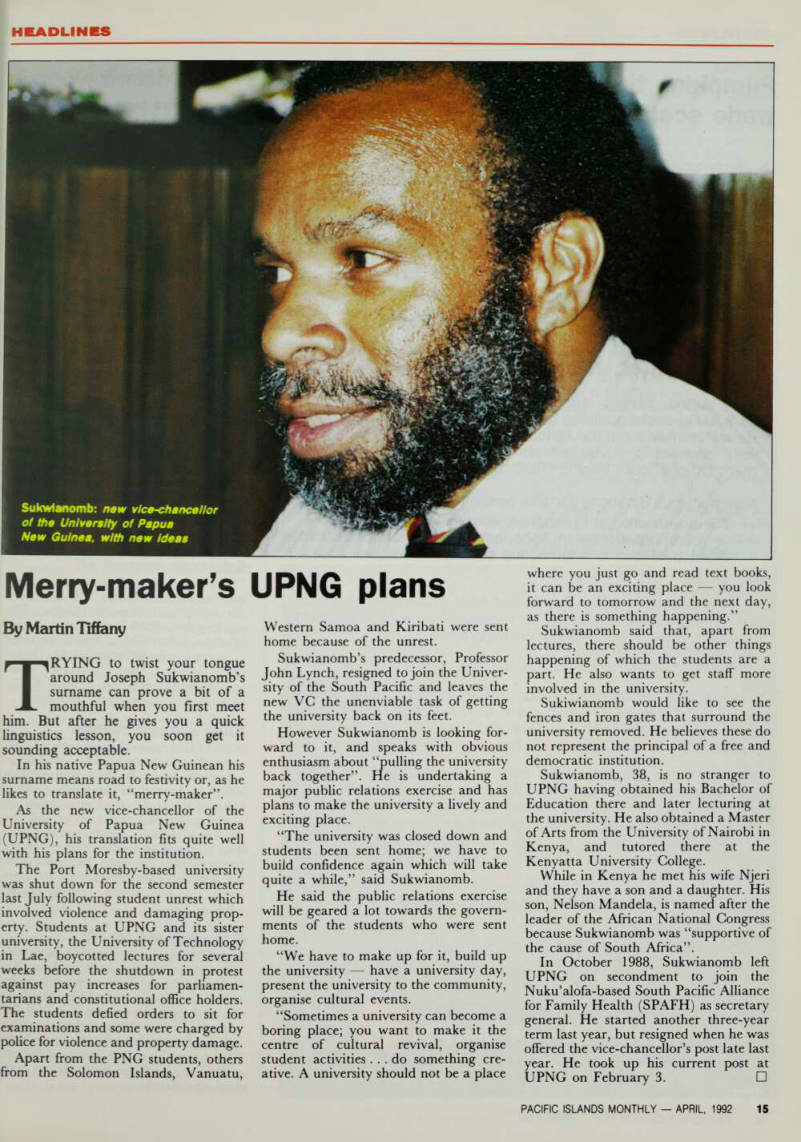
Sukwlanomb: new vice-chancellor of the University of Papua New Guinea, with new ideas
Pumpkins tip
trade scales
IN November 1991, Tonga recorded what is said to be its first visible trade surplus US$7O,OOO. The surplus is said to be from squash pumpkin exports to Japan of about US$3.3 million.
French aid to Cooks THE Cook Islands has signed an aid
agreement with France worth almost US$l million, signalling an end to a 25-year struggle for better water and
electricity supplies.
Anti-snake grant
HAWAII has received a US$lOO,OOO grant from Washington’s Office of Ter ritorial and international affairs to de velop fool-proof ways of preventing Guam’s destructive brown tree snake from becoming established in Hawaii.
Some snakes have been found dead at Honolulu International Airport, in the
landing gear of planes from Guam.
US confirms presence THE United States has affirmed its commitment to a military presence in the Asia-Pacific region, saying any talk of its decline in the region is wrong and dangerous. Assistant American Defence Secretary, James Lilley, told an Asia- Pacific defence conference in Singapore the need for a United States role in the region’s security affairs would continue.
Special youth Jail?
WESTERN Samoa’s Police Com missioner, Galuvao Tanielu, has called for the establishment of a special jail for young people. He says offenders as young as 12 have been jailed with adults in the past because there were no alternatives, and as a result teenage inmates had picked up bad habits.
Rules for death PAPUA New Guinea’s attorney general, Bernard Narakobi, is working on a set of rules for the enforcement of capital punishment in the country. The PNG
parliament passed the death penalty bill
last year but it has still not been implemented due to lack of enforcement regulations.
Solomons warned off THE Papua New Guinea government has warned the Solomon Islands to keep out of PNG’s internal affairs. The warning from PNG Trade and Industry Minister, John Giheno, was in response to statements by Solomon Islands Oppo sition leader, Joses Tuhanuku, and
former parliamentarian, Sethuel Kelly,
in support of Bougainville secession.
Bond scheme revived WESTERN Samoa has revived a schol arship bond scheme aimed at encourag ing graduates funded by government to return and work in the public service.
Most of the bonds were guaranteed by parents, who are liable to refund the thousands of tala spent on their chil dren’s sponsored studies if they do not honour signed contracts. The bond is for the same number of years the students spent on scholarship (usually three
years).
Samoans set for TV SAMOANS waiting for their own tele vision station might get it by June, if a new timetable by the government can be met. The plan is to use Television New Zealand expertise to install a NZ Pal system covering Apia during the 30th independence celebration in June. Most TV owners have US standard NTSC systems to pick (free) transmissions from American Samoa.
Shock death
of lekawe
JACQUES lekawe, the first Kanak elected to head a regional organis ation died unexpectedly in Welling ton last month from cancer. He was admitted to hospital after complaining of a sore throat, but died soon after. lekawe, 45, was to take over as secretary-general of the Noumea-based South Pacific Commission in June.
Married with five children, he ob tained a law degree in France before returning the New Caledonia to take up a career in the administration of the territory. Before being appointed to head the SPC, he was New Caledonia’s deputy high commissioner responsible for devel opment, and the president of the Cale donian Investment Bank.
AIDS a big export
FRENCH Polynesia and New Caledonia have the highest incidence of AIDS in the region, says a Australian HIV surveil lance report. Papua New Guinea has the largest number of carriers 37 though its relative percentage is lower because of its huge population of four million. The report gives 15 and 9.4 rate per 100,000 population in the French territories. French Polynesia’s figure is alarming with 27 AIDS cases at World Health Organisation’s last count in 1991.
New Caledonia has 16 confirmed cases, Papua New Guinea 37, Guam eight, Fiji seven while Tonga, the Federated States of Micronesia and Marshall Islands two each, and Western Samoa one.
Countries and territories so far of ficially free of the deadly infection are American Samoa, Cook Islands, Kiri bati, Niue, Northern Marianas, Palau, Solomon Islands, Tokelau, Tuvalu, Vanuatu and Wallis and Futuna. Last month a medical research centre in Melbourne disclosed that Australian male tourists could be “exporting AIDS” to Asian and Pacific holiday countries because of the increasing number of tourists travelling specifically on sex holidays. Australia has 2882 AIDS cases up from the last count of 2474 casees, and 396 known HIV virus carriers
New party
TWELVE Fiji trade unionists and for
mer Fiji Labour Party (FLP) officials
launched a new political party on February 25 because of FLP’s insistence on boycotting this year’s general elec tions. The New Labour party will be headed by Michale Columbus, president of the Fiji Trade Union Congress and a former vice-president of the FLP.
Deaths due to blockade THERE have been more claims that the Papua New Guinea blockade of Bou gainville has contributed to the deaths of
many people. Sam Voron, the Australian amateur radio enthusiast who set up the seccessionist Bougainville government’s radio services, says it is stopping medical supplies and causing great misery.
Mine determined BOUGAINVILLE Copper Limited, the company that operated the giant copper mine on the secessionist island, says it is determined to re-open the mine once the crisis on the island is over, but the company has been unable to assess the mine’s future viability because they have been unable to visit it since 1990.
Niue aid cut SHARP cuts in New Zealand’s aid to Niue have forced the country to seek development assistance in Australia.
Niue Premier Sir Robert Rex and the head of the island’s public service Terry Chapman returned from Canberra in February after meeting with Prime Minister Paul Keating and Foreign Affairs Minister Senator Gareth Evans.
Who’s a Fijian?
THE question of who qualifies to be a Fijian was brought to the front in Fiji in February. This followed the disqualifi cation of prominent Fiji businessman and former member of parliament Jim Ah Koy from contesting a parliamentary seat reserved for indigenous Fijians.
Ah Koy’s mother is an indigenous
Fijian and last year his name was included in the Vola ni Kawa Bula, which is the register of indigenous Fijians.
However, his name was struck from the roll of Fijian voters in late February because his father is not a Fijian.
According to the registration officer for the Suva City Fijian Urban Constitu ency, Taniela Tabu, since Ah Key’s father is not a Fijian he cannot be registered on the roll of Fijian voters.
Ah Koy said the move was premedi tated and said he would appeal to the courts.
Earlier when Ah Koy’s “Fijianness” was challenged, he filed objections to the registration of Fijian high chief, Ratu Viliame Dreunimisimisi, as a Fijian on the grounds that his grandfather was a Tongan.
Ah Koy said the decision to drop him from the roll of Fijian voters would lead to questions about the duality of laws in Fiji. It would also create two classes of Fijians. Ah Koy supporter, Major Gen eral Sitiveni Rabuka, said the moves to question the Fijianness of Ah Koy and Dreunimisimisi were deeply “embarrass ing”.
University of the South Pacific aca demic Dr Tupeni Baba said the Fijian race was headed towards extinction if “we continue to define Fijianness so
rigidly and on grounds of racial pu rity.” Prior to the military coups of 1987, Ah Koy had sat in parliament as representative of the General Electors, a party which encompassed all races who are not indigenous Fijians or ethnic Indians. Fiji’s post-coup consti tution guarantees a majority of parlia mentary seats for indigenous Fijians.
PNG’s first freeway
PAPUA New Guinea is to get its first freeway following Cabinet approval of a K 65 million tender for the construc tion of the Spring Garden Road/
Airport link, providing 3000 jobs in
skilled, semi-skilled and manual labour areas. The project involves construction of a tunnel through Burns Peak to provide a more direct link from the city area, including the port, and the provision of a freeway linking the city, via the tunnel, to Jacksons Airport. The contract has been awarded to Kinhill Kramer Consortium. Work is sched uled to start by June and finish within three years.
Difficult decade ahead A RECENT economic report predicts a difficult decade for Pacific Island economies. The Pacific Economic Bull etin, published by the Australian Na tional University, says Island countries will fall further behind the competitive nations of the Pacific rim. □
Advertisements & other items, pp. 16-17 (1 item)
Marine Resources Advisor
VACANCY ADVERTISEMENT
The United States Agency for International Development (U.5.A.1.D.) seeks qualified candidates for the position of Marine Resources Advisor in the Agricultural Development Office. A three year contract is envisaged with U.S.A.I.D.’s Regional Development Office/South Pacific (RDO/SP) in Suva, Fiji.
Minimum qualifications for this posting include: BS in relevant field (fisheries, economics, business). 3 years experience in fisheries and/or marine resources development in a small island country.
Preferred qualifications include: MS or higher degree in relevant field (fisheries, economics).
Private sector experience in fisheries in the Pacific Islands.
A.I.D. project implementation experience.
Preference will be given to U.S. citizens.
The Marine Resources Advisor (MRA) will be responsible for implementation and management of RDO/SP’s Pacific Islands Marine Resources Project (PIMAR). The MRA will be directly responsible to the Agricultural Development Officer.
PIMAR is a 5 year, USDI3.7 million foreign assistance project to six Pacific island countries. PIMAR has country components in: Cook Islands (black pearl culture development), Tonga (Smallscale tuna longlining), Tuvalu (bottomfish fishery development), Kiribati (lagoon assessment and management), Fiji (commercial fisheries development), and Papua New Guinea (private sector
fisheries development).
For further information on this posting, please contact: Ms. Sharon Fee Agricultural Development Officer
U.S.A.I.D. RDO/SP
P.O. Box 218 Suva, FIJI (679) 311-399 Phone: (679) 300-075 FAX.
Please send applications and curriculum vitae to Ms. Fee at the above address. Deadline for receipt of applications is April 30, 1992.
BUNKERING, SHELL STYLE.
Keeping ships fueled in Fiji, American Samoa and Tonga, with the finest in facilities and quick, efficient turnaround service*
H Shell Fiji Limited
GPO Box 168 Telephone: 313933, 314983 Fax: 302279 Cable 'SHELL 1 Suva Telex: 2274 SHELL FJ, SUVA QR8241
Samoa boxers
look to Spain
BOXERS are Western Samoa’s best bet at the Olympics this year.
Eager to get their squad into shape for the four-yearly event, a team of six New Zealand-based Samoan boxers were in vited to Apia in early March.
New Zealand champions, heavy weight David Tua, middleweight Bob Casio, light-middleweight Sililo Figota, and welterweight Andrew Tua were among them. The other two were lightweight Fai Falemoe and light wel terweight Ameto Tuumuli.
Lone soccer team MELANESIAN Cup holders, Vanuatu, are the South Pacific’s lone entrant in the World indoor soccer tournament.
It is placed in Oceania qualifying round play-offs in Brisbane against Australia and New Zealand in June.
Vanuatu, which shocked tough op ponents in the Melanesian Cup last year but failed to get the gold at the South Pacific Games, will try out their luck in World Indoor Soccer as underdogs.
Vanuatu’s outdoor team coach Terry O’Donnel expects his side to qualify in the World Cup qualifying rounds against New Zealand and Fiji. The other pool,
redrawn after Western Samoa’s with drawal, has Australia, Solomon Island and Tahiti.
Singh wins third FIJI’S Vijay Singh collected his third European title when he shot a final round of 66 to capture the Turespana Masters in Malaga recently.
The Fiji-born golfer, who was engaged in a bitter row with the Fiji golfing association a few years ago, won by two shots from England’s first-year profes sional, Gary Evans. Singh turned 29 in February. His recent winning streak in Europe makes him one of most successful professionals from the islands.
Pick of the world TWO Pacific Islands-born players are named in a World XV selection to play three Test matches against New Zealand All Blacks in April. Western Samoa’s Peter Fatialofa, who captained the side to a historic World Cup quarterfinal finish, and Tongan-born Willie Ofahengaue are the lone picks from the region. Second-rower Fatialofa is based in New Zealand, but played for Samoa after missing out on All Blacks selection.
Ofahengaue now plays for Australia’s Wallabies and represented them at the World Cup final. The World XV will play All Blacks at Christchurch on April 18, Wellington April 22, and at Auck land on April 25. □
Advertisements & other items, p. 18 (1 item)
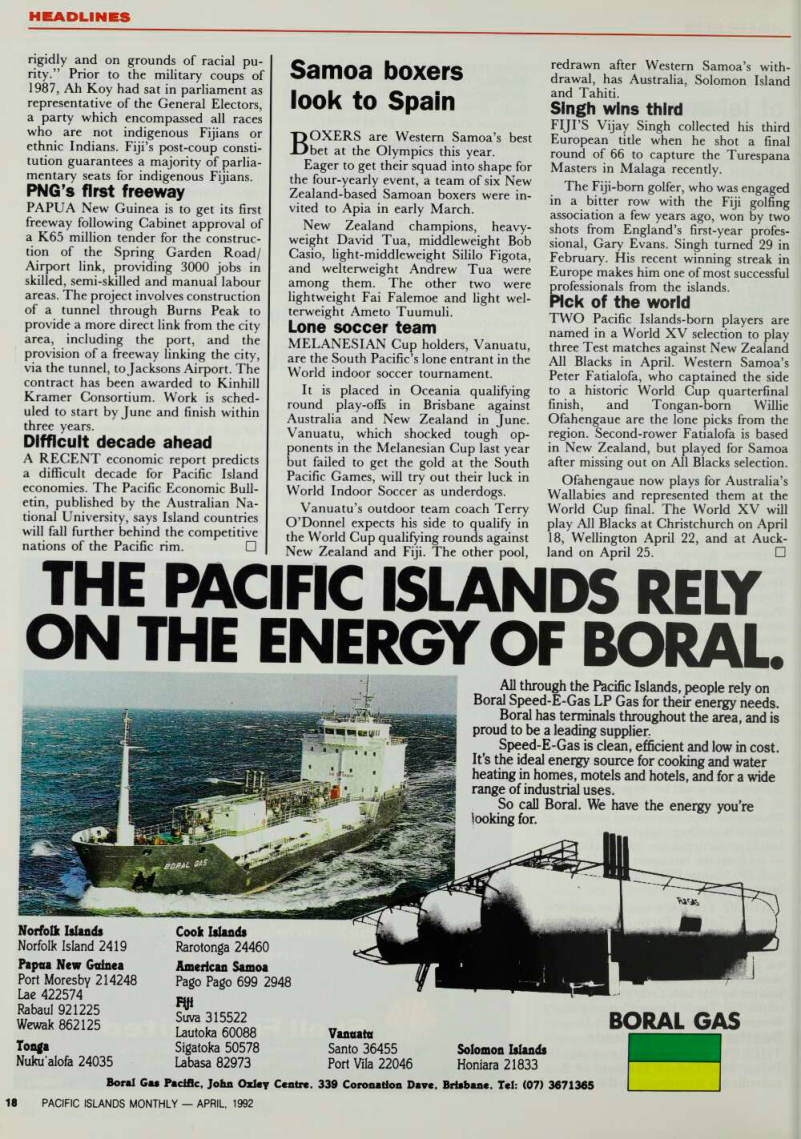
The Pacific Islands Rely
ON THE ENERGY OF BORAL
Norfolk Islands Norfolk Island 2419 Paptxa New Guinea Port Moresby 214248 Lae 422574 Rabaul 921225 Wewak 862125 Tonga Nuku’alofa 24035 All through the Pacific Islands, people rely on Boral Speed-E-Gas LP Gas for their energy needs.
Boral has terminals throughout the area, and is proud to be a leading supplier, Speed-E-Gas is clean, efficient and low in cost.
It’s the ideal energy source for cooking and water heating in homes, motels and hotels, and for a wide range of industrial uses.
So call Boral. We have the energy you’re booking for. «•: * i • i i rr Cook Islands Rarotonga 24460 American Samoa Pago Pago 699 2948 m Suva 315522 Lautoka 60088 Sigatoka 50578 Labasa 82973 Vanuatu Santo 36455 Port Vila 22046
BORAL GAS
Solomon Islands Honiara 21833 Boral Gas Pacific. John Oxley Centre. 339 Coronation Dave. Brisbane. Tel: (07) 3671365
Forced famine or seasonal?
By Evelyn Hogan
KURIMA district has had fam ines before. The whole of the Highlands of the Island of New Guinea suffers from per iodic failures of the sweet potato crop.
When rain falls heavily three to eight weeks after sweet potato is planted, the tubers don’t develop.
In PNG, cash crops have been intro duced and roads give access to markets.
If the crop fails, people buy rice. In 1984, when food shortages through the High lands provinces affected 750,000 people, food aid encouraged people to remain in their own villages. Through a regular planting program, people soon recover a steady production of sweet potato.
At the same time in Irian Jaya, food aid donated by the World Food Pro gramme remained in the warehouses of Wamena and Nabire. Officials gave the excuse that it was difficult to get food in without road access. But corruption by local officials is suspected.
This current famine only occurs in the Kurima District. The Jayawijaya Regent in charge of the area, Jos B. Wenas, said the famine was caused by the villagers in Silimo being occupied by planting wild
coconuts, a favourite delicacy, and forgot
to plant sweet potatoes. One report said “In Irian Jaya, tribal villagers are still heavily dependent on food found in the forests and are unused to agriculture.”
The delivery of food aid already has proved a contentious issue because of the ncidental effects. In 1981, when there vere food shortages in the Southern Highlands, the Provincial Nutritionist vrote: “I would like to put on record my dew that indiscriminate food aid vithout strong evidence of nutritional leprivation in the area concerned can 'ery often have contradictory effects to hose intended.” He said strengthening ocal coping strategies was better.
But it seems strange that, for the first ime in 20,000 years in these mountain 'alleys, people have forgotten to plant, frekkers who recently returned from the laliem Valley say that, immediately lorth of Kurima, people are very well fed m their traditional diet of sweet potato nd vegetables. There is a heavy military •resence south of Kurima. Evidence now oming out of Irian Jaya indicates that, ince 1989, government teams have argeted a number of villages in the Lurima region with the intention of elocating their populations. Armed with warnings that the area was quake-prone, persuader” teams visit villages to coax eople into moving. They are offered )od, school and health facilities if they
move; and nothing if they don’t.
Government educational and health teams have moved away from the Hupla village of Soba and the Yali villages of Ninia and Holuwon, which in the eyes of the government have ceased to exist. For those that stay behind, there are no supplies from the Kabupaten govern ment, and the village schools remain closed. When local people facing food shortages asked the Departement Sosial for rice they were told, “Go to Elelim where you belong.”
Food aid supplies arrived in Wamena in late January for the stricken Silimo area with 27 kampungs and a population of about 12,000. However, as with the 1984 famine, the food is still in the warehouses and officials use the excuse that the helicopters used could not fly through the thick fog. Yet on January 24, a group of government officials visited the area by helicopter.
In Silimo, 148 have died in the famine affecting 12,000 yali people. Yet instead of taking food into the area, Freeport Indonesia Inc. (FII) helicopters have been used to move 600 people from Silimo to the new settlement at Elelim, off the end of the road north of Wamena. (FFI mines in Irian Jaya and has expanded into a new 6.5 million acre
exploration area.)
Fll’s new exploration area covers the whole of the central highlands. A section, including Soba, Ninia and Holuwon, projects into the Jayawiyaya Ranges east of Silimo. Road development, planned for the year 2005, will connect the area to Wamena. Significant reserves of gold and copper are in these ranges.
Traditional landowners have been moved for Freeport’s sake in the past.
The Jayapura-based Kabar dari Kampung report in 1988 that, in Janu ary 1978, FFI issued a directive that the traditional owners of the area, the Amungme, were forbidden to enter and traverse Freeport’s current mine site at Tembagapura, the international airfield at Timika, the Portsite of Amamapare and the copper smelter.
People were forcibly moved from the cool area near the mine down to the heat and humidity of the coast. Within two years, people were suffering from malnu trition and malaria, and 216 children died when a epidemic swept through the new settlement.
If the famine in Silimo was caused by freak climatic conditions, then the action of the Indonesian state in not delivering food aid to allow the people to remain in their ancestral area, amounts to neglect.
If the famine has been the result of forced movements since 1989 to clear a crucial part of FH’s new exploration area, the result would be genocide. □
tape slows
EC red tape slows the flow
THE slow rate of dispersement of funds under Lome II and Lome 111 was a major discussion point during the fourth African, Caribbean and Pacific/European Community (ACP/EC) Joint Meeting in Suva on February 28. Pacific Island countries complained that they faced difficulty securing money to get projects running because of EC red tape.
EC representative and meeting co chairman, Frans Klinkenbergh, said this was largely because procedures were too complicated. He pointed out these were laid down in the Lome Convention negotiated by EC and AGP countries. An in-depth study was started in 1990 to find out which procedures caused the delay. A report will be presented to the joint EC/ACP ministers’ meeting in Jamaica in May.
The Suva meeting was attended at ministerial level by Fiji, Kiribati, Pa pua New Guinea, Solomon Islands, Tuvalu, Vanuatu and Western Samoa, and at official level by Tonga. The meeting was to consider a final regional package to be funded under Lome IV.
Under Lome IV which began last year, ECU3S million (US$42 million) has been made available to the eight AGP Pacific Group members for re gional projects.
The meeting agreed that the Lome IV Regional Programme should con centrate on Natural Resources and Environment comprising marine re sources, agriculture and forestry and the environment; Transport and Ser vices comprising air and maritime transport, tourism and trade; and Human Resource Development. The three sectors will receive 45 per cent, 35 per cent and 10 per cent of the ECU3S million respectively with a reserve of 10 per cent being retained for agreed projects outside the three sectors.
Officials from both sides meet again in three months to specify priorities.
According to Tuilaepa Sailele
Malielegaoi, Western Samoa’s Minister of Finance, there were about ECU 110 million worth of projects and a total budget of ECU3S million. Malielegaoi co-chaired the meeting with Klinkenbergh. Total funding for the Pacific countries under Lome IV dropped by about US$4 million from Lome 111. Klinkenbergh said a bit more had been given to the STABEX fund and a bit less to programmable aid. STABEX provides a back-up fund when industries like copra or forestry experience a drop in income. □
ports unfolding
Tale of two ports unfolding with the future
THE Singapore of the South Pacific. Where? Those with some knowledge of this region should have no problem picking the front-runner to fit the description.
With its diverse and growing industries - especially under its tax-free zone scheme strong export base and status as a tourist haven, Fiji is the obvious choice. But something else sets it apart.
Unlike other regional countries, Fiji has two major ports. Suva, the main port, which handles the bulk of the country’s containerised cargo, and Lau toka, from where major foreign
exchange-earners, sugar and woodchips,
are exported.
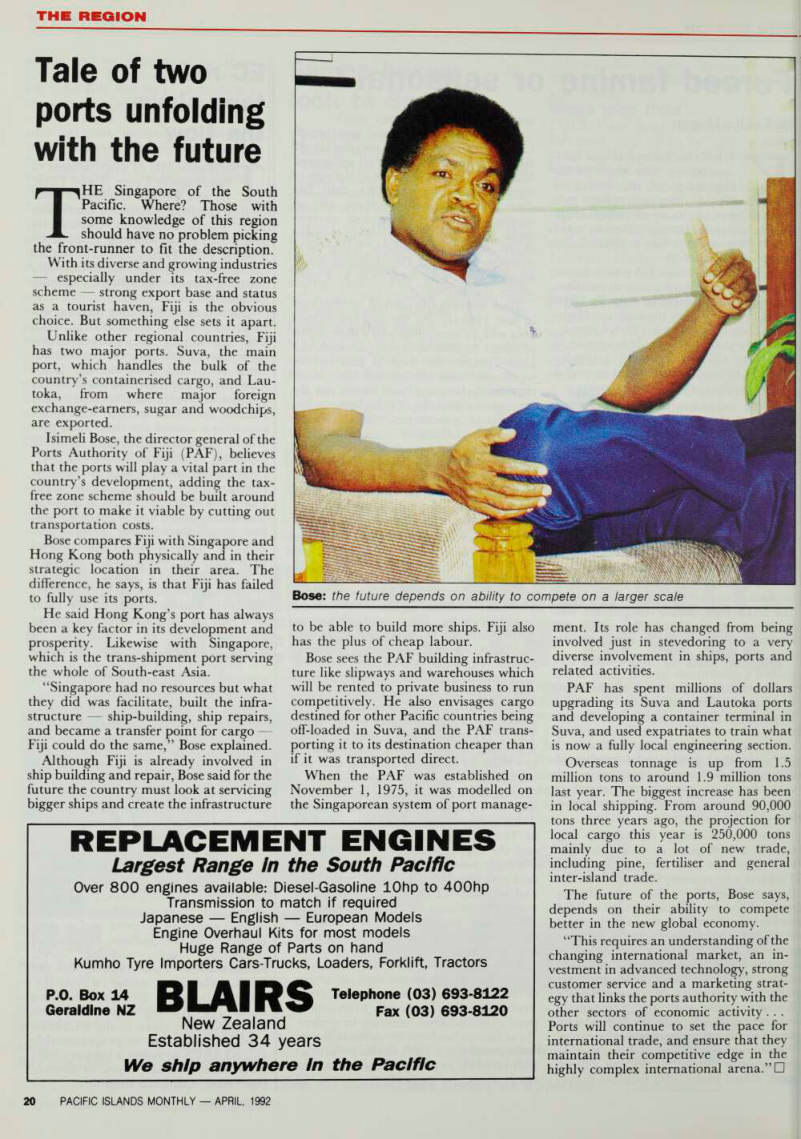
Isimeli Bose, the director general of the Ports Authority of Fiji (PAF), believes that the ports will play a vital part in the country’s development, adding the tax free zone scheme should be built around the port to make it viable by cutting out transportation costs.
Bose compares Fiji with Singapore and Hong Kong both physically and in their strategic location in their area. The difference, he says, is that Fiji has failed to fully use its ports.
He said Hong Kong’s port has always been a key factor in its development and
prosperity. Likewise with Singapore,
which is the trans-shipment port serving the whole of South-east Asia.
“Singapore had no resources but what they did was facilitate, built the infra
structure ship-building, ship repairs,
and became a transfer point for cargo Fiji could do the same,” Bose explained.
Although Fiji is already involved in ship building and repair, Bose said for the future the country must look at servicing bigger ships and create the infrastructure
to be able to build more ships. Fiji also has the plus of cheap labour.
Bose sees the PAF building infrastruc ture like slipways and warehouses which will be rented to private business to run competitively. He also envisages cargo destined for other Pacific countries being off-loaded in Suva, and the PAF trans porting it to its destination cheaper than if it was transported direct.
When the PAF was established on November 1, 1975, it was modelled on the Singaporean system of port manage
merit. Its role has changed from being involved just in stevedoring to a very diverse involvement in ships, ports and related activities.
PAF has spent millions of dollars upgrading its Suva and Lautoka ports and developing a container terminal in Suva, and used expatriates to train what is now a fully local engineering section.
Overseas tonnage is up from 1.5 million tons to around 1.9 million tons last year. The biggest increase has been in local shipping. From around 90,000 tons three years ago, the projection for local cargo this year is 250,000 tons mainly due to a lot of new trade, including pine, fertiliser and general inter-island trade.
The future of the ports, Bose says, depends on their ability to compete better in the new global economy.
“This requires an understanding of the changing international market, an in vestment in advanced technology, strong customer service and a marketing strat egy that links the ports authority with the other sectors of economic activity . . .
Ports will continue to set the pace for international trade, and ensure that they maintain their competitive edge in the highly complex international arena.” □
Bose: the future depends on ability to compete on a larger scale
Advertisements & other items, p. 20 (1 item)
Replacement Engines
Largest Range In the South Pacific Over 800 engines available: Diesel-Gasoline lOhp to 400 hp Transmission to match if required Japanese English European Models Engine Overhaul Kits for most models Huge Range of Parts on hand Kumho Tyre Importers Cars-Trucks, Loaders, Forklift, Tractors P.O. Box 14 Geraldine NZ D I A 8 D £ Telephone (03) 693-8122 r*. Fax (03) 693-8120 New Zealand Established 34 years We ship anywhere In the Pacific
Foreign investment tango
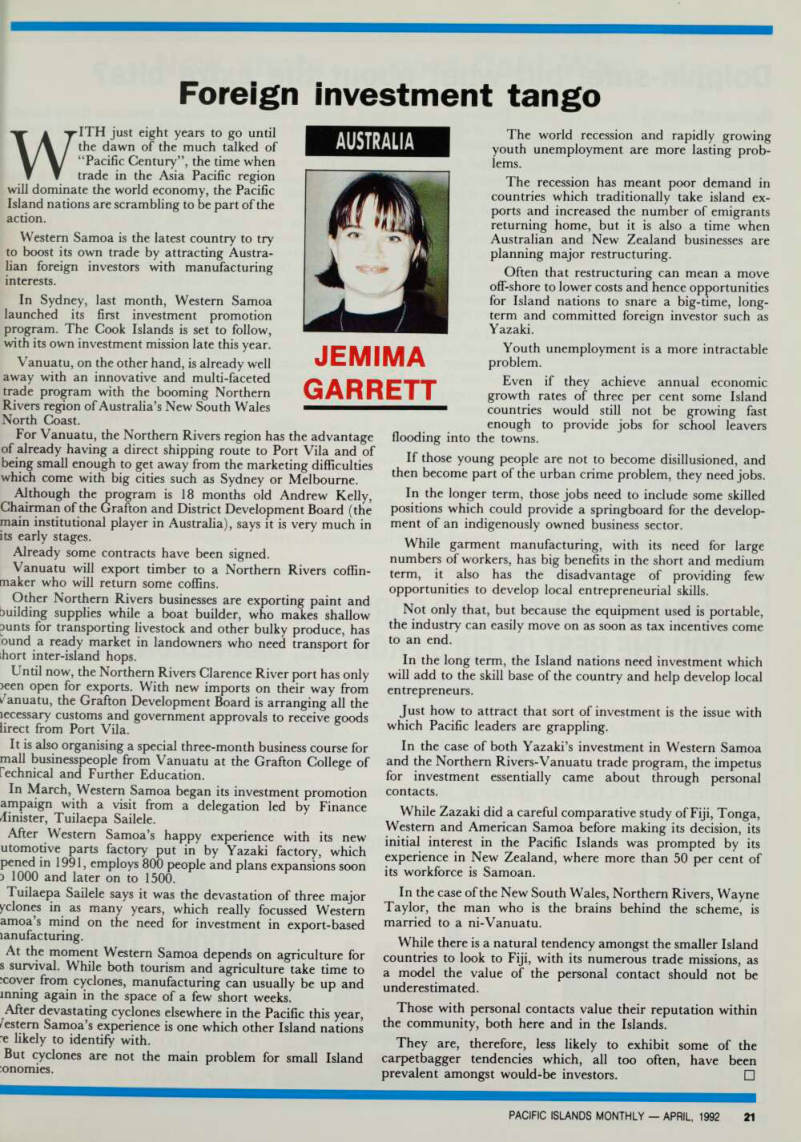
WITH just eight years to go until the dawn of the much talked of “Pacific Century”, the time when trade in the Asia Pacific region will dominate the world economy, the Pacific Island nations are scrambling to be part of the action.
Western Samoa is the latest country to try to boost its own trade by attracting Austra lian foreign investors with manufacturing interests.
In Sydney, last month, Western Samoa launched its first investment promotion program. The Cook Islands is set to follow, with its own investment mission late this year, Vanuatu, on the other hand, is already well away with an innovative and multi-faceted trade program with the booming Northern Rivers region of Australia’s New South Wales North Coast.
For Vanuatu, the Northern Rivers region has the advantage of already having a direct shipping route to Port Vila and of being small enough to get away from the marketing difficulties which come with big cities such as Sydney or Melbourne.
Although the program is 18 months old Andrew Kelly, Chairman of the Grafton and District Development Board (the main institutional player in Australia), says it is very much in its early stages.
Already some contracts have been signed.
Vanuatu will export timber to a Northern Rivers coffin maker who will return some coffins.
Other Northern Rivers businesses are exporting paint and building supplies while a boat builder, who makes shallow 3unts for transporting livestock and other bulky produce, has bund a ready market in landowners who need transport for
ihort inter-island hops.
Until now, the Northern Rivers Clarence River port has only )een open for exports. With new imports on their way from /anuatu, the Grafton Development Board is arranging all the iccessary customs and government approvals to receive goods lirect from Port Vila.
It is also organising a special three-month business course for mall businesspeople from Vanuatu at the Grafton College of fechnical and Further Education.
In March, Western Samoa began its investment promotion ampaign with a visit from a delegation led by Finance
/linister, Tuilaepa Sailele.
After Western Samoa’s happy experience with its new utomotive parts factory put in by Yazaki factory, which pened in 1991, employs 800 people and plans expansions soon 5 1000 and later on to 1500.
Tuilaepa Sailele says it was the devastation of three major in as many years, which really focussed Western amoa s mind on the need for investment in export-based
lanufacturing.
At the moment Western Samoa depends on agriculture for s survival. While both tourism and agriculture take time to ;cover from cyclones, manufacturing can usually be up and inning again in the space of a few short weeks.
After devastating cyclones elsewhere in the Pacific this year, Western Samoa’s experience is one which other Island nations e likely to identify with.
But cyclones are not the main problem for small Island :onomies.
Australia
The world recession and rapidly growing youth unemployment are more lasting prob lems.
The recession has meant poor demand in countries which traditionally take island ex ports and increased the number of emigrants returning home, but it is also a time when Australian and New Zealand businesses are
planning major restructuring.
Often that restructuring can mean a move off-shore to lower costs and hence opportunities for Island nations to snare a big-time, long term and committed foreign investor such as Yazaki.
Youth unemployment is a more intractable problem.
Even if they achieve annual economic growth rates of three per cent some Island countries would still not be growing fast enough to provide jobs for school leavers
flooding into the towns.
If those young people are not to become disillusioned, and then become part of the urban crime problem, they need jobs.
In the longer term, those jobs need to include some skilled positions which could provide a springboard for the develop ment of an indigenously owned business sector.
While garment manufacturing, with its need for large numbers of workers, has big benefits in the short and medium term, it also has the disadvantage of providing few opportunities to develop local entrepreneurial skills.
Not only that, but because the equipment used is portable, the industry can easily move on as soon as tax incentives come to an end.
In the long term, the Island nations need investment which will add to the skill base of the country and help develop local entrepreneurs.
Just how to attract that sort of investment is the issue with which Pacific leaders are grappling.
In the case of both Yazaki’s investment in Western Samoa and the Northern Rivers-Vanuatu trade program, the impetus for investment essentially came about through personal contacts.
While Zazaki did a careful comparative study of Fiji, Tonga, Western and American Samoa before making its decision, its initial interest in the Pacific Islands was prompted by its experience in New Zealand, where more than 50 per cent of its workforce is Samoan.
In the case of the New South Wales, Northern Rivers, Wayne Taylor, the man who is the brains behind the scheme, is married to a ni-Vanuatu.
While there is a natural tendency amongst the smaller Island countries to look to Fiji, with its numerous trade missions, as a model the value of the personal contact should not be underestimated.
Those with personal contacts value their reputation within the community, both here and in the Islands.
They are, therefore, less likely to exhibit some of the carpetbagger tendencies which, all too often, have been prevalent amongst would-be investors. □
Jemima
Garrett
Environmentalists, Judges

Dolphin-safe, but what about the extra bits?
By David North
and consumer advocates have made life exciting for the tuna
industry recently.
While both StarKist and Van Camp back only dolphin-safe tuna in Pago Pago, other firms tried to continue to buy tuna caught by purse-seiners working the Eastern Tropical Pacific, where they often catch (and kill) dolphins snared in their big nets * America’s powerful environmental lobby has pushed through legislation saying that the US cannot import tuna from countries whose vessels (like those of Mexico, Venezuela and Vanuatu) con tinue to fish “on dolohin” fDolnhins tinue to hsh on dolphin . (Dolphins swim above schools of tuna m the Eastern Tropical Pacific.) But vessel owners learned they could sell their catch to non-banned nations, such as Italy, Spain, and Japan which, in turn, sold the catch to US firms. The pro-dolphin Earth Island Institute in San Francisco went into the US District Court to fight this, and Judge Thelton E.
Henderson twice ordered that the prac tice of importing yellowfin caught in this manner be halted.
The ruling is beneficial to the two canneries in Pago Pago, which handled only dolphin-safe tuna anyway, and to most of the South Pacific nations. US law ’ b >' forcin S tuna boats out of the Eastern Tropical Pacific, have caused ™ an y to move into the EEZs of nations rther to the West ’ notabl y Pa P ua New 9, ulnea and , the Federated States of Micronesia, thereby increasing the li cence fees paid to those governments.
If the rulings have been good for some P arts of the industry, and bad for others, *c e recent findings of the magazine, Consume, Reports, on the lack of cleanliness m canned tuna sold to Americans, hurts . h business ever yone m me ousmess.
Consumer Reports is a very powerful, • ■ • P , . . n n , mS 1 tution. It accepts no advertising, and uses expensive a oratory testing to examine ar ! eva ua e P ro uc s * evo e lve [ ull P a S es to a dlscusslon of various brands ot canned tuna.
While it assures readers that the crud
found in some tuna cans is not harmful to one’s health (because of the cooking process) Consumer Reports’ copy was not a PP etlsm g : “We sent three samples of each tuna product to a lab that specialises in such testing. Scientists there wash the filth from the fish and examine it under a microscope. About half of the 123 Sam P‘f con ‘ amed thm § s that u should r n * have been there: insect parts, hairs, fish spies, and feather barbules (indigestible bits of feathers that birds swallow when preening and later excrete, apparently when flying around the boats anc j t h e p rocess i n g plants). Extraneous matter turned up in at least one sample G f each brand we tested.” ma „ azine re in earlier years, the magazine re ported, there was a much lower incidence of such stuff in cannec l tuna. n . . . .
Consumer Reports had some advice about buying low-sodium tuna in gen- Jf about too muc h sa lt i n the product, buy water packed tuna and simply rinse it before eating The low-sodium tuna usually costs cons id e rably more than the regular
product. □
Advertisements & other items, p. 22 (2 items)
22
PACIFIC ISLANDS MUNIHLY APRIL, 1992
THE REGION
Corporation Limited
THE NATIONAL TRADING CORPORATION LIMITED OFFERS
YOU THE BEST OF FIJI’S PRODUCE, CANNED OR FRESH. m: • i • ■JL Either canned or fJ&P' t fresh, the National
Trading Corporation
Limited (NATCO) can provide you a choice of Fiji produce that is outstanding For complete details contact us today, and discover the best range of canned foods
from Fiji.
j : UlSm r*\ '* V mm spin
KID
NATIONAL TRADING
CORPORATION LIMITED
Head Office: 24-26 Edinburgh Drive P 0 Box 13678, Raiwaqa Cable ‘NATIONMARK’ Suva Telex: FJ2413 Fax: (679) 302624 Tel: (679) 315711
New shots ... post-Cold War
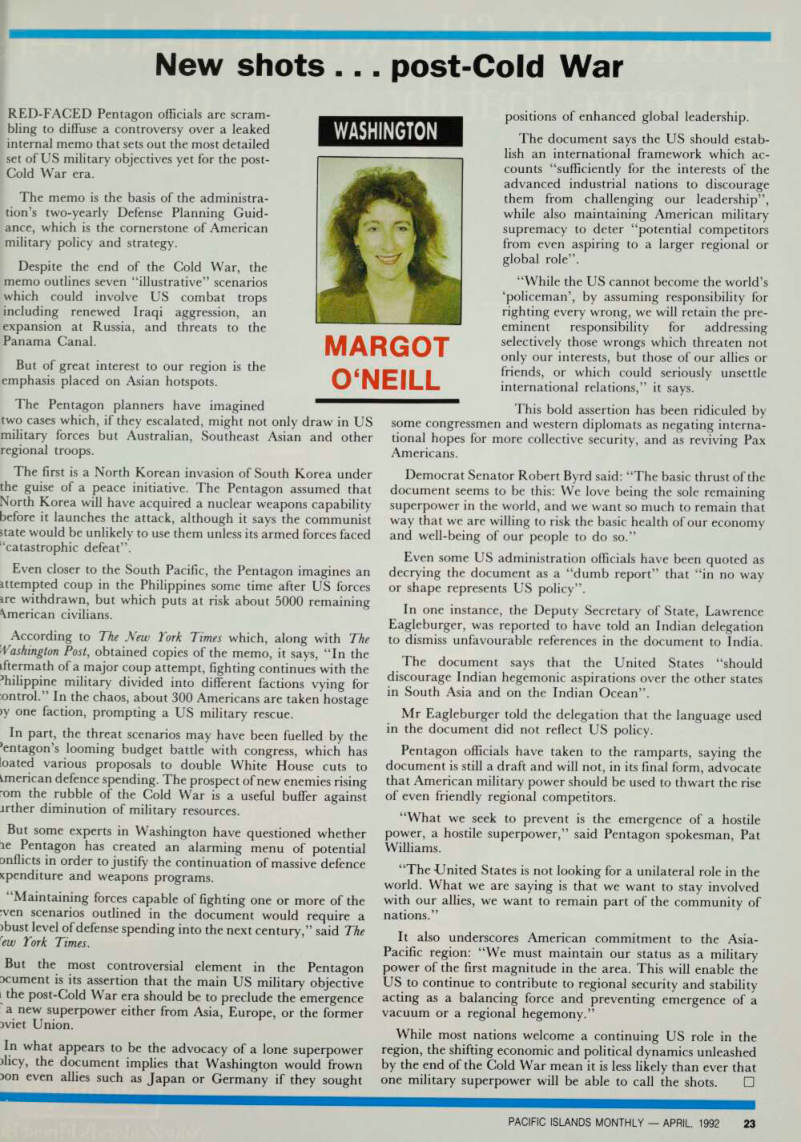
RED-FACED Pentagon officials are scram bling to diffuse a controversy over a leaked internal memo that sets out the most detailed set of US military objectives yet for the post- Cold War era.
The memo is the basis of the administra tion’s two-yearly Defense Planning Guid ance, which is the cornerstone of American military policy and strategy.
Despite the end of the Cold War, the memo outlines seven “illustrative” scenarios which could involve US combat trops
including renewed Iraqi aggression, an
expansion at Russia, and threats to the Panama Canal.
But of great interest to our region is the emphasis placed on Asian hotspots.
The Pentagon planners have imagined
two cases which, if they escalated, might not only draw in US military forces but Australian, Southeast Asian and other regional troops.
The first is a North Korean invasion of South Korea under the guise of a peace initiative. The Pentagon assumed that North Korea will have acquired a nuclear weapons capability before it launches the attack, although it says the communist state would be unlikely to use them unless its armed forces faced
‘catastrophic defeat”.
Even closer to the South Pacific, the Pentagon imagines an ittempted coup in the Philippines some time after US forces ire withdrawn, but which puts at risk about 5000 remaining \merican civilians.
According to The New York Times which, along with The Washington Post , obtained copies of the memo, it says, “In the iftermath of a major coup attempt, fighting continues with the ffiilippine military divided into different factions vying for ontrol.” In the chaos, about 300 Americans are taken hostage >y one faction, prompting a US military rescue.
In part, the threat scenarios may have been fuelled by the ‘entagon’s looming budget battle with congress, which has loated various proposals to double White House cuts to American defence spending. The prospect of new enemies rising "om the rubble of the Cold War is a useful buffer against irther diminution of military resources.
But some experts in Washington have questioned whether le Pentagon has created an alarming menu of potential □nflicts in order to justify the continuation of massive defence Kpenditure and weapons programs.
Maintaining forces capable of fighting one or more of the wen scenarios outlined in the document would require a )bust level of defense spending into the next century,” said The r ew York Times.
But the most controversial element in the Pentagon Dcument is its assertion that the main US military objective ■ the post-Cold War era should be to preclude the emergence a new superpower either from Asia, Europe, or the former Dviet Union.
In what appears to be the advocacy of a lone superpower )licy, the document implies that Washington would frown Don even allies such as Japan or Germany if they sought
Washington
positions of enhanced global leadership.
The document says the US should estab lish an international framework which ac counts “sufficiently for the interests of the advanced industrial nations to discourage them from challenging our leadership”, while also maintaining American military supremacy to deter “potential competitors from even aspiring to a larger regional or global role”.
“While the US cannot become the world’s ‘policeman’, by assuming responsibility for righting every wrong, we will retain the pre eminent responsibility for addressing selectively those wrongs which threaten not only our interests, but those of our allies or friends, or which could seriously unsettle international relations,” it says.
This bold assertion has been ridiculed by
some congressmen and western diplomats as negating interna tional hopes for more collective security, and as reviving Pax Americans.
Democrat Senator Robert Byrd said: “The basic thrust of the document seems to be this: We love being the sole remaining superpower in the world, and we want so much to remain that way that we are willing to risk the basic health of our economy and well-being of our people to do so.”
Even some US administration officials have been quoted as decrying the document as a “dumb report” that “in no way or shape represents US policy”.
In one instance, the Deputy Secretary of State, Lawrence Eagleburger, was reported to have told an Indian delegation to dismiss unfavourable references in the document to India.
The document says that the United States “should discourage Indian hegemonic aspirations over the other states in South Asia and on the Indian Ocean”.
Mr Eagleburger told the delegation that the language used in the document did not reflect US policy.
Pentagon officials have taken to the ramparts, saying the document is still a draft and will not, in its final form, advocate that American military power should be used to thwart the rise of even friendly regional competitors.
“What we seek to prevent is the emergence of a hostile power, a hostile superpower,” said Pentagon spokesman, Pat Williams.
“The United States is not looking for a unilateral role in the world. What we are saying is that we want to stay involved with our allies, we want to remain part of the community of nations.”
It also underscores American commitment to the Asia- Pacific region: “We must maintain our status as a military power of the first magnitude in the area. This will enable the US to continue to contribute to regional security and stability acting as a balancing force and preventing emergence of a vacuum or a regional hegemony.”
While most nations welcome a continuing US role in the region, the shifting economic and political dynamics unleashed by the end of the Cold War mean it is less likely than ever that one military superpower will be able to call the shots. □
Margot
O‘Neill
Advertisements & other items, p. 24 (1 item)
yWaj
It took Boo of the worlcfe best beer:
to prove that was only one.
i
fXPORTO
IfZtAUND’SFIHEST®
mm r 4 3 4- S' * 0
nmj
s; / s; 0 v '2 HP .. —'-'I In 1985 eight hundred international beers competed for the Championship Trophy in the Brewing Industry Awards held at Burton-on- Trent, England.
There was only one winner.
yWaj
cr New Finest Be«
Warriors on a new battlefield
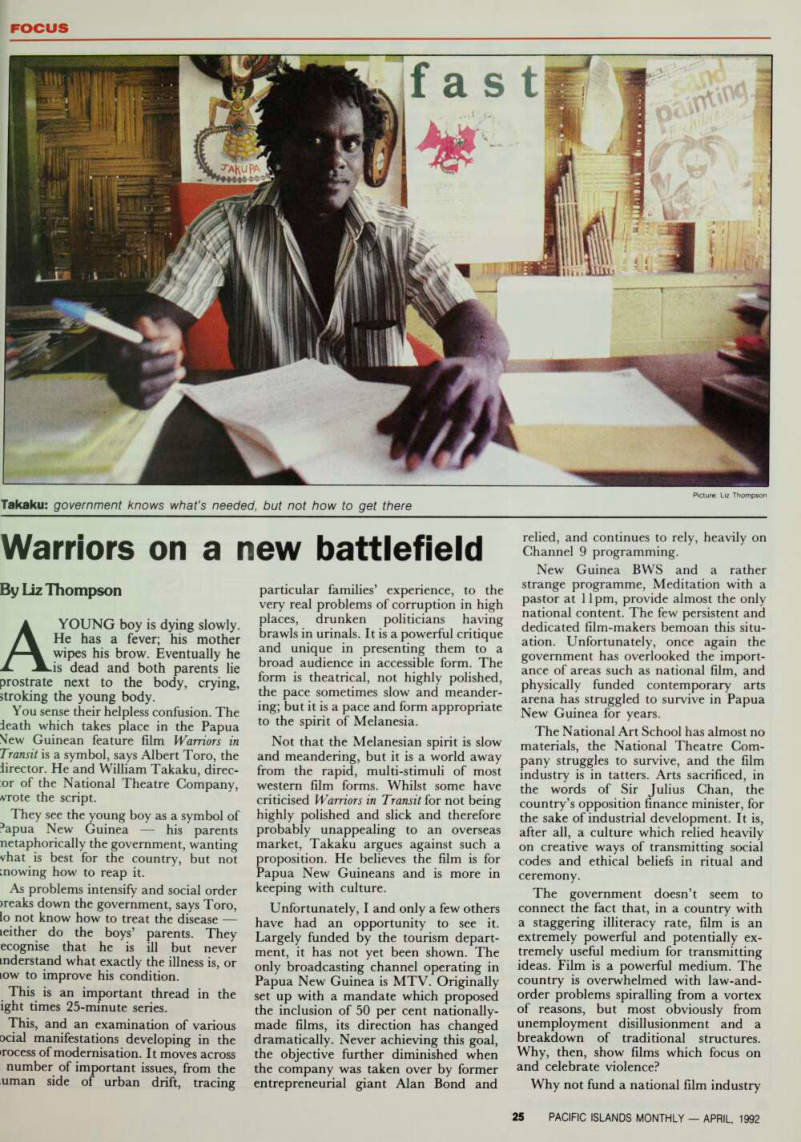
Focus
By Liz Thompson
A YOUNG boy is dying slowly.
He has a fever; his mother wipes his brow. Eventually he is dead and both parents lie prostrate next to the body, crying,
stroking the young body
You sense their helpless confusion. The death which takes place in the Papua Mew Guinean feature film Warriors in Transit is a symbol, says Albert Toro, the director. He and William Takaku, direc or of the National Theatre Company, vrote the script.
They see the young boy as a symbol of 3 apua New Guinea his parents
netaphorically the government, wanting
vhat is best for the country, but not mowing how to reap it.
As problems intensify and social order ireaks down the government, says Toro, lo not know how to treat the disease icit er do the boys parents. They ecogmse that he is ill but never in erstand what exactly the illness is, or iow to improve his condition. • T his 1S an i m P ortant thread in the ight times 25-minute series.
This, and an examination of various ocial manifestations developing in the Tocess of modernisation. It moves across number of important issues, from the uman side of urban drift, tracing
particular families’ experience, to the very real problems of corruption in high P lace , s ’. politicians haying brawls in unnals. It is a powerful critique and unlc l“ e presenting them to a kroad . audlence >" accessible form. The , 15 theatrical, not highly polished, the P ace sometimes slow an d meander in Bi l3ut kis a P a “ f nd form appropriate to s P int °* Melanesia.
Not that the Melanesian spirit is slow and meandering, but it is a world away from the rapid, multi-stimuli of most western film forms. Whilst some have criticised Warriors in Transit for not being highly polished and slick and therefore probably unappealing to an overseas market, Takaku argues against such a proposition. He believes the film is for Papua New Guineans and is more in keeping with culture, Unfortunately, I and only a few others have had an opportunity to see it.
Largely funded by the tourism depart ment, it has not yet been shown. The on iy broadcasting channel operating in Papua New Guinea is MTV. Originally set up with a mandate which proposed the inclusion of 50 per cent nationally made films, its direction has changed dramatically. Never achieving this goal, the objective further diminished when the company was taken over by former entrepreneurial giant Alan Bond and
relied, and continues to rely, heavily on Channel 9 programming.
New Guinea BWS and a rather strange programme, Meditation with a pastor at 11pm, provide almost the only national content. The few persistent and dedicated film-makers bemoan this situ ation. Unfortunately, once again the government has overlooked the import ance of areas such as national film, and physically funded contemporary arts arena has struggled to survive in Papua New Guinea for years.
The National Art School has almost no materials, the National Theatre Com pany struggles to survive, and the film industry is in tatters. Arts sacrificed, in the words of Sir Julius Chan, the country’s opposition finance minister, for the sake of industrial development. It is, after all, a culture which relied heavily on creative ways of transmitting social codes and ethical beliefs in ritual and ceremony.
The government doesn’t seem to connect the fact that, in a country with a staggering illiteracy rate, film is an extremely powerful and potentially ex tremely useful medium for transmitting ideas. Film is a powerful medium. The country is overwhelmed with law-and order problems spiralling from a vortex of reasons, but most obviously from unemployment disillusionment and a breakdown of traditional structures.
Why, then, show films which focus on and celebrate violence?
Why not fund a national film industry
Takaku: government knows what's needed, but not how to get there
Picture: Liz Thompson
and film-makers who want to look at national issues in a sensitive and in formed way, and want to contribute to the forging of a new cultural identity?
Skool Bilong Wokim Piksa, a film school established in the Highlands and recent producer of the feature film Tin Pis , is a French-funded operation. Toro com plains the films it produces have become
too french, lacking an intrinsically Papua
New Guinean flavour.
Takaku says Papua New Guineans only see their own people appear in documentaries, which frequently look at them as the other, the exotic, primitive race, or in advertisements. It’s time, he says, the people could relate to their own heroes. Warriors in Transit doesn’t necess arily produce superheroes, but it does address numerous issues extremely perti nent to most Papua New Guineans, in a accessible and entertaining form.
It traces, through a few key figures and a squatter community, the pain of urban migration. It is directed on one level, says Takaku, to the grassroots-level Papua New Guinean, “attracted by the bright lights of the city, coming in from rural areas with the hope of good times, when they arrive the problems begin”.
Once there, they wonder where the food they imagined is, the shelter they envisaged, the money they assumed
flourished. The film looks at the move ment of youth away from parents, the rejection of all traditional. Sensitively, it examines family breakdown.
“The entire family unit,” says Takaku, “is crumbling, we must highlight this so people are aware. Families are the root of all love that kept societies together before and now that is crumbling, the house is rotting and things are going all over the place and people are wandering around mad.”
It scathingly examines workings and hypocrisy within government. Using the process of a real estate developer bribing government officials to bulldoze a squat ter settlement, it addresses issues close to home. Politicians get drunk, fight in toilets and are depicted as essentially self interested and corrupt.
Toro says government selfishness, combined with failure to understand the real problems as with the parents and dying child, compound to produce chaos.
The film is hard-hitting in it’s depic tion of the country’s government and bureaucracies maybe that’s why the industry’s so badly funded. But it is important, as in any country, to be able to examine these issues, and in Papua New Guinea a broadly received presen tation can only really take place in the medium of film or radio.
“Warriors”, as the film title suggests, are “in transit”. The film asks," says Takaku, “where do we go from here, how do we transit into this new era, and why do we have to do it?”
It is part of a process of production which could be extremely valuable and constructive in Papua New Guinea today. Already invited to appear in overseas festivals, MTV have offered Takaku and Toro about K 260 per episode, about As4oo. That, says Takaku, is a joke. Given the total lack of copywright laws in the country as soon as it went to air on TV, it would be pirated and the filmmakers would find it difficult to make any more money.
Takaku plans to try and screen it in theatres around the country.
NBC, the National Broadcasting Com mission from which the radio emerges, is
currently being revamped, along with
financial assistance from ABC correspon dent Sean Dorney. Hopefully, it will eventually provide an alternative tele vision broadcasting station. This, in conjunction with a better-funded film industry and the number of talented and committed directors who have already emerged, could start to turn film into an exciting, important and culturally useful medium. One can only hope that the film industry is in transit and on it’s way to better times. □
Advertisements & other items, p. 26 (1 item)
Lashok
vei
EXP re
QUALITY IN
AIR TRANSPORT
For all your travel, we alone offer that balanced combination of service and value which you have often sought but never found!
SUVA
NADI
EDMONTON
TORONTO
VANCOUVER
EUROPE
CANADA
LONDON
USA
SEVILLE
NEW YORK
LOS ANGELES
SAN FRANCISCO
HONOLULU
JEDDAH
KARACHI
DELHI
BOMBAY
MADRAS
CALCUTTA
• TOKYO
PEKING
► HONG KONG
‘SINGAPORE
BANGKOK
'SYDNEY
BRISBANE
•AUCKLAND
SUVA
NADI
LOOKING AFTER PEOPLE WHO TRAVEL
HERE ARE THE BEST REASONS TO BOOK WITH TRAVEL EXPRESS • VALUE FOR MONEY We offer some of the best value airfares available anywhere using the best airline for your itinerary. • EFFICIENCY We use Qantam, Marlin and Carina, one of the most technologically advanced reservations system that gives instant access to airfares, hotel, car hire and itinerary planning. • PEOPLE Our personnel are consultants who understand the needs of travellers; they are trained experts in making your arrangements go the way you want them to. • PRODUCTS We are all eager to give you the best possible travel service from the widest selection of travel products now available through our travel service initiative, TRAVEL EXPRESS.
TODAYS BEST VALUE AIR FARES FROM
FIJI’S BEST TRAVEL PEOPLE CONTACT
lASHOK
LALLUBHAI
AGENTS FOR ALL INTERNATIONAL & DOMESTIC AIRLINES Phone: (679) 780294 (679) 700870 Facsimile: (679) 780366 A/H: (679) 780220 P.O. Box 7, Nadi-Fiji 163 Queens Road, Opp Nadi Post Office
Pacific
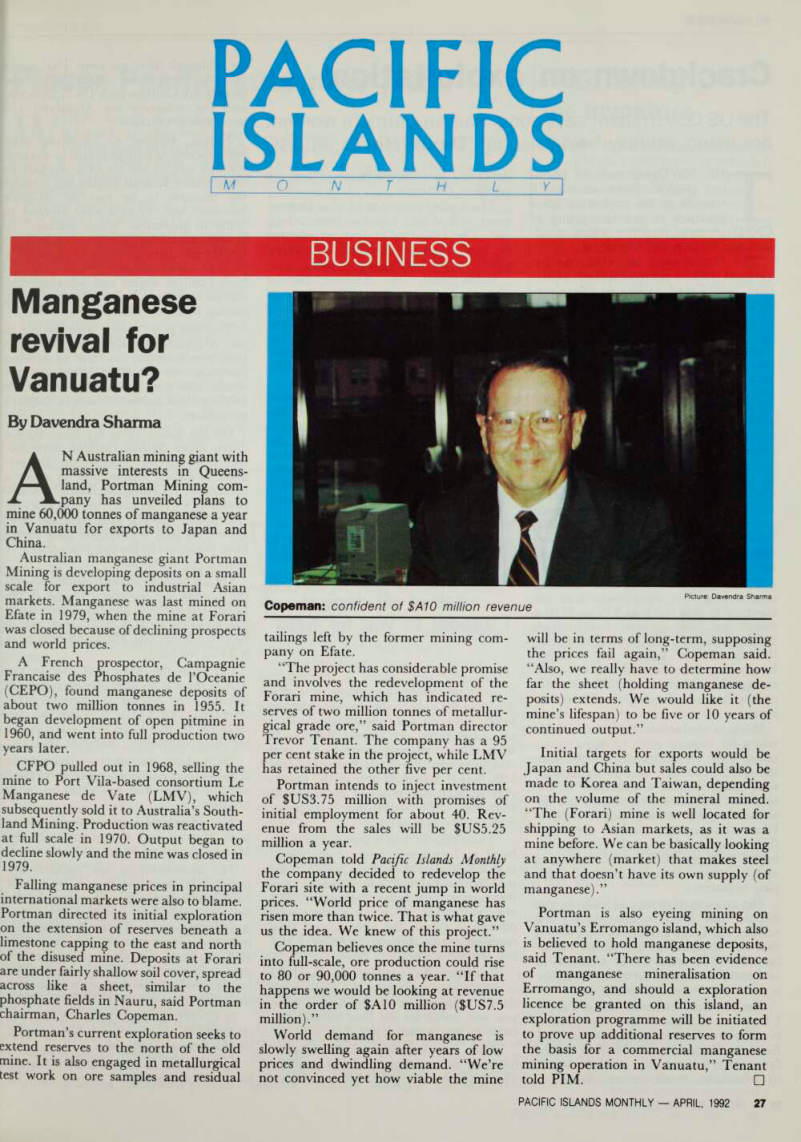
Islands
Monthly
Business
Manganese revival for Vanuatu?
By Davendra Sharma
AN Australian mining giant with massive interests in Queens land, Portman Mining com pany has unveiled plans to mine 60,000 tonnes of manganese a year in Vanuatu for exports to Japan and China.
Australian manganese giant Portman Mining is developing deposits on a small scale for export to industrial Asian markets. Manganese was last mined on Efate in 1979, when the mine at Forari was closed because of declining prospects and world prices.
A French prospector, Campagnie Francaise des Phosphates de I’Oceanie (CEPO), found manganese deposits of about two million tonnes in 1955. It
began development of open pitmine in
1960, and went into full production two years later.
CFPO pulled out in 1968, selling the mine to Port Vila-based consortium Le Manganese de Vate (LMV), which subsequently sold it to Australia’s South land Mining. Production was reactivated at full scale in 1970. Output began to decline slowly and the mine was closed in 1979.
Falling manganese prices in principal international markets were also to blame.
Portman directed its initial exploration on the extension of reserves beneath a limestone capping to the east and north of the disused mine. Deposits at Forari are under fairly shallow soil cover, spread across like a sheet, similar to the phosphate fields in Nauru, said Portman chairman, Charles Copeman.
Portman’s current exploration seeks to extend reserves to the north of the old mine. It is also engaged in metallurgical test work on ore samples and residual
tailings left by the former mining com pany on Efate.
“The project has considerable promise and involves the redevelopment of the Forari mine, which has indicated re serves of two million tonnes of metallur gical grade ore,” said Portman director Trevor Tenant. The company has a 95 per cent stake in the project, while LMV has retained the other five per cent.
Portman intends to inject investment of 5U53.75 million with promises of initial employment for about 40. Rev enue from the sales will be 5U55.25 million a year.
Copeman told Pacific Islands Monthly
the company decided to redevelop the Forari site with a recent jump in world prices. “World price of manganese has risen more than twice. That is what gave us the idea. We knew of this project.”
Copeman believes once the mine turns into full-scale, ore production could rise to 80 or 90,000 tonnes a year. “If that happens we would be looking at revenue in the order of SAIO million (SUS7.S
million).”
World demand for manganese is slowly swelling again after years of low prices and dwindling demand. “We’re not convinced yet how viable the mine
will be in terms of long-term, supposing the prices fail again,” Copeman said.
“Also, we really have to determine how far the sheet (holding manganese de posits) extends. We would like it (the mine’s lifespan) to be five or 10 years of
continued output.”
Initial targets for exports would be Japan and China but sales could also be made to Korea and Taiwan, depending on the volume of the mineral mined.
“The (Forari) mine is well located for shipping to Asian markets, as it was a mine before. We can be basically looking at anywhere (market) that makes steel and that doesn’t have its own supply (of
manganese).”
Portman is also eyeing mining on Vanuatu’s Erromango island, which also is believed to hold manganese deposits, said Tenant. “There has been evidence of manganese mineralisation on Erromango, and should a exploration licence be granted on this island, an exploration programme will be initiated to prove up additional reserves to form the basis for a commercial manganese mining operation in Vanuatu,” Tenant told PIM. □
Picture: Oavendra Sharma
Copeman: confident of $A10 million revenue
Crackdown on exploitation
The US Government says some Saipan garment workers are being virtually held prisoner. David North reports.
THE US Department of Labor has cracked down on what it regards as the exploitive labor practices of a major group of CNMI garment factories whose prod ucts are sold on the Mainland.
The Department has charged that garment workers are overworked, under paid, and forced to live in unsanitary conditions while being held virtual
prisoners by their employers.
The workers toil 11 hours a day, six days a week, and work eight and a half hours on Sunday. That adds to 74.5 hours a week, or 322 a month, about twice as long as the average work week on the Mainland. Further, they are not paid at the higher (overtime) rates for work beyond 40 hours a week, as Mainland law stipulates.
The workers are supposed to get 52.15 an hour, the minimum wage set by the CNMI government, but the US Labor Department says that the average worker gets only $1.63 an hour, gross, and that is further reduced by a series of deduc tions, many of which the Department finds questionable.
Some of these deductions are manda tory savings, but other deductions are contrary to law (such as $75 to $l2O a month for “management fees”). With the deductions figures in (and excluding the remittances home) the workers’ hourly wages are reduced to between 74 cents and $1.04 an hour, PIM calculates on the basis of the Department’s stat istics.
While a deduction from a worker’s wages for housing may be appropriate under some circumstances, in this case the $lOO-$ 150 per month deductions were made despite a provision in the contracts between the employers and the workers saying housing would be free.
When the garment workers are using their housing, they work and live in fenced and guarded compounds, and many of them sleep in converted ship
ping containers.
The amount of money at stake in this dispute has been estimated at $2O million; this is the amount of back wages that the Department of Labour calcu lates are due some 1,350 workers. A lawyer for the owners says that the figure is more than twice too high.
The principal owner is Willie Tan, a US citizen of Chinese ancestry; he and his relatives own American International Knitters Corporation and four other firms which ship sweaters and sportswear to Mainland retail stores. Some of
America’s best-known fashion labels are on these garments.
The battle between the Labor Depart ment and Willie Tan has been a long one. The Department first investigated the case. Then, on behalf of the workers, sued Tan for backwages in July.
Subsequently the Federal District Court in Saipan ordered Tan to put up $400,000 in bonds to guarantee that if back wages are found due, money will be available, and to prevent Tan from shipping any workers (and potential witnesses) back to China or the Philip pines without the Court’s consent.
In this connection, the Department released an affidavit filed by one of the workers and subsequently translated from the Chinese. It recounted that the worker had received, seen by two Labor
Department investigators, two cheques
for back wages from the factory. We pick up the story from the workers’ statement:
‘You enforce your laws as stable as a mountain ... against all danger I appeal to you for help'
“. . . At that time [a management per son] told me to keep the checks (cheques) safely; someone will collect from me later on. That night, at around 8.30 pm [a management person] came to my post and demanded the checks from me. I told him that it stated on top of the checks that nobody can demand these checks from me ... he replied that “this paper is of no use to you ...”
“I saw that he had a few checks in his hand, so I gave my checks. I was afraid that if I refused there’d be problems for me. I don’t know any laws, I was thinking to telephone you people. But after witnessing 12 of the workers who refused to return the checks, and they received many threats, therefore I did not telephone you.
“I learned that you enforce your laws as stable as a mountain. So against all danger I appeal to you for help. I hope you will secret for me that we will not come to any harm. Until then.”
There are virtually no Chamorros involved in any aspect of the conflict.
The workers are largely Mainland Chin
ese, although there are some Thai, some Filipinos and some from FSM; the owners are Chinese with US citizenship; and the enforcers are Mainland US government officials.
Saipan decided to encourage the manufacture of garments but, in essence, decided not to use its own workers in these plants. Instead Saipan has allowed the business to be run by off-shore interests, who, in turn were allowed to bring in powerless “guest workers” to actually make the garments. It is as if the CNMI government simply carved off a piece of the island and permitted Main land Chinese wages and working con ditions to exist, all the while producing clothes marked “Made in the USA”.
This last point upsets some people in the Mainland clothing industry who have been investing in a large advertising campaign on behalf of US-made gar ments; that their advertising dollars are helping to sell garments made in Saipan’s
sweatshops.
On the island, there are more than a dozen other Saipan clothing manufac turers, wondering whether the Depart ment of Labor will be able to make a precedent. As Allan McCann, the De
partment’s principal investigator in
Guam and CNMI said recently “I’ve never reviewed a company that didn’t have violations in the two years that I’ve been going to Saipan.”
On the Mainland, both employers and the unions are watching to see if the Labor Department can bring the rate of oay up to the local (CNMI) legal rate of $2.15 an hour. The Mainland minimum is $4.25 an hour.
On both the Mainland and in the islands there is another observer, Juan N Babauta, the elected Washington Rep resentative of CNMI. “If Willie Tan is in violation he should be held accountable for those violations,” Babauta said.
“It is about time that we treated our alien workers humanely, paid them their rightful wages, and put them in clean
housing.”
The Mainland rules apply in full to both Hawaii and Guam, as does the Mainland rate of $4.25 an hour.
The minimum is set industry-by industry in American Samoa by a joint Mainland-Island panel appointed by the Secretary of Labour and the Governor of American Samoa. There the principal ndustry is tuna canning, and its rate is 52.87 an hour, though most workers are paid a few cents more per hour. (The issue there is the setting of the rates, not their enforcement; see PIM July, 1991.) In CNMI the rate ($2.15 an hour) is set by the local government, but enforced by the federal authorities.
In Palau (as in the Associated States) local option prevails. □
Placer Pacific sets new pace
WHEN record production was achieved at the world-rated Porgera mine in the PNG high lands, it was their three principal Australian partners who picked up the most credits.
Porgera manager, Placer Pacific, has won repute in Australia as the country’s leading gold producer with the help of output from Porgera. It said in its production report for 1991, that it churned out 2 million ounces (62.2 tonnes) of gold last year, almost double the 1990 figure.
Output from five mines surged from 1.14 ounces to 2.06 million ounces.
With that it has replaced Western
Mining Corporation once involved
with Emperor at Fiji’s Vatukoula gold mines as Australia’s leading gold producer. Placer and Western Mining are expected to be virtually at level billing in terms or overall equity gold
production.
However, the Canadian controlled Placer Pacific should edge ahead in coming years, largely on the strength of Porgera. It said the main factor in the production increase was the strong performance by the huge Porgera mine in PNG, owned 30 per cent and managed by Placer.
Placer’s other PNG mine, the 80 per cent owned and managed Misima mine on the island of the same name, was also a strong performer. Its production for the year, 323.127 ounces was up only marginally from 317,167 ounces, but was well up on expectations.
Placer said production there was also helped by improved recovery rates (94 per cent) and increased treatment rates.
Exploration adjacent to the main pit area and elsewhere on Misima has continued, with Placer reporting ad ditional drilling planned for 1992. □
PNG fishing
for investors
THE PNG Government has ap proved a package of incentives in a bid to attract foreign investors into the country’s fishing industry.
The incentives package includes exemption of import and export duty on vessels, vessel parts, fuel and stores, boat construction material and canned or frozen fish products.
The government also has decided on a tax holiday of five years for pioneer industries and depreciation costs re bates on plant, equipment and vessels, and facilities for repatriation of capital and profits as part of the package.
The Government has closed off its waters to distant water fleets on access conditions. Preferential access will be given to domestic-based operators and foreign investors committed to shore based fisheries development projects. □
Different and attractive
Investment report
FROM the tiny atolls of Kiribati to the large land-mass of Papua New Guinea, the Pacific region is marked by its diversity a diversity that makes investment in this region of the world both attractive and different.
Vanuatu Offshore investment can be arranged without visiting the country.
There are no direct personal or :orporate income taxes or gains taxes, withholding taxes or estate duty taxes for either investors taking advantage of the )ffshore status or those who live and work n the country.
Business opportunities available to the nvestor are in tourism, agriculture and
ight industry.
Tourism is the fastest growing area of levelopment, and investment in agricul ure is possible. Exporting agricultural •reduce is feasible. Industrial concerns re also encouraged by the government, i particular opportunities in manufac uring items to assist in import substi ution. *apua New Guinea The economy is largely dependant pon its natural resources. The country noted for producing copra, palm oil, Dcoa, tea and coffee, and an increasing umber of spices.
Forestry is also an important source of wenue.
A growing fishing industry is provid
ing another source of income, and tuna fishing and processing are seen as having the most opportunities for commercial
development.
Mineral and petroleum developments include gold and cooper mines.
Commercial and business enterprises concentrate on retail and wholesale trading, light manufacturing, transport
and shipping.
Solomon Islands The government seeks to encourage foreign investors with investment assist ance, and it is keen to see the develop ment of industries that will use and process natural resources. In particular, development of industries that produce products for export- and import substitution will receive substantial en couragement.
Opportunities also exist in tourism, forestry, fisheries, transport and mining.
There are several investment incen tives.
Kiribati The economy is dependent upon copra, salt, fishing and foreign aid.
There is a current programme of encouragement of small-scale industries and privatisation in an effort to increase the participation of the people.
The company tax rate is 25 per cent on the first $50,000 and 35 per cent thereafter.
However new businesses may be granted “Pioneer Industry” tax status
which allows for reduced tax rates. There are also several double taxation treaties in place.
Fiji The economy has been largely depen dent on the production and export of sugar. However, with the advent of tourism in the 1960 s and the govern ment’s commitment to encourage private investment and economic growth, the dominance of the sugar industry in the economy has decreased.
The manufacture and export of gar ments under the government’s taxation concessions for certain industries also produces substantial earnings for the economy while other major exports include unrefined gold, timber and fish.
Manufacturing, which is export oriented, has been encouraged by the government with various taxation con cessions.
All new foreign investment proposals require the approval of the Fiji Trade and Investment Board.
Customs duties are levied on goods entering Fiji.
Investment incentives primarily take the form of tax concessions reductions in company income tax, accelerated deductions, import duty concessions, tax holidays etc.
A number of trade concessions are available to assist the development of exports from Fiji. □ Compiled by Pacific branches of Peat Marwick, chartered accountants
Advertisements & other items, p. 30 (1 item)
Tagio Tumas!
4 s Thank You!
Vinaka Vakalevul
Tenku Tru!
Kobatiraba!
Bahut Dhanyevaad!
No matter which way we say it, it can't express our gratitude enough.
We are indebted to the many organisation,business houses and individuals who have helped us make the Pacific Pavilion at Expo 92 a reality.
We plan to repay this kindness by giving Spain,Europe and the world a taste of the Pacific they won’t forget.
Pacific Discoveries Limited i taking the Pacific to the world GPO Box 1171, 108 Amy Street, Suva, Fiji.
Phone (679) 303 919 or (679) 303855 Fax (679) 303681
Painful economic jump-start
By David North
ONE way to jump-start an Island economy is to suffer a major hurricane, then have the US Government come to the rescue. That has been American Samoa’s experience three times in recent years.
The sequence works like this. First, the big storm Tusi, in 1987, Ofa in 1990, and last December, Val, A lot of damage is done. The Governor (most recently Peter Tali Coleman) prevails on the US President to declare American Samoa a disaster area. The President’s decision sets in motion a flurry of not always well coordinated relief efforts, and volunteers and supplies pour in from the Mainland.
A number of sharpsters as well as real victims benefit.
One reason why the pattern persists is that, even in a time of budget constraints, the amounts of money shipped from Washington to Pago Pago are tiny by Washington terms, if massive by those of the American Samoan Government (ASG). Further, they come from many places, so no single federal government agency is nicked significantly. Finally, it is not in the interests of ASG to slow the distribution of goods and services to make sure that the Mainland money is spent wisely so it often isn’t.
How much money is involved? Esti mates suggest about $3O million for Val (as opposed to a miserly US allocation of $ 150,000 to help the far more numerous
rictims in Western Samoa.)
In general terms, Federal Emergency
Management Agency (FEMA) does
houses and the Red Cross does food and household vouchers. Both traditionally have trouble working out who is eligible for some help and who needs none; the Mainlanders who do most of the work are easily confused by Island names and there is no system of numbering houses, so FEMA has been known to provide more housing repair assistance than was needed.
The FEMA package is attractive convince FEMA that you own the house, and it needs fixing, and they give you a cheque for up to $B,OOO. No receipts are called for routinely unless the damage is more than $B,OOO. In cases of severe damage, FEMA will replace the entire house with one of its own.
Relief vouchers and food baskets distributed by the Red Cross are equally attractive; vouchers were reportedly given to 10,226 families representing 77,035 individuals. In contrast, the most recent estimate of the entire population is 50,000. The average family voucher was worth $l,lOO.
Sometimes sharpsters are thwarted.
Half a dozen locals, who had been Red Cross volunteers, were caught writing out phoney vouchers for their own use.
A building contractor was arrested for taking more than $lOO,OOO in deposits from homeowners, then not doing any work on their houses.
The ASG government, meanwhile, got funding from FEMA for more than 600 short-term jobs, and paid many of the workers $5 an hour much more than the minimum wage set for regular ASG workers. It also came out, after Val, that ASG was in a jam for mismanaging the
Tusi clean-up during the Lutali Admin istration, and owing the Feds $1 million as a result.
Meanwhile, substantial amounts of money and supplies pour into the American Islands after these storms.
During Ofa there was so much money, in FEMA repair funds, that new supplies of US bills had to be flown in from Hawaii those with the cheques wanted greenbacks. Similarly, the outpouring of money into Western Samoa banks was so great following Ofa, that the banks had too few borrowers to absorb it. ( PIM,
April 1991)
But some lessons had been learned: O ASG reduced the usually easy migration from Western Samoa for 30 days after Val, apparently to see to it that only residents of American Samoa ben efited from the Mainland largess; Governor Coleman’s explanation was he did not want to place additional burdens on the territory’s utilities, services, and public infrastructure post-storm.
O FEMA houses, built to strict mainland building codes, after Tusi and Ofa, generally survived Val’s even fiercer winds.
O FEMA has decided, after the village of Sili (15 houses) was virtually demolished three times by heavy seas, that it will not rebuild it again. This is painful to the inhabitants who, because of traditional Samoan ties to the land, feel that they cannot buy plausible building sites elsewhere.
The relief workers particularly the short-term people brought in right after the disaster are not auditors, they’re just good-hearted folk who want to help.
So the chances are that the pattern of real damage, generous Mainland response, and local waste will be repeated when Val’s successor hits the Islands. □
push for
Western Samoa push for investment
WESTERN Samoa last month launched a campaign in Austra lia and Hong Kong for invest ment in its manufacturing industries.
Finance minister Tuilaepa Sailele, peaking to a meeting of Sydney busi nessmen as head of a high-level del gation from the public and private ectors, promised a variety of tax incen ives for investors including income tax holidays” of up to 10 years.
“We believe there is scope for Austra an investment in Western Samoa in the )rm of light manufacturing industries, nd in the development of the tourist
industry,” Sailele said.
The Western Samoa drive follows establishment last year of Yazaki Samoa, a subsidiary of the Japanese firm that also has operations in Australia.
The Apia-based company now em ploys more than 600 Samoans manufac turing automotive electrical components for export to Australia, a figure that could soon increase to 1000.
Chief executive Peter Ray said his company had been impressed by the lack of red-tape in Western Samoa govern ment circles that enabled it to set up its
plant quickly.
Sailele said the investment promotion mission was launched because Western Samoa’s agricultural base had “not performed well” in past years, a situation compounded by recent cyclones.
This had resulted in a fall in pro duction and in foreign exchange earn ings. Agriculture and the public sector also had been unable to absorb annual increases in the country’s labour force.
To help develop export-oriented
manufacturing, import-substitution in
dustries and tourism, the government was offering incentives such as income tax holidays of up to 10 years and the import of raw materials and building materials free of duty or excise tax.
Large manufacturing enterprises
could negotiate additional incentives with the government, the minister added.
Western Samoa also has available an offshore financial centre established un der legislation covering international companies and trusts, offshore banking, trustee companies and insurance. □
Nickel profit for Sofinor
NEW Caledonia’s Sofmor nickel company, in which native Kanaks were encour aged to buy shares two years ago, posted a SUS 6 million profit in 1991.
Its prospects for exports this year look promising with orders from Japan, France, Germany, the United States, Spain and Italy. It plans to sell 700,000 tonnes.
Nickel mining is the territory’s biggest local-income generator and foreign exchange earner, with exports bringing in 72 billion Pacific francs. Other exports are meat, prawns, canned foods and agricultural goods. Nickel brings 90 per cent of export revenue.
Under the 1988 Matignon Accord, Kanaks from economically-depressed northern province are being encouraged to buy shares in nickel industry-related companies. Former nickel-mining chief executive, Jacques Lafleur, sold some of the mine’s operations to the Sofmor company.
Expansion of nickel mining in the north is seen as a way of boosting the economy and involving the Kanaks in commerce. The north is relatively unde veloped, while other parts have fishing, tourist and small-scale agriculture indus tries. Feasibility studies are being done on the suitability of a Fiji-type taxfree scheme to attract investors.
New Caledonia lifts trade barriers FIJI and Australia’s push to capture the consumer goods market in New Gale
donia has received a huge plus with the territorial government lifting restrictions on a wide range of commodities it has traditionally imported from France.
France’s high commissioner Alain Christnacht who, since taking office last year, has been actively trying to integrate the French territories in the region, said he has removed import-licensing require ments for 408 categories of goods. He said the new move to gradually free up the New Caledonia market will see only 117
categories, including imports of beer,
restricted. New Caledonia has had tough trade protection against all 525 imported products, allowing only European and particularly French goods with preferen tial access.
Over the past two years Fiji and Australia have sent trade missions to New Caledonia to boost exports into the territory of 167,000 population. France’s plans to integrate the territorial markets within the South Pacific Forum region started soon after former French premier Michel Rocard visited the South Pacific, making stopovers in Australia and then Fiji in August, 1989.
After Fiji embarked on a trade promo tion mission to New Caledonia last year with hopes of selling fish, furniture, garments and other manufactured goods there, Christnacht followed it up with a delegation of senior government and Kanak representatives visiting Suva in August. He had announced then that he would look at ways of boosting inter island trade. □
Defying logic on the stock exchange
MINING leader CRA, which main tains substantial interest in Papua New Guinea, seems to defy all economic logic on the Australian stock exchange.
Its share prices have been rising instead of falling following news of a disappointing current financial year.
CRA’s difficult season was
underpinned by continuing uncertainty
about the huge Panguna mine on PNG’s troubled Bougainville island. Panguna was closed in May, 1989.
The PNG mine at Mt Kare also was abruptly closed last January 6, following an armed attack.
Share prices of CRA rose by more than a dollar in February-March. CRA shares picked up from $A12.10 on January 1 to nearly SAI4 late February.
It has puzzled brokers at a time when stocks for BHP, Australia’s largest com pany and said to be the only real market equivalent to CRA, has stagnated at 5A13.70.
Since the start of 1992, nearly 8.5 million shares have been traded, virtu ally sales by overseas institutions to Australians.
Though some analysts are doubting the company would have success with re entering Bougainville, CRA executives are optimistic of returning to the island where it has minded copper and gold since the early 19705.
It has said the Mt Kare alluvial gold mine would only reopen when the government could guarantee the safety of workers by posting extra police in the region. □
Breakthrough
with New Caledonia
NEW Zealand, Australia and other exporting nations may benefit from what is being described as a break-through trade agreement with New Caledonia.
A nine-member New Zealand trade mission went to Noumea in late No vember, coinciding with a visit to the French Territory by New Zealand’s External Relations and Trade Minis ter, Don McKinnon.
McKinnon said breakthrough had been made in commitments given by New Caledonian authorities to liberal ise access for wine and dairy products.
The pledge to allow in more imports came from France’s High Com missioner to New Caledonia, Alain Christnacht.
Under existing import rules, milk powder exports to New Caledonia face quotas. Shipments of UHT milk are prohibited, as is wine from sources other than France.
Wellington lawyer, Celia Caughey of Russell McVeagh, who prepared the ground for the trade mission by report ing on the potential to increase New Zealand’s annual $42 million export trade, said New Caledonia already imported a lot of wood products and there is much potential for exporting construction materials. Boats and pleasure craft, especially yachts, and marine equipment were in high de mand by both wealthy residents and the tourist trade. New Zealand oysters were already selling successfully and there were markets for other foodstuffs, including fresh fruit and vegetables.
New Zealand’s agricultural expertise could provide the basis for technologi cal transfers in such areas as deer and
poultry farming.
There’s a flip-side to the trade agreement, details of which remain to be settled. Jacques Lafleur, New Cale donian magnate and leader of the pro- French RPCR party, said there must be an improvement in two-way trade. Last year, New Caledonia exported only SNZ3OO in goods to New Zealand.
There have been difficulties for access of prawns and tropical fruit shipments because of New Zealand’s strict quar antine standards.
Apart from any trade deals, New Zealand is keen to attract more invest ment from New Caledonia. With its huge nickel export exports, New Cale donia enjoys a per capita Gross Na tional Product not much below New Zealand’s □
Cruising, not all smooth sailing

By Davendra Sharma and Anna Buckley
NEW Caledonia, Vanuatu and Fiji will be attracting more visitors this year from cruise
ships.
Qantas subsidiaries, Viva Holdings and Jetabout, who jointly book 60 per cent of the Pacific islands-bound Austra lian tourists, found that as recession gripped most would-be travellers last year, cheaper holidays like Bali, Hawaii and Los Angeles were preferred. Fiji, New Caledonia, Vanuatu and Tahiti were not so popular.
Viva’s Pacific manager Karen Miller told Pacific Islands Monthly that though Fiji was able to sway some tourists with cheap $A499 return airfares from Syd ney, Melbourne and Brisbane; New Caledonia, Vanuatu and Tahiti have remained high-cost destinations.
“Vanuatu has had a fairly steady flow because of the low flight frequencies,” she said. Viva, however, is offering special packages to Vanuatu with three interna tional hotels, Iririki, LeLagon and Radisson Royal Palms Resort. It also launched packages with Qantas to Ta hiti.
In February, it started selling Air
Pacific’s low fares on fly-cruise packages with Italian cruiseliner, Starlauro Cruises.
“It gives option to travellers to either cruise to Fiji or fly across by Air Pacific,”
Miller said.
New Caledonia and Vanuatu are main destinations on Starlauro's schedules this year. Solomon Islands capital, Honi ara and Papua New Guinea’s alluring Samarai island have been included in a March 21 sail, which will also make stopovers at Ambrym volcanoes in Vanuatu. Three other cruises from mid April to early May are planned for Vanuatu, Fiji and New Caledonia, It has cut back fares by up to 28 per cent to get more travellers on board. Its Archille Lauro has a capacity to carry 930 passengers. Starlauro’s Pacific products spokeswoman Marcy Furse told PIM that the Pacific Islands destinations were picked according to customer preference.
“Starlauro has found that a lot of passengers want places which offer some thing different. They want to look around and explore.”
Cruise ship trips cost considerably less
than travelling by air and staying at hotels, she said.
More than half of all Vanuatu’s
are offloaded in Port Vila, a thousand at a time, once a fortnight. This year, the
v^lT^as*?, rt
™ a haS d °^ led - Many Stay overm g ht ’ some for U P to three da Ys “We make up SUS2O,OOO worth of business every time a tourist boat isjn to y n > not to mention benefits to taxi drivers, minibuses, shop owners, car-hire companies, restaurants and cafes,” said Joel Joseph of Tour Vanuatu. It is good business, he says, because Tourists book trips in advance; money is paid up front.
“Good money for the government,” he says The government owns 55 per cent of y shares £ Tour Vanuatu. .• Ut p ot . everyone wants more cruise S^ 1 ? S ‘ ort . Vlla residents already corn- Pam of n ° lse ’ crow d s and queues, There are profits to be made, but some business houses complain that passengers on pre-paid package tours typically stay no more than a day and meals and entertainment on board are inclusive and pre-paid.
“Cruise ships represent less than 10 per cent of my business,” says Frank King, an independent tour operator. “What Vanuatu needs is big spenders, not people interested only in drink and duty free.” □
Advertisements & other items, p. 33 (1 item)
Products Of The Pacific
The Natural Dairy
Rewa Dairy produce a wide variety of natural
dairy products that are
good for you, and can service all areas of the Pacific.
Rewa Dairy not only
have the ability to produce U.H.T. milk, but they also have the latest Technology to pack almost any liquid into Tetrapak cartons. So if you need more information on Rewa Dairy's range of natural dairy products or their packaging capabilities contact: Rewa Co-operative Dairy Company Limited, P.O. Box 3678, Samabula, Suva, Fiji. Tel: 381288.
Fax: 370190 ■ T* full cream rvxFunvvR
STRAWBERRY
SKIM
MILK
POWDER
mmm
tmnjtvovn i
CHOCOLATE
(tm mrrrt r>.
Ill
. mk i LW ■. k lun °VR .*!! , . . ...
S5 t FLAVOUR >:
IUiuiil
Pure Creamery
BUTTER
Mil ,rn i . r> -S* :• • v
mmm
Solomons’ sweet success
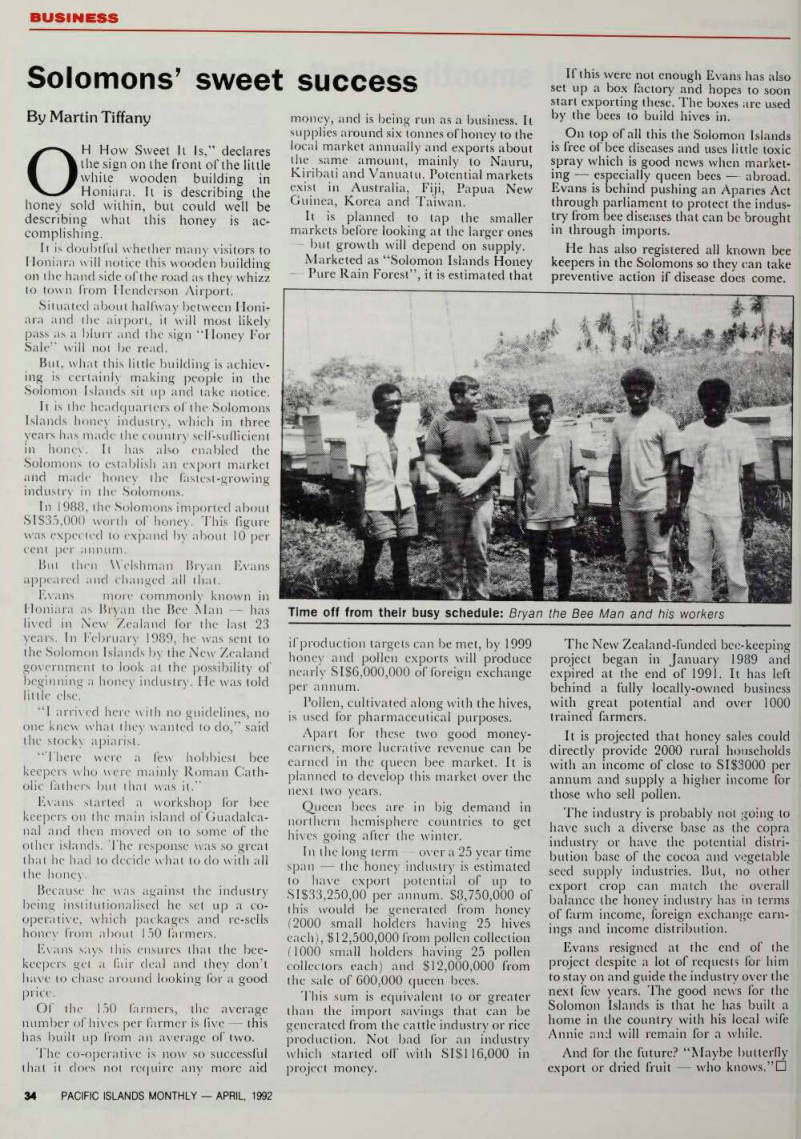
By Martin Tiffany
OH How Sweet It Is,” declares the sign on the front of the little white wooden building in Honiara. It is describing the honey sold within, but could well be describing what this honey is ac complishing.
It is doubtful whether many visitors to Honiara will notice this wooden building on the hand side of the road as they whizz to town from Henderson Airport.
Situated about halfway between Honi ara and the airport, it will most likely pass as a blurr and the sign “Honey For Sale” will not be read.
But, what this little building is achiev ing is certainly making people in the Solomon Islands sit up and take notice.
It is the headquarters of the Solomons Islands honey industry, which in three years has made the country self-sufficient in honey. It has also enabled the Solomons to establish an export market and made honey the fastest-growing industry in the Solomons.
In 1988, the Solomons imported about 51535,000 worth of honey. This figure was expected to expand by about 10 per cent per annum.
But then Welshman Bryan Evans appeared and changed all that.
Evans more commonly known in Honiara as Bryan the Bee Man has lived in New Zealand for the last 23 years. In February 1989, he was sent to the Solomon Islands by the New Zealand government to look at the possibility of beginning a honey industry. He was told little else.
“1 arrived here with no guidelines, no one knew what they wanted to do,” said the stock) apiarist.
“There were a few hobbicst bee keepers who were mainly Roman Cath olic fathers but that was it.”
Evans started a workshop for bee keepers on the main island of Guadalca nal and then moved on to some of the other islands. The response was so great that he had to decide what to do with all the honey.
Because he was against the industry being institutionalised he set up a co operative, which packages and re-sells honey from about 150 farmers.
Evans says this ensures that the bee keepers get a fair deal and they don’t have to chase around looking for a good
price.
Of the 150 farmers, the average number of hives per farmer is five this has built up from an average of two.
The co-operative is now so successful that it does not require any more aid
money, and is being run as a business. It supplies around six tonnes ofhoney to the local market annually and exports about the same amount, mainly to Nauru, Kiribati and Vanuatu. Potential markets exist in Australia, Fiji, Papua New Guinea, Korea and Taiwan.
It is planned to tap the smaller markets before looking at the larger ones - but growth will depend on supply.
Marketed as “Solomon Islands Honey — Pure Rain Forest”, it is estimated that
if production targets can be met, by 1999 honey and pollen exports will produce nearly 5156,000,000 of foreign exchange per annum.
Pollen, cultivated along with the hives, is used for pharmaceutical purposes.
Apart for these two good money earners, more lucrative revenue can be earned in the queen bee market. It is planned to develop this market over the next two years.
Queen bees are in big demand in northern hemisphere countries to get hives going after the winter.
In the long term over a 25 year time span the honey industry is estimated to have export potential of up to 51533,250,00 per annum. $8, 750,000 of this would be generated from honey (2000 small holders having 25 hives each), 512,500,000 from pollen collection (1000 small holders having 25 pollen collectors each) and 512,000,000 from the sale of 600,000 queen bees.
This sum is equivalent to or greater than the import savings that can be generated from the cattle industry or rice production. Not bad for an industry which started off with 515116,000 in
project money.
If this were not enough Evans has also set up a box factory and hopes to soon start exporting these. The boxes are used by the bees to build hives in.
On top of all this the Solomon Islands is free of bee diseases and uses little toxic spray which is good news when market ing especially queen bees abroad.
Evans is behind pushing an Apanes Act through parliament to protect the indus try from bee diseases that can be brought
in through imports.
He has also registered all known bee keepers in the Solomons so they can take preventive action if disease does come.
The New Zealand-funded bee-keeping
project began in January 1989 and
expired at the end of 1991. It has left behind a fully locally-owned business with great potential and over 1000 trained farmers.
It is projected that honey sales could directly provide 2000 rural households with an income of close to SIS3OOO per annum and supply a higher income for those who sell pollen.
The industry is probably not going to have such a diverse base as the copra industry or have the potential distri bution base of the cocoa and vegetable seed supply industries. But, no other export crop can match the overall balance the honey industry has in terms of farm income, foreign exchange earn ings and income distribution.
Evans resigned at the end of the project despite a lot of requests for him to stay on and guide the industry over the next few years. The good news for the Solomon Islands is that he has built a home in the country with his local wife Annie and will remain for a while.
And for the future? “Maybe butterfly export or dried fruit who knows.” □
Time off from their busy schedule: Bryan the Bee Man and his workers
Advertisements & other items, pp. 35-36 (1 item)
Fui, The Centre
OF OUR WORLD
Canadian
anadi*
MIEN
’OKYO
JAGOYA
tONG KONG
SANGKOK
AIPEI
TORONTO
ALL OF
CANADA
VANCOUVER
SAN FRANCISCO
HONOLULU
v;
LOS ANGELES
FIJI
NEY
D
EUROPE
MANCHESTER
LONDON
PARIS
FRANKFURT
MUNICH
MILAN
ROME
f
Can
SOUT
LIMA
SANTIA
BUENOS AIRES
E JANEIRO
in s
ERICA
IMAOIAIM AIRLINES INTERNATIONAL INVI
ENROLL IN OUR CANADIAN FREQUENT FLYER PROGRAM AND QUALIFY R AN INSTANT 4000 POINTS IF YOU JOIN AND FLY WITH US WITHIN 45 DAYS TRAVELLING ON YOUR OWN OR IN GROUPS EUROPE AND SERVILLE SPAIN. FARES FROM $2758 00 WHICH ALLOWS YOU STOPS IN CANADA AND HONOLULU CALL US FOR FARE QUOTES OR INFORMATION, choice of FOUR SHARED SERVICES a week to CANADA and connections to your other Canadian destinations.
Canadian
Canadian Airlines International
T ll T t&i ‘
riffef.v
--•I T mm md
SSSa
rjVPrr* am
■»tlh m * -i
USUI-
«*! M «* i.
Si 2* r* sfc**
NADI INTERNATIONAL AIRPORT.
THE HUB OF THE SOUTH PACIFIC
It is a reponsibility that we take very seriously.
That is why we have recently spent over $l2 million upgrading and expanding our facilities; preparing for the future, today.
We are called the hub of the South Pacific Islands, located in Fiji.
Equipped to service the world’s most advanced passenger aircraft, the Boeing 747-400.
Or any of the many scheduled international carriers that utilize our services.
For as the region’s largest and most modern airport, we have become the gateway to the South Pacific Islands. CIVIL AVIATION AUTHORITY OF FIJI Providing complete passenger and freight facilities both regionally and internationally.
To find out more about the gateway of .South Pacific Islands, Nadi International Airport, send for our free brochure. * send to: Free Brochure, Nadi International Airport, Private Mail Bag, Nadi Airport, Fiji Islands. Phone: 72500 Fax: 790325 GR7948
Unemployment’s dark companion
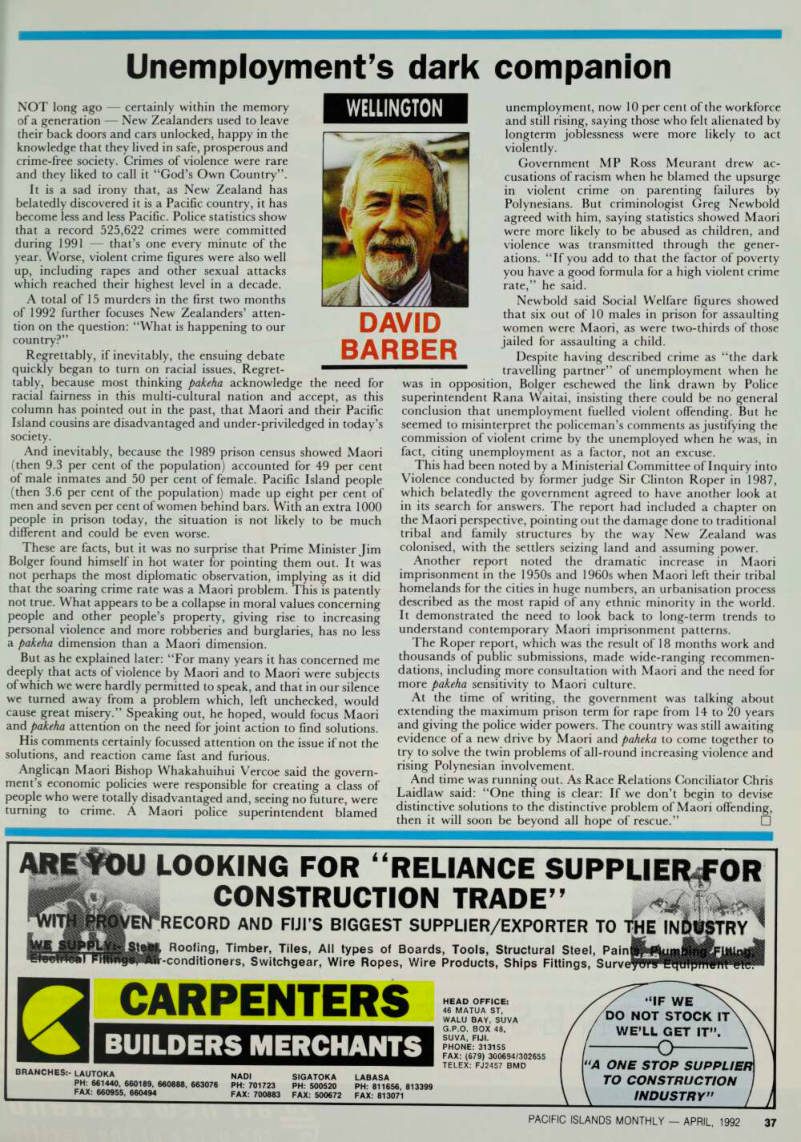
NOT long ago certainly within the memory of a generation New Zealanders used to leave their back doors and cars unlocked, happy in the knowledge that they lived in safe, prosperous and crime-free society. Crimes of violence were rare and they liked to call it “God’s Own Country”.
It is a sad irony that, as New Zealand has belatedly discovered it is a Pacific country, it has become less and less Pacific. Police statistics show that a record 525,622 crimes were committed during 1991 that’s one every minute of the year. Worse, violent crime figures were also well up, including rapes and other sexual attacks which reached their highest level in a decade.
A total of 15 murders in the first two months of 1992 further focuses New Zealanders’ atten tion on the question: “What is happening to our country?”
Regrettably, if inevitably, the ensuing debate quickly began to turn on racial issues, Regret
tably, because most thinking pakeha acknowledge the need for racial fairness in this multi-cultural nation and accept, as this column has pointed out in the past, that Maori and their Pacific Island cousins are disadvantaged and under-priviledged in today’s society.
And inevitably, because the 1989 prison census showed Maori (then 9.3 per cent of the population) accounted for 49 per cent of male inmates and 50 per cent of female. Pacific Island people (then 3.6 per cent of the population) made up eight per cent of men and seven per cent of women behind bars. With an extra 1000 people in prison today, the situation is not likely to be much different and could be even worse.
These are facts, but it was no surprise that Prime Minister Jim Bolger found himself in hot water for pointing them out. It was not perhaps the most diplomatic observation, implying as it did that the soaring crime rate was a Maori problem. This is patently not true. What appears to be a collapse in moral values concerning people and other people’s property, giving rise to increasing personal violence and more robberies and burglaries, has no less a pakeha dimension than a Maori dimension.
But as he explained later: “For many years it has concerned me deeply that acts of violence by Maori and to Maori were subjects of which we were hardly permitted to speak, and that in our silence we turned away from a problem which, left unchecked, would cause great misery.” Speaking out, he hoped, would focus Maori and pakeha attention on the need for joint action to find solutions.
His comments certainly focussed attention on the issue if not the solutions, and reaction came fast and furious.
Anglican Maori Bishop Whakahuihui Vercoe said the govern ment’s economic policies were responsible for creating a class of people who were totally disadvantaged and, seeing no future, were turning to crime. A Maori police superintendent blamed
Wellington
unemployment, now 10 per cent of the workforce and still rising, saying those who felt alienated by longterm joblessness were more likely to act
violently.
Government MP Ross Meurant drew ac cusations of racism when he blamed the upsurge in violent crime on parenting failures by
Polynesians. But criminologist Greg Newbold
agreed with him, saying statistics showed Maori were more likely to be abused as children, and violence was transmitted through the gener ations. “If you add to that the factor of poverty you have a good formula for a high violent crime rate,” he said.
Newbold said Social Welfare figures showed that six out of 10 males in prison for assaulting women were Maori, as were two-thirds of those jailed for assaulting a child.
Despite having described crime as “the dark travelling partner” of unemployment when he
was in opposition, Bolger eschewed the link drawn by Police superintendent Rana Waitai, insisting there could be no general conclusion that unemployment fuelled violent offending. But he seemed to misinterpret the policeman’s comments as justifying the commission of violent crime by the unemployed when he was, in fact, citing unemployment as a factor, not an excuse.
This had been noted by a Ministerial Committee of Inquiry into Violence conducted by former judge Sir Clinton Roper in 1987, which belatedly the government agreed to have another look at in its search for answers. The report had included a chapter on the Maori perspective, pointing out the damage done to traditional tribal and family structures by the way New Zealand was colonised, with the settlers seizing land and assuming power.
Another report noted the dramatic increase in Maori imprisonment in the 1950 s and 1960 s when Maori left their tribal homelands for the cities in huge numbers, an urbanisation process described as the most rapid of any ethnic minority in the world.
It demonstrated the need to look back to long-term trends to understand contemporary Maori imprisonment patterns.
The Roper report, which was the result of 18 months work and thousands of public submissions, made wide-ranging recommen dations, including more consultation with Maori and the need for more pakeha sensitivity to Maori culture.
At the time of writing, the government was talking about extending the maximum prison term for rape from 14 to 20 years and giving the police wider powers. The country was still awaiting evidence of a new drive by Maori and paheka to come together to try to solve the twin problems of all-round increasing violence and rising Polynesian involvement.
And time was running out. As Race Relations Conciliator Chris Laidlaw said; “One thing is clear: If we don’t begin to devise distinctive solutions to the distinctive problem of Maori offending, then it will soon be beyond all hope of rescue.” □
David
Barber
Advertisements & other items, pp. 37-38 (1 item)
Carpenters
ARE fOU LOOKING FOR “RELIANCE SUPPLIERdpOR
CONSTRUCTION TRADE”
RECORD AND FIJI’S BIGGEST SUPPLIER/EXPORTER TO
Roofing, Timber, Tiles, All types of Boards, Tools, Structural Steel, Pain ■conditioners, Switchgear, Wire Ropes, Wire Products, Ships Fittings, Surv
CARPENTERS
BUILDERS MERCHANTS
BRANCHES:- LAUTOKA
PH: 661440, 660189, 660888, 663076
FAX: 660955, 660494
HEAD OFFICE:
46 MATUA ST,
WALU BAY, SUVA
G.P.O. BOX 48,
SUVA, FIJI.
PHONE: 313155
FAX: (679) 300694/302655
TELEX: FJ2457 BMD
NADI
PH: 701723
FAX: 700883
SIGATOKA
PH; 500520
FAX; 500672
LABASA
PH: 811656, 813399
FAX: 813071
% •> HE IN
TRY
IF WE DO
NOT
STOCK
IT WE LL
GET
IT O
‘A ONE STOP SUPPLIER
TO CONSTRUCTION
\ INDUSTRY” /
PACIFIC ocean
Rarotonga Apia Papeete Nuku' Alofa ankfurt London Nadi Honolulu 1 Los Angeles Toronto Noumea ancouver V a 1 0° SJ ' Norfolk Is.
Auckland Wellington Christchurc Perth Brisbane Adelaide Sydney Melbourne Hobart Taipei Cairns Nag ay a Bali Hong Kong Tokyo Singapore Bangkok Kuala Lumpur
WE INCLUDE
THE HOPS
OTHER
AIRLINES SKIP.
No international airline covers the Pacific quite as well as Air New Zealand. We're the only airline linking the Pacific Islands to New Zealand, North America, Asia, UK and Europe with a modern fleet of 747 and 767 widebodied aircraft. And, now we offer direct flights between Tonga, Apia and Honolulu. Plus, with our new frequent flier programme, every flight you make with us, whether it's a short hop or a long jump, will earn you travel points towards upgrades, companion tickets and free trips. And that's another good reason for Pacific travellers to fly with us.
Samoan sights on new business
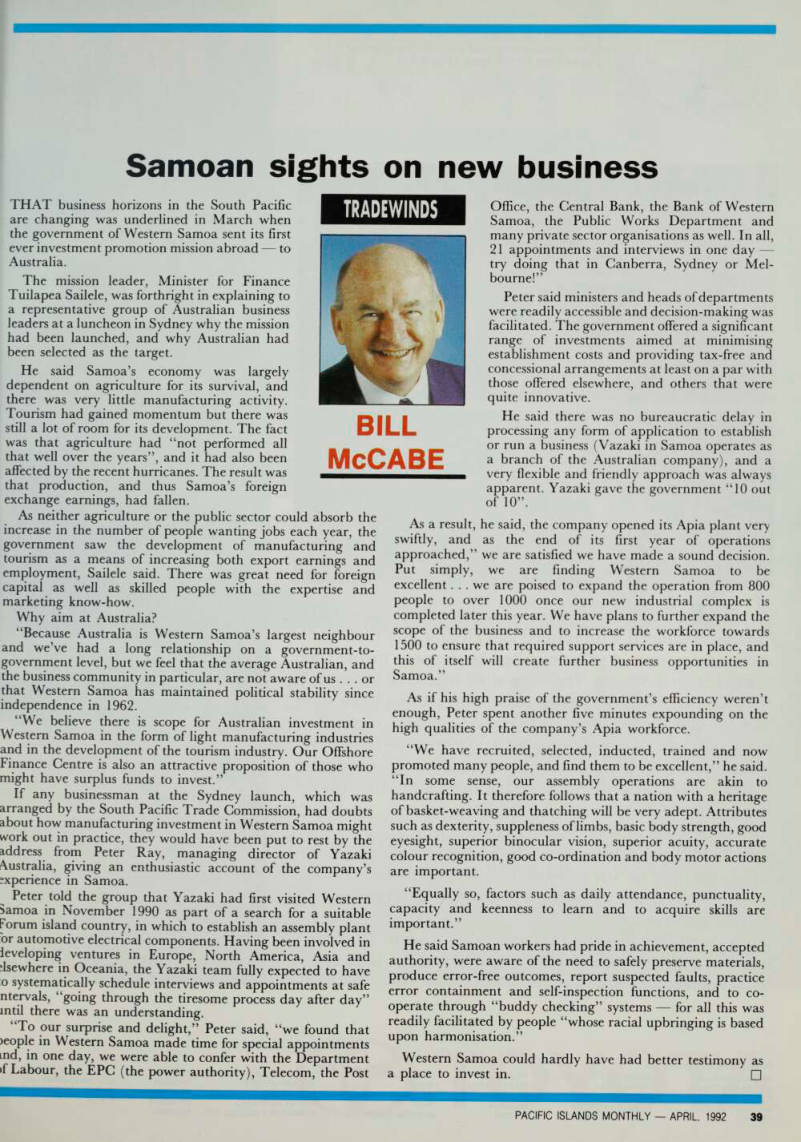
THAT business horizons in the South Pacific are changing was underlined in March when the government of Western Samoa sent its first ever investment promotion mission abroad to Australia.
The mission leader, Minister for Finance Tuilapea Sailele, was forthright in explaining to a representative group of Australian business leaders at a luncheon in Sydney why the mission had been launched, and why Australian had been selected as the target.
He said Samoa’s economy was largely dependent on agriculture for its survival, and there was very little manufacturing activity.
Tourism had gained momentum but there was still a lot of room for its development. The fact was that agriculture had “not performed all that well over the years”, and it had also been affected by the recent hurricanes. The result was that production, and thus Samoa’s foreign
exchange earnings, had fallen.
As neither agriculture or the public sector could absorb the increase in the number of people wanting jobs each year, the government saw the development of manufacturing and tourism as a means of increasing both export earnings and employment, Sailele said. There was great need for foreign capital as well as skilled people with the expertise and
marketing know-how.
Why aim at Australia?
“Because Australia is Western Samoa’s largest neighbour and we’ve had a long relationship on a government-to govemment level, but we feel that the average Australian, and the business community in particular, are not aware of us ... or that Western Samoa has maintained political stability since independence in 1962.
“We believe there is scope for Australian investment in Western Samoa in the form of light manufacturing industries and in the development of the tourism industry. Our Offshore Finance Centre is also an attractive proposition of those who might have surplus funds to invest.”
If any businessman at the Sydney launch, which was arranged by the South Pacific Trade Commission, had doubts about how manufacturing investment in Western Samoa might work out in practice, they would have been put to rest by the address from Peter Ray, managing director of Yazaki Australia, giving an enthusiastic account of the company’s experience in Samoa.
Peter told the group that Yazaki had first visited Western Samoa in November 1990 as part of a search for a suitable Forum island country, in which to establish an assembly plant or automotive electrical components. Having been involved in leveloping ventures in Europe, North America, Asia and dsewhere in Oceania, the Yazaki team fully expected to have o systematically schedule interviews and appointments at safe ntervals, “going through the tiresome process day after day” mtil there was an understanding.
To our surprise and delight,” Peter said, “we found that >eople in Western Samoa made time for special appointments ind, in one day, we were able to confer with the Department •f Labour, the EPC (the power authority), Telecom, the Post
Tradewinds
Office, the Central Bank, the Bank of Western Samoa, the Public Works Department and many private sector organisations as well. In all, 21 appointments and interviews in one day try doing that in Canberra, Sydney or Mel bourne!”
Peter said ministers and heads of departments were readily accessible and decision-making was facilitated. The government offered a significant range of investments aimed at minimising establishment costs and providing tax-free and concessional arrangements at least on a par with those offered elsewhere, and others that were
quite innovative.
He said there was no bureaucratic delay in processing any form of application to establish or run a business (Vazaki in Samoa operates as a branch of the Australian company), and a very flexible and friendly approach was always apparent. Yazaki gave the government “10 out of 10”.
As a result, he said, the company opened its Apia plant very swiftly, and as the end of its first year of operations approached,” we are satisfied we have made a sound decision.
Put simply, we are finding Western Samoa to be excellent... we are poised to expand the operation from 800 people to over 1000 once our new industrial complex is completed later this year. We have plans to further expand the scope of the business and to increase the workforce towards 1500 to ensure that required support services are in place, and this of itself will create further business opportunities in Samoa.”
As if his high praise of the government’s efficiency weren’t enough, Peter spent another five minutes expounding on the high qualities of the company’s Apia workforce.
“We have recruited, selected, inducted, trained and now promoted many people, and find them to be excellent,” he said.
“In some sense, our assembly operations are akin to handcrafting. It therefore follows that a nation with a heritage of basket-weaving and thatching will be very adept. Attributes such as dexterity, suppleness of limbs, basic body strength, good eyesight, superior binocular vision, superior acuity, accurate colour recognition, good co-ordination and body motor actions
are important.
“Equally so, factors such as daily attendance, punctuality, capacity and keenness to learn and to acquire skills are
important.”
He said Samoan workers had pride in achievement, accepted authority, were aware of the need to safely preserve materials, produce error-free outcomes, report suspected faults, practice error containment and self-inspection functions, and to co operate through “buddy checking” systems for all this was readily facilitated by people “whose racial upbringing is based upon harmonisation.”
Western Samoa could hardly have had better testimony as a place to invest in. □
Bill
Mccabe
Advertisements & other items, pp. 40-41 (1 item)
r
The new Toyota brand mark. Three ellipses forming a “T” which stand for our customer, our commitment to the satisfaction of that customer through our product and for our spirit of creativity.
It’s not often that you hear descriptions like rugged or durable combined with refined and elegant. But then there’s never been a vehicle quite like the new Toyota Land Cruiser Station Wagon. The unrivalled legend of off-road reliability is now unsurpassed in comfort and sophistication as well. Attention to detail is found everywhere, from the fine trim to the instrument panel to the graceful lines of its exterior. Even in places you can’t see, like the heavy-duty ladder frame and suspension design that add to the superb
luxury-car ride.
But Toyota’s innovation goes beyond providing luxury and durability. The new Land Cruiser Station Wagon, and all of our cars, are designed to create a harmony between car and driver, and to provide you with the ultimate driving experience.
The new Toyota Land Cruiser Station Wagon. Think of it as much more than a spacious luxury sedan with fourwheel drive. r . r/; jhk mm * t.: f, . . ■f »: ¥- *;• -%•
PH 312666 PH 282848 PH 234-5911
D. PH 23673
TOYOTA
Eyes on the Pacific
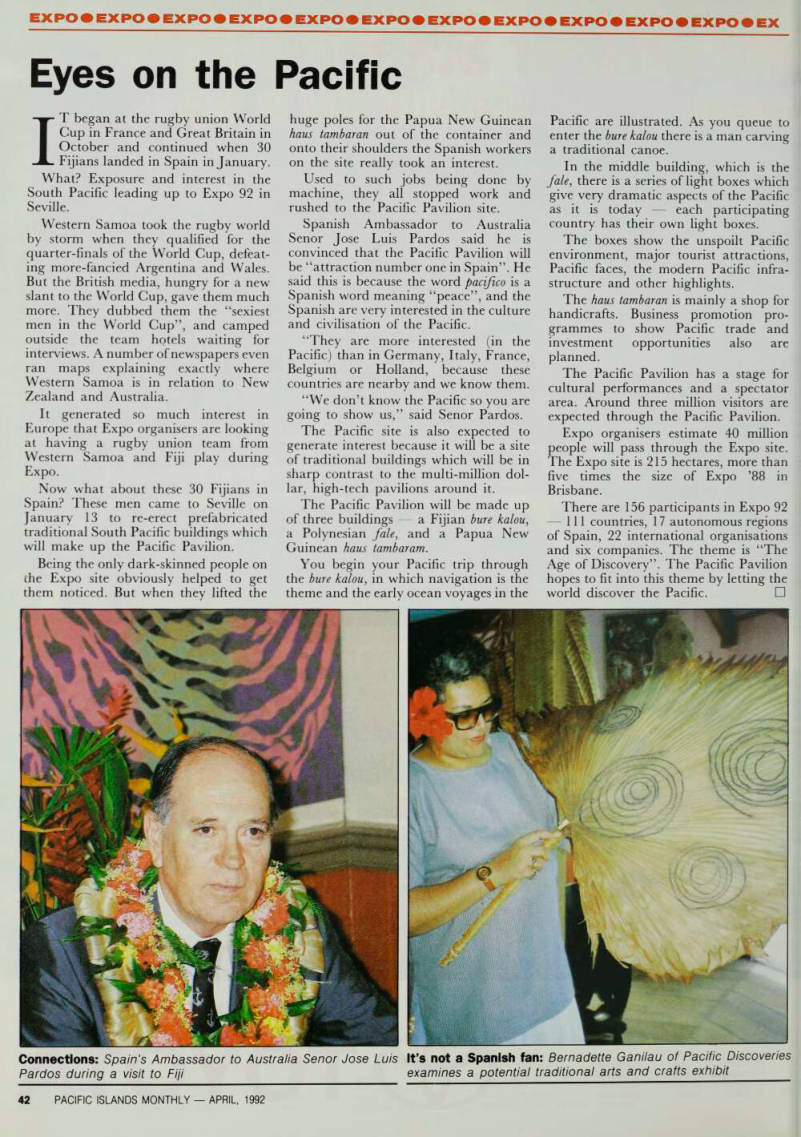
EXPO .EXPO. EXPO .EXPO. EXPO .EXPO. EXPO. EXPO. EXPO. EXPO. EXPO. EX
IT began at the rugby union World Cup in France and Great Britain in October and continued when 30 Fijians landed in Spain in January.
What? Exposure and interest in the South Pacific leading up to Expo 92 in Seville.
Western Samoa took the rugby world by storm when they qualified for the quarter-finals of the World Cup, defeating more-fancied Argentina and Wales.
But the British media, hungry for a new slant to the World Cup, gave them much more. They dubbed them the “sexiest men in the World Cup”, and camped outside the team hotels waiting for interviews. A number of newspapers even ran maps explaining exactly where Western Samoa is m relation to New Zealand and Australia.
It generated so much interest in
Europe that Expo organisers are looking
at having a rugby union team from Western Samoa and Fiji play during
E X P°.
Now what about these 30 Fijians in Spain? These men came to Seville on January 13 to re-erect prefabricated traditional South Pacific buildings which will make up the Pacific Pavilion.
Being the only dark-skinned people on the Expo site obviously helped to get them noticed. But when they lifted the
huge poles for the Papua New Guinean haus tambaran out of the container and onto their shoulders the Spanish workers on the site really took an interest.
Used to such jobs being done by machine, they all stopped work and rushed to the Pacific Pavilion site.
Spanish Ambassador to Australia Senor Jose Luis Pardos said he is convinced that the Pacific Pavilion will be “attraction number one in Spain”. He said this is because the word pacifico is a Spanish word meaning “peace”, and the Spanish are very interested in the culture and civilisation of the Pacific.
“They are more interested (in the Pacific) than in Germany, Italy, France, Belgium or Holland, because these countries are nearby and we know them.
“We don’t know the Pacific so you are going to show us,” said Senor Pardos.
The Pacific site is also expected to generate interest because it will be a site of traditional buildings which will be in sharp contrast to the multi-million dol lar, high-tech pavilions around it.
The Pacific Pavilion will be made up of three buildings a Fijian bure kalou , a Polynesian fale , and a Papua New Guinean haus tambaram.
You begin your Pacific trip through the bure kalou, in which navigation is the theme and the early ocean voyages in the
Pacific are illustrated. As you queue to enter the hure kalou there is a man carving a traditional canoe.
In t h e middle building, which is the fale, there is a series of light boxes which give very dramatic aspects of the Pacific as it is today each participating country has their own light boxes, The boxes show the unspoilt Pacific environment, major tourist attractions, Pacific faces, the modern Pacific infra structure and other highlights, The haus tambaran is mainly a shop for handicrafts. Business promotion pro grammes to show Pacific trade and investment opportunities also are
planned.
The Pacific Pavilion has a stage for cu l t Ural performances and a spectator area. Around three million visitors are expected through the Pacific Pavilion.
Expo organisers estimate 40 million people will pass through the Expo site.
The Expo site is 215 hectares, more than five times the size of Expo ’BB in Brisbane.
There are 156 participants in Expo 92 111 countries, 17 autonomous regions Q f Spain, 22 international organisations and six companies. The theme is “The Age of Discovery”. The Pacific Pavilion hopes to fit into this theme by letting the world discover the Pacific. □
Connections: Spain’s Ambassador to Australia Senor Jose Luis Pardos during a visit to Fiji
It's not a Spanish fan: Bernadette Ganilau of Pacific Discoveries examines a potential traditional arts and crafts exhibit
for us?
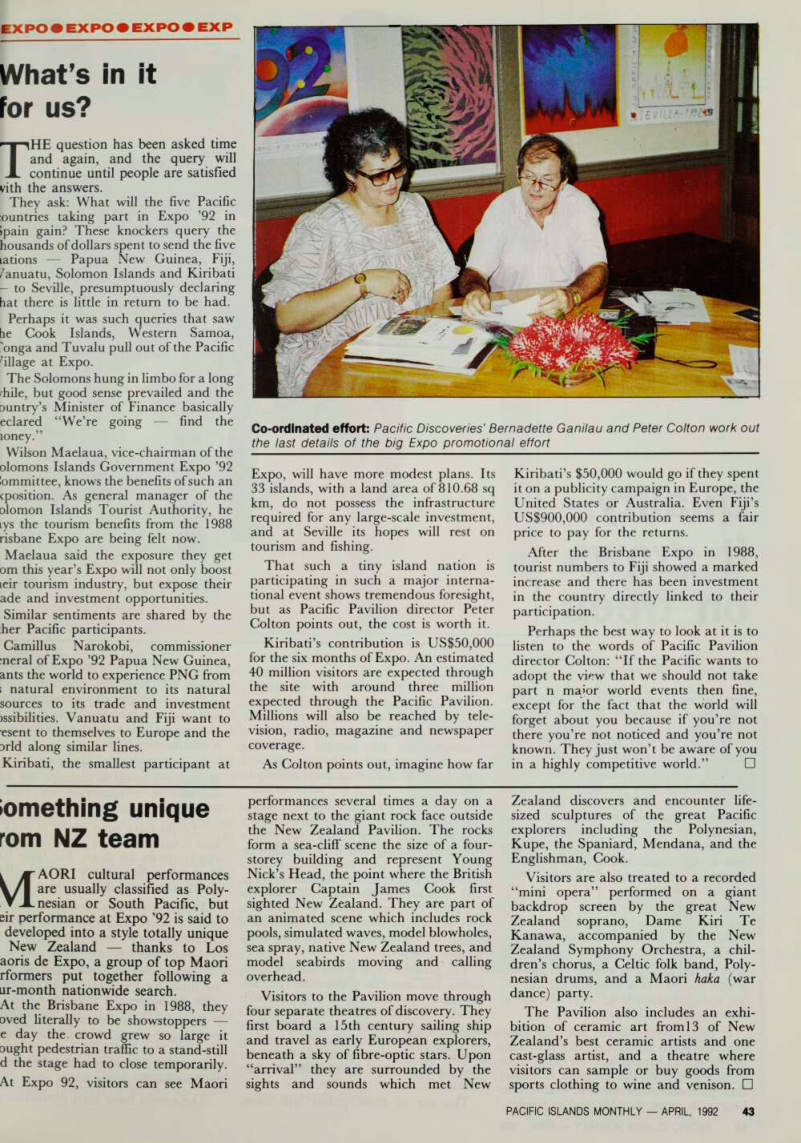
What’s in it for us?
THE question has been asked time and again, and the query will continue until people are satisfied rith the answers.
They ask: What will the five Pacific ountries taking part in Expo ’92 in ipain gain? These knockers query the housands of dollars spent to send the five
lations Papua New Guinea, Fiji,
Vanuatu, Solomon Islands and Kiribati - to Seville, presumptuously declaring hat there is little in return to be had.
Perhaps it was such queries that saw he Cook Islands, Western Samoa, "onga and Tuvalu pull out of the Pacific
Ullage at Expo.
The Solomons hung in limbo for a long rhile, but good sense prevailed and the [>untry’s Minister of Finance basically eclared “We’re going find the loney.”
Wilson Maelaua, vice-chairman of the olomons Islands Government Expo ’92 lommittee, knows the benefits of such an (position. As general manager of the □lomon Islands Tourist Authority, he iys the tourism benefits from the 1988 risbane Expo are being felt now.
Maelaua said the exposure they get om this year’s Expo will not only boost icir tourism industry, but expose their ade and investment opportunities.
Similar sentiments are shared by the her Pacific participants.
Camillus Narokobi, commissioner ;neral of Expo ’92 Papua New Guinea, ants the world to experience PNG from ; natural environment to its natural sources to its trade and investment >ssibilities. Vanuatu and Fiji want to esent to themselves to Europe and the
arid along similar lines.
Kiribati, the smallest participant at
Expo, will have more modest plans. Its 33 islands, with a land area of 810.68 sq km, do not possess the infrastructure required for any large-scale investment, and at Seville its hopes will rest on tourism and fishing.
That such a tiny island nation is participating in such a major interna tional event shows tremendous foresight, but as Pacific Pavilion director Peter Colton points out, the cost is worth it.
Kiribati’s contribution is US$5O,OOO for the six months of Expo. An estimated 40 million visitors are expected through the site with around three million expected through the Pacific Pavilion.
Millions will also be reached by tele vision, radio, magazine and newspaper coverage.
As Colton points out, imagine how far
Kiribati’s $50,000 would go if they spent it on a publicity campaign in Europe, the United States or Australia. Even Fiji’s US$9OO,OOO contribution seems a fair price to pay for the returns.
After the Brisbane Expo in 1988, tourist numbers to Fiji showed a marked increase and there has been investment in the country directly linked to their
participation.
Perhaps the best way to look at it is to listen to the words of Pacific Pavilion director Colton: “If the Pacific wants to adopt the view that we should not take part n major world events then fine, except for the fact that the world will forget about you because if you’re not there you’re not noticed and you’re not known. They just won’t be aware of you in a highly competitive world.” □
Co-ordinated effort: Pacific Discoveries’ Bernadette Ganilau and Peter Colton work out the last details of the big Expo promotional effort
Something unique
From NZ team
t yj'AORI cultural performances
V/l are usually classified as Poly- Y A nesian or South Pacific, but eir performance at Expo ’92 is said to developed into a style totally unique New Zealand thanks to Los aoris de Expo, a group of top Maori rformers put together following a ar-month nationwide search.
At the Brisbane Expo in 1988, they □ved literally to be showstoppers e day the crowd grew so large it aught pedestrian traffic to a stand-still d the stage had to close temporarily.
At Expo 92, visitors can see Maori
performances several times a day on a stage next to the giant rock face outside the New Zealand Pavilion. The rocks form a sea-cliff scene the size of a four storey building and represent Young Nick’s Head, the point where the British
explorer Captain James Cook first
sighted New Zealand. They are part of an animated scene which includes rock pools, simulated waves, model blowholes, sea spray, native New Zealand trees, and model seabirds moving and calling overhead.
Visitors to the Pavilion move through four separate theatres of discovery. They first board a 15th century sailing ship and travel as early European explorers, beneath a sky of fibre-optic stars. Upon “arrival” they are surrounded by the sights and sounds which met New
Zealand discovers and encounter life sized sculptures of the great Pacific
explorers including the Polynesian,
Kupe, the Spaniard, Mendana, and the Englishman, Cook.
Visitors are also treated to a recorded
“mini opera” performed on a giant
backdrop screen by the great New Zealand soprano, Dame Kiri Te Kanawa, accompanied by the New Zealand Symphony Orchestra, a chil dren’s chorus, a Celtic folk band, Poly nesian drums, and a Maori haka (war dance) party.
The Pavilion also includes an exhi bition of ceramic art from 13 of New Zealand’s best ceramic artists and one cast-glass artist, and a theatre where visitors can sample or buy goods from sports clothing to wine and venison. □
Advertisements & other items, p. 43 (1 item)
Expo •Expo* Expo • Exp
Quality,
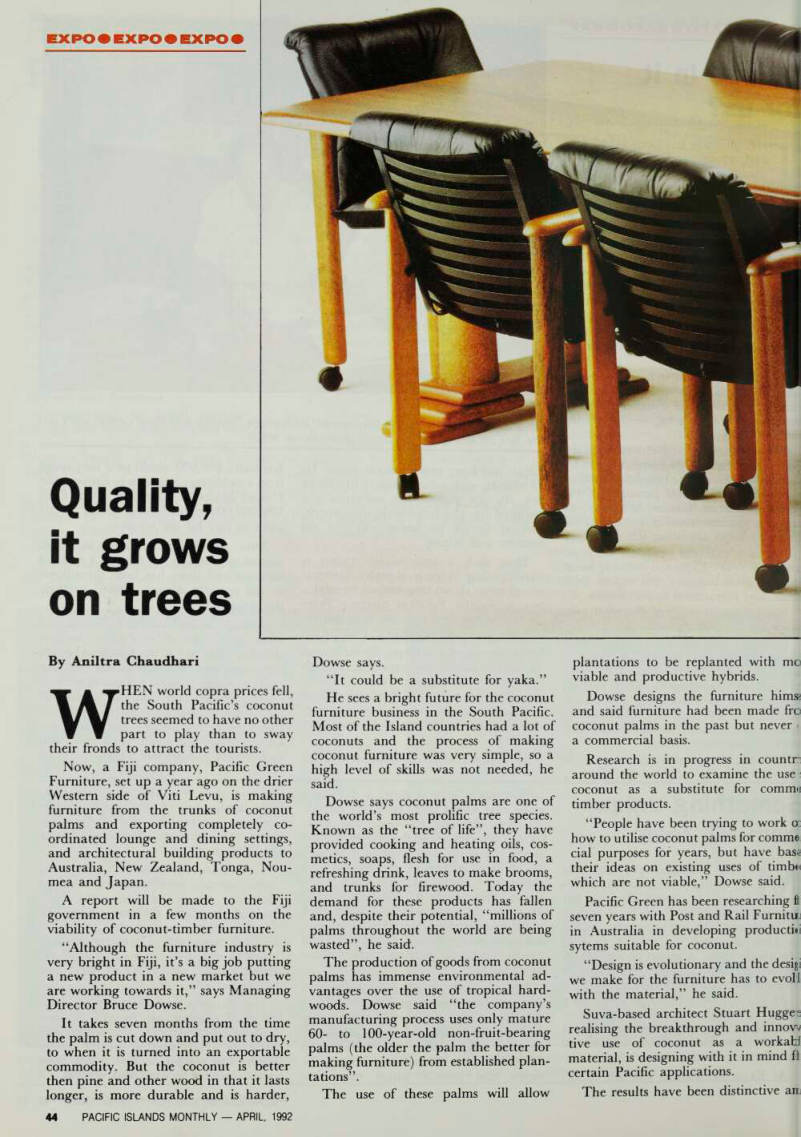

it grows on trees
By Aniltra Chaudhari
WHEN world copra prices fell. the South Paci fi c s coconut trees seemed to have no other part to play than to sway tneir ironas o a rac e ouns s.
Now, a Fiji company, Pacific Green Furmture. set up a year ago on the drier Western side °f Vtti evu, is making furniture from the trunks of coconut palms and exporting completely co ordinate,d. loun g« and dining settings, and architectural building products to Australia New Zealand, Tonga, Nou mea and Japan.
A report will be made to the Fiji government in a few months on the viability of coconut-timber furniture.
“Although the furniture industry is very bright in Fiji, it’s a big job putting a new product in a new market but we are working towards it,” says Managing Director Bruce Dowse.
It takes seven months from the time it takes seven montns trom tne time the palm is cut down and put out to dry, to when it is turned into an exoortable to when it is turned into an exportable commod.ty. But the coconut is better then pine and other wood in that it lasts longer, is more durable and is harder,
Dowse says.
“It could be a substitute for yaka.”
He sees a bright future for the coconut furniture business in the South Pacific.
Most of the Island countries had a lot of coconuts and the process of making coconut furniture was very simple, so a high level of skills was not needed, he said.
Dowse says coconut palms are one of the world’s most prolific tree species.
Known as the “tree of life”, they have provided cooking and heating oils, cos metics, soaps, flesh for use in food, a refreshing drink, leaves to make brooms, and trunks for firewood. Today the demand for these products has fallen and, despite their potential, “millions of palms throughout the world are being wasted”, he said.
The production of goods from coconut palms has immense environmental ad vantages over the use of tropical hard woods. Dowse said “the company’s manufacturing process uses only mature 60- to 100-year-old non-fruit-bearing palms (the older the palm the better for making furniture) from established plan tations”.
The use of these palms will allow
plantations to be replanted with mo
viable and productive hybrids.
Dowse designs the furniture himsa and said furniture had been made fro coconut palms in the past but never . a commercial basis.
Research is in progress in countn world P e « amine the use coconut a$ a substjtute for comm „ timber products, . , . . . . People have been trying to work oc t 0 utlllse c ° conut palms for comm, c > al . Purposes for years, but have base th , e ! r , ldeas on ex ‘ s j in g “ ses of t ‘ mb " whlch are not vlable - Dowse sald - Pacific Green has been researching fl seven years with Post and Rail Furnituj i n Australia in developing productid sytems suitable for coconut, “Design is evolutionary and the desigi we make f or the furniture has to evoll t h e ma t e rial ”he said.
Suva-based architect Stuar ugge° realising the breakthrough and mnow roronut as a workab tlve V s f . , S 0 0? 1 ? . . °. , A material, is designing with it m mind fl « ,f cations The results have been distinctive arc
ealising the breakthrough and innova ive use of coconut as a workable riaterial, is designing with it in mind for ertain Pacific applications.
The results have been distinctive and efreshing. Coconut can’t compete with xisting timbers in the ease of use.
The wood can be extremely hard and ic high silica content makes traditional
'ood-working machinery inadequate.
Machinery using state-of-the-art
brasives and low-friction sawing systems ere designed to address this particular roblem.
But then its hardness is an advantage ecause the material is strong and arable.
It also has a natural beauty due to the nique grain structure which is unlike ly other timber. The production rocesses which the company has devel 3ed brings out the best of these natural ialities.
But Dowse was not about to release formation on the processing of the •conut trunks.
“That’s a trade secret,” he said.
He did reveal that the sawn trunks mt into an organic solution which evented infection from wood borers
and other bugs, then they were left to dry for two months in a special room for “mellow drying”.
After this the ma terial is ready for mak ing furniture and other goods.
The site of the fac tory on the dry West ern coast of Viti Levu, near Sigatoka, was necessary to obtain ex port quality, low moisture content ma terial.
“Moisture leads to expansion and con traction in any ma terial and could cause cracking in the fin ished product”.
At the Pacific Green
plant, breakthroughs
are occurring all the time, although Dowse
acknowledges that
they still need to ex plore the full potential of coconut timber.
A final report on their research findings
is still to be prepared, however Dowse is confident of the future of the industry and its benefit for the entire region. □
Nice to admire and durable: lamp and small table made from coconut timber
Old source of materials, new business: A Pacific Green dining suite from coconut timber.
Advertisements & other items, pp. 44-45 (2 items)
Expo • Expo • Expo •
45
PACIFIC ISLANDS MONTHLY APRIL, 1992
EXPO • EXPO • EXPO
PNG pins hopes on war relics
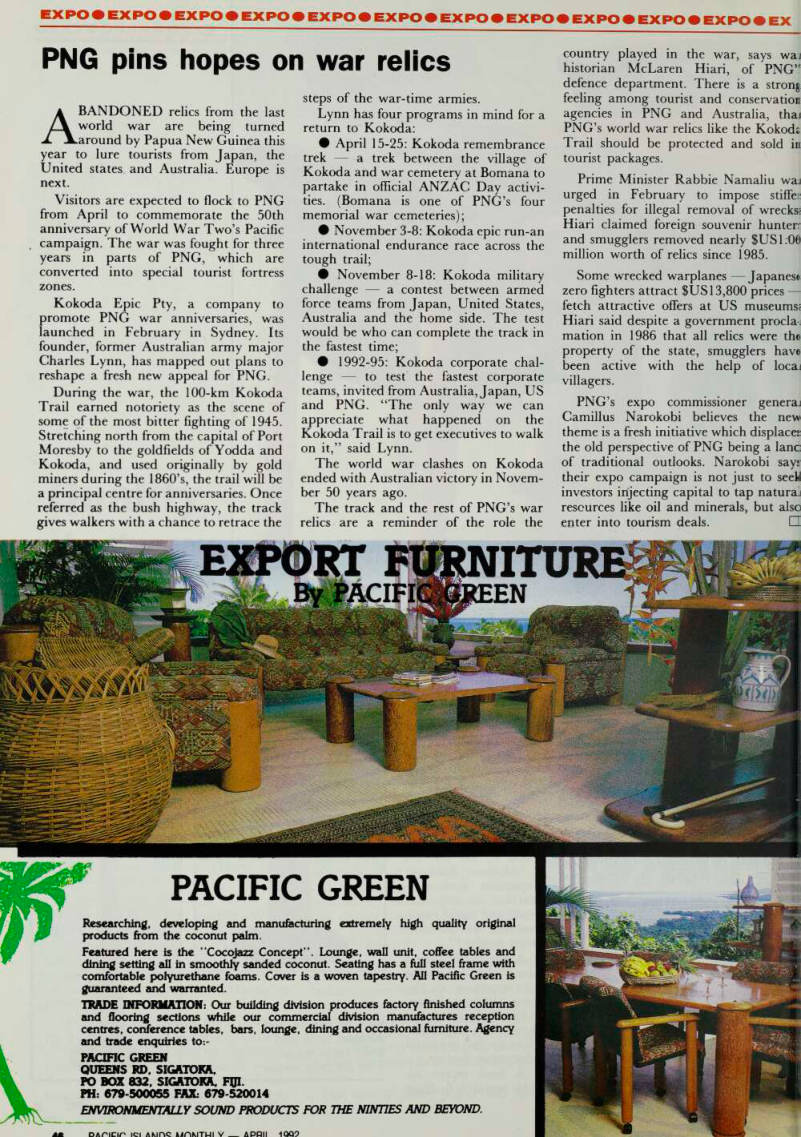
ABANDONED relics from the last world war are being turned around by Papua New Guinea this year to lure tourists from Japan, the United states and Australia. Europe is next.
Visitors are expected to flock to PNG from April to commemorate the 50th anniversary of World War Two’s Pacific campaign. The war was fought for three years in parts of PNG, which are converted into special tourist fortress zones.
Kokoda Epic Pty, a company to promote PNG war anniversaries, was launched in February in Sydney. Its founder, former Australian army major Charles Lynn, has mapped out plans to reshape a fresh new appeal for PNG.
During the war, the 100-km Kokoda Trail earned notoriety as the scene of some of the most bitter fighting of 1945.
Stretching north from the capital of Port Moresby to the goldfields of Yodda and Kokoda, and used originally by gold miners during the 1860’s, the trail will be a principal centre for anniversaries. Once referred as the bush highway, the track gives walkers with a chance to retrace the
steps of the war-time armies.
Lynn has four programs in mind for a return to Kokoda: • April 15-25: Kokoda remembrance trek a trek between the village of Kokoda and war cemetery at Bomana to partake in official ANZAC Day activi ties. (Bomana is one of PNG’s four memorial war cemeteries); • November 3-8: Kokoda epic run-an international endurance race across the
tough trail;
• November 8-18: Kokoda military challenge a contest between armed force teams from Japan, United States, Australia and the home side. The test would be who can complete the track in the fastest time; • 1992-95: Kokoda corporate chal lenge to test the fastest corporate teams, invited from Australia, Japan, US and PNG. “The only way we can appreciate what happened on the Kokoda Trail is to get executives to walk on it,” said Lynn.
The world war clashes on Kokoda ended with Australian victory in Novem ber 50 years ago.
The track and the rest of PNG’s war relics are a reminder of the role the
country played in the war, says waj historian McLaren Hiari, of PNG’' defence department. There is a strong feeling among tourist and conservation agencies in PNG and Australia, thai PNG’s world war relics like the Kokod* Trail should be protected and sold in tourist packages.
Prime Minister Rabbie Namaliu waj urged in February to impose stiffen penalties for illegal removal of wrecks?
Hiari claimed foreign souvenir hunter: and smugglers removed nearly SUSI:O6 million worth of relics since 1985.
Some wrecked warplanes —Japanese zero fighters attract SUS 13,800 prices fetch attractive offers at US museums* Hiari said despite a government procla mation in 1986 that all relics were the property of the state, smugglers have been active with the help of locaj villagers.
PNG’s expo commissioner generaj Camillus Narokobi believes the new theme is a fresh initiative which displaces the old perspective of PNG being a lane of traditional outlooks. Narokobi says their expo campaign is not just to seek investors injecting capital to tap naturae resources like oil and minerals, but also enter into tourism deals. Q
Advertisements & other items, pp. 46-47 (2 items)
46
DA/-'ICIf' ICI AKinC AiirtMTUl V APRII IQQ9
Pacific Green
Researching, developing and manufacturing extremely high quality original products from the coconut palm.
Featured here is the “Cocojazz Concept”. Lounge, wall unit, coffee tables and dining setting all in smoothly sanded coconut. Seating has a full steel frame with comfortable polyurethane foams. Cover is a woven tapestry. AH Pacific Green is guaranteed and warranted.
TRADE INFORMATION: Our building division produces factory finished columns and flooring sections while our commercial division manufactures reception centres, conference tables, bars, lounge, dining and occasional furniture. Agency and trade enquiries to:-
PACIFIC GREEN
QUEENS RD. SIGATOKA,
PO BOX 832. SIGATOKA. FQI.
PH: 679-500055 FAX: 679-520014
ENVIRONMENTALIY SOUND PRODUCTS FOR THE NINTIES AND BEYOND.
DAnnr ici a Nine urtMTUi v aprii IQQ9
KINHILL KRAMER
edibility. ..continuity.
commitment...quality...excellence
are all terms synonymous with Papua
New Guinea's leading engineering
consultant. , /■ • • --'' * • ■ .
Hi 3*.Sb
mn iinn
llilllllllllililllli'illilllll Papua New Guinea Solomon Islands Fiji Head Office Port Moresby
KINHILL KRAMER PTY LTD.,
Kinhill Kramer Building Cnr Islander Drive & Wards Road
HOHOLA
National Capital District
PO Box 1948, BOROKO,
Papua New Guinea Telephone (675) 256033 Facsimile (675) 211049
Telex CAMAKRA NE 23050
KINHILL KRAMER (SOLOMON ISLANDS) LTD KINHILL KACIMAIWAI PTY LTD First Floor, 6-12 Andrews Street, Nadi Fiji Islands PO Box 9213 Fourth Floor NPF Building Mendana Avenue PO Box 377 Honiara, Solomon Islands Telephone (677) 21996 Facsimile (677) 22190 Vanuatu
KINHILL KRAMER (VANUATU) LTD.,
Ist FLoor, Drugstore Building Kumul Highway P.O. Box 96, Port Vila Vanuatu Telephone (678) 23 457 Facsimile (678) 22 455 Nadi Airport, Fiji Islands Telephone (679) 780033 Facsimile (679) 780131 Australia Head Office Adelaide
KINHILL ENGINEERS PTY. LTD.,
200 East Terrace, GPO Box 2702, Adelaide South Australia 5001 Telephone (08) 2237011 Facsimile (08) 2320163 Telex AA82364 A MEMBER OF THE KIIIHIU GROUP OF COMPANIES
Fiji ...
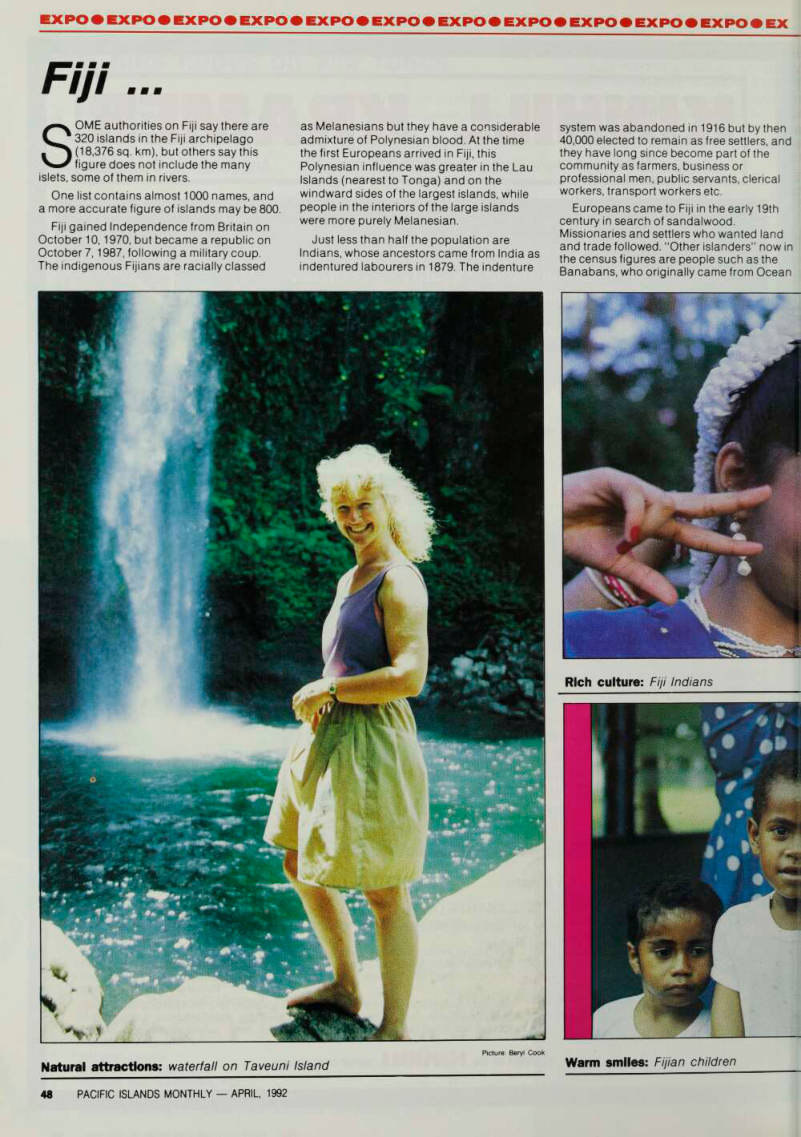
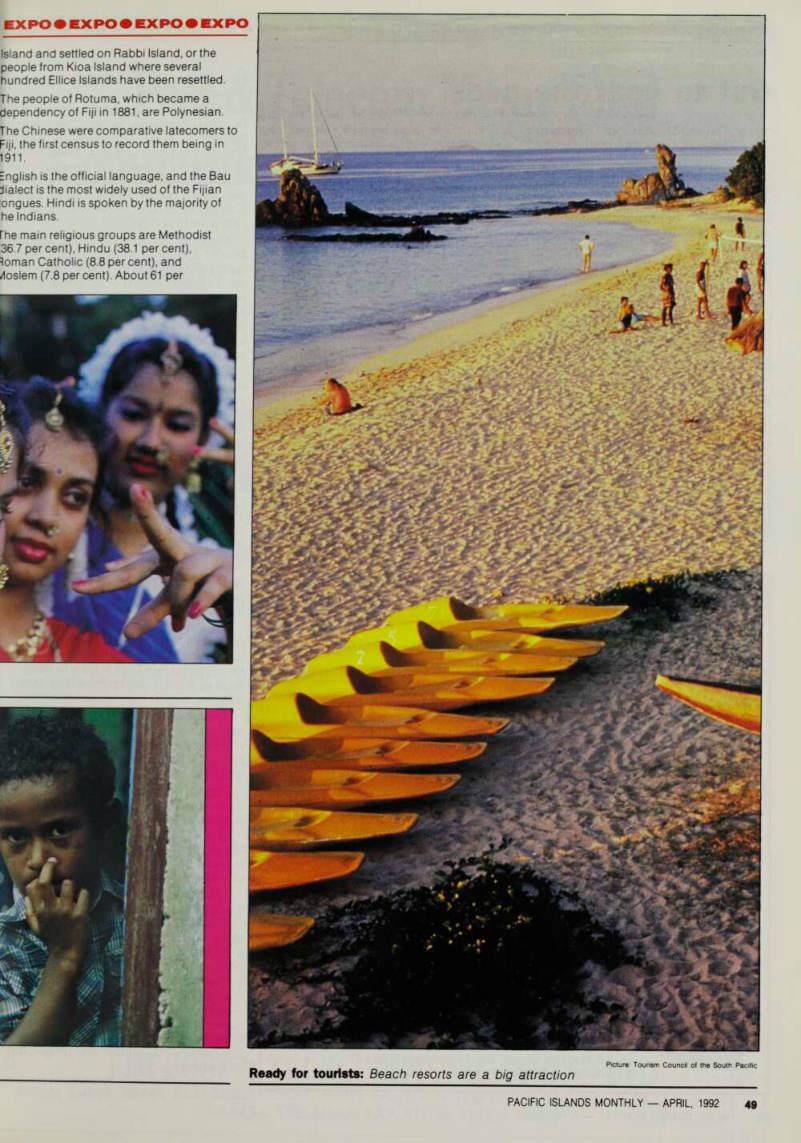
SOME authorities on Fiji say there are 320 islands in the Fiji archipelago (18,376 sq. km), but others say this figure does not include the many islets, some of them in rivers.
One list contains almost 1000 names, and a more accurate figure of islands may be 800.
Fiji gained Independence from Britain on October 10,1970, but became a republic on October 7,1987, following a military coup.
The indigenous Fijians are racially classed
as Melanesians but they have a considerable admixture of Polynesian blood. At the time the first Europeans arrived in Fiji, this Polynesian influence was greater in the Lau Islands (nearest to Tonga) and on the windward sides of the largest islands, while people in the interiors of the large islands were more purely Melanesian.
Just less than half the population are Indians, whose ancestors came from India as indentured labourers in 1879. The indenture
system was abandoned in 1916 but by then 40,000 elected to remain as free settlers, and they have long since become part of the community as farmers, business or professional men, public servants, clerical workers, transport workers etc.
Europeans came to Fiji in the early 19th century in search of sandalwood.
Missionaries and settlers who wanted land and trade followed. “Other islanders” now in the census figures are people such as the Banabans, who originally came from Ocean
Natural attractions: waterfall on Taveuni Island
Picture: Beryl Cook
Rich culture: Fiji Indians
Warm smiles: Fijian children
Island and settled on Rabbi Island, or the people from Kioa Island where several hundred Ellice Islands have been resettled.
The people of Rotuma, which became a dependency of Fiji in 1881, are Polynesian.
The Chinese were comparative latecomers to Fiji, the first census to record them being in 1911.
English is the official language, and the Bau dialect is the most widely used of the Fijian ongues. Hindi is spoken by the majority of he Indians.
Che main religious groups are Methodist 36.7 per cent), Hindu (38.1 per cent), toman Catholic (8.8 per cent), and /loslem (7.8 per cent). About 61 per
Picture: Tourism Council of the South Pacific
Ready for tourists: Beach resorts are a big attraction
cent of Fijians still live in villages in a largely subsistence economy and with the obligations of communal life.
However, under modern economic pressures life for the people, with increasing numbers of Fijians working for wages or looking for work in cities such as Suva, living far from their family villages.
The growth of urban areas has associated problems lack of housing, employment, education facilities and basic infrastructure has contributed to growth in crime.
Recreation includes sports such as cricket, hockey, basketball, squash, tennis and bowls. The winter sports, Rugby football and soccer, command the biggest followings. Water sports are popular and golf has advanced with private sponsorship of tournaments.
Tourism is the biggest earner, but much of the money goes out of the country to the developers. Sugar has been the economic mainstay, and Fiji produces a range of manufactured products. Processing of raw materials from primary resources has been the most significant form of manufacturing sugar milling, gold extraction, coconut oil extraction and fish canning.
Main exports are sugar, molasses, gold, fish, coconut oil, lumber and ginger, but tourism has grown. □ Compiled from the Pacific Islands Yearbook.
Advertisements & other items, p. 48 (1 item)
48
PACIFIC ISLANDS MONTHLY APRIL, 1992
EXPO* EXPO* EXPO* EXPO* EXPO* EXPO* EXPO* EXPO* EXPO*EXPO*EXPO*EX
Out to beat the odds
VANUATU has an impressive range of crops and manufactured goods and opening for exports; it enjoys the same access as Fiji has in selling garments and furniture into Australia and New Zealand (under SPARTECA) and exporting agriculture or dairy products into the European Community (Lome Convention); and it has special entry into the United States under the Generalised System of Preferences.
Vanuatu also has at least as many investment and finance centre security incentives as any other Island country. It has operated a respected international finance centre since 1971.
Why then, asks principal trade officer, Roy Mickey, is the country lacking large scale foreign investment and export thrust? Mickey, the chief government officer seconded to the World Expo Committee last year, discovered that it has been a lack of exposure coupled with local problems. “Our local politics of the past . . . problems with work permits, the green letter business where foreigners got deported were all problems for us,” he said.
But there has been a change in government, with a new coalition part ner joining the old Lini administration.
A few exports have started in a big way with beef being exported to Japan, New Caledonia and Fiji, copra to Europe, and coffee, cocoa and kava to France.
Kava and coffee have shown potential for export expansion this year. Four million kava plants are planned for plantation in 1992. Kava used in the chemical and pharmaceutical market in France earned the country 8.9 million (SUS7O,OOO could you ) in 1989.
A large coffee-planting scheme is under way on Tanna island under a joint
Commonwealth Development Corpor
ation (60 per cent) and Vanuatu govern ment venture. Exports of up to five tonnes of coffee a month were planned for this year to Australia, Vanuatu’s princi pal trading partner.
Vanuatu’s push into Europe will start at Expo ’92, said finance secretary George Pakoa. “Some think that our trade and tourism links are with Austra lia, why should we go all the way to Europe. But I feel Vanuatu should be made known. Our going to Spain is not
only tourism but for boosting trade and investment as well.”
The country’s appeal for tourists will be that Vanuatu is an “untouched paradise”. With a decline in tourist arrivals from Australia and New Zealand as a result of recession, Europeans could fill the vacuum. “Europe could easily full the slump we’re facing,” said Linda Kalpoi, a manager at National Tourism Office in Port Vila.
Vanuatu has been attracting a steady flow of European tourists after it began taking part in World Trade shows with the Tourism Council of the South Pacific in Munich, London and Germany.
Kalpoi said remote and exotic areas like the islands of Tanna, Santo and Male kula are now being opened up for tourists.
Vanuatu offers that something extra: volcanoes, unique Melanesian custom dances, diving and the bungy jumping.
It has some of the most exclusive resorts in the South Pacific. A new hotel, Kakula Island Resort and Club Med are planned in the outer lesser-known islands.
New Caledonia, which has direct flights to France, provides the quickest connection to Port Vila. Flag carrier, Air Vanuatu has plans to increase flights out of Australia and New Zealand from June if forecasts improve. □
Advertisements & other items, pp. 50-51 (1 item)
“General Engineering”
We are fully equipped for all types of general machining and fabrication. • Turning • Milling • Gear Cutting • Steel Fabrication • Hot Dip Galvanising • Sheet Metal Works • Zinc Plating Plant • 15 Ton Crane • In House Grit Blasting • Sandblasting (Wet or Dry) • Industrial Coatings • Plate Rolling to 2M Wide x 16mm Thick • Truck Bodies (Aluminium & Steel) • Metal Spray Zinc Allu Bronze • Agricultural Equipment • Cyclone Easterners • Aluminium Welding
INTRODUCING NEW FACILITIES
HOT ZINC SPRAY EQUIPMENT
• For on site application of zinc on structural members
TOOL & CUTTER GRINDING
HYDRAULIC HOSE REPAIRS
ELISHA ENGINEERING
COMPANY LTD., BA
36-38 Nabeka Street, Ba. Telephone: 670122 ELISHA Fax: 670006, P.O. Box 42, Ba, Fiji.
Post & Telecom Mean Total
Communication Equipment in Fiji.
V / xN mwm a IdSlxir - * v To do effective business in Fiji means having the best communication equipment available.
And that's where Fiji Post & Telecom can help.
For Post & Telecom can provide anything from a single line telephone system, to the latest digital PABX, with all the after-sale service and training It ff & you require. * ■ M \ So if you are looking for communication equipment in Fiji, look no further than Post & Telecom. u 1"
T C-
FIJI POST & TELECOMMUNICATIONS LTD.
SUVA: 304019, 304443, FAX: 210527, TELEX: 2188FJ. LAUTOKA: TEL: 662111, FAX: 666600 TELEX- 5145FJ LABASA: TEL: 811800, FAX: 812766, TELEX: 8260FJ GR 601
Vanuatu ...
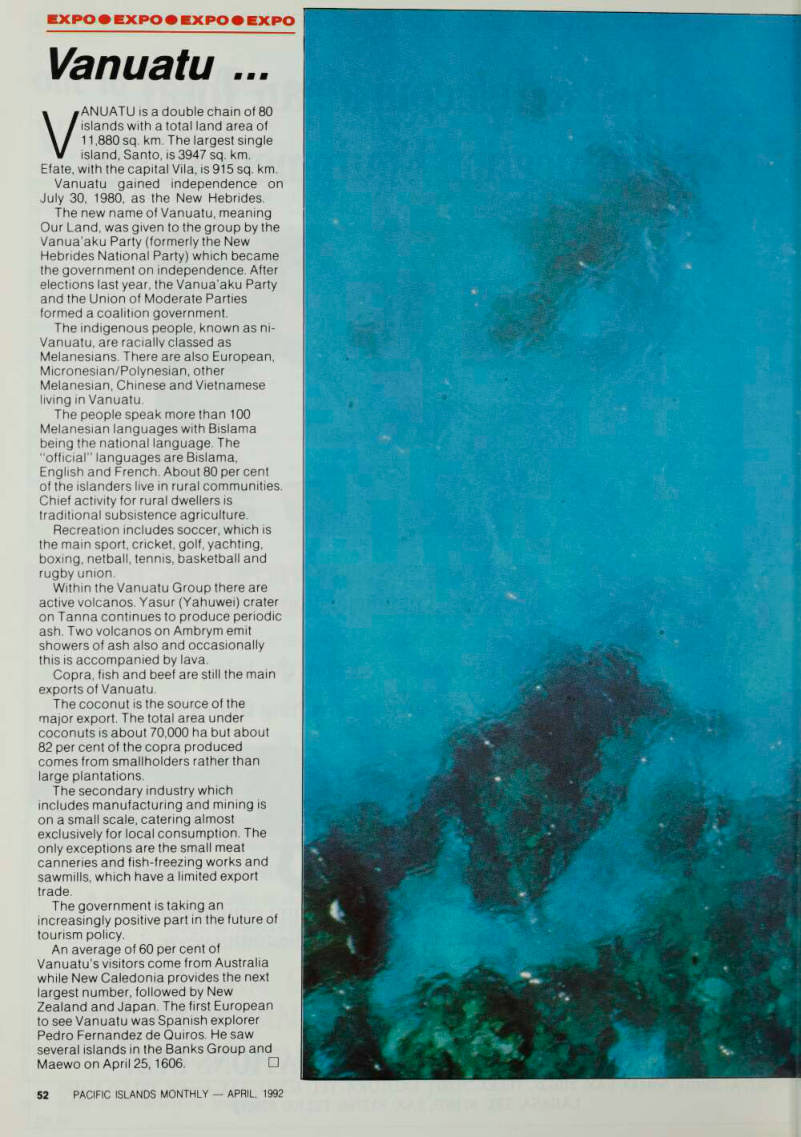
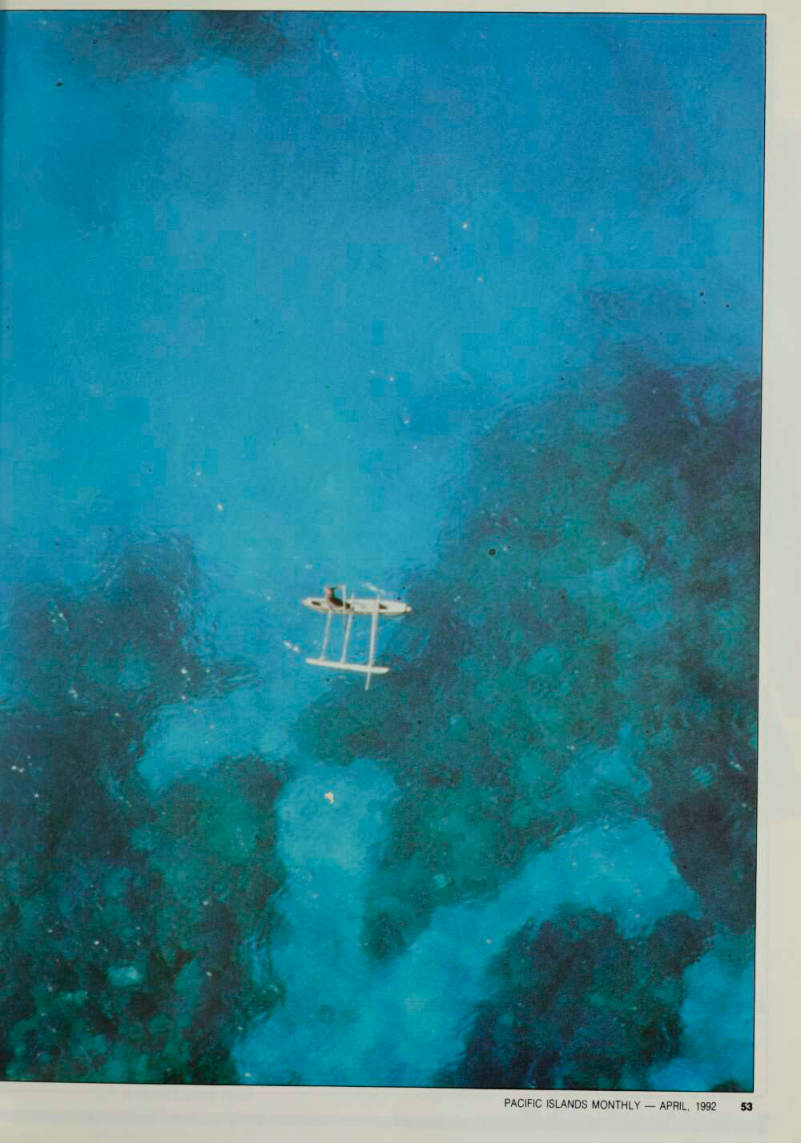
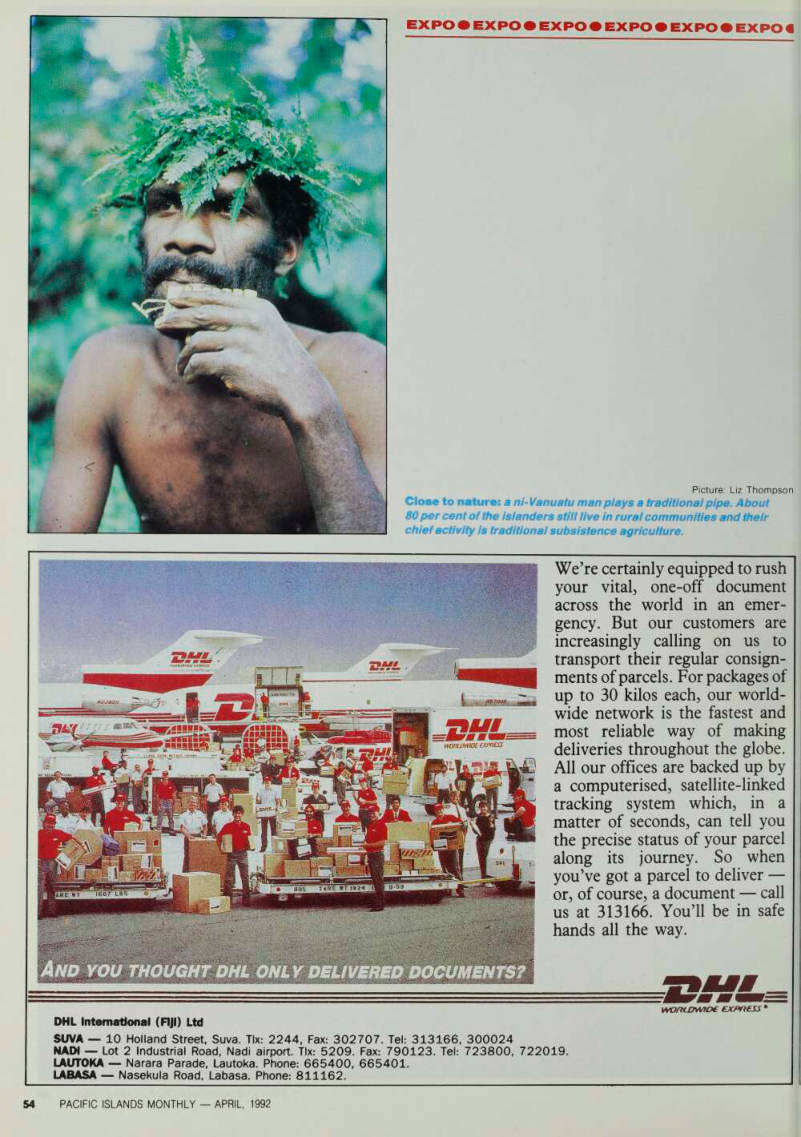
VANUATU is a double chain of 80 islands with a total land area of 11,880 sq. km. The largest single island, Santo, is 3947 sq. km.
Efate, with the capital Vila, is 915 sq. km.
Vanuatu gained independence on July 30, 1980, as the New Hebrides.
The new name of Vanuatu, meaning Our Land, was given to the group by the Vanua’aku Party (formerly the New Hebrides National Party) which became the government on independence. After elections last year, the Vanua’aku Party and the Union of Moderate Parties formed a coalition government.
The indigenous people, known as ni- Vanuatu, are racially classed as Melanesians. There are also European, Micronesian/Polynesian, other Melanesian, Chinese and Vietnamese living in Vanuatu.
The people speak more than 100 Melanesian languages with Bislama being the national language. The “official” languages are Bislama, English and French. About 80 per cent of the islanders live in rural communities.
Chief activity for rural dwellers is traditional subsistence agriculture.
Recreation includes soccer, which is the main sport, cricket, golf, yachting, boxing, netball, tennis, basketball and rugby union.
Within the Vanuatu Group there are active volcanos. Yasur (Yahuwei) crater on Tanna continues to produce periodic ash. Two volcanos on Ambrym emit showers of ash also and occasionally this is accompanied by lava.
Copra, fish and beef are still the main exports of Vanuatu.
The coconut is the source of the major export. The total area under coconuts is about 70,000 ha but about 82 per cent of the copra produced comes from smallholders rather than large plantations.
The secondary industry which includes manufacturing and mining is on a small scale, catering almost exclusively for local consumption. The only exceptions are the small meat canneries and fish-freezing works and sawmills, which have a limited export trade.
The government is taking an increasingly positive part in the future of tourism policy.
An average of 60 per cent of Vanuatu’s visitors come from Australia while New Caledonia provides the next largest number, followed by New Zealand and Japan. The first European to see Vanuatu was Spanish explorer Pedro Fernandez de Quiros. He saw several islands in the Banks Group and Maewo on April 25,1606. □
Picture: Liz Thompson Close to nature: a ni-Vanuatu man plays a traditional pipe. About 80 per cent of the islanders still live in rural communities and their chief activity is traditional subsistence agriculture.
Advertisements & other items, pp. 52-55 (3 items)
52
PACIFIC ISLANDS MONTHLY APRIL, 1992
EXPO • EXPO • EXPO • EXPO
54
EXPO • EXPO • EXPO • EXPO • EXPO • EXPO «
PACIFIC ISLANDS MONTHLY APRIL, 1992
mmrm m mm
LafeJH9Koi*a
SHiS
ureesis Mil!
UU H £ J
TARE
DHL International (FIJI) Ltd We’re certainly equipped to rush your vital, one-off document across the world in an emergency. But our customers are increasingly calling on us to transport their regular consignments of parcels. For packages of up to 30 kilos each, our worldwide network is the fastest and most reliable way of making
deliveries throughout the globe.
All our offices are backed up by a computerised, satellite-linked tracking system which, in a matter of seconds, can tell you the precise status of your parcel along its journey. So when you’ve got a parcel to deliver or, of course, a document call us at 313166. You’ll be in safe hands all the way. wontuwtoe express * SUVA 10 Holland Street, Suva. Tlx: 2244, Fax: 302707. Tel: 313166, 300024 NADI Lot 2 Industrial Road, Nadi airport. Tlx: 5209. Fax: 790123. Tel: 723800, 722019.
LAUTOKA Narara Parade, Lautoka. Phone: 665400, 665401.
LABASA Nasekula Road. Labasa. Phone: 811162.
ADVENTURE FOR ALL AGES
■ n .■ i V . - ;3-„ r_ 3^es.
Whatever your brand of adventure, Vanuatu will lot disappoint you. fou could witness the unforgettable Pentecost Jump, valk to the edge of an active volcano, dive the President Coolidge’ or witness ancient tribal ceremon- Or you might experience enough adventure ravelling by boat back to your hotel in the middle of he night, flying to an outer island an a small aircraft ir simply shopping at the local markets. Whatever your •rand adventure, Vanuatu has it all for you.
See your travel agents, airline or write to or call.
VANUATU
NATIONAL TOURISM OFFICE
KUMUL HIGHWAY
INTERNATIONAL BUILDING
P 0 BOX 209
PORT VILA
VANUATU
TELE: 22685/22515
FAX: 23889
Kiribati...
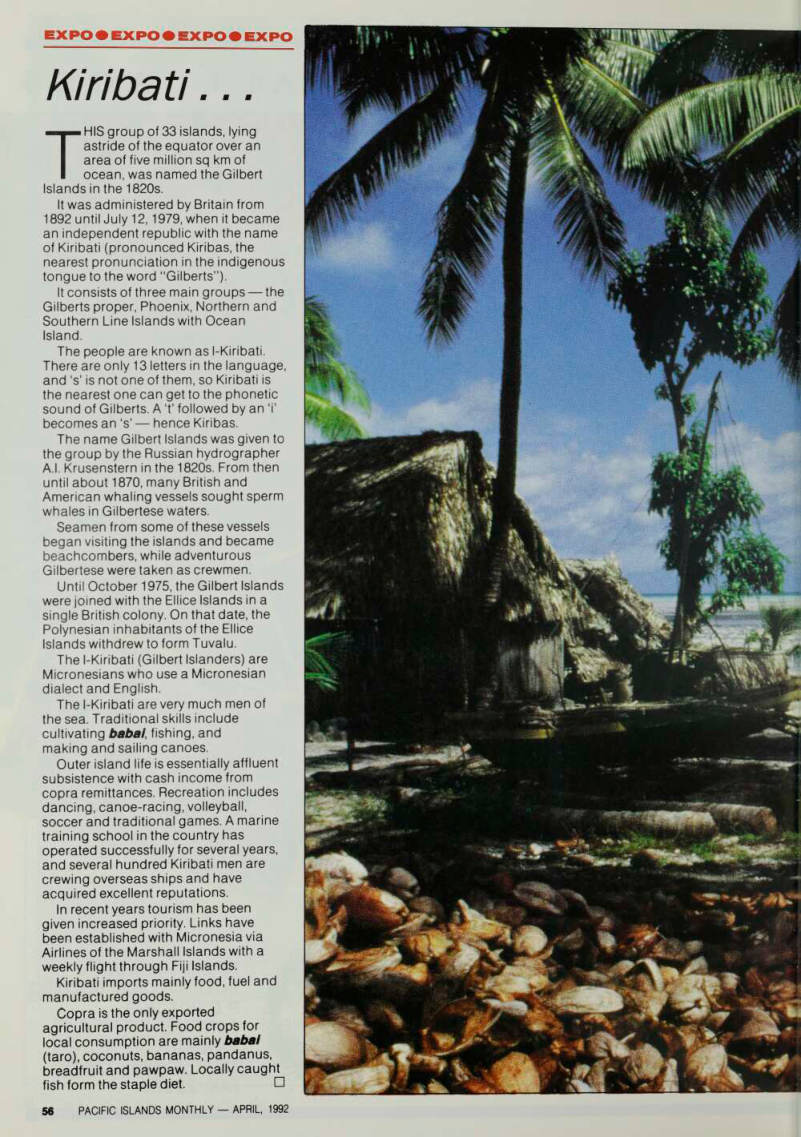
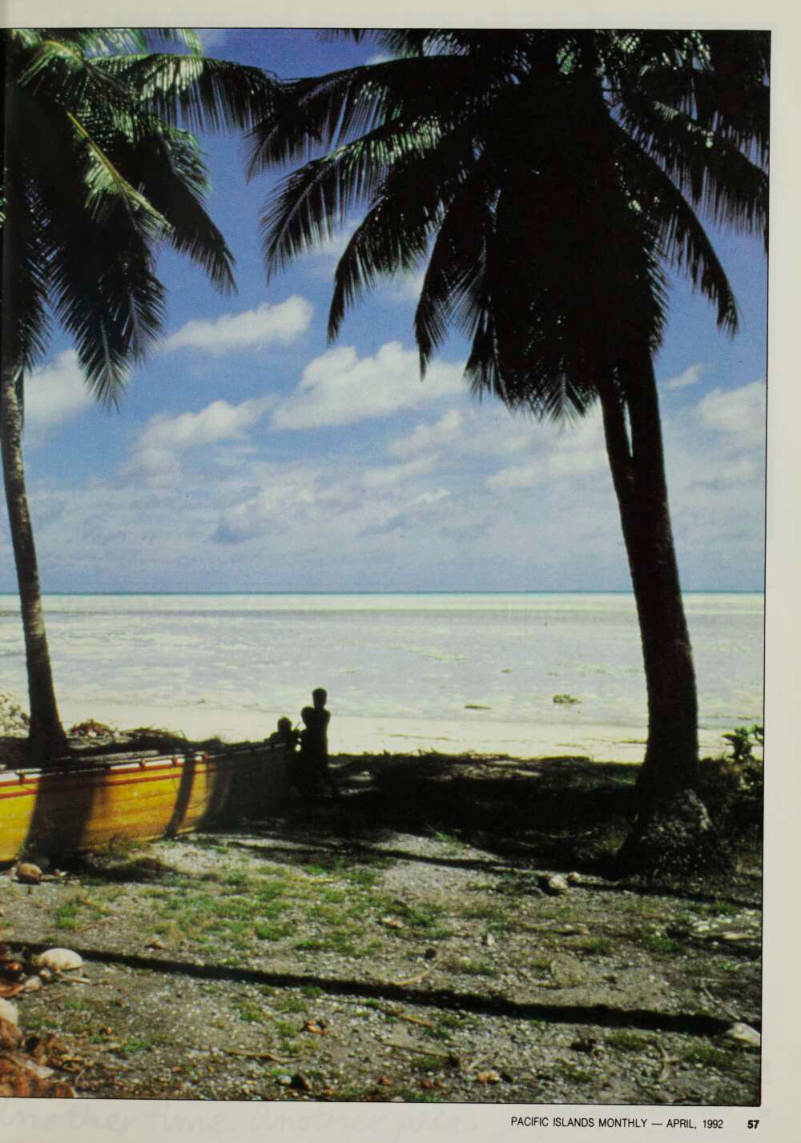

THIS group of 33 islands, lying astride of the equator over an area of five million sq km of ocean, was named the Gilbert Islands in the 1820 s.
It was administered by Britain from 1892 until July 12,1979, when it became an independent republic with the name of Kiribati (pronounced Kiribas, the nearest pronunciation in the indigenous tongue to the word “Gilberts”).
It consists of three main groups the Gilberts proper, Phoenix, Northern and Southern Line Islands with Ocean Island.
The people are known as l-Kiribati.
There are only 13 letters in the language, and ‘s’ is not one of them, so Kiribati is the nearest one can get to the phonetic sound of Gilberts. A T followed by an ‘i’ becomes an ‘s’ hence Kiribas.
The name Gilbert Islands was given to the group by the Russian hydrographer A.I. Krusenstern in the 1820 s. From then until about 1870, many British and American whaling vessels sought sperm whales in Gilbertese waters.
Seamen from some of these vessels began visiting the islands and became beachcombers, while adventurous Gilbertese were taken as crewmen.
Until October 1975, the Gilbert Islands were joined with the Ellice Islands in a single British colony. On that date, the Polynesian inhabitants of the Ellice Islands withdrew to form Tuvalu.
The l-Kiribati (Gilbert Islanders) are Micronesians who use a Micronesian dialect and English.
The l-Kiribati are very much men of the sea. Traditional skills include cultivating babal fishing, and making and sailing canoes.
Outer island life is essentially affluent subsistence with cash income from copra remittances. Recreation includes dancing, canoe-racing, volleyball, soccer and traditional games. A marine training school in the country has operated successfully for several years, and several hundred Kiribati men are crewing overseas ships and have acquired excellent reputations.
In recent years tourism has been given increased priority. Links have been established with Micronesia via Airlines of the Marshall Islands with a weekly flight through Fiji Islands.
Kiribati imports mainly food, fuel and manufactured goods.
Copra is the only exported agricultural product. Food crops for local consumption are mainly babal (taro), coconuts, bananas, pandanus, breadfruit and pawpaw. Locally caught fish form the staple diet. □
Picture: Tourism Council of the South Pacific Dressed to dance: a young Kiribati girl takes seriously what for most I-Kiribati is a recreational pursuit. Other activities include canoe-racing, volleyball, soccer and raditiionai games.
Advertisements & other items, pp. 56-59 (3 items)
Expo • Expo* Expo • Expo
58
EXPO • EXPO • EXPO • EXPO • EXPO • EXPO
PACIFIC ISLANDS MONTHLY APRIL, 1992
Huahine Mining And Dredging Company
Authorized Representatives for
NESSIE Portable Sand Dredges
For more information FAX, phone, or write:
HUAHINE MINING AND DREDGING COMPANY
B.P. 36 Fare, Huahine, Polynesie Francaise.
TEL: (689) 68.84.02 FAX: (689) 68.80.30
■ Contract Dredging ■ Land Reclamation ■ Beach Formation and Repair ■ Marina and Channel
Clearing
■ Sales ■ Service
jJAH
'U * g NAURU • KIRIBATI ■ VANUATU • COOK ISLANDS • FIJI • SOLOMONS • FRENCH POLYNESIA • TONGA • WESTERN SAMOA • NEW CALEDONIA
V;\ * mt v v
Bwn£lvj'/v
Jaw*
S-V;t<
• x t .m % . > 4 5? ft ’
m^:rA
' V v Hv r v 4\ a- % '/ <C*V\ ■ V v*: . i V: « Si V K h « V ,* ff 4 lb w*f* < P \
bcfaM cy\ tfr/jh
ivu» cCvuA w\<prg ,
Where would you find white powder
oeaches overhung with coconut palms,
reaching down to tropical blue water?
Where would you find diving in coral seas so clear and warm?
Where would you find top class resorts featuring world class cuisine, sporting activities, shows, casino and
night clubs?
Where would you find a live volcano and ancient custom villages, fresh grown market produce and some of the friendliest people you’ll ever meet?
Where? Vanuatu, that’s where. An untouched paradise on earth.
Melbourne; Phone 03-417 3977, Fax 03-417 5977.
Sydney: Phone 02-223 8333, Fax 02-223 8781.
Brisbane: Phone 07-221 2566, Fax 07-233 2330. Auckland: Phone 09-373 3435, Fax 09-358 1413.
Noumea: Phone 28 66 77, Fax 27 40 50.
Nadi: Phone 733 521
tn&ijyjtyiUy\4 t iXfoutHiV WHjL.
The Untouched Paradise
Solomon
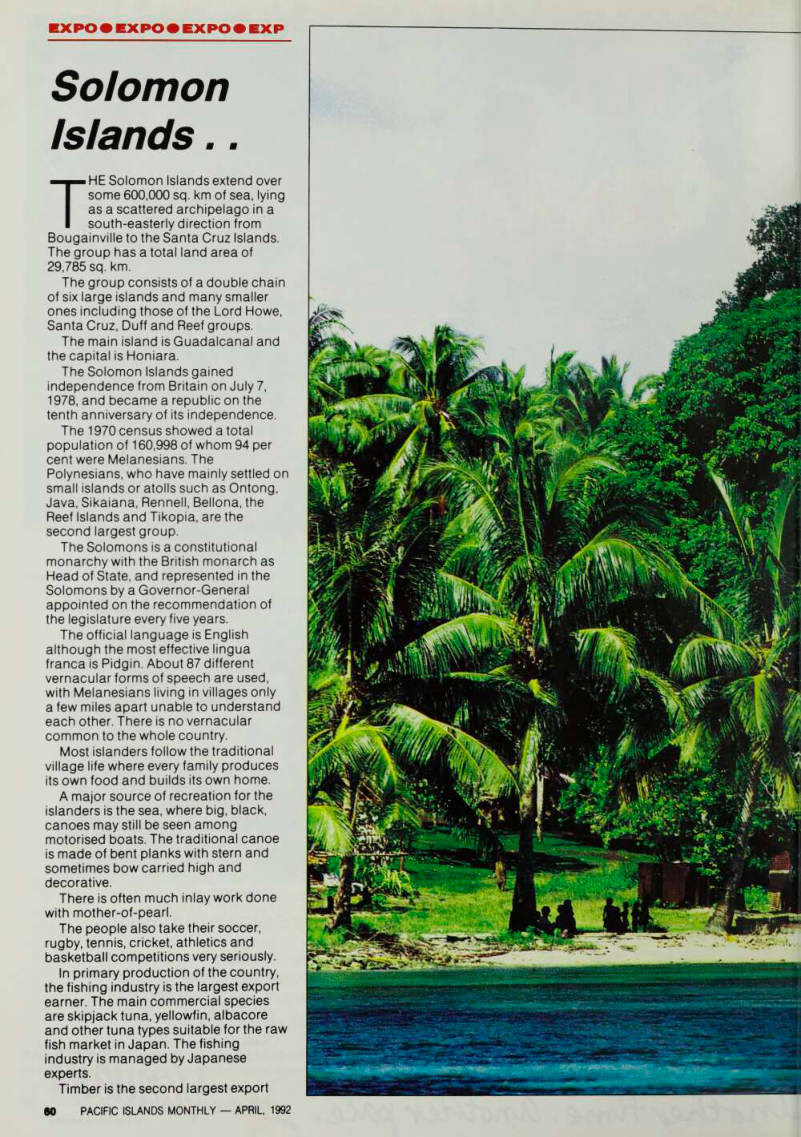
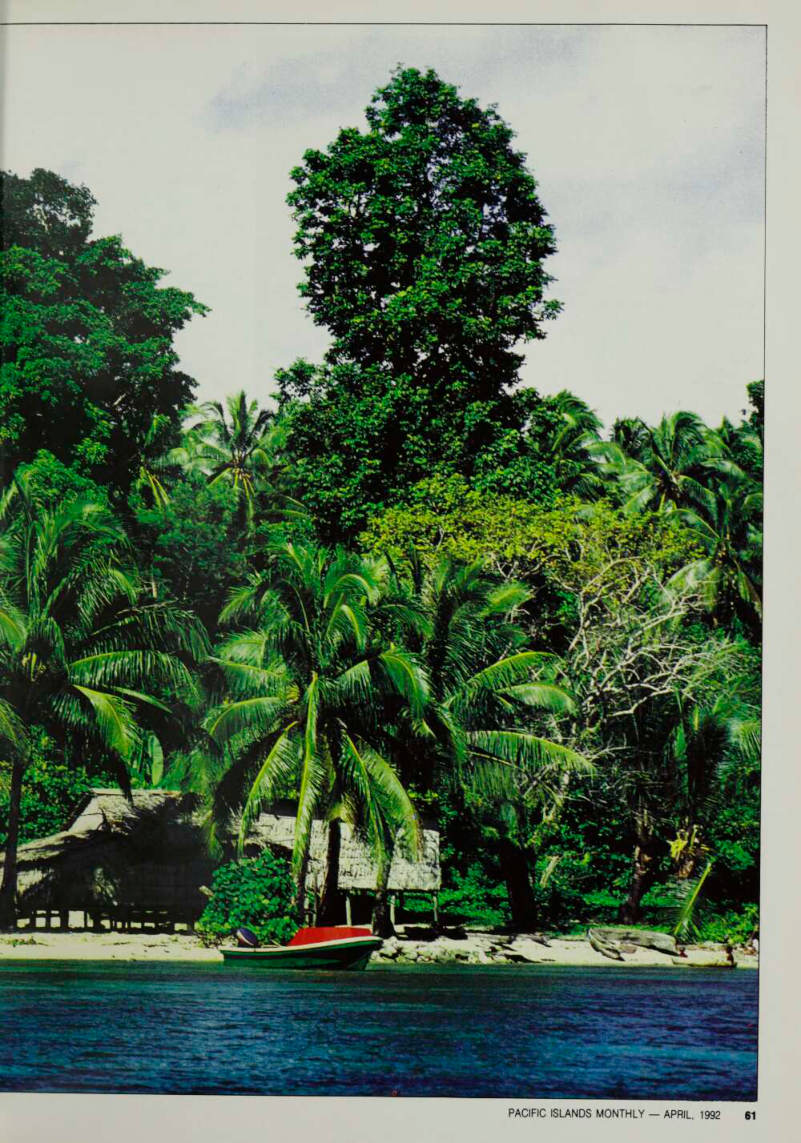
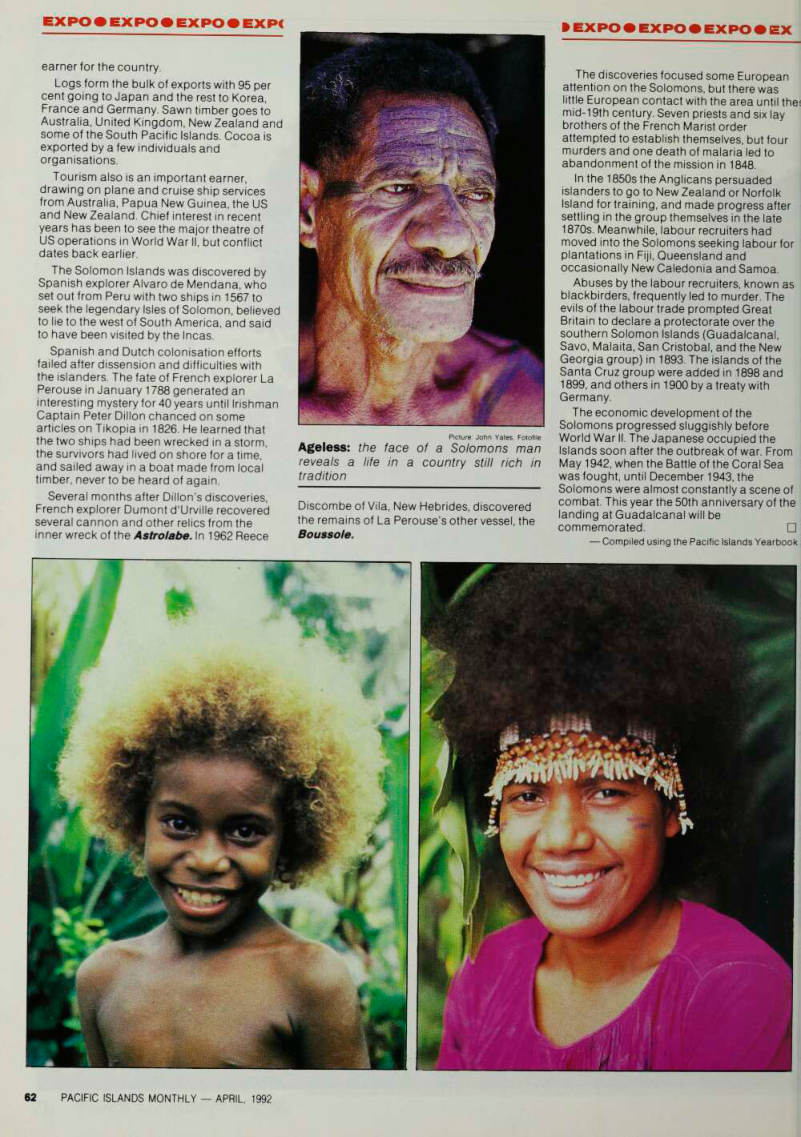
Islands..
THE Solomon Islands extend over some 600,000 sq. km of sea, lying as a scattered archipelago in a south-easterly direction from Bougainville to the Santa Cruz Islands.
The group has a total land area of 29,785 sq. km.
The group consists of a double chain of six large islands and many smaller ones including those of the Lord Howe, Santa Cruz, Duff and Reef groups.
The main island is Guadalcanal and the capital is Honiara.
The Solomon Islands gained independence from Britain on July 7, 1978, and became a republic on the tenth anniversary of its independence.
The 1970 census showed a total population of 160,998 of whom 94 per cent were Melanesians. The Polynesians, who have mainly settled on small islands or atolls such as Ontong, Java, Sikaiana, Rennell, Bellona, the Reef Islands and Tikopia, are the second largest group.
The Solomons is a constitutional monarchy with the British monarch as Head of State, and represented in the Solomons by a Governor-General appointed on the recommendation of the legislature every five years.
The official language is English although the most effective lingua franca is Pidgin. About 87 different vernacular forms of speech are used, with Melanesians living in villages only a few miles apart unable to understand each other. There is no vernacular common to the whole country.
Most islanders follow the traditional village life where every family produces its own food and builds its own home.
A major source of recreation for the islanders is the sea, where big, black, canoes may still be seen among motorised boats. The traditional canoe is made of bent planks with stern and sometimes bow carried high and decorative.
There is often much inlay work done with mother-of-pearl.
The people also take their soccer, rugby, tennis, cricket, athletics and basketball competitions very seriously.
In primary production of the country, the fishing industry is the largest export earner. The main commercial species are skipjack tuna, yellowfin, albacore and other tuna types suitable for the raw fish market in Japan. The fishing industry is managed by Japanese experts.
Timber is the second largest export
earner for the country.
Logs form the bulk of exports with 95 per cent going to Japan and the rest to Korea, France and Germany. Sawn timber goes to Australia, United Kingdom, New Zealand and some of the South Pacific Islands. Cocoa is exported by a few individuals and organisations.
Tourism also is an important earner, drawing on plane and cruise ship services from Australia, Papua New Guinea, the US and New Zealand. Chief interest in recent years has been to see the major theatre of US operations in World War 11, but conflict dates back earlier.
The Solomon Islands was discovered by Spanish explorer Alvaro de Mendana, who set out from Peru with two ships in 1567 to seek the legendary Isles of Solomon, believed to lie to the west of South America, and said to have been visited by the Incas.
Spanish and Dutch colonisation efforts failed after dissension and difficulties with the islanders. The fate of French explorer La Perouse in January 1788 generated an interesting mystery for 40 years until Irishman Captain Peter Dillon chanced on some articles on Tikopia in 1826. He learned that the two ships had been wrecked in a storm, the survivors had lived on shore for a time, and sailed away in a boat made from local timber, never to be heard of again.
Several months after Dillon’s discoveries, French explorer Dumont d’Urville recovered several cannon and other relics from the inner wreck of the Astrolabe. In 1962 Reece
Discombe of Vila, New Hebrides, discovered the remains of La Perouse’s other vessel, the Boussole.
The discoveries focused some European attention on the Solomons, but there was little European contact with the area until the mid-19th century. Seven priests and six lay brothers of the French Marist order attempted to establish themselves, but four murders and one death of malaria led to abandonment of the mission in 1848.
In the 1850 s the Anglicans persuaded islanders to go to New Zealand or Norfolk Island for training, and made progress after settling in the group themselves in the late 1870 s. Meanwhile, labour recruiters had moved into the Solomons seeking labour for plantations in Fiji, Queensland and occasionally New Caledonia and Samoa.
Abuses by the labour recruiters, known as blackbirders, frequently led to murder. The evils of the labour trade prompted Great Britain to declare a protectorate over the southern Solomon Islands (Guadalcanal, Savo, Malaita, San Cristobal, and the New Georgia group) in 1893. The islands of the Santa Cruz group were added in 1898 and 1899, and others in 1900 by a treaty with
Germany.
The economic development of the Solomons progressed sluggishly before World War 11. The Japanese occupied the Islands soon after the outbreak of war. From May 1942, when the Battle of the Coral Sea was fought, until December 1943, the Solomons were almost constantly a scene of combat. This year the 50th anniversary of the landing at Guadalcanal will be commemorated. □ Compiled using the Pacific Islands Yearbook
Picture: John Yates, Fotofile Ageless: the face of a Solomons man reveals a life in a country still rich in tradition
Advertisements & other items, pp. 60-63 (3 items)
60
PACIFIC ISLANDS MONTHLY APRIL, 1992
EXPO • EXPO m EXPO • EXP
62
» EXPO • EXPO • EXPO • EX
PACIFIC ISLANDS MONTHLY APRIL, 1992
EXPO • EXPO • EXPO • EXP<
Solomon Islands Tourist Authority
THE ISLANDS LOST IN TIME
Without doubt, we are the islands lost in time But look at what we have to offer our visitors...
Unspoilt, unsophisticated friendly people Magnificent reef and wreck diving Spectacular waterfalls in lush tropical rainforests Unique flora and fauna Traditional artifacts and handicrafts elaborately made by skilled craftsmen Traditional dances and folklore dating back centuries Thermal springs and dormant volcanoes World War II relics and battlefields Golden sundrenched beaches surrounded by turqoise waters So!
If you're looking for a new destination with something different to see and d 0...
Look our way.
Come, before word gets around.
Solomon Islands Tourist Authority
i For further information contact; Solomon Islands Tourist Authority. PO Box 321, Honiara. Phone; (677) 22412. Fax; (677) 23986 our representative: General I ravel Marketing Services. Suite 20/37 Alexander Street, Crows Nest, N.S.W, 2065, Phone (02) 4334555 Fax (02) 4385197
In the giant’s garden
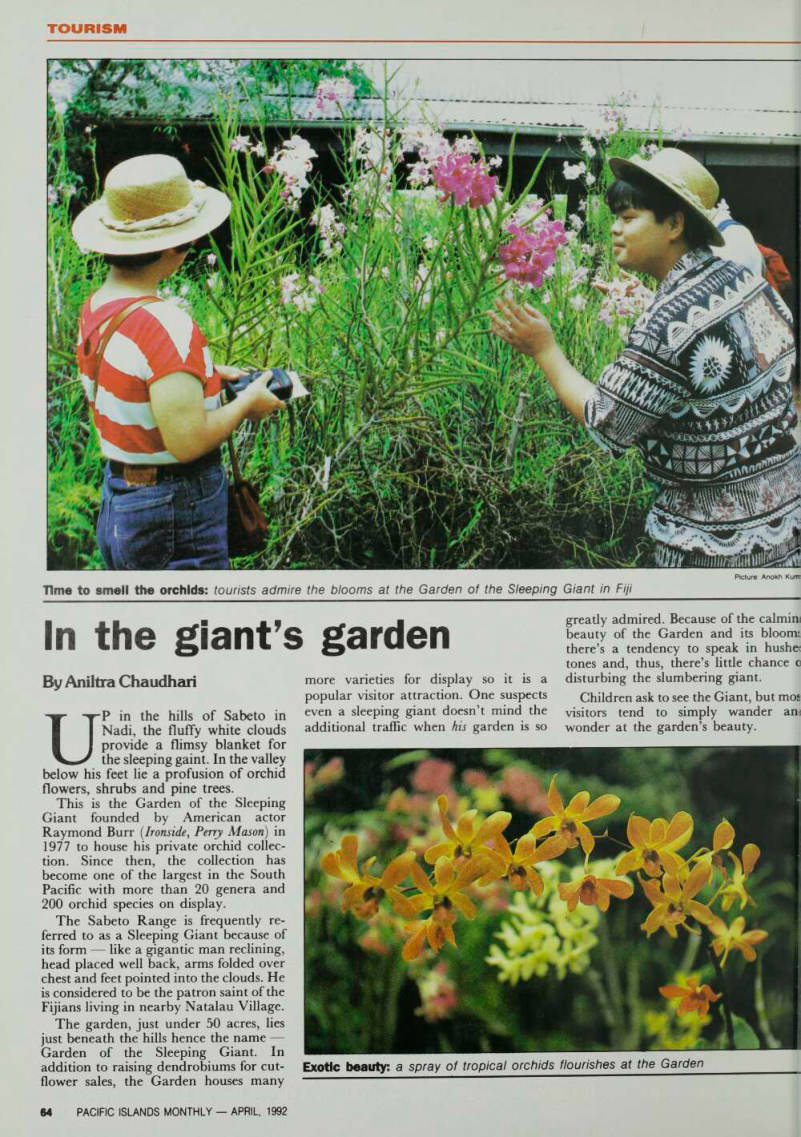
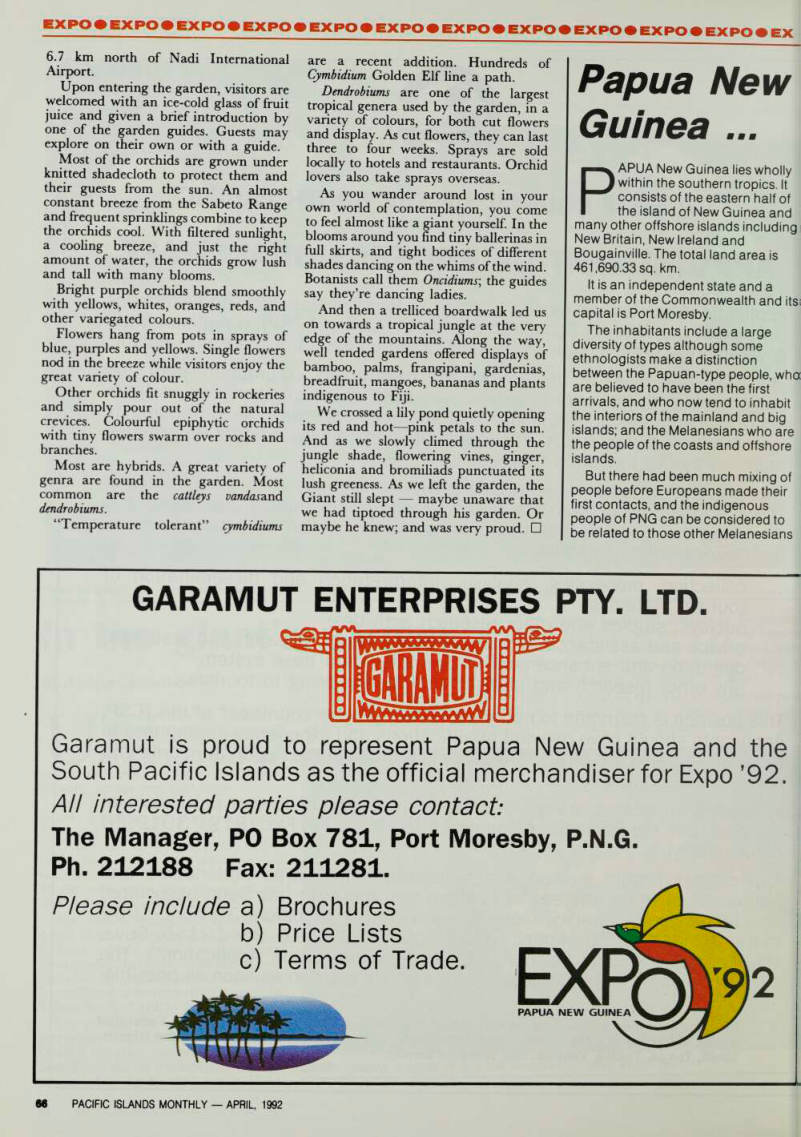
By Aniltra Chaudhari
UP in the hills of Sabeto in Nadi, the fluffy white clouds provide a flimsy blanket for the sleeping gaint. In the valley below his feet lie a profusion of orchid flowers, shrubs and pine trees.
This is the Garden of the Sleeping Giant founded by American actor Raymond Burr ( Ironside , Perry Mason ) in 1977 to house his private orchid collec tion. Since then, the collection has become one of the largest in the South Pacific with more than 20 genera and 200 orchid species on display.
The Sabeto Range is frequently re ferred to as a Sleeping Giant because of its form like a gigantic man reclining, head placed well back, arms folded over chest and feet pointed into the clouds. He is considered to be the patron saint of the Fijians living in nearby Natalau Village.
The garden, just under 50 acres, lies just beneath the hills hence the name Garden of the Sleeping Giant. In addition to raising dendrobiums for cut flower sales, the Garden houses many
more varieties for display so it is a popular visitor attraction. One suspects even a sleeping giant doesn’t mind the additional traffic when his garden is so
greatly admired. Because of the calmini beauty of the Garden and its blooms there’s a tendency to speak in hushec tones and, thus, there’s little chance o
disturbing the slumbering giant.
Children ask to see the Giant, but mos visitors tend to simply wander am wonder at the garden’s beauty.
Time to smell the orchids: tourists admire the blooms at the Garden of the Sleeping Giant in Fiji
Picture: Anokh Kum
Exotic beauty: a spray of tropical orchids flourishes at the Garden
6.7 km north of Nadi International Airport.
Upon entering the garden, visitors are welcomed with an ice-cold glass of fruit juice and given a brief introduction by one of the garden guides. Guests may explore on their own or with a guide.
Most of the orchids are grown under knitted shadecloth to protect them and their guests from the sun. An almost constant breeze from the Sabeto Range and frequent sprinklings combine to keep the orchids cool. With filtered sunlight, a cooling breeze, and just the right amount of water, the orchids grow lush and tall with many blooms.
Bright purple orchids blend smoothly with yellows, whites, oranges, reds, and other variegated colours.
Flowers hang from pots in sprays of blue, purples and yellows. Single flowers nod in the breeze while visitors enjoy the great variety of colour.
Other orchids fit snuggly in rockeries and simply pour out of the natural crevices. Colourful epiphytic orchids with tiny flowers swarm over rocks and branches.
Most are hybrids. A great variety of genra are found in the garden. Most common are the cattleys vandasa.nd dendrobiums.
“Temperature tolerant” cymbidiums
are a recent addition. Hundreds of Cymbidium Golden Elf line a path.
Dendrobiums are one of the largest tropical genera used by the garden, in a variety of colours, for both cut flowers and display. As cut flowers, they can last three to four weeks. Sprays are sold locally to hotels and restaurants. Orchid lovers also take sprays overseas.
As you wander around lost in your own world of contemplation, you come to feel almost like a giant yourself. In the blooms around you find tiny ballerinas in full skirts, and tight bodices of different shades dancing on the whims of the wind.
Botanists call them Oncidiums\ the guides
say they’re dancing ladies.
And then a trelliced boardwalk led us on towards a tropical jungle at the very edge of the mountains. Along the way, well tended gardens offered displays of
bamboo, palms, frangipani, gardenias,
breadfruit, mangoes, bananas and plants
indigenous to Fiji.
We crossed a lily pond quietly opening its red and hot —pink petals to the sun.
And as we slowly dimed through the
jungle shade, flowering vines, ginger,
heliconia and bromiliads punctuated its lush greeness. As we left the garden, the Giant still slept maybe unaware that we had tiptoed through his garden. Or maybe he knew; and was very proud. □
Advertisements & other items, pp. 65-66 (1 item)
Appointment Of Professional Staff
TOURISM COUNCIL OF THE SOUTH PACIFIC
Applications are invited for the position of Head of Research and Statistics Division of the Tourism Council of the South Pacific (TCSP), a regional intergovernmental organisation of thirteen island countries of the South Pacific.
The main objectives of the Council are to promote, co-ordinate, plan and implement projects and activities designed to strengthen regional cooperation in tourism development of member countries. Most funding is currently provided by the Pacific Regional Tourism Development Programme financed by the European Community.
The Head of Research and Statistics Division will report to the Director of TCSP, and will be responsible to the Director for planning, organising and executing the research and statistics component of the work programme of the Council which includes: — .. collection, processing, analysis, interpretation and dissemination of tourism statistics; .. surveys, studies and other research activities; advice and assistance to member countries on research and statistics; .. operation and enhancement of computer data base system; .. any other research and statistic activities relating to tourism.
This position is restricted to nationals of the member countries* of the TCSP.
Applicants should have relevant qualifications and experience appropriate to the post and a record of achievements in tourism in the region at middle and senior management level.
Interested applicants are advised to obtain a copy of further particulars of the post from the Secretariat (Phone: (679) 315277; Fax: (679) 301995) before applying.
Applications should include a detailed curriculum vitae and names and addresses of three referees with whom the applicant has been associated in a professional capacity, must be submitted on or before 30 April, 1992 to the Director, Tourism Council of the South Pacific, P.O. Box 13119, Suva, Fiji. Envelope should be marked “Professional Staff Application”. The successful applicant is expected to take up his position as soon as possible. ★ Member countries of the Tourism Council of the South Pacific are: Cook Islands, Federated States of Micronesia, Fiji, Kiribati, Marshall Islands, Niue, Papua New Guinea, Solomon Islands, Tahiti, Tonga, Tuvalu, Vanuatu and Western Samoa.
GARAMUT ENTERPRISES PTY. LTD
AAA
IT Garamut is proud to represent Papua New Guinea and the South Pacific Islands as the official merchandiser for Expo ’92.
AH interested parties please contact: The Manager, PO Box 781, Port Moresby, P.N.G.
Ph. 212188 Fax: 211281.
Please include a) Brochures b) Price Lists c) Terms of Trade
PAPUA NEW GUINEA
Papua New
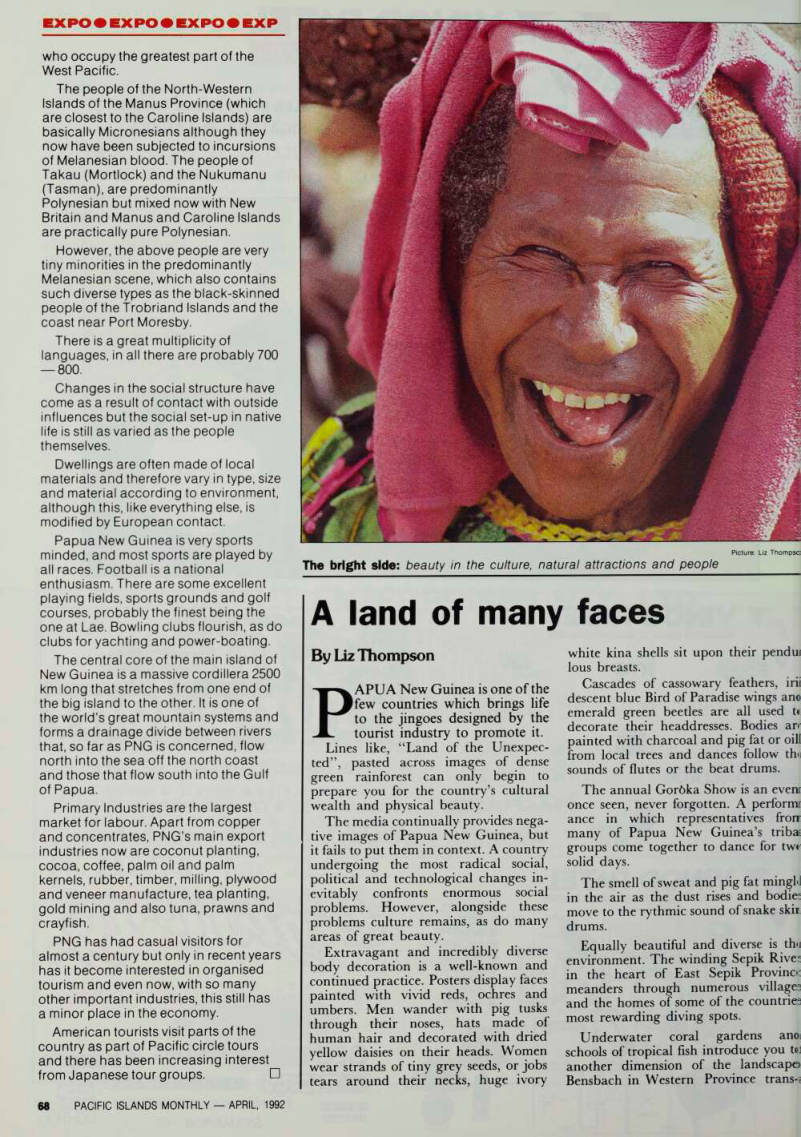
Guinea ...
PAPUA New Guinea lies wholly within the southern tropics. It consists of the eastern half of the island of New Guinea and many other offshore islands including i New Britain, New Ireland and Bougainville. The total land area is 461,690.33 sq. km.
It is an independent state and a member of the Commonwealth and its; capital is Port Moresby.
The inhabitants include a large diversity of types although some ethnologists make a distinction between the Papuan-type people, wha are believed to have been the first arrivals, and who now tend to inhabit the interiors of the mainland and big islands: and the Melanesians who are the people of the coasts and offshore islands.
But there had been much mixing of people before Europeans made their first contacts, and the indigenous people of PNG can be considered to be related to those other Melanesians
who occupy the greatest part of the West Pacific.
The people of the North-Western Islands of the Manus Province (which are closest to the Caroline Islands) are basically Micronesians although they now have been subjected to incursions of Melanesian blood. The people of Takau (Mortlock) and the Nukumanu (Tasman), are predominantly Polynesian but mixed now with New Britain and Manus and Caroline Islands are practically pure Polynesian.
However, the above people are very tiny minorities in the predominantly Melanesian scene, which also contains such diverse types as the black-skinned people of the Trobriand Islands and the coast near Port Moresby.
There is a great multiplicity of languages, in all there are probably 700 800.
Changes in the social structure have come as a result of contact with outside influences but the social set-up in native life is still as varied as the people themselves.
Dwellings are often made of local materials and therefore vary in type, size and material according to environment, although this, like everything else, is modified by European contact.
Papua New Guinea is very sports minded, and most sports are played by all races. Football is a national enthusiasm. There are some excellent playing fields, sports grounds and golf courses, probably the finest being the one at Lae. Bowling clubs flourish, as do clubs for yachting and power-boating.
The central core of the main island of New Guinea is a massive cordillera 2500 km long that stretches from one end of the big island to the other. It is one of the world’s great mountain systems and forms a drainage divide between rivers that, so far as PNG is concerned, flow north into the sea off the north coast and those that flow south into the Gulf of Papua.
Primary Industries are the largest market for labour. Apart from copper and concentrates, PNG’s main export industries now are coconut planting, cocoa, coffee, palm oil and palm kernels, rubber, timber, milling, plywood and veneer manufacture, tea planting, gold mining and also tuna, prawns and crayfish.
PNG has had casual visitors for almost a century but only in recent years has it become interested in organised tourism and even now, with so many other important industries, this still has a minor place in the economy.
American tourists visit parts of the country as part of Pacific circle tours and there has been increasing interest from Japanese tour groups. □
Advertisements & other items, pp. 66-67 (2 items)
66
PACIFIC ISLANDS MONTHLY APRIL. 1992
EXPO •EXPO •EXPO* EXPO * EXPO * EXPO* EXPO* EXPO* EXPO* EXPO* EXPO* EX
Yinop Patel
y
BIGGEST NAME IN HARDWARE
10 STEWART ST, SUVA, FUI. GPO BOX 14416, FAX 302627, TELEX 2377, PHONE 313811 BA • SUVA • LAUTOKA • NADI • RAKIRAKI • SIGATOKA • LABASA OPENING SOON Bth STORE (BIGGEST HARDWARE OUTLET IN FIJI) NABUA, SUVA TIMBER • HARDWARE • BUILDING MATERIAL t TILES • LIGHTS • STRUCTURAL STEEL
PATEL
ACACIA
ires
CERAMIGA VALVERDE BE
iPGH
CERAMIC ITI.ES
CERAMICHE
LAFAENZA
CERAMICHE .
concordc
w
PIP
m
ICEROSA
COMM3* □ SAS3UOLC s*».
(xxrKH.vrm
W CERAMiCHf
fMARAZZI
Sanuua \ laces oing
FIJI'S LARGEST STOCKIST OF TILES
• MARBLE • SLATES • GRANITE • MIRROR TILES • CARPET TILES • GRASS CARPET • REFLECTIVE
ACRYLIC SHEETS • COLOURED PERSPEX SHEETS
• ACOUSTIC TILES • VINYL ASBESTOS TILES
y .T VINOD PATEL
r k L W O’
■WALL BRACKETS -CEILING LIGHT
T
• POOLS
• SPORTS
• ROADS
• WHARFS
• FACTORIES
• HOTELS
• OFFICES
• HOMES
• BANKS
• SHOPS
a o vrw
GEC g philips jQynini
■ LIGHTING
[T] THQwnmnT
maaa eye iwasaki electric co..ltd.
SYLUANIA 3D LIGHTING
A land of many faces
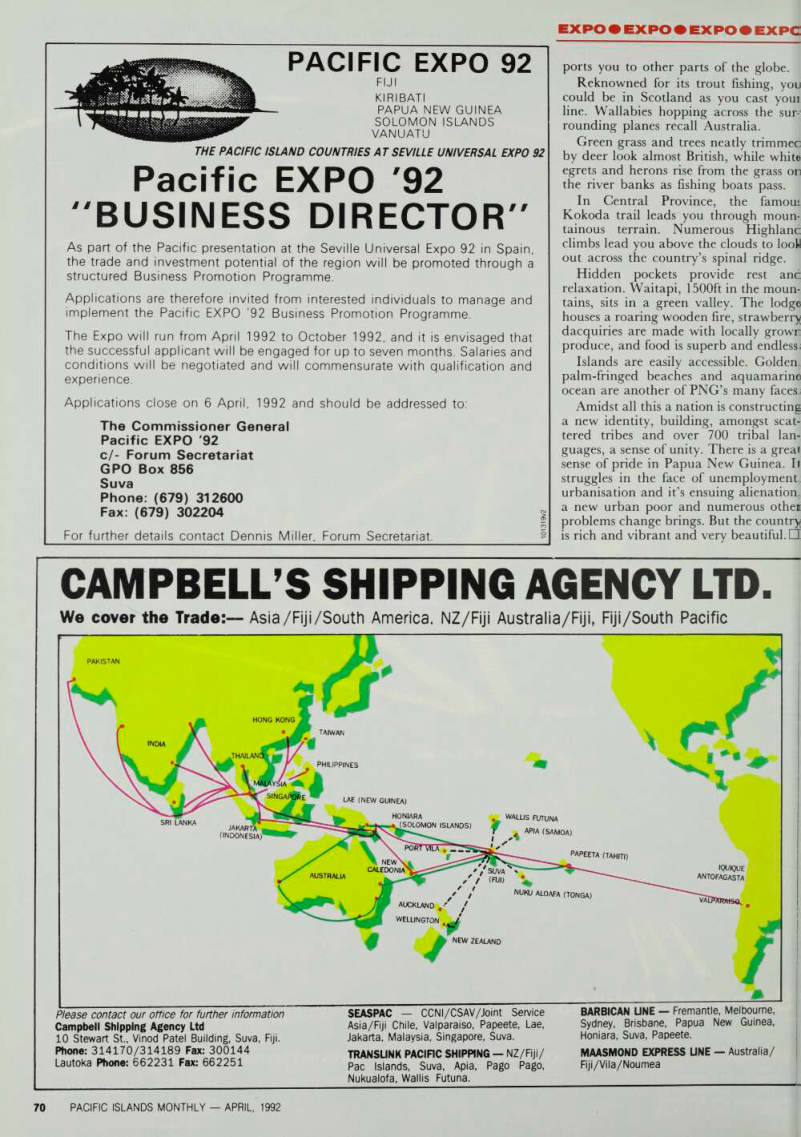
By Liz Thompson
PAPUA New Guinea is one of the few countries which brings life to the jingoes designed by the tourist industry to promote it.
Lines like, “Land of the Unexpec ted”, pasted across images of dense green rainforest can only begin to prepare you for the country’s cultural wealth and physical beauty.
The media continually provides nega tive images of Papua New Guinea, but it fails to put them in context. A country undergoing the most radical social, political and technological changes in evitably confronts enormous social problems. However, alongside these problems culture remains, as do many areas of great beauty.
Extravagant and incredibly diverse body decoration is a well-known and continued practice. Posters display faces painted with vivid reds, ochres and umbers. Men wander with pig tusks through their noses, hats made of human hair and decorated with dried yellow daisies on their heads. Women wear strands of tiny grey seeds, or jobs tears around their necks, huge ivory
white kina shells sit upon their pendui lous breasts.
Cascades of cassowary feathers, irii descent blue Bird of Paradise wings ano emerald green beetles are all used t« decorate their headdresses. Bodies arc painted with charcoal and pig fat or oill from local trees and dances follow thu sounds of flutes or the beat drums.
The annual Gor6ka Show is an evenr once seen, never forgotten. A performr ance in which representatives frorr many of Papua New Guinea’s tribaE groups come together to dance for twc solid days.
The smell of sweat and pig fat mingl.J in the air as the dust rises and bodies move to the rythmic sound of snake skiu drums.
Equally beautiful and diverse is th*i environment. The winding Sepik Rives in the heart of East Sepik Province meanders through numerous villages and the homes of some of the countries most rewarding diving spots.
Underwater coral gardens anoi schools of tropical fish introduce you to] another dimension of the landscape) Bensbach in Western Province trans-<
Picture: Liz Thompson
The bright side: beauty in the culture, natural attractions and people
ports you to other parts of the globe.
Reknowned for its trout fishing, you could be in Scotland as you cast your line. Wallabies hopping across the sur rounding planes recall Australia.
Green grass and trees neatly trimmec by deer look almost British, while white egrets and herons rise from the grass on the river banks as fishing boats pass.
In Central Province, the famouj Kokoda trail leads you through moun tainous terrain. Numerous Highlanc climbs lead you above the clouds to look out across the country’s spinal ridge.
Hidden pockets provide rest anc relaxation. Waitapi, 1500 ft in the moun tains, sits in a green valley. The lodge houses a roaring wooden fire, strawberry dacquiries are made with locally grown produce, and food is superb and endless; Islands are easily accessible. Golden.j palm-fringed beaches and aquamarine ocean are another of PNG’s many faces; Amidst all this a nation is constructing a new identity, building, amongst scat tered tribes and over 700 tribal lan guages, a sense of unity. There is a great sense of pride in Papua New Guinea. It struggles in the face of unemployment urbanisation and it’s ensuing alienation, a new urban poor and numerous ©then problems change brings. But the country is rich and vibrant and very beautiful. Q
Advertisements & other items, pp. 68-70 (3 items)
Expo • Expo • Expo • Exp
Solomon Airlines
\ po rt Moresby
SOLOMON
ISLANDS
PUA NEW GUINEA
Honiara Cairn
FIJI
m Nadi
TONGA
Brisbane /
AUSTRALIA
L Port Vila
VANUATU
// Tonga apu Auckland r
NEW ZEALAND
y i ■
Solomon Airlines
THE NATIONAL AIRLINE OF THE KINGDOM OF TONGA
USTRALIA
FIJI
SOLOMONS
risbane: (07) 221 4433 31 4666 (677) 20031 risbane: (07)229 7813 Suva Honiara ydney: (02)239 1722 ielboume: (03) 321 6860 aims: (070) 31 5634
NEW ZEALAND PAPUA NEW GUINEA
(09) 308 9098 (675) 25 5724 Auckland Port Moresby
VANUATU
(678) 23838 Port Vila
TONGA
(676) 23414 Tongatapu
FRANKFURT
(69) 17 2260
LOS ANGELES
(213) 670 7302
PACIFIC EXPO 92
FIJI
KIRIBATI
PAPUA NEW GUINEA
SOLOMON ISLANDS
VANUATU
THE PACIFIC ISLAND COUNTRIES AT SEVILLE UNIVERSAL EXPO 92
Pacific EXPO '92
"BUSINESS DIRECTOR"
As part of the Pacific presentation at the Seville Universal Expo 92 in Spain, the trade and investment potential of the region will be promoted through a structured Business Promotion Programme.
Applications are therefore invited from interested individuals to manage and implement the Pacific EXPO '92 Business Promotion Programme.
The Expo will run from April 1992 to October 1992, and it is envisaged that the successful applicant will be engaged for up to seven months. Salaries and conditions will be negotiated and will commensurate with qualification and experience.
Applications close on 6 April, 1992 and should be addressed to: The Commissioner General Pacific EXPO '92 c/- Forum Secretariat GPO Box 856 Suva Phone: (679) 312600 Fax: (679) 302204 For further details contact Dennis Miller, Forum Secretariat.
CAMPBELL’S SHIPPING AGENCY LTD
We cover the Trade:— Asia/Fiji/South America. NZ/Fiji Australia/Fiji, Fiji/South Pacific
HONG KONG
TAIWAN
INDIA
THAI LAN
PHILIPPINES
X £
SINGA
LAE (NEW GUINEA)
WALLIS FUTUNA
SRI LANKA
JAKARTA
(INDONESIA)
\ pdßTwrrrrs r
PAPEETA (TAHITI)
NEW \
CALEDONIA
iquique
* f SUVA ' -
/ / (Fill) \
/ NUK LI ALOAFA (TONGA)
/ f
AUSTRALIA
ANTOFAGASTA
AUCKLAND
WELLINGTON
W
NEW ZEALAND
Please contact our office for further information Campbell Shipping Agency Ltd 10 Stewart St., Vinod Patel Building, Suva, Fiji.
Phone: 314170/314189 Fax: 300144 Lautoka Phone: 662231 Fax: 662251 SEASPAC CCNI/CSAV/Joint Service Asia/Fiji Chile, Valparaiso, Papeete, Lae, Jakarta, Malaysia, Singapore, Suva.
TRANSLINK PACIFIC SHIPPING - NZ/Fiji/
Pac Islands, Suva, Apia, Pago Pago,
Nukualofa, Wallis Futuna.
BARBICAN UNE Fremantle, Melbourne, Sydney, Brisbane, Papua New Guinea, Honiara, Suva, Papeete.
MAASMOND EXPRESS UNE Australia/
Fiji/Vila/Noumea
70
EXPO •EXPO* EXPO • EX PC
PACIFIC ISLANDS MONTHLY APRIL, 1992
Helping hand from within
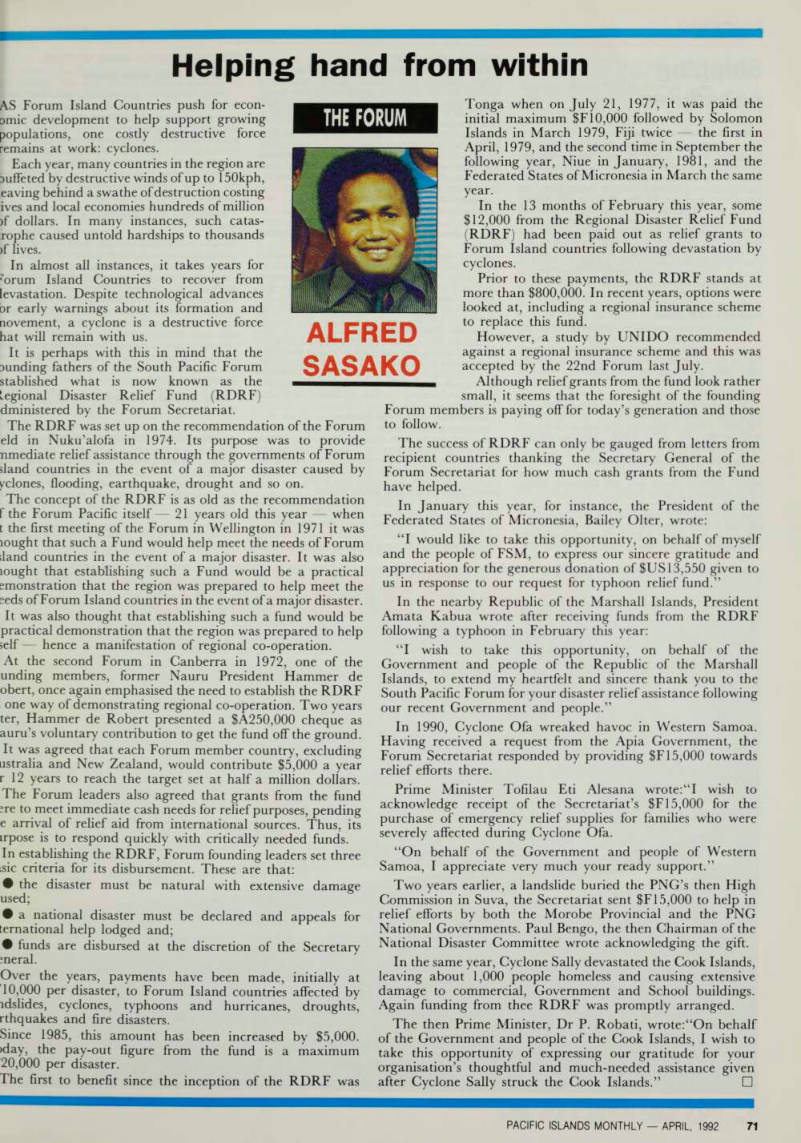
AS Forum Island Countries push for econ omic development to help support growing populations, one costly destructive force remains at work: cyclones.
Each year, many countries in the region are ouffeted by destructive winds of up to 150 kph, caving behind a swathe of destruction costing ives and local economies hundreds of million )f dollars. In many instances, such catas rophe caused untold hardships to thousands )f lives.
In almost all instances, it takes years for r orum Island Countries to recover from levastation. Despite technological advances or early warnings about its formation and novement, a cyclone is a destructive force hat will remain with us.
It is perhaps with this in mind that the ounding fathers of the South Pacific Forum stablished what is now known as the Legional Disaster Relief Fund (RDRF) dministered by the Forum Secretariat.
The RDRF was set up on the recommendation of the Forum eld in Nuku’alofa in 1974. Its purpose was to provide nmediate relief assistance through the governments of Forum sland countries in the event of a major disaster caused by flooding, earthquake, drought and so on.
The concept of the RDRF is as old as the recommendation f the Forum Pacific itself — 21 years old this year when t the first meeting of the Forum in Wellington in 1971 it was lought that such a Fund would help meet the needs of Forum iland countries in the event of a major disaster. It was also lought that establishing such a Fund would be a practical emonstration that the region was prepared to help meet the “eds of Forum Island countries in the event ofa major disaster.
It was also thought that establishing such a fund would be practical demonstration that the region was prepared to help self hence a manifestation of regional co-operation.
At the second Forum in Canberra in 1972, one of the unding members, former Nauru President Hammer de obert, once again emphasised the need to establish the RDRF one way of demonstrating regional co-operation. Two years ter, Hammer de Robert presented a $A250,000 cheque as auru’s voluntary contribution to get the fund off the ground.
It was agreed that each Forum member country, excluding astralia and New Zealand, would contribute $5,000 a year r 12 years to reach the target set at half a million dollars.
The Forum leaders also agreed that grants from the fund :re to meet immediate cash needs for relief purposes, pending e arrival of relief aid from international sources. Thus, its irpose is to respond quickly with critically needed funds.
In establishing the RDRF, Forum founding leaders set three tsic criteria for its disbursement. These are that: • the disaster must be natural with extensive damage used; • a national disaster must be declared and appeals for
ternational help lodged and;
• funds are disbursed at the discretion of the Secretary meral.
Over the years, payments have been made, initially at 10.000 per disaster, to Forum Island countries affected by idslides, cyclones, typhoons and hurricanes, droughts, rthquakes and fire disasters.
Since 1985, this amount has been increased by $5,000. >day, the pay-out figure from the fund is a maximum 20.000 per disaster.
The first to benefit since the inception of the RDRF was
The Forum
Tonga when on July 21, 1977, it was paid the initial maximum $F 10,000 followed by Solomon Islands in March 1979, Fiji twice the first in April, 1979, and the second time in September the following year, Niue in January, 1981, and the Federated States of Micronesia in March the same year.
In the 13 months of February this year, some $12,000 from the Regional Disaster Relief Fund (RDRF) had been paid out as relief grants to Forum Island countries following devastation by cyclones.
Prior to these payments, the RDRF stands at more than $BOO,OOO. In recent years, options were looked at, including a regional insurance scheme to replace this fund.
However, a study by UNIDO recommended against a regional insurance scheme and this was accepted by the 22nd Forum last July.
Although relief grants from the fund look rather small, it seems that the foresight of the founding
Forum members is paying off for today’s generation and those to follow.
The success of RDRF can only be gauged from letters from recipient countries thanking the Secretary General of the Forum Secretariat for how much cash grants from the Fund
have helped.
In January this year, for instance, the President of the Federated States of Micronesia, Bailey Olter, wrote; “I would like to take this opportunity, on behalf of myself and the people of FSM, to express our sincere gratitude and appreciation for the generous donation of SUS 13,550 given to us in response to our request for typhoon relief fund.”
In the nearby Republic of the Marshall Islands, President Amata Kabua wrote after receiving funds from the RDRF following a typhoon in February this year: “I wish to take this opportunity, on behalf of the Government and people of the Republic of the Marshall Islands, to extend my heartfelt and sincere thank you to the South Pacific Forum for your disaster relief assistance following our recent Government and people.”
In 1990, Cyclone Ofa wreaked havoc in Western Samoa.
Having received a request from the Apia Government, the Forum Secretariat responded by providing $F 15,000 towards relief efforts there.
Prime Minister Tofilau Eti Alesana wrote:‘T wish to acknowledge receipt of the Secretariat’s $F 15,000 for the purchase of emergency relief supplies for families who were severely affected during Cyclone Ofa.
“On behalf of the Government and people of Western Samoa, I appreciate very much your ready support.”
Two years earlier, a landslide buried the PNG’s then High Commission in Suva, the Secretariat sent $F 15,000 to help in relief efforts by both the Morobe Provincial and the PNG National Governments. Paul Bengo, the then Chairman of the National Disaster Committee wrote acknowledging the gift.
In the same year, Cyclone Sally devastated the Cook Islands, leaving about 1,000 people homeless and causing extensive damage to commercial, Government and School buildings.
Again funding from thee RDRF was promptly arranged.
The then Prime Minister, Dr P. Robati, wrote:“On behalf of the Government and people of the Cook Islands, I wish to take this opportunity of expressing our gratitude for your organisation’s thoughtful and much-needed assistance given after Cyclone Sally struck the Cook Islands.” □
Alfred
Sasako
Shipping
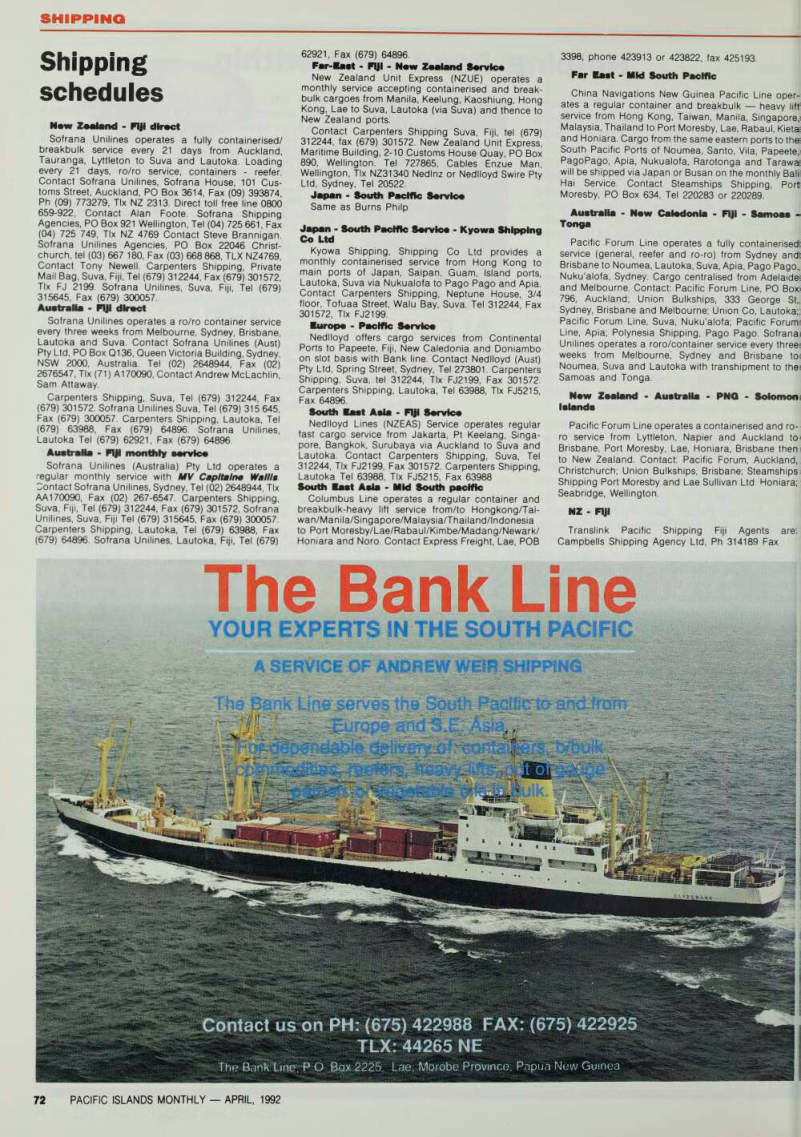
schedules
Now Zoaland - FIJI dlroct Sofrana Unilines operates a fully containerised/ breakbulk service every 21 days from Auckland, Tauranga, Lyttleton to Suva and Lautoka. Loading every 21 days, ro/ro service, containers - reefer.
Contact Sofrana Unilines, Sofrana House, 101 Cus toms Street, Auckland, PO Box 3614, Fax (09) 393874 Ph (09) 773279, Tlx NZ 2313. Direct toll free line 0800 659-922, Contact Alan Foote. Sofrana Shipping Agencies. PO Box 921 Wellington, Tel (04) 725 661, Fax (04) 725 749, Tlx NZ 4769 Contact Steve Brannigan.
Sofrana Unilines Agencies, PO Box 22046 Christ church, tel (03) 667 180, Fax (03) 668 868, TLX NZ4769, Contact Tony Newell. Carpenters Shipping, Private Mail Bag, Suva, Fiji. Tel (679) 312244, Fax (679) 301572, Tlx FJ 2199. Sofrana Unilines, Suva, Fiji, Tel (679) 315645, Fax (679) 300057.
Australia - Fiji dkoct Sofrana Unilines operates a ro/ro container service every three weeks from Melbourne, Sydney, Brisbane, Lautoka and Suva. Contact Sofrana Unilines (Aust) Pty Ltd, PO Box Q 136, Queen Victoria Building, Sydney, NSW 2000, Australia Tel (02) 2648944, Fax (02) 2676547, Tlx (71) A 170090, Contact Andrew McLachlin, Sam Attaway.
Carpenters Shipping, Suva, Tel (679) 312244, Fax (679) 301572. Sofrana Unilines Suva, Tel (679) 315 645, Fax (679) 300057. Carpenters Shipping, Lautoka, Tel (679) 63988, Fax (679) 64896. Sofrana Unilines, Lautoka Tel (679) 62921, Fax (679) 64896 Australia - FIJI monthly sorvlcs Sofrana Unilines (Australia) Pty Ltd operates a regular monthly service with MV Capital™ Wallis Contact Sofrana Unilines, Sydney, Tel (02) 2648944, Tlx AA170090, Fax (02) 267-6547 Carpenters Shipping, Suva, Fiji. Tel (679) 312244, Fax (679) 301572. Sofrana Unilines, Suva, Fiji Tel (679) 315645, Fax (679) 300057 Carpenters Shipping, Lautoka. Tel (679) 63988, Fax (679) 64896. Sofrana Unilines, Lautoka, Fiji. Tel (679)
62921, Fax (679) 64896.
Far-East - FIJI - New Zealand Service New Zealand Unit Express (NZUE) operates a monthly service accepting containerised and break bulk cargoes from Manila, Keelung, Kaoshiung, Hong Kong, Lae to Suva, Lautoka (via Suva) and thence to New Zealand ports.
Contact Carpenters Shipping Suva, Fiji, tel (679) 312244, fax (679) 301572. New Zealand Unit Express, Maritime Building, 2-10 Customs House Quay, PO Box 890, Wellington. Tel 727865, Cables Enzue Man, Wellington, Tlx NZ31340 Nedlnz or Nedlloyd Swire Pty Ltd, Sydney, Tel 20522.
Japan - South Pacific Sorvlcs Same as Burns Philp Japan - South Pacific Sorvlco - Kyowa Shipping Co Ltd Kyowa Shipping, Shipping Co Ltd provides a monthly containerised service from Hong Kong to main ports of Japan, Saipan, Guam, Island ports, Lautoka, Suva via Nukualofa to Pago Pago and Apia.
Contact Carpenters Shipping, Neptune House, 3/4 floor, Tofuaa Street, Walu Bay, Suva. Tel 312244, Fax 301572, Tlx FJ2199.
Europe - Pacific Sorvlcs Nedlloyd offers cargo services from Continental Ports to Papeete, Fiji, New Caledonia and Doniambo on slot basis with Bank line. Contact Nedlloyd (Aust) Pty Ltd, Spring Street, Sydney, Tel 273801. Carpenters Shipping, Suva, tel 312244, Tlx FJ2199, Fax 301572.
Carpenters Shipping, Lautoka, Tel 63988, Tlx FJ5215, Fax 64896.
South East Asia - Fiji Sorvlcs Nedlloyd Lines (NZEAS) Service operates regular fast cargo service from Jakarta, Pt Keelang, Singa pore, Bangkok, Surubaya via Auckland to Suva and Lautoka. Contact Carpenters Shipping, Suva, Tel 312244, Tlx FJ2199, Fax 301572. Carpenters Shipping, Lautoka Tel 63988, Tlx FJ5215, Fax 63988 South Bast Asia - Mid South pacific Columbus Line operates a regular container and breakbulk-heavy lift service from/to Hongkong/Tai wan/Manila/Singapore/Malaysia/Thailand/Indonesia to Port Moresby/Lae/Rabaul/Kimbe/Madang/Newark/ Honiara and Noro. Contact Express Freight, Lae. POB
3398, phone 423913 or 423822. fax 425193.
Far East - Mid South Pacific China Navigations New Guinea Pacific Line oper ates a regular container and breakbulk heavy lift service from Hong Kong, Taiwan, Manila, Singapore,* Malaysia, Thailand to Port Moresby, Lae, Rabaul, Kieta and Honiara. Cargo from the same eastern ports to the South Pacific Ports of Noumea, Santo, Vila. Papeete.
PagoPago, Apia, Nukualofa, Rarotonga and Tarawa will be shipped via Japan or Busan on the monthly Bali Hai Service. Contact Steamships Shipping, Port) Moresby, PC Box 634, Tel 220283 or 220289.
Australia - New Caledonia - Fiji - Samoas - Tonga Pacific Forum Line operates a fully containerised! service (general, reefer and ro-ro) from Sydney andl Brisbane to Noumea, Lautoka, Suva, Apia, Pago Pago,, Nukualofa, Sydney. Cargo centralised from Adelaide! and Melbourne. Contact: Pacific Forum Line, PO Box! 796, Auckland; Union Bulkships, 333 George St„ Sydney, Brisbane and Melbourne; Union Co, Lautoka;; Pacific Forum Line, Suva, Nuku’alofa; Pacific Forumi Line, Apia; Polynesia Shipping, Pago Pago. Sofranai Unilines operates a roro/container service every threei weeks from Melbourne, Sydney and Brisbane to< Noumea, Suva and Lautoka with transhipment to the!
Samoas and Tonga.
Nsw Zealand - Australia - PNQ - Solomon Islands Pacific Forum Line operates a containerised and ro ro service from Lyttleton, Napier and Auckland to Brisbane, Port Moresby, Lae, Honiara, Brisbane then to New Zealand. Contact: Pacific Forum, Auckland, Christchurch; Union Bulkships, Brisbane; Steamships Shipping Port Moresby and Lae Sullivan Ltd Honiara: Seabridge, Wellington.
Nz - Fiji
Translink Pacific Shipping Fiji Agents are: Campbells Shipping Agency Ltd, Ph 314189 Fax
300144 Suva; Ph 662231 Fax 662251 Lautoka.
Auckland Agents. McKay Shipping Ph (9) 390229 Fax (9) 3032931. Tauranga Agents, seatrade agencies Ph (75) 754989 Fax (75) 758380.
NZ - Fiji - Pago - Apia - Nuk Translink Pacific Shipping operates a monthly sailing with Polynesian Link, which carries Dry Container, reefers and breakbulk cargoes. NZ Agents McKay Shipping Shipping AKLD Ph 390229, Fax 3032931. Fiji Agents Campbells Shipping Agency & ltd Ph 314189 Fax 300144 NZ - Noumaa - Wallis - Futuna franslink Pacific Agency operate a container Breakbulk service once a month from NZ through Fiji jnd Noumea to Wallis & Futuna.
Australia - FIJI Sarvlca Ihief container services under Australia Pacific Island .ine Unitize Sofrana and PFL vessels to provide a wice monthly, service from Australia. Fiji Agents Jampbells Shipping Agency Ltd Ph 314189 Fax 00144. System Agents Nedlloyd Swire Ph(2) 512699. Melbourne Yarra Shipping Ph (3) 6936300.
Tisbane, Nedlloyd Swire, ph (7) 8321551.
Australia - Fiji - Noumea - Vila - Santa larsmond Express Lines operate a breakbulk service om Goodwood Island Australia to Fiji, Noumea, Vila anto and Honiara. Continuous receiving depots in /dney and Brisbane enable this vessel to bring argoes from these parts. Fiji Agents Campbells lipping Agency Ltd, ph. 314189, Fax 300144, Isbane Agents Shippings & Marketing Ph (7) >28082. Sydney Agents Seabord Agencies (2) 72325. ustralia - Now Caladonia - Fiji - Hawaii - North marica ACT Pace Pacific (ACTA Shipping) operates a fully mtainerised/break bulk service every 17-20 from albourne, Sydney, Brisbane to Noumea, Suva and lutoka. The vessels continue on to the West Coast North America calling Honolulu at frequent ervals. Ships are ACT and ACT 12. Contacts: ACTA / Ltd, Sydney Ph 2869666, Tx 121369, Fx 2869610. :TA Pty Ltd, Melbourne Ph 6112000, Tx 30949, Fx 33055. ACTA Pty Ltd, Brisbane Ph 2213116 m Tx
40719. Fx 2298143. SATO, Noumea Ph 281122, Tx 3163, Fx 278532. Burns Philp Shipping, Suva Ph 311777, Tx 2168, Fx 301127; Burns Philp Shipping, Lautoka Ph 60777, Tx 5146, Fx 65850.
Waat Coast of North AmaHca - FIJI - Now Zealand Blue Star Line Pacific Coast Service operates a fully containerised/break bulk service every 23 days from Vancouver, Seattle, San Francisco, Los Angeles to Pago Pago, Suva and New Zealand ports. The vessels continue to call Suva on the Northbound voyage from New Zealand every fortnight to pick up Fiji exports such as garments, fresh ginger, etc. for Hawaii and West Coast of North America ports. Blue Star Line also provides a through service to East Coast to North America. Ships are Wellington Star, Southland Star and California Star. Contacts: Blue Star Line, San Francisco Ph 9282026, Tx 184925, Fx 6730355; Blue Star Line, Vancouver Ph 6817300, Tx 0451326, Fx 6835797, Interocean Steamship Corp, Seattle Ph 6829820, Tx 321101, Fx 3437421; Blue Star Line, Los Angeles Ph 5970454, Tx 408564, Fx 5978710. New Zealand Line, Wellington, Ph 739029, Tx 3583, Fx 4992468; New Zealand Line, Auckland Ph 390965, Tx 2556, Fx 3032039; Burns Philp Shipping, Suva Ph 311777, Tx 2168, Fx 301127; Burns Philp Shipping, Lautoka Ph 60777, Tx 5146, Fx 65850.
Japan - South Pacific Sarvlca Bali Hai Line a joint service of China Navigation, Mitsui OSK Line and NYK Line operates a fully containerised/break bulk service from Korea, Japan to South Pacific ports on a monthly basis serving ports of Pusan, Kobe, Nagoya, Yokohama, Tarawa, Lauto ka, Suva, Apia, Pago Pago, Papeete, Nukualofa, Noumea, Vila, Santo. The ships are also fully specialised to carry vehicles on ro/ro basis. Ships are Coral Islander and Pacific Islander. Contacts; John Swire & Sons, Tokyo Ph 32309220, Tx 22248, Fx 3239288; Nippon Yusen Kaisha, Tokyo Ph 3284516. Tx 22236, Fx 32846332; Mtsul OSK Lines, Tokyo Ph 35877086, Tx 22266, Fx 35877732, Burns Philp Shipping, Suva (C/lslander) Ph 311777, Tx 2168, Fx 301127; Carpenters Shipping, Suva (P/lslander) Ph 312244, Tx 2199, Fx 301572: Burns Philp Shipping,
Lautoka Ph 60777, Tx 5146, Fx 65850; Carpenters Shipping Ph 63988, Tx 5215, Fx 64896.
Europa - South Pacific Sorvica Bank Line Limited operates a monthly service from United Kingdom, Europe to South Pacific ports.
Vessels are fully equipped to carry containers, break bulk cargo and have deep tank facilities to carry bulk liquid such as oil, etc. The service operates from Hull, Rotterdam, Hamburg, Dunkirk, Le Havre, Papeete, Apia, Suva, Lautoka, Noumea, Vila, Santo, Honiara, Papua New Guinea Group, Singapore and back to Europe/Continent. Ships: Forthbank, Ivybank, Clyde bank, Moraybank. Contacts: Bank Line, London Ph 2650808, Tx 887392, Fx 4814784, Bank Line. Lae Ph 421235, Tx 44265, Fx 422925; Bank Line, Sydney, Ph 9063173, Tx 24063, Fx 9061430; Burns Philp Shipping, Suva Ph 311777, Tx 2168, Fx 301127; Burns Philp Shipping, Lautoka Ph 60777, Tx 5146, Fx 65850.
Europe - Pacific Service Columbus Line services Continental ports to Pa peete and Noumea on slotbasis with CGM. Contact AMI, Papeete, phone 428972, fax 432184; CGM, Noumea phone 687 273321, fax 687 274183.
Australia - Vanuatu - FIJI Sitmar Cruises operates a year round cruise programme for Sydney to Vanuatu, Fiji. The pro gramme also includes a number of calls to a number of islands such as Dravuni, Yasawa-i-Rara, Rotuma, Mystery Island, etc.
Contact: Sitmar Cruises, Sydney Ph 2560111, Tx 20712, Fx 2560101; Burns Philp Shipping, Suva Ph 311777, Tx 2168, Fx 301127, Burns Philp Shipping, Lautoka Ph 60777, Tx 5146, Fx 65850.
Aust/NZ-FU»-Samoa-Tonga
W Islands Line operate breakbulk, FCL and refrigerated container service from Australia and New Zealand ports to the ports of Apia, Pago pago, Nukualofa, Vavau, Suva and Lautoka. Aust agents: Mainstar Maritime Agencies, Ph (612) 317 2356, Fax (612) 669 5704. NZ Agents: Niue Trading Company, Ph (649) 790935, Fax (649) 790949, Apia agent: Morris Hedstrom. Vavau: W Islands Line. Nukualofa, W Islands Line. Pago Pago: Burns Philp Shipping. Suva/ Lautoka: Bilibili Shipping, Q
Advertisements & other items, pp. 72-73 (1 item)
The Bank Line
YOUR EXPERTS IN THE SOUTH PACIFIC
A SERVICE OF ANDREW WEIR SHIPPING
The Bank Line^erveslhe
... . m ! * . m
0 Burns Philp Shipping
The Total
Transport Package
BURNS PHILP SHIPPING - TRAVEL - TRANSPORT DIVISION When you use Burns Philp’s transport network, it means we take complete charge of your consignment and deliver it to its destination, with the minimum of effort on your part and with the maximum of care on ours. Our international network of transport companies allows us to offer you a total transport package.
mznamuM&L
• Forwarding • Packing • Crating • Documentation • Travel #Heavy Haulage
• Customs Clearance «Air freight
WE ARE AGENTS FOR:-
International Forwarding • LEP International • Sitmar Cruises • Shell Tankers • FCF Fisheries For further information contact:
SUVA
GPO Box 335 Ph; (679) 311777 Telex: FJ2168 Fax: (679) 301127 Cable: BURSHIP
LAUTOKA
P 0 Box 61 Ph: (679) 660777 Telex: FJ5146 Fax: (679) 665850 Cable: BURSHIP
• Meadowsfreight
BP TRAVEL SERVICE
LABASA
PO Box 32 Ph: (679) 881454
NADI AIRPORT
PO Box 61 Lautoka Ph;(679)722166 Telex: FJ5146 Fax: (679)722151
INTERNATIONAL FORWARDING
PO Box 2269 Govt. Buildings Suva Ph: (679) 313111.
Telex: FJ2170 Fax: (679) 300477
Ancient seafaring skills revived
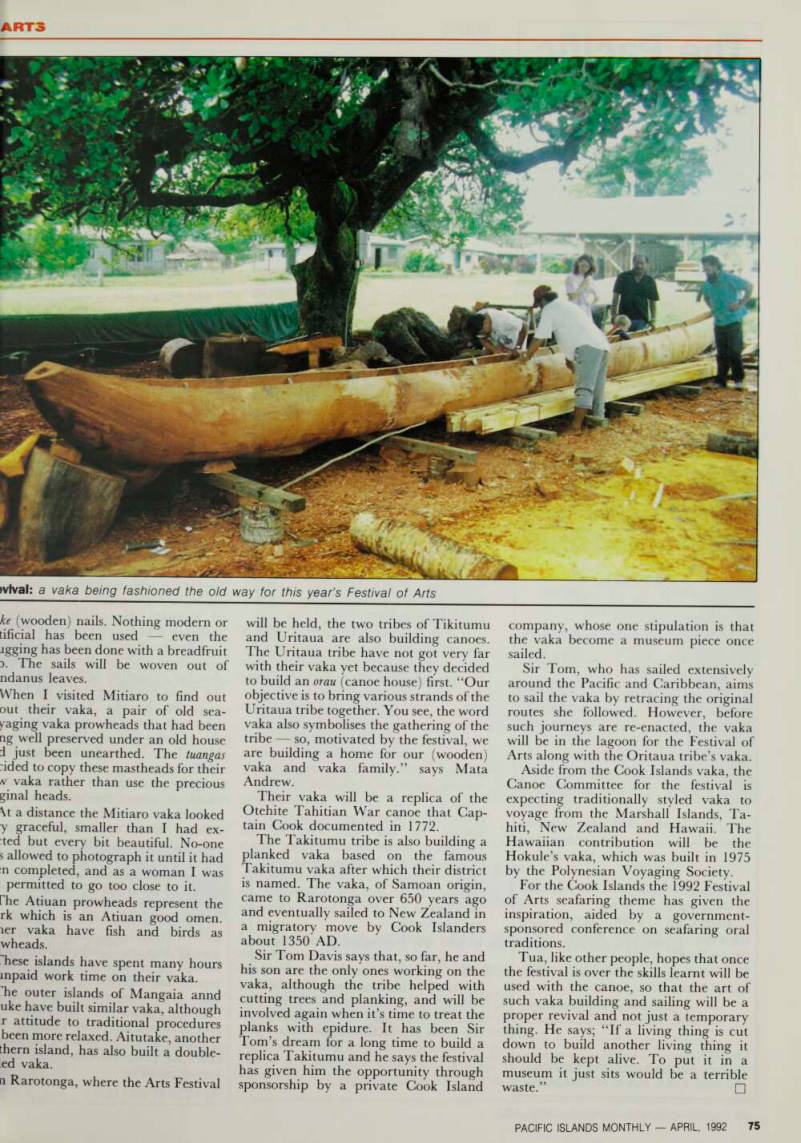
Arts
By Angela McCarthy
THE challenge went out from Rarotonga a year ago: show the world Polynesia’s ancient sea faring skills are not forgotten; build a replica of a vaka (traditional sea voyaging canoe) and sail it to Rarotonga for the October 1992 Festival of Arts.
The outer Cook Islanders of Atiu, Mitiaro, Mauke, Mangaia and Aitutaki have taken up the challenge with zeal.
They have finished their double-hulled vaka and have been studying the tra ditional navigation techniques they will need to travel the 260 odd kilometres from their islands to Rarotonga.
Sea-voyaging vaka have been obsolete on these tiny islands for many gener ations so the islanders have had to rely on a hotchpotch of information to create the canoes. They have used oral histories, books and photographs, the recollection of the elderly, and improvisation by
today’s fishing outrigger builders.
The vaka projects all began with tree felling ceremonies. The Gods were asked to bless the trees to give them protection and ensure that they would not crack
when falling or split during construction, and would sail well. The participants say that a lot of the present ceremonies have been improvised because details of old tree-felling ceremonies are no longer fully known. Today, too, the Christian influ ence has meant most blessings had to be asked of the Christian god rather than the pre-missionary deities.
After the prayers and chants, the trees were felled by chainsaws and then stripped of branches, and pulled along log rollers out of the swamp or coral to a roadside where trucks could take them to their carving place. Throughout the whole procedure, chants of encourage ment were sung, usually accompanied by
impromptu dance.
Each felling was followed by a feast prepared by the women. In Atiu and Mitiaro the women were not allowed to watch the felling but, while preparing the food, they danced and chanted their support for the men.
In Mitiaro, some members of a family which owned the biggest mango tree on the island were in disagreement over whether it should be felled because of its age and fruitfulness. The story told is that
the tree refused to fall because permissioi had not been given properly. A member of the family had to say a special praye? over the tree before it would come down The same tree’s timber later gave off sucl bad vibes to the older carvers that the T refused to start carving until the family 5 ' blessing was unanimously given. I eventually was!
The original vaka were enormouj double-hulled craft that carried hum dreds of people, livestock and plants tho width and breadth of the Pacific. Th« islands haven’t attempted to reproduce vaka of that size they no longer have the right-sized timber or the time to do so. However they have put a strong emphasis on making the vaka as tra ditionally as possible. It has not been easy!
The island councils and tuagas (canoe makers) succumbed to chainsaws do nated by the Cultural Development Department for the tree fellings, and tc modern chisels and axes, but the ma terials and method of construction used have been traditional.
In Mitiaro, four mango trees were used to make the hulls one of which is 27 foot and one slightly less. The vaka, which is waist height and very rounded, is joined by sennit (coconut husk) and
ke (wooden) nails. Nothing modern or
tificial has been used even the igging has been done with a breadfruit d. The sails will be woven out of ndanus leaves.
When I visited Mitiaro to find out out their vaka, a pair of old sea gaging vaka prowheads that had been ng well preserved under an old house d just been unearthed. The tuangas :ided to copy these mastheads for their v vaka rather than use the precious
ginal heads.
\t a distance the Mitiaro vaka looked y graceful, smaller than I had ex :ted but every bit beautiful. No-one s allowed to photograph it until it had n completed, and as a woman I was permitted to go too close to it. fhe Atiuan prowheads represent the rk which is an Atiuan good omen, ler vaka have fish and birds as wheads.
Tese islands have spent many hours mpaid work time on their vaka. lie outer islands of Mangaia annd uke have built similar vaka, although r attitude to traditional procedures been more relaxed. Aitutake, another them island, has also built a doubl ed vaka. n Rarotonga, where the Arts Festival
will be held, the two tribes of Tikitumu and Uritaua are also building canoes.
The Uritaua tribe have not got very far with their vaka yet because they decided to build an orau (canoe house) first, “Our objective is to bring various strands of the Uritaua tribe together. You see, the word vaka also symbolises the gathering of the tribe so, motivated by the festival, we are building a home for our (wooden) vaka and vaka family.” says Mata Andrew.
Their vaka will be a replica of the Otehite Tahitian War canoe that Cap tain Cook documented in 1772.
The Takitumu tribe is also building a planked vaka based on the famous Takitumu vaka after which their district is named. The vaka, of Samoan origin, came to Rarotonga over 650 years ago and eventually sailed to New Zealand in a migratory move by Cook Islanders about 1350 AD.
Sir Tom Davis says that, so far, he and his son are the only ones working on the vaka, although the tribe helped with cutting trees and planking, and will be involved again when it’s time to treat the planks with epidure. It has been Sir Tom’s dream for a long time to build a replica Takitumu and he says the festival has given him the opportunity through sponsorship by a private Cook Island
company, whose one stipulation is that the vaka become a museum piece once sailed.
Sir Tom, who has sailed extensively around the Pacific and Caribbean, aims to sail the vaka by retracing the original routes she followed. However, before such journeys are re-enacted, the vaka will be in the lagoon for the Festival of Arts along with the Oritaua tribe’s vaka.
Aside from the Cook Islands vaka, the Canoe Committee for the festival is expecting traditionally styled vaka to voyage from the Marshall Islands, Ta hiti, New Zealand and Hawaii. The Hawaiian contribution will be the Hokule’s vaka, which was built in 1975 by the Polynesian Voyaging Society.
For the Cook Islands the 1992 Festival of Arts seafaring theme has given the inspiration, aided by a government sponsored conference on seafaring oral traditions.
Tua, like other people, hopes that once the festival is over the skills learnt will be used with the canoe, so that the art of such vaka building and sailing will be a proper revival and not just a temporary thing. He says; “If a living thing is cut down to build another living thing it should be kept alive. To put it in a museum it just sits would be a terrible waste.” □
[?]ival: a vaka being fashioned the old way for this year’s Festival of Arts
Advertisements & other items, pp. 74-76 (1 item)
[Jystems
o m O _=) > R
acinc
iotmm ■cd m turns ■ mumcsrsm ■mu mom ■ urn swims - books cum oh mi mmm sma - mmm i sormm support m sum PACIFIC WIDE MAIL ORDER COMPDTER PRODUCTS AT THE LOWEST PRICES WITH FULL SERVICE SUPPORT
Sy fi ?
5-5 5# *3? ?et
SOFTWARE SPECIALS
LOTUS 123 - Re
WORD PERFECT 5.1 - $650
WORDSTAR V 6.0-$595
D.BASE IV- VI.I $lOOO
WINDOWS 3.0
MOUSE/WINDOWS $325
EXCEL hr WINDOWS $750
WORD hr WINDOWS ■ $725
AMI PRO hr WINDOWS $7OO
Call hr any others!
IBM COMPATIBLE
DOS PC's
286-16 ■ $1650
386SX-16 ■ $lBOO
486 SX-33■ $2750
ALL SYSTEMS:
40Mb Hard Disk, IMb memory SVC A Colour Monitor
5J5 FDD, 2S, IP, 1C
Electrical supply Use a battery backup UPS
PCM-250 (286) ■ $4OO
PCM-350 (386) ■ $5OO
m
HEWLETT
PACKARD
LASER HP HIP euly $2400
LASER HP 111 oaly $3700
INKJET HPSOOoaly $lOOO
INK JET SOOC oaly $lB5O
* All exclusive Pacific
distributorships
* Trade, Government and
commercial enquiries welcome:
* All Pricing in Australian Dollars * Servicing the Pacific since 1980 * Fnll warranty and on going support PO Box 198, Port Vila, Vanuatu - Tel: (678) 25065 - Fax: (678) 22938
The Pacific
Is Yours
Have all the information
at your fingertips order
PIM publications NOW[
nJi w ■ Pacific Islands Yearbook 16th Edition As4s ■ Fiji Handbook Business & Travel Guide A 514.95 ■ PNG Map ■ The Journal of William Lockerby ■ Map of Fiji ■ Map of the Pacific A 53.50 A 53.50 A 53.50 A 53.50 Number of copies being ordered: Pacific Islands Yearbook Fiji Handbook PNG Map The Journal of William Lockerby Fiji Islands map Pacific Islands map Enclosed is A$ for payment + Debit A$ to my □ Bank Card □ VISA □ Master Card Card No: Expiry Date: My Name: Postal Address: Country: Tel:
Post to: PACIFIC ISLANDS MONTHLY,
PO BOX 1167, SUVA, FIJI ISLANDS.
More than a record of culture
Books
Ethnology of Vanuatu, by Felix Speiser, published 1991 by Crawford House Press, PO Box 143, Bathurst, NSW 2795, Australia. SAI29.
Acquirer of one of the world’s finest Melanesian ethnological collec tions, Felix Speiser lamented that “no island will be* represented by the whole range of its cultural possessions, for the traveller cannot rely on the initiative of the natives but will, as a rule, manage to see only what he wants to see, and will therefore be able to acquire only what he has actually set his eyes on, either through chance or through systematic research.”
For all his doubts, the author of this classic text on Vanuatu art and culture has produced an extraordinary master
piece of anthropological inquiry.
Enthnographische Materjalen aus den Neuen Hebriden und den Banks-Inseln, first pub lished in 1923, is now translated into English, thanks to the support of the Pro Helvetia Foundation in Zurich and the Swiss Academy of Humanities.
Speiser saw himself chiefly as the mere recorder of the complex world he found: his accounts of the mental realm of his subjects are filled with a sense of wonder and enthusiasm. Both summary of the work of earlier anthropological investi gators and overarching account of the intricacies of grade-economies, magic and life-cycle rituals, Speiser’s survey leaves little hidden.
It is studded with more than 1600 of
Speiser’s own delicate photographs.
Thorough, sometimes ghoulish accounts of poisons and hunting techniques mingle with recondite ideas about Vanuatu religion: “It is clear that the notion which the natives have of the soul is not very different from those of the European except perhaps that it is even a little more vague ... the soul can leave the body without necessarily entailing death.”
Speiser was clearly an intriguing combination of artist and scientific inves tigator. He was both fired by the excitement of the New Hebrides, which he described in a Mills and Boon volume,
and appalled by the demographic
collapse under colonial rule, which he recorded in a scientific paper, Decadence
and preservation.
After establishing the pioneering Basel Ethnographic Museum New Hebrides collection, largely based on his stay in the Vanuatu archipelago from May 1910 to July 1912, he continued his Melanesian field trips, devoting special attention to the lower Sepik. During his later years, he developed an intriguing interpret ation of Vanuatu art, which is briefly sketched in an essay in this volume by
Christian Kaufmann of the Basel Ml seum: “It was Speiser’s contention ths deeply linked as it was with religion an ritual, art always started from images a form close to nature, representing tl: apparent shape of the being to which referred ... art forms that were meanim ful would degenerate into those that we meaningless and evolve no further, unle the society to which their authc belonged regained its creativity an invented new links between its religioi ideas and new images.”
Speiser emerged as one of the prirr European scholars in the field Melanesian art, codifying and doc; menting its achievements against tl more accessible, better known works neighbouring Polynesia. Yet I Kaufmann reminds his readers that til technical specialism was balanced I Speiser’s vivid humanity, a “commi ment of mind to the peoples of tl Pacific”, which breathes still from H pages, for “in their more recent histo* he had seen too many of them desperate throes when the very roots their existence had been destroyed in tl clash with the colonial system”.
Speiser saw his work primarily as document, a tribute to cultures slippii into the shelter of memory, rather ths part of the living tradition that sprang u once more in the independent Republ of Vanuatu. He would doubtless 1 surprised if he learned that the Ambry\ and Pentecost slit drums he describes ai once more part of social life. Speiser sketches of upright hollow drums froc the Banks Islands served as the basis fl a project by the Vanuatu Cultun Centre to restore the making and use these Timiat Wos on Vanua Lava an Mota Lava in the Banks group durii 1987.
Speiser, by virtue of his work in Bas»: stands as one of the chief initiators modern Europe’s encounter with Pacif culture. Each of the pieces Speiss collected in Basel are displayed in settim that communicate their spiritual charg the piece illustrated on the cover Ethnology , a southern Malekulla sku statue, remains a deeply potent imago The Swiss Government remember* its New Hebrides connection, and in tl year of Vanuatu’s independence, 19® funded the present translation. With i reports and legends, its careful descrii tions of tree-ferns and tapa mats, dancing grounds and pig sacrifices, rock drawings and painted tree, the boo* is a testament to its author’s painstakin effort and to the universe of traditions I
helped preserve. !
the wind
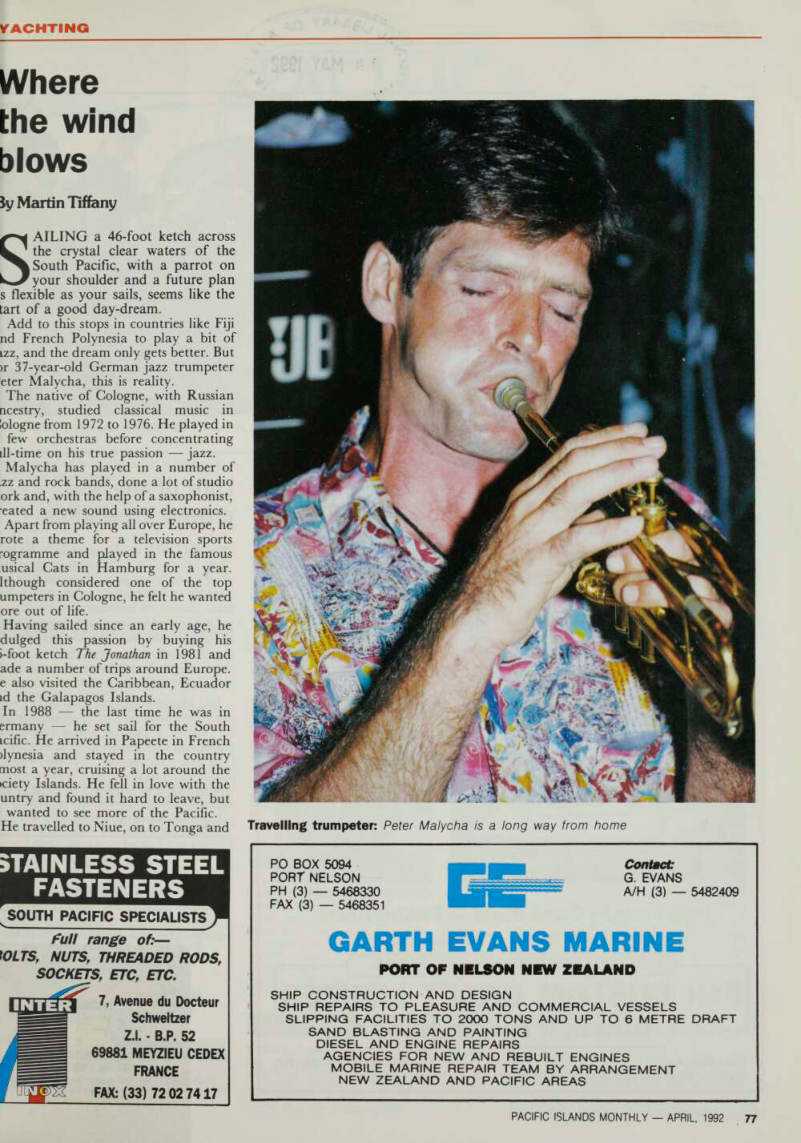
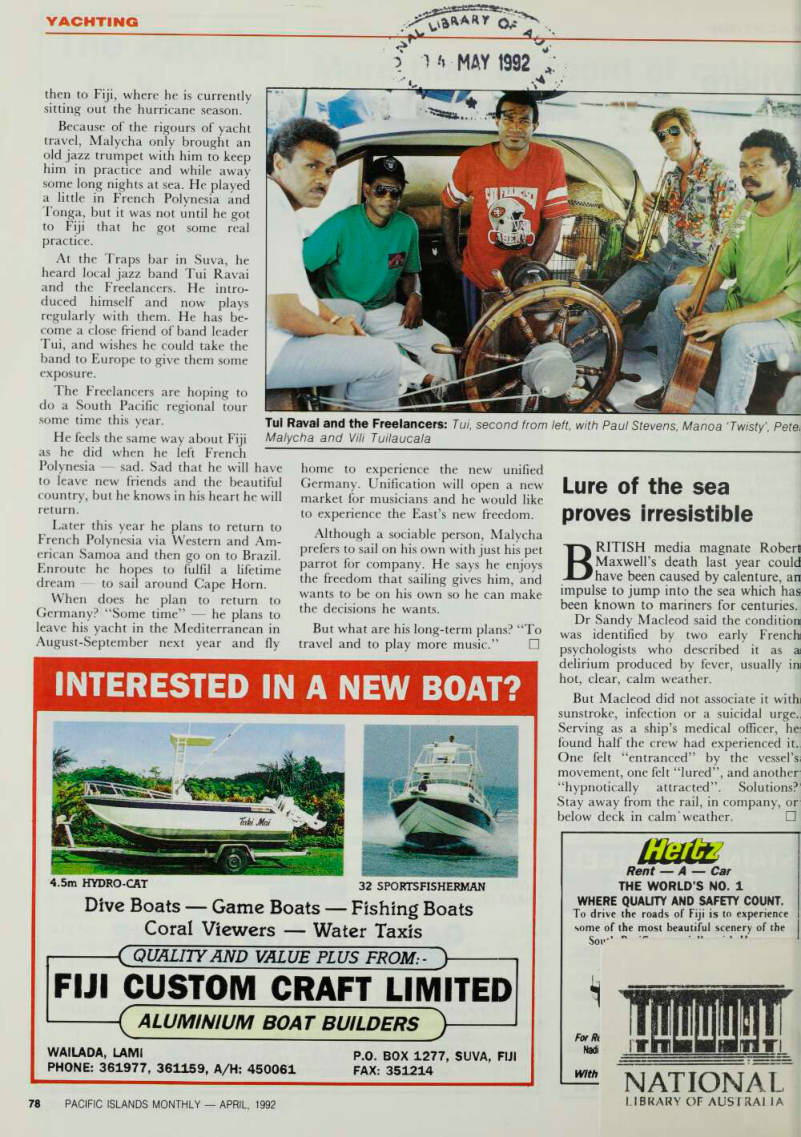
Yachting
Where the wind blows
By Martin Tiffany
SAILING a 46-foot ketch across the crystal clear waters of the South Pacific, with a parrot on your shoulder and a future plan s flexible as your sails, seems like the tart of a good day-dream.
Add to this stops in countries like Fiji nd French Polynesia to play a bit of izz, and the dream only gets better. But >r 37-year-old German jazz trumpeter eter Malycha, this is reality.
The native of Cologne, with Russian ncestry, studied classical music in lologne from 1972 to 1976. He played in few orchestras before concentrating
ill-time on his true passion jazz.
Malycha has played in a number of ,zz and rock bands, done a lot of studio ork and, with the help of a saxophonist, eated a new sound using electronics.
Apart from playing all over Europe, he rote a theme for a television sports "ogramme and played in the famous usical Cats in Hamburg for a year, Ithough considered one of the top umpeters in Cologne, he felt he wanted ore out of life.
Having sailed since an early age, he dulged this passion by buying his >-foot ketch The Jonathan in 1981 and ade a number of trips around Europe, e also visited the Caribbean, Ecuador
id the Galapagos Islands.
In 1988 the last time he was in ermany he set sail for the South iciflc. He arrived in Papeete in French )lynesia and stayed in the country most a year, cruising a lot around the ►ciety Islands. He fell in love with the untry and found it hard to leave, but wanted to see more of the Pacific.
He travelled to Niue, on to Tonga and
Travelling trumpeter: Peter Malycha is a long way from home
then to Fiji, where he is currently sitting out the hurricane season.
Because of the rigours of yacht travel, Malycha only brought an old jazz trumpet with him to keep him in practice and while away some long nights at sea. He played a little in French Polynesia and Tonga, but it was not until he got to Fiji that he got some real practice.
At the Traps bar in Suva, he heard local jazz band Tui Ravai and the Freelancers. He intro duced himself and now plays regularly with them. He has be come a close friend of band leader Tui, and wishes he could take the band to Europe to give them some exposure.
The Freelancers are hoping to do a South Pacific regional tour some time this year.
He feels the same way about Fiji as he did when he left French
Polynesia sad. Sad that he will have to leave new friends and the beautiful country, but he knows in his heart he will return.
Later this year he plans to return to French Polynesia via Western and Am erican Samoa and then go on to Brazil.
Enroute he hopes to fulfil a lifetime dream to sail around Cape Horn.
When does he plan to return to Germany? “Some time” he plans to leave his yacht in the Mediterranean in August-September next year and fly
home to experience the new unified Germany. Unification will open a new market for musicians and he would like to experience the East’s new freedom.
Although a sociable person, Malycha prefers to sail on his own with just his pet parrot for company. He says he enjoys the freedom that sailing gives him, and wants to be on his own so he can make the decisions he wants.
But what are his long-term plans? “To travel and to play more music.” □
Lure of the sea
proves irresistible
BRITISH media magnate Robert Maxwell’s death last year could have been caused by calenture, an impulse to jump into the sea which has been known to mariners for centuries.
Dr Sandy Macleod said the condition was identified by two early French psychologists who described it as ai delirium produced by fever, usually ini hot, clear, calm weather.
But Macleod did not associate it withi sunstroke, infection or a suicidal urge., Serving as a ship’s medical officer, he: found half the crew had experienced it., One felt “entranced” by the vessel’s; movement, one felt “lured”, and another
“hypnotically attracted”. Solutions? 1
Stay away from the rail, in company, or below deck in calm'weather. □
Tui Raval and the Freelancers: Tui, second from left, with Paul Stevens, Manoa 'Twisty', Peter Malycha and Vili Tuilaucala
Advertisements & other items, pp. 77-80 (1 item)
Garth Evans Marine
STAINLESS STEEL
FASTENERS
'south pacific specialists^
full range of; —
f OLTS, NUTS, THREADED RODS,
SOCKETS, ETC, ETC.
INTER
7, Avenue du Docteur Schweitzer
Z.I. - B.P. 52
69881 MEYZIEU CEDEX
FRANCE
FAX; (33) 72 02 7417
PO BOX 5094
PORT NELSON
PH (3) 5468330
FAX (3) 5468351
Eb Contact
G. EVANS
A/H (3) 5482409
GARTH EVANS MARINE
PORT OF NELSON NEW ZEALAND
SHIP CONSTRUCTION AND DESIGN
SHIP REPAIRS TO PLEASURE AND COMMERCIAL VESSELS SLIPPING FACILITIES TO 2000 TONS AND UP TO 6 METRE DRAFT
SAND BLASTING AND PAINTING
DIESEL AND ENGINE REPAIRS
AGENCIES FOR NEW AND REBUILT ENGINES
MOBILE MARINE REPAIR TEAM BY ARRANGEMENT
NEW ZEALAND AND PACIFIC AREAS
INTERESTED IN A NEW BOAT?
H * Taki Mai ■": 7.
4.5 m HYDRO-CAT
32 SPORTSFISHERMAN
Dive Boats Game Boats Fishing Boats Coral Viewers Water Taxis < QUALITY AND VALUE PLUS FROM:- >
FIJI CUSTOM CRAFT LIMITED
-( ALUMINIUM BOAT BUILDERS
WAILADA, LA Ml
PHONE: 361977, 361159, A/H: 450061
P.O. BOX 1277, SUVA, FIJI
FAX: 351214
UMi
Rent A Car
THE WORLD S NO. 1
WHERE QUALITY AND SAFETY COUNT.
To drive the roads of Fiji is to experience some of the most beautiful scenery of the Soi ,.. - - ••• • • % For Rt Nadi With I ■
NATIONAL
LIBRARY OF AUSTRAI JA
ISLANDS
IMONT H L Y I
MfiRK€T PinC
For the benefit of our readers who would like to place a small classified advertisement in our magazine, Market Place will assist you in selling personal items, accommodation, real estate, boating or a service ... in fact anything you would like to sell to our over 50,000 readers.
Market Place Advertising Rates are structured to allow you to place as many advertisements as you wish, economically.
WORKBOAT WATERVIEW
luilt in Australia 1987 OA 10.42 M, Beam 4.64 M, Grt 13, Propulsion x Ford 2725 series 6-Cylinder Diesels, peed about 10KN, Fuel capacity 1,500 litres, /elded Aluminium Construction, 21 passeners, 2 crew, toilet. Classed Maritime Services card. essel Inspectable Sydney ellers seeking best offers ‘as is where is’ 3r further information: ustral Chartering Pty Limited th Floor, 80 Mount Street, orth Sydney, NSW, 2060. jstralia.
.X: AA170384
JX: +612 964 0202 :L +612 954 0200 antact Mr Francis Keegan Managing Director
TRAVEL GUIDES
istralian citizen planning to move to Fiji early 393 seeks partnership or purchase small isiness in tourism or manufacturing prefer- )ly in western district. 3ve considerable business experience and ied to hard work. siting Fiji July/August 1992. hn Gardner, 1/43 Beach Rd, Brighton SA )48 Australia.
XECUTIVE POSITION REQUIRED
stralian Citizen, with Comprehensive Experice in Financial & Personnel Management d in Sales & Marketing in the South Pacific; sviously responsible for purchasing, irehousing, large scale distribution proams for multiple location operations; extene knowledge of import & export trades in uth Pacific, S.E. Asia and North America, n years experience in expatriate positions ;h excellent references available. Long term "(tract preferred. enquiries in strict confidence to: 5 Candidate ). Box 599 rwood, N.S.W. 2134 stralia.
REAL ESTATE
tel 10 units, plus managers unit with ice and new 2 br house on adjacent block, 3 aradise (Tax Haven) US$5OO,OOO. Phone Fax (678) 23569.
SCRAP METAL
Tall ingots operate from Brisbane, Australia and make frequent visits to the Pacific Islands, as they have done for twenty-five years. We are buyers of Copper, Brass. Aluminium, Lead, Cable etc. Inspection for big lots no problem.
Telephone 61 7 8922033. Fax 617 8922077.
ANNOUNCEMENT
Sample copy Expat World, “the newletter of International living” US$5.OO (or equivalent) inclusive airmail delivery. EW, Box 1341, Raffles City, Singapore.
SCRAP METAL
Good prices paid for your clean scrap Aluminium, Brass, Copper, Lead, etc. Contact Nonferral Pty. Ltd. 23 Davis Rd. Wetherill Park NSW 2164 Australia. Fax 612 604 1304 for prompt reply. Our Company is a long established smelter and a leading metals buyer from the Pacific region. Telephone 612 604 8855.
COMMERCIAL PRINTING
Top quality four colour printing,
brochures, posters, packaging, product
labels, fabric labels, billboards, books,
magazines, stickers, books. Export quali-
ty. Contact Fiji’s most experienced Com-
mercial Printers. FIJI TIMES COMMER- CIAL PRINTING, P.O. Box 1167, Suva. Fiji.
Phone: 304111 Fax. 301521.
FOR SALE BY TENDER
The Tonga Commodities Board advises its intentions to sell by tender a wide range of construction and workshop equipment, desiccated coconut and snack food processing plant and equipment. For a list of assets available and the terms and conditions of the tender, please contact Mr Vic Huddleston, Commodities Board P.O. Box 27 Nukualofa, Tonga. Tenders will close at 4.00 pm April 2nd 1992.
DANCE GROUPS
Booking Agency for conventions, festivals, tours, needs South Pacific performers for upcoming events. Send resumes, details etc to PACIFIC PEOPLES, P.O. Box 5622, West End, Brisbane, Australia 4101. Ph: 61 7 844 4096. Fax 61 7 846 4709
FOR SALE
MOTOR TUG ‘WIRANA’
Built in Australia 1971 LOA 32.83 M, Beam 8.94 M, Grt 316.85, Propulsion English Electric Diesel, 12-Cylinder, 2640 BHP at 900 RPM, Free running speed about 14KN, Fuel capacity 170,000 litres, Single variable pitch propeller 26 ton bollard pull, fitted with towing winch, classed DNV 1 A 1 tug.
Vessel Inspectable Cairns, North Queensland.
Sellers seeking prompt sale ‘As is where is’
PACIFIC
SLANDS
fM Q N T H L T~|
MARKCT PLACC CAN UJOAK
WONDCRS FOR VOU ...
Promote your business, or service, sell your household items, cars or heavy machinery etc.
ONLY AUSSI PER WORD.
NO COMPANY LOGO. NO
DISPLAY. NO BOLD TYPE.
Just forward your Advertisement together with payment to: PACIFIC ISLANDS MONTHLY “Market Place", P.O. Box 1167, Suva, Fiji.
CONDITIONS:
1. All Advertisements are subject to acceptance and approval of publisher. 2. Advertisements are published as space permits: we cannot guarantee date of insertion. 3. All advertisements must be prepaid and should be typed or printed clearly. 4. Deadline for receipt of advertisements is the 10th of the month prior to issue.
5. PACIFIC ISLANDS MONTHLY
assumes no responsibility for any service other than publishing paid advertisements in this section.
2. • c oWJa)£s>
We put
?h<L
a lot of thought into
our first car.
75 years later,
our cars
think a lot about you
They were shipbuilders. Probably the best in their time. But this elite team of engineers wouldn't stop at conquering the sea.
In a special part of their workshop, a dream was taking shape. A peculiar, motor-driven buggy that would run smoother and handle better than any horseless carriage ever had. In fact, the prototype was so successful that they assembled twenty more making the 1917 Mitsubishi Model-A Japan’s first series production car.
That moment made Japanese motor vehicle history, and launched Mitsubishi’s 75 year tradition of automotive firsts. But while the same spirit of innovation lives on, it has evolved into much more than a knack for advanced engineering. At Mitsubishi today, automotive innovation is the discovery of new and unexpected ways to enhance the relationship between cars and people. And between technology and our earth.
Driver and passenger safety as touchstones for every new idea. Cleanliness and conservation as ultimate virtues to pursue. These are but some of the arenas where Mitsubishi designers and engineers demonstrate their commitment to human and environment-conscious innovation. And their achievements continue to include important industry firsts each refueling the same pride and de- f* termination that propelled those ambitious shipbuilders so long ago. 4 J UNNIV^tSARY AMERICAN SAMOA: PACIFIC MARKETING INC, PO Box 698. Pago Pago, Tel 699-9140 / AUSTRALIA: MITSUBISHI MOTORS AUSTRALIA LTD. 1284 South Road. Clovelly Park, South Australia, Tel (08) 2757297 / FIJI: NIVIS MOTOR & MACHINERY CO. LTD. G.RO. Box 150, Suva. Tel 383411 / GUAM: GUAM INTERNATIONAL MOTORS INC. PO Box 8638, Tamuning Guam. Tel 6467622 / NEW CALEDONIA: SOCIETE DTMPORTATION D'AUTO DU PACIFIOUE SUD S.A. PO Box 2548, Noumea.
Tel 274 144 / NEW ZEALAND: MITSUBISHI MOTORS NEW ZEALAND LTD. Private Bag Ponrua. Tel 237 0109 / NORFOLK ISLAND: BORRY'S PTY LTD. PO Box 169, Tel 2114 / PAPUA NEW GUINEA: TOBA PTY LTD. PO. Box 503, Port Moresby.
Tel 217-874 / SAIPAN: E'SAIPAN MOTORS INC. PO Box 569, Tel 234 7343 / SOLOMON ISLANDS: HARVEST PACIFIC LTD G.RO. Box 823, Honiara, Tel 30407 / TAHITI (FRENCH POLYNESIA): SOPADEP S.A. PO Box 1617, Papeete, Tel. 427393 / TONGA: SITANI MAPI CO., LTD. PO Box 83. Nukualofa, Tel 24044 / VANUATU: SOCOMETRA VANUATU LTD. B P 06. Route de Lagon, Port Vila, Tel. 2314 / WESTERN SAMOA: MOTOR DISTRIBUTORS (SAMOA) LTD. PO Box 576, Apia, Tel 20957