The stamp of disapproval
pp. 46-51 · Read in the full issue

Arts
By Galal and Mel Kernahan
HAWAIIAN artist-historian Herb Kawainui Kane is asking a SUSI million endowment of the new Cultural Centre in Rarotonga as compensation for plagiarism of his paintings on Cook Islands and Penrhyn postage stamps by Kenny International of New York City.
“I seek nothing for myself,” Kane says.
“Polynesians, for too long, have seen their culture exploited by others. Now, at a time when museums around the world are shamefacedly beginning to return pillaged articles of our ancestral art and culture, it is time Finbar Kenny be challenged to make amends for his unauthorised use for personal profit of the art of a Polynesian artist.”
“Finbar Kenny” is the “Kenny” in Kenny International, philatelic con cessionaire for the Cook Islands since it achieved self-government in 1965. He is an aging, reclusive multi-millionaire, whose most memorable moment in the public limelight came 13 years ago.
In a New York Times article datelined “Washington, DC, August 2” it was noted Kenny “... entered a plea of guilty on behalf of his corporation in Federal District Court today to charges that $337,000 was paid to rig a general election in the Cook Islands so that the corporation could keep worldwide distri bution rights for the South Pacific
country’s postage
stamps ... The case is the first criminal con viction brought under the Foreign Corrupt Practices Act, which prohibits payment of bribes overseas by Americans to increase business.”
Less than two weeks later, in an article from “Auckland, 14 August,” the New York Times reported, “An American stamp dealer, Finbar Kenny, was ordered to pay $50,000 and costs and a $2OO fine in a Cook Islands court for hav ing used government funds to fly voters home from New Zea land in 1978 to vote for the then premier Sir Albert Henry.”
Polynesian artist-historian lashes out against what he claims are unauthorised copies of his paintings;
Kenny International’s operations in the Cook Islands came to include separate series of postage stamps for the individual islands of Aitutaki and Penrhyn.
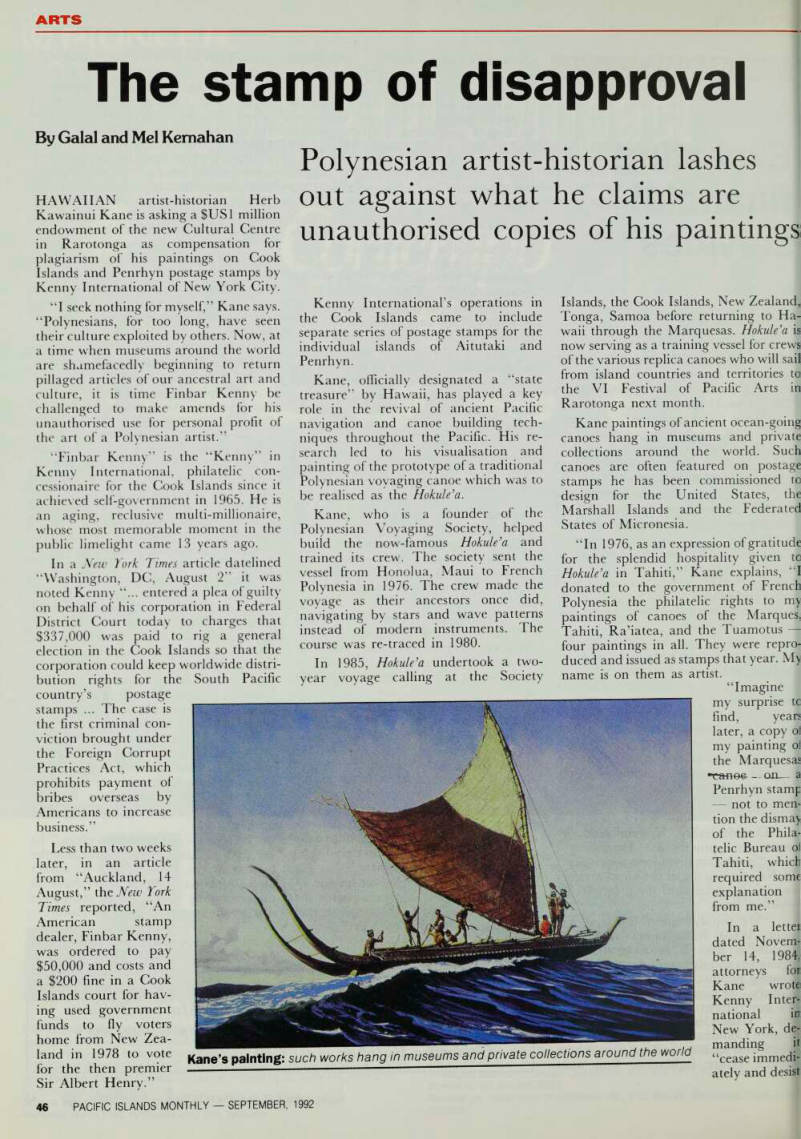
Kane, officially designated a “state treasure” by Hawaii, has played a key role in the revival of ancient Pacific navigation and canoe building tech niques throughout the Pacific. His re search led to his visualisation and painting of the prototype of a traditional Polynesian voyaging canoe which was to be realised as the Hokule’a.
Kane, who is a founder of the
Polynesian Voyaging Society, helped
build the now-famous Hokule’a and trained its crew. The society sent the vessel from Honolua, Maui to French Polynesia in 1976. The crew made the voyage as their ancestors once did, navigating by stars and wave patterns instead of modern instruments. The course was re-traced in 1980.
In 1985, Hokule’a undertook a two year voyage calling at the Society
Islands, the Cook Islands, New Zealand, Tonga, Samoa before returning to Ha waii through the Marquesas, Hokule’a is now serving as a training vessel for crews of the various replica canoes who will sail from island countries and territories to the VI Festival of Pacific Arts in Rarotonga next month.
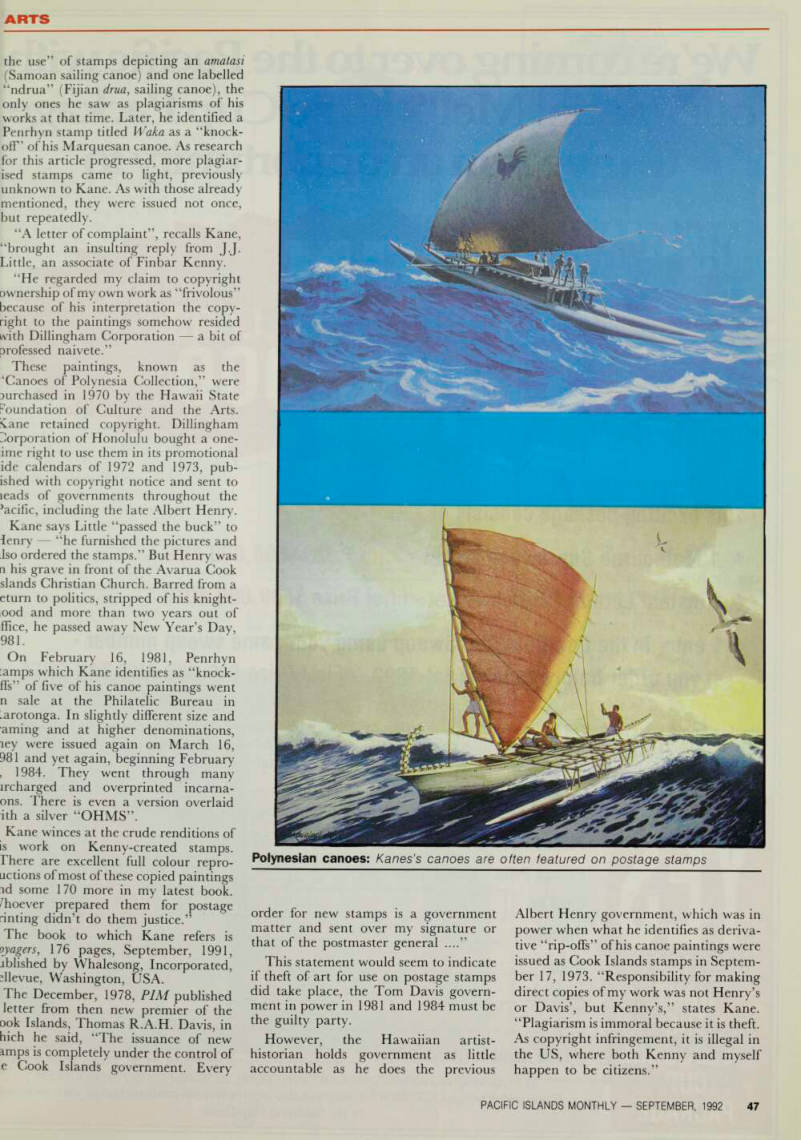
Kane paintings of ancient ocean-going canoes hang in museums and private collections around the world. Such canoes are often featured on postage stamps he has been commissioned to design for the United States, the Marshall Islands and the Federated States of Micronesia.
“In 1976, as an expression of gratitude for the splendid hospitality given to Hokule’a in Tahiti,” Kane explains, “I donated to the government of French Polynesia the philatelic rights to my paintings of canoes of the Marques, Tahiti, Ra’iatea, and the Tuamotus four paintings in all. They were repro duced and issued as stamps that year. My name is on them as artist.
“Imagine my surprise tc find, years later, a copy ol my painting ol the Marquesas Ttmoe - on— a Penrhyn stamp not to men tion the dismay of the Phila telic Bureau ol Tahiti, which required some
explanation
from me.”
In a letter dated Novem ber 14, 1984, attorneys for Kane wrote Kenny Inter national in New York, de manding it “cease immedi ately and desist
Kane’s painting: such works hang in museums and private collections around the world
the use” of stamps depicting an amatasi (Samoan sailing canoe) and one labelled “ndrua” (Fijian drua , sailing canoe), the only ones he saw as plagiarisms of his works at that time. Later, he identified a Penrhyn stamp titled Waka as a “knock off’ of his Marquesan canoe. As research for this article progressed, more plagiar ised stamps came to light, previously unknown to Kane. As with those already mentioned, they were issued not once, but repeatedly.
“A letter of complaint”, recalls Kane, “brought an insulting reply from JJ.
Little, an associate of Finbar Kenny.
“He regarded my claim to copyright ownership of my own work as “frivolous” because of his interpretation the copy right to the paintings somehow resided
with Dillingham Corporation a bit of
professed naivete.”
These paintings, known as the ‘Canoes of Polynesia Collection,” were purchased in 1970 by the Hawaii State Foundation of Culture and the Arts. iCane retained copyright. Dillingham Corporation of Honolulu bought a one ime right to use them in its promotional ide calendars of 1972 and 1973, pub ished with copyright notice and sent to leads of governments throughout the ’acific, including the late Albert Henry.
Kane says Little “passed the buck” to fenry “he furnished the pictures and Iso ordered the stamps.” But Henry was n his grave in front of the Avarua Cook slands Christian Church. Barred from a eturn to politics, stripped of his knight ood and more than two years out of flice, he passed away New Year’s Day, 981.
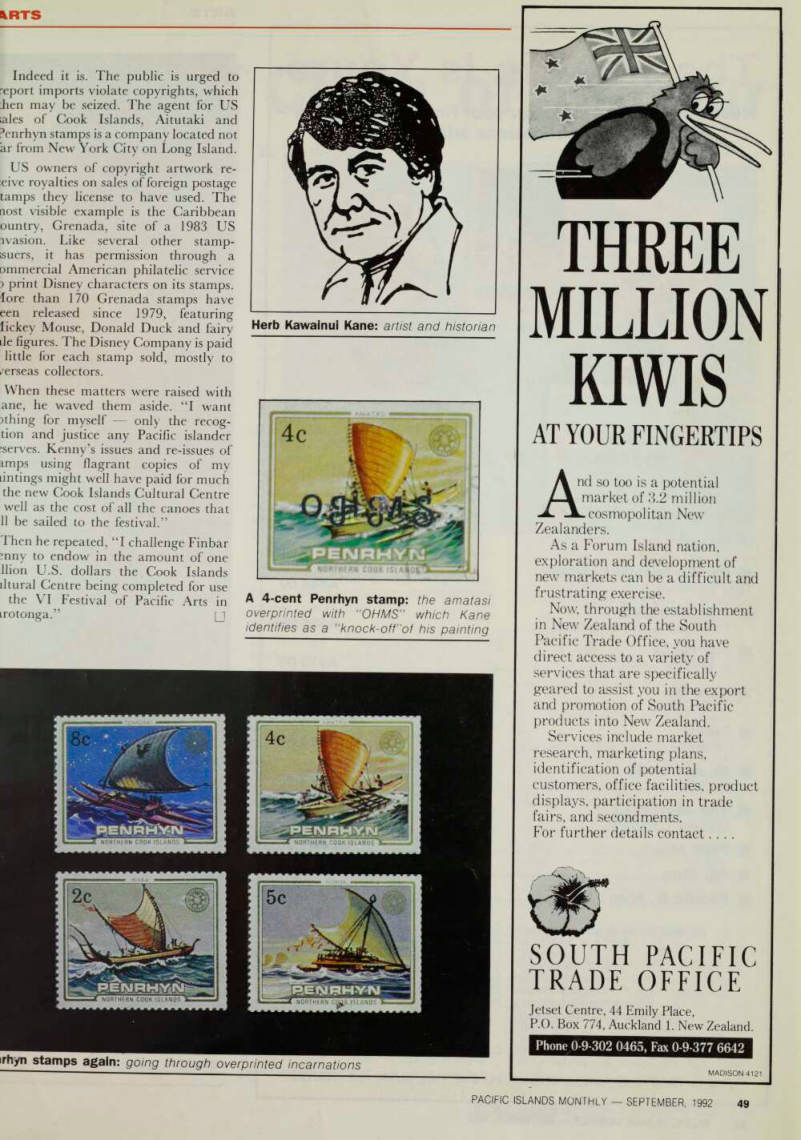
On February 16, 1981, Penrhyn :amps which Kane identifies as “knock ffs” of five of his canoe paintings went n sale at the Philatelic Bureau in .arotonga. In slightly different size and aming and at higher denominations, icy were issued again on March 16,
981 and yet again, beginning February
, 1984. They went through many
ircharged and overprinted incarna ons. There is even a version overlaid ith a silver “OHMS”, Kane winces at the crude renditions of is work on Kenny-created stamps, fhere are excellent full colour repro uctions of most of these copied paintings id some 170 more in my latest book.
Whoever prepared them for postage riming didn’t do them justice.”
The book to which Kane refers is
oyagers , 176 pages, September, 1991,
iblished by Whalesong, Incorporated,
dlevue, Washington, USA.
The December, 1978, PIM published letter from then new premier of the ook Islands, Thomas R.A.H. Davis, in hich he said, “The issuance of new amps is completely under the control of e Cook Islands government. Every
order for new stamps is a government matter and sent over my signature or that of the postmaster general ...”
This statement would seem to indicate if theft of art for use on postage stamps did take place, the Tom Davis govern ment in power in 1981 and 1984 must be the guilty party.
However, the Hawaiian artist historian holds government as little accountable as he does the previous
Albert Henry government, which was in power when what he identifies as deriva tive “rip-offs” of his canoe paintings were issued as Cook Islands stamps in Septem ber 17, 1973. “Responsibility for making direct copies of my work was not Henry’s or Davis’, but Kenny’s,” states Kane.
“Plagiarism is immoral because it is theft.
As copyright infringement, it is illegal in the US, where both Kenny and myself happen to be citizens.”
Polynesian canoes: Kanes's canoes are often featured on postage stamps
Indeed it is. The public is urged to r eport imports violate copyrights, which Ten may be seized. The agent for US lales of Cook Islands, Aitutaki and 3 enrhyn stamps is a company located not ar from New York City on Long Island.
US owners of copyright artwork re vive royalties on sales of foreign postage tamps they license to have used. The aost visible example is the Caribbean ountry, Grenada, site of a 1983 US ivasion. Like several other stamp isuers, it has permission through a ommercial American philatelic service print Disney characters on its stamps, lore than 170 Grenada stamps have een released since 1979, featuring lickey Mouse, Donald Duck and fairy lie figures. The Disney Company is paid little for each stamp sold, mostly to /erseas collectors.
When these matters were raised with ane, he waved them aside. “I want )thing for myself only the recog tion and justice any Pacific islander serves. Kenny’s issues and re-issues of imps using flagrant copies of my tin tings might well have paid for much the new Cook Islands Cultural Centre well as the cost of all the canoes that 11 be sailed to the festival.”
Then he repeated, “I challenge Finbar mny to endow in the amount of one llion U.S. dollars the Cook Islands iltural Centre being completed for use the VI Festival of Pacific Arts in irotonga.” □
[?]rhyn stamps again: going through overprinted incarnations
Herb Kawainui Kane: artist and historian
A 4-cent Penrhyn stamp: the amatasi overprinted with “OHMS” which Kane identifies as a “knock-off’of his painting
Ellen Gienge[?] Douglas Ram Samuj: at the drawing board